




Abstract
Flipped classroom (FCR) is an active learning pedagogical method in which the students prepare prior to class using different modalities, for example, reading materials and videos, and afterward spend the time in class discussing the content and reinforcing the concepts. We chose to replace one problem-based case on “Shock” with flipped-style teaching in the respiration circulation module of a private medical university. Our objective was to use the clinical presentation of “Shock” to open a window to interrelate basic science concepts of cardiovascular physiology and pathology. It aimed to merge the case-based discussion with small-group discussions in the form of FCR activity. The qualitative study gives an overview of comments of facilitators, observers, and leadership of the Department and University obtained during focus group discussions and in-depth interviews. Thematic analysis of responses emphasized the importance of FCR as an effective teaching learning modality, which can be made more effective by careful selection of topic and provision of facilities to support technology-enhanced learning. The discussions with facilitators, observers, and leadership revealed its usefulness through student’s engagement and increased participation to build learning of the key concepts. Student satisfaction in these activities can be enhanced by construction of knowledge acquired in non–face-to-face component with substantial pre-reading materials, videos, peer discussions, quizzes, and prompt feedback.
Introduction
A common practice in medical college teaching is to conduct didactic lectures and classes that have more of a 1-way flow of information and does not promote the environment of discussion and reasoning. 1 The modern generation, “the generation of innovation,” is not easy to engage when it comes to teaching, and we constantly require newer methods of teaching and learning to keep them engaged. 2 In recent years, students prefer methods that are more discussion-based and engaging.
One such tool of innovation, recently introduced to the Teaching System at Aga khan University Medical College, is Flipped Classroom (FCR). Evidence from a systemic review on the use of FCR in higher education shows improved student satisfaction and increased academic performance, as measured by improved examination results, before and after test scores and course grades. 1 The working definition of the FCR describes a technique where foundational knowledge is acquired independently by a learner prior to a classroom encounter, and class time is then devoted to applying new information and knowledge via discussion. 3
In an FCR, concepts based on covering lower-level cognitive work for example, gaining knowledge and comprehension, are covered before the class, and those based on covering high-order cognitive work, for example, application, analysis, synthesis, and evaluation, are focused in the classroom. 4 Learning in the FCR has a number of benefits; it has been suggested that certain FCR designs promote better self-learning and help students develop higher order thinking skills. 5 Researchers support that teaching laboratory sessions via FCR can be beneficial as the pedagogy is meant for practical/skills applications and mastery.6,7 In fact, there is evidence that FCR teaching increases class attendance well. 8 Another benefit is that the educators now have more flexibility to cover depths of material and offer feedback as well as supervision to the students. 5
We were cognizant of the concept of Universal Design for learning and wanted to implement a session where students apply knowledge through activities that involve all individuals, as well as teamwork and immediate feedback. 9 Therefore, we gave lectures to students as prereading material and developed a model which is similar to that of Della Ratta et al 10 The designed FCR for “Pathophysiology of Shock” had a non–face-to-face (F2F) component which had dedicated preclass reading and study material to students, followed by a pretest. 2 The mean pretest score of the students was 4.86 ± 0.91. The F2F was conducted in 3 small-group sessions, with a facilitator assigned for each group in which the discussion was generated in groups followed by a posttest (Figure 1). The student scores in the posttest improved to 6.09 ± 0.81 (P = .021) after attending the flipped class session. Students approved that the framework helped to promote their learning, motivation, and engagement with improvement in understanding of the course materials and enhancement of learning during face-to-face activity. In all, 97% of students found the preparation material useful and appropriate, whereas 87% enjoyed the small group class more than the usual large class formats. Moreover, many students commented that the class was fun and interactive and that it was more helpful to work in teams to answer questions. The detailed findings can be found in a previous publication. 2 In addition to acquiring the test scores, we performed qualitative research to elaborate on the quantitative analysis, triangulate the results, and explore supportive factors and experiences of people to critically analyze the effectiveness of the FCR in terms of its continuation as an effective teaching and learning pedagogy. 11 The information was obtained from all stakeholders—facilitators (conducted the sessions), observers (faculty members who went to the sessions to observe the event), students (who attended the sessions), and leaders (Dean and Chair) who not only observed the session but were involved in decision-making of its continuation in the curriculum. The data were generated from focus group discussions (FGDs) with the “observing faculty members” and “facilitators for the session” along with in-depth interviews (IDI) directed toward the departmental/university leadership. The secondary data were retrieved from the open-ended response of students.
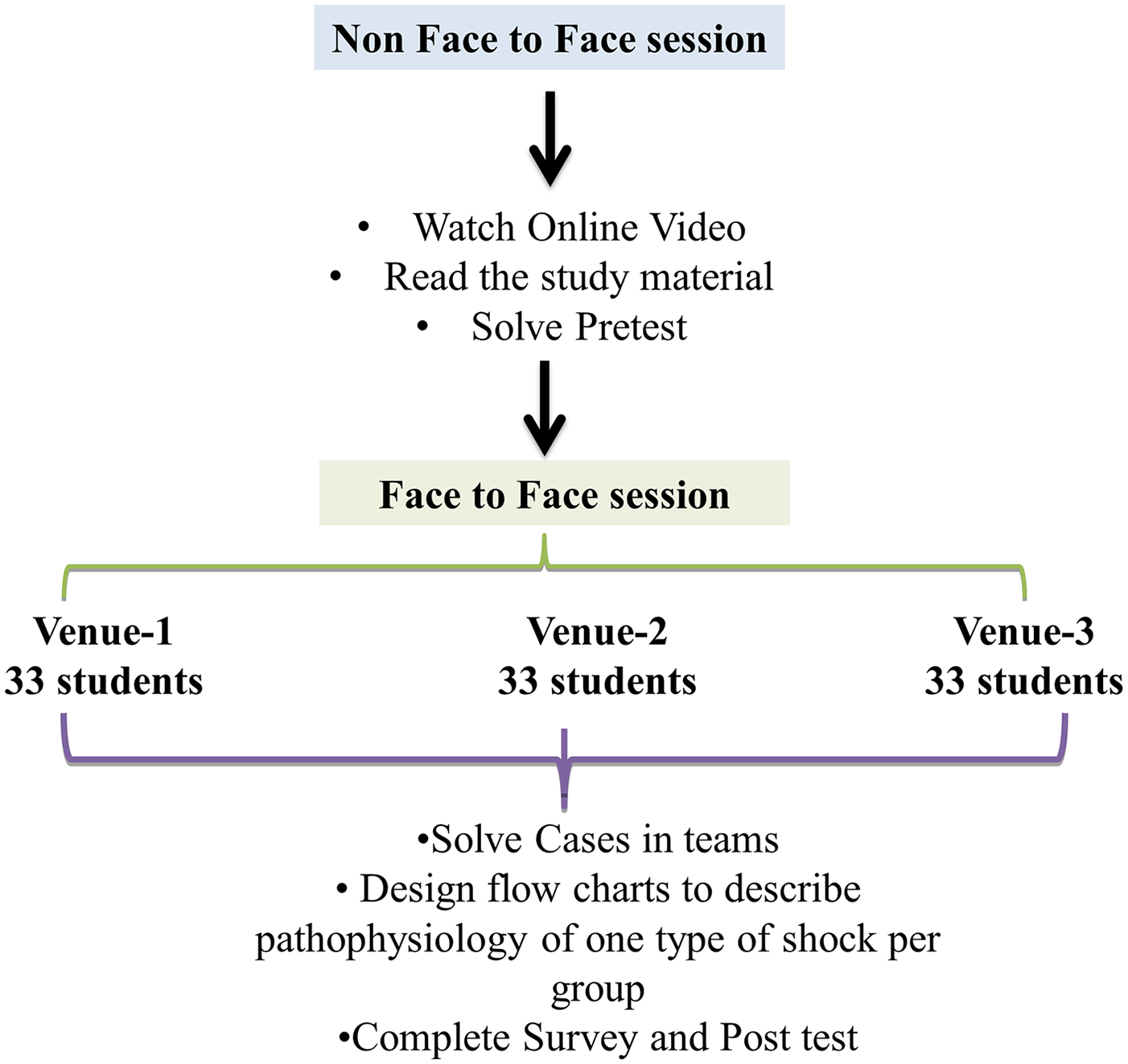
Schematic representation of the FCR process.
For the FGD and IDI, an interview guide was developed from an iterative literature process which was consistent with relevant literature on the execution of these tools for data generation in qualitative analysis (Supplementary Material Appendix I-C).12,13 Pilot testing provided an opportunity to assess how well the participants understood the questions in the guide. Two FGDs were conducted, one with the facilitators and the other with the observers by an independent convener. The independent convener was not associated with the study nor was of an authoritative position. Consent was taken from all those who participated in the FGDs. All 3 faculty members who conducted the session were marked as (1, 2, 3), and the 3 observers who witnessed the session were marked as (A, B, C). Each focus group was conducted by an independent convener in the conference area that was free from noise and disturbance, and each lasted for approximately 45 to 60 minutes. All FGDs and IDIs were audiotaped. Two research assistants performed simple verbatim transcription of FGD/IDI recordings. For this qualitative arm of the study, a total of 19 faculty members (8 men and 11 women) participated. Transcripts were imported into the package MAXQDA, where thematic analysis was performed by the authors after familiarization with data, generation of initial codes, identification of themes, and reviewing and revising them, followed by final write-up.14,15 Once the analyses were complete and a final model was developed, these findings were shown to all or some of the participants (the members) who were invited to check the findings and give feedback. 16
Narrative Reflection of What Was Achieved
During the planning phase of this FCR session, special emphasis was given to the understanding of this modality of teaching. The faculty who conducted the session and the faculty who observed the session reflected on their experience and indicated that FCR was not a completely new teaching concept as they were used to the interactive teaching styles. After the FGDs and IDIs, the following 5 themes emerged and are narrated below.
FCR versus other teaching modalities
There were mixed views regarding the comparison of FCR with other teaching modalities. Majority of the facilitators, observers, the Department Chair, and the Dean of Medical College agreed that it is one of the finest teaching methods among all the interactive teaching methods. The Dean further added that the real “bonus” of this teaching modality is achieved when everyone participates. Observer C was, however, cautious in his remarks; he thought that there was value in didactic teaching in cases where basic concepts need to be clear to the students before they can contribute to discussions. It was acknowledged by all participating in the FGD that the Flipped model enables cooperation among students. Flipped classroom is a perfect stage to build a team-based learning environment. Students also maintained that there should be more FCR sessions on other topics and that it enabled them to work in teams as well.
Shortcomings of FCR and required improvements
Flipped classroom, although an effective method of teaching, was found to be quite demanding in terms of time and effort. This was found to be a factor holding back faculty to experiment with this pedagogy. In addition, logistics such as good Internet connectivity and the availability of space are also some other challenges to cater for while designing the session. Another point of view was that some students do not come prepared with the content needed for discussion during the F2F sessions. This “lack of interest” shown by some students was surely one reason that needs to be addressed seriously. However, when students were asked about this concern, they responded that people who did not come prepared still managed to understand because there was ample opportunity for peer guidance and a chance to go back and watch the content again. As for the improvements, it was suggested that more software and online modalities should be explored to improve the FCR methods further and specialized staff should be made available to faculty for the use of such software and online modalities.
Selection of topics and details
To flip or not to flip, that is the question! Selection of a topic for FCR is the single most important decision, the teachers are confronted with, whenever use of this pedagogy is considered. It was suggested that thorough analysis of the concept and planning should take place to identify the learning outcomes and methods to reinforce learning. Those topics that can be discussed using clinical case scenarios and those that serve as a bridge to clinical understanding were considered to be flipped easily compared with the topics that explore hard core basic concepts.
Technology-based learning via FCR
Flipped classroom environment is a perfect platform to introduce technology in everyday teaching practices. The facilitators’ view was in favor of FCR based on the notion that students have a vast array of available information through the Internet; therefore, incorporating technology to assist in their learning was a great option. Students also commented that bringing software such as Kahoot and Padlet to be used through smartphones was a “welcome approach to prompt feedback” during a lecture.
What Lessons Were Learnt?
The facilitators, observers, and leadership agreed to the usefulness of FCR conducted for teaching key concepts of Pathophysiology of Shock. The study findings emphasized that learning can be facilitated in peer lead discussions by developing confidence and self-motivation for synthesis and application of knowledge. The results are in accordance with literature where FCR has been reflected as a positive learning experience with students’ engagement and commitment to peers, in a technology-enhanced learning environment. 17 Although reflections from faculty (observers and facilitators) expressed its existence in a number of interactive teaching styles, it was considered to be a time-consuming activity that initially required lot of efforts at the facilitators’ end and availability of technological resources. This limitation of Internet and computer access in FCR has also been highlighted by other educators. 18 The study therefore highlighted the importance of strategic planning, for transforming the sage on stage with careful designing of preclass activities, question development, and selection of appropriate videos. To overcome the shortcoming of faculty preparedness, “training of trainers” was conducted by the corresponding author’s team, 19 which provided a safe space where faculty learned best practices and shared their lesson plan for constructive feedback. This initiative leads to adaptation of FCR by many modules across the curriculum. However, it is suggested that learning outcomes for FCR sessions should be well aligned with the subject content and planned effectively. Student satisfaction in these activities can be enhanced by construction of knowledge acquired in non-F2F component with substantial prereading materials, videos, peer discussions, quizzes, and prompt feedback. Our research is endorsed by leadership, faculty, and students, and we are optimistic that it will be a useful stepping stone to pursue further iterations of the flipped approach with improvement in logistic support.
Supplemental Material
Appendix_1A-C_xyz3031596937a3f – Supplemental material for Teaching “Shock Pathophysiology” by Flipped Classroom: Views and Perspectives
Supplemental material, Appendix_1A-C_xyz3031596937a3f for Teaching “Shock Pathophysiology” by Flipped Classroom: Views and Perspectives by Rehana Rehman, Satwat Hashmi, Rozmeen Akbar and Syeda Sadia Fatima in Journal of Medical Education and Curricular Development
Footnotes
Acknowledgements
The authors thank Dr Farhat Abbas, ex-Dean; Dr Perwaiz Iqbal, ex-BBS chair; Office of the Undergraduate Medical Education; as well as students and faculty members who made this work possible.
Funding:
The author(s) received no financial support for the research, authorship, and/or publication of this article.
Declaration of conflicting interests:
The author(s) declared no potential conflicts of interest with respect to the research, authorship, and/or publication of this article.
Author Contributions
SSF, RR, and SH designed and implemented the study. SSF, RR, and SH conducted the class sessions and wrote the manuscript. RA conducted the FGDs and was involved in manuscript writing. SSF, RR, and SH contributed equally to the project. All authors revised the manuscript before final submission and publication.
Supplemental Material
Supplemental material for this article is available online.
References
Supplementary Material
Please find the following supplemental material available below.
For Open Access articles published under a Creative Commons License, all supplemental material carries the same license as the article it is associated with.
For non-Open Access articles published, all supplemental material carries a non-exclusive license, and permission requests for re-use of supplemental material or any part of supplemental material shall be sent directly to the copyright owner as specified in the copyright notice associated with the article.
