




Abstract
Thailand has set a goal to produce graduates who have critical thinking and innovative skills that are useful for the industrial sector. The purpose was to apply a strategic management process as the framework of this study consisting of (1) situational analysis, (2) strategic formation, (3) strategic implementation, and (4) strategic control and feedback. This study proposes an innovation program consisting of (1) curriculum goals, (2) continuous teaching and learning, and (3) regular follow-ups and evaluation of innovative projects and their impacts on society. It can be concluded that the country’s development of innovators requires the cooperation of all sectors to create a solid, sustainable, and productive system that can produce innovative workers to develop the economy, society, and the nation, and to enhance the national competitiveness in the world.
Overview
Thailand’s higher education
Thailand’s educational development during 2009-2015 has been reported to be successful in many aspects. 1 However, the status quo is no longer considered to be strong enough for Thai higher education institutions to stand out and succeed because of students’ demands, technology changes, and the expectations of stakeholders. 2 To be successful, Thai institutions must seek innovative ways of developing programs that will create innovators by improving the processes of delivering quality outcomes. For this reason, Thailand’s higher education should have in place strategies for creating innovators. The purpose of this study then was to apply a strategic management process 3 as the framework for achieving the goal of creating innovative graduates, consisting of (1) situational analysis, (2) strategic formation, (3) strategic implementation, and (4) strategic control and feedback. However, there are still some problems that need to be urgently solved in the next phases. Particularly, according to the World University Ranking by Quacquarelli Symonds (QS) and Times Higher Education, it was found that Thailand’s higher education competitiveness has had a tendency to decrease and tends to be lower than that of other comparable countries, especially Singapore and Malaysia. Although it was found that Chulalongkorn University is the highest ranked of all universities in Thailand, that university was placed at 245th in the QS World University Rankings in 2018 and 50th in the QS Asia University Rankings in the same year. 4 Therefore, no Thai university has been ranked in the top 200 universities since the world rankings were established. 5 For Thai universities to be competitive internationally, they need to be ranked among the top 200 universities according to the QS world ranking criteria. Thai students need to attempt to get into the top universities, and it is assumed that a student-centered approach is the most effective method of teaching. It is believed that such an approach encourages students’ engagement in teaching-learning activities, focusing on individual interaction to achieve the program’s learning objectives.6,7 Thailand’s educational system has not met educational standards for the input and process dimensions that are used as parameters for evaluating the quality of education. In terms of the input dimensions, Thai high school students prefer to study social sciences rather than other science programs, which is incongruent with the national development direction of achieving Thailand 4.0. Thailand 4.0 is a sector-specific industrial policy that aims to attract new investment toward transforming the economy. This is an economic model whose aim is to relieve the country from several economic challenges that have resulted from past economic development models, models that emphasized agriculture (Thailand 1.0), light industry (Thailand 2.0), and advanced industry (Thailand 3.0). These challenges included “a middle income trap,” “an inequality trap,” and “an imbalanced trap.” 8 Moreover, there are structural problems in the process dimensions concerning instructional management and educational budget allocation. Effective management systems are needed to meet educational standards and labor market needs, and the production of graduates is not in line with the needs of the labor industry. It has been found that the number of bachelor graduates has increased every year but most of them cannot serve the needs of employers in either the public or the private sectors, and the graduates still lack innovative ideas and skills. 9 This is considered one of the reasons behind the decrease in the quality of the overall national development, apart from a lack of working age laborers and skilled workers. 10 Moreover, Thailand’s population structure is changing. It is expected that the country will completely enter an aging society at the end of the 12th National Economic and Social Development Plan (2017-2021), when the proportion of the elderly will increase to 1.8% of the total population. Furthermore, the number of elderly living alone will reach approximately 7.98%. 11
It is known that the world is changing rapidly—from the digital age to the era of information and communications technology. 12 The Internet and online communication can closely connect people, as well as public and private organizations, from various parts of the world. 13 Although, the size of business does matter in competition. Using innovative ideas to create a business model adds value to products and services. Thus, every sector including public and private organizations and Thai people are all affected by these changes. Other factors that have caused the national development to slow down are political instability, the impacts of the global economic recession, incomplete public services, infrastructure, logistics networks, and lower levels of community resilience and self-reliance. 14 It can be seen that the current higher education standards in Thailand have the goal of producing graduates who can create and apply knowledge at work, respond to the needs of employers, and enhance the country’s competitiveness at the international level. 15 It cannot be denied that Thailand’s higher education teaching method is passive. This results in graduates having learned more about theory than practice, and therefore in real situations, they do not have the skills for working in companies or in industrial markets. Thus, Thailand’s higher education should be more active, requiring a greater degree of interaction among learners and instructors, and with innovative technology. This is consistent with the 20-Year National Strategy (2016-2036) of Thailand, which aims to develop graduates with the ability to be a thinker and to create innovations in response to the needs of the country and industrial markets. To ensure that the Thai education system is moving in such a direction, the government of Thailand has attempted to define educational measures and to develop management systems that link the private and industrial sectors, promote work-integrated learning, place emphasis on innovation, and encourage commercialization. It is crucial that higher education management focuses on developing policies that promote innovations that are beneficial to the economy and society of Thailand. Higher education management places an important role on the development of students and a skilled labor force that is ready to serve the needs of all sectors. 16 Manpower analysis and education management planning are needed to produce skilled manpower for the labor market. The strategies for incubating innovators at the higher education level are determined, beginning with analyzing the current situations in Thailand and trend of changes that affect the national education and taking into account the key factual information and issues related to higher education management. The obtained information is formulated to determine a guideline or model for developing an innovative curriculum and instruction in response to the Thailand 4.0 policy. Curriculum structure and content with instruction focusing on innovation are implemented as tools to promote the production of innovators that suit the needs of Thai society and that are equipped with competitiveness for the future world society. Strategic control and feedback, the evaluation of outputs, outcomes, and impacts are employed as follow-up procedures to determine success.
Curriculum development of higher education from international perspectives
How to help create innovators
The idea of innovative curriculum development arose in the United States in the 1930s and the 1940s by R.W. Tyrer. 17 Regarding the increase in ethical, technological, intellectual, and social change that has brought about the initiation of curriculum development projects successfully in America, Britain, and in some other countries, Babson College has shown that curricula that are innovative should involve students and professionals in education that combines disciplines and that encourages analytic thinking, ethical business practices, and creativity through experiential learning. 18 At the core of Babson’s approach to education is entrepreneurial thought and action, while it continually builds and evolves cross-disciplinary programs for its students. Furthermore, Williamson and Payton have discussed the notion of Futurelab handbooks as a way to create innovators, which should begin primarily with educational leaders involved in curricula and with innovation in teaching. 19 This includes curriculum managers and school teachers who are able to respond to recent changes in national curricula, local authorities, and classroom teachers that are responsible for developing new practices. Examples of innovation can be seen in nursing education curricula, indicating that these curricula need to fit the needs of nursing leadership and practice while at the same time facing the complexities of the healthcare environment today. International nursing organizations, the Institute of Medicine in the United States, and health care practice partners have called for reform in the nursing curricula to ensure that the safety and quality of patient care are met. 20 In addition, the innovative learning management system “Canvas” has been proposed to build a new framework for the advancement of the new curricula. It is grounded in principles of design thinking and provides a collaborative, human-centered, holistic platform for administrators, instructors, and curriculum developers to engage in innovation and to implement experiential courses—particularly those that involve organizational or community partnerships. 21
Research Methodology
A comparative analysis and a literature review of existing Thai and international policies in terms of how and which strategies of those higher education policies help to create innovators, including an overview of previous studies, were used to generate a synthesis of the existing knowledge of the strategies for creating innovators in Thailand’s higher education. Therefore, a strategic management process was applied for the framework of this study, consisting of 4 steps—from analysis to obtaining feedback as mentioned above. According to this framework, this article proposes guidelines for developing an innovation program that can produce graduates suitable for current social and technological conditions.
The research methodology of this literature review was composed of 2 methods. First, literature was collected from academic and research articles published in journals on Google, Google scholar, SAGE, Wiley, and ScienceDirect databases for the last 15 years. These articles discussed the aspects of creating innovators in Thailand’s higher education compared with international aspects. In addition to the information about Thai national policies, data were searched from public websites, such as that of the Thai Ministry of Education. The reviews used key words as follows: “education situation,” “higher education,” “innovator incubation,” “strategies for education policy,” “Thailand 4.0,” and “global and social situation changes.” The results were screened, and the number of involved data was used from 30 articles and related information supporting the analysis of the literature reviews. Second, data were collected from seminars and dialogues with stakeholders, such as Thai higher education experts and advanced security management program groups to explore the question of how to help create innovators in the country. Finally, this study used data from both parts for analysis, synthesis, and suggestions for strategies for creating innovators in Thailand’s higher education.
Analysis of the Current Situation and Future Trends Affecting Thai Education
Education plays an important role in shaping a country’s competitive advantage and standpoint on the world stage under economic and social dynamics, which result from the advancement of technology. 22 The current higher education system’s teaching and learning style in Thailand has not been able to adapt to these changes. The production of higher education graduates, especially at the bachelor level, who will become the major workforce of the country, remain focused on single-discipline teaching and learning. Furthermore, the real barriers to innovation in developing innovative thinkers in Thai universities and organizations are as follows: (1) innovative thinkers in Thai universities who have ideas are reluctant to share them because they are worried that no one will like their ideas, and thus they think that they might lose face; (2) it is the nature of Thai people to a certain extent to resist new ideas—they sometimes feel uncomfortable about change and uncertainty; (3) the beliefs of the Thai people are to a certain degree against innovative initiatives. Often, the status quo remains and nothing happens; and (4) when implementing ideas in organizations, it often takes a lot of effort and time to produce results. All of this has to do with the issue of change and the resistance of the Thai people to it. Therefore, most organizations in Thailand do not want to devote the necessary time or effort to creativity activity. For these reasons, it is necessary to identify the barriers to innovation in Thailand so innovative thinkers and creative organizations can be developed. This makes the graduates lack integrated analytical skills as well as creative and innovative minds. Therefore, to keep pace with the fast-changing world, the higher education teaching method in Thailand should focus on the concept of innovation and ensure that each student and graduate is equipped with creative thinking skills. It is necessary for each graduate to have a knowledge base and creative ideas because the labor market needs a new generation of employees with innovation, language, and team-working skills. A student-centered approach is required to produce qualified graduates with those skills. However, a teacher-oriented method focusing on classroom lectures and memorizing theories rather than practical exercises cannot be used any longer.9,23 It can be said that the teacher-oriented approach is out-of-date and is unsuitable for a rapidly changing technological world. Situational analysis suggests that another important issue in this is how to promote the commercialization of innovation and to wisely prepare for possible risks and failures. Facts and strategies related to the development of higher education innovators that can respond to the Thailand 4.0 policy in a practical and sustainable way can be described as follows.
Main issues concerning information technology and changes in Thai and global societies
Technology has transformed an industrial society into an information and telecommunications society. 24 There have been two main social and cultural changes in the world so far. First, ancient people left their nomadic life and began to settle in agricultural communities. Second, a major change occurred when people changed their focus to the mass production of consumer goods at a low cost, in other words, the industrial era. As a result, agricultural ways of life were replaced by urban civilizations and industrialized economies. The industrial era has continued due to the advancement of technology since the industrial revolution took place. The recently emerging “Industry 4.0” model is associated with a technological society, where production bases are integrated with technologies and information technology-based businesses have begun to spread around the world, resulting in the emergence of the terms “cyber society.”
According to previous studies, the cyber society encompasses the relationship between a society of humans and a network of computers. It can be called a big data society in this context.25,26 It involves individual identity data, knowledge bases, communication between societies, and electronic services and transactions. Local economic systems are transformed into global economic systems, and goods and services are widely and rapidly exchanged across the globe. Information and technology development contributes to business expansion. 17 The economic systems of all countries are now connected and have an effect on each other. Public and private organizations have two-way communication systems and use technological networks to disseminate their organizational information. 27 They also have changed their organizational structure and tend to focus more on a horizontal organizational structure. Business units seem to be smaller and connected with different functional units in the form of networks. This has had an impact on organizational working styles, as employees can work anywhere and at any time. Online networks make it possible to create online interactions and online conference systems and services have been developed and distributed to recipients. Due to more advanced technology, trade and investment activities are likely to be carried out through online communication channels, where buyers and sellers do not need to see each other.
Based on these changes, the National Economic and Social Development Board of Thailand 2017 has established strategies for propelling the country toward Thailand 4.0 and transforming the focus of the national economic structure into an innovative and value-based economy with the three main characteristics mentioned above. These strategies aim at strengthening the country’s development to ensure that all Thai people have lifelong knowledge, skills, and self-development abilities so as to help enhance the sustainability of Thailand’s economic competiveness. Promoting and strengthening the country’s higher education management through building cooperative networks among entrepreneurs and universities are essential for moving toward Industry 4.0.
Thus, encouraging students to learn and understand the big data emerging in societies and communities will be beneficial to themselves, relevant organizations, and the country. Moreover, students should understand all kinds of new learning media and significant platforms that are helpful for their learning and work. In other words, every student should have access to lifelong learning, including the use of Massive Open Online Courses (MOOCs). Thus, it is necessary to educate students in how important comprehensive learning is and how to achieve it, including covering big data monitoring and evaluation. This is because data management will be useful for them in making complicated decisions. Moreover, integrating large amounts of data into the monitoring, evaluation, and learning system should be applied to the workplace in a systematic and timely manner to respond to actual needs. Due to global changes, the education system should be adjusted according to the current social context to keep pace with the dramatic advancement of science and technology. 28 Teaching and learning styles should be improved by allowing students to access learning sources and to seek knowledge in an integrated way through various education management systems that are flexible and unlimitedly accessible. The new generation should have comprehensive knowledge about technology utilization and Artificial Intelligence (AI). 29 As on-demand technology can serve the needs of each individual, the education on-demand system should be adopted to adjust learning styles according to the needs of each student. Nowadays, technology is so advanced that it can be used to select a learning style that is appropriate for the learning level of each student. 30 An educational program that promotes and encourages students of all ages, especially at the higher education level, to have the characteristics of critical thinkers on the basis of scientific and technological knowledge should be unavoidably developed. Graduates should have appropriate characteristics, be able to work smarter in the industrialized society, and be aware of and prepared for changes. Together with economic structural reforms and research and development transformation, investing in human resource development should be urgently carried out in accordance with emerging changes. Otherwise, Thailand will be left behind by its neighbor countries in the next few years.
Related issues in terms of the commercialization of innovation
Physical changes have an impact on technology development. The use of AI for convenience purposes has gradually increased and become part of everyday routines. 31 Technological changes and the use of the Internet have an effect on the management paradigm in the business sector. 32 As a result, a new management approach has emerged, especially in small and medium enterprises (SMEs), which are more flexible and adaptable to changes than large enterprises. This has encouraged large organizations to begin to partner with mid-size organizations to create innovations in a more flexible way.
Cornell University and the Business School for the World (Institut Européen d’Administration des Affaires: INSEAD) have collaborated with the World Intellectual Property Organization in developing innovation indicators for countries around the world (Global Innovation Index [GII]). 33 These innovation indicators can be divided into two groups: (1) innovation input such as educational levels, research studies, investment, and competitiveness; and (2) innovation output such as output from knowledge and technology development and output from creativity. According to the results of the GII 2017, Thailand ranked 51st among 127 countries, while Singapore ranked 7th, Malaysia ranked 37th, and Vietnam ranked 47th, as shown in Table 1. It can be said that Thailand is already surpassed by other ASEAN countries in terms of innovation. 33 Considering the innovation output, it can be seen that the commercialization of innovation not only adds value to products but also increases business competitiveness and contributes to Thailand’s economic competitive advantage in the global market.
GII 2017 and input/output sub-indices: ranks and 90% confidence intervals.
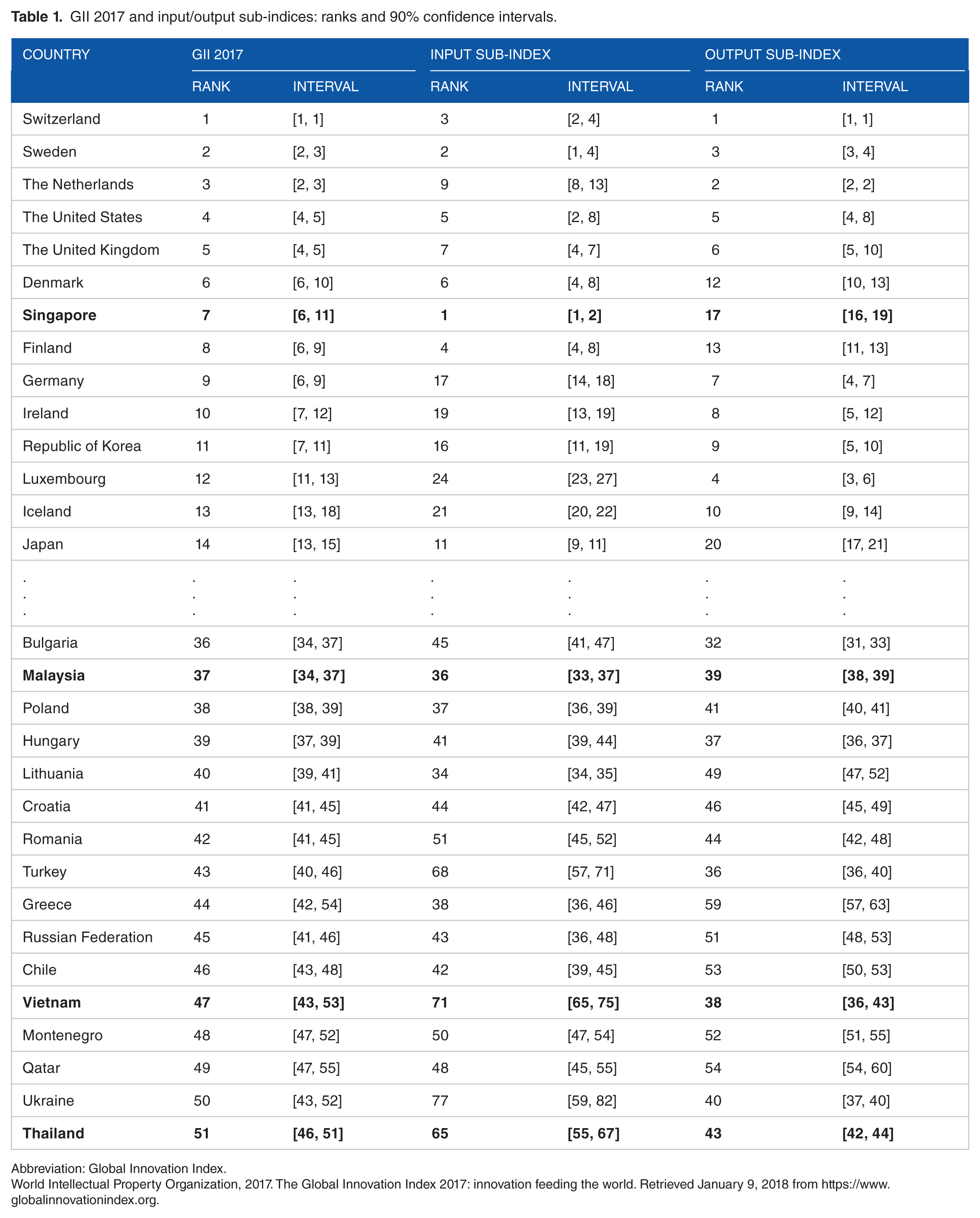
Abbreviation: Global Innovation Index.
World Intellectual Property Organization, 2017. The Global Innovation Index 2017: innovation feeding the world. Retrieved January 9, 2018 from https://www.globalinnovationindex.org.
Related issues in terms of possible risks regarding innovation acceleration
The key factors of risk management are smart risk-taking and preparing for failure. 34 In terms of risk management in innovation development, the following issues should be taken into account:
Risk awareness and perception as well as risk and failure acceptance: smart risk management is associated with having knowledge of various risk perspectives, taking account of the perspectives of outsiders, looking ahead to possible risks and crises, using risk incidents as learning lessons to prepare for risk, and identifying risks in all aspects.
Finding a relationship between risk incidents and risk factors: risk issues should be simultaneously managed and solved to clearly understand the strengths and weaknesses that lead to failure. The process of risk management should be holistically linked with innovation development, learning about continuous business changes, and monitoring global situations on a continuous basis.
Building a commercial and industrial cooperation network to develop creative ideas: an innovative society should be established and promoted, even though it can lead to business risks. If the innovative society is carefully and cautiously established, it will become the center for information, knowledge, and experience sharing, which can contribute to national security in the future.
Strategic Policy Formation
To achieve Thailand 4.0, the start-up phase will involve developing the student’s competency by including innovation courses in every higher education program. This will lead to producing graduates with innovator characteristics suitable for each discipline and professional field of study, known as the spring-up phase. Finally, the step-up phase will involve commercialized innovations to sustain a competitive advantage in the global market. It can be said that incubation is associated with time. The process of incubating innovators is considered the start-up stage, where early adopters need to have a clear understanding of the concept of innovation. The number of innovation adopters will gradually increase over time until remaining at a slow pace in the form of an s-curve. This pattern will contribute to the achievement of goals and will help to generate revenue and national benefits. The innovator incubation program, however, provides the start-up stage with the time and resources to design and build an efficient and sustainable business model. In other words, the program seeks to mold the stages of the start-up, the spring up, and the step up into successful self-sustaining businesses, as shown in Figure 1.

Process of innovation development and commercialization.
Strategic Implementation
Curriculum structure and content focusing on innovation
Higher education management is unique and different from education management at other levels because it is concerned with the development of human resources, which will become a major force in Thailand’s economic and social development. 35 Therefore, to develop a curriculum that is in line with Industry 4.0 model and that provides the national labor force with innovation and technological skills, an innovator incubation program was determined based on three main elements: (1) defining the program objective, (2) designing the curriculum and instruction, and (3) monitoring and follow-up results, including output, outcomes, and impacts. The last element is the process of strategic control and feedback, one of the strategic management processes that will be discussed further.
Defining the program objective, which is producing “innovators”
The whole idea of the program is to help students learn about the challenges of beginning to be innovative-minded and to provide them with entrepreneurial guidance. Students are encouraged to begin at the early stage and proceed until the last stage as well as beyond graduation. The objective of the innovator incubation program was systematically defined earlier. The outputs and outcomes of the program derive from providing knowledge about innovation to students in each academic year until they graduate and are equipped with innovator characteristics. The graduates of this program should use their integrated thinking skills to be innovative and to be able to commercialize their innovations for the benefit of Thai society and to enhance the national economy. An example of an innovator incubation program can be seen in Figure 2.

Curriculum design for innovator incubation program.
Curriculum and instruction design
During the first year, general education courses are offered to develop innovative attitudes and to provide students with innovation knowledge, including the evolution of innovation and challenges of being innovation leaders. Considering the program’s instructional style, it focuses on building motivation and encouraging cognitive learning. The students are evaluated both before and after learning with an innovation knowledge and attitude assessment form to examine their obtained knowledge and attitudes toward this instructional style and to develop further innovation perspectives in the future.
During the second year, the students are motivated to develop their innovation skills and perspectives through various innovation-driven activities, especially in foundation courses, with the use of group discussion, case study, and participatory learning methods to make them understand the principles, concepts, and patterns of innovation that match each discipline and its requirements. For example, an innovation-driven activity aiming to promote innovation competency and innovative thinking skills are carried out as part of a professional foundation course. In terms of evaluation, innovation competency and perspective assessment forms are used.
During the third year, the requirement is an innovation project in each professional foundation course. For example, a professional practice course requires students to design or develop a specific innovation project that matches the content of that course. In terms of evaluation, each group of students creates one innovation project to build on their knowledge, skills, and perspectives obtained from the first- and second year of college.
During the fourth year, which is the final stage before graduating and entering the labor market, the students must apply the knowledge and skills that they have learned to creating innovation work in elective courses such as a course focused on a professional innovation research/project. The students are allowed to carry out an innovation-based mini research or innovation-based project to develop innovation work as well as innovative systems and services. As for evaluation, each group of students develops one innovative work. The outcome of this program is innovative works that can be commercialized and graduates with innovator characteristics that can work in various professional fields.
In addition to the above teaching and learning activities, cross-professional networks among students in various fields of study are created and promoted. 36 There is a forum for the students to exchange knowledge and innovative ideas or to showcase their innovative projects to publish and build on innovations in a truly integrated way.
Strategic Control and Feedback
Follow-ups and evaluation of outputs, outcomes, and impacts
Traditional teaching styles should be reformed by reducing classroom lecture time and encouraging students to develop analytical and creative thinking skills. This is considered a new dimension of educational management that integrates working and learning. Formal learning will no longer be available. 37 Students can study anywhere and at any time without having to go to a university.
The follow-ups and evaluation of outputs consist of 2 parts: (1) formative evaluation, which has been carried out throughout the students’ 4 years of college; and (2) summative evaluation, which assesses learning output within 6 months to 1 year after graduation. According to the views of the employers of graduates, the innovator characteristics of graduates working in various agencies are reflected through preparing proposals, designing innovations, testing innovations, applying for patents/petty patents/copyright registrations, presenting innovative projects at national and international conferences, and commercializing innovations.
The follow-ups and evaluations of outcomes should be carried out by taking into account the competitiveness of Thai graduates in the global market. Each educational institution may have at least 5 innovations that are awarded at the national or international levels, and some institutions may become knowledge management centers for the innovator incubation program.
The follow-ups and evaluation of impacts can be divided into 2 levels: (1) impacts on the society and the community, which means that one educational institution may have at least 5 innovations that can be practically used in the community; and (2) the impacts on national security, which take into account Thailand’s position in global and regional university rankings. At present, Thai universities are ranked among the top 3 universities in ASEAN and top among the top 100 universities in the world, according to the QS World University Rankings and Times Higher Education. As for the GII rankings, Thai universities are also ranked among the top 25 universities. 38
Conclusions and Recommendations
Recommendations for sustainable innovator development
Thai education management is currently experiencing a change in technology. Meanwhile, poverty and migration are the main factors pushing children out of the education system and forcing them to enter the labor market instead of studying in upper secondary schools. An important problem of the Office of the Higher Education Commission and of higher education teachers is that only 51% of all upper secondary school students enter higher education. There are many factors causing this problem, including changes in the population, youth, students and graduates, changes in the labor market, adaptation to the knowledge-based economy, decentralization, technology, the information age, changes in global and ASEAN contexts, violence and conflicts in the Thai society, the 20-Year National Strategy, and the government’s Thailand 4.0 policy. Thus, Thai higher education institutions should be an important mechanism for solving the problems and crises of the country and use their knowledge to determine appropriate solutions and guidelines for national development. To achieve the Thailand 4.0 goal, the University 4.0 model should be actively carried out and supported by research, knowledge, and innovation development, as well as cooperation from the private sector. 39
Higher education institutions will play a role in enhancing national competitiveness, solving problems, responding to the needs of the business, industrial, and community sectors, creating academic excellence, and developing full-time personnel in the field of research and development of the industrial sector, especially for industrial businesses that mostly require full-time employees. 40 As Thai society has not recognized the importance of innovation development and still lacks an effective intellectual property protection system, there are a lot of counterfeit products sold in Thailand. Therefore, making all sectors active and aware of the importance of innovation is an essential key to the country’s economic and social development and should be developed into a culture of respecting intellectual property rights. Educational institutions should increase their role in cultivating a culture of creating responsible innovations and fighting against counterfeiting among the country’s young generation of innovators.
Recommendations for the commercialization of innovations
The critical success of innovation relies on the process of commercialization. 41 An ecosystem that is conducive to the commercialization of innovations should be built, and higher educational institutions should collaborate to produce graduates with innovator characteristics. The government sector, consisting of experts in each professional field, should determine policy and collaborate with private organizations with good investment and marketing support. Currently, the government sector has paid attention to the development of the patent registration system, which is a part of the commercialization process, which are guidelines and procedures to make the patent registration process faster and more efficient. 42 However, the patent registration process is only the first step of the commercialization of innovations. In the 4.0 era, clear and concrete measures are important to the country’s sustainable competitiveness in the global setting, and thus the following measures have been defined and presented:
The private sector should be encouraged to invest in the higher education system in terms of science, technology, and innovation by focusing on producing innovators for the industrial labor market and acquiring innovations during the production of graduates so that those innovations can be commercialized by the private sector from the early stage of the innovator incubation.
The government must accelerate the development of a standardized marketing system and provide financial and investment support to graduates with innovator characteristics to promote the commercialization of innovation in the form of SMEs. Furthermore, a contract that facilitates cooperation between large organizations and SMEs should be developed to expand the business scale.
An innovation ecosystem should be created through cross-sectional cooperation, the government’s support based on civil state policy, and integrated collaboration between regional and national agencies in the government and industrial sectors to find unique innovations and to create innovative excellence in each area with the establishment of an “Innovation Center,” brand building, and marketing promotion planning. In addition, universities should be a vital force in driving and empowering communities to innovate. At the present time, cooperative partnerships in education adapt quickly to industry needs and are increasingly popular and complimentary with traditional higher education. This is because cooperative involvement is able to bring specific important content to the workforce while traditional universities have the structure to bring about theoretically and empirically informed education.43,44
The commercialization of innovation is not only associated with marketing and profitability but also includes its utilization in communities. Thus, the academic services of scholars in higher education institutions must cover the use of innovations to improve the quality of life of people in communities so as to avoid problems of impractical innovations. Innovations created during the process of higher education graduate production should be used to improve people’s livelihood and reduce social inequalities.
It is necessary to increase the demand for innovations. Due to the small size of the Thai economy, the private sector lacks incentives to invest in innovation research and development. Thailand’s innovation market is also small so it is not cost-effective to invest in innovation development, and therefore, the government should create an atmosphere of free competition, develop intellectual property protection systems and consumer protection mechanisms, systematically classify innovations, and reorganize the listing of Thai innovations and creations by making them more interesting.
Footnotes
Acknowledgements
This study was a part of the Advanced Security Management Program (ASMP), Association of the National Defense College of Thailand, under the Royal Patronage of His Majesty the King.
Funding:
The author(s) received no financial support for the research, authorship, and/or publication of this article.
Declaration of Conflicting Interests:
The author(s) declared no potential conflicts of interest with respect to the research, authorship, and/or publication of this article.
