



Abstract
Issues of inequality in higher education have received considerable attention in recent decades, but the intersection of inequality and educational technology at an institutional level has received little attention. This study aims to provide a perspective on institutional educational technology policy informed by current understandings of inequality. The study takes the form of a content analysis of institutional educational technology policy and strategy documents of universities in the United Kingdom and South Africa. A preliminary review of the educational technology policy literature reveals low levels of engagement with issues of inequality in policy documents at an institutional level. Therborn’s typology of inequality provides the basis of a structured framework for the analysis, with Bourdieu’s concepts of capital being incorporated as markers of the various types of inequality. The study reveals regional differences in the approach to inequality as a policy matter, as well as a varied engagement with the issues of inequality related to educational technology at a policy level.
Introduction
Inequality in higher education has, unfortunately, received a great deal of attention in recent years, as has inequality in general. South Africa ranks as the most unequal country in the world in terms of the Gini Index (World Bank, 2016) and the UK ranks as the sixth most unequal country in the OECD. 1 Many of the issues raised during the tide of higher education’s student protests are the consequences of inequality in various ways. These include the dire discrepancies in success rates across student demographics. For example, white South African completion rates are on average 50% higher than black African ones (Council on Higher Education, 2013). The student call for free education, and the debates about whether education should be free for all, or should be paid for by well-off students, are also directly related to how inequality is experienced in universities, and to the potential policy responses to what can only be described as a crisis.
An interesting dimension to the turbulence in the sector has been the role of technology within and in response to the protests themselves. When faced with disrupted classes and the possibility of shutdowns, many universities have turned to a form of what has generally been termed ‘blended learning’. At short notice, academics have been encouraged to provide their course materials online, to offer their courses in blended learning forms, to exploit the possibilities of technology to circumvent the disturbances in face-to-face classrooms. This move online has inevitably been controversial, and has seen the online become inextricably entangled with the politically charged currents within the institutions.
Students regarded the move to blended learning as contentious, with many criticising it on equity grounds; late 2016 saw a flurry of heated comments and commentaries on social media. In South Africa, blended learning was explicitly associated with academic exclusion for black students and the point was made repeatedly that students on financial aid would not have access to technology and connectivity off campus. The argument was made that blended learning was for the privileged who could teach themselves if they had access to the required resources.
Gatherings were also held to protest the exclusionary nature of blended learning. At the University of Cape Town, for example, a mass meeting was called for students, tutors and academics who wanted to boycott blended learning on this basis. The University’s Student Representative Council criticised the institution’s ‘blended learning’ programme, calling it ‘an academic project for the wealthy’ and arguing that ‘this strategy still leaves students, particularly those from poor and working class backgrounds, worse-off’ (Baker, 2016).
In the light of this coalescing of issues, the question of whether and how inequality has been considered within institutional educational technology policies becomes worthy of attention. As with other issues, students have drawn attention to issues which need urgent attention.
In the literature on the practice and profession of educational technology there has been significant attention paid to inequality through discourses of the digital divide, while more recently, the massive open online course (MOOC) literature includes much on inclusion and access (e.g., recently, Hansen and Reich, 2015; Rohs and Ganz, 2015) and of course there are several critical voices such as Selwyn (2014 ) and Watters (2016) whose work directly and indirectly addresses inequality. However this literature has not specifically considered analyses of institutional educational technology policies. At the same time, while there is also in existence a solid body of literature which analyses educational technology policies themselves (as described below), to date this has not focused specifically on issues of inequality.
This gap is addressed in our study which set out to investigate how universities’ educational technology policies represent issues of inequality. The first question was to ascertain whether equality and inequality (or similar terms like equity and inequity) are mentioned at all in institutional educational technology policies. We then explored which aspects of inequality receive attention in institutional educational technology policies. We were also interested in looking at differences in relation to type of institution, and by region.
The educational technology policy literature
Much of the scope of the existing research on educational technology policy has considered national policy. A 2013 study, for example, compared educational technology policies across three sites, Norway, Flanders and England (Aesaert et al., 2013). It found that such policies tended to express one or more of four rationales: an economic rationale regarding digital competences for jobs; an educational rationale whereby technology is a supportive learning tool; a catalytic rationale with technology as a medium for educational change and improvement; and a social rationale with digital competences as inclusion for full participation in society (Aesaert et al., 2013: 135). This last rationale, the social, is aligned with issues of equality and inclusion and is elaborated by expressing equity as a dimension of policy which foregrounds full participation by all in the knowledge society (Aesaert et al., 2013: 144).
A review of national e-learning policies produced by HEFCE in the UK, looking at how the policies changed when they were revised, saw a shift to a more embedded and student focused approach (Edirisingha, 2014). Of interest to this review is the absence of any reference to equality, inequality, access, inequity (or related ideas).
Another UK study (Hayes, 2015), this one a corpus-based analysis of UK government policy and university strategy texts written between 1997 and 2012 which undertook a discourse analysis of 2.2 million words, found the discourse to be narrow, prioritising an economically linked view, one which ‘structures a pathway of objective goals, such as improved processes, for productivity, redesign and transformation of our education systems’ (Hayes, 2015: 32). The author explains how the analysis shows that educational technology policies reveal an instrumental and technical model which fails to consider diverse and unequal contextual circumstances locally and globally. The study concludes that the focus of policy has been on ‘practical applications of technology…and facilitation of practice’ with ‘little of the critique of modern capital’ (Hayes, 2015: 31).
While later studies building on Hayes (2015) do not directly address issues of equity or inequality, they note the dehumanisation of policy rhetoric and are clearly positioned in opposition to contemporary neo-liberalisation of higher education and academia (Hayes and Jandric, 2014). Such studies touch on cognate issues such as openness, which they term ‘emergent alternative and oppositional’ cultures (Hayes and Jandric, 2014: 196); this observation is relevant to our study.
Similar findings emerged from a study of national policies at the primary and secondary levels in Australia, the USA and the UK, which found that of the four drivers identified in the policies analysed, the primary government priority for educational technology is facilitating economic growth, the others being promoting social development, supporting educational reform and improving educational management (Orlando 2014). None of the drivers identified pertained to concerns about equality or equity.
Another macro level analysis of e-learning policy took the form of a content analysis and interpretation of the development of US e-learning policy; it was derived from a comparative study on the development of federal-level e-learning policy between the USA and the European Union (Roumell and Salajan, 2014). Using a Hegelian dialectic analysis as an interpretive framework the researchers identified four lines evident in policy discourse: global competitiveness, economy, merit versus inclusion and education reform. They tracked a shift from infrastructure to access in terms of social accessibility. It was of interest to this study that they noted that the concept of the digital divide emerged and that the social contexts of educational technologies were found to be important. They concluded that the more recent policy discourses value making the education system more inclusive.
A study looking at the Ministry of Education in Argentina’s evaluations of the well-known one laptop per child programme – ‘Conectar Igualdad’ – had an explicit equality agenda (Conectar Igualdad translates as ‘Connect Equality’) (Dussel et al., 2013). The authors state clearly that ‘[t]his chapter uses Conectar Igualdad as a way of reflecting on what it might mean to approach social inclusion through educational technology policies as a wider political action’ (Dussel et al., 2013: 127). While their focus is on secondary schools, the issues are largely generalisable in terms of inequity of access, dropout rates, etc., to the current state of both schooling and higher education in South Africa and the UK.
Turning to the university sector, a handful of studies are found which look at or include institutional educational technology policies, the largest of which was a study which surveyed 96 UK universities in 2014 (Walker et al., 2014). Only four mentioned the role of institutional policy in their responses, and interestingly, despite its wide ranging remit, there was no mention of issues of equality or inequality.
A smaller scale study (O’Connor, 2014) which examines the introductory framing of e-learning policies at three Australian universities, particularly notes ‘the absence of access-driven concerns’ (O’Connor, 2014: 632). The study showed how e-learning policies are being used as instruments to drive broader changes in curriculum and curriculum design practices at these institutions, and observed that these universities ‘are reluctant to embrace narratives that promote changes to access and traditional enrolment practices’ (O’Connor, 2014: 633).
A rare analysis of the process of developing and implementing an e-learning policy at one university, that of Lancaster University in the UK (Edirisingha, 2014), considered educational technology and pedagogical dimensions, but did not mention inequality, access or equity. This type of analysis is unusual as there is a paucity of literature on this.
This absence is unsurprising as is evidenced in the comments made in a review paper of the field of educational technology. Expressing concern about the general state of educational technology practice and scholarship, Rudd (2014) synthesises many of the issues which have been raised by those concerned with social and critical issues in the field:
Before the educational technology ‘boom’ years, there was a far higher proportional instance of critical theory and research in the field, which highlighted, and perhaps warned of: ‘techno-romanticism’; deskilling and intensification of work; the socially constructed nature of educational technology; the symbolic violence and ideology underpinning its introduction, use and proliferation; as well as inequalities along a number of dimensions in terms of access, use, effective application and utilisation in other fields, structures and systems where ownership of economic, social and cultural capitals are key mediating factors.
While these are general comments, they are relevant to an analysis of educational technology policy, particularly in light of the acknowledgement of the inequalities which exist across multiple dimensions.
Analytical framework
The multiple dimensions of inequality was an important consideration when developing a framework for the policy analysis, as it was necessary to capture the complexity of the issues and firmly root them in educational technology as well. The framework developed was therefore an elaboration and a combination of key concepts from Therborn (2013) and Bourdieu (1977, 1986), as well as from the data itself. Early analysis through an iterative process resulted in the framework summarised in Figure 1 below.
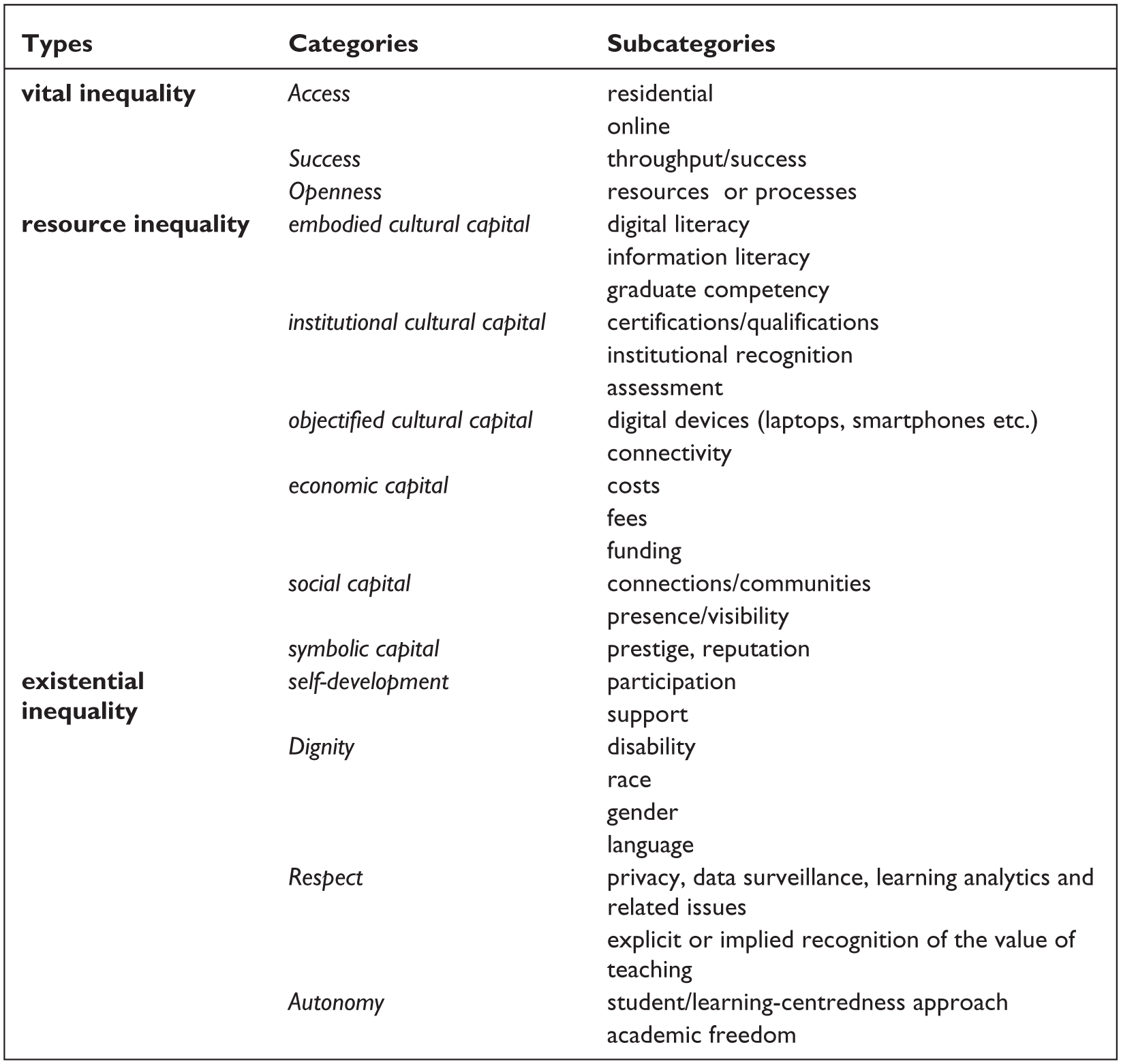
The analytical framework representing types of inequality, categories and subcategories.
Therborn’s typology of inequality provides the overarching framework. Therborn (2013: 1) defines vital inequality as ‘socially constructed unequal life chances of human organisms’. In the educational context we understand this to refer to the fact that access to and success in education is a life or death matter. It has been established, for example, that poor people are less likely to be educated (Seery and Arendar, 2014), and that educated people generally live longer (Meara et al., 2008) – even parents of college graduates live longer (Friedman and Mare, 2014; Ingraham 2014). It is also not irrelevant that more complex indices of poverty alleviation are now including educational deprivation as one of the major indicators (Noble and Wright, 2013). Therefore in our framework, we categorised the dimensions of vital inequality for our purposes as access, success and openness. With regards to access, we looked at whether and how institution promotes opportunities for students to access education, in a residential capacity or online. This could be on an inward looking basis, that is, for students who attend campus on a regular basis – who might benefit from blended learning, or on an outward looking basis, that is, distance learning students who benefit from a robust virtual learning environment (VLE). With regard to success, we were looking for how the institution supports students to ensure that they succeed in their studies, and improve throughput and completion rates, particularly using technology to do so. The last indicator in this dimension was openness, as this can be considered an enabler for both access and success. In this regard we were therefore looking for specific references to openness of resources as well as processes.
The second type of inequality Therborn (2013: 3) provides is resource inequality which means ‘providing human actors with unequal resources to act’. Here the categories are drawn from Bourdieu whose concept of capital can be seen to represent the different types of ‘resources’ a person may need to draw upon to progress in higher education. The first type of capital is embodied cultural capital, or ‘long-lasting dispositions of the mind and body’ (Jenkins, 2002). This type of capital is commonly expressed as skills, competencies, knowledge and representation of self-image. It also includes digital literacy – ability to use digital equipment to a certain level; information literacy – ability to seek and process information effectively to serve needs; graduate competencies – skills and competencies expected of graduates in the workplace. In this study, we were looking for ways in which the institution recognises variance in the levels of these, how it promotes their development, and what emphasis it places on them. The second relevant category is institutional capital – formal recognition of knowledge, usually in the form of educational qualifications or certifications, and assessment. The third category, objectified cultural capital refers to physical objects as ‘cultural goods which are the trace or realisation of theories or critiques of these theories’ (Bourdieu mentions pictures, books, dictionaries, instruments, machines) (Jenkins, 2002). In our case, this is recognised with references to actual technologies, tools and devices, such as laptops, tablets, mobile phones, and connectivity and Wi-Fi. The fourth category, economic capital refers to assets, either in the form of or convertible to cash, identified by references to the costs associated with higher education and how technology influences or is influenced by these. We were looking specifically for mention of costs, fees, or funding. The next capital, social capital refers to connections, social obligations and networks, i.e. who you know (or don’t know) advantages or disadvantages a person (Czerniewicz and Brown, 2012). This is the ability for the virtual to extend beyond local, place-based boundaries. We were looking specifically for references to communities of practice (CoP), networks, relationships within and outside of the university, and opportunities for collaboration. This also included references to increasing the visibility of the university. These are all considered advantageous and afforded by technology. Finally, we considered symbolic capital referring to institutions seeking prestige or reputation through research or teaching excellence. This was identified through explicit references to cultivating quality as a means to garner reputation and prestige, or through competitiveness, quality of applicants and graduates, being ‘world class’ etc.
The third type of inequality Therborn considers is existential inequality which he says is the most neglected type of inequality, and which he defines as ‘unequal allocation of personhood, i.e. of autonomy, dignity, degrees of freedom and of rights to respect and self-development’ (2013: 3). In an educational context, these aspects of ‘personhood’ can be understood as self-development, dignity, respect and autonomy.
In the context of this study self-development refers to how students might reach, or be assisted to reach their full potential. This might be recognised either through participation (are students/staff encouraged to cultivate a participatory learning environment through the use of technology or support?) or through acknowledgement of the importance of literacies (how the institution supports development of literacies in students and staff or offers opportunities for professional advancement). The category of dignity in this study is understood to refer to how students and staff are treated as persons, with regard to disability, race, gender, language, that is, inherent characteristics which may present a barrier to entry or success, but which may be referred to as being remedied through technological measures. The category of respect refers to how students and staff are treated as actors/agents. In terms of students, we were looking for whether and how identity is respected in relation to issues of privacy, data surveillance, learning analytics, etc. In terms of staff, references were sought regarding their contribution to teaching and learning, and whether there is explicit or implied recognition of the value of teaching? The inverse of this would be references to casualised teaching, for example, adjuncts, contract teaching etc. Finally the last category considered as part of existential inequality is that of autonomy which we understand as referring to the roles of students and staff, and the choices and liberties they have which are afforded by technology. In terms of students, we looked for evidence of a student-centred approach to the use of technology, and whether students are encouraged to be self-directed in their learning and use of technology. In terms of staff, we looked for the choices they are given with regard to e-learning and whether there is reference to their academic freedom being acknowledged and protected in this regard.
The framework is represented as in Figure 1.
Methodology
The educational technology policy and strategy documents of eight higher education institutions were analysed largely in the form of a content analysis. Educational technology was understood to be broadly framed by other terms including e-learning, technology-enhanced learning and so on. The research emerged from a symposium held in England with English partners hence it was decided that both English and South African universities would be analysed, allowing both sites to be reviewed and compared.
Eight universities were selected – four universities from England and four from South Africa. There are currently 108 universities and university colleges in England 2 therefore the sample represents about 4% of English institutions. As there are 26 South African universities overall this sample represents 15% of South African institutions. The documents were found through online searches and were thus examples of those which had been made publically available.
Figure 2 shows the institutions and the policy and strategy documents analysed.
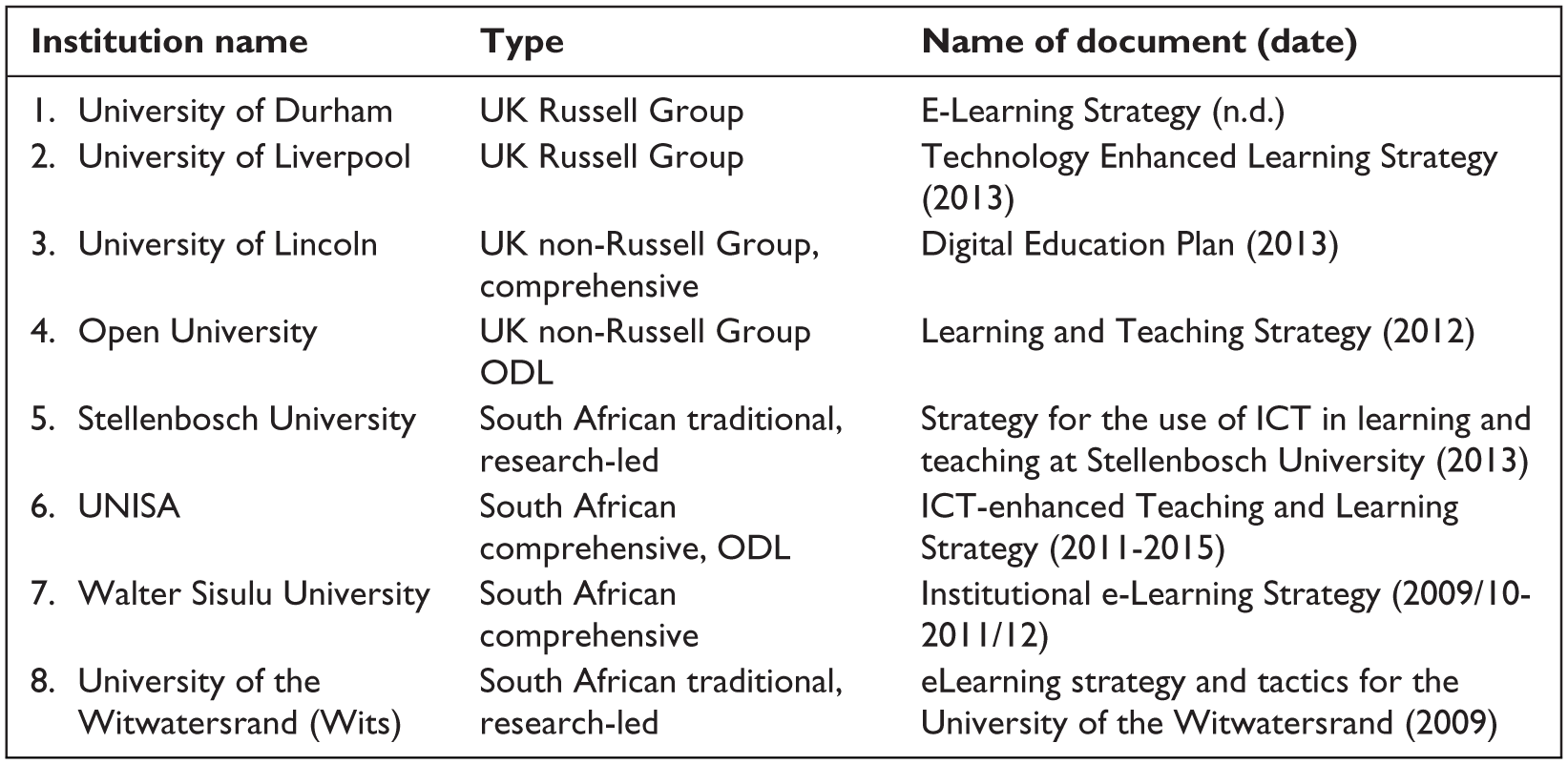
The names and types of institutions analysed, with the titles of their various policy documents.
The sampling rationale is as follows: both of the large distance education universities from each region were included – the Open University in the UK, and UNISA in South Africa; University of Liverpool is similar to both Wits and Stellenbosch (i.e. they are research intensive institutions); while Walter Sisulu University and University of Lincoln both fulfil the role of what is known as a ‘comprehensive’ university, with a relatively greater focus on undergraduate teaching (over 85% of Lincoln’s student body for 2015 consisted of undergraduates). 3 The University of Durham was included to have the same number of universities from each region. The sample size was kept small to make the scope of the study more manageable.
The theoretical framework provided the categories and subcategories which were used as a basis for coding. This was largely content analysis which is a method that involves establishing categories and then counting the number of instances in which they are used in a text or image. It is a partially quantitative method, which determines the frequencies of the occurrence of particular categories (Marks and Yardley, 2011). Of course, these instances occur in context, which can be interpreted in order to make sense of the numbers. Each institution seems to have its own understanding of the nature, purpose and function of an e-learning policy document, so the contexts are variable.
The categories were weighted when analysed (Figure 3). By a straight count of how many times vital inequality is mentioned (88 responses, compared to 181 for resource inequality, and 100 responses for existential inequality) we discover that it comes out much lower. This is due to the greater number of categories in the other two types (only 3 categories, compared to 6 for resource inequality, and 4 for existential inequality). Therefore, a weighted count is a more accurate indicator of the actual relevance of each type, and by this measure, vital inequality comes out significantly more strongly: 22 responses compared to 11 and 10, respectively, for resource and existential inequality – nearly twice as high as either of the other two.
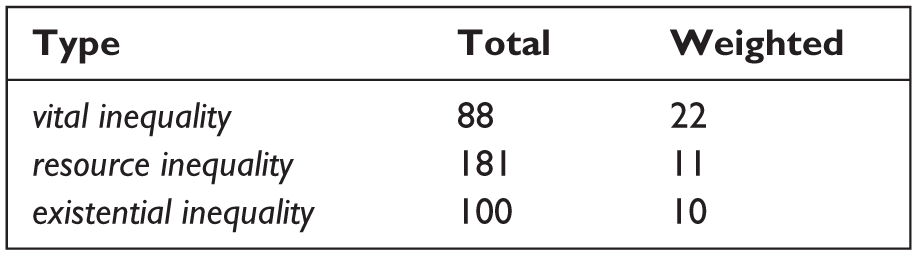
The total and weighted 4 mentions of the three types of inequality.
The same holds for the categories (Figure 4), where certain categories have more subcategories, and therefore respond more strongly on a straight count than on a weighted count. Indicative in this regard, resource inequality in terms of embodied cultural capital (with 67 responses) comes through roughly equal with vital inequality in terms of access on a straight count (67 and 63 responses respectively), but with 3 subcategories rather than the 2 of access, it is second on a weighted count (22 versus 32 responses respectively). Existential inequality in terms of autonomy has only 42 responses on a straight count, but (also with 2 subcategories) comes through roughly equal (21 responses) on a weighted count with embodied cultural capital.
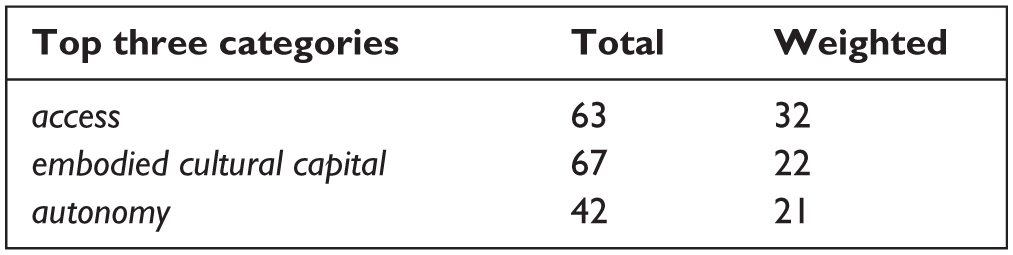
The total and weighted mentions of the top three ranking categories.
Appendices and implementation plans were not considered as part of the analysis which meant that the actual documents were generally longer than the portions analysed. This is because our assumption is that the vision and intentions of the policy would be found in the main documents themselves.
Policies analysis
Regional differences
Policies of South African institutions tend to show higher responses to the issues in general. This is in part due to Stellenbosch University’s policy which is generally more relevant in terms of the issues than other universities, and which therefore provided more examples. On the whole it seems that South African institutions are more concerned (at the policy level) with dimensions and issues of inequality. There is, however, a relatively greater emphasis in UK institutions on matters of existential inequality.
Notable absences
We were interested to know whether the policies used the language of equality explicitly at all in any of the documents. We found that throughout all of the documents analysed, ‘inequality’ is never mentioned, and there is only one mention of ‘equality’, which was also used in the context of ‘transformation’:
Widening participation and
We noted that the term ‘equity’ is mentioned only twice:
A successfully implemented strategy will enable the University to meet its strategic ambitions relating to reputation, excellence, …policies and practices (integrating into teaching and learning policy, assessment policy, incentives as part of performance evaluation and reward system, copyright of material,
On a related note, we wondered whether ‘transformation’, a powerful and current term, particularly in the South African context, would be present in any of the documents as this might be an indication of an interest in equity issues. We found that the word ‘transformation’ is mentioned only once, but not in terms of demographic or curriculum transformation, but rather in relation to technology:
ICT systems and technology have increasingly greater value if they are focused on renewal and
Thus transformation has a marked absence in these documents.
We were also interested to see whether there was any mention of ‘sustainability’ given the current global discourse around austerity and climate change, but this was a surprising absence, the notable exception here being the South African distance education provider.
This strategy aims to increase the focus of UNISA on providing innovative services to its students, to build a reliable and resilient technical infrastructure which is both
Vital inequality
Interesting to observe, first of all, is the overall strong emphasis on vital inequality. Here we were looking for indicators of access, success and openness.
In terms of access we were looking for how the institution promotes opportunities for students to access education, in a residential capacity or online. There is a strong cluster on access overall (63 total responses), with a fairly even split between residential access and online access generally (33 and 30 responses, respectively). This indicates a strong focus on the use of educational technology to improve access both for existing residential students and for distance and non-residential learners. Interesting to note is the regional difference in approach to access - relatively greater emphasis is placed on this by non-Russell Group and by South African institutions. There were only eight mentions of access from Russell Group institutions, compared to 22 and 33 from non-RG and SA institutions respectively – almost three and four times as many.
Some South African institutions explicitly state that educational technology is to be used to enhance face-to-face delivery:
ICT will be used to supplement the face-to-face classes. E-learning will facilitate teaching and learning in the constructivist approach, and will hopefully also promote life-long learning. (Walter Sisulu) In the Wits context, its application domain will be in supporting and enhancing our established face-to-face approaches, and does not currently include reference to distance learning unless demand arises. (Wits)
The lack of mention by the Russell Group universities may be because of their ongoing commitment to residential and face-to-face forms of provision.
We also see that the focus is rather on access into the system, rather than succeeding in the system once in it; access gets a weighted score of 32, compared to only 11 for success. Regarding the latter, we were looking for references in relation to how the institution supports students to ensure that they succeed in their studies, and improve throughput and completion rates.
Generally, there seems to be a much greater concern for success in South African and non-Russell Group institutions, with the Russell Group institutions registering no responses. The Open University has more responses (4) than any other institution (next closest is 3 from both Walter Sisulu and Stellenbosch). This may be indicative of greater concern with throughput rates, which is explicit in some policies:
This strategy will also hopefully improve the students’ pass-rate and effectively the throughput rate, as the low throughput rate has been identified as a challenge for some departments/programmes. (Walter Sisulu) Improve retention and progression of students (Open University)
This is perhaps unsurprising as a policy concern in the light of South Africa’s poor success rates, where only 25% of students graduate in regulation time, and more than half of students who enrol in universities never graduate, even accounting for students who take longer than 5 years, or who return after dropping out (Fisher and Scott, 2011). The lack of attention to issues of using technology to support success in the Russell Group universities may be attributed to their elite nature and their assumptions that their students are likely to succeed.
Given the relationship of openness to access, we were looking for specific references to openness of resources as well as processes. We saw a much stronger focus on openness in non-Russell Group UK institutions (4 on a weighted count, compared to 2 in South African and 0 for Russell Group). Interest generally is indicative of an acknowledgement of the value of open educational resources (OERs) for improving the quality of teaching and learning:
Enhance the Providing a media rich learning and teaching environment
There is an interesting link between openness and reputation, as expressed in this acknowledgment, where it is viewed that high quality resources can contribute to reputation and prestige:
Our engagement with OER, work-based, distance learning and continuing professional development programmes will increase our international profile and reputation, and create new markets for our academic provision, research and consultancy. (Lincoln)
Some institutions appear to be preoccupied with openness in terms of MOOCs, demonstrating a slightly blinkered view on openness, or indicative of the way that the discourse on open education has been subsumed into the discourse on MOOCs. For example, three out of four mentions from Stellenbosch include reference to MOOCs and/or to Coursera or EdX:
Plan a policy/strategy to give students and lecturers affordable access to academic electronic sources, for example on Coursera and other open educational resources platforms. Target disciplines or research expertise that is unique within the University and showcase parts of the courses as OERs and/or as MOOCs. Building on the idea of short courses, SU has the further opportunity to showcase and give targeted open access to some of its expertise. This can be in the form of MOOCs, for example. With the wealth of information available through the Internet, there is a growing need for turning information into knowledge through the ‘World’s best courses, online, for free’ (see Coursera initiated by Stanford University and Princeton via www.coursera.org), which are available ‘for anyone, anywhere, anytime’ (see edX of Harvard University, MIT and University of California, Berkeley via www.edx.org).
In general, though, openness is not a primary objective of the policies reviewed here.
Resource inequality
Resource inequality gets a lot of attention in the policies analysed and is a strong responder, both in terms of total mentions (67 responses) as well as on a weighted count (22 responses).
Almost all institutions acknowledge the need to develop literacies, and there is an even split between digital literacy and information literacy (25 responses each), with graduate competencies coming in lower (at 17). There is an apparent regional difference, however, between South African and the UK, with UK institutions generally more focused on deeper level information literacies and graduate competencies preparing students for employment, while South African institutions are more focused on ensuring all students have the requisite entry-level digital literacies to succeed in their studies:
Our students will have the opportunity to practise and develop key It is not enough for our graduates to be technologically competent. In order to succeed in the current employment context they need to have a For the purpose of this e-learning project, the main focus is capacitating these students on
With regards to certification (or institutional cultural capital), we were looking for formal recognition of knowledge, usually in the form of educational qualifications. This category is a low responder, indicating no acknowledgement of the institution’s role in validating digitally mediated modes of learning. The only institution which explicitly references certification/qualification and recognition is the Open University:
Additionally, in a market where students are choosing between providers, we need to make the structure and language of our offering is understandable in the wider education market. This will signal a move to a qualification-based approach. Provide the facility to manage a lifelong learning record. Effective use of technology will help learners to do this- providing links to formal qualifications as well as the capacity to support reflection and help them in identifying appropriate new learning outcomes. Develop approaches to individualised and personalised support for planning and recording achievements
The acknowledgement of certification makes sense from the perspective of a distance education provider with a particular mandate to prepare students for the world of work; perhaps more surprising is the lack of such a statement from the South African distance provider.
References to objectified cultural capital abound, with numerous mentions of tools and technologies on the forms of laptops, tablets, mobile phones and connectivity and Wi-Fi. The technology itself gets substantial mentions. UK and South African institutions respond fairly evenly on a weighted score (4 and 5, respectively). There seems to be general acknowledgement of the ubiquity of mobile, and the wide range of devices in use, with a strong focus on providing good connectivity both on and off campus:
Students and staff will be able to make effective use of powerful and rapidly evolving mobile devices to enhance learning, communication and impact. (Leeds) …be available on a wide range of mobile devices and platforms as well as desktop computers and laptops (Leeds) Enable learners to use their own devices in institutional contexts and to personalise institutional services to meet their own requirements. (Open University) The University facilitates the availability of connectivity, Internet-enabled devices, software and electronic education resources for all staff and students, on and off campus. (Stellenbosch) Connectivity, both on and off campus, remains an essential prerequisite for the effective use of ICT in L&T. The lack of sufficient 3G/Wi-Fi connectivity in lecture halls was also highlighted during the faculty visits as one of the biggest stumbling blocks in relation to the use of ICT. (Stellenbosch)
In South Africa, a few institutions even acknowledge the shift to ‘bring your own device’ (BYOD), encouraging ownership of and facilitating access to devices and tools for students and staff:
Wherever possible, students will be encouraged to own computers or other personal computing devices. (Wits) Increase, sustain and support affordable, secure and reliable access for students and staff (lecturers, markers, tutors, etc.) to a range of appropriate technologies and software. (UNISA) Financing of technology in the student’s hands … The facilitation of laptop purchases … The facilitation of tablet purchases. (Stellenbosch) In the interviews with the faculties it became clear that students often have access to newer technology than the lecturers. To ensure that lecturers have the appropriate technology, the following actions are planned: special offers to encourage lecturers to obtain the necessary ICT equipment; training courses to become familiar with the equipment. (Stellenbosch)
It is of course, appropriate that policies about educational technology would pay a great deal of attention to technology itself. The risk is in generalisations, such as students having access to newer technologies than academics, or the homogenising of the student population. This would be especially concerning in the current climate where blended learning has been lambasted on the basis of inequity.
The other likely area where reference to inequity might be expected would be in relation to economic capital. How would ‘bring your own devices’, as a trend to be encouraged and be funded? Yet, this category is another low responder – only 17 total mentions, with a weighted count of 6. There is very little consideration of costs and funding, with the exception being the ‘online and distance learning’ (ODL) institutions, UNISA and the Open University. Most of the responses are in the context of how educational technology can help to offset costs.
South African institutions respond somewhat more strongly (3 responses) in terms of economic capital than non-Russell Group institutions (2.5), but both respond much more strongly than Russell Group institutions (only 0.5). Aside from one mention from University of Liverpool, all of the mentions in UK documents were from the Open University:
A successfully implemented strategy will enable the University to meet its strategic ambitions relating to reputation, excellence, equity of student experience and This will increase flexibility and offer opportunities for course production and presentation to be managed more effectively, improving productivity and delivery timescales and be
The Open University is the only UK institution to explicitly mention changing funding arrangements in UK higher education, specifically the reduction of government spending:
We do know that the substantial reduction in Government spending will significantly affect the University’s future markets and offerings. The OU may thrive in this new market by continuing to deliver its core business, a high quality, lower cost, more flexible student learning experience. But to continue to do this will require increased efficiency and responsiveness in the processes of designing, developing and delivering an enhanced learning experience, and we need to ensure that the technologies that enable these activities are robust, reliable and fit for purpose. Divergence in the UK funding arrangements: The overarching strategy should set the framework for learning and teaching for all OU students, with sufficient flexibility to meet the requirements of diverging policy agendas.
The strong response from South African institutions in relation to changing funding arrangements generally may also be seen to be closely related to reductions in government spending - although this is seldom explicitly stated in the documents:
For schools that allocate teaching loads according to a model, eLearning contribution could be built into the model
UNISA offers the only mention of how cost effectiveness may influence students:
Increase, sustain and support affordable, secure and reliable access for students and staff (lecturers, markers, tutors, etc.) to a range of appropriate technologies and software. To deliver and use new technologies in such a way as to minimise the investments students have to make for their study while keeping abreast of current developments in technology.
While economic capital received little attention, matters of social capital received more, particularly regarding networks and collaboration, especially in the UK where non-Russell Group UK institutions responded most strongly: 3.5 on a weighted count, compared to 1.5 from Russell Group, and only 2 from South Africa, almost half as much. Most of the responses come from connections (15 total), and this manifests in a conception of the university as a networked community, both internally as well as externally:
To continue to build capacity in all areas of e-learning the University will maintain networks and communities of practice across the institution to develop, share and embed e-learning practice. The University commits to providing high quality electronic learning resources. (Durham) An environment that connects and provides the opportunity for interaction for all the University’s communities and stakeholders, including staff, students, alumni, employers and the wider public. (Lincoln) Enable staff and students to work independently, and/or collaboratively and support project work, personal and professional development, reflective practice and showcasing of outputs. (Lincoln) Support learners in building knowledge collaboratively and engaging in social learning. (Open University) Reduce isolation of the distance learner – between novice and expert, and between peers through online communities of learning and practice. (Open University)
Of all the capitals, the one which is more dominant in educational policy documents is that which is concerned with symbolic capital. It responds most strongly out of all the capitals, and is second only (by weighted count) to access overall. There a strong regional variance, with South African and non-Russell Group UK institutions coming through quite strongly on a weighted count (4 and 5 mentions respectively) ahead of Russell Group institutions (only 0.5). Generally, there is a focus on remaining competitive, being world class, and how effective implementation of educational technology can enhance the reputation and status of the institution:
The University will maintain parity (as a minimum) with competitor institutions who are moving forward rapidly in this area. (Leeds) There will be opportunities for the University to have a distinctive edge over its competitors through providing a consistent, user focussed and high quality digital experience. (Leeds) eLearning is a sine qua non for a university aspiring to world class status. (Wits) According to the majority of faculty members, a more comprehensive application of ICT in L&T will greatly strengthen SU’s esteem as a technologically advanced institution. (Stellenbosch)
Reputation is seen as a means of attracting and retaining the best applicants and students, and is linked to maintaining or expanding ‘market share’:
There are even concerns around ‘corporate identity’ and ‘brand awareness’:
More importantly for some is that ICT should not change the
And a range of other concerns are co-opted into this, such as openness and access:
We also need to determine the role which the VLE is to play in promoting our global ambitions. Development of OER can provide the world with a window on our University and help create a global brand which will, in turn, help secure our future. (Lincoln) Rivalry and
The dominance of reputational considerations rather than equity concerns is indeed striking.
Existential inequality
Therborn considers this the most neglected type of inequality, and defines it as ‘unequal allocation of personhood, i.e. of autonomy, dignity, degrees of freedom, and of rights to respect and self-development’. Our analysis of self-development found that there was a fairly average response on this category (18 total mentions). There is a notable lack of response from non-Russell Group UK institutions (0.5 on a weighted count), compared to Russell Group and South African institutions (both 6 times higher at 3). There is a distinction between supporting staff in developing online learning, and students in accessing it:
Comprehensive and appropriate ongoing training and support for all staff and students to help them make the most effective use of digital tools and services. (Leeds) Training of lecturers in the effective integration of technology in the classroom in order to improve interactivity. (Stellenbosch) A student and staff development programme that supports students and staff in their exploration of effective ways of teaching and learning with new technologies (UNISA)
The category dignity is the lowest responding category overall, with a total of only 5 mentions (1 on a weighted count). Most of the responses come from an acknowledgment of the need to facilitate access for students with disability. There is a total lack of acknowledgment from non-Russell Group institutions, while Russell Group and South African institutions are fairly even, with 2 responses to 3 total, both 1 on a weighted count:
The University will continue to work towards developing systems to support access for all and ensure, in particular, that any potential conflicts to our commitment to support widening participation are addressed. The University commits to ensure that it is pro-active in addressing students’ differing abilities to access technologies,
Some of this is in the context of meeting legislative mandates, specifically from UK Russell Group institutions:
Rigorous assessment of all digital technologies and services to ensure they meet statutory and University requirements for accessibility. (Leeds)
The only other subcategory to receive any mention was language (1), perhaps indicating a failure to acknowledge how race and gender can present barriers to entry:
Undertake a pilot project with web conference technology such as Lync to offer interpreting services to students. The benefit of this type of technology is that the lecture can be recorded at the same time for later streaming. (Stellenbosch)
The category of respect yielded a fairly average response (35 total mentions, 18 on a weighted count), with a 2 to 3 split between privacy and value (14 and 21 respectively). There is little regional difference, except for the fact that Russell Group institutions come through with half as many mentions as the other two (2.5 on a weighted count, compared to 5 for both non-Russell Group and South African). There does not, however, appear to be any difference in the approaches to the issues. There is some mention of the use of learning analytics, with an acknowledgment of the need to ensure security and privacy of the related data:
It is important to note that ethical issues will be considered when the students’ information is being gathered, shared and stored in the electronic systems. Linking the support systems to the lecturer/student portal will enhance information management. (Walter Sisulu) Contribute to and support the institutional discourse and policy development on the social, ethical, legal, and human use of technologies. (UNISA) As ICT is increasingly integrated within the L&T processes, it will be essential to pay close attention to the challenges related to the electronic security of the technology platform within which all information systems are managed. (Stellenbosch)
A rare exception is to be noted from Stellenbosch, which makes a lengthy quote worth providing:
It is important to understand that technologies are not simply tools that we can employ to achieve particular ends as if they are objective/neutral entities. Technologies form part of mechanic assemblages in societies that serve to either control or democratise societies. At the micro-level of institution or classroom, pedagogical assemblages incorporating network technologies can therefore serve to control students (colonise desire) or serve to stimulate creativity and innovation so that the assemblages function to liberate and transform society. All education/pedagogical assemblages are multiplicities that integrate architectures (traditional or network technologies) and body parts (of students and lecturers) with brain chemistry and everything in between. It is our intention at SU that pedagogical assemblages of which network technologies form part will invigorate vectors/lines that open up new ways of learning, being and becoming.
Interestingly the category of autonomy is the third most mentioned subcategory by total number of mentions (42) after embodied cultural capital and access (67 and 63 respectively), and third by weighted count (21). There is little regional difference, with Russell Group, non-Russell Group, and South African institutions all within one point of each other on a weighted count (4, 5 and 6 respectively). There is
Concluding discussion
It matters that educational technology policies take inequality into account. Technology – as part of the learning and teaching experience – is ubiquitous; the higher education experience is digitally mediated as the norm. But this is not evenly experienced and students are anything but a homogenous group. Therefore policies and strategy documents which will determine the allocation of resources and which articulate core values must of necessity take this varied and unequal set of experiences into account. The ad hoc and sometimes even crude implementation of ‘blended learning’ formats as an expedient, and the mixed responses from students who do not necessarily experience technology as facilitative is indicative of this.
Using a theorised framework in this paper allows for a relatively more fine grained analysis to be undertaken, highlighting absences as well as showing that there are certain aspects pertaining to inequality and to equity which are indeed addressed in these policies.
In contrast to much of the literature, this study found that using technology as a form of access into higher education is a widespread policy intention, albeit in a way limited to entry rather to using technology as an enabler for success. Similarly, access to and availability of technology receives considerable attention across the board, although the myriad ways that technologies are unevenly distributed is not made explicit and clearly needs to be addressed. There remains a tendency to a simplified homogenised notion of ‘students as digital natives’ with easy access to both technologies and the kinds of capitals which they need to exploit them; yet this is a notion which has been thoroughly debunked.
While this study does not set out to answer the question ‘what are the discourses of educational technology documents?’ (a cursory analysis suggests that these would be discourses of efficiency, expedience and aspiration) the framework does illuminate that symbolic capital, or institutional prestige is a very important objective and policy goal. Whether this sits comfortably with equity goals is not immediately obvious.
What is obvious from this analysis is that policy and strategy documents are anything but neutral – they reflect, amplify and shape values and experiences. The silences are therefore just as important as what is present; gender and other forms of identity, increasingly recognised in the educational technology and the policy literature are barely to be seen here. Most striking of all, this analysis shows that in the most obvious ways, equity as an explicit intention is effectively non-existent as is using technology to overcome inequality. In the current neoliberal, increasingly commercialised and financialised higher education sector, this is a most disturbing absence which signals the urgent need for a more explicit socially concerned agenda both generally in the educational technology professional arena as well as particularly in educational technology policies and strategies. This is not trivial as it is essential that such agendas are cognisant of the unequal life experiences of students whose lives and learning are directly impacted by these documents.
Footnotes
Declaration of conflicting interests
The author(s) declared no potential conflicts of interest with respect to the research, authorship, and/or publication of this article.
Funding
The author(s) received no financial support for the research, authorship, and/or publication of this article.
Notes
Author biographies
 ) together with colleagues at Leeds University. Laura is involved with policy work, is a contributor to national and global conversations in varied formats and serves on the advisory boards of a variety of international higher education educational and technology publications.