



Abstract
Introduction:
Simulation activities are valuable teaching aids for understanding about living with visual impairment (VI). Our medical students used low-vision simulation spectacles (Sim-specs) to enable learning about VI.
Methods:
Students made tea and filled dosette boxes using Sim-specs simulating central visual loss (age-related macular degeneration) and navigated using Sim-specs simulating peripheral visual loss (glaucoma). Facilitators recorded errors made for each task. Students completed questionnaires to grade the tasks’ difficulty on a 4-point Likert-type scale. The students also participated in focus groups to discuss how their approach to working with patients may change following this training.
Results:
In total, 252 out of 254 students participated. Central visual loss provided the greatest challenge when undertaking fine motor skilled activity (dosette box). Highest average number of errors made was for dosette box task (0.70 error), followed by navigation (0.59), then making tea task (0.34). Students scored the most difficult task on average as the dosette box task (3.23 Likert-type points), followed by navigation (2.97), then making tea task (2.63). Our students have shown learning in recognising the challenges of VI and have adapted their approach to patients.
Conclusions:
Simulation activities are valuable additions to the undergraduate curriculum. Such activities can potentially enable greater empathy for our visually impaired patients.
Introduction
Simulation activities are valuable teaching tools to help people with normal vision, including health care staff, understand the impact of vision impairment on daily life.1,2 Low-vision simulation spectacles (Sim-specs©) can simulate visual defects from mild to severely reduced central or peripheral vision. Studies have shown that low-vision simulator goggles can reliably simulate the symptoms of common ocular conditions.3,4
There has been an increasing role for simulation training in medical education in recent years. Studies have discussed how learning in a controlled, simulated environment allows students to practice a particular clinical skill and improve clinical outcomes without risk of causing harm to actual patients. 5 In addition, simulation can help students improve empathy, communication, and professionalism.6–9 Physician empathy has been shown to improve clinical outcomes and patient satisfaction.8,10,11
A literature review revealed very few studies examining the role of low-vision simulation in education. One study involved asking pharmacy students to identify and compare medication management difficulties when wearing goggles that simulated a variety of ocular conditions. 4 The authors determined that the pharmacy students were able to identify medication management difficulties when wearing simulation goggles, which in turn enabled them to devise methods to reduce the risk of medication errors. 4
Medical students form a group of health care professionals who will encounter visually impaired patients throughout their careers, regardless of which specialty they choose to pursue. We conducted a qualitative study to describe a set of low-vision simulation activities where medical students experience the challenges of daily activities faced by such patients. The first objective of this study was for students to recognise the challenges encountered by patients with visual impairment. The second objective was to obtain and record students’ thoughts on how their approach to working with patients with visual impairment may change as a result of their experiences.
Methods
Setting and participants
All second year medical students from a London medical school attend a full-day objective structured clinical examination (OSCE)-style clinical skills teaching day. The entire year group is timetabled to attend the clinical skills teaching day which is accommodated over two consecutive days. They had not been given any formal teaching on visual impairment prior to the teaching day.
There were eight OSCE stations. Each OSCE station ran for 20 min with eight students per station. We incorporated a Sim-specs station as one of the OSCE stations. Sim-specs were used to simulate central visual loss (age-related macular degeneration [AMD] Sim-specs) or peripheral visual loss (glaucoma Sim-specs).
A brief introduction was given to the students at the start of the station to explain the pathology and visual loss associated with AMD and glaucoma. Participation in the Sim-specs station was voluntary, and students signed a consent form to confirm they wished to take part in the OSCE station.
The facilitators had the opportunity to carry out each of the simulation tasks and were trained on how to score the facilitator section of the questionnaire at the start of the project.
Simulation tasks
Task 1 – fine motor task: making tea (AMD Sim-specs)
Students were asked to put tea bag into a mug, pour out cold water from kettle (pre-filled by facilitator), remove tea bag into bin, and pour one teaspoon of sugar into the tea.
Task 2 – fine motor task: filling a dosette box with medications for 3 days (AMD Sim-specs)
Students were asked to read instructions, open dosette box lids, fill compartments with ‘pills’ according to instructions, and close dosette box lids.
Task 3 – navigation task: washing hands at sink (glaucoma Sim-specs)
Each student under simulation was accompanied by an instructor to act as a sight guide to ensure safety. Students were asked to navigate to the sink (a distance of 10 m), wash and dry their hands, and to return to their starting point.
One facilitator was responsible for each task. The facilitators read from a script that gave consistent, minimal verbal instructions to the students. To accommodate the group sizes, there were two groups running in parallel within this station, with each group performing all three tasks. Figure 1 shows the students carrying out the tasks.

Students carrying our simulation activities, supervised by facilitators: (A) navigation task, (B) making tea task, and (C) filling a dosette box task.
Evaluation (Simulation Project Questionnaire)
During each task, facilitators completed a questionnaire to record how the students performed the tasks and how many errors were made. Details of the recorded mistakes and difficulties are provided in Figure 2. At the end of each session, each student filled in a short questionnaire to grade the difficulty of the task subjectively on a 4-point Likert-type scale (score 1 = very easy, 2 = easy, 3 = difficult, 4 = very difficult). To the best of our knowledge, there is no validated scoring system to address the difficulty rating. We chose to use the 4-point Likert-type scale as this was the method used in the Zagar and Baggarly 4 study.

Questionnaire used to record data for the study.
Our second objective was to obtain and record students’ thoughts on how their approach to working with patients with visual impairment may change as a result of their experiences. We captured the students’ reactions in the comments sections of the questionnaire, and through a qualitative approach utilising focus groups at the end of the OSCE station. All eight students participating in the station in each round took part in the focus group after completing the tasks. They were asked two questions:
What did you think about the task?
List at least one thing you might do when working with people with visual impairment now that you have undertaken this station
A voice recorder captured each focus group session. The authors analysed the students’ answers by going through all of the comments to identify the most commonly occurring themes.
Results
Overall, 254 students attended the clinical skills teaching days. Of those, 252 students took part in the simulation OSCE station (99.2%). Two students declined to participate (0.8%).
The average number of errors per activity was calculated for each task (total number of errors divided by number of participants). Facilitators scored the highest average number of errors for the dosette box task (0.70), followed by navigation task (0.59), then making tea task (0.34). The most commonly reported errors appear in Table 1.
Errors recorded by facilitators in the execution of tasks by the students.

Average difficulty was calculated for each task (total difficulty rating divided by number of participants). Students scored the most difficult task on average as the dosette box task (3.23), followed by navigation task (2.97), then making tea task (2.63). Focus group questioning revealed common insights, with individual words being characterised into word clouds (Figure 3).
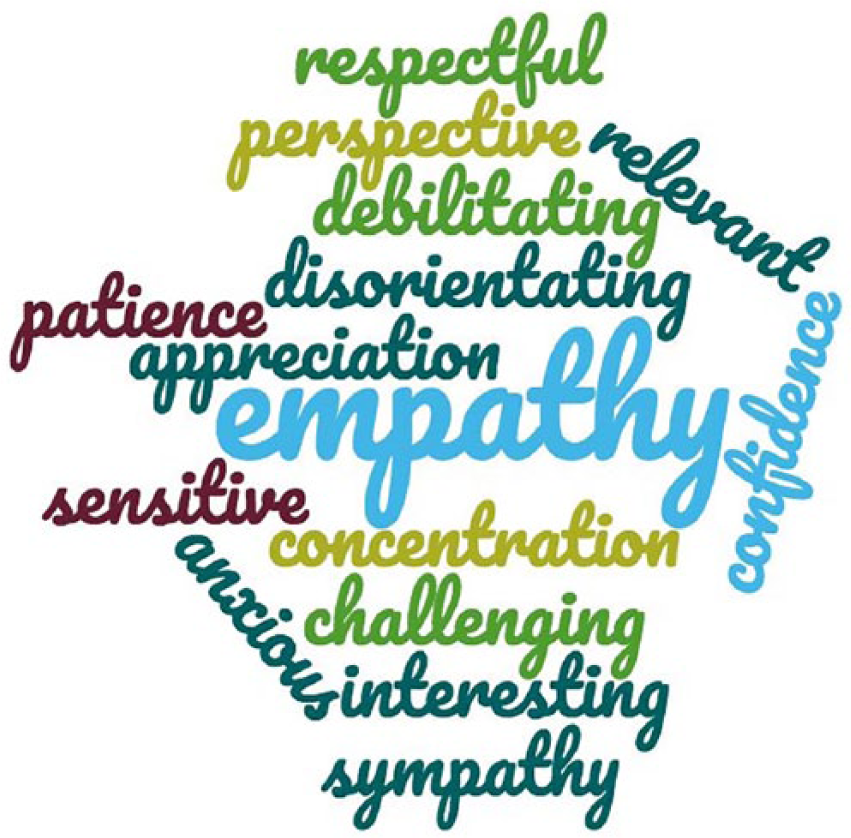
Word cloud of common insights provided by the students.
What did you think about the task? Students’ answers were focused on three domains and we have included a selection of comments:
1. The impact of familiarity with the task on its perceived difficulty:
Dosette box task was the hardest because this isn’t something that I would normally do, whereas I have muscle memory from making tea on a daily basis. Working in an unfamiliar environment with small ingredients makes the tasks more difficult.
2. How the students felt they were perceived by others:
I felt so awkward and uncomfortable when thinking about how I was perceived by other people I was much slower … I must have been so frustrating for the others who were waiting for me.
3. Performing the tasks enhanced their learning:
I take vision for granted Knowing is not the same as experiencing Not very representative as I would adapt by moving my eyes
List at least one thing you might do when working with people with visual impairment now that you have undertaken this station. A selection of comments: Clearer instructions … do one task at a time Guide people in unfamiliar surroundings by being more descriptive about the environment and the directions Offer to read instructions out loud or help them read by moving paper or words into view, or using larger size fonts Allow more time and patience for patients to do tasks Ask patients what they need help with, but not patronize them Facilitate ways to make things easier for patients: use colours/tactile senses, simplify prescriptions, home aids or gadgets.
Discussion
The role of the health care provider is not just to diagnose and treat diseases, but also to promote the well-being of patients.
12
Well-being can be encompassed within the patient’s quality of life, defined by the World Health Organisation Quality of Life Group
13
as an individual’s perception of their position in life in the context of the culture and value systems in which they live and in relation to their goals, expectations, standards, and concerns. It is a broad-ranging concept affected in a complex way by the person’s physical health, psychological state, level of independence, social relationships, and their relationship to salient features of their environment.
A systematic review paper showed that symptoms of depression were more prevalent in AMD patients compared with patients without AMD. 14 Other papers have shown that patients with glaucoma had a poorer quality of life, which correlated with the degree of visual field loss.15–18 Even glaucoma patients with relatively minor field loss reported subjective visual impairment and moderate to severe mobility restriction.19–21 Therefore, empathising with patients allows health care providers to understand how patients with sight impairment feel and function within their environment, which in turn could help guide the overall management of the patient and promote patient involvement in clinical decision-making. 12
To our knowledge, this is the first study to assess medical students’ experience and understanding of visual impairment using simulation activities. Our study suggests that it is feasible to include such activities within the undergraduate curriculum. Students should learn to recognise the challenges of living with visual impairment and its impact on normal daily activities. According to our data, the students demonstrated that it is easier to carry out tasks that they are familiar with or which are set in known environments. In addition, the students were able to learn from the experience to suggest ways of adapting their approach to patients with visual impairment. Interestingly, the students’ perceptions of the most difficult tasks and the facilitators’ objective assessments were consistent, as evidenced by the dosette box task scoring the highest average difficulty rating and the highest average errors.
This study is consistent with the findings published by Zagar and Baggarly. 22 In the latter study, the students demonstrated the difficulties of managing medicines when visually impaired. As in our group, the pharmacy student feedback showed an increased understanding of the challenges faced by patients with visual impairment that would not have been found with traditional teacher-led learning. Interestingly, as in our study, the pharmacy students were able to appreciate that low vision had different implications for the individuals, and that some tasks would be more difficult than others based on the condition and the task at hand.
It can be challenging to teach and quantify ‘patient experiences’ and empathy. 23 Studies have shown that empathy increases when the individual is exposed to an actual experience. For example, Danziger et al 24 showed that prior pain experience increases empathy towards others in pain. Students also report increased understanding and awareness for patients and their clinical conditions through simulated experience. Dearing and Steadman 25 used audio devices to simulate auditory hallucinations in schizophrenia. Eymard et al. 26 simulated physical impairment using body suits and chronic obstructive pulmonary disease masks. These were largely qualitative studies that did not use validated scales for scoring empathy. The psychometric scales designed to measure empathy among health care providers are not specific for measuring empathy towards target patient groups, resulting in a lack of objectively measured outcome data for empathy. 27
Medical students need to be able to understand the limitations to independent living, the everyday tasks that require good vision, and the challenges facing patients with impaired vision. This understanding would, in turn, allow them to empathise with patients who have low vision and to use their own experience of the low-vision simulation to take initiative and minimise risk or environmental hazards faced by low-vision patients.
The strengths of the simulated activities used in our study are that the tasks involved are simple, easily replicable, and require only some basic equipment. We modified the tasks to reduce potential harm to students, for example, using cold instead of hot water to make tea, and reducing obstacles for the navigation task. The study itself had a large sample size of consecutively enrolled students, which could represent high external validity. We also used standardised methods for data collection, assessment, and self-assessment.
There are also some limitations to our study. First, most patients with visual impairment lose sight gradually with a period of adaptation, which cannot be simulated with existing tools.
Second, it would have been useful to compare our students’ responses against a control group of students who did not carry out the simulated activities. This would have provided a baseline of error rates for students carrying out the tasks without simulated visual impairment. However, all of the students had to be given the opportunity to carry out the simulated activities because it was run as part of the OSCE-style clinical skills teaching day.
Third, we did not measure the time taken to complete tasks, nor the interrater reliability of the facilitators. The authors considered recording the time taken for the participants to carry out the simulated activities while designing the study. However, the authors felt that speed may not be as useful as accuracy as an indicator in relation to the difficulty of carrying out the activities for visually impaired patients.
Future directions of this project could include updating the current design to assess the students’ prior understanding of living with visual impairment as well as the simulated activities’ impact on students’ empathy, which were not measured on this occasion due to time constraints of the OSCE setting. Students could be asked to fill out a questionnaire assessing their prior understanding before the start of the station (including, for example, whether they had prior experience of visual impairment themselves or in their family or friends) and their empathy levels after carrying out the tasks using a validated empathy scale such as Jefferson or Kiersma-Chen scales. Although it is not known whether such simulation activities need to be repeated in order for the acquired information to be retained long term following the study, the long-term effect on students’ empathy could also be assessed during later clinical years.
Conclusions
Simulation teaching is a useful tool in medical education. The latter cannot be limited to the provision of medical knowledge. Other skills such as empathy are important. Simple simulation activities can be used by medical students to better appreciate the challenges of living with visual impairment, and we would like to roll out simulation teaching as a regular session. In addition, in a health care environment, this form of teaching should be disseminated to a wider audience range, for example, to administration staff involved in health care, in order to help improve patient experience at the hospital and in the community. The findings may also eventually be used as a basis for planning support services around the difficulty of the tasks.
Footnotes
Acknowledgements
The authors thank Maaret Virtanen for helping to coordinate the project, facilitators for helping to run the project at UCL (Aadil Hussain, Pei Lin, Sam Myers, Stafford Sansome, Deanna Taylor, Hannah Timlin, Zheng Xu), and UCL Medical School for approval to undertake study.
Funding:
The author(s) received no financial support for the research, authorship, and/or publication of this article.
Declaration of Conflicting Interests:
The author(s) declared no potential conflicts of interest with respect to the research, authorship, and/or publication of this article.
Author Contributions
All authors contributed towards the design of the project, the collection and analysis of data, and the writing of the paper.