




Abstract
In 2020, the Association for Education and Rehabilitation of the Blind and Visually Impaired (AER) approved a white paper outlining the roles and responsibilities of vision professionals when serving learners with cerebral visual impairment (CVI) (Mazel et al., 2020). Mazel et al. define vision professionals as teachers of students who are visually impaired and orientation and mobility specialists. This white paper was intended to serve as a first step in defining a scope of practice for vision professionals. Its writing was one of the first initiatives undertaken by the newly formed AER Division on Neurological Visual Impairment. The authors used current literature, alongside current professional wisdom in the field of visual impairment, to outline the scope of practice. The paper was then presented to members of the field of visual impairment for feedback and revision before being presented to the division for approval. Finally, the national board of directors of AER approved the paper in 2020.
Now that a scope of practice has been defined (Mazel et al., 2020), with approval from the members of the professional organization (AER), it seems logical that an effort be made to shift professional practice to align with these standards. In his seminal work, Bandura (1977b, 1997) posited that for individuals to pursue a practice, they must possess self-efficacy. Bandura (1977a) found high congruency between self-efficacy and performance (82%). In fact, self-efficacy, our own ability and desire to accomplish an action, is central to setting and accomplishing goals. Bandura (1997) further explained that for an individual to accomplish a task, they must possess both belief in their ability to perform the task and agreement that a task is worthwhile. For example, according to Bandura's theory, a teacher of students with visual impairments must believe they possess the knowledge and skills to complete a learning media assessment for a child with CVI and agree that a learning media assessment is appropriate for a child with CVI before they are likely to apply the practice. Conversely, if a teacher of students with visual impairments lacks either belief in their knowledge and skills or agreement with the assessment's
by answering questions on this article. For more information, visit:☑Earn CEs Online
In a recent survey conducted by Jackel (2019), parents of children with CVI felt that their child's teacher of students with visual impairments had sufficient knowledge and skills to serve their child (Jackel, 2019). However, other studies have suggested that teachers of students with visual impairments do not share this same level of confidence in their own knowledge and skills (Ely & Ostrosky, 2017; Mazel et al., 2019). Yet, since 2019, several new resources with up-to-date information are available for professionals (see, e.g., Cerebral Visual Impairment Society of Scotland, 2024; Perkins School for the Blind, 2024; Lueck et al., 2023; McComiskey, 2021; Roman-Lantzy, 2019). In addition, the American Printing House for the Blind has several new products designed to help teachers work with children with CVI (American Printing House for the Blind, 2020). Although it will take time for professionals to gain the knowledge and skills they need, as well as feel confident in their new skill set, it seems important to take a current measure of professional self-efficacy around CVI. This information could help leaders understand where to focus workforce development efforts. Additionally, such a measure will serve as a baseline for understanding professional growth or change over time.
The study findings presented in this paper are designed to gather an understanding of professional self-efficacy in the field of visual impairment applied through the lens of the scope of practice as outlined in the white paper (Mazel et al., 2020). Thus, our research team set out to summarize the main points from the paper into key statements about professional practice (see Figure 1). The white paper has three sections including (a) roles and responsibilities, (b) assessment, and (c) collaboration. Summary statements were developed for each of these sections. The authors of the current study then used the summary statements as the foundation to investigate whether professionals agreed with the concepts outlined in the white paper and applied them in their practice. The study reported in this paper focuses on the subset of data pertaining to roles and responsibilities. Specifically, the following research questions guided this study:
How do vision professionals rate their self-efficacy pertaining to the seven key practice statements described in the roles and responsibilities section of the white paper using factors such as knowledge and skills, agreement, and practice? What do vision professionals identify as barriers to implementation of the roles and responsibilities as identified in the white paper?
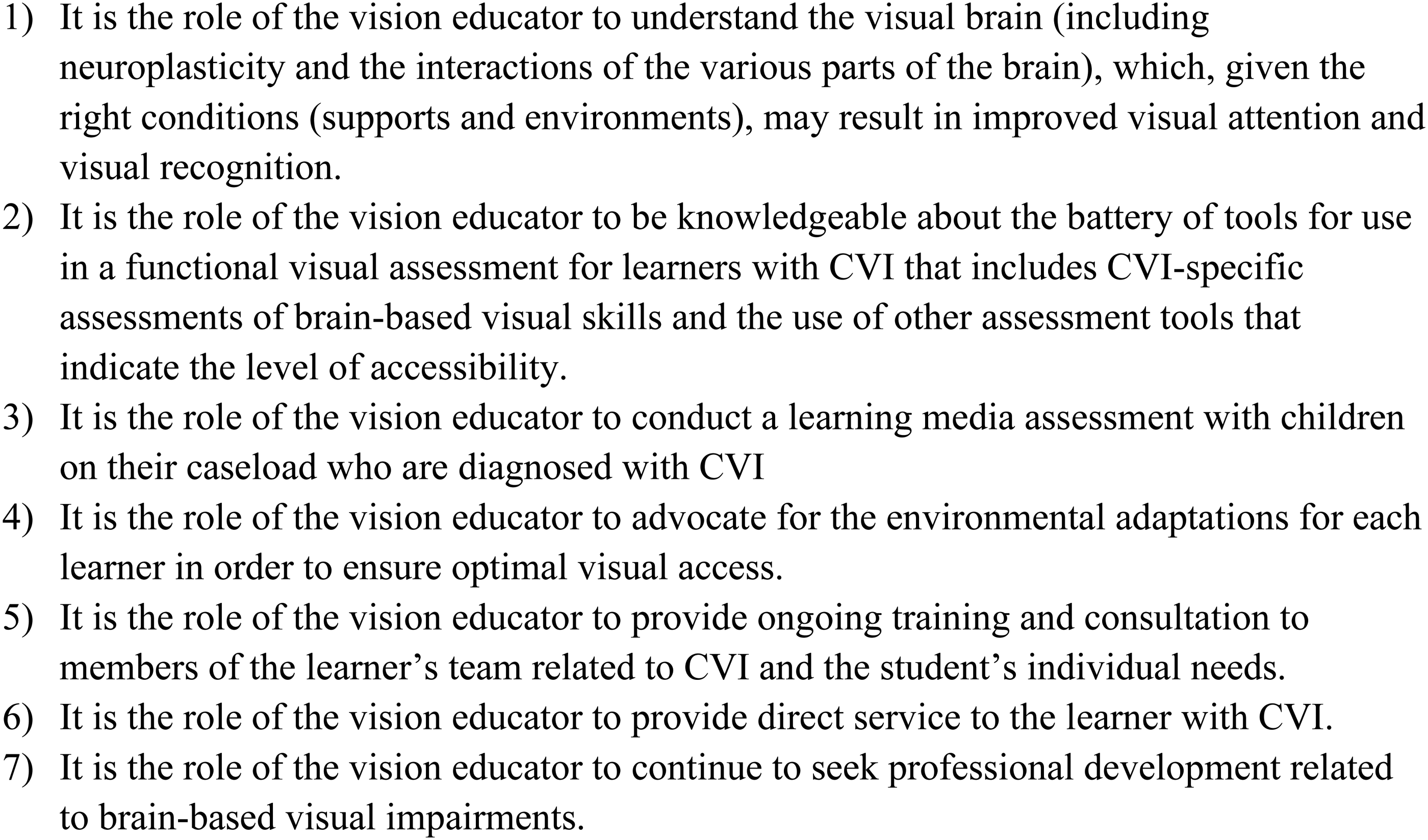
Seven Statements in the Section Called: Roles and Responsibilities of Vision Educators.
Methods
Recruitment
To be included in this study, participants must have met U.S. state requirements to be certified as a teacher of students with visual impairments, orientation and mobility specialist, or both. In addition, at the time the survey was completed, participants had to have at least one child on their caseload with CVI. Participants were recruited through social media postings and email distribution lists messages that contained information about the study and included a survey link. The distribution lists utilized for this study included those of the Perkins School for the Blind and the electronic discussion groups of the Neurological Visual Impairment Division of AER. Emails were also sent to university professors who prepare teachers of students who are visually impaired across the United States. All recruitment materials encouraged recipients to share the survey with others. Potential participants were informed that they would have the opportunity to be entered into a drawing for a gift card after their completion of the survey.
Data Collection
Following approval by the Institutional Review Board of the Department of Special Education, Illinois State University, data were collected using an online survey that was created in Qualtrics, a cloud-based survey and “experience management” tool. The survey was available for participants to complete within a 6-week window. The first screen of the survey included consent information. Those who consented to participate then completed the survey without identifying information. After completion of the survey, participants were offered a separate link that was not connected to survey data that allowed them to provide their email address so they could be entered into a drawing for a $50 gift card.
Measures
Survey Development
Because no existing survey was available to answer the research questions within this study, the first two authors, along with three other professionals, created a survey based on the white paper entitled Roles and Responsibilities of Vision Educators When Learners Have CVI (Mazel et al., 2020). This paper identified the roles and responsibilities of vision educators. The main purpose of the survey was to investigate the alignment of vision educators’ beliefs and practices with the identified roles and responsibilities that were outlined in the white paper.
Survey Components
The first section of the survey was a demographic section that included 11 questions regarding characteristics such as age, ethnicity, level of training or education, number of years of experience as a teacher of students with visual impairments, number of years of experience as an orientation and mobility specialist, current organizational affiliations, and the number and percentage of children with CVI who are currently on the participants’ caseload. Participants were also asked to rate their knowledge of the Mazel et al.’s (2020) white paper.
The second section examined vision educators’ beliefs about their roles and responsibilities within the field of visual impairment and their practical application of the practices that were identified in Mazel et al. (2020). Since seven key practices were identified within the roles and responsibilities portion of Mazel et al. (2020), those developing the survey created seven statements corresponding to these practices. The statements are outlined in Figure 1. The survey also included a third section containing eight statements pertaining to assessment as articulated in Mazel et al. (2020), but those data are not included in this paper.
All seven statements followed a similar format and required participants to rate their agreement with specific statements on the role of the vision educator and to rate their knowledge and skills to perform each role. Participants rated their knowledge and skills and agreement based on a 5-point Likert scale ranging from 1 (low) to 5 (high). Participants were asked if the statement described part of their practice when serving learners with CVI on their caseload and whether the professional felt they possessed acceptable knowledge and skill to fulfill the identified role. Participants were also provided with options and asked to identify up to three challenges in implementing the identified role.
Data Cleaning
Two hundred and thirty-eight participants met inclusionary criteria and were included in the calculations when reporting results. Specifically, 398 participants began the survey and gave consent to participate. Of the 398, 34 participants did not answer any questions, including those related to demographics. Thirty-five participants were excluded after completion of the demographic section because they did not identify as vision professionals. Also, 21 were excluded after the demographic section because they did not have a child with CVI on their current caseload. Fifty participants left the survey after finishing the demographic section and did not complete any part of the roles and responsibilities section.
Two hundred and fifty-eight participants began the roles and responsibilities section. As previously described, the roles and responsibilities section included seven statements, and there were four survey questions pertaining to each statement. Participants were removed from data analysis if they did not answer at least one survey question from at least four of the survey statements. Using this rule for data cleaning, 20 participants did not complete a sufficient amount of the roles and responsibilities section and were removed. Thus, the remaining 238 participants met inclusion criteria and completed the demographic section and at least one question from at least four statements of the roles and responsibilities section of the survey.
Participants
Of the 238 participants, all participants identified themselves as a teacher of students with visual impairments (n = 238), and 23% (n = 55) reported themselves to be dually certified as an orientation and mobility specialists. See Table 1 for detailed demographic information.
Demographics.
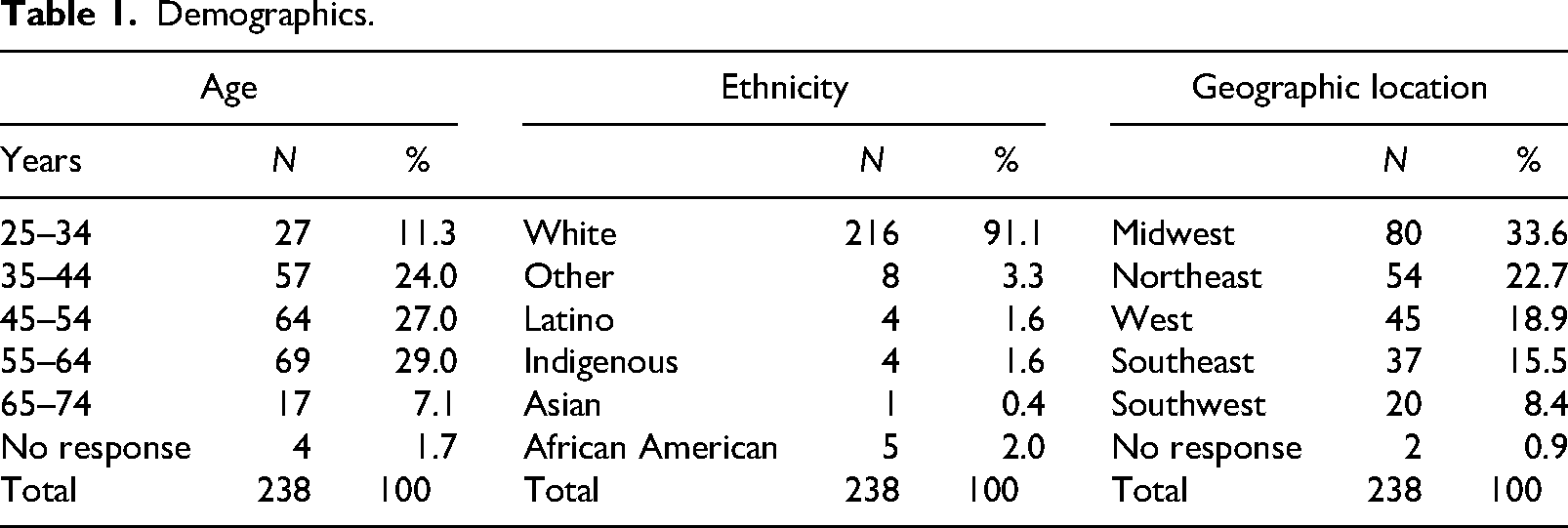
The majority (91.1%) identified as White. The ethnicities of African American, Latino, and Native American were indicated by 5.2% of participants. Less than 1% of respondents (n = 1) indicated an ethnicity of Asian. Participants varied in age and geographic location. A little more than one third of the participants (35.3%) were under 45 years of age, while 27% were aged 45–54 years, 29% were aged 55–64 years, and 7.1% were aged 65–74 years. Responses were gathered from across the United States. Thirty-nine states were represented, with 80 participants from the Midwest, 54 from the Northeast, 45 from the West, 37 from the Southeast, and 20 from the Southwest.
The majority of respondents (71.8%; n = 171) reported that less than half of the students on their caseload had a diagnosis of CVI, while about one quarter of respondents (25.5%; n = 61) indicated that more than half of their students had a diagnosis of CVI. Six respondents (2.5%) said that all the students on their caseload were students with CVI.
Participants were asked to identify their level of familiarity with the white paper (Mazel et al., 2020). Just over half (52.5%; n = 125) indicated that they were unaware of the document; while 17.6% (n = 42) said that they were aware of the paper but had not read it. The remainder of the respondents indicated that they had read the white paper and had either limited understanding and memory of its contents (11.3%; n = 27) or a basic understanding and memory of the contents (18.5%; n = 44).
Findings
The survey was organized into seven statements (see Figure 1) pertaining to the role of the vision professional when one of their students has CVI. For each statement, participants were asked to rank their level of agreement with the statement and their level of knowledge and skills to perform that role as described in the statement. The outcome for these two questions across the seven statements is available in Tables 2 and 3. Together, the responses to these two questions provide insight into self-efficacy.
Rating of Agreement With the Statement.

Rating of Knowledge and Skills Described in the Statement.

Self-Efficacy (Agreement With Knowledge and Skills)
Figure 2 is a bar graph showing the percentage of respondents who responded with a score of either 4 or 5 pertaining to agreement and knowledge and skills across the seven statements. In comparing responses across the seven statements, respondents reported their agreement at a higher level than their knowledge and skills for all statements accept Statement 6, “It is the role of the vision educator to provide direct service to the learner with CVI.” Statement four, pertaining to the vision educator's role to advocate for environmental adaptations, had the highest agreement (97%), along with the highest report of knowledge and skills (88%). While 94%–97% of respondents indicated strong agreement with the roles described in statements two, four, and five, the greatest discrepancy between agreement and knowledge and skills was evident in statements one, two, and three. In fact, while 94% of respondents agreed with statement two (“It is the role of the vision educator to be knowledgeable about the battery of tools for use in a functional visual assessments”), only 64% ranked themselves at a 4 or 5 on this area for knowledge and skills. In fact, this statement gathered the lowest knowledge and skills response when compared to all other statements. Similarly, 88% of respondents said that they agreed with statement one pertaining to the role of the vision educator to understand the visual brain, while only 67% ranked themselves at a 4 or 5 on knowledge and skills in this area. Eighty-nine percent of respondents agreed with the statement that it is the role of the vision educator to conduct a learning media assessment with children on their caseload with CVI and only 69% rated themselves at a 4 or 5 in this area of knowledge and skills.
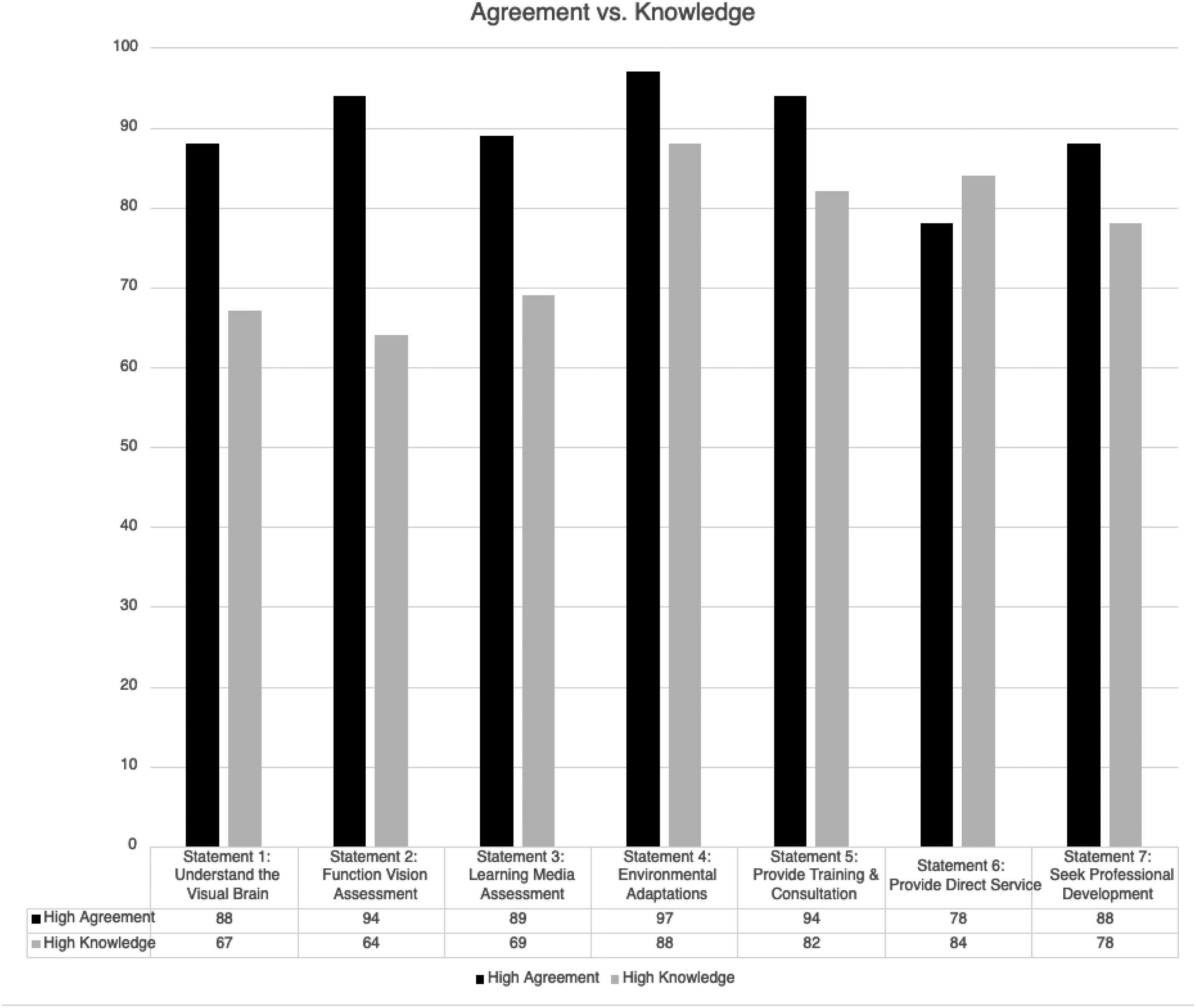
Percent Comparison of High Rank for Agreement Versus High Rank for Knowledge and Skills.
A third aspect of self-efficacy is a report of practice (see Figure 3). Survey respondents were asked whether the statement was part of their practice. Ninety-three percent identified that they advocate for environmental adaptations. Only 83% suggested that they provide direct services to students with CVI. Interestingly, 92% stated that they conduct a functional vision assessment, but only 84% said that conducting a learning media assessment, as part of their practice. In a similar comparison, 90% provide ongoing training and consultation of others on their team, yet only 82% said that they continue to seek professional development related to brain-based visual impairments for themselves. Finally, 86% of respondents agreed that understanding the brain is part of their practice.
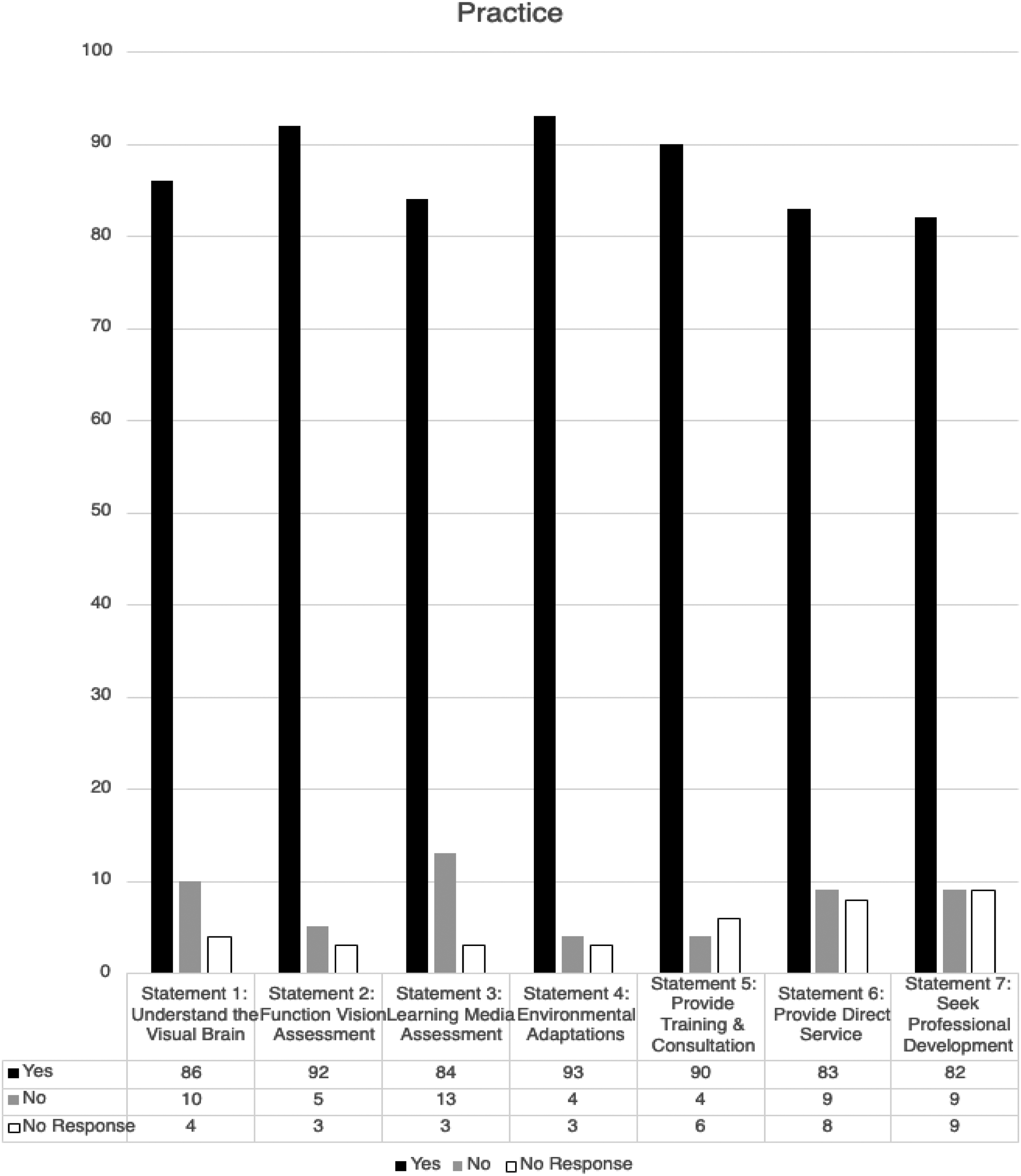
Part of Practice by Statement.
Barriers to Application of Knowledge and Skill Statements in Practice
For each of the seven statements, participants were asked to identify barriers to making each statement part of their professional role. For example, related to statement three, participants were asked to identify barriers to the role of the vision educator to conduct a learning media assessment with children on their caseload diagnosed with CVI. Participants could choose three from a list of possible barriers. Percentages were calculated by dividing the number of responses for a particulate barrier divided by the total number of respondents (n = 238). Some themes emerged from these data.
Statement one pertained to professionals’ responsibility to understand the visual brain. While 88% of participants said they agreed with this as a professional role, 67% said they lacked the knowledge and skills to put this into practice (see Figure 2). Participants ranked the top barrier as a need for more training and/or professional development (56%). However, 46% also indicated that they did not have enough time in their professional day to get such training and 31% indicated that finances to pay for training were a barrier.
Participants were asked to rank barriers to using a battery of assessment tools when completing a functional vision assessment. Importantly, 90% said they needed more training to reach this goal. Thirty-eight percent also said they did not have time in their professional day while 11% indicated that another colleague is responsible for completing the functional vision assessment.
Although all survey respondents indicated that they were teachers of students who are visually impaired, only 84% said that they complete learning media assessments for their students (see Figure 3). However, across survey respondents, 69% felt that they needed more training or professional development related to learning media assessments when children have CVI. In addition, 54% said that the lack of available assessment tools is a barrier, while 29% said that they did not have enough time in their professional day to complete the learning media assessment for children with CVI.
Statement four suggested that advocating for environmental adaptations is a responsibility of vision professionals. Among survey respondents, 65% identified that the primary barrier to meeting this professional obligation was due to resistance from the educational team, and 36% said administration resisted the implementation of needed environmental adaptations. Forty-one percent felt they needed more training or professional development in this area.
Statement five suggests that it is the role teachers of visually impaired students to provide ongoing training and consultation to members of the learner's team when children have CVI. Interestingly, from the choice of barriers, 38% indicated that they did not agree that providing ongoing training and consultation was part of their responsibility. However, 61% of respondents reported there is not enough time in the professional day to provide such support. Additionally, 48% indicated that they need more training or professional development in this area.
Direct service for learners with CVI is identified as a role of the teacher for visually impaired students. A need for more training or professional development was ranked as the most common barrier among respondents (57%), while 47% said that there was not enough time in their professional day, and 44% felt there was a lack of new information to inform their direct service provision.
Finally, 58% said there was not enough time in the workday to seek professional development related to brain-based visual impairments. Forty-two percent indicated that finances were a barrier to participating in professional development and 27% indicated that they lacked confidence in their ability to identify reliable sources for training on topics related to CVI.
Discussion
Overall, the findings of this survey are encouraging. The vast majority of vision professionals who responded to the survey agreed that the seven statements provided an accurate description of their roles and responsibilities as vision professional regarding learners with CVI. Most indicated that they felt relatively well equipped with the knowledge and skills they needed to carry out the seven roles and responsibilities. In fact, most reported that the seven practices are already part of the services that they provide to learners with CVI. However, there is still a percentage of professionals for which this is not true.
For example, almost one-quarter of respondents failed to strongly agree with Statement 6, which stated that, “It is the role of the vision educator to provide direct service to the learner with CVI.” Given that a foundational statement in the white paper described direct service as the role and responsibility of the vision profession when learners have CVI; however, this finding is somewhat concerning. As theorized by Bandura (1997), in order to impact practice, it is important that individuals agree that a task is appropriate while also believing that they have the skills to accomplish the task. These two components do not seem to be met for a number of respondents pertaining to the provision of direct services, which suggests that CVI leaders need to conduct investigations and have deep conversations about the topic of direct service when learners have CVI. If direct service is the role and responsibility of the vision professional, leaders need to understand why almost one quarter of professionals do not strongly agree with this statement.
A need for more training was indicated as a barrier to applying six of the seven statements listed in the survey, which is important information for leaders in the field of vision. Several resources (i.e., websites, journal articles, webinars, social media groups, books, and conference training) have been made available in recent years on the topic of CVI. Therefore, this survey outcome could suggest that professionals are not aware of these new resources. If so, leaders need to pursue initiatives to raise awareness.
Given that a lack of time was the second-most-common barrier indicated across the seven statements, however, this finding could also indicate that professionals do not feel like they have the time to take advantage of professional development resources. If this is the case, perhaps leaders should identify approaches that will help professionals find the answers they need in a more efficient manner. Solutions to the development of knowledge and skills among the workforce of vision professionals should be a priority for leaders. As professionals begin to take advantage of new and varied resources, it will be important to reassess this barrier in the future to understand if progress is being made.
Among professional development needs, opportunities related to assessment appear to be the most desired. Data pertaining to the functional vision assessment were interesting. Although this area was among the highest ranked for strong agreement and practice among respondents, it was among the lowest ranked in knowledge and skills for respondents. In fact, 90% of respondents indicated that a need for training was a barrier to applying the practice about functional vision assessments described in the statement. Furthermore, training pertaining to the learning media assessment might be even more important. Although professionals had fairly high agreement with the statement on learning media assessments, 13% of respondents said they do not complete learning media assessments with learners who have CVI. This finding suggests that there is an especially imminent need for professional development pertaining to the learning media assessment. Several new resources are available pertaining to functional vision assessments and learning media assessments. Therefore, in addition to offering more professional development opportunities, efforts might need to be channeled toward making professionals aware of how to access the available professional resources related to assessment.
Limitations
Some recruitment for the survey was accomplished through avenues that may be biased toward vision professionals who are the most interested in CVI (i.e., members of the Neurological Visual Impairment Division of AER), which may have skewed the data toward a positive alignment toward the statements. Although respondents represented regions across the United States, only 8.4% came from the Southwest, while 33.6% were from the Midwest. This discrepancy could also affect data results.
In survey development pertaining to questions about practice, only a yes and no response option was offered. Since inclusionary criteria required that all respondents have children with CVI on their current caseloads, we wanted respondents to make the decision about whether the statement described their practice. We determined that giving an option for sometimes or somewhat would cloud response data. This decision resulted in some respondents choosing to skip the question. For example, while agreement and knowledge and skills questions pertaining to statements one through four were answered by all 238 participants (see Tables 2 and 3), three to four percent of participants (n = 8–9) skipped the practice question for these same statements (see Figure 3). We chose to calculate percentages including skipped responses rather than removing skipped responses from data analysis. This decision was made because the skipped questions seem an important component to consider. If calculations were made with skipped responses removed, percentages would have been different. Therefore, the reader is encouraged to be aware of this decision in data analysis made by the researchers.
Conclusion
Professional roles and responsibilities were recently outlined in a white paper approved by AER through its Neurological Visual Impairment Division. The survey reported here serves as a first step in gauging where the field of visual impairment is in terms of its understanding about whether these ideals are a common and accepted part of the professional practice of vision professionals. Ensuring that vision professionals possess the self-efficacy to put these roles and responsibilities related to CVI into practice is an essential component in workforce development.
Footnotes
Declaration of Conflicting Interests
The author(s) declared no potential conflicts of interest with respect to the research, authorship, and/or publication of this article.
Funding
The author(s) disclosed receipt of the following financial support for the research, authorship, and/or publication of this article: This work was supported by the Perkins School for the Blind.
