




Abstract
In response to changes in health care, American medical schools are transforming their curricula to cultivate empathy, promote professionalism, and increase cultural competency. Many scholars argue that an infusion of the humanities in premedical and medical training may help achieve these ends. This study analyzes Web-based messaging of Ohio’s undergraduate institutions to assess premedical advising attitudes toward humanities-based coursework and majors. Results suggest that although many institutions acknowledge the humanities, most steer students toward science majors; strong advocates of the humanities tend to have religious or other special commitments, and instead of acknowledging the intrinsic value that the humanities might have for future physicians, most institutions promote the humanities because entrance exams now contain related material.
Introduction
The influential report penned by Abraham Flexner in 1910 established a framework for medical education that has endured for more than 100 years. 1 Yet, there is consensus that medicine today is in the midst of fast-paced and radical change that puts pressure on this traditional approach.2–4 Specifically, although medical education during the Flexner period focused on the centrality of natural science knowledge and clinical skills for delivering quality patient care, medicine today is increasingly focused on addressing the needs of diverse patient populations and working with patients, their families, schools, churches, and workplaces, to provide care in a way that improves the health of communities in a culturally competent manner. Cultivating the humanistic sensibilities and skill sets of new physicians is therefore of critical importance.5,6
In response to changes in medicine, many American medical schools are engaged in curriculum transformation processes, with an aim of using competencies to promote cultural competence, foster interpersonal communication, and call attention to other humanistically infused topics. These efforts are bolstered in the academic literature by a proliferation of peer-reviewed journals championing the benefits of including the humanities in medical education curriculum, especially in light of continuing challenges cultivating and maintaining student empathy, 7 promoting professionalism, 8 avoiding burnout, 9 and other considerations of identity affirmation and wellness.10–12 It is noteworthy, however, that few medical educators and scholars have trained their focus on earlier, more formative stages of the developmental process. The rigor and intensiveness of medical school, framed by board exams that focus student doctors mainly on natural sciences and clinical skills, may serve as an impediment for helping students to develop humanistic, cultural, and socially informed competencies. This suggests the need for cultivating these sensibilities earlier, especially in the premedical years of undergraduate education. An important question, therefore, is what kind of messaging, advising, and curricular preparation is taking place in American undergraduate institutions to prepare students for future medical education, and specifically, competency in various humanistic skills necessary for medicine?
Although a robust literature examines the importance of establishing best practices for carrying out mentoring and advising medical students,13–16 the undergraduate educational literature lacks a knowledge base in premedical messaging and advising. This article analyzes how undergraduate institutions portray the humanities, both from a perspective of the intrinsic value of humanistic training for future physicians and as a potential advantage for premedical applicants. As such, this article is a first step toward rethinking how premedical advising portrays 21st century medicine and appropriate preparations within the medical school admissions process.
Methods
This study evaluated premedical messaging regarding the humanities of 4-year colleges in Ohio. For several reasons, Ohio is a useful state with which to begin this analysis. Although Ohio, the seventh largest state in the United States according to recent census data, is home to some of the most prestigious and highly ranked medical institutions in the United States (the Cleveland Clinic, Cincinnati Children’s Hospital, and Nationwide Children’s Hospital in Columbus, for example), its health profile is among the worst in the country, in categories such as infant mortality, ranking 43rd among the 50 states. 17 In addition, from a workforce development perspective, Ohio faces similar challenges as most American states, especially in persuading young physicians to enter primary care and practice in both rural and urban contexts.
Our analysis is limited to those institutions with dedicated premedical Web pages or 60 of the 68 Ohio colleges with premedical programs. The methodology we deployed was content analysis, a widely recognized approach for undertaking qualitative text-based analysis that has gained considerable traction in the social sciences,18,19 including health research. 20 Using the online qualitative data analysis program, Dedoose, we coded PDFs of the Web pages (and, in some cases, PDFs available for download on Web sites) for thematic linkages and conceptual clusters.21–24 Specifically, in line with “conventional” content analysis, 25 codes were not established prior to the coding process but arose organically in response to the texts themselves. Using Dedoose analytics, including cross-coding reliability and co-occurrence tools, codes were merged and dominant themes distilled. In total, 3 master themes were identified from the coding process. Reliability testing was undertaken before full coding began and consisted of using Dedoose’s inter-reliability testing module, with which coders code a test document, compare results, discuss coding strategies, and adjust accordingly where confusion or disagreement may have existed. Once agreement was reached on the meanings of different codes that arose during initial testing, full coding commenced. The thematic foci we present here were the result of this collaborative process.
Findings
Our analysis yielded 3 major findings. First, many colleges recommend humanities courses but most of these colleges emphasize the natural sciences over the humanities. Second, a strong relationship exists between a college’s likelihood to emphasize the humanities and religious and other mission-based affiliations. Third, most colleges that do emphasize humanities courses tend to do so as an opportunistic matter of doing well on entrance exams and meeting other admissions criteria, instead of emphasizing the intrinsic import of humanistic thinking to contemporary medicine.
The humanities are important but emphasize science majors
The most common finding was not an outright rejection of the humanities but a subtle ordering of priorities in emphasizing the natural sciences. To be sure, many colleges note that medical schools do not privilege the natural sciences. For example, Kent State University notes that although “Students often choose to pursue the primary major in the biological sciences, chemistry, or psychology; they may, however, pursue any major in the college along with the premedical program,” implying that focusing one’s course of study is an option for premedical education. Wright State University notes that some “students choose to major in a scientific discipline because they are fascinated by science and believe that such a major will be the foundation for a variety of career options. However, this does not enhance your chances for admissions.” Case Western University emphasizes this point as well but further argues that
Medical schools do not give preference to particular majors over others; nor do they give preference to students with multiple majors or minors . . . Most medical schools seek to construct a class of students that is diverse in academic and experiential backgrounds.
Oftentimes, humanities courses are cast as a complement to the natural sciences. The University of Findlay notes,
Imagine a curriculum that includes classes as varied as calculus, college writing, organic chemistry, biodiversity, social sciences and foreign languages. Although a science major isn’t a requirement for admission to medical school, a strong background in the prerequisite science courses plays a large role in the admission process.
Similarly, the University of Dayton explicitly refers to “A substantial complement of humanities and social sciences courses,” adding that “Within this framework, the curriculum is flexible and can be tailored to suit personal interests.”
Defiance College is emphatic in precisely the opposite direction as these colleges, insisting that “The premedical student should major in molecular biology.” Yet, Defiance’s Web site adds, “However, many medical schools are seeking a variety of backgrounds in their students and the premedical student is encouraged to develop verbal skills by electing several speech and literature courses.” Although the humanities are not mentioned specifically, they are valued primarily in terms of the fallback options they provide:
At Ohio Wesleyan University, we want each pre-med student to have a major in some department or discipline so that each student has sufficient background in an area besides medicine to be able to pursue an alternative career if the medical school dream does not work out.
Despite these supportive statements about selecting majors, the more common finding was that institutions steer students away from the humanities in fact while remaining supportive of humanities majors in principle. Xavier University notes, for example, that
. . . the Natural Sciences degree is not the only possible degree for a student interested in health sciences. Professional schools are interested in quality and breadth of undergraduate work. It is generally in your own best interest to major in something in which you have a genuine interest and which may provide you with an attractive alternate career. Of course, majoring in one of the humanities will require careful scheduling to include the minimum science requirements . . . Keep in mind that admissions committees at health professions schools pay particular attention to science grades, so of course, you will need to perform well in these classes (emphasis added).
The Franciscan University of Steubenville, notes, for example, that
Contrary to the common notion, you don’t have to major in a science as an undergraduate if you want to go to medical school. While our Biology and Chemistry programs will well prepare you for medical school, we crafted our preprofessional programs so that students in the humanities and other majors will have sufficient knowledge of biology, chemistry, mathematics, and physics to get into and succeed in the medical school of their choice.
Kent State University takes a similar approach:
Students . . . must also complete all the requirements for a primary major or field of concentration. Students often choose to pursue the primary major in the biological sciences, chemistry, or psychology; they may, however, pursue any major in the college along with the premedical program.
They add, however, that “the BS Chemistry degree with a concentration in Biological Chemistry includes all the courses required for the Pre-Medical program.”
Finally, the prioritization of science over humanities courses often occurs subtly, as when Ohio Northern University notes that “pre-professional majors” will take courses in Biology, Chemistry, Physics, Anatomy, Physiology, Exercise Physiology, Psychology, and”—almost as an afterthought—“Medical Humanities.” In its encouragement of premedical students’ development of cultural competency, Wright State notes,
students are also encouraged to take electives such as women (sic) studies, African American studies, medical sociology, health communication, social inequality, and race and ethnicity to better understand how social, educational, economic, familial, and racial and gender dynamics impact the healthcare industry.
This encouragement, however, comes by way of something of an addendum rather than a central recommendation.
Implications for humanities content on admissions
Unsurprisingly, the Web sites of many premedical programs and their curricular equivalents provide information about the Medical College Admission Test (MCAT). This information steers students toward classes they should take to increase their chances of obtaining a successful score. John Carroll University advises, “Additional course electives are strongly encouraged and may be taken in biology, chemistry, psychology, sociology, philosophy, religion, and political science as a way to enhance your educational background and preparation for the MCAT and medical school.” They add, “Additional coursework that will enhance your educational background and preparation for the MCAT is strongly encouraged.” Ohio University notes,
Most medical schools require a year, with laboratories, of biology, general chemistry, organic chemistry and physics. These sequences should be completed before you take the [MCAT] . . . While not required, courses in anatomy, physiology, genetics, immunology, biochemistry and the humanities are often strongly recommended.
Similarly, according to Ohio Wesleyan University (OWU),
Medical schools really don’t care if you have a pre-med major or not. True, they do want you to have the right science and social science background to be able to achieve well in medical school. However, more important than the precise major in college are (1) earning great grades . . . [and] (2) having the background to score highly on the MCAT.
Many schools emphasize the natural sciences, and to a lesser degree, the social sciences, but neglect humanities-based subjects. Wittenberg University explains that the MCAT’s verbal reasoning section includes “series of passages that test your ability to comprehend, reason, and think critically” but adds “The passages vary widely in their content, but are usually esoteric.” (It is worth noting that the 2015 changes retitled the “verbal reasoning” section, suggesting that this Web site is out of date.) Miami University notes, “The co-major [pre-medicine] integrates formal advising sessions with professional development courses and courses covering the fundamental concepts in the biological, physical, and social sciences required for admission into medical school and/or covered on the [MCAT].” For Ashland University, justifications for emphasizing social sciences—though not humanities—come by way of changes in the MCAT in 2015: “This revised exam contains a new section . . . To prepare for this new section we recommend that you take a semester or two of psychology and/or sociology.” Similarly, Wright State University notes, “To prepare for this new exam, students are strongly recommended to complete additional courses in psychology, sociology, molecular/cell biology, genetics and medical ethics.” Although the University of Cincinnati acknowledges that “Many students who love science courses seem to avoid courses that require extensive reading and writing,” it is to the MCAT that they appeal rather than the growing importance of humanistic dimensions in becoming a successful physician.
Beyond the MCAT, however, many colleges support the humanities in terms of medical school admissions generally, especially as concerns coursework as a commitment to broad learning and the selection of majors. Xavier University, for example, raises the question of diversity: “Remember, professional schools value diversity and a broad liberal arts background in their students, so balance your science courses with courses that interest you, that develop your communication skills and that broaden your understanding of human existence.” Ohio State University “urges” premedical students “to take advantage of academic opportunities in history, art, literature, creative writing, philosophy, social sciences and communications,” although no justification of this time or effort is given.
According to the University of Cincinnati, the decision to take humanities and social sciences courses should be guided by the requirements of specific schools as
Some schools also require or recommend upper level sciences, a year of English composition, humanities and/or social sciences . . . If you are interested in a particular school, you should learn as much about that school as you possibly can early on.
The University of Findlay assures students in the natural sciences that they will “receive a strong educational foundation in the natural sciences and humanities,” as well as that “Medical schools across the nation realize the value of this broad educational base.”
Support for the humanities from faith-based and other special mission institutions
Finally, our analysis suggests that institutions with specific affiliations and missions tend to take a stronger position in support of the humanities. For example, the Franciscan University of Steubenville, a private institution with a Catholic-rooted social justice mission, has one of the strongest commitments to humanities training in Ohio. Its Web site explains,
we believe that the world needs more professionals in the healthcare industry who operate knowing that healing is not just of the body, but of the whole person. For us, medicine means more than biology and chemistry, and being a doctor means more than diagnosis and treatment. We believe that physicians should be masters of the art of healing, and practitioners of compassion and care for the physical, emotional, and spiritual well-being of the afflicted . . . Our programs are strong on the hard science of medicine, while giving healthy respect to the human qualities and ethical dimensions that so many competing programs, and even medical schools, leave out.
Mount St. Joseph University, a Cincinnati-based, liberal arts Catholic university notes,
The pre-medicine and pre-health professions advisors . . . will help guide you in taking the appropriate required courses in biology, chemistry, physics, mathematics and social sciences, as well as the recommended electives in the arts and humanities to successfully prepare you to apply to the health-related professional school of your interest.
Our analysis identified 2 colleges in Ohio whose commitments to the humanities stood out because of secular commitments: Hiram and Antioch. Antioch explains that its biomedical sciences “program is designed to appeal to students who value serving society and who want to make a difference,” is supported by “local community agencies,” and encourages “one year of English composition, psychology, sociology, further statistics and mathematics, and foreign languages.” Hiram offers a nationally known biomedical humanities major that “couples an intensive science core—one that meets the requirements for medical schools—with a curriculum that utilizes courses in medical humanities enabling students to develop a balanced approach to healthcare.” In these cases, premedical students are steered toward preparations for medical school that are part of broader institutional commitments reflecting values associated with those college’s graduation requirements and identity. These commitments appear to be concerned both with values within undergraduate education and with the broader social mission of becoming a physician.
Discussion
Our data point to several important approaches toward premedical advising in Ohio’s undergraduate institutions. Many Ohio colleges appear to be leveraging changes in medical school admissions to encourage students to consider taking humanities courses. This is unsurprising in light of the fact that in 2015 the American Association of Medical Colleges (AAMC) substantially revised the medical college entrance exam, the MCAT. Emphasizing “concepts that tomorrow’s doctors need to know in order to serve an increasingly diverse population and have a clear understanding of the impact of behavior on health,” the exam now includes a new “critical analysis and reasoning skills” (CARS) section, which asks students to undertake “interpretations, implications, or applications of historical accounts, theories, observations, or trends of human society as a whole, specific population groups, or specific countries.”
26
The CARS passages, AAMC notes
. . . often focus on the relationships between ideas and are more likely to be written in a conversational or opinionated style. Therefore, you should keep in mind the tone and word choice of the author in addition to the passage assertions themselves. Humanities passages might describe the ways art reflects historical or social change or how the philosophy of ethics has adapted to prevailing technological changes.
26
The AAMC explains that passages are drawn from disciplines as divergent as architecture, art, dance, ethics, literature, music, philosophy, popular, culture, religion, theater, and cultures (see Table 1).
Example passage from Critical Analysis and Reasoning Skills section of the Medical College Admission Test exam.
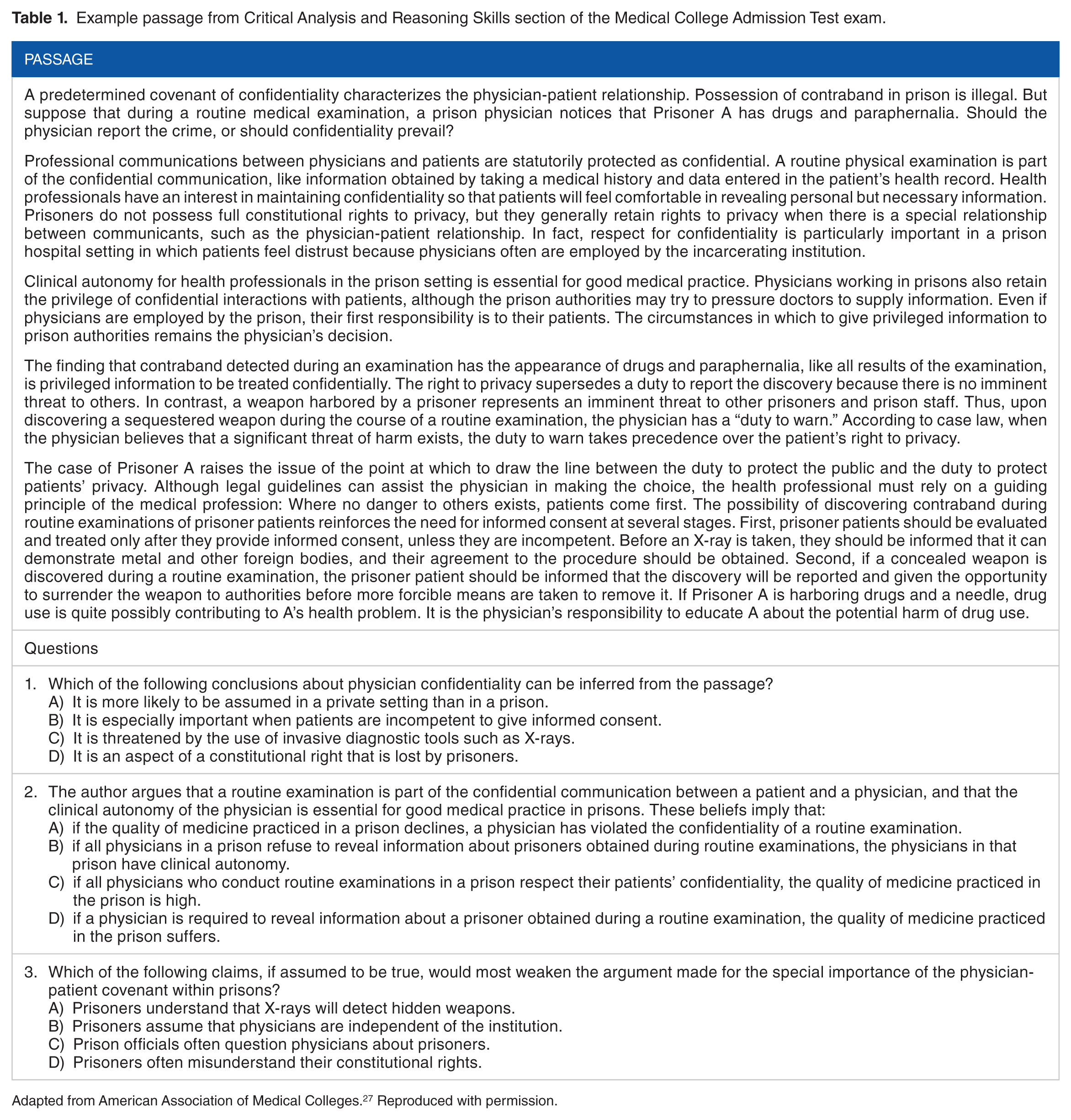
Adapted from American Association of Medical Colleges. 27 Reproduced with permission.
Yet, with the exception of those schools whose missions (religious, social justice, or otherwise) point toward investments in humanistic thinking, most colleges limit their support for the humanities to the MCAT as an entrance requirement. Acknowledging that there could be some latitude in how one interprets the subtlety of messaging, we found no statements of the intrinsic value of humanities for contemporary physicians that were not rooted in the more opportunistic frame of the process of applying to medical school. Despite questions about how the AAMC characterizes the humanities (“conversational,” “opinionated,” etc), the changing MCAT nonetheless marks a change in premedical culture.
An additional finding suggests that there is something unique about those schools that encourage, or even require, students identifying as premedical to take courses in the humanities. We have noted the different dispositions taken by Catholic institutions—especially Franciscan and Jesuit institutions—toward the humanities. It is also unsurprising that a school such as Antioch College, with its secular social justice mission, would also approach preparations for medicine as a matter of social commitment or contribution. Hiram College is a unique case in that although it is loosely religiously affiliated, its commitment to the medical humanities does not—unlike many of the Catholic-affiliated colleges—appear to stem from its “strong tradition of religious freedom, and of support and encouragement for each student to maintain his or her faith and practice of religion.” 28 Instead, Hiram offers a premedical curriculum built around a vision of medicine that emphasizes the importance of the humanities to medicine primarily as a function of its commitment to interdisciplinarity and the liberal arts (since the establishment of Hiram’s program in 1998, more than 50 other programs [major, minor, and certificate], under various names [health humanities, medical humanities, biomedical humanities], have been established around the country. In total, 15 are major, degree-granting programs, see Table 2). Although many of Ohio’s undergraduate institutions lay claim to commitments to liberal arts, most of these commitments materialize in isolation, as curricular foundations embedded in a general education or core program, but largely disconnected from thinking about premedical and other professional preparations. Indeed, many discussions about the state of the liberal arts, however unproductive they may sometimes be, center on supposed tensions between the liberal arts and professional programs, from nursing to medicine to business. 29
American universities with medical and health humanities majors.
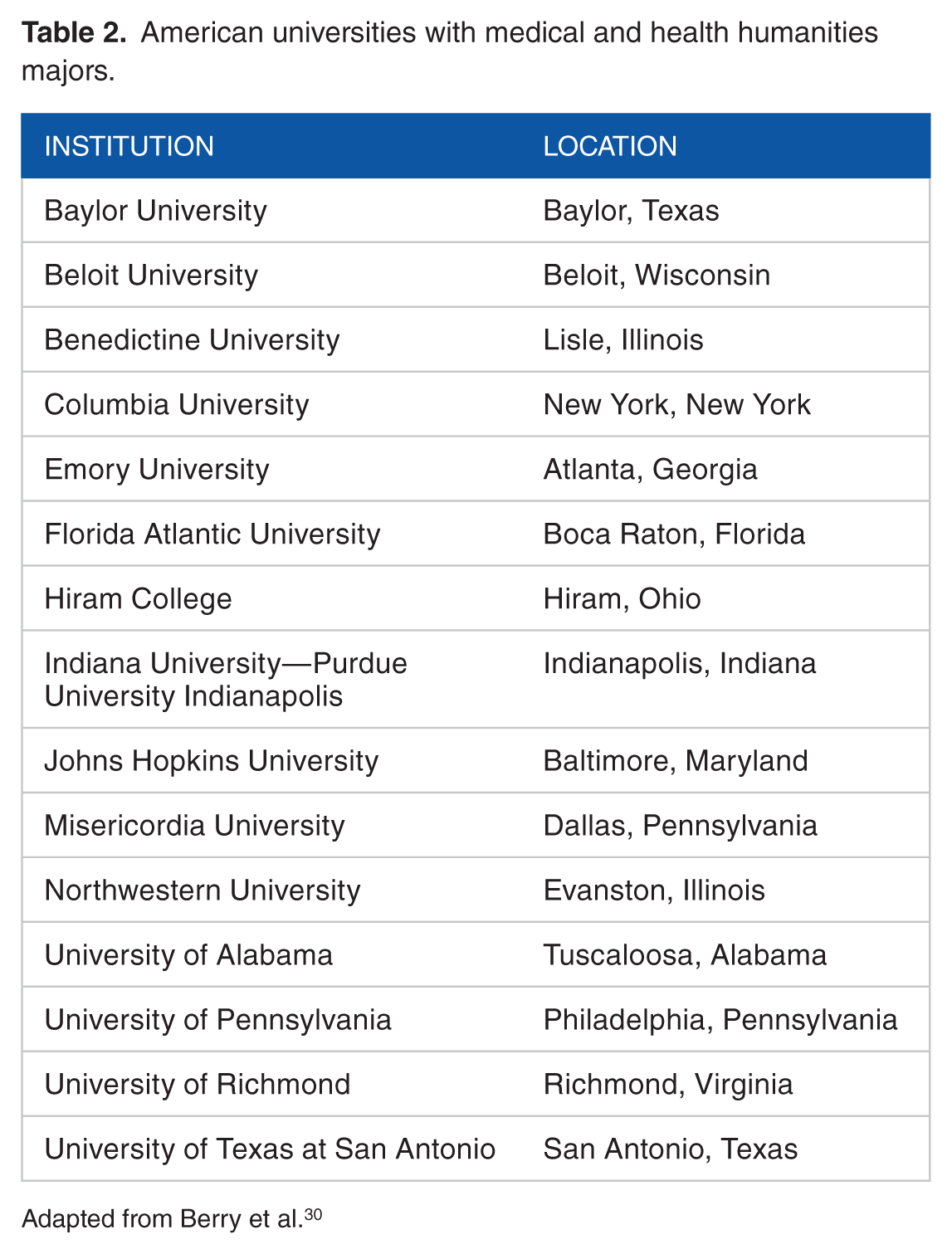
Adapted from Berry et al. 30
Yet, when communicating with students, even Hiram steers its embrace of the humanities toward admissions and not the nature of medicine itself. It notes, “Our first-in-the-nation biomedical humanities major gives students exactly what medical schools look for beyond grades and test scores: medical and research experience, diverse interests and community service.” In an interview with the Hiram student newspaper, Erin Lamb, chair of the Hiram program points to additional workforce evidence, suggesting that “Students exposed to baccalaureate health humanities coursework are more likely to be drawn to primary care fields, which we are in such great need of right now.” 31 This evidence, supporting the connection between medical humanities and primary care, could be of great benefit to other schools who have the mission of increasing the number of their students that enter primary care, where the humanities may in fact play a more critical role in training physicians with a broad understanding of sociocultural dynamics, communication, and critical thinking.
It is unsurprising, of course, that college Web sites, as part of a broader branding effort, emphasize career trajectories and the prospects of success in meeting students’ professional goals. Insofar as this is the norm, advertised commitments to the humanities nonetheless serve as a helpful means of articulating institutional differences, such as between the small number of Ohio colleges that engage the question of what is required for a successful career in 21st century medicine, and those that emphasize what is merely useful for gaining admission to medical school, as a preprofessional matter. It is worth noting that left almost wholly uninterrogated on Ohio college Web sites is messaging about changes afoot in medicine itself, such as the importance of cultural competency, empathy, professionalism in community and new corporate contexts, and medical ethics.
Two additional observations arising from our findings are worth noting. First, beyond the natural sciences, recommendations for courses in the social sciences far outweigh those in the humanities. Second, who maintains a college’s Web site often seems to determine the kind of messaging that takes place about medicine as a profession, especially as concerns whether medicine is portrayed as simply an extension of scientific knowledge and clinical skills, or it is understood as a complex social and humanistic phenomenon.
With this in mind, we make several caveats. First, we should be cautious to ascribe too much intentionality to the Web sites we have analyzed. Although there does appear to be some lack of attention to developments in medicine, this may be a simple function of failure to update regularly. As many universities in the United States suffer from workforce shortages, with an increasing amount of labor (including, in some cases, advising labor) being deferred to part-time adjunct instructors, it is possible that many of these Web sites are simply not regarded as dynamic documents that should reflect a changing profession. In other cases, based on the personal experience of the authors, it may be that many of the persons tasked with doing premedical advising do not have the authority to, or easy-enough access for updating Web sites, which are often centralized in university administrative offices. The dynamics we have observed—the impact on limited attention to the non-natural sciences components of medicine when Web sites are run out of natural sciences departments and problems with Web sites being outdated in a way that often fails to capture recent developments in medicine—suggest that many institutions may be well-served to centrally maintain premedical advising Web pages (and possibly premed advising itself). This would allow multiple departments (natural sciences, humanities, and social sciences) to collaborate in messaging and reflect a broader, more inclusive understanding of medicine.
Finally, it is worth considering some of the implications of our study for undergraduate humanities departments themselves, beyond premedical advising and the future of medicine. Specifically, as has been well-documented, humanities programs are besieged across the United States, with hiring freezes, an increased reliance on adjunct labor, and pressure from the Science, Technology, Engineering, and Math (STEM) movement to focus on traditionally nonhumanistic subject areas, largely in response to a national workforce efforts to renew American leadership in these areas. With the decline of law school enrollments, 32 which were often fed by undergraduate major areas such as philosophy, political science, and English, a substantial opening for institutional divestment from the humanities took place over the past decade or so, and continues apace, even if the dichotomy of STEM and the humanities is a false one, as the recent movement to convert STEM to “STEAM”—where the “A” stands for the arts—suggests.33,34 The forces in motion that have animated this study may serve as a counterweight to these trends. Accordingly, although many humanities departments—including chairs and faculty—rarely think of themselves as having any role to play in premedical preparation and advising, it may be that the direction in which 21st century medicine is headed provides an opening for undergraduate humanities departments to play a larger role, providing along the way a renewed justification for increasing instead of reducing these departments’ preprofessional roles on campuses. This is especially potentially powerful in schools that project strong rhetorical commitments or that have historical missions rooted in the liberal arts.
An important limitation of our study, of course, is that we have restricted our analysis to Ohio. Future research should expand not only the scope of analysis but also the mode of research. Specifically, to better understand how premedical advising shapes student thinking about the humanities, it would be useful to conduct qualitative interviews with advisors as well as students. It is possible—perhaps likely—that the faculty or staff dispensing advice and the students receiving and processing it may think about medicine and the humanities in ways that are at odds with Web site messaging.
Conclusions
It is reasonable to assume that premedical undergraduate messaging plays at least some role in shaping students’ perceptions of medicine. Despite the potential complicating factors in how students interpret this messaging, we can say with certainty that it tells us a great deal about how undergraduate institutions portray and understand medical training and careers in medicine. At stake in understanding the nature of this messaging is not only the meaning of medicine itself, and expectations about what makes a great physician within the context of 21st health care, but also the decisions that students, with their advisors, make in preparing for careers in medicine. The nature of these preparations, in turn, is of tremendous importance to the kind of workforce that American medical schools are producing, with consequences for students’ abilities not only to serve as technically skillful clinicians but also to relate to and work with a diverse range of patients and appreciate the role physicians play in the social aspects of medicine. These social dimensions, after all, are increasingly being recognized as containing critical tools for the pursuit of healthier patients and populations—sometimes even as important as traditional clinical knowledge. Future research will need to consider more dynamic messaging that can only be understood by analyzing actual conversations between advisors and students, or interviewing advisors from various departments about their perceptions of the goals of premedical advising, the state of medical education and medicine.
Footnotes
Funding:
The author(s) received no financial support for the research, authorship, and/or publication of this article.
Declaration of conflicting interests:
The author(s) declared no potential conflicts of interest with respect to the research, authorship, and/or publication of this article.
Author Contributions
Both authors contributed to data collection, coding, analysis, and manuscript preparation.