




Abstract
Keywords
Critically ill traumatic brain injury (ciTBI) patients are incapacitated. They depend on family members or health care proxies as surrogate decision makers (“surrogates”) for any medical decisions, including the life-or-death (“goals-of-care”) decision about continuation of care or withdrawal-from-life-sustaining interventions. Surrogates make the goals-of-care decision based in part on the patient’s long-term prognosis, which is typically communicated to the surrogates by physicians. Physicians commonly rely on their own experience to derive an estimate of prognosis, but may also apply predictions obtained from validated prognostic models, such as the intracerebral hemorrhage (ICH) score1,2 and FUNC scores 3 for patients with an ICH or the International Mission for Prognosis and Analysis of Clinical Trials in TBI (IMPACT) model4,5 for patients with TBI to obtain an estimate for a patient’s severity of disease and long-term prognosis.6,7 While the authors of these models recommend that these models should not be used for endorsing limitations of care or making treatment decisions without also considering individual patient factors not included in such scores,6,8,9 in clinical practice unfortunately many physicians use them to inform clinical decision making. 8
However, in ciTBI physicians vary considerably in their perceptions of neurologic prognosis and withdrawal-from-life-sustaining therapies.10–13 Goals-of-care decisions lack standardization, and physicians are prone to adding their personal opinions and biases based on their impression of the patient when offering (or not offering) certain treatments at their discretion.10,11,13 In many other diseases, a more standardized and collaborative approach to the communication of projected outcomes, delineation of treatment options with their risk-benefit ratios, as well as the systematic elicitation and inclusion of patient values and preferences has been achieved by the use of shared decision-making tools (decision aids).14–17 Recently, two large professional medical societies highlighted the need for shared decision making in the intensive care unit (ICU) to facilitate information exchange, deliberation, and effective decision making. 18 This approach has also been suggested for difficult decisions in TBI. 19 Currently, no decision aid exists for goals-of-care decisions in ciTBI patients or any other diseases in the neuro-ICU. 17 The International Patient Decision Aid Standards (IPDAS) serves as a framework for the development, rating, and certification of high-quality decision aids and recommends a systematic approach, beginning with the exploration of stakeholders’ (i.e., physicians’ and surrogates’) communication practices and preferences for decision making.20,21 Furthermore, this framework advises the presentation of probabilities, such as those derived from disease-specific validated outcome models. 21
In ciTBI, the IMPACT model remains the most widely validated outcome model but has significant weaknesses. It is based on admission criteria only and does not include the clinical course of a patient after admission, or response to supportive care in the ICU for the first crucial 3 to 5 days. Therefore, the IMPACT model may be poorly suited to be included in a future goals-of-care decision aid for ciTBI, because potential care-limiting decisions should not be based on prognostic probabilities derived from admission criteria only. However, to our knowledge, to date there is a paucity of better ciTBI outcome prediction models, which include the patient’s hospital course and response to treatment, leaving the IMPACT model as a leading candidate for use in a goals-of-care decision aid in ciTBI.
The objective of the current study was to examine physicians’ awareness, perceptions, and use of the IMPACT model, as well as their preferences for communicating prognostic estimates during family meetings with ciTBI surrogates. The information gained from this study would crucially inform the content and building of a future goals-of-care decision aid in ciTBI.
Methods
Study Design and Participants
This current study is one component of a larger qualitative study exploring key stakeholders’ (surrogate decision makers and physicians) attitudes and preferences for outcome prognostication for ciTBI patients, and its communication to families and surrogate decision makers 22 that was conducted between October 2015 and August 2016. Participating physicians were recruited using purposive and snowball sampling from seven academic medical centers from five geographic regions of the United States (Northeast, Mid-Atlantic, South, West, and Midwest; Figure 1) representing four different specialties (neurosurgery, neurocritical care, trauma surgery, and palliative care). Inclusion criteria included English-speaking with willingness to undergo an audio-recorded interview, caring for ciTBI patients, practicing as an attending for ≥2 years after fellowship training, and routine engagement in goals-of-care discussions for ciTBI patients.
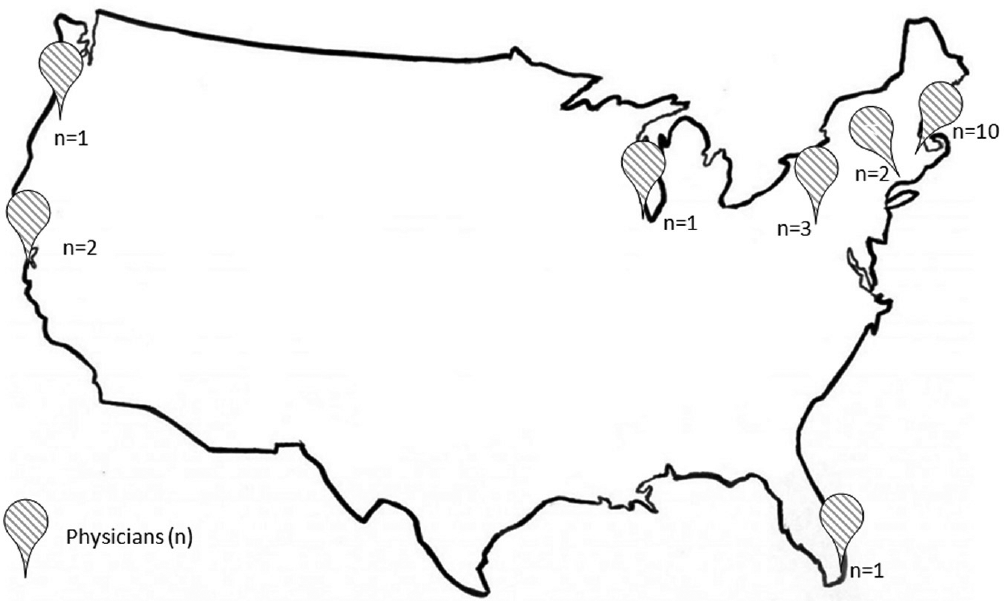
Geographic distribution of participating physicians. This map shows the number and location of participating physicians in the United States.
The University of Massachusetts Medical School (UMMS) Institutional Review Board approved the study with written consent for in-person interviews (n = 10), or verbal consent with an approved script for telephone interviews (n = 10).
Measurements and Interviews
Baseline demographics were obtained using a written survey. We developed a semistructured interview guide with open-ended questions. To address the objectives of our current study, one part of the interview guide was aimed at exploring physicians’ communication practices during family meetings of ciTBI patients discussing the patient’s prognosis, as well as physicians’ awareness, knowledge, use, and perception of the IMPACT model to guide estimates of the patient’s prognosis. The interview guide was iteratively refined with input from content and physician-patient communication experts, and tested in two mock interviews. The institutional review board approved the final interview guide before its use. One trained interviewer (SM) conducted all interviews in person or over the phone. All interviews were digitally audio-recorded and transcribed verbatim by a professional transcription service. Participants were offered a $25 gift card for their participation.
Coding Procedures and Analysis
We developed a coding scheme using parallel deductive and inductive methods. The initial coding scheme was developed based on the interview guide content by a neurointensivist (SM) and an experienced qualitative researcher (KM). Two coders (TQ and JM) cooperatively coded five transcripts while making inductive changes to the initial coding scheme when necessary, with review of changes by SM and KM. Conceptually similar themes were combined and emerging themes added; conflicts were resolved using a third reviewer. Using this revised coding scheme, coders then independently coded the same three additional transcripts, resulting in >80% congruency. All previous and subsequent transcripts were then coded separately using the revised coding scheme, with no further inductive changes required, indicating theme saturation (no new themes emerged). All codes were reviewed by three authors to ensure correct classification. Recruitment was continued to diversify the sample and to confirm that indeed no novel information would be obtained through the analysis of several additional transcripts. Theme saturation and feasibility resulted in a final sample size of 20 physicians. Qualitative analysis was performed using NVIVO (QSR International Pty Ltd., Melbourne, Australia). Baseline characteristics of the study groups were summarized using descriptive statistics.
Results
Baseline Characteristics
The average interview duration was 37 minutes (range = 19–65 minutes). Baseline characteristics of the study cohort are shown in Table 1. The mean number of years in attending practice was 14. Half of the participants were specialized in neurocritical care, with the other half distributed among neurosurgery, trauma, and palliative care. The geographical location of participants is shown in Figure 1. Of the approached physicians, one declined participation.
Participating US Physicians’ Baseline Characteristics (N = 20)

Note: Data are presented as n (%) unless otherwise specified.
IMPACT Model Awareness and Use in Clinical Practice
Overall, only 12 (60%) of the physicians expressed awareness of the IMPACT model, of whom 8 were nonsurgical neurocritical care specialists. Of the 12 physicians with knowledge of the IMPACT model, 7 indicated using the model at least some of the time to form a patient’s prognosis in clinical practice, although none used it exclusively to derive a prognosis. One physician mentioned he/she might show the output from the IMPACT model to select families “once in a while if there is a family that is very number-oriented and they want percentages.” Of the seven neurosurgeons interviewed, three expressed awareness of the IMPACT model, of whom one was “barely aware,” and one acknowledged its use for discussions among physicians, but not with families. Of the two trauma surgeons, only one stated that he/she “had heard about” the IMPACT model, but was not using it for prognostication due to lack of familiarity with this model.
Major Themes
We identified four major themes representing a variety of views on the communication practices of numeric estimates of the patient’s prognosis during family meetings and the utility of the IMPACT model for ciTBI prognostication and clinical decision making. When physicians were unaware of the IMPACT model specifically, we included general statements about the use of health outcome models, as these statements included important insights into the physicians’ perceptions of the utility of outcome scores for neurological prognostication. Below we list each theme with a representative quote. Additional quotes for each theme are shown in Table 2.
Themes and Representative Physician Quotations

TBI, traumatic brain injury; DAI, diffuse axonal injury; CT, computed tomography; ICH, intracerebral hemorrhage; ER, emergency room.
The IMPACT Model (Outcome Scores in General) Are Research Tools and Should Not Be Used in Individual Patients
Many physicians expressed significant apprehension about applying the IMPACT model to individual patients. Specifically mentioned was the opinion that the IMPACT model and other outcome scores are research tools and were designed to inform clinical trial design, but should not be applied at the bedside to an individual. As one physician stated,
I am always very scared when I hear of colleagues trying to use the IMPACT calculator or the CRASH calculator. These things were never designed for clinical decision making, they were designed to inform clinical trial design.
Mistrust in the IMPACT Model Data
Several physicians raised concern about the quality of the data underlying the IMPACT model, as well as the quality of the data generated by TBI outcome research in general due to heterogeneity among the different injury patterns and the stratification into different TBI severities by the Glasgow Coma Scale. This mistrust in TBI outcome data also represented the main reason for physicians not applying the IMPACT-model in clinical practice:
I don’t think the data is really good. I think for me TBI is probably the most difficult disease to prognosticate and I do not think that any of the decision tools that we have personally are very good. . . . I do not think the disease has been studied very well.
Even physicians who were not aware of the IMPACT model expressed a genuine concern and mistrust in using any prognostic models and calculators for the determination of a patient’s prognosis:
I do not put any stake in the calculators that are out there right now. There’s not a lot of science available really—Prognosis in TBI is really not clear cut.
The IMPACT Model Is Helpful in Reducing Physician Variability in a Heterogeneous Disease
Despite the inherent mistrust in using the IMPACT model (or any outcome model in general), all physicians acknowledged the challenges in forming a prognosis reliably for many of these critically ill patients. Therefore, several physicians viewed the IMPACT model as helpful in reducing the variability among physician opinions when many different physicians and services are caring for a patient:
I think it is helpful to ground the physicians a little bit. In short, I think it reduces the variability of prognosis that a large group of physicians may give to this very heterogeneous group of patients.
Several physicians warned that the IMPACT model should not be used in isolation but in conjunction with all available clinical data:
At times, we will also calculate an IMPACT score to add to the clinical information we have about that patient. It is not done in isolation but rather in conjunction with clinical examination. . . . Putting that all together, we start to get a good idea of how we feel the patient is doing.
Presenting Numbers Derived From Statistical Models May Mislead Patient Families
A frequently mentioned concern regarding the clinical use of the IMPACT model for families was the reluctance by physicians to provide numeric prognostic estimates to families. Participants stated several reasons for this concern. The first reason was the assumption that families will misinterpret numeric estimates due to stress and despair, thereby creating false hope and unfounded optimism:
Percentages will be interpreted by families in whatever way they want. Even if you give them the 80% chance of mortality, if they’re optimistic, they will latch on to the 20%.
In addition, physicians expressed apprehension about potentially low numeracy among surrogate decision makers, resulting in oversimplification of numeric estimates:
Family members, unless they are very mathematically sophisticated, really don’t interpret these numbers the way that physicians and scientists interpret these numbers. They become simplified and used against you later.
Although a subgroup analysis of attitudes and awareness of the IMPACT model by physician specialty was considered, it was not performed due to the small sample size.
Discussion
Our study found substantial variability in expert physicians’ awareness, utilization, and perception of the IMPACT model, but consistency in their reluctance to use numeric prognostic estimates during family meetings. These findings present both insights and challenges to promoting informed decision making among surrogates while illustrating physicians’ approaches to prognostication for ciTBI patients.11,13
With the creation of a ciTBI goals-of-care decision aid in mind, which meets as many IPDAS criteria as possible, including the criteria to “present probabilities” for the outcome prognostication, 21 we purposefully examined physician responses to the IMPACT model as the most widely validated prediction model in TBI.4,5,23,24 Parsimonious outcome models, in general, are not designed to guide treatment decisions or limitations of care, but due to their ease of use, in the reality of clinical practice, physicians often turn to these tools for guidance to inform clinical decision making and may misuse them by applying them to individual patients. 8 We found in our study that most of the participating TBI expert physicians do not endorse the communication of probabilities derived from the IMPACT model in a ciTBI decision aid, while some find the model helpful in grounding physicians in their prognostication.
Our findings are in line with a recent qualitative study assessing attending physician attitudes and use of clinical prediction models when discussing end-of-life care. Physicians in that study reported that they use clinical prediction models primarily to “validate” the prognosis the physician had already derived to enhance their predictive confidence. However, similar to the results of our study, physicians were hesitant to provide actual numerical data to patients and had concerns of promoting prognostic overconfidence in end-of-life care. 25
Other published literature has also raised caution about the utility and appropriate use of prognostic scores to guide treatment decisions and provide outcome prognostication in neurological emergencies.8,26 Because these scores are parsimonious by design, they omit unique patient characteristics that might affect patient’s prognosis such as preexisting comorbidities, including cognitive decline, and major in-hospital complications. Decisions based on prognostic scales that result in limitations of care during the early phases of catastrophic brain injuries, including TBI, may lead to clinical nihilism and self-fulfilling prophecies.8,13,26 For example, in patients with an ICH, a multicenter study of 742 neurologists and neurosurgeons showed that knowledge of the ICH score considerably influenced physician decision making and prognostication. 7 The physicians’ prediction of 30-day mortality and initial treatment intensity recommendations changed significantly before and after the ICH score was provided to them in two hypothetical ICH cases. Recommendations for treatment limitations were 60% higher when the ICH score suggested no chance of functional independence, but were significantly lower with an ICH score suggesting independence at 30 days. Similarly, another multicenter study in ICH patients revealed that physician and nurse clinical judgments correlated more closely with actual 3-month functional patient outcomes than with two of the most commonly applied ICH prognostic scores. 9 In the setting of ciTBI, prospective comparisons of patients’ outcomes as predicted by the IMPACT score versus independent clinician judgment have not been published. However, in a large Italian TBI quality performance database study, the actual ciTBI patient outcomes were consistently better over the 11 years of collected data than the outcomes predicted by the IMPACT model. 27 This research suggests that skepticism about the IMPACT model expressed by the physicians in our study is indeed warranted.
A second important concern raised by several participants in our study was mistrust in the data from which the IMPACT model was derived. This mistrust may be based on awareness that the IMPACT model explains only 35% of the variability in outcomes after TBI. 24 While the IMPACT model has been externally validated,5,28 its source data were combined from many observational studies and clinical trials of different patient populations, years under study, and data quality.4,29 Therefore, in order to achieve adequate power in the predictive model, the selection of variables affecting prognosis was limited to few common variables collected in all source studies. 30 This recognition of the limitation of standardized data collection across research studies eventually led to the creation of the TBI Common Data Elements.31–33 There are several ongoing single- and multicenter prospective TBI studies that are currently working on the development of more precise TBI prediction models (TRACK-TBI, CENTER-TBI, and OPTIMISM study) to include information about the clinical inpatient course of a patient after admission, and response to early supportive care.34–36
There are fundamental uncertainties involved in communicating individual risk estimates. 37 Models that are well calibrated to predict the outcomes of a large population do not predict well (discriminate) for individuals. 38 Predictive models are typically validated based on calibration, not discrimination, although only discrimination is the relevant standard if the model is intended for individual prediction. 39 Our finding that physicians were reluctant to use a model that was validated at the population level to predict at the individual level may indicate their appreciation of the limitations of applying population-based risk models to individuals.
The reluctance of physicians to present numeric prognostic estimates derived from the IMPACT model is discordant to the communication preferences of surrogate decision makers of ciTBI patients when discussing prognosis. A recent study showed that surrogates felt that prognostic probabilities help limit uncertainty and ambiguity, and hearing numeric estimates conveys more confident decision making. 22 A high numeracy and health literacy level of the participating surrogate decision makers may have biased the results of this study, however. This discordance between physician practice and surrogate preference regarding delivery of information about prognosis in the setting of ciTBI requires further study.
Physicians in our study worried that families will not adequately interpret the meaning of the numeric estimates due to low numeracy and health literacy, high stress levels, and false hope. Several studies have confirmed that surrogates may interpret prognostic estimates with an optimistic bias.40,41 Reasons other than simple misunderstandings of numerical risk information are thought to underlie this optimistic bias; psychological biases such as “the need to remain hopeful,” skepticism in the physicians’ ability to accurately predict death, and positive patient attributes as perceived by the surrogate, but not low numeracy and health literacy, have been suggested as some of the cognitive causes for optimistic bias. 40 Furthermore, only a very small proportion of surrogates rely exclusively on prognostic information provided by physicians. 41 Patient attributes greatly influence surrogates’ own impression of the patient’s prognosis, including strength of character, life history, appearance, and faith. 41 Furthermore, other research has shown that neither surrogates’ personal estimates of the patient’s outcome nor their understanding of the physician’s prognostication differed between conveying the patient’s long-term prognosis numerically versus qualitatively. 42 For some patients or their surrogate decision makers, conveying the “gist,” which is the qualitative, vague, bottom-line meaning of the information, rather than a numeric prognostication, may be preferred by physicians, patients, and by their surrogates themselves.40,43,44 The perspectives captured from some of the physicians in our study support this notion.
In contrast, however, presenting numeric prognostic estimates to surrogate decision makers using the best available clinical prediction models, albeit imperfect and with a large degree of uncertainty, has important advantages. First, as recent research has shown, many surrogate decision makers in ciTBI patients want to know these numbers. 22 Second, as physicians stated in our study, clinical prediction models may help limit the prognostic variability among physicians with different experience levels and biases; they help “ground” them. Third, avoiding the communication of probabilities could suggest to families a lack of confidence in the physician’s overall competence in caring for ciTBI patients. The clear communication of probabilities and the associated uncertainty appropriately tailored to the family’s numeracy level is, however, a difficult skill to learn and teach. Having a tool available that uses icon arrays and images to convey this numeric information may help.
As we develop a decision aid for the goals-of-care decision in ciTBI patients, we have carefully weighed the options of including or omitting the IMPACT model from the decision aid. We are well aware of the limitations of the IMPACT model and that the goals-of-care decision, a possible treatment limiting decision, must not be based on the admission variables only without considering the patient’s clinical course. However, complete omission of the IMPACT model from the decision aid would equal omission of all outcome probabilities from the decision aid, given the current absence of a better ciTBI outcome prediction model that includes elements of a patient’s clinical course or response to supportive ICU care over the first crucial 3 to 5 days after TBI. Such omission would be against the IPDAS criteria, and clearly against what families and surrogate decision makers need. 22 Therefore, we are considering including the IMPACT model in the decision aid, well knowing that we must also explain the uncertainty associated with it, as it only includes admission criteria. One possible consideration is to use the IMPACT model to calculate the predicted mortality and poor outcome at 6 months (IMPACT predicts only these two dichotomized outcomes), provide this information to the physician who is going to discuss goals-of-care in order to “ground them,” and encourage the physician to add additional elements derived from the clinical course not included in the IMPACT model, such as response to treatment in the first few days, certain severe in-hospital complications (e.g., cardiac arrest, need for renal replacement therapy, refractory increased intracranial pressure, ischemic stroke from herniation), 36 preexisting comorbidities, or cognitive status before the TBI. Physicians may then “tweak” the prognosis to the better or worse from the “base” prognosis derived from the IMPACT model before it is included and presented in the decision aid to the patient’s family. As the ongoing TRACK-TBI, CENTER-TBI, and OPTIMISM studies34–36 yield improved prediction models, we will update the decision aid with this new information. This approach is one of many possible approaches to the described outcome prediction dilemma in patients with TBI and has been modeled by the inventors of a decision aid for families of chronically ventilated medical ICU patients. 45
Study Strengths and Limitations
Our study has several strengths and limitations. We recruited physicians from across the United States representing five geographical areas, with overrepresentation from the East Coast, and underrepresentation of African American and Latino physicians. Physicians from these racial and ethnic backgrounds, and those from other areas of the United States and the world, may have different experiences, views, and approaches to communicating prognosis, which we may not have fully captured. We reached theme saturation after interviews with 20 physicians, which may seem small, but is a sample size that is typical for qualitative interview studies. It was designed to uncover some of the key issues in this area but not to produce generalizable results. Half of our cohort included nonsurgical neurointensivists, while the surgical participants were recruited from neurosurgery and trauma. It is possible that there may have been differences between these surgeons and nonsurgical physicians in the awareness, use, and perception of the IMPACT model. Half of our participants were recruited from a single center (UMMS). Therefore, it is possible that the institutional culture and center-specific practices may have biased the results. However, given the similarities of the physician comments from this and other study sites, our results likely represent findings that are not center-specific. Finally, the reservations expressed by physicians regarding the use of the IMPACT model may not be generalizable to all models in neurocritical care or models outside of this field.
In summary, our study identified significant variability of the awareness, perception, and use of the IMPACT model among physicians. While many physicians prefer to avoid conveying numeric prognostic estimates with families using the IMPACT model, several physicians thought that they “ground” them and reduce prognostic variability among physicians. These findings may factor into the creation and implementation of future ciTBI-related decision aids. Furthermore, research efforts should continue to focus on accumulating reliable ciTBI outcome data.
Footnotes
This work was done in the Department of Neurology at the University of Massachusetts Medical School, Worcester, MA. Sources of Funding: Financial support for this study was provided entirely by NIH/NICHD grant 5K23HD080971 (PI Muehlschlegel) and the NIH Clinical and Translational Science Award to the University of Massachusetts Medical School (UL1TR000161). The funding agreement ensured the authors’ independence in designing the study, interpreting the data, writing and publishing the report.
None of the authors have any conflicts of interest.
Prior presentations: Portions of this work were presented in poster form at the Annual Neurocritical Care Society Meeting in National Harbor, MD in September 2016. The final work was presented in poster form at the Society for Medical Decision Making 39th Annual North American Meeting in Pittsburgh, PA in October 2017.