




Abstract
The construct of general health literacy and the domain of health numeracy have been well described and measures of the construct developed and validated.1–14 The strategy of screening patients for low health literacy and using literacy-specific strategies of communication and education in health has been suggested but its efficacy is unknown. 15 A strategy of tailoring communication to the individual’s level of health literacy has potential advantages to a universal approach of clear communication. First, a strategy of limiting interventions to those who are determined by valid measures to have low literacy may be less costly than universal use of a resource-intensive intervention. Second, a universal approach that prioritizes the communication of information designed for persons with low literacy may not optimize the communication with persons of high literacy. Third, the increasing sophistication of health information technology increases the feasibility and scalability of a tailored approach to communication. Finally, modern psychometric measures of health literacy offer the potential to decrease respondent burden and usability of literacy assessments. 16 The objective of this systematic review is to evaluate the efficacy of communication and behavioral interventions tailored to an individual’s level of health literacy or numeracy on knowledge, psychosocial, or health outcomes, compared to a control group where interventions are not individually tailored. As print and numeric health literacy are considered domains of the general health literacy construct and some measures of health literacy incorporate both domains, our design considers studies that measure and tailor to print, numeric, or a composite of print and numeric literacy as eligible for the systematic review. Furthermore, in order to capture all studies that could inform the research question, we considered studies that measured and tailored to education level to be eligible for inclusion.
Methods
Study Eligibility Criteria
Investigators were guided by PRISMA criteria for systematic reviews. 17 In order for studies to be eligible, the authors had to report an intervention that was conducted in the primary language of the study population. Health literacy, health numeracy, or level of education must have been assessed at the individual level prior to the intervention. The study protocol had to include an experimental or cohort design with an intervention tailored to the individual’s level of print literacy, numeracy, or education. Inclusion criteria also required a comparator group (a pre-intervention assessment or a control group in which the intervention was not tailored to the person’s level of health literacy, numeracy, or education), a measurable outcome, and to be published in English.
Information Sources
We used PubMed and Embase from inception to January of 2016. The last search of the data was conducted in July 2016.
Search
We consulted a research librarian to create a search strategy. For PubMed we used the following terms to identify eligible observational or experimental study designs: observational study, crossover procedures, randomly allocated, placebos, clinical trials, multicenter study, controlled clinical trial, single blind method, experimental design. Working with a research librarian and guided by the goals of the systematic review, we identified search terms that reflect communication and behavioral interventions pertinent to the health care context. Terms used in the search included public education, consumer education, decision making, risk communication, teaching, decision support, patient education, notification, patient communication, tailored, or tailoring, or tailor. We then used the following terms to indicate if baseline health literacy, or health numeracy, or education was assessed: statistical literacy, statistics literacy, numeracy, educational attainment, science literacy, scientific literacy, graphic literacy, graph literacy, quantitative literacy, health numeracy, and health literacy. Finally, we used the following terms to identify if a baseline assessment or screen was made: screening, mass screening, measurement, testing, or test. We required that the study have one term in each of these four categories (study design, intervention, literacy, and screening). The search strategy was adapted to accommodate the Embase database search algorithm. We limited the search to articles published in English.
Study Selection
All abstracts that met our criteria were reviewed by one of the investigators. The initial review of abstracts identified all that were reporting original research. Each abstract that met this criterion was reviewed to assess the full PICOS criteria including the following: 1) the population must have a primary language that is the same as the intervention and screening tools used to assess literacy, numeracy, or education at baseline; 2) the intervention must include the use of a screening tool for literacy, numeracy, or education; 3) the intervention must be tailored or targeted to the individuals level of literacy or education; 4) a comparator must either be a pre-post design or if a separate control group is used it must be subject to the intervention but not tailored to literacy, numeracy, or education or be composed of usual care; and 5) a measurable outcome pertaining to health comprehension, health behavior, heath care services, morbidity or mortality, or other must be identified (see Online Appendix 1). The full article was reviewed if it was not clear from the abstract that the article met PICOS criteria. If there was uncertainty regarding the PICOS criteria, a second investigator reviewed the study and a decision was made by consensus. Those articles that met PICOS criteria had a full review by 2 independent reviewers to abstract methods, outcomes, and assess quality (see Online Appendix 2). Discrepancies in the reviews were discussed by the investigative team and consensus achieved regarding study elements and quality ratings.
Data Collection Process
We piloted the PICOS and Data Extraction Forms (see Online Appendixes 1 and 2) on several studies and revised the forms to increase clarity and usability. The revised forms were piloted on several additional studies until they were found to be working well with clear understanding and consensus among the investigative team regarding criteria. One investigator (MS) abstracted data from all studies. The other investigators divided the studies between them with each study abstracted by two investigators. Investigators sent completed forms to one investigator (MS) to review and identify discrepancies, which were then discussed in a conference and consensus reached.
Data Items
Data extracted included identifying data for the study, study design, subjects, literacy screening tool used, intervention group sample size at the start and end of the study, description of the intervention, control group sample size at the start and end of the study, study duration, outcomes including the name of the outcome, the measurement instrument, and a description of the outcome including direction of effect. We identified studies that had statistically significant changes in outcomes, those that had no statistically significant changes in outcomes, and those that had mixed findings. As each study varied in the outcome assessed, we did not combine data across the studies.
Quality criteria were adapted from an approach used by Berkman and others, to reflect elements of potential bias in the studies. 18 Elements abstracted for the quality analysis included the method of randomization, allocation concealment, creation of comparable groups, maintenance of comparable groups, health literacy or numeracy measurement, outcome measurement, outcome measurement equally applied, blinding of patients and providers, blinding of outcome assessors, appropriate statistical testing, assessment of impact of loss to follow-up, control of confounding, sample sufficient for power analysis, and an overall study assessment (see Online Appendix 2). The overall study assessment in the quality measure was coded as good (conclusions are very likely to be correct given degree of bias), fair (conclusions are probably correct given degree of bias), or poor (conclusions are not certain given degree of bias).18,19
Results
Study Selection
Our search strategy yielded 2,323 unique citations. We excluded 1,865 citations based on screening of title and abstracts, mainly due to lack of a research design that met inclusion criteria or nonrelevant topics. There were 458 citations that met criteria for full article review. We subsequently excluded 440 articles that did not meet PICOS criteria, most because the intervention was not tailored to the individual level of print literacy, numeracy, or education. This left 18 citations for full review; two investigators independently reviewed each of the 18 full manuscripts. Nine of the 18 citations that underwent full review were subsequently excluded because they did not meet PICOS criteria. An additional citation was excluded because outcomes were measured in only one of two intervention arms leading to a poor quality rating. This yielded 8 citations with 9 studies (1 manuscript reported 2 studies) for final inclusion (Figure 1).
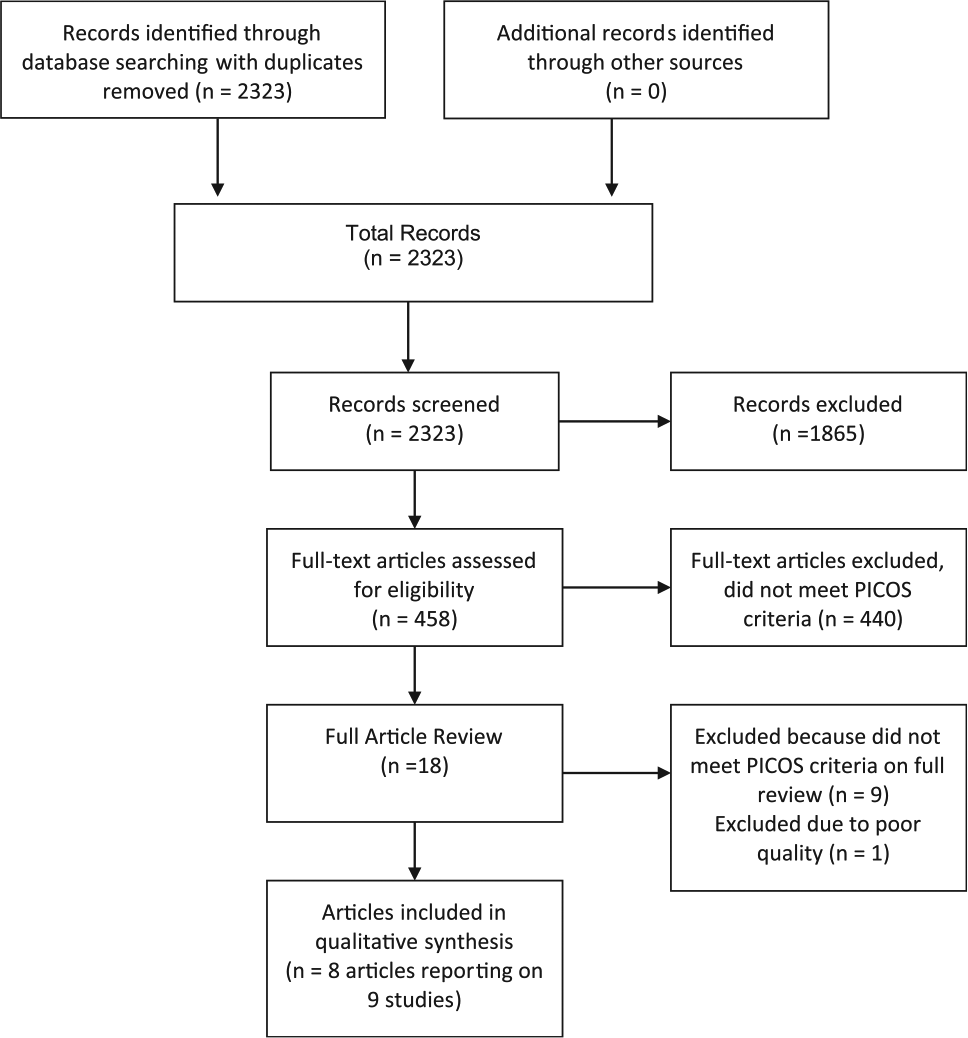
The flow diagram for article retrieval and review in the systematic review.
Study Characteristics and Quality
Of the nine studies identified, all were randomized controlled trials (Table 1). The studies varied with respect to the target population, clinical context, nature of the intervention, and primary outcomes. Eight studies involved patient or community member interventions and one study involved provider notification of patient health literacy level. Of the patient-focused interventions, three were among patients with hypertension (two in the emergency room setting and one in primary care), two among patients with diabetes, and one each of patients with the following diagnoses or presentations: glaucoma, heart disease, and depression. One study focused on nutrition education among community members in England. Outcomes evaluated included knowledge (n = 4), disease control indicators (n = 3), self-confidence (n = 1), medication adherence (n = 2), adverse drug events (n = 1), use of low literacy management strategies (n = 1), and clinician satisfaction and perceived effectiveness (n = 1). Of the nine studies reviewed, seven were rated as good quality and two as fair quality (Table 2). In the following, we summarize each study with additional study details provided in Table 1.
Summary of Included Studies

Note: HTN = hypertension; S-TOFHLA = Short Test of Functional Health Literacy in Adults; RCT = randomized controlled trial; HL = health literacy; DM = diabetes mellitus; REALM = Rapid Estimate of Adult Literacy in Medicine; DCC = drug consultative committee; CI = confidence interval; PCP = primary care provider; PHQ-9 = Patient Health Questionnaire–9; OR = odds ratio; ACS = acute coronary syndrome; IRR = incidence rate ratio. Quality criteria adapted from Berkman and others. 19 Categories included method of randomization, allocation concealment, creation of comparable groups, maintenance of comparable groups, health literacy valid measurement, outcome measurement, equal measurement across groups, blinding, statistical testing, power, and control of confounding.
Quality Assessment of Included Studies

Note: Quality criteria adapted from Berkman and others. Categories included method of randomization, allocation concealment, creation of comparable groups, maintenance of comparable groups, health literacy or numeracy valid measurement, outcome measurement, equal measurement across groups, blinding, statistical testing, power, and control of confounding. Overall summary assessment presented.
Results of Individual Studies
Positive Studies
Five studies had positive findings. In a study by Giuse and others, 93 patients with hypertension presenting to an emergency room were randomized to an experimental intervention versus usual care. 20 Health literacy was measured with the Short Test of Functional Health Literacy in Adults (S-TOFHLA). 3 The experimental group was given hypertension education materials tailored to inadequate, marginal, or adequate health literacy levels. Investigators developed core and supplemental versions of patient education materials about hypertension, written at the fifth- and eighth-grade reading level, respectively. The core set (given to those with inadequate or marginal health literacy) included the minimal information needed to answer hypertension knowledge questions and the supplemental set (given to those with adequate health literacy) included elaboration of the concepts presented. Patients with inadequate or marginal health literacy were given core materials. Those with marginal health literacy had the option of receiving supplemental materials. Patients with adequate health literacy were given core and supplemental materials. The control group received standard discharge instructions. The primary outcome was hypertension knowledge. The study reported statistically significantly greater improvement in knowledge scores among the experimental versus control groups.
In a second experiment by Giuse and others, 20 103 patients with hypertension presenting to the emergency room were randomized to receive an intervention tailored to both health literacy and learning style compared to usual discharge instructions. Health literacy was assessed with the Brief Health Literacy Test developed by Chew and others and categorized into inadequate, marginal, or adequate health literacy. 21 The primary outcome was hypertension knowledge. The study was positive, demonstrating a greater increase in knowledge in the experimental versus control groups. In both Guise studies, the control arm reflected usual care rather than a strategy of universal precautions for low health literacy.
In a study by Rothman and others, 22 217 patients with poorly controlled diabetes in a primary care clinic were randomized to a clinical pharmacist information session followed by an intensive disease management intervention from a diabetic care coordinator. The comparator group received only the initial clinical pharmacist information session followed by usual care. Health literacy was assessed with the Rapid Estimate of Adult Literacy in Medicine (REALM). 2 Both the pharmacist and team members were aware of the patient’s health literacy status with communication individualized by utilizing techniques to enhance communication among those with low health literacy. These techniques included predominant use of verbal education with simplified explanations of critical behaviors and goals, teach back techniques to assess patient comprehension, and use of picture-based materials. Of note, all literacy levels of the intervention arm received an enhanced intervention compared to usual care. The control arm received the initial clinical pharmacist information session followed by usual care but was not exposed to a strategy of universal precautions for low health literacy. The primary outcome was HbA1c. The study was positive, finding a greater improvement in HbA1c level, and achieving goal HbA1c systolic blood pressure in the experimental versus control groups.
In a study by Weiss and others, 23 70 patients with limited health literacy defined by a REALM score of less than or equal to 60 (indicating less than a high school reading level) and a diagnosis of depression were randomized to standard treatment of depression plus health literacy training or standard treatment of depression alone. Health literacy was measured by the REALM. 2 The health literacy skill training was provided by a detailed assessment of skills and the development of a learning plan that involves computer-assisted instruction, traditional text-based instruction, and self-paced learning modules. The program also offered employment skill training. The control arm received standard treatment but did not reflect a strategy of universal precautions for low health literacy. The primary outcome was control of depression as measured by the Patient Health Questionnaire–9. The study was positive with the experimental group demonstrating improved control of depression compared to the control group.
In a study by Seligman and others,
24
63 primary care providers were randomized to receive notification of the health literacy level of 182 patients with limited health literacy and diabetes or to not receive this notification. The notification including the following statement:
Your patient, Mr./Ms.____ has undergone a screening measure of functional health literacy in (English/Spanish) and was found to have (inadequate/marginal) health literacy. Patients with low levels of functional health literacy may be more likely to have difficulties understanding written health materials, following prescribed treatment regimens, or processing oral communication.
During the study period, some of the physicians had attended a local lecture on limited health literacy but there was no systematic training to improve physicians’ management of patients with limited health literacy. Health literacy was measured with the S-TOFHLA. 1 The primary outcome was the use of management strategies designed for low-literacy patients including involving patient family members or friends, referring to a diabetes educator, referring to a nutritionist, using pictures or diagrams, reviewing understanding of medications, or spending time educating about diabetes. These behaviors were used as a primary outcome because of evidence that physician visit–based behaviors are the most proximate intermediate endpoint through which screening for health literacy might affect patient outcomes.25,26 The control arm received usual care and was not exposed to a strategy of universal precautions for low health literacy. Secondary physician outcomes included visit-specific satisfaction and perceived effectiveness. The providers in the experimental group were found more likely to use three or more of the six recommended management strategies during the patient visit than those in the control group. Secondary outcomes indicated that providers in the intervention group were less satisfied with the visit and perceived the visit to be less effective than providers in the control group (Table 1).
Mixed Results (Positive and Negative Primary Outcomes) Study
In a study by Bosworth and others, 27 588 veterans with hypertension were enrolled in a randomized controlled trial. The study had mixed results with positive findings for the outcome of self-confidence but negative findings for the outcomes of hypertension knowledge or self-reported medication adherence. Baseline health literacy was measured with the REALM. 2 The experimental group received a nurse-administered hypertension counseling session administered by telephone. The patients identified as having low health literacy had their hypertension medication regimen explained verbally by the nurse at the first phone call and then anytime the regimen was altered. In addition, the patient’s regimen is explained to a family member/friend, the nurse reinforced the medication instructions, and provided information on the purpose of medications and the potential side effects. The control group received usual care and did not use a strategy of universal precautions to address low health literacy. Outcomes included knowledge, self-confidence, and self-reported adherence to medications. This study had mixed results. At the 6-month assessment, the experimental group had a greater increase in self-confidence with the treatment group that the control group. However, there was no difference between groups in hypertension knowledge or self-reported medication adherence.
Negative Studies
Three studies had negative results. In a study by Kripalani and others, 28 851 patients who were hospitalized with acute coronary syndrome or heart failure were randomized to receive pharmacist-assisted medication reconciliation, tailored inpatient counseling by a pharmacist, low literacy adherence aids, and individualized telephone follow-up after discharge. Intervention counseling was described as sensitive to the patient’s health literacy level. The control group received usual care and did not use a strategy of universal precautions to address low health literacy. The primary outcome was clinically important medication errors within 30 days. Health literacy was measured with the S-TOFHLA. 3 There was no difference in clinically significant medication errors within 30 days of discharge between groups
In a study by Muir and others, 29 127 veterans with glaucoma treated in ophthalmology clinic were randomized to receive videos scripted at the 4th-, 7th-, or 10th-grade level. Subjects who scored less than 60 on the TOFHLA (inadequate literacy) saw a video scripted at the 4th-grade reading level, subjects who scored 60 to 74 (marginal health literacy) at a 7th-grade level, and those who scored >74 (adequate health literacy) at a 10th-grade level and received an American Academy of Ophthalmology educational brochure at the 10th-grade level. The intervention group also received training in how to use the eye drops and a phone call once a month to ask if the patient had questions about the medication. The control group received standard care and did not include a strategy of universal precautions to address low health literacy. Health literacy was measured with the TOFHLA. 1 The primary outcome was medication adherence as measured by days without medication. There was no difference between groups in days without medication at 6 months.
Finally, in a study by Fine and others, 30 264 women aged 25 to 34 and of lower socioeconomic class in England were randomized to 3 groups: 1) video and booklet about nutrition, motivational material, and training materials in a simplified format if the patient was of low education and mathematical ability; 2) video and booklet only; and 3) no intervention. Education and math ability was measured at baseline. The primary outcome was nutrition knowledge. There was no difference found between groups in gains in nutrition knowledge before and after the intervention.
Discussion
In summary, of the nine studies identified, five were positive and rated as good quality, three were negative with two of those of good quality, and one had mixed results. A large number of studies have evaluated interventions that are designed for persons of low health literacy. 19 However, our review highlights that relatively few have both measured individual-level literacy at baseline and had a study design that tailored the intervention to the individuals’ level of health literacy. Furthermore, our review found no studies that compared an intervention arm tailored to individual level health literacy to universal precautions for persons of low literacy. Despite the limited studies identified, our analysis provides some support for a strategy of testing for and tailoring interventions to the level of health literacy. Furthermore, our findings provide insight regarding the efficacy of this approach across clinical contexts, target populations, and outcomes of interest.
Our review indicates that a strategy of tailoring communication to an individual’s level of health literacy may be effective in primary care settings when outcomes of disease knowledge and self-management of chronic disease are of interest. Study designs that focused on improving patient knowledge and disease management skills were positive or demonstrated mixed results. In the two experiments conducted by Giuse and others, 20 hypertension knowledge scores improved more in the group receiving educational materials tailored to health literacy level than the control group receiving standard discharge instructions. Previous research has found that discharge instructions are often written at a higher literacy level than the literacy skills of patients receiving the instructions.31,32 Of interest, 14% and 20% of the study population had inadequate or marginal health literacy in experiments 1 and 2, respectively. In the study conducted by Rothman and others, 22 the addition of educational sessions that were tailored to level of health literacy to a single clinical pharmacist consultation led to a significant improvement in HbA1c among diabetic patients. In this study, 38% of the study population had low literacy. The study by Bosworth and others 27 reports an increase in self-efficacy regarding hypertension management among the group that received nurse-administered counseling tailored to health literacy and other patient factors compared to a control group, although the study failed to demonstrate a difference in hypertension knowledge and adherence. The proportion of low health literacy in the Bosworth study population was not reported although 17% had a high school or less level of education. As a group, these studies suggest that tailoring the content of education and counseling interventions to the individual health literacy level of the patient may improve knowledge about chronic disease or indicators of chronic disease control.
The study by Weiss takes a very different approach than the other studies evaluated. Rather than an intervention designed to provide communication or education tailored to the patient’s level of skill, this study had an intervention designed to improve patient literacy. This strategy was found to have a positive impact on disease management of depression. Although health literacy is often analyzed as a trait, the field of adult learning suggests that both print and numeracy skills can be improved with education and training. 33 This study suggests that a strategy of testing for health literacy in the clinical setting and referral to adult literacy programs may have a positive impact on health outcomes.
Studies in our review that focused on medication adherence or adverse effects of medications were negative.28,29 These include the large study (n = 851) by Kripalani and others 28 that evaluated a literacy-sensitive pharmacy intervention among patients hospitalized with acute coronary syndrome or heart failure. The primary outcomes were clinically important medication errors including nonadherence, assessed by interview and self-report. One factor that may limit the generalizability of this finding is the low percentage (10%) of persons with inadequate health literacy in the study sample. This was lower than the estimated prevalence of low health literacy of 26% (95% confidence interval = 22% to 29%) in a systematic review. 34 A subset analysis indicates that participants with inadequate health literacy were more likely to incur a benefit from the intervention but the finding did not reach statistical significance and the study was not powered to measure this heterogeneity effect. A second negative study conducted by Muir and others 29 evaluated a literacy tailored educational intervention about glaucoma medication with a primary outcome of medication adherence assessed by review of pharmacy records and determination of days without medication. This study was negative, although 36% of participants had inadequate or marginal health literacy. This study also reports indications of heterogeneity with greater response to the intervention in the low-literacy subgroups but differences did not reach statistical significance. In summary, these studies indicate that medication adherence may less responsive to literacy-tailored educational interventions compared to knowledge and other behavioral outcomes.
One study in our systematic review targeted the physician. 24 The intervention involved clinician notification of low literacy in a patient. 24 The Seligman study indicates that notifying of patients with low health literacy increases their use of management strategies appropriate for low-literacy persons. 24 However, the study also identified unintended adverse outcomes including decreased satisfaction and perceived effectiveness of the visit.
This systematic review has some limitations. First, publication bias may lead to an overrepresentation of positive studies in the literature. Second, our study design sought to include interventions targeted to either print or numeric health literacy. These domains may differ in response to tailored approaches to communication. However, they each comprise domains of the general health literacy construct. Furthermore, several validated measures of health literacy are composite measures of print and numeric domains. 35 Inclusion of both print and numeric literacy in this systematic review was consistent with the objectives of this study. Third, we found no studies where the comparator arm used a universal approach to communication and behavioral interventions for low-literacy persons. The optimal study design to test a universal versus contingent strategy of providing health literacy–appropriate interventions would include arms with identical strategies with the addition of a tailored intervention for the experimental arm. Our design required a contingent strategy in the experimental arm but allowed for usual care in the control arm. Despite these limitations, this is the first systematic review to provide evidence supporting a contingent approach to low health literacy interventions. Additional studies including direct comparisons of contingent versus universal approaches are needed to determine optimal strategies for communication and behavioral interventions among persons with low health literacy.
In conclusion, we find a modest degree of evidence that tailoring health communication strategies to patient level of health literacy can improve knowledge, proximal indicators of disease control (such as A1c level in patients with diabetes), and disease control (depression). These outcomes may lead to a decrease in morbidity and mortality associated with chronic disease. The efficacy of a contingent approach to low literacy may vary with clinical context (primary care v. hospitalization), target of the intervention (patient v. physician), and outcomes evaluated (cognitive, behavioral, disease indicators, or adverse effects). This review highlights the need for evaluating not only proximal effects of communication but more distal effects on health outcomes. Our findings also identify the lack of head to head studies that evaluate a contingent versus universal strategy to address communication and behavioral interventions for persons of low health literacy. Given the potential to use health information technology to tailor interventions, selected use of literacy contingent strategies is one option to consider in the design of effective health care communication strategies.
Footnotes
Financial support for this study was provided in part by a grant from the American Cancer Society. The funding agreement ensured the authors’ independence in designing the study, interpreting the data, writing, and publishing the report.

References
Supplementary Material
Please find the following supplemental material available below.
For Open Access articles published under a Creative Commons License, all supplemental material carries the same license as the article it is associated with.
For non-Open Access articles published, all supplemental material carries a non-exclusive license, and permission requests for re-use of supplemental material or any part of supplemental material shall be sent directly to the copyright owner as specified in the copyright notice associated with the article.
