




Abstract
Objective
This scoping review aimed to synthesise research on the relationships between health literacy and adherence to physical activity guidelines in adults.
Data Source
A search of MEDLINE, ProQuest, Scopus, CINAHL, Web of Science (Core Collection), PubMed, and PsycINFO was conducted using keywords. Observational and intervention studies written in English were reviewed.
Inclusion and Exclusion Criteria
Eligible research studies used a validated, objective measure of health literacy. Physical activity needed to be reported as either a primary or secondary outcome, and groups needed to be dichotomised as physically active, inactive, or similar.
Extraction
Out of 2098 articles identified, 19 met the inclusion criteria.
Synthesis
A numerical analysis of the studies was performed. A narrative summary supplemented the analysis to synthesise the main themes and patterns.
Results
Fifteen studies examined the association between total health literacy scores and achieving >150 minutes of moderate-to-vigorous physical activity weekly. Nine studies reported a positive association, while others found no significant association. In particular, studies using self-reported physical activity more frequently found an association, whereas no association was found when using objective physical activity measures.
Conclusion
The findings of this review were inconclusive. The lack of a standardised health literacy instrument presents a barrier to progress in the field of physical activity and health literacy research. Moreover, longitudinal relationships between health literacy, mediators and physical activity must be investigated.
Objective
Health literacy (HL) refers to an individual’s capacity to navigate, understand, and use health-related information to manage their health.1,2 Low health literacy is linked to poor health outcomes, including higher mortality rates, medication non-adherence, and difficulties navigating health systems,3-5 and increased risk of unhealthy behaviours, such as physical inactivity. 5 Such associations make HL particularly important for public health and health promotion efforts.
Approximately one-third (31%) of the global adult population, or 1.8 billion people, are physically inactive. 6 Physical inactivity is a major modifiable risk factor of all-cause mortality, accounting for 6% of premature deaths worldwide.7,8 Reducing physical inactivity by 10% or 25% could prevent more than 533 000 and over 1.3 million deaths, respectively, each year. 8 Increasing physical activity (PA) prevents, mitigates, and ameliorates the effects of many non-communicable diseases, injuries, and associated comorbidities. 9 Furthermore, achieving the recommended levels of PA can reduce the risk of all-cause mortality by 75%. 10 While meeting the PA guidelines is attainable for most individuals, adopting and maintaining an active lifestyle also requires a combination of cognitive, behavioural, and self-regulatory skills to overcome motivational and scheduling barriers. 11 As efforts to achieve global PA targets continue, the nexus between HL and adherence to PA guidelines is becoming increasingly relevant.
Previous systematic reviews have concluded that there is a positive relationship between HL and PA levels across different age groups.12,13 However, these findings referred to an increase in PA irrespective of whether such an increase meets recommended PA guidelines. Although any increase in PA is broadly beneficial, typically, the interpretation of population surveillance data and the implementation of public health policy often centres on whether recommended guidelines for PA are met. By focusing on PA guidelines, the design of this study aligns with public health priorities; targeting the relationship between HL and the threshold of PA most likely to result in meaningful health improvements.
The variation in PA and HL measurement tools and the complex nature of the HL construct generally make comparing and synthesising findings across studies challenging.14,15 Scoping reviews, however, are particularly valuable in such cases, as they are well-suited to synthesise heterogeneous literature. 16 To our knowledge, no scoping review on HL and adherence to PA guidelines has been published.
This scoping review aims to identify and synthesise research on the relationships between HL and adherence to PA guidelines. Specifically, the proposed review seeks to answer the following review questions: (i) What is the association between HL and adhering to PA guidelines in the general adult population?; (ii) What HL constructs are being measured, and what instruments are used to assess them?; (iii) How does implementing HL interventions compare to no intervention or standard care impact adherence to PA guidelines in the general adult population?; and (iv) What are the patient and social-level factors suggested to influence the connection between HL and health numeracy, and adhering to PA guidelines?
Method
This scoping review followed the Joana Briggs Institute (JBI) approach to scoping reviews. 17 The JBI approach was used for its methodological quality and the availability of tools to guide scoping reviews. 18 The research team developed the review protocol and registered with the Open Science Framework on the 20th of February 2024 (https://osf.io/smqfj). This report was written using the Preferred Reporting Items for Systematic Reviews and Meta-Analyses Extension for Scoping Reviews (PRISMA-ScR) checklist. 19 To identify the key concepts relevant to the primary research question, “What is the association between health literacy and physical activity in the general adult population?” we used the Population, Concept, and Context (PCC) framework recommended by the Joanna Briggs Institute.
Eligibility Criteria
The review included observational or intervention studies written in English and involved the general adult population (18 years or older). The English language restriction was due to resource constraints. Studies with adults and children were considered if they reported data separately for adults. However, studies focused exclusively on adolescents or children were excluded.
Eligible research studies used a validated, objective measure of HL. Studies that relied upon self-assessed measures, where participants estimate their HL levels, were excluded as these assessments are generally intended for use in clinical settings rather than research purposes. For intervention studies, HL needed to be objectively measured both at baseline and after the intervention and show improvements to be included. 20
To qualify for inclusion, PA needed to be reported as either a primary or secondary outcome, and groups needed to be dichotomised as physically active or inactive or similar. Self-reported measures of PA were accepted due to their widespread use in large-scale observational studies and the application of standardised thresholds (eg, ≥150 minutes of PA per week). For this study, people who do not meet recommended levels of regular PA were defined as “physically inactive”. Where pedometers were used to measure PA, participants must achieve at least 7000 steps per day to be considered sufficiently active.
Information Sources
The search strategy followed the Peer Review of Electronic Search Strategies standard. 21 An initial search on PubMed was performed to identify relevant articles based on keywords in titles, abstracts, and index terms. Subsequently, a Health Sciences Librarian assessed the strategy to balance breadth, comprehensiveness, and feasibility. A search strategy was then tested on PubMed to verify and refine the search query as needed to ensure it captured a significant number of relevant studies. Once finalised, the strategy was adjusted to suit other databases’ syntax and subject headings. Validations and updates continued throughout the review process to maintain the effectiveness of the PubMed search strategy. The following bibliographic databases were searched: MEDLINE, ProQuest, Scopus, CINAHL, Web of Science (Core Collection), PubMed, and PsycINFO. The search was unrestricted by date. To achieve literature saturation, we examined the reference lists of included studies and relevant reviews identified during the search process.
Selection of Sources of Evidence
The results of each review were exported to EndNote 20 (Clarivate Analytics, PA, USA) to remove duplicates. The remaining articles were imported into Covidence (https://www.covidence.org/) for further duplicate detection. One reviewer screened the titles and abstracts; potentially relevant articles were retrieved in full and added to Covidence. Two independent reviewers assessed the full texts against the inclusion criteria, with any exclusions documented according to JBI guidelines. Discrepancies were resolved through discussion or by consulting an additional reviewer. The search results and study inclusion process are presented using the PRISMA-ScR flow diagram (Figure 1). Flow Diagram of the Article Selection Process according to the PRISMA-ScR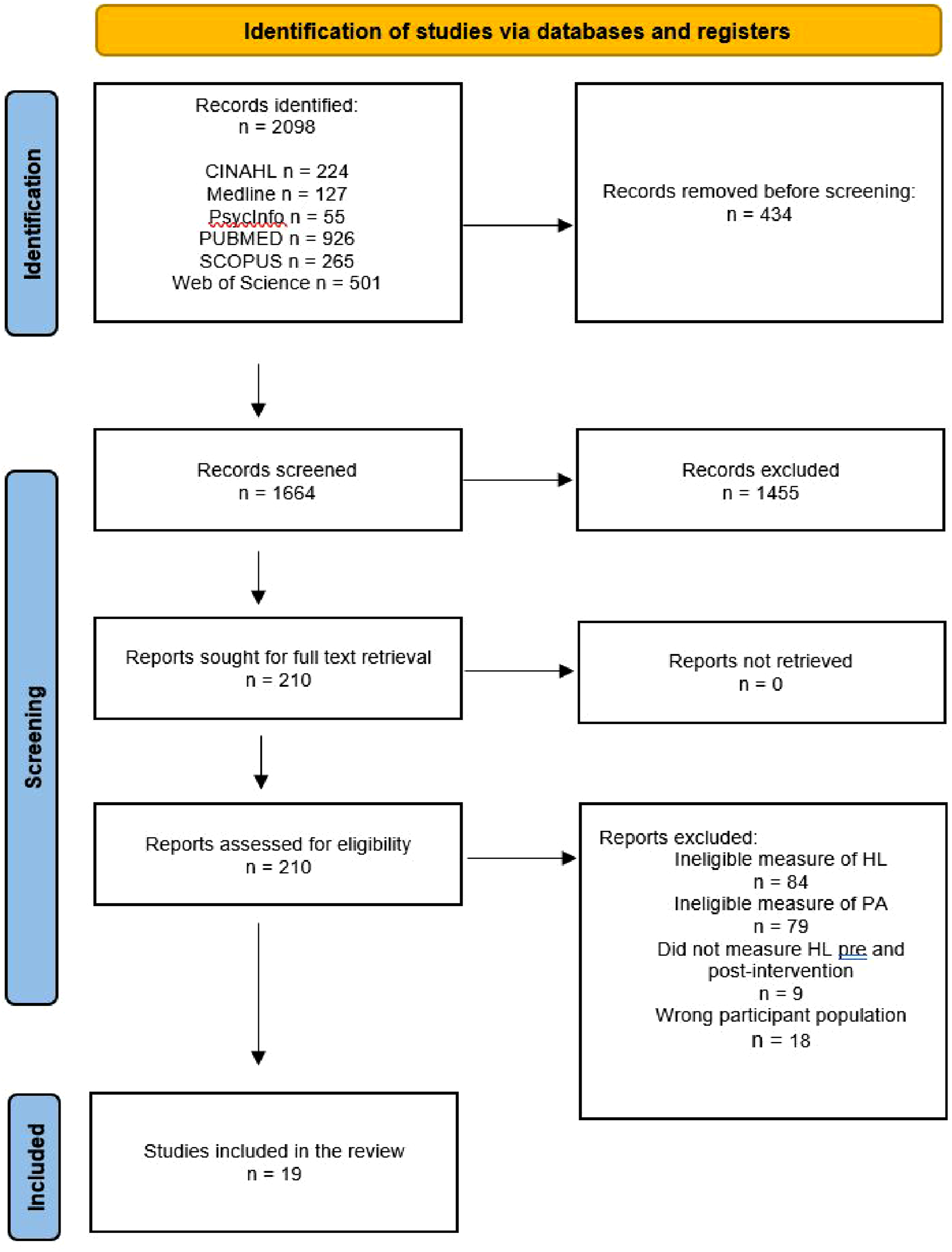
Data Extraction
The Joanna Briggs Institute standardised data extraction form guided data extraction from each included study. The data extraction form was piloted on a small subset of studies to ensure clarity, completeness, and consistency in data collection. The form was refined based on issues identified during this pilot phase. Data extraction was performed independently by one reviewer (AL). The reviewers were not required to contact study authors or investigators to clarify any ambiguous or missing data. The reason for exclusion has been noted and described in the PRISMA flow diagram (Figure 1). Consistent with guidance on scoping reviews, no methodological quality appraisal of the included studies was performed.
Data Analysis
A numerical analysis of the nature and extent of the studies was performed. A narrative summary supplemented the analysis to synthesise the main themes, patterns, and conclusions from the review, explaining how the results align with the review’s aim and questions.
Results
The selection of sources of evidence is illustrated in Figure 1. A total of 2098 articles were identified from a search of electronic databases. After removing 434 duplicates, 1664 titles and abstracts were screened. Full texts were retrieved for 210 studies, of which 191 were excluded for reasons such as not adequately measuring HL (n = 84), did not measure HL pre- and post-intervention (n = 10), including the wrong participant population (n = 18), and issues with validity, alignment with guidelines, and classification of PA (n = 79). A total of 19 articles met the inclusion criteria and were included in the review.
Study Characteristics
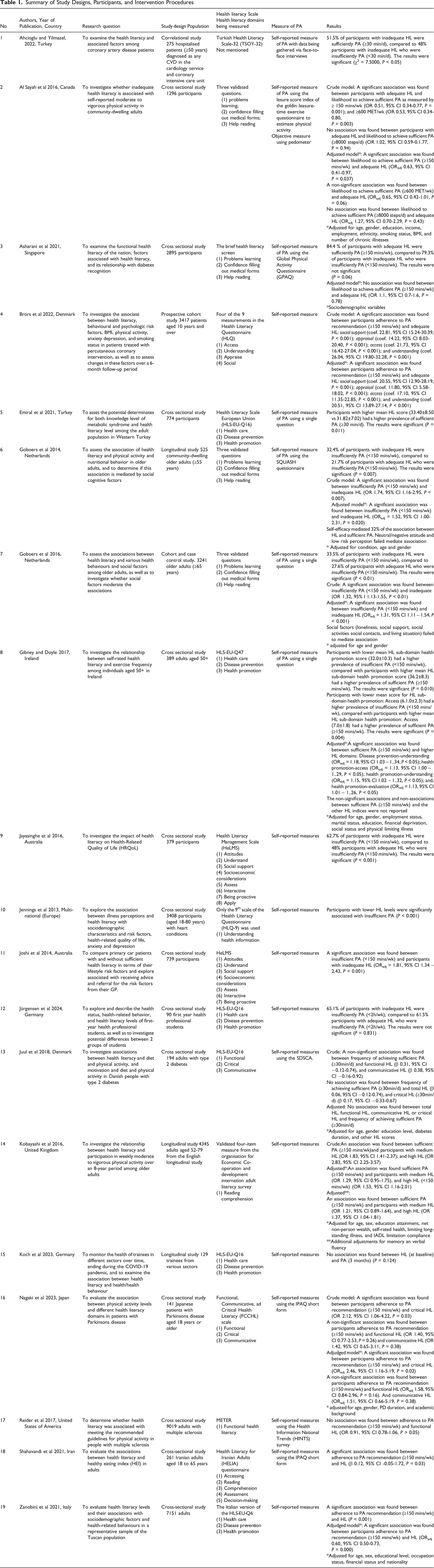
Summary of Study Designs, Participants, and Intervention Procedures
Health Literacy
Various HL assessment tools were used in the included studies. Of the 19 studies, 3 used only a portion of a survey.27,37,38 Most studies used a version of the European health literacy survey (HLS-EU), including the HLS-EU-Q16 (n = 4),24,29,30,36 HLS-EU-Q47 (n = 1), 25 and the Italian version of the HLS-EU-Q6 (n = 1), 34 The Brief Health Literacy Screen was utilised in 4 studies.22,23,35,40 Two studies used the Health Literacy Questionnaire (HLQ-9); however, neither study used the entire scale. Specifically, Brors, Dalen 38 used 4 of the 9 measurements: accessing, understanding, and appraising health information and the availability of social support to assist in managing health. Jennings, Astin 27 only measured understanding of health information. The Health Literacy Management Scale was used in 2 studies.26,28 The Medical Term Recognition Test, 32 the Turkish Health Literacy Scale-32, 39 the Newest Vital Sign, 39 the Organisation for Economic Co-operation and Development International Adult Literacy Survey, 37 the Health Literacy for Iranian Adults tool, 33 and the Functional, Communicative, and Critical Health Literacy Scale 31 featured in 1 study each.
Physical Activity
Eighteen studies relied on self-reported measurements of PA. Of these, 12 used a direct question,24-29,34,36-40 1 used the Global Physical Activity Questionnaire, 23 1 used the SQUASH questionnaire, 35 1 used the SDSCA questionnaire, 30 and 2 employed the IPAQ short form.31,33 Additionally, 1 study utilised the Health Information National Trends Survey. 32 One study combined both an objective measure, using a pedometer, with a self-reported measure of PA, specifically the Leisure Score Index from the Godin Leisure-Time Exercise Questionnaire. 22
Findings
Fifteen studies examined the association between total HL scores and PA of ≥150 minutes of MVPA per week. Nine studies found a significant positive association between PA and HL,22,24,26-28,33-35,40 while 4 studies found no such association.23,29,30,32 One study reported a significant association using unadjusted odds ratios, but this association became non-significant after adjusting for covariates. 37 Another study found that individuals with inadequate HL were more likely to engage in sufficient PA. 39
One study specifically explored the relationship between PA of ≥600 MET and HL. 23 The unadjusted model indicated a significant association, but this association was no longer significant after adjustment for covariates. No association was found between adequate HL and the likelihood of achieving sufficient PA (≥8000 steps/day) in either crude or adjusted models.
Five studies investigated the relationship between PA of ≥150 minutes per week and a specific subdomain of HL. One study consistently found significant associations between PA and the subdomains of social support, appraisal, access, and understanding in both crude and adjusted models. 33 Communicative HL was found to have a non-significant association with PA in 2 studies using unadjusted models; however, both studies reported no association when using adjusted models.30,31 Three studies examined functional HL. Two reported non-significant associations in crude models30,31 and 1 found no association. 32 Only 2 of these studies used adjusted models, and both reported no association.30,31 One study focused on 3 HL domains: Disease Prevention, Health Promotion, and Healthcare, each with 4 sub-indices: Accessing, Understanding, Evaluating, and Applying. 25 Significant findings were reported only for Health Promotion (combined), Disease Prevention: Understanding, Health Promotion: Accessing, Health Promotion: Understanding, and Health Promotion: Evaluating. 25
No studies reported on the direct relationship between health numeracy (HN) and adherence to PA guidelines. One study investigated if self-efficacy, neutral/negative attitude and low-risk perception mediated the relationship between HL and sufficient PA. 35 Self-efficacy mediated 32% of the association between HL and sufficient PA, while neutral/negative attitude and low-risk perception did not show as mediators. 35
Discussion
Summary of Key Findings
This scoping review aimed to identify and synthesise existing research on the relationship between HL and PA. This review builds on previous work,12,13 explicitly focusing on HL and its relationship with adherence to PA recommendations. However, the findings of this scoping review are inconsistent with previous work.12,13 This discrepancy may be attributed to differing inclusion criteria or publication timelines. Three studies not documented by Buja 12 were identified in this review.25,26,32 Considering that this search, which has a narrow focus on PA guidelines, identified missed studies, it is plausible that previous evaluations may have overlooked further research outside this review’s scope. Furthermore, half of the studies included in this review were published after Buja. 12 Considering the concept of HL is changing and increasing in complexity, more recent studies might indicate a shift in the relationship between HL and PA. Therefore, this review may provide a new viewpoint on the impact of HL on PA, reflecting the changing nature of HL itself. Nevertheless, the changing concept of HL is improbable in explaining the disparity in our results, as previous studies also documented substantial variation in the measure of HL between studies.12,13
The most likely explanation for the variation in results is in the measurement of the PA. This study specifically reviewed adherence to PA guidelines, while other studies included a broader range of PA measures, including PA level (low, moderate, high), mean PA, and PA intensity (light, moderate, vigorous). PA guidelines are intended to be easy to understand. Compared to self-directed PA, the relative simplicity of following set guidelines may help explain differences observed in the findings.
The results of our review suggest that there is some evidence to support an association between HL and PA. Compared with individuals with low HL, people with adequate HL were more likely to comply with PA recommendations and maintain a more active lifestyle. Nevertheless, all of these studies depend on self-reported PA data, which is susceptible to recall bias and inaccuracies in documenting actual PA. 41 This implies the necessity of exercising caution when interpreting the results and restricts the reliability of the findings. Therefore, although some evidence suggests an association between HL and PA, the dependence on self-reported data introduces constraints that must be resolved in subsequent research.
Interestingly, the only study that used an objective measure of PA reported no association between HL and PA. 22 This is a key finding that contrasts with studies relying on self-reported data. An explanation for this may be the role of self-perception in HL. Individuals with higher HL might report PA levels that align more with health recommendations, even if their actual activity levels do not differ significantly from individuals with lower HL when measured objectively. Another explanation is HL may influence how PA is reported in self-report questionnaires. Participants with inadequate HL might have underreported their actual PA compared to those with adequate HL, potentially due to misunderstanding or misinterpreting the questions. Overall, the evidence on the relationship between HL and PA remains inconclusive. While there is some indication of a link, the current body of research is insufficient to draw any conclusions.
Gaps in the Literature and Future Recommendations
Most studies are cross-sectional, limiting conclusions about causality between HL and PA. Longitudinal or intervention studies would provide stronger evidence for causation. Future studies should prioritise longitudinal studies to progress knowledge of the interaction between HL and adherence to PA guidelines. Moreover, none of the intervention studies satisfied the inclusion requirements, indicating a gap in the research that should be addressed.
Half of the studies in our review used multivariate logistic regression analysis. This approach enhanced the clarity of the results by accounting for various confounders and allowed for the measurement of odds ratios, which quantifies the strength of the association between each predictor and the outcome, making the results easier to interpret. 42 However, the selection of confounding variables varied across studies, which complicated synthesising the overall findings. Furthermore, some studies controlled for factors that may lie within the causal pathway. Factors like knowledge and income might mediate the relationship between HL and health outcomes. This “overadjustment” could have underestimated the true effect of HL by masking its direct influence on PA.
Only 1 study in this review actually investigated possible mediating effects, identifying self-efficacy as mediating the relationship between HL and PA. This finding is consistent with previous empirical studies that found that self-efficacy mediates HL and self-care behaviours. 43
HN has often been overshadowed in broader discussions of HL, either being considered a subset of HL or ignored entirely. Defined as “the degree to which individuals have the capacity to access, process, interpret, communicate, and act on numerical, quantitative, graphical, biostatistical, and probabilistic health information needed to make effective health decisions”, 44 HN might be particularly relevant to PA behaviours. For instance, setting goals, such as achieving 10 000 steps daily or following public health guidelines on PA, are mainly numerical. Without adequate HN, individuals may struggle to effectively manage and maintain appropriate levels of PA. Future research exploring the relationship between HN and adherence to PA guidelines is needed, as it may offer valuable insights into how numeracy skills influence PA behaviours and inform more effective health promotion strategies.
This gap in the evidence base is particularly striking given the global policy emphasis on health literacy. There is a critical need for pragmatic, well-funded research, particularly real-world evaluation studies, to assess whether and how HL and HN interventions translate into measurable improvements in population-level PA.
Strengths and Limitations
Our study has several strengths. First, the extensive search strategy makes it unlikely that any significant studies were missed. Additionally, the low risk of bias from selective reporting strengthens the study’s objectivity, as many published studies show no relationship between HL and compliance with PA recommendations. However, there are some limitations. This review did not assess the methodological quality of the selected studies, which restricts our ability to assess the overall findings. Furthermore, including only English-language articles may have excluded important studies published in other languages, potentially introducing a language bias and limiting the generalisability of the results.
Conclusion
To our knowledge, this is the first scoping review exploring the association between HL, HN and adherence to PA guidelines in adults. Despite the growing prevalence and importance of HL research, this scoping review reports substantial heterogeneity in the measure of HL, making it difficult to confidently conclude that HL is associated with adherence to PA guidelines in adults. This finding is particularly striking given that HL has become a dominant feature of healthy public policy. Future studies should prioritise the inclusion of HN, adopt longitudinal designs, standardise HL measures, and explore potential mediators such as self-efficacy through intervention-based research. The findings from this review reinforce the need for further research to better understand the association between HL and PA. The review’s inconclusive results suggest that there is not yet a consistent link between HL and compliance with PA guidelines. This raises concerns about assuming that improving HL alone will significantly enhance PA. Although this review was restricted to adherence to PA guidelines, the mixed results presented in this review may also extend to other areas of behaviour, such as diet adherence and lifestyle change. Policymakers should therefore be cautious when relying on HL as the primary driver of interventions aimed at raising population PA levels to meet guidelines. In practice, healthcare professionals should continue to acknowledge HL in the provision of services. However, when implementing strategies to improve PA adherence, focusing on approaches with a stronger evidence base, such as goal setting, might offer a more reliable solution.So what?
Implications for Health Promotion Practitioners and Research
Supplemental Material
Supplemental Material - The Relationship Between Health Literacy and Adherence to Physical Activity Guidelines in Adults: A Scoping Review
Supplemental Material for The Relationship Between Health Literacy and Adherence to Physical Activity Guidelines in Adults: A Scoping Review by Alex Lawrence, Jon Wardle PhD, and Jacqui Susan Yoxall in American Journal of Health Promotion
Footnotes
Author’s Note
This scoping review is part of a Master’s by Thesis program being completed by AL, which is intended to matriculate to a PhD.
Acknowledgments
We would like to acknowledge the support from our institution’s faculty library department.

Author Contributions
All authors contributed to the development of the scoping review question. AL designed the initial search strategy in collaboration with co-authors JW and JY. AL conducted the initial database search. JW and JY served as second reviewers for abstract and full-text screening or third reviewers, resolving any conflicts as needed. AL performed the data analysis and drafted the initial manuscript, with all authors reviewing subsequent drafts and approving the final manuscript.
Funding
The authors received no financial support for the research, authorship, and/or publication of this article.
Declaration of Conflicting Interests
The authors declared no potential conflicts of interest with respect to the research, authorship, and/or publication of this article.
Data Availability Statement
The datasets used and/or analysed during the current study are available from the corresponding author on reasonable request.
Supplemental Material
Supplemental material for this article is available online.
References
Supplementary Material
Please find the following supplemental material available below.
For Open Access articles published under a Creative Commons License, all supplemental material carries the same license as the article it is associated with.
For non-Open Access articles published, all supplemental material carries a non-exclusive license, and permission requests for re-use of supplemental material or any part of supplemental material shall be sent directly to the copyright owner as specified in the copyright notice associated with the article.
