



Abstract
This manuscript includes abbreviated remarks from the Integrative Research Review panelists at the 74th Annual Conference of the Literacy Research Association.
Introduction
At the 74th Annual Conference of the Literacy Research Association, the Integrative Research Review Panel responded to the Association's call for literacy research that critically examines the consequences of oppressive versus liberating literacy policies and practices. The panel convened five scholars—Kate Kedley, Aria Razfar, Regina Ciphrah, and Zhihui Fang with Brittany Adams—whose diverse research foci, designs, and methodologies collectively contribute to providing a primer in circumventing dominant paradigms of literacy research with empowering, sustainable literacy development and practice. Engaging with community members, youth, families, and colleagues across disciplinary divides, each project builds capacity to provoke “good trouble, necessary trouble” (Lewis, 2014). The following are abbreviated remarks from each panelist's presentation.
Writing the Wor(l)d: Reclaiming Public Spaces and Reputations for Youth in Honduras
Kate Kedley
The 2024 LRA conference theme focused on “empowerment literacy(ies).” To illustrate “good trouble” and “actuat[ing] agency,” I share a literacy research project where Honduran youth “reclaimed public spaces” from state and community violence by occupying street-corners with poetry, music, and performances. Honduras has high rates of violence and migration to the United States and other international locations (CNN Staff, 2014), and these Honduran youth hope to associate public spaces with art as opposed to fleeing violence and oppression. With the purpose of reading and writing “word” and the “world” (as Freire and others have proposed), this project intended to disrupt oppression through writing, reading, and public performance. The national, racial, economic, linguistic, and other power dynamics in this project prompted a perpetual pursuit for a literacy-based social justice project in a transnational, multilingual space. Furthermore, because the Honduran state has been (since a 2009 coup d’état and before) antagonistic toward artists and activists, this reclaiming movement is “buenas problemas” in terms of resistance, and offers the larger North American teaching and educational audience a dynamic view of Honduran youth, one that goes beyond their identification by the media and politicians as “nacros,” “gang members,” and “migrants.”
Background, Positioning Statement, and Ethical Considerations
There are many obvious and recent connections between Honduras and the United States, such as sweatshop scandals (the Kathie Lee Gifford and Wal-Mart child labor scandal in the 1990s), our breakfasts (Honduras is the original “banana republic,” but also coffee and sugar are exported out of Honduras), and migrant caravans and the current and continuous attack on immigrants to the United States by both major political parties and all presidential administrations. Beyond that, there is a centuries long history of strong economic, educational, and historical ties between the United States and Honduras.
However, these historical and contemporary links aren’t the only reason to study critical and community literacies in Honduras. Critical pedagogy is especially appropriate for a study with a setting in Latin America because of the history of revolutionary culture and literacy campaigns there (Morrell, 2013). Alternative forms of education, including literacy education, literacy campaigns, popular education, and education via alternative methods of delivery (such as radio usage) occupy important roles Latin America in terms of both education and political formation. Morrell (2008) also notes that “Latin America and the Caribbean have offered some of the best examples of the relationships between literacy praxis and social revolution,” but have otherwise been absent from critical and postcolonial discourses. Ethically, it has been important to remember that academic research, especially when conducted by a researcher from the Global North working in the Global South, “is not an innocent or distant academic exercise but an activity that has something at stake and that occurs in a set of political and social conditions” (Tuhiwai Smith, 2014). Because “there can, of course, be no apolitical scholarship” (Mohanty, 2002), as researchers and planners of the project we were intentional in our planning and execution as we strove to be critical and transformative.
In Honduras, I am identified by others most closely as a member of a historically colonizing entity—the white English-speaking United States—militarily, economically, and culturally. Though my identity is linked closely with the imperial center (the United States), it rarely results in anything other than positive opportunities. As a researcher, I’ve been enthusiastically invited where Honduran scholars have been excluded. My whiteness and US citizenship often allowed me to talk myself out of dangerous situations in ways my Honduran colleagues can’t.
However, there is also, especially in activist circles, a suspicion of white people from the United States and our objectives for being in Honduras, ranging from the idea that I am there to help advocate for English-language private or charter schools or as a religious missionary. There have been several spaces (especially early on in my research) where teachers went through a series of checks to make sure I wasn’t connected to the CIA, as they had known people who were “disappeared” in the 1980s.
The photograph in Figure 1, I took on May 1, 2007, long before I was a researcher in Honduras, on a May Day (International Workers Day) march I participated in with a group of queer Honduran activists. I keep it in my office to remind me of the harm people from the Global North have done in the Global South. I also remember what a Honduran public-school teacher told me years later in 2012. He asked me to remember that I wasn’t needed or even asked to be in Honduras, to research education; Hondurans generally want the “gringos afuera.” However, if I decided I would do literacy research in Honduras, then I should address and challenge the power imbalance the United States contributes to in that space.
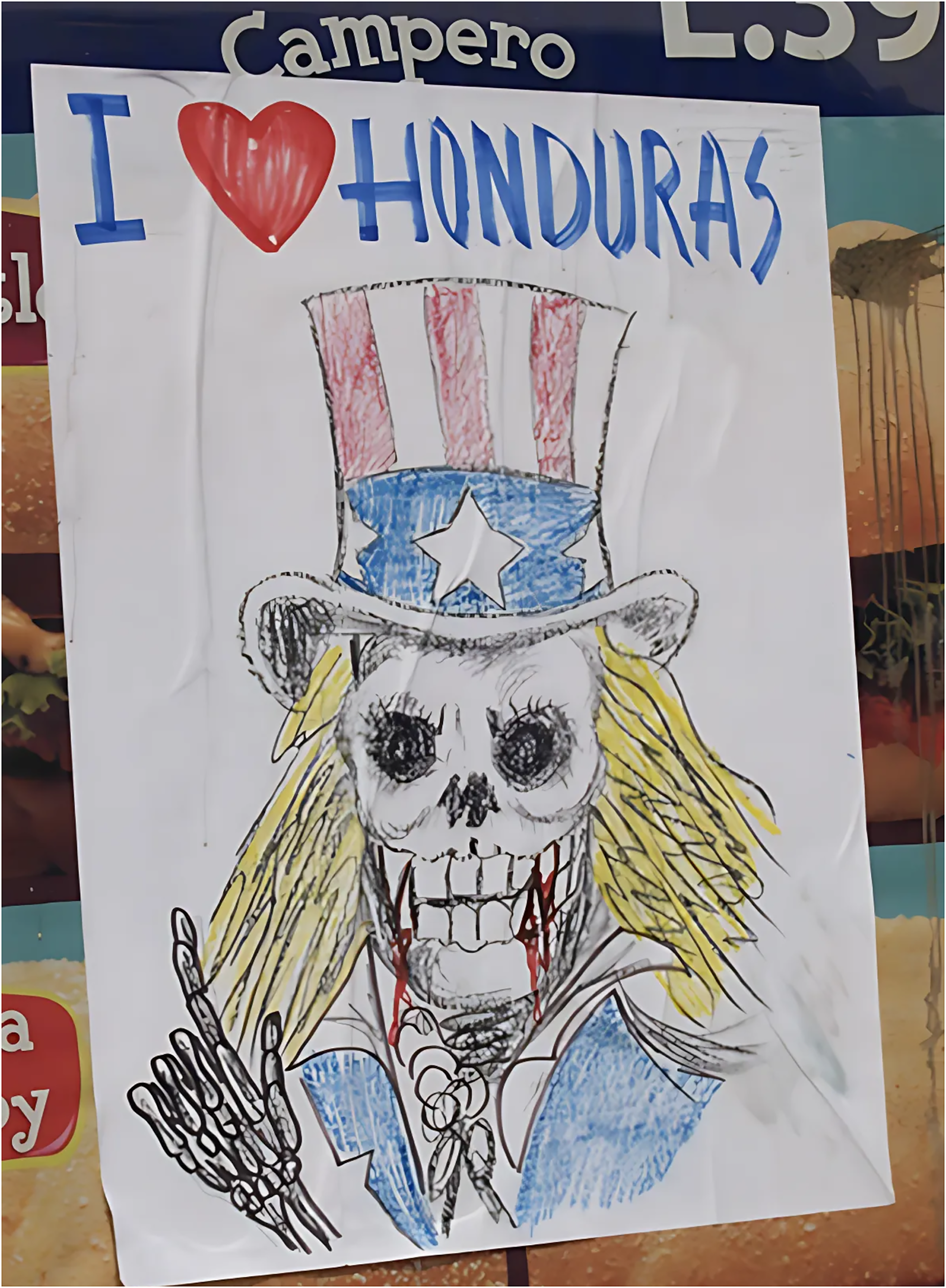
Photo of graffiti art in San Pedro Sula, Honduras.
These conversations led to the following research questions in this continuing project.
RQ1: How can a critical literacy project in Honduras disrupt the framing of Honduran youth as delinquents and criminals and public spaces as violent? RQ2: How do binaries often inherent in research (e.g., activist-academic, community-campus, researcher-community partner, etc.) complicate the ideas of reciprocity? RQ3: How can the knowledge generated by the collective address the inequities that colonization, imperialism and exploitation from my country (the United States) has contributed historically to?
Methods, Data Sources, and Theoretical Framing
There are three theoretical lines I drew from when speaking the LRA 2024 panel. First, publicly engaged scholarship suggests that community research should be reciprocal and mutually beneficial (Bringle & Hatcher, 2011; Fitzgerald et al., 2012). Second, La Sistematización is a methodology fairly unique to Latin America. It is a process of documenting, analyzing, critiquing, and learning (from multiple perspectives) everything that happens during the research. La Sistematización is different than an ethnography in that it focuses more on practicalities of the process and learning from experiences based on the changing needs and realities of the people and the communities, and not cultural analysis through qualitative research methods. Finally, in terms of critical literacies, we looked for opportunities for praxis. We defined praxis as the ability to (1) read the word and (2) read the world and (3) act to address those inequities discovered in the readings (Freire, 1976).
My relationship with Honduras began before 2012, but it wasn’t until then I began to spend time in Honduras as a “researcher.” For the purposes of the LRA 2024 panel, I focus on data gathered from 2017 to 2020. In 2017 and 2018, I co-organized, planned, and implemented workshops for youth that focused on poetry, photography, prose, and other creative and writing arts with Honduran teachers and activities. This led to 2-week-long encuentros, or gatherings, in 2019 and 2020. With an internal grant from my university, we invited 30 poets, artists, musicians, and authors to travel to Honduras from other Latin American countries, and explored those ideas of youth as criminals, public spaces as dangerous, and how to counter both. Another data source that youth organized and participated in were “Analyses of Reality,” where we shared and brainstormed about the situation in Honduras, which at the time had high rates of violence partly due to the president being linked to drug-trafficking. He is currently in US Federal prison (U.S. Department of Justice, Office of Public Affairs, 2024). One of the larger “Analyses of Reality” meetings was an “alternative dialogue” organized by the teachers’ and the medical doctors’ professional organizations and unions, who refused to recognize the legitimacy of the government workings.
In an attempt to reclaim identities and public spaces, the youth filled park corners, or stopped traffic, and read prose and poetry and played music and sang. We also went to prisons for performances and schools when the teachers were striking to prevent the government from taking the schools over and occupied them. The teachers and activists called these types of events Formacción, which is a play on the Spanish words for (political) formation and action.
And finally, as we realized there was an interest in a more permanent space, we collected books for a small library. Honduran teachers and activities showed films at night on the side of the building. Several of the young poets wrote collections of poetry and drew art, and we printed them in the United States and shipped 100 s of copies the authors could share with their families and friends or sell for a small fee. Women and LGBTQ people wanted specific places to do these activities and voice their unique needs. Finally, some of the people expressed an interest in maintaining connections to the Tolupan and Garifuna indigenous communities, and one Honduran teacher-activist started working with a Tol speaker to write a poetry book in Tol (though because they only have an oral language, it was using Spanish script).
Thus, that data corpus continues to grow, but currently contains the following, primarily gathered during the above listed events and activities:
Reflective Field Notes (from 2012 on…) Interviews with (over 200 teachers, educators, etc.) Observations (from events such as primary, secondary, and university classes, union meetings, community gatherings, etc.) Artifacts (from newspapers, pamphlets, graffiti, protest signs, etc.) La Sistematización (a growing document with reflections and critique used to plan the future) Social Media Posts and Messages (both solicited and observed)
How Can a Critical Literacy Project in Honduras Disrupt the Framing of Honduran Youth as Delinquents and Criminals and Public Spaces as Violent?
When they are not framed by the Honduran state and international media as delinquents, criminals, migrants, and gang members, Honduran youth are often referred to as ni-nis (a neither-nor, indicating they are neither studying, nor working) because of the lack of opportunities available for them in schools or in the workforce. However, the connotation of ni-ni puts the weight of the fault for “neither studying, nor working” on the individual youth themselves and ignores the global context which limits their options and contributes to instability and violence in Honduras.
The Honduran youth's interest in writing, learning, producing, and sharing during the workshops contrasted this descriptor. The youth scrambled to be the first to read aloud to the group, and well after the workshops were over, continued to actively participate when we sent out prompts via social media or messaging apps, such as “Write a 10-line poem expressing what you think is a ‘public space’” or “write something about the phrase ‘breaking down barriers’.”
I asked participant Rolando in an interview: “How did these activities help you think about yourself as a cultural creator?” He answered “Of course, they helped me personally, and I also decided to launch my own social media page to publish my poetry.” Another participant—a teen girl named Ani—wrote to me privately on social media and said “I have received messages from other young people who are about my age, saying they wanted to participate in what we have been doing… and they want to find a space where they can be free.”
The participation and maintenance of the creation and maintenance of literacy spaces contrasts with the idea of the negative connotation of ni-ni—neither going to school nor working—and disrupts the framing of these youth as one-dimensionally having of lack of ambition and criminal tendencies.
How do Binaries Often Inherent in Research (Activist-Academic, Community-Campus, Researcher-Community Partner, etc.) Complicate the Ideas of Reciprocity?
From the onset, the intent of this project was to question and challenge the borders and binaries often inherent in academic research projects, especially relative to reciprocity. In 2017, Honduran educator and activist Hector Flores and I published an article on the topic of reciprocity in publicly engaged research projects (Kedley & Flores, 2017). Through the process of writing and working with him for years, where I conceptualized myself as the “researcher” and him as the “community partner,” I realized he conceptualized not only me, but himself and the youth as the researchers and knowledge producers. I was seeing this project in the binaries I had intended to avoid, such as academic-activist, community-campus, and researcher-community partner.
We moved forward thinking that instead of “building” bridges between our communities (which indicates we were in fact, two-sided, or settled within a binary). Flores said our focus must be built on the idea that “the academic must therefore renounce the privileges allowed by the institution and assume the conditions that communities allow.” Thus, we intended to “burn” bridges in a way that makes it so they are no longer necessary, because we would be one entity working toward the same goal or reading the word and world, and action up the inequities we uncovered in that process.
How Can the Knowledge Generated by the Collective of These Projects Address the Inequities That Colonization, Imperialism, and Exploitation from my Country (the US) has Contributed Historically to?
Sometimes the production of research through peer-reviewed articles isn’t the most important objective for communities, and university researchers are asked to participate or contribute to activities outside that tradition. For example, the Jesuit radio station in Honduras invited me to participate in satirical sketches that critiqued the Honduran narco-dictatorship and the US's support of it, where I played the role of the “gringo businessperson,” “American missionary,” or the “US ambassador.” I also served as an international observer for two presidential elections there (2013 and 2021) where I accompanied teachers and documented and reported on police abuse, tear gassing, and irregularities on the elections run by the narco-state. I was asked to create a study guide for a children's book (Christopher the Ogre Cologre, It's Over) by Central American, Chinese, and American author and scholar Oriel Maria Siu. Finally—I write expert witness testimony for asylee seekers from Honduras to the United States, fleeing violence and poverty. In the 2024 calendar year I have testified in court for a child with spina bifida, deaf twins, an Afro-Indigenous transwoman, and a gay, HIV+ man, among others.
These alternative products stemming from the research project, addressing the role of the United States in Honduras is only possible because of the knowledge generated in educational and creative spaces that I was privy too. Cruz, for example, ended his poem with these lines, which alludes to the influx of weapons and militarization funded by the United States: “Daily, we ask for more books, and we wait for the guns to go away, that like a cancer, gnaw at us, poison us, and cause us harm.”
At the conclusion of over a decade of research in Honduras, and within the current attack on Central Americans and migrants to the United States, these products seem more impactful than any other contributions I have given to these projects. And none of them would be possible if that public school teacher had not sternly told me how little they needed yet another North American researcher.
Special Thanks to: As partners in this work, I would like to thank the following individuals for their contributions. From El Progreso in Honduras, I would like to thank Abg. Prisila Alvarado Euceda, a human rights lawyer and activist; Licda. Lilian Andino, a public school teacher & union leader; Abg. Hector Efren Flores Asiego, an arts and culture director; Licda. Karina Flores, a disability rights activist and Spanish language interpreter; and Cristian Murillo, MSc, a disability rights activist. I would also like to thank Kyleigh Pope, MS, CCC-SLP, a speech language therapist based in Philadelphia, United States, and Oriel Maria Siu, PhD, an ethnic studies scholar and author in San Pedro Sula, Honduras.
Screaming into the Void: An Interdisciplinary Approach to Long COVID Narratives in Community Health
Aria Razfar
Introduction
About one in ten individuals/people who suffered from a COVID infection experience lingering symptoms or develop post-infectious symptoms that last weeks, months, or indefinitely. This infection-associated chronic condition is known as “Long COVID.” Long COVID is associated with numerous psychiatric/psychological and neuro-cognitive issues including, but not limited to, fatigue, insomnia, anxiety, depression, brain fog is a commonly known symptom of Long COVID that can cause memory problems (Asadi-Pooya et al., 2022).
In the Fall of 2022, I received a call from our university's Associate Vice Chancellor of Community Health. We met as members of the faculty executive committee for the University of Illinois’ Discovery Partner's Institute, and he recounted our conversations about narrative inquiry. He explained to me the story of an irate viewer who had just heard him say on local television that the medical field simply doesn’t know enough about how to diagnose and treat COVID let alone Long COVID based on the available biomedical evidence. Rather than dismiss this viewer, Dr. Krishnan decided to respond and hear their story. In our conversation he said, “Aria, I have thousands of these stories, what can we [empirically] do with them?” It was from this point that our interdisciplinary collaboration began. Over the last three years we have built an interdisciplinary team consisting of an oral historian, an emergency medicine doctor, a physician-scientist with expertise pulmonary disease, a design strategist, and an educational linguist/literacy scholar to focus on understanding Long COVID patients’ narratives for the purpose of improving healthcare outcomes (Razfar et al., 2024).
We began with a broad research question: What can Long COVID narrative analysis tell us about patient experiences and related training needs for healthcare providers? We examined this question across Long COVID narrative episodes from a range of contexts (n = 101). The narratives were collected by medical, public health, and education students as part of a special course project at the University of Illinois Chicago (UIC) during the spring semester of 2023. In a convergence of qualitative and quantitative methods, we developed a rubric and used it to analyze each narrative across seven dimensions grounded in sociolinguistic, linguistic anthropological, oral history, and narrative medicine traditions.
An Interdisciplinary Approach to Narrative Inquiry and Analysis
Given the context of our study, narrative medicine served as a critical bridge to linguistic orientations to narrative inquiry (Clandinin et al., 2017). Charon introduced an approach to understand the lives of patients and provide health care providers with a context for a more empathic understanding of their suffering (Charon, 2022). This narrative framework focused on centering patients’ stories through empathic listening. It aimed to reintegrate the lives of patients, reclaim their humanity, and combat the minimization of patients to their illness.
We collaboratively developed our approach further to include sociolinguistic and linguistic anthropological dimensions. Sociolinguistic perspectives (e.g., Labov, 1972) focused on structural dimensions of narratives, or type 1 narratives, performative narrative episodes that are temporally linear, contextually detached, contain a singular and coherent moral stance, are highly tellable to a wide audience, and generally have a single author (Razfar & Rumenapp, 2013). Type 1 narratives are performative and scripted. Linguistic anthropological perspectives help cast a wider net in terms of what counts as a narrative episode by foregrounding the relational, emergent, and often implicit characteristics of narratives, or what are called type 2 narratives (Razfar & Rumenapp, 2013). Type 2 narratives emphasize the more open-ended and dynamic nature of human storytelling which was salient toward understanding the Long COVID phenomenon. In contrast to the performative and temporally linear type 1 narratives, type 2 narratives tend to be emergent and non-linear, hence, requiring a more ethnographic approach (Ochs & Capps, 2001).
Razfar and Rumenapp (2013) developed a narrative analysis model that integrated the sociolinguistic and linguistic anthropological models for narrative analysis. It consisted of five components on a five-point Likert scale. This is a continuum between Type 1 (performative) and Type 2 (emergent) narratives as a criteria for analyzing narratives. The five dimensions are as follows: (1) Tellership refers to the number of authors in a given episode. A rating of 1 for tellership means there was one primary author in the narrative, whereas a higher tellership rating indicates multiple speakers. (2) Tellability refers to the range of audience, from private to public. Tellability ratings are inverted from the tellership continuum insofar as that a high rating (e.g., 5) indicates low tellability, that is, more private, while a low rating (e.g., 1) indicates greater public access (e.g., social media). (3) Embeddedness as a narrative rating begs the question, “Did you have to be there” to understand? If a narrative is detached from context, it receives a low rating (e.g., 1) for embeddedness. If it is situated with clear context, it will rate higher for Embeddedness (e.g., 5). (4) Regarding moral stance, a low rating indicates a singularly communicated assertion, opinion or viewpoint on the topic at hand, whereas a high rating indicates some degree of being conflicted on the matter that the speaker is still working through. (5) Finally, ratings for temporality range from a level 1 indicating a linear and causal sequence of events to a level 5 which is a more open-ended and spiral sequence of events (Razfar & Rumenapp, 2013).
Our team developed two additional dimensions specific to Long COVID patient narratives including hearability and solidarity. Hearability refers to the level of empathy exhibited in the narrative through explicit linguistic markers. Hearability, or empathy, is the capability of an individual to understand the emotional states of others (Riess, 2017). A low level of hearability indicates minimal linguistic markers (either verbal or non-verbal) of the listener showing acknowledgement or understanding of the narrator. A high level of hearability indicates evidence of overt linguistic markers of empathy as indicated in our coding rubric. Broadly, the concept of solidarity refers to acts of service and support for others (Pot, 2022). For the purposes of our analysis, solidarity refers to overt actions taken in response to the dialogue in the narrative, such as designing a platform for people with Long COVID to share their stories, to engaging in medical advocacy to bring more attention to issues related to Long COVID. A low level of solidarity refers to zero observable actions taken, whereas a high rating of solidarity refers to tangible actions taken in support of the one telling the narrative. Another way to think about the continuum ratings for hearability and solidarity is that the move from being parasitic (1) to transformative (5) with an emphasis on active listening, action, and advocacy at the higher levels of ratings. In other words, a Long COVID patient who describes feeling invisible by their doctor would be experiencing low hearability, and by correlation, low solidarity. While the correlation between hearability and solidarity is not identical, it is essentially impossible to take action (solidarity) on a need that has not been fully heard and understood with empathy (hearability) (Figure 2).
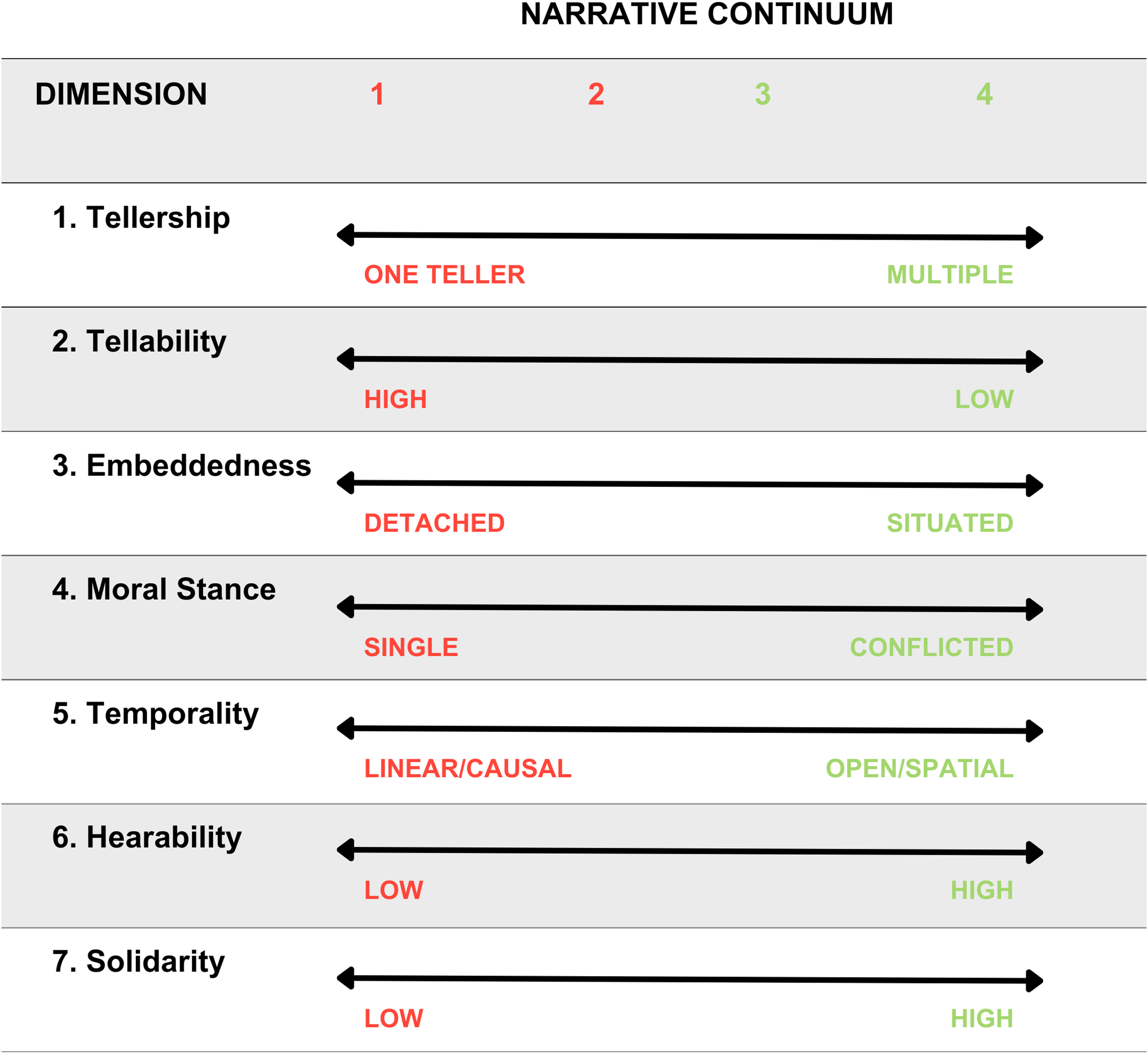
Integrated narrative continuum.
Data Collection and Analysis
The narratives collected for this project were collected through four primary sources: personal interviews conducted by the students in the class, stories shared on social media, vignettes published in texts, as well as stories told on public news outlets (n = 101). The distinction between narratives published on social media outlets and public news outlets is important in terms of distinguishing Type 1 from Type 2 narratives in this project. Type 1 narratives, otherwise known as performative narratives, tend to include a clear stance and message, and would be more likely to appear in national media outlets such as CNN. Most narratives collected for this project were gathered from social media sites, interviews, and other grassroots publishing efforts focusing on elevating the narratives of patients with Long COVID. Such platforms include The JAMA Network, Twitter, Reddit, and Lex.
The narratives collected for this project consisted of a diverse range of identity markers. This consisted of those who self-identified as people of color, the LGBT+, prisoners, children, people with disabilities, and people who are unhoused. The diversity of our corpus points to the multifaceted and intersectional impact of Long COVID on vulnerable populations. Of the 101 narrative episodes we analyzed, 45 (45%) were related to experiences in the clinical setting and 56 (55%) were in the non-clinical setting. Each narrative was rated twice on a four-point scale with high levels of inter-rater reliability. The results offer strong insight into the experiences of patients with Long COVID in ways that we believe the medical community can learn from as it races to catch up from a dearth of understanding about the pervasive Long COVID phenomena. There is a significant difference between clinical narratives and non-clinical settings with respect to temporality, hearability, and solidarity (Figure 3).
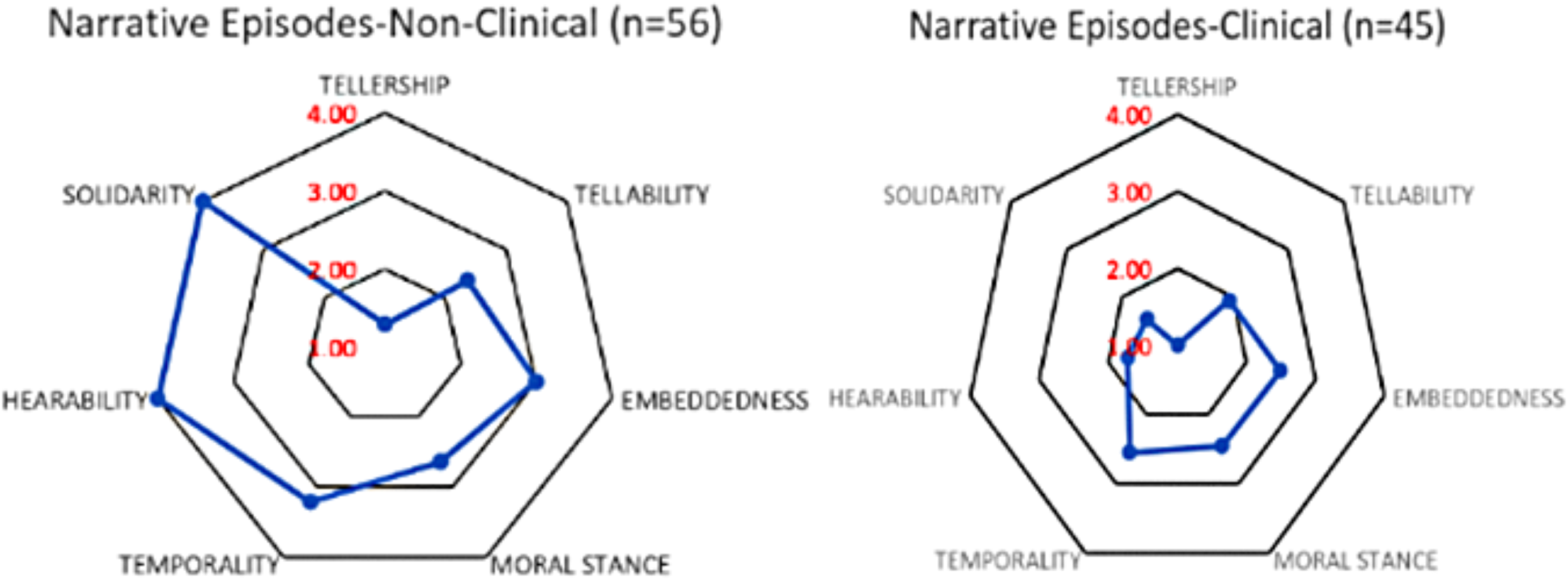
Non-clinical and clinical narratives side-by-side.
Narratives in the clinical setting showed much lower hearability (empathy) and solidarity (both less than 2). In contrast, narratives from non-clinical settings were higher in hearability (empathy) and solidarity. Here are two contrasting examples, the first from a clinical setting and the second from a non-clinical setting:
Type 1 Narrative in Clinical Setting
The following narrative, taken from social media, is from a patient with Long COVID who was recently discharged from the emergency department (Adinig, 2023). This is a type 1 narrative that is temporally linear, low on hearability/empathy, and low on solidarity (lines 5–9) (Figure 4).
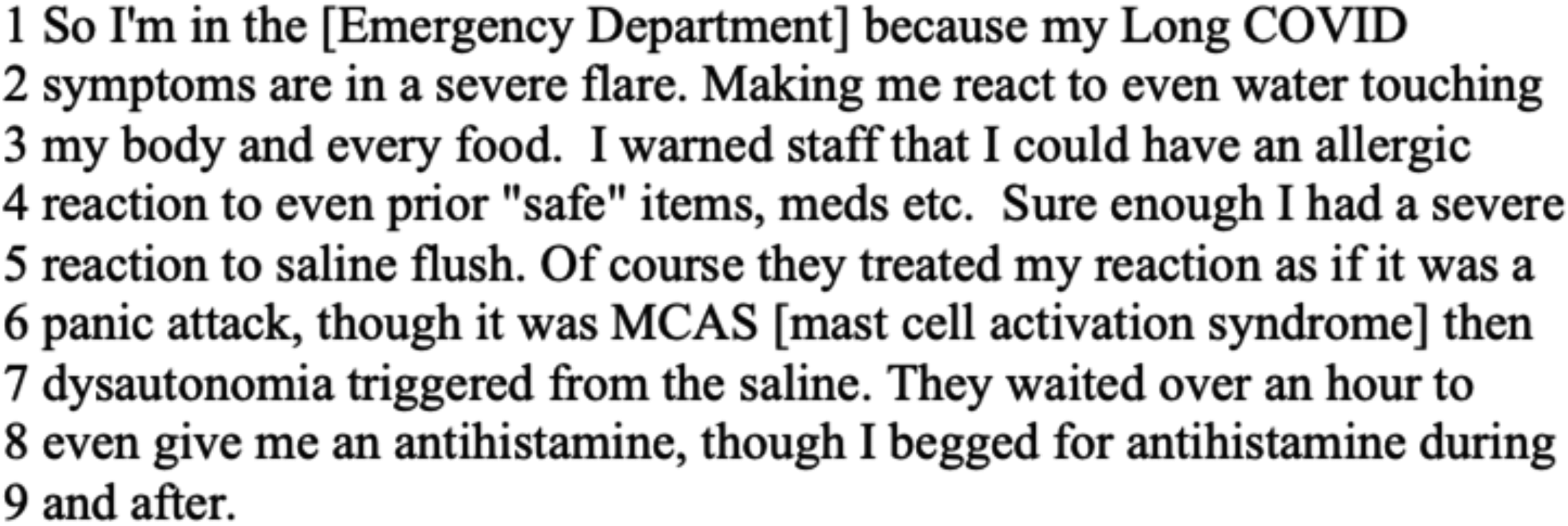
Type 1 narrative: Emergency medicine with low hearability and solidarity.
In this episode, the patient makes a clear self-diagnosis and issues a warning to the hospital staff (lines 1–4). However, they were not heard (i.e., low hearability/empathy). The health professionals did not take any actions to support the patient (low solidarity). The situation was exacerbated by their active dismissal of the patient's reaction as a “panic attack.”
Type 2 Narrative in Non-Clinical Setting
In contrast, the following narrative episode takes place in non-clinical setting, an acupuncturist center (Czarniak, 2022). The patient displays a host of positive affective linguistic markers. This is more of a type 2 emergent narrative that is temporally circular, high in hearability/empathy, as well as high in solidarity (lines 1–20) (Figure 5).
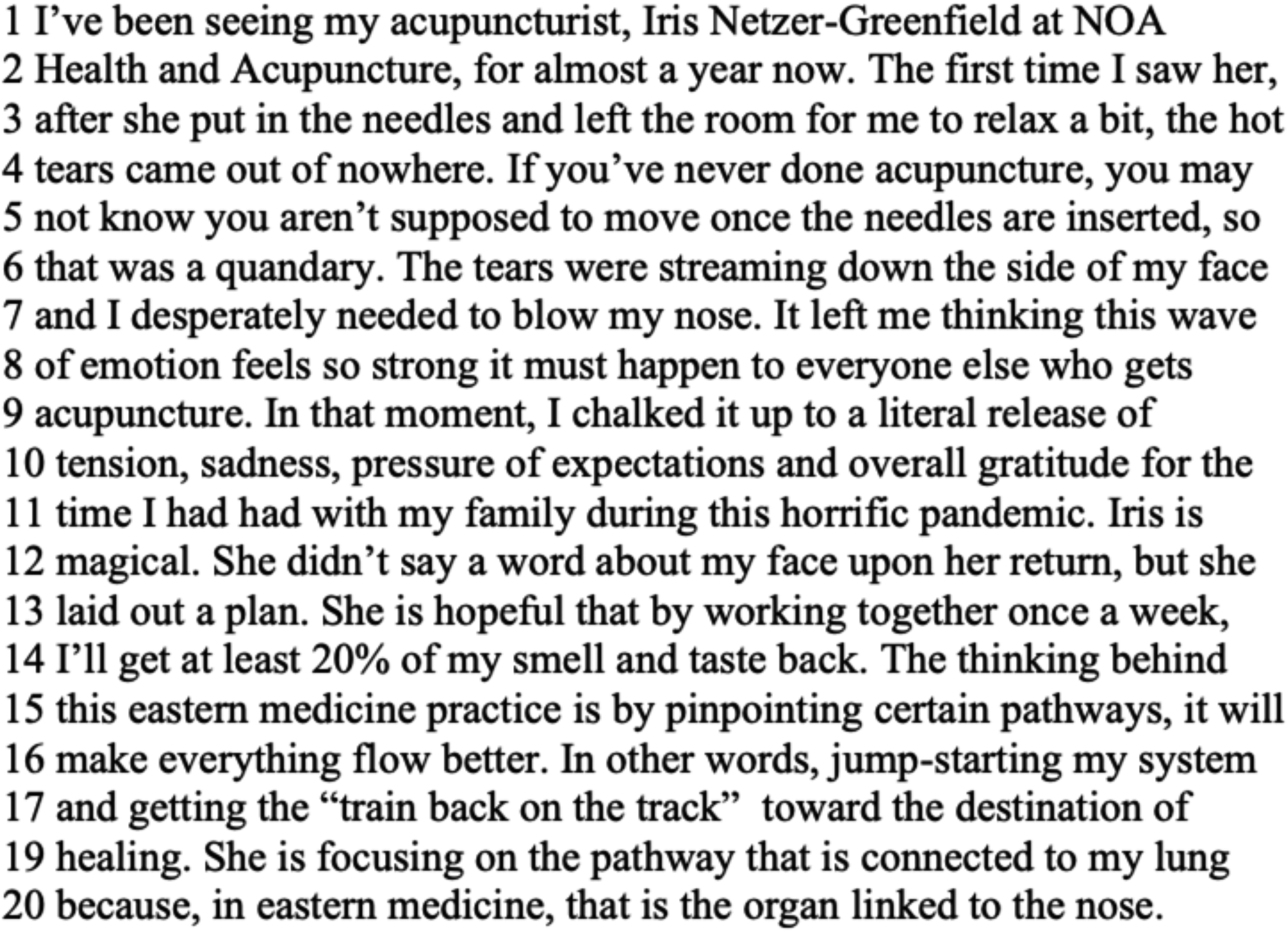
Type 2 narrative: Non-clinical setting with high hearability and solidarity.
She refers to her acupuncturist by her first name and as a “magical” provider (lines 11–12). The acupuncturist's expressed empathy turned into observable actions taken on behalf of the patient like developing an action plan (line 13) and conveying hope in a positive return to normalcy (lines 7–10). Furthermore, this patient continues to describe the underlying value system (e.g., thinking behind this eastern medicine, line 15) that led to the patient's feeling of agency, empowerment, and hope for recovery.
Conclusion and Implications
Medicine is often highly focused on a narrow range of objective, measurable data - blood tests, imaging, and visible abnormalities on a physical exam or signs. Narrative medicine provides a framework for going beyond biomedical diagnostics in healthcare by integrating the context of patient's lives. Here the role of ethnography, narrative inquiry, and sociocultural approaches to healthcare literacy become vital. Our interdisciplinary team developed novel conceptual insights as well as methodological innovations that have implications for the education and training of healthcare professionals. The results of our narrative analysis offer a glimpse into the stark reality of life for patients with Long COVID. Beyond the serious physical implications, the narratives including dialogue with healthcare providers suggest that there may also be psychological damage perpetuated by well-meaning healthcare providers who dismiss symptoms or attribute them to a mental disorder. There are three critical implications of our work: (1) Support healthcare providers with Long Covid training and resources, including leveraging AI technology to support Long Covid diagnoses and dialogue with patients; (2) Support healthcare providers with tools and time to engage in active listening with patients, and training around hearability and solidarity; (3) finally support holistic grassroots and governmental efforts with and for Long COVID patients (e.g., RecoverCovid.org, Body Politic, and Long Hauler Advocacy Project).
Footnotes
Funding
This project was supported by funding from the Vice Chancellor's Population Health Sciences Office at the University of Illinois School of Public Health.