



Abstract
This grounded theory study explored how primary-grade teachers perceive and enact dialogic English Language Arts (ELA) comprehension pedagogy in the novel context of pandemic-induced digital learning. The study involved nine diverse rural primary teachers teaching digitally during the coronavirus disease pandemic. The researchers followed a constructivist, postmodern orientation to co-construct substantive theory with the knowledge of participating teachers. The researchers conducted two rounds of virtual interviews and collected digital artifacts of ELA comprehension instruction. Qualitative data were analyzed using constant comparative analysis to address teacher perceptions and enactments of digital dialogic comprehension instruction. The emergent substantive theory represents connected, iterative processes of teachers perceiving and enacting dialogic, digital instruction. First, teachers espoused a dialogic stance toward ELA instruction based on their beliefs in various comprehension paradigms, diverse funds of knowledge, and multiplicity of voices in discourse. Relatedly, teachers responded to particularities of virtual contexts, digital discourses, and pandemic times to enact dialogic ELA comprehension instruction through a reconstruction of literacy pedagogies. Implications for research and practice are discussed, including the need for ongoing negotiation of dialogic pedagogy in diverse instructional contexts, to cultivate teachers’ dialogic literacy practices in locally and culturally responsive ways.
Introduction
With increasingly digital contexts of literacy teaching and learning communities, it is paramount to sustain multiplicity of student voice and knowledge, especially with young primary-aged children. This is particularly true for rural communities, where geographic spread may necessitate online instruction bridging unique, place-based literacies and diverse student identities. This study builds upon literacy research positioning comprehension as an agentive process involving skills and sociocultural interactions to create knowledge (Lee, 2023). Specifically, this study seeks to broaden the understanding of sociocultural interactions in comprehension through exploring digital dialogic comprehension pedagogy with diverse rural primary teachers. Highlighting the ways in which teachers and students were engaged in literacy learning during the pandemic, we explicate rural primary teachers’ process of developing digital dialogic English Language Arts (ELA) comprehension pedagogy. The present theory intends to extend diverse knowledge construction in ELA comprehension pedagogy (Hattan & Lupo, 2020; Moll, 2019), to reimagine primary discourse, comprehension, and knowledge composition with local school communities.
Literature Review
Extending Knowledge in Dialogic Comprehension Pedagogy
Rooted in Bakhtin's (1981) theory of dialogism, we conceptualize comprehension from divergent theoretical paradigms to form a deeper understanding of reader–text interactions. From cognitive models of the comprehension process, readers engage in interactive cycles of integrating literal interpretations of the text with prior knowledge to form a full mental schema of the author's messages in a text (Kintsch, 1998; van den Broek et al., 1999). Sociocultural theories extend the relationship between knowledge and comprehension processes by sustaining diverse funds of student knowledge in socially situated reader–text interactions (Hattan & Lupo, 2020; Rosenblatt, 1969). From a dialogic, multi-dimensional view of comprehension (Davis et al., 2015; Lee, 2023), readers interpret and critically reason with texts to not just gain knowledge, but produce new knowledge and agentive action (Freire, 2018).
To leverage the relationship between knowledge and comprehension, recent scholarship has promoted a knowledge-building approach to comprehension instruction (Davidson, 2019). Instructional activities should engage readers in productive text-based discussion to construct meaning (Garas-York & Almasi, 2017). Specifically, dialogic text-based discussions with interactive and analytical discourse have been associated with enhanced reading comprehension performance (Almasi & Yuan, 2023; Murphy et al., 2018). Yet, minimal scholarship has examined dialogic comprehension practices within primary-grade ELA pedagogy (Cervetti & Hiebert, 2019). By exploring dialogic ELA comprehension pedagogy with rural primary teachers, we intend to develop a deeper understanding of how diverse knowledge is extended through primary classroom dialogue.
Exploring Diverse Voices in Digital Dialogic Teaching
The research on dialogic teaching encompasses an array of teaching discourse practices, collaborative knowledge construction, relational teaching epistemologies, specific talk tasks, and higher-order learning goals. This study recognizes dialogic teaching as a pedagogical epistemology, repertoire of teaching practices, and classroom community that capitalizes upon language dialogue to co-construct ideas and co-reason through diverse perspectives to further learning and deepen understandings (Alexander, 2020; Kim & Wilkinson, 2019; Mercer et al., 2019; Shor & Freire, 1987). As a teaching philosophy, dialogic teaching espouses a relational stance towards knowledge and learning, as well as education and social interactions (Alexander, 2020; Freire, 2018). Also, as a discourse pedagogy, dialogic teaching supports student learning and engagement through constructing collective knowledge in dialogue (Mercer, 2019; Reznitskaya, 2012). In a dialogic classroom community, students are positioned as agentive and knowledgeable co-inquirers to promote critical consciousness and liberatory practices (Shor & Freire, 1987; Soler-Galart, 2019). Calcagni and Lago (2018) presented three domains for conceptualizing dialogic teaching: teaching-learning, assumptions, and instruments. The teaching-learning domain includes productive talk, knowledge building, and equity in relationships. Assumptions include beliefs, norms, and aims of dialogic teaching. Instruments consist of talk moves, tasks, group arrangements, and assessments. Our exploration of rural primary teachers’ dialogic comprehension practices is interested in the first two domains of assumptions of teachers’ perceptions of dialogism in comprehension, as well as the teaching-learning domain of collective dialogue to co-construct diverse knowledge within novel digital spaces.
Dialogic teaching practices are categorized by collective and purposeful discourse (Alexander, 2020; Reznitskaya & Wilkinson, 2015). Teachers scaffold students’ inquiry of critically interpreting and responding to contestable arguments (Reznitskaya & Wilkinson, 2017). Indicators of dialogic discussion include shared authority, open questioning, constructive feedback, meta-level reflection, explanation, and collaboration (Reznitskaya, 2012). In elementary settings, teachers have adopted moderator, participant, or coach roles to facilitate reciprocal discourse (Chen et al., 2017), scaffolding collective knowledge construction through accepting, building, and linking child-initiated dialogue (Muhonen et al., 2016). Research has documented how teachers apply a range of discourse moves to collectively construct knowledge with students (Wilkinson et al., 2019), but further scholarship is needed to illuminate how teachers leverage diverse funds of knowledge in primary dialogic comprehension pedagogy (Pearson et al., 2020).
Diverse funds of cultural knowledge are assets to students’ literacy learning (Moll, 2019; Paris, 2012), and students’ cultural knowledge plays a significant role in mediating text interactions (Brooks & Browne, 2012; Hattan & Lupo, 2020). In culturally and historically responsive literacy instruction, knowledge pursuits of identity, skills, intellect, criticality, and joy can be developed harmoniously (Muhammad, 2023). Culturally responsive text-based discussion is not limited to isolated readings of multicultural literature (Enriquez, 2021), but should promote joy and truth of cultural experiences across text interactions and discussions (Vlach et al., 2023). It is necessary to not only understand how primary teachers foster foundational literacy skills and meaning-construction, but also how they advance culturally pluralistic ways of being and knowing in discourse. Since comprehension is an enabling skill for further argument, creation, and social transformation (Pearson et al., 2020), understanding how primary teachers sustain diverse funds of knowledge in dialogic comprehension pedagogy is vital.
As all cultures are embedded within communities of place (Gruenewald, 2003; Taira & Maunakea, 2022), it is also critical to examine how teachers extend students' local funds of knowledge in dialogic teaching. Scant literacy research has investigated how teachers leverage rural children's local experiences and ways of knowing (Corbett & Donehower, 2017; Eppley et al., 2011). Moreover, scholarly intersections of literacy and rurality have been historically deficit-based. From narrow interpretations of literacy assessment and instruction, literacy in rural places has been limited to remedial interventions to reach metrocentric standards (Donehower et al., 2012). Further research is needed to extend local rural funds of knowledge in dialogic comprehension instruction while centering the cultural and historical diversities of rural communities (Corbett & Donehower, 2017). While popular depictions of rural demographics are homogeneously White, many rural counties in North Carolina (NC) have majority populations of Color (NC Rural Center, 2023). By gleaning rural NC primary teachers’ perspectives in sustaining cultural and local funds of knowledge in dialogic comprehension pedagogy, this study offers insights into pedagogical possibilities within cultural and rural knowledge-creation.
In addition to contextualizing culture and place in dialogic comprehension, temporal and spatial considerations of COVID-19 pandemic-induced virtual learning are critical to situating the present substantive theory. While research has examined elementary readers’ comprehension process and interactions with discourse in digital texts (Kiili et al., 2020), teaching and learning exclusively in digital spaces is new for primary education, especially amidst a global pandemic. The abrupt transition to virtual schooling caused many challenges for families and schools, particularly with inequitable connectivity in remote rural communities (Diallo, 2020). There is emergent research exploring how digital technology can be applied in dialogic implementations (Mercer et al., 2019), so investigating how rural primary teachers adapted dialogic practices for novel digital contexts is critical. Furthermore, the predominant rhetoric surrounding COVID-19 and literacy education has focused on student learning loss (Kuhfeld et al., 2020), but this study demonstrates the ways rural teachers and students were engaged in literacy learning. With the perspectives of rural primary teachers, the present substantive theory analyzes praxes of dialogue, knowledge, culture, place, space, and time embedded in digital dialogic comprehension pedagogy.
Methodology
The purpose of this inductive, grounded theory study was to generate theoretical understandings of how primary teachers perceived and enacted dialogic ELA comprehension pedagogy in pandemic-induced digital learning contexts (Glaser & Strauss, 2017). Present theoretical findings were grounded in the perspectives of nine diverse rural primary teachers who were teaching digitally during the pandemic (Charmaz, 2014). Participating teachers engaged in two rounds of individual virtual interviews and shared digital artifacts related to their digital ELA comprehension instruction. This study is intended to develop theoretical insights into primary dialogic comprehension pedagogy within novel contexts of digital learning in rural schools. Therefore, this study explored the following research questions:
How do teachers perceive their dialogic approaches to ELA comprehension instruction? How do teachers enact dialogic approaches to ELA comprehension instruction within pandemic-induced digital learning environments?
Teacher Participants
Teachers were purposely sampled through a recruitment survey (Glaser & Strauss, 2017) to recruit rural elementary teachers whose ELA comprehension practices emphasized discourse and text-based discussion in congruence with dialogic approaches to language pedagogy. The survey included questions asking teachers’ familiarity with dialogic teaching and their priorities for teaching ELA comprehension. It also asked teacher and school demographic information. Of 16 survey respondents, nine teachers were purposefully selected to participate in this study.
All nine teachers identified as female. Teachers were racially and ethnically diverse. Two teachers identified as Black, one identified as multiracial, one identified as Latina, and five identified as White. Teachers worked in primary grades first through third. Their experience ranged from 1 to 15 years, with an average of 5 years’ experience. Teachers represented six rural school districts in North Carolina. Eight teachers taught in a public school, and one taught in a charter school.
Substantive Theory Development
We employed grounded theory to develop substantive theory of primary teachers’ process of developing digital dialogic comprehension pedagogy. Substantive theory is a mid-level theory that falls between minor working hypotheses and formal grand theories (Glaser & Strauss, 2017). The substantive theory of this present study is specific to the particular contexts of the participating teachers during the COVID-19 pandemic. Moreover, this study followed a constructivist, postmodern orientation to grounded theory, to co-construct theory with the knowledge of diverse rural primary teachers (Charmaz, 2014). To conceptualize digital dialogic pedagogy, constructivist grounded theory methodology enabled us to explicate this underexplored process between socially situated intricacies of culture, locality, and temporality. Constructivist grounded theory centers lived experience throughout the research process and product to illuminate connections between events, meanings, individuals, and social constructs (Charmaz, 2020). In doing so, constructivist grounded theory blurs boundaries between categorizing social processes and revealing possibilities for changing social processes through critical inquiry in reflexivity, language, discourse, and theoretical sampling (Charmaz, 2020). In using constructivist grounded theory, we intended to not only understand digital dialogic comprehension pedagogy, but to extend a polyphony of voices on discourse and pedagogy with the experiences of rural primary teachers.
Reflexivity
We attended to researcher reflexivity throughout the constructivist grounded theory process, acknowledging our researcher subjectivities influenced the methodology and analyses (Charmaz, 2020). As a Korean American female and rural native, the first author is committed to cultural plurality in language, literacy, and rural communities. She also taught in an elementary school during the pandemic and empathized with teachers’ emotions in navigating virtual schooling with young children. Her scholarly objective as a former teacher and current teacher educator is to cultivate dialogic literacy communities, where students are positioned as active literacy agents to reimagine themselves and their communities. The second author is a White American female native to urban communities, and her elementary teaching experience was all in urban schools. Thus, she is an outsider to the rural context, but experienced in and committed to dialogic, culturally sustaining literacy instruction. We engaged in ongoing reflexivity to promote transparency and trustworthiness in the present substantive theory.
Data Collection
Virtual Semi-Structured Interviews
Teachers engaged in two rounds of virtual semi-structured interviews for a total of 18 semi-structured interviews. Individual interviews were conducted by the first author. Both rounds of interviews followed a semi-structured interview guide created by the researchers. Teachers were asked questions to share their perspectives and experiences with practicing dialogic comprehension pedagogy during pandemic-induced virtual learning. The first interviews were held near the beginning of the school year and ranged from 28 to 42 min long.
Following the first interview, we engaged in initial coding analyses. These initial analyses informed the development of the semi-structured interview guide for the second interviews. In particular, initial analyses pointed to the challenges in developing student talk virtually. The second interview asked teachers to share how they cultivated student talk to promote dialogue and leverage diverse funds of knowledge in virtual contexts. Second-round interviews were held approximately 4 weeks following the first interviews and ranged from 38 to 70 min.
Digital Artifacts
Teachers shared digital artifacts of their virtual ELA comprehension pedagogy prior to their second interview. Teachers were asked to share two types of teaching artifacts. One artifact was a recent lesson plan from their virtual ELA comprehension instruction. The lesson plan also served as a springboard for further reflection on their virtual comprehension pedagogy in the second interview. The other artifact was to document their current ELA curriculum through either a description of their curriculum or example texts used in ELA comprehension lessons. Teachers shared 25 total artifacts.
Data Analysis
Qualitative data from the virtual interviews and digital artifacts were analyzed using grounded theory constant comparative analysis (Glaser & Strauss, 2017). Data analysis included three levels of systematic coding—open, axial, and selective coding. While data analysis followed a systematic coding procedure, the coding process was dynamic and cyclical through ongoing analyses and data collection. Initial rounds of open and axial coding began after the first interviews. Open coding involved phrase-by-phrase coding to thoroughly generate 575 open codes, which were linked into 68 concepts significant to the initial data. In axial coding, the first-level open codes were analyzed into 22 explanatory categories. These initial rounds of coding analyses were intended to achieve theoretical sampling before returning to the field to collect further data to ensure data saturation (Creswell & Poth, 2018).
The second round of data analysis resumed to code the digital artifacts and second round interviews. Generative phrase-by-phrase open coding was again conducted, resulting in 623 new open codes for a combined total of 1,198 open codes. These open codes were again linked conceptually into 105 first-level concepts. During the second round of axial coding, concepts were refined into 24 categories. The final stage of coding was selective coding, where categories were integrated and refined into six central categories informing the present emergent substantive theory.
Data Credibility and Trustworthiness
We sought to enhance the trustworthiness of the present substantive theory in multiple ways. We engaged in researcher reflexivity for constructivist grounded theory (Charmaz, 2020), attending to self-consciousness of our identities and experiences in shaping the research process. We practiced member checking during interviews and analyses (Creswell & Poth, 2018). During interviews, the first author asked teachers to confirm researcher interpretation of teacher responses. We also sent teachers copies of preliminary findings and asked for their comments, revisions, or suggestions. While we used semi-structured interview guides, teachers were invited to share any salient insights in interviews that went beyond the guide. Additionally, we partook in peer debriefing throughout analyses with other literacy and teacher education scholars to support data credibility and transparency (Spall, 1998). To strengthen reliability, the first author transcribed all interviews to ensure transcription accuracy of diverse accents. We coded transcriptions and digital artifacts using qualitative software, Dedoose. All coding procedures were recorded in a codebook, and we maintained an audit trail of research procedures.
The Substantive Theoretical Process of Digital Dialogic ELA Comprehension Instruction
Our analysis yielded six thematic findings representing substantive theory addressing our research aims. First, three themes describe how rural, primary-grade teachers perceived their dialogic approaches to ELA comprehension instruction. Next, three themes represent how teachers enacted dialogic approaches to ELA comprehension instruction within pandemic-induced digital learning.
Perceiving Dialogism in Comprehension Instruction
Espousing a Dialogic Stance to Comprehension
Teachers referenced multiple theoretical paradigms in articulating their comprehension instruction. From a cognitive understanding of language and literacy, Magnolia (pseudonyms) shared her goal for comprehension instruction was to support first-graders’ fluency, so they can expend more mental energy on constructing meaning from texts, “we try and do everything that we can to make the kids more fluent, so it takes less of their working memory.” Abigail expressed that her goals for comprehension instruction included reading fluently and reading for understanding. Moreover, teachers defined comprehension instruction as inclusive of early language skills. Clover pre-taught new, unfamiliar vocabulary in texts, through definitions and images, to support student comprehension. Blaire's school used Wordly Wise texts for vocabulary instruction and focal stories for ELA standards. She integrated the types of comprehension questions asked in focal stories into discussions with Wordly Wise vocabulary texts, “I'm asking them the characters, the setting, what's happening in the beginning, in the middle, and the end.” Teachers identified early language and literacy skills as important foci to support comprehension.
In addition to attending to multiple cognitive skills, teachers’ priorities for comprehension pedagogy reflected their understanding of comprehension as a socially implicated measure. On the one hand, teachers understood comprehension as a sociopolitical assessment score with influences on grade promotion and expressed desires to increase student comprehension achievement. Several teachers espoused a comprehension goal for increased student performance on reading assessments. Abigail said her goal for students to do well on reading assessments remained the same in traditional and virtual contexts. Camellia discussed how she would meet with individual students to graph Istation assessment results and set performance goals. School systems positioned comprehension in terms of assessment scores, and teachers’ pedagogical goals likewise prioritized comprehension achievement.
On the other hand, teachers’ instructional goals also went beyond product-based measures to understand comprehension as a social activity. Brooke felt it was important to instill a love of reading with her children, “to create a love and joy reading, trying to get us to have opportunities to pick books of their own and to give them examples of how to, you know, really get into the book.” Magnolia wanted students to enjoy reading and learning, especially during virtual learning contexts where student engagement proved challenging. Furthering the complications between comprehension as a product and process for further learning, teachers expressed comprehension among young children is dynamic. Abigail argued the importance of teaching young children to read for understanding, “I think comprehension for them is not something after they have gotten to the point where they’re able to read.” She felt that teaching comprehension cannot be sidelined until students master decoding but learning to read and reading to learn must be intertwined in the early grades. Dahlia reflected how it can be difficult to discuss comprehension in isolation because comprehension connects to multiple sources of knowledge and disciplines. Adopting multiple perspectives of comprehension, teachers positioned comprehension dynamically with multiple literacy skills that foregrounded dialogism.
Espousing a Dialogic Stance to Knowledge
Parallel to their perspective on the nature of comprehension, teachers identified a dialogic stance toward a plurality of knowledge in ELA comprehension instruction by leveraging a range of academic, cultural, and local funds of knowledge. For example, Brooke began virtual ELA lessons by having a discussion or collaboratively completing a KWL chart with students about their prior knowledge before reading, such as what they already know about spiders. She explained they would continue to build upon discussions and graphic organizers throughout the week to advance students’ background knowledge. Teachers employed digital media resources to build students’ academic knowledge, including going on virtual field trips or sharing images and videos with students. Blaire shared how the STEAM specialist came into her online classroom to co-teach and integrate science and ELA standards with The True Story of the Three Little Pigs (Scieszka, 1989). “We watched a short video about a construction site and what goes on … our STEAM teacher had the kids build the strongest structure they could.” Teachers activated and extended students’ academic knowledge in virtual ELA comprehension instruction.
Additionally, teachers utilized students’ cultural knowledge to advance their comprehension learning. Magnolia shared how she supported students generating text-to-self connections when reading Abuela (Dorros, 1997), “it's really great when they can connect to it … ‘oh yeah I know about that, we did that when we went to Mexico’, or ‘my grandma is from Guatemala, and she's told me stories about that.’” Although teaching about culture in American history can be difficult with younger students, teachers understood the importance of teaching cultural history. Magnolia highlighted an instance where it was difficult for a colleague to manage difficult conversations about the history of racial segregation: Not personally in my class, but another teacher on my team, she was talking about this. And the one little girl was like, “man White people suck.” It was a little White girl. She's like, “I don't know if I want to be White,” and then she was like “no, no, no, that's not what we're trying to talk about that, like, this is history.”
Teachers also integrated cultural funds of knowledge with local knowledge of their diverse rural communities. As Blaire was planning for her virtual second quarter ELA plans, she revealed how she had advocated for her grade level to include more diverse texts, while her team preferred teaching the same ELA texts every year. She argued her investment in diversifying texts for students: Because yes, we are in a rural school, but I don’t have all White children in my class, I have some Hispanics, and some African American children, some Asian children, some mixed-race kids, and I want my kids to be able to read a story and be able to identify with a character that we read about and be like, that's, that's like me.
Teachers’ emphasis on funds of knowledge was not only to support comprehension, but also to sustain diverse student identities and lived experiences within literacy communities. For instance, Brooke shared her personal initiative was to teach students about culture in a careful, gradual manner, “it's kind of been an ongoing initiative with my kids that, you know, we're all different, and that the ways that we can accept those differences.” She expressed how she wanted to introduce culture in a respectful way, given the national climate of racial tensions, as well as the racial differences between herself as a White female and her majority African American students. Brooke also revealed how focusing on culture was initially challenging for her, “it was a very touchy subject for me, like I grew up not talking about people's skin color … but it's something that I realized is really important.” Rather than resorting to the colorblind methods in which she had been taught, Brooke centered her ELA pedagogy with intentional discourse of multicultural funds of knowledge. Instead of holding to a singular approach to instruction, teachers believed ELA comprehension to be a meaningful dialogue of multiple cultures, knowledge, and lived experiences.
Espousing a Dialogic Stance to Voices
Student participation in dialogue was also at the heart of teachers’ comprehension ideologies. Teachers expressed a strong focus on classroom dialogue to enhance student comprehension. For example, Florence described talk as her biggest strategy in building students’ background knowledge in comprehension instruction, “I feel like students are learning best when they are talking about it.” Also, Magnolia positioned her role within facilitating classroom discourse as a moderator to extend student perspectives in collective knowledge-building discussion: I really let the kids guide the discussion and I only tried to participate when it's kind of like going off topic, more like a moderator versus like—I’m going to give you my thinking, and I want you to think about my thinking.
Furthermore, teachers invited voices from the local community to enrich classroom discourse. Abigail was a visiting international teacher from Jamaica who made conscientious efforts to learn about the rural community she was living and teaching in. In connection to their recent ELA focus on communities, Abigail invited local historians to speak with the classroom on the changes within their local businesses: So, they come, and they say to us, “growing up when we had a movie theater here, there was a pharmacy down the road,” and then you would look at it now, and then we say about those things are no longer here … But what has happened is that these rural areas now have become underdeveloped over the years.
Enacting Dialogism in Comprehension Instruction
Responding to Instructional Contexts
While teachers expressed dialogic perceptions of ELA comprehension instruction, unstable instructional contexts influenced their enactment of dialogic practices. In traditional in-person classrooms, teachers recalled being better able to uphold students as co-constructors of their comprehension learning, particularly with collective classroom dialogue. However, challenges with novel virtual contexts disrupted primary teachers’ classroom dialogue, which became monologically controlled by teachers. For example, Florence divulged how she dominated virtual classroom discourse: And I hate to say this because this is not my favorite form of teaching, but it really is more of a question-and-answer type of conversation. So, I asked a question, students raise their hands and then they answer the question out, just because you know it is chaotic when all students are trying to talk at once … it really is just a lot of lecture-style teaching, which I’m not a huge fan of.
Responding to Digital Discourses
In addition to the virtual learning context in general, teachers overwhelmingly stated that developing student-to-student talk using available technology was the most challenging obstacle to overcome in virtual schooling. Teachers found it difficult to incorporate student talk in whole-group ELA comprehension instruction. Camellia pointed out that traditional student talk strategies like think-pair-share were not easily transferred to virtual learning. While most teachers were limited in their ability to include student talk in whole-group instruction, they developed additional opportunities for student talk as they began meeting with virtual small groups. For example, Magnolia's students were able to leave their microphones unmuted in small groups without there being too much background noise and “enjoyed bouncing ideas off each other and [helping] one another read and discuss texts.” Florence noted that students demonstrated more authority in text-based discussions during virtual small groups, “instead of really me doing more of the connections … it's more of the students, saying, well, ‘hey, you know, this makes me think about when I do this or when we read about this.” She was then able to transition to a discussion mediator to chain student voices toward cumulative discourse, “so let's talk more about that and how that connects to what we're talking about today.” While seeking digital student discourse was overwhelmingly the greatest challenge, small group settings allowed greater opportunities for extended student talk.
In addition to seeking students’ digital oral discourse, teachers explored multimodal forms of discourse to support digital dialogic practices. In a reflection of Clover's recent lesson on informational texts, student discourse was engaged through multiple modes. “They got to pop back on Seesaw and then draw an example of matter and record themselves talking about it and how they knew it was matter. Then from there we read informational texts on it.” Using video and multimodal composition, Clover's students communicated their understandings through oral discourse, drawing, and writing for multimodal demonstration of learning. Following students’ multimodal responses, Clover was then able to further their collective learning through text-based discussion. Similarly, Abigail sought to activate digital discourse through reading and writing connections. She recorded in her virtual ELA lesson plan, “teacher will model how to write a story with dialogue.” Her lesson plan documented her intentions to connect the ELA unit on character dialogue with teaching the narrative writing process. In the process of developing digital dialogic practices, teachers and students interacted with digital multimodal discourse to further text comprehension.
As teachers reflected on their process of becoming more dialogic, they also identified significant areas for continued professional development. Several teachers specified facilitating student talk as a necessary area for professional development. For instance, Florence articulated the importance of professional development for continued growth in facilitating classroom discourse in both in-person and digital contexts: Not only is it hard with virtual learning, but I feel like that's more difficult in general just because I feel like it takes a little more planning to do that, and you have to know the right moments to do that.
Responding to Pandemic Times
A unique consideration in teachers’ enactment of digital ELA instruction was recognizing students’ need for social interaction and positive relationships during isolating times. Teachers in turn created ways to build rapport with students in the virtual setting to better promote literacy engagement. Camellia organized a virtual lunch with the teacher, where she and students ate their lunches together and watched fun videos to build strong relationships. Also, Brooke made time for informal conversations, “sometimes they just need to talk, so sometimes we just have a full-blown discussion … I just let them talk and we just sit there and laugh and giggle and whatever else that we want to do.” Teachers not only worked toward developing digital dialogic comprehension practices, but they also prioritized students’ social–emotional needs as human beings, positioning themselves in a virtual community with students.
Teachers also understood the pressures of living through a global pandemic on young learners. Ways of coping with pandemic life became common topics in ELA discussions, as Abigail revealed, “a lot of discussion, unfortunately, is about the pandemic and life, you know, living in this, in this time.” Rather than ignoring the current context, Abigail integrated the pandemic sociocultural context into comprehension instruction. Abigail read Little Lion Goes to School (Magnus, 2003) with her students, which was a story about a boy who lives and goes to school in a Jamaican fishing village. After reading, she facilitated a discussion with students about how they thought the boy's life in his village and school may have changed during the pandemic: We can have those discussions about changes around the world, so they understand that this system, this, whatever is happening, is not only affecting us, it's also affecting everybody. It's affecting the entire world and people are coping or dealing with it differently … It is happening and people are facing it, so don't feel alone.
In addition to supporting students as young children living through pandemic times, teachers strongly focused on continuously advancing student learning. Camellia proclaimed her passion for providing students with the right amount of mental challenge to grow as readers, writers, and thinkers: When we do the guided reading and writing, I try to like encourage them to try something, you know push themselves forward and persevere … and I'm always trying to figure out, like who really understood, and if they didn't understand, what can I do to make them understand.
Substantive Theory Conclusion
Altogether, primary teachers’ process of developing digital dialogic comprehension instruction mirrored the non-neutrality of reader-text interactions. As shown in Figure 1, teachers espoused a relational stance toward a plurality of comprehension, knowledge, and voice to co-construct deeper ways of understanding texts with students. They also responded to the particularities of virtual instructional contexts, digital discourses, and pandemic times to reconstruct a new mode of dialogic ELA comprehension pedagogy. This process was an ongoing, unstable cycle of assessing and refining digital dialogic comprehension pedagogy. Therefore, the process of developing dialogic comprehension pedagogy is unresolved and will continue to evolve amidst changing particularities in diverse contexts.
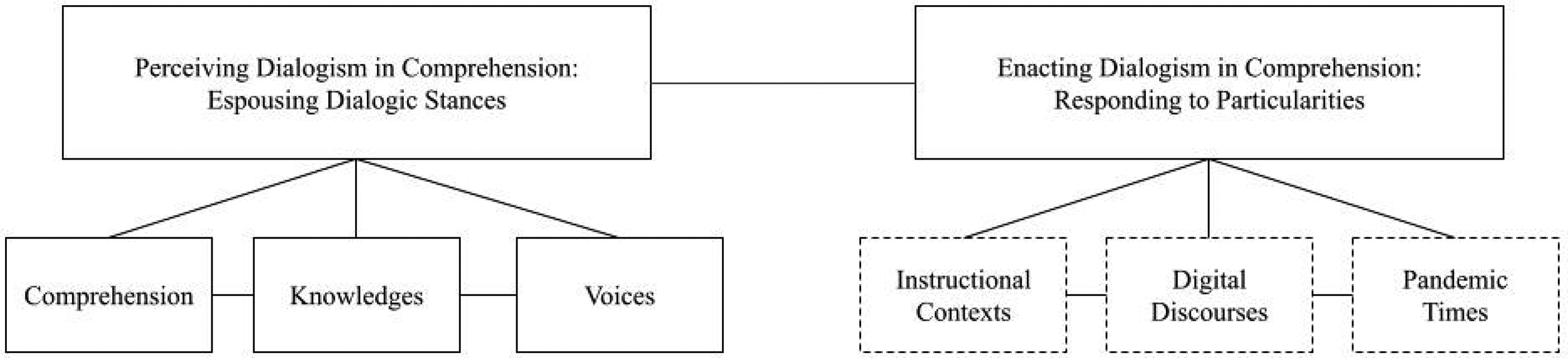
Rural primary teachers’ iterative process of perceiving and enacting dialogic ELA comprehension pedagogy.
Discussion
The present substantive theory has notable implications for research and practice. The iterative process of developing dialogic comprehension pedagogy broadens the existing research on reading comprehension models, dialogic teaching, literacy practices, and teacher education with the cultural and local pedagogical knowledge of participating rural primary teachers. First, the present theory aligns with the recent call to conceptualize comprehension as more than a product of reading (Pearson et al., 2020). Rural primary teachers affirmed comprehension as an agentive process of integrating skills, knowledge, and text interpretation (Kintsch, 1998; Lee, 2023). Simultaneously, teachers upheld comprehension as a sociocultural activity of critically reading local worlds (Freire, 2018). The present theory not only reaffirms comprehension as both an individual and sociocultural process of integrating and generating knowledge to understand texts and worlds (Davis et al., 2015), but also broadens existing early comprehension research to co-construct diverse cultural and local funds of knowledge through comprehension and discourse (Hattan & Lupo, 2020; Moll, 2019).
Furthermore, teachers’ dialogic comprehension pedagogy advanced culturally and locally responsive approaches to dialogic teaching (Gruenewald, 2003; Muhammad, 2023; Paris, 2012), as they leveraged a polyphony of academic, cultural, and local knowledge in dialogue with primary learners. There has been a bifurcation across dialogic teaching scholarship between highlighting and omitting the importance of classroom culture in dialogic teaching (Kim & Wilkinson, 2019). This substantive theory explicates the significance of culture, rurality, and teacher–student relationships in shaping dialogic primary classroom spaces. Addressing the call to include rural contexts in literacy examinations of reading the word and the world (Azano, 2015), the present theory underscores the need to listen and learn from narratives of culturally diverse rural community members (Files et al., 2022). By applying present theoretical findings into practice through inviting students’ and communities’ cultural and local knowledge in literacy instruction, teachers have pedagogical opportunities to adapt literacy curricula that sustain cultural communities, especially historically marginalized communities (Taira & Maunakea, 2022). Critical next steps for participatory research inquiries are to engage alongside primary teachers and students in dialogic literacy practices for individual and community social transformations to critically read and construct their local worlds (Soler-Galart, 2019).
Additionally, the present theory revealed pedagogical synergies between literacy practices for comprehension and composing. Interestingly, teachers unpromptedly identified a strong pedagogical relationship between supporting primary students’ comprehension and writing processes. In refining their dialogic comprehension pedagogy in new digital spaces, teachers facilitated collaborative dialogue through multimodal oral and written composition. Talk, reading comprehension, and writing are inextricably linked and mutually supportive (Rojas-Drummond et al., 2017). Yet, much of the dialogic teaching research has focused on oracy and text interaction (Alexander, 2020; Reznitskaya, 2012). The present co-constructed theory further demonstrates the need to generate new research insights into dialogic teaching for primary composition (Myhill & Newman, 2019). It is imperative to illuminate more agentive, multi-voiced, and transformative writing practices (Coskie et al., 2022; Kline & Kang, 2022). Future scholarly initiatives should provide rich understandings of primary dialogic writing pedagogy to support teachers and students in agentively rewriting their worlds in culturally pluralistic and locally sustainable ways.
Indeed, this theory necessitates reflective visions for teacher education to cultivate dialogic literacy processes within culturally and locally diverse communities. As recommended by primary teachers, future literacy professional development should build upon dialogic practices to center student dialogue in classroom discourse, small group text-based discussion, and writing instruction. Professional development should explore both dialogic theories and applications within the oracy-writing discourse continuum (Alexander, 2020) while also framing possibilities for primary teachers and students to apply dialogue, reading, and writing as vehicles for inquiry-driven civic engagement (Hass, 2023). While professional development and coaching for dialogic teaching have shown promising findings for strengthening teachers’ facilitation of dialogic inquiry in oral classroom discourse (Reznitskaya & Wilkinson, 2015; Walsh et al., 2020), research is needed to examine teacher development in dialogic writing practices with primary writers. Furthermore, teacher education and professional development designs must attune to local cultural contexts, especially with underserved rural school communities (Outlaw & Grifenhagen, 2021). Teacher education scholars’ conscious attention to cultural and local funds of knowledge within professional development is essential to further cultivating teachers’ dialogic literacy practices in culturally and locally responsive ways. Facilitating teacher development in creating dialogic literacy spaces to co-construct knowledge with primary-aged children is a significant area for future research, teacher education, and community engagement.
Limitations
The temporal context of the COVID-19 pandemic resulted in important limitations to the present substantive theory. Data were limited to teachers’ reflective perspectives of their digital dialogic comprehension pedagogy. Future research should synthesize in-depth analyses of teacher beliefs with observations of classroom community discourse. As this theory is specific to the context of the participating rural NC primary teachers, this theory is limited in transferability. However, the aim of this study is not to create universal theory, but to broaden scholarly understanding of dialogism in primary ELA comprehension with diverse rural communities. Additionally, our intent was to co-develop theory with rural primary teachers in constructivist grounded theory, but future explorations will benefit from participatory methodologies to foster dialogic literacy communities with teachers and students.
Conclusion
The present substantive theory generates culturally sustaining and humanizing literacy practices of timely consequence for digital and political extents. With the rise of artificial intelligence in literacy instruction, it is paramount that these digital spaces attune to cultural and local knowledge diversity of students. Ensuring that multiple cultural and local voices are genuinely coordinated, rather than ignored, in digital discourses is necessary to design humanizing digital literacy instruction. Analogously, recent political mandates have limited teacher pedagogy to simple, singular confines of comprehension as a product of literacy. However, this research authenticates comprehension instruction as a dialogic process of constructing knowledge plurality. Excavating interconnections between comprehension, discourse, and knowledge is urgently needed to enhance culturally and locally responsive literacy pedagogy for teachers and learners.
Footnotes
Declaration of Conflicting Interests
The authors declared no potential conflicts of interest with respect to the research, authorship, and/or publication of this article.
Funding
The authors received no financial support for the research, authorship, and/or publication of this article.
