



Abstract
In this study, we explore systems thinking maps as a local literacy practice in a systems thinking professional development institute for PreK-8 teachers. Existing literature underscores the necessity of equipping teachers with a robust understanding of systems thinking; this study addresses a call in the research to find ways to do so. Rooted in the principles of systems thinking, professional development, and literacy practices, we analyze how the literacy practice of systems thinking mapping contributed to participant pedagogical reflection and systems thinking theory development. We employed a case study approach, allowing an in-depth investigation of the mapping literacy events within the professional development setting. We collected data throughout the four days of the professional development; the data set included observations and recordings of mapping sessions, reflections on mapping from 29 participants, and photographs of the systems maps created. Our results highlight the potential of systems thinking maps to foster collective understandings of systems thinking, deepen understandings via the co-construction of dynamic texts, and imagine pedagogical possibilities. The literacy practice not only strengthens participants’ grasp of systems but also creates a shared space for collaborative learning, flattening hierarchies and engaging teachers as co-learners. The implications extend to disrupting traditional professional structures, emphasizing the centrality of the learner while fostering hope, optimism, and agency. This study contributes valuable insights into literacy practices that promote collaborative learning among teachers, encouraging a shift toward more inclusive and transformative professional development.
On the first day of a four-day professional development summer workshop dedicated to systems thinking, three teacher-facilitators engaged the group in a literacy event (Barton, 2007). Because systems thinking is an innovative way of viewing systems and their interrelatedness and interdependence, one of the facilitators opened with, “I know all of you got up this morning. I know that you got ready to come here. You may have fought traffic, whatever happened... What systems did you experience this morning until [before] you got here?” (see Figure 1).
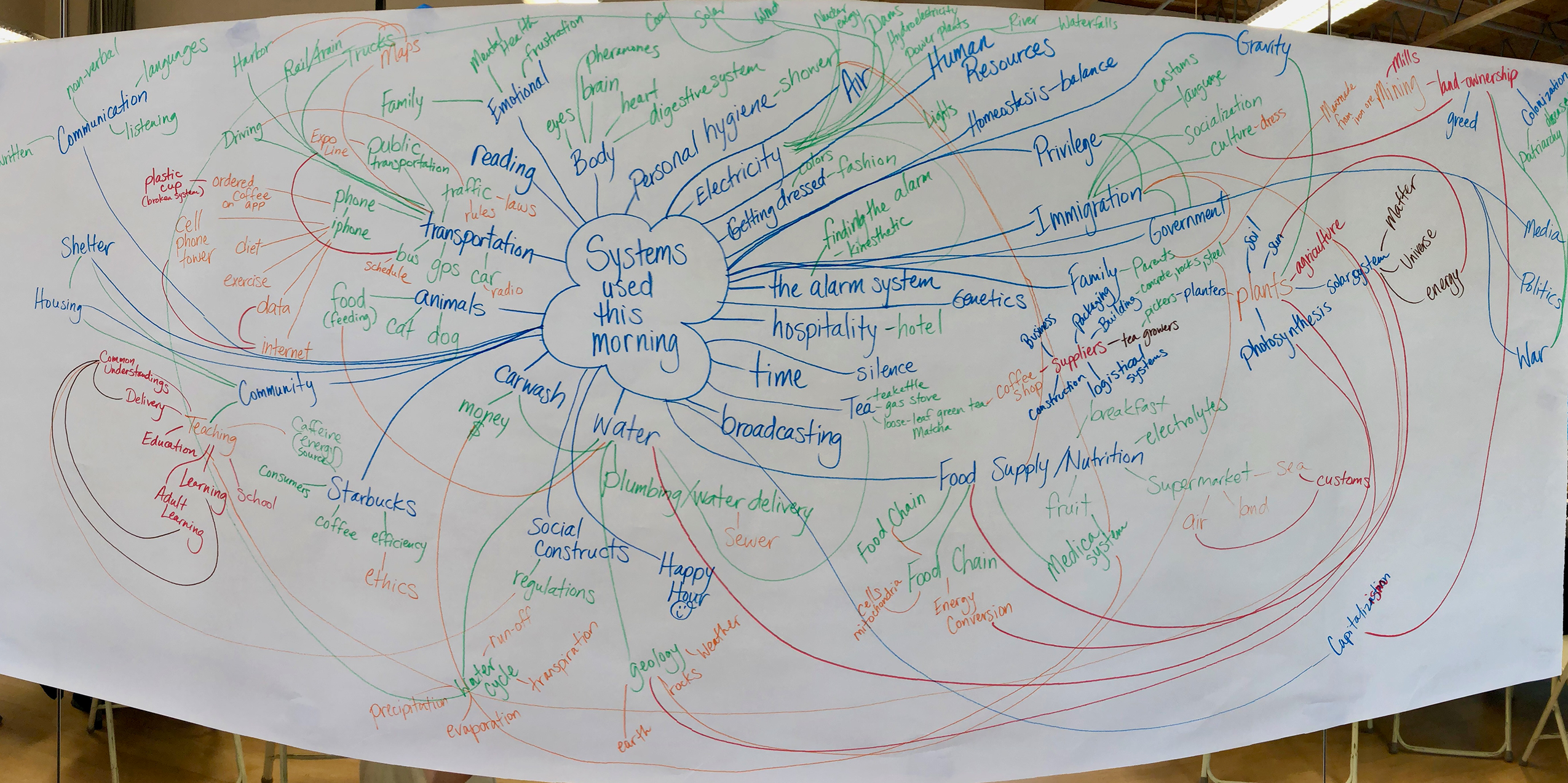
The first map co-created in the institute: our morning systems.
PreK-8th grade teacher-participants began to share their thoughts, ranging from a Starbucks coffee system to the electricity system, as the facilitators jotted down those thoughts on a large piece of butcher paper. Soon conversations expanded from simply identifying a system to considering its personal, social, and environmental impacts. Their ideas branched out into related topics such as the effectiveness of caffeine as an energy source and the ethics surrounding patronage of the popular coffee chain alongside its efficiency. As they built on the systems connected to the larger electricity system, brainstorms swirled around energy creators like dams, hydroelectricity, nuclear power plants, solar, wind, and coal. Other systems discussed included body systems, immigration, and families detained at the border.
After 45 minutes of identifying diverse, wide-ranging, and personal connections between the human-made and natural systems impacting their morning so far, a sense of community was established. Participating in a dynamic thinking exercise where the inclusion of multiple voices was validated, one teacher commented to the group, “I feel strangely closer to everyone in this room now.” Thus began educators’ understanding of systems thinking by actively drawing upon their local knowledge and sharing personal experiences and thoughts.
In an overarching study of a multi-day teacher professional development in systems thinking (Goode & MacGillivray, 2023a; 2023b), we examined one specific literacy practice used by teachers during this professional development: the creation of systems thinking maps to visually represent, synthesize, and analyze systems. Specifically, we explored how PreK-8 teachers used the literacy practice of systems thinking maps for their own pedagogical reflection and development. We asked: In what ways did PreK-8 teachers take up the local literacy practice of systems thinking maps? How did teachers talk about their current learning through maps and future instruction implementing maps with respect to this local literacy practice?
Rationale
Systems thinking is an approach that recognizes the world's interconnectedness. It is a perspective critical to global, economic, social, and environmental sustainability (Capra & Luisi, 2014). Developing participants’ understanding of both systems (e.g., Cabrera & Cabrera, 2015; Davis et al., 2015) and mapping (e.g., Curwen et al., 2019) is needed if teachers are to take up the content and practices of a pedagogy that engages in systems thinking. Yoon et al. (2017) explain that while research studies into systems thinking in education have focused on designing learning environments for students, “only a handful have studied teacher understanding of complex systems” and systems instruction (p. 101). Chinn (2017) asserts, “it is vital for research on systems education to include a strong focus on preparing teachers” (p. 127).
For decades, there has been an appeal to make teacher professional development interactive, social, contextual (Cochran-Smith & Lytle, 1999; McComb & Eather, 2017; Putnam & Borko, 2000), and influential on teachers’ professional growth (Borko, 2004). Reflection is recognized as one of the most powerful methods of professional learning. Effective professional development must include active learning, be consistent with participants’ knowledge and beliefs, and in the process, develop a learning community (Desimone, 2011; Goode & MacGillivray, 2023a).
To think about this data set of a four-day professional development on systems thinking, we use two complementary lenses. One is systems thinking, which involves developing an understanding about interactions, relationships, perspectives, distinctions, and patterns inherent among systems (Cabrera & Colosi, 2008; Curwen et al., 2019; Davis et al., 2015). The second framework is Barton's (2007) notion of literacy as a social practice. As noted in existing studies of the use of systems thinking pedagogy, teachers and students have used literacy to enhance a system's effectiveness, sustain its practices, and/or interrupt a broken system to serve the greater good (Curwen et al., 2018, 2019; Lewison et al., 2015).
Systems Thinking
To reiterate, systems thinking envelopes the understanding that everything in the world—both human systems and natural ones—are interconnected and interdependent (Capra & Luisi, 2014). Although systems thinking has been applied since the 1930s in varied disciplines such as biology and increasingly in social sciences since the late twentieth century (Capra & Luisi, 2014), its practical application in education is relatively new (Senge et al., 2012). This perspective views a system as a collection of elements operating toward a common goal or in a manner to achieve a purpose (Meadows & Wright, 2008). It recognizes that systems are dynamic, have patterns, are self-sustaining through feedback loops, are interdependent, and are subject to disruption. A system is often disrupted by identifying a point of leverage where the greatest impact might be made.
Senge et al. (2012) assert the importance of a systems thinking perspective within a K-12 curriculum. This call is in part because a system thinking approach can be applied to solving a number of “wicked problems,” (Checkland & Poulter, 2006) such as climate change and poverty, which continue for generations. Several classroom studies document how teachers adopting a pedagogy infused with a systems thinking perspective inspired students to take action to impact societal and environmental change. These include classrooms where elementary students gained deep insights about ecosystems (Hokayem et al., 2015); second graders developed solutions to a statewide drought (Curwen et al., 2018), and seventh graders made connections to understand the circumstances of famine in Malawi (Lewison et al., 2015). In each instance, students’ agentic steps sought to disrupt an out-of-balance system for the betterment of the environment and humankind. Notably, in pedagogical strategies used by teachers that are grounded in a systems view of the world (Curwen et al., 2018, 2019; Lewison et al., 2015), literacy practices are integral, as a significant amount of reading, writing, and dialogue is needed to develop collective understandings.
Literacy as a Social Practice with Local Texts
We drew upon the notion of literacy as a social practice, which focuses on cultural literacy practices embedded in local contexts (Barton, 2007; Street, 2001). Within literacy practices are specific literacy events, which are the visible episodes of individuals’ experiences mediated through text (Barton, 2001, 2007; Street, 2001). This perspective draws attention to the creation of local texts through reading and writing as participants negotiate and solidify relationships.
Systems thinking maps can be conceived as a local text which Zoch et al. (2018) define as a “local expression of the literacy practices and beliefs within that context” (p. 371). These maps, similar to concept maps, are co-constructed by posting participants’ ideas so that they are visible to everyone. Ideas flow in a nonlinear manner and linkages between ideas are charted by connected lines and sometimes uni- or bi-directional arrows. These texts are often only fully understood by those who work to create them and exist for the usefulness of the authors rather than for an outside audience. Local literacy practices provide an opportunity to explore perspectives and voices in a specific context, such as a professional development setting, which can shape individual and collective beliefs, attitudes, values, and aspirations (Rogoff, 2003).
In a learning setting, local texts such as charts are frequently used to represent ongoing and dynamic dialogue between and among participants (Maloch et al., 2004). Classroom studies have highlighted charts as a valued component to guide and reinforce thinking (e.g., Consalvo & David, 2016; Orellana-Garcia & Sailors, 2016; Zoch et al., 2018). Systems thinking maps as a local text are unique from regular classroom charts in that they are open-ended with possibilities for learning more about the main topic, while also revealing relationships, nurturing community, and developing a shared understanding (Goode & MacGillivray, 2023b).
Methodology
We organized our research as a single case study, as defined by Yin (2018). This methodology provides structure for an in-depth investigation of a subject (in this case, the systems maps) within its real-world context (in this case, the teachers’ professional development). As a research team, we were able to observe, experience, and analyze the systems maps as a local literacy practice (Zoch et al., 2018). Focusing on how the systems maps were co-created in this specific professional development was crucial for analyzing the texts’ social purposes and multiple contexts, including values, histories, beliefs, and power relationships (Purcell-Gates et al., 2011). The case study approach provided a unique opportunity to delve into the intricate details of the subjects’ constructed understandings of the co-created systems maps. This allowed for gaining valuable insights into the “factors that shape and the process through which people interpret or make meaningful” through systems mapping (Dyson & Genishi, 2005, p. 3).
Setting and Participants
The setting for this study was a four-day summer professional development on systems thinking pedagogy hosted at an independent school in Southern California. The institute was an optional professional development opportunity for K-12 teachers. While many of the attendees taught at local schools and had some knowledge of the systems thinking work already happening in the two sponsoring schools, other attendees joined because of a developing interest in the topic from reading the institute description or taking a university course on systems thinking.
The research team included three researchers who collected data and two researchers who joined the team for data analysis. The two researchers who joined the project presented at the institute and were participants in the study. All members of the research team are women who previously taught in K-12 and now work in teacher education programs. The systems thinking institute was organized and led by a team of 10 facilitators (see Table 1) from the host school and a neighboring public school. The facilitation team, responsible for the institute's coordination, was a collaborative effort involving three teachers from the independent school, four teachers from the local public school, two consultants with three years of experience working on implementing systems thinking pedagogy, and the institute director. Over the course of nine months, the team, consisting of nine women and one man, met regularly to create a teachers–teaching–teachers professional development program. Their collective teaching experience ranged from seven to 35 years. Throughout the institute, facilitators took turns guiding both whole and small group activities, providing insights into student work examples from their own classrooms. The director played a key role in framing the days, consistently redirecting participants toward group and personal goals.
Systems Thinking Institute Participant Information.
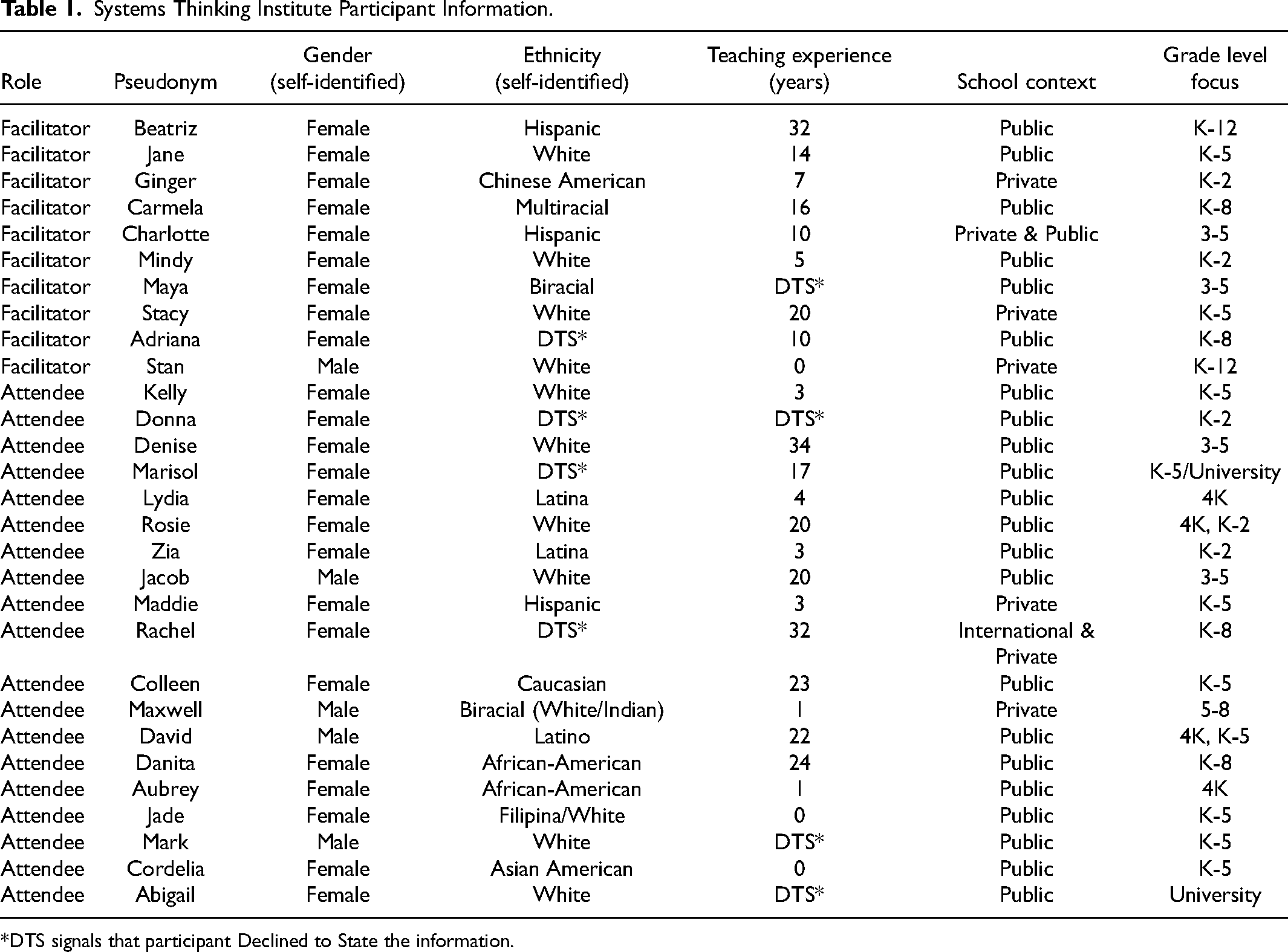
*DTS signals that participant Declined to State the information.
The 19 attendees (see Table 1) at the institute brought diverse teaching experiences, with three participants having recently completed their teacher education degrees, the majority having four to ten years of classroom teaching, and one seasoned teacher with over 30 years in the elementary classroom. Furthermore, their exposure to systems thinking pedagogy varied, spanning from no prior knowledge to four years of classroom implementation. The group was racially and ethnically diverse. We obtained IRB approval and informed consent from all participants. We will use the term participants when referring to a group inclusive of both facilitators and attendees. For confidentiality, pseudonyms are used for all names in this article.
Data Collection
The three data-collection members of our research team were equally engaged in gathering data. This involved conducting 20 semistructured interviews with participants (deMarrais, 2004), generating field notes from a cumulative 60 hours of observation (Emerson et al., 1995), and collecting artifacts (Yin, 2018) such as personal research journals, handouts, and over 100 photos. All observations and interviews were audio-recorded. The three data collectors (Gretchen, Laurie, and Leslee) did not lead sessions. Two of the authors (Margie and Amy) participated throughout the institute and co-led one session. None of the authors assisted in planning the institute.
For comprehensive coverage, we implemented a rotational approach during sessions, enabling each member of the original three-person research team to elaborate on field notes throughout the day based on their observations and interviews. During whole-group discussions, a minimum of two team members were present, and one member observed during each breakout session. This paper draws upon all data surrounding the creation of systems maps, including observations of four group map-making sessions and all reflections about map making in both whole group and small group sessions and interviews.
The four group maps, selected purposefully by the facilitators and centered around everyday experiences and items, served as anchors for learning each day. The maps were as follows:
Map 1: Morning Systems, Day 1, Whole Group Map 2: Broken Pencil System, Day 3, Whole Group Map 3: Trucks System, Day 3, Small Groups with Whole Group Debrief Map 4: Animals System, Day 4, Small Groups with Whole Group Debrief
Data Analysis
After multiple cycles of re-reading the data, Gretchen and Laurie kept returning to the centrality of maps as a local literacy practice for developing understandings of systems thinking theory and its application to pedagogy. With this idea, Gretchen and Laurie began working together on coding from a literacy practices lens (Purcell-Gates et al., 2011). Specifically, we used initial coding to grasp basic themes and issues (Charmaz, 2006). In this phase of coding, we read through the data to start breaking it into pieces, giving us a beginning point to start memo writing about the codes created (Saldaña, 2009). Examples of initial coding include “background knowledge,” “mapping process,” and “ideas for mapping.” We revised these codes into three categories: past collective knowledge, present map as living document, and imagining future pedagogical directions.
At this point, we presented our ideas to Margie and Amy. From that point, we worked as a four-person team to begin a second phase of coding data according to the three categories. After several meetings, we expanded our coding to include two additional categories: emotional experiences with local text and supplemental professional development content (e.g., teachers sharing examples of student work with systems thinking before the professional development workshop). This expansion of codes allowed us to account for all the data within the corpus for this article.
As we attended to the data, we also employed in vivo coding to capture and honor participant voices (Charmaz, 2006). As we read through the data, we coded “words and phrases that seemed to call for bolding, underlining, italicizing, highlighting, or vocal emphasis,” as well as words and phrases that were repeated (Saldaña, 2009, p. 75). Two examples of our in vivo coding are “questioning” and “connected,” two words repeated by many participants throughout the map-making process. Coding in this way helped us shape our findings about the participants’ processes of learning about systems thinking via the co-creation of systems maps.
While working on this phase of coding, we provided space to make memos and discuss them together in weekly research meetings (Saldaña, 2009). This led to the development of a code book and, finally, spreadsheets of all coded data. For the final cycle of analysis, we used pattern coding to reorganize and reanalyze the data to “develop a coherent synthesis” (Saldaña, 2009, p. 149). During pattern coding, we re-analyzed for patterns in the codes (Miles & Huberman, 1994). As we analyzed, we returned to sociocultural understandings of local literacy practices (Purcell-Gates et al., 2011; Zoch et al., 2018). After writing our final codes as findings and sharing a draft with fifth author Leslee, our analytical step was to confirm that they were an accurate representation of the practice of systems mapping (Savin-Baden & Major, 2013).
Results
The creation of systems thinking maps provided opportunities for participants to cultivate collective understandings of systems thinking, deepen those understandings while co-constructing dynamic local texts, and imagine possibilities for their pedagogy. What follows is an elaboration of each of these findings.
Cultivating an Understanding of Systems Thinking
The professional development workshop was designed to assist participants in supporting their own ability to engage in systems thinking,to learn how to create a systems map, and to recognize ways they could begin to incorporate systems thinking pedagogy in their future teaching. As previously mentioned, the participants’ exposure to systems thinking ranged from no prior knowledge to four years of classroom implementation. Therefore, cultivating a collective understanding among participants was best gained by an initial immersion in the creation and examination of a commonly understood system: their morning system.
Identifying Systems Through Background Knowledge
To teach this complex theoretical perspective, the facilitators began the professional development workshop by starting with the familiar. Going back to the dialogue captured in Figure 1, the facilitators started with everyone's experience in the morning system. Since the notion of a “system” was a new concept for some participants, the facilitators rephrased the prompt in colloquial terms: “How did you get here? What did you use? What did you experience?” Participants begin offering their ideas: alarm, time, and car wash. Immediately, as they wrote down these suggestions, the facilitators began to make distinctions (Cabrera & Colosi, 2008). For example, they noted two different yet interrelated systems: the alarm clock system and the time system.
Two of the workshop facilitators acknowledged participants’ responses and posed follow-up questions, while a third facilitator served as a scribe to record ideas. One participant's visit to a car wash that morning generated another's thinking of the city's water system. The scribe moved swiftly capturing ideas and drawing lines connecting the relationships between them. When one person offered “cars,” it sparked others’ thinking about “transportation system,” which in turn reminded another participant of the “public transportation” they had used to get to the workshop. With the multimodal practice (Jewitt, 2008) of the scribe placing similar ideas on the map in general proximity to one another and drawing lines between them, these ideas were all connected as concepts associated with the general system of transportation. As the facilitators affirmed, encouraged, and validated participants’ funds of knowledge (Moll et al., 1992), the energy in the room accelerated, and participants’ contributions flowed.
Recognizing Systems’ Interrelationships
This mapping of participants’ ideas helped to quickly bind the community's identity as learners who can make connections among concepts. Facilitators modeled how to incorporate a systems thinking approach by intentionally returning to participants’ ideas and using purposeful questioning about interrelated aspects (Goode & MacGillivray, 2023a). For example, when one participant mentioned their morning system of drinking tea, facilitators innocuously asked, “What kind…?” Then a more systems-related question followed, “How did it get to you…?” Nudged by these types of prompts, participants burrowed into greater depth and nuance about the supply chain from growth to production. Further inquiries implied inherent economic, social, and power structures: “How did they [people] get to pick the tea?” “So, you think the pickers are the same people that grew the plant?” A few minutes later the conversation progressed to how tea was a product sold in retail stores. The facilitators capitalized on a shared understanding of stores as physical buildings to launch another discussion. The subsequent exchange (below) about the resource of steel (a commonly used material in building construction) was an example of how the facilitators’ questioning evoked participants’ understanding of a key systems thinking concept of interrelated and interconnected systems (Capra & Luisi, 2014): Facilitator #2: Where does that steel come from? Participant #1: From Ireland. Participant #2: From manufacturing. Participant #3: From Europe. Facilitator #1: Iron ore and…what makes steel? Iron and what? Facilitator #2: I actually know this. Facilitator #1: Do you know? How do you know this? Facilitator #2: What did you say [participant]? Participant #4: Well, if you ask where steel comes from, it's man-made. But it's man-made from natural elements found in the earth. So, iron and something else. I should be thinking of it. I should know this. Iron and something else. I taught fifth grade last year and I should know this. Facilitator #2: I'm not sure I know that either. But I know iron ore. Because a lot of it is mined in Minnesota. But it definitely comes from the earth. Facilitator #1: So that was a system that… How did that they get that iron ore out? What is that system? It just walks out of the ground? Participant #5: Mining. Facilitator #1: Mining. OK. Great. Participant #5: And that connects to the issue of land rights and the issue of ethics to whether you're paying for the land or have some type of exchange with the people who own the land, originally. Or just…. Participant #4: And that doesn’t even take into account… Participant #6: Wow! Blowing my mind already. [Laughter] Participant #7: Capitalism But it's interesting how it's all connected because I’m thinking, food supply and nutrition, how it connects to say the FDA [Food and Drug Administration], how it connects to the medical system, how [it] connects to the media, how it connects to advertising. And we sort of go down this road, all twirling in different ways.
Deepening Understandings Through Co-Constructing Dynamic, Local Texts
The institute attendees reflected on the power of participating in map-making in understanding systems thinking theory and pedagogy. Importantly, they experienced intellectual stretching in learning an innovative approach to systems thinking and valued how the co-construction process was a critical element of map-making. Yet, they discovered, through practice and rehearsal, the challenges of leading this type of pedagogical effort.
Easing into Ambiguity
The recursive practice of mapping systems embraced how thinking can be refined over time. It also drew attention to the nature of learning. Each day immediately following the whole group activity, participants gathered in small groups to reflect through socioemotional and cognitive lenses. During interviews and whole group discussions reflecting on learning about the interrelatedness and interdependence of systems (Capra & Luisi, 2014), one participant expressed feeling “stretched” while others reported ricocheting between “clarity to confusion,” yet ultimately felt an ease in their understanding. The following exchange captures one small group's discussion about how their knowledge was extended (Davis et al., 2015) during the first systems map. Facilitator #1: How did it feel? What did you think as a learner? Participant #2: Felt like we had enough time, which often doesn’t feel like that way in a classroom setting. So, I think that reflection is important. Participant #3: I felt stretched in a cool intellectual way. Facilitator #1: [records group's ideas on chart paper] Participant #4: I went back-and-forth in having clarity and having, like, unclarity. I don’t know…what's the opposite [of clarity]? Facilitator #1: Clarity to confusion. Participant #4: Yeah. And back again, okay. Participant #3: Yeah. But it was okay. I didn’t feel like I didn’t know what was going on. I felt confused but I was an okay confused learner.
Coconstruction as a Critical Quality of Maps
Throughout the week, participants considered the ways their interactions during map-making were critical to the process. The participants valued how it was “other-oriented.” One facilitator reflected on how, as a teacher, she organizes information “based on my own schema,” and how, participating as a learner, she realized that in her future classroom instruction, the systems maps can and should include students’ schemas to represent a collaborative learning environment (McVee et al., 2005). Creating knowledge together facilitated bonds among the teachers and helped them see how it could similarly have the potential to cement their students’ learning community.
The co-construction of the maps made the participants’ thinking visible, as the facilitator wrote down everyone's suggestions. This inclusive act provided an opportunity for everyone's ideas to be codified. The institute director reflected in an interview that “the act of writing it [down] made it a part of our curriculum and validated ideas even without writing down [the participants’] names.” The inclusion of multiple perspectives as a valid, documented part of the discussion led one participant to reflect that systems mapping “sparks [in me] that collaboration is helpful and [we] can do more with more people.” During the professional development and in interviews, educators discussed the idea of transforming the walls into “curriculum,” featuring systems maps displayed as “living documents” for interaction. The capacity to “interpret the walls” within the context of the “classroom as curriculum” indicated a possible instructional change toward more student-centered practices as it shifted the focus away from a single teacher as the primary source of learning (Davis et al., 2015). As a local literacy practice (Zoch et al., 2018), the system mapping act opened the classroom as a space for co-constructing knowledge and sharing power with learners as knowledge-bearers (Purcell-Gates et al., 2011).
Additionally, the participants considered the act of thinking and co-constructing to be more important than the final mapped product. As one participant explained to a researcher, “…the way systems thinking looks on paper is less about what it looks like [and more] about what is happening while [the contributions] are being transferred on the paper…It's not necessarily so that we have organized thoughts.” In other words, the map is not a tool for neatly graphically organizing and categorizing a predetermined set of information; the map is a tool for messily representing the convergence of ideas from a group of learners who are still in the process of thinking, learning, and changing their minds about a system (Zoch et al., 2018). As one participant explained, “The ‘so what?’ is the talk and collaboration. That's the big ‘so-what.’” Systems maps are one way to implement local texts that capture the power of collaborative knowledge-creation.
Challenges in Leading a Coconstructive Effort
On the third day of the institute, many attendees had their first chance to lead a systems map discussion. Everyone was put into a small cluster and each group was given a toy truck to be the central item for a map. The group members rotated roles every five minutes: one person was the scribe, one person asked probing questions, one person wrote down the question stems used during the session, and the rest of the group were the students. During the debriefing, the participants shared how challenged they felt: Facilitator #1: How do the roles feel? Participant #2: Paying attention to how I was feeling…impatient…okay, [I need to] calm down. Participant #3: I felt more comfortable in certain roles…not as questioner. Participant #4: I felt like [Participant #3], because I don’t do [systems maps] in this manner. And it's only after you step into the role that you understand. Participant #5: It was hard to be the scribe and participate [in making the map]. Two roles at once. Participant #6: This activity got me thinking of myself as [the] questioner and what our frame brings to the discussion and how much bias we bring–what we want to leave out [and what we include]…and being as open-ended as possible but also specific based on the intention [of the lesson].
Imagining Possibilities for Their Future Pedagogy
Systems mapping is a vehicle for developing systems thinking that can revitalize teachers’ imaginings of future pedagogy (Goode & MacGillivray, 2023b). Teachers’ optimism related to the power of literacy processes surrounding making systems maps to create a responsive and humanizing curricular experience can transmute imaginings of future teaching and classroom life. Participating in a community created around a living text reignited teachers’ hopefulness about their future pedagogical repertoires (see also Goode & MacGillivray, 2023b).
Relevance and Community
Attendees discussed that their current curriculum often did not pique students’ interests because of its obsolescence and lack of a student-centered focus. One lamented that, in her experience, the practice of “highlighting the whole page of a textbook” did not help her learn “anything.” She contrasted this individual passive practice with the professional development's more collaborative and dialogic systems thinking mapping in creating a feeling of being “really energized.” Systems mapping as an instructional strategy created relevance by assuming individuals bring funds of knowledge and that these will contribute to the community's understanding of complex ideas. Individual thought transmogrified to a community declaration of knowledge documented on paper and displayed in the classroom. One teacher shared with the group, “I am part of this community. Having ownership in the class makes a difference and having those charts on the wall... [The charts become] the third teacher.” In this way, participants imagined systems maps as a critical resource.
During the professional development workshop, systems maps became part of teachers’ imagining of how to connect with students in their future curriculum and classroom. Facilitators talked of system maps as active tools in their English Language Arts and content areas when discussing topics from immigration (social studies), to hearing aids (science), to beauty in the natural world (interdisciplinary). In their discussions with attendees about future possibilities, classroom walls could become community “curriculum” with the systems maps serving as “living documents” from which to engage, emphasizing the need to leave the maps posted for ongoing reference. The evolution of the maps included updating them by adding and deleting ideas, connecting lines to show an awareness of relationships, and changing colors used on the map as learners’ understandings developed. This assumption of evolution created a future trajectory of a community of learners continuously working to understand complexity.
Participants in this professional development appreciated the dynamicity of systems mapping. As one participant declared in a whole group reflection, “Systems maps keep you alive because I feel alive when I am thinking and sharing with children.” This teacher was imagining the thrill of learning using this new tool with her students. Systems mapping invigorated images of future teaching by drawing on the pedagogical potential to connect with learners in powerful ways. One participant shared an epiphany that when all students have the opportunity to share their ideas and have those ideas recorded on the maps, students could actually “feel the citizenship concepts that we are teaching!” A teacher who had experience implementing system maps found that the act of mapping supported her in talking about difficult issues that burdened the children's lives, such as fears of deportation. Her experience gave her the conviction that, with future classes, students’ knowledge, hopes, and fears could be captured in the mapping process; this allows teachers to root discussions in children's funds of knowledge rather than a predetermined sense of what counts as knowledge. Two participants proudly announced in an interview that they were unsure what systems they would explore the next year because they wanted students to take the lead. In the context of this professional development, this attention to the students’ interests was celebrated.
Humanizing the Learning Environment
With living texts as pivotal to a community of learners, the curriculum was humanized. Enthusiasm was integral to learning rather than muted by prescribed lesson plans. After making a systems map in professional development, one teacher remarked in an interview, “This is when things got really energized. The presenters talked about students getting really excited about this part and these adults did the same.” During group reflection after the first mapping practice, participants talked about the activity's potential to “engage different kinds of learners” and build on learners’ interests. Minds came together as they created systems maps as a group. This literacy practice aligns with Cochran-Smith and Lytle's (1999) call for building communities through shared experiences and social interaction among teachers. Making connections in professional development can be a powerful strategy in teachers’ growth (Borko, 2004).
The following interaction revealed participants learning about their own teaching after they practiced the role of scribe, which involved capturing ideas in a systems map. As a group, their thoughts deepened and the potential for change was magnified. Participant #1: Everyone has different knowledge, nice to see what knowledge [everyone has]. Participant #2: [I became aware of] where I place things [student ideas] strategically, giving that up made me realize how much I do that [control learning by determining where words are placed on the systems map]. Participant #3: We all bring our value system and our personality. Participant #4: Made me “other” oriented–I forced myself to listen to someone else. Big pay off. I wouldn’t have thought of that.
One teacher suggested to a researcher, “Systems maps can show students that everyone can participate.” This literacy practice, as experienced by this group of teachers, provides insight into the centrality of the learner to imagine a sense of possibility and confidence in their future instructional leadership. This deep engagement of learners prompted one attendee to fling her arms in the air during a whole-group discussion declaring, “This is the most alive I’ve been in a meeting in probably years. Absolutes just make you move on, and questions keep you alive.” This participant was alluding to fact-based learning in traditional professional development and curriculum as rote. In contrast, the practice of asking questions during systems mapping energized learning. Other teachers echoed this sentiment later in interviews describing themselves as feeling “thinking and alive” when mapping.
Continuing this thread, one facilitator who had implemented systems thinking in her class explained that she initially thought that mapping was a waste of time because it seemed aimless and time-consuming. However, after watching a systems thinking consultant use it in her classroom and seeing her students become engaged, she decided to try it herself and was pleased at how it “transformed” her curriculum. It became focused around systems, student interest, inquiry, interdisciplinary learning, and understanding the world. Instead of having discrete subjects taught at certain times of the day, the crossovers between content area lessons and topics made their way onto the systems maps, providing cohesiveness to students’ learning. Similarly, other participants recognized how the creation of systems maps had the potential to be transformative. Mapping's potential sent ripples of excitement as participants reflected on the importance of these new curricular opportunities.
Systems maps have the potential to open up the classroom to student voices and teacher agency. Attendees were imagining future pedagogical possibilities alongside facilitators who had already been using systems and were exploring how to use if more effectively and fully. Systems mapping sparked participants’ joy in building relationships and sharing enthusiasm for the future. By humanizing the learning space, there was gratitude for learning a literacy process that encouraged new possibilities and for the connection to others in shared inquiry and forged understandings (Barton, 2007).
Conclusion and Significance
Overall, the creation of the local texts of systems thinking maps during a professional development workshop provided significant opportunities for teachers to cultivate collective understandings built upon personal background knowledge. Legitimizing local knowledge by documenting and visibly displaying it on chart paper provided a concrete way for participants to recognize systems and their interrelationships. The process of mapping nurtured an intellectual community that simultaneously allowed for divergent experiences, united the group, and extended the participants’ thinking.
Mapping invited participants to articulate their thoughts, share their ideas, make connections, and validate their experiences. The maps captured the evolution of the group's thought processes, developed throughout the institute's shared readings, writing, and dialogue. The multidirectional lines reflected the agility of the participants’ thinking: ideas and knowledge were dynamic and changed with new learning. Maps that are nonlinear in nature are distinctive from other types of local texts used in classrooms (Zoch et al., 2018) in that they are open-ended with possibilities for learning more about the main topic and revealing relationships (Capra & Luisi, 2014). Importantly, the participants realized that no matter what topic was at the center of a systems map, connections would be made to produce a larger picture of how systems work. The alacrity with which educators recognized the complexity of the interrelationships among social, economic, and environmental systems (Capra & Luisi, 2014) through this process was compelling. Teachers felt “alive” when thinking about their future classrooms, ignited with a passion for a humanized learning environment involving co-learning, students’ funds of knowledge, and the open-ended nature of systems thinking pedagogy.
In this professional development, there were three pivotal ways these co-created maps contributed to a meaningful learning experience. First, the maps were context-based, a product of open-ended questioning created in real time by a community of learners (Desimone, 2011). Second, systems maps required an active stance. Learners used their existing funds of knowledge (Moll et al., 1992) and connected those ideas to new knowledge as they created a shared visual of their understanding (McVee et al., 2005). Third, systems maps provided immediate feedback to the learners: what was missing in one learner's schema about a topic was provided by other learners during the creation of the maps as part of deep collaboration (McComb & Eather, 2017). Focusing on local literacy practices that offer a place for teachers to be co-learners can encourage teachers and teacher educators to disrupt the ubiquitous hierarchies embedded in traditional top-down professional development.
This study falls within the broader exploration of systems thinking pedagogy and its theoretical roots (Ardell & Curwen, 2021; Curwen et al., 2018, 2019; Goode & MacGillivray, 2023a, 2023b). It also points to the potential of incorporating innovative theories such as systems thinking to provide a more holistic picture of the lenses available to teachers as they think about their work with students. Systems mapping as a local literacy practice, experienced by this group of teachers, provides insight into the centrality of the learner to imagine a sense of hope, optimism, and agency.
Footnotes
Declaration of Conflicting Interests
The authors declared no potential conflicts of interest with respect to the research, authorship, and/or publication of this article.
Funding
The authors received no financial support for the research, authorship, and/or publication of this article.
