



Abstract
Teachers Pay Teachers (TPT) has emerged as the most popular online educational marketplace of the moment, but exactly how curriculum marketplaces support professional learning and classroom curriculum design is still an emerging area of inquiry in educational research. This paper explores the perspectives of six novice teachers on the supplemental teaching materials available on TPT. Through semi-structured think-aloud interviews, we identified tensions related to teachers’ landscapes of practice, institutional mistrust, perceived authoritativeness of TPT sellers, curriculum marketplaces as altruistic platforms, and the affordances and constraints of TPT for managing finite resources. Findings suggest that professionals who work with preservice and in-service teachers must reframe their discussion of curriculum marketplaces toward developing early-career teachers’ critical curriculum cultivation practices. Such reframing has the potential to influence how educators make use of online curriculum marketplaces, what resources they download, and how those resources are employed.
Keywords
Introduction
Right now, teaching is harder than ever. Teachers grapple with a variety of complicating factors, such as time management, curriculum development, behavior management, and data tracking. These factors are particularly challenging for early-career teachers, who balance so many different roles beyond simply curriculum design and implementation. Teachers Pay Teachers (TPT), a popular online marketplace for teaching curriculum and information, looms like a skyscraper within the contemporary landscape of teacher practice. As early-career teachers work to orient themselves within a new professional landscape, many turn to TPT.
Early-career classroom teachers continue to rely on TPT for lesson plans, class activities, student materials, and original ideas to navigate the myriad demands of their new profession (Shelton & Archambault, 2018). However, there remains a researcher/practitioner gap regarding the use of TPT. Scholarship has indicated significant problems with TPT, from the quality of the materials to how the site features manipulate users. There is a growing body of research interrogating the quality of the curricular materials available on TPT (Shelton et al., 2023; Xu et al., 2022), but limited empirical studies have investigated teachers’ practices when using TPT. And, despite being consistently marketed as “by teachers, for teachers,” TPT was quietly acquired by IXL Learning, a powerful educational technology company. We find it interesting that TPT's reputation within K-12 educational spaces remains controversial when its parent company, IXL Learning, is often adopted by school districts as an instructional intervention and is thus legitimized.
This study endeavors to communicate across the novice teacher and practitioner divide by exploring how early-career teachers make use of TPT through the lens of information literacy. By examining how six early-career elementary school teachers find, evaluate, and use resources on the TPT platform, we hope to identify productive opportunities for strengthening novice teacher use of the online curriculum. The following question guided this inquiry: How do early-career teachers use the TPT platform to find, evaluate, and select instructional resources?
Literature Review
This study brings together current research about teachers’ need for supplemental curriculum, the online education marketplace, and information literacy practices. New teachers face a multitude of difficulties on the job. Precipitating factors include challenges related to curriculum development, frequent assessment requirements, time and classroom management, differentiating instruction, a lack of mentorship, and general workload. Early-career teachers often struggle to balance the demands of teaching with other expected tasks, such as lesson planning, grading, and participating in professional development (Toropova et al., 2019). They feel pressure to perform like master teachers while still figuring out how to balance the demands of their personal lives (Morris et al., 2017; Ozder, 2011). Because of this, early-career teachers need meaningful support to navigate their profession effectively (Fry, 2007) and cite a lack of feedback from experienced colleagues and administrators as a major contributor to burnout (Ingersoll & Strong, 2011).
Finally and most pertinent to this study, new teachers frequently suffer from a lack of resources for lesson and unit planning (Martell, 2022; Mathews, 2011). Developing lesson plans that meet the needs of a diverse classroom can be a formidable task for new teachers. And the varying instructional goals that teachers must simultaneously achieve complicate this task. Striking the right balance between multiple objectives can be challenging, and it often takes teachers a few years to figure out the processes and practices that work for them (Voet & De Wever, 2020).
In response to what can often feel like a sink-or-swim environment, many teachers depend on the online education marketplace to supplement their officially adopted curriculum materials with unofficial materials (Silver, 2022). TPT, the most popular marketplace of the moment, has gained more than 7 million users since it was founded in 2006, among which approximately 85% are PreK-12 teachers based in the United States (Brown et al., 2023). It offers teachers more than 5 million pieces of resources available on the platform (Hodge et al., 2019). The impact of TPT on the teaching profession is still an emerging area of inquiry (Curcio et al., 2023). Limited empirical studies have investigated teachers’ use of TPT or the quality of the curricula available on TPT. An analysis conducted by McArthur Harris and colleagues (2021) found that 30 percent of the history resources pulled from TPT reflected racist assumptions and stereotypes of marginalized communities. Polikoff and Dean's (2019) expert reviewers rated most of the materials as “mediocre” or “probably not worth using” (p. 11). Curcio and colleagues (2023) identify several constraints of TPT, including inaccuracies and a lack of clarity in materials, weak curricular alignment, and an overall capitalist culture that values flash over substance. Others note a lack of instructional support, diverse representation, differentiation, and higher-order thinking (Brown et al., 2023). The intended user is “effectively, divorced from an instructional context because assigning context would limit the potential market for the material” (Brown et al., 2023, p. 9).
The rapid growth of the platform has raised concerns about the impact of consumerist ideology on education (Rodríguez et al., 2020; Schroeder et al., 2023). That isn’t to say that high-volume sellers are deliberately scamming users; sellers perceive the materials they post to be user-friendly, affordable, and high quality (Sawyer et al., 2020). Neither do users feel scammed, as they believe TPT resources to be generally of high quality, and particularly feel the resources they pay for are high quality (Carpenter & Shelton, 2022). However, as Brown and colleagues (2023) observed, TPT sellers’ market their sites as “one-stop shops” (p. 1) in an attempt to monopolize users’ purchasing power, which discourages legitimate peripheral participation (Lave & Wenger, 1991) from curriculum sellers who share resources outside of the TPT platform (e.g., Curcio et al., 2023). Reconciling teacher perceptions with these expert reviews requires the exploration of educators’ information-seeking behaviors.
There remains very limited research available that has examined how teachers sift through online content, engage in searches, and ultimately make decisions to download materials they find online (Carpenter & Shelton, 2022; Silver, 2022). Teachers’ information literacy practices are missing from the equation, and only by understanding what they do can teacher educators support them in honing their information-seeking practices. Understanding how early-career educators seek out and evaluate the quality of classroom resources is a critical component of interrogating the professional hierarchies that promote highly scripted curricula (Compton-Lilly et al., 2020; Valencia et al., 2006). To this end, this study seeks to explore how early-career teachers find and evaluate the curriculum on online curriculum marketplaces such as TeachersPayTeachers. What resources are these teachers drawn to, and why? What sort of pedagogical knowledge and practical considerations inform their decision-making processes?
In this study, we define information literacy as recognizing when information is needed and having the ability to locate, evaluate, and effectively use the needed information (American Library Association [ALA], 2006). The International Society for Technology in Education (2019) indicates the importance of pedagogical training in twenty-first-century information and media literacy skills as a component of teacher preparation. In response to the lack of curation on marketplaces like TPT, teacher educators have developed interventions to support pre- and in-service teachers in evaluating resources (e.g., Gallagher et al., 2019). However, such interventions are not uniformly taken up in teacher preparation programs, nor can they ever fully anticipate all the elements necessary to critically examine online resources (Schroeder et al., 2023). Instruments like critical media checklists likely also underestimate how sites like TPT are designed to shape user behavior (Decuypere, 2019). As a result, there is still much we don’t know about how teachers search for, evaluate, and select supplementary classroom materials on TPT. This study seeks to fill some of the gaps in our collective knowledge, guided by the question: How do early-career teachers use the TPT platform to find, evaluate, and select instructional resources?
Conceptual Framework
This study takes up ideas around teachers’ landscapes of practice (Lave & Wenger, 1991) and information landscape as metaphor (O’Day & Jeffries, 1993; Wineburg & McGrew, 2019) to understand how early-career teachers find, evaluate, and use curricular resources—both to support students’ learning and to navigate their developing identities as early-career teachers. For example, we might consider the information literacy practices that early-career teachers take up when seeking supplementary curriculum as survivalist strategies in a new terrain. Information literacy is one lens to understand what early-career teachers do to better position teacher educators to help new teachers map this unfamiliar terrain. As teacher educators, we can learn from the practices of early-career teachers to best prepare our future students.
A useful framework for making meaning of participants’ evaluations of online resources is the use of heuristics, or if/then judgment rules that ease the cognitive load when evaluating information (Chaiken, 1980; Metzger & Flanagin, 2015). Evaluators use heuristics to make quick decisions, particularly when motivation and/or their ability to evaluate information are low (Chaiken, 1980). Teachers make a myriad of quick decisions, and systematically reviewing every resource encountered on TPT would require motivation and time that, by their own admission, participants did not have. Therefore, exploring the judgment rules that emerged across this initial study can provide pathways toward understanding teachers’ evaluative criteria for supplementary curriculum obtained through TPT. Identifying those evaluative practices may offer insights for strengthening novice teacher use of online curriculum.
Methods
To answer the research question, we designed a basic qualitative study (Merriam & Tisdell, 2016) that relied on screen recording and a concurrent scenario-based think-aloud protocol to gather data on novice teachers’ information-seeking behavior when using TPT.
Participants
Participants for this study were early-career elementary education teachers enrolled in an education master's program at a regional university in the northeastern United States. Prospective participants were invited to apply through an online demographic survey that collected their teaching experience, instructional grade level, and frequency of TPT use. While 10 participants expressed interest, the recruitment process ultimately yielded six complete interviews for analysis (see Table 1). Two participants did not attend scheduled interviews, and an additional two participants teach non-elementary grades (math interventionist, secondary science) and are not included in this analysis. All participants had been teaching for less than 3 years and taught kindergarten to fifth grade. Their reported use of TPT ranged from multiple times a week to once a month. All participant names are pseudonyms.
Participant Information.
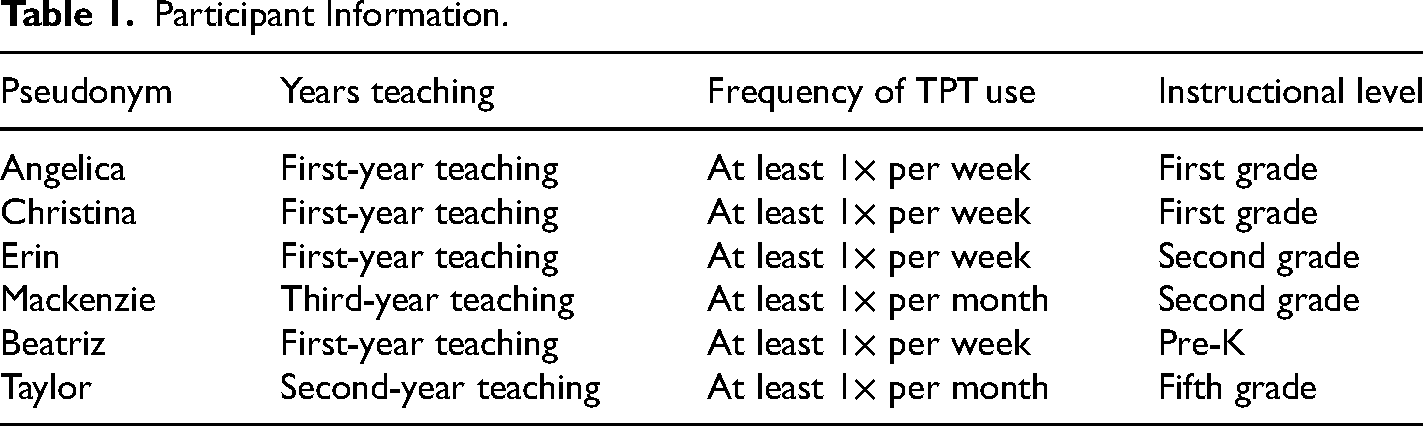
At the time of data collection, both authors were professors in the program where participants are enrolled. Gillian conducted all interviews and was not the professor of any participants at that time. Both authors advertised participation in the study to all practicing teachers enrolled in the education Master's program. All participants who completed interviews were compensated with a $20 Amazon gift card and were free to leave the study at any time.
Data Sources and Collection
Data for this study included semi-structured think-aloud interviews (Charters, 2003; Ericsson & Simon, 1993; Pressley & Afflerbach, 1995), including both verbalizations and participant actions and behaviors. Think-aloud interviews have been commonly used in new literacies research to explore usability processes and digital practices as this methodology enables simultaneous multimodal capture of visual screen data, vocal commentary, and user behaviors (e.g., Asselin & Moayeri, 2010; Kohnen et al., 2020). Participants were audio- and video-recorded using Zoom as they engaged in the think-aloud interviews lasting 30–60 min. For the purposes of this paper, “think-aloud interviews” will be referred to as “interview/s.”
The first part of the interview focused on exploring participants’ perspectives regarding the TPT platform, including the platform's perceived reputation within their teaching context as well as any personal perspectives. Questions included, “What do you think about TPT?”, “What reputation does TPT have amongst the teachers you know?”, “What might you use TPT to find, if anything?” and “What are you teaching now?” These questions initiated dialogue regarding each teacher's professional practice, as well as the role TPT plays within the participant's perception of their day-to-day teaching. While these issues were explicitly addressed within the first part of the interview, participants regularly interwove their perceptions of TPT throughout the entire interview.
In the second part of the interview, participants engaged in a think-aloud to find classroom instructional resources appropriate to their grade level using the platform. Prior to the think-aloud, the interviewer (Gillian) previewed the think-aloud text with participants and asked participants to practice thinking aloud. All participants were comfortable with the act of thinking aloud, as it is a common strategy in teaching and teacher preparation to make metacognitive processes more visible to learners (Ku & Ho, 2010).
During this think-aloud task, participants shared their computer screen with the interviewer. Then, participants were tasked with finding a resource to teach with and were encouraged to use their authentic classroom practices. If participants could not identify a skill or concept to teach, Gillian suggested “identifying the main idea in a text” as a generic starting point. As participants navigated the platform, they were encouraged to think aloud regarding their decisions, perceptions, and choices. The task would end when the participant found a source that they would be willing to use in the classroom, or when they expressed that they would stop searching at this point during an authentic search.
After concluding the think-aloud task, participants were asked how they might implement their selected resource in the classroom. If participants did not select a resource, they were asked how they would find or create a resource outside of the platform. Participants were then asked to provide any additional commentary. To conclude the interview, Gillian summarized her perception of the participants’ typical perspectives and processes regarding TPT. This summarization acted as an informal member-checking measure, and participants were invited to respond to and revise this summary.
During the interviews, Gillian collected informal notes regarding utterances and insights; following interviews, the interviewer synthesized the informal notes and demographic surveys into analytic memos. Additionally, both researchers and a graduate assistant transcribed interview audio. These memos, notes, recordings, and transcription of the think-aloud interviews, along with participant's self-reported demographic data, all comprise data for analysis.
Data Analysis
Data analysis began by unitizing the data. Transcripts were unitized into sentences as individual utterances, and video-recorded data were unitized into 5-minute subsections for ease of analysis.
The first round of analysis involved open coding (Saldaña, 2016) and analytic memoing across the six interviews. The first round of open coding was guided by the dimensions of information literacy including information need, information seeking, information evaluation (Bruce, 2004; de Silva & Chandrawamsa, 2016), as well as the emergent teacher perspectives regarding TPT uttered during the think-aloud interviews and insights from analytic memos taken during the interviews. During open coding, participant utterances were used as the first example of initial codes. Open codes were initially documented on copies of the audio transcripts using Dedoose software.
Following the first round of open coding, Gillian assembled a preliminary codebook designed to document both the perspectives shared and the information literacy practices observed across the interview corpus. This codebook contained codes, operationalized definitions, and coding exemplars from the first round of open coding. Sample codebook codes included practices (e.g., using filters, keyword searches, opening multiple tabs, evaluative judgments) and perspectives (e.g., school perspectives on TPT, curricular needs met by TPT).
During the second round of coding, we used focused coding (Saldaña, 2016) to construct categories of significant codes found across the data corpus (e.g., both transcripts and video recordings) while keeping note of the frequency and order of practices employed by participants. Using Dedoose, we separately applied the codebook to transcripts and participant videos separately, before meeting to discuss and resolve differences. We collaborated to revise the codebook and collapse codes into developing categories.
During the third round of coding, we employed axial coding (Saldaña, 2016) to explore how codes within initial themes interacted with and related to each other. For example, how did participant perspectives on the developmental appropriateness of resources intersect with comments on a resource's aesthetic appeal? By establishing overarching categories through collaborative analytic memoing, we created themes guided by aspects of information literacy, including the information need, information-seeking behaviors, and heuristics for information evaluation (ALA, 2006). See Figure 1 for an example of our iterative coding process.
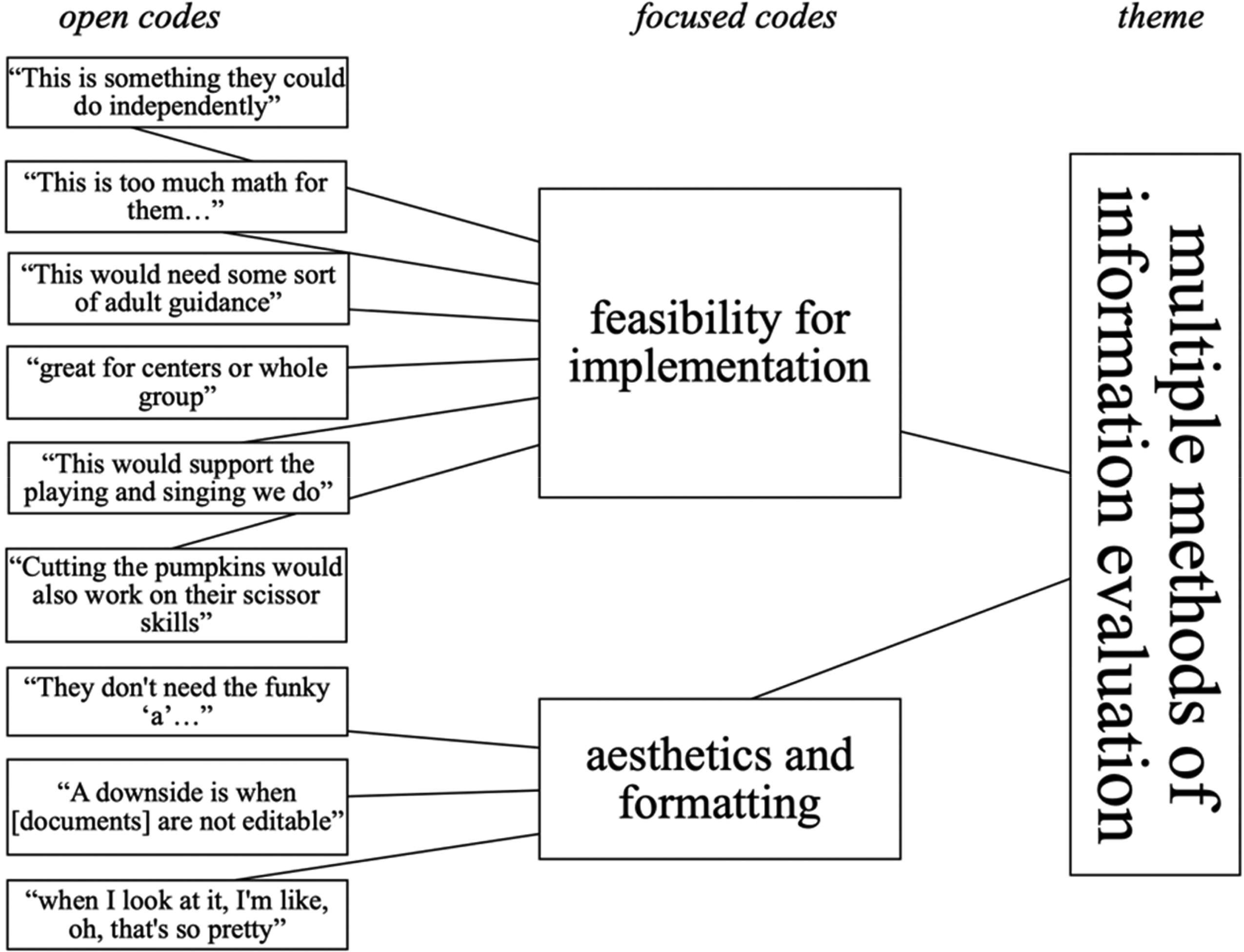
Iterative coding process.
Findings
Across these participants, distinct patterns emerged across their information-seeking and information-evaluation practices. In this section, we present findings segmented into two themes, each centering information seeking and information evaluation. First, we noted similar patterns of resource seeking across the TPT platform. Second, we observed significant divergences across participants’ information-evaluation practices (e.g., downloading resources, adapting resources, collaging resources into something new), many of which seemed to be guided by participants’ pedagogical knowledge, classroom routines, and resource affordances.
Similar Patterns of Resource Seeking
TPT is an online marketplace and contains several features common to other online marketplaces. A home page with recommended content, a search bar, filters, and a results page following an online search are all affordances of the platform. For an overview of participant resource-seeking behaviors (see Table 2).
Presence of Information Literacy Behaviors Across Participants.
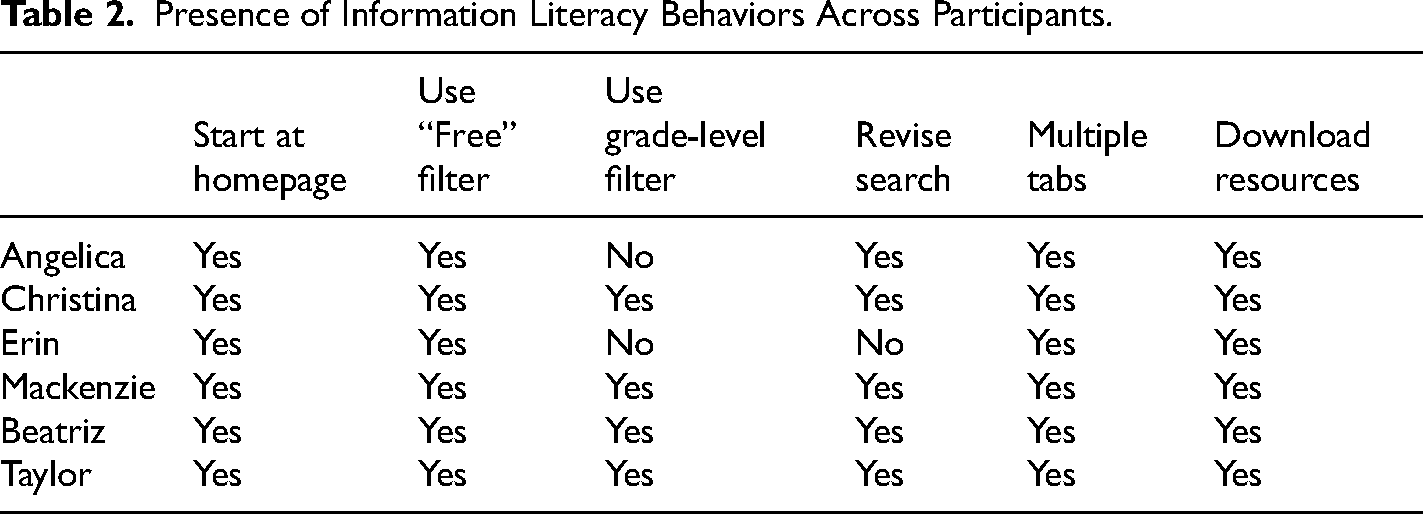
Most participants began their search using the search bar on the TPT homepage. Participants would enter an initial search into the search bar, usually a broad search related to the type of resource they sought. All participants used filters during their initial search, selected from a menu to the left of the screen; however, some participants began the search before filtering while others filtered before beginning the search. The most frequent filter used—and the first filter selected by all participants—was the “free” filter which limited the results to payment-free options. Four of the six participants used grade level filters, and all four of these participants selected their chosen grade, as well as grades one level below and one level above. For instance, Erin, a second-grade teacher, selected filters for first, second, and third grade “just to see.”
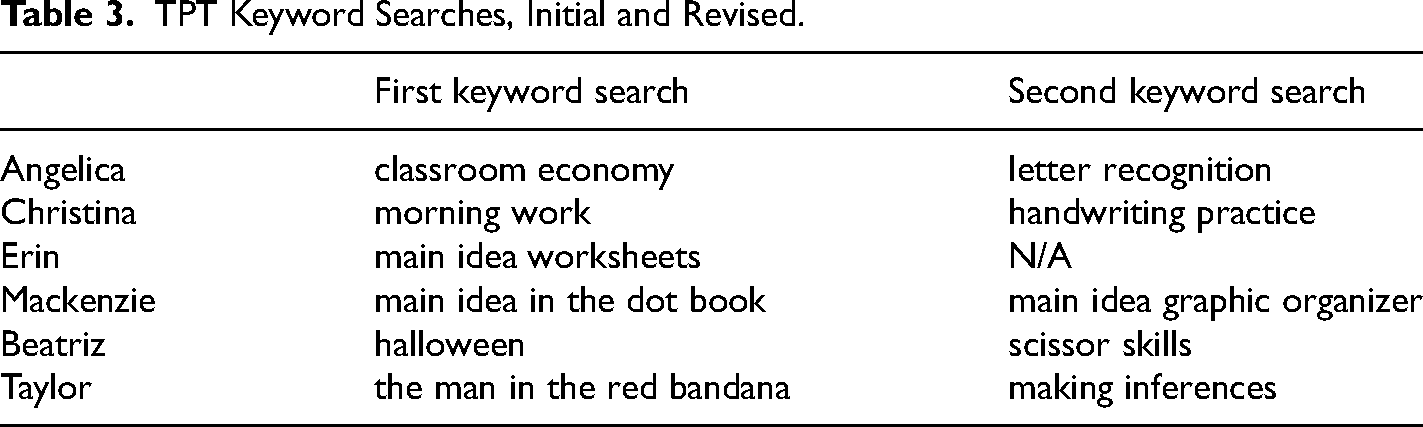
However, the first search was rarely successful. Upon arriving at the first results page, participants often skimmed the results for relevance to the resources they had in mind. Five of the six participants revised their search after their first results page (see Table 3). Some participants changed the topic entirely (i.e., Angelica, Beatriz), yet many other participants revised their keyword searches to widen or narrow their query. For example, Christina specifies “handwriting practice” instead of morning work, as the “morning work” results were too broad. Yet Mackenzie's search sought out materials from a certain book, and when no results were relevant, she revised her search to a more general graphic organizer that she could use to identify the main idea in any text.
TPT Keyword Searches, Initial and Revised.
When participants reach the desired search results page, they begin a process here defined as sifting: reviewing search results and self-selecting resources for deeper review. All participants used new browser tabs to open potentially relevant resources. By opening the resource in a new tab, participants can review the resource before selecting or discarding the resource while maintaining their initial search results. Multiple participants opened multiple potential resources in new tabs; for example, Erin opened two new tabs while Angelica opened four.
Many participants used the “preview” function to overview the resource where, as Taylor says, “you can see it zoomed in.” All participants used the preview function at least once during the think-aloud observation, while Erin and Mackenzie mentioned that the preview was the “first” affordance they examined after clicking on a resource. However, Taylor was the only participant to use the zoom function on her browser in addition to the preview function, which she uses when a preview isn’t provided. Additionally, all participants downloaded at least one free resource to evaluate beyond the preview. Once the resource was previewed or downloaded, participants began the evaluation process.
Multiple Methods of Information Evaluation
While participants’ strategies for finding relevant resources generally followed an established structure, there was divergence in how participants evaluated these resources. Participants used different heuristics, or judgment rules, to evaluate resources for potential use. Emergent heuristics specific to teachers’ evaluation of TPT resources were identified throughout participants’ think-alouds. Participant heuristics focused on the developmental and pedagogical appropriateness of the resource, whether the resource was feasible to implement, and whether the affordances of the resource were appropriate for students.
Developmentally and Pedagogically Appropriate.
Multiple participants expressed attunement to the appropriateness of the resource for the developing literacy practices of their students. Although these early-career teachers largely teach highly scripted curriculum, they all described using TPT to supplement their existing curricular materials. Often, these teachers described using small groups in their instruction, and looked for activities that could act as self-sustaining centers while teachers worked with other students. Angelica verbalized her inner monologue as she reviewed a potential centers activity for her first graders, saying, This looks like it has a lot of writing. So, they won't be able to do this on their own… It's got to be something that I can explain to them once … because I'm going to be working with my guided reading group. They could probably read this sentence and then color each picture with the same sound… Which is interesting because it kind of reminds me of chaining. Here's the \k\ sound and see if you can sound it out.
Feasibility for Implementation.
As early-career teachers, participants demonstrated nascent awareness of their own pedagogical style and classroom dynamic. Participants appeared to be imagining the implementation experience of a potential resource by juxtaposing the resource against their instructional practices. For example, Erin was skeptical that a particular resource might work in her classroom. She was looking for a morning work activity that would be completed as a whole group on the carpet, and discussed how different features of an activity were suited to different contexts: I feel like the carpet is always centered more towards games and activities… In morning meetings, it always has a game aspect to it. Whereas if I'm looking for more of an activity to do in a center…
Other participants engaged in similar evaluation processes. Mackenzie remarked on a resource's applicability to different groupings of students, while Beatriz was drawn to instructional games, saying “In my classroom, I like to do a lot of playing and singing.” Angelica was interested in implementing a letter sort to support some of her students but began to wonder when in the day she could implement the sort because “most of these students also get pulled for services.”
Aesthetics and Formatting.
Resources preferred by participants usually afforded editable or reusable document formatting, such as a Word Document or a Google Document, rather than a non-editable PDF. Beatriz prefers editable resources because “you can change it and modify it to be your own,” while Angelica reported that “if [a resource] is not editable … it deters me.” Resources being easy to edit and revise adds to a resource's perceived reusability: Taylor described “saving a copy” of a resource to use with next year's class while Erin described paying “$2, $3 for a resource … that I’ll have for the rest of my life now.”
Many participants commented on the “cute” aesthetics of resources available on TPT. Sometimes resources would have a particular “wow-ing” effect on participants: Beatriz commented “when I look at [this resource], I’m like, oh that's so pretty.” Similarly, Christina and Mackenzie remarked on the cuteness of resources. However, these utterances of cuteness were typically made as a participant first reviewed a resource; no participant used aesthetics as the final criteria for decision-making.
Furthermore, multiple early elementary teacher participants were troubled by the notion that cute resources may be more appealing. Both Angelica and Christina, first-year teachers in first grade, noted that many of the “cute” fonts popular on TPT might conflict with students’ developing print awareness. Angelica described the fonts as “squiggly,” and reported changing the fonts as “I can’t have cursive in my classroom … students will not understand what that is.” Christina described the “double story” lowercase letter g and letter y that regularly trouble students as common in both online curriculum and the curriculum resources provided by her school. Christina described: Some of the fonts are just not what we’re teaching, and they get really confused… That weird G that's on like Times New Roman … when they’re that young, it's good for them to see, but we don’t want to teach them that's how we make Gs.
Promising Practices and Opportunities for Development
Early-career teachers are in the challenging position of applying curriculum while also managing classroom environments, tracking data, and engaging students in rigorous content learning. It is a common lay practice among many educators to supplement existing curriculum with outside resources (Carpenter et al., 2021; Silver, 2022), particularly those from TPT (Shelton & Archambault, 2022). By analyzing teachers’ behaviors as information literacy practices, we gain insight into a pattern of knowledge interchange: the relationship between knowledge of the TPT platform and existing information literacy practices. Overarching themes in participant videos included teacher needs for curriculum supplements as well as non-instructional supplements; information-seeking practices involving curation, recursive keyword searches, and deliberate use of filters; and information evaluation as guided by classroom pragmatics and students’ instructional needs.
Each of these teachers presented unique and contextually bound practices related to TPT. At the onset of this research, we hoped to uncover practices that we flippantly characterized as “the good, the bad, and the ugly.” And certainly, throughout this study, we noted emergent practices from these early-career educators that could enhance or problematize strategies for finding and evaluating resources on TPT. For example, a recurring positive practice observed in every participant was opening tabs to collect multiple resources before selecting, or practicing “click restraint” (McGrew & Glass, 2021). Other encouraging practices included the use of “free” and grade-level filters to streamline results, recursive searching to achieve saturation, and matching materials with a scripted curriculum or preconceived pedagogical approach. Such practices reduce the pool of resources to increase relevance to the searcher. Further, all of these practices imply that these teacher participants were being strategic in their searching, rather than finding the first resource and implementing it without consideration.
However, rather than uncovering “bad” or “ugly” practices demonstrated by our participants, we repeatedly observed ways in which flaws and limitations within the landscape of practice impeded participants’ emerging professional knowledge. The problem is not our teachers, but rather the widespread policies that dictate and/or control teachers’ ability to select appropriate resources. Teachers are deeply impacted by the deficit framing of their expertise that pervades both teacher preparation and K-12 learning environments. This framing posits that teachers cannot be trusted to make judgment calls about resources on TPT, so in turn they are told to avoid the platform altogether. Because teachers cannot be trusted to effectively teach their own students, they are saddled with highly scripted yet astoundingly insufficient curricular programs (Ainsworth et al., 2012; Yeigh et al., 2017). There seems to be a general derision for teachers’ supplementation of curriculum, yet the institutionally-provided resources do not address all instructional and pragmatic needs within day-to-day classroom instruction.
Simultaneously, little attention in teacher preparation is allocated to the increasingly complex landscape of the internet and its impact on information seeking. On a continuum of incidental to intentional information seeking (Kohnen & Saul, 2018), TPT exists in a middle space. Most participants perceive the platform as a “safe” way to find ideas to implement in their classrooms (Carpenter & Shelton, 2022; Curcio et al., 2023). Yet how teachers generally spoke about TPT is similar to common discourses about Google; phrases like “I’ll just Google that” or “I’ll find something on TPT” centers the platform itself as the locus of information, rather than a marketplace for independently created resources. TPT is a tertiary source for curriculum, not a publisher. Further, sites like Google and TPT are not neutral or altruistic operations—in fact, TPT is now owned by a major educational technology company that features instructional software often adopted by school districts. Indeed, TPT is a commercial platform designed to separate users from their money (Brown et al., 2023). The platform has accumulated significant power within the educational landscape, and that power accrual is designed to promote the platform rather than enhance the quality of public education.
As literacy teacher educators, we cannot tell students to avoid TPT any more than we can advise them to avoid Google. Rather, it is our charge to equip ourselves and future teachers with practical strategies to use these platforms effectively rather than being used by them (Schroeder et al., 2023). In analyzing teachers’ behaviors as information literacy practices, we gain insight into a pattern of interchange between knowledge of the TPT platform and existing information literacy practices. It's not enough to just say “teachers need to curate resources” or “educators need to critique the content of supplementary resources”; we must develop strategies to tweak, adjust, refine, and enhance the practices these teachers are already using without demonizing the platform itself or their preexisting practices. Teachers seek out information or supplementary curriculum because they are filling an information need because they’re trying to find their footing as teachers, or trying to find their place in this profession. Further, much like the disciplinary practices of journalists and nonfiction authors (Kohnen & Mertens, 2019), these early-career educators are using their developing professional knowledge to enhance how they find and evaluate pedagogical resources. Approaching their practice from an information literacy perspective offers us a way forward that's simultaneously practical and critical.
Future Research and Practice
As we step back and examine the scope of extant research, we are struck by the informational challenges facing early-career teachers. These teachers are simultaneously navigating online landscapes to find curricular resources—environments characterized by a glut of information in which TPT stands tall as a trusted, well-known platform—while navigating the development of nascent teaching practices and making sense of existing curricular resources. Rather than viewing these navigation patterns as separate and discrete, we posit that considering interactions between information literacy practices and awareness of effective pedagogical practices may provide a productive avenue for future scholarship regarding how teachers use curriculum marketplaces like TPT.
We echo Silver's (2022) call for increased interrogation of why teachers supplement their existing curriculum, as well as the innovative practices used by teachers as they navigate both online curricular landscapes and their developing teaching practices. For example, multiple participants in this study described employing innovative digital and information literacy practices regarding TPT resources, including but not limited to downloading and editing free resources, using screenshots of previews, editing fonts and PDFs for student comprehension, and using their established curriculum as a guide for evaluating potential resources. And as participants navigated the TPT platform, their decision-making appeared informed by their developing positionality in the landscape of practice: an interest in developing a repository of activities and resources; the balancing of time, energy, and money; and the ability to share resources with their colleagues. These practices appear to mutually inform one another, and future scholarship may consider the interaction between information literacy practices and teacher identity regarding TPT use.
Additionally, because our data sources were limited to think-aloud interviews and live observations of teacher resource evaluation on TPT, how teachers implemented TPT resources (beyond self-reporting) exceeds the scope of this study. Future research could extend the methodology of this study to include classroom observations of implementation. Further consideration may be given to the quality of resources that teachers select following strategic analysis; for example, is the “color each word” worksheet that Christina found as strong a pedagogical resource as she asserts?
Conclusion
The early-career teachers interviewed as part of this study are some of the newest members of the teaching force. During their first few years as teachers, they are beginning to navigate instructional needs, time pressures, and institutional norms. To do so, these teachers would occasionally supplement their instruction with resources that they found and evaluated prior to implementation. Exploring how teachers use their professional knowledge to make decisions about curriculum supplementation provides insight into teachers’ curricular reasoning.
Even at an early stage in their careers, participants strategically blended their pedagogical knowledge with instructional needs to find, collect, and evaluate resources. Most promising, perhaps, are the information literacy strategies used by these early-career teachers as they navigate the TPT curriculum marketplace. Not only were participants able to find resources, but they engaged in thoughtful evaluation based on both knowledge of students and pedagogies. They wondered: can my student read this font? Is this going to be too challenging, too easy, too frustrating? Can students complete this activity independently? Does this resource make the day-to-day of my instruction easier to facilitate? These early-career teachers often evaluated multiple resources and occasionally described combining resources into materials that fit their students’ needs. Ultimately, we view participants’ curriculum supplementation practices as drawn from necessity; all participants have school-provided curriculum, yet all participants simultaneously referenced a need for additional resources that facilitate daily classroom practices.
There is a broader impetus for understanding how teachers find and evaluate resources for curriculum supplementation. With more than 44% of teachers leaving the field within 5 years (Ingersoll et al., 2018) and 54% of Americans reporting that they wouldn’t want their own children to become teachers (Will, 2018), American education is at a crossroads. As it stands, career sustainability is a primary concern for teacher educators. As teacher educators, we must work urgently to address the unsustainable conditions teachers navigate daily. One approach to challenge the deficit perspective on teachers and their curriculum supplementation is to develop our understanding of teachers’ information-seeking practices during curriculum supplementation. By examining the information literacy practices of teachers as they address curricular needs, we can better support early-career educators in honing their information evaluative skills, thereby drawing on the resuscitating power of literacy research to examine teachers’ professional knowledge, and how they make decisions to best support their students.
Footnotes
Declaration of Conflicting Interests
The authors declared no potential conflicts of interest with respect to the research, authorship, and/or publication of this article.
Funding
The authors received no financial support for the research, authorship, and/or publication of this article.
