



Abstract
Amidst the backdrop of rising censorship legislation, it is important to understand the influence of teachers’ particular contexts on their perceptions of potentially controversial texts and subsequent instructional choices. This study explores five in-service teachers’ acts of positioning observed in year-long antibias antiracist professional book club, which facilitated educators’ access to such texts and opened space for imagining ways to incorporate them into classroom practice. The findings illuminate how teachers positioned their school’s moral framework, their responsibilities towards families, and specific texts as possible for classroom use. Furthermore, this study prompts critical reflection on the role of facilitators in revising contextual storylines while highlighting the persistent challenges of breaking free from entrenched storylines in pursuit of antibias antiracist pedagogy.
Keywords
Educators are in the middle of an evolving educational landscape, one wherein they must navigate their school's particular sociopolitical context alongside a surge of educational censorship efforts. In the 2021–2022 school year alone, a staggering 122 educational censorship bills were introduced in 33 states (Sachs, 2022), and 1,648 unique book titles were challenged in 32 states (Friedman, 2022). Most often, these bills and challenges target people from historically nondominant and minoritized backgrounds, especially with regard to their race, gender, and/or sexuality. These legal initiatives have intensified educators’ hesitancy to broach topics with students that might be deemed risky or risqué (Koss & Paciga, 2023), and that hesitancy is warranted. News reports have detailed instances of teachers facing investigation and termination because of their use of texts perceived to be controversial (e.g., Demopoulos, 2023; Rahman, 2023; Sonnenberg, 2023). In response, as former classroom teachers and current teacher educators, we believe that teachers’ professional development must enable them to create supportive spaces for engaging with potentially controversial texts and develop strategies for incorporating them into classroom practice. This proactive stance ensures that teachers have uninterrupted access to the valuable information within these texts as resources, opening space for discussions on how to forward antibias, antiracist (ABAR) practices through the use of provocative literature.
In this study, we reflected on this work and our shared goal of fostering a justice-centered space through a yearlong book club with five in-service teachers. In the second year of a multiyear research practice, this book club aimed to meet teachers’ previously expressed need for practical tools while addressing their hesitancy in implementing ABAR pedagogy.
1
We had two overarching goals for the book club. First, we wanted to expose in-service educators to contemporary children's and young adult literature that centers ABAR topics as potential tools to tackle complex and sometimes controversial issues. Simultaneously, we hoped the space would encourage discussions around strategies for enacting these texts within the teachers’ school context. In a prior analysis of the book club space (Wargo et al., 2024), our analytic focus centered on how teachers engaged with children's literature that specifically explores gender and sexuality. We found that teachers utilized the book club space to grapple with their context's silence surrounding these identity markers and to envision how the texts could be employed as backup to perceived community pushback. For this article, we turned to the larger data corpus to explore how teachers positioned themselves, their context, and others while reading children's and middle-grade literature. We wanted to understand how teachers’ acts of positioning may have resulted in narratives, or storylines, that held imagined power over their instructional decisions. More specifically, we asked:
What storylines, both liberatory and oppressive, circulated as five in-service teachers imagined risky texts in practice? How did these teachers understand their role as educators when responding to these storylines? How were these (con)texts positioned within these imaginings?
Literature Review
Far from being neutral, the U.S. educational system actively promotes particular ideologies (Apple, 2019). Yet, a persistent idea of educational neutrality proves harmful because it ignores the dichotomy that education either liberates or domesticates students (Freire, 1985). The impossibility of neutrality extends to the realm of curricular texts and books (Dávila, 2022) because they function as conduits for cultural values (Alfonso, 1987). Consequently, texts often become battlegrounds for control, with individuals and groups seeking a symbolic claim to power by influencing what information is available to students (Knox, 2014). Although various reasons are cited for book challenges, Knox (2014) identified preserving children's innocence as an underlying reason and primary goal. In this section, given that we sought to interrogate how educators positioned themselves, their context, and others when engaging with risky texts, we survey the extant literature to define what it means for a text to be considered risky/risqué for K–12 students. Then, we highlight why teachers might be hesitant to teach these texts, and we explore why professional book clubs have been suggested as a support to alleviate such concerns.
Risky/Risqué Texts
The concept of childhood, influenced by cultural and temporal contexts, is entwined within the fabric of book challenges. Wargo and Apol (2020), for example, followed others in defining risky/risqué texts as those focused on complicated social and cultural issues in ways that urge readers to understand today’s youth. Conceptualizing certain texts as risky prompts teachers to reflect on where they perceive the inherent risks in the texts (Wessel-Powell & Bentley, 2022) and to unpack their preconceived notions and assumptions about childhood (Lesko, 2001). Whereas legislation continues to position children in deficit ways (Lammert & Godfrey, 2023), it is crucial to recognize that children possess the capacity for critical inquiry and dialogue (Vasquez et al., 2019). Acknowledging this potential, the National Council of Teachers of English (NCTE, 2018) encourages teachers to continue teaching texts that might be labeled risky. However, despite teachers wanting to meet the needs of their students through literature, many educators and librarians have reported that the growing fear of potential pushback influences their literature selections (Koss & Paciga, 2023). To counteract this trend, one needs to better understand the root of teachers’ hesitations. This understanding can enhance one’s ability to support teachers in fostering critical conversations around risky texts (Wessel-Powell & Bentley, 2022) and better prepare future generations of teachers (Kimmel & Hartsfield, 2019).
Hesitancy to Teach Risky/Risqué Texts
Although the phenomenon of book challenges has a long history, the recent surge in censorship legislation is shaping teachers’ perceptions of the education field and their curricular decisions (Koss & Paciga, 2023). At the same time, there is a notable shift toward a more cautious approach when engaging students with risky topics (Lammert & Godfrey, 2023). Within this evolving landscape, teachers grapple with fears of potential resistance from their local community (Sachdeva et al., 2023), especially from families, who have increasing influence over the texts used in classrooms (Kimmel & Hartsfield, 2019). Nevertheless, teachers have a moral obligation to provide justice-oriented teaching (Cochran-Smith et al., 2009), which can be achieved by selecting literature that prepares children for the realities of a pluralistic society (Hartsfield & Kimmel, 2020).
The hesitancy to teach difficult topics through texts is well documented. From depicting tales of war and violence to more mundane stories of personal oppression, these types of children’s texts have been described as “risky stories” (Simon & Armitage, 1995), “risky historical texts” (Damico & Apol, 2008), “literatures of trauma” (Robertson, 1997), and “children’s literature of atrocity” (Baer, 2000). While these labels indicate the perceived high-stakes nature of these texts, researchers call for educators to utilize them in their classrooms because of their “risky” real content. Eppert (2000) says that these “narratives of historical witness” require attention because they demand readers confront horrendous human acts and develop empathy through response. Responding to hesitations to teach these types of texts, Wargo and Apol (2020) emphasized that “our job as educators is not to discount or absolve ourselves from pedagogical responsibility of teaching risky/risqué topics but to advocate for ways to include diverse voices and experiences” (p. 136). For early-career teachers, this reflection must occur alongside professional development initiatives scaffolded by engagement with other teachers (Wessel-Powell & Bentley, 2022). In support of teachers’ facilitation of discussions on social issues, researchers have documented how children's literature can be a resource that assists teachers in presenting such complex topics, ultimately serving as the foundation of critical conversations (Leland & Harste, 2001). Professional book clubs, recognized as steadfast forms of continued professional development (Flood & Lapp, 1994), can provide teachers with the opportunity to read and discuss these impactful texts.
Professional Book Clubs
In professional book clubs, the chosen book serves as a heuristic for teachers to collaboratively generate knowledge and reflect on their own teaching experiences (Kooy, 2006; White, 2016). Participation in professional book clubs has led to teachers modifying their classroom practices (Goldberg & Pesko, 2000; NCTE, 2022). Additionally, while engaged in professional book club communities, teachers have expressed a sense of freedom, opening space for them to address larger educational issues and challenge the status quo (Flood et al., 1994; White, 2016). Through their text engagement and conversations, teachers enhance their awareness of others and reflect on their own beliefs, which sometimes are transformed subsequently (NCTE, 2022; White, 2016).
Whereas most of the recent research on professional book clubs has focused on teachers engaging with instructional texts (e.g., Blanton et al., 2020; White, 2016), Boyd and colleagues (2021) suggested that book clubs centered on children’s texts can influence teachers’ perspectives on risky content. As one example, Rogers and Mosley (2008) found that teacher candidates’ collaborative interpretation of children’s texts led to the engagement of their “racial imaginations” (p. 121). The teacher candidates’ engagement involved considering what, in terms of characters’ actions or dialogue, was antiracist while also reflecting on their own positionalities and rehearsing their potential roles as ABAR educators.
In contrast to Rogers and Mosley's (2008) focus on teacher candidates, in our professional book club study, we explored how practicing teachers positioned themselves, their shared context at a Catholic school that faced particular book challenges during the 2022–2023 school year, and others. Because teachers are more often influenced by the ideologies of their local community rather than governmental control (Koss & Paciga, 2023), the school context inevitably impacts the teachers’ storylines about the context, people, and texts. Thus, our study illustrates a particular sociopolitical time and context when examining how in-service teachers take up ABAR tasks and texts.
Theoretical Framework
Given our interest in exploring how, when engaging in a professional book club, educators examined themselves, their context, and others in relation to risky texts, we turned to positioning theory to understand teachers’ imagined storylines and social orders.
Positioning theory, as conceptualized by Harré and Moghaddam (2003), considers the intricate nature of how people locate themselves and others through discourse. Positions, guided by presuppositions concerning duty distribution, play a pivotal role in determining “who could [have the authority to] perform which actions” (Harré & Moghaddam, 2003, p. 4), thereby shaping the structure of social episodes. Thus, the negotiation of positions occurs within sequences of relational acts that are embedded in and contribute to the reinforcement of power distribution (Barone, 2011), a process influenced by the norms individuals associate with their roles (McVee, 2011). This process is temporal and involves individuals constructing their identities and understandings of the world within and across discursive acts (Green et al., 2020). As the book club comprised teachers working within the same context, we were interested in how they might position their identities, duties, and power within the relational and discursive acts that unfolded within and across the book club sessions.
To help us understand the nuances of these constructions, we turned to Slocum-Bradley's (2010) positioning diamond, which understands the construction of positions as shaped by four key components: social forces, identity, storylines, and duties and rights. Social forces, defined as speech acts, strategically position oneself and others through storylines, or the narratives people tell (Slocum-Bradley, 2010). Identities are the characteristics and affiliations that individuals assume through discourse, and duties and rights make up the moral order that undergirds what action is deemed proper. Together, these components shape the discourse issuer, the subject matter of the discourse, and how the discourse connects to broader society. This was particularly important to our book club as teachers were considering the focal topic and how it intersected with their imagined and real contexts.
Positioning is significantly influenced by prior interactions, present engagement, and future imaginings with “material and social” resources available to individuals (Green et al., 2020, p. 121). In this way, “social and textual artifacts” (Anderson, 2009, p. 292) mediate positional constructions by shaping a position’s meaning, interpretation, and trajectory within the complex web of institutional norms. As such, we understand Slocum-Bradley's (2010) positioning diamond as being shaped through social interactions around artifacts (e.g., children’s literature) within a broader sociocultural context.
Following others interested in the reexamination of data to more explicitly explore social and power relationships (e.g., Barone, 2011), we drew on positioning theory as we reentered the book club data, exploring how normative storylines influenced teachers’ positioning of their rights and duties to teach justice-oriented books within the perceived cultural identity of their context. We came to understand the book club texts as mediating heuristics that functioned as social forces, prompting teachers to position themselves in power-laden relationships within the group and their broader school community. Knowing that their responses were shaped by internal censorship and external controversy, we wondered how teachers positioned their identities and others in relation to the liberatory and oppressive storylines circulating within their shared context.
Method
The professional book club was part of a larger 2-year research–practice partnership that we expanded in Year 2 to include a yearlong book club alongside ongoing ABAR professional development. This addition was in response to teachers’ hesitancy in the first year to incorporate learnings from the ABAR professional development into their English language arts classrooms. Throughout the first year, teachers consistently desired material resources that could be brought into the classroom to support ABAR pedagogies. To address these patterns seen in Year 1, we aimed for the book club to serve as an ideological and pedagogical catalyst for integrating justice-oriented children’s and young adult literature into educators’ teaching practices.
Participants and Context
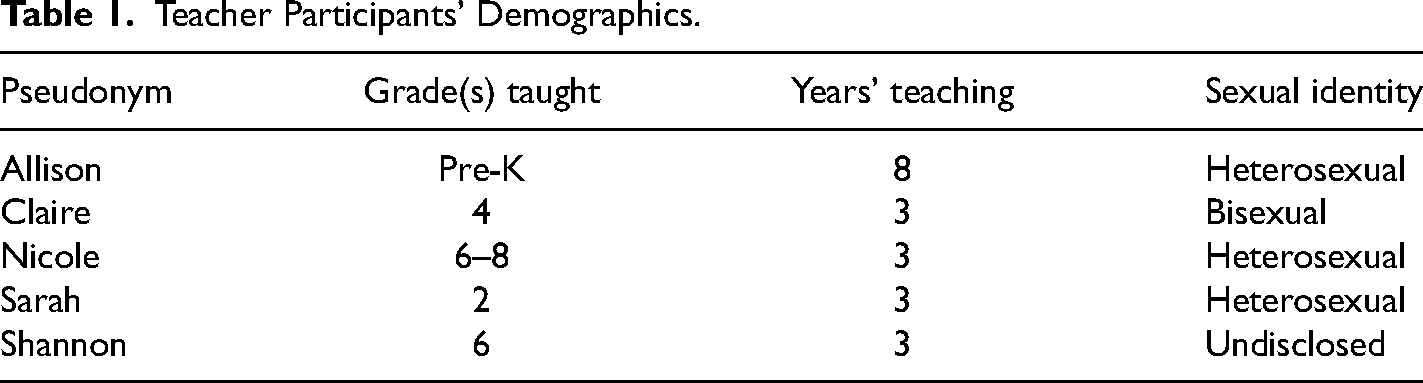
Five in-service teachers, working with pre-K–6 students, took part in the book club (see Table 1 for information about the participants). These educators all worked at St. Ignatius School (all names are pseudonyms), an independent Catholic school in the U.S. Northeast with an enrollment of over 400 students. Within the broader professional development context, participating teachers were paired with three teacher educators from Benedict College, a local Jesuit university. The in-service teachers self-identified as white, Catholic, cisgender women in their third or eighth year of teaching. Four of the teachers were either recent graduates of or currently pursuing their master's degree in education at Benedict College. Our identities, as authors of this article and facilitators of the book club, matter to those of the participants. We—one associate professor and two doctoral students—are white-seeming, although we vary ethnically and religiously. Kyle and Jon self-identify as gay, cisgender men without prior experience in Catholic education, whereas Kierstin is a straight, cisgender woman who was a former Catholic school educator.
Teacher Participants’ Demographics.
Per the school's mission, St. Ignatius promises to “prepare children to live lives of faith, service, and leadership for the betterment of society.” However, despite the school's justice-oriented vision, particular topics (e.g., police brutality, lesbian, gay, bisexual, transgender, queer or other non-cis/heterosexual identites (LGBTQ+)+ identities) became sources of contention after receiving pushback from families and resistance from the administration. In response to these challenges, the book club opened space for teachers to engage in discourse that openly addressed ideological frictions mediated through engagement with the texts. To support the teachers in navigating potentially contentious topics, we intentionally selected risky texts that feature particular social issues and respond to their contextual tensions (see Table 2). Given the participants’ diversity of grade levels and context area expertise, we read picture books for four sessions and middle-grade chapter books for two sessions.
Focal Texts in the Book Club.
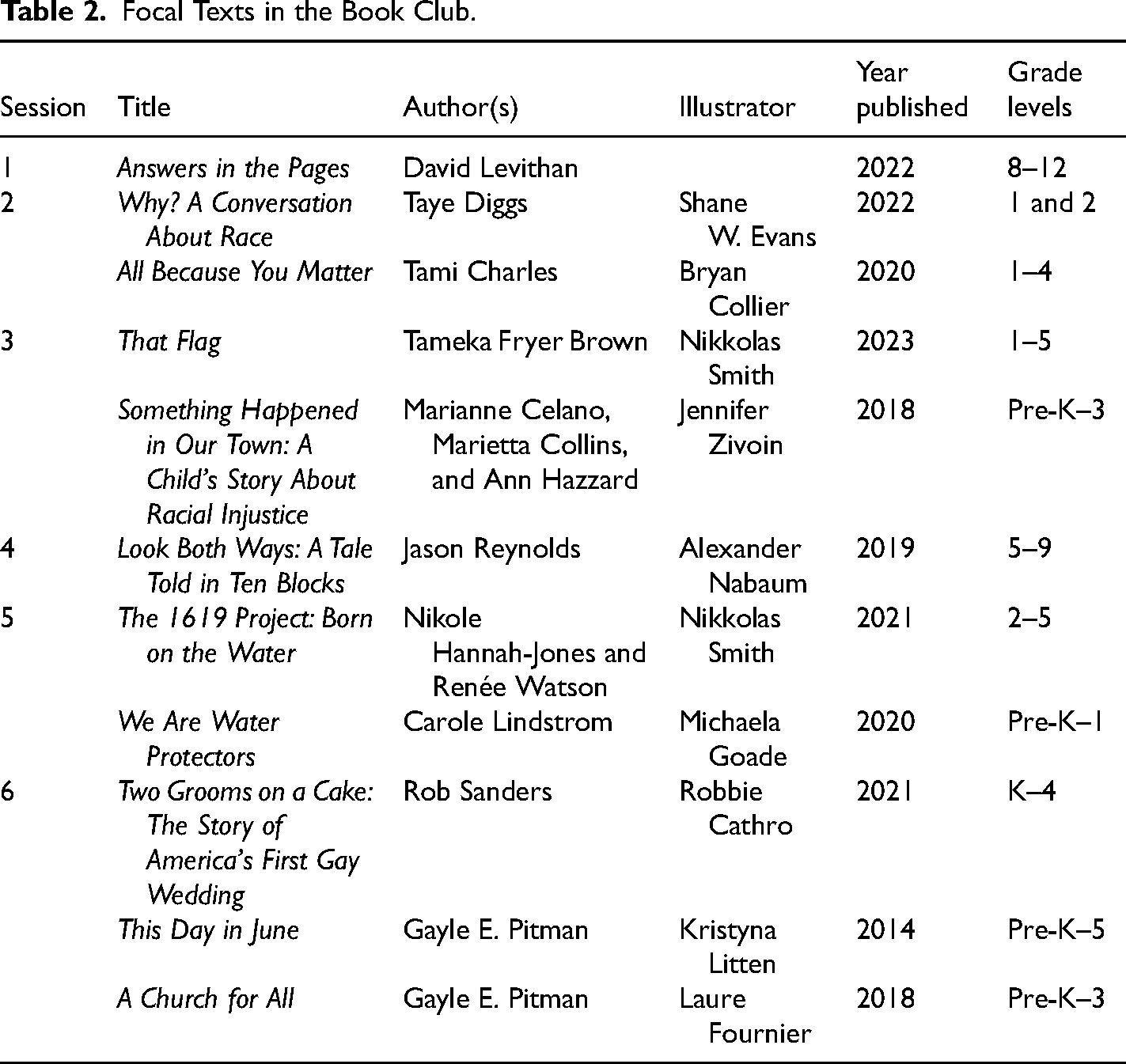
We rotated leadership to plan the book club sessions, with each of us taking turns creating initial questions that aligned with the text's topics and the broader conversations in our professional development. We then met weekly to refine these questions, which served as a discussion springboard. Ultimately, though, a goal was for teachers to generate and ask their own questions. In the first session of the book club, we explored a chapter book in which a teacher navigates a parental challenge to a classroom text. Starting with a teacher as a predominant character was an intentional choice, as we intended the book to act as a reflective heuristic for our teacher participants to deepen their self-understanding. Responding to teachers’ questions about facilitating conversations, for Session 2, we selected a pair of picture books that model conversations around (a) addressing events of injustice and (b) promoting positive racial identity. Then, in Session 3, we delved into two texts that facilitate conversations around more explicit issues of racism, such as police brutality and the Confederate flag. We dedicated Session 4 to a chapter book with an asset-based approach, following different yet interconnected students on their walk home from school as they encounter various challenges. In the final two sessions, we aimed to provide access to texts that resonated with ongoing challenges in the teachers’ school context. Session 5 featured two picture books linking the cultural and social politics of water and land with historically enslaved people and contemporary Indigenous communities, and in Session 6, we delved into historical events and contemporary movements surrounding gender and sexual identities.
Relationality Statement
Knowing the precarity of doing this work as white-seeming teacher educators with white in-service educators, we acknowledge the potential for our efforts, despite our best intentions, to inadvertently reify whiteness and oppression in ways that might limit the advancement of racial justice. We remain mindful of Johnson's (2020) perspectival article, “When Black People Are in Pain, White People Just Join Book Clubs,” in The Washington Post. We agree with his sentiment, and we are guided by and follow Oluo (2018), who reminded us that, as white individuals, we are not bestowing favors by facilitating this space; rather, we are responding to our role in upholding systemic inequities. By introducing and funding texts that have been or could be positioned as problematic within the shared context, we used these texts to discuss how topics such as racism and homophobia might be approached in the classroom. This entailed discussing pedagogical strategies that could facilitate teachers taking up these texts in their classrooms. Ultimately, our strategy was to transform discussions into actionable steps, fostering an environment where we held one another accountable.
As welcomed guests in the school, we encountered challenges in holding teachers accountable for translating the book club discussions into action. We and the teachers shared a desire to see these texts implemented in classrooms, hoping to catalyze change in the local context. However, the prospect of potential consequences created a nuanced situation, as it would not directly impact us professionally but would affect the teachers. In other words, we asked teachers to implement texts that could jeopardize their job security, whereas we maintained our professional stability. Ultimately, this challenge may have contributed to our hesitations and limited intervention during book club discussions, potentially impeding the teachers’ depth of engagement with issues related to equity and justice.
Data Generation and Analysis
For this article, we reentered our book club data to ask broader questions around positioning and power of the entire data corpus. To do this, we analyzed data generated during the 2022–2023 school year across book club sessions and pre/post one-on-one interviews with teachers. During each 1-h book club session (N = 6), teacher educators and participating educators engaged in text-based discussions. To be selected, the focal text needed to be published within the past decade and feature themes that would foster ABAR-related conversations. Hosted on Zoom, each session was audio-recorded and transcribed. The final book club session was held in person to create a reflective space to synthesize the year's work. The audio recording of this session was also transcribed and used as a source of triangulation.
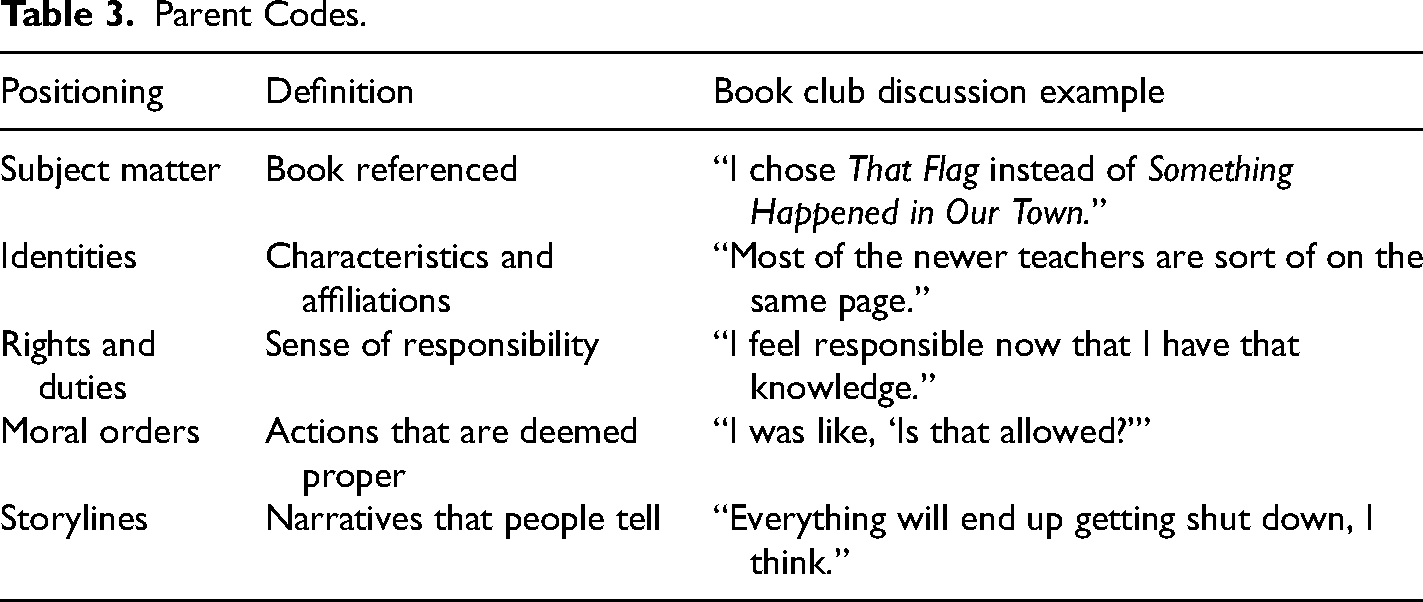
Drawing on Slocum-Bradley's (2010) positioning diamond, we adopted a typology of codes that revealed the storylines discussed and negotiated during the book club sessions. These codes (see Table 3 for parent codes) allowed us to explore how teachers positioned themselves, their context, and others while reading risky texts. Our analytic process began by categorizing the transcribed discussions into coded segments (Maxwell, 2005), “fracturing the data” (Strauss, 1987, p. 33) into smaller components. This resulted in the creation of child codes, which were used when reentering the data for a second round of coding. Concurrently, we wrote analytic memos to identify and interrogate the emerging storylines across the transcripts and their relationships with the subject matter, identities, moral orders, and rights and duties (Emerson et al., 1995). Specifically, we employed reflective questioning to trace how our assumptions, positions, and tensions informed the emerging storylines. We asked questions such as “What surprised me?,” “What intrigued me?,” and “What disturbed me?” (Sunstein & Strater, 2012, p. 385). Following this, we engaged in conversations where we acted as critical friends, pushing back and drawing on our varying perspectives to reach a consensus on the final storylines. Then, we triangulated these more focused analyses with the participant interviews and final reflective book club session, looking for confirmation or disconfirmation of our emerging findings.
Parent Codes.
Findings
Throughout our meetings, teachers grappled with the books’ technical, pedagogical, and situational natures. Questioning not only if they could teach the risky texts but also when, how, and what they would teach from them consistently surfaced. In this way, the texts acted as heuristics that animated storylines about the educators, their context, and their students. Sessions did not always cultivate rich conversations about the texts, as the focus often shifted to how the books were powerful forces imagined to elicit distinct reactions from various stakeholders. As teachers participated in the conversations, the interactions between their identity and the texts, as influential agents, formed a dynamic relationship that intricately shaped the teachers’ perceptions of an educator's role. In this section, we unpack three storylines: the school's moral order as a systemic barrier, the teachers’ sense of duty toward families, and the teachers’ rationales for reading particular texts in their classrooms.
“I Can’t See Myself Reading This Tomorrow and Not Having Any Problems”: Positioning the Context's Moral Order as a Barrier
In the tuition-dependent Catholic school, teachers framed families’ expectations as a crucial influence on the school's moral order. This often led to teachers’ perceptions of systemic barriers. Claire, a fourth-grade teacher, highlighted the connection between the financial contributions of families and their sense of entitlement to influence the school's curriculum. She remarked, “Because parents are paying for it, they feel like, ‘Well, I deserve this, and I deserve this as a parent because I’m paying for it.’” As a result, teachers questioned their right to push against the moral order perceived to be set by families.
This questioning of their role in shaping the school's moral order often manifested around teachers’ text selections. Although teachers understood the book club's texts as unproblematic, they positioned the books as catalysts for potential problems due to storylines potentially generating family pushback. Sarah described Two Grooms on a Cake: The Story of America's First Gay Wedding by Rob Sanders, for instance, as teaching “good values,” but she expressed reservations about bringing the text into her classroom. Without explicitly naming the text's focus on same-sex marriage, Sarah expressed, “I can’t see myself reading this tomorrow and not having any problems.” Her sentiments underscore how teachers suppressed their professional duties when selecting texts for their classrooms because of perceived storylines circulating around imagined family pushback.
Some teachers extended the pushback storyline beyond the classroom, anticipating resistance to student-initiated discussions at home. For example, when reflecting on Tameka Fryer Brown's That Flag, Shannon noted that a teacher in the text suggests to a student that she should ask her family about the Confederate flag. In response, Shannon stated, “We as adults know that if a student comes home and asks questions, more than likely they’re going to be shut down, ‘cause that’s how we assume families operate a lot.” Shannon’s preconceived notions about family dynamics led her to articulate an assumption that caregivers often shirk risky child-initiated conversations, extending the dimensions of the storyline around upholding a particular moral order as carrying over from students’ homes into the school space.
Family expectations were not the only factor that caused teachers to question their right to forward a new type of moral order. Participants grappled with internal tensions between the school's efforts to embrace change and those who wanted to maintain traditions. Allison, the participant with the longest tenure at the school, highlighted this challenge when comparing St. Ignatius with the school described by David Levithan in Answers in the Pages: When parents walk through those doors, some of them went to our school and they want it to be the same, or they’re expecting it to be the same in some capacity. And in some classrooms, it is…. We have a lot of very young teachers, and that's very exciting, but we still have some strongholds of older traditions and people who are maintaining some things that maybe shouldn’t be maintained.
Allison's comments showcased how teachers at St. Ignatius are expected to deliver a particular service, one that is in tension with moral orders aligned with ABAR pedagogies (e.g., explicitly talking about bias and racism). Recalling a family's reaction to her reading of IntersectionAllies: We Make Room for All by Chelsea Johnson, LaToya Council, and Carolyn Choi (2019), Allison positioned education as a product that could be in tension with families’ expectations as consumers: I said, “I understand that you are paying for a product, and if you’re not getting what you’re paying for, I think that you should look elsewhere.” And that was a nice way of being like, “You are paying, [but it] doesn’t sound like you’re getting what you want. Get the receipt on that.”
Thus, Allison positioned the family's concern as a legitimate response, and in doing so, she de-emphasized her identity as a professional whose duty includes facilitating conversations about intersectionality with all students.
Through their participation in the ongoing ABAR professional development, teachers were implicitly assigned the responsibility of reshaping the school's moral orders but found themselves without clear guidance on how to navigate these mission-centered challenges. Again, using Answers in the Pages as a comparative source to their own context, Sarah explained the inadequate infrastructural support as a consequence of the administration prioritizing enrollment over values clarity: Admin says, “Yes, we support you,” and “Yes, we’re gonna do these things, and we’ll have those conversations with you.” … [But with families,] you can’t go back to, “Well, you heard this before you came here. This is what you knew you were getting.” There's none of that. It's like, “Oh, we just need to get the students, so we’re gonna take whoever we want. We’re gonna tell ‘em what they want to hear so that they come. And then after that, we’ll figure it out.”
Despite advocating for their school to relinquish past moral orders, teachers perceived it as unrealistic because of how the school positioned itself as aligned with all perspectives in order to attract a broader spectrum of families.
“I Don’t Know If I’m Allowed to Tell You That You Don’t Know Your Kid”: Teachers’ Conflicting Sense of Duty Toward Families
Reading Answers in the Pages not only provided a window into participants’ shared context, but one of the book's central protagonists, a teacher named Mr. Howe, also became a conduit for teachers to discuss their own rights and duties. Specifically, Mr. Howe's reactions to families served as a starting point for teachers to confront and understand their duties concerning families within their particular classrooms. Reflecting on a specific instance of family pushback, when parents failed to recognize their children's prior knowledge of an ABAR topic, Shannon noted, I think in a way that actually really linked with Answers in the Pages ‘cause the parents were thinking about it in terms of when they first got a phone or when they were that age, but the world is so different right now.
Navigating the paradox between families’ perceptions of their children and her understanding of students’ awareness from classroom conversations, Shannon boldly concluded to her book club colleagues, “I don’t know if I’m allowed to tell [families] that you don’t know your kid, but you don’t know your kid.” This statement underscores teachers’ constant grapples with their role and responsibility when navigating the dynamics of their relationships with students’ families. However, unlike their shared perceptions around recognizing systemic barriers, teachers’ sense of duty to support families was a point of contention.
On the one hand, Allison felt that the root of families’ pushback was due to their exclusion from discussions about the school's advancement of ABAR pedagogies. In response, she strongly believed in the importance of including families in these conversations and considered it central to her role as an educator. She believed that a collaborative approach could alleviate potential misunderstandings and create space for shared learning experiences. In a conversation about the peritext in Gayle E. Pitman's This Day in June, Allison said, “I’d rather engage the parents beforehand so they feel like they’re in on it and that they’re part of it and that they’re partners because I feel like parents will also learn from each other.” While noting the useful information within the book’s peritext, she assigned herself responsibility with not only including families but also supporting their understanding of how to facilitate ABAR-related conversations: “I think parents want to have more of a heads-up and maybe some more support … some scaffolding for parents for how to approach these subjects at home. They might not know how.” Across sessions, Allison positioned the educator's role as existing beyond the classroom, especially when risky texts were incorporated into a class's curriculum. For Allison, ABAR pedagogical work must include all stakeholders, and as the classroom lead, she felt she must equip families to continue conversations at home, thus educating more than just the students in her classroom.
On the other hand, teachers like Nicole were cautious about adding more tasks to their already demanding role. Emphasizing the primary responsibility to inform, include, and support students, Nicole stated: I agree, Allison, but I also think our job is to teach the kids. We’re not paid to give supplementary materials to parents…. I agree that would be nice, but it's not our job to educate them or prepare them to have hard conversations with their kids.
Nicole emphasized that providing families with supplementary materials or preparing families for difficult conversations was not within the scope of her job. In her view, the educator's role is not to challenge the ideological positions held by families; instead, her view of her professional role is limited to the scope of what happens within her school environment. As a middle-grades educator, Nicole considers her professional role as limited to the students in her classroom, a viewpoint that both echoes Shannon's earlier comments about families failing to recognize their children's prior knowledge and exemplifies the tension among teachers regarding their perceived duties concerning their students’ families.
In this complex landscape of perceived duties, where the contours of teachers’ responsibilities in guiding families through challenging topics remained unclear, teachers often made decisions that might alleviate their burden of direct responsibility to families, opting for choices that created distance between themselves and their students’ families. This approach of avoidance became palpable in the first book club session when Sarah stated, “I don’t want to bring anything up that's gonna make anybody's family upset.” Echoing this sentiment in the fifth book club session, Claire, a teacher who described her preference to ask for forgiveness rather than permission, recalled an interaction during her first year of teaching at St. Ignatius. In describing this negative experience with a parent, Claire articulated how it still affects her today: My first negative experience with a parent has soured me so much that now I feel much more on offense with, like, all parents. And I’m like, “Oh, I need to be prepared ‘cause they could come for me.” … I’m like, “OK, what can I do to mitigate this ahead of time?”
In this statement, Claire positioned families as holding the power to “come for me,” and as a result, she saw herself as responsible for “be[ing] prepared” to make sure that she can “mitigate this [family pushback] ahead of time.” This reveals a shared aspect among many of the teachers’ mindsets, where their primary sense of duty was directed toward preemptively managing potential family pushback, which often ran counter to facilitating meaningful ABAR learning in their classrooms.
“It Was Just Nice to Have That Connection With Them”: Teachers’ Positioning Rationales for Text Inclusion
Navigating the contours of their school context and their perceived responsibilities to families was indeed challenging for participants. However, at times, teachers were able to envision reading the book club's texts to or with their students or actually attempted to do so. Nonetheless, despite teachers’ intentions, the rationale for the texts’ inclusion was connected to relatability or curriculum rather than the inherent importance of these ABAR texts.
For instance, Claire imagined teaching Something Happened in Our Town: A Child's Story About Racial Injustice by Marianne Celano, Marietta Collins, and Ann Hazzard, not primarily for its ABAR elements but because it offers opportunities for curricular connections, providing what Claire described as “random tie-ins.” Specifically, she envisioned integrating the text with the school's religion curriculum: “I felt like that [the book] was good and tied in with free will. Like everybody's capable of good, we need to make good choices.” This comment underscores how teachers’ motivations in introducing the texts were not always centered on addressing bias; instead, teachers often sought to connect the books’ content with students’ lives or incorporate the material into broader curricular frameworks.
However, when educators aimed to intentionally address racism or bias, their efforts were constrained by the school's explicit curriculum. For instance, Allison initiated a series of lessons focused on students’ racial identities, but this initiative occurred outside the main curriculum. In the case of Sarah, her decision to read That Flag was influenced by its connections to her knowledge-building curriculum's unit on the War of 1812. Reflecting on this, she shared, I had so many thoughts going through my head …. Because the way that our curriculum is very like, “You read,” obviously you can add [to] and adapt it into whatever way you want, but the text is all written, and you’re just supposed to follow it. It's very scripted.
Sarah characterized St. Ignatius's curriculum as a static foundation that allows teachers to only add to its content rather than remove or replace it. Thus, even with knowledge of potential texts that could foster ABAR pedagogical practices, the school’s curriculum acted as a constraint for teachers to enact change.
Participating teachers also imagined bringing or attempted to bring the book club texts into their classrooms to foster connections with students. During the first session, Nicole recalled placing Answers in the Pages on her desk and two students interested in forming an LGBTQ+ club at the school noticing the book: They [were] like, “Oh my gosh, you’re reading this book. I love that book.” And then I went over to them today and [said], “I love that book, too.” It was so cute. So, it was just nice to have that connection with them.
In contrast to Mr. Howe's approach in the text, Nicole's placement of the book on her desk did not necessarily signal an immediate intention to address its topics. Instead, it was her deliberately covert strategy to foster relationships with her students. This perspective was further exemplified by Shannon, who envisioned her students connecting with This Day in June. “I think they would really get into it,” she noted. “Half the kids in my class have definitely been in a Pride march, so I don’t see why this one would be as much of an issue to talk about.” As evinced through Shannon's reflection, it becomes evident that teachers could imagine teaching ABAR texts that have connections with students’ lived experiences in ways that superseded anticipated family or school-based challenges rather than solely for the purposes of addressing racism and bias.
Discussion
Through the professional book club, teachers engaged with risky children's books, addressing topics and texts currently facing challenges across the United States. However, instead of exploring the potential benefits and insights these texts could offer, teachers tended to fixate on the potential risks associated with incorporating them into their teaching. While this phenomenon may not be generalizable as it is particular to our context's space and time, we believe our study provides what Stake (1995) calls “petite generalizations,” or work that offers others insights into the challenges and opportunities that might arise in their own practice (p. 20). As such, we hope that by examining our findings, other facilitators and researchers will discover parallels with their own contexts and ground professional learning in the assumption that localized storylines do indeed matter, particularly in how they may be positioned as oppositional forces to ABAR goals.
We found, for instance, that teachers’ reluctance to introduce these texts was less influenced by national storylines and more shaped by the specific ideological boundaries present within their individual school contexts’ storylines. Specifically, our findings underscore the dangers of an oppressive local storyline that positions education as a commodity. This positioning is particularly prevalent in religious private schools, especially those with conservative Christian identities, wherein contentious topics are understood to be avoidable (Graham, 2021). In the face of potential and real pushback within their Catholic school, teachers were reluctant to hold themselves or one another accountable to create a new moral and social order within the school. Indeed, the storyline that education should align with families’ expectations introduced tension when teachers collectively considered their roles, resulting in debates around educators’ responsibilities to families. Even as some educators vocalized their own moral responsibility to enact ABAR pedagogies regardless of families’ expectations, teachers often erred on the side of caution, avoiding the disruption of the school's cultural politics.
Our study also suggests a potential in-road for other researchers and facilitators to consider when working with teachers and risky texts. Specifically, when teachers imagined or chose to introduce risky texts, their decisions were not solely motivated by the text's ABAR elements, its potential to spark generative classroom discussions or their professional judgment. Rather, teachers cited their knowledge of their students and the school's adopted curriculum as the primary reasons, aligning their choices with the school's contextual storylines. This is significant because it indicates that teachers integrated these texts into their classrooms when they could make connections to existing storylines. For example, Sarah taught That Flag during the War of 1812 unit due to feeling supported by an overlap in content. In moments like this, teachers felt safe to take small risks because of the alignment between a particular text and the school's storylines. However, their intent was not to challenge the cultural politics of the school but rather to make small changes within their own classroom context. This choice to not actively reshape the larger institutional storyline prompts a critical reflection on how teachers may or may not view their roles as changemakers to narratives that surround their context.
Given teachers’ differing perspectives on their responsibility to reshape problematic local storylines, critical reflections on our own role in facilitating this professional book club can provide insights for others engaged in similar work. Throughout the book club, we refrained from interjecting or advocating for more substantial changes. It is now evident that as facilitators, we possessed the opportunity to intervene and revise or challenge storylines as they unfolded, a choice we opted not to make. This decision gives rise to complex considerations. On the one hand, we were guests in the space, so we regularly relied on the teachers to shape the storylines of the environment in which they participated every day. On the other hand, we may have done a disservice by abstaining from reshaping the storylines that we saw articulated in and shaped by the book club space. Given our status as members of the partnering university, we may have had an untapped influence to advocate for changes in the local storyline, especially since, unlike the teachers, our job security was not jeopardized by challenging the more problematic norms of St. Ignatius.
Although our intention was for the book club space to act as a conduit to explore collective what-if scenarios, teachers consistently exhibited caution, anchoring most discussions in the realms of existing difficulties, reflections on what transpired in the past, and envisionings mired in sentiments that may never come to pass. It was only toward the conclusion of the book club that liberatory storylines surfaced when three of the five teachers started to discuss their departure from the school. After announcing her departure for a role in a nearby public school district, Allison noted that she hoped to use the book club's texts at her new school: “I’m packing them. I’m taking them with me.” Allison's sentiment implies that despite the limited enactment of the book club educators to create new storylines in their current context, the group remained optimistic about the ABAR pedagogical opportunities within the books. Our work, thus, highlights the ongoing challenge that educators who find hope in risky texts face in breaking free from entrenched and oppressive local storylines when pursuing ABAR pedagogies.
Furthermore, our reflections as researchers and facilitators of ABAR learning underscore how we did not move beyond simply acknowledging the cultural politics surrounding how texts were positioned within teachers’ local context. In response, we end with a call for ourselves and others to leverage insider-outsider positions to actively partner with teachers, using risky texts to confront and rewrite the cultural politics at play. This collaborative effort may allow for more genuine transformation, supporting teachers in reshaping constrictive narratives within and beyond professional book club spaces.
Footnotes
Declaration of Conflicting Interests
The authors declared no potential conflicts of interest with respect to the research, authorship, and/or publication of this article.
Funding
The authors disclosed receipt of the following financial support for the research, authorship, and/or publication of this article. This work was supported by the Boston College Collaborative Fellows.
