



Abstract
The purpose of this study is to examine preservice teachers’ (PTs) meta-awareness related to their developing literacy (teacher) identities and examine the discursive belief systems and patterns embedded within this context. In this instrumental case study, we aim to determine the relationship(s) between meta-awareness and PTs’ literacy (teacher) identities through how they demonstrate their knowledge of literacy instruction and envision future literacy practices. The findings include PTs’ demonstration of their meta-awareness of literacy through their use of evaluative language, explicit memories, and content appropriation. Because personal and professional identities draw deeply from one another in shaping how PTs demonstrate their learning, our discussion expands upon this duality. Implications for teacher educators include recontextualizing one's past experiences as a reader and writer in literacy methods coursework as a means of moving toward agentic redress and responsive instruction.
Keywords
Many preservice teachers (PTs) come to literacy methods courses in their teacher preparation programs feeling “burnt out” on reading and writing––a symptom some attribute to the K-12 system's investment in high-stakes testing and formulaic writing (Applegate & Applegate, 2004; Kerkhoff et al., 2020). Some PTs wax poetic on elementary years, a time they “loved” reading and writing––others express shame or embarrassment for their struggles. For many, their very preconceptions on what literacy teaching is and can be, have been shaped by these formative K-12 experiences (Lortie, 1975). As preservice literacy teachers, they are eager to know how to create affirming and enriching literacy experiences for their future students and, for many, how to redress the harms they experienced as students themselves.
In our elementary methods courses, we work to parallel the content of effective literacy instruction and pedagogy with sociocultural theories on identity and learning (Heath, 1983; Street, 1984). While it is essential for teachers to have strong foundational knowledge of metacognitive literacy instructional practices (Griffith & Ruan, 2006), teachers must also know themselves as literacy learners in order to model and scaffold students’ understanding of the invisible mental micro- and macroprocesses that occur during the act of reading and writing. We work with our PTs to identify how the diversity of their K-12 experiences may have influenced their positionality and impetus for becoming teachers. Similarly, we explore how the social environment has (and has had) the power to shape or disrupt stereotypes, biases, and students’ self-efficacy (Worthy et al., 2012). We further study how the concept of social identification (Wortham, 2004), or social and institutional labeling, contributes to the stories children develop about themselves as readers and writers––as it did for the PTs, as both college students and as novice practitioners. This theory of social positioning is important to consider alongside literacy identity, especially within hierarchical, normed systems, such as schools.
Drawing from this perspective, we wondered how our PTs’ literacy (teacher) identities, both personal and professional, shifted in relation to the metalinguistic instructional knowledges of learning to teach reading. We also wondered how we might use research on metacognition to unpack the PTs’ meta-awareness of literacy practices and instruction. We define meta-awareness as the implicit or explicit demonstration of one's metacognition or meta-processing within a specific social context or domain, such as our elementary literacy methods courses. By focusing on the demonstrations of PTs’ meta-awareness, this study excavates how and where embedded discourses mediate particular stances and literacy identities, both personal and professional. Where necessary, we put parentheses around “teacher” to mark this hybrid identity.
In this study, we ask: (1) What are the ways PTs demonstrate their meta-awareness of literacy through language within their elementary literacy methods coursework? (2) What is the relationship between PTs’ meta-awareness of literacy and their literacy teacher identity?
Theoretical Framework
To frame our study on PTs’ meta-awareness and literacy teacher identity, we first draw on Gee's (1989) use of d/Discourses to mark how we conceptualize knowledge of reading and writing in teacher education. In schooling traditions (Heath, 1983; Street, 1984), literacy instruction and development carry historical and practice-centered storylines that influence and shape the social construction of literacy identities (Gee, 2012). This includes recognizable behaviors (i.e., quiet, sustained attention to a book) and social tropes (i.e., loving to read and “falling” into a good book) that broadly position learners as strong or struggling, on or below grade level to both oneself and others. Positioning theory (Davies & Harre, 1990) further reminds us that contexts, such as a teacher education course, are situational, political, and steeped in these and other discourses that shape readers’ identities through normative markers of ability. Positioning theory helps us hone in on our PTs’ meta-awareness, or how the PTs within this context are using language to identify themselves, others, and their beliefs across social discourse, be that publicly, privately, or in written reflection. Because reading identities are fluid and change over time (Collins & Blot, 2003), these demonstrations of meta-awareness, as embedded within a tradition of teacher education, will produce particular types of behaviors and tropes around “good” reading and writing. Furthermore, how our PTs demonstrate these knowledges and processes carries significant information about how they are positioning themselves and their future students as readers and writers.
In order to examine PTs’ metalinguistic knowledge and processes within the social domain of our elementary literacy methods courses, we further draw from the field of sociolinguistics and the concept of indexicality (Bucholtz & Hall, 2005). Indexicality is the means by which a person positions themselves in relation to social and cultural norms (in our case, around becoming a reading teacher) through their language, actions, physicality, materiality, and so on. It is ongoing, fluid, and inter-relational. We intentionally partner indexicality and positioning theories in order to identify how one's stance (in this case, toward literacy) influences one's (re)positioning of self and students within this context. Bucholtz and Hall (2005) explain the importance of indexicality within domain-specific contexts. They write: Identity may be in part intentional, in part habitual and less than fully conscious, in part an outcome of interactional negotiation, in part a construct of others’ perceptions and representations, and in part an outcome of larger ideological processes and structures. (p. 585)
The complexity at which one's identity is comprised is further complicated by the context and settings in which the identity is located, such as one's identity as a literacy learner and one's identity as a literacy teacher.
With the additional push toward the Science of Teaching Reading (STR) in our state and beyond, the metalinguistic knowledge a beginning literacy teacher is required to understand and employ can feel both challenging and surprising to our PTs. In our state, in addition to core subjects, English as a second language, and pedagogy and professional pesponsibility exams, PTs are now required to pass a STR certification exam (Texas Administrative Code, 2020). This exam includes four domains of knowledge, including reading pedagogy, foundational skills, comprehension, and analysis and response. The metacognitive processes by which the PTs develop and demonstrate this domain-specific knowledge within university coursework have the potential to reveal how contemporary discourses on “effective” teaching shape PTs’ literacy (teacher) identities and in what ways. For comparison, an unexamined “domain” of teaching reading that PTs bring into our courses is what Smith and Nichols (2023) call the “affective economy” of reading, or the “often-invoked yet seldom-theorized imperative for educators to cultivate, in their students, affective attachments to literacy: to foster a love for, or pleasure in, reading, or to ward off hatred for books” (p. 326). This discursive trope saturates much discussion early in our teacher preparation program and often undergirds what drew many to the profession. It is not a domain, however, reflected in the STR educator standards. This collision between the PTs’ human experience of reading and the complexity of the reading process strikes a chord for many PTs.
However, our work with PTs does not exist in a vacuum. How the PTs demonstrate their growing understanding of literacy teaching in our methods courses contains the relational complexities of identity that are (simultaneously) performative and private, professional and personal. Furthermore, how we as researchers have chosen to mark or measure metacognition is fundamentally partial. By using sociolinguistic tools in this work, we are outright privileging language (English as the medium) as our vehicle of analysis. As teacher–researchers and university instructors, we are often constrained by what is provided to us through our students’ verbal and written expression and cannot theorize beyond what the PTs have consented to provide. We acknowledge identity as constituted within these expressions, though not isolated to them, and that PTs’ use of language across interactional, participatory roles and writing contain markers of evaluation, affinity, and even rejection. We believe such information has the potential to illuminate macro discourses on literacy embedded in our own teaching and the developmental experiences we provide through coursework.
Metacognition and Literacy Teacher Identity in Preservice Teacher Preparation
Literacy and learning theorists recognize there are important differences between metacognitive knowledge and metacognitive processes: knowing about what you know and knowing how to regulate what you know, respectively (Yzerbyt et al., 1998). Both are forms of meta-awareness. This is important to the work we do as researchers interested in preservice literacy education because learning to teach reading and writing is complex, internal work. Scholars have found that PTs recognize the importance of teaching metacognitive reading strategies to students (Iwai, 2016). Additionally, when teachers have strong metacognitive knowledge of reading, students have better reading-related metacognition (Soodla et al., 2017 ) and a deeper understanding of content domains (Curwen et al., 2010). Yet, there is less evidence on how PTs demonstrate their metacognition in relation to their own literacy habits, attitudes, and identities and how these stances may or may not contribute to their development as responsive practitioners.
In this review of the literature, we focus on the connections between meta-awareness and literacy teacher identity development during preservice preparation and coursework. Specifically, we summarize existing scholarship focused on the role of metacognition in preparing PTs for the literacy classroom, along with scholarship focused on PTs’ literacy identity formation from a personal and professional perspective. It is important to note that, in the literature, scholars have often used the terminology of metacognition in relation to the awareness of one's reading skills and strategies. After reviewing the literature, we incorporate a more expansive view within this domain by using the term meta-awareness to consider how PTs grow into and beyond metacognitive reading skills and strategies toward the act of becoming a literacy teacher as a whole. By choosing to use the term “meta-awareness” (as opposed to metacognition), we place our analytic lens upon how our PTs’ internal learning is demonstrated externally through course activity. As we cannot get “inside the heads” of our PTs, we rely on expressed shifts of practice through PTs’ implicit and explicit reflection in writing and discussion.
The Role of Metacognition in Preparing Literacy Teachers
Flavell (1979) introduced metacognition as a process of cognitive monitoring where metacognitive knowledge, experiences, tasks, and actions (strategies) interact in complex ways. This concept, more colloquially defined as “thinking about thinking,” is linked to education and learning across content areas. Meta-processes of reading, or one's awareness of their own strategies for monitoring comprehension as one moves through a text, has been proven a necessary skill for readers at all developmental levels (Baker & Brown, 1984). In literacy instruction, practice with self-monitoring, self-regulation, and other metacognitive actions are typically situated within a problem-solving task such as text comprehension (Risko et al., 2005).
When teachers have knowledge of metacognitive reading strategies and explicitly teach metacognitive strategies, their students’ knowledge of these processes increases and improves their comprehension (Block & Israel, 2005; Soodla et al., 2017). Thus, it is essential for teachers to gain a pedagogical understanding of metacognition—knowing what is necessary to explicitly teach and model these meta-processes with young students (Wilson & Bai, 2010). Included in this pedagogical understanding is an awareness and application of one's own metacognitive strategies. In a study examining the metacognitive development of secondary-level PTs, Lesley et al. (2007) found that most of the PTs in the study applied a limited number of metacognitive strategies during reading tasks, which may have contributed to the PTs’ deeply rooted negative attitudes toward reading. Aşıkcan and Saban (2018) found that the metacognitive awareness in PTs who reported reading books every day or almost every day was significantly higher than PTs who reported never reading books, indicating a relationship between book reading habits and awareness of metacognitive reading processes. Scholars have also measured PTs’ knowledge and application of metacognitive reading processes prior to explicit instruction in methods courses. For example, Barrentine et al. (2011) administered a preassessment on strategic comprehension strategies with elementary PTs and found that 86.1% of the PTs’ responses were limited or inadequate. Multiple studies have shown that when PTs receive explicit instruction on metacognitive reading strategies, they increase their awareness of the use of these strategies—a necessary component of their pedagogical understanding of metacognition (Barrentine et al., 2011; Çubukçu, 2008; Pratt, 2020). While these studies emphasize the importance of increasing PTs’ metacognitive awareness of reading and writing strategies to improve student achievement of the same, they do not discuss the impact on PTs’ own emerging literacy identities.
The Role of Literacy Teacher Identity Formation in Teacher Preparation
As PTs move through coursework and field experiences, their identities, attitudes, and beliefs about teaching are constantly adjusting and changing in response to those experiences (Rodgers & Scott, 2008). Course instructors can guide students through a process of introspection that helps hone and develop students’ professional teaching identity (Hsieh, 2016; Kerkhoff et al., 2020). To do this, PTs must have opportunities to approach their own lives from a metacognitive stance in which they recognize prevailing (often racialized and hegemonic) discourses on success and ability. Without critical self-exploration and identity work, educators are likely to continue “enacting a pedagogy that harms instead of heals” (Sealey-Ruiz, 2022, p. 25). When we take up this teacher identity formation work in education courses, we provide PTs with the time and space to excavate their own life histories in order to become more critically aware of historic and present injustice, culturally responsive to the needs of all students, and continuously reflective of their own teaching practices.
A critical component of PTs’ professional identity development is helping them become more aware of their own literacy identity, its sociocultural and discursive history (Dunham & Alexander, 2022), and its impact on students. The connections between PTs’ past literacy experiences––their beliefs, attitudes, and relationships toward literacy––quite verily shape their perspectives today. Further, we know that teacher literacy identities are powerful and have the potential to influence their students’ dispositions toward literacy (Tovey, 2022). Applegate and Applegate (2004) found that a teacher's own attitude (whether positive or negative) toward reading is visible and evident to their students. Similarly, it has been shown that a teacher's classroom literacy practices often draw from their own past K-12 classroom experiences (Lortie, 1975). In this way, attitudes and beliefs about literacy are often recursive. However, Hall et al. (2010) found that literacy teachers can become more critically conscious of their influence on students by reflecting on their beliefs about literacy. Likewise, Kerkhoff et al. (2020) found that fostering awareness about PTs reading teacher identities allowed PTs to better envision the role they would have in their students’ developing dispositions towards reading.
While many studies call for this reflective literacy identity work in PT education (e.g., Granado & Puig, 2015), fewer studies take up exactly how PTs engage in this work, including how they explore and demonstrate their literacy identities. Our study seeks to add to the existing literature by actively searching for markers of meta-awareness within PT coursework and discussion and bringing attention to what those reflections reveal about PTs developing literacy (teacher) identity as well as the broader macro-discourses on reading and writing development.
Methodology
This qualitative, instrumental case study (Creswell & Poth, 2018; Thomas, 2016) includes an in-depth description of the relationship among PTs’ metacognition, their literacy identities, and their envisioned literacy instruction bounded within two field-based literacy methods courses. An instrumental case study methodology helps researchers understand something else outside of the case (Stake, 1995). With this study, we focus simultaneously on the individual case and how it will inform the larger inquiry of how PTs prepare to teach in the elementary literacy classroom. In the sections that follow, we provide an overview of the context for our study, participants, and data sources.
Context and Participants
Our study took place in spring 2023 within two literacy methods courses in the first semester of the PTs’ professional development sequence. Both courses were field based, meaning the PTs were taught on an elementary campus in a large urban school district and had weekly opportunities to apply what they were learning with elementary students. One course focused on the developmental processes of reading and assessments, while the other course focused on methods of teaching language arts. The teacher preparation program, within which these two courses are a part of, has a strong commitment to preparing social justice and equity-focused educators.
Both courses served as one of the first opportunities PTs had in the program to explicitly consider their identities as literacy teachers while learning foundational reading and writing content. For purposes of this study, we provided surveys for students to self-identify and offer relevant information about their learning. While we did not require them to name sociocultural markers of identity, most students did discuss the racial, linguistic, gender, and sexual identity markers that they felt most influenced their work. The participants in this study (n = 34) included nine self-identified PTs of color and eight who identified as multilingual; 22 PTs identified as White and 23 as monolingual. Three students chose not to complete the survey. Thus, our participants largely emulated the demographics of the current teaching force: primarily female, White, middle class, and monolingual English speakers. As students at a top-tier university, our PTs typically have an upbringing that prioritizes autonomous frames of literacy (Street, 1984) and dominant schooling experiences (Au, 2012). Our analysis includes the selection of data from participants across racial demographics while also recognizing the oversaturation of Whiteness in both literacy and teacher education (Sleeter, 2001) and the ways in which this infiltrates PTs’ meta-awareness of literacy (teacher) identities.
Data Sources and Collection
Our data came from PTs’ coursework within these two literacy methods courses. Specifically, we drew from three primary assignments: a multimodal literacy identity project (LIP), a “reading like a reading teacher” (RLRT) small group assignment, and a writer's notebook (WNB) assignment. Data sources included field notes from class discussions, course surveys, written reflections, and transcripts from project presentations (see Table 1).
Data Sources.
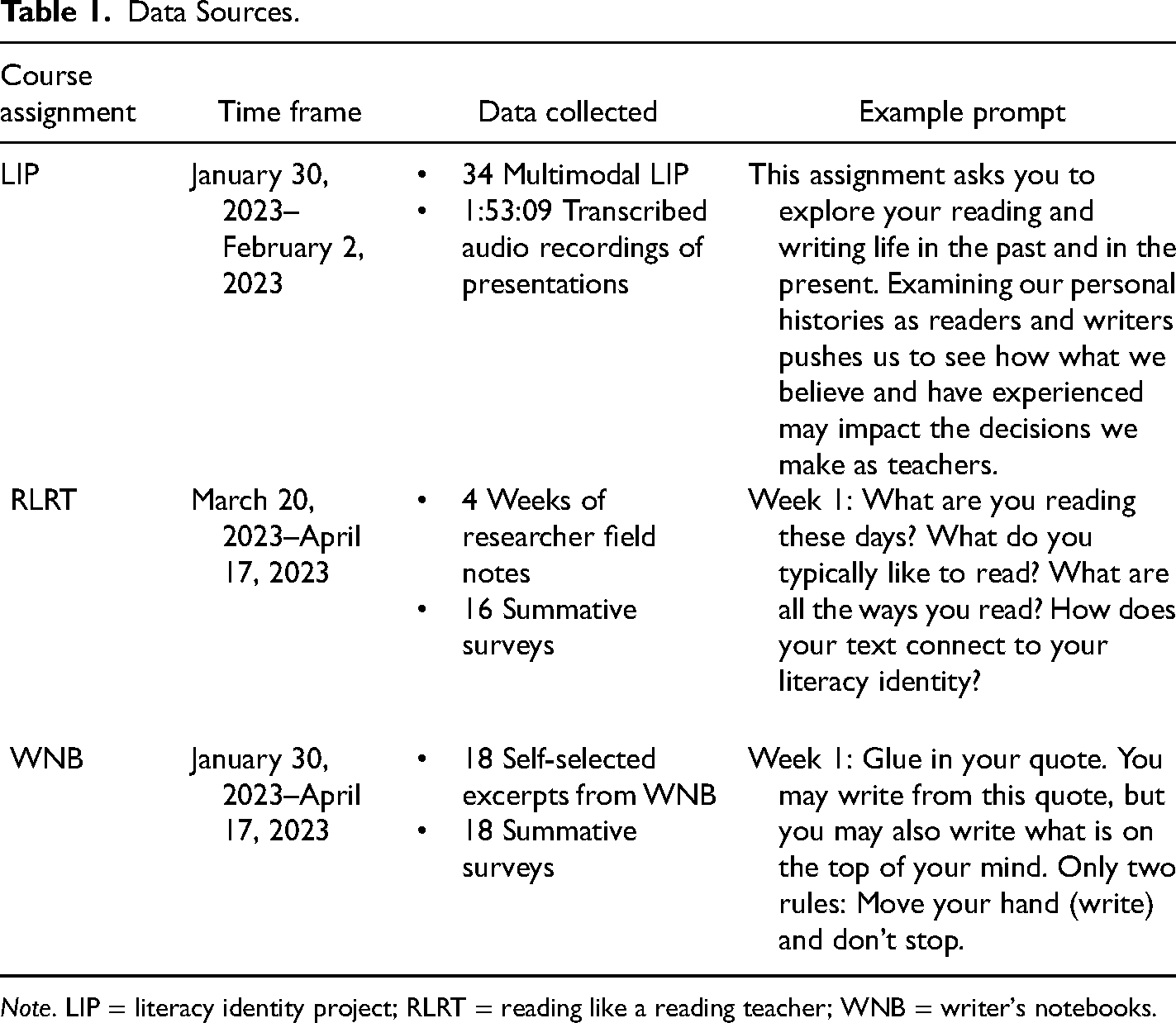
Note. LIP = literacy identity project; RLRT = reading like a reading teacher; WNB = writer's notebooks.
The LIP asked students to explore their reading and writing lives—both past and present. While reflecting on their personal histories as readers and writers in and out of school contexts, students were prompted to critically examine how their sociocultural identities (i.e., race, language, and gender) and the broader societal context in which they grew up influenced their experiences with language and literacy, their biases, and other (appreciative or deficit) views they may hold about themselves or others. PTs prepared multimodal presentations that were shared orally in class. This assignment informed our second research question looking at the relationship between PTs’ literacy identities and meta-awareness as participants orally discussed and semiotically represented their literacy identities from early memories through present day.
The RLRT assignment was designed as a way to deepen and extend students’ focus on the processes of reading (stamina, motivation, and choice) alongside peers and the course content. Students selected a text of their choice and then met weekly with a small group of peers to reflect on and discuss their reading processes. The course instructors provided one to two questions each week to guide these small group discussions toward the meta-awareness of reading strategies, habits, and identities. After 4 weeks, PTs completed a course survey reflecting on what they had discovered about themselves as a reader and how that might inform their teaching practice. Additionally, observations of PTs’ discussions during the RLRT provided insight into how PTs demonstrated their meta-awareness of literacy as they discussed their process and engagement with reading personal texts.
Finally, students used WNBs as a pedagogical and instructional tool for literacy (teacher) practice, including entries such as quick writes, note-taking, and both prompted and unprompted reflective writing. In end-of-course surveys, PTs submitted up to three WNB entries they felt were reflective of their growth or learning as writers, as well as reflections on the usage of the notebook across time, classroom activities, and work with elementary writers in their fieldwork. This summative collection of coursework informed the findings of both research questions as data illuminated PTs’ meta-awareness of literacy through composition and survey reflections, prompting PTs to discuss their connections to their literacy teacher identities.
Each of these course assignments reflected the importance of building a discursive community of readers and writers among the PTs. We triangulate the data with transcripts from recorded oral final exams and reading responses. Priority was given to the PTs’ direct engagement with the three aforementioned classroom assignments; oral exam transcripts and reading responses were used as secondary sources to triangulate the data.
Data Analysis
After clarifying the bounds of our case and selecting our data sources, we engaged in multiple rounds of individual open coding and memoing across all data points. As a team, we routinely and systematically compared our initial codes to ensure interrater reliability. Data analysis continued with several rounds of inductive coding and axial coding (Creswell & Poth, 2018), where patterns from the data were collapsed into categories relevant to our two research questions. This consolidation led to the development of a codebook (Table 2), where we included a description and key examples from the data that embodied the essence of that code. It is important to note that because our research questions addressed how PTs demonstrate their meta-awareness through language, our codes represent different ways of positioning and how language was used to self-identify or index their stance on different literacy components.
Codebook.
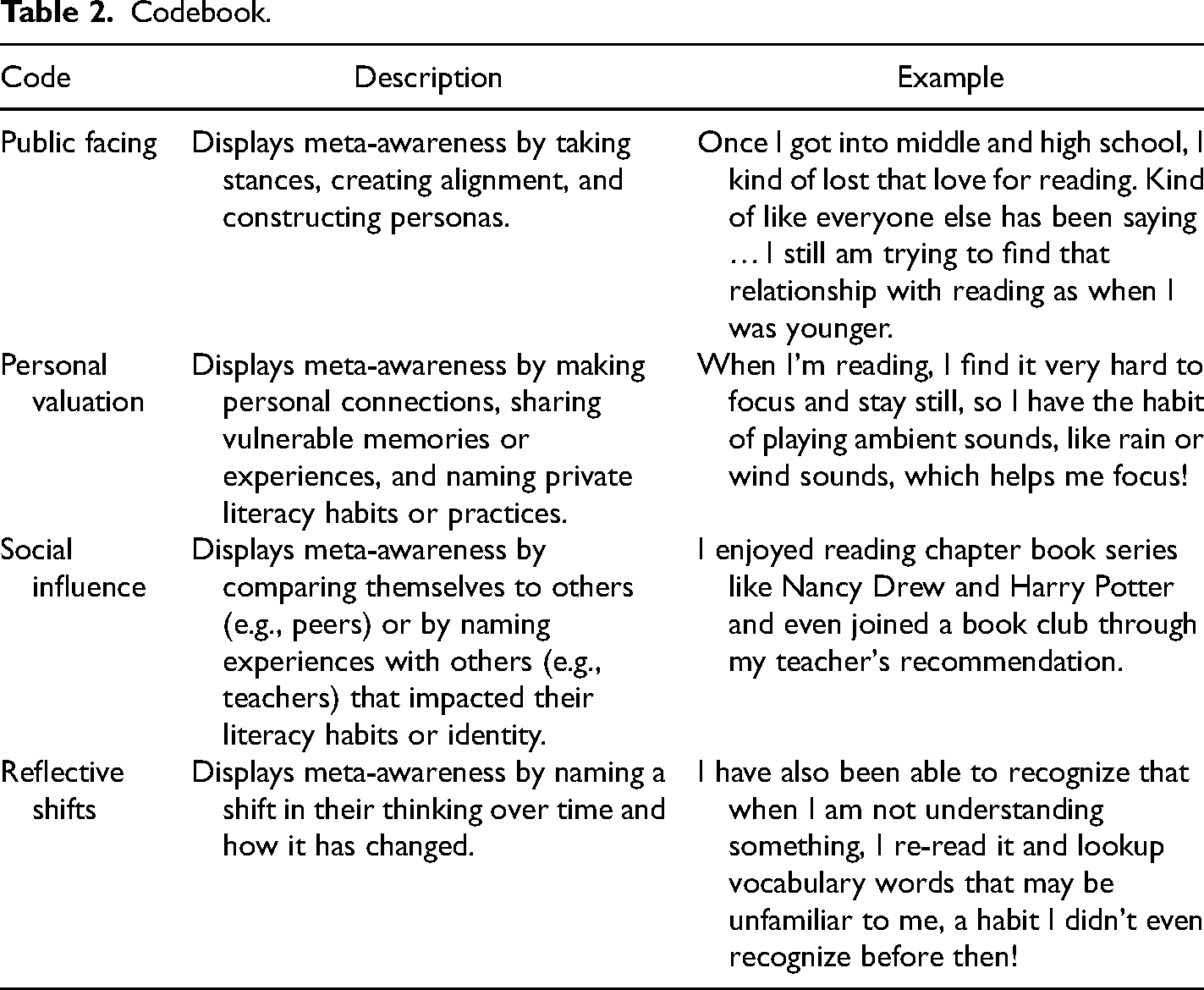
Finally, we organized our analysis into three distinct themes: evaluative language, explicit memories, and content appropriation. These themes were determined across a variety of codes and reflect our PT's demonstrations of meta-awareness as evidenced through their positional language. The first theme illustrates the evaluative language that PTs used as they positioned themselves within the binary of love and hate. The second theme highlights the language of explicit memories and how this language prompted PTs to position themselves in community. Finally, the third theme addresses content appropriation and how PTs leveraged this language to position themselves as literacy teachers. To illustrate these three themes in more detail, we extracted example quotations and reflections from across the data set that were strongly aligned to our themes. This method of analysis prompted a continuous and close examination of the data to further our understanding of the participants’ perspectives and experiences (Thomas, 2016).
Positionality
Our research team all identify as White women and former elementary literacy teachers and teacher educators. Specifically, as White female literacy educators, we acknowledge our intersecting identities as dominant to the field (National Center for Education Statistics, 2023) and engage in continual, critical analyses of our practices as a team and as individual instructors. It is of great importance to us to not only monitor how our curriculum and instruction resonate with the PTs’ racial, linguistic, and sociocultural experiences but also to grow our practices alongside them. We honor our students’ stories as a key component in furthering a pedagogy of epistemological validity in literacy research (de los Ríos & Patel, 2023).
We further recognize how our position as course instructors may influence the tenor of student voice within this study and/or limit our interpretive analyses. However, we collectively recognize and identify with the hybrid identity development (e.g., personal and professional) inherent to becoming a literacy teacher within a teacher education program. Stances on hybrid identities in literacy spaces (e.g., Haddix, 2010) challenge us to maintain our critical, reflective eye on the process of teaching reading and writing in teacher education spaces. Similarly, our perspectives on literacy instruction are grounded in discursive attention to reflexivity, identity safety, and sociocultural knowledge building with and alongside our learners. This study is an example of such reflexive praxis.
Findings
The purpose of our study was to determine how PTs demonstrate their literacy meta-awareness and to identify the relationship between this meta-awareness and their literacy (teacher) identities. Using a framework of indexicality, we identified three themes that illustrate how PTs used language to position themselves within these demonstrations of meta-awareness and identity formation. First, we discuss how PTs positioned themselves within a binary through the use of evaluative language to describe their literacy identities. Next, we share how PTs positioned themselves within a community by sharing explicit memories. Finally, we explore how PTs positioned themselves as literacy teachers by trying on pedagogical and content language.
Evaluative Language: Positioning Oneself Within the Binaries
Our first theme foregrounds PTs’ demonstration of their meta-awareness through their use of evaluative language. Specifically, the language that PTs used when describing their relationship with reading and writing often positioned themselves within a binary of love and hate. Out of 95 data excerpts, we found 27 instances where PTs used the words “love” or “hate” in both positive and negative ways that positioned themselves in relation to larger cultural literacy norms. At times, the evaluative language indicated a static notion of the PTs’ declaration of their relationship with or opinion of reading and writing. For example, in her literacy identity presentation, Adriene (all names pseudonyms) declared, “I hated to read as a kid. I wasn’t a reader.” Here, Adriene's short and evocative statement illustrates a connection between her feelings about reading and her literacy identity as a child. Other PTs used this language of “hate” to signify their resistance against being required to read. Destiny shared, “I love to read, hate being told to read” (LIP, February 6, 2023). Similarly, Kristy noted how she “hated summer reading or any book that [she] was forced to read” (LIP, February 6, 2023). The PTs’ evaluative language positions themselves along a binary with little room to add nuance to both their relationships with literacy and their literacy identities, especially as they reflected on their past identities as readers.
Other demonstrations of PTs’ meta-awareness that were located within this binary of love and hate did reveal more of a temporal shift in their positioning. In these examples, PTs used the language of “love” and “hate” alongside phrases such as “falling in/out,” “lost,” or “rediscovered.” When PTs used this language to explain the action of “falling out of love” with reading, it was typically a result of previous schooling experiences. PTs shared how they fell out of love with reading when reading became a more tedious process involving canonical texts in high school. During her literacy identity presentation at the beginning of the semester, Riley shared, “I wished I never fell out of my love for reading and hearing stories. I believe it was because of the way literature was presented to me later in my schooling.” Da-eun recounted a similar sentiment from her middle and high school days: “I think I lost a lot of my love for reading because we started having longer required texts, and I felt it didn't give me enough time to read what I actually wanted to” (LIP, January 30, 2023). Riley and Da-eun's meta-awareness of their past readerly identities represents a common experience among the PTs in this study. The language they used indicated that at one time there was more of an enjoyment of reading, and somewhere along the way (typically middle or high school), this was lost. And although this language indicates a shift in their positioning, it still remains confined to this all-or-nothing mentality within a binary of love and hate.
PTs also indicated a temporal shift as they reflected on their relationship to writing throughout the years. In a similar vein, PTs used evaluative language to recount times when they had negative experiences with writing and indicated a change that became the catalyst for “falling in love” with writing again. Heidi shared her thoughts in her writer's notebook, “Writing always felt too stressful because the teachers would grade every essay harshly. After taking this class, I have learned to love writing again.” Similarly, Amelia shared that her coursework helped her “rediscover my love for free writing, specifically poetry” (WNB, April 20, 2023). While on the surface, this language seems hopeful as PTs demonstrate their meta-awareness by indicating a shift in their relationship with writing, it remains stuck within a binary.
Across these examples of using the evaluative language of “love” and “hate,” PTs are indexing themselves in a public-facing way. In other words, they are using evaluative language to align themselves with others and connect to larger cultural norms and discourse of how people talk about reading and writing. Ultimately, these demonstrations of PTs’ meta-awareness perpetuate a limited view of one's relationship with reading and writing—that it must be extreme.
Explicit Memories: Positioning Oneself Within Community
PTs demonstrated their meta-awareness by naming and drawing upon explicit memories in order to emphasize a past or current position or belief about literacy. Often, those memories were socially located within a formal (classroom) or informal (peer group) literacy community.
In describing these memories, it was clear that PTs’ understanding of their own literacy identities was often strongly linked to the identities, habits, or expectations of those around them, most commonly their teachers and peers.
Several PTs cited explicit memories with teachers as deeply affecting their personal feelings toward literacy. For example, Kim stated: My teacher, Mrs. Rubio, really wanted me to find that love for reading again. Because she knew that I loved to write, she allowed me to write stories for Mrs. Silva's second grade class, and read it aloud to them! Eventually, I began to love reading again and read so much that year that I made it into the millionaires club! (LIP, June 2, 2023)
Here, Kim identified a turning point in her reading identity that is linked to a specific year and teacher in school. Kim acknowledged that Mrs. Rubio's decision making allowed Kim to demonstrate her literacy skills in a new way. Kim was also aware of her teacher's desire for her to love reading again. She positioned herself as a valued member of her own class community and “millionaires club.”
Some PTs recalled a poignant but negative experience with a teacher that impacted their literacy identity. For example, Michelle wrote, “In elementary school, I couldn't read until 4th grade. My teacher even banned me from the class library because I needed to work on “baby books.” (LIP, June 2, 2023). By restricting her access to books, Michelle was othered in her classroom community by her own teacher. Additionally, Michelle's perception that she “couldn’t read until 4th grade” implies a narrow view of literacy, likely tied to the mode of assessment and standardized expectations at her elementary school.
Peer influence, in both support and competition, was also commonly mentioned by PTs as they demonstrated their meta-awareness through memories. In several examples, PTs mentioned how in school, literacy became competitive. Accelerated reader (AR), an online program that awards students points for completion of quizzes after reading independently, was mentioned several times by PTs in their reflections. AR claims to fuel intrinsic motivation in readers that leads to lifelong reading and learning (Pavonetti et al., 2002). However, many PTs explored how their experiences with AR were not private or individual but wrapped up in classroom competition and comparison. Calista recalled, “I would sometimes get sad seeing my friends blow through books and get tons of A.R. points” (LIP, January 30, 2023). Similarly, Jessica explained: I knew I wasn't good at reading, and then AR levels were also introduced in elementary school, so this was kind of discouraging for me because I read really slow, like a lot slower than my peers, and so I felt embarrassed and really just ultimately discouraged and I didn't want to read. Like I had no drive to get better. (LIP, June 2, 2023)
Both Calista and Jessica linked their identity as a reader to the perception of their peers’ reading abilities, especially in terms of reading speed.
In all of these examples, the PTs used a language of remembering to talk about a lived and embodied experience that was situated within a classroom or peer community. By expounding upon these explicit memories, the PTs metacognitively reflected on the impact of these formative literacy moments. Ultimately, we saw PTs recognize how their literacy identities were socially and relationally located and influenced by teachers, peers, and even nonhuman actors like computer programs.
Content Appropriation: Positioning Oneself as a Literacy Teacher
Our third finding showed PTs demonstrating their meta-awareness related to more current literacy (teacher) identities through appropriating language related to the metalinguistic content of the literacy methods courses when describing their current or envisioned literacy practices. This section purposefully builds upon the previous two findings. In these examples, PTs used course language to identify specific literacy skills and strategies that they use today that may have supported challenges they encountered as beginning readers. Their language positions them as readers who can, and quite possibly will, redress the reading/writing difficulties they experienced as K-12 students. Further, as many of these data examples are also public facing, we see the PTs finding linguistic footing for a new persona specifically related to their professional teacher identity (i.e., I am a teacher who…). By making certain concepts public, we see they are ready to activate these concepts within themselves, with their peers, and alongside their future students.
We hear this clearly in Adriene's statement when she writes, “If I don’t know a word, being able to decode it or even look it up really helps me understand the meaning of the text” (RLRT, April 17, 2023). Adriene, who had previously stated her meta-awareness around her negative literacy identity (“I hated to read as a kid. I wasn’t a reader”), now indexes an active stance toward her ability to comprehend a text. She acknowledges the labor that is involved in being a reader or that being a “good” reader is not an intrinsic trait, it is something a person does. By making this statement, she aligns with what Duke and Cartwright (2021) would call an active view of reading, which identifies active self-regulation as key to “understand the meaning of the text.” This reveals her attunement to the complexity of reading beyond word recognition (decoding) and language comprehension as set forth in the simple view of reading (Gough & Tunmer, 1986).
PTs also demonstrated their metacognition by appropriating other metalinguistic terms related to the content of the literacy methods courses into belief statements: I believe multimodal texts allow students to further express themselves in a way that writing may make it difficult to do so (or at least fully). Art forms such as pictures or drawings, graphs, etc. can allow students to further get that expression and perspective they are wanting to convey, it can help for the audience of their writing to visualize their voice, etc. (Elizabeth, WNB, April 20, 2023)
In this statement, Elizabeth bridges the importance of multimodal texts with developing the clarity of one's message for oneself and an audience. She does not say that multimodality should replace traditional alphabetic code, but that modality is a vehicle for expanding the reach of monomedial text. There is a sense in Elizabeth's comment that writing alone will not reveal everything a student knows or feels about their topic. This willingness to hold our students’ written contributions as always partial or becoming (not static representations of their fullness or intellectual worth) is a humanizing way to position literacy development. She expands this view on writing as expression by envisioning a “plan” for supporting future multilingual writers with genre-based instruction, “I plan on allowing my future students to write in their home language… For when we work on…[Standardized Testing] readiness, I would still encourage students to use the language they desire, and from there we can transform it” (Elizabeth, WNB, April 20, 2023).
Like Elizabeth, other PTs positioned themselves as knowledge-bearing literacy teachers through public and private (voiced and written) reflections, further demonstrating an expansive and expanding view of what counts as literacy in elementary classrooms. PTs, for example, appropriated (or tried on) words, such as “culturally responsive,” to mark themselves as people who “want to make sure” to value culture as part of a full literacy educational stance.
In sum, the PTs marked their position as growing educators for their peers and for us as a discursive audience of teacher preparation—all of which were embedded goals of the literacy methods courses. Due to the unique contextual positioning of these content terms, many of these data examples are also public facing: they are presenting a new, or a becoming, persona specifically related to their emergent teacher identities or knowledge-bearing professional identities. This suggests a curating, or a selective marking, as though they are thinking: “what language do I have to mark my belief and might I use to display both my metacognition around reading and writing? How can I reveal to my peers and instructors the type of teacher I am becoming?”
Discussion
The PTs in this study demonstrated their awareness of their own literacy habits, experiences, and identities in multiple ways. To signify the cognitive intentionality of this work focused on both literacy content and developing literacy teacher identity, we adopt the term meta-awareness throughout the study. One demonstration of this meta-awareness was through PTs’ use of evaluative language when discussing their relationship with reading and writing. Consistently using words such as “love” and “hate” points to societal discourses and norms of how people have experienced the act of reading and writing as students within schooling domains. When our PTs’ discourse around reading and writing arrives at discussion within a binary, we wonder what storylines and experiences shaped these evaluative stances. How does this impact teachers’ ability to teach reading and writing in the elementary classroom? Do teachers have to “love” reading and writing in order to teach it? This theme of evaluative language pushes us to consider how we, as researchers and teacher educators, can continue to bring nuance to the way people discuss their relationships with and identities toward reading and writing and what it might mean for our own instruction moving forward.
The PTs also demonstrated their meta-awareness as they described explicit memories connected to other people, places, and tools of practice in communal recollection of their literacy experiences. Similarly, language theorists have considered the role of time and memory in the act of languaging (Becker, 1991) or our verbal “activity of human beings in the world” as key to recontextualizing the “imperfectly remembered” bits of felt experience (p. 34). We see our PTs’ memories linked to the construction of literacy identity formation as we collectively interrogated the “secret” underbelly of instructional detail in community. In this way, our work demystified the processes and practices of learning to read and write that were previously hidden from their view as K-12 students. Because classroom life is also a social practice (Gee, 2012; Street, 1984), we could highlight language through the stories our PTs told of people and places that impacted their relationship with reading and writing. Just as “communication becomes orientational” (Becker, 1991, p. 34), PTs communicated their own positions in relation to others as they demonstrated the power of peers’ and teachers’ influence on their personal literacy identities.
Finally, we found that PTs demonstrated their meta-awareness through content appropriation language where they were able to try on and try out language from their coursework that focused on literacy content knowledge and literacy pedagogical content knowledge, similar to Ries et al.'s (2023) finding around language used in peer-coaching partnerships. We noticed that language related to this theme was used when PTs were describing their current literacy practices and future literacy instruction. As mentioned earlier, we believe this connects to Duke and Cartwright's (2021) active view of reading, in which active self-regulation plays an important role. As PTs reflected on their own experiences with learning to read and write, they inadvertently shared their meta-awareness of their motivation and engagement with literacy. Additionally, we found that PTs were appropriating this language for their own use as literacy teachers and, at times, applying it to make sense of their own lived experiences and memories, as Adriene did when she demonstrated her active stance toward her ability to decode unknown words, a shift from her previous declaration of not being a reader.
Reflecting on these themes helps us to construct a frame for thinking about PTs’ meta-awareness and the connections to their literacy identities and literacy teacher identities. First, we begin with emotive and affective language as the first visceral declarations of one's identity as related to reading or writing. Then, we move into a memory stance where PTs are able to language around their experiences with the developmental process of reading and writing and their early memories with literacy events (Heath, 1983). Both of these demonstrations of meta-awareness then lead to PTs’ ability to directly identify metalinguistic terms, literacy content vocabulary, and instructional moves that can support young learners in their future classrooms, as perhaps it could have been for them. Experiencing reading difficulties or successes as a student, without the metalinguistic know-how to validate or remedy the feelings, likely led the PTs to adopt positions of love or hate. The memories, people, and objects that they attached to certain literacy experiences help them (re)contextualize classroom instruction they experienced as well as the classroom instruction they hope to embody. Ultimately, the purpose of building PTs’ meta-awareness around literacy and connecting this to their literacy teacher identities prepares them to be agentic teachers in the literacy classroom where they are able to understand and explain their curricular approaches to teaching literacy.
Implications and Limitations
The findings related to PTs’ meta-awareness of literacy practices and their literacy (teacher) identities have important implications for teacher educators. First, literacy teacher educators should consider the benefits of having PTs identify explicit memories of their own literacy learning and attach new metalinguistic knowledge and metacognitive strategies to begin to recontextualize their hatred of (or love of) reading and writing. Second, teacher educators and researchers should continue to develop more nuanced language around our relationship with reading and writing to avoid getting stuck within a binary of love and hate. This continued work will prepare PTs to become metacognitive practitioners—teachers who have a firm sense of self who are adaptive, reflective, and critical.
While we believe the findings from this study have important implications, it is also important to note the limitations of our study. Data were only collected in one semester; thus, we were not able to capture and analyze additional changes to their meta-awareness across the subsequent semesters of neither their teacher preparation program nor their current literacy (teacher) identity as practicing classroom teachers. Additionally, our study did not use quantitative methods to quantify or measure explicit changes across the participants. Future research should consider how longitudinal and quantitative methods might add to the field's understanding of the relationship between PTs’ meta-awareness of literacy and their literacy (teacher) identities.
Giving “voice” to our inner thoughts, questions, struggles, and triumphs is a vulnerable act. We argue that through the identity work and metacognitive literacy practices in our courses, our PTs have deepened their commitment to the profession and their students. As a community, we engaged in inquiry, critique, and growth by centering the active, engaged readership PTs’ envision for their learners while also turning the reflective camera of metalinguistic nuance back onto ourselves as mature decoders. By drawing awareness to their own meta-processes, PTs shifted their perceptions of themselves as readers and writers and helped them to reconsider these acts as developing over a lifetime (Kerkhoff et al., 2020). Noticing their literacy behaviors led PTs to reclaim their identities and work toward their goals as future teachers, like Calista, who shared, “I hope to help my students find a love for reading I never had.”
Footnotes
Declaration of Conflicting Interests
The authors declared no potential conflicts of interest with respect to the research, authorship, and/or publication of this article.
Funding
The authors received no financial support for the research, authorship, and/or publication of this article.
