



Abstract
Concerned with disinformation, fake news, and a posttruth era, literacy research on digital learning ecologies has focused on content of the texts that youth encounter but less explicitly on aesthetics—issues of form or the way a text is written. Drawing on critical sociocultural theories, this article examines youth aesthetic meaning-making with non-neutral digital texts. The data analyzed are part of a multiyear multimethod study of the aesthetic literacy practices of queer youth of color and allies. Data were collected during an online summer literary salon where youth discussed textual content alongside issues of aesthetic forms. Findings illustrate that youth drew on a broad range of aesthetic tools to achieve (1) a poetic function concerned with how aesthetic forms elicit figurative, connotative, and storied meanings; (2) a catalytic function concerned with how aesthetic forms persuade, manipulate, or encourage particular actions; and (3) an ideological function concerned with how aesthetic forms inscribe or contest social inequalities. These tools and functions, complicate previous understandings of disinformation, fake news, and critical reasoning in literacies research. This study suggests a critical sociocultural approach to aesthetics as territory for further scholarship across many areas of literacy research.
Researchers have long asserted that the texts youth encounter are not politically neutral but rather that their interpretation can sustain oppressive narratives or work toward social justice (Greene, 1995; Janks, 2010). Many of these literacy researchers define text broadly to include language, images, films, and multimodal compositions. In an information society, where youth are inundated with digital texts across multiple platforms (Nichols & Garcia, 2022), scholars have urgently explored how youth make meaning with these nonneutral texts. Researchers have investigated disinformation in digital spaces (Comber & Grant, 2018), youth evaluation of online sources (McGrew, 2021), and civic participation across virtual platforms (Mirra & Garcia, 2022). Much of this research has attended to issues of the texts’ literal meaning; however, this line of research has been less focused on the role of aesthetics. By aesthetics, I refer to not what a text means explicitly, but rather issues of form, connotation, or the way a text is written or constructed. This definition aligns with Dewey's (1934) understanding that all artistic objects “involves what is said and how it is said, or substance and form” (p. 106, emphasis original) and that aesthetics are concerned with “form as something that organizes material” (p. 134) Similarly, Eagleton (2013) has characterized aesthetics as a focus on practices that consider “tone, mood, pace, genre, syntax, grammar, texture, rhythm, narrative structure, punctuation, ambiguity—in fact to everything that comes under the heading of ‘form’” (p. 2). Acknowledging a gap in the literature, recent scholarship has called for a renewed focus on issues of aesthetics particularly to understand inequalities in digital platforms (Nichols & Leblanc, 2021) and in literacy research (Coleman, 2021). This study responds to these calls by investigating the role of aesthetics in youth textual meaning-making in a digital ecology.
This article is part of a larger 2-year design-based study (Reinking & Bradley, 2007) centered on queer youth of color and allies’ meaning-making in a digital learning ecology. The dataset included audio and video recordings of youth participating in a virtual literary salon—an online space where youth synchronously discussed their interpretations of myriad digital texts—as well as verbal protocols, semi-structured interviews, and writing conferences. I analyzed the data to answer the following research questions: (1) What are the aesthetic tools youth employ as they engage with a wide variety of texts and cultural artifacts in digital spaces? and (2) What are the aesthetic functions of youth literacy practice with nonneutral texts in an online learning ecology?
Theorizing Aesthetics in Community
Drawing on critical sociocultural theories of literacy learning (Lewis et al., 2007), I approach textual interpretation through an understanding of literacy as a social practice (Heath, 1983; Street, 1984). As such, youth do not interpret texts through autonomous skills, but rather engage within communities of practice (Lave & Wenger, 1991) that are more specifically interpretive communities (Fish, 1980). These communities are socioculturally constituted groups with at least some degree of shared purposes and practices regarding ways of thinking, reading, writing, and speaking. Across digital spaces, youth might belong to several interpretive communities that employ different approaches to interpretation including being part of online fandom communities, creative writing communities, and group text messages.
Aesthetic literacies are the socioculturally shared practices of particular interpretive communities—ways of reading, writing, talking, and thinking—that focus on not only what a text means but also on how that text is written or constructed. Importantly, these interpretive communities operate within systems of unequal power which may enable or limit access to these shared practices and which youth negotiate through their discursive participation. Greene (2001) has theorized the aesthetic as a critical mode and essential to social action. Greene argues that without a focus on aesthetics, people become numb to issues of power and oppression that perpetuate racism, classism, sexism, transphobia, homophobia, linguistic purity, ableism, and other social injustices. Thus, aesthetic literacies are not only inseparable from systems of power but also are a type of critical literacy as aesthetic literacies demand an analysis of how inequality functions in, to use the Freirean phrasing, both “the word and the world” (Freire & Macedo, 1987, p. ix).
This critical sociocultural approach to theorizing aesthetic literacies affords the opportunity to trace how youth take up aesthetic forms, tools, and functions within a socially constituted digital learning ecology. When I refer to aesthetic forms, I mean any particular instantiation of a text or part of a text that a reader interprets as also associated with some larger socially held category of similar texts—typically through genre, archetype, trope, or connotation. Any particular novel, poem, painting, sculpture, song, or ballet is an aesthetic form as it is a token of the larger socially constructed and recognized type of that kind of artistic work. I differentiate between texts and aesthetic forms in that a text is merely marks on a page or screen. However, aesthetic forms are always already associated with socially-recognizable types and so are a way to talk about generally held cultural interpretations.
By aesthetic tools I mean the specific language, resources, and concepts that community members use to mediate understandings of intertextual interpretation (Vygotsky, 1978). For example, metaphor might be an example of an aesthetic tool if this word meaningfully mediates a shared concept about how to make meaning with a text for a particular interpretive community.
By aesthetic functions I refer to what shared practices or ways of interpreting accomplish socially. Drawing from early theories of the social aspects of language, the concept of aesthetic functions continues a line of inquiry from Jakobson (1960) . Jakobson focused on how aesthetics contributed to the poetic function of language which involved the “ordered shape of the message” (p. 57) including its connotations, figurative meanings, and the feelings evoked for readers from its form. Analyzing what youth do with aesthetic forms in interpretive communities helps to reveal how people in socially constituted learning ecologies construct ideologies, practices, and other social relations.
Research on Youth Aesthetic Interpretation
A long line of scholarship has interrogated the relationship between meaning and aesthetic forms in textual interpretation, particularly with regard to readers’ response (Lee, 1995; Rosenblatt, 1938; Sipe, 2008). Rosenblatt (1938) conceptualized readers aesthetic stance which included understandings of form and affective response and which she contrasted with an information-seeking efferent stance. More recently and working empirically, Levine and colleagues (2021) investigated these connections between interpretation, especially connotative meaning, and readers’ affect and provided classroom strategies for aesthetic response as a way to motivate deeper literary inquiry.
Research on communities that center youth aesthetic interpretation often explores the critical practices of youth writers and digital composers. For example, Thomas and Stornaiuolo (2016) update Rosenblatt's reader response theory to include the myriad ways that youth re-story what they have read in novel ways. Thomas and Stornaiuolo illustrate how youth respond to texts by changing key aesthetic features such as genderbending or racebending focal characters of popular stories to shift aesthetic representations and invert power structures.
Similarly, Johnson's (2017) work with Black queer youth demonstrated how composing through reflective journaling and memoir writing not only strengthened youth aesthetic literary conventions but also allowed them to write possible selves that were otherwise inaccessible. Johnson's work demonstrates the identity-building potential of aesthetic literacy practice. Similarly relevant for work on aesthetic literacies, Toliver's (2021) study of Black girls writing science fiction, fantasy, dystopia, and other speculative genres demonstrates how genres that encourage the aesthetic imagination are closely linked to a development of an activist stance and critical consciousness. These studies bring much needed insight to the ways that aesthetics intertwine with systems of socially-constituted power through in-person face-to-face interpretive communities.
In a progressively more digitized world, understanding aesthetic interpretation in online communities is increasingly urgent. Recent research has demonstrated how youth communities led by Black Indigenous People of Color (BIPOC) and queer people have engaged in critical consciousness and justice-driven activism with digital aesthetic forms. This research shows how communities create diverse modalities including sketches and writings shared on video conferencing platforms (Barton & Cappello, 2023; Thakurta, 2023), social media posts (Jones et al., 2023; McDaniel, 2023), and YouTube videos (Shrodes, 2022). For example, Kelly (2020) describes how Black girls created digital compositions focused on resisting oppression through social media platforms like Instagram, Twitter, and Snapchat.
This research illustrates how communities centering BIPOC and queer people engage in richly interpretive and justice-driven practice in digital spaces. Thus, these findings point to digital ecologies as promising areas for the current study's focus on the role of aesthetics and justice in these spaces. Further, while many of these studies focused on the critical practices of adolescent writers to confront inequalities, less seems known about how youth also read and talk about critical aesthetics, particularly in digital spaces. A next step in this line of scholarship involves investigating youth aesthetic interpretation that engages in not only writing and composing but does so alongside collective reading and talk about aesthetics, which is an aim of the present study.
Method
This article is part of a larger two-year multi-method design-based study (Reinking & Bradley, 2007) centered on queer youth of color and allies’ meaning-making in a digital learning ecology. For this article, I used a qualitative microethnographic approach to describe the aesthetic tools and functions involved in youth textual interpretation within a digital learning ecology.
Learning Context
Inspired by a tradition of queer-led literary salons such as at Gertrude Stein's Parisian apartment and a rich history of radical queer bookstores in the United States as restorative spaces for meeting and discussion of aesthetics among queer communities and allies (Pritchard, 2017), Literary Scholars for Justice was a summer literary salon that brought together youth to read, talk, and write about aesthetic forms and social justice. Literary Scholars for Justice theorized youth as organic intellectuals (Gramsci, 1971). Youth were literary scholars in their own right, were expert at the kinds of aesthetic literacies important to them, and could use these literacies to work toward social change. Literary Scholars for Justice was held synchronously online, primarily over Zoom, as a virtual literary salon across two consecutive summers.
Participants
Twenty-five youth participated in Literary Scholars for Justice. Participant demographics were as follows: 100% of participants identified as people of color. Thirty-six percent of participants identified as multiracial or as having multiple racial and/or ethnic identities. When asked about their racial and ethnic identities, 72% identified as Latinx, 40% as Black, 16% as white, 8% as Asian, and 4% as Native American or indigenous; percentages for these demographics add up to more than 100 because many participants identified as belonging to multiple racial or ethnic groups. All participants who identified as white also identified as multiracial and/or multiethnic and identified as people of color. Additionally, 72% identified as participants who as students received free or reduced-price school lunch. Further, 32% of participants identifying as having received special education services including an individualized educational plan in their high schools. Youth ages ranged from 16–19. Approximately 56% of participants identified as cisgender women, approximately 24% of participants identified as cisgender men, and approximately 20% of participants identified as non-binary, trans*, transgender, gender-queer, gender-fluid, and/or gender non-conforming. Approximately 50% of participants identified as queer and/or as identifying with at least one LGBTQIA+ identity. I report gender and sexuality demographics using the qualifier “approximately” because sometimes participants’ gender and sexual identities shifted during the study, as these identities for some youth participants were not experienced in static ways.
Researcher Role and Positionality
Issues of aesthetics and social justice are personal to me. As a white, gay, cisgender man from a working-class background, I became attuned to issues of social justice and aesthetics as I navigated my gay identity in a rural homophobic public high school. On one occasion, peers rigged the school's audio-visual equipment to broadcast, across classrooms, a homemade video. In the video they tied a character—possessing my name and likeness—to a stake, poured “gaysoline” over him, and shouted homophobic slurs as he ignited in flames. Experiences like these, demonstrated to me that the aesthetic forms—in this case video, story, and narrative compositions can be used to cause real-world violence, particularly to queer people. Simultaneously, these experiences drive me toward using aesthetic practices to transform oppressive learning ecologies for all youth.
Importantly part of my positionality in this work is that I knew many of the youth participants prior to their engagement with Literary Scholars for Justice. I recruited participants from a university-sponsored online writing-mentoring program that drew from the local school community. Because I was a high school teacher in this same community for over a decade, many of the study participants were also my former high school students. Similar to traditions of practitioner inquiry which must attend to power relations that arise from multiple roles of teacher, researcher, designer (Storm, 2016), I worked to mitigate possible tensions. I followed all informed consent and assent procedures for participants and their guardians as well as routinely reminded participants that Literary Scholars for Justice had no grades and no mandatory assignments. Further, because all research activities occurred digitally on Zoom, participants actively chose for themselves when and for how long they wished to turn on their microphone and video camera. Youth also decided when to type in the chat window and when to write in their writing portfolios. Youth actively chose how they wished to participate on a moment-by-moment basis. This approach differed from more traditional in-person studies and was a further strength of the online format.
Having a prior relationship with many of the study participants was a strength in that I already had time to deeply get to know participants and their families as well as their interests, passions, hopes, struggles, and dreams. Having this kind of personal and contextual knowledge bolstered the trustworthiness of the research given an otherwise relatively short timeline of the summer salon.
Data Collection and Analysis
Over the two summers of the larger project, I collected approximately 235 hours of audio and video recordings from a combination of salon sessions, think aloud protocols, interviews, and writing conferences. Additionally, I collected approximately a thousand pages of writing/compositions including culminating projects, informal writings, and digital Zoom chats. I video and audio recorded all sessions of the summer literary salon for a total of 90 hours across approximately 30 three-hour sessions. I also conducted 140 individual think-aloud protocols (Pressley & Afflerbach, 2012) where participants read and thought aloud as they interpreted a digital text. The average length of each think aloud was approximately 20 minutes. Additionally, during the second year of the project I conducted semi-structured interviews before and after the summer literary salon with all participants as well as regular one-on-one writing conferences using a think-aloud method (Beck, 2018). Throughout the literary salon I wrote daily field notes.
All recordings were transcribed; I first used Zoom's auto-transcription feature and then verified the transcripts by hand. To organize transcripts, recordings, and field notes, I created a chronological data log where I wrote short descriptions of the activities and content of each recording.
For this article, I used a qualitative approach to data analysis (Strauss & Corbin, 1990) to construct understandings of youth aesthetic literacies. I took a micro-ethnographic approach and coded at the level of the literacy event (Bloome et al., 2022). The literacy event flexibly allowed for the coding of multiple types of data sources (e.g., salon session transcripts, verbal reports). Salon session transcripts contained relatively short conversational turns and verbal reports of think-aloud sessions contained longer conversational turns. Coding at the level of the literacy event instead of the conversational turn allowed me to construct discursive boundaries when youth shifted their use of aesthetic tools or functions. I marked these shifts as boundaries in literacy events. Sometimes shifts occurred within single conversational turns and sometimes they occurred in larger interactional units. I constructed these boundaries across two phases of coding as described below.
As a first phase of coding, I applied descriptive and structural codes (Saldaña, 2021) to identify the places in the data where youth were engaging in discussions of aesthetic forms. At this stage, I coded to capture as many textual elements, genre features, literary devices, and aesthetic forms as I could. I generated over a hundred unique codes as I described what I saw in the data including youth engaging with discussions of rhythm, tempo, color, line, synecdoche, and hyperbole.
I completed this first phase of coding as I collected data, often by completing the transcription and this first coding phase on the same day that I collected the data. This process mitigated against dataset size becoming overwhelming. As a form of data reduction, only literacy events that I identified as literacy events that involved aesthetic tools from phase one were eligible for the second phase of coding where I focused on aesthetic functions—because I theorized that aesthetic functions would not likely be discernable absent aesthetic tools.
Thus, as a second phase of coding, I used process coding (Saldaña, 2021) to identify the practices that youth employed around aesthetic interpretation in places where I had coded youth as engaging with aesthetic tools. Here I practiced open coding to capture a wide spectrum of possible process codes. My codes included places where youth “sought patterns” and “identified strangeness” but also where youth “pointed to a specific word or part of the text” and “applied a literary device to a particular word.” The codes also captured what youth were doing with aesthetics including codes such as “aesthetics as constructing bias,” “aesthetics inspiring critical questions,” and “aesthetics as narrative building.” I created 37 unique process codes for this step.
Having completed open coding, I next iteratively refined codes and in alignment with my theoretical framework, considered practices and purposes of the sociocultural community to build more abstract categories. This process of axial coding led me to construct the categories of aesthetic tools from the descriptive and structural codes and aesthetic functions from the process codes. These categories are presented in the findings section below.
Findings
In this section, I present the ways that youth engaged with aesthetic literacies. I found that: (1) youth engaged in aesthetic meaning-making through a wide array of aesthetic tools across multiple modalities and disciplinary traditions; (2) youth took up three aesthetic functions—a poetic function concerned with how aesthetic forms constructed figurative, connotative, and storied meanings; a catalytic function concerned with how aesthetic forms worked to persuade, manipulate, or encourage particular actions or stances; and an ideological function concerned with how aesthetic forms inscribed normativity and/or criticality.
Tools of Aesthetic Literacies
Youth in this digital learning ecology engaged with and analyzed many texts that spanned a diverse array of genres and modalities. During the literary salon, youth selected what texts to collectively analyze. They analyzed television shows, movies, music videos, song lyrics, poetry, novels, memoirs, theatrical scripts, screenplays, literary theory, social media pages, forum posts, websites, memes, text messages, fan-fiction, emails, and still images. These texts also included a wide range of typical literary and cinematic genres including non-fiction, horror, fantasy, science-fiction, action, drama, coming-of-age, and comedy. Music genres included pop, hip-hop, R&B, country, showtunes, rap, and classical.
Across these texts, youth drew on many shared aesthetic tools that is mediating resources or concepts for making meaning with texts in this interpretive community. As a way to more explicitly share knowledge with one another, often, youth explicitly named the aesthetic tools that they used. This afforded the whole community opportunities to hear peers explicitly name aesthetic tools and likely aided in the continued uptake of these tools across the community. Some of the aesthetic tools that youth used were closely associated with particular modalities. For example, youth primarily talked about camera panning when talking about film texts and primarily talked about melody when talking about music. However, other tools cut across textual modalities such as a focus on narrative elements like tropes and archetypes. Youth also drew on tools of critical representations across texts by pointing out the aesthetics associated with gender performance, stereotypes, and tokenization.
Table 1 illustrates the kind of tools that youth used in the learning ecology. This table is not comprehensive of every aesthetic tool used by any individual in the learning community but rather captures the aesthetic tools that youth both explicitly named and used with regularity. To be included in the list, at least five (20%) of participants had to explicitly use the aesthetic tool by name and the tool needed to be explicitly used in at least five different transcripts, all on different days. In many cases all or nearly all of the youth participants explicitly used the particular tools listed in the table.
Shared Aesthetic Tools of the Learning Ecology.
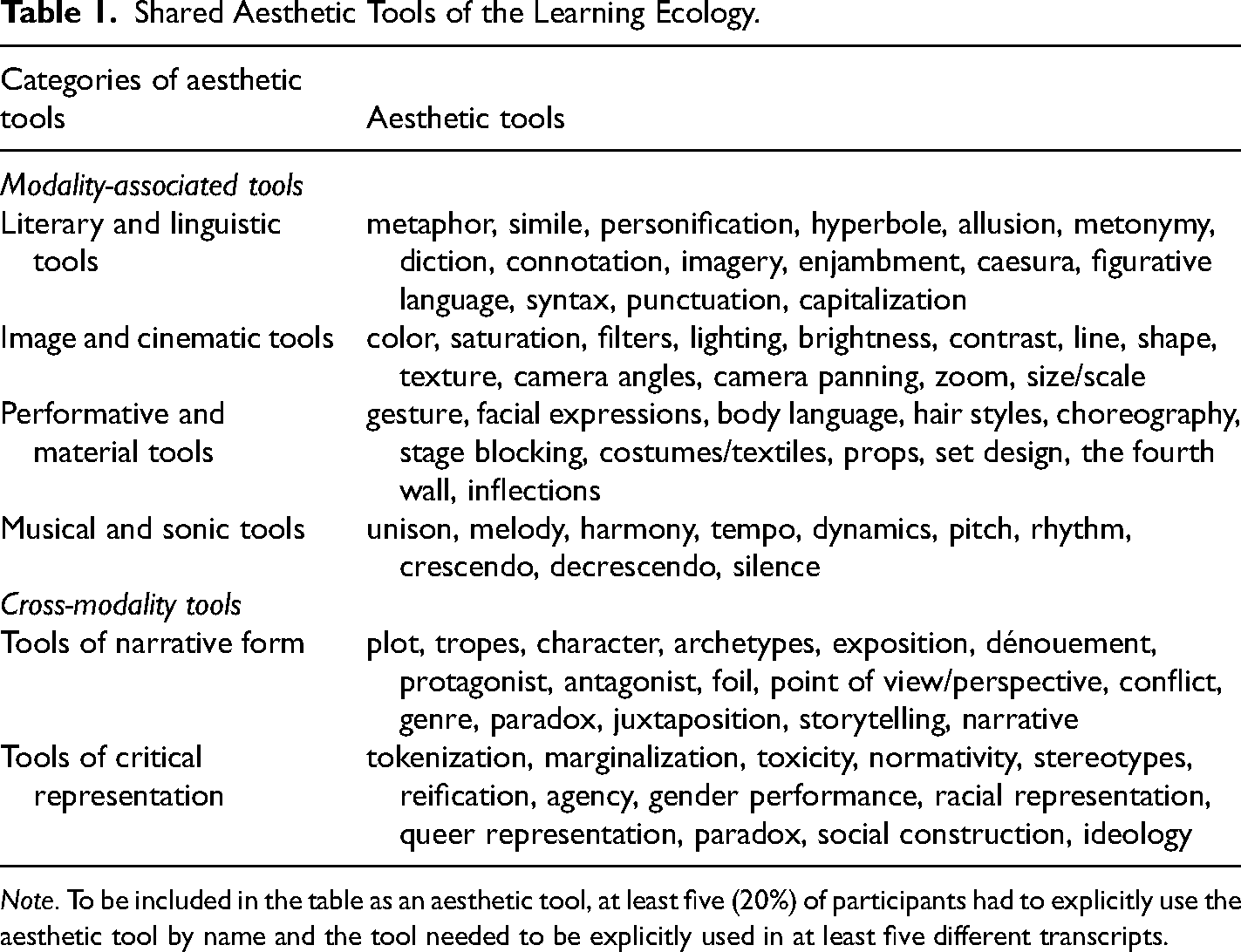
Note. To be included in the table as an aesthetic tool, at least five (20%) of participants had to explicitly use the aesthetic tool by name and the tool needed to be explicitly used in at least five different transcripts.
The wide array of aesthetic tools that this community used in this digital learning ecology suggests the importance of aesthetic literacies to both this community and possibly to interpretation in digital spaces. Further, the talk about these tools saturated this learning community as youth explored their inquiries about aesthetic forms and social justice.
Functions of Aesthetic Literacies
Process codes suggested that youth engaged with three aesthetic functions in their interpretive practice. Importantly, these are count functions—meaning that the same conversational turn could represent more than one of these functions. Some of the youth discourse simultaneously constructed all three of these aesthetic functions. For clarity to each pattern, I present typical examples of each function separately to illustrate what each function achieved socially in this interpretive community.
Poetic Function
The poetic function captured youth interpretation that focused on figurative or connotative meaning-making. Youth engaging with this function made metalinguistic comments that showed they were aware that they were analyzing stories, narratives, or aesthetic objects. The poetic function went beyond literal meaning to investigate the effects of figurative and connotative meanings on readers particularly with regard to how these elements shaped readers’ emotional response and connection to the text.
For example, in one session of the literary salon, participants collectively read and discussed an excerpt of José Muñoz's (2009) literary theory about queerness. In the text, Muñoz states that queerness is a potentiality and that it is always on the horizon. Immediately after reading this passage, Geo, addressed the group by saying that he noticed that the word “horizon” is “a metaphor, like I feel like that's a metaphor for hope, like we're not there yet, but we can get there, as we always see horizons every day, like they are a constant thing.” Geo interpreted Muñoz's use of the word horizon aesthetically and pointed to how the idea of queerness being on the horizon is “a metaphor for hope.” He supported this idea by pointing out that a horizon is something one can see “every day.” He underscored the “constant” quality associated with the word even though this quality was not part of the denotational meaning of horizon. While the Oxford English Dictionary has listed 16 definitions for horizon, none of them included the words “constant” or “everyday.” Geo did not build on denotational meaning but rather on connotative and figurative meanings. Thus, Geo demonstrates the poetic function in his aesthetic literacy practice.
Amethyst engages with the poetic function of aesthetics literacies by discussing the form or structure of whole novels and comparing them to one another. Amethyst discusses two coming of age novels featuring queer protagonists. She read both novels in their digital forms using e-reader software. Amethyst pointed to aesthetic similarities by saying that The Black Flamingo by Dean Atta, followed a similarly narrative structure to Juliet Takes a Breath by Gabby Rivera. Immediately after reading the prologue to The Black Flamingo, which is a short imagistic poem, Amethyst explained, “it's like the same thing I was trying to explain with Juliet Takes a Breath. The book starts twice. I think I should say this about this book too” Amethyst noticed that both books begin with a short prologue that introduces ideas important to the larger narrative. Amethyst's observation that “the book starts twice” focused her interpretation on the novels as aesthetic objects by highlighting not only what explicitly happened in the plot but rather focusing on how the narrative was constructed. She continued that the narrator of The Black Flamingo, “starts off with sort of describing himself. He's just sort of rambling basically about these ideas that he has, in essence, and then Julia [the protagonist of Juliet Takes a Breath] is also sort of doing the same thing.” Finally, Amethyst pointed out that both novels follow a pattern of “‘well, this is who I am, and where I came from,’ and then at the end of the story, they both close with letters.” Thrilled by her analysis, Amethyst concluded the conversational turn giggling with glee as she exclaimed, “it’s like tickling my brain!” Amethyst demonstrated how the poetic function was concerned with comparing narrative structures to understand how texts work in similar ways. This kind of analysis seemed to deepen Amethyst's inquiry about how authors structured coming-of-age novels with queer protagonists and simultaneously provoked joyful giggles and a large smile of accomplishment.
The poetic function also helped youth make sense of non-linguistic representations. Valeria focused not on the linguistic form but on musical form in Frank Ocean's song “Bad Religion” and explained that “I noticed…with like the clapping and the outros is also very much like a church, it really fits in with the whole church vibes.” Here, Valeria noticed that the rhythmic clapping during the “outro” or the last part of the song mirrored the kind of clapping that one might expect of a gospel song in church. Valeria talked about her own experiences with going to church as how she was able to make these connections, thus this was an example of how the poetic function often relied not on denotational meaning but on social meaning and how youths’ funds of knowledge and experiences deepened their aesthetic literacies.
Finally, Thundura demonstrated how the poetic function was important to youth analyzing digital social media pages such as those on Instagram. In looking at a favorite transgender musical artist's social media page, Thundura muses to the group, “her bio says, ‘nothing scares them more than a woman who knows the power of her own flames’ first of all I love that line. Very cute. Very beautiful.” After pausing a moment, to smile broadly, Thundura continued, “I just think like flames is like very fiery very passionate very confident and then it's also like if you can't handle the heat like stay away from the kitchen like you know I mean?” She then continued, “It's very common narrative, ‘I'm here, and if you can't handle it, you’ve got to back out.’” Thundura drew on two different connotations of flames. The first connotation viewed flames as associated with passion and confidence. For the second connotation, Thundura drew on the idiom of “if you can’t handle the heat, stay away from the kitchen” in order to focus on acceptance and independence in that if one cannot accept this musical artist for who she is, then one needs to “back out.” In this example Thundura demonstrated the poetic functions around her engagement with the aesthetic form of the social media page. Thundura constructed a complex interpretation that implicitly drew on multiple aesthetic tools including connotation and idiom. This analysis did not preclude Thundura's joy in viewing the Instagram page on social media but rather augmented this joy prompting her to focus on her “love” for this particular turn of phrase.
Within this digital learning ecology, aesthetic literacies functioned poetically. Engaging with aesthetic forms allowed youth to construct multiple figurative meanings, draw on social knowledge, experience joy, and pursue textual inquiries.
Catalytic Function
The catalytic function was concerned with how aesthetic forms worked to persuade, manipulate, or encourage particular actions or worldviews. For example, youth often discussed how certain aesthetic tools revealed kinds of bias in non-neutral digital texts. Amethyst demonstrated this idea in the literary salon when she compared the New York Times website to the CNN website and the Fox News website, all of which she accessed within the same few minutes. She explained, “I noticed that on like New York Times [website] it’s like mostly numbers and percentages and stuff like that, while on the other two websites I noticed like there’s some quotations and people saying things.” Noticing these differences not in what is being said but in the kind of aesthetic forms that are emphasized on the different websites (numbers and percentages vs. quotations and first-hand accounts) led Amethyst to conclude that it felt like the New York Times website conveyed an emphasis on “what’s going on here and all this information.” However, the other news outlets “explore like a he-said-she-said type news.” Ultimately, just based on the aesthetics and not the content, Amethyst found the New York Times personally more trustworthy than the other outlets on the particular day that she viewed these websites. This demonstrated how aesthetics served a catalytic function—that they were persuasive within themselves and contained important information about underlying epistemologies and potential sources of bias.
Similarly, Valeria noted how aesthetics could be used to try to persuade and potentially even mislead. Valeria discussed the aesthetics of a right-leaning news website from January 7, 2021, which was the day after the United States Capitol attack. Screensharing the webpage from that day, Valeria said, “this was like the big thing; it was a riot, but then they [the news organization] decided to highlight the headline ‘orderly transition.’” Valeria shook her head and then continued, “I just find that very interesting because in the smaller font they’re talking about the capital being stormed but they're choosing to highlight something that shows a complete opposite.” Valeria used the aesthetic tool of font size to analyze how the aesthetic forms interact with the meaning. She noted that the largest font, the headline, claimed an “orderly transition” but that the smaller font of the body of the article described a “riot” and “the capital being stormed.” Thus, Valeria revealed how she analyzed this digital text as misleading and as attempting to persuade, largely through the aesthetics of font size. Immediately after this conversational turn, Velma added that there was a similar disconnect between the choice of pictures that were juxtaposed with the text because the images that did not show the attack on the capitol. Velma noted that “they try and create you know, like headlines with images, so that you don't even need to read like the actual headline you can just assume what’s happening.”
Beyond news sources, Reggie, who identified as a cisgender Black man, talked about how his favorite online video game also used aesthetics to manipulate him. He described that the video game routinely came out with new characters that players could purchase to be able to play as that character. While Reggie explained that most of the characters were depicted as white, eventually, the game developers released a character who was a person of color, specifically a Black masculine character. Reggie told the group, “Then they come out with a character that looks exactly like me, and I’m like oh my God, you best believe! He had the same haircut and the same vibe except he had a UK accent.” Reggie paused, perhaps for dramatic effect before he went on excitedly, “I never spent $100 so fast … and just to play this guy just to realize that a whole three months later, a new character came out and she was more fun than him.” Reggie sunk his head into his hands before he continued, “So, $100 down the drain, but, still very interesting.” Reggie explained that he felt manipulated to spend his money—which he had earned from his afterschool job—because he was drawn to the aesthetics of the character. He also noted that later he realized that the character was not mechanically very useful in the game and that he no longer played as that character. He described that the character lacked the functionality to be enjoyable to play even though it was aesthetically appealing. Reggie felt material monetary consequences for how he interpreted the game aesthetics. In this way, Reggie analyzed the game as having a catalytic function on him because it persuaded him to spend his own money on a perceived aesthetic advantage, though not a strategic one.
The catalytic function revealed that aesthetics literacies for youth do not only serve the function of building figurative interpretations but also are read as having persuasive and even in some cases coercive power. In each summer literary salon, as the salon progressed, youth participants began to warn one another through a series of exclamations to “watch out” for “sneaky aesthetics!” as the group continued to become stronger and more nuanced in their ability to point to this catalytic function of aesthetic literacies.
Ideological Function
The ideological function was concerned with normativity and criticality. By normativity, I specifically am referring to the ways that aesthetics helped to underscore, bolster, or reify status quo social relations that potentially worked against ideas of equity or social justice. Similarly, by criticality, I mean the ways that aesthetics helped to disrupt these normative relations and moved toward critically conscious ways of interacting with texts and the world. Sometimes some youth interpreted aesthetics as both reifying normativity in some ways and in opening space for criticality in other ways. Across all the instances of this function, the aesthetics underscored or highlighted ideologies—socially held, often arbitrary, and sometimes unexamined beliefs related to systems of power.
For example, one of the texts that participants responded to was a video clip of a drag queen performance from the reality television show RuPaul's Drag Race, where a drag performer danced while wearing a costume that had a dress on the left side of their body and a suit on the right side. In this costume, they performed a song about the characters Barbie and Ken like the American toy dolls. In response to this television clip, Zorion remarked, “I find it kind of funny that he went with a lighter foundation to express like his female side.” Here Zorion was pointing out that the drag queen used a lighter type of makeup known as foundation for the side of his face with the dress and a darker foundation makeup for the side with the suit. He continued, “I don’t really know a lot about makeup I just know that he changed his skin tone to be a little bit lighter and, it definitely shows.” Zorion continued that the drag performer specifically chose to include this contrast in the foundation makeup “instead of just wearing a wig and eye shadow.”
Zorion, focused on aesthetic tools about the visual shade of the makeup. Zorion's analysis illustrated that youth were aware of how aesthetics aligned with gender ideologies—where the lighter makeup connoted femininity and the darker makeup connoted masculinity. Zorion was not necessarily praising or critiquing these choices but was noting how the aesthetics of makeup underscored ideologies of women as more dainty and men as macho because of the aesthetics of the costume.
The way that aesthetic forms mark ideologies of gender performance was often discussed in the salon. Thundura analyzed the gender performance on the social media site, Instagram, of one of her favorite musical artists who was as a trans woman. In the pictures on the social media site, the musical artist can be seen in multiple poses riding first a cobalt blue motorcycle and then a hot pink motorcycle. Excited to share her analysis, Thundura speaks loudly and quickly to everyone saying, “I don't know if it’s just me like touching bases on the normativity of men having motorcycles, but it just makes me feel like she’s more powerful. She’s got a motorcycle. She's riding around NYC like a bad bitch!” Thundura pointed out that to her a normative cultural understanding of motorcycles sometimes connoted a type of macho masculinity. She said she didn’t know if it is just her “touching bases on like the normativity of men having motorcycles” as a way to preface her statement and show that she might be playing into this cultural trope and might be excited in part because the musical artist is going against the more stereotypical aesthetic by riding the masculinized motorcycle. However, she continued that she still interpreted this image as “powerful” and is excited for how the musical artist disrupted normative gendered aesthetics. For Thundura, the disruption of normative gender aesthetics created a feeling of admiration for this artist and allowed her to show her complex understanding of the ideological function of the aesthetic forms.
Aesthetics of gender were also used to ask critical questions. For example, Veronica read an excerpt of the beginning of the digital version of Audre Lorde's memoir Zami: A New Spelling of My Name. After her reading, Veronica wondered what the effect on a reader would be if Lorde changed the opening paragraph. Veronica pointed out, “like the way it just like starts, with the way the language is, it’s like always the men has to come first and then the females are like last” Veronica had just read the opening paragraph which began with Lorde discussing her father and then turned to all the women in her life. Veronica wondered why this story began with men and wondered how the aesthetic effect would be different if Lorde began with women—particularly since Lorde was a feminist scholar. In this way, the aesthetic tool of syntax, or the order of particular clauses and parts of speech, helped mediate understanding. Veronica was able to critically wonder and imagine how changing the order of the words might change the meaning and decenter masculinity from its place of prominence at the beginning of Lorde's story. Youth participants often engaged in this kind of questioning of aesthetics as tied to ideologies throughout the salon.
Discussion
Across the data from both years of the summer literary salon, youth demonstrated the importance of aesthetic literacies in their textual meaning making. Youth drew on a wide array of aesthetic tools that included concepts from a wide variety of traditions including figurative language, camera angles, musical dynamics, body language, narrative structures, and tools of critical representation. Similarly, in their engagement with aesthetic literacies, youth demonstrated the multiple functions of aesthetic forms. The poetic function described how youth constructed figurative meanings as well as an awareness of form as a way to augment understandings of textual content. A catalytic function described how youth interpreted aesthetic forms as trying to position, manipulate, persuade, or spurned to action, particularly in ways that supported bias and disinformation. However, the catalytic function also showed how an awareness of form allowed youth to be critically conscious of and to resist this manipulation. An ideological function described how youth read aesthetic forms in ways that inscribed and contested normative social structures. Particularly with regard to aesthetics around gender, youth used aesthetic literacies to question normative ideologies and consider new ways of being in the world.
This study moves forward theory about aesthetics and literacies. First, while some have described how many scholars have cast aesthetic forms as being located within the text (Tyson, 2015), this study demonstrates that aesthetic forms are interpreted socioculturally as mediational tools (Vygotsky, 1978) in communities and that the participants in this study brought a rich set of resources to this kind of collective interpretive practice. Similarly, while Jakobson's (1960) theoretical explorations of aesthetics only revealed the poetic function, this study has empirically suggested that aesthetics also do important social work through both a catalytic and an ideological function. Further, Rosenblatt (1938) asserted that people could read even a newspaper with an aesthetic stance if they chose to do so. This study continues Rosenblatt's legacy by focusing, through empirical study, on how aesthetic forms shape youth in overt and subtle ways regardless of readers’ stance.
Aesthetic literacies, complicate previous understandings of disinformation, fake news, and critical reasoning, in literacies research. In digital literacy research a popularly held assumption is that teaching youth to notice disinformation, in the form of biased and factually incorrect information, will inoculate youth from falling trap to these ploys (Comber & Grant, 2018). Even with the proliferation of artificial intelligence that can create human-like conversation and compelling deep fakes, researchers have underscored that “the output of these models is likely to include inaccurate or outright false information” (Nash et al., 2023, p. 202). However, this study reveals, through the catalytic function, that digital texts can be misleading not only through their content but also through their aesthetics. To engage in digital critical media literacy, youth need to not only comprehend content but also to critically and flexibly employ aesthetic tools including a focus on fonts sizes, colors, and the ways images are juxtaposed with words. My findings suggest that aesthetics play a larger role in both digital literacies and critical literacies than previously conceptualized.
Thus, part of this article's significance is in making an argument for researchers to pay attention to aesthetic forms, tools, and functions in a wide range of literacy research. Sometimes the field has relegated a focus on aesthetics to only issues of response to literary texts, and perceived artistic genres. However, the participants in this study illustrate the large number of text genres and modalities that are implicated when researchers approach aesthetic literacies through critical sociocultural frameworks. Aesthetics stand to add to the field of literacy research similar to other recent socioculturally constituted phenomenon, such as research on soundscapes (Wargo, 2018), materiality (Thiel, 2015), temporality (Buchholtz, 2016), and multimodality (Philips & Smith, 2012). This article makes the case that issues of aesthetics are an urgent and overlooked concept with implications for critical literacy, digital literacy, media literacy, disciplinary literacy, and reading comprehension.
Implications and Conclusions
Considering educational practice, English language arts teachers will perhaps see the most direct implications for their work as social justice educators. English language arts teachers often approach literary analysis as separate from either reading comprehension or writing/composing; they may approach analysis of canonical literature as separate from digital forms; they often teach literary form as separate from social justice and activism (Beck et al., 2021; Dressman & Faust, 2014). However, this study demonstrates the importance of and power in breaking down these boundaries to approach all of these activities through a framework of aesthetic literacies. Aesthetic literacies can help build reading comprehension particularly through the poetic function with its focus on figurative and metaphorical language. Similarly, an awareness of aesthetic literacies can help youth to write their own stories in purposeful ways. Aesthetic literacy practices are also just as important in analyzing novels as they are in analyzing news websites and a myriad of other texts. Teachers can build practices across text genres by engaging with diverse texts and modalities. This research continues to create stronger empirical support for work in English language arts classes with critical media literacies, multimodal texts, films, songs, and all kinds of human expression.
Perhaps most poignantly, aesthetic forms and social justice can be taught together. To do this work, teachers might also have youth write their own justice-driven novels or stories and have youth analyze how they are countering normativity and stereotypes in their own writing and through their own use of aesthetic forms. Teachers can also encourage youth to follow their justice-driven aesthetic curiosities and can help guide these inquiries in student-centered ways. Teachers might have youth engage with the aesthetic tools described in this study to analyze a wide range of texts that youth select. I explain further examples of curriculum and pedagogical activities within an aesthetic literacies framework in other recent scholarship (Jones & Storm 2022; Storm, 2020; Storm et al., 2022; Storm & Rainey, 2024).
The concept of aesthetic literacies affords scholars and practitioners new ways to think about how representations and realities collide and coincide in learning spaces. Particularly in an increasingly digitized world where youth encounter a daily onslaught of texts, a focus on aesthetics in literacy research is needed to continue to interrogate and understand how to move education toward equity and justice—with regard to both the word and the world.
Footnotes
Declaration of Conflicting Interests
The author declared no potential conflicts of interest with respect to the research, authorship, and/or publication of this article.
Funding
The author received no financial support for the research, authorship, and/or publication of this article.
