



Abstract
The pandemic revealed inequities facing educators; in response, a district/university partnership hired seven external mentor/teacher leaders (TLs) to support 100+ early career teachers (ECTs). Drawing on sociocultural theories and a critical discourse analysis of 10 hour-long discussions among mentors, we sought to understand their collectively constructed understandings of systemic inequities facing ECTs. Findings indicate TLs collectively constructed meaning by evoking differing perspectives to make sense of these inequities and working to define their locus of control or ways they could provide support to the ECTs. Implications indicate what is necessary for mentoring in response to professional inequities in schools.
Thank you all. I feel like I just needed to socialize this a little bit and hear from other people and I don’t want to take the whole time, but I do appreciate just having a conversation.
During Center Hours, a weekly collaborative time to discuss problems of practice, Katie, a mentor of early career teachers (ECTs) in an urban Texas district, thanked the group of mentors who helped her think through how to handle a sensitive conversation. Mentors often ended a turn with either an appeal for conversation, or like Katie, gratitude. These mentors, who were hired to help ECTs to navigate the first years of teaching, found themselves supporting ECTs beyond what might be expected in an induction program, related to the impacts of a global COVID-19 pandemic as well as restrictive legislative mandates.
Texas, where our study took place, enacted legislation prior to the pandemic that required all teachers to complete professional learning in the “science of reading” (TX HB3) and for all students to be screened for dyslexia and other learning difficulties in reading (TEC, §38.003, 2019). When schools returned to in-person learning, both mandates were just taking effect, and teachers, many newly hired to fill educator shortages, were required to spend 60 uncompensated hours participating in online Reading Academies (Lopez, 2022). Urban districts experienced ongoing high turnover in teaching staff, and time and labor were stretched thin. In 2021–2022, State pressure on schools to remediate what has come to be called “pandemic learning loss” (Skar et al., 2022) was at its height. Our district–university partnership turned to early career mentoring to address the greatest needs for learners, teachers, and schools in the district.
This study focused on how mentors of ECTs pursued deep understanding of the systemic inequities facing ECTs to contribute to stability for this district. Mentors were a part of University–District Induction Program (UDIP, pseudonym), a program developed in 2021 in response to the impact of the pandemic. UDIP assigned seven mentors, called teacher leaders (TLs), to support 100+ ECTs at 14 elementary campuses. As a part of their mentoring and work, the TLs witnessed, and sought to understand, systemic inequities related to the remediation of “pandemic learning loss” (Skar et al., 2022). We define systemic inequities as the often-unexamined oppressive outcomes of how efficiency is prioritized in larger systems (Engeström, 2001). Systemic inequities are evident when the objectives of the system are prioritized over the disruption of inequities, such as large class sizes, ECTs working beyond contract hours and outside of their certification area; mandated teacher professional development time without pay; and intimidating surveillance of ECTs. UDIP established weekly “Center Hours,” an hour-long virtual discussion forum, for mentors to discuss these inequities that impacted teacher retention and build resources for mentoring toward the objective of stabilizing the turnover in the district. This study examines this virtual discussion space to ask, how do mentors collectively construct responses to the systemic inequities facing ECTs?
Review of Literature
We summarize the existing scholarship surrounding the induction and mentoring of ECTs with a specific focus on the early career mentors, their roles, how they are supported, and how they address systemic inequities in mentoring. Within the literature, early career mentors are defined as experienced teachers who provide support to novice teachers in their first three years of teaching (Hobson et al., 2009; Jimerson et al., 2015; Long et al., 2012). Early career mentors often provide one-on-one support to assist novices in becoming a part of their professional communities, facilitating student learning, and developing their expertise, skills, beliefs and values (Hobson et al., 2009; Spooner-Lane, 2017). Whereas induction support, more generally, focuses on supporting novices’ acclimation into the profession and often includes mentoring (Ingersoll & Strong, 2011), mentoring differs in its establishment of a respectful and trusting relationship that enables mentors to support novices in establishing their own goals (Long et al., 2012; Spooner-Lane, 2017).
Many induction programs recognize the growing complexity of mentoring and have offered incentives and ongoing specialized training to support mentors in their roles (Zembytska, 2016), however studies examining mentorship of ECTs often focus on the experiences of and outcomes for the mentees (Kwan & Lopez-Real, 2010) rather than the mentors’ professional learning and growth (Betlem et al., 2019). The research that does exist indicates that ongoing support for mentors is an important component of effective mentoring for ECTs (Spooner-Lane, 2017). Professional learning supports for mentors vary (Betlem et al., 2019) and may include individualized or collaborative trainings (e.g., orientation sessions, reflective coaching workshop), participating in problem solving groups or mentor support groups, and establishing mentor communities (Burke et al., 2010; Zembytska, 2016). The benefits of such support for mentors include positive impacts on their professional growth, deepened self-reflection, criticality, and expanding perspectives (Hobson et al., 2009). Studies that focus on how mentors’ capacities and expertise expand have found the positive impact of collaboration, professional sharing, and dialogue with other mentors and stakeholders (Betlem et al., 2019).
A body of literature focused on how difficult it is to address critical issues in mentoring also informed our review. For example, addressing issues of racial equity within preservice contexts is challenging for mentors (Daly, 2022; Land, 2018). This set of studies focus using microanalysis on moments when there is a silence around racism or oppression in dialogue. In these studies, mentors engage in “continual acts of negotiation” (Bieler, 2010, p. 401) to initiate and sustain critical dialogue, including taking a stance as a teacher, learner, or colleague, making a claim or counterclaim (Daly, 2022), remaining non-evaluative, and positioning the mentee as agentive (Bieler, 2010; Tolbert, 2015). It follows from this research that mentors do need a professional community to support them in this work. Most of the studies about problem solving in mentor professional communities that focus directly on systemic inequities are in preservice settings, where mentors of student teachers, not ECTs, learned to mentor critically (e.g., Land, 2018; Mosley Wetzel et al., 2021; Taylor et al., 2018). In these studies, mentors benefited from sustained support in content, coaching practices, and building critical perspectives from peers within a mentor community. Mentors served as thought partners, sharing expertise (e.g., Mosley Wetzel et al., 2023). Our study seeks to add to the existing literature by extending this scholarship on problem solving that mentors do within mentor communities, specifically in relation to issues of systemic inequity.
We did not locate any studies that directly related to how mentors of ECTs take on or grapple with systemic inequities as part of their mentoring. This distinction is important because mentors to ECTs are often considered experienced teachers but may be experienced under different systemic circumstances. In this current moment, and in induction efforts, more research is needed about how mentors of ECTs can be supported in their mentoring in response to shifting inequities (Ingersoll & Strong, 2011; Waterman & He, 2011). We recognize that in order to successfully navigate such mentoring contexts, ECT mentors must name and unpack the inequities they seek to disrupt. And, we know less from the literature about how partnerships such as UDIP are both uniquely positioned to provide such professional support and also potentially limited in how they can serve ECTs. For example, we know very little about how to support ECTs when they see their interests in conflict with the institutional interests (district/schools). What we can glean from the literature is that mentors are not simply actors of remediation or counselors trained to navigate challenging circumstances, but agentic and dexterous practitioners who need support in-community and in ways that validate the expanse and nuance of varying contexts. By exploring the professional conversations of a community of TLs, this study contributes understandings around how mentors can analyze and address systemic inequities in support of their coaching and mentoring of ECTs.
Theoretical Framework
Our analysis of Center Hours discourse is guided by critical social theory. Critical social theory allows us to identify how systemic inequities are addressed within the discourse, building on sociocritical theories of meaning making as a collective, mediated activity. Critical social theory examines power in society, and how, through language, power is reproduced or disrupted in movements for social change (Fairclough, 1993). Teachers, their students, and their communities face many challenges within the school setting. For many students, especially those who reflect the linguistic and cultural diversity of a changing U.S. demographic landscape, challenges often include violence because of their language, race, culture, and ways of being. This violence often gets enacted through curriculum and instruction, although it is also upheld by policy and practices beyond the classroom (Kumashiro, 2000).
UDIP confronted head-on a crisis in the schooling system of turnover. Most solutions like UDIP focus on efficiency-based solutions, in which ECTs receive high levels of supervision and frequent assessments of their implementations of systems in the classroom. The New London Group (Street, 1995) argued that there is a direct tension between the way that schools are organized for efficiency through means of surveillance and uniformity and the world of work that is much more reflective of distributed thinking and production of knowledge. It was important to the partnership to counter efficiency models by providing external TLs who were focused on the individual ECT in addition to the school leaders who provided needed training and support on school systems. In addition, it was important to UDIP to foster critical perspectives of TLs. One example we will return to in our findings is that we directly addressed deficit discourses about children and families in relation to “learning loss” (Skar et al., 2022) and named when we were using race-evasive language (Annamma et al., 2017) in relation to those families and children.
We drew on critical theory to understand both the impact of critical approaches in response to efficiency-based solutions and the challenges TLs encountered in taking up those approaches. Authoritative discourse (Bakhtin, 1981) is one way we can understand how such power hierarchies are held in place. Authoritative discourse is the taken-for-granted view that demands acknowledgement, often because language associated with the discourse is prevalent and used to organize activity within organizations (i.e., grade level, learning difficulties, family involvement). Meanings of these terms go unquestioned because they are so commonplace and linked to the authority of data, research, policy, and practices. In their study about dyslexia, Worthy et al. (2018) contrasted authoritative discourse, fixed and widely accepted, with internally persuasive discourse that represents a curious, wondering stance: “Here we focus on authoritative discourse, which has a single, static, inflexible meaning and ‘demand our unconditional allegiance’” (Bakhtin, 1981, p. 343). “Because authoritative discourse is not open to questioning or change, it limits possibilities for multiple perspectives” (p. 360). Internally persuasive discourse, by contrast, explains what is persuasive to the individual (Freedman & Ball, 2004). Worthy et al. apply the theory to understand why practitioners are fixed in their beliefs about dyslexia despite new information about the presence of meanings across systems, in policy, and in practice. And, their study takes place in Texas, where authoritative discourse related to dyslexia is held up in policy documents and through authoritative language in schools relating to assessment, diagnosis, and treatment.
In Center Hours, we were interested in how authoritative discourse relating to educational inequities was invoked and how the discourse was expanded or challenged through discussion. Meaning is mediated by texts, language, and action in zones of proximal development (Vygotsky, 1978; Wertsch, 1993). However, meanings can be layered over time in ways that reflect a multiplicity of voices. At times, we noticed internally persuasive discourse (Bakhtin, 1981), when the TLs expressed curiosity or challenges to terms or practices.
TLs, who are introduced in Table 1, were all former educators in PK-12 public schools. They were racially and ethnically diverse, and experienced their own teaching lives in ways that provided them access to authoritative discourse. They each also had experiences that positioned them to question social practices, systemic inequities, and even one another. Within Center Hours, they drew upon their cultural-historical knowledge of systems and inequities (Solórzano & Yosso, 2002) to make meaning together about literacy, teaching, policy, and equity.
Participants' Self-Reported Identities, Background, and Experiences.

Methodology
Early Career Teacher Support Program
UDIP grew out of a long partnership between the university and the ISD, and in response to the ISD's concerns about teacher retention. In the previous academic year, the partnering district (ISD) reported teacher retention at 86%. Of those 14% of teachers who left, 41% were ECTs. Turnover of teachers is a persistent challenge in Texas, where only about 60% of new teachers continue after 5 years in the profession (Charles Butt Foundation, 2022; Landa, 2022). Our university and the ISD were aware that teacher turnover negatively impacts opportunities for learning for students of Color (Ingersoll & Strong, 2011). Prior research, and our own experiences working within the Texas induction landscape, indicates that sustained, focused support for ECTs from a mentor can be impactful in such difficult times (Maloch et al., 2022). UDIP focused on the emergent needs of ECTs during the school year, professional learning support, and support of students within the ECTs’ classrooms.
UDIP supported over 100 ECTs (defined as teachers in their first, second or third year of teaching) across 14 elementary schools that the district designated as “high needs.” These schools had high teacher turnover and served minoritized communities. TLs were hired to provide coaching and mentoring support to the ECTs. UDIP was available to all ECT teachers working on these selected campuses; ECT participation was voluntary but strongly encouraged by campus administrators, and the majority of ECTs participated. The TLs, who all had previous teaching and coaching experience, were provided professional development in reflective coaching models (Mosley Wetzel et al., 2023), but were not asked to follow a particular protocol. Instead, the TLs were asked to be responsive to the emergent urgent needs of the ECTs.
This study focuses on one component of the induction program designed to provide support for the TLs in their mentoring. Each week, the TLs met together in virtual Center Hours. During this weekly time, the program director and TLs voluntarily gathered for program updates, professional learning opportunities, and informal check-ins. While Center Hours initially started as voluntary, it evolved into a ritual space with almost perfect attendance. Center Hours became an integral feature of UDIP as a space for the TLs to collectively process interactions with their ECTs and campus administrators.
ISD is a large urban school district with a racially and socio-economically diverse student community. In 2021–2022, the district's reported student enrollment was about 75,000. Of the enrolled students, 54.47% identified as Latinx, 30.52% White, 6.35% Black/African American, 4.61% Asian, 3.81% two or more races, and 0.16% American Indian/Alaska Native. Across the district, 51.3% of students are identified as economically disadvantaged. As context, the district was adapting to new legislation (TX HB3) as discussed in the introduction. Teacher training focused on teachers’ use of progress monitoring and early identification of reading difficulties. In addition, new computer-based assessments (HB4545; HB3) were implemented to locate deficits in reading across grades, leading to the development of targeted interventions.
The primary participants were the TLs, who provided just-in-time support based on the needs of ECTs and their campuses through mentoring, coaching, and professional development. The TLs brought a range of experiences—some former classroom teachers in the district, others external consultants and instructional coaches. They also brought diverse disciplinary perspectives from the arts, reading, special education, bilingual education, and mathematics, as further illustrated in Table 1.
Researcher Positionality
We are former teachers and current teacher educators and researchers who identify as white, cis-gender women and men. We embed critical and equity-oriented stances and practices in our teaching and research. Each of us has attended Center Hours and participated in various capacities in the TLs’ conversations. We analyzed how our talk during Center Hours shifted the course of the conversation, and we experienced tensions when considering when to participate and when to remain silent. We engaged in critical reflexivity (Mudambi et al., 2022) in relation to our positions and privilege in the research context and considered how these inform and limit our data analysis.
Data Sources
Our data were collected between May 2021 and May 2022:
Eighteen recordings and fieldnotes of “Center Hours.” Discussion threads captured on Microsoft Teams—follow-up conversations between Center Hours. Two interviews with each TL (14 total). Seven ECT focus group conversations.
This paper focuses on Center Hours recordings, transcripts and fieldnotes; interviews and focus groups were used as secondary data sources to triangulate findings.
Data Analysis
Our first step in the analysis of TL discourse was to watch Center Hours recordings and read the corresponding fieldnotes to create a table that summarized the foci of the discussions related to systemic inequities. We narrowed the number of Center Hours for closer analysis to ten that included illustrative discussions of systemic inequities, corrected the automated Zoom transcripts, and noted nonverbal cues such as pauses, intonation, and body language. We inductively coded (Merriam, 1998) those ten transcripts for the inequities introduced, paying close attention to the contexts of systemic inequities, in addition to the participants’ identities and backgrounds (see Table 2).
Examples of System Inequities Discussed Across Transcripts.
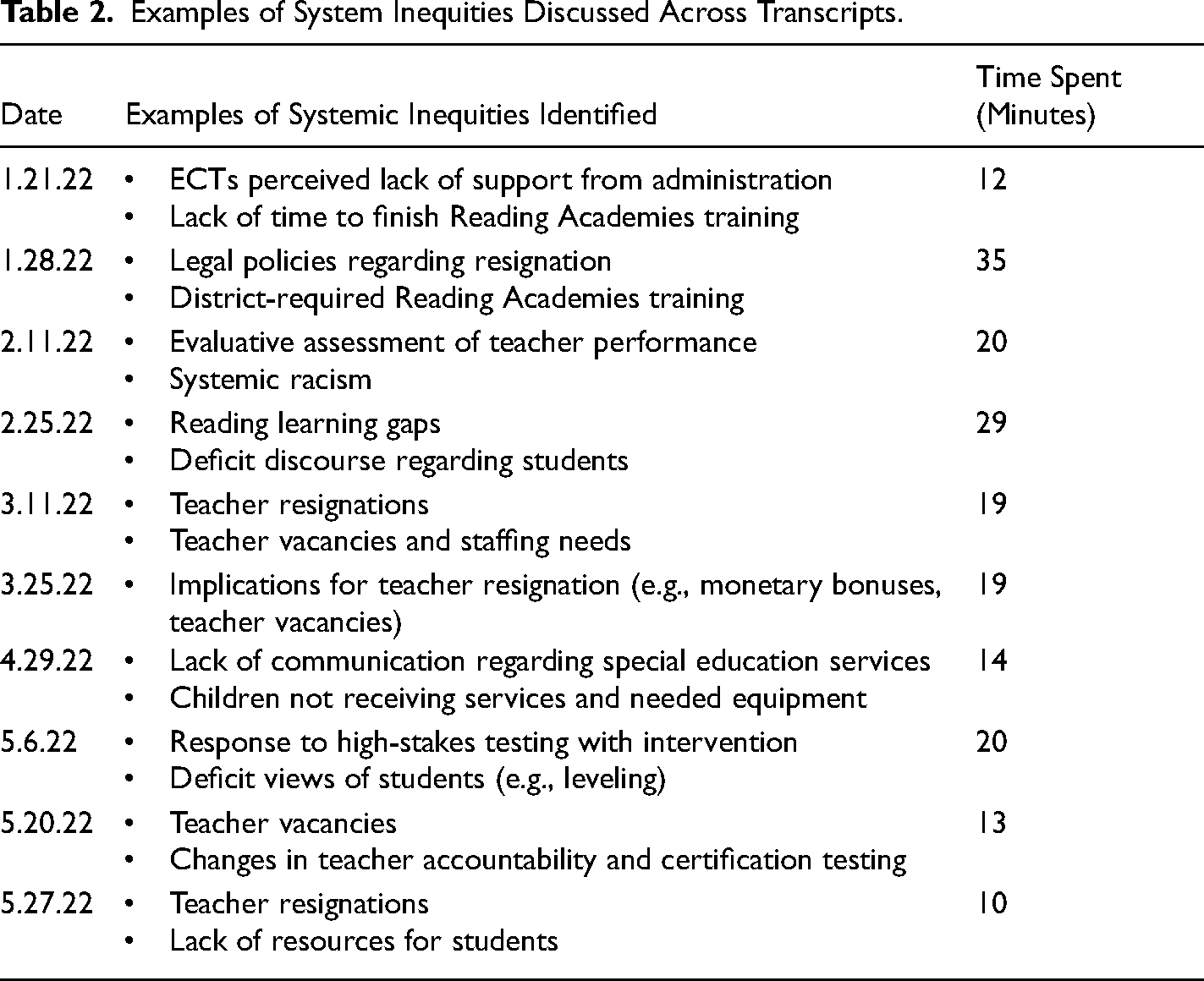
We then analyzed data using critical discourse analysis (Rogers, 2004), drawing on Halliday's (1978) three functions of language: interpersonal, ideational, and textual. We described the ideational function, considering what storylines related to the inequity were identified in the TL discussions. We extrapolated here, thinking about what (in)equity issues were connected (i.e., the working conditions of the ECT; administrator's level of support; power dynamics between administration and ECTs). In addition, we coded for the storylines that may have been related to this inequity (i.e., administrators are not effectively supporting ECTs, which is a barrier to retaining ECTs; administrators should be responsive coaches, rather than objective evaluators; etc.). We asked ourselves: What discursive strategies are being used to legitimize or challenge particular interpretations? In identifying these interpersonal functions—such as when TLs agreed with each other, challenged or aligned with authoritative discourses, built on each other's talk, or changed the topic—we were able to see how participants were building meaning together about the inequity and drawing on shared meanings and shared texts (Fairclough, 1995). We identified authoritative discourse as one of the challenges toward actively disrupting inequities through mentoring. Our final step was constructing analytic summaries of each Center Hours and bringing those to discuss in research meetings. This process allowed us to contextualize these findings and identify the larger, systemic issues present in the field, other engagements with this program, and our review of the literature.
Findings
Across the ten Center Hours, TLs often foregrounded either the inequities as tensions for the ECTs or for themselves. They primarily constructed responses to systemic inequities in two ways. First, they worked to make sense of these inequities through their conversation with one another. TLs told stories, mostly leveraging broadly accepted storylines common in the school context, and sometimes disrupting them. They lamented, with emotion, how ECTs were being inequitably treated and how students were impacted as a result. Second, TLs collectively highlighted and brainstormed responses to the inequities. TLs actively worked to make sense of what was happening in local and global educational contexts, working together to figure out what these events meant for ECTs, their students, and for themselves. These responses drew on a broader array of voices (Bakhtin, 1981), and often problematized authoritative discourse to propose active stances toward disruption of inequities through mentoring. Borrowing from language used in one Center Hours, we called this “locating the locus of control.”
To further expand these findings, we focus on one of the ten Center Hours, from early in the spring semester (February 25, 2022) as an illustrative example. This transcript illuminates the power of how authoritative discourse reinforces efficiency and deficit-based constructions of children and youth that exist simultaneously with a force intended to interrupt systemic inequities (i.e., the negative impacts of testing and accountability on students of Color).
Making Sense of Systemic Inequities
Across the ten Center Hours, TLs identified many inequities. On January 21, approximately one month before the transcript we examine in this paper, Katie (TL) spoke about what she was seeing in classrooms related to reading instruction when mentoring ECTs:
And then we have this context where we have every student entering school at least a year behind and then teachers working to get these kids caught up. And then the narrative that the teachers are receiving is: “You’re not doing a good enough job. Your kids are so far behind.” […]
Rather than completely flipping the narrative on its head to say: “Our kids have been doing a ton when they have been at home. They have been dipping into funds of knowledge that we couldn’t have imagined that existed.”
And so, this is, like, my dream space of where I want to go: “How do we move [to] a place of imagining beyond this box that we are stuck in, in education?”
And, it's just, this is why people are leaving. […] And there is no teacher that can do what these teachers are being asked to do because the kids are so far down a path of different kind of learning that's not being valued or acknowledged, that it's impossible.
Katie identified how students are measured as both problematic in terms of how students are positioned in terms of their academic achievement, as opposed to their knowledge and growth during the pandemic and as problematic for an ECT who is set up to fail. Katie ventriloquated (Bakhtin, 1981) an administrator, “You’re not doing a good enough job,” who positions an ECT as failing. Katie's challenge was that unless the narrative is “flipped” of academic failure, ECTs and their students don’t stand a chance in the system. Katie's passionate turn during this Center Hours related directly to the analysis of systems we will address in this paper. It is important context for a later conversation on February 25, when Sarah brought a statistic to the group related to reading failure. Aligned with Katie's admonishment, “the way that we measure success of kids is the problem,” Sarah brought an example of to the group of such measurement.
On February 25, 2022, the TLs’ conversation picked up again on a prominent discourse present in schools and broader society, which Katie brought up a month earlier, of students being behind, what has been named a discourse of “learning loss.” Sarah, one of the TLs, quoted a statistic that the ISD superintendent had shared earlier in the week through a press release, not cited to protect the anonymity of ISD:
In sharing this statistic, Sarah brought forward an inequity facing the district—more students of Color are reading below grade level this year than pre-pandemic. After sharing the statistic, she explained how she used this statistic to open coaching conversations with ECTs:
I asked like how I could support them with their reading. […]
We’re going to use all of our tools to figure out what's going on and how we can move some of those learners. […]
And it's a good chance for us to dig into the data together. And then turn it into a coaching cycle from there.
Across her talk, Sarah's reporting of and subsequent use of the statistic in her approach to coaching invokes and relies on an authoritative discourse (Bakhtin, 1981) related to learning and schools. Specifically, the statistic is held up as authoritative evidence that students have lost learning during the pandemic, which runs counter to what Katie introduced as their funds of knowledge that grew when learning at home. This discourse—one that is signaled by use of the phrase “learning loss” (Lewis et al., 2022)—rests on assumptions about learning as a set of skills, strategies, or knowledge that develops over time, that can be measured and categorized using a system of grade level, and a model of teaching that focuses on remediating gaps. In terms of reading, this discourse of learning loss is often tied to a cognitive view of reading, rooted in autonomous concepts of decoding and language comprehension (Street, 1995). It is racialized; racial surveillance of online learning was used as a means to criminalize students of Color (Hornsby, 2021) and assign culpability to families of Color.
Sarah's opening story served to evoke this authoritative discourse in relation to her mentoring when she positioned the statistic of low reading scores as an opening for a coaching conversation. The next two turns following Sarah's opening comment (not shown here) do not disrupt or question the statistic, indicating the authority that the statistic holds in the conversation. In Julie's next turn, she focuses on the ECTs and what they might (not) know about how extensive “learning loss” is in ISD. I’m almost wondering, like, do our novice teachers even have a sense of …what is grade level? Right? So, if this has been their first couple of years teaching, and they’ve always been in this grade level, like, do they even have a sense of sort of the, the baseline expectations of and you can look at [state standards] and you can see like all this information. […]
At this point in the discussion, Melissa, a researcher who was participating in the meeting, intervened with a question that sought to draw on such histories and extend the lived experiences that Julie and Sarah brought into the conversation in the early turns.
First, Sarah asked clarifying questions about the statistic she raised at the beginning of the story, further searching for meaning about students of Color and their reading achievement.
And so that's kind of what I want to dig in with my teachers. Like, is it specific skills? Is it a phonological breakdown? Is it comprehension? Like, where are the things breaking down and what is causing this? What are they really seeing? Because that number was so staggering and I don’t know where it came from and I don’t know their basis for it.
Sarah began to question the authority of the statistic, as she wondered how data were collected. The district was using a short-cycle assessment program to monitor math and reading progress, as well as standardized tests. She also connected reading difficulty to learning loss, as identified by progress toward or distance from grade level and the consideration to discrete reading skills. This connection of learning loss to reading difficulty returned a few turns later. There was continued silence around how students of Color were of focus in the statistic but unnamed in the conversation.
Next, Leslie, provided a direct response to Melissa's question about the TLs’ own experiences with February reading levels:
Returning to Sarah's questions about the statistic, three TLs posed additional questions or experiences relating to the reading deficits indicated by the statistic. Here, we have shortened these excerpts to show the building of analysis about reading difficulty:
The TLs were part of a system that identified learning loss during the pandemic as identified by the reading and math achievement scores of students, as Lenora summarized. They proposed that reading scores—or being “below grade level”—can be attributed to a deficit in terms of what students are able to do—reading difficulty (Worthy et al., 2018). The discourse of learning loss was connected to grade level/baseline expectations not met (Julie); reading difficulty (Sarah, Leslie); and missed opportunities (Lenora, Annalise).
These connections of reading difficulty and transitions to learning loss position students as having deficits—holes to fill in, gaps in learning; and by connecting learning loss to reading difficulty, TLs’ language referenced the school-based practices to evaluate, group, and accelerate reading development/skill development. Sarah and Jackie referenced concepts that refer to specific ways of remediation using the metaphor of Scarborough's rope model for reading (2001), that skilled reading is built from decoding, or knowing the code, and language comprehension, or knowing what words mean. Jackie's turn is more specific about this discourse—that children can struggle with one or the other area of reading, and if teachers focus on the area of deficit, either phonological” (Sarah) or “decoding, phonics” (Jackie); or on the other hand “comprehension” (Sarah) or “language comprehension” (Jackie), that they might find a clearer path toward instruction than looking at a measure of grade-level reading.
Throughout the ten transcripts we analyzed, many voices participated in the construction of meaning of systems and how they produce achievement or failure (Bakhtin, 1981). In this conversation, learning loss is authoritative and unchallenged. Learning loss is connected to contexts related to legislation (i.e., science of reading language; remediation, grade level), but not contexts of race or social class. The discourse sits in sharp contrast with Katie's concern that the narrative about loss must be “flipped” if students, and their teachers, have a chance of being successful in the system. We do not know why Katie was not active in the February 25 Center Hours, as she was present but did not speak. She was often active in check-ins when systemic inequities related to student identities, equitable practices, and fair working conditions were on the table. We continued to analyze the talk to understand alternative explanations for or disruptions of the discourse of learning loss, possible entry points for intentional scaffolding or further disruption of these discourses.
Lenora and Annalise, in the turns above, seek to explain the reading scores drawing on what they know about the policies of school closures and their impacts on interrupted learning within schooling systems. They both reference learning loss as connected to transitions, from school to home, from school to school. Their turns connect transitions to negative impacts on students, based on the lack of access to instruction. Both Lenora and Annalise are drawing on their lived experiences working in schools that serve students of Color that have higher mobility than schools that serve predominantly White students. They have experienced as teachers how schools lost touch with students during school closures. As the statistic is specific to students of Color, and through the meanings they evoke around transitions, we saw these moves as expanding the systems analysis from how to “move kids” to interrogate the contextual factors and devastating conditions of the pandemic for students of Color. However, “students of Color” is not repeated after it is initially named by Sarah's initiation of the conversation.
As the TLs further considered the statistic and what it meant in their respective contexts, several began questioning where the figure came from, noticing how the students were being positioned and the impact of those positionings. For example, Annalise wondered whether the ECTs knew what data are being referenced in this statistic, posing, “And the fact that we look at 20 different pieces of data and, you know, everybody's looking at different data.” By questioning the source of the statistic and the content of the assessments, TLs began to trouble its validity, and propose implications for ECTs.
The TLs were drawing on the tools they had at hand to both uphold and question the authoritative discourse of learning loss. In Center Hours, it was quite common for policies and practices of systems to be analyzed at length and through multiple perspectives. We worry about the deficit ideas about students that stayed on the table, the absence of naming the racialization of the statistic, and the lack of disruption using a more systems-focused lens, which might have questioned how the system led to the inequities of reading achievement. We also recognize the power of authoritative discourse and the need for voices to counter this power.
Locating the Locus of Control
The second way TLs constructed responses to inequities was by defining their locus of control; in other words, by finding ways they could impact practice and make change. This term came from the January 21 Center Hours when the director led a discussion of coaching as a practice to make systemic changes within the classroom (Mosley Wetzel et al., 2023). The session was intended to empower TLs to address systemic inequities at a local level, even when the source of the inequity was not local.
Across Center Hours, TLs constructed together what it meant to actively disrupt systemic inequities in their mentoring. Supporting ECTs was a way to make change. Within their coaching, there were also circumstances and actions that were outside of their control as external mentors. For example, TLs were not able to take away responsibilities or add time to the ECT's schedule; they were often unable to find the resources that ECTs needed to meet the needs of all the students quickly enough; and they were often left out of important insider knowledge that would impact their coaching, such as when the school day would be interrupted.
We return to the February 25 transcript to illustrate how TLs constructed what it means to define their locus of control. Sarah bridged back to her original point—mentoring could engage ECTs in the systems analysis and/or actions to address the inequity: But that's where we can step in. I think it's important. Take that off their [ECTs’] plate at some of my campuses; like I’m pulling groups like one or two days a week. […] And I think it it's not an ideal situation, but it's a good entry point for us. […]
Sarah began her turn during Center Hours reporting using the statistic as a conversation starter with the ECTs. Sarah was attempting to refocus the conversation on coaching, and it is that focus on coaching that holds this entire segment of the Center Hours together. The TLs constructed locus of control, from Sarah's early turns to these later turns, in order to articulate how they enter into a classroom to support an ECT. Sarah shared her coaching moves and questions for the ECTs (i.e., “can we talk about it?”). She returned to the topic of coaching by “tak[ing] that off their plate” and working with small groups who show differences in grade level. Perhaps drawing on Lenora and Annalise's move to introduce context, she articulated that new teachers are less equipped to address the challenges associated with the pandemic's impact on communities, but also defined her responsibilities as a mentor. Sarah provided a path forward for TLs who may face a similar coaching situation. Sarah's accomplishment was to bring what Katie named as a hopeless situation back to the locus of control—following a pattern we saw across transcripts of TLs designing new solutions through mentoring.
Discussion
This project occurred in an urban district where teachers are likely to both begin and end their career in three to five years, and in schools where systemic inequities persist for students, their teachers, and their communities. In this analysis, the reading scores of students of Color were related to authoritative discourse of learning loss, and TLs sought to understand the context of their mentoring and their next steps as mentors. Across the ten transcripts, TLs collectively analyzed data and policies, identifying, participating in, and disrupting discourses of inequities. Moving from systems analysis to locus of control, the TLs collectively made meaning of how they could support ECTs who are in between a rock and a hard place, proposed by Katie. In the Center Hours, TLs searched for ways to make things less oppressive and more liberatory for the ECTs, and for the students, families, and communities they serve.
These Center Hours were early in Spring, and as the semester progressed, each TL differently internalized systems analysis and brought it into their coaching. We heard Katie's passionate advocacy for seeing students’ strengths, and we witnessed Julie and Sarah's drive to bring ECTs into coaching through systems analysis. The systemic inequities the TLs addressed over time varied, but across the transcripts there were some common features of their collective meaning making. Often, the subject of reading came to the foreground in relation to classrooms organized for cycles of assessment and intervention. Authoritative discourse is held in place by policies that center efficiency over creativity and compassion (New London Group, 1996). TLs were constrained in imagining how to mentor ECTs, even when the discourses were concurrently being challenged. We focused on their analysis of a reading statistic as a powerful example.
A second common aspect was how the TLs built methods of critically examining systems together. As former teachers, many in this same district, the TLs came into the program with a host of experiences and knowledges around what it meant to be an educator navigating injustices in educational systems. They experienced systemic inequities as teachers and were often tasked with analyzing systems using their experiences, so it was no surprise to us that they approached systems analysis from an experiential and empathetic perspective. Their critical analysis happened through layering stories and voices, to build consensus or interrupt taken-for-granted explanations for what they were seeing.
Finally, we heard the TLs collectively making meaning toward the practical. They were hesitant to stay too long in systems analysis without moving to concrete ideas about locus of control to provide support for ECTs in alleviating the tensions they faced daily. Their efforts of moving to the locus of control are part of disrupting inequities and restoring a sense of agency for teachers who experience their roles as disempowering. As Katie said, “And then the narrative that the teachers are receiving is: ‘You’re not doing a good enough job. Your kids are so far behind” (January 21, 2022). Identifying the locus of control is active, critical work of mentors who are working to challenge systemic inequities with, and for ECTs and their students. In Katie's talk, that meant challenging the voice of an administrator, of “flipping” the narrative.
We extended the literature on university–district partnerships and the tensions that partnerships may have for mentors. Observing systemic inequities from outside the system, they could have positioned themselves as having little access to change. They could have coached each other to alleviate tensions without disrupting. But that is not what we saw. They were grappling with powerful discourses, so tremendous that they needed this space to process their next move. Future research may continue to explore how external mentors approach their work by utilizing their insider/outsider status in strategic ways.
Limitations and Implications
The data set we utilized in this study and our questions did not directly analyze the silences around race and racism in the Center Hours; and future research is needed using frameworks that directly interrogate racial justice using critical theories of race. We also did not address here research questions focused on the context-attentive mentoring that TLs developed and how they approached ECT challenges differently based on their strengths and understandings of their roles, in response to different systemic inequities across the 14 campuses where they mentored. This is the subject of a forthcoming paper.
We see implications for professional learning provided for mentors within induction programs. Mentor allotments from state and districts focus on professional learning around cycles of coaching, ways to model practice, and practices of examining data. TLs in this study were ready with these tools but did not yet have the community they needed to respond to systemic inequities in coaching. We encourage programs to be more intentional in the move toward critical coaching for mentors of ECTs, and to continue to examine the professional learning structures needed within induction programs.
Footnotes
Declaration of Conflicting Interests
The author(s) declared no potential conflicts of interest with respect to the research, authorship, and/or publication of this article.
Funding
The author(s) disclosed receipt of the following financial support for the research, authorship, and/or publication of this article: This work was supported by the Klein Foundation, Powell Foundation, Tapestry Foundation, Bella Vista Foundation (grant number 202100514-001).
