




Abstract
Current conversations in literacy research call for the need to consider children’s social-emotional development and academic learning in an integrated way that honors and supports the whole child in their cultural context. Here we review available literatures on the cognitive, linguistic, affective, social and cultural dimensions of typical and atypical reading acquisition and what is known of their neural correlates. From this review, and in consultation with neuro- and psychological scientists and expert educators working in a range of contexts, we derive a series of interdisciplinary Learnings. These describe what is known about how diverse children grow into readers and how literacy development can be optimally supported in school, home and community contexts across the first decades of life. The Learnings together provide a critical cross-disciplinary synthesis of how literacy and social-emotional development are coordinated, individually variable, dynamic and sensitive to contextual influences. They reveal how evidence-based, culturally inclusive, socially attentive and developmentally appropriate instruction is an essential piece of helping every child organize their brain and mind for literacy. Such comprehensive instruction is necessary to address inequities in general and special education, and to help children become fully literate—a designation that goes beyond simply decoding and comprehending text. Impacts of digital technology, and other timely issues and open questions, are also discussed.
What does it mean to become a reader, and how does one do so? Our hope for all children is that they not only decode written language with accuracy and automaticity—that they learn to read—but that all children are also empowered and ignited by their engagement with written language embedded in various media and contexts—that they become literate. Becoming a reader is a life-long process of developing skills and dispositions to navigate, make sense of, and contribute to the world through words coordinated with symbols and images. It is a dynamic, situated process.
A fuller understanding of how one becomes a reader emerges when we consider literacy and social-emotional development simultaneously and in association with one another, and recognize the influence of culture, context, time, and individual differences, as well as of component skills necessary for reading, on this biopsychosocial developmental process. While learning to read is a gateway into literacy development, we think of literacy development much more broadly. We understand reading development as the long-term process by which individuals build, with instruction, capacities to decode and express ideas and information through print, following the conventions of a given language. By contrast, in this article we consider literacy as the ability and disposition to utilize expressive and receptive written language in various forms. Literacy describes capacities for meaningful engagement with written language across content domains and media, in formal and informal contexts.
Unfortunately, the brain and cognitive bases of reading, and the interdependent social-emotional and cultural dimensions of development, are too often insufficiently attended to in the design and implementation of literacy curriculum (Jones & Bouffard, 2012; Petscher et al., 2020; Yoder & Gurke, 2017). Social emotional learning (SEL) includes inter- and intra-personal understanding, emotional awareness, self-regulation, social communication, and related skills (Collaborative for Academic, Social, and Emotional Learning, 2015). Though SEL is often conceptualized as separate from “cognitive” learning, including literacy instruction, in actuality both social-emotional and academic learning are deeply cognitive and affective, even intertwined in the brain (Immordino-Yang, 2015; Immordino-Yang & Damasio, 2007). In the brain, social, emotional, and cognitive processing are interdependent and engage overlapping neural systems and networks (Gotlieb et al., 2022b; Immordino-Yang & Gotlieb, 2017). There is no cognitive brain system that is not also involved in social and emotional processing, and vice versa. In fact, from a neural perspective, it is impossible to think deeply about or remember information about which one has experienced no emotion, as spending neural processing on information that does not matter to the person would be inefficient (Immordino-Yang, 2015). Attending to students’ social-emotional experiences of the learning process throughout educational contexts and activities is therefore critical, for all children but especially for those from non-dominant groups, for whom school is often alienating. In the modern world, the social-emotional affordances of literacy are fundamental for civic engagement and access to opportunities.
Misunderstandings about the intertwined cognitive, emotional, and social nature of learning and literacy development are major contributors to the twin U.S. educational crises in literacy and well-being. Fewer than four in ten students in 8th and 12th grade read proficiently and the majority of 12th grade students report rarely reading any literary works outside of school (NAEP, 2019; The Nation’s Report Card, 2018). At the same time, and equally concerning, about one in every five high school students seriously contemplates suicide, while many more experience high degrees of anxiety, hopelessness, boredom, and disconnectedness at school that interfere with academic persistence (Gallup, Inc., 2015; Horowitz & Graf, 2019; Ivey-Stephenson et al., 2020; WestEd, 2017). The proportion of students facing these reading and social-emotional challenges is much greater among students of color and those experiencing poverty, due to lack of access to resources and because existing educational practices can undermine individuals from minoritized groups (Aspen Institute, 2018; Azzopardi et al., 2019; NAEP, 2019). Sadly, the COVID-19 pandemic has further exacerbated these pernicious race- and class-based inequalities, causing harm to communities and broader society (Margolius et al., 2020; U.S. Department of Education, Office of Civil Rights, 2021; Youth Trust, 2020).
Evidence from neuroscience, psychology and linguistics reveals that, unlike other types of learning, and unlike the full development of “literacy,” the act of decoding written language is highly unnatural for the brain. This means that most children will not discover how to break the code, or grow the neural pathways to decode efficiently, without high quality explicit instruction in phonics, decoding, orthography, semantics, syntax, and morphology. Because of this, methods for early reading instruction that forefront context cues and guessing at words often actually undermine the reconfiguration of neural pathways connecting visual symbols with meaningful linguistic units of sound.
At the same time, many educators with vast experience helping children learn to read also recognize that the development of broader literacy—inclinations toward meaningful engagement with written words, stories, and ideas—must involve agentic, creative engagement with rich contexts and diverse perspectives. Research evidence strongly corroborates this notion. The tension, then, in effective literacy curriculum design and delivery is around how best to navigate and support both aspects of children’s learning.
Our Approach and Process: Toward an Evidence-Based, Culturally Relevant and Humanistic Approach to Reading and Literacy Development
Here we offer eight sequenced insights or “Learnings” that we hope will help educators and researchers navigate this tension and make sense of the interdependencies of the social-emotional, cultural, cognitive and linguistic aspects of literacy development. These are synthesized from across multiple relevant research literatures on the neural, psychological and educational bases of reading and social-emotional development across the first two decades of life, and from educators’ feedback about their needs and challenges in the classroom. Our aim is not to comprehensively assimilate all studies on reading or to comprehensively discuss all educational approaches and current debates. Instead, we aimed to produce a reliable and relevant synthesis that could be of help to both educators and researchers aiming to understand the state of the field, including best evidence-based practices, current issues in school contexts, and open questions.
We start from the premise that because reading is a gateway to literacy, and because literacy enables individuals and communities to advocate for themselves in a range of employment, civic and institutional settings (such as health care settings and schools), literacy development is the right of every child. We seek to unpack and interpret the available qualitative and quantitative evidence to build out an understanding of literacy that straddles what are often framed as competing interests. Effective literacy curriculum honors the diversity of voices and lived experiences among youth and teachers, while equitably supporting opportunities for youth to efficiently develop the neural networks that undergird lifelong and meaningful access to the information and enjoyment that literacy provides.
As part of our process, to help ensure these Learnings’ relevance to practice and alignment with real-world concerns, we began by gathering a diverse author team that included current and former educators and researchers with diverse linguistic and cultural backgrounds, and expertise in different aspects of literacy and social-emotional development. Our team then set to reviewing relevant bodies of literature, searching through several hundred scientific journal articles and books, in addition to evidence-based work by theorists and practitioners. We worked to understand the development of neural systems and psychological processes underlying efficient reading, and to understand what is known in communities and scholarly literature about the roles of culture, culturally responsive educational practices, racism and social-emotional experiences in schools. We shared our work iteratively with an advisory board of scientists specializing in reading development and the reading brain, and of educators highly experienced and successful in working with linguistically, culturally, neurally and socio-economically diverse populations, including youth with severe reading and socio-emotional challenges. We incorporated these advisors’ extensive feedback to refine the Learnings. Following each Learning, we suggest research questions and other provocations designed to move discussions forward.
Learning 1: Literacy Supports Civic and Intellectual Engagement
Supporting reading development and closing the literacy gap are important because reading paves the way for young people to explore curiosities, find information, and develop into critical thinkers, and to access others’ perspectives and effectively express their own. Literacy therefore enables social, civic and intellectual engagement that strengthens our families, communities and democracy and moves us towards a more equitable society.
“So let us wage a global struggle against illiteracy, poverty and terrorism and let us pick up our books and pens. They are our most powerful weapons.”
∼ Malala Yousafzai, 2013 Address to the United Nations Youth Assembly
What is the purpose of literacy, and what is the cost of illiteracy? Our democracy and communities benefit from a diverse electorate with refined critical analytic and perspective-taking skills—the very skills honed through literacy (Wolf, 2018). Our economy benefits from disciplined and creative minds that spur innovation and communicate (Frey & Osbourne, 2013). Our society benefits from individuals developing the informed, ethical, and civic capacities undergirding a purposeful life, and how better to do so than by engaging deeply with others’ stories (Wolf, 2018). Our families and individuals benefit from the joy of losing oneself in reading for pleasure or interest (Willingham, 2015). Literacy is among the most fundamental modern skills for cultural participation. All individuals deserve high quality public instruction responsive to their needs, especially in reading. Inequities in literacy give rise to inequities across realms of society (e.g., in the justice system; Chow et al., 2022; Senghor, 2016). Schools, our best hope for inspiring young people to create change in the world, must provide all youth with the gift of literacy as a tool to unlock their potential.
Literacy enables individuals to fully participate in the conversations that shape our lives and futures. In a culture and society so filled with and dependent on language, and as our economy increasingly requires knowledge-based work rather than manual labor, literacy has become necessary and hence a fundamental human right (Wolf, 2018). It is a foundation from which individuals come to understand and interact with their world throughout their life and even grow their intelligence (Ritchie et al., 2015). Aside from productivity and information access, literacy is associated with the development of interpersonal skills, such as empathy and perspective-taking, that are key for navigating human relationships (Batini et al., 2021; Dodell-Feder & Tamir, 2018; LaRusso et al., 2016; Sparapani et al., 2018). Literacy has the potential to help young people create the future they desire. Without strong literacy skills, many basic life choices are inaccessible, particularly in work and civic life. Literacy is basic to numerous positive socio-cultural outcomes.
Future Directions
Supporting reading achievement and closing gaps have been long-standing goals in education policy, practice, and research (Lyon, 1998). In conjunction, there is increasing focus on supporting social-emotional learning (Osher et al., 2016) and on educating for civic participation and reasoning (Lee et al., 2021). Future work should strategically integrate these in the service of a broader goal: serving the public good by creating a smarter electorate and workforce, and via these a more equitable society that promotes basic human rights and makes good on promises to improve individuals’ welfare. As we work, it is important to remember why reading is important: reading ability is an entryway into literacy—an essential capacity for modern thriving.
Learning 2: Coordinated Literacy and Social-Emotional Development
Students’ social-emotional needs and cultural funds of knowledge are critical assets to leverage for literacy development. Especially among low-SES students, students of color, and students with learning disabilities, these are generally under-supported and not well understood.
Educating With Sensitivity to Students’ Social-Emotional and Cultural Experiences
Children learn in deeply cultural ways and come to the world ready to engage with other people in order to learn (Gutiérrez, & Rogoff, 2003; Immordino-Yang et al., 2019; Nasir et al., 2021; Tomasello et al., 1993). To optimally support diverse youth in becoming literate thinkers, research has revealed the need for effective culturally responsive and social-emotionally engaged teaching practices (e.g., Bonner et al., 2018; Darling-Hammond & Oakes, 2019; Griner & Stewart, 2013; Ladson-Billings, 2009; Milner, 2010; Milner, 2015). For example, Culturally Relevant Pedagogy (CRP) is a student-centered approach to education that strives to honor the cultural backgrounds and relational assets of all students, especially historically marginalized students and their families. It recognizes that culture is dynamic and that there can be substantial variability not only across cultures, but also within the practices and beliefs of a cultural group. Because such approaches help learners build a sense of belonging and community connection, these practices set up classroom conditions conducive to equitable learning. Part of the CRP approach is acknowledging that educational conditions have failed to facilitate many individuals from culturally, racially, and economically diverse backgrounds building a sense of belonging and relevance in academic contexts and working to strategically remediate this problem. This mode of pedagogy actively welcomes all students in the construction of knowledge with each other and with their teachers. Relationships between students and teachers are central to CRP. Teachers acknowledge and affirm the unique backgrounds and experiences students bring into the classroom, and they use these assets to develop instruction that is motivating and relevant. CRP helps all students to build social and reading skills in a synergistic way and may be especially important for students with learning disabilities and/or from culturally and linguistically non-dominant backgrounds who are likely to feel disconnected from school (Utley et al., 2011).
Culturally sensitive literacy instruction can be motivating to students, especially to marginalized students, because it helps them affirm and extend their identities and connect cultural and individual sources of pride and self-awareness to the act of reading (e.g., Blanchett et al., 2009; Craig & Washington, 2006; Hall, 2012). Feeling connected to one’s racial-ethnic identity, and sharing racial and identity characteristics with others in the school community, can lead to improved education outcomes (Altschul et al., 2006; Benner & Crosnoe, 2011). The use of multicultural literature, literature that expresses counter-narratives, and literature with socially poignant and relevant content helps enhance empathy and reduce prejudice (Ladson-Billings, 1994). Such literature can also provide insights into diverse individuals’ historical experiences and identities (Glazier & Seo, 2005; Kozleski, 2010; Vavrus, 2008). When students can see themselves or diverse others represented in their instruction and literature, they learn dispositions for engaging with social thinking and issues, while also building a sense of legacy and civic responsibility (Lee et al., 2021). This sense of belonging can lead to immediate and long-term positive consequences for academic performance and well-being (Quay, 2017). Attending to the cultural, linguistic, ethnic, and racial identities represented in literatures and ways of thinking and solving problems across academic subjects is integral to setting up rich context for teacher-student interactions, and should be designed from the start into programming (Milner, 2015).
Schools that take a “whole child” approach to education, caring for students’ well-being and strategically affirming the cultural assets of diverse youth, can more effectively support the interdependent development of reading and of culturally complex identities for both literacy and civic development. Research documents detrimental effects of trauma, including from poverty and racism, on the development of reading skills and reading-relevant brain areas (Duplechain et al., 2008; Noble et al., 2007), but also the cultural and social assets that all youth bring to their learning and the educational practices and conditions that can support youth’s holistic growth. Curricula can be tailored around the interests and needs of the population served by a school. For example, in schools in the United States, writing is the main avenue for self-expression, but especially for Native American and Black children, some more desirable forms of expression that are consistent with their heritage and culture may include storytelling, sermonizing, dance, or music (Cleary, 2008; Gardner-Neblett et al., 2012; White-Kaulaity, 2007). Literacy curricula that foreground Native American practices around oral storytelling could be especially effective for Native Students (e.g., Costantino & Hurtado, 2006). Such curricula could first inspire a love of words, an appreciation of their power, and a respect for narratives rooted in students’ home cultures, and then transition students to exploring stories in written form. In so doing, these curricula would welcome learners’ identities into instruction and improve content-specific development by making it meaningful and relevant to students’ lives. Educators could also draw in community members to share oral stories so that supporting young people’s development is seen as a community responsibility and the purpose of education becomes clearer to students. Such a culturally situated approach illuminates community cultural wealth and individuals’ cultural funds of knowledge (Moll et al., 1992; Yosso, 2005), affirming and extending individuals’ lived experiences and empowering students to leverage their developing skills to express positions and participate in their communities.
Leveraging Students’ Dynamic Sense of Self to Support Reading Engagement
The concordance young people feel between their identity and their experiences at school affects how they engage with reading-related activities and school more generally. Identity—our multi-dimensional, ever-present understanding of the self—is constantly evolving in response to social and cultural realities (Holland et al., 1998; Osher et al., 2020). Social categorizations such as class, gender, age, race, and disability create overlapping systems of power and privilege which shape how individuals experience the world. Identity is built by an individual, in relationships, within the context of these social categorizations. Identity is not, however, a group membership or category, but a self-conceptualization and affinity.
For many minoritized children, there is an incongruence between the individual/cultural identities they construct and their school identity, which affects school engagement and literacy-related outcomes. Relatedly, these students may be more likely to be made aware of stigmatized aspects of identity and exposure to stereotypes about aspects of identity can affect their academic performance and engagement. This phenomenon, known as stereotype threat/lift, can have either positive or adverse effects (Steele, 2011). For example, when teachers and caregivers help students with learning disabilities conceptualize those disabilities as a type of neurodivergence that comes with strengths to be celebrated, reminding students of their disabilities can paradoxically improve their academic performance; the opposite is true for learning disabled students who have come through more standard schooling, and understand their learning disability as a shortcoming. The extent to which they feel they are being judged based on stereotypes about people with learning disabilities matters for their experience in school and perception of themselves (Daley & Rappolt-Schlichtmann, 2018). Further, the way students conceptualize their learning disability is also impacted by other aspects of their identity. More than most students with learning disabilities, students with learning disabilities who are white, middle class, and male are likely to be told and to believe that their learning disabilities come with great gifts, like special creative abilities, and that their learning disabilities will not limit their potential (Blanchett, 2010; Sleeter, 1987). Thus, in considering stereotype threat/lift effects on students it is important to consider students multiple, intersecting aspects of identity (Tine & Gotlieb, 2013). Reading-relevant stereotype threat/lift effects have been studied extensively for the last quarter of a century (Steele, 2011; Steele & Aronson, 1995), although more work on stereotype threat/lift effects for students with dyslexia is still needed (Haft, Chen et al., 2021). Stereotype threat/lift is one of the few points of intersection that currently exists in the literature around reading skill and social-emotional experiences. Motivation for reading, and to a lesser extent reading anxiety, are other notable points of intersection (e.g., Guthrie et al., 1999; Haft, Duong et al., 2019; Ramirez et al., 2019).
Improving Reading Self-Efficacy
Students’ beliefs about their potential as a reader and learner begin to form early in schooling and can have profound effects on their academic engagement, and in turn their growth trajectory. As such, attending to readers’ self-efficacy, and mindsets in coordination with readers’ growing skills is important (Dweck, 2008). Individuals with higher levels of self-efficacy tend to show more cognitive skills, engagement, and self-regulation, and better academic and reading outcomes (Carroll & Fox, 2017; Hall, 2012; Pajares, 1996; Schunk, 1989). Fortunately, reading self-efficacy is malleable, especially when students are young (Shell et al., 1995). Educators can create conditions in which students’ self-efficacy might grow by supporting skill development and self-efficacy in tandem. It is only possible to increase reader self-efficacy to a small degree without actually improving reading skills. Still, interventions targeted at improving reading outcomes in children with learning disabilities succeed when they increase feelings of self-efficacy and motivation (Haft, Myers et al., 2016; Lovett et al., 2021; Torgesen et al., 2008). Intervention to improve reading skill and self-efficacy is especially important for students from low-SES circumstances who may believe that their academic abilities are more fixed (Destin et al., 2019) and may have fewer opportunities for high-quality primary instruction.
Nurturing Contexts Can Support Reading Development and Efficacy Through Building Social-Emotional Skills
Students, and especially those who experience reading difficulties, benefit from environments and caretakers that promote a growth mindset and positive interpersonal relationships (Andersen & Nielsen, 2016; Cho et al., 2019; Haft, Myers et al., 2016). Classrooms that build upon the capacities students already have, develop cultures of learning, and positively centralize race can improve students’ self-efficacy (Immordino-Yang et al., 2019; Milner, 2017). For example, research highlighting the resilience of Black youth has shown that when students perceive their educational surroundings to be supportive and identity affirming, they are more likely to experience increased academic self-esteem and success (Cunningham & Swanson, 2010; Nasir & Hand, 2008). This is particularly pertinent for students from minoritized cultural and socioeconomic backgrounds who benefit greatly from, yet are less likely to receive, instruction that relates to their lived experiences and affirms their belongingness in academic spaces (e.g., Gray et al., 2020; Kozleski, 2010).
Outside of the classroom, community organizations can cultivate social-emotional skills and relationships to support literacy development. Meaningful mentorship and social engagement with story narratives can help increase youths’ sense of life purpose and positive sense of identity and are associated with healthy patterns of brain network growth (Haft, Chan, et al., 2019; Immordino-Yang & Knecht, 2020; Riveros & Immordino-Yang, 2021). Especially for students with reading disabilities from low-SES backgrounds, summer reading programs can improve reading, forestall reading slippage over the summer (so-called “summer slide”), and can lead to healthy growth in the brain (Romeo, Christodoulou, et al., 2018).
Home literacy environments also provide opportune spaces for positive literacy development. Frequent literacy-related activities at home (e.g., joint reading) lead to improved educational and social-emotional outcomes (Baker, 2013). This can be particularly important for youth with reading difficulties because it helps these children imagine themselves as readers and affords them opportunities to engage with text in pleasurable ways that establish comprehension skills (Willingham, 2015).
Future Directions: Leveraging Communities’ Cultural Assets and Historical Legacies to Strengthen Literacy and Social-Emotional Development
Researchers need to make a concerted effort to bridge bodies of knowledge related to literacy and SEL and examine these processes in concert as they develop and interact in youth. Longitudinal research is an especially useful tool for understanding and mapping the integrated development of these processes, whose relation to one another grows increasingly complex as students progress through school. To date, the research community has not comprehensively integrated longitudinal investigation of literacy development with investigation of social-emotional growth. Doing so is necessary to reveal and leverage the assets all students bring. While numerous studies have examined school-based SEL programs’ effects on academics (e.g., Corcoran et al., 2018), limited research has only just begun to explore the possible additive effects of simultaneous social-emotional and reading support for struggling readers and social-emotional aspects of the experience of being a struggling reader (e.g., Catts & Petscher, 2021; Haft, Chen et al., 2019; Haft, Duong et al., 2019 Sturm et al., 2021; Wanzek et al., 2021).
Moving forward we hope that researchers will pursue asset-based, longitudinal research centered on students’ community cultural wealth, literacy development, and social-emotional growth. Research should address: How do social-emotional and literacy skills develop longitudinally in a coordinated fashion in the brain and mind, and how is this development understood and experienced by diverse youth and communities? Questions that might deepen this exploration include: How might the concept of self-efficacy be expanded or rethought to better accommodate current sociocultural changes and the cultural assets of diverse youth? How are self-efficacy, identity, and reading outcomes related and why might relationships among these matter? How might these relationships change across the process of learning to read? How might it change with psychosocial development? In what ways are self-efficacy, motivation, engagement, grit, and growth mindsets related? How might these SEL capacities be synergistic, and how might they work together to promote curiosity and purpose? How are the aforementioned potentially inherently biased? What qualities of texts, literacy curricula, and teacher training programs promote students’ reading self-efficacy? How do expert teachers leverage reader’s identity to support reading development across the process of learning to read?
Advancing the scientific study of reading to be more responsive to a diversity of students will require significantly more concerted efforts at integrating families, communities, and educational practices into the research process (Hoffman et al., 2021), as well as utilizing the strengths of interdisciplinary teams.
As one example of a line of inquiry in this vein, we consider the case of long-term English Language Learners (ELLs)—students who continue to struggle with English after several years of enrollment in U.S. schools. Research has explored and explained language- and literacy-related challenges that contribute to these students remaining ELLs. Other high-quality work has explored the intersection of culture and developmental linguistic practices. Still other work explores the role of policies related to ELL reclassification and implications for long-term ELL status (Rhinehart et al., 2022). To our knowledge, research has not explored development processes in the social-emotional domain that contribute to understanding why students linger as ELLs with continued challenges in reading. This area is ripe for research given that the emergence of long-term ELL status typically coincides with the adolescent period when profound social-emotional and identity related changes occur (Erikson, 1950), and given that identity related questions can be especially complex for multicultural youth in immigrant families (Bacallao & Smokowski, 2009; Suárez-Orozco et al., 2015). There are numerous positive sociocognitive benefits for youth of healthy integration of heritage and national identities, and schools play a major acculturating role in immigrant origin youth’s lives. As such, research that investigates supporting identity-building processes in conjunction with supporting literacy, could be effective for improving long-term ELLs literacy outcomes. Supporting bilingual and bidialectal learners in their home languages and dialects has been argued to constitute best practice (Bialystok et al., 2009; Vaughn et al., 2006), and more research is needed on how best to accomplish this in a range of contexts and age groups.
Learning 3: Literacy in the Mind, Brain, and Context
In the brain and mind, social-emotional, cognitive, cultural and academic capacities are fundamentally and inextricably intertwined. These capacities are not served by separate brain systems, but instead by interconnected networks dynamically activating and co-regulating. We can better understand, assess, and support literacy development when we consider the brain, mind, and context as integral contributors.
A Confluence of Neurobiological and Social Factors Shape the Trajectory of Literacy Development
Biological dispositions, environmental factors, and the interaction of our biology and experience all contribute to our sociocognitive traits, scholarly identity, and literacy development (Immordino-Yang et al., 2019; Immordino-Yang, 2015; Immordino-Yang & Gotlieb, 2017). Given the evolving and interacting influences of biological, cultural, and experiential factors (Gutiérrez & Rogoff, 2003), it is important to understand students’ traits, identities, and brains as malleable and affected by context (Erikson, 1968; Huttenlocher, 2002). Our brains are shaped by our cultural and emotional experiences and opportunities to read, and conversely, we engage in activities differently depending on our biology and dispositions (Immordino-Yang et al., 2019). Educational experiences must attend to this mutually reinforcing relationship between our brains and environment to promote healthy literacy development. Doing so means recognizing that literacy skills are changeable and that changing and improving skills can also grow and develop the brain for more efficient reading ability.
Studying the Brain Can Help Us Understand How We Learn to Read
Given that learning to read is primarily a school-based activity, it may not be apparent why measuring the brain would contribute to understanding how we read, and yet neuroscience has added significantly to our understanding of reading (Gotlieb, Rhinehart et al., 2022; Tong & McBride, 2020). School or laboratory-based behavioral tests of reading-relevant skills may measure a mix of multiple cognitive, linguistic, self-regulatory, perceptual, and motor skills all at once. As such, it can be difficult to isolate how individual variation in specific cognitive processes contribute to reading. Techniques like measuring event-related potential in the brain have such specific temporal resolution, measuring changes at the level of milliseconds, that it is possible to isolate how changes in electrical activity in the brain correspond with the onset of specific stimuli. In so doing we can identify the unique contributions of discrete cognitive tasks. Techniques like functional neuroimaging can offer insights into regions of the brain that are involved in reading, which can shed light on similarities and differences in the processes undergirding reading at different points in the development of reading skills or for typical and atypical readers.
One critical insight that has emerged from studying the brain is that the brain systems involved in complex literacy tasks are the same as those involved in the experience of social emotions (Immordino-Yang, 2015). This insight offers evidence in support of a premise of this article—that we can better understand and support literacy development when we consider social and cognitive processes together.
Dyslexia Risk and Outcomes are a Function of Interaction Between Genetics and Educational Opportunities
The confluence of biological and social forces that shape literacy development is perhaps clearest in the case of individuals with dyslexia. Dyslexia is a learning disability most prominently affecting reading (Lyon et al., 2003). It is neurobiologically based (Hoeft et al., 2006; Shaywitz & Shaywitz, 2008; Wolf, 2008), and manifests as core deficits related to phonology, linguistic fluency, word recognition, spelling, and decoding. These core deficits may produce downstream problems with reading comprehension and background knowledge and can occur in individuals with strong cognitive abilities, instructional opportunities, and other significant talents, such as strong visual pattern recognition abilities (Wolf, 2008) and social-emotional awareness (Sturm et al., 2021). There is both a genetic contribution to dyslexia (e.g., Black et al., 2012; Erbeli et al., 2021; Snowling et al., 2003), and various positive and adverse environmental factors that can predict reading success or struggle (e.g., Baker, 2013; Molfese et al., 2003; Walker et al., 2011). Recent work demonstrating increased physiological reactivity to emotional contexts among dyslexic youth also speaks to the complexity of the interplay between cognitive and affective dimensions; such reactivity is associated with stronger social skills and emotional empathy, but also with a tendency toward anxiety that can be heightened when school does not feel safe and supportive to these youth (Palser et al., 2021).
Because of the complexity of biological and environmental factors that contribute to literacy skill, and because of the developmental nature of dyslexia, controversy exists over how to disentangle students with “true” dyslexia from students with lack of opportunities or with histories that have complicated reading development (sometimes called, “garden variety” poor readers). Many of the earliest cases of dyslexia were identified in individuals from wealthy families, in part because lack of opportunity to learn to read or other environmental factors could not explain the reading challenge these wealthy individuals experienced (Shaywitz & Shaywitz, 2020). In these individuals, their reading challenges were studied as medical problems with an assumed biological origin. There are many processes involved in becoming a skilled reader, as suggested by Scarborough’s (2001) famous “reading rope,” Frith’s (1986) developmental model, and the direct and indirect effects model of reading (Kim, 2020); when any of these go awry, whether because of biological and environmental factors or both, it is possible for dyslexia risk to increase. Today when educators do not understand the multiple contributors to “true” dyslexia and to other reading struggles, a diverse swath of students are less likely to receive the reading support they need. Compelling research suggests that combining neurological and psychological perspectives and methods in the study of dyslexia may be especially effective (e.g., Black et al., 2015; Dehaene, 2009; Hoeft et al., 2007; Hoeft et al., 2011; Simos et al., 2002; Wolf et al., 2009).
Future Directions: Understanding Literacy Development as Reflecting Brain, Mind, and Context
Considering the confluence of biological, psychological, and environmental influences on the students’ development can be quite fruitful (Immordino-Yang & Gotlieb, 2017). For example, future research might ask: How could instructional practices be improved and adapted to various groups by harnessing research in motivation and engagement, brain science, and child and adolescent psychology? How and to what extent does a youth’s identity as a reader shape their development of civic identity in the community and literacy skill? Does this translate into psychosocial outcomes and brain development long-term, in and beyond adolescence? What insights can neuropsychological research provide into the developmental trajectory of self-efficacy in reading, especially for students with reading differences and/or challenges? How should pedagogy reflect biopsychosocial development across the grade span, and how is this process shaped by various aspects of identity?
Here we highlighted dyslexia to show the influence of biology and environment on an educationally relevant phenomenon. We hope future work will continue to explore this intersection, asking for example: How is the development of self-efficacy and identity in reading unique in students with reading differences and/or challenges, and how is this different as a function of students’ educational environments and neurobiological profiles? Another major pernicious environmental factor that can affect our neurophysiological and sociocognitive development is poverty and the accompanying chronic stress (Blair et al., 2011; Evans & Schamberg, 2009; Troller-Renfree et al., 2022). We urge more interdisciplinary research into the ways educational experiences can help ameliorate adverse effects.
Learning 4: Phonics Instruction is Necessary but Not Sufficient
Explicit, early instruction in phonics is essential. Optimal reading instruction also involves direct instruction in several other aspects of language, including prosody, pragmatics, orthography, semantics, syntax, and morphology. It supports the integration and expansion of students’ linguistic and dialectal diversity, background knowledge, social relationships, and sociocognitive skills, while also helping students engage directly in decoding.
Reading and the Brain
Humans have been reading for only about 6,000 years. A cultural invention this recent, on an evolutionary time scale, could not possibly have shaped the evolution of the human brain (Immordino-Yang & Deacon, 2007). Indeed, in the brain, there is no natural or innate reading circuit. Instead, each new reader creates within their brain the structures to support reading. Over the course of as much as 20 or more years, structures distributed throughout the brain that evolved to support evolutionarily older cognitive, linguistic, attentional, and affective tasks are repurposed to support reading (Dehaene, 2009; Dehaene & Cohen, 2007). Given the unnaturalness of reading (relative to spoken language, for example), students do not learn to decode written language simply by observation—explicit instruction is necessary (Wolf, 2008). How this reading instruction takes place has sparked vigorous debate.
Reading Instruction Must be Informed by Currently Available Evidence
The “reading wars” have raged for decades (see Castles et al., 2018), but they can be resolved. It has now been clearly shown that explicit, systematic phonics instruction (i.e., learning the relationship between letters and sounds) is necessary for all students (e.g., Ehri et al., 2001; Wolf et al., 2009). Focusing early readers on words as units, with emphasis on meaning and text engagement rather than on parsing phonetics, which is consistent with a whole language approach, may initially engage students but can undermine children’s organization of brain networks for efficient reading over time. The research base for explicit phonics instruction, with instruction in other aspects of language (e.g., Petscher et al., 2020), both in terms of its theoretical foundation in cognitive psychology and neuroscience (e.g., see Kovelman et al., 2012) and in terms of evidence from intervention research (e.g., Morris et al., 2012), is much stronger than the research base for “whole language” instruction (Jeynes & Littell, 2000). Nonetheless “whole language” instruction advocates have led the way in creating and disseminating reading curricula, such that millions of students still receive literacy instruction that is not aligned with what rigorous research has shown to be optimal.
More recently, fewer educators and researchers are explicitly identifying as “whole language” proponents, but many who are sympathetic to this approach have assumed the mantle of balanced literacy. Balanced literacy rightly notes that context matters for comprehension, that it is important to encourage children to read texts that are engaging and meaningful to them, and that the imagination of children is something precious to be cultivated. However, a truly balanced literacy approach must include comprehensive phonics instruction as well as instruction in narrative arcs, and attend to the development of rich background knowledge important for deep reading (Willingham, 2017). These aspects of curriculum need not obviate students’ enjoyment of reading meaningful texts.
Unfortunately, too often the term “balanced literacy” continues to refer to instruction that too heavily relies on context clues, and does not adequately support teachers with knowledge about the psychological and neuroscientific evidence base for how people become truly proficient readers (Wolf, 2018). To begin to remediate this issue, there have been federal and state-level policy changes to support incorporation of evidence-based literacy instruction (e.g., Reading First) and some media organizations (e.g., SesameStreetInCommunities.org) have incorporated the implications from the evidence base of how people read into their products. Aligned with these advances, major balanced literacy proponents and curricula developers have recently commented on the need for more phonics-oriented adjustments to their approach (Goldstein, 2022), but there are challenges and push-back. Simply put, change in these practices is slow (Seidenberg, 2017).
Especially after more than two years of pandemic related disruptions in reading, supporting phonics instruction in the general education classroom and through special interventions, when necessary, is critical for young students. For struggling readers, regardless of SES, race, or IQ, multicomponent reading interventions that have explicit phonics instruction are most helpful (Morris et al., 2012; Petscher et al., 2020). These multicomponent, early interventions are successful because, as the direct and indirect effects model of reading proposes, reading involves relations among numerous skills including listening comprehension, text fluency, content knowledge, discourse knowledge, affect, perspective taking, reasoning, vocabulary, grammatical knowledge, phonology, morphology, orthography, working memory and more (Kim, 2020). Intervention programs like RAVE-O (Wolf, 2010; Wolf et al., 2009) are not only phonics based, but also attend to metacognitive skills and the integration of other elements of language (e.g., polysemy) and reading that improve literacy development. Current evidence supports the notion that reading interventions should include instruction in phonology, prosody, pragmatics, orthography, semantics, syntax, and morphology or “POSSuM” (Bowers et al., 2010; Cain et al., 2004; Lovett et al., 2000; Orkin et al., 2022).
Future Directions: Expanding Research About Literacy Development to Incorporate Integrated Support for Cultural and Social-Emotional Growth
A strong evidence base has illuminated how students learn to read, how to teach basic literacy skills most effectively, and what happens in the brain when reading and learning to read (e.g., Christodoulou et al., 2014; Dehaene, 2009; Lyon, 1998; National Reading Panel, 2000). The next frontier for reading curricula is to attend more fully to supporting the social-emotional experiences, and cultural and linguistic diversity, of budding readers. Advocates for students from minoritized groups have raised legitimate concerns about the lack of cultural diversity in reading research, and researchers are now beginning to address this historical injustice and limitation to our understanding in their work. Learning to read can be a challenging and emotionally charged process for many young people. Cultural, linguistic, and dialectal diversity in the development of literacy is substantial and a potential source of strength, but not well understood (Goldenberg & Coleman, 2010; Lee, 2006; Seidenberg, 2017; Suárez-Orozco et al., 2015; Washington & Seidenberg, 2021; see Learning 6). For example, many aspects of literacy beyond word reading, such as cultural differences in the use and interpretation of incorporated images and storytelling practices, are shaped by social experience and require appropriate adaptation of instruction (Lee, 2006; Seidenberg, 2017). Human developmental, social, and cultural psychology have shown that the preservation of youths’ home cultures and languages is critical for the youths’ mental health and survival (Chandler et al., 2003) and that drawing on students’ home language practices and valuing their linguistic repertoires can deepen vulnerable youths’ literacy, reasoning abilities, and participation in academic learning (Lee, 2006). We encourage future research to examine how the core elements of pedagogy informed by current robust evidence about how people learn to read might be adapted to different cultural contexts and for different groups of readers. There is a need to both deepen our scientific understanding of the relationship between culture and literacy development and to learn more about how to implement, adapt, and replicate evidence-based practices.
Learning 5: A Human Developmental Perspective on Literacy
There are windows of risk and opportunity during the developmental trajectory from birth to early adulthood in which particular literacy-, social-emotional-, and identity-relevant skills can be optimally supported. However, it is never too late to intervene. There is substantial individual and contextual variability in reading development, but for everyone, literacy is a life-long process.
Recent frameworks created through the synthesis of research from the learning sciences, education, and developmental psychology have established that reading-, social-emotional-, and identity- relevant skills are interlaced and dynamically evolving throughout child and adolescent development; the evolution of these skills is highly dependent on individual, contextual, and environmental variability (Darling-Hammond et al., 2020; Fischer & Bidell, 2006; Immordino-Yang et al., 2019; Kim, 2020; Raver, 2004). Early development is not necessarily better, and it is never too late to intervene. That said, during the prenatal period, infancy, childhood, and adolescence, there are particular developmentally normative skills that, when supported in culturally appropriate ways, contribute to literacy development.
Prenatal
The foundation for social relationships and literacy begins early. Even before birth, the growing fetus learns to recognize its mother’s voice and the sounds and combinations of sounds that are used in the languages within its community. After birth, babies can recognize music and story books they were exposed to in utero (Hepper, 1988). It is thought that prenatal exposure to language and song help babies to recognize the cadence and emotional qualities of language.
Infancy Through Early Childhood
The home literacy environment profoundly shapes the development of the brain, and the language and reading skills it supports, especially in the first few years of a child’s life (Hutton et al., 2020). Caregivers play a critical role by offering a nurturing relationship and cultivating a culture of positive language engagement for early literacy (e.g., Aikens & Barbarin, 2008; Brooks-Gunn & Markman, 2005; Hill et al., 2018). Parents’ language and literacy skills and mental health affect their child-directed speech and the growth trajectory of toddlers’ vocabulary (Golinkoff et al., 2015; Pan et al., 2005). In fact, at the neural level, young children’s exposure to dynamic conversation at home has been shown to affect the extent to which Broca’s area, a part of the brain critical for language production, is active when listening to a story; these findings hold beyond the effects of SES or the number of words a child has heard (Romeo, Leonard et al., 2018). Research suggests that simple, low-cost, authentic, real-world, culturally relevant interventions can help increase language exposure for young children. For example, signage in supermarkets in low-SES neighborhoods that encourages adult-child dialogue has been shown to increase the amount of conversation between caregivers and children while at the supermarket (Ridge et al., 2015).
In addition to adult-child conversations, daily print-based reading with infants, toddlers, and young children is one of the best practices caregivers can engage in for positively impacting literacy and social-emotional development for years to come (e.g., Mol & Bus, 2011). However, too many children are not read to daily because of lack of books in the home, lack of time to read (such as when parents have to work multiple jobs), parents’ negative attitudes towards reading, parents’ inadequate literacy skills, and the underrepresentation of non-European American culture in children’s books (Duursma et al., 2008; Luo et al., 2020; Sinclair et al., 2018). Public health organizations have begun to make progress in addressing the need to educate parents about the importance of reading to young children, and the need to empower parents, including linguistically diverse parents and parents with disabilities, to read in the home. Additionally, there are organizations that aim to mitigate barriers to family reading by providing free books to families with infants and young children and by supporting community education around the importance of early reading, talking, and singing in a developmentally appropriate way (Zuckerman & Needlman, 2020). Such programs can increase parents’ time reading to their children, lower parental stress, and facilitate bonding (e.g., Jain et al., 2021).
With reference to the biblical parable in the Gospel of Matthew that “the rich get richer, and the poor get poorer,” Keith Stanovich (1986, 2009) has suggested that children who know more words will learn more words, and students who read more will learn more from the texts they read. And, students who enter school with stronger academic and social skills will go on to develop those skills more than do their peers. Thus, investing in children at early stages has a large social, academic, and economic return on investment (Heckman, 2006). The literacy skills developed in preschool have been shown to translate to reading ability later in childhood (e.g., Scarborough et al., 1991) and intervention in early childhood has the greatest chance of stemming reading challenges, especially for children from low-SES households (e.g., Blair & Raver, 2014; Diamond et al., 2007; Weiland & Yoshikawa, 2013). Longitudinal studies have shown that interventions in preschool and kindergarten are linked to positive outcomes in high school and beyond (e.g., Campbell et al., 2002; Schweinhart et al., 2005; Stanley et al., 2018). In addition, the availability of reading instruction should match the developmental needs of the child. For example, most kids are not developmentally ready to read in kindergarten and trying to make them do so may actually be disadvantageous for them and deprive them of the joy of reading (Goswami, 2003; Wolf, 2008). Earlier development of skills is not better, especially if it means those skills are built on a wobblier foundation. Instead, engaging in pre-literacy activities together—enjoying stories, language games and songs—can be useful in building a strong foundation, vocabulary and world knowledge until children gradually become ready for phonics.
Middle-Late Childhood
The transition from 3rd grade to 4th grade has been characterized as representing a shift from learning to read to reading to learn. Fourth grade reading materials typically contain substantially more complex vocabulary and sentence structure (Paige & Magpuri-Lavell, 2014). While this supposed shift, and standardized testing aimed at documenting it, has affected the design of curricular materials and instructional practices, scientific evidence does not support the idea that students are ready to make such a transition (Coch, 2015). Rather, reading and literacy skills develop in a slow and continuous fashion over many years, and the subcomponents of each may develop asynchronously within a student and differently across different students (Fischer & Bidell, 2006). While it is critical to support early literacy, if students have not learned to read by the end of third grade it is wrong to assume that the window in which they can do so has closed. The reality is that the period of learning to read extends well beyond third grade, and all students have a right to be supported as developing readers regardless of the alignment between their ability and their grade level.
Adolescence
Adolescence is a period of tremendous cognitive, identity, and social-emotional development (Gotlieb et al., 2022a; Gotlieb, Hickey-Mood et al., 2022; Steinberg, 2014). Literacy skill can improve as a function of this development and can facilitate other domains of psychological growth. For example, as adolescents come to reason more abstractly about the social world around them, they develop skills for deep, analytic and compassionate reading and narrative construction. Language, culture, and cultural history (including a legacy of racism) impact how youth come to understand who they are and who they want to become now and into adulthood (Chandler et al., 2003; Erikson, 1968; O’Shea et al., 2019). Students’ identities are informed by the literature and language curricula they experience in school (Quinlan & Curtin, 2017) because these provide starting points to imagine possible personas as they are transported by learning of the lives of others. Additionally, teenagers’ literacy skills impact teens’ ability to explore and express their emerging sense of self, at a time when heightened social inclinations also present vulnerabilities. If students do not see themselves and their interests and cultural backgrounds represented in their schoolwork, this may drive a false dichotomy between their cultural and home or community identities and their identity as a student (e.g., Milner, 2017). For this reason, it is important that youth are exposed to literature with a diversity of characters, authors, narrative structures and content themes.
Adolescent learners with weak literacy skills may experience shame and even trauma around reading. People need to feel capable, competent and intelligent, able to learn and improve themselves, including in school and reading classes (See also Learning 2). Although reading interventions for students in middle and high school yield smaller gains than reading interventions for younger students (Scammacca et al., 2007), specially designed reading interventions are quite effective for this age group (i.e., Edmonds et al., 2009; Flynn et al., 2012; Lang et al., 2009; Lovett & Steinbach, 1997; Scammacca et al., 2007; Wanzek et al., 2013). Reading interventions for older students work best when they: (a) are designed with adolescents’ maturing social, cognitive and cultural needs in mind (Yeager et al., 2018); (b) include a focus on motivation and engagement (Cockroft & Atkinson, 2017; Kim et al., 2017; Lovett et al., 2021; Roberts et al., 2008; Torgesen et al., 2008); (c) are administrated in small, safe-feeling dyads and triads over multiple years with progress monitoring (Lovett & Steinbach, 1997; Vaughn et al., 2008); (d) include a focus on comprehension (Roberts et al., 2008; Scammacca et al., 2007; Suggate, 2010). Notably, attending to social-emotional factors like motivation and engagement is a critical component of reading interventions for adolescents struggling to read (Lovett et al., 2021); these predict gains in reading achievement at least as well as students’ SES (Froiland & Oros, 2014). Multi-component interventions that focus on word meaning, understanding context, and comprehension strategies are particularly helpful (Scammacca et al., 2007). Time should be set aside in older students’ busy school schedules to work on these aspects of reading, whether in their traditional classes or separately. Notably, these literacy skills are not simply the purview of English and language arts classes. Social studies, science and other courses can also incorporate reading supports and interventions (e.g., Wanzek et al., 2015). Connecting reading practice and support to students’ own interests and goals can help substantially.
Future Directions: A Developmental Perspective on Literacy
We see great need to study literacy with a situated, developmental lens that includes a focus on the complex interactions of cognitive and social-emotional development, both for young children and across adolescence, and even into post-secondary education. More research should seek to answer: How can we measure literacy in ways that will help us support its development in authentic contexts in diverse communities across the lifespan? How can educators be supported in leveraging literacy to create: school and classroom practices that encourage students at each stage to bring themselves and their prior knowledge fully to the classroom; safe spaces to explore one’s sense of self in developmentally appropriate ways; age-appropriate opportunities to contribute to the community and honor diverse cultural practices; and family and community involvement in students’ learning experiences from birth through adulthood?
While there is a robust body of research on social-emotional and cognitive development in the first few years of life, much more research is needed about the ways to leverage adolescents’ emerging social-emotional and cognitive capacities to support literacy development, and especially to help long-term struggling readers. This is especially important for adolescents of color, those living in poverty, English learners, and youth involved in the juvenile justice or foster care systems, given that on average these groups struggle with reading to a larger extent and have been underrepresented or largely neglected in basic cognitive and brain science research on literacy.
Learning 6: Comprehensive Teacher Preparation
Effective teacher preparation is needed and should involve helping practitioners understand culturally responsive instruction, young people’s developing social-emotional lives, and scientific approaches to reading instruction.
Training Teachers to Understand the Role of Culture in Education
Teacher preparation programs need to help teachers-in-training develop dispositions and practices for teaching that promotes culturally relevant, deep learning among their students (Darling-Hammond & Oakes, 2019). Effective teacher education centers on helping teachers develop skills that increase their professional vision, i.e. their abilities to evaluate and respond to learners’ developing academic needs, interests, and strengths (Darling-Hammond & Snyder, 2000; Kundrak et al., 2022). Further, educators’ training programs need to help practitioners understand their own positionality, as well as the history, politics, and ongoing social dynamics around inequality in American education. This has become even more important as teachers are increasingly relied upon to support their students struggling with the pernicious downstream problems stemming from poverty and racism. Part of this charge is safely supporting educators coming to understand the ways their own backgrounds and circumstances affect their communications and relationships with students, as well as their pedagogical practices. All students bring personal assets and funds of knowledge to their literacy development (Moll et al., 1992); for teachers to see and leverage these requires an awareness of their own social and emotional strengths and biases, including racial and socioeconomic biases (Darling-Hammond & Oakes, 2019; Rodriguez et al., 2020). Given that the teacher workforce, and especially the special education teacher workforce, is disproportionately white (80.5% of all public school teachers and 83.5% of all special education public school teachers identify as white; U.S. Department of Education, NCES, 2020), and much whiter than the student body, helping teachers understand and address the roles of race and poverty is especially important.
Skilled educators implement pedagogy with a cultural lens and with sensitivity to students’ diverse backgrounds, while recognizing that there are some basic principles of reading instruction that are important for students across backgrounds. Some key practices include: 1) instructing literacy in both indigenous/home and dominant languages and valuing diverse dialects; 2) connecting learning activities to communities and students’ families’ values; 3) building curriculum that enables cultural knowledge, academic proficiency, and community service to intersect; and 4) assessing students using curriculum-embedded, authentic tasks (Keehne et al., 2018). Teaching phonics to early readers is essential (see Learning 4), but the way these practices are framed should be enriched by and embedded in students’ authentic cultural and linguistic assets. By providing students reading materials likely to inspire their interest and curiosity, educators can help students build connections between reading materials and their lived experiences, affirm their identity in scholarly spaces, and bring to light the powerful role that literacy can play in their lives and futures.
Training Teachers to Understand Social-Emotional Development
Teachers should also be supported in developing awareness around their personal social-emotional assets as individuals and as educators (Rodriguez et al., 2020). Effective preservice teacher education programs develop teachers’ social emotional competence and help them understand how to build safe, supportive, and welcoming learning environments (Melnick & Martinez, 2019). Critically, educators need to unlearn the idea that emotions interfere with learning or that social-emotional skills should mainly be taught as standalone lessons (Immordino-Yang et al., 2019). When educators come to understand principles of child and adolescent development, their ability to support students improves (Darling-Hammond & Oakes, 2019), in part because they understand that young people, and in fact all people, think harder and more deeply about content and skills they care about (Immordino-Yang & Damasio, 2007).
Training Teachers, Including High School Teachers, to Understand the Evidence About how People Learn to Read
To fully realize the benefits of improving teachers’ cultural and social-emotional awareness, it is critically important that educators understand and teach in ways that are aligned with current evidence about how people learn to read (see Learning 4). Leveled appropriately for learners’ needs, lessons for emerging readers should include systematic, comprehensive, phonics-based literacy instruction (e.g., Ehri, 2020). As of 2020, about half of traditional teacher preparation programs adequately instruct teachers in an evidence-based, comprehensive, systematic approach to teaching reading, which represents a substantial increase from just a few years ago (National Council on Teacher Quality, 2020). Still, many teacher preparation programs, especially alternative certification programs, do not provide such instruction, and about 40% of textbooks used in teacher preparation programs include harmful myths about how to teach reading (National Council on Teacher Quality, 2020). Thus, not only are there many veteran teachers who were never trained in a scientific approach to reading, but many new teachers are beginning their careers unprepared.
The lack of exposure to an evidence-based approach to reading instruction is especially prevalent among high school teachers, despite that full reading fluency is still developing at this age. Given that reading struggle is prevalent among middle and high school students (The Nation’s Report Card, 2018), and more so now because of COVID-19 related learning loss, more comprehensive and embedded supports for reading skills must be available when needed. Despite the reality that teachers of advanced subjects do not specialize in reading instruction, all teachers should have fundamental understanding of this content. Evidence is accumulating about how to prepare high school teachers to address reading struggle in their students (Lovett et al., 2008); now we need more secondary school educators to receive such training. Further, since most students with reading difficulties benefit from reading interventions, and substantial reading support may not be provided in general education classrooms, it is paramount that middle and high school special education teachers are taught how to explicitly teach reading skills.
Future Directions
More work is needed that draws on the expertise of educators and policy makers to address challenges in teacher preparation and professional development. Moving teacher preparation programs towards instructing emerging educators in practices that are most likely to support the literacy development of their future students, even when such instruction runs counter to traditional or intuitive practices, is critical. Similarly, policy should address how to: a) better support teachers while they are in training, in part through designing lengthened residencies and other embedded professional growth supports; c) deepen and expand training to include principles of literacy across grade levels and neurodiverse populations.
Learning 7: Inequities in Special Education
There is a complex system of inequities, especially race/ethnicity-based inequities, around identification for special education. Timing and quality of remediation are also inequitable. Addressing these issues requires adapting pedagogical and assessment practices to be developmentally, culturally, and linguistically appropriate, and informing educators and parents about how to employ and interpret screeners and assessments responsively. We were alert to the gap separating the written word from the colloquial. We learned to slide out of one language into another without being conscious of the effort. At school, in a given situation, we might respond with “That’s not unusual.” But in the street, meeting the same situation, we easily said, “It be’s like that sometimes.
∼Maya Angelou, 1997 I Know Why the Caged Bird Sings
Disproportionality in Special Education
Special education plays a major role in supporting literacy development for millions of students. In 2020, more than 14% of all public-school students (and as many as 1 in 5 students in some states) received special education services under the Federal Individuals with Disabilities in Education Act (IDEA), and the percent of students served by special education has been on the rise for the past decade (NCES, 2021; U.S. Department of Education, IDEA 2020). About one-third of the students who received special education were identified as having specific learning disabilities, with reading disabilities being the most common (NCES, 2021).
It is important to understand who is placed into special education and the way cultural biases contribute to these placements. This is because the categorization of students as learning disabled has been used as a way for general education programs not to teach students whom they find difficult to reach, but special education can also improve students' learning experience and growth when it offers needed supports (Lyon et al., 2001). As such, for the past half century there have been legal battles about disproportionality in special education (e.g., Larry P. v. Riles, 1972 ). Students from low-SES backgrounds are more likely to be placed into special education than higher-SES students (Blair & Scott, 2002) and school district SES intersects with students’ race, ethnicity and gender to compound disproportionate identification in special education (Coutinho et al., 2002). Black, Latinx, and Native students are more likely than white students to be in special education (NCES, 2021; Sullivan & Bal, 2013), while Asian students are least likely (Skiba et al., 2008; Sullivan & Bal, 2013). However, confounding variables such as academic achievement make the patterns of identification of Black and Hispanic students complex to interpret; depending on what other factors are taken into account, such students may actually be under-identified for needed services (Morgan et al., 2015; Morgan et al., 2017). In addition, schools with a higher percentage of minority students and schools with more struggling readers are less likely to place students in special education (Hibel et al., 2010; Odegard et al., 2020). Inequities and disproportionalities in special education placement at the district level may exist even when these are not observable at the state or national level (Artiles et al., 2005).
Some have argued that special education on the basis of learning disabilities has become a way to allow for racial segregation in racially integrated schools (Blanchett, 2010; Sleeter, 1987). It may be that schools with a higher percentage of minority students (i.e., more homogenously minority schools) have fewer students in special education because there is less pressure to segregate in those schools. Alternatively, this so-called “frog-pond” effect may arise because in a school with fewer resources and more struggling readers it is difficult to determine which students are struggling due to “true dyslexia” and which are struggling due to poor quality of instruction. In either case, overrepresentation in special education closely reflects broader inequities and injustices in education and society (Blanchett et al., 2009).
Especially given inequities in availability of quality reading instruction, disability theory suggests that “disabling” individuals by quantifying how they differ from the norm is unnecessary and even dehumanizing (Annamma et al., 2013; Davis, 2016). Some have argued that schools should not identify students for special education based on perceived risk factors as educators may be biased against youth of color and youth experiencing poverty (O’Connor & Fernandez, 2006). Current systems for special education referral and placement may disproportionately document minority students as disabled because their performance is assessed using tests developed to suit white middle-class students—a decision rooted in historical and systematic racial biases.
Early and Widespread Screening, Designed to Inform Targeted Instructional Practices, Has the Potential to Reduce Disproportionality in Special Education
Unlike identifying students as learning disabled, screening students involves assessing them on their skills in one or more academic or social-emotional areas to determine their risk of experiencing challenge in that area and their needs for targeted supports. Universal screening in reading (i.e., testing all students except those few with the most persistent and severe developmental diagnoses, rather than only students whom teachers refer for testing) has been shown to help reduce some disproportionalities in special education and to improve outcomes (VanDerHeyden et al., 2007). It helps address bias introduced by only evaluating students referred by teachers for testing. Additionally, given that language-minority students are underrepresented in special education in younger grades and overrepresented in older grades (Samson & Lesaux, 2009), early screening, if designed appropriately for this population, could help these students receive appropriate services sooner, before problems lead to underachievement, self-efficacy, and even behavioral issues. Given heterogeneity in the profiles of students who may go on to struggle with reading (Ozernov-Palchik et al., 2017; Wolf & Bowers, 1999), and given the efficacy of early interventions (Lovett et al., 2017), universal screening is helpful for identifying and quickly ameliorating students’ areas of challenge.
It is promising then that all but 11 U.S. states have passed legislation related to early screening for reading difficulties and many are considering legislation requiring universal screening (National Center on Improving Literacy, 2022). If appropriately designed and developmentally sensitive, certain forms of screening should begin as soon as students enter school, or when possible, even before, for example through pediatrician appointments. New science suggests that neural and behavioral indicators of dyslexia may be present even in children’s first year of life (Langer et al., 2017; Lohvansuu et al., 2018), suggesting the possibility that very early screening could be useful, so that children can be provided the services needed to circumvent later reading problems.
Understandably, parents may push back on screening because communities know all too well how these sorts of data have been weaponized against children to label them as deficient, undermine their learning resources, and ignore their strengths. To make progress towards implementing early, near-universal screening, schools, educators and policy makers need to build the community’s trust. First, those in power must acknowledge how practices have historically been racially biased and detrimental to many children, and then explain clearly how current practices aim to advance parents’ efforts to procure appropriate supports for their children. Addressing misunderstanding among parents about screening, helping them to understand that screening is simple and quick, yet has the potential to ensure that their children are provided the targeted supports they need, could also be helpful. When parents realize that screening may facilitate their child’s success, they may be more comfortable with their child’s participation.
Perhaps the most critical step in moving towards equitable screening is addressing the current dearth of screeners that adequately assess culturally, linguistically, and dialectally diverse youth. When creating “nationally normed” reading screeners, it is important to be explicit and transparent about the makeup of the sample on whom the screener was normed, so that researchers and educators can assess generalizability or comparability to their students and context. Culturally appropriate assessments consider the different cultural practices that influence children’s development, in order to more accurately capture students’ strengths and needs. For example, to address the historical bias in language and literacy assessments, screeners should consider children’s home dialects, such as their use of African American English (Craig & Washington, 2006; as exemplified in the quote at the beginning of this Learning), and children’s home cultural narrative skills, which can be especially strong among African American and Native students (Chandler et al., 2003; Gardner-Neblett et al., 2012). Neither of these factors would be taken into consideration in traditional language assessments, yet these unequivocally represent strengths these children bring. Dynamic assessments that adjust to the student’s preferences and performance in a supportive context, and well-constructed non-standardized assessments that accommodate cultural and home-language characteristics, have been considered more culturally inclusive and effective (Washington, 2001). Additionally, formative, progress-monitoring assessments that offer timely, targeted feedback can help teachers support every student’s learning in real time, rather than merely capturing a snapshot of what each student can do. More culturally sensitive and formative screeners will be essential as we move schools towards supporting rather than sorting students.
The Double-Edged Sword of Labels and Diagnoses
Receiving a label or diagnosis can be a complex process. Even with optimal reading instruction and home supports, some children have difficulty learning to read due to a range of underlying neural profiles clinically described as variants of dyslexia (see also Learning 3). Screeners are not a tool to diagnose dyslexia or other learning disabilities; once a screener or skilled teacher has identified that a child may experience reading or language-based challenges, extensive additional testing by a trained psychologist is needed to diagnose. This additional testing comes at high financial cost to a school district, but this may be necessary or desired for complex cases. Dyslexia can stem from a range of underlying neural and psychological processing differences, or a combination of these, including various difficulties distinguishing linguistic sounds and various difficulties rapidly and automatically processing information (Wolf & Bowers, 1999). Thus, even a diagnosis of dyslexia may not fully explain the reason for the challenges a student has.
Although labels like “specific learning disability” run the risk of stigmatizing students, there can also be benefits to accurate diagnoses (see Lauchlan & Boyle, 2007). For instance, labeling students with disabilities is currently the most efficient way to ensure that essential specialized educational services are funded and implemented in public schools. Classification in special education can result in funding for high-touch evidence-based practices not available in general education so that children can meet individualized goals and access age-appropriate curriculum despite difficulties decoding. However, screening, labeling, and diagnosing are only useful to the extent that they lead to students receiving targeted, early interventions that put them on the path to engaging with rich, meaningful content. Given the ways that learning disability labels intersect with other aspects of identity and group membership, and open questions around the cultural appropriateness of existing screeners, accurate diagnosis and availability of high-quality special services are especially important for students from minoritized groups. Without close ties to high-quality services, screening, labeling, and diagnosing can have negative effects for youth, especially those of color (Blanchett, 2010).
Learning disability labels can also empower students by helping them understand their own profile of strengths and weaknesses, so that they can advocate for themselves. The most successful dyslexic individuals are those who have insight into their areas of difficulty, as well as into their areas of strength and passion, and develop self-efficacy because of this self-awareness (Fink, 1995; Rodis et al., 2001). When managed appropriately, facilitating self-understanding through labels can be beneficial. Indeed, dyslexia and other learning disabilities, are not problems with intelligence, and can even be associated with exceptional intellectual strengths and creativity (Rappolt-Schlichtmann et al., 2018).
Future Research and Improved Implementation to Address Disproportionality and Outcomes
Future work should reorient special education for reading to highlight students’ strengths and needs while considering demographic characteristics that could influence their special education placement and experience. One component of this involves the development of new, less culturally biased tools for reading and language assessment, as we describe above. Another area for investment is educating special education and other teachers about high leverage practices—i.e., collaborative and flexible placement practices that support learning across grades and content areas for students with or without disabilities (McLeskey et al., 2017). These practices are research-based and outline specific ways educators should collaborate, instruct, assess, and support social, emotional and cognitive development in an integrated way. It is also important that students’ receiving services do not feel punished or excluded from the learning activities other youth enjoy. Most notably, when “pull out” practices that provide reading support do so at the expense of allowing students access to interesting elective courses, students can lose motivation and connection to school. Especially for students with reading challenges, classes like art and physical education, where these students may be able to demonstrate strengths and derive enjoyment, are important (Mayes & Moore, 2016). Additionally, use of “response to intervention” (RTI) models allows students to be taught in inclusive environments for as much of their time as possible. With RTI, students receive special interventions for only the constrained amount of time they need and do not languish in special education for the duration of their academic career (Arias-Gundín, & García Llamazares, 2021).
Future efforts should attempt to provide academic and social-emotional supports in tandem, with a sensitivity to environmental influences on students’ experiences with reading disabilities and their socio-affective sequelae. Given co-morbidities between reading disabilities and attentional issues, anxiety, depression, and other psychiatric conditions (Goldston et al., 2007; Hendren et al., 2018; Nelson & Harwood, 2011), and the effects of poverty and trauma (including racial trauma) on both reading and mental health, addressing emotional needs together with academic ones would be helpful to children.
We hope future research will address the following: How can schools harness the power of culturally responsive pedagogy to address special education inequities and to improve reading instruction and literacy outcomes for everyone? How can we measure literacy as it occurs in authentic contexts in diverse communities, in order to better appreciate and support reading as a tool for sociocognitive and civic development? How might developmental neuropsychological work afford insights into effective ways to support students of color, students living in poverty, students with dyslexia or other reading challenges, and bilingual/bidialectal learners?
Learning 8: Digital Versus Print Reading
Technological advances present both a liability and a support for youth’s literacy development. Printed text, more than digital text, facilitates spending time thoughtfully reading to build deep understanding and social-emotional connections, though reading in a digital format provides ready access to a breadth of timely information. When used well in schools, digital literacy tools can provide an effective supplement to skilled teacher-based instruction.
Increased Technology Reliance for Literacy Development has Mixed and Complex Effects
Despite many open questions around the role of technology in students’ social, emotional, cognitive, academic and brain development, digital technology has had an increasing presence in youth’s lives and schooling over the past years (Gardner & Davis, 2013; Twenge et al., 2019). Technology has greatly increased the number of words individuals see and the information and people they can access (Willingham, 2015). However, the relationship between digital technology and literacy development is complicated (Wolf et al., 2012).
Across ages and reading levels, there is now compelling evidence suggesting the benefits of limiting technology use in favor of in-person instruction and print reading. Like other language-related skills, learning to read is a social act that cannot proceed without guidance from caring, fluent readers. In addition, reading is a complex undertaking that can be undermined by distracting design elements in digital reading applications. For instance, electronic features in both children’s story books and advanced textbooks have been shown to adversely affect readers’ speed and enjoyment, and perhaps comprehension (Baron, 2017; Daniel & Willingham, 2012; Parish-Morris et al., 2013). Reading that supports the development of critical thinking and empathy is generally slower and more in-depth; such reading is best done in print (Wolf, 2018). Numerous experts from across medicine and education have also urged against all use of electronics among youth under 2 years old, for the sake of protecting healthy cognitive and visuo-spatial development (Steiner-Adair & Barker, 2013). Educators and parents need to be discerning in selecting digital applications that might provide age-appropriate educational value (Hirsh-Pasek et al., 2015; Steiner-Adair & Barker, 2013).
Educators’ skill and judgment is particularly needed in situations where technologies can be leveraged to reduce inequities. New technologies, including social media and multimedia books, may provide some unique reading and social-emotional benefits for underserved populations such as English Language Learners (Li et al., 2015), students at risk for reading or language-based challenges, and students with vision or hearing impairments (Bus et al., 2015; Verhallen et al., 2006). Digital tools may afford each of these groups access to linguistic supports that can enable a breadth of benefits (Rose & Meyer, 2002), among them the ability to access specialized or complex texts even when accessing print is difficult. For example, audiobooks are one way for people with dyslexia or visual impairment to engage with developmentally appropriate information of interest to them, even while continuing to work on decoding or Braille reading with simpler texts, as these skills remain critical to their full literacy (Millar, 1997). Organizations and schools that serve large proportions of people with disabilities can attest to the power of technology in supporting universal design for learning, and thereby in creating more accessible, equitable and enriched learning environments (Rose & Meyer, 2002).
Although There are Some Advantages of Digital Reading and Social Media, Caution is Warranted
Presently, there are open debates around how best to leverage technology in schools and for learning. Some emerging educational technologies have shown varying degrees of success in supporting students’ reading fluency, especially when integrated with teacher support (Cheung & Slavin, 2012; Hill et al., 2017). Overall, though, reading comprehension skills appear to be better supported by print reading than by digital media (Delgado et al., 2018). This may be in part because the self-regulatory capacities required of students to monitor their reading when accessing digital text are not yet fully developed. Despite a preference for reading on screens, students’ comprehension, reading behaviors and reading speed are better in print reading as compared to digital (Golan et al., 2018). Even adults who have mastered the decoding aspects of reading may skim more and read less carefully in online environments (Liu, 2005; Pernice et al., 2014). These tendencies can have negative consequences for individuals’ thoughtful reflection and deep reading, and negative consequences for society, because they can be exploited in the viral spread of misinformation. For example, “fake news” has abounded online because individuals are fed information that has been curated to appeal to them and grab attention as they read quickly, regardless of its truth value. Individuals read these sources only superficially, and are additionally distracted by advertisements, undermining their judgements of the veracity of the information (Wolf, 2018).
Given the complexity of this landscape, what we know about the role of technology in youth development and well-being to date is complicated (James et al., 2017). It is very clear that technology-enabled connectivity is essential. Technology can enable access to information and services especially for those who might otherwise be isolated, including for those living in poverty or with disabilities. Especially in the midst of the COVID-19 pandemic, virtual connections made possible access to mental and physical health supports. For example, young adults reported using social media and digital mental health tools to alleviate depression and anxiety (Rideout et al., 2021). At the same time, many researchers have found widespread evidence of adverse effects of smartphone, social media, and other technology on adolescent identity development, affect, mental health, social connectedness, empathy, attention, and sociocognitive reflective capacities (e.g., Alter, 2017; Gardner & Davis, 2013; Steiner-Adair & Baker, 2013; Twenge et al., 2018), especially for girls (Twenge et al., 2022) and racial-ethnic minority adolescents (Weinstein et al., 2021). The developmental effects of media use are likely dynamic and varied; these technologies can provide a means of social connection, but can also, paradoxically, precipitate feelings of missing out or social inadequacy. In the brain, social media and digital communication overuse have been suggested to promote shallow, rather than deep, social-emotional engagement under some conditions, with possible detrimental neurodevelopmental effects (Immordino-Yang et al., 2012).
A Path Forward
Technology is changing adults’ and youth’s literacy engagement in ways that may affect our democratic, civil society and social connection (Turkle, 2015; Wolf, 2018). As society becomes more dependent on technology, print retains an important role in deep reading for comprehension. With digital reading, we skim and react quickly, and typically do not think deeply about the text. Print-based reading is more conducive to reading deeply, allowing us to take more complex perspectives and critically analyze (Wolf, 2018). Modern literacy instruction should include teaching students that there are distinct ways of reading print versus digital information, and help students develop abilities to manage in these two formats (Wolf, 2018). Students can be taught to self-monitor their reading habits, keeping track of their time on screens and the purpose of that time (Baughan et al., 2022). Print and digital reading each have advantages and disadvantages, and knowing when to read in print or digitally is important. Students should learn to choose print for deeper comprehension and digital text for ready access to a breadth of information.
Future Work
Complexities around the role of technology in literacy and social-emotional development have come to the fore over the past decade, and most dramatically during mass quarantining in response to COVID-19. During the pandemic, children across America relied on a digital device as their only connection to school and classmates, and long-duration use of such devices increased significantly (Brown & Greenfield, 2021). Quality of reading instruction available to youth varied substantially during COVID-19 lockdowns, in part due to technological constraints and access (Chamberlain et al., 2020). Because of this, SES- and urbanicity-based differences in technology access exacerbated existing educational inequities across the pandemic.
Given the intersections between modern literacy development and mental health, and given pervasive inequities, future research should ask: How do we harness the power of digital technology to improve reading instruction and literacy outcomes while supporting youths’ well-being? How might digital educational tools be designed to be less culturally biased and more enabling of assets? What qualities of digital and print texts and reading curricula promote literacy for a diversity of students, and which undermine literacy, and under what conditions?
Concluding Remarks
Literacy is a human right. A cognitive, linguistic, social, affective, relational, and cultural capacity, literacy depends on, but involves more than, the decoding and comprehension of texts. Literate individuals develop skills and proclivities for appreciating the broader significance of information they encounter, for thinking critically about ideas, and for understanding concepts as they relate to oneself and society. Because literacy is so fundamental to engaging fully in the modern world, all children are entitled to literacy instruction that is developmentally and linguistically appropriate, cognitively enriching, emotionally engaging, and culturally affirming. Here we present eight Learnings synthesizing what is known from across disciplines about the evidence base for how people learn to read in the modern context, and how to holistically support children in becoming literate. Our aims are to facilitate teachers, parents and schools in providing high quality reading instruction, and to advance applied and interdisciplinary research at the intersection of literacy and social-emotional development. Literacy instruction that honors individual variability and integrates social-emotional, academic, neurological, cultural and linguistic considerations can help address the persistently low reading performance of youth in the U.S. and ameliorate inequities. We hope the Learnings presented here will hasten progress toward implementing for all youth an evidence informed, culturally just approach to teaching and intervention, helping all children along the path to literacy.
Summary of Eight Learnings About the Integration of Literacy and Social-Emotional Development.
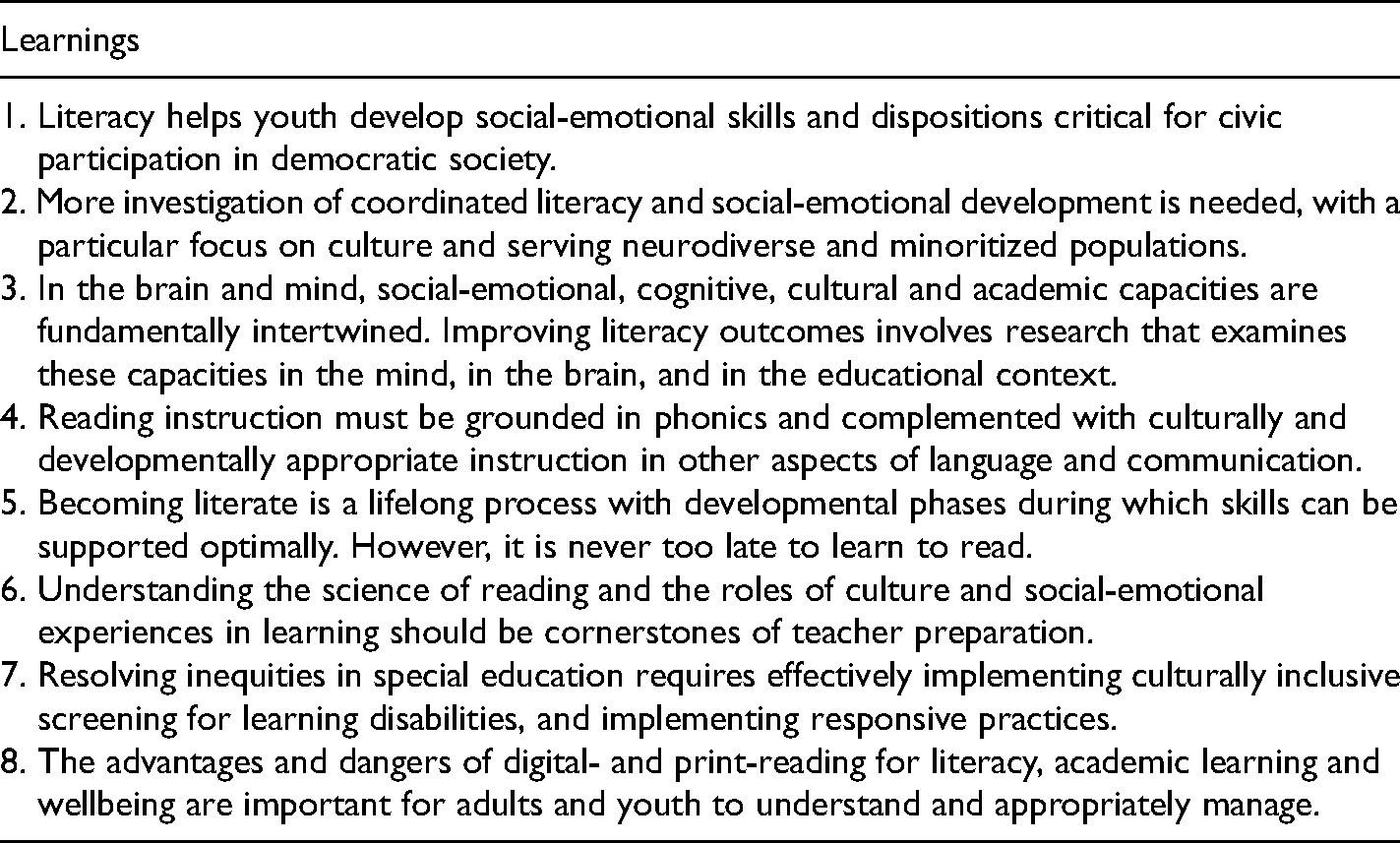
Footnotes
Declaration of Conflicting Interests
The author(s) declared no potential conflicts of interest with respect to the research, authorship, and/or publication of this article.
Funding
This work was funded in part by an Advanced Education Research and Development Fund contract to MHI-Y.
