




Abstract
This paper argues for a Black epistemological literacy education by centering Black equity in the process of teaching literacy methods. I offer a pedagogical model that stems from my own experiences disrupting required elementary literacy methods courses. My approach utilizes Black Language to illustrate the linguistic, sociocultural, and cognitive dimensions of literacy, and therein draws awareness for how white monolingual norms are thoroughly normalized in literacy instruction. While the linguistic legitimacy of Black Language, particularly its phonological systems, have been well established, in our current state, phonics instruction belongs to White Mainstream English. I contend that any cognitive literacy instruction for Black Language speakers must leverage the tacit knowledge of their own language. Pre-service teachers must receive explicit instruction on understanding societal hierarchies, especially as anti-Blackness and white supremacist views of Black Language are intertwined. A Black epistemological literacy education is necessary in modeling for pre-service teachers how literacy curricula must move beyond tokens of diversity.
Whitestream Norms in Literacy Methods Instruction
“You will have one minute to read as many words as possible in this text. You will only get credit for words that are accurately pronounced in Black Language and follow the Black Language grammar in the text. You will be assessed on how many words you’ve read correctly based on Black Language standards in this time. Ready, set, go!” This is a mainstay activity I have conducted in my elementary literacy methods courses in efforts to center Black Language and disrupt whitestream monolingual norms. I found urgency in this work since most of my teacher education experiences have been situated in predominantly white contexts. In the activity above, I provide teacher candidates with the first page of Young’s (2010) article, “Should writers use they own English?” which employs a variety of Black Language phonetics, syntax, and rhetorical devices. I organize teacher candidates into pairs to engage in this common literacy practice assessing oral fluency. As one teacher candidate reads the text aloud, the other is marking a copy of the text to keep track of miscues based on Black Language standards in the written text. After both get a turn, there is generally a sigh of relief from the majority white teacher candidates that the activity is over.
As we debrief the activity, the initial response always begins with, “That was so hard!” When I asked them what they found difficult, teacher candidates share about feeling constantly unsure about their pronunciation, which then affected how quickly they were able to read the text. Though this activity was not intended for reading comprehension, some also share about how so much energy was spent on decoding that there was minimal bandwidth left to comprehend the author’s message. I then pose the following questions: how would you feel about reading if all your textbooks were written in Black Language? What if every book in your classroom and school libraries were only written in Black Language? What if all instruction, and every interaction with teachers and other faculty were only in Black Language, and you were always corrected for not using it correctly? In this hypothetical world, how would you feel about reading, school, and learning? This activity has offered teacher candidates a glimpse of what literacy might look like in classrooms when it does not center their white monolingual norms.
Literacy education, like schooling, is overrepresented and dominated by white people, policies, and ideologies (Boutte et al., 2021; Peele-Eady & Foster, 2018). White epistemologies have long narrated the literacy practices taught in teacher education programs and enacted in classrooms (Ball & Lardner, 2005). White ideologies and epistemologies understand the world of literacy only through White Mainstream English. Phonics, comprehension, writing—language itself—belong to white monolingual English speakers, since theirs is the sole language for instruction and assessment (Flores & Rosa, 2015; Willis, 2019). Proponents of phonics-based instruction rarely incorporate the phonics of Black Language, and speakers of the language are corrected or considered to lack language when they enter prekindergarten (Lee, 2022). At a time when some (Shanahan, 2020) call for explicit phonics instruction and causal research to determine effective reading instruction to “ensure equal access” (p. S235), it is ironic that phonics instruction rarely acknowledges Black Language in affirming ways, and that such research often does not incorporate the language of the students it purports to support. In our current state, phonics instruction belongs to White Mainstream English.
In this paper, I offer an approach to literacy education that centers Black equity in the process of teaching literacy methods. By intertwining the two, this approach shifts whose epistemologies are centered, and offers an equitable pathway for future teachers to envision literacy instruction. This paper presents a pedagogical model of literacy methods education that explicitly centers Black linguistic norms. In doing so, this work not only incites awareness for how white linguistic norms are thoroughly normalized in literacy methods, but also models for pre-service teachers how literacy curricula must move beyond tokens of diversity.
Such tokenization can take form when aspects of Blackness are represented, but the course as a whole continues to sustain white monolingual ideologies. For example, literacy educators may incorporate children’s literature with Black characters, speak broadly about “culturally and linguistically diverse students,” or perhaps even offer a few lessons about Black Language. This last example, in particular, exceeds what most literacy methods courses offer, yet I argue it is still not enough. Literacy educators cater to White Mainstream English speakers when they teach about learning to read and assessing student writing without any attention to Black Language speakers (Ball & Lardner, 2005). There is no amount of add-ons that can cancel out the miseducation of white-centric literacy methods; a complete re-haul with a new starting point is required.
Much has been written about the whiteness in teacher education that continues to persist in overwhelming ways (Carter Andrews et al., 2021). From majority white faculty and white teacher candidates to programs, policies, and practices that prioritize white dominance at the expense of students and faculty from Black, Indigenous, and People of Color (BIPOC) communities, there is little in teacher education that is unmarred by whiteness (Lee & Lee, 2020). The practice of approaching course content and diversity in curricula as mutually exclusive is well-established in literacy education (Wetzel, 2020), and there is a long, overdue need to ameliorate a debt in our field to right the historical harm inflicted on BIPOC communities (Souto-Manning, 2021).
But what might literacy methods instruction look like if Blackness (instead of whiteness) was centered? Such an epistemological shift is often met with questions that require an extensive rationale for beginning with Blackness. However, the Black Girls’ Literacy Collective (BGLC) challenges white monolingual norms as a starting point, especially given the rich histories of Black women literacies and the ways these practices are pedagogically beneficial to all students (Haddix et al., 2016). As a collective, the BGLC are Black women scholars who draw on Black feminist epistemologies to support Black girlhood in K-12 education and Black women in teacher preparation. They contend that all educators need to be attuned to Black girls’ literacies since their humanities are consistently devalued in schools and society. This work inspires my approach to unapologetically center Blackness and illustrates the ways I have imagined Black epistemological literacy methods instruction thus far. Doing so naturally also centers Black Language, a topic rarely discussed in most teacher education programs.
Conceptual Framing
The Black epistemological literacy methods I offer in this paper are conceptually framed by linguistic and raciolinguistic notions of Black Language. Kynard (2013) discusses the pioneering role Black linguist Geneva Smitherman played in propelling Black Language in its linguistic, sociolinguistic, and emancipatory brilliance. Smitherman (1977) has mapped the linguistic components of Black Language, including the unique phonetic, semantic, and syntactic ways the language is systematically constructed to communicate meaning. This groundbreaking research disrupted extant explanations of Black Language at that time. In the post-Brown v. Board of Education era in which white educators were forced to teach Black students, white researchers also theorized explanations about Black students entrenched in white hegemonic norms. For example, white educational psychologists Bereiter and Engelmann (1966) have become infamous for their deficit theories of Black Language, which framed Black students without “correct” language, and institutionally gaslit Black Language speakers from being acknowledged as speaking a real language. Such deficit work, which is white supremacist in nature (Lee, 2022), reified and sustained anti-Black language practices in schools for decades to come. Smitherman’s (1977) work, however, established the linguistic legitimacy of Black Language by documenting it based on the markers linguists use in identifying a real language: (1) linguistic components (e.g., phonetic, semantic, syntactic) that are both (2) rule-governed, and (3) systematic in nature. She further elucidated the sociolinguistic elements of Black Language by identifying discursive aspects, such as signifyin (verbal word play), call and response, and repetition. Understanding Black Language as linguistically legitimate, and that the implications of this empirical truth in literacy education are many, will be further divulged in this paper.
The linguistic and sociolinguistic aspects of Black Language have always also intersected with Blackness, Black oppression, and Black Freedom movements (Alim & Smitherman, 2012; Baker-Bell, 2020; Kynard, 2013). Smitherman (1977) called it a “linguistics of white supremacy” when “whites don’t have to learn to talk like blacks to gain upward mobility in America” but the reverse is true for Black mobility (p. 173). Black Language has been delegitimized in society and, therefore, contextualizes why schools continue to ignore the legitimacy of the language. This is despite the fact that white America continues to appropriate, and financially and socially capitalize on Black Language (Baker-Bell, 2020). A raciolinguistic perspective (Alim et al., 2016) illustrates the ways racism is often practiced through linguistic discrimination and explains why the maltreatment of Black Language and Black students are deeply intertwined and continue to thrive in classrooms. Raciolinguistic ideologies (Flores & Rosa, 2015) focus on white supremacy as the root problem of racist language practices in schools and place the onus on actors of white supremacy to make changes for equity. Taken together, the field of raciolinguistics and raciolinguistic ideologies offer an understanding that race and language cannot be considered separately, but have been historically and continue to be used as proxies to sustain white supremacy by devaluing communities of color. It is important to note that Black Language is not monolithic by race or geography. While Black Language is historically tied to Black communities, there are geographic variations to the language, and other racial groups have also been observed to acquire Black Language (Paris, 2011).
Teacher preparation programs are actors of white supremacy when they ignore the existence of Black Language in curricula, and teachers are ignorant and unprepared to teach Black Language speakers in P-12 classrooms. With over half a century of research documenting the importance of its legitimacy as a language (Baugh, 1999; Rickford, 1999; Smitherman, 1977), as well as calls for teachers to shift both attitudes and instruction for Black Language speakers (Smitherman & Villanueva, 2003), an important change must begin with how teachers are educated, and the ways white epistemologies dominate literacy education. This is significant because such ways of understanding literacy instruction are then translated into anti-Black linguistic racism in schools (Baker-Bell, 2020). Centering Black Language within literacy education is a necessary way to repair the linguistic harm done in our societal conscience and should not be mistaken as a form of discriminating against White Mainstream English 1 . I approach a Black epistemological literacy education by employing Black Language as a case in the process of teaching various aspects of literacy. Thus, wrongful ideas that centering Black Language discriminates or devalues other forms of English and/or world languages are inaccurate because such instruction does not encourage nor has the power to force these other variations/languages to be subservient to Black Language in society. Employing a raciolinguistic ideologies frame, this paper seeks to ameliorate the status of Black Language in schools and in teacher preparation by placing an onus on literacy methods education to significantly change the epistemologies by which they function.
Positioning Myself in Literacy Education
My entrée into literacy and Black Language began as an elementary teacher. Witnessing anti-Black linguistic racism (Baker-Bell, 2020) by fellow teachers while I was simultaneously a doctoral student learning about Black Language illuminated a deeper level of harm done to Black students (Lee, 2017). With the encouragement and feedback of Black friends within my doctoral program, I forged an understanding that, as an Asian American, working towards Black justice is not a betrayal to my racial community, but an act of joining liberatory work that has historically also freed Asians and Asian Americans. I believe that the freedoms of our communities are tethered together, and that until all of us are liberated from whiteness, none of us are. It is out of this shared onto-epistemological reality of white oppression that I seek Black linguistic justice (Baker-Bell, 2020) in my pedagogy.
The Black epistemological literacy education I propose in this paper comes from my five years of teaching in a predominantly white institution. From 2015 to 2020, I was a literacy educator who taught two of the 3-part literacy methods course sequence required for elementary education majors. In my first year, faculty who had previously taught the first course in the sequence sought to offer teacher candidates a more holistic view of literacy, and selected Kucer and Silva’s (2013), Teaching the Dimensions of Literacy, as the course text. After reading through the text, while I appreciated the multi-dimensional view of literacy and pedagogically sound practices featured, I did not find linguistic diversity, especially Black Language, to be integrally woven throughout the text. The authors did, however, spend a good portion explaining the sociocultural dimension of literacy through Black Language examples, and offered useful insights in understanding the nature of power in language practices. I wanted to further integrate the language through explanations of the other dimensions, and thus, I “hacked” the course text to thread Black Language throughout. While the authors discussed the dimensions of literacy to include: linguistic, cognitive, sociocultural, and developmental, I was unable to fully incorporate this fourth dimension with the same depth as the other three given the time constraints of the semester. In the remaining paper, I share instructional examples of how I sought Black epistemological literacy methods by centering Black Language in the teaching of these dimensions. The model I offer is not intended to be prescriptive, and the examples I provide can be dynamically used across dimensions based on the focus for instruction, as I have done in the past. The scope of this paper, therefore, is on this pedagogical model, and not on teacher candidates’ responses to this approach; forthcoming work will offer the space needed to adequately describe this topic. Table 1 shows how I incorporated Black Language into each of the dimensions and offers examples of how this was included in my literacy methods courses.
Towards a Black Epistemological Literacy Methods Instruction.
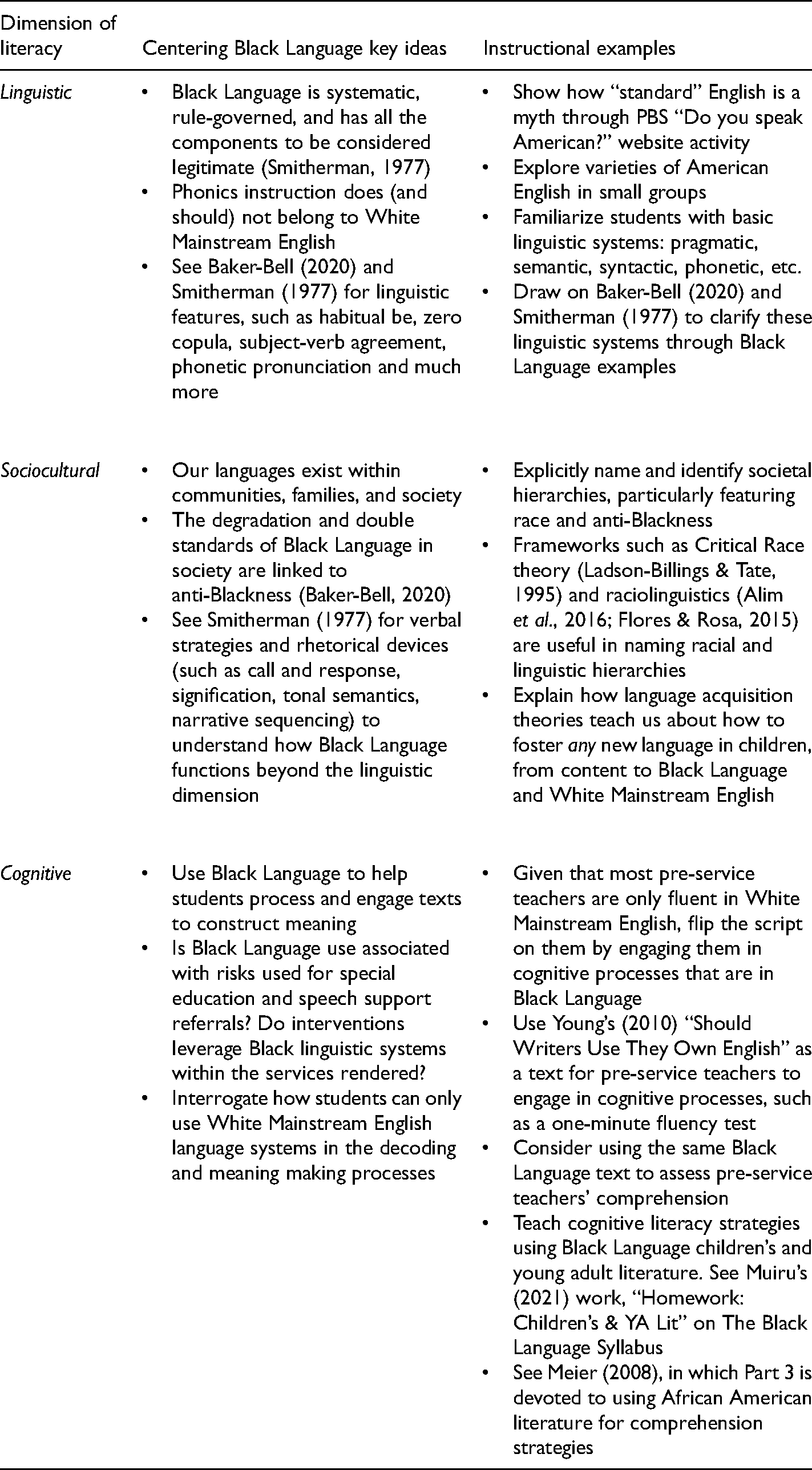
Towards a Black Epistemological Literacy Education
The Linguistic Dimension
A major component in propelling a Black epistemological literacy education is understanding how and why Black Language is linguistically legitimate. This requires rudimentary knowledge of the linguistic parts that comprise a language, and how languages come to be defined as such. This linguistic dimension of language is also important for teachers to understand when instructing and assessing children’s reading and writing. Thus, I begin with Kucer and Silva’s (2013) linguistic dimension: pragmatic, semantic, syntactic, morphological, orthographic, and graphophonemic. These systems constitute the parts of languages and incorporate what linguists study to identify the legitimacy of a language (Baugh, 1999; Smitherman, 2000). For example, when the phonology of a language includes patterns that are consistent over time, they become phonological rules/generalizations and follow a systematic order. These language parts, then, are how linguists determine what is a real language (and not just slang, as Black Language is often erroneously assumed to be). Thus, as I transition from an overview of the dimensions of literacy and focus on the linguistic dimension, I pose the following question: What makes a language real? This question sets the stage for understanding how Black Language is linguistically legitimate.
Prior to making this case about Black Language, however, and while I introduce the linguistic systems, I also foreground conversations about what “real” language is by naming the linguistic fact that “standard” English is a myth (Lippi-Green, 2012) and entrenched in whiteness and white monolingual norms (Alim & Smitherman, 2012; Baker-Bell, 2020). I utilize PBS (2005), which has a section on “Standard American English” and explains why this dialect is nonexistent. Kucer and Silva’s (2013) text also points out that exceptions to phonological rules exist more than incidents in which the rules are followed, thus, the idea of English as a standard for “correctness” is inaccurate. The work of explicitly showing teacher candidates white linguistic norms and how they are used in hegemonic ways is aligned to the spirit of raciolinguistic ideologies (Flores & Rosa, 2015). That is, there is an onus on actors of white supremacy—teacher educators, programs, teacher candidates—to take action and ameliorate the continued oppression of Black students.
The previously mentioned PBS website also has a section entitled, “From sea to shining sea” in which there are a variety of English dialects linked under “American varieties,” among them Appalachian English, California English, Chicano English, and Southern English. I assign teacher candidates into small groups to focus on and discuss one English dialect and ask them to pay particular attention to the dialect’s linguistic parts (e.g., phonology, syntax, semantics). After teacher candidates have had time to read about their assigned dialect and discuss it in groups, I lead the whole class in a discussion about how language in America is much broader than the hegemonic norms and stereotypes often portrayed in movies and media. This foundation of understanding the various linguistic components that constitute a language, as well as the cultural and geographic varieties of English, set the stage for teacher candidates to learn and accept that Black Language is real and should be respected as a legitimate language.
One of the American varieties highlighted on the PBS website is “African American English,” thus teacher candidates already have some exposure to the language at this point. I then begin a lecture that formally introduces Black Language and how it will be a central case as we consider the multiple dimensions of literacy. In my introduction to Black Language, I cover the following teaching points:
Of all the language varieties explored on the PBS website, Black Language has been the most written about, yet continues to be the most marginalized in society writ large. I distinguish between Black Language as a dialect and a language. Black Language should be considered a language over a dialect based on: (1) its syntactic roots in West African languages, and (2) the double standard afforded to white European languages. Languages are considered distinct from dialects when monolingual speakers from different languages do not understand one another, but if there is communicative understanding, then the spoken code is considered a dialect. However, Norwegian and Swedish are considered languages despite the fact that monolingual speakers of these languages can understand the other language. See Smitherman (2006) as the originator of these rationales and explanations. Black Language is defined as: “a style of speaking English words with Black flava—with Africanized semantic, grammatical, pronunciation, and rhetorical patterns… [it] comes out of the experience of U.S. slave descendants. This shared experience has resulted in common speaking styles, systematic patterns of grammar, and common language practices in the Black community” (Smitherman, 2006, p. 3). While Black Language is rooted in Afro-centric languages and histories (Smitherman, 1977), not all Black people speak Black Language, nor are all Black Language speakers racially Black (Paris, 2011). There is a need to focus on Black Language given the ways Black students continue to be institutionally gaslit
2
for the discrepancy in their test scores when compared to white students who continue to benefit from schooling that was linguistically tailored for them.
After I make these teaching points about Black Language, I again pose the question: What makes a language real? At this point, and after reading Kucer and Silva’s (2013) chapter on the linguistic dimension of literacy, teacher candidates are competent in distinguishing major linguistic systems. As I review them, I also map how each of these systems are present in Black Language. I share Black Language samples found in Smitherman (1977), and Baker-Bell (2020) offers a detailed mapping of more linguistic systems in Figure 4.3 Features of Black Language in her book, Linguistic Justice: Black Language, Literacy, Identity, and Pedagogy (p. 75).
The linguistic grounding described here offers a rich foundation to explore a plethora of topics salient to early childhood and elementary literacy. For example, given that Black Language is linguistically legitimate, how does this change the age-old practice of Daily Oral Language and others similar to it, in which students are asked to correct “incorrect” sentences that often feature Black Language? How do one-on-one conferences during writing workshop change when we acknowledge Black Language syntax and semantics? What would phonics instruction look like when Black Language phonology and graphophonemics are honored? Within a Black epistemological literacy methods education, we must rethink all our whitestream literacy practices that are normalized in classrooms.
The Sociocultural Dimension
After the linguistic dimension, Kucer and Silva (2013) move to the cognitive dimension of literacy, though I diverge from this order in my course. I choose to segue into the sociocultural dimension after the linguistic one because of the natural transition in discussing how the linguistic inequities towards Black Language also translate into sociocultural ones as well. One key question I pose is: If we know Black Language is real and there is half a century’s worth of research support, why is the language still unrecognized and devalued? Kucer and Silva’s chapter on the sociocultural dimension describes how literacy is not an individual activity, but inherently constructed and practiced with people in groups and cultures. The social nature of how we do literacy, then, varies by our group memberships. Power structures dictate that not all groups’ ways of doing literacy are equally acknowledged or respected, and that those with dominant group statuses are able to practice literacy in ways that are considered “normal.” Kucer and Silva identify various literacy practices, including those related to recreational, spiritual, and social. They draw on literature about initiation-reply-evaluation (Cazden, 2001; Mehan, 1979) discourse structures and from funds of knowledge (González et al., 2005) to discuss the disparate ways of doing literacy in schools and communities.
I build on Kucer and Silva’s chapter by making explicit what these power structures are, as well as explain how sociocultural theory in literacy evolved from a variety of language acquisition theories. From a Critical Race Theory perspective, race is the central organizing feature in American power structures (Ladson-Billings & Tate, 1995), and can be doubly oppressive when racial membership intersects with other social marginalization (Crenshaw, 2017). When a Critical Race lens is paired with raciolinguistics, we begin to understand why Black Language continues to be considered “incorrect” English in schools, is used in degrading ways to question the abilities of Black students, and when stolen by whitestream society, is considered “cool” enough to profit financially (Baker-Bell, 2020). Black Language speakers, like all bilingual students, are institutionally gaslit to think they do not have as much language as their white monolingual peers when, in fact, the exact opposite is true. If schools truly tracked students by the “amount” of linguistic ability they had when entering kindergarten, Black Language speakers should actually be placed in all of the accelerated/gifted programming. But because schools only consider knowledge to be real when it is communicated in White Mainstream English, young Black Language speakers are confronted with a system already set out to linguistically gaslight them.
Teacher candidates must also understand how a sociocultural theory of literacy evolved from other language acquisition theories. This knowledge is significant because for too long the approach towards educating Black Language speakers has been to “correct” their language and instill code-switching tactics when learning (Young, 2014). However, if we are interested in enacting pedagogies that culturally sustain students’ languages while also growing their linguistic repertoires, teachers must have an idea about how people acquire new language. To accomplish this, I synthesize major language acquisition theories since the mid-20th century. Beginning with behaviorist approaches, I describe Pavlovian experiments in which dogs were trained to salivate when they heard a bell. Similarly, a behaviorist approach in literacy focuses on external factors and environment to shape a student’s language learning. The literacy practices of “skill and drill” flashcards for learning new vocabulary words and spelling tests that require students to rewrite misspelled words multiple times all employ behaviorist notions of learning language.
Chomsky (1959), however, refuted these notions with an innatist view, which contends that children are born with an internal grammar system that allows them to naturally acquire language without explicit instruction. He reasoned that children, over time, become competent language users without caregivers’ explicit instruction, which is unlike the process of learning other content. Mathematical concepts, for example, require some explicit instruction, and cannot be mastered by merely socially engaging with others. Constructivist and interactionist theories postulate that there is a dance between one’s environment and internal self that fosters the learning of new language. Studies observed children interacting with caregivers, and how the languages of both child and adult are constructed from and shape each other (Brown & Bellugi, 1964/2001; Halliday, 1980). These theories underscore the necessity for language acquisition to occur with others, and not simply something to be mastered through repetition. These theories also explain why when teachers talk at students or only use repetition strategies, students often do not learn the vocabulary or spelling of new words.
Finally, sociocultural theory came to literacy in the post-Civil Rights era when some language scholars became aware of the (mis)education of Black students. Building on constructivist notions of language, sociocultural theorists argued for the language practices of historically marginalized students to be honored in schools (Hymes, 1972). At the time, these notions countered widely accepted deficit views of Black Language speakers, and instead, encouraged teachers to draw on students’ broad communicative competence in a variety of settings. Some (Wheeler & Swords, 2006) have taken this to mean Black Language speakers need to code-switch for learning, but many Black Language scholars have always and continue to underscore how anti-Blackness is at the root of myriad deficit language practices, attitudes, and ideologies (Alim & Smitherman, 2012; Baker-Bell, 2020; Kynard, 2013; Smitherman, 1977; Young, 2014).
Understanding language acquisition is significant in teaching Black Language speakers (and all students) for a variety of reasons. First, learning any new language, whether it is another language, vocabulary, or content-based words, requires interaction and social engagement with others. The pedagogical implications of this are endless but can be conceived of in two broad ways: (1) practices that rely on repetition and correction will not foster language growth, and (2) social interaction must be an integral component to any learning activities. Black Language speakers are all too often “corrected” because teachers often believe that this will help them learn White Mainstream English when, in fact, it is counterproductive towards this endeavor (Lee, 2017).
Second, the group memberships students hold matters. Students’ ways of doing language are baked within their families, communities, and ways of communicating in their lives outside school, and thus, must be leveraged when learning new language in classrooms. This means inviting Black Language in student writing and writing instruction (Hartman & Machado, 2019; Lee & Handsfield, 2018), accounting for the language during reading assessments (Compton-Lilly, 2005), and creating space for Black Language speakers’ linguistic dexterity in multilingual settings (Frieson & Scalise, 2021). Third, the sociocultural nature of Black Language also includes verbal strategies and rhetorical devices, such as call and response, signification, tonal semantics, and narrative sequencing, which are explained in detail in Smitherman (1977). Narrative sequencing, for example, refers to when Black Language speakers narrate stories through various episodes rather than focusing on just one topic. Teachers employing whitestream norms can perceive their stories to be “off topic” or “unfocused” in literacy practices, such as show and tell or in narrative writing (Michaels, 1981), but instead should leverage Black Language practices in literacy instruction by inviting their discursive and rhetorical practices (Lee, 2007).
The Cognitive Dimension
The cognitive dimension of literacy in Kucer and Silva (2013) is described as the “mental processes, strategies, or procedures that the individual engages so as to construct meaning through the linguistic and other sign systems” (p. 95). This dimension focuses on what is occurring between the mind and a particular text, and thus focuses on the meaning-making process at the individual level. They explain how readers use their tacit knowledge of various linguistic systems (e.g., morphemes, syntax) to make sense of texts. They contend that the reading process is dynamic, and thus, the practice of leveling readers and writers is not beneficial to students in the meaning-making process. Instead, they offer several factors that influence the transaction processes of reading and writing, which include students’ systems of languages, availability and flexibility to use strategies, background knowledge, purpose of reading/writing, and assimilating and accommodating one’s cognitive strategy to be congruent to the text.
As I center Black Language into this dimension, I help teacher candidates consider how Black Language speakers’ linguistic and cultural assets are invited and utilized in the meaning-making process. For example, if we understand that students deploy their tacit knowledge of language systems as they read and write, then we must interrogate the ways we only allow students to use White Mainstream English language systems to make sense of these processes. In the introduction of this paper, I share an activity in which teacher candidates are asked to use Black linguistic systems (e.g., phonetics, syntax) in a text written in Black Language. Given that most of the teacher candidates I previously taught only had tacit knowledge of White Mainstream English language systems, there was an incongruence between the language systems with which they had mastery and the ones they were asked (and being assessed) to produce. This incongruence explains the overwhelming response about how difficult the activity is—not only to read the text but also in comprehension. Though decoding texts and comprehension are different processes, there is a relationship between being able to read and being able to understand a text.
This activity with teacher candidates offers a learning opportunity for them to empathize when students’ knowledge of language systems differs from the only language system used and counted in schools. As mentioned in the introduction, this activity illuminates issues of student agency and identity beyond the reading processes, but it also underscores how these seemingly individual cognitive processes are still embedded within racial power structures, anti-Blackness, and white monolingual norms. Employing a lens of raciolinguistic ideologies requires reflexivity on the actors and mechanisms of white supremacy, and my activity in the introduction opens up space to critically consider how one reading assessment can potentially reverberate into educational damage for years to come. For example, timed oral fluency tests often serve as universal screeners within a Response to Intervention model for all kindergarten students. These scores, and other tests conducted similarly within classrooms, then level students and can determine the reading groups within which they are placed as well as how they might be referred for special education or speech interventions (Willis, 2019). While it is imperative for students to receive the support services they need, we must critically consider if and how Black linguistic systems are accounted for in these assessments and interventions. Is Black Language use associated with risks used for special education and speech support referrals? Do interventions leverage Black linguistic systems within the services rendered? We must interrogate the ways early childhood literacy assessments are white supremacist in nature and position Black Language as a risk rather than an asset to be leveraged (Lee, 2022).
Another important factor in accessing students’ cognitive dimension of literacy is their tacit knowledge of a text. There is an onus on educators to select texts that leverage Black Language speakers’ tacit knowledge in literacy activities. Conduct an inventory of how often Black linguistic systems are represented in the following texts that comprise students’ everyday literary worlds: oral fluency and comprehension assessments, reading group materials, classroom library, mentor texts, student writing, content-based texts, teachers’ oral instruction. While the list of everyday texts students encounter surpass the items identified here, this list elucidates the gross underrepresentation of Black linguistic systems in student learning, and conversely, the inordinate overrepresentation of White Mainstream English language systems.
Muiru (2021) offers children’s and young adult literature booklists on The Black Language Syllabus, and Meier’s (2008) book, Black Communications and Learning to Read: Building on Children’s Linguistic and Cultural Strengths, provides in-depth explanations of how to use African American literature in various comprehension strategies. Along with published books, we need to also consider how family/community members can be leveraged in classrooms to access students’ funds of knowledge and increase the amount of Black linguistic resources we offer them.
Conclusion
Every time I teach the course described here, teacher candidates almost unanimously agree that much of what they learned about Black Language was from my course. My pedagogy comes from the burning question I had as a doctoral student and has guided my research: If we have over half a century of research documenting the linguistic legitimacy of Black Language, why is there such a chasm between what is known and what is acknowledged and practiced in schools? My experiences as a teacher educator mirror what has been documented in the literature about the race-evasiveness of literacy education (Wetzel, 2020). I have come to understand that teacher ignorance of Black Language is a reflection of literacy educators’ disregard for the language in virtually all curricula and programming. Perhaps this disregard stems from a lack of knowledge or the need to prioritize other content required for program accreditation. Regardless of why Black Language is nonexistent in literacy education, the impact of this silence sustains White Mainstream English as the only avenue to learn, and literacy educators become culprits in supporting white supremacy in teacher preparation.
The Black epistemological literacy education I offer here is a sampling of what a re-imagination of literacy methods could look like if it were not siloed from “diversity” work. This pedagogical approach is not intended to serve as a curriculum for literacy educators, but to illustrate how teacher educators and candidates must engage in critically reflexive work as they learn about Black Language (McMurtry, 2021). This work is a beginning and invitation for others to imagine what a Black epistemological literacy education could look like. This is also a call to interrogate how phonics instruction has historically been guided by white supremacist views of Black Language and must be re-written to invite and honor the language of Black communities. Our work has the power to either reify or rectify the harm done to Black Language speakers in schools. The pedagogical model for literacy methods education offered here shifts our starting point from sprinkling linguistic diversity into coursework to centering Black epistemologies in the process of understanding what literacy is. Such a shift is urgent as P-12 schools and teacher preparation programs pay little attention to Black Language despite a resurgence of purported care and commitment towards Black lives. It is imperative, then, that we fight to cohere our precepts and practices in our work towards Black equity.
Footnotes
Declaration of Conflicting Interests
The author declared no potential conflicts of interest with respect to the research, authorship, and/or publication of this article.
Funding
The author received no financial support for the research, authorship, and/or publication of this article.
