




Abstract
DELIVER (DELiberative ImproVEment of oRal care quality) is a multinational project funded under the EU’s Horizon Europe program; we aim to develop a blueprint model for improving the quality of oral health care for everyone: the DELIVER Quality Improvement Model. We are a team of partners from Denmark, England, Germany, Malta, the Netherlands, Portugal, and Sweden who will use a mixed-methods research approach to create a synergistic problem-solving ecosystem to convert deliberative dialogues into meaningful support for improving the quality of oral health care. Together with citizens/patients, providers, payers, and policymakers, new quality improvement (QI) approaches will be codeveloped and coproduced in 3 phases (over 4 y): phase 1 involves defining quality of oral health care, situational analysis of the status quo of QI, and consenting of core quality indicators for a Europe-wide monitoring framework. Phase 2 involves in-depth analysis of select QI approaches: 1) QI in dental practices based on patient-reported outcome and experience measures (PROMs/PREMs), 2) community-based QI for vulnerable groups, and 3) quality-oriented commissioning of oral health services. In addition, the regulatory determinants of oral health care QI will be scrutinized. In phase 3, the knowledge gained from phases 1 and 2 will be used to develop the DELIVER Quality Toolkit, a resource containing manuals and digital tools to support context-specific implementation of oral health care QI. DELIVER is anticipated to contribute to positive changes in oral health systems.
Knowledge Transfer Statement:
The EU DELIVER project aims to enhance the quality of oral health care through codevelopment and coproduction of solutions together with citizens/patients, providers, and policymakers. The unique multicountry nature of the project will facilitate fast-track prototype development and testing of innovative QI approaches in select countries. Reflective learning regarding the transferability of findings between different countries and settings offers unique opportunities to drive progress toward context-specific implementation of innovative oral health care QI approaches. The collective knowledge gained from the 7 European countries involved in DELIVER can also generate knowhow for improving the quality of oral health care in other countries around the globe.
Keywords
Why DELIVER?
Despite the vast disease and economic burden to individuals and society (World Health Organization 2022), a low sense of urgency for oral health care quality improvement (QI) persists in policy and practice. According to a recent working definition, quality of oral health care comprises the following 7 domains: patient safety, effectiveness, efficiency, patient-centeredness, equitability, timeliness, and access to care (Righolt et al. 2020).
The threats in oral health care quality are vast and span multiple stakeholders, multiple sectors, and multiple levels of the oral health system (practice, community, and policy levels). Oral health care is the most frequent type of health care that Europeans forgo due to financial reasons, with large inequalities in unmet dental care needs between low- and high-income groups and out-of-pocket expenditures making up 59% of total dental care expenditure (Winkelmann et al. 2022). For those who cannot access or afford oral health care, this can lead to impairment of speaking and chewing ability, psychosocial well-being, and even life-threatening systemic infections. For those who can access and afford oral health care, quality concerns include adverse effects due to diagnostic and treatment errors or medication lapses such as antibiotic overprescribing.
A complex systems problem exists in which research–policy gaps and research–practice gaps trigger inertia and inaction instead of addressing the largely preventable burden of oral diseases (Listl et al. 2022). Solving such complex issues requires coherent quality improvement (QI) strategies and efforts that span across multiple stakeholders, sectors, and levels (Kruk et al. 2018). So far, however, there is a lack of synergistic problem solving to improve the quality of oral health care together with citizens/patients, providers (oral health professionals and professionals from other disciplines), and policymakers (Listl et al. 2022).
DELIVER’s Aims
The overarching aim of DELIVER is to convert deliberative dialogues into meaningful QI for oral health care. The ultimate deliverable will be the DELIVER Quality Toolkit, which serves to operationalize the conceptual DELIVER Quality Improvement Model (see Fig.1). The DELIVER Quality Toolkit will contain actionable knowledge and implementation support tools for oral health care QI.
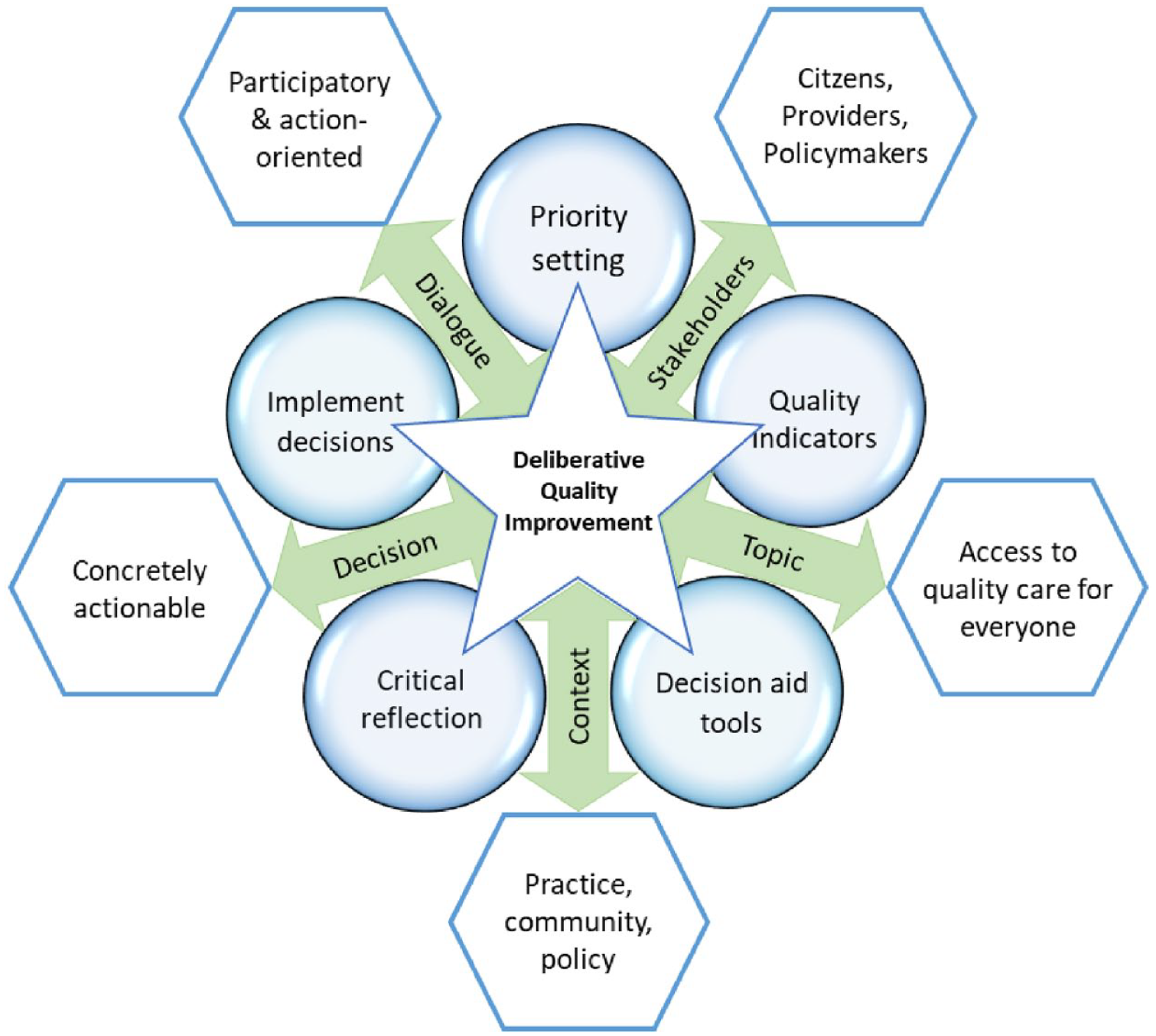
DELIVER Quality Improvement Model.
The specific objectives of the DELIVER project and their corresponding Work Packages (WPs) are as follows:
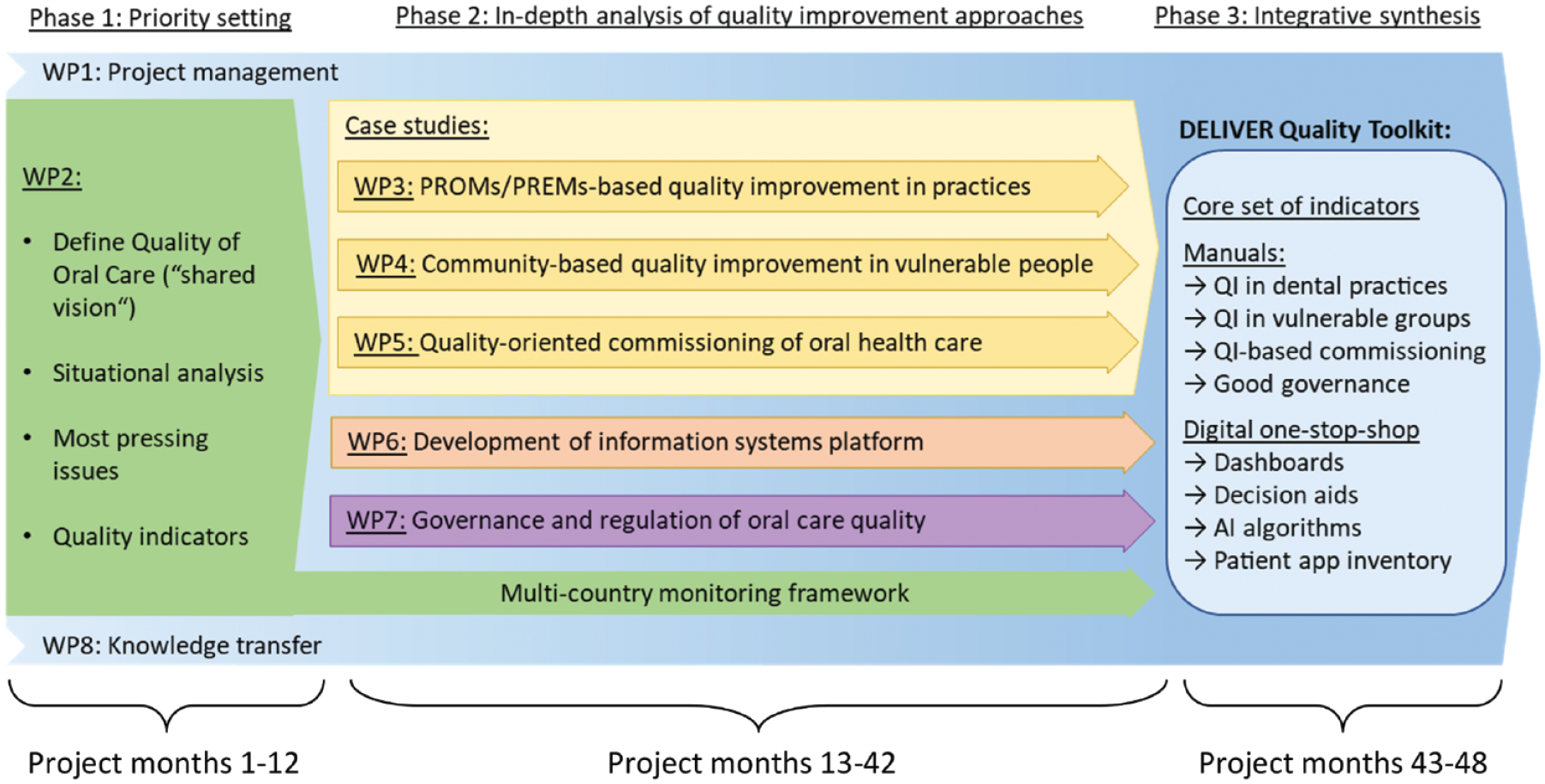
Phases and Work Packages (WPs) of the DELIVER project.
To address these objectives, DELIVER will build on previous learnings from the development and testing of QI interventions in other fields of medicine and, where appropriate, also develop novel QI interventions. Further details relating to the objectives described above are provided in the following section below.
DELIVER’s Methods
The complexity of aligning processes across multiple stakeholders, multiple health-related sectors (including public health and personal care delivery, insurance sector, social work sector, etc.), and multiple levels of the oral health system (practice, community, and policy levels) necessitates a shared vision and codevelopment of concretely actionable solutions for oral health care QI. To this end, DELIVER builds upon and synthesizes across state-of-the-art QI and implementation science methods. To strengthen capacities for oral health care QI, DELIVER will engage citizens/patients, providers, and policymakers in the codesign, codevelopment, and coevaluation of interventions. More specifically, DELIVER leverages the following methods throughout 3 phases over the 4 y with various WPs (also see Fig. 2):
Different study populations will be involved in various parts of the project. In particular, to extract maximum value of information during the project period, the case studies to test QI interventions (WP3–WP5) will take place in the Netherlands, England, Denmark, and Germany while all project participants will critically assess the cross-country transferability of respective findings. This serves to ensure practical feasibility and efficient knowledge generation within the 4-y project period.
Note that DELIVER employs a mixed-methods approach to leverage and combine both qualitative and quantitative information for enriched insights into oral health care QI. For example, the consenting of quality indicators will draw from qualitative insights. These quality indicators will then inform the quantitative measurement of feedback information within case studies to test QI interventions (e.g., PROMs/PREMs for performance feedback interventions in dental practices) while the subsequent evaluation of the QI interventions itself will draw from case study participants’ qualitative insights. For further references to support the use of the described methodologies (particularly in relation to stakeholder engagement and patient feedback information), the interested reader is referred to previous literature (Listl et al. 2022).
DELIVER’s Expected Results and Impacts
DELIVER’s key results are expected to be provided via the DELIVER Quality Improvement Toolkit (WP8), which integrates the key learnings and knowledge products from WP2 to WP7:
Core set of consented quality indicators on practice, community, and policy levels (WP2)
Knowhow for PROMs/PREMs-based QI in dental practices (WP3)
Knowhow for intersectoral oral health care QI in vulnerable communities (WP4)
Knowhow for quality-oriented oral health care resource allocation (WP5)
Information system (1-stop shop): dashboards, decision aid tools (from WP6)
Knowhow for governance/regulation of oral health care quality (WP7)
In the longer run, the implementation of DELIVER’s results is expected to have substantial scientific, economic, and societal impacts. In particular, the outputs of DELIVER are expected to provide tools to help improve the governance, financing, and delivery arrangements of oral health systems, including a shift to people-centered oral health care, better QI training of oral health care providers, and improved access and affordability of oral health care for vulnerable population groups. Ultimately, DELIVER is expected to contribute to strengthening oral health systems and to help achieve universal health coverage (World Health Organization 2022).
It’s Time to DELIVER
In conclusion, the EU-funded DELIVER project addresses highly relevant and urgent knowledge and implementation gaps to improve the quality of oral health care. The unique multicountry nature of the project will facilitate fast-track prototype development and testing of innovative QI approaches in select countries and allow for rapid adaption for adoption in different contexts. The reflective learning regarding the transferability of findings between different countries and settings, achievable only with such international collaboration, is expected to drive progress toward context-specific implementation of innovative oral health care QI approaches in the EU and worldwide.
Author Contributions
S. Listl, contributed to conception, design, drafted and critically the revised manuscript; N. Bostanci, M. Byrne, J. Eigendorf, G. van der Heijden, M. Lorenz, P. Melo, K. Rosing, P. Vassallo, E. B. van Veen, contributed to conception, design, critically revised the manuscript. All authors gave final approval and agree to be accountable for all aspects of the work.
Footnotes
Declaration of Conflicting Interests
The authors declared no potential conflicts of interest with respect to the research, authorship, and/or publication of this article.
