




Abstract
When making decisions in high-pressure situations, police officers experience cognitive demands and often lack access to data about the people with whom they are interacting. Artificial intelligence (AI) tools that provide such data can potentially improve officers’ ability to respond effectively to calls and thus bolster public safety. However, research in diverse social sciences has documented persistent biases in AI-assisted work. We propose a framework for understanding how bias can creep into AI-assisted police work and how to intervene. In a cycle of bias, AI tools provide biased information to officers, which in turn promotes biased responses during interactions with the public, ultimately resulting in biased incident reports that amplify the original biases in the AI systems. Our proposed interventions focus on training and nudges that increase officers’ use of deliberative processing, empathic mindsets, and perspective-getting techniques and encourage the writing of detailed, debiased incident reports. We recommend taking a cognitive view of policing and drawing on insights from behavioral science research to maximize the benefits of AI tools while minimizing the risk that they will amplify biases.
Police officers often make decisions while under stress and pressed for time, which can lead to troubling consequences such as wrongful arrests, use of excessive force, and disproportionate arrests of Black community members. 1 Existing informational resources can enable officers to prepare for interactions in ways that are better calibrated to the needs of community members.2,3 For instance, inputting a name into CompStat or another incident database might reveal factors like a person’s past arrests or encounters with police. 4 But most police agencies do not provide tools that enable officers to review, organize, and synthesize a community member’s history of encounters with law enforcement in real time before engaging in an encounter with that person.
The U.S. Department of Justice’s Office of Community Oriented Policing Services has argued that police officers—from rank-and-file patrol officers to department heads—could benefit from real-time access to relevant data in their day-to-day work. 5 Artificial intelligence (AI) technology—which can be thought of as software that simulates human decision-making and learning—holds promise for meeting that need because it can easily synthesize large amounts of quantitative and qualitative data in real time. Moreover, this ability to synthesize data can potentially help ameliorate a common problem for officers: a lack of bandwidth for processing information in the heat of the moment. 1
Some forms of AI software are already used in aspects of policing as standalone technologies or to enhance existing technologies, such as image recognition or predictive analytics (for instance, predicting where certain crimes are particularly likely to occur and at what times of day). Thousands of U.S. police agencies use standard or AI-based image recognition software. 6 When officers obtain images of license plates or suspects, the software can match those images to images in databases, which then generate the names of and other information about the people who own the cars or have a history of police encounters. Automated AI text summarization and classification tools, which are not yet widely used, could offer similar benefits, especially in high-pressure situations when an officer is deployed to an emergency call.
One example of an AI tool used by police departments, ForceMetrics, 7 synthesizes information from large numbers of incident reports and extracts insights and themes from community members’ histories with law enforcement. 8 AI tools like ForceMetrics can, for instance, instantly recognize multiple references to concepts related to hunger in a history of police reports and tag community members’ files with the label “food insecurity”—a task that would require intensive human capital to code and extract without AI tools. With this knowledge in hand, officers might approach someone who stole food from a grocery store with greater empathy than they would have displayed without access to this information. By showing empathy, the officers may help to avoid a combative response from the individual. Other labels assigned by AI after report analysis might relate to factors such as homelessness or mental health.
Although AI tools hold the potential to improve officers’ ability to respond to crime effectively and, in so doing, ultimately bolster public safety, research also documents persistent biases in AI tools and in the behavior of employees who use them. AI software programs, or algorithms, that make predictions on the basis of large amounts of past data are only as accurate as the data they are trained on; any biases in the training data will result in biased algorithms and predictions. 9 In this context, “training” means the process by which AI algorithms learn to recognize patterns in past data and use those patterns to make predictions. Take the case of facial recognition. An AI system would first be exposed to a large collection of facial images, along with information about whose face is in each image. The system would analyze the unique features of each face—such as the shape of the eyes or the distance between facial features—and use this information to create a set of rules for distinguishing between different people. Once trained, the system can then apply these rules to identify a match between a new image and a known face in the database.
But facial recognition software might lead to racial bias in the identification of possible crime suspects if flaws in the training data set caused the system to be more accurate at matching a new image with a known face in the database when the person in the new image is White rather than Black. In that case, pursuing a matched Black person as a suspect could lead to miscarriages of justice more often than would be the case with a matched White person. There are high-profile examples of officers wrongfully arresting community members on the basis of faulty image matches by facial recognition software. 10 AI tools are only meant to supplement existing crime-solving methods. However, the high-profile mistaken arrest incidents reveal that officers can unintentionally allow AI tools to replace critical thinking. 6
In this article, we describe a framework for understanding how AI can foster and amplify bias in policing—creating what we call a cycle of bias—and how best to intervene to mitigate this cycle. (See Figure 1 and the Supplemental Material.) Our theorizing draws on research into self-fulfilling prophecies, in which predictions of how someone will behave lead the person to behave in the predicted manner. 11 Self-fulfilling prophecies are especially relevant to understanding bias in AI-assisted police work because they unfold in interpersonal interactions, which make up much of an officer’s daily job. 12
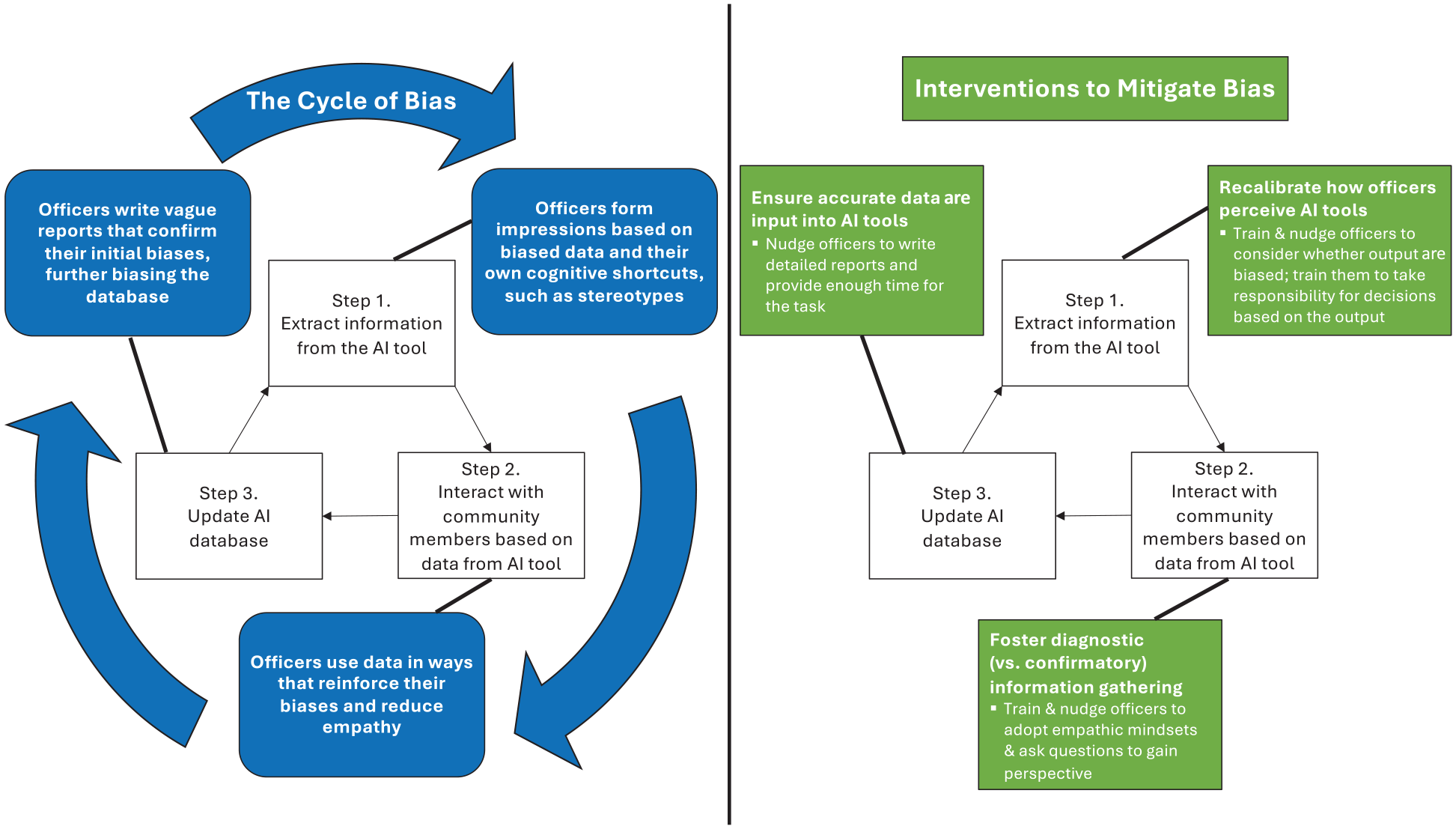
The cycle of bias in AI-assisted police work & how to disrupt it
Framework: The Cycle of Bias in AI-Assisted Police Work
To understand how bias in AI tools could exacerbate inequities in criminal justice outcomes, it is first necessary to understand how officers might use AI tools in their daily work. As is shown in Figure 1, AI-assisted police work generally involves three basic steps.
In Step 1—before any interaction occurs—officers gather data from the AI system about potentially involved individuals (the “targets”) and form initial impressions of the individuals. This could happen at the police station prior to being deployed to a call or in the car while en route to the location.
In Step 2, the officers interact with the targets in ways shaped by the data provided by the AI tool, the impressions formed from that data, and the impressions they form on the scene.
In Step 3, after the interaction, the officers update the AI database with details about the interaction. The AI software then retrains using the updated data and refines its algorithm, which then serves as the starting point for subsequent cases.
If the AI tools are developed using algorithms based on biased training data, bias can be introduced as early as Step 1. Indeed, it is likely that most existing police databases from which AI tools would draw are biased. 13 For example, Black people are disproportionately stopped by police compared with their White counterparts. 14 As a result, existing police databases are likely to include more information about and a greater number of police-stop reports for Black people than White people. This imbalance can predispose officers to be more suspicious of Black people and to stop them more often than they do White people.
Furthermore, officers are also likely to interact with biased data in a biased way, owing to the demands on their cognitive bandwidth (also known as cognitive load) and the time pressure they face in their jobs. In pressured circumstances, officers will often use cognitive shortcuts to form impressions: Instead of carefully analyzing information, they may make quick, intuitive judgments and be influenced by heuristics (or rules of thumb), such as stereotypes. They may, for instance, allow biased data to confirm their preexisting beliefs (a phenomenon known as confirmation bias 15 ) that Black men are more likely than White men to be perpetrators. Similarly, they may feel overly confident that they know the “right” way to behave toward a community member based on the officers’ past history of interacting with people in a given community. 16 Indeed, research we have conducted reveals that officers often form inaccurate perceptions of community members’ thoughts and feelings in interactions. 17 These inaccurate perceptions may stem in part from the cognitive demands inherent in policing.
At Step 2, when police engage with community members, officers would continue to be prone to using cognitive shortcuts and, therefore, could end up failing to effectively use constructive information provided by AI tools. This misstep can further exacerbate heuristic thinking. 6 For example, officers might unnecessarily escalate an encounter with a person accused of a crime on the basis of their assumption that the individual is a criminal when, in reality, the individual acted out because of mental health issues. If the officers had fully appreciated the output of an AI tool that flagged this contextual factor, they might instead have had a better understanding of what was happening and why and treated the community member more compassionately.
In the interaction stage, officers might also be afflicted by AI technology’s potential to significantly undermine people’s empathy toward others. 18 Research has shown that technology-mediated communication may decrease people’s perspective-taking ability,19,20 which is a key component of empathy. 21
It is during interactions with community members that self-fulfilling prophesies arise. A police officer may form a hasty judgment about a community member, which in turn shapes how the officer treats that person. The officer’s treatment then affects how the community member responds, ultimately reinforcing the officer’s initial swift judgment. In an example of a self-fulfilling prophecy, an officer may perceive Black men as being more violent than White men. If this officer responds to a call about a Black man jogging down an alley and an AI tool indicates that the alley is in a high-crime stretch of town, the officer may assume that the man has committed a crime rather than considering alternative explanations. 1 The officer may therefore start the interaction by issuing commands instead of asking questions. 22 This approach may alarm the jogger, causing him to try to flee, which might then lead the officer to use unnecessarily harsh force to restrain the jogger—thereby perpetuating the history of racial biases contributing to the use of force by police. 23
In the context of AI-assisted police work, such an outcome means that at Step 3, report writing, the information fed back into the system will be based on officers’ self-fulfilling prophecies and will further confirm the biases in the existing data set. Bias at this stage can affect which reports get written and how reports are written. The report for the jogger scenario described in the previous paragraph will indicate that the target was aggressive, just as the officer’s assumptions and biases predicted. Had self-fulfilling prophesies and biases not occurred and had the officer considered an alternative explanation that proved to be correct—that the man was simply out jogging for exercise—the officer may have ended up not writing a report about the situation at all.
When the algorithm updates to include new biased reports, it will become still more biased. This increasingly biased algorithm will serve as the starting point for subsequent calls and cases, creating a negative cycle that will amplify bias and likely increase injustice over time. To combat this recursive negative process, we next outline potential strategies to mitigate bias in AI-assisted police work.
Interventions to Mitigate Bias
A comprehensive approach that intervenes at each step of police work and targets multiple aspects of policing (tools, individual biases, and interactions with community members) is needed to mitigate the cycle of bias. Research in behavioral science informs our recommendations. Beyond providing insight into causes of and antidotes to bias in general, researchers have begun to study people’s psychological responses to advanced technologies like AI.24 –28 For example, research indicates that people often perceive that algorithms tend to overlook qualitative and contextual information (in other words, they perceive algorithms to be overly reductionistic), which leads them to believe that algorithmic decisions are more unfair than decisions made by humans. 26
Specifically, we propose that the most effective approaches for mitigating bias in AI-assisted police work will focus on improving officers’ deliberative processing, inducing empathic mindsets, training officers on an expanded set of communication tactics, and prompting officers to be more factual and detailed in their report writing. To support these claims, we illustrate how applying our proposed interventions could shift the process of AI-assisted police work from one that perpetuates bias to one that disrupts it.
At Step 1, Recalibrate How Officers Perceive AI Tools
As part of addressing bias related to the initial use of AI tools, police leaders could ensure that bias-fighting advice is added to the initial training on how to tactically deploy new AI tools. This added training would encourage officers to take time to absorb the tools’ output and consider whether the information might be biased. Slowing down also should reduce reliance on stereotypes and other bias-promoting cognitive shortcuts. (Research has shown that, in the field, interventions that encourage officers to stop and think can reduce wrongful arrests and the use of force.) 1
In addition, developers of AI tools could include nudges in the AI interface that remind officers of the bias-fighting concepts taught in the training. Technically, nudges are features incorporated in people’s environments that do not meaningfully alter their incentives but can nonetheless subtly motivate them to engage in certain desirable behaviors. 29 It is important to note that nudges have been found to be equally effective for people who are and are not experiencing a high cognitive load. 30 One way to encourage officers to engage in more deliberative processing would be to program a simple pop-up window to remind them that AI tools can produce skewed results if they are trained on biased data and that humans need to prune out information that seems biased. Such a statement could be sufficient to encourage officers to stop and think rather than to passively accept an algorithm’s output. This approach is akin to ChatGPT’s disclaimer that appears directly beneath the chat bar after a response is generated, which says, “ChatGPT can make mistakes. Check important info.”31,32 Researchers have found that people are more likely to notice and correct bias in information produced by algorithms than to correct bias in their own decisions. 33
A more elaborate intervention could explicitly highlight in the AI interface what the AI tool cannot do in addition to what it can do. For example, notifications in AI interfaces could remind officers that AI can identify concrete and objective features of a case 34 but cannot provide the complete picture and can never know all of community members’ experiences and histories. This approach emphasizes that AI is not all-powerful: Humans and AI tools are collaborators. This perspective, known as the hybrid intelligence paradigm, is advocated by some AI experts. 35 In other words, the messaging in the interface would emphasize that although the output gathered from AI tools is information that serves as a helpful starting point for understanding, it is necessarily limited. Similarly, AI interfaces could incorporate design features emphasizing that AI is one tool in the officer’s tool kit rather than an active decision-maker in a given scenario. This messaging would reinforce that the officers are the responsible actors, discouraging them from taking the AI tool’s output as ground truth.
Taken together, these types of interventions will prompt police officers to engage in more deliberative processing. They will also highlight the human skills officers should bring to interactions with community members.
At Step 2, Foster Diagnostic (vs. Confirmatory) Information Gathering
To address bias in the interaction step of policing, we suggest that police departments (a) teach officers to think and act in more empathic ways and (b) include nudges in AI tools reminding them to adopt empathic mindsets.
In interventions designed to induce an empathic mindset, 36 trainers attempt to shift authority figures, such as police officers, away from making judgments about people’s character (for example, that they have inherent character flaws) and toward considering contextual reasons why individuals may engage in misbehavior (for example, that they lack the money to buy food) and are deserving of empathy. This empathic mindset can be induced by providing authority figures with examples of contextual reasons for people’s behaviors (such as readings that clearly illustrate how situations, contexts, and social structures beyond people’s control can help explain their actions).
In contexts outside of policing, like education, empathic mindset interventions have been shown to reduce stereotyping and the severity of discipline used by authority figures. 37 In the domain of criminal justice, researchers tested a related intervention in which they found that when people read a first-person narrative of a prisoner, they displayed more empathy than they did when they read third-person information about incarceration. 38
Interventions could also teach officers concrete communication tactics that would help them translate the motivational benefits of having an empathic mindset into behaviors that lead to less biased treatment. Interventions that teach these communication tactics are particularly appealing because practicing them can make the tactics habitual and automatic, 17 requiring minimal cognitive attention from officers who already have limited bandwidth. 1 What is more, once officers are comfortable with empathic communication tactics, AI interface nudges can prompt officers to use them.
One particularly promising communication approach for promoting an empathic mindset and reducing biased behavior is perspective getting.39,40 In contrast to perspective taking, in which people try to imagine themselves in someone else’s shoes, perspective getting involves, as Nicholas Epley and Tal Eyal have put it, “directly asking [an]other person what is on his or her mind” 41 in an interaction. Relative to perspective taking, perspective getting has been shown to increase the accuracy of people’s interpretations of others’ thoughts and feelings 39 and to reduce prejudicial attitudes. 42 In the domain of policing, one nationally certified conflict de-escalation training program, Insight Policing, teaches officers how to ask “curious questions” 40 —essentially leveraging perspective getting to build bridges between officers and the communities they serve. If officers were trained in perspective getting when they were taught how to use AI tools, they would learn to ask questions in interactions that could verify the accuracy of the data they gathered via the AI tools rather than using the AI output uncritically as a guide to their interactions with community members. Officers could periodically be reminded of these question-asking skills in the AI interface itself via time-sensitive nudges, such as ones issued before officers get out of the car to initiate contact with a driver during a traffic stop.
Asking questions to get community members’ perspectives should reduce officers’ tendency to use data from AI tools to confirm biased assumptions and stereotypes. Instead, officers will be more likely to focus on getting an accurate picture of the community members with whom they interact. Training officers to develop an empathic mindset and incorporate perspective-getting nudges into informational tools should improve not only AI-assisted policing but also police work in general. Moreover, these interventions could help assuage community members’ concerns that AI-assisted police work will harm service quality and lead officers to overlook their unique needs.43,44 Research in other fields has found that consumers worry that, compared with the quality of work not assisted by AI, the quality of AI-assisted work will be worse 43 and that individuals using AI tools will be less attentive than usual to other people’s unique circumstances and contexts. 44
At Step 3, Ensure Accurate Data are Input Into AI Tools to Mitigate Future Algorithmic Bias
If the interventions we have described are implemented effectively, they could by themselves reduce bias in the report-writing step of policing. Not only will officers prepare a less biased incident report than would have otherwise been the case, they will also likely collect more data on and draft fuller accounts of interactions. Detailed accounts tend to be less subject to bias than shorter ones are. 45
Nevertheless, interventions specific to this phase of police work could be helpful, such as ensuring that officers have sufficient motivation and time to write detailed reports. From a motivational standpoint, AI tools could include interface prompts asking officers to describe their encounters in as much detail as possible, even when they find it challenging to do so. The interface might say, for instance, “Write a report so that someone who wasn’t there could easily follow what happened. It is normal if this feels difficult to do: It means you are building your skills.” 46
From a structural standpoint, police department policies could explicitly build in time for officers to complete sufficiently detailed reports before the end of their shift, which would reduce cognitive load 47 and allow officers to devote their brainpower to producing descriptive step-by-step accounts of their encounters. Research has shown that removing distractions and reducing cognitive load when people are trying to accomplish effortful tasks promotes accuracy and attention to detail. 47 Officers’ updating of databases with specific and accurate data and reports will help to debias AI algorithms, which will then provide outputs that serve as more accurate starting points for subsequent calls and cases.
Conclusion
We have outlined a framework that describes how officers might use AI tools in their day-to-day work. We then illustrated how bias could creep into each step of this work, creating a cycle that amplifies bias in the AI algorithms and in policing over time, ultimately exacerbating inequities in criminal justice outcomes. We have also described how interventions grounded in behavioral science research could be tailored to AI-assisted police work to mitigate bias at each phase of the cycle. AI tools hold promise for improving policing. However, they must be paired with psychologically informed training and nudges designed to mitigate bias at each step of police work if the tools are to fulfill that promise of improving public safety for all.
Supplemental Material
sj-docx-1-bsx-10.1177_23794607241300788 – Supplemental material for How behavioral science interventions can disrupt the cycle of bias in AI-assisted police work
Supplemental material, sj-docx-1-bsx-10.1177_23794607241300788 for How behavioral science interventions can disrupt the cycle of bias in AI-assisted police work by Andrea G. Dittmann, Kyle S. H. Dobson and Shane Schweitzer in Behavioral Science & Policy
Footnotes
Declaration of Conflicting Interests
The author(s) declared no potential conflicts of interest with respect to the research, authorship, and/or publication of this article.
Funding
The author(s) received no financial support for the research, authorship, and/or publication of this article.

References
Supplementary Material
Please find the following supplemental material available below.
For Open Access articles published under a Creative Commons License, all supplemental material carries the same license as the article it is associated with.
For non-Open Access articles published, all supplemental material carries a non-exclusive license, and permission requests for re-use of supplemental material or any part of supplemental material shall be sent directly to the copyright owner as specified in the copyright notice associated with the article.
