



Abstract
This article explores why private sector adoption of behavioral science has been limited and shares strategies for expanding its integration into businesses. After outlining three core barriers to adoption, the author proposes solutions for more effectively communicating the field’s value to business leaders—solutions rooted in his personal experience and supported by observations shared by other successful practitioners. He then focuses on actions that the broader behavioral science community (including academics, policymakers, and practitioners) can take to promote the private sector’s long-term adoption of behavioral science.
It has been nearly 15 years since the publication of Nudge: Improving Decisions About Health, Wealth, and Happiness and the creation of the Behavioural Insights Team (the original “nudge unit”) by the U.K. government. Since then, popular awareness and interest in behavioral science has grown enormously—with best-selling books, popular podcasts, master’s degree programs, and industry organizations now dedicated to exploring why people often make suboptimal decisions for themselves and ways to gently and ethically shift such behaviors.
The application of behavioral science has grown in parallel with the public’s interest. Perhaps the most telling indicator is the compilation of the Behavioral Teams Directory (https://www.behavioralteams.com/), which now lists over 900 organizations employing teams that use behavioral science to promote positive behaviors, such as saving for retirement, developing healthier eating habits, and engaging in sustainable consumption. These organizations include the World Bank; the Bloomberg Foundation; Save the Children; and numerous national, state, and local governments and ministries.
Although behavioral science has made significant inroads in organizations focused on policy and philanthropy, private sector adoption has arguably lagged. Some companies, primarily in the financial services and health care sectors, have well-established, dedicated behavioral units, but most of these teams are quite small (with fewer than five people), and they often struggle to secure the buy-in of colleagues and obtain funding and resources. Of course, counts of behavioral units significantly underrepresent the overall application of behavioral science in the private sector, as there are many “BeSci enthusiasts” attempting to champion projects within their business functions. However, these efforts are typically ad hoc and subject to cancellation due to changes in leadership, corporate priorities, and budgets.
Given the vast resources and reach of the private sector, this slow pace of adoption stands as a missed opportunity to improve the lives of millions of employees and customers and to drive progress in a variety of areas, such as sustainability, diversity and inclusion, and health. To help address this situation, in this article I explore several barriers to private sector adoption of behavioral science and share strategies for how behavioral scientists and partners in industry can overcome them, drawing on my own experience and that of a number of leading practitioners. (See note A for more information about me and the practitioners quoted in this article.)
Barriers to Adoption
When identifying the barriers, it is worth asking why adoption of behavioral science has lagged in the private sector, particularly when innovation typically flows in the opposite direction—with governments and nonprofits often being slower than businesses to adopt new ideas and technologies.
One simple theory is that the pioneers of the applied field, such as Richard Thaler, Cass Sunstein, and David Halpern, were focused primarily on policy applications. The result was that many of the field’s initial success stories were tied to such challenges as increasing timely payment of taxes, 1 promoting organ donation,2,3 and increasing the amount of money people put aside for retirement.4,5
It is also true that some leaders in the academic and policy worlds are hesitant to engage with the private sector. They may be concerned about reputational risk, worried that perceptions of their research could be tainted by that research’s application in companies driven by a profit motive. They may also harbor understandable concerns that behavioral science insights and tools will be misused to take advantage of consumers or employees rather than to help them achieve their own goals.
6
As Neela Saldanha, a behavioral science pioneer at PepsiCo and current executive director of Y-RISE at Yale University, explains,
Many private sector companies see behavioral science as a marketing or activation tool, where the potential for social good is not always black and white. And behavioral science resources are naturally going to be drawn toward areas and projects that provide the greatest potential for return and ROI [return on investment].
Three other hurdles, which are summarized in Figure 1, are arguably self-inflicted. All three are tied to how we, as behavioral scientists, have introduced and conveyed our work and our value to business leaders.
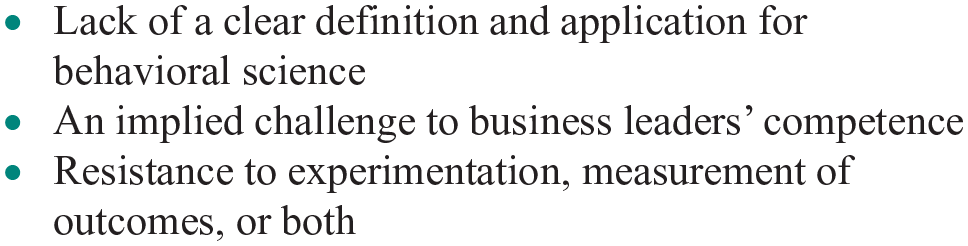
Hurdles to integrating behavioral science in the private sector
Perhaps the single most important challenge is the extremely broad definition and potential application of behavioral science.
The myriad of heuristics, behaviors, and challenges explored under the banner of “behavioral science” can be overwhelming and disorienting. As a result, the field lacks a clear identity and application in the minds of most business leaders. Merle van den Akker, behavioral science manager at Commonwealth Bank of Australia, summarizes the problem this way:
Behavioral science has not managed to make itself a “household name” in business yet because it is too multipurpose. Behavioral science is everywhere and as a result it is nowhere. With a marketer, you know what you will get. It is the same with HR [human resources]. They are clearly defined roles with clearly defined purposes. Behavioral science is not. The big irony here is that both of these departments can benefit a lot from a behaviorally informed approach.
In some ways, a broad definition and range of applications might be expected to encourage uptake by business. It makes intuitive sense that the study of human decision-making could offer useful insights across nearly all managerial challenges. After all, most business objectives and decisions ultimately involve influencing behavior, be it of customers, employees, or other stakeholders. Yet this broad applicability and flexibility can mean that behavioral science lacks a clear home within many organizations. In fact, behavioral science professionals or units are based everywhere from risk management to product design departments. This lack of a clear identity can make it difficult even for practitioners themselves to know where to focus their efforts and build support. According to Jeff Kreisler, managing director and head of behavioral science at JP Morgan,
The great challenge is choosing what to make. We can have influence over so many parts of an organization, but what is the best approach? Do we make something broad but shallow or narrow and deep? Try to have some impact across many aspects of the organization or demonstrate significant impact in one specific area?
The field’s lack of clear definition also leads businesspeople to think (and claim) that they “already do behavioral science.” In many cases, this means that they have picked up an idea and used it to craft an advertisement or product offer—such as the idea that reminding people of social norms can influence behavior or that people tend to focus more on the present than the future (present bias). This view is a significant threat to the field, because the haphazard application of ideas without full understanding, measurement, and evidence can easily lead to disappointing results and ultimately the dismissal of the field’s value (“We already tried behavioral science and it did not work”).
A second hurdle is that business leaders can perceive behavioral science as an implied challenge to their competence and thus react somewhat defensively or hesitantly.
7
Whether intended or not, the implied message of suggestions to apply behavioral science approaches and frameworks is that the existing approach is misguided, outdated, or suboptimal in some way. This sensitivity is only amplified when behavioral scientists are engaged to fix problems rather than to contribute to initial product or process design. Van den Akker explains,
Often, behavioral scientists are called into the room when something has gone wrong. And that is assuming two things already: One, people know about behavioral science and therefore who to call, and two, they are willing to admit that things have gone wrong. And those are two big assumptions to make!
In my experience, this defensive reaction to the application of behavioral science strategies typically occurs in people who are explicitly charged in their jobs with understanding and influencing behavior, such as those in marketing and consumer insights areas. This resistance may manifest itself in requests to simply “give me the behavioral science answer to solve my problem” and an unwillingness to devote sufficient time and energy to a challenge. As Tim Houlihan, former enterprise director of behavioral science at Truist Bank, notes,
The marketing or HR partner expects that the behavioral science practitioner can quickly assess, diagnose, and design the perfect solution. Then he or she can reach into a bag of behavioral science tricks, pull out the relevant tool, apply it, and generate great results with only a 30-minute phone call’s worth of background information. When internal partners discover that more time and investment is needed, they are likely to end the discussion and revert to their status quo.
A third hurdle is some executives’ lack of comfort with the field’s explicit commitment to experimentation and measurement of behavior change. James Healy, principal of Human Capital Consulting at Deloitte, summarizes the situation this way:
Many organizations—particularly senior executives—are just not comfortable with experiments. Given the choice of two initiatives, one presented as “tried and true” and the other as an experiment to see if it works, most executives will choose the former.
Relatedly, there is often resistance to moving away from familiar, comfortable forms of measurement in favor of more behaviorally focused metrics. 8 For example, the success of corporate training programs, such as for avoiding network security breaches or meeting compliance demands, has historically been measured in terms of attendance, scores on quizzes, and participant feedback, without attempts to gauge subsequent changes in behavior. 9 The prospect of being judged on additional measures or metrics that directly assess employees’ posttraining behavior can give pause to those who manage those training sessions. In fact, people who manage internal functions (such as human resources, compliance, and cybersecurity) are often resistant to measuring outcomes, because they are unaccustomed to being evaluated in this way.
These hurdles ultimately contribute to a predictable outcome, which is a lack of commitment to behavioral science initiatives. As Becky Frayer, founder of Behavioral Fusion and former director of behavioral science at both Procter & Gamble and Allstate, observes,
When behavioral science is in the early stages of application within an organization, it is not uncommon for leadership stakeholders to believe that it is the metaphorical cherry on top of an already great sundae: delicious and special, but not always necessary when times get tough. More mature organizations recognize that behavioral science application is the bowl of the sundae itself: fundamental to the business in all aspects of strategy, design, and execution.
To be fair, business leaders sometimes start their engagement with behavioral science initiatives with genuine interest and positive intent. But when budgets get tight, funding for behavioral science initiatives often falls by the wayside. This is particularly the case when initiatives that are viewed or framed as “behavioral science projects” compete for funding and resources against well-established programs—that is, when new ideas and initiatives fight against the status quo.
Ironically, the funding issue may be exacerbated by the way behavioral science has been popularized. Books, articles, and podcasts have often highlighted quick wins and solutions that do not require a significant investment, such as changes in the wording of reminder letters to taxpayers or the setting of default contribution levels to promote retirement savings.1,4 Ted Utoft of BVA Nudge Consulting holds this view:
I think we have to take some responsibility that, for many clients and organizations, behavioral science only means novel nudges with big impact. We may have done ourselves a disservice by highlighting a few outstanding examples of very low-cost, contextual interventions that had a huge impact. This expectation of silver bullets can set us up for resistance when we then insist on rigor, patience, and ultimately incremental change.
Overcoming the Barriers
To overcome these barriers, behavioral scientists can engage in two complementary approaches. First, they can take immediate opportunities to frame discussions with business leaders in ways that more effectively convey the value of behavioral science to their organizations. Second, they collaborate with colleagues in the field and other partners on long-term efforts to build a strong foundation for the adoption of behavioral science in the private sector. (Figure 2 summarizes the actions I recommend.)
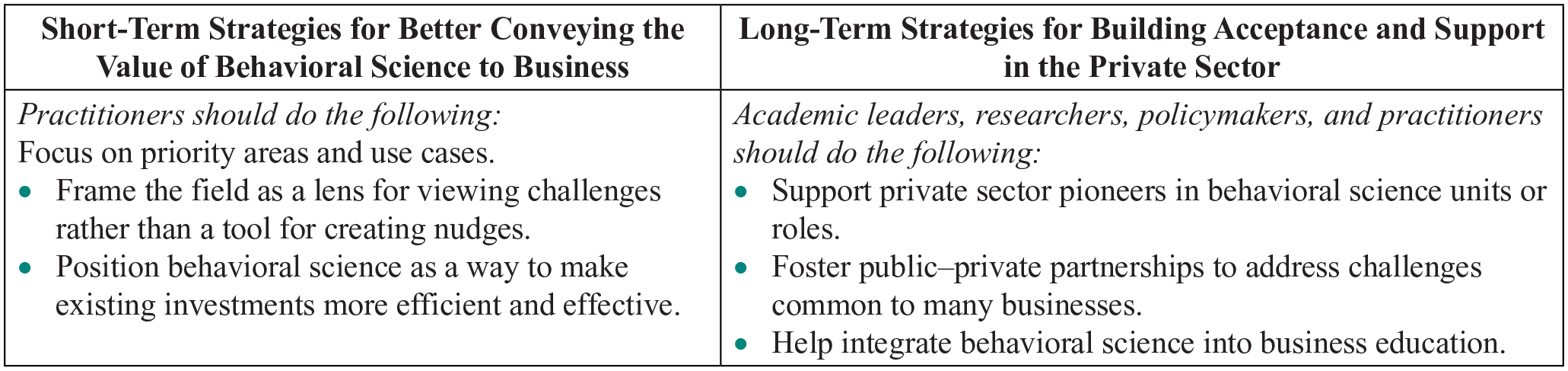
Strategies for overcomng hurdles to integrating behavioral science in the private sector
Conveying the Value of Behavioral Science
I recommend the following three strategies to frame discussions about where behavioral science fits into a corporation’s strategies for achieving its goals.
Focus on Priority Areas & Use Cases
In previous publications, I have outlined several promising areas of opportunity for behavioral science, such as preventing cybersecurity breaches and promoting employee retention. 10 Clearly, though, priorities will inevitably vary by company or business sector. As a general rule, I have found it best to start discussions by trying to uncover and understand the challenges that are already taking up considerable time, energy, and effort at the organization. If behavioral science can be presented as a new way to address high-profile issues, it is likely to receive consideration and funding.
On the project level, I often apply a relatively simple rubric to initially evaluate which challenges might be the best ones to tackle in a given organization. It takes into account the potential business value or ROI of a desired behavior change, the anticipated likelihood of success, and the anticipated ease of implementation. Finally, and perhaps most importantly, ethical considerations are taken into account as I attempt to gauge whether this is a “win-win-win” opportunity for the organization. 11
Regardless of the exact criteria applied, the most important action is to frame behavioral science as a vehicle to help address a company’s primary business challenges so that leaders not only recognize its value but also come to identify certain issues or opportunities as behavioral science challenges. Zarak Khan, chairperson of the board at Bescy, encapsulates the approach well:
There is a tendency for behavioral scientists to look for the biggest “behavioral” opportunity. I always encourage folks to start with the biggest business opportunity, within which there is nearly always a behavioral element that benefits from additional attention.
Frame the Field as a Lens (Rather Than a Tool)
Many business professionals overreact to popular examples and quickly define behavioral science as a “tool for creating nudges.” Although “nudge” is a catchy term, it clearly does not do full justice to the broader applications of behavioral science. 12 Understanding how people actually behave can help organizations design better products, services, processes, and policies. So focusing solely on nudges or interventions not only undersells the field—and leaves nearly every creative agency able to claim expertise—it also directly affects how and when behavioral science is applied.
Framing behavioral science as a fresh lens for viewing and addressing business challenges is a compelling alternative. In addition to reducing defensiveness—by positioning the field as a new dimension that complements an organization’s current efforts—it encourages business leaders to integrate behavioral science earlier in their strategy, design, and development processes. Relatedly, it is important to emphasize that the field’s practices are based on scientific research and follow systematic processes. Highlighting and illustrating the multistep process 13 —from problem definition through the design and testing of interventions—counters misperceptions of the field, such as the notion that it relies solely on applying nudges or that it applies academic theory blindly. Dilip Soman, Canada research chair in behavioral science and economics at the Rotman School of Management, University of Toronto, talks of using “behavior as a lens and science as the method,” which speaks to both the scope and the rigor of the field.
Position Behavioral Science as a Way to Make Existing Investments More Efficient & Effective
As I noted earlier in this article, behavioral science is too often perceived by business leaders as an incremental investment and something additional for business teams to consider beyond their usual activities. Unfortunately, this perception leaves the field competing for resources—and often fighting a losing battle—against both well-established approaches and a wide variety of new areas (such as artificial intelligence and data science). To break out of this zero-sum dynamic, behavioral science advocates can consciously talk to business leaders about the application of behavioral science as a way to improve existing functions or investments (such as training programs, consumer research, or compliance). A related strategy is to focus on building behavioral science into the “wiring” of an organization by integrating it into core business processes, such as budgeting, hiring, and performance reviews. 14
Building a Stronger Foundation for Adoption
In parallel with more immediate efforts to position behavioral science for business leaders, behavioral scientists in the academic, policy, and private sector realms would be wise to pull together to support and promote the field over the longer term, specifically by aligning on the actions described next.
Support Private Sector Pioneers
Relatively few dedicated behavioral science units or positions exist within companies, and these teams often struggle to engage colleagues, secure resources, and demonstrate their value. The fate of these pioneers is critical to the future growth of the field: If they are deemed successful, behavioral science will be perceived as a source of competitive advantage and its reach will inevitably expand. If not, organizations will move on, and it will become twice as difficult for future efforts to gain traction.
Academic leaders, researchers, policymakers, and practitioners all have roles to play in supporting behavioral science champions within organizations. One role involves sharing insights and lessons learned (that is, what has worked and why). Fortunately, the field already does this quite well (if somewhat haphazardly) through a wide range of websites, podcasts, and published articles. Another role involves creating more forums and vehicles that allow practitioners to connect and discuss common challenges so that they can learn from each other. This is a natural fit for industry organizations, such as the Global Association of Applied Behavioural Scientists (GAABS; https://gaabs.org/), Bescy (https://www.bescy.org/), and the Behavioral Science & Policy Association (https://behavioralpolicy.org/).
An additional way to support behavioral science pioneers is to help them become more knowledgeable and effective business professionals. As Zarak Khan explains,
Many behavioral scientists are not knowledgeable enough about business or the teams whose expertise they would augment and whose buy-in they would require. Behavioral science expertise is only half of the knowledge base. You have to have expertise in the area you support as well.
Foster Public–Private Partnerships
Although a handful of private sector organizations (such as Commonwealth Bank of Australia, Johnson & Johnson, and Vanguard) have made significant and sustained commitments to behavioral science, the reality is that most companies simply are not willing or able to make comparable investments at this time. Thus, the more likely path to progress lies in bringing together consortiums to explore using behavioral science to address challenges common to many businesses, such as reducing fraud, improving employees’ mental and physical health, and promoting sustainable behaviors.
These efforts and projects are most likely to happen at the sector level, possibly driven by regulators, coordinated by industry organizations, and funded by numerous participating companies. However, the involvement of academic experts will be critical to lend resources, credibility, and expertise to these large-scale programs, which will inevitably be complex. One notable and inspiring example of collaboration is BI-Org (https://www.biorgpartnership.com/), the Behaviourally Informed Organizations Partnership, which is hosted by the research center known as Behavioural Economics in Action at Rotman or BEAR, part of the University of Toronto. The collaboration includes researchers from universities and nonacademic organizations and representatives of many other organizations who are working together to develop ways of enhancing the spread and effectiveness of behavioral science insights in organizations.
Better Integrate Behavioral Science Into Business Education
Over the past 10 years, dedicated behavioral science programs have been established at the University of Pennsylvania, the London School of Economics, Carnegie Mellon, and other institutions to foster the development of the next generation of behavioral scientists. This is clearly a step in the right direction. However, a parallel need exists: to ensure that far more business leaders truly understand how to ethically and effectively leverage behavioral science within their business functions. These people may not become behavioral scientists themselves, but they will know how to employ and direct behavioral scientists so that they deliver value and ROI to their organizations. As importantly, they will become influential advocates within their organizations.
To widen the field’s reach and influence the next generation of business leaders, behavioral scientists will need to do more to prompt and help academic leaders to better integrate behavioral science into MBA and executive education programs. Ideally, academics and practitioners will collaborate closely with one another to ensure the proper balance of theory and application and tailor course content to cover specific business functions and challenges.
What Success Will Look Like
While charting a path forward, it is important to consider the potential implications of the increased application of behavioral science across the private sector. As noted earlier, ethical issues are an important consideration. Certainly, engagement with businesses should not (and must not) require behavioral scientists to abandon their principles. However, it is reasonable for academics—perhaps with the guidance of industry organizations—to join together to arrive at a set of common guidelines for the ethical application of behavioral science. In fact, academic leaders such as Liam Delaney of the London School of Economics and Political Science have made significant efforts to this end, culminating in the creation of the FORGOOD framework. 15 Collaborations such as Ethical Systems ((https://www.ethicalsystems.org/) and the Responsible Research for Business and Management initiative (https://www.rrbm.network/) advocate for a similar vision. Even though organizations, initiatives, and frameworks will not eliminate gray areas, they will help encourage people to engage by providing them with a consistent set of criteria to consider.
Personally, I have always focused on evaluating the merits of individual projects (and asking myself whether a particular initiative was ethical) rather than making broader judgments about organizations and their larger business models. However, I recognize that other people may have reservations about engaging with specific industries or organizations.
A related issue involves control, because the broad adoption of behavioral science across the private sector will inevitably lead to wide variations in application, quality, and rigor. For example, it is well known that businesses typically operate on shorter timelines than academics do and are inclined to substitute quick A/B tests for the gold-standard approach to determining cause and effect: expansive (and expensive) randomized controlled trials. Simply put, trade-offs between rigor and pragmatism (and perhaps even some misuse) will occur, which may arguably compromise the field.
This is not an issue to be taken lightly. However, organizations (and consultancies) are already applying ideas and frameworks as they choose in the name of behavioral science. Thus, I applaud the efforts of organizations such as GAABS to promote quality standards among practitioners. More broadly, however, I find that it is generally best to engage with companies—and help promote the ethical and disciplined application of behavioral science—rather than to walk away from the opportunity to have a positive influence.
Finally, it is worth noting that success in the private sector may ultimately take the form of integrating and embedding behavioral science within traditional business functions and processes rather than the widespread implementation of dedicated behavioral science teams. In other words, behavioral science could become “how business is done” instead of being the province of a dedicated field of specialists. As Gonzalo Carmiña, founder of BeWay, notes,
This field [of behavioral science] should blend with all the other fields that belong with a company. So data scientists in a company need to become behavioral data scientists, UX [user experience] researchers need to become behavioral UX researchers, marketing people need to become behavioral marketers.
As a field, behavioral science certainly remains a long way from this destination. But we, as members of the field, can ultimately expand our positive impact if we collaborate and apply our collective energy to instilling and embedding behavioral science in the private sector. On this point, Jeff Kreisler offers some sage advice: “The hard truth is that we need to take our own medicine: We need to apply behavioral science to the process of building behavioral science itself.” That is, we need to apply the same commitment and rigor to this larger challenge as we do regularly for specific projects to improve people’s lives. This is a journey worth taking, given the enormous opportunity to apply behavioral science ethically and effectively in the private sector.
Footnotes
Declaration of Conflicting Interests
The author declared no potential conflicts of interest with respect to the research, authorship, and/or publication of this article.
Funding
The author received no financial support for the research, authorship, and/or publication of this article.