



Abstract
Teamwork has been at the core of human social organization for millennia and is essential for organizational productivity and innovation. Yet teamwork often is not as effective as it could be. Drawing on extensive research into the factors that enable teams to function well, this article offers policy recommendations for bolstering teamwork capabilities in society at large and in organizations. Our proposals call for teaching teamwork skills as part of the curricula in higher education and in lower grades in school, creating government and industry regulations designed to enhance teamwork, and designing jobs and organizational workflows in ways that prioritize and support teamwork.
Teams of people working together for a common purpose have been a centerpiece of human social organization ever since our ancient ancestors first banded together to hunt game, raise families, and defend their communities.
On April 11, 1970, three astronauts boarded Apollo 13, the spacecraft carrying out the United States’ third mission to the moon. Two days into the flight, an oxygen tank exploded, causing extensive damage to the craft. Within three hours, the oxygen stores were gone and, along with them, the craft’s ability to generate electrical power and operate its life support systems. A team of engineers back on Earth had to figure out how to get the crew home safely. Their seamless communication, determination, and adaptability, among other critical assets, led to a historic success: Despite the failed mission, teamwork saved the crew.
The rescue of the Apollo 13 crew shows the life-saving power of excellent teamwork under the most demanding conditions. 1 On the flip side, poor teamwork can lead to disaster. It played a role in the 1986 explosions at the Chernobyl nuclear power plant in the former Soviet Union; the 1984 release of toxic chemicals in Bhopal, India; and the 2010 Deepwater Horizon explosion and massive oil spill in the Gulf of Mexico—all of which are legendary for their consequential losses of human life, extensive environmental damage, and substantial financial costs.
Acknowledging the drastic consequences of poor teamwork, civil aviation became the first industry to systematically promote a teamwork culture. Because of overwhelming evidence that many accidents are the result of aircrews’ failure to collaborate well, it made teamwork training obligatory for all commercial pilots.2,3 (We describe the requirements in more detail in the Regulating for Teamwork section of this article.)
Teamwork is essential for the success of a large variety of industries and pursuits, in environments from the shop floor to the halls of academia.4-6 In short, teamwork matters, and the push for organizational agility in response to increasing pressures to innovate has made effective collaboration in teams even more important.1,7,8 Indeed, technology giants such as Google have acknowledged teamwork’s centrality and declared teamwork to be core to their success, and team-based methods that originated from managing software development have become cornerstones of organizational transformation across various industries.9,10
We should note that although most people intuitively understand teamwork to be collaboration by a group to achieve goals important to an organization, investigators who study the topic also apply more formal definitions (see the sidebar What Is a Team? What Is Teamwork?).
Going forward, the ability to foster effective teamwork will become even more critical to organizations’ ability to thrive, because at the same time reliance on teams is growing, teams themselves are becoming more complex. Artificial intelligence (AI) embodied in robots, other autonomous entities, and decision support systems are enabling flexible collaborations in which technology takes over certain tasks, supports decisions, and provides guidance.11,12 Good teamwork is essential to ensuring that these hybrid human-technology systems are effective. The global COVID-19 pandemic accelerated the evolution of digitally enabled teamwork. This metamorphic shift to virtual teaming requires good teamwork skills that transcend the lack of face-to-face contact. An increasingly diverse workplace also necessitates attention to teamwork. Although diversity offers a heterogeneity of views, experience, and ideas that can boost creativity, it also can create substantial challenges for collaboration.
What Is a Team? What Is Teamwork?
Investigators who study teams and teamwork have developed detailed definitions of the terms, such as those that follow.
In 1992, Eduardo Salas and his colleagues defined a team as “a distinguishable set of two or more people who interact dynamically, interdependently, and adaptively toward a common and valued goal/objective/mission.”A
More recently, Steve W. J. Kozlowski and Daniel R. Ilgen expanded the definition to “(a) two or more individuals; (b) who interact socially (often face-to-face, but increasingly virtual); (c) possess one or more common goals; (d) are formed to perform organizationally relevant tasks; (e) exhibit interdependencies with respect to workflow, goals, and outcomes; (f) have a differentiated structure of roles and responsibilities; (g) and are embedded in an encompassing organizational system, with boundaries and linkages to the broader context and task environment.”B
Salas and his colleagues have also highlighted differences between taskwork and teamwork: “Taskwork involves the performance of specific tasks that team members need to complete in order to achieve team goals…. teamwork focuses more on the shared behaviors (i.e., what team members do), attitudes (i.e., what team members feel or believe), and cognitions (i.e., what team members think or know) that are necessary for teams to accomplish these tasks.”C
A. From page 4 of Salas, E., Dickinson, T. L., Converse, S. A., & Tannenbaum, S. I. (1992). Toward an understanding of team performance and training. In R. W. Sweeney & E. Salas (Eds), Teams: Their training and performance (pp. 3-29). Ablex.
B. From page 79 of Kozlowski, S. W. J., & Ilgen, D. R. (2006). Enhancing the effectiveness of work groups and teams. Psychological Science in the Public Interest, 7(3), 77-124. https://doi.org/10.1111/j.1529-1006.2006.00030.x
C. From page 600 of Salas, E., Shuffler, M. L., Thayer, A. L., Bedwell, W. L., & Lazzara, E. H. (2015). Understanding and improving teamwork in organizations: A scientifically based practical guide. Human Resource Management, 54(4), 599-622. https://doi.org/10.1002/hrm.21628
Now is therefore a good time to build on insights from industries and organizations that have taken teamwork seriously and to scale up efforts to promote team effectiveness. Yet many organizations still focus primarily on building task-related technical skills while giving much less attention to teamwork skills such as solving problems collaboratively, resolving conflicts, and supporting one another, which are required to accomplish tasks.1,5
We suspect that the ongoing inattention to strengthening teamwork in many organizations stems in part from a paradox: On the one hand, many organizational leaders still hold the view that teamwork happens easily without any extra effort by anyone; on the other hand, companies often have difficulty setting up programs that succeed in fostering teamwork.
In this article, we aim to alter the perception that teamwork processes happen effortlessly. A team of experts does not automatically make an expert team. In the next section, we point to key findings from an extensive body of research that has identified the core processes used by successful teams and the skills and capabilities that underlie those processes.1,13-18 In the sections that follow, we offer evidence-based recommendations for interventions that support effective teamwork. We have not attempted to be exhaustive in our recommendations, given the wide range of options to promote teamwork in organizations and beyond, nor do we provide a comprehensive literature review. Rather, we provide a concise overview and summarize the most salient evidence that undergirds our recommendations. Thus, we emphasize particularly relevant and impactful avenues for action based on key insights and strong evidence from team research.
We propose that teamwork skills be taught and assessed as part of school curricula from a young age; that, in the work arena, licensing requirements for individuals and organizations include teamwork training and the assessment of teamwork skills to increase individuals’ and organizations’ readiness to invest in improving teamwork; and that enterprises not only provide teamwork training but also specifically organize themselves in ways that enhance team effectiveness.
“Many organizations focus primarily on building task-related technical skills while giving much less attention to teamwork skills.”
Good teamwork requires effort and training. Researchers know a lot about what makes teams effective, but society in general and organizations in particular need to find better ways to act on that knowledge. We hope that our recommendations stimulate such action.
The Science of Effective Teamwork
Teamwork has been studied for decades. The human relations movement in the 1930s and 1940s established that social factors such as group cohesion and recognition contribute to individuals’ performance. 19 And early studies on teamwork in coal mining showed that beyond satisfying social needs, teams are crucial for accomplishing complex and highly interdependent tasks. 20
Since then, the science of teamwork has evolved into a specialty. Teams are complicated entities. Although they are composed of individuals, they have collective properties that emerge from the individuals’ interactions in the context of their task and organizational system. Thus, individuals are nested in teams, teams are nested in the broader organizational system, and the interconnections among these levels evolve dynamically over time. 21 To address this complexity, research into what makes for an effective team has examined teamwork capabilities, or competencies, that are rooted in individuals but that lead to effective teamwork at the collective level. Interventions target both levels.
Several targeted13-15 and more comprehen-sive1,16-18 reviews conducted over the past two decades have compiled the extensive evidence identifying the core teamwork processes that support team effectiveness, the capabilities that underlie good teamwork, and key interventions that shape good teamwork. Of particular note, a comprehensive review by Steve W. J. Kozlo-wski and Daniel R. Ilgen amassed evidence from meta-analyses (which statistically combine data from multiple studies) showing that particular teamwork processes contribute to team effectiveness. 1 These core teamwork processes are concisely summarized in Table 1. Kozlowski and Ilgen also highlighted key interventions with significant empirical support for enhancing the targeted teamwork processes; these methods are concisely summarized in Table 2. The sidebar Core Capabilities encapsulates the core capabilities that underlie good teamwork processes.22-25 These capabilities are the primary targets for team training and other interventions designed to improve team effectiveness. See Tables S1, S2, and S3 in the Supplemental Material for more detailed descriptions of key findings.
Processes of effective teams & related findings from meta-analyses
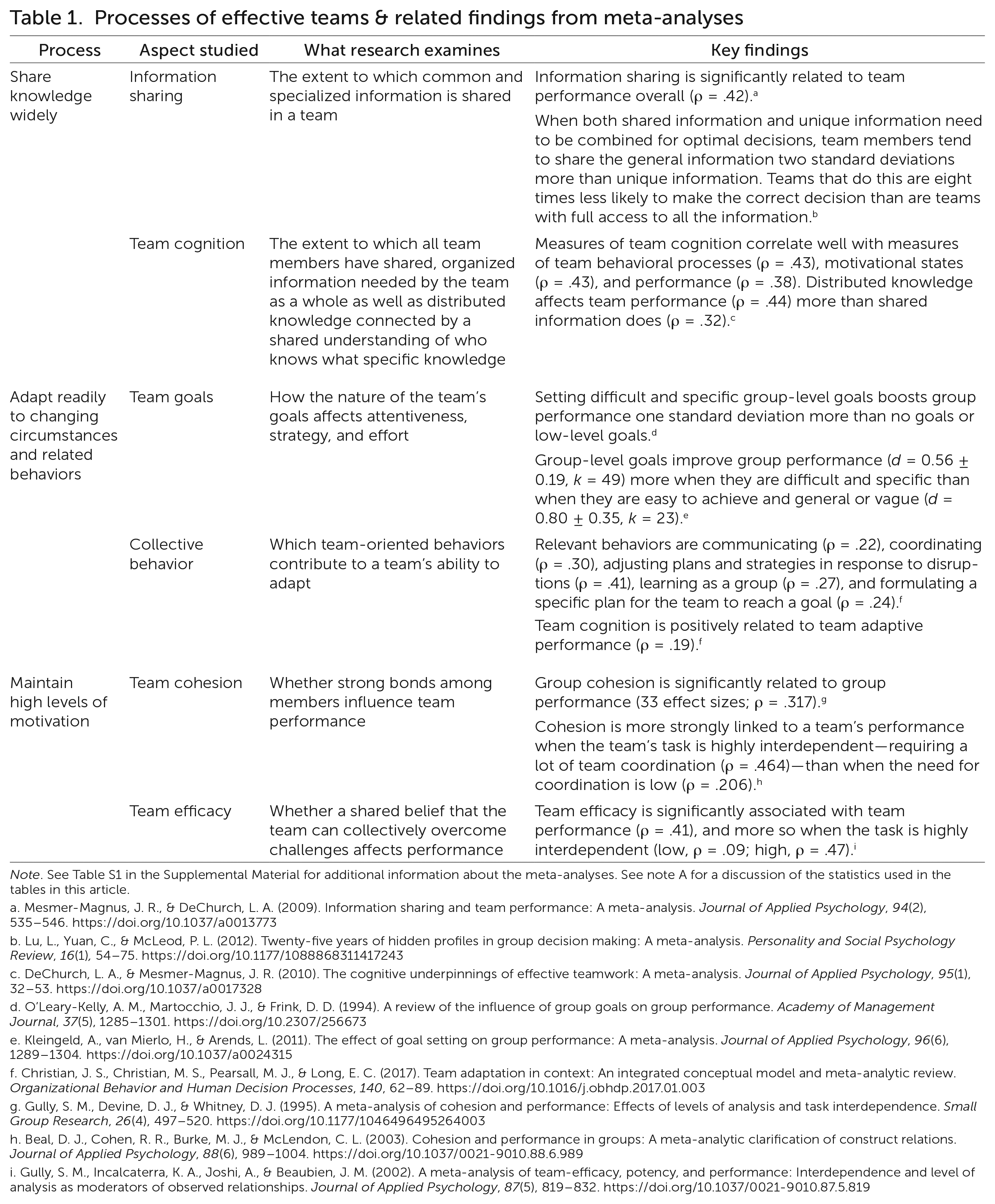
Note. See Table S1 in the Supplemental Material for additional information about the meta-analyses. See note A for a discussion of the statistics used in the tables in this article.
Mesmer-Magnus, J. R., & DeChurch, L. A. (2009). Information sharing and team performance: A meta-analysis. Journal of Applied Psychology, 94(2), 535-546. https://doi.org/10.1037/a0013773
Lu, L., Yuan, C., & McLeod, P. L. (2012). Twenty-five years of hidden profiles in group decision making: A meta-analysis. Personality and Social Psychology Review, 16(1), 54-75. https://doi.org/10.1177/1088868311417243
DeChurch, L. A., & Mesmer-Magnus, J. R. (2010). The cognitive underpinnings of effective teamwork: A meta-analysis. Journal of Applied Psychology, 95(1),
O’Leary-Kelly, A. M., Martocchio, J. J., & Frink, D. D. (1994). A review of the influence of group goals on group performance. Academy of Management Journal, 37(5), 1285-1301. https://doi.org/10.2307/256673
Kleingeld, A., van Mierlo, H., & Arends, L. (2011). The effect of goal setting on group performance: A meta-analysis. Journal of Applied Psychology, 96(6), 1289-1304. https://doi.org/10.1037/a0024315
Christian, J. S., Christian, M. S., Pearsall, M. J., & Long, E. C. (2017). Team adaptation in context: An integrated conceptual model and meta-analytic review. Organizational Behavior and Human Decision Processes, 140, 62-89. https://doi.org/10.1016/j.obhdp.2017.01.003
Gully, S. M., Devine, D. J., & Whitney, D. J. (1995). A meta-analysis of cohesion and performance: Effects of levels of analysis and task interdependence. Small Group Research, 26(4), 497-520. https://doi.org/10.1177/1046496495264003
Beal, D. J., Cohen, R. R., Burke, M. J., & McLendon, C. L. (2003). Cohesion and performance in groups: A meta-analytic clarification of construct relations. Journal of Applied Psychology, 88(6), 989-1004. https://doi.org/10.1037/0021-9010.88.6.989
Gully, S. M., Incalcaterra, K. A., Joshi, A., & Beaubien, J. M. (2002). A meta-analysis of team-efficacy, potency, and performance: Interdependence and level of analysis as moderators of observed relationships. Journal of Applied Psychology, 87(5), 819-832. https://doi.org/10.1037/0021-9010.87.5.819
Methods for improving teamwork in organizations & related findings from meta-analyses
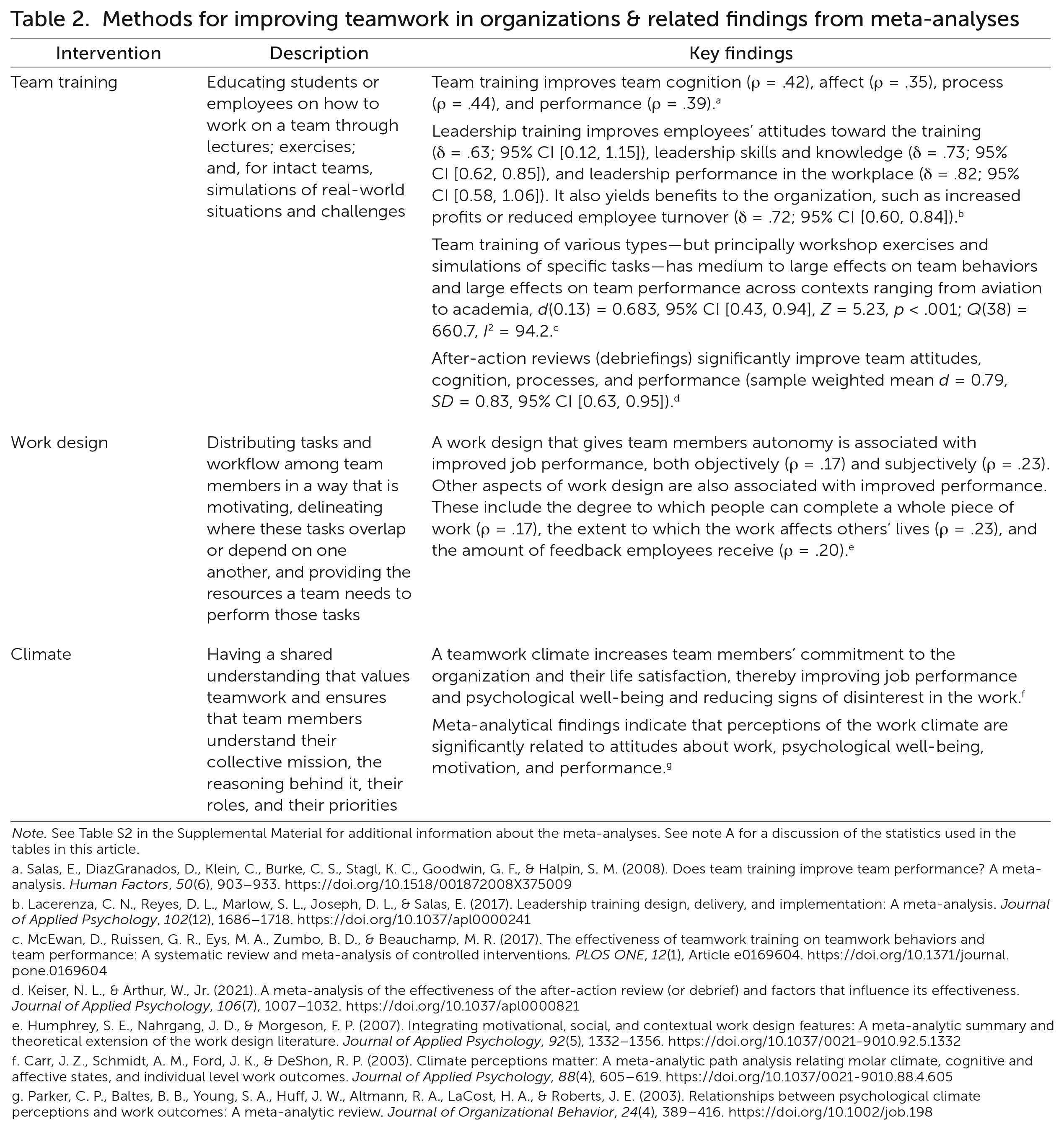
Note. See Table S2 in the Supplemental Material for additional information about the meta-analyses. See note A for a discussion of the statistics used in the tables in this article.
Salas, E, DiazGranados, D, Klein, C, Burke, C. S, Stagl, K. C., Goodwin, G. F., & Halpin, S. M. (2008). Does team training improve team performance? A metaanalysis. Human Factors, 50(6), 903-933. https://doi.org/10.1518/001872008X375009
Lacerenza, C. N, Reyes, D. L, Marlow, S. L., Joseph, D. L., & Salas, E. (2017). Leadership training design, delivery, and implementation: A meta-analysis. Journal of Applied Psychology, 102(12), 1686-1718. https://doi.org/10.1037/apl0000241
McEwan, D, Ruissen, G. R, Eys, M. A., Zumbo, B. D., & Beauchamp, M. R. (2017). The effectiveness of teamwork training on teamwork behaviors and team performance: A systematic review and meta-analysis of controlled interventions. PLOS ONE, 12(1), Article e0169604. https://doi.org/10.1371/journal.pone.0169604
Keiser, N. L, & Arthur, W, Jr. (2021). A meta-analysis of the effectiveness of the after-action review (or debrief) and factors that influence its effectiveness. Journal of Applied Psychology, 106(7), 1007-1032. https://doi.org/10.1037/apl0000821
Humphrey, S. E, Nahrgang, J. D., & Morgeson, F. P. (2007). Integrating motivational, social, and contextual work design features: A meta-analytic summary and tneoretical extensien of the wor k deside literature. Journal ofApplied Psychology, 92(5), 1532-3356. https://doi.org/10.1037/0021-9010.92.5.1352
Carr, J. Z., Schmidt, A. M., Ford, J. K., & DeShon, R. P. (2003). Climate perceptions matter: A meta-analytic path analysis relating molar climate, cognitive and affective states, and individual level work outcomes. Journal of Applied Psychology, 88(4), 605-619. https://doi.org/10.1037/0021-9010.884.605
Parker, C. P., Baltes, B. B., Young, S. A., Huff, J. W., Altmann, R. A., LaCost, H. A., & Roberts, J. E. (2003). Relationships between psychological climate perceptions and work outcomes: A meta-analytic review. Journal of Organizational Behavior, 24(4), 389-416. https://doi.org/10.1002/job.198
As Table 1 shows, substantial scientific evidence has identified three core teamwork processes that enable teams to be successful. Teams need to build a common basis for action through sharing knowledge, they need to continuously adapt their knowledge and actions to fit changing situational demands, and they need to keep team members motivated to contribute to shared team goals.
For example, investigations of the knowledge component have found that measures of information sharing and team cognition correspond to measures of the effectiveness of team performance and decision-making. By information sharing, we mean team members communicating information that everyone needs to know and that relates to specific expertise. By team cognition, we mean team members sharing the common, organized knowledge they need and also understanding who knows other key information. (The term organized knowledge refers to how various facts and concepts relate to one another.) When teams share information well, grasp the tasks, agree on what is important, and understand who knows what specific information, they can avoid wasting time on tangential activities, miscommunication, and meandering searches for information, and it facilitates decision-making.
Core Capabilities
1. Develop team strategies and goals.
2. Coordinate interdependent tasks.
3. Monitor task progress (goals).
4. Monitor team processes.
5. Provide feedback and support.
6. Promote collaborative problem-solving.
7. Foster team cohesion and endurance.
8. Address and resolve conflict.
Note. For teams to work effectively, team members need to master the eight skills listed above, which underlie the three team processes described in Table 1. See Table S3 in the Supplemental Material for selected studies that support the value of these capabilities.
Research into adaptation looks at how the nature of a team’s goals affects strategy and effort and at which team behaviors contribute to a team’s ability to adapt. Among the findings are that team goals that are more difficult and specific are more strongly related to team performance than are more general team goals. In addition, team cognition is associated with team adaptive performance, and a range of specific teamwork behaviors are related to team adaptation, including communication, coordination, and plan formation.
With respect to motivation, investigators have found that it is associated with a team’s social cohesiveness and the shared belief that the team can overcome difficulties. These features are more critical to success when a team’s task requires a lot of interdependence—that is, when the extent to which each person’s ability to contribute to the goal depends on other people’s actions. For example, a soccer team’s prowess depends on coordinated action among team members, whereas a track team’s success relies far more on individual performances.
Studies of teamwork spanning some 75 years have delineated eight core competencies that underly the three essential team processes that have been identified. As summarized in the sidebar Core Capabilities, team members must be able to work together to develop strategies and goals for the team, coordinate task execution, monitor progress toward reaching goals and how well team processes are working, provide feedback and support, promote problem-solving, foster cohesion and endurance, and manage conflict.22-25 These competencies are the primary targets of training to improve teamwork.
The interventions that shape teamwork processes and hence team effectiveness involve team training, work design, and climate. Regarding team training, a large body of evidence indicates that both training aimed at team members and training aimed at team leaders have a substantial influence on improving team cognition, teamwork processes, and team performance (see Table 2 for evidence and references). Work design involves the distribution of tasks in a team, the interdependencies among tasks, and the resources and demands related to those tasks. A good work design ensures team members can apply their knowledge and skills to the team’s goals and remain engaged in the work; work design has been shown to affect job performance. Climate refers to the shared assumptions and norms of the team. An effective team climate is one in which teamwork is valued and collaboration is the norm. It is one in which team members understand their mission, the reasoning behind it, their roles and their priorities, and what is rewarded and punished by management. Climate is related to psychological well-being, motivation, and performance.
With respect to implementing interventions, team training is flexible and broadly applicable, and it can be implemented in a variety of ways, as we shall discuss. Work design is under the control of organizational management and thus is specific to particular team task contexts. Similarly, team climate is substantially influenced by team leaders and the broader organizational system, making it context specific.
“Team training is a particularly potent intervention for improving team effectiveness regardless of the setting.”
Team training is a particularly potent intervention for improving team effectiveness regardless of the setting. 26 The type of training provided in schools or the workplace will depend on whether the skill is generic across teams of all sorts or specific to a given team. 22 Capabilities such as problem-solving and conflict resolution have generic aspects that can be taught to individuals in school, work, or any of a variety of settings. In contrast, the best ways to coordinate team activities and develop strategies for meeting team goals usually need to vary by context and so are more appropriately taught to intact work teams. Some generic capabilities—problem-solving, for example—may have team- or task-specific aspects that are also best addressed to intact teams. Thus, as a general strategy, schools and universities should offer courses that address the generic aspects of core teamwork capabilities, and workplaces should include training for the more specific aspects.
We now turn attention to policy recommendations for improving teamwork by members of society in general. We then address specific actions for teamwork in work environments.
Educating Students for Teamwork
The basic skills and abilities needed in teamwork, such as communication, collaborative problem-solving, and conflict negotiation, should be taught as part of standard school curricula. To date, teachers in primary and secondary schools mainly emphasize generic social skills that help children get along in the classroom. 27 For teamwork skills, they rarely offer the systematic instruction that they apply for other subjects, such as languages or science. 5 As a result, students lack teamwork skills.
To rectify this, the Organisation for Economic Co-operation and Development (OECD) has taken initial steps toward bringing formal teamwork training to schools. It established the assessment of basic social skills in schools as part of a program to better understand and support children’s and juveniles’ social and emotional skills development. 28 In another important initiative, the OECD evaluated high school students’ ability to collaborate with others to solve a problem. 29 It found that only 8% of students across all 38 OECD countries showed a high degree of competence at skills such as being aware of group dynamics, ensuring compliance with agreed-upon roles, and resolving conflicts.
Similarly, Arthur C. Graesser and his colleagues have outlined several possible methods for teaching collaborative problem-solving and teamwork skills in schools. 5 Those methods include conducting case-based analyses of real-world teamwork scenarios, as well as reflecting on the practice of working in a team. Although these methods have not been well studied yet, we recommend that early teamwork instruction combine teaching of psychological processes in teams with practical skills training, such as role-plays on managing interpersonal conflict or in-class demonstrations of the challenges of sharing information and making decisions in groups. Teachers could address these skills in the context of group projects, which would then be graded not only on the quality of the end product but also on the extent to which students worked together effectively.
Assessment of teamwork skills could include giving exams that test knowledge of the skills, strategies, and concepts needed for successful teamwork and grading students on practical exercises that give them a chance to display these skills. In its assessment of collaborative problem solving, the OECD established four skill levels based on students’ ability to both solve complex problems and do so collaboratively. Educators could use these levels to establish a starting point for teaching teamwork skills to high school students. 5
Learning teamwork skills in schools would be expected to increase students’ later value in the labor market, given that recent economic analyses show that high-paying jobs increasingly require good social skills. 30 From an economic perspective, this is explained by the fact that social skills reduce coordination costs in highly specialized work processes, which means that social skills foster the good teamwork needed to accomplish highly interdependent tasks.
The importance of teamwork skills has received more attention at colleges and universities, probably because surveys of employers and university alumni consistently show that graduates are ill prepared for the social demands of their jobs.31,32 However, most colleges do not offer formal courses on teamwork. Instead, instructors teach teamwork skills informally by assigning students to group projects and assisting them in managing these projects.33,34 Arguably, teamwork skills cannot be taught fully in a classic classroom lecture. But relegating these skills to informal learning signals that they are less important than technical skills, making students less motivated to learn them.
Recognizing these problems, some universities have begun to offer formal courses on team-work.35-38 An early example is provided by Gilad Chen and his colleagues, who have described in detail an elaborate course they developed at George Mason University in Virginia called The Psychology of Working in Groups and Teams. The course followed a framework developed by Michael A. Stevens and Michael J. Campion. 39 Instructors emphasized the core competencies of conflict resolution, collaborative problem-solving, communication, goal setting, performance management, and planning and task coordination. 35 The course combined classroom lectures on teamwork with in-class exercises and simulations of real-world team situations at separate assessment centers. Students were evaluated by both in-class exams and their performance in assessment-center exercises. In evaluating the effectiveness of the approach, the researchers found that students in the course significantly outperformed control group students on a teamwork competencies test designed for the course. The control group
students either had not had any teamwork instruction or had participated in the assessment center exercises but not the classroom lectures.
Universities should develop and routinely offer such teamwork courses. Courses could focus on particular teamwork situations, such as multidis-ciplinary research collaborations, virtual teams, or culturally diverse teams. They would improve individuals’ competencies both as members of such teams and as team leaders. The National Academy of Sciences has created an impressive tool kit called Enhancing the Effectiveness of Team Science that is geared to scientific staff from administrators to graduate students and provides guidance on creating, supporting, and leading scientific teams. 6 Universities can use such tools not only to support research teams with appropriate resources and policies but also to prepare students for managing the challenges of working in teams of all types. 40
Regulating for Teamwork
Government and industry regulations are powerful levers for change. Accordingly, we propose to include teamwork skills in professional and organizational licensing as a way to increase the awareness of their importance and the readiness to act on that awareness.
Civil aviation offers an excellent model. It has long been recognized that 60%-80% of aircraft accidents are the result of human error, with a substantial proportion of those errors caused by communication, coordination, or collaboration issues—that is, teamwork failures. 2 Correspondingly, commercial airlines are required to establish teamwork training programs to obtain a license to operate. This teamwork training, known in aviation as crew resource management training, is obligatory for all commercial pilots and is increasingly also required for flight attendants and air traffic controllers.2,3 Crew resource management training is built around so-called nontechnical skills, or notechs, focusing on cooperation, leadership, situation awareness, and decision-making. 41 As part of the training, a range of specific behaviors must be taught and assessed (see Table 3). During this training, which is conducted in highly sophisticated flight simulators, cockpit crews, sometimes along with cabin crews, are exposed to critical situations—say, an engine failure, low fuel, bad weather, or some combination of problems—that the group has to resolve as a team. Instructors assess and debrief the crews on the teamwork skills, such as soliciting advice or providing emotional support, that the trainees demonstrated during the exercise. The trainees also receive formal classroom training to learn and reinforce these skills.
Teamwork competencies required of pilots & criteria used to evaluate the pilots
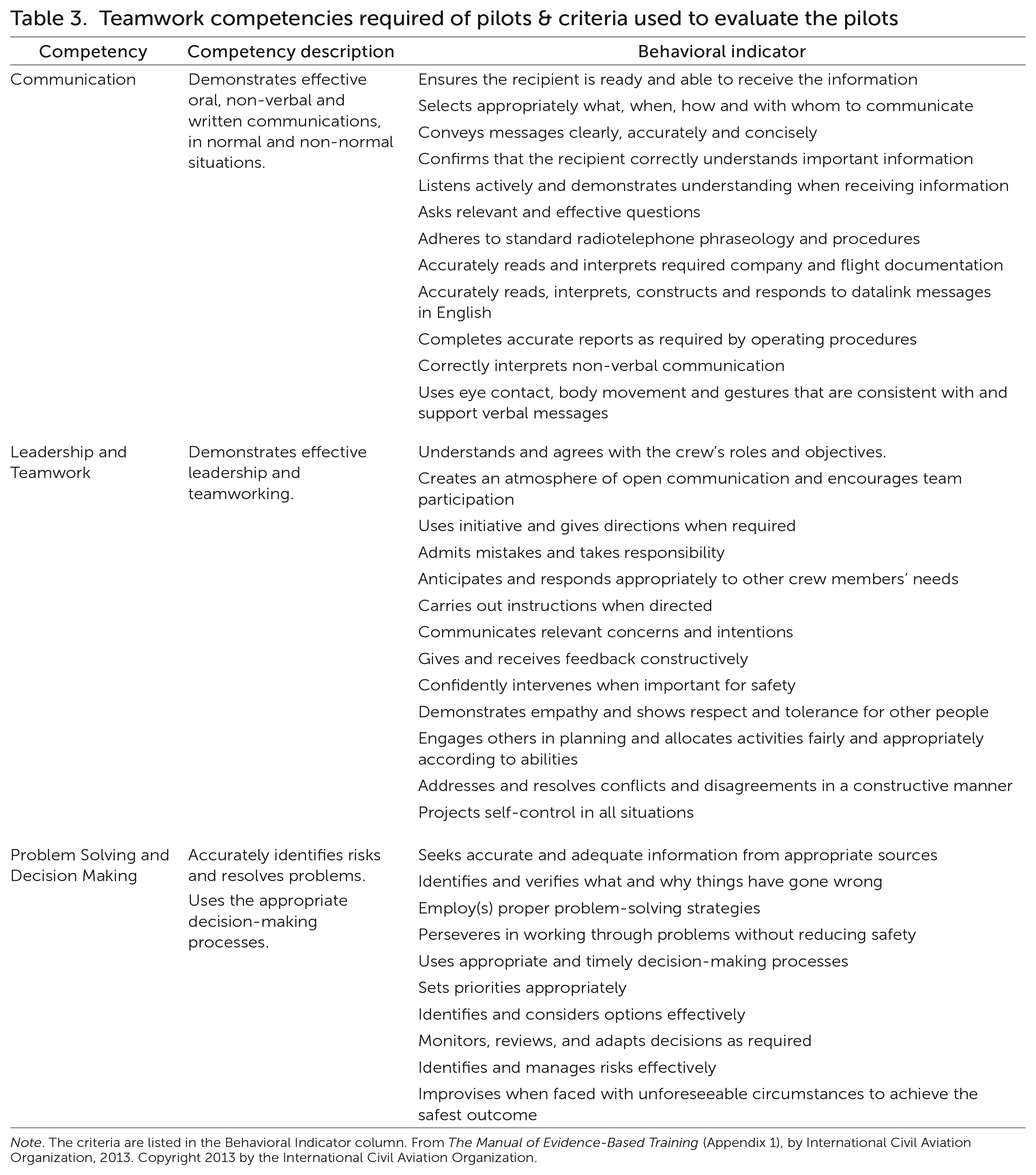
Note. The criteria are listed in the Behavioral Indicator column. From The Manual of Evidence-Based Training (Appendix 1), by International Civil Aviation Organization, 2013. Copyright 2013 by the International Civil Aviation Organization.
In the United States, fatal aircraft accidents have continuously decreased since the U.S. Federal Aviation Administration mandated crew resource management training for commercial airline flight crews. 42 As will be seen next, other high-risk industries such as health care and nuclear power have followed suit.43,44
Because of the growing awareness that medical errors and patient safety are substantially affected by teamwork, efforts comparable to those in civil aviation are beginning to take root in health care.45-47 In medicine, teamwork errors exact high costs in human life.46,47 Indeed, medical errors are the third leading cause of death in the United States; they may account for more than 250,000 deaths per year. 48 As in aviation, most of those human errors have their roots in poor teamwork.49,50
A number of U.S. hospitals have deployed a validated program to improve medical teamwork called Team Strategies and Tools to Enhance Performance and Patient Safety (TeamSTEPPS).51,52 TeamSTEPPS emerged from a collaboration by the Agency for Healthcare Research and Quality and the U.S. Department of Defense. It is a freely available patient safety tool kit that targets four core teamwork competencies: leadership, communication, situation monitoring, and mutual support. In addition, a randomized controlled trial, the gold standard in medical research, demonstrated that training hospital emergency room physicians to be better team leaders led to better team leadership behavior and better patient care outcomes. 53 To date, however, licensing for medical personnel does not require team training, so regulatory
action is needed to make this training more widespread in the health care industry.
Many other high-risk industries where human life is at stake (such as nuclear power and railways) endeavor to improve teamwork skills through training. However, licensing of personnel as well as the license to operate for the respective organizations rarely depend on teamwork training. In industries with lower risk profiles and therefore less public attention and regulatory pressure, teamwork skills are even lower on regulators’ agendas. That can be modified through policy action, by pushing for requirements in licensing procedures for professions and organizations across industries, and through more awareness of the importance of teamwork in professional associations. For instance, inadequacies in judicial counseling and decision-making have been attributed to the practice of relying on single lawyers. By convening teams of clients, judges, lawyers, and subject-matter experts at various stages of the judicial process and offering teamwork training to legal professionals, judicial counseling could be made more effective. 54 Similarly, problem-solving teams of schoolteachers could better support student learning and reduce inappropriate referrals to special education. Forming effective teams in schools would require team training for teachers and administrative support for the teams, among other changes that licensing requirements would encourage. 55
As our comments imply, in addition to requiring training in teamwork skills, regulators can promote effective teamwork by establishing requirements that change work practices. In some industries, the license to operate depends on the ability of organizations to demonstrate that they create working conditions, norms, and values that are conducive to good teamwork. The catastrophic accident at Chernobyl in 1986 led international and national regulators to develop programs to instill a safety culture in the nuclear power industry.56,57 Team training is an important part of these programs—as a way of improving team processes such as communication, collaboration, and leadership—as is work design, which can ensure that teams have needed resources and personnel and that they distribute responsibilities effectively.58-60 Nuclear installations can benefit from guidelines, recommendations, and training materials designed to enhance teamwork provided by their own professional associations and by national and international regulators. They are also inspected and assessed on a regular basis to monitor progress toward establishing appropriate work practices. Similar inspection programs have been set up by regulators in aviation for commercial airlines and air traffic management providers.61,62 In health care, safety climate or culture is at the core of many organizational change programs.
63
“Both individuals and intact teams need training on how to work effectively as a team.”
In the financial services industry, the financial crash of 2008 spurred regulatory efforts to promote good work practices under the heading of “ethical culture.” 64 Ethical culture regulations do not yet address teamwork specifically, but they should. Regulators could borrow practices from industries such as nuclear power and civil aviation that have made teamwork training part of a new safety culture.
Introducing team training, work design, and climate supportive of teamwork through regulatory action requires a participatory process and a tailored approach. For each profession and industry, core teamwork skills and methods for their assessment need to be defined. The eight core teamwork capabilities described earlier, such as collaborative problem-solving, coordination, and conflict management, are a good place to start, but the skills may need to be prioritized and assessed differently across industries. (For a discussion related to health care, see the article by Asela M. Olupeliyawa and his colleagues in the reference list. 65 ) Good team leadership may look quite different in a research and development team at a drug company, for example, than in a team of firefighters or tax lawyers. Task complexity, employee qualification, automation, and external relationships, to name but a few factors, all need to be taken into account to promote effective change. 66
Once standards are in place, regulators need to be mindful that assessing work practices and climate is different from assessing technical installations and processes. Inspectors and auditors from regulatory bodies typically have engineering and science backgrounds aligned with the industries they regulate.67,68 These inspectors may lack the skills required to evaluate social, team, and organizational processes and may need to be trained in those skills. In addition, regulatory agencies will need to hire staff with social science backgrounds to ensure proper assessments as well as adequate feedback and support for the executives in charge of implementing the new licensing requirements within an organization.
Organizing for Teamwork
Educators can help students learn the necessary skills to collaborate in teams, and regulatory requirements and oversight can elevate the importance of good teamwork in organizations. In the final analysis, however, organizations have to bring all of these elements together in daily routines of good teamwork. 69 Across industries, organizations should take steps to capitalize on the power of teamwork and not just count on the efforts of top-performing individuals. 70 Organizational leaders should invest in team training, work design, and climate. (See Table 2 for key findings from research related to these actions, and see the sidebar Consequences of Poor Teamwork in the Supplemental Material for examples of the effects of poor teamwork in different fields.)
We have already described multiple examples of team training. We now discuss some of the research that offers broader insight into what constitutes effective training.26,71,72 The research shows, for instance, that both individuals and intact teams need training on how to work effectively as a team. This training can take the form of educators or management professionals teaching teamwork skills in classroom settings. Alternatively, experts might coach specific teams of, say, health care professionals or nuclear engineers through simulations of challenging or crisis situations.
Research also shows that training based on an analysis of the needs of a specific situation works best. For instance, in homogenous teams, it is important to increase awareness of complacency and groupthink, whereas in heter-ogenous teams, building shared mental models (organized information held collectively among a team) and a common language are more relevant.
Moreover, training should be designed so that teams develop and use the specific competencies and skills needed in their industry. For instance, a training program developed in a large teaching hospital focused on improving communication by exposing medical teams to situations that required team members to speak up during a simulated anesthesia delivery— for example, to urge a lead anesthetist to do a tracheotomy during a scenario in which a patient proved difficult to intubate. 73 In the evaluation of the training, the authors found that the training was particularly effective in getting team members to speak up when the debriefing emphasized assertiveness across hierarchies.
With respect to work design, it has been shown to strongly affect both individual and team performance and hence is a powerful lever for team effectiveness.74,75 Good design helps team members to apply their knowledge and skills to the team’s tasks and remain engaged in the work. In particular, individual and team tasks should be designed in a way that allows for high levels of autonomy. That is, as organizations rightfully and increasingly rely on teams to coordinate interdependent tasks, adapt to continuously changing internal and external demands, and innovate to keep the organization ahead of its competitors, organizational leaders should make sure to give those teams sufficient control and resources. 76 In addition, work processes should be arranged so that employees feel their team’s work is important and so that they receive feedback about their performance. 77
Concerning climate, the aim is to develop shared norms and values that help teams understand
their roles and have trust in their colleagues and leaders. This often requires supportive organizational structures and policies as well as good leadership. Team leaders not only have an impact on the day-to-day functioning of teams but also play a crucial role in instigating change in team processes and outcomes.78,79 Efforts to effect change in organizations should therefore combine the introduction of new procedures with training that specifically prepares team leaders for their role in the changeover.
For example, in 2008, experts from Johns Hopkins University and the Michigan Health and Hospital Association included the training of team leaders in hospital intensive care units in a study aimed at improving teamwork to enhance patient safety—for instance, by controlling infections more effectively.63,80 They trained team leaders (one doctor and one nurse) at each of 67 hospitals (103 intensive care units) in best practices for infection control. They established a daily goals sheet to improve communication among clinicians and a safety program geared toward promoting a safety climate, among other measures. The intervention improved the staff’s ratings of the team safety climate and substantially reduced catheter-related bloodstream infections at participating hospitals.
Conclusion
The sidebar Fostering Teamwork as a Society: Three Avenues of Action summarizes our recommended interventions. In following our recommendations, educators, regulators, and leaders at organizations need to also be mindful of changing conditions for teamwork. Changes in work practices, such as the shift to virtual teamwork during the pandemic, and technological advances require new skill sets and team arrangements. For successful human-AI teams, it will be crucial to embed what is known about effective teamwork into the design of these new systems. On the flip side, artificial agents can be programmed to assess, coach, and shape effective teamwork interactions on the fly. 81 The earlier that teamwork knowledge and skills become part of policy action, the more likely it will be that these new technological opportunities will be exploited responsibly. We hope that our review and recommendations provide a compelling rationale and realistic call for such action.
The changes we call for, which build on more than half a century of team research, would affect the work of science itself. Universities would not only educate students in teamwork but also develop new programs to advance teamwork skills and establish a research culture based on multidisciplinary collaboration. In that way, academia would be better able to fulfill its promise to bring socially valuable innovation into a world of grand challenges that require large-scale collaborative efforts or, as it has been called, “team science.”6,82,83 To establish this teamwork culture, universities would need to bolster and expand cross-disciplinary programs, and academia as a whole should reward faculty for collaborative efforts instead of placing multidisciplinary research on the sidelines. For instance, research that integrates knowledge from several disciplines tends to be published in lower ranked journals and receives fewer citations than research in a single discipline. 84 In an encouraging move, funding agencies such as the National Institutes of Health and the National Science Foundation have begun to push for team science though calls for grant applications that require that multidisciplinary teams conduct the research. Agencies have begun to complement this effort with explicit guidance on how to set up, train, and support multidisciplinary research teams. 85
Acknowledging that teamwork skills need to complement technical expertise is fundamental. The psychological and behavioral sciences, which provide the knowledge base for good teamwork, are often considered soft because their variables cannot always be measured objectively and experimental designs to isolate causal relationships are difficult to implement due to practical and ethical concerns. Yet behavioral research has amassed sound evidence that organizations, be they firms or universities, should capitalize on to build the effective teamwork needed to succeed in the long run. Teamwork is at the core of modern society and should be nurtured with care and respect.
Fostering Teamwork as a Society: Three Avenues of Action
1. Educating for teamwork: Teamwork skills should be part of the regular curriculum in K-12 schools and universities.
• Elementary and middle school: Include role-plays on managing interpersonal conflict and in-class demonstrations of challenges of group information sharing and decision-making. Practice and evaluate skills in the context of group projects.
• High school: Build on efforts by the Organisation for Economic Co-operation and Development to teach and assess social competencies and collaborative problem-solving.A
• University: Offer more courses that combine classroom teaching and formal assessment of teamwork skills with practice of those skills in simulated team situations. Use tool kits developed by the National Academy of Sciences to foster teamwork skills among scientists.B
2. Regulating for teamwork: Licensing requirements for professions and organizations should include training and testing of teamwork skills.
• Build on and adapt existing instruments from civil aviation for teamwork-related training and assessment requirements.
• Build on and adapt regulatory requirements from the nuclear industry regarding work design and climate for teamwork effectiveness.
• Train inspectors and auditors from regulatory bodies in the assessment of social, team, and organizational processes.
3. Organizing for teamwork: Organizations should increase their investment in interventions aimed at improving teamwork.
• Design individual and team tasks so that team members have sufficient autonomy and adequate resources for self-management in the team.
• Train whole teams on teamwork skills in the context of their organization.
• Promote organizational and leadership development to build a climate of trust and support.
A. Graesser, A. C., Fiore, S. M., Greiff, S., Andrews-Todd, J., Foltz, P. W., & Hesse, F. W. (2018). Advancing the science of collaborative problem solving. Psychological Science in the Public Interest, 19(2), 59-92. https://doi.org/10.1177/1529100618808244
B. National Research Council. (2015). Enhancing the effectiveness of team science. The National Academies Press. https://doi.org/10.17226/19007
Supplemental Material
sj-pdf-1-bsx-10.1177_23794607231192734 – Supplemental material for Teamwork doesn’t just happen: Policy recommendations from over half a century of team research
Supplemental material, sj-pdf-1-bsx-10.1177_23794607231192734 for Teamwork doesn’t just happen: Policy recommendations from over half a century of team research by Gudela Grote and Steve W. J. Kozlowski in Behavioral Science & Policy
Footnotes
author note
Steve W. J. Kozlowski gratefully acknowledges the U.S. Army Research Institute for the Behavioral and Social Sciences (ARI) for support from Grant W911NF2210005, awarded to a project for which Kozlowski was the principal investigator and that, in part, contributed to this work. The views, opinions, and findings contained in this article are solely those of the authors, and one should not construe them as an official ARI or Department of Defense position, policy, or decision, unless so designated by other documentation.
author affiliation
Grote: ETH Zurich. Kozlowski: University of South Florida. Corresponding author’s e-mail:

Notes
References
Supplementary Material
Please find the following supplemental material available below.
For Open Access articles published under a Creative Commons License, all supplemental material carries the same license as the article it is associated with.
For non-Open Access articles published, all supplemental material carries a non-exclusive license, and permission requests for re-use of supplemental material or any part of supplemental material shall be sent directly to the copyright owner as specified in the copyright notice associated with the article.
