




Abstract
This article describes an in-person class exercise that explores true cost accounting, negative externalities, and ethics for business students. Building upon earlier games intended for economics students, the exercise is a game in which students are assigned to play the role of a farmer or a fisher who plan to use a common resource. Students relate the decision to use traditional or clean technology to issues confronting farmers and fishers on Lake Erie, considering environmental, social, and economic costs, and focusing on ethical decision-making in the presence of externalities. The article provides instructions, discussion questions and debrief guide, and lists and describes potential articles for students to read before participating in the activity.
Keywords
The increasing world population (Godfray et al., 2010) and mismanagement of common resources, like arable land and clean water or air, challenges the United Nations’ ability to eliminate hunger, as described by Sustainable Development Goal number two (Bebbington & Unerman, 2018) and ensure food security (Food and Agriculture Organization, 1996) from production to consumption. Students may be unaware of the social impact associated with producing high-demand foods in industrialized countries (van Bussel et al., 2022), including government subsidies, the cost of pollution to society, or health care costs. Using a game, we illustrate misallocation of common resources associated with the food system. We encourage students to consider the ethics associated with prioritizing profit-maximization without acknowledging the true costs of food production (Andrews, 2002; Hoyt et al., 1999; Wang et al., 2011).
Theoretical Foundation
We use this exercise in a co-taught, interdisciplinary undergraduate class about socio-ecological food systems at a highly selective U.S. business school. Ethical decision-making, including “socially desirable outcomes and a fair distribution of valuable outcomes,” alongside goals such as profit maximization or shareholder value are an important part of our students’ education (Hirschauer et al., 2018, p. 44). Furthermore, this exercise represents the Principles of Responsible Management Education (PRME) (Greenberg et al., 2017) to help business students practice integrated sustainability. These skills simultaneously address social responsibility, ecological integrity, and value creation in the decision-making process (Siegrist et al., 2020). This socioecological systems approach (Ostrom, 2009) recognizes multiple complex and interrelated systems between the resource, users, and governance. It helps students understand connections and feedback loops among systems without getting overwhelmed by complexity. Our synchronous in-class exercise demonstrates externalities—how decisions made by one party regarding the use of the common resource can negatively affect another, uninvolved party. These negative externalities—social costs in addition to private production costs –may be unknown or ignored by corporations when making production decisions. Therefore, excessive resources will be directed to produce a good that pollutes, resulting in a market price that is too low relative to its true costs to society (True Cost Initiative, 2022). The “cultural notion that food . . . is underpriced because of environmental, social, and health externalities” (Lusk, 2013, p. 420) is not new, and students understand quickly the connection between unmeasured social costs, such as climate change, biodiversity loss, or disruption of ecosystem services (Colombo et al., 2024), and lower market prices that do not reflect true production costs.
Overview
Microeconomics is not a prerequisite for our class, so we teach about externalities and true cost accounting without explicitly using economic frameworks. We introduce these concepts and the exercise during the unit on food production. Students learn about the prevalence of monocropping in the United States, which results in undesirable outcomes such as soil degradation, reduced biodiversity, and increased fertilizer use (Kremen & Miles, 2012). In the absence of strong government regulation, production of crops like corn can result in substantial local water pollution. More generally, conventional agricultural production in the United States causes economic, environmental, and social costs, yet firms do not fully take account of these (Lusk, 2013). As a result, traditional accounting methods understate the true cost of food production. We introduce the more general skill of socio-ecological systems thinking and the applied concept of true cost accounting to measure the full extent of costs (Colombo et al., 2024).
We modify the “Paper River” activity developed by Hoyt et al. (1999) and updated by Andrews (2002) to incorporate sustainability through the transdisciplinary co-teaching lens of economics and food systems. In previous versions, an upstream industrial firm pollutes a common resource (fresh water in a river). Students representing the upstream firm complete math problems on paper. The upstream firm’s choice of pen or pencil impacts the ability of the downstream to build paper airplanes. Although pen is a less costly choice, it depletes paper as a common resource; only pencil may be erased, and the paper reused. The more upstream firms used pen, the fewer paper airplanes could be created by the next group of students. In Andrews’ (2002) version, use of pen or pencil cannot be traced back to any individual student, so classmates who spend the resource remain anonymous. Further, because no one “owns” the paper, students in the upstream group lack any incentive to conserve the resource for later. Andrews (2002) relates the activity to firms’ behaviors in the Chesapeake Bay Watershed.
We add substantial context to the firms, their practices, and consequences, which become the subject of post-exercise discussion regarding true cost, negative externalities, and the connection between food production practices and ethical behavior. The context added to this exercise paired with a post-exercise reflection demonstrates a real-life example of socio-ecological systems-thinking and ecosystem services in courses related to social issues in management, production and operations, or sustainability. Before class, students read an article about ecosystem services provided by the Lake Erie Watershed to surrounding communities (see Appendix A). In class, we define the upstream firms as farmers (Appendix B) and the downstream firm as fishers (Appendix C). Farmers choose how to grow their corn—(a) using traditional practices, which cost less but pollute the river, leading to eutrophication and subsequently a less healthy water ecosystem or (b) using clean practices, which cost more but minimize damage to the surrounding water ecosystem and conserve resources.
Learning Objectives
After completing the exercise, students can
Describe how true cost accounting and negative externalities relate to food production and consumption.
Identify equity issues associated with common resource use.
Empower students to employee socio-ecological systems thinking as consumers and in future employment so they use common resources in a more sustainable way.
Broaden perspective on social and environmental costs associated with food production to encourage future business leaders to prioritize environmental sustainability in production decisions.
Exercise
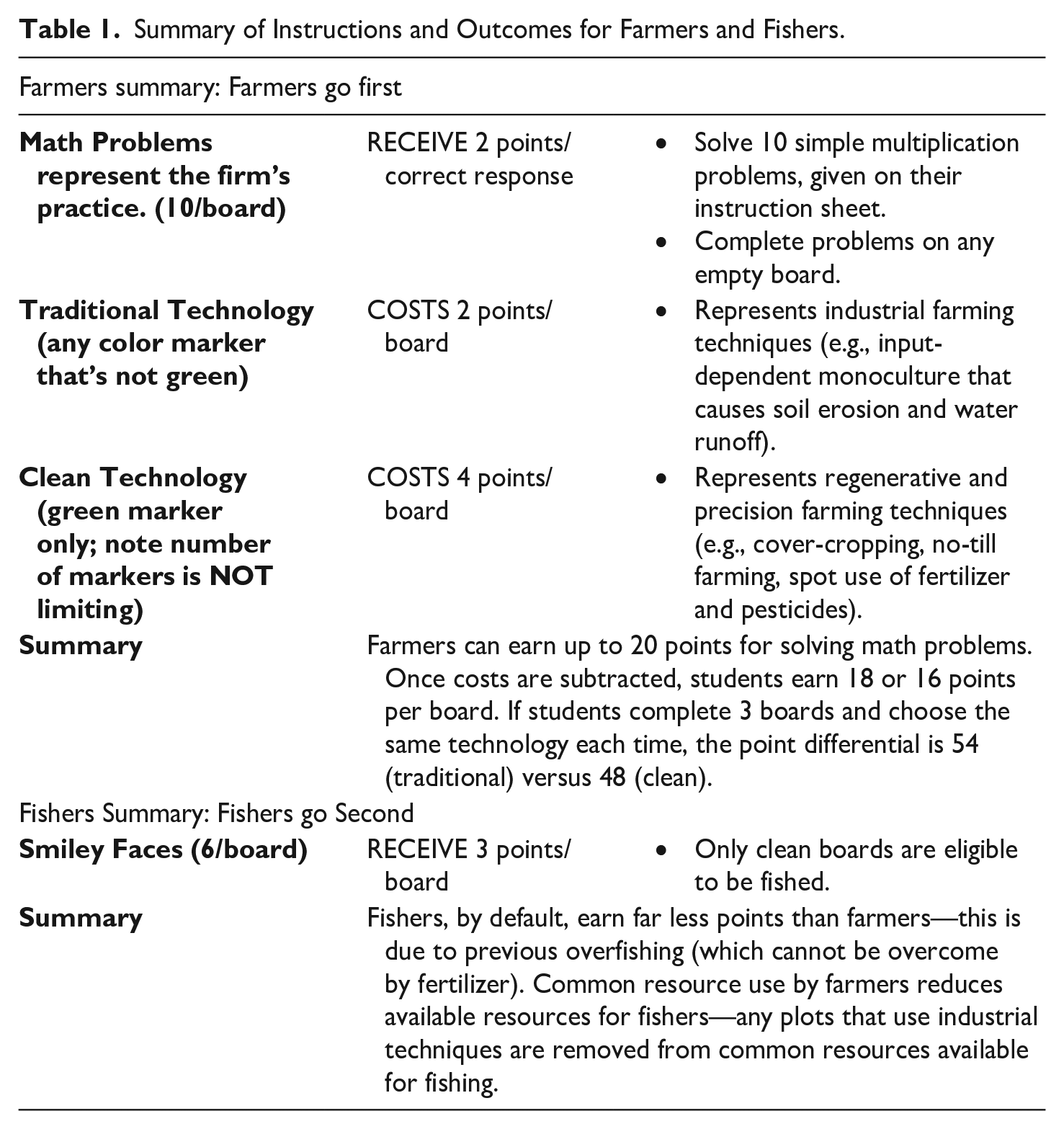
The activity is taught as part of one 90-minute, in-person class session in a class with a capacity of 44 students. We divide students into two equally sized groups. We outline the instructions below, with details and links to the prereading materials, including background material on the ecological details that degrade the ecosystem services provided by the Lake Erie watershed, at the end of the teaching note (Appendices A–D). Table 1 summarizes these instructions and brief takeaways. While described for in-person use, we have modified it for a synchronous online setting using a shared online slide deck instead of whiteboards. The teaching note (Appendix A) describes how to adapt the game for class size, materials available, and teaching modality. Depending on the time spent on background information (e.g., more time in a sustainability class), the exercise and debrief (Appendix D) could take as little as 30 minutes or the whole class.
Summary of Instructions and Outcomes for Farmers and Fishers.
Instructions for a Synchronous In-Class Setting
Before class, label approximately 30 whiteboard spaces (~1.5 spaces per student in the farmer group) to represent the common resource (i.e., the Lake Erie Watershed).
Divide students into two groups (Farmers or Fishers) and provide them with their group’s instructions (see Appendices B and C for printable instructions).
Explain the classroom setup and provide students with equal access to whiteboard markers representing traditional and clean techniques.
Farmers’ instructions require them to complete 10 basic multiplication problems. We ask farmers to solve the same 10 problems on each space available to them. They can move to any other available space once they are done. Farmers are informed that they earn 2 points for each individual math problem solved on a board, a maximum of 20 points on each completed board. They are also informed that they should consider the explicit cost differences between the clean (4 points) and traditional (2 points) practices, which will impact their final score.
Time is called after 3 minutes.
Each farmer totals their score.
All boards that used clean technology are erased; fishers are reminded of their task. If using poster boards, remove posters using traditional technology; flip posters using clean technology to the unused side to make resources available for fishers.
Fishers draw six smiley faces/whiteboard space and can move to any other available space once they are done.
Time is called after 3 minutes.
Each fisher totals their score.
Divide students into groups of four to discuss the debrief questions (Appendix D).
Instructions for Debriefing the Exercise
Before a whole-class debrief, students meet in small groups to discuss their game experience for approximately 15 minutes. In small groups, students share which role they played and then discuss externalities, incentives, and fairness. The small-group debrief is critical, as students discuss with classmates who may have experienced the game differently from them. Instructors may curate small groups so that each has two farmers and two fishers or may prefer random grouping to gauge whether group membership changes student reactions.
In small groups, students relate the game to the specific case of Lake Erie, applying their experience as farmer or fisher to real-world outcomes. In the whole-group debrief, students react to the impact of farmers’ production practices on the fish and fishers in Lake Erie. Students may incorporate the “true costs” article they read before class to conclude that farmers should be compelled to charge higher prices, thereby reducing the number of consumers (i.e., the quantity demanded). A higher price could be one way to internalize an externality that encourages additional discussion of ethical decision-making. For example, food may be inexpensive because of unaccounted-for costs, yet low prices help consumers who could not otherwise afford to purchase enough calories. Students may also mention the idea of regulating farmers’ production practices. In our exercise, students write their names on the boards they fill, but instructors could also use Andrews’ (2002) practice of anonymity; either should facilitate discussion of which firms should be regulated, and how.
The exercise could also be conducted twice in the same class session by having students change roles, or switching the order so that fishers go first (Andrews, 2002). Although we have not played the game this way, students do consider the implications of upstream versus downstream roles as part of the discussion. We engage in qualitative discussion of true cost accounting; the AgriFood Handbook (True Cost Initiative, 2022) provides some calculations for performing true cost accounting. These features could be added for students with more background knowledge in economics, accounting, or related courses.
Conclusion
Understanding externalities in food production is critical to grasping the U.S. food system. We describe an exercise that illustrates an externality caused by polluting a common resource and demonstrates socio-ecological equity implications as an example of applied RME. We introduce substantial context about sustainability outcomes to support students’ recognition of how individual firms’ decisions can lead to diverse environmental and social outcomes. By using the entire classroom, students interact and react to resource use in real time, enlivening the material and encouraging a deeper discussion of the true cost of food. Ideally exercises like these will help students to consider corporate social responsibility if they work in supply chain management or marketing in the future (Moir, 2001).
Undergraduate economics students were the audience for previous versions of the exercise (Andrews, 2002; Hoyt et al., 1999), while our version is appropriate for business students without this background. Our prereading and modifications to an existing exercise allow students to participate fully in a discussion on externalities and explore how true cost accounting could result in advocating for higher food prices, which encourages a deep discussion of business ethics that is critical for business students (Bear, 2017). Students discuss whether and how to adopt voluntary corporate social responsibility strategies, such as using clean technology, even if that raises explicit costs. A discussion of managers’ goals aside from profit maximization, and of stakeholder theory whereby corporate social responsibility can enhance profits by appealing to consumers or communities among other stakeholders (Bear, 2017), is particularly useful for business students who may need to make similar decisions throughout their careers (Greenberg et al., 2017).
Footnotes
Appendix A
Appendix B
Appendix C
Appendix D
Acknowledgements
We want to thank our students for engaging in this exercise and taking part in thoughtful discussion of their own experiences paired with the application to the scenario we presented. Their dedication and efforts are much appreciated. We also thank the editor and reviewers of this special issue for their thoughtful feedback and consideration of our article.
Declaration of Conflicting Interests
The authors declared no potential conflicts of interest with respect to the research, authorship, and/or publication of this article.
Funding
The authors received no financial support for the research, authorship, and/or publication of this article.
