



Abstract
Confirmation bias is a common cognitive error that emerges when people seek and use information that supports existing beliefs rather than more critically assessing evidence and potentially changing that belief. It often arises when considering controversial topics. Management classes in organizational behavior, ethics, international business, and strategy often cover issues that can be polarizing for students and stimulate a confirmation bias response. One approach to helping students remedy this problem is through debiasing interventions or helping people into slower, more deliberate reasoning. The debiasing technique described here has organizational behavior students commit to a position on a controversial issue in discrimination, then surprises them by having them write a paper from the opposite perspective. It also requires a critique of the argument they built and then reflection on what could prompt them to make a similar cognitive effort in other topics. Supplemental materials for the students include discussions on identifying good sources and assumptions about merit.
Keywords
Confirmation bias is a common cognitive error that results from people seeking and using information that supports existing beliefs rather than more critically assessing evidence and potentially changing that belief. It often arises when considering controversial topics (Vedejová & Čavojová, 2022) where controversy results from conflicting ideological and affective standards. Americans are increasingly polarized along ideological lines—the most among 14 Western nations—and tend to conflate partisan political identity with race, religion, and in-group identity (affective polarization) (Dimock & Wilke, 2021). College students may be even more polarized than American society as a whole (Kaufmann, 2022).
From a management education perspective, this is troubling: Students should develop the ability to control their own reasoning processes (Smith, 2003) and be open to considering alternative views and revising their own judgments when warranted (Meisel & Fearon, 2006; Payne, 2005). This is particularly important when students engage with hot-button topics such as cultural differences between societies with respect to child labor, the proper role and responsibilities of a firm in society, or gender or racial discrimination. Responding to these controversial topics in an effective and equitable manner is an important managerial ability (Allen, 2022) and students need to learn how to do this despite prior commitment to a stance.
In an MBA Organizational Behavior class I teach, this confirmation bias problem manifested in student papers on controversial topics in discrimination such as gender-linked pay differences, racial equity in hiring, or religious accommodation. Students were assigned to choose a topic and position on it to defend in a well-reasoned analysis. However, in the first several times through the assignment, I found that students usually just reiterated their original arguments despite seeing alternative viewpoints and sources in online discussions and did not distinguish between more and less biased sources. Furthermore, they usually failed to show why their argument was stronger than the counterargument. Students often fail in this because they regard their judgment as common sensical or obviously true and thus do not push the rigor of the assessment. I saw this as an opportunity to use controversy and commitment to get students to engage more critically with their own thought processes. In this article, I demonstrate a debiasing exercise centered on surprising students out of their complacency with and commitment to current beliefs by requiring them to do something cognitively uncomfortable: argue the opposite of that they believe.
Theoretical Foundation
In the context of dual processing theory, confirmation bias arises from System I/intuitive/heuristic thinking (Croskerry et al., 2013; Kahneman, 2011). System I thinking operates automatically, without voluntary control, and relies on intuition. It is fast and requires little cognitive effort (Kahneman, 2011). Croskerry et al. (2013) observe that as much as 95% of our cognitive effort is in System I. This intuitive style is amplified by emotional investment and the desire to protect identity and ideology rather than find the truth (Christensen & Moynihan, 2020; Martel et al., 2020) which leads to a tendency to uncritically support current positions. In particular, anger or outrage about an issue has been associated with an unwillingness to consider the other side of the argument (Suhay & Erisen, 2018; Swami et al., 2014) and specifically to confirmation bias (Dickinson, 2022). Allen (2022) argues that instructors can help management students build analytic skills by having them engage with controversial topics and confront the confirmation tendency, particularly if they are asked to research the issues rather than simply discuss them.
Debiasing puts students in a position where they must assess and challenge their own automatic thinking. It is therefore a call to slower, more deliberative and reasoned thinking and is often a corrective for errors from intuitive response (Graf-Vlachy, 2019; Kahneman, 2011). This can be equated to critical thinking (Battersby & Bailin, 2011), evaluating the link between evidence and potential conclusions (Paris, 2016), or structured thinking (Haber, 2020). Some tested techniques for debiasing include writing out the argument and its reasoning (Bhatti, 2018; Sieck & Yates, 1997; Smith, 2003) and intentionally considering the opposite perspective (Allen, 2022; Donovin & Townsend, 2016; Graf-Vlachy, 2019; Lord et al., 1984; Sellier et al., 2019; Strachanova & Valus, 2019), among others.
The approach I developed to debias student thinking is similar: it asks them to commit to a position on a controversial discrimination topic of their choice—and then has them write from the opposite point of view, critique that argument, and then reflect at a metacognitive level on what they learned about the argument and about when the technique should be used. I have used this in blended classes of 20 to 25 students.
Learning Objectives
At the conclusion of this assignment, students will be able to
Develop and critique an argument opposite to their own views;
Identify assumptions underlying the arguments;
Describe how to vet and use sources for a strong argument;
Describe the cues that should make them think more carefully.
Description and Development of the Assignment
This assignment unfolds over 3 weeks (see Appendix A) and results in a 1,000-word paper that develops an argument on a controversial topic, a critique of the argument and evidence, and a reflection on what was learned in the process. Three weeks before the paper is due, I advise students that they will choose a paper topic and I then set up online discussions for two or more controversial topics (see Appendix B) to solicit true positions from students about their current state of beliefs. Students develop a line of argument and introduce sources or data to support their positions. This requires me to be active in the conversations as I push students to further define or defend their positions and to justify the sources. In the graduate Organizational Behavior class I teach, these discussions happen in an online format as part of a blended class but could also be done as a staged, preparatory assignment in a traditional class setting. By the end of the first week, I ask each student for an email with a one-paragraph commitment to a topic and position, which I use to confirm that their justification for the position is consistent with what they have argued in discussions. In this request, it is simplest to channel topics: for example, students interested in the gender pay or promotion topics could choose from:
(a) A pay (or promotion) gap exists and is due to discrimination;
(b) A pay (or promotion) gap exists but is not due to discrimination;
(c) A pay (or promotion) gap does not exist.
Students are advised that not submitting a position statement means they cannot submit a paper worth a significant part of the course grade.
I then post the assignment noted in Appendix C, which requires them to write from the opposite perspective. That is, to follow the example above, if a student chose (a), the flip would be that a gap exists but not because of discrimination. If the student chose (b) or (c), the opposite would be that there is a gap, and it is caused by discrimination. This helps students clarify exactly what their topic will be and allows me to organize discussion groups where students can exchange sources and data. Students must also critique or reconcile the argument they just made and then reflect on the process. The critique gives students a chance to discuss the quality of the arguments, the sources they found, the underlying assumptions, and issues they might have had in developing the argument. In the reflection, the objective is to have them think about what they learned through the exercise: Was their position changed? Why or why not? What conditions or circumstances should prompt this sort of slower, deliberative construction?
Helping Students Support Their Arguments
Since the paper topics were not what the students originally planned to write about, I guide discussions on topics to strengthen their analysis (Appendix D). These address finding and assessing the quality of evidence and thinking about assumptions underlying the notion of merit.
I begin debriefing the exercise in the face-to-face class just before the papers are due. First, I set the stage for this exercise as a type of formal debate where people are expected to be able to argue either side of a position with skill. Almost always, there are students who have done this and are able to discuss how it helped them understand the positions better. We then discuss the challenges in creating the opposition argument. Students reflect on the discussions we had developed around the quality of sources with their own trials in finding good evidence. I complement this with some exercises on how to vet a source. This discussion helps students meet learning objective (LO) 3 (though this will be formally assessed in the paper). Second, students arguing discrimination does not exist in pay or hiring often use merit as an explanation. That is, pay or hiring decisions are linked to “the best qualified” so we discuss how merit works as a basis for hiring, pay, and promotion. I lead students into a discussion about what “merit” really means and considering how hiring or promotion standards are often not clearly objective, which can lead to biased decisions because decision makers rely on other, implicit standards. This speaks to underlying assumptions and helps students understand how to begin to identify those (LO 2).
Assessment and Outcomes
Students are first assessed on their engagement with and contributions to the discussions. This is a critical part of the effort because in the earliest discussions, students do not know how the assignment will be structured and the genuine points of view emerge. As noted above, I use these to vet the proposed topic from each. In the discussions that support the actual paper development, students engage with issues that address LOs 2 (identifying assumptions) and 3 (quality of sources).
The second major part of the assessment is the paper itself (see Appendix F). I give the newly developed argument some weight (LO 1) but about twice as much to the critique and reflection combined (addressing LOs 2, 3, and 4). I want students to articulate their perspectives on the difficulty of thinking from the other side, of how to find good sources, and when they believe this slower process is warranted.
The reflection responses from students mostly hinged on how they moderated their original opinions. For example, one student wrote, “We surround ourselves with likeminded people and information that supports our preconceived positions. Forcing myself to defend the alternative side moved me further towards the middle of the issue.” Another commented, “I recognized my initial view was shortsighted and likely incorrect. My initial view was based on equal negotiation abilities . . . in this, I failed to account for unconscious bias.” Others wrote that “it was surprising to see . . . how different an argument can be formed from similar data,” “I learned . . . that there may not be a right or wrong answer to this debate,” and “I am honestly shocked how much this new data has changed my perspective on the topic.”
Applications and Caveats
I believe this technique can be used in any management course where controversial topics are covered. For instance, this could work in a strategy class discussing whether firms can be too profitable. Another example is an international business course covering cultural differences between nations where topics such as child labor or exploiting lower environmental standards in a developing nation are very controversial. Ethics classes discussing corporate social responsibility (e.g., defending Friedman’s view of the social responsibility of the firm) can also use this. The key is to encourage students to form the commitment to a position as they see fit.
Second, instructors should actively monitor and manage discussions, so they do not become too heated. However, I have found that since students are arguing the opposite of their original positions, this does not happen often at all.
Finally, some arguments or positions do not lend themselves to finding good sources or evidence. If a student chooses the argument that White privilege exists, for example, then having to argue that it does not is difficult when it comes to finding sources that are reliable in the way we had discussed. In these cases, I advise the student to make the best argument they can but to focus more on the critique and why arguing the opposite is weak. Thus, I have learned to read the critique first as this helps frame how I read the primary argument.
Conclusion
Simply asking people to be more reasoned or thoughtful does not resolve confirmation bias (Lord et al., 1984). Interventions or debiasing approaches can help people think more slowly or carefully about their decisions. The approach used here is a multistep effort that begins with inviting students to engage with a controversial topic by presenting their views, supporting them with evidence, and commitment to a position. Then, they are assigned to write a paper from the opposite perspective and defend it as best they can. They are also assigned to critique the argument they built and then reflect on the process and what was learned. The development process is complemented by extended discussions on sources and identifying and thinking through assumptions. Students typically finish the exercise with a more nuanced or moderated view of the topic and sources than they had before.
Footnotes
Appendix A
Schedule and Topics for the Exercise
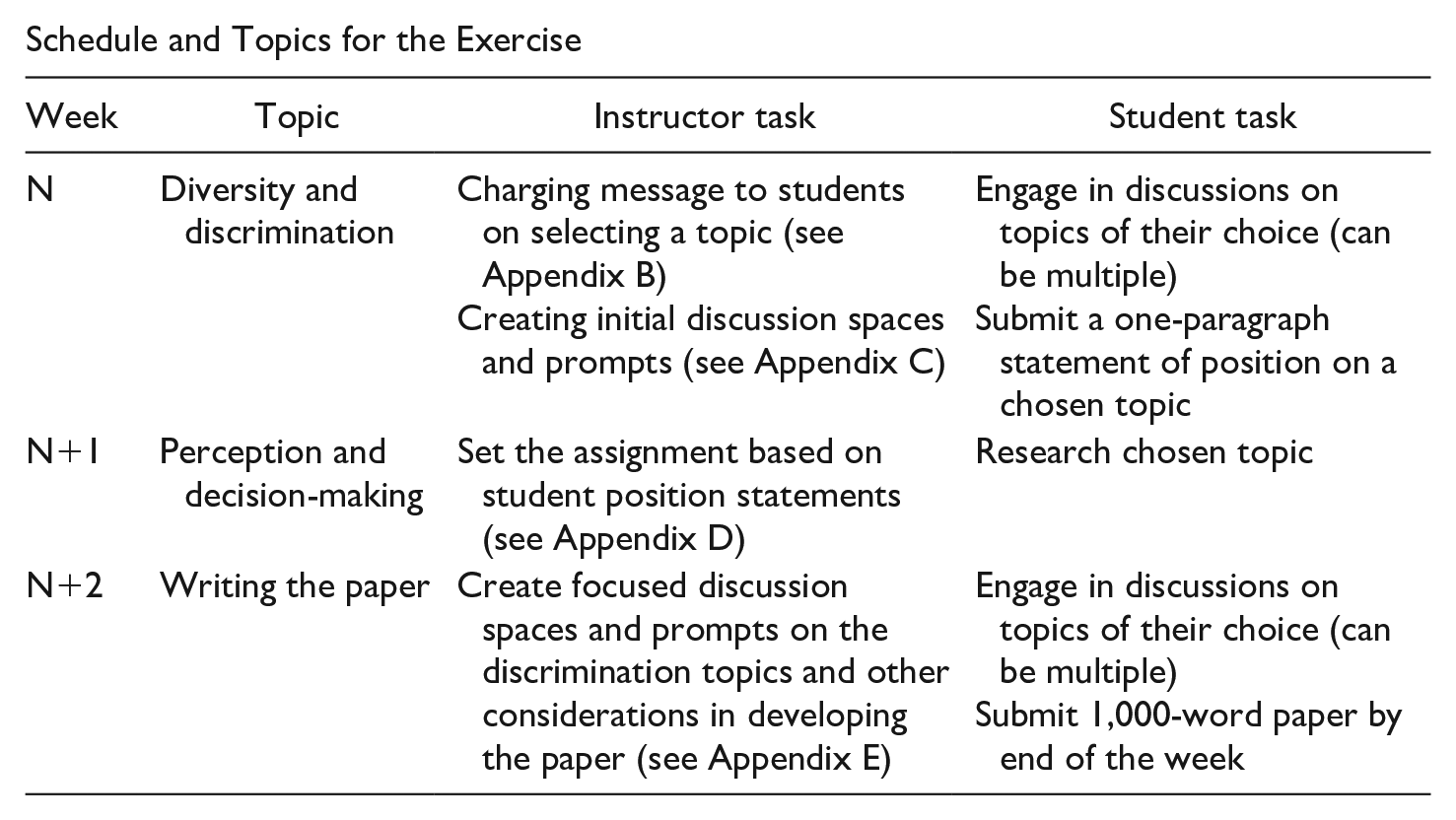
| Week | Topic | Instructor task | Student task |
|---|---|---|---|
| N | Diversity and discrimination | Charging message to students on selecting a topic (see Appendix B) Creating initial discussion spaces and prompts (see Appendix C) |
Engage in discussions on topics of their choice (can be multiple) Submit a one-paragraph statement of position on a chosen topic |
| N+1 | Perception and decision-making | Set the assignment based on student position statements (see Appendix D) | Research chosen topic |
| N+2 | Writing the paper | Create focused discussion spaces and prompts on the discrimination topics and other considerations in developing the paper (see Appendix E) | Engage in discussions on topics of their choice (can be multiple) Submit 1,000-word paper by end of the week |
Appendix B
Appendix C
Appendix D
Appendix E
Appendix F
Rubric for the Assignment.
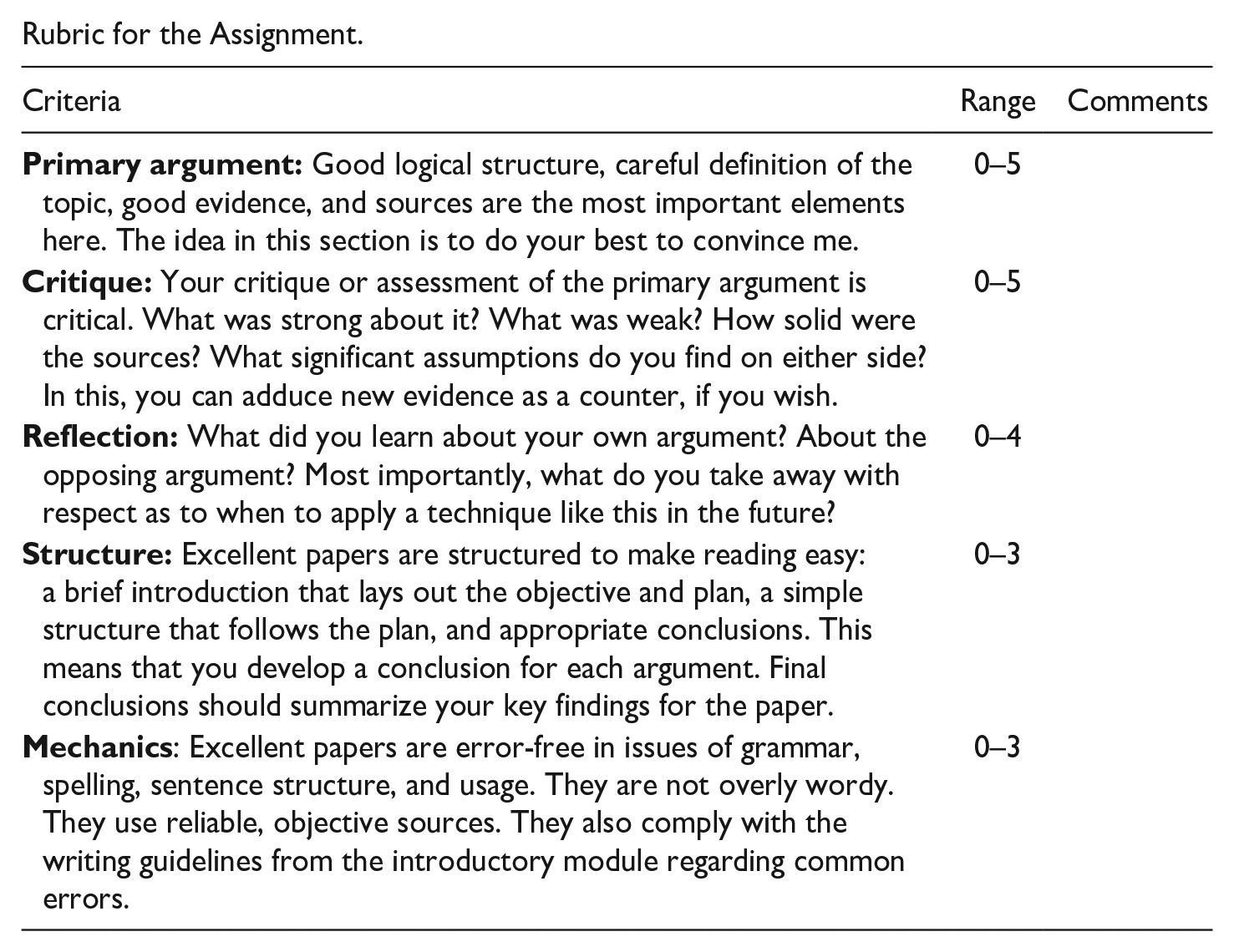
| Criteria | Range | Comments |
|---|---|---|
| 0–5 | ||
| 0–5 | ||
| 0–4 | ||
| 0–3 | ||
| 0–3 |
Declaration of Conflicting Interests
The author declared no potential conflicts of interest with respect to the research, authorship, and/or publication of this article.
Funding
The author received no financial support for the research, authorship, and/or publication of this article.
