



Abstract
Delivering bad news is an inevitable aspect of management. Teaching students to deliver bad news effectively and professionally can be successfully implemented into a course that addresses elements of managerial communication. In this article, we explain an experiential exercise that applies components of a three-phase model for delivering bad news. This exercise challenges students, working in groups, to plan and craft the text of an email message that delivers bad news and then to write a response to that message from the perspective of the participant. Students then analyze how other groups handled the same scenario. The exercise may fit with instruction about tone and word choice in written communication, especially as it relates to delivering bad news. The four-step exercise can be used in an undergraduate- or graduate-level course. Recommendations for adapting the exercise to the online environment are included.
Managers are often tasked with delivering bad news to direct reports, suppliers, customers, coworkers, or upper management (Bell et al., 2020; Engels, 2007; Hillebrandt et al., 2021) but are frequently unprepared for this challenging responsibility (Richter et al., 2016). Bad news is defined as “information that results in a perceived loss by the receiver, and it creates cognitive, emotional, or behavioral deficits in the receiver after receiving the news” (Bies, 2013, pp. 137–138). Such situations may involve issues of performance management, product creation or delivery, expectations surrounding deliverables, changes in benefits, and many other managerial responsibilities (Kingsley Westerman et al., 2018; von Bergen & Thompson, 2010). When delivering bad news, both in written form and verbally, the manager delivering the bad news must match the message’s tone to the circumstances of the situation and tailor the message to the particular audience receiving it.
Although the literature reveals that delivering bad news verbally can be more persuasive and more effective in maintaining personal relationships than delivering bad news by email (Jansen & Janssen, 2013), email is sometimes the only option available for managers. This experiential exercise teaches how to deliver effectively written bad news messages. In this exercise, students craft emails in response to a challenging fictitious business scenario and employ principles of using appropriate tone in managerial communication. The exercise is designed for use in an undergraduate- or graduate-level course in management or organizational behavior that emphasizes managerial communication. This article provides several possible fictitious scenarios to use in the exercise, describes how the exercise can be implemented in a classroom, and includes suggestions for adapting the exercise for the online environment.
Theoretical Foundation
Experiential learning techniques are used to help managers and medical professionals develop the skills of delivering bad news through a variety of means. These include improvisational theater (Kukora et al., 2020), role-plays (Baer et al., 2008), simulations (MacLaine et al., 2021), and video recordings (Kiluk et al., 2012). This experiential exercise allows participants to practice delivering bad news through written messages and is grounded in Bies’s (2013) framework for delivering bad news. This framework describes the delivery of bad news as a process that involves three phases: preparation, delivery, and transition. Each phase includes multiple activities.
Specifically, the preparation phase encompasses those actions taken prior to the delivery of the bad news. According to Bies (2013), these actions include giving advanced warning, creating a “paper trail,” calibrating expectations, using disclaimers, and providing the opportunity for voice, coalition building, and rehearsal. The delivery phase entails those actions taken during the actual delivery of the message, including the timing of the delivery, the medium of the delivery, face management and self-preservation, account giving, truth telling, and the disclosure of information. The final phase, transition, includes the actions taken after the message has been delivered. These actions are engaging in public relations, providing an appeal procedure, scapegoating, and caretaking and parting ceremonies (Bies, 2013).
This exercise incorporates these three phases and encourages students to apply some of the specific actions involved in each phase.
Learning Objectives
At the end of the exercise, students should be able to:
Apply the three phases of the Bies (2013) framework by crafting email messages involving bad news with appropriate tone.
Identify multiple approaches to writing an email in response to the same business situation.
Instructions for the Exercise
This exercise is designed to help students learn to deliver bad news through email by placing themselves in the position of both the sender and the receiver of the bad news message. In advance of conducting this exercise, teach the steps of the Bies (2013) model (preparation, delivery, and transition), discuss the importance of tone in written communication, and review best practices for wording effective emails (see Appendix A). In addition, discuss situations when email may not be the ideal method for delivering bad news—such as providing corrective feedback to an employee or announcing the termination of employment—even if it may be the best or only option available, especially in a remote work environment.
This experiential exercise allows students to apply the basics of effective email writing taught in prior class sessions. Using a fictitious business scenario, students collaborate in groups to craft two different email messages that require them to analyze the situation from the points of view of the sender and the receiver. Students also have the opportunity to read the emails written by other groups to identify alternative approaches to handling the same scenario.
Logistics of the Exercise
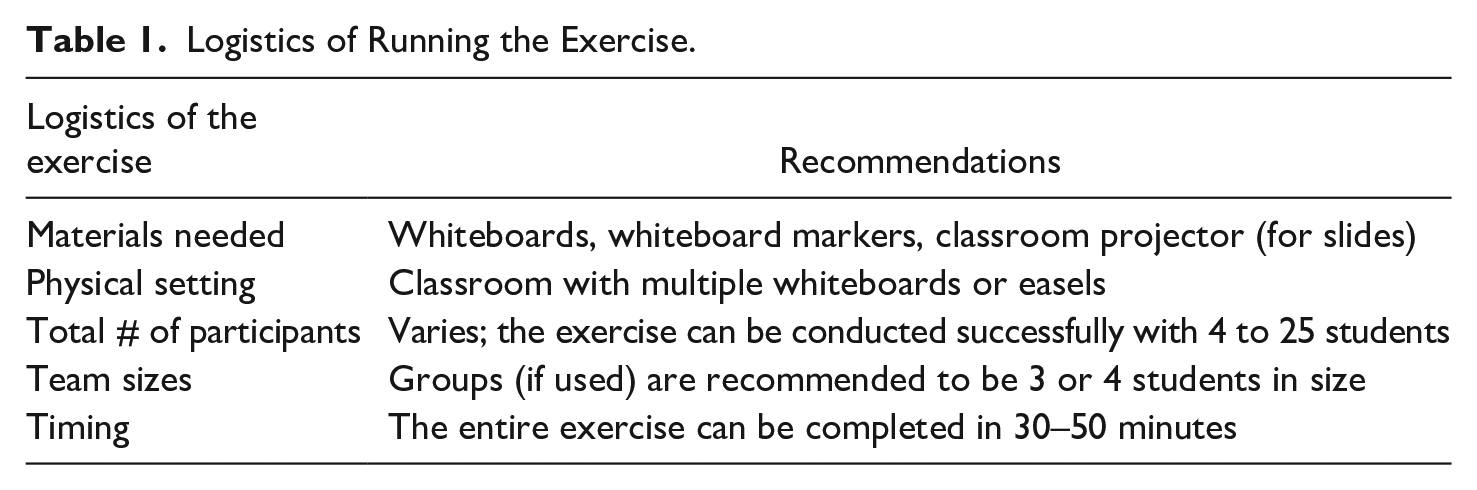
The exercise requires some preparation on the part of the instructor. To allow students to easily view each others’ email responses, the exercise is best conducted in a classroom with multiple whiteboards (either stationary or portable) or large easels on which students can write. For each whiteboard or easel, ideally there should be multiple colored markers.
The exercise can be run with a class as small as four students or as large as 25 (or more) students. If the class size is small, organizing students into groups is not necessary. However, if groups are used, limit these groups to three or four students, if possible, to maximize student involvement in crafting the emails. Logistics of the exercise are summarized in Table 1.
Logistics of Running the Exercise.
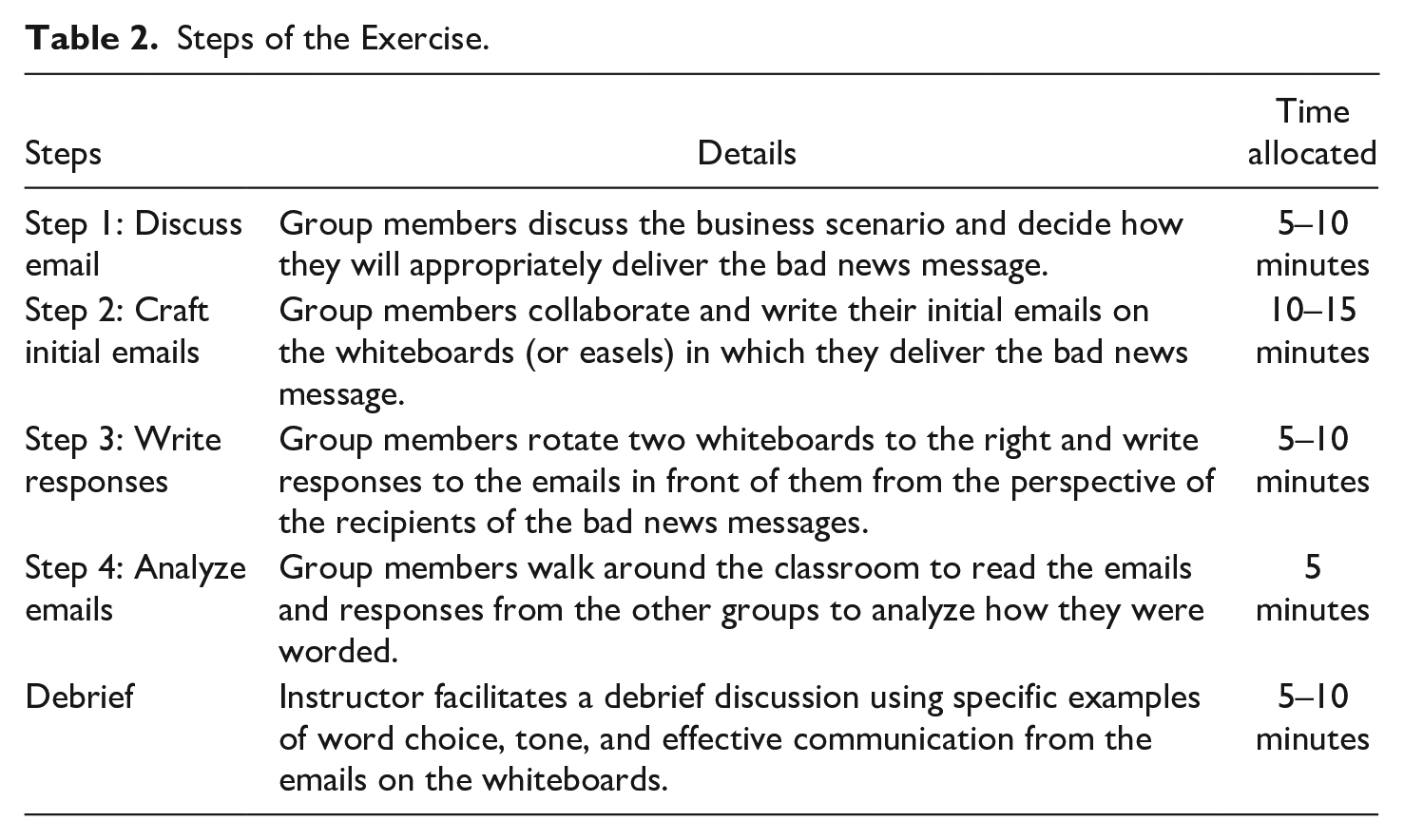
The exercise has four steps, not counting the debrief session. If groups are desired for the exercise, break students into the groups before proceeding further.
Step 1
After groups are selected, introduce group members to the fictitious scenario selected from the options in Appendix B (or another scenario). These scenarios are available as supplementary material. Allocate 5 to 10 minutes for group members to discuss the scenario and to determine how they will write an email that delivers the bad news message. In line with the preparation phrase of Bies’s (2013) framework, instruct students to use this planning time to select wording that can maintain the relationship with the recipient as they consider the perspective of the recipient.
Step 2
Give group members 10 to 15 minutes to write their emails on their whiteboards or easels. Remind students to format their communication as a formal email, including a formal salutation and a subject line. Explain to the students that they have now moved into the delivery phase of Bies’s (2013) framework. Give students editorial license to make up details of the situations they have been assigned, such as industries, company names, and so on.
Step 3
Once all groups have completed their emails, instruct group members to rotate two whiteboards (or easels) to the right in the classroom. This rotation encourages physical movement and reduces the likelihood that students will be assigned to an email message from a different group that they might have read during Step 2. Instruct groups to now reply to the emails on the whiteboards in front of them. Ask each group to write its response from the perspective of the person(s) who received the bad news. Allot 5 to 10 minutes for this step.
Step 4
After all groups finish writing their email responses, encourage students to walk around the classroom and read the emails and the responses from each group, noting examples of effective and ineffective use of tone and word choice. Allow up to 5 minutes for this step, depending on the number of students in the class and the number of emails to be read. (See Appendix C for examples of student emails written for this exercise.)
These four steps and the recommended timing are summarized in Table 2.
Steps of the Exercise.
Debriefing the Exercise
A debriefing session follows the completion of Step 4. The debriefing session is the best opportunity to review and discuss the three phases of Bies’s (2013) framework. The debrief is also the ideal time to focus on the third and final phase: transition phase. In the language of Bies (2013), one of the actions of the transition phase is “providing an appeal procedure” (p. 148); in other words, allowing the recipient of the message to appeal the decision taken. The responses from the recipient(s) in Step 3 afforded students this opportunity to apply this appeal procedure. Also included in the transition phase is repairing any damage done to the relationship after the delivery of bad news (what Bies [2013] referred to as “engaging in public relations” [p. 147]).
To this end, facilitate a 5- to 10-minute discussion around questions such as these:
What evidence of effective preparation did you see in the emails?
What examples of effective communication and tone did you see? What made these emails effective?
How did the groups differ in their responses to the same situation?
What long-standing relationship issues—good or bad—may result between the two parties because of this bad news?
Is there any wording that might provoke an angry or defensive response from the recipient?
Is there any wording that may avoid or ameliorate bad feelings or a defensive response?
Student responses to the above questions vary; however, it is common for students to pinpoint specific phrases in the emails that demonstrate empathy for the recipients of the messages. Frequently, students will identify word choice such as “we regret to inform you,” “we appreciate your effort,” or “we recognize the position this change puts you in” as examples of effective tone. Typically, a casual tone to an email or a lack of a justification for the decision will prompt students to say that the wording could cause bad feelings or damage long-standing relationships.
When students identify potentially harmful wording, consider discussing with them what specific changes could be made to the wording. We have found it most helpful to do this by highlighting words and phrases in the students’ emails in a different color of whiteboard marker. Using a different color allows the instructor feedback to be easily viewed and differentiated from the original emails themselves, especially in a larger classroom.
Online Variations
The exercise as outlined is intended to be taught in a classroom setting with whiteboards and involves physical movement around the room. The exercise can be successfully modified for the synchronous or asynchronous online environment, however, with some variations. See Appendix D for suggestions on how the exercise may be conducted online.
Conclusion
This exercise allows students the opportunity to apply the three phases of Bies’s (2013) framework of delivering difficult messages: preparation, delivery, and transition. As many students in management and leadership courses will someday serve as supervisors and managers themselves, practicing these phases in an experiential exercise like this one will help them develop the managerial communication skills they will need to deliver bad news in the future, an inevitable aspect of management (Bell et al., 2020; Engels, 2007; Hillebrandt et al., 2021).
Supplemental Material
sj-docx-1-mtr-10.1177_23792981221102525 – Supplemental material for Crafting a Bad News Email: An Exercise in Managerial Communication
Supplemental material, sj-docx-1-mtr-10.1177_23792981221102525 for Crafting a Bad News Email: An Exercise in Managerial Communication by Scott Springer and Ann Springer in Management Teaching Review
Supplemental Material
sj-pptx-1-mtr-10.1177_23792981221102525 – Supplemental material for Crafting a Bad News Email: An Exercise in Managerial Communication
Supplemental material, sj-pptx-1-mtr-10.1177_23792981221102525 for Crafting a Bad News Email: An Exercise in Managerial Communication by Scott Springer and Ann Springer in Management Teaching Review
Footnotes
Appendix A
Appendix B
Appendix C
Appendix D
Authors’ Note
This exercise was presented at the Management & Organizational Behavior Teaching Society’s 2019 annual meeting.
Declaration of Conflicting Interests
The authors declared no potential conflicts of interest with respect to the research, authorship, and/or publication of this article.
Funding
The authors received no financial support for the research, authorship, and/or publication of this article.

References
Supplementary Material
Please find the following supplemental material available below.
For Open Access articles published under a Creative Commons License, all supplemental material carries the same license as the article it is associated with.
For non-Open Access articles published, all supplemental material carries a non-exclusive license, and permission requests for re-use of supplemental material or any part of supplemental material shall be sent directly to the copyright owner as specified in the copyright notice associated with the article.
