




Abstract
Global value networks are often large, complex, and opaque. Understanding the relationships among stakeholders involved in these networks or organizations can be challenging. This card sort task provides an interactive way to engage participants in questioning the roles of stakeholders who are involved in a business ethics dilemma or an organizational product failure. This card sort task and discussion activity encourages participants to recognize that stakeholders may hold different knowledge, responsibility, or power; identify competing, conflicting, or complementary interests across stakeholders; articulate logical arguments; and engage in debate, compromise, and critical evaluation. This technique has been used successfully with undergraduate and postgraduate business, management, and social science students and is suitable for in-person and remote classes.
Keywords
Businesses are increasingly participants of globe spanning value networks, either as the orchestrating organization, or as the cog that provides essential goods and services. Through their involvement in global value chains (GVCs), businesses are exposed to diverging stakeholder expectations and pressures and to multiple legal, regulatory, and soft law requirements. Yet when something goes wrong, the largest company within the network or the supposedly most powerful organization is typically held to account by media, the public, nongovernmental organizations (NGOs), or government. For example, most consumers may expect the fashion brand they buy from to be responsible for working conditions across the whole supply network, for example, to ensure that no child labor is present in the production of their jeans (Enderwick, 2018). How realistic is this expectation when there are many tiers of suppliers involved across different countries, from cotton picking to stitching the pairs of jeans together?
Rather than using heuristics of organizational size, we designed this exercise to challenge pre-conceptions (e.g., that the largest organization always has more power within a value chain). The exercise involves students engaging with a case study that involves multiple stakeholders within a GVC involved in a complex ethical situation. Students work in small groups on a card sort task to identify and understand which actors within the case study’s GVC (and potentially beyond) could be considered accountable, knowledgeable, or able to effect change. Students must discuss and debate to reach a decision within their group and then articulate their position as part of class discussion.
We have designed the exercise to be flexible, and it can be applied to a wide range of case studies and problems. The exercise is suitable for Business Ethics, Corporate Social Responsibility, International Business, and Supply Chain undergraduate and postgraduate courses. With a single instructor the exercise can be run with eight to 40 students. The exercise can be run in a single 60-minute session, extended to 90 minutes, or divided across three sessions. While the activity has been delivered with an online class, the available virtual learning platform may reduce the interactive nature of the card sort task, and therefore, in-person delivery is recommended.
We originally developed this exercise as part of an international multidisciplinary research project. Our research explored how modern slavery was identified and tackled within GVCs, and we used this exercise with an international fashion GVC from retailers in the United Kingdom through to small scale cotton spinners in India, including policy makers and NGOs from both countries. We have used the activity successfully in the United Kingdom with Japanese pupils, undergraduate students from management and social science backgrounds, international business masters students, and at international management conferences with academic colleagues.
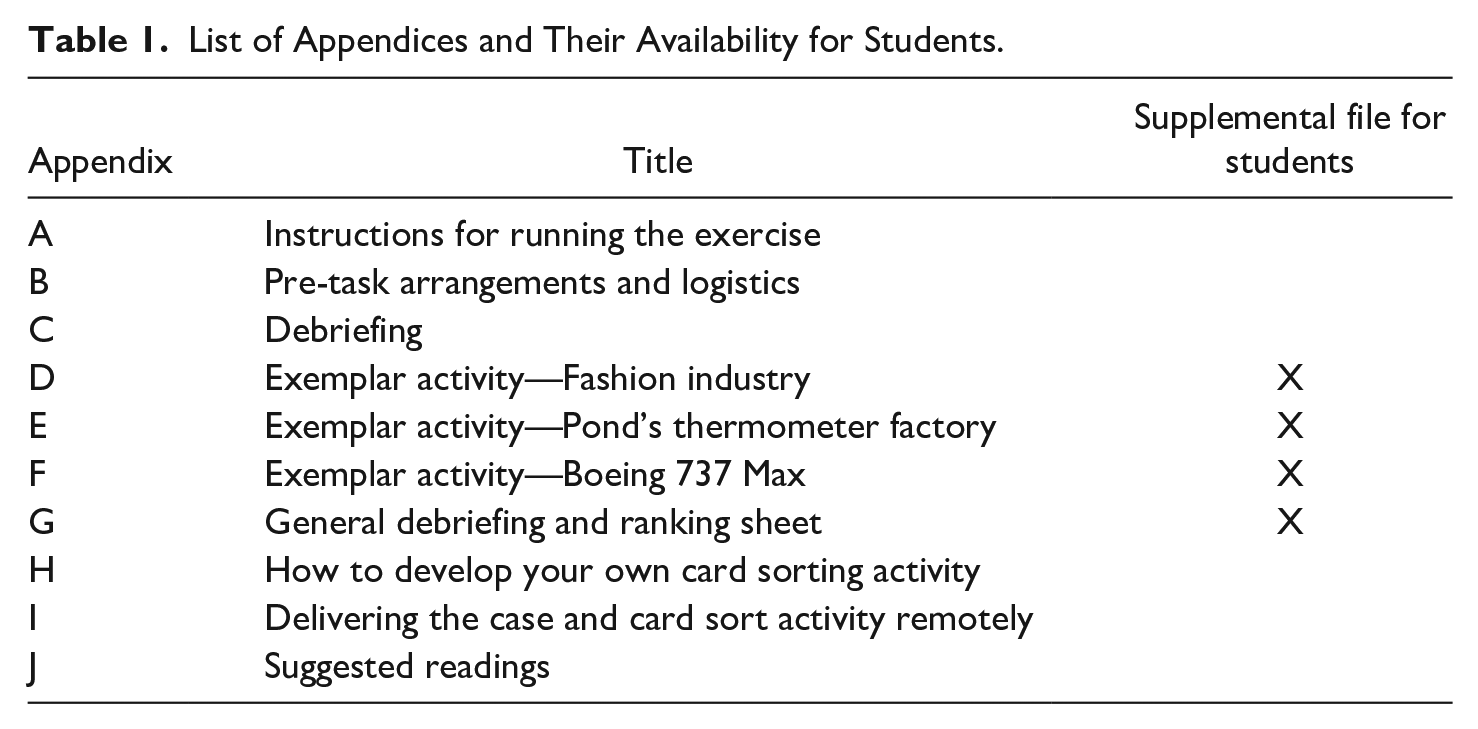
In the appendices, we provide detailed instructions on how to set up, run, and debrief the activity (A–C), examples of activities relating to the fashion industry, the Boeing 737 Max, and a polluting factory in India (D–F), a general debrief and ranking sheet (G), as well as instructions how to create your own card sorting activity (H) and how to use the activity remotely (I) (see Table 1).
List of Appendices and Their Availability for Students.
Stakeholder Theory
The card sorting task is based on an understanding of the role of and relationships between stakeholders in global value networks. The dimensions of knowledge, responsibility, and power have been identified as key distinctions between stakeholders within GVCs (cf. Enderwick, 2018; Gereffi et al., 2005). This brief about stakeholder theory will familiarize participants and facilitators with essential tenets of the theory.
Stakeholder theory was proposed by Freeman (1984) as a broader and more pluralistic approach to managing organizations. He emphasized the potential value organizations can create when they know and work collaboratively with their stakeholders. The stakeholder perspective argues that stakeholders include employees, investors, shareholders, customers, business partners, and societal stakeholders that represent the natural environment, local communities, government agencies, media, and academia (Birte et al., 2020; Bocken et al., 2013). These stakeholders can be situated close to a company’s headquarters or be globally dispersed along the global value network of the company, including the production, consumption, and recycling/disposing of the goods and services the organization provides. Consequently, a firm’s stakeholders may reside in countries where the company does not operate/produce/sell but where its waste is washed up or the impact of its services is felt. The theory thus argues that organizations should not solely focus on shareholders and shareholder maximization but consider the interests of all the parties that are directly and indirectly affected by the organization (Freeman et al., 2004).
Donaldson and Preston (1995) categorize stakeholder theory into descriptive, instrumental, and normative aspects. The descriptive aspect focuses on how stakeholders are managed in practice. The instrumental aspect considers only the “primary” stakeholder groups, those with a direct economic connection to the firm such as employees and investors. The normative aspect is rooted in the moral intuition that believes a firm’s responsibilities to its various stakeholders should go significantly beyond what is accepted by contemporary shareholder/stockholder approaches. Donaldson and Preston (1995) claim that the normative aspect of stakeholder theory is its core and that the other aspects of the theory play a subordinate role.
An organization can, and should, maintain support from its stakeholders by considering and balancing their relevant interests (Reynolds et al., 2006). Organizations need to understand that some stakeholders, at a certain point in time and space, are more influential and relevant than others and that the amount of influence may change through interactions with stakeholders or through externalities and wider institutional support (Friedman & Miles, 2002). Identification of relevant stakeholders is therefore a key issue. Because organizations encounter a multitude of stakeholders with varying and at times conflicting interests, understanding which stakeholders to prioritize at any given time is a challenging task that can be assisted by the identification of salient stakeholders (Mitchell et al., 1997).
A variety of approaches exist to help identify key stakeholders and inform judgments regarding prioritization of interests. For example, Mitchell et al. (1997) provide a framework of urgency, legitimacy, and power to support the identification of salient stakeholders. Alternatively, Reynolds et al. (2006) present two methods (within-decision approach and across-decision approach) to identify stakeholder interests and impacts. The within-decision approach considers every decision as singular and independent units whereas the across-decision approach balances stakeholder interests across the system (a series of decisions over time) rather than on a decision-by-decision basis (for further suggested readings, see Appendix J).
Learning Objectives
After participating in this exercise, students will be able to:
Identify examples of salient stakeholders within a specific GVC.
Assess and compare the different levels of knowledge, responsibility, or power held by stakeholders within a GVC.
Identify competing, conflicting, or complementary interests across stakeholders.
Develop and articulate logical arguments regarding attribution of knowledge, responsibility, and power of specific stakeholders in a GVC.
Exercise Overview
The exercise utilizes a card sorting methodology, which has been used extensively in psychological research to study managers’ decision making, belief structures, and mental models (e.g., Barnett, 2008; Budhwar, 2000; Hodgkinson et al., 2004; Lantz et al., 2019). Card sorting tasks require participants to sort cards, each labeled with one item such as tasks, objects, stakeholders, scenarios, or outcomes. Participants are instructed to sort the cards in a specific manner, for example, to indicate the different levels of responsibility of stakeholders in a supply chain (see Appendix A). The approach forces participants to make discrete choices between options and construct hierarchies and can be used to prompt reflection on unconscious beliefs or knowledge that drive decision making and the assumptions held on particular problems or topics.
The exercise involves participants reading a case study ahead of the exercise relating to a business problem or failure that involves a complex GVC or diverse set of stakeholders. Participants work in small groups to identify key stakeholders in the case who may have any knowledge, responsibility, and power regarding the situation. Participants are required to debate the role of the different stakeholders within their groups and to come to a shared agreement regarding the rank order of the stakeholders (from most to least knowledgeable, responsible, and powerful). Participants record their rankings and share and justify their decisions as part of a class discussion. The rankings help participants to recognize where they have made contradictory evaluations. The exercise requires participants to articulate logical arguments and engage in debate, compromise, and critical evaluation.
Debriefing
The debriefing provides an opportunity for participants to deepen their understanding of the competing interests and tensions within supply chains or among stakeholders by drawing out tensions between knowledge, responsibility, and power; to highlight the individual differences that arise regarding these attributions; and to identify competing, conflicting or complementary interests across stakeholders. It also provides an opportunity to follow up on the industry or topic specific nature of the case study, for example, to provide additional context or to link back to other course material. The debriefing can follow a three-step approach: ask participants about any additional stakeholders they added using the blank cards and discuss why they did so; ask how they attributed knowledge, responsibility, and power to stakeholders and how they justify the allocation; and, finally, recognize and highlight the diversity of perspectives on ethics and responsibility (see Appendix C).
Variations
Single or Multiple Sessions
The activity can be executed in one session or over three sessions. If the activity is conducted within a single session, then at least 60 minutes are suggested for briefing, the activity, discussion, and debriefing. Ask students to familiarize themselves with the case material in advance. When the activity is spread over three sessions, then focus each session on one of the three dimensions (knowledge, responsibility, or power). Spreading the activity over multiple sessions allows focus on one dimension and thus usually results in deeper discussion.
Practical Actions
We have extended the activity in some classes to include an additional small group discussion task after the third card sort in which we ask participants to consider what practical steps could be taken to address the focal problem. For example, what practical actions could be taken, and who should do these, to reduce modern slavery within t-shirt production?
Student Led
Set teams, or individual students, the task of researching a GVC and identifying five to 10 stakeholders. Students could then lead their peers through the card sort activity—providing a summary of their GVC, creating a card deck, leading the card sort, and then asking debrief questions supported by the instructor (see Appendix H).
Online Teaching
The activity is suitable for in-person and remote classes (see Appendix I).
Conclusion
This card sorting exercise sensitizes students to such situations by forcing them to take a step back to question their own assumptions and those of other students, discover the assumptions and objectives of stakeholders discussed, and identify relationships and interdependencies between the categories. The tasks involved in this exercise are thus a great stimulus for sensemaking of the business environment firms operate in and allow for a re-assessment of the framing they have used to understand business operations, GVCs, and the role of stakeholders.
Supplemental Material
sj-docx-1-mtr-10.1177_23792981211054848 – Supplemental material for Sorting It Out: Identifying and Addressing Conflicts and Business Ethics in Global Value Networks
Supplemental material, sj-docx-1-mtr-10.1177_23792981211054848 for Sorting It Out: Identifying and Addressing Conflicts and Business Ethics in Global Value Networks by Matthew C. Davis, Hinrich Voss, Mark P. Sumner and Divya Singhal in Management Teaching Review
Supplemental Material
sj-docx-2-mtr-10.1177_23792981211054848 – Supplemental material for Sorting It Out: Identifying and Addressing Conflicts and Business Ethics in Global Value Networks
Supplemental material, sj-docx-2-mtr-10.1177_23792981211054848 for Sorting It Out: Identifying and Addressing Conflicts and Business Ethics in Global Value Networks by Matthew C. Davis, Hinrich Voss, Mark P. Sumner and Divya Singhal in Management Teaching Review
Supplemental Material
sj-docx-3-mtr-10.1177_23792981211054848 – Supplemental material for Sorting It Out: Identifying and Addressing Conflicts and Business Ethics in Global Value Networks
Supplemental material, sj-docx-3-mtr-10.1177_23792981211054848 for Sorting It Out: Identifying and Addressing Conflicts and Business Ethics in Global Value Networks by Matthew C. Davis, Hinrich Voss, Mark P. Sumner and Divya Singhal in Management Teaching Review
Supplemental Material
sj-docx-4-mtr-10.1177_23792981211054848 – Supplemental material for Sorting It Out: Identifying and Addressing Conflicts and Business Ethics in Global Value Networks
Supplemental material, sj-docx-4-mtr-10.1177_23792981211054848 for Sorting It Out: Identifying and Addressing Conflicts and Business Ethics in Global Value Networks by Matthew C. Davis, Hinrich Voss, Mark P. Sumner and Divya Singhal in Management Teaching Review
Footnotes
Appendix A
Appendix B
Appendix C
Appendix D
Appendix E
Appendix F
Appendix G
Appendix H
Appendix I
Appendix J
Acknowledgements
We thank the British Academy/DfiD for funding the project “Pulling a Thread: Unravelling the Trail of Modern Slavery in the Fashion and Textile Industry” (TS170074) which led to the creation of the card sorting activity and its eventual adaptation in teaching.
Declaration of Conflicting Interests
The authors declared no potential conflicts of interest with respect to the research, authorship, and/or publication of this article.
Funding
The authors received no financial support for the research, authorship, and/or publication of this article.

References
Supplementary Material
Please find the following supplemental material available below.
For Open Access articles published under a Creative Commons License, all supplemental material carries the same license as the article it is associated with.
For non-Open Access articles published, all supplemental material carries a non-exclusive license, and permission requests for re-use of supplemental material or any part of supplemental material shall be sent directly to the copyright owner as specified in the copyright notice associated with the article.
