




Abstract
Tag-team parenting refers to parents who work nonoverlapping or desynchronized schedules and is likely driven by parents’ job demands as well as access to and preferences for nonparental childcare. Dual-earner parents with young children are more likely than other couples to work more desynchronized schedules. Yet little is known as to whether their propensity to work desynchronized schedules has changed over time given vast changes in maternal employment and the early care and education landscape over the past 30 years. Using a sample of dual-earner parents with young children from the Survey of Income and Program Participation, the authors describe and decompose trends in parents’ work schedule synchronization to show whether, and why, tag-team parenting has changed over time in the United States. The results suggest that tag-team parenting declined by 17 percent to 26 percent between 1997 and 2019. However, these declines were concentrated among households with greater social and economic resources. Occupational upgrading among parents, increases in household income, and increases in the availability of publicly funded early education explained the greatest proportion of the decline in desynchronized schedules. These results point to the affordability of childcare and parental employment demands as key determinants of parents’ work schedule synchronization.
Most young children in the United States live in households in which all parents are employed (U.S. Census Bureau 2023). As a result, parental work schedules are central to how families spend their time. In dual-earner households, many parents work synchronized or overlapping schedules that allow them to maximize time with each other and engage in shared parenting of their children. Some parents instead work nonoverlapping schedules (e.g., one parent working standard daytime hours and another working nights), a phenomenon often referred to as “tag-team parenting” (Boushey 2006; Presser 1988, 2003). Parents with young children might choose to tag-team parent because they prefer exclusive parental childcare. Others might do so out of necessity because of a lack of affordable and accessible nonparental childcare, the demands of their job, or inability to find jobs with overlapping schedules.
Work schedule synchronization has implications for child and parental well-being. Tag-team parenting typically requires one parent to work fewer hours and/or to work during nonstandard times—evenings, nights, weekends—which reduces the amount of time available for families to spend together. When mothers work nonstandard schedules, they spend more time alone with their children without their partners present (Gracia and Kalmijn 2016; Lesnard 2008; Pilarz and Awkward-Rich 2024; Wight, Raley, and Bianchi 2008). In turn, parental nonstandard work schedules have been associated with more parental stress and worse mental health (Joshi and Bogen 2007; Perry-Jenkins et al. 2007; Strazdins et al. 2006; Zilanawala and McMunn 2022) as well as poorer child cognitive and socioemotional skills (Dunifon et al. 2013; Han 2005; Han and Fox 2011; Joshi and Bogen 2007; Wang 2023). Even when parents prefer tag-team parenting for their young children, mothers nevertheless describe feeling stressed and exhausted due to insufficient sleep, lack of family time, and time spent solo parenting (Hattery 2001).
Although prior studies have found that a substantial proportion of dual-earner married parents in the United States work desynchronized schedules (Boushey 2006; Hepburn 2018; Presser 2003), these studies have mostly used data from the late 1990s and early 2000s. Furthermore, none have examined recent trends in tag-team parenting. Understanding whether and why parents’ work schedule synchronization has changed since the 1990s given substantial changes in families’ lives can shed light on the factors that shape tag-team parenting. The aim of this study is to fill these gaps by answering the following research questions: (1) What are recent trends in tag-team parenting in the United States? (2) Which families are more likely to engage in tag-team parenting? and (3) What explains changes in tag-team parenting? We answer these questions using a sample of dual-earner parents with young children from the 1996 to 2020 panels of the nationally representative Survey of Income and Program Participation (SIPP). We consider several potential determinants of tag-team parenting related to changes in parents’ employment demands and access to nonparental childcare, as well as demographic shifts. Our findings offer insights into how and why parents’ work schedule synchronization has changed over time.
Conceptual Framework
“Tag-team parenting” refers to desynchronization in parents’ work schedules with respect to the number and timing (e.g., day vs. night shift) of work hours. When parents work similar schedules, families have more opportunities for spending time together. Families might also face fewer logistical challenges creating an equitable division of caregiving responsibilities between parents. Parents who work more dissimilar schedules spend less time together and spend more time alone with their children (Gracia and Kalmijn 2016; Lesnard 2008; Pilarz and Awkward-Rich 2024; Wight et al. 2008). Moreover, when one parent works more hours than the other, there is an inherent imbalance in caregiving responsibilities, which has implications for parents’ employment and earnings trajectories (Musick, Bea, and Gonalons-Pons 2020). Although parents do not spend all their time away from work caring for their young children, the lack of a comprehensive childcare system in the United States, coupled with young children’s need for constant supervision, means that arranging and providing care for children is a central concern and substantial time investment (Calarco 2024; Enchautegui 2013; Pilarz and Awkward-Rich 2024).
We propose that tag-team parenting among dual-earner families is driven by two overarching explanations: (1) parents’ access to and preferences for early care and education (ECE; i.e., childcare and early education programs provided in home-based settings, childcare centers, and schools) and (2) parental employment demands. In this section, we review these explanations and motivate our hypotheses. We hypothesize that, on average, tag-team parenting has declined and that both childcare and parental employment–related factors—namely, improvements in ECE access and occupational upgrading—will help explain hypothesized declines in tag-team parenting. We also hypothesize that tag-team parenting is more prevalent and has declined less among families of color and those with fewer socioeconomic resources.
Childcare Access and Preferences
The more parents’ work schedules overlap, the more nonparental ECE that they need for their young children. One straightforward explanation of tag-team parenting is the high cost of nonparental ECE, especially center-based ECE (Child Care Aware of America 2024). Parents’ desires to minimize ECE costs could explain parents’ decisions to work more desynchronized schedules (Blau 2001; Boushey 2006; Calarco 2024; Hepburn 2018).
Yet beyond the cost of care, a myriad of other factors also matter for parents’ ECE access (Friese et al. 2017). Family needs, parents’ employment demands, social and cultural norms, and the availability and quality of ECE in their communities shape parents’ childcare preferences and decisions (Meyers and Jordan 2006). Licensed and high-quality ECE for infants and toddlers, children with special needs, parents who work nonstandard hours, and families in rural areas is especially scarce (Henly and Adams 2018). Families with multiple children face higher ECE costs and additional barriers, such as finding providers that accommodate all children (Chaudry et al. 2011). Some parents turn to family and friends to provide care, while others do not have this option or avoid it to prevent overtaxing these support systems (Calarco 2024; Henly and Lyons 2000). Parents unable to access affordable ECE that meets their needs might resort to tag-team parenting.
From this perspective, we expect that tag-team parenting might have declined in recent decades because of three key changes that might have improved dual-earner parents’ access to ECE: increases in parents’ socioeconomic resources that make it easier to afford ECE; decreases in parents’ childcare needs; and greater supply of, and public funding for, ECE. With respect to parents’ socioeconomic resources, college completion rates have increased steadily over the past few decades (England, Levine, and Mishel 2020), and parents with a college degree are also much more likely to be married to similarly educated parents (Hirschl, Schwartz, and Boschetti 2024; Schwartz and Mare 2005). Increases in mothers’ education and earnings have contributed, in part, to increases in family income in dual-earner parent households (Blau and Winkler 2017; Fox et al. 2012; Kearney, Hershbein, and Jácome 2015). Parents with higher levels of education and income are more likely to use nonparental and center-based ECE (Coley et al. 2014). Parents with the highest incomes have also dramatically increased spending on formal ECE since the 1990s (Kornrich 2016). These shifts suggest that more dual-earner parents are better able to afford nonparental ECE and, in turn, rely less on tag-team parenting than in the past.
Furthermore, parents’ childcare needs have likely decreased because of demographic shifts. A decline in fertility since 2007 means that two-parent families have fewer children (Smock and Schwartz 2020) and, consequently, lower childcare costs. These fertility declines are concentrated among women younger than 30 years, as births to women 30 years and older have stayed stable or risen (Kearney, Levine, and Pardue 2022; Smock and Schwartz 2020). Women with higher levels of education delay childbirth and have fewer children than those with lower levels of education; however, these trends have remained parallel over time, with some evidence of increases in fertility among the most highly educated women (Hazan and Zoabi 2015). When women, especially higher educated women who work higher paying jobs, delay childbearing, they have more economic resources with which to pay for childcare (Hazan and Zoabi 2015). On the whole, these changes in fertility suggest that tag-team parenting might have declined.
An increase in three-generation households since 1996 also has implications for tag-team parenting (Pilkauskas, Amorim, and Dunifon 2020; Pilkauskas and Cross 2018). On one hand, having more adults in the household available to provide care suggests less of a need for tag-team parenting. On the other hand, elderly grandparents might need care themselves (Dukhovnov and Zagheni 2015; Friedman, Park, and Wiemers 2017), potentially increasing care needs and parents’ use of tag-team parenting. Families might experience something in between, with grandparents able to provide some childcare while also requiring care themselves. We hypothesize that, on average, the rise in multigenerational households would reduce tag-team parenting by increasing the availability of nonparental caregivers in the household.
At the same time, changes in the childcare market have likely increased the availability of ECE during the day, when parents’ work hours are most likely to overlap, while decreasing ECE available during nonstandard hours. Growth in the supply of center-based ECE (Bassok, Fitzpatrick, and Loeb 2011; Phillips et al. 2018) and improvements in the qualifications of the center-based ECE workforce (Phillips et al. 2019) suggest parents have more and higher quality center-based ECE options, which are typically only available during weekday, daytime hours. Meanwhile, the supply of family childcare providers, which are more likely to offer care during nonstandard times, has declined (National Survey of Early Care and Education 2021).
Additionally, increases in public spending on ECE have improved ECE affordability. Government spending on childcare subsidy, Head Start, and state public prekindergarten programs increased dramatically in the 1990s and 2000s (Magnuson and Shager 2010). These investments increased low-income children’s participation in center-based ECE (Greenberg 2010; Magnuson, Meyers, and Waldfogel 2007). Nevertheless, these programs serve a minority of eligible families (Administration for Children and Families 2022; Chien 2024), and families with fewer socioeconomic resources continue to use center-based ECE at lower rates than families with more resources (Flood et al. 2022; Hardy and Park 2022). Altogether, we would expect that increased availability and affordability of center-based ECE would lead to a decline in tag-team parenting overall. However, families with fewer socioeconomic resources might continue to be more reliant on tag-team parenting because of the (un)affordability of ECE.
Another reason parents might engage in tag-team parenting is that they prefer parental care when children are young and purposefully work desynchronized schedules to minimize nonparental ECE. For some parents, tag-team parenting is the “preferred” childcare arrangement rather than the result of inaccessible nonparental ECE (Hattery 2001). Measuring parents’ “ideal” childcare preferences is difficult because preferences are dynamic and shaped in part by the local childcare market context (Chaudry 2004; Chaudry et al. 2011); parents’ preferences are expected to shift as better childcare options emerge, children grow older, and families’ needs change (Chaudry, Henly, and Meyers 2010; Meyers and Jordan 2006). We hypothesize that increases in the supply of higher quality ECE would shift parents’ preferences away from tag-team parenting and toward nonparental ECE.
Because of a lack of data, it is difficult to quantify how many families might engage in tag-team parenting because it is their preferred arrangement. In 2019, approximately 14 percent of U.S. mothers who worked a nonstandard schedule did so for “better childcare arrangements,” which may or may not refer to exclusive parental care (Pilarz and Walther 2025). In other studies, parents often report preferring exclusive parental or relative care for infants and center-based ECE for preschoolers (Sandstrom et al. 2024), suggesting that preferences for tag-team parenting are most relevant for parents of infants. Because we lack data on childcare preferences and because preferences themselves are shaped by contextual factors, this study focuses on family-level and contextual factors related to parents’ ECE access.
Parental Employment
Besides access to childcare, parents’ work schedule synchronization might be driven by their employment demands. Whereas some parents might choose to work more desynchronized schedules by selecting into jobs with a particular type of schedule or with schedule flexibility, others might be pushed into tag-team parenting because their job requires that they work part-time or nonstandard schedules. Indeed, most parents who work nonstandard schedules report doing so for involuntary reasons, such as it being a requirement of the job (Enchautegui, Johnson, and Gelatt 2015; Pilarz and Walther 2025; Presser 2003).
Changing trends in parents’ occupations and employment arrangements suggest that mothers are increasingly likely to work full-time, daytime schedules concurrently with their partners, which would decrease tag-team parenting. Since the 1990s, women’s employment in full-time, full-year jobs has increased (Kearney et al. 2015). Women have made substantial gains in employment in managerial and professional occupations, which include higher paying and higher prestige jobs. These jobs tend to provide workers with more flexibility but are also more likely to require full-time, daytime schedules and have the lowest rates of nonstandard work schedules (Blau and Kahn 2017; Gerstel and Clawson 2018; Pilarz and Walther 2025; Presser 1995), which might limit tag-team parenting. Gains in occupational upgrading, however, have been concentrated among women with a college degree while women (and men) without a college degree have experienced shifts into lower paying and lower quality service jobs (Kearney et al. 2015). Therefore, occupational upgrading among parents points to a decline in tag-team parenting that is concentrated among mothers with higher levels of education and those working in managerial and professional occupations.
Concurrently, the rise in “just-in-time” scheduling practices in the low-wage service sector has contributed to work schedules marked by instability, unpredictability, inflexibility, and limited worker input (Henly, Lambert, and Dresser 2021; Lambert 2008; Schneider and Harknett 2019). These types of schedules might make it difficult for parents to coordinate their work schedules (Carrillo et al. 2017; Harknett, Schneider, and Luhr 2022). Furthermore, if these jobs are more likely to provide only part-time hours or require work during nonstandard times, parents might be more likely to work desynchronized schedules involuntarily. The likelihood of being assigned these schedules falls disproportionately on workers with lower levels of education and workers of color, who are overrepresented in low-paying service sector jobs (Branch and Hanley 2017; Gerstel and Clawson 2018; Golden and Kim 2020; Presser and Ward 2011; Storer, Schneider, and Harknett 2020). Indeed, since the 1990s, the prevalence of nonstandard work schedules has decreased among White, married, and college-educated mothers; meanwhile, nonstandard schedules have decreased less, or even increased, among Black, single, and less educated mothers (Hepburn 2020; Pilarz and Walther 2025). Thus, for parents without college degrees, parents of color, and those employed in the service sector, tag-team parenting might not have declined and might even have increased. In sum, shifts in parents’ occupations and growing inequality in the labor market suggest that these changes would lead to greater disparities in the prevalence of tag-team parenting across parental education and race and ethnicity.
Prior Research on Tag-Team Parenting
Studies have consistently found that dual-earner parents have more dissimilar schedules compared with dual-earner couples without children across multiple countries, including the United States, France, Australia, the Netherlands, and the United Kingdom (Boushey 2006; Chenu and Robinson 2002; Hallberg 2003; Hamermesh 2000; Jenkins and Osberg 2004; Presser 2003; Van Klaveren and Van Den Brink 2007; Venn 2004). In a comparative study, Carriero, Ghysels, and Van Klaveren (2009) found that parents’ work schedule coordination varied across countries. Whereas dual-earner parents in Italy and Belgium coordinated their schedules to increase work-time overlap (defined as the number of hours per week in which both parents are working), those in the Netherlands tended to coordinate their work schedules to reduce work-time overlap. The authors suggest these cross-country differences might stem from differences in childcare availability and affordability.
In the United States, Presser’s (2003) foundational work on nonstandard work schedules examined overlap in dual-earner, married couples’ work schedules using data from the 1997 Current Population Survey. Presser estimated the proportion of couples working split-shifts, meaning both parents do not work a fixed day shift and thus have the potential to tag-team parent. She found that as many as 60 percent of couples with children younger than five years have at least one spouse who works nonstandard hours or weekends, and low family income further heightened this risk. However, this analysis was unable to examine synchronization in both the number and timing of parents’ work hours.
Boushey (2006) expanded on Presser’s (2003) work by using a more nuanced measure of work schedule synchronization among dual-earner married couples in the 1996 and 2001 panels of the SIPP. The dissimilarity index (DI) considers both the amount of (dis)similarity in the timing of work schedules (i.e., extent to which couples work during the same times of the day) and similarity in the number of work hours (i.e., extent to which couples work the same number of hours) (Chenu and Robinson 2002). The average DI among dual-earner, married parents was highest among those with children younger than six years. Boushey also found more dissimilarity in work schedules among less educated, lower income, younger families, and families of color. However, the study did not consider other potential correlates or explanations, such as parents’ occupations or childcare availability, nor examine trends in schedule synchronization.
More recently, Hepburn (2018) examined measures of work-time overlap and DI among dual-earner couples with children younger than 13 years using two distinct data sources from 1990 and 2012. Results reinforce previous findings that parents with lower incomes and lower levels of education work more dissimilar schedules. However, the study found no change in the level of work schedule synchronization between these two time points. Parents of school-age children face different time constraints than those with younger children because school attendance essentially provides several hours per weekday of free childcare, which reduces the amount of nonparental childcare parents need (Gibbs, Wikle, and Wilson 2025; Ruppanner, Moller, and Sayer 2019). Therefore, findings that combine young and school-age children might mask heterogeneity in trends in tag-team parenting between the two groups.
In sum, although prior studies provide point-in-time estimates of tag-team parenting, these estimates are outdated, are missing key determinants of tag-team parenting, and cannot explain how or why tag-team parenting has changed among dual-earner parents with young children. We address limitations of prior research by documenting trends in tag-team parenting in the United States between 1997 and 2019 using data from a nationally representative sample of dual-earner households from the SIPP. After describing overall trends, we examine which families have more desynchronized schedules and whether these patterns have changed over time. Next, we decompose trends in parents’ work schedule synchronization focusing on factors related to our two hypothesized explanations for tag-team parenting—changes in parents’ access to nonparental ECE and parental employment demands—as well as demographic shifts. In addressing these research questions, our study sheds light on the motivations for tag-team parenting among dual-earner parents with young children in the United States.
Method
Data and Sample
The SIPP is a household-based survey that uses a continuous series of national panels. Each panel includes a nationally representative sample of households (n ≈ 14,000–52,000 households) that is interviewed multiple times over a period of approximately four years. In the 1996 to 2008 panels, the SIPP interviewed households approximately three times per year and collected information about work schedules using a work schedule topical module, which was administered during one or multiples waves of a panel between 1996 and 2011. Beginning in 2014, the SIPP was redesigned to interview households once per year, and the work schedule questions were moved to the core questionnaire. After the redesign, the SIPP continued collecting similar items about work hours and schedules for all household members aged 15 years or older. To make the data as comparable as possible across panels, we appended observations from the reference month of the work schedule topical module waves in the 1996 to 2008 panels to observations from the reference month of the 2014 to 2020 panels. This created a repeated cross-sectional sample of parents interviewed at various points between 1997 and 2019. Our observation period ended in 2019 (data collected in the 2020 SIPP) because the onset of the coronavirus disease 2019 (COVID-19) pandemic in early 2020 disrupted parents’ work and childcare arrangements.
To create our analytic sample, we first identified women 18 years and older who were mothers of at least one child 0 to 5 years old living in their households (n = 46,725 person-year observations, n = 32,309 unique individuals). We used mothers’ records to identify parentage because they are typically the primary caregiver. We restricted the sample to cases in which mothers were the designated reference parents, meaning that they answered questions on behalf of their children (Lee 2023); mothers’ partners were 18 years or older; and SIPP person weights were nonmissing. We used this sample (n = 46,591 observations of 32,245 unique mothers) to show trends in household composition and employment in Figure 1. Across all study years, mothers in dual-earner households (i.e., defined as employed mothers who were married or cohabiting with a working partner) constituted the largest subgroup of mothers, representing about 40 percent or more of all mothers in a given year.

Mothers’ partnership and employment status, 1997 to 2019.
Because the purpose of this study is to examine tag-team parenting among employed parents, we focused the remainder of our analyses on dual-earner households. We excluded 38 cases because the mother and/or her partner had missing or invalid work schedule data and 93 observations from same-sex partnerships because same-sex couples could not be reliably identified before the 2014 SIPP redesign. This analytic sample included 19,421 observations from 14,359 unique mothers. We used this sample of dual-earner households to address our first research question by examining trends in tag-team parenting in all years from 1997 to 2019.
In our descriptive and decomposition analyses addressing our second and third research questions, we examined changes in tag-team parenting between the first and last year in our study period using a subsample of dual-earner households who were interviewed in 1997 or 2019. To ensure nonmissing data on covariates of interest, we excluded 29 observations with missing geographic data in the public-access datafiles, 5 observations from the District of Columbia with missing data on childcare market characteristics, and 486 observations with missing occupation data. The final analytic sample for these analyses included 2,813 dual-earner families with young children interviewed in 1997 or 2019.
Measures
Tag-Team Parenting
The SIPP asked respondents to report the start and end times of a typical day of work and on which days of the week they typically work. We used this information to create a weekly work-time grid composed of 672 15-minute intervals (96 per day for seven days). During each interval, respondents were coded as working or not working. If respondents worked multiple jobs (6.6 percent of the analytic sample), we used information corresponding to the job with the greatest number of work hours during the reference month to maintain comparable estimates before and after the SIPP redesign. Because respondents only provided start and end times for a typical workday, we applied the same work schedule to each day of the week that they worked. Because this assumption might not be accurate for parents with irregular work schedules, we conducted sensitivity analyses that dropped these cases (see “Results”).
We used the work-time grid to create two continuous measures of tag-team parenting. Our primary measure is the DI, which considers the degree of similarity in both the number and timing of couples’ work hours (Chenu and Robinson 2002). The DI is a ratio of nonsynchronized work time (i.e., the proportion of time during which both partners are working) to the estimated proportion of nonsynchronized time if schedules were fixed at random (see the Appendix in Chenu and Robinson 2002 for specific equation). The DI ranges from 0 to 200. It is equal to 0 if the mother and her partner have identical work schedules (e.g., both work 9 a.m. to 5 p.m. Monday to Friday) and 200 if they both work 84 hours per week with no schedule overlap (e.g., one parent works 6 a.m. to 6 p.m. Monday through Sunday, and one parent works 6 p.m. to 6 a.m. Monday through Sunday). The DI can be disaggregated into two components: (1) the overlap component indicates the amount of overlap in the timing of work hours, and (2) the work-hour component reflects the degree of similarity in the number of hours worked (Boushey 2006; Chenu and Robinson 2002). The total DI value is equal to the sum of these two components. We prefer this measure to Presser’s (2003) measure of schedule overlap, which compares parents’ work schedule categories (e.g., proportion of couples in which both parents worked a fixed day shift), as it is more precise and nuanced.
In addition to the total DI value, we examined a binary variable capturing high levels of dissimilarity. We used a DI value of 80, as this captures meaningfully large disparities in the number of couples’ work hours and small amounts of overlap in their schedules (see example in the Online Appendix). A DI value of 80 also corresponds to approximately the 75th percentile in the DI distribution. Thus, this binary measure captures changes in the prevalence of the most dissimilar schedules. We created parallel binary measures for each of the overlap and work-hour components of the DI equivalent to scores 40 or higher.
Our supplementary measure of tag-team parenting, which we call the overlap measure, is the proportion of mothers’ work hours during which their partners were also working. If mothers are recorded as having 100 percent overlap, their partners are working during all their work hours. Conversely, if there is 0 percent overlap, mothers’ partners are not working during any of their work hours. This measure is more intuitive than the DI measure but does not account for dissimilarity that can be attributed to differences in the number of parents’ work hours. In the Online Appendix, we provide three examples of hypothetical families with low, average, and high scores on the DI and overlap measure to contextualize the substantive meaning of these measures.
Access to Nonparental ECE
To assess parents’ access to ECE, we examined parents’ socioeconomic resources; parents’ childcare needs, which includes the number and ages of children and the availability of care from other familiar adults; and the availability and affordability of center-based ECE according to state-level childcare market characteristics and spending on ECE.
With respect to socioeconomic resources, we used information on the highest grade completed to create separate indicators for the mother and her partner had a college degree or higher level of education (≥16 years). Monthly household income was adjusted to 2019 dollars using the Consumer Price Index and measured as follows: less than $5,000, $5,000 to $7,499, $7,500 to $9,999, $10,000 to $12,499, and $12,500 or higher.
To capture childcare needs, we measured the number of children in the household using a set of categorical variables for one, two, and three or more children. We also included an indicator of the age of each mother’s youngest child (zero to two years vs. three to five years). To measure the availability of potential additional childcare providers in the household, we used an indicator for the presence of another adult (not including the mother and her partner) in the household.
We used state-level childcare market characteristics to measure the accessibility of ECE. We used a continuous measure of the number of childcare businesses in the state from the U.S. Census Bureau’s County Business Patterns data, which captures the availability of center-based ECE in the state. We also used four measures of the generosity and inclusion of publicly funded ECE programs from the State Safety Net Policy dataset (Bruch, Meyers, and Gornick 2018). Generosity is the amount of total spending per child served by the program, and inclusivity is the percentage of eligible children served by the program. These state-level measures are available for the childcare subsidy program and separately for the Head Start and state prekindergarten programs combined. We included all four measures in the same model as they capture distinct aspects of publicly funded ECE programs and were not highly correlated with one another (r = −0.26 to 0.56). Using similar measures, prior research has demonstrated that public funding for ECE within a state is associated with increases in maternal employment and children’s participation in center-based ECE (Bainbridge, Meyers, and Waldfogel 2003; Greenberg 2010; Magnuson et al. 2007; Pilarz 2018; Rigby, Ryan, and Brooks-Gunn 2007; Washbrook et al. 2011).
Parental Employment Characteristics
To examine changes in parental employment that might shape parents’ work schedule synchronization, we focus on mothers’ and fathers’ occupations, which are strong determinants of overall job quality and work schedules. The SIPP collected detailed occupation codes for each parent using the most recent iteration of the Standard Occupational Classification system published by the Bureau of Labor Statistics. Because the codes changed over time, we used Dorn’s (2009) occupational classification system to harmonize occupation codes across waves and group them into six main categories: (1) managerial and professional specialty occupations; (2) technical, sales, and administrative support occupations; (3) service occupations; (4) farming, forestry, and fishing occupations; (5) precision production, craft, and repair occupations; and (6) operators, fabricators, and laborers (Dorn 2009). For mothers, we combined categories 4 and 5 because of a small number of observations in each.
We created additional measures of parents’ work schedules to descriptively examine how parents’ work hours, schedule type, and schedule reasons differed across levels of schedule dissimilarity. We used information on parents’ typical start and end times of work and their self-reported schedule (i.e., regularly working a daytime, evening, night, rotating, split, or irregular schedule) to create measures of work schedules. Parents were coded as working a fixed day schedule if they worked more than 50 percent of their hours between 8 a.m. and 4 p.m. They were coded as working a fixed evening or night schedule if they worked more than 50 percent of their hours between 4 p.m. and 12 a.m. or between 12 a.m. and 8 a.m., respectively. If they self-reported working a rotating, split, irregular or other unspecified schedule, they were coded as working that schedule regardless of what time during the day they reported working. We used information on parents’ typical start and end times of work and days of the week worked to estimate the total number of hours worked in a typical week (hours per day multiplied by days per week). Additionally, we created an indicator of weekend work equal to 1 if parents worked on Saturdays or Sundays.
To measure parents’ reasons for working their schedule, we used an item that asked respondents to select the main reason for working this type of schedule. We examined the prevalence of parents who reported an involuntary work schedule reason (i.e., could not get any other job, requirement of the job, or other involuntary reason) and those who reported voluntarily working their schedule because of better childcare arrangements.
Demographic Characteristics
We measured mothers’ age using a set of categorical variables for 18 to 29 years, 30 to 34 years, and 35 years or older. We included an indicator of marital status to differentiate between married versus cohabiting couples. We also included measures of mothers’ race and ethnicity using the following self-reported categories: non-Hispanic White; non-Hispanic Black; non-Hispanic Asian, Pacific Islander, or other race; and Hispanic of any race. We did not include partners’ age, race or ethnicity, because they were highly correlated with those of the mothers. Most mothers are younger than their partner or less than one year older (87 percent in 1997 and 86 percent in 2019), and a minority identify as a different race or ethnicity than their partner (10 percent in 1997 and 18 percent in 2019). Our findings are robust to including additional variables that capture differences in age and race and ethnicity between mothers and their partner (results are available upon request).
Analytic Approach
To address our first research question, we show trends in tag-team parenting over time using the full sample of dual-earner families from 1997 to 2019 and multiple measures of tag-team parenting. Next, to determine which families were more likely to engage in tag-team parenting—our second research question—we conducted descriptive analyses showing the level of parents’ schedule dissimilarity by household-level characteristics. These and the remaining analyses were restricted to dual-earner families in the 1997 and 2019 waves.
We address our third research question—what explains changes in tag-team parenting—using Oaxaca-Blinder decomposition (Jann 2008). This method builds on Kitagawa’s (1955) seminal work by decomposing the mean difference in an outcome over time into components that are explained, or unexplained, by changes in the observed variables in the model (Blinder 1973; Oaxaca 1973). Following recent applications of this method, we used a pooled sample for 1997 and 2019 to ensure that results were not affected by the selection of comparison year (Neumark 1988; Oaxaca and Ransom 1994; Pilkauskas and Cross 2018). We also used normalized effects for all categorical variables. Normalizing overcomes the problem that decomposition results are sensitive to the reference group chosen and is akin to averaging the estimates while varying the reference group (Pilkauskas and Cross 2018; Yun 2005). It also allows us to calculate effects for every category in each variable, making the results more interpretable. We weighted all estimates using the SIPP person-level weights and clustered standard errors at the state level in the decomposition models. The pooled sample size in these models is 2,813, with 1,878 observations in 1997 and 935 in 2019. The relatively small sample in 2019 raises concerns about our ability to detect statistically significant differences in the decomposition results. For this reason, we focus our interpretation on both the magnitude and statistical significance of the findings.
Results
Sample Characteristics
The characteristics of the dual-earner families in our sample evolved over time in line with changes in family demographics during this period (see Table 1) (Smock and Schwartz 2020). The proportion of mothers who identified as White and who were married decreased, while the proportion of mothers who were 35 years or older and who identified as Hispanic, Asian, or another race or ethnicity increased. We observed large increases in the proportion of mothers and their partners with at least a BA and in households with at least $12,500 in monthly income. Although there was little change in the number of children or age of youngest child, the proportion of households with three or more adults increased.
Sample Characteristics (Mean or Percentage).

Changes in parental employment characteristics reflect a shift among women into higher paid professions with traditional schedules. Mothers increased their employment in managerial and professional specialty occupations, full-time employment, and fixed daytime schedules. Partners’ employment in managerial and specialty occupations also increased, but there was little change in their work hours and schedules. The proportion of parents who reported an involuntary work schedule reason also increased, especially among mothers. With respect to state-level childcare market characteristics, we observed changes consistent with an increase in the supply of center-based ECE and an increase in enrollment in state prekindergarten and Head Start programs, while the generosity and inclusion of state childcare subsidy programs was relatively unchanged.
Given these changes in the characteristics of dual-earner households, to what extent might selection into dual-earner households be influencing our findings? If, for example, tag-team parenting is less common among more affluent households, and dual-earner households have become a more select and affluent group over time, we would observe decreases in tag-team parenting because of compositional changes. To shed light on this issue, we used the sample of all mothers (see Figure 1) to regress an indicator of being in a dual-earner household on each household-level covariate interacted with year (i.e., 2019 vs. 1997). The results show a few substantive changes in selection into dual-earner households over time (see Table A1 in the Online Appendix). Compared with 1997, in 2019, mothers who were Hispanic (vs. White), mothers who were unmarried (vs. married), and mothers with higher incomes (vs. lower incomes) were more likely to select into dual-earner households, whereas those who identified as Asian (vs. White) were less likely to do so. Because mothers of color, unmarried mothers, and low-income mothers tend to work more dissimilar schedules than their White, married, and higher income counterparts (Boushey 2006), the effect of these demographic changes on the prevalence of tag-team parenting might offset each other (i.e., increases in tag-team parenting due to more unmarried dual-earner households offset by decreases in tag-team parenting due to higher incomes among dual-earner households). For this reason, we believe selection is unlikely to be a major driver of changes in the prevalence of tag-team parenting over time.
Trends in Tag-Team Parenting
Figure 2A shows trends in mean overall DI as well as the DI hours and overlap components. Between 1997 and 2019, the average DI value declined from 58.9 to 49.2, a 16.5 percent decrease, meaning that mothers’ and their partners’ work schedules became less dissimilar (more synchronized). Work schedule dissimilarity declined steadily from 1997 through 2011, especially during the Great Recession era, when unemployment was high and parents were less likely to have full-time employment (Cunningham 2018). DI values increased slightly during the economic recovery before reaching a low in 2019. The overlap component declined by 10.7 percent, from 30.8 to 27.5, while the hours component decreased more substantially by 23.1 percent, from 28.1 to 21.6.

Trends in tag-team parenting among dual-earner families with young children: (A) dissimilarity index and (B) binary measures of schedule synchronization.
To illustrate the substantive meaning of this decline in DI, we provide an example of a hypothetical couple and describe their work schedules under two conditions: (1) at approximately the mean values of the DI (including each of the overlap and work-hour components) in 1997 and (2) at the corresponding values in 2019. In this hypothetical family, in 1997, Lena worked 28 hours per week (Monday to Thursday, 6:15 a.m. to 1:15 p.m.), Drew worked 45 hours per week (Monday to Friday, 8:30 a.m. to 5:30 p.m.), and their work hours overlapped for 19 hours of the week (DI = 60, the approximate mean DI in 1997). If we apply the observed decline in DI to this hypothetical family, in 2019, Drew is working the same schedule, but now Lena works 32 hours per week (Monday to Thursday, 6 a.m. to 2 p.m.), and their work hours overlap for 22 hours (DI = 48, the approximate mean DI value in 2019). In 2019, Lena is working 4 more hours per week, so the discrepancy between Lena and Drew’s work hours is smaller, and a greater proportion of the couples’ work hours overlap, meaning that they would need an additional 3 hours of nonparental childcare per week. Although there are many different combinations of parental work schedule changes that could underlie the observed changes in mean DI values over time, this example illustrates one possibility to shed light on the substantive meaning of these changes.
Trends in tag-team parenting were similar using our binary measures (see Figure 2B). The percentage of dual-earner families with a DI of 80 or higher declined from 32.8 percent in 1997 to 24.0 percent in 2019, a 26.8 percent decrease. When examining the work-hour and overlap components separately, we found that the proportion of families with high levels of dissimilarity (≥40) declined by 31.9 percent and 21.8 percent, respectively (Figure A1). Similarly, the percentage with 30 percent or less overlap between mothers’ and their partners’ work schedules decreased from 24.3 percent to 19.1 percent, a 21.4 percent decrease. These binary measures declined by a larger relative magnitude than the total DI, which suggests that declines in schedule dissimilarity were larger at the highest levels of dissimilarity.
How do mothers’ and their partners’ work schedules and childcare arrangements differ across levels of schedule dissimilarity? As shown in Table 2, dual-earner households with more dissimilar schedules were more likely to work nonstandard schedules: 45 percent to 48 percent of mothers and partners with a DI of 100 or more worked a nonstandard schedule compared with only 1 percent of those with a DI below 40. The trend was similar for weekend work, though weekend work was more prevalent at lower levels of DI. Although partners’ work hours were relatively stable across DI values, mothers with higher DI values tended to work fewer hours per week.
Parental Employment Characteristics and Childcare Use across Levels of Schedule Dissimilarity (Mean or Percentage).
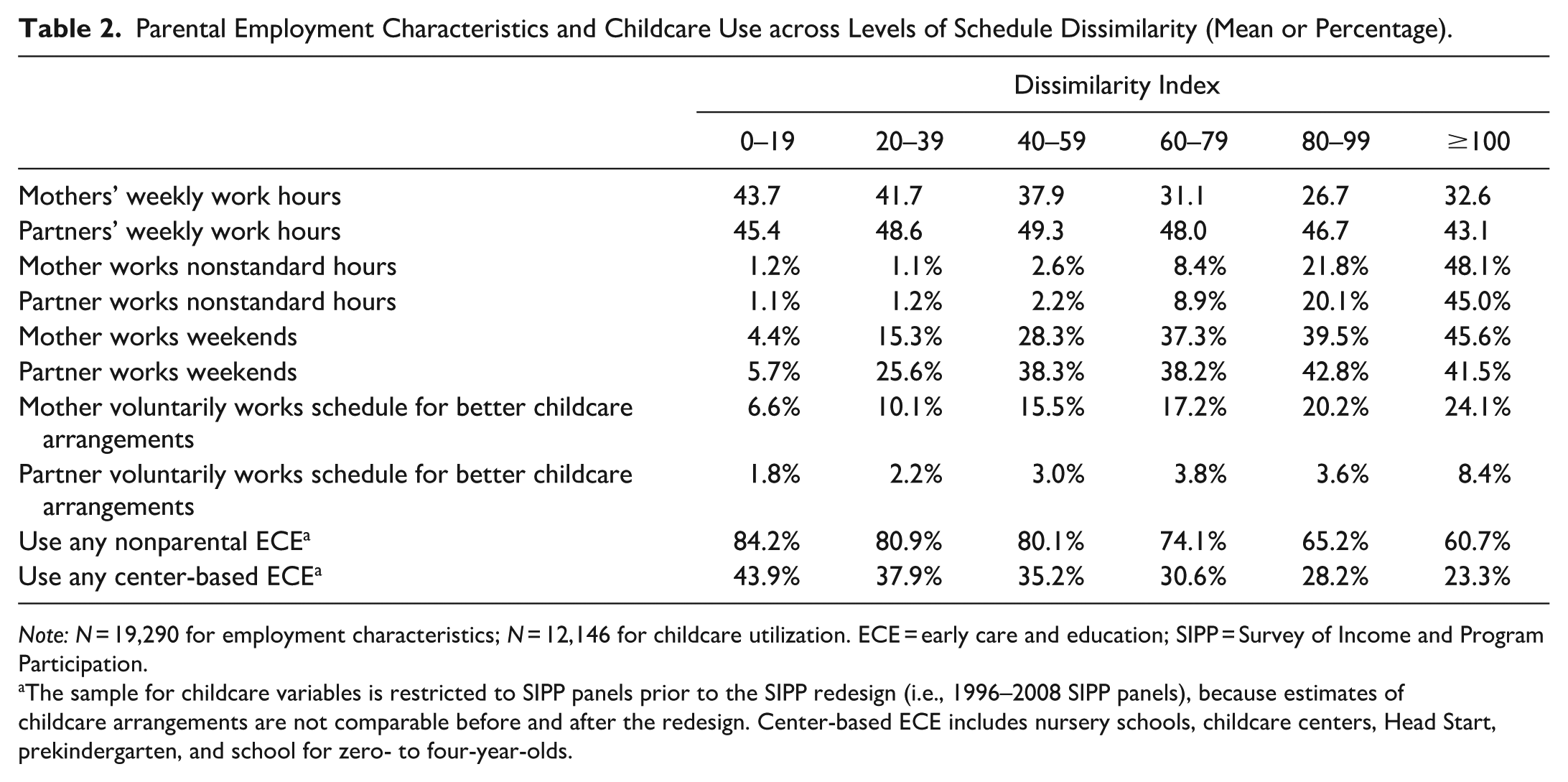
Note: N = 19,290 for employment characteristics; N = 12,146 for childcare utilization. ECE = early care and education; SIPP = Survey of Income and Program Participation.
The sample for childcare variables is restricted to SIPP panels prior to the SIPP redesign (i.e., 1996–2008 SIPP panels), because estimates of childcare arrangements are not comparable before and after the redesign. Center-based ECE includes nursery schools, childcare centers, Head Start, prekindergarten, and school for zero- to four-year-olds.
Consistent with our expectations that tag-team parenting would be inversely related to ECE use, parents with more dissimilar schedules were less likely to use any nonparental ECE for any of their children, especially center-based ECE (see Table 2). Whereas 44 percent of households with the lowest DI values used center-based ECE, only 23 percent of those with the highest DI values did so. Additionally, mothers with more dissimilar schedules were more likely to report that they worked their schedule voluntarily because it allows better childcare arrangements compared to mothers with less dissimilar schedules; partners were much less likely to report this work schedule reason across all DI levels.
Who Is More Likely to Tag-Team Parent?
Table 3 shows the average DI values among dual-earner households in 1997 and 2019 by household-level characteristics. Although most groups experienced declines in schedule dissimilarity, mothers 30 years and older, White mothers, married mothers, and those with a BA or more education experienced larger relative declines in schedule dissimilarity than their counterparts. This is consistent with our hypothesis that declines in tag-team parenting would be concentrated among parents with social and economic advantage. For example, White mothers experienced a 24.9 percent decline in schedule dissimilarity, whereas Black and Hispanic mothers had an increase in schedule dissimilarity. Asian mothers and those who identified as another race or ethnicity had a smaller decline than White mothers. Differences by partners’ education were less pronounced, though households with monthly incomes at or above $7,500 experienced larger declines in dissimilarity (8.5 percent to 12.3 percent) than those with lower incomes (3.8 percent to 6.4 percent). Households with only one child, and those without adults aside from mothers and their partners, also saw larger declines in schedule dissimilarity than their counterparts.
Mean Dissimilarity Index among Dual-Earner Families with Young Children.

With respect to parental employment characteristics, schedule dissimilarity was lowest and declined the most among mothers in managerial and professional specialty occupations, which are typically higher paid and more prestigious than the other occupations (Blau and Kahn 2017). Tag-team parenting did not decline among mothers working in technical, sales, and administrative support occupations. Among mothers’ partners, the largest decline in schedule dissimilarity occurred among those working in farming, forestry, and fishing. In contrast, schedule dissimilarity increased for those working as operators, fabrications, and laborers.
What Explains Changes in Tag-Team Parenting over Time?
Table 4 shows the results of the Oaxaca-Blinder decomposition model that decomposed the 9.5-point decline in schedule dissimilarity, from 58.8 in 1997 to 49.2 in 2019. 1 The coefficients from these models represent the decline in schedule dissimilarity that can be explained by a given variable. A positive coefficient indicates that the compositional shift in a given characteristic explains the observed decline in the DI. A negative coefficient indicates that the compositional shift worked against the decline in DI (i.e., the DI decreased less as a result). The results suggest that changes in the levels of the characteristics included in the model explained 82.1 percent (7.82 of 9.53 points) of the decline in schedule dissimilarity. The unexplained portion of the decline is 1.72 points.
Results of Decomposition Analyses.

Note: N = 2,813.
p < .05. **p < .01.
We found evidence to support both of our hypothesized explanations for declines in tag-team parenting: access to nonparental ECE and parental employment demands. Factors related to parents’ ability to access ECE explained a substantial portion of the decline in tag-team parenting. Increases in dual-earner households’ monthly income explained 34.2 percent of the decline in schedule dissimilarity; this was driven by an increase in households earning $12,500 or more per month (equivalent to $150,000 or more annually) and a decrease in households with annual incomes below $5,000 per month (equivalent to $60,000 annually). Other socioeconomic and child and household characteristics in the model related to childcare access (i.e., parent education, number and age of children, and number of adults in the household) did not meaningfully explain the decline in schedule dissimilarity and were not statistically significant.
Increases in public prekindergarten and Head Start program inclusion also explained a substantively large share of the observed decline in schedule dissimilarity (26.8 percent). However, this estimate was imprecise and not statistically significant. None of the other state-level childcare market characteristics explained a substantive or statistically significant share of the decline.
With respect to parental employment demands, changes in parents’ occupations explained 30.6 percent of the decline in parents’ schedule dissimilarity during this period. In particular, mothers’ and their partners’ transitions into managerial and professional specialty occupations together explained 23.5 percent. The decline in partners’ employment as operators, fabricators, and laborers explained 7.6 percent of the decline. In contrast, the increase in mothers’ employment in service occupations contributed toward increasing schedule dissimilarity (3.6 percent). Additionally, increases in mothers’ age explained 18.6 percent of the decline in schedule dissimilarity.
We conducted supplemental decomposition analyses with a binary indicator for high levels schedule dissimilarity using a DI of 80 or higher as the threshold. We conducted these analyses using Oaxaca-Blinder decomposition in a linear probability model as well as using the Fairlie decomposition method for binary outcomes. Results from these models are similar to one another and to our main model using the continuous measure of DI (see Tables A2 and A3). Changes in the levels of the characteristics in the model explained 8.1 to 8.3 percentage points of the 9.0 percentage point decline in high dissimilarity. The most important explanatory variables were the same as those reported above.
We conducted sensitivity analyses dropping cases in which either or both parents self-reported working an irregular schedule, 15.7 percent and 1.4 percent of the sample respectively. Results were unchanged after dropping cases in which both parents worked irregular schedules (see Table A4). When we excluded cases in which either parent worked an irregular schedule, we found that schedule dissimilarity was slightly lower and declined by 7.7 points, from 56.0 in 1997 to 45.7 in 2019 (see Table A5). Even so, the factors that explained the decline in schedule dissimilarity were the same. Additionally, results suggests that schedule dissimilarity would have declined further if not for a decrease in the percentage of married parents.
Discussion
Parents’ work schedules are central to how families spend their time. In two-parent, dual-earner families, the extent to which parents’ schedules are synchronized shapes opportunities for families to spend time together with implications for parental and child well-being (Gracia and Kalmijn 2016; Lesnard 2008; Wight et al. 2008). Parents of young children might choose to work desynchronized schedules, referred to as tag-team parenting, because they prefer exclusive parental care or cannot find affordable childcare that meets their families’ needs. They might also work desynchronized schedules because of the demands of their job. In this study, we examined trends in parents’ work schedule synchronization in the United States from 1997 to 2019, focusing on dual-earner parents with young children. We examined heterogeneity in schedule synchronization across child and family characteristics to identify which families are more likely to tag-team parent and how this changed over time. Finally, we estimated decomposition models to shed light on the determinants of tag-team parenting.
Our findings offer new insights into tag-team parenting. We provide the first estimates of trends in parents’ work schedule synchronization in the United States and more recent estimates than in prior studies (Boushey 2006; Hepburn 2018). Across multiple measures of schedule synchronization, we find that tag-team parenting declined between 1997 and 2019. Parents’ schedule dissimilarity declined overall by 17 percent, whereas the proportion of parents with the most dissimilar schedules declined by 27 percent. This suggests that schedule dissimilarity has decreased more among families with the most dissimilar schedules. The decline in parents’ schedule dissimilarity reflects two key changes in mothers’ work hours and schedules since 1997. Because mothers have increased their weekly work hours, the number of hours parents work per week is increasingly similar. Also, because fewer mothers are working nonstandard schedules, there is more overlap in parents’ work hours. We expect that these trends are likely to extend to the time of writing; however, because the COVID-19 pandemic disrupted work and childcare arrangements and increased the prevalence of remote work, future research should examine parents’ work schedule synchronization since the onset of the pandemic.
Another key insight from our study is that the decline in tag-team parenting was not uniform across all dual-earner families. Consistent with prior research (Boushey 2006; Hepburn 2018; Presser 2003), we found that parents with fewer social and economic resources—including younger mothers, unmarried parents, parents without a college degree, and those with lower household incomes—had more dissimilar schedules. However, schedule dissimilarity declined more among older, married, and college-educated mothers, thereby widening the gaps between those with more versus fewer resources. We also found growing divergence by mothers’ race and ethnicity. Although schedule dissimilarity declined among White families, it increased among Black and Hispanic families.
These findings suggest growing inequality in the United States with respect to how families spend their time, which has implications for child and family well-being. Studies have long documented widening disparities in parents’ investments of time and money in their children by family socioeconomic status, referred to as diverging destinies (McLanahan 2004; McLanahan and Jacobsen 2015). Our study points to growing inequality in another aspect of parents’ time: the amount of time they have available to spend together as a family, with their partner and children, an important input into promoting family cohesion and family members’ well-being (Hattery 2001; Vagni 2022). Future research should examine how growing inequality in schedule synchronization affects child and family well-being and contributes to disparities in children’s developmental outcomes.
What factors contributed to the decline in tag-team parenting? Our findings provide new evidence that both parents’ access to nonparental ECE and parents’ employment demands contribute to schedule dissimilarity. Increases in household socioeconomic resources and the availability of publicly funded ECE programs that make childcare more affordable were key contributing factors. Increases in household income explained nearly 34 percent of the decline in schedule dissimilarity. We also found suggestive evidence that increases in the inclusivity (i.e., proportion of eligible children served) of Head Start and prekindergarten programs, which provide free or low-cost early education to preschool-aged children, explained 27 percent of the decline in tag-team parenting; this estimate was imprecise and not statistically significant. These results support the hypothesis that inability to afford nonparental ECE leads some parents to work more desynchronized schedules. Our findings suggest that for at least some parents, particularly those with preschool-aged children, tag-team parenting is likely not a preferred choice but shaped by their access to high-quality and affordable ECE options.
Our findings were also consistent with our hypothesis that changes in parents’ employment demands would partially explain the decline in tag-team parenting. Changes in parents’ occupations accounted for almost one-third of the decline in schedule dissimilarity. These changes include occupational upgrading, primarily among mothers but also their partners, into managerial and professional specialty occupations in tandem with declines in partners’ employment as operators, fabricators, and laborers. Our results also suggest that an increase in mothers’ employment in service occupations contributed to a small increase (or less of a decline) in schedule dissimilarity. As these jobs have the highest rates of part-time and nonstandard schedules, it is possible that mothers self-select into these jobs to be able to tag-team parent. However, because workers in service occupations are often low-paid, involuntarily work part-time, and experience little control over and flexibility in their work schedule (Golden and Kim 2020; Lambert, Fugiel, and Henly 2014; Schneider and Harknett 2019), it is more likely that parents in the service sector work more dissimilar schedules involuntarily.
On the whole, our findings suggest that dual-earner parents are, on average. generally better able to balance work and childcare responsibilities. More overlap in parents’ schedules provides more opportunities for them to spend time together as a family than in the past. More similarity in parents’ work hours allows a more equal distribution of caregiving responsibilities between parents. These changes imply improvements in child and family well-being (Chung 2021; Hattery 2001; Vagni 2022). Yet we cannot draw definitive conclusions without knowing parents’ work schedule and childcare preferences or the effects on family well-being. For example, occupational upgrading might have been accompanied by more parents being required to work full-time, daytime schedules, potentially prohibiting some parents who prefer to tag-team parent from desynchronizing their schedules. As little research has examined parents’ preferences for tag-team parenting or how work schedule dissimilarity is associated with child and family well-being outcomes, these are important questions for future research.
Our findings also invite additional questions around how demographic changes matter for parents’ work schedule synchronization. Increases in mothers’ age explained nearly one fifth of the decline in schedule dissimilarity. This could indicate that older mothers make different choices about work and childcare compared with younger mothers. It is also possible that age is capturing other aspects of access to nonparental ECE or employment demands not captured by other variables. For example, older mothers might have more work experience, longer tenures, and more seniority in their jobs. Their age might therefore be capturing workplace advantages that affect their decisions to tag-team parent.
To our knowledge, the SIPP is the only nationally representative U.S. survey that contains information on work schedules over multiple years with enough detail to allow examination of trends in tag-team parenting. We leverage these data using multiple measures of schedule synchronization, examining heterogeneity in trends across family characteristics, and using decomposition methods to provide novel insights into who engages in tag-team parenting and why. Nevertheless, there are several limitations to these data. We are only able to observe the work schedules of household members. For mothers who live with a partner who is not their children’s father, we may underestimate the amount of tag-team parenting if mothers coordinate their work schedules with nonresident fathers or other household members (Carrillo et al. 2017). Because tag-team parenting is likely more difficult for parents who live apart (Pilarz, Cuesta, and Drazen 2020), we believe this will not substantively alter our findings. Future research should examine tag-team parenting between mothers and nonresident fathers, as well as same-sex couples and adoptive families who we could not be consistently identified in our sample. Furthermore, although the SIPP collects information on the start and end times of work on a typical day and on the days worked in a typical week, we had to assume that parents worked the same hours of the day on each day of the week that they worked. For parents with schedules that vary day to day, our estimates may over- or underestimate the amount of tag-team parenting. Finally, as our measures of the childcare market were at the state level, future research should use more local measures of ECE to yield more precise estimates.
Conclusion
Examining trends in tag-team parenting over time helps us understand how parents are balancing work and family demands under changing childcare and labor market contexts. Our findings suggest that tag-team parenting has declined since the late 1990s among dual-earner parents with young children. Both parents’ occupational upgrading as well as increases in household income and the availability of publicly funded early education programs that make nonparental ECE more affordable appear to contribute to declines in tag-team parenting. However, we also found growing inequality in work schedule synchronization because families with fewer social and economic resources and families of color experienced smaller (or no) declines in tag-team parenting compared with their counterparts. For these families, policies that provide workers more input in when and how much they work and that make nonparental ECE more accessible might decrease their reliance on tag-team parenting. As schedule synchronization shapes how parents divide caregiving responsibilities and the amount of time parents spend with each other and together with their children, future research should examine the implications of these changes in tag-team parenting for parental and child well-being.
Supplemental Material
sj-docx-1-srd-10.1177_23780231251406753 – Supplemental material for Tag-Team Parenting: Trends in Work Schedule Synchronization among Families with Young Children
Supplemental material, sj-docx-1-srd-10.1177_23780231251406753 for Tag-Team Parenting: Trends in Work Schedule Synchronization among Families with Young Children by Alejandra Ros Pilarz and Anna K. Walther in Socius
Footnotes
Acknowledgements
We gratefully acknowledge Michal Engelman, Peter Hepburn, and Christine Schwartz for helpful comments on prior versions of this article. We thank KaLeigh White and the State Safety Net Policy database team for sharing data on childcare and early education policies used in this study.
Funding
The authors disclosed receipt of the following financial support for the research, authorship, and/or publication of this article: This research was supported by the Eunice Kennedy Shriver National Institute of Child Health and Human Development under award number K01HD104002. The content is solely the responsibility of the authors and does not necessarily represent the official views of the National Institutes of Health.

Supplemental Material
Supplemental material for this article is available online.
1
Author Biographies
References
Supplementary Material
Please find the following supplemental material available below.
For Open Access articles published under a Creative Commons License, all supplemental material carries the same license as the article it is associated with.
For non-Open Access articles published, all supplemental material carries a non-exclusive license, and permission requests for re-use of supplemental material or any part of supplemental material shall be sent directly to the copyright owner as specified in the copyright notice associated with the article.
