




Abstract
As women earn an increasing share of college degrees, what happens to the labor market value of degrees from institutions where women predominate? The author investigates how the gender composition of degree-granting institutions, termed college feminization, shapes job applicant evaluations in the entry-level labor market. Using an original 2 × 2 national survey experiment (n = 637), participants evaluated job applicants who graduated from either a majority-women or majority-men college, holding all other qualifications constant. The results show no evidence that degrees from majority-women institutions are devalued relative to those from majority-men institutions. However, college feminization leads male applicants to be evaluated less favorably in interview recommendations. Perceived competence helps explain this gendered penalty but not through a direct downgrading of male applicants’ competence. Instead, competence operates indirectly through a shifting standards process, whereby competence is weighted more heavily when evaluating male applicants from feminized colleges. This pattern suggests that men from feminized institutions are not rated as less competent, but competence is applied more stringently when determining who is interview worthy. These findings suggest that college feminization can disrupt advantages historically extended to men and reconfigure inequality, offering a novel mechanism through which men’s structural advantage is recalibrated in contemporary labor markets.
Women in the United States have earned more bachelor’s degrees than men since the 1980s. Today, women earn approximately 58.5 percent of bachelor’s degrees (Buchmann, Dwyer, and Yao 2025). On some college campuses the growing presence of women is so persistent that public commentators have begun to ask, “Where have all the men gone?” (Marcus 2017). Although men’s educational stagnation vis-à-vis women’s rising educational attainment has resulted in notable labor market progress for women, gender inequality in the labor market persists. Scholarship consistently shows that women’s educational and occupational advances have not closed persistent gender gaps in hiring, pay, and promotion (Galperin et al. 2020; Levanon, England, and Allison 2009; Mandel 2013; Quadlin 2018; Yavorsky 2019).
Sociologists have documented how gender inequality persists through individual-level and institutional-level mechanisms. At the individual level, employers construct shifting criteria that reward men for competence and women for likability, penalizing high-achieving women in hiring (Quadlin 2018; Uhlmann and Cohen 2005). At the institutional level, the feminization of occupations, defined as increases in the proportion of women workers, has been linked to devaluation and wage penalties, even for men (England, Budig, and Folbre 2002; Magnusson 2009; Mandel 2013). Yet although occupational feminization is well studied, we know far less about how feminization operates in nonoccupational institutions, including colleges and universities, where women increasingly dominate enrollment and degree attainment.
This study offers a novel extension of the feminization literature by asking: what happens to the labor market value of a college degree when the institution that conferred it is feminized? Specifically, I investigate whether graduating form a college where women earn more degrees affects a candidate’s likelihood of being recommended for a job interview and whether the effect differs by gender.
Using a nationally representative survey experiment, I isolate the effect of institutional gender composition by manipulating whether job applicants received their degrees from a feminized college (majority women) or one that is majority men, while holding applicant qualifications constant. I also examine two competing mechanisms: whether feminized colleges are perceived as less selective than male-dominated colleges, and whether their graduates are perceived as less competent than graduates from more male-dominated institutions.
The findings reveal a gendered devaluation process rather than a universal devaluation. Women’s hiring prospects are unaffected by the gender composition of their alma mater, but men who graduate from feminized institutions are less likely to be recommended for interviews compared with men who graduate from male-dominated institutions. Additional analyses indicate that this penalty is not driven by perceptions of institutional selectivity or perceived competence but instead reflects a shifting standards process in which competence is weighed more heavily when evaluating men from feminized colleges. These results extend sociological theories of gender, status, and institutional signaling, and offer new insight into how feminization of higher education may subtly recalibrate how institutional credentials are valued and interpreted in the labor market.
College Feminization, Gender, and Employment
College Degree Value in a Changing Higher Education Landscape
Higher education in the United States expanded rapidly over the second half of the twentieth century. More men and women attend and graduate from college today than in the past. Between 1950 and 2010, the share of individuals aged 25 to 29 years who had obtained a bachelor’s degree increased from 7.8 percent to nearly 32 percent (DiPrete and Buchmann 2013). This growth reflects a widely held belief in the labor market value of a college degree. On average, college graduates earn significantly more than high school graduates, with a median wage gap of about $22,000 (Baum 2014).
Yet although the wage premium for a college degree rose sharply through the 1980s and 1990s, recent decades show mixed trends: some studies observe a “flattening” plateau, whereas others show slower growth in the margin of returns, even as wage premiums remain large in absolute terms (Athreya and Eberly 2021; Cheng et al. 2021; Valletta 2018). One explanation is that as more people earn degrees, the labor market becomes saturated, making it harder for college graduates to stand out. This is particularly true for graduates of less selective and for-profit institutions, who are more likely to be channeled into lower skilled, less cognitively demanding jobs (Deterding and Pedulla 2016; Horowitz 2018; Rivera 2011).
As employers face an increasingly credentialed applicant pool, they may rely more heavily on indirect signals, such as the perceived status of degree-granting institutions, when making hiring decisions. In this context, characteristics like college selectivity or gender composition may shape how employers evaluate applicants and their qualifications.
College Degrees as Signals of Competence and Status in the Job Market
Although a college degree is widely viewed a valuable credential, scholars disagree on what it signals to employers. Human capital theory holds that degrees certify concrete skills and signal applicants’ capacity to learn and be productive in the workplace (Spence 1973). Credentialist theory, by contrast, argues that educational attainment signals cultural fit rather than competence, rewarding applicants for aligning with dominant norms and values rather than job-specific skills (Collins 1971).
In today’s competitive labor market, where many applicants hold college degrees, employers increasingly rely on institutional characteristics, especially perceived status, to distinguish among candidates. Graduates from elite institutions are more likely to receive callbacks than graduates from less selective institutions, in part because such colleges are assumed to produce more competent and capable workers (Gaddis 2015; Rivera 2011). Institutional characteristics of colleges and universities can thus play a role in shaping the signals sent by the college degree by influencing perceptions of applicants and their degree-granting institutions. Although most sociological research focuses on institutional characteristics, like college selectivity, that are directly associated with status, other features, such as an institution’s cultural reputation or organizational identity, can also signal status in the labor market (Binder and Abel 2019). Such symbolic differences can shape how employers and others interpret a college’s status and the kind of graduate it is seen to produce. Likewise, additional features of institutions may signal status and thereby shape how college graduates fare in the entry-level labor market. Given the salience of gender, feminization in the college context may similarly operate as a characteristic of institutions affecting whether the college degree improves one’s chances of securing a job.
Sociological theories of gender, status, and occupation feminization suggests this is a possibility. Research identifies gender as a prominent status characteristic that operates in subtle yet powerful ways by signaling the status of individuals and institutions (Ridgeway 2011). Because, as Ridgeway’s (2011) status construction theory argues, widespread cultural beliefs about gender are fundamentally beliefs about the relative status, social esteem and competence of men and women, gender shapes perceptions of the relative value, respect, and competence of men and women. In the job market, gender status beliefs can lead to differences in how individual women and men are perceived and evaluated, leading women to receive fewer job offers and promotions (Correll, Benard, and Paik 2007). In the occupational setting, gender status beliefs shape perceptions of occupations with high proportions of women, because work in predominantly female jobs is, as Levanon et al. (2009:868) argued, “devalued due to the low status of the jobs’ incumbents” (England et al. 2002; Magnusson 2009; Mandel 2013).
Extending this logic to higher education, college feminization may alter how degrees are perceived by employers. As institutions confer more degrees to women, their credentials may carry lower status compared with those from institutions where men earn the majority of degrees, particularly for male graduates who violate gendered expectations. These patterns suggest that gender is not simply an individual attribute but a status signal embedded in institutions themselves. In this study I examine whether such gendered institutional signals shape evaluations of applicants’ interview worthiness, producing either a universal devaluation or gendered form of devaluation.
Universal devaluation: Applicants from feminized colleges will be evaluated less favorably in terms of interview recommendations than applicants from male-dominated colleges, regardless of applicant gender.
Gendered devaluation: Male applicants will be evaluated less favorably in terms of interview recommendations than female applicants for graduating from feminized colleges.
From Occupations to Colleges: Dynamics and Consequences of Feminization
In this study I examine whether the feminization of colleges and universities, as measured by the gender composition of an institution, shapes how employers assess the labor market value of a college degree. Although sociologists have long studied the feminization of occupations as a mechanism of gender inequality (Levanon et al. 2009; Mandel 2013, 2016; Reskin and Roos 2009), less attention has been paid to how feminization operates in educational institutions. Yet cultural beliefs about status, which afford greater respect, value, and competence to men, extend beyond individuals to institutions they inhabit (Ridgeway 2011). As women now outpace men in college attainment, it is important to assess whether institutional feminization shapes perceptions of the value of the college degree in the labor market.
Although employers and the public may not know the precise gender composition of most colleges, they are likely aware that higher education as an institution has become increasingly female dominated in recent decades, with women now earning the majority of bachelor’s degrees. In this sense, this study serves as a first step toward understanding how the broader feminization of higher education shapes perceptions of institutional value and applicant competence. Even if decision makers do not consciously register a college’s gender composition, they may nonetheless respond to the cultural coding of higher education as a feminized institution, extending long-standing gender hierarches from the occupational sphere into the educational domain. Thus, although this study is focused on a single college profile, it captures a more general social process through which feminization may alter how higher education institutional signals are evaluated in the labor market.
College feminization may shape employer perceptions in at least two ways. One potential pathway is through perceptions of institutional selectivity. Given that women, on average, are more likely than men to attend less selective institutions (Baum and Goodstein 2005), colleges where women earn most degrees may be perceived as lower in status relative to colleges where men earn most degrees. In this view, the feminization of a college becomes a proxy for institutional quality, and graduates may be penalized not because of their own characteristics but because their alma maters are presumed to be less selective than institutions where men earn most degrees.
A second possibility centers on the perceptions of graduates’ competence. Decades of research shows that feminized occupations are often perceived as requiring less skill or cognitive ability and are thus devalued (Levanon et al. 2009; Mandel 2013). If similar beliefs extend to educational settings, colleges where women earn the majority of degrees may be seen as less rigorous, and their graduates may be perceived as less competent relative to graduates of male-dominated colleges.
These two theoretical pathways, one focused on perceived institutional selectivity and the other on perceived graduate competence, mirror long-standing debates in the occupational feminization literature about whether gendered penalties arise from structural sorting or from cultural devaluation (Levanon et al. 2009; Reskin and Roos 2009). By adapting these insights to the higher education context, I investigate whether college feminization shapes evaluations of graduates in hiring contexts and explore which of these mechanisms best explains its impact on graduates’ early labor market prospects.
Together, these perspectives generate distinct predictions about how college feminization may influence employer evaluations of job applicants. If college feminization operates as a signal of institutional status, we would expect to see a general penalty for graduates of feminized institutions, regardless of their gender, because of the perception that such institutions are less selective and thus lower in prestige. In this scenario, feminization functions as a proxy for diminished institutional quality, and any disadvantage in evaluations should be mediated by perceptions of college selectivity.
Perceived selectivity pathway: Any less favorable evaluations associated with college feminization will operate through perceived institutional selectivity, such that graduates of feminized college are evaluated less favorably because these institutions are viewed as less selective.
By contrast, if college feminization signals lower graduate competence, we would expect a different pattern. Drawing from gender status beliefs, the perceived devaluation of competence associated with feminization is likely to result in less favorable evaluations for graduates of feminized institutions, regardless of their gender, because of perceptions of lower competence. In this scenario, feminization functions as a proxy for diminished perceptions of competence, and the penalty in hiring evaluations should be mediated by perceptions of graduate competence. In both of these views, the negative effect of college feminization would be generated for both women and men graduates of institutions where women earn more degrees.
Perceived competence pathway: Any less favorable evaluations associated with college feminization will operate through perceived applicant competence, such that graduates of feminized college are evaluated less favorably because they are viewed as less competent.
The Gendered Consequences of College Feminization
Although both the selectivity and competence perspectives suggest that college feminization could disadvantage all graduates of institutions where women earn most degrees, sociological evidence indicates that labor market returns to education are also shaped by the social characteristics of applicants (Gaddis 2015). In particular, widespread cultural beliefs about gendered competence suggests that the consequences of attending a feminized college may differ for men and women. Men who graduate from feminized institutions may be evaluated less favorably compared with men who graduate from male-dominated institutions, because they are perceived as violating normative gender expectations. Drawing on role congruency theory, research suggests that male applicants who affiliate with feminized institutions may appear incongruent with the high-status role associated with masculinity, resulting in a form of status incongruency backlash (Rudman et al. 2012). Female applicants, in contrast, may be unaffected as their association with a feminized institution aligns with prevailing gender expectations.
This pattern can also be understood through a shifting standards lens: evaluators may unconsciously adjust what counts as competence (or the importance of competence in evaluative decisions) depending on who the applicant is. Uhlmann and Cohen (2005) demonstrated that decision makers often redefine which qualifications matter in ways that justify preferring members of higher status groups. In this context, evaluators may weight a feminized credential differently when it belongs to a man relative to the same credential held by a woman or man from a male-dominated institution, effectively downgrading its value relative to other credentials to reconcile his affiliation with a lower status institution. In this view, college feminization challenges the meaning of male achievement and alters the standards by which men’s competence is judged when they are graduates of feminized institutions.
Shifting standards: Any observed penalty associated with college feminization will operate indirectly through a shifting standards process in which evaluators adjust the weight placed on criteria such as perceived institutional selectivity or perceived applicant competence.
Although prior research shows that men often receive advantages in feminized occupational contexts (Williams 1992), such advantages tend to accrue after hiring, once men are incumbents in those roles. Whether those advantages extend to the hiring stage remains an open question. In this study I empirically test these possibilities: whether college feminization reduces the likelihood of being recommended for a job interview, and whether those effects differ by applicant gender, operating directly through perceptions of institutional selectivity or applicant competence, or indirectly through shifting evaluative standards that alter how these perceptions are weighted in evaluative contexts.
Data and Methods
To assess whether college feminization influences hiring perceptions, and whether these effects vary by applicant gender, I conducted an original, nationally representative 2 × 2 factorial survey experiment. This design allows the identification of causal effects by randomly assigning respondents to one of four applicant profiles that varied along two dimensions: the gender of the applicant and the gender composition of their degree-granting institution. Unlike field experiments, which cannot easily manipulate institutional-level cues such as gender composition, this survey experiment was designed to isolate and test the effects of feminization on employer evaluations under controlled conditions.
This design builds on prior research demonstrating that both individual- and institutional-level characteristics shape employer evaluations of job candidates (Gaddis 2015; Rivera 2011). Field experiments often focus on applicant traits signaled via resumes, but because resumes rarely convey institutional-level statistics, such as gender composition, I used a survey experiment to manipulate both applicant and institutional cues directly.
Data and Sample
Data were collected by AmeriSpeak, a NORC Panel-Based Research Platform at the University of Chicago. The panel leverages the NORC national sample frame and a combination of address-based sampling, random-digit dialing, and face-to-face recruitment to be representative of the U.S. household population. The survey was fielded between May 10, 2018, and May 31, 2018. 1 Because college graduates are likely to have the greatest knowledge of degree-granting institutions, more likely to be in managerial positions, and routinely act as gatekeepers in the labor market, in all main analyses, I restrict the sample to respondents with a bachelor’s degree or beyond 2 and respondents who are at least 25 years old. Although these restrictions yield a highly educated subsample relevant to labor market gatekeeping, this group is not representative of the population of employers. Rather, this sample captures the perspectives of college-educated adults who are disproportionately likely to work in professional and managerial roles where hiring and evaluation decisions are often made.
Data were dropped from respondents because of failure to provide usable answers on the dependent measure, missing data on at least one demographic or independent measure, and failure to pass a two-part manipulation check question and thus were not included in the analysis (final n = 637). 3 The final analytical sample included 337 women and 300 men 25 to 90 years of age. Table 1 presents descriptive statistics for the analytical sample.
Descriptive Statistics for Survey Experiment: All Respondents.
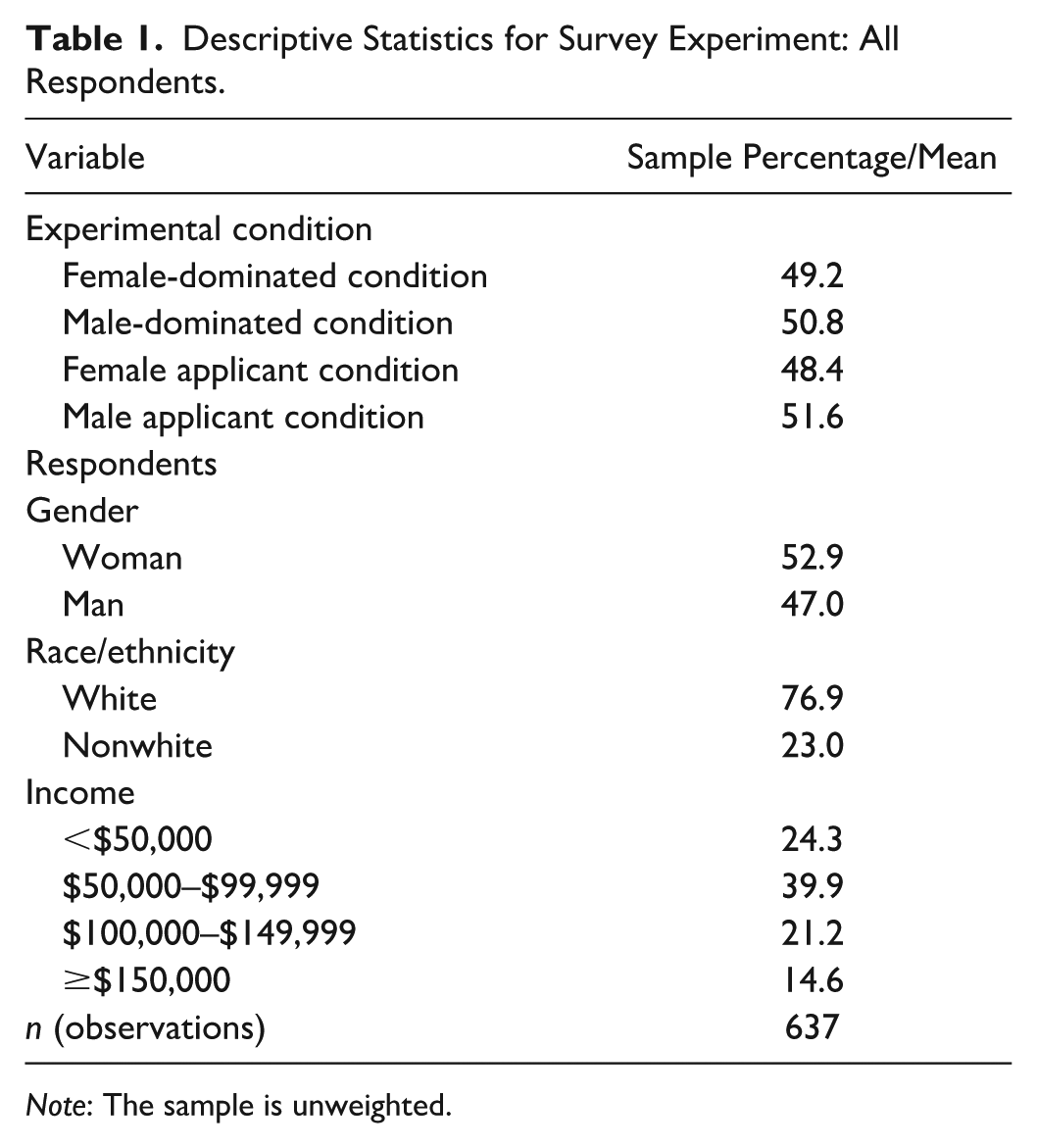
Note: The sample is unweighted.
Experimental Design and Procedure
The experiment followed a 2 (college gender composition: majority women vs. majority men) × 2 (applicant gender: female vs. male) between-subjects design. Respondents were told that they were participating in a study for a college career center to understand how its graduates might fare in the entry-level job market. Each respondent was shown a profile for a fictitious liberal arts institution, Wadsworth College, including a brief description, an undergraduate enrollment figure, and visual information on student demographics and degrees awarded by gender.
Respondents were then shown a job description for an entry-level marketing representative position 4 and resume for a recent graduate of Wadsworth College. The resume was randomly assigned to feature either a male (Brad) or female (Allison) 5 applicant. To isolate the effects of college gender composition and applicant gender, all resume characteristics were held constant across conditions. Each applicant profile listed a grade point average of 3.57, major (BA in social sciences), two years of work experience in a generic office setting, and involvement in extracurricular activities (student advisory and track club). These attributes were selected because they are relatively common across applicants and do not strongly favor one gender. Full resume text is included in Appendix A. The only manipulated features were the applicant’s gender and the gender composition of their college (signaled using a pie chart showing 64 percent of degrees awarded to either women or men). The experimental threshold of 64 percent female aligns with real-world variation in U.S. higher education. Several large public and private universities report comparable gender distributions. For example, the University of North Carolina-Greensboro (66.4 percent women), University of Northern Colorado (66.0 percent women), City University of New York-Hunter College (63.4 percent women), Loyola University Chicago (65.7 percent women), and California State University-Dominguez Hills (60.1 percent women) all fall within this range. These cases illustrate that gender compositions used in the experiment reflect observed patterns across contemporary U.S. higher education (U.S. News & World Report 2024).
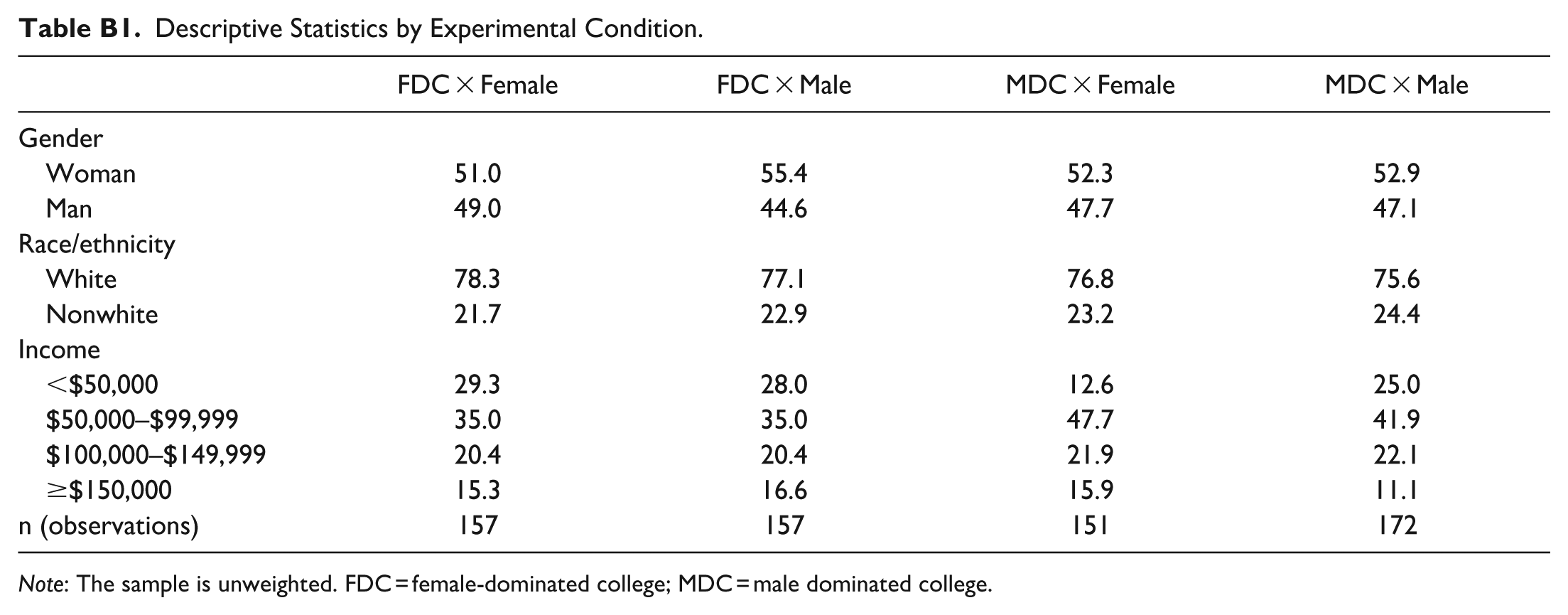
This design isolates the causal effects of applicant gender and college feminization on respondents’ evaluations. Approximately 88 percent of respondents passed a two-part manipulation check and were retained in the final analytical sample. All materials used in the experiment are available at Time-Sharing Experiments for the Social Sciences repository. Additionally, to assess the success of randomization, Table B1 in Appendix B presents respondent background characteristics across treatment conditions. Chi-square tests show no significant differences in gender, race, or income distributions across the four experimental groups, indicating that randomization produced balanced samples as intended.
Variable Construction
After reviewing the applicant materials, respondents were asked, on a five-point Likert scale, “How likely would you be to recommend [applicant name] to be interviewed?” Responses were dichotomized for analysis: “Extremely likely” was coded as 1 and all other responses as 0. This survey question forms the foundation of the primary dependent variable, interview decision. This outcome closely follows convention of online survey experiments, which often transform scales into binary dependent variables similarly. Although multiple levels of likelihood may capture general favorability, in practice, advancing to the interview stage typically requires the strongest endorsement (Quadlin 2018). In this sense, an “extremely likely” response is the most appropriate proxy for the decision point that matters most in hiring. To test potential mechanisms for a college feminization effect, I measured two mediating perceptions: competence of the applicant and perceived selectivity of the college. Respondents rated the applicant’s competence on a seven-point Likert scale in response to the prompt “The applicant is competent. On a scale from one to seven, how strongly do you agree or disagree with the following statement about this applicant?” To capture perceptions of institutional selectivity, respondents answered the question “What do you think the chances are of being accepted to Wadsworth College?” with options ranging from “100%” to “less than 10%” in 10-point increments. Other explanatory variables include basic demographic measures provided by AmeriSpeak. All models presented are robust to controls, including whether the respondent is female or nonwhite and the seven-category measure of income provided by AmeriSpeak.
Finally, a two-part manipulation check assessed respondent attention. The first item asked respondents to identify the college specialty presented in the college brochure-style description of Wadsworth College. Next, after respondents had rated applicants, they were asked, “According to what you have learned today, who earns more four-year college degrees at Wadsworth College?” Respondents were then offered two options: one indicating women earn more degrees at Wadsworth College and the other that men earn more degrees at Wadsworth College. Approximately 88 percent of respondents passed the two-part manipulation check and were included in all models. Descriptive statistics for the analytic sample are provided in Table 1.
Results
I present analyses in four stages. First, I test whether college feminization influences interview recommendations overall (universal devaluation). Second, I examine whether this relationship varies by applicant gender (gendered devaluation). Third, I assess whether perceptions of college selectivity and applicant competence account for any observed patterns (perceived selectivity pathway and perceived competence pathway). Finally, I test whether perceived college selectivity or perceived applicant competence explain observed gendered penalties, and assess whether these perceptions operate directly or indirectly through a shifting standards process (shifting standards).
Is There a College Feminization Effect?
Tables 2 and 3 presents both descriptive means of interview recommendations by experimental conditions (Table 2) and linear probability models with main effects only (Table 3). The occupational feminization literature predicts a universal devaluation of credentials from institutions where women earn most degrees. If this hypothesis holds, applicants from feminized institutions, regardless of their gender, should be less likely to receive interview recommendations. Contrary to this expectation, the results of the ordinary least squares linear probability model show no significant main effect of college feminization on the likelihood of being recommended. Thus, I do not find support for a universal devaluation of the college degree.
Means and Standard Deviations (in Parentheses) of Being Recommended to Be Interviewed, by Experimental Condition.

p < .05 (FDC vs. MDC within applicant gender).
Ordinary Least Squares Linear Probability Models Predicting Whether an Applicant Is Recommended to Be Interviewed.

p < .001 (two-tailed test).
The descriptive results, however, suggest a more nuanced pattern. Male graduates of feminized institutions received less favorable evaluations in terms of interview recommendations than their counterparts from nonfeminized institutions (p < .05), whereas no such difference emerges for female applicants. As shown in Figure 1, men from majority-women or feminized colleges received interview recommendations at a rate of roughly 21 percent, compared with 31 percent for men from male-dominated colleges, a 10 percentage point difference. By contrast, women from feminized colleges were recommended at similar or slightly higher rates (29 percent) compared with women from male-dominated colleges (24 percent), a modest 5 percentage point difference that is not statistically significant. This pattern points to an interaction between applicant gender and institutional feminization, providing initial evidence that the consequences of college feminization are gendered.
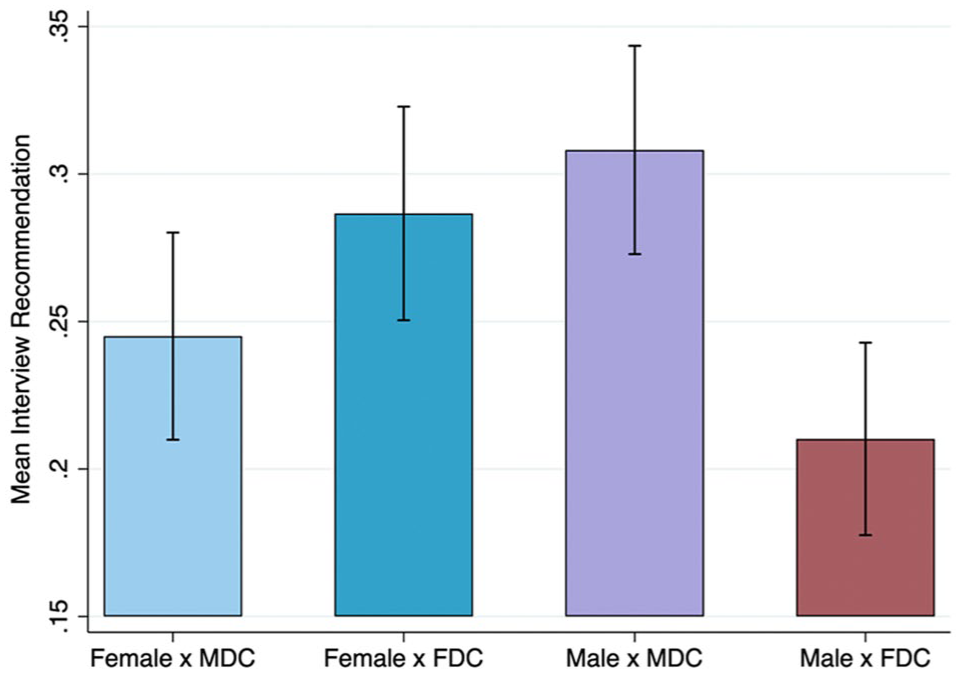
Mean interview recommendations by applicant gender and college feminization (raw means and standard errors).
To assess whether applicants might be evaluated less favorably in terms of interview recommendations when attending institutions misaligned with gender expectations (i.e., men at female-dominated colleges and women at male-dominated colleges), I tested gender differences within each institutional type. Consistent with the main pattern, male applicants from feminized institutions were significantly less likely to be recommended than their male counterparts from male-dominated colleges (10 percentage point difference, p < .05). By contrast, female applicants from male-dominated colleges were not significantly disadvantaged relative to their peers from female-dominated colleges (5 percentage point difference, p > .05). Together, these mean differences provide strong support for the gendered devaluation hypothesis showing that men from feminized colleges are evaluated least favorably of all four experimental conditions, whereas women show no comparable disadvantage, indicating a gender-specific penalty rather than a broader “gender mismatch” effect.
Table 4 presents linear probability models estimating the likelihood that an applicant is recommended for an interview. 6 Model 1 includes applicant gender, college feminization, and their interaction. Consistent with Tables 2 and 3, male applicants from feminized institutions are significantly less likely to be recommended for an interview 7 than their counterparts from nonfeminized institutions with an estimated 14 percentage point decrease in the probability of receiving a recommendation (p < .05). Model 2 adds respondents perceived selectivity of the college to test whether the feminization penalty reflects beliefs about institutional prestige (perceived selectivity pathway). The coefficient for male applicants from feminized institutions remains negative and statistically significant, and the size of the interaction effect is largely unchanged, suggesting that perceived selectivity does not help explain the less favorable evaluations of male applicants from feminized institutions. Model 3 incorporates respondents’ ratings of applicant competence (perceived competence pathway). Here, the negative effect of college feminization for male applicants becomes smaller and statistically insignificant, while perceived competence emerges as a strong predictor of interview recommendations (p < .05). This attenuation suggests that competence may play a role in shaping evaluations but the reduction in the male × female-dominated college coefficient is not statistically significant. Rather than reflecting a straightforward stereotype-based downgrading, this pattern points to a potentially shifting standards process in which competence may be weighted more heavily when evaluating men from feminized institutions.
Ordinary Least Squares Linear Probability Models Predicting Whether an Applicant Is Recommended to Be Interviewed.

Note: Values in parentheses are robust standard errors. FDC = female-dominated college.
p < .05, **p < .01, and ***p < .001 (two-tailed tests).
To formally test whether the effects of college feminization operate indirectly through perceived selectivity or applicant competence, I estimated indirect effects using Preacher and Hayes’s (2004) bootstrapping procedure with 5,000 resamples. This approach formally tests mediation by assessing whether the indirect path from college feminization to interview recommendations through each perception differs significantly from zero. Figure 2 shows that perceived selectivity does not significantly mediate the effect of college feminization on interview recommendations for male applicants (indirect effect = −0.0015, 95 percent confidence interval includes zero). By contrast, Figure 3 shows that perceived competence has a statistically indirect effect (indirect effect = −0.02, 95 percent confidence interval = −0.0576 to −0.0002). In the figure, the path from college feminization to competence (left arrow) is nonsignificant, whereas the path from competence to interview recommendations (right arrow) is significant, illustrating that competence strongly predicts interview evaluations even though male applicants from feminized colleges are not directly rated as less competent. This pattern is consistent with a shifting standards process rather than a conventional direct mediation. In other words, evaluators appear to weigh competence more heavily when assessing men from feminized institutions, resulting in less favorable overall evaluations without direct downgrading of their perceived competence.

Effects of college feminization (female-dominated college [FDC]) on interview recommendations for male applicants, with college selectivity as a potential mediator. FDC does not significantly predict perceived selectivity, and selectivity does not significantly predict recommendations. *p < .05.

Effects of college feminization (female-dominated college [FDC]) on interview recommendations for male applicants, with applicant competence as a potential mediator. FDC does not significantly predict competence, but competence strongly predicts recommendations, suggesting a shifting standards process rather than direct downgrading of male FDC applicants’ competence. *p < .05.
Together, the analyses point to a gendered pattern in how college feminization shapes applicant evaluations. Male graduates from institutions where women earn most degrees are evaluated less favorably in terms of interview recommendations. These differences are not explained by perceptions of college selectivity or uniformly lower competence ratings for men from feminized colleges. Instead, competence carries greater weight in evaluations of these men, such that small differences in perceived competence have a stronger impact on their outcomes. This pattern aligns with a shifting standards process rather than a straightforward devaluation mechanism: evaluators appear to apply competence more stringently when assessing men from feminized institutions, resulting in less favorable overall evaluations.
I also include null results for non-BA respondents in Table 5. The absence of effects among non-BA respondents suggests that gendered institutional signals may resonate most strongly with BA holders, who are more likely to serve as labor market gatekeepers and to recognize institutional distinctions. For non-BA respondents, such cues may carry less symbolic weight and therefore produce no systematic bias. Non-BA respondents may be less attuned to the symbolic distinctions between institutions. This divergence points to an educational bifurcation in the cultural logics through which institutional and gendered cues are interpreted in the United States, underscoring how higher education not only structures access to labor market opportunities but also shapes the evaluative frameworks that inform judgements of applicants.
Ordinary Least Squares Linear Probability Models Predicting Whether an Applicant Is Recommended to Be Interviewed.
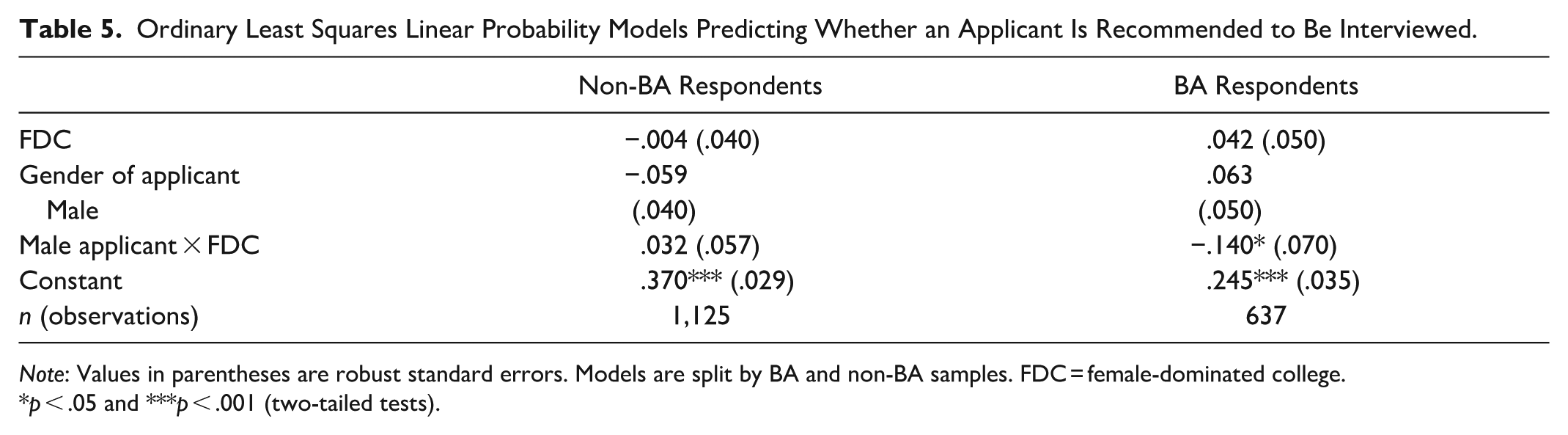
Note: Values in parentheses are robust standard errors. Models are split by BA and non-BA samples. FDC = female-dominated college.
p < .05 and ***p < .001 (two-tailed tests).
Discussion
In this study I use an original national survey experiment to investigate how college feminization, measured by the gender composition of bachelor’s degrees conferred, shapes labor market evaluations of job applicants. Building on prior research on institutional signaling and gendered labor market stratification, I find that the consequences of college feminization are not uniform across genders. Women graduates of feminized institutions are not evaluated less favorably in the job applicant screening process. By contrast, male graduates of feminized institutions are evaluated less favorably in terms of interview recommendations than men from nonfeminized institutions, signaling a gendered devaluation of their degrees.
The results challenge the notion that feminization leads to a universal decline in institutional prestige. Contrary to expectations that feminized institutions are penalized because they are perceived as less selective, the results show that perceived selectivity does not explain the observed pattern of less favorably evaluations. Instead, the negative effect operates through a shifting standards process in which competence carries heightened influence for men from feminized institutions. Male applicants from feminized institutions are not evaluated as less competent overall. Rather, competence becomes a more decisive factor in determining their interview likelihood, suggesting that evaluators weigh competence more heavily when assessing them. These results indicate a disruption in the processes that typically sustain male privilege in the labor market. Rather than interpreting these findings as evidence of male disadvantage, they should be understood as evidence of a recalibration in evaluative standards that weakens the automatic attribution of competence and status to men, particularly in institutional contexts that do not reinforce traditional masculine dominance. This is not a story of new inequality for men, but one of a fracture in long-standing gender privilege.
Beyond these empirical findings, this study contributes new insight into how normative gender expectations interact with institutional characteristics to shape labor market outcomes. In particular, they reveal how feminization can have counterintuitive and asymmetric consequences. As women earn a growing share of college degrees, and as first-generation and racially diverse students become more represented across campuses, long-standing markers of dominance may lose some of their strength. Feminization in this context disrupts, not reverses, the systems of symbolic privilege that have historically elevated men by default.
A comparison with research on differential returns to credentials further clarifies this process. Gaddis (2015), for instance, showed that Black applicants are penalized, reflecting a direct devaluation of both racial and institutional status. In contrast, the current study reveals that male applicants, members of a historically advantaged group, are evaluated less favorably when affiliated with feminized institutions not because their competence is rated lower, but because competence is applied more stringently to them. This pattern suggests that whereas racialized credentials trigger direct devaluation, gendered institutional cues may activate a shifting standards process in which evaluators intensify scrutiny of privileged applicants when their institutional affiliations challenge gender expectations. In this way, institutional feminization does not invert inequality but exposes the conditional nature of privilege in contemporary credential systems.
The implications also extend to current cultural and organizational dynamics. The findings resonate with the growing backlash against diversity, equity, and inclusion (DEI) initiatives, suggesting that standards for evaluating competence may become more stringent in moments when organizational actors perceive equity efforts or feminized institutions as challenges to traditional status hierarchies. In such contexts, hiring decisions may be influenced by heightened scrutiny of competence that appears neutral yet reinforces existing hierarchies. Future research should examine how DEI backlash intersects with institutional feminization to shape evaluative practices across different organizational settings, particularly in contexts where definitions of “merit” and “competence” may be routinely contested.
Finally, as higher education becomes increasingly female dominated, its cultural status may also shift. Although this study focuses on perceptions of a single institution, it offers a window into how the feminization of higher education more generally may transform the symbolic status of colleges in the labor market. These findings also speak to enduring patterns of gender segregation across educational institutions. The emergence of labor market penalties for men from feminized colleges underscores how institutional gender composition continues to carry symbolic weight, even as women’s enrollment has expanded across higher education. This suggests that gender segregation in higher education is not only a matter of enrollment patterns but also of how institutions are valued in the labor market. If feminized colleges are implicitly devalued because they are associated with women, then the clustering of women into certain campuses or sectors of higher education may reinforce existing hierarchies of prestige and opportunity. In this way, institutional feminization becomes a mechanism through which gender segregation in education can translate into stratification in the workplace.
Although this study focuses on gender and institutional feminization, future research should examine how these dynamics might intersect with race and ethnicity. Prior audit and vignette studies have consistently shown that applicants with stereotypically Black or Latine names are evaluated less favorably than equally qualified white applicants, reflecting racialized status beliefs in hiring. Had such names been included in this study, the observed patterns might well have been compounded: men from feminized institutions with racialized names might face intersecting bias. In this sense, the penalty identified for men at feminized institutions likely represents only one dimension of a broader matrix of stratification in labor market evaluations.
This work has several implications for sociological theory and future research. First, it deepens our understanding of how feminization influences institutional signaling in the labor market, not simply as a marker of selectivity but as a cue filtered through gendered status beliefs. Second, it raises critical questions about equity in an era when women now earn a majority of bachelor’s degrees and when higher education increasingly serves first-generation, racially diverse, and economically marginalized students.
Future research should extend this work to examine how feminization shapes labor market evaluations in specific occupational contexts, especially those already feminized (e.g., education, social work) versus male-dominated fields (e.g., finance, technology). It will also be important to explore how college major feminization interacts with institutional feminization to influence perceptions of job applicants. In addition, because institutional signals are mediated by broader social cues, researchers should explore how other institutional characteristics—such as racial composition, funding structure, or geographic location—interact with gender composition to shape perceived value.
Although the expansion of women’s participation in higher education is widely seen as a marker of gender progress, this study reveals a paradox: as women gain ground in educational attainment, the very institutions that elevate them may trigger more stringent evaluative standards for some of the graduates who pass through them. Yet this devaluation is best understood not as a disadvantage to men per se, but as a recalibration of the privileges long afforded to masculinity in institutional settings. College feminization exposes how status beliefs continue to shape evaluative criteria in subtle and shifting ways. In this sense, college feminization marks not only a transformation in higher education but also a critical frontier for understanding and challenging the subtle mechanisms through which gendered advantage persists in the labor market.
Footnotes
Appendix A: Survey Experimental Stimuli
Appendix B: Descriptive Statistics by Experimental Condition
Descriptive Statistics by Experimental Condition.
| FDC × Female | FDC × Male | MDC × Female | MDC × Male | |
|---|---|---|---|---|
| Gender | ||||
| Woman | 51.0 | 55.4 | 52.3 | 52.9 |
| Man | 49.0 | 44.6 | 47.7 | 47.1 |
| Race/ethnicity | ||||
| White | 78.3 | 77.1 | 76.8 | 75.6 |
| Nonwhite | 21.7 | 22.9 | 23.2 | 24.4 |
| Income | ||||
| <$50,000 | 29.3 | 28.0 | 12.6 | 25.0 |
| $50,000–$99,999 | 35.0 | 35.0 | 47.7 | 41.9 |
| $100,000–$149,999 | 20.4 | 20.4 | 21.9 | 22.1 |
| ≥$150,000 | 15.3 | 16.6 | 15.9 | 11.1 |
| n (observations) | 157 | 157 | 151 | 172 |
Note: The sample is unweighted. FDC = female-dominated college; MDC = male dominated college.
Appendix C: Logistic Regression Models Predicting Whether an Applicant Is Recommended to Be Interviewed
Log Odds Coefficients from Logistic Regression Models Predicting Whether an Applicant Is Recommended to Be Interviewed.
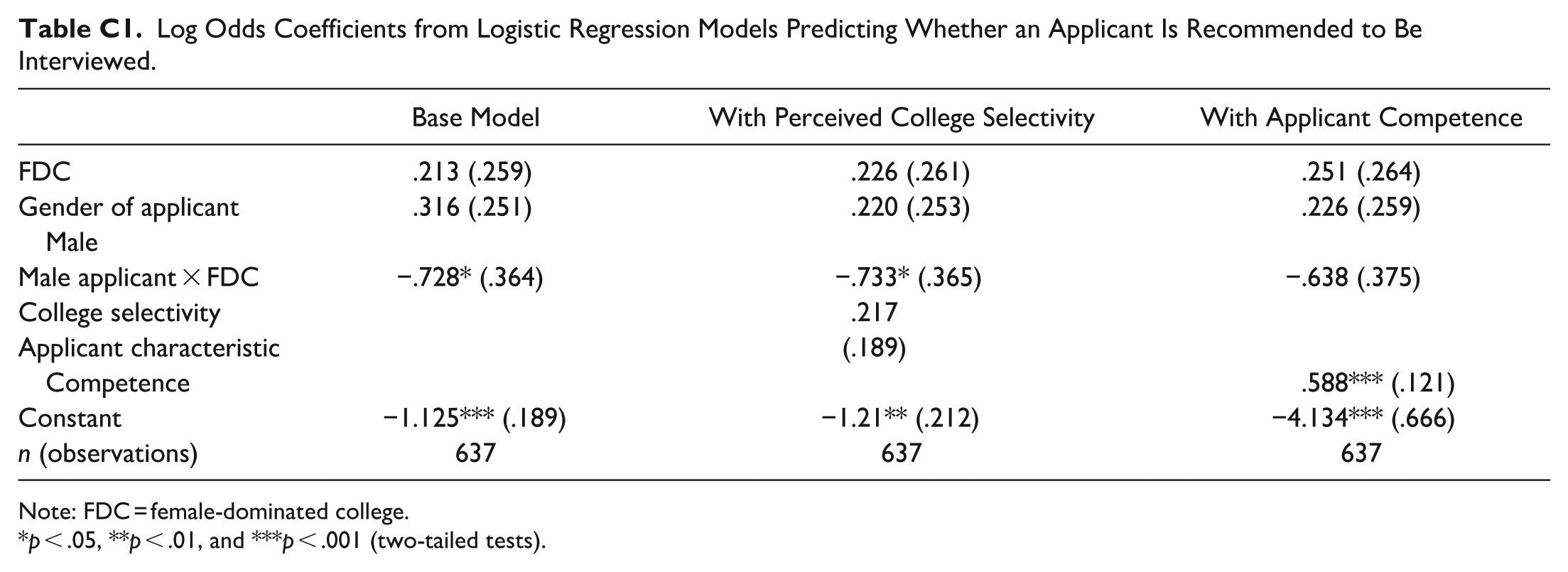
| Base Model | With Perceived College Selectivity | With Applicant Competence | |
|---|---|---|---|
| FDC | .213 (.259) | .226 (.261) | .251 (.264) |
| Gender of applicant | .316 (.251) | .220 (.253) | .226 (.259) |
| Male | |||
| Male applicant × FDC | −.728* (.364) | −.733* (.365) | −.638 (.375) |
| College selectivity | .217 | ||
| Applicant characteristic | (.189) | ||
| Competence | .588*** (.121) | ||
| Constant | −1.125*** (.189) | −1.21** (.212) | −4.134*** (.666) |
| n (observations) | 637 | 637 | 637 |
Note: FDC = female-dominated college.
p < .05, **p < .01, and ***p < .001 (two-tailed tests).
1
The completion rate was 29.1 percent.
2
I collected data from respondents with all levels of education but have chosen to limit analyses to respondents with at least a bachelor’s degree for main analyses. The test for equality of coefficients suggests that the college-educated and non-college-educated samples are statistically different in how they evaluate candidates. Generally, non-college-educated respondents were less sensitive to gender composition of degree-granting institutions as well as gender of the applicant when making interview recommendations.
3
Data dropped from respondents because of failure to provide usable answers on the dependent measure, missing data on at least one demographic or independent measure, and failure to pass a two-part manipulation check question do not drive results.
4
I chose marketing representative because it is a position that is not perceived to be overly feminine or masculine.
5
Allison and Brad are pretested names shown to be considered, respectively, female and male white applicants.
6
7
The results remain directionally consistent across alternative specifications of the outcome variable. When the measure is recoded to include both “very likely” and “extremely likely” responses, or treated as continuous, the effects are slightly reduced in size and fall short of conventional levels of significance. This attenuation is expected given that lower thresholds capture broader favorability rather than the decisive moment of selection. Consistent with prior experimental designs ( ), the “extremely likely” response remains the most appropriate proxy for the interview decision point that matters most in hiring evaluations.