




Abstract
Drawing on the first national survey experiment of its kind (n = 3,922), the authors examine Americans’ perceptions of transgender people’s sex and the factors that underlie these perceptions. The authors randomly assigned respondents to a vignette condition describing a transgender person whose self-identified gender (i.e., identifies as a man or a woman), age (i.e., adult or teenager), and gender conformity in physical appearance (i.e., conforming, nonconforming, ambiguous, or unspecified) had been experimentally manipulated. Then, respondents were asked how they would personally classify that person’s sex. The findings suggest that Americans are more likely to perceive a transgender person’s sex as consistent with their sex assigned at birth than with their gender identity. Furthermore, of the experimental manipulations included in the experiment, only the transgender person’s level of gender conformity—not their self-identified gender or age—affects public perceptions of sex. The authors also find distinct cleavages along sociodemographic lines, including politics, sexual orientation, and interpersonal contact with transgender people. Implications for research on sex and gender are discussed.
Recent estimates indicate that about 1.4 million U.S. adults identify as transgender, or as people whose gender identity does not align with the sex they were assigned at birth (Flores et al. 2016). 1 Although transgender people constitute a nontrivial segment of the population, the public can be slow to accept or even acknowledge those who defy traditional categories, including sex and gender (Broockman and Kalla 2016; Powell et al. 2010; Powell, Quadlin, and Pizmony-Levy 2015; Schilt and Lagos 2017; Stone 2019; Westbrook and Saperstein 2015).
Discussions regarding transgender people have intensified in recent years (Epps 2018; Lambda Legal n.d.) and recently made headlines again in fall 2018, when in a U.S. Department of Health and Human Services memo, the Trump administration proposed to define gender and sex in a way that would exclude the recognition of transgender persons (Green, Benner, and Pear 2018). This proposed change elicited strong negative reactions from scientific and professional organizations such as the American Sociological Association (2018) and the American Psychological Association (2018). These conflicts about transgender people ultimately come down to whether policymakers, scholars, and the public place greater emphasis on a person’s sex—a biological construct that emphasizes anatomical, chromosomal and physiological differences—or a person’s gender—a social construct that invokes social roles as well as a person’s own ideas about their identity. 2 The extent to which people privilege biological or social factors shapes how they think about transgender people, including the fundamental question of how they perceive of transgender people (Schilt and Lagos 2017).
Research on transgender people is still very much emerging, with some influential writings on the everyday lived experiences of trans men and trans women, as well as their partners (Dozier 2005; Pfeffer 2017; Schilt 2010). However, with the exception of some reports from polling organizations (Brown 2017; Lipka 2016), less attention has been directed to public attitudes toward transgender people generally (but see Norton and Herek 2013; Stone 2013, 2019; Westbrook and Schilt 2014). In particular, we are aware of no large-scale social scientific research that has assessed how the public perceives of transgender people’s sex, as well as the various factors (about both transgender people and members of the public) that shape these perceptions.
In this article we use data from a nationally representative survey experiment (n = 3,922) to assess public attitudes toward transgender people’s sex. Historically, public opinion has played a key role in many debates related to sex and gender. Public attitudes toward LGB individuals, for example, were frequently invoked in debates over same-sex marriage (Hart-Brinson 2018; Lewis and Oh 2008; Powell et al. 2010), and we see public attitudes toward sex and gender as playing a parallel role in debates over transgender rights. If the public tends to privilege a transgender person’s sex assigned at birth, then this may be an indication that the public may be resistant to transgender rights. If, however, the public tends to privilege a transgender person’s gender identity, then this may be a signal that the public endorses rights and privileges for transgender people.
In this study, we randomly assigned respondents to a vignette condition describing a transgender person whose characteristics had been experimentally manipulated (as described further below). Then, we asked respondents how they would personally describe that person’s sex. The study was specifically designed to answer three key questions about how the public thinks about sex and gender broadly and about transgender people’s sex more specifically. These questions are the following:
How do people answer the fundamental question of how they perceive of transgender people’s sex? In other words, do Americans think a transgender person’s sex is consistent with their sex assigned at birth or consistent with their gender identity?
To what extent do characteristics of transgender people (including self-identified gender, age, and physical appearance) affect public perceptions of their sex?
To what extent do respondent sociodemographic characteristics (including respondent sex, age, sexual orientation, and others) shape public perceptions of transgender people’s sex?
In addition to these three overarching questions, we present data showing how perceptions of transgender people’s sex map onto attitudes toward transgender rights, including the frequently-cited issue of bathroom access. These data are described further in the “Data and Methods” section. In what follows, we provide background information, outline our three key questions, and present informal expectations derived from the relatively little extent research on this topic.
Background
Sociological Approaches to Studying Transgender People
As noted above, discussions regarding transgender people have intensified in recent years, and the scholarly literature is no exception. A relatively small, but rapidly growing, body of research in sociology and the social sciences more broadly has started to examine transgender issues. Below, we provide a brief overview of some (but certainly not all) of the most prominent work on transgender people to emerge in recent years. We contend that most existing research has focused on experiences of transgender people, with less attention paid to how the public perceives of transgender people. Thus, the present study offers an important complement to what is already a strong emerging area of research.
One of the most well-known early accounts of transgender people is Garfinkel’s (1967) ethnomethodological study of a transitioning woman named “Agnes.” From this early work, a central theme in the sociological literature on gender is that gender is interactional, rather than biological or essentialist (West and Zimmerman 1987). Although early research used Goffman’s (1963) concept of “passing” to describe how transgender people “do gender,” scholars more recently have critiqued the pathologizing of transgender people and have called upon scholars to study transgender people from these people’s points of view (Bornstein 1995; Namaste 2000, 2005; Rubin 2003). Indeed, the treatment of “passing” as something that only transgender people do—when in fact gender constrains everyone’s behavior—represents the problematic construction of sex and gender in society (Schilt and Lagos 2017).
In response to these critiques of early research on transgender people, many studies that have emerged in the past few decades have used narratives as a method of inquiry (Devor 1997; Mason-Schrock 1996; Vidal-Ortiz 2008; Rubin 2003). Intersectionality scholars also have made key contributions by showing how other social identities, such as race/ethnicity, gender, and social class, shape transgender people’s experiences (Abelson 2014; Broad 2005; Dozier 2005; Lombardi 2009; Nordmarken 2014; Schilt 2010; Vidal-Ortiz 2002, 2009). Research has also documented how social and institutional constraints affect transgender people’s identities and behavior (Rubin 2003; Schilt 2010; Whitley 2016). For example, studies of the medical field show that health care providers vary in their understanding and support of transgender issues, which, in turn, affects the type of care transgender people seek out and receive (Lombardi 2001; Nordmarken and Kelly 2014; shuster 2016; Windsor 2017). Prior research on transgender people’s experiences often refers to public opinion indirectly, in the sense that personal experiences (whether positive or, more often, negative) are an indicator of public opinion about transgender people. Yet we are aware of no scholarly research that uses large-scale quantitative experimental data to assess public attitudes toward transgender people and the factors that drive those attitudes. The present study complements other work using narrative and qualitative approaches by bringing the social context surrounding transgender people to the fore. Public attitudes are important not only because they have the capacity to shape public policy (Broockman and Kalla 2016; Brooks and Manza 2006) but also because they affect transgender people’s everyday lives and the tenor of their social interaction.
Perceptions of Transgender People’s Sex
We initially focus on how the public perceives transgender people’s sex in a broad sense: either consistent with their sex assigned at birth or consistent with their gender identity. This question reflects people’s core beliefs about sex and gender, and which construct people tend to privilege when thinking about transgender people.
As noted above, the Trump administration has taken a clear stance on this issue by placing an overriding emphasis on biological factors. The Department of Health and Human Services has proposed that sex be defined as “either male or female, unchangeable, and determined by the genitals that a person is born with. . . . Any dispute about one’s sex would have to be clarified using genetic testing” (Green et al. 2018). This definition clearly excludes transgender people and eschews the idea that a person’s gender identity can conflict with the sex they were assigned at birth. The Obama administration, in contrast, tended to privilege a person’s gender identity, for example, by advising schools to treat students’ gender identity as their sex for Title XI purposes (Lhamon and Gupta 2016).
The fact that the past two administrations have taken such opposing stances on transgender people suggests that the public may also be divided on this issue. Indeed, of the limited polls that have gauged public attitudes toward transgender people, most have shown a clear divide between those who privilege a person’s sex assigned at birth versus their gender identity, with a slight edge toward sex assigned at birth (Brown 2017). Scholarly research has also pointed to tentative and uneven acceptance of transgender individuals (Compton, Meadow, and Schilt 2018; Pfeffer 2012; Meadow 2018; Schilt 2010). We expect to find a similar divide in our nationally representative sample, as this is an issue that has inspired considerable public debate and will continue to do so for some time.
Characteristics of Transgender People
Aside from assessing how the public perceives transgender people in a broad sense, we also consider the factors about transgender people that may affect those perceptions. In the experiments, we focus on three factors that could potentially affect perceptions of transgender people and that have been mentioned frequently in policy debates, court cases, and other public discussions: (1) self-identified gender, (2) age, and (3) physical appearance.
First, we consider the issue of self-identified gender: whether the transgender person is a trans woman (assigned male at birth but identifies as a woman) or a trans man (assigned female at birth but identifies as a man). The public image of transgender people is typically that of trans women. In fact, a Google image search for the terms “transgender” or “transgender person” overwhelmingly returns images of trans women. Public debates surrounding public restrooms also center on trans women and whether cisgender women and girls are at risk when they must share a restroom with trans women (National Center for Transgender Equality 2016; Westbrook and Saperstein 2015; Stone 2019). This evidence generally suggests that the public may be less likely to perceive trans women’s gender consistent with their gender identity compared with trans men.
Second, we consider whether the person is a teenager or an adult. Some members of the public ask whether teenagers (and, in some cases, children) are mature enough to identify as transgender. These stakeholders argue that teenagers tend to “experiment” and are “finding themselves” and thus are not capable of recognizing their transgender identity (Kuvalanka, Weiner, and Mahan 2014). Some courts have even taken this stance, for example, ruling that teenagers who identify as transgender are insufficiently mature to legally change their names (Knight 2018). On the basis of this evidence, the public may be less likely to perceive transgender teenagers’ gender consistent with their gender identity compared with transgender adults.
Finally, we consider the extent to which the transgender person’s physical appearance conforms with their gender identity. Gender scholars contend that gender performance is a determining factor in shaping attitudes toward transgender people (Schilt 2010), especially given the salience of “doing gender” in everyone’s—not just transgender people’s—lives (West and Zimmerman 1987). Some have more specifically highlighted the salience of gender conformity, or a person’s ability to “pass” consistent with their gender identity (Grant et al. 2011). Indeed, the issue of commonality (i.e., the message of “we are just like you”) was frequently invoked in debates over same-sex marriage (Chasin 2000). Some advocates made the argument that same-sex couples were the same as any other couple that wanted to get married and highlighted the commonalities between same- and opposite-sex couples. If finding commonalities between groups is similarly important here, then the public may be less likely to perceive transgender people’s sex consistent with their gender identity if they are nonconforming, compared with conforming.
In addition to gender conformity and gender nonconformity, we also gauge perceptions of transgender people whose level of conformity is ambiguous (i.e., the person’s gender expression is unclear in the eyes of others) as well as entirely unspecified. We include the unspecified status, in particular, because most national surveys on transgender issues do not indicate whether a transgender person passes or not (see, e.g., Brown 2017; Lipka 2016). We use these data to determine whether public perceptions of transgender people—with no information about their level of gender conformity—are more similar to those of transgender people who pass or do not pass. These data, therefore, help determine the controlling image of a transgender person, or whether people tend to think about a gender-conforming or gender-nonconforming person when they are asked to think about a transgender person in the abstract.
Characteristics of Respondents
Additionally, we consider how respondents’ sociodemographic characteristics predict perceptions of transgender people’s sex. Although there are clear differences in the ways that transgender and LGB individuals are perceived, attitudes toward these groups may overlap (Flores 2015). Consistent with documented sociodemographic patterns in attitudes toward LGB individuals and same-sex marriage, we expect that women, younger respondents, sexual minorities, and college-educated respondents, among others, will be more likely than their counterparts to privilege gender identity over sex assigned at birth (Baunach 2012; Doan, Loehr, and Miller 2014; Flores 2015; Powell et al. 2010).
Aside from these basic sociodemographic variables, we focus on three additional factors we expect to drive attitudes toward sex and gender, namely, politics, religion, and interpersonal contact with transgender people. We expect to find cleavages along political lines, considering political cleavages in views on same-sex marriage as well as the stark divide in how the Trump administration currently is approaching, and the Obama administration previously approached, transgender issues. Indeed, polling data show that Democrats are substantially more likely to have inclusive attitudes toward transgender people than Republicans (Brown 2017). We also expect that evangelicals are less likely to privilege a transgender person’s gender identity than are nonevangelicals, given evangelicals’ greater endorsement of traditional gender roles and opposition to same-sex marriage. In addition, we expect contact with a transgender person (e.g., knowing a transgender person) to be associated with inclusive attitudes toward transgender people’s sex, a pattern that parallels research on contact with sexual minorities (Loehr, Doan, and Miller 2015; Tadlock et al. 2017; but see Flores 2015). Because we conducted our experiment using a nationally representative sample of U.S. adults, we are able to include measures for a wide range of sociodemographic characteristics, including but not limited to those listed here. 3 We describe these variables in the next section, along with details on the experimental design for the study.
Data and Methods
We use data from a population-based survey experiment that was fielded through the National Opinion Research Center’s AmeriSpeak panel as part of the Time-Sharing Experiments for the Social Sciences program (Jeremy Freese and James Druckman, principal investigators). 4 Unlike most online survey companies that rely on samples of people who have opted in to be surveyed, AmeriSpeak recruits a nationally representative sample through mail, telephone, and in-person recruiting methods. For this reason, AmeriSpeak and similar panels (e.g., GfK) are increasingly being used in survey experiments across the social sciences (Doan and Quadlin 2019; Mize and Manago 2018; Pedulla and Thébaud 2015; Powell, Schnabel, and Apgar 2017; Quadlin 2019).
We conducted two rounds of data collection as part of a larger project on attitudes toward transgender people, discrimination, and recognition of rights and privileges. The first round was fielded April 18 through May 26, 2017 (n = 2,034), and the second round was fielded July 24 through August 21, 2017 (n = 2,007), for a total of 4,041 respondents across the two rounds. 5 As described below, our analyses are based on the 3,922 respondents who provided full information on the key variables of interest. The survey response rates for these rounds were 38.7 percent and 33.1 percent, respectively. Descriptive statistics for the sample are shown in Table S1 in the supplemental material. Descriptive statistics and analyses include survey weights to account for nonresponse and noncoverage bias, but our substantive conclusions are the same regardless of whether the analyses are weighted.
Experimental Design
Respondents were randomly assigned to a vignette condition describing a transgender person named Casey. We selected the name Casey because it is among the most common unisex names in the United States (Flowers 2015), and it peaked in popularity between the 1970s and early 2000s, making it a plausible name for a transgender person in multiple age groups. 6 The vignettes systematically varied Casey’s self-identified gender, age, and physical appearance in a 2 × 2 × 4 full factorial design, resulting in 16 possible combinations. 7 Full text for the vignettes is shown in Appendix S1 in the supplemental material.
To manipulate self-identified gender, we varied whether Casey was born female but now identifies as a man (i.e., trans man) or was born male but now identifies as a woman (i.e., trans woman). To manipulate age, we described Casey as either 16 or 36 years old. These are ages that clearly indicate that Casey is either a teenager or an adult.
To manipulate physical appearance, 8 we varied what “most people” assume about Casey’s gender when meeting Casey for the first time: gender conforming (i.e., consistent with Casey’s gender identity), gender nonconforming (i.e., consistent with Casey’s sex assigned at birth), ambiguous (i.e., most people are unsure whether Casey is a man or a woman), or unspecified (i.e., no information provided about Casey’s physical appearance). As discussed earlier, we included the ambiguous and unspecified conditions because they are useful for assessing attitudes toward transgender people more broadly. The ambiguous condition allows us to gauge how respondents react to transgender people who are neither explicitly gender conforming nor gender nonconforming. Results from the unspecified condition, meanwhile, can be compared with the other three conditions to determine how respondents envision a transgender person without any contextual information about their physical appearance. If the results for the unspecified and gender-conforming conditions are similar, for example, we can conclude that respondents generally think of transgender people as gender conforming. If, however, the patterns for the unspecified conditions are more similar to the gender-nonconforming conditions, we can conclude that respondents think of transgender people as gender nonconforming.
As an illustration, the trans man, adult, gender-nonconforming condition read, “Casey is 36 years old and was born a female, but now identifies as a man. When meeting Casey for the first time, most people assume Casey is a woman.” In contrast, the trans girl, teenager, ambiguous condition read, “Casey is 16 years old and was born a male, but now identifies as a girl. When meeting Casey for the first time, most people are unsure whether Casey is a boy or a girl.”
Outcome Measures
After viewing the vignette, respondents were presented with a series of questions about Casey (some of which differed across survey rounds, as indicated below). Full text for the questions is shown in Appendix S2 in the supplemental material. Respondents in both rounds were asked, “Do you personally consider Casey to be a male or a female?” The response options were “male,” “female,” or “other”; those who chose “other” were asked to write a short explanation. 9 Ordering of response options was randomized for each respondent. To analyze these responses, we sorted them according to how the respondent perceived Casey’s sex: (1) consistent with sex assigned at birth, (2) consistent with gender identity, or (3) other if the “other” category was chosen. The meaning of the “other” category is considered in the “Results” section. 10
Although we offered “male” and “female” as response categories here, the open-ended responses indicated that respondents often conflated “sex” with “gender” and “female/male” with “woman/man” in their discussion of the vignette character. Others have found similar patterns in prior research, as the general public (and even the academic community) tends to conflate the concepts of sex and gender (Westbrook and Saperstein 2015). For example, when asked for “the first thing you think when you see the word ‘gender,’” Americans are much more likely to respond with “male/female” than “man/woman” (Pryzgoda and Chrisler 2000). For these reasons, we contend that this perceived sex item ultimately captures aspects of both sex and gender. Respondents were not more likely to privilege sex assigned at birth simply because of our response categories; this is not how the public thinks about sex and gender. Instead, respondents made an individual calculation about whether to privilege sex assigned at birth or gender identity when responding to this item.
As an additional outcome, respondents in round 1 were presented with a scenario in which Casey was at a local store and needed to use the restroom. These respondents were asked which public restroom Casey should use: the men’s restroom, the women’s restroom, or “other”; as before, those who chose “other” were asked to write a short explanation.11,12
Analytic Strategy
The results are reported in four parts. First, we examine how respondents answer the fundamental question of how they perceive of transgender people’s sex. Second, we show how a transgender person’s self-identified gender, age, and physical appearance affect these perceptions. Third, we present results from multiple regressions and discuss how perceptions vary across sociodemographic groups. Finally, we demonstrate how respondents’ perceptions of sex are associated with their attitudes toward transgender bathroom access, a key policy debate that reflects Americans’ broader attitudes toward transgender rights.
The analyses are restricted to cases with complete data on the perceived sex item and key sociodemographic items (n = 3,922). A total of 119 cases, or 3 percent of the sample, were excluded because of missing data on the dependent (8 cases) or independent variables. In supplementary analyses, we used multiple imputation to account for missing data on the covariates using 10 imputed data sets, and results were equivalent to those shown here. Because respondents were randomly assigned to conditions, the relative rates of respondents’ sex perceptions should not be biased by sociodemographic differences. Nevertheless, in analyses using multivariate regressions, we include a range of control variables to account for any residual bias and to assess group differences in attitudes toward transgender people’s sex. These controls include respondent sex, race/ethnicity, age, sexual orientation, 13 marital status, parental status, education, income, region, metropolitan status, religion, vote in the 2016 election, and interpersonal contact with transgender people.
Results
Overall Patterns: Perceptions of Transgender People’s Sex
Figure 1 shows how respondents answered the fundamental question of how they perceive transgender people’s sex. For this analysis, we present results without regard to the transgender person’s self-identified gender, age, or physical appearance. This analysis, therefore, speaks to the public’s core perceptions of transgender people’s sex before delving into the factors that shape those perceptions. As shown in the figure, more than half of respondents (53 percent) consider transgender people’s sex to be consistent with their sex assigned at birth. In other words, these respondents consider trans men to be female (in the trans man conditions), and trans women to be male (in the trans woman conditions). In contrast, approximately three eighths of respondents (38 percent) consider transgender people’s sex to be consistent with their gender identity. These respondents consider trans men to be male and trans women to be female. Taken together, this pattern suggests that Americans are more likely to privilege biological notions of sex, rather than social notions of gender and personal identity, when thinking about transgender people’s sex.
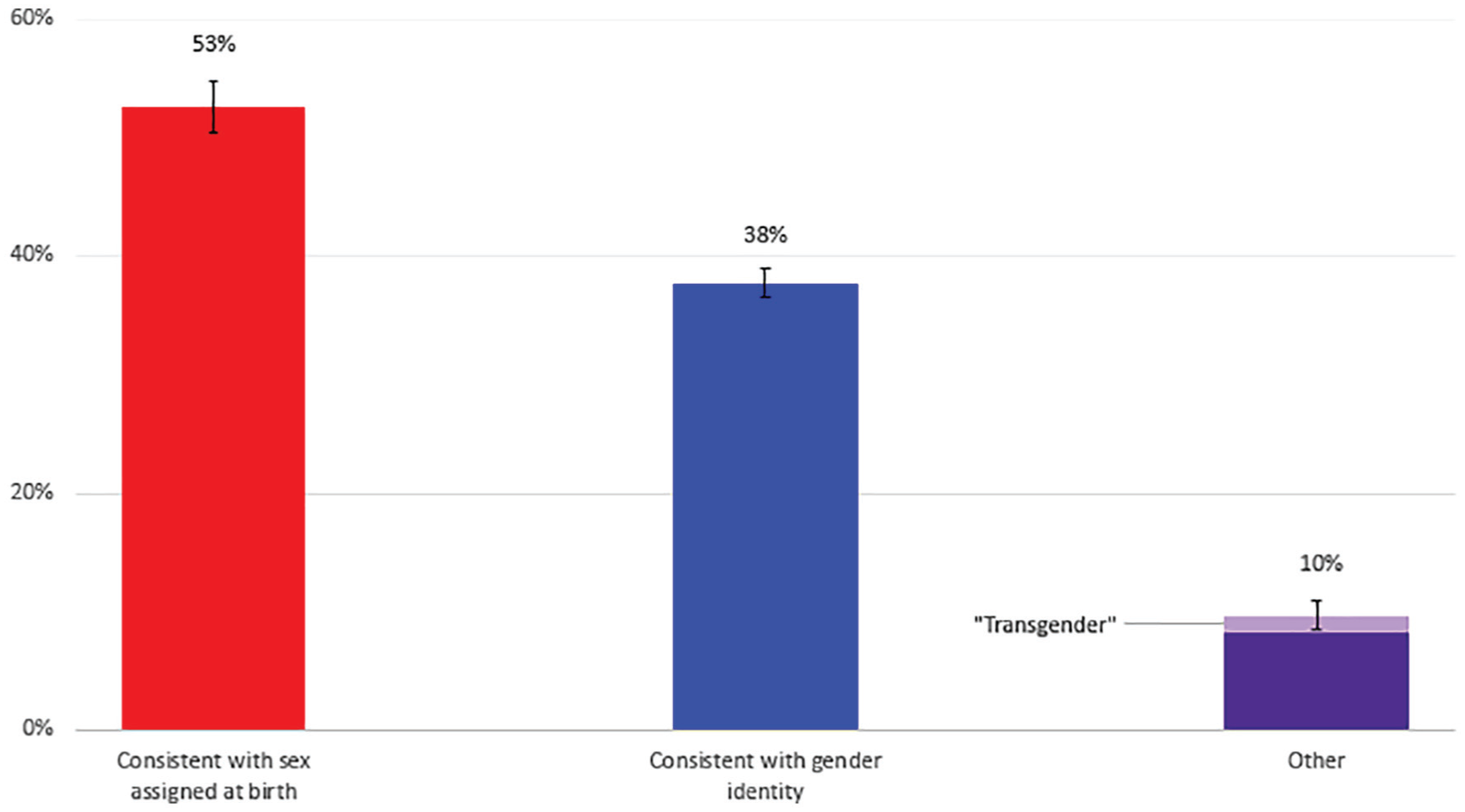
Perceptions of transgender people’s sex (n = 3,922).
The remaining respondents (10 percent) said the transgender person’s gender is something “other” than male or female. Of these, only 15 percent (or between 1 percent and 2 percent of respondents in total) considered transgender people to be “transgender,” while the remaining respondents (about 8 percent of respondents in total) gave another explanation. Those who selected “other” and did not write in “transgender” gave a range of responses. About half gave some iteration of “I don’t know”; one fifth said they would leave it up to the transgender person’s judgment, usually as a way of deferring to the transgender person’s identity; and about 10 percent made disparaging comments about transgender people. Notably, very few respondents used terms such as “non-binary,” “gender fluid,” or “genderqueer” that are common among gender scholars. This suggests either that the public is not familiar with these terms or they did not think the terms were relevant to the situation. 14
Effects of Self-Identified Gender, Age, and Physical Appearance
Notwithstanding these overall patterns, respondents’ perceptions of sex may also be shaped by the transgender person’s other characteristics, namely, their self-identified gender, age, and physical appearance. These results are shown in Figure 2. This figure reports the percentage of respondents who consider transgender people’s sex to be consistent with their sex assigned at birth, by each of the experimental manipulations. Put differently, these are people who take a more restrictive stance on sex and gender and tend to privilege biological notions of sex when evaluating transgender people’s sex.

Percentage of respondents who perceive sex consistent with sex assigned at birth, by self-identified gender, age, and physical appearance (n = 3,922).
The left panel in Figure 2 shows results for self-identified gender. Here we see that 52 percent of respondents in the trans man conditions and 53 percent of respondents in the trans woman conditions consider the person’s sex to be consistent with their sex assigned at birth. These percentages are not significantly different from each other. Thus, regardless of whether respondents are presented a trans man or a trans woman, they have similar perceptions of sex.
A comparable pattern emerges in the middle panel of Figure 2, which shows results for age. Respondents in the adult conditions perceive the person’s sex to be consistent with their sex assigned at birth 52 percent of the time, versus 53 percent of those in the teenager conditions. These percentages, once again, are not significantly different from each other. This pattern indicates that Americans do not distinguish between adults and teenagers when determining transgender people’s sex. This result may be surprising, considering that some members of the public, not to mention policymakers and judges, have argued that teenagers are insufficiently mature to identify as transgender. On the contrary, these data demonstrate that Americans consider transgender people’s age more or less irrelevant to perceptions of sex.
The right panel in Figure 2 shows that of the three factors examined in this study, physical appearance—more specifically, the transgender person’s level of gender conformity—has by far the largest effect on Americans’ perceptions of transgender people’s sex. When a transgender person is described as gender conforming in appearance, only 41 percent of respondents consider the person’s sex to be consistent with their sex assigned at birth. Thus, a relatively small percentage of people rely on this more restrictive definition of sex when the person is described as gender conforming. This figure climbs sharply to 61 percent in conditions with a gender-nonconforming person. In other words, the public frequently relies on a transgender person’s physical appearance, or their ability to “pass” consistent with their gender identity, when making determinations about that person’s sex. Those who do not “pass” are significantly more likely (in both a statistical sense and a substantive sense) to be categorized as consistent with their sex assigned at birth.
In addition, 54 percent of respondents in both the ambiguous and unspecified conditions consider transgender people’s sex to be consistent with their sex assigned at birth. Thus, Americans are about evenly split in their perceptions of sex when a transgender person’s gender expression is ambiguous or when their appearance is entirely unspecified. As discussed earlier, the unspecified conditions are particularly salient because most national surveys on transgender issues ask about “transgender people” in the abstract, without including information about physical appearance. We find that respondents’ perceptions in the unspecified conditions (54 percent consistent with sex assigned at birth) are more in line with those in the gender-nonconforming conditions (61 percent) than with those in the gender-conforming conditions (41 percent). This pattern suggests that Americans tend to think of transgender people as gender nonconforming, unless they are explicitly described as gender conforming. The fact that the controlling image of a transgender person is one of gender nonconformity has great potential to affect public opinion about transgender people in the abstract, as well as attitudes toward rights and privileges for transgender people.
Effects of Respondent Sociodemographic Variables
The previous analyses show how Americans think about transgender people’s sex, as well as the factors about transgender people that affect that determination. But how are these perceptions associated with respondents’ own sociodemographic characteristics? Table 1 addresses this question by showing how a range of demographic factors are related to perceptions of sex. This table presents marginal effects from a multinomial logistic regression predicting respondents’ perceptions of sex. For ease of interpretation, we show changes in the predicted probability of perceiving sex consistent with sex assigned at birth across these variables. Full regression results are shown in Table S2 in the supplemental material.
Average Marginal Effects of Experimental Manipulations and Respondent Sociodemographic Variables on the Predicted Probability of Perceiving Sex Consistent with Sex Assigned at Birth (n = 3,922).

Note: Average marginal effects from multinomial logistic regressions shown. For binary predictors, the marginal effects are based on changes from 0 to 1 on these variables. For age, the marginal effect is based on a marginal change in age. For income, the marginal effect is based on a standard deviation change in income (about $4,900). For each marginal effect, all other variables are held at their observed values. Standard errors of predictions in parentheses. Full regression results for are shown in Table S2 in the supplemental material. Omitted categories are adult, trans man, gender conforming, male, white, sexual minority, never married, no children in household, less than high school diploma, South, nonmetropolitan, not Evangelical, did not vote or voted for third-party candidate, and does not know a transgender person.
p < .05. **p < .01. ***p < .001.
Model 1 focuses on standard demographic variables, before introducing the potential confounding effects of religion, politics, and interpersonal contact. Here we see that many of these variables are associated with perceptions of sex. Women, Latinx respondents, respondents in other racial categories, 15 sexual minorities, and college-educated respondents are significantly less likely than their counterparts to classify a transgender person’s sex consistent with their sex assigned at birth (p ≤ .05 for all). Put differently, respondents in these groups take a more inclusive stance, and tend to privilege the transgender person’s gender identity. Table 1 shows that the average marginal effect of respondent’s age is not significant, but this is because age has a curvilinear effect on perceived sex (see Table S2). Up to about age 55, respondents are increasingly likely to perceive sex as consistent with sex assigned at birth, but this effect then dissipates. We see minimal effects of marital status, parental status, urbanicity, and income.
Model 2 adds religious and political factors. Evangelical respondents are significantly more likely than non-Evangelicals to perceive the transgender person’s sex as consistent with sex assigned at birth (ME = 0.11, p < .001). In addition, compared with respondents who did not vote or who voted for third-party candidates, those who voted for Hillary Clinton in the 2016 election generally privilege gender identity (ME = −.16, p < .001), while Donald Trump voters generally privilege sex assigned at birth (ME = .20, p < .001). 16
Model 3 adds a measure for interpersonal contact, or knowing someone who is transgender. Respondents who know a transgender person (31 percent of the sample) are significantly more likely to privilege gender identity than those who do not know a transgender person (ME = −0.11, p < .001). 17 This result underscores the idea that interpersonal contact (or the lack thereof) plays an important role in shaping attitudes toward transgender people.
Despite these clear differences across groups, we found that when we looked within each of these groups, the effects of the experimental conditions were strikingly consistent. These analyses suggest that a transgender person’s physical appearance—but not their self-identified gender or age—affects public perceptions of gender within a full range of demographic groups. To illustrate this point, Figure 3 compares the effects of the experimental manipulations between those who voted for Clinton in the 2016 election (top panel) and those who voted for Trump in the 2016 election (bottom panel). As evidenced by the disparate percentages in the top and bottom panels, there is a wide gulf between these groups in terms of perceptions of sex. Trump voters are generally much more likely than Clinton voters to perceive a transgender person’s sex as consistent with their sex assigned at birth. However, in both panels, physical appearance is the only experimental manipulation that affects respondents’ perceptions.

Percentage of respondents who perceived sex consistent with sex assigned at birth, by voting behavior in the 2016 election (n = 2,860).
Supplementary analyses show that no subgroups significantly distinguished between trans men and trans women, or between adults and teenagers, in their perceptions of sex. Perhaps more importantly to our point, nearly every subgroup in our data—the two exceptions being sexual minorities and respondents who know a transgender person—made a significant distinction between transgender people who were described as gender conforming and those who were described as gender nonconforming (see Tables S3 and S4 in the supplemental material). Overall, then, the tendency to emphasize gender conformity transcends social status when it comes to perceptions of transgender people’s sex.18,19
Perceptions of Sex and Attitudes toward Transgender Bathroom Access
In addition to advancing knowledge about perceptions of sex and gender, these data provide a window into key public debates surrounding transgender rights—one of the most visible debates centering on the issue of bathroom access. As discussed earlier, in addition to their determination of Casey’s sex, respondents who participated in round one of data collection were asked to indicate which bathroom Casey should use while in public (i.e., either men’s, women’s, or “other”).
Figure 4 shows that these two sets of responses are very much aligned. Most of the time, when respondents perceived a transgender person’s sex consistent with their sex assigned at birth, they also indicated the person should use a bathroom consistent with their sex assigned at birth (79 percent). A parallel pattern emerges for those who perceived transgender people’s sex consistent with their gender identity (75 percent). Those who perceived Casey’s sex as “other” had more heterogeneous attitudes toward bathroom access, although the modal choice for these respondents was “other” (53 percent), so the general consistency between perceptions of sex and attitudes toward bathroom access holds here. Overall, the consistency between these two items suggests that perceptions of sex are a major factor that underlies attitudes toward transgender rights more broadly. 20

Attitudes toward transgender bathroom use, by perceptions of transgender people’s sex (n = 1,971).
Discussion
Using data from the first national survey experiment of its kind, this study makes multiple contributions to research on perceptions of transgender people in the United States. As to the fundamental question of how the public perceives of transgender people’s sex, we find that Americans are more likely to privilege a transgender person’s sex assigned at birth than their gender identity. We further show that a transgender person’s level of gender conformity in appearance, but not their self-identified gender or age, affects how other people perceive of their sex. 21 Although the effects of these experimental manipulations are consistent across most sociodemographic groups, we find that some groups—such as sexual minorities, respondents who voted for Clinton in the 2016 election, and respondents who personally know a transgender person—tend to have more progressive attitudes than their counterparts overall. Additionally, these perceptions of transgender people’s sex map onto broader attitudes toward transgender rights, such as the debate over bathroom access, which has been central to public discourse surrounding transgender people for the past several years.
These data provide one of the first glimpses into how the public thinks about transgender people, especially when it comes to issues of sex and gender. The data suggest that public perceptions of transgender people’s sex are more similar to the guidelines proposed by the Trump administration than the more inclusive guidelines used by the Obama administration and endorsed by many scientific and professional associations. That said, these patterns are reminiscent of the attitudes regarding same-sex marriage from more than a decade ago—attitudes that liberalized so quickly that twice as many Americans now support same-sex marriage as oppose it.
Although there are clear differences between debates over same-sex marriage and transgender rights, our data point to some places where these two issues may overlap. For example, we find that interpersonal contact with transgender people is linked with more inclusive attitudes toward this group, similar to the way that contact with LGB people is linked with approval of same-sex marriage. As noted above, in our nationally representative sample, only 31 percent of people knew a transgender person, substantially lower than the 90 percent of people who had interpersonal contact with lesbians, gay men, or bisexuals (see Table S1 in the supplemental material). As the number of people who identify as transgender continues to grow and become more visible, and interpersonal contact becomes more common in turn, we might expect the public to increasingly privilege gender identity over sex at birth.
Another parallel is in the public’s overriding emphasis on “passing” when it comes to how transgender people are perceived. We find that physical appearance matters much more than other factors, including the transgender person’s self-identified gender and age, in shaping public attitudes toward transgender people’s sex. The data suggest that for many Americans, resistance to inclusive views toward transgender people is conditional and contingent on appearance. It is notable that the powerful effect of conformity in appearance holds even for the groups with the most restrictive views of transgender persons (e.g., Trump voters, evangelicals, and men).
To be clear, we are not endorsing the idea that transgender people should strive for gender conformity in order to receive benefits in society. Scholars have frequently debated the extent to which minority groups should assimilate to accommodate other people’s viewpoints, and it may be troubling to many social scientists that physical appearance is the most important factor in how transgender people are perceived. But the public’s emphasis on gender conformity suggests that people are most willing to accept those who they perceive as “like them.” This was also a common argument that was made in debates over same-sex marriage, that is, “we are just like you,” or the argument that same-sex couples are in love and committed to each other just like any other couple that wants to get married, so they should not be denied this basic right. These data show that transgender people who are physically indistinguishable from cisgender men and women are much more likely to have their gender identity acknowledged, compared with their gender-nonconforming counterparts.
Given the emphasis Americans place on gender conformity, these results underscore also the importance of access to health care for transgender people (see also Center for American Progress 2018; Grant et al. 2010; Shires and Jaffee 2015). Indeed, if transgender people had better access to gender confirmation surgery, hormone therapy, and routine care, this would benefit them personally, while also potentially having the added benefit of reducing transprejudice in the general public.
Additionally, we find that when a transgender person’s physical appearance is ambiguous, or when no information about their physical appearance is given, Americans tend to think about someone who is gender nonconforming. This pattern suggests that the social penalties associated with gender nonconformity are tightly linked with transgender people. Most polls, when gauging public opinion about transgender people, do not include any information about physical appearance, similar to our use of the “unspecified” conditions in these data that do not specify the transgender person’s physical appearance. Because the controlling image of a transgender person is apparently one of gender nonconformity, attitudes toward “passing” may need to evolve in order for public attitudes toward transgender rights to evolve as well. Put differently, our analyses suggest that if the controlling image of a transgender person were one of gender conformity, a clear majority of Americans would take a more inclusive view of transgender persons and would privilege gender identity over sex at birth. We note that this interpretation is based on our finding that results in the ambiguous and unspecified conditions are more similar to those in the gender-nonconforming conditions than the gender-conforming conditions. But the results for the ambiguous, unspecified, and gender-nonconforming results are not perfectly aligned. This suggests that respondents likely had mixed reactions to the ambiguous and unspecified conditions, and more research is needed to tease out people’s attitudes toward transgender people when gender conformity is unclear.
These patterns suggest that gender performances play a pivotal role in shaping attitudes toward transgender people (Schilt 2010). Despite the overwhelming public focus on issues of self-identified gender and age, the only factor that consistently and strong affects attitudes were related to physical appearance and gender conformity. Furthermore, this study demonstrates that the public relies on traditional categories when conceptualizing transgender people. Although a nontrivial number of people now identify as transgender in the United States, many members of the public remain resistant to those who defy traditional categories of sex and gender. As this population continues to grow, and traditional categories continue to blur, scholars should assess the factors that predict public perceptions of transgender people, as well as attitudes toward transgender rights and privileges.
Supplemental Material
Supp_material – Supplemental material for Americans’ Perceptions of Transgender People’s Sex: Evidence from a National Survey Experiment
Supplemental material, Supp_material for Americans’ Perceptions of Transgender People’s Sex: Evidence from a National Survey Experiment by Long Doan, Natasha Quadlin and Brian Powell in Socius
Footnotes
Acknowledgements
We thank the Socius reviewers and editors for their comments. We also thank the Time-Sharing Experiments for the Social Sciences principal investigators, Jeremy Freese and Jamie Druckman, for their suggestions on the study design. Previous versions of this article were presented at meetings of the American Sociological Association and the Population Association of America, as well as colloquia at Indiana University and The Ohio State University. We are grateful to audience members for their helpful feedback.
Supplemental Material
Supplemental material for this article is available online.
1
2
Here we do not mean to imply that gender is not influenced by biological sex, as these two factors are linked. In the case of transgender people’s sex, however, we found that most respondents privileged either biological or social factors, as described throughout.
3
We have focused on the main effects of these sociodemographic variables here, but it may also be the case that these variables interact with the experimental conditions in meaningful ways. These interactions are considered further in notes in the “Results” section.
4
Data and materials are publicly available from the Time-Sharing Experiments for the Social Sciences Web site: tessexperiments.org.
5
Sensitivity analyses confirm that the key patterns hold not only for the full sample but also for the samples from each individual round.
6
Names are typically considered unisex if at least one third of people with that name are male and at least one-third are female. According to the most recent national statistics, 59 percent of people named Casey are male and 41 percent are female. Other unisex names we considered using were Riley, Jessie, Avery, Jaime, Payton, Kerry, Jody, and Kendall. Most of these names were ruled out because they signaled age in ways that confounded the age manipulation.
7
We did not manipulate race in this study, because there were no unisex names that clearly signaled race. As such, we cannot speak to how the vignette character’s race may moderate the results presented. An examination of how race intersects with gender identity, age, and gender expression in shaping attitudes would be a worthwhile endeavor for future work.
8
An alternative way to manipulate physical appearance would be to use images of transgender people. Although this seems like it would be an attractive option, it would be nearly impossible to ensure that these images are comparable across conditions. Indeed, comparability would be a legitimate criticism if we had used this method. Given these constraints, we decided to use written descriptions of physical appearance in the vignettes.
9
We did not provide “transgender” as a response option here because this would give respondents an “out,” or a middle ground that would let them avoid giving their true opinions. We thought this was especially important to omit because many policies continue to rely on gender binaries, for example, bathrooms that are designated for “men” and “women” without any alternatives. In short, we wanted to understand how respondents think about transgender people in what is still very much a binary world. If respondents truly considered Casey’s sex to be “transgender,” they could write this response in. However, as we note in the “Results” section, a surprisingly small proportion of people who chose “other” wrote that Casey is transgender.
10
Respondents in round 2 also were asked to explain their responses in an open-ended question. Results from these qualitative data will be reported in a follow-up article.
11
A random subset of respondents in the teenager conditions were asked which restroom Casey should use at school. Supplementary analyses show that among those respondents in the teenager conditions, responses were consistent regardless of whether Casey was described as at school or at a store.
12
Respondents in round 2 were presented with two scenarios about Casey that gauged their attitudes toward (1) employment discrimination and (2) denial of service at a restaurant. Despite theoretical distinctions that could be made between employment discrimination and denial of service (which are considered formal rights) versus bathroom access (which is considered an informal privilege; Doan et al. 2014), supplementary analyses show that results were consistent across these three items. Thus, we present results only for the bathroom item for ease of presentation. Results for the employment discrimination and denial of service items are shown in Figure S1 in the  .
.
13
Respondents in the AmeriSpeak panel were asked if they were heterosexual or LGB. At the time we conducted our surveys, the AmeriSpeak sociodemographic profile did not ask respondents if they were transgender.
14
As noted earlier, respondents in round 2 were asked to explain their responses in an open-ended question. In examining these responses, we determined that a nontrivial number of people misunderstood the trans man condition (e.g., mentioning that Casey was born with male genitalia) and instead assumed that Casey was a trans woman. In contrast, a much smaller number of respondents appeared to misunderstand the trans woman condition. Overall results were not affected by this misunderstanding, but we view this as a potentially important dynamic for how the public thinks about transgender people.
15
The “other” racial categories include Asian Americans, Native Americans, and multiracial respondents, among others.
16
The sociodemographic patterns found in model 1 mostly reappear in model 2. Among the exceptions, whereas we find no significant difference in Black and White respondents’ perceptions in model 1, a significant Black-White difference emerges in model 2. We recommend caution in interpreting this pattern, given the extremely low percentage of Black respondents who voted for Trump.
17
As a point of comparison, more than 90 percent of our sample knows someone who is gay, lesbian, or bisexual. We do not distinguish among type of contact with a transgender person in our analysis (e.g., whether someone knows a transgender friend or family member) because the percentage of respondents who reported having a transgender friend or family member was too small to produce meaningful estimates.
18
We found patterns consistent with this conclusion in supplementary analyses of second differences, as well as interactions between the experimental conditions and sociodemographic variables.
19
As shown in Table 1, overall men are more likely than women to perceive a transgender person as consistent with their sex assigned at birth. As shown in Table S3 in the , however, the liberalizing effect of gender conformity is so great, especially for men, that when presented with a transgender person who is gender conforming in appearance, men and women do not significantly differ in their perceptions.
20
Paralleling the patterns regarding perceptions of transgender person’s gender, we found that physical appearance, but not self-identified gender or age, significantly affected respondents’ views regarding bathroom use.
21
It is possible that the age manipulation (16 vs. 36 years old) is not a large enough age gap to detect differences in attitudes toward the vignette character. Future work should explore how a broader spectrum of age categories across the life course may affect perceptions. Nevertheless, these results suggest minimal differences toward teenage and adult transgender people.
Author Biographies
References
Supplementary Material
Please find the following supplemental material available below.
For Open Access articles published under a Creative Commons License, all supplemental material carries the same license as the article it is associated with.
For non-Open Access articles published, all supplemental material carries a non-exclusive license, and permission requests for re-use of supplemental material or any part of supplemental material shall be sent directly to the copyright owner as specified in the copyright notice associated with the article.
