




Abstract
Little is known about how non-binary genders shape the distribution of household labor: a space that remains largely segregated along the gender binary. This article presents qualitative findings from households where at least one romantic partner identifies as non-binary. Between 2023 and 2025, I combine 80 hours of longitudinal interview data and field notes from visits to 22 primarily-monogamous and white households to understand how nonbinary identity affects household labor. I argue that “gender heritage”—the experiences of binary socialization—exerts greater influence on relational practices, like housework, than gender identity. Specifically, AFAB partners in relationships with AMAB partners are more likely to take on the majority of cognitive labor in the maintenance of their household and relationship. I challenge the assumption that non-binary identities translate into interactions wherein one’s experience evades influence from assigned gender. Rather, it is binary gender heritage that strongly predicts the distribution of historically gendered household labor burdens.
Introduction
Within months of conception, the fetal body is hailed into the binary gender system. Ultrasound visits are a sort of baptism, initiating the deep-seated cultural conviction that this fetus, hailed one way, is fundamentally different from all the other fetuses hailed another way. After the ultrasound, the hailing continues: middle-class expecting parents want to know the range of acceptable color palettes for the nursery walls, their friends and family want to know if offering a onesie with lace and frills is cute or taboo. Although families may presume that they’re talking about the sex of a child, they are really imagining the child’s gender trajectory, beset within the family’s racialization and class status (Butler, 2024; Chisholm, 1970; de Beauvoir, 1949; Halberstam, 2018; Meadow, 2018; Missé, 2022; Sabsay, 2016).
This article makes the case for theoretical and empirical attention to the concept I term “gender heritage,” or the remnants of socialization that have not been deconstructed during gender transition but remain intact as vestiges of a binary interpellation. When a child is born in U.S. society, they are presumed to live out their lives as their assigned 1 gender and to one day develop attraction to the gender they were not assigned (Hill Collins, 2000; Lamont, 2020; Missé, 2022). “Gender-open parenting,” where parents intentionally avoid assigning their child a binary gender, is still a nascent social practice (Rahilly, 2022). And one that I do not necessarily find espoused even by my nonbinary interlocutors who are or plan to be parents. Two of my white, transfeminine interlocutors in their 30s, Carla, a new parent, and Reagan, who plans to become a parent in the coming years, both said that their children are “statistically likely” to remain in the gender they were assigned, and thus it’s more “practical” to raise them in concurrence with their binary assignment. Surprisingly, this logic aligns with the “cultural myth” that “people are born into strict identity categories and will ‘naturally’ follow the rules of those categories unless there is something ‘wrong’ with us” (Spade, 2025: 71–72). The presumption of nontrans 2 and heterosexual identity, then, is so pervasive that it would be perverse—or at least “impractical”—to suggest the child might develop otherwise.
As an analytical framework, “gender heritage” examines the suitcase filled with dispositions, relationships, and subjectivities acquired pre-transition that are not abandoned but taken along for the ride, and examines how these artifacts furnish a life post-transition. This concept I offer has its own “heritage” in Bourdieu’s (1977) theory of habitus, the mundane and prolific subtleties in a person’s embodiment that signal their class upbringing. While “gender heritage” could be a more familiar term to describe habitus in the context of a binary gender system, it expands on habitus to include phenomena that are not just embodied (i.e., the way one holds a fork), but practices for which one may or may not have received subtle training in their childhood (like seeing dust and removing it); as well as the ways in which peer interactions can bring one’s gender heritage into the fore. Gender heritage is transmitted in both primary (i.e., family) and secondary (i.e., school) social institutions (Thorne, 1997).
Additionally, gender heritage addresses how the gender binary operates at the macro-structural level, such that “our cultural past has greatly impacted the way we see the world, the way we act today, and the way we continue to raise our children . . . it is important to acknowledge the past while speaking to our present” (Mangino, 2022: 12). The gender binary will always be part of our U.S. cultural heritage in the ongoing history of settler-colonialism and white supremacy. Whatever our individual raced and classed gender heritage may be, we all share the heritage of being held accountable (in varied ways) to reproduce the patriarchal, white supremacist gender binary. The gender binary casts a long shadow on all of the cultural venues in which we conduct our lives.
To illustrate this framework, I take the case of cognitive and emotional labor divisions in U.S. households with at least one nonbinary partner. In doing so, this article addresses a gap in trans and nonbinary studies by considering what individuals take with them as they migrate to another gender, or beyond a binary gender. It also offers a framework for addressing persistently gendered phenomena, like divisions of household and care labor, that are otherwise dismissed as purely individual preference, as opposed to preferences informed by social forces (Pfeffer, 2010). “Gender heritage” addresses a tension raised by one of my interlocutors, Salome, a white nonbinary transfemme who shared with me their observation that many nonbinary adults in her life “have a lot more to unpack as far as genders they may have grown up in,” specifically “harmful traits they may have picked up from those lived gendered experiences,” that can be a “challenge” to discuss without misgendering the person.
Trans and nonbinary adults, in their assertions of autonomy within a binary gender system, demonstrate that no amount of gender socialization can determine an individual’s ultimate gender destination. I argue that while gender assignments at birth are not destinies, they are local pathways. These pathways constitute a form of heritage and are specific to one’s social locations that funnel subjects through the gender system to “be” and aspire certain ways that may not always appear, at first glance, to be gendered phenomena. As my interview-based research on nonbinary households illuminates, binary gender norms permeate even radical forms of being. The fact that binary norms can permeate nonbinary identities challenges an assumption that informally circulates in U.S. discourse. This assumption, as anthropologist Asthana (2024, personal communication) asserts, reflects “middle class, white, neoliberal ideas that nonbinary identities can somehow supersede gender norm socialization” (see also Wright, 2019: 126). In other words, the notion that individuals can determine their own power on the basis of their unique identity is specific to a Western European, bourgeois culture that romanticizes the idea of an individual who simply is “themselves” in isolation from interpersonal relationships and institutions. It is the idea that one’s identity can precede, “supersede” or evade the structures that scaffold our lives. Gender heritage shows how even those who eschew identification with the gender binary remain caught in the sticky web of binary institutions and social relations, though one’s entrapment remains complex.
Conceptual framework
Gender heritage is not a harkening back to the gender binary as an ultimate, universal and inescapable mechanism for organizing social life. Embedded in this theory of gender heritage is the yearning for the abolition of gender as a process that sorts people into hierarchical categories of difference and, in doing so, conceals their full humanity. Gender heritage is attention to “the mechanisms in place . . . that create demographic delimitations to be placed in hierarchical and antagonistic relationship” (Bey, 2022b: 131). The conceptual work of gender heritage is to reveal how such “demographic delimitations” are covertly, or perhaps unintentionally, created and maintained.
The focus on gender as an individual attribute can be myopic, reinforce narratives of difference, and obscure the relational nature of the gender structure (Thorne, 1997). Beyond individual identity, gender is produced in interaction, and the dynamics that occur can subtly reinforce a structure that otherwise does not explicitly figure into identity. While nonbinary identities depart from the identity category they were originally assigned, there is, however, little interrogation of the contours of this departure.
If our assigned gender category interacts with every other facet of our lives, everything as minute as they way we utter a sentence, to as big as how we pursue our ambitions, then we must address how an initial gender assignment profoundly shapes us even if we no longer identify with it. Not only do we inherit binary gender categories, we inherit binary gender injustices. Nonbinary identities must account for the ways in which the binary gender system, as it is entangled with sexism, capitalism and white supremacy, advantages certain subjects while disadvantaging others.
This paper is not an examination of “gender performance” (Butler, 1993; West and Zimmerman, 1987). It is an examination of household practices that do not figure into an individual’s explicit gender expression, but follow a gender pattern indicative of the binary gender in which they were raised. Previous sociological research can be interpreted through the framework of gender heritage. For example, Daminger’s (2020) study of heterosexual, college-educated couples that reproduce the gendered division of labor despite professing egalitarian views on housework and Connell’s (2010: 43) study of trans men and women who are “consciously [holding] on to gendered characteristics that did not match their chosen gender presentations,” and recognize their socialization as relevant to their subjectivity.
Many transphobic discourses conflate the concept of “heritage” with “authenticity,” and, by extension, link the notion of “heritage” with an immutable essence. Such discourses are not echoed in my concept of gender heritage. I do not make claims about which criteria must be fulfilled to constitute “realness” in a given gender category. Such claims will always be ridden with errors and exclude vast swaths of people a category is meant to include (Ahmed, 2017; Riley, 1988). On the contrary, I argue that gender heritage is a framework to investigate the social pathways that shape individual subjectivities. These structural pathways are constituted by the coordinates of an individual’s social locations: their bodies, assigned and destination genders, in the context of race, ethnicity, class, religion, disability, nationality, weight, and documentation status (Halberstam, 2018; lester, 2018). So, in this paper, I dislodge “heritage” from essentialist claims to “authenticity” and “realness,” and instead present “heritage” as a provincial perspective that takes into account how our compulsory experiences from birth with the gender binary inform (but do not neatly determine) our sense of self in the world and ways of relating to others.
Literature review
Gender socialization
Socialization describes the interactions and relations that make up our daily lives as developing subjects. Socialization paints the horizon of what an individual imagines is possible for their life. Many nonbinary and trans kids and adults recall struggling in childhood to properly perform and feel at home in their assigned gender (Bey, 2022b; Darwin, 2022; Kobabe, 2019; Meadow, 2018; Missé, 2022; Mock, 2014; Roche, 2019; Roche et al., 2020; Stein, 2018; Wilchins, 1997). Still, some training escapes detection as a gendered phenomenon. The subjectivity individuals develop is significantly influenced by their assigned gender and its accommodating pressures and restrictions. “[W]e are not only vulnerable to these social pressures,” sociologist Missé (2022: 17) writes, “we are built on them.” Similarly, Halberstam (2018: 60) writes that “Children of all backgrounds . . . are supposed to internalize models of gender and reproduce them . . . even [in] their own hopes and fears about the future.” There are multiple subliminal ways in which a child is trained to enact a heterosexual, nontrans identity. It may mean that one person’s female gender socialization may make them more inclined to organize their personal decisions around a relationship; whereas the assigned male cohort is socialized to prioritize their ambitions (Lamont, 2020; Wong, 2023).
Outcomes of socialization are hard to pinpoint; harder still is it to capture how an individual responds to their socialization. “[T]he human mind is so much more than a blank slate waiting for an outside hand,” lester (2018: 177) writes. “How someone will hear, interpret, and internalize the multiple messages they receive, and how they will respond in turn will vary from person to person.” It is presumptuous to dilute a person’s subjectivity to merely an empty vessel to be filled with cultural messages to embody and reproduce. This is also a diluted vision of socialization, which is largely a collection of forgettable moments pierced by those that are scorched into our memories, stitched together to form the quilt that is our subjectivity. This article takes on the task of excavating how, beyond explicit identity, subtle processes of gender socialization form a gender heritage that shapes subjectivity in ways that have lasting effects on the relationships, experiences, and perspectives of individuals; even those who disavow their gender assignment. These inherited and learned ways of being can maintain inequity even in nonbinary relationships.
Binary heritage in heterosexual households
For decades now, research on the divisions of household labor illuminated how the binary gender system, a product of sexism, racism and capitalism, frames our most intimate relations and activities. Interlocking systems of oppression (Hill Collins, 2000) form the heritage of the binary gender structure. As such, they form the heritage of individuals expected to develop into masculine or feminine subjects.
The notion that the “feminine” should play damsel to the “masculine” reverberates throughout all economic classes. 3 Beal (2008) and Mies (2014) describe how the ideal of white femininity was constructed for the domestic enjoyment and exploitation by the male laborer under capitalism. Thus, while women may “benefit” from their husbands’ class positions, they do not necessarily occupy the same class as their husbands by nature of their gender, which places disproportionate cultural expectations on them for domestic and care work (Acker, 1988; Thorne, 1987). In fact, the U.S. economy relies on the unpaid work largely provided by female caregivers in lieu of legislative safety nets (Calarco, 2020).
Although 20th-century women entered the paid labor force at unprecedented levels and became independent from their husbands’ wages, household labor and childcare continue to be unjustly divided (Coltrane, 2000; DeVault, 1994; England, 2010; Hochschild, 1989; Rodsky, 2019; Syrda, 2022). Even female breadwinners perform more housework than their male partners who earn less income or are unemployed altogether (Hochschild, 1989; Tichenor, 2005). Resoundingly, women remain the “she-fault” stewards of households (Rodsky, 2019). So much so that married women take on as much—if not more—household and care work than single mothers, a phenomenon referred to as “single married women”; or, as one trending term puts it: “career women with adult toddler husbands” (Blake, 2011; Pepin, 2018; Schulte, 2015; Trantham, 2024).
The unprecedented demographic transition of white middle class women into the paid workforce in the latter half of the 20th century was a revolution for white women, whose occupational lives and economic agency were qualitatively different from that of their own mothers and grandmothers (Hochschild, 1989). Yet even this revolution into paid work stalled. U.S. female labor participation spiked in the 1970s and ’80s but plateaued in the 1990s; any increases since were lost as a result of the COVID-19 pandemic (Buchholz, 2022). Without structural support for their imposed cultural role as caregivers, female participation in the paid workforce was destined to decline (Buchholz, 2022; Calarco, 2020; Schulte, 2024).
Still, the genie is out of the bottle: the discrepancy between the transformation of women’s economic lives and the stagnation of men’s domestic contributions was profoundly felt in the marriages of white, dual-earner heterosexual couples. To cope with these tensions, couples developed “family myths,” which obscured the inequity of their relationship to allow them to believe that both partners were getting what they wanted (Daminger, 2019; Hochschild, 1989). Under invisible patriarchal pressures, wives would create images of equal sharing, minimizing the extent of her responsibility and overstating the contributions of her husband’s. They would speak of their relationship in terms of feeling “lucky”: if they thought that their husbands were better than the “going rate” (i.e., contributing more to housework than other husbands they knew), then they felt that they were lucky to have the best of what was available on the “marital market,” even if the inequities at home still loomed large (Hochschild, 1989: 50, 180; Lockman, 2019).
DeVault (1994) also found that women think about their marriage in terms of luck: if their husbands weren’t particularly picky eaters, then wives felt “lucky” that their husband’s food preferences were not as difficult, and therefore demanding, as other husbands they knew. The fact that they were the ones responsible for feeding, or for the bulk of housework and childcare, was an unchallenged assumption. Rodsky (2019), author of Fair Play, quips that a woman whose husband “willingly handles his fair share of domestic tasks” is “lucky,” underlining how the marital marketplace maintains a supply of men who do not step up. Psychologist Lockman (2019) pushes back against this still-pervasive notion that women frame their husbands’ (often minor) contributions in terms of luck as “an impediment to the elusive goal of equity in the home.” Even as some research finds that some men are stepping up more in the household, it is limited and most often among the “male leisure class,” or wealthy, educated men who cook as an “artisanal pastime” (Van Dam, 2025). Or what Hochschild (1989) described as a “fetish contribution”: participation in domestic chores as long as they are an appealing use of men’s leisure time (also see DeVault, 1994; Schulte, 2015).
Much of the wives’ sense of luck comes from the fact that the “cognitive labor” they perform to sustain their families and maintain a household—the endless, unarticulated calculus to keep a household perpetually running through the work of anticipating needs and monitoring results—is rendered invisible by the cultural conception of “work” as a formal activity that must be paid. Cultural notions of what counts as work obscure other kinds of work important to the functioning of society and devalue the people who perform this invisible work (Daniels, 1987). Part of the issue, according to Daniels, is that women themselves do not consider the routine and highly-skilled activities they do in the private sphere to be work. They lack consideration for their own work because they, too, subscribe to the belief in their natural aptitude for such activities, when really women’s work consists of trained (socialized) skills, not natural talent (Daniels, 1987). Social expectation implicitly mandates that women assume responsibility for this care work—for if she doesn’t do it, not only would she be unwomanly, but there is an unspoken yet universal understanding that “no one else will” (DeVault, 1994: 109).
When labor divisions are unfair, it remains women’s jobs to recognize the inequity and work to mitigate it, as demonstrated by the works of Rodsky (2019) and Blake (2011) who write to an audience of heterosexually-partnered women readers about ways to negotiate with their husbands to make labor divisions more fair for them. Women’s recruitment into doing care work—which implies doing service for men—is at the core of constructing “ideal” family life in the United States (DeVault, 1994). Through embodying care work, women learn deference and servitude to men (and even the children they raise) (DeVault, 1994). Men, in turn, learn to be entitled to such servitude (DeVault, 1994). Without articulation, women perform service, and in their choice of “deference to others and fitting their own projects into frames established by others, their actions contribute to traditional assumptions about women’s ‘nature’” (DeVault, 1994: 163).
Divisions of labor within the family, then, cannot be explained by random arrangements that naturally emerge over time. Families of any configuration may explain their divisions of labor as a simple matter of preference and skill, but these explanations obscure how gender socialization enforces the development of certain preferences and skills. If men are raised with the latent expectation that women will serve them, and women are implicitly taught selflessness and servitude, then men are enabled to do the housework they prefer (if they do it at all), and women learn to reserve the unglamorous tasks for themselves (DeVault, 1994: 104). As DeVault highlights, what women “happen to be faster” at doing is actually the outcome of years of experience doing the highly skilled work of care. The absence of language for this very work means that society “fail[s] to see the skill that produces group life, the effort of being constantly responsible and attentive, or the subtle pressures that pull women into the relations of subordination and deference produced by this work” (DeVault, 1994: 228).
Today, sociologists find that heterosexual-partnered women continue to perform the bulk of “cognitive labor” even if their male partners share in the decision-making and execution of the tasks (Ciciolla and Luthar, 2019; Daminger, 2019). Since women are pressed to multi-task in the home more than men, researchers consider her time more “contaminated” (Hektner et al., 2007; Schulte, 2015). That is, women can seldom be fully present in the moment or achieve a flow state because of the looming mental load; like a TaskManager program always running in the background, taking up terabytes. Daminger (2019) notes from her study of 35 heterosexual dual-earner couples that the cognitive labor that women are most likely to do “are also the most invisible, abstract, and distant from power” (p. 629). These findings nuance an activity that was only vaguely defined in previous sociological literature on the division of household labor. Echoing Marjorie DeVault, cognitive labor is difficult for the laborers to articulate, to the point that they find it hard to give themselves “full credit” for their contributions, and even whether their cognitive contributions counted as “work” (Daminger, 2019: 620). (This reluctance to recognize one’s own work is also a gendered phenomenon, see Priebe and Van Tongeren, 2023.) Should cognitive labor be treated seriously as a variable, researchers may find less technical egalitarianism within couples where many physical tasks are shared.
Mirroring Hochschild’s observations in 1989, Gerson (2010) finds from her interviews with 120 adults ages 18–32 that despite women’s desires for more egalitarian relationships, their “fallback strategies” still follow the historical gender pattern. Women may want to work more, and their male partners may want them to work as well, but when it comes to meeting the conflicting demands of work and family life, the expectations for women and men have seldom changed. Even in dual-earner families, “neotraditional” husbands see their work as more important, and thus expect their wives to scale back on their work hours should the demands of child rearing come calling. As Gerson (2010: 171) puts it, men “profess support for the ideal of equal parenting but they fall back on the practical advantages of devoted mothering.” Women see having it all as being able to successfully work and raise children. Men imagine having it all as not having to be the primary breadwinner nor the primary caregiver: “In contrast to self-reliant women, who expect to combine work and parenting as best they can, and neotraditional women, who expect to fit paid work around their family tasks, neotraditional men stress how their earnings substitute for time and other forms of care” (Gerson, 2010: 173). Gerson found that gender flexibility, or the ability of families to eschew gender expectations to overcome extenuating circumstances (e.g., job loss, addiction, abandonment) best predicted their ability to surmount challenges. Despite a reported increase in egalitarian values among heterosexual dual-earner partners (in this case, equitable sharing of the same household chores), the literature shows that traditional gender ideologies persist in practice, wherein the category “woman” is stuck to the category “domestic.” Therefore, female gender heritage is characterized in part by disproportionate domestic labor burdens—and emotional labor burdens to minimize her experience of these inequities.
Binary heritage in queer households
Research on queer households suggest that same-sex couples and couples with a transgender male partner struggle with inequity in ways that reflect the nontrans, heterosexual struggle (Brewster 2017; Carrington, 2002; Lamont, 2020; Mangino, 2022; Pfeffer, 2010; Ward, 2010). Some scholars have observed that domestic labor continues to be perceived as an expression of femininity in gay and lesbian couples (Barrett, 2015). The partner who makes the least income typically shoulders the most domestic labor, mirroring burdens that typically befall women in heterosexual relationships. However, Moore (2008) finds that in the absence of “explicit male gender privilege or the material advantage of high income,” control over the household and childrearing holds more power in Black lesbian stepfamilies (p. 353).
In Pfeffer’s (2010) study, she argues that transgender male partners have few “alternative cultural models for enacting nonhegemonic male and trans male identities” (p. 173). Pfeffer also suggests that the women may embrace a Third-Wave feminist politic, which espouses ideals of “individualism, free will, and choice” (p. 177). By attributing housework divisions to voluntary preferences that simply happen to resemble traditional gender roles, the women in Pfeffer’s (2010) study “explain inequality away” all while maintaining a feminist identity (p. 178). Similarly, the Queer couples in Kelly and Hauck’s (2015: 448) study expressed dividing labor “based on personal preferences for specific tasks rather than a commitment to equality.” Tornello’s (2020) survey study finds that majority white transgender and nonbinary families think their divisions of housework live up to their professed egalitarian ideals, based on what they report in a one-time, online survey.
Previous literature shows that queer households face inequities they carry with them from their gender heritage. Ward (2010) finds that nontrans women perform gender labor for their trans-male partners. She describes this as “giving gender to others, or actively suspending self-focus in the service of helping others achieve the varied forms of gender recognition they long for” (p. 237). Even as all genders perform labor for other genders, Ward stresses that “feminine subjects . . . are held particularly responsible for the work of gendering. This is because duties that comprise gender labor—witnessing, nurturing, validating, fulfilling, authenticating, special knowing, and secret keeping—have long been relegated to the sphere of female work” (p. 240). Queer families whose sexuality and gender deviates from the cis-heterosexual norm should not be assumed to automatically deviate from typically segregated divisions in housework. As Lamont (2020: 3) writes, “Lesbian, gay, bisexual, and queer (LBGQ) people are not immune to this contradiction between an egalitarian ideal and established expectations as they navigate the tension between assimilation and innovation.” Thus, the domestic labor inequities that characterize the gender binary are also present in households whose members break with the traditions of prescribed heterosexuality and/or cisgender identity. Yet very little is known about the experiences of couples who identify outside of the gender binary. The task of researching the divisions of household labor between nonbinary partners is finding out whether opting out of the gender binary altogether breaks the cycle of unequally valued categories that lead to unjust divisions of labor.
Methods
This article draws from 80 hours of semi-structured, longitudinal interviews, conducted between February 2023 and May 2025, either online or in the homes of 22 households; eight of which are referenced in this article (Table 1). Depending on the interlocutors’ preferences, some were interviewed alone, with their partner, or a mixture of solo and partnered interviews. Interlocutors were interviewed an average of 2–3 times over the course of 27 months.
Interlocutors’ demographics.
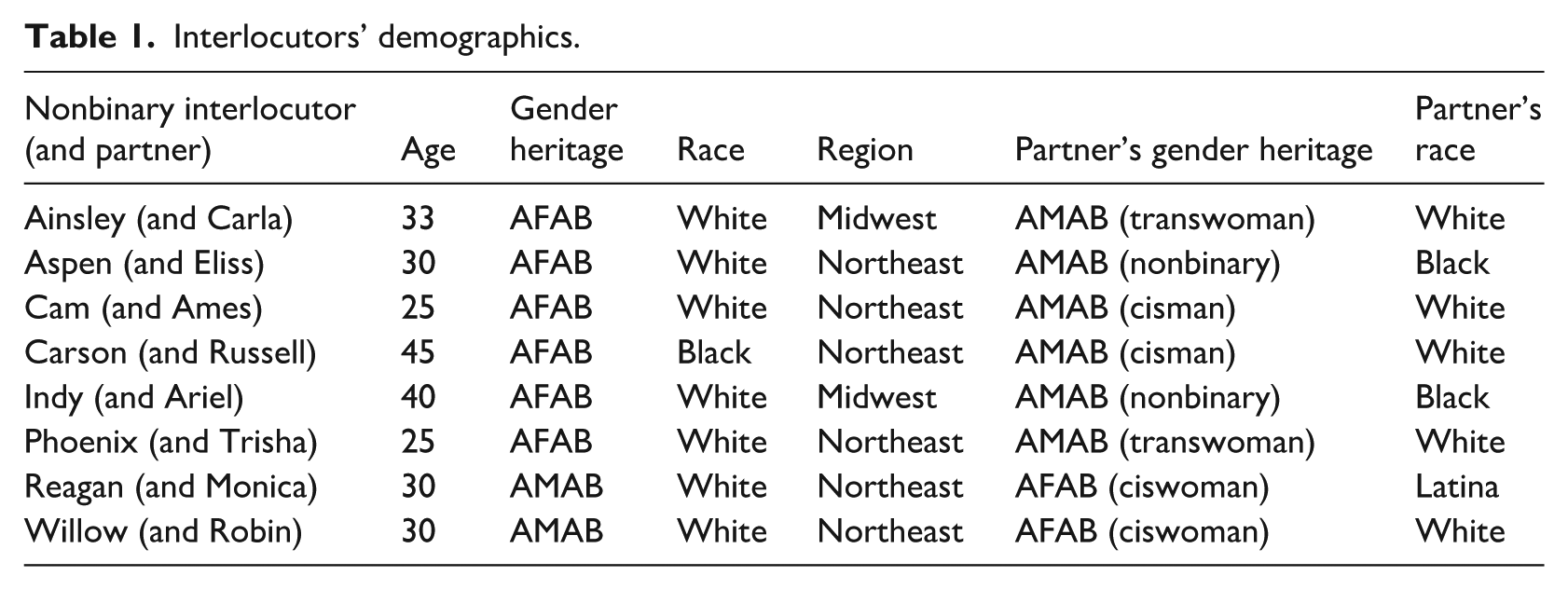
The interview guide used for this study draws inspiration from Darwin’s (2022) interviews with nonbinary individuals. My interlocutors were situated across the country; residing in urban and suburban areas in the Pacific Northwest, Midwest, and East Coast. Interviews were used as an entrypoint, a “crucial way to gain permission to conduct participant observation” (Lareau, 2021: 64). On occasions that I visited interlocutors in their homes, I also took field notes on how I was received, interactions between partners, and any housework that was done in my presence. As participation varied for each household, the data is asymmetrical: not all romantic partners participated in an interview, and most of the data on division of labor is self-reported. The interlocutors discussed in this paper were interviewed alone, unless otherwise specified. While no claim to generalizability can be made, the data offers early insights into cognitive labor divisions in primarily-monogamous, college-educated, middle-class and white nonbinary households.
To protect the anonymity of interlocutors, all names have been changed to pseudonyms and any potentially identifying details have been changed. All interviews were auto-transcribed by Zoom or Otter.ai and manually edited for errors. Editing the transcripts for errors enabled me to get into the weeds of my data during which “some of the very best ideas about what the data can mean” arose and were documented in analytic annotations (Deterding and Waters, 2021: 724). As I listened to the interview audio and edited the transcript for errors, I coded by hand the interviews for recurring themes, such as discussions of one’s gender socialization. Sections from coded interviews were subsequently analyzed alongside my field notes and woven together in analytic memos. This research was approved by the Internal Review Board at my university.
Interlocutors
Participation in this study was open to any volunteer in the U.S. and Canada (1) over the age of 25, (2) currently cohabiting with a romantic partner(s), and (3) who identified themselves and/or their partner(s) as nonbinary. Interlocutors were recruited through queer community-based organizations, word of mouth, and social media platforms such as Lex and Reddit. Table 2 provides an overview of the general demographics. All of my interlocutors identified as feminists (when asked), and the vast majority are racialized as white, from middle-class backgrounds with at least a college education, and were born between 1980 and 2000. Just under half also identified as disabled, including chronic mental health conditions such as anxiety and depression. Almost half also identified as having suspected or diagnosed Autism Spectrum Disorder, Attention-Deficit/Hyperactivity Disorder (ADHD), or both.
General interlocutor demographics.

A small handful of my interlocutors identified as biracial, Black or Latine. All households included at least one white partner. The fact that the households interviewed in this study are predominantly white could suggest that the findings are unique to predominantly white spaces. Indeed, when research centers on queer households of color, the findings are significantly different from previous research that centers whiteness (Moore, 2008). Gender heritage inequities can operate differently in households of color, and differently still in multiracial households that do or do not include white members. A major limitation of this study is that I do not have observational or interview data that offer insights into how race interacts with the gender heritage of a given partner to inform household labor divisions. Still, evidence persists that across race/ethnicity and class, women do more physical and cognitive labor in their different-gender households (Hill Collins, 2000; Lockman, 2019).
All of my interlocutors were raised in two-parent, heterosexual households; a small handful were raised with the assistance of their grandparents and in a few cases, the father was absent for long periods of time either due to divorce or occupational demands. None of my interlocutors transitioned prior to the age of fifteen, and thus all were raised from infancy to young adulthood with the expectation to identify with the gender they were assigned at birth. They were raised with varying degrees of familial and peer pressure to conform to binary expectations. Generally speaking, my interlocutors spent their childhoods in dual-earner, heterosexual households that resembled those described by Hochschild (1989), DeVault (1994), Wong (2023), and Gerson (2010). That is, my interlocutors grew up seeing the parent assigned female at birth held most responsible for chores and childcare. This traditionally unjust organization of household labor contradicted the expressly feminist views some of my interlocutors’ parents impressed upon them. This was apparent in Tatum’s upbringing, whose father told them that they could excel in STEM “despite” being a girl; but himself would not participate equitably in household chores, believing that rinsing his own dish and loading it into the dishwasher sufficed as a fair contribution to cleaning up after a dinner he didn’t cook. Rather interestingly, research finds that daughters who see their fathers take on a fair share of housework are more likely to work outside of the home and pursue a less stereotypically-gendered occupation, suggesting that fathers’ equitable presence in running the home encourages better representation of women in male-dominated fields (Croft et al., 2014).
Positionality
I share affinity with some of my nonbinary and trans interlocutors in that I do not derive a sense of internal identity from my assigned gender (Winer 2025), but rather understand my female assignment as a “struggle position” (MacKinnon, 2023) that I operate from within as a “bad cis subject” (Bey, 2022a: 44) alongside those who “do not and cannot sit comfortably within” an interpellation as cis (Bey, 2022b: xiv). I accept the use of “she/her” pronouns to hail me, not out of a specific affinity with or sense of ownership of that set of pronouns, but rather, a recognition of the gendered gaze, the narrow prism through which my body is seen and interpreted from the exterior. I understand pronouns, in a broader sense, to be “committing semiotic crimes, crimes of meaning-making that snatch your body from you” (Bey, 2022a: 106) not only because they can be wrongfully used to hail someone, but because gender always limits the ways in which people can be legible to others. Thus to hail me as a “she” tells an always-incomplete yet nevertheless revealing story about how my subjectivity is specifically shaped by relations with others, across time, in this world. The pronoun does not reveal the essence of my being, but rather, the ways in which I am nonconsensually acted upon by the world. My body is racialized as white and gendered as feminine and proximate to the ideal (i.e., attributed thinness and youth, see Gonsalves, 2024; Hill Collins, 2000). It is at these axes of power that I approach this research as a subject within the “matrix of domination” (Hill Collins, 2000).
Findings
The testimonies presented in this section offer a small but thickly descriptive sample representative of the experiences across my interlocutors’ households. The testimonies offered by my interlocutors in group settings were likely at least somewhat censored for social desirability bias, and it is possible that some testimonies shared with me one-on-one would not have been framed the same way in a group setting. But, as my findings make clear in the sections below, there remains a clear thread across my interlocutors’ experiences regardless of the settings in which they shared them.
All households reported striving for a distribution of tasks that satisfied all partners. That is, they prioritized satisfaction with the labor divisions and many checked in regularly with their partners to ensure that burdens were perceived as fairly distributed. However, the findings also suggest that nonbinary partners assigned female at birth (AFAB) tend to shoulder more cognitive labor (also known as the “mental load”) than their partners assigned male at birth. These findings resemble the experiences of nontrans AFAB people who continue to be found to be largely responsible for the cognitive labor in their heterosexual households (Daminger, 2019; Dunatchik et al., 2021; Mangino, 2022; Rodsky, 2019). This skewing of cognitive labor toward AFAB nonbinary partners suggests that gender heritage is a salient factor that shapes the organization of nonbinary households—at least to the extent that these are norms that guide whiteness in households. The following sections demonstrate this skewing in three areas: relationship development, productivity as it is associated with attention-deficit/hyperactivity disorder (ADHD), as well as logistics and social affairs external to the household.
Relationship development
When Aspen (29, nonbinary AFAB), met their partner, Eliss (28, nonbinary AMAB), for the first time, Eliss was playing guitar on a mutual friend’s couch. Sitting alone with me at their kitchen table, Aspen shared how they hit it off as friends at first, but after multiple philosophical discussions about dating and what the other was looking for in a partner, Aspen asked Eliss whether they might be compatible as partners. Eliss agreed, and later that year, made the official “proposal” to Aspen to be romantic partners. One year later, Aspen felt a desire to make a stronger commitment to Eliss and brought up the prospect of marriage. Shortly after their engagement, the consensual nonmonogamy practiced by Aspen and Eliss became a source of conflict. The following summer, after contention surrounding a couple of Eliss’ sexual partners, Aspen initiated a conversation about transitioning their relationship to a “queer platonic” configuration because, as Aspen put it, they didn’t “want things to be hard anymore” and thought that “letting go of sex” in their relationship was the best solution. They remain unmarried, but Aspen anticipates formalizing marriage in the near future. Setting up the court date will likely be Aspen’s job: “If I need Ellis to do something, I will delegate.” From the initiation of their sexual relationship to its current platonic configuration, Aspen’s accounts suggest that Aspen shouldered the burden of cognitive labor necessary to accomplish these relationship landmarks and emotional labor required to sustain their relationship.
Like Aspen, Cam (24, nonbinary AFAB), took similar initiatives to establish their relationship with Ames (27, nontrans male). The pair connected on the last day of class, when Cam initiated a conversation with Ames and invited him out for a concert. Afterwards, Cam followed up with Ames to ask if they could consider the outing a date. After 8 months of dating, Cam asked Ames if they could mark themselves as in a relationship on Facebook. They moved in together (at Ames’ initial insistence) and have since moved to another apartment with roommates. These initial examples might suggest a relationship development that defies heterosexual binary norms, where Cam pursues Ames and Ames wants to settle down in a shared nest. However, while their relationship does not exactly follow the patterns of a traditional script, it became clear that managing the relationship remains largely the domain of female gender heritage.
Cam identifies as “ambi-amorous,” meaning that they adapt their romantic practices to suit their primary relationship. Cam explained to me how they “accidentally” discovered that their relationship with Ames was monogamous, after Cam found out that Ames disapproved of Cam kissing friends at a party. The emotion work required to establish these terms seemed to be on Cam: they recalled how, following the party, Ames was withdrawn and unusually quiet with Cam. Sensing Ames’ negative mood, Cam prodded Ames to open up about his feelings, upon which Ames revealed that he was actually quite upset with Cam kissing outside of their couple. As Cam recalled, they explained to Ames that this was a boundary that Cam approved. One day, they plan to get married. Cam already envisions that it will be up to them to plan the wedding and pick the floral arrangements. The fact that Cam resigned themselves to planning the future wedding suggests that Cam could be “giving gender” to their nontrans male partner, taking on the burdens assigned to women and thus relieving Ames of burdens outside of his gender norms. Or, that Cam’s nonbinary identity has not fundamentally changed their socialization as a woman, to the extent that Cam, who describes themselves as “female of center,” still places feminized expectations upon themselves.
Contrary to Cam, Robin, 28, the nontrans fiancée of Willow (29, nonbinary AMAB) describes sharing the wedding planning with Willow. They are “equally avoidant,” as the couple joked to me in their living room. Willow and Robin both took turns proposing to each other. However, Robin insisted that she receive her proposal first. When I probed about Robin’s desire to be proposed to first, she explained that Willow proposing to Robin first would relieve her of a lot of anxiety around making the first proposal special. Plus, and perhaps more strikingly, Robin, unlike Willow, was raised with the expectation that one day she would be proposed to. Growing up with the expectation of one day being a bride made Robin feel she “was owed something by society.” Willow, assigned male, was never socialized to give much thought to their wedding day. Prior to meeting Robin, they had never given consideration to the proposal or their engagement ring. Robin’s desire to receive a proposal first might not have anything to do with her gender identity—after all, Robin said that receiving the proposal didn’t feel like an affirmation of her womanhood. But the lifelong anticipation and subsequent anxiety around the proposal reflect her gender heritage, and indicate the gendered trajectory upon which Robin was placed that differs from her partner Willow.
While Robin did not subjectively experience the proposal as an affirmation of her gender identity, she did experience it as an accomplishment that her gender training made her feel she was “owed . . . by society.” In this case, Willow’s acceptance to propose to Robin first was not an affirmation of either of their gender identities, but it was an affirmation, or outcome, of their respective gender heritages.
Robin’s anxiety and Willow’s flexibility reflect the different pathways of their gender training. Unlike Robin, Willow was not raised to anticipate their wedding day, and thus could honor Robin’s wishes shaped by her gendered upbringing. After their engagement was announced, Robin described being “freaked out” about wearing her engagement ring. Willow nodded: “People got weird at you specifically after we got engaged in a way that they were very much not to me.” Despite both having artistic “femme” rings, and Willow proudly displaying their ring for their friends to fawn over, Robin felt “immediately this crushing weight of expectation.” Furrowing her brow, she recounts attributing this pressure to her straight friends, with whom every conversation about her engagement “was around me being a bride and becoming a wife and when was my wedding and what was I planning about it, and there was no expectation that Willow participate at all . . . and I just felt this really, gross, expectation.”
Willow corroborated Robin’s experience, adding that: “Very briefly people would acknowledge and congratulate me on my engagement but it wasn’t this onslaught of questions and expectations and ‘oh, so you must . . .’ sort of conversations.” The topic of weddings, and assumptions people make about who in the relationship will have anything substantial to say on this topic, brings peoples’ gender heritage to the fore. Willow and Robin’s straight friends may have accepted Willow’s nonbinary identity, and yet still discursively place Willow in a binary male role insofar as they weren’t expected to have much to say about their upcoming wedding with Robin, and consequently, Robin was expected by her peers to answer to all of their wedding planning. This is a prime example of how peer relations outside of the household slot partners into a binary role in accordance with their gender heritage; with the effect of keeping majority responsibility for relationship development squarely on the shoulders of people with female gender heritage.
ADHD and cognitive labor
Fifteen interlocutors, or eleven households, reported at least one partner living with suspected or diagnosed Attention Deficit/Hyperactivity Disorder (ADHD). Multiple AFAB partners of AMABs described having better “executive functioning” than their AMAB partners, some of whom attributed their AMAB partner’s limited housework contributions to their “probable ADHD.” In fact, it was common among my interlocutors to attribute inequities in cognitive labor to suspected or verified ADHD diagnoses.
ADHD, it should be noted, remains a hot topic of debate among researchers, some of whom suspect that it’s less of a medical condition and more of a reflection of the human body’s struggle to cope with the overwhelm and multi-tasking that characterizes modern life in post-industrial, capitalist societies (Schulte, 2015). In any case, nearly half of my interlocutors reported living with ADHD as a personal attribute, although its manifestations took on a distinctly binary-gendered pattern. This raises the question of whether ADHD diagnoses constitute a new form of what Hochschild describes as a “family myth,” in which gendered inequities are obscured by non-gendered explanations for household organization.
Even if the ADHD diagnosis may be true, the diagnosis could be used to explain inequities that otherwise could be attributed to differences in gender heritage. Autism and ADHD are not gender neutral experiences. Even as these neurodiverse experiences impact household organization, they do so in ways that are themselves influenced by gender heritage. Research finds that white heterosexual women (without ADHD) in relationships with men who have ADHD disproportionately shoulder cognitive labor burdens for the management of their household (Zeides Taubin and Maeir, 2024). It is not coincidental, then, that assigned male partners are often described as having ADHD and/or worse executive functioning than their assigned female partners. Aspen described their initial labor divisions with Eliss as “extremely unbalanced,” noting that the way Eliss, who has ADHD, work[s] is that somebody has to signal to them that the issue exists. And so we spent a lot of time working really hard for them to already have a mapped out way of cleaning. Both of us also grew up not knowing how to clean—and I grew up not knowing how to share labor. I didn’t know how to tell somebody that something needs to be done, and then let them do it. So if they took longer than half an hour to do the dishes that I asked them to do, I’m just going to do them. And then I’m gonna secretly resent them for it. And I had to unlearn that habit. I had to learn how to actually delegate, and then they had to learn how to not be delegated to. So they had to learn how to take initiative on household tasks . . . [I]f I was asked this question a year ago, my answer would be different in that our household labor practices were extremely unbalanced where I was doing most of the labor, and I wasn’t communicating very well about the fact that labor needed to be done.
Multiple details are of note in this passage. First, Aspen describes that they alone shouldered the cognitive labor of pointing out to Eliss what needs to be done, because “somebody has to signal to them that the issue exists.” So how did it come to pass that it is Aspen who delegates, and Eliss who must learn to take initiative from Aspen when they both “grew up not knowing how to clean”? In our conversation, Aspen only cursorily alluded to their upbringing when prompted: “we both are at least able to acknowledge that we have this kind of conditioning within us of—like me, not even thinking when I fulfill household tasks, and them having to be reminded about them.” Aspen’s perspective on their differently gendered upbringing from Eliss was further articulated in an interview 7 months later, when Aspen attributed the asymmetry that plagued their labor divisions not only to Eliss’ ADHD but also to their different “raised expectations”: I think there’s also the expectation of I’m AFAB, they’re AMAB, and both of us just have that raised expectation of, like, I tend to take on a lot of the labor because that’s my place in the household where, and this is not something I actually believe, but like, that’s my place in the household, and their place in the household is to . . . honestly, I don’t think they’ve ever really felt like they have a place in the household . . .
Aspen’s gender heritage includes being raised with the expectation that they have a place in the household. Eliss, who Aspen suspects never felt that they’ve had a place in the household, cannot count acquiring household organization skills among the experiences that constitute their gender heritage.
It is also striking how ADHD is used to explain opposite behaviors. Reagan, 30, describes how their ADHD means that they will sometimes rely on Monica, 30, to remind them to do certain tasks, like mail the rent check or inject their estrogen. Monica works 60–80 hours per week and Reagan is currently unemployed, yet Reagan will still rely on Monica to tell them what deeper cleaning needs to be done around the household. This supports previous research that when AMABs live with ADHD, they can rely on their AFAB partner to perform cognitive labor on their behalf. However, it is possible that when AFABs have ADHD and live with an AMAB partner, they are less likely to rely on that AMAB partner to remind them to complete tasks. Strikingly, the ADHD diagnosis may be an instance of “reframing” that Mangino (2022) describes where the focus is shifted away from the gendered dynamic and onto a neutral scapegoat. When Reagan asks Monica to remind them to do certain tasks, this eerily resembles the emotional labor expected of people with female gender heritage, “encompass[ing], among other things, the keeping track and anticipatory work that so often falls to women: knowing what is where, who needs what, the grocery list, the family’s budget, the family calendar, and so on” (Manne, 2020: 124). The tendency to keep track and anticipate largely fell on people with female gender heritage: Monica and Robin had this in common with Aspen and Cam, Phoenix, Indy, Ainsley and Carson.
Reagan also notes that they take less initiative than their nontrans female partner, Monica, in getting the ball rolling on meals. Reagan’s translation of their ADHD diagnosis to lack of initiative is similar to general explanations for Eliss’ lack of initiative, Phoenix’s reports of their transfemme partner Trisha’s “bad executive functioning” that match transfemme Carla drawing parallels between her ADHD and her “horrendous executive functioning.” This is different from Indy, 40, a nonbinary AFAB who also received an ADHD diagnosis but is proactive about feeding themselves, and actually cooks more for themselves than they do for their nonbinary AMAB partner, who has a restrictive diet. When I visited Indy’s home, they made sure my water glass was never empty for long, despite attending to multiple to-dos in their home.
Overall, how ADHD is described to affect assigned male partners differs from partners assigned female at birth, who connect their ADHD to over-doing tasks. For example, Phoenix, 24, describes being home alone and spontaneously deciding to deep clean, while their partner, Trisha, a transfemme, works late in the service industry: . . . I’ll be by myself. She’ll still be at work, and my brain will just go: It’s time to deep clean the bathroom. The bathroom is not in need of a deep clean very much, but you know, my brain will decide it’s time to go, it’s time to do it, so I’ll do it, and she’ll get home and be like, ‘Why is the house like a showroom suddenly?’ and I’m like, ‘Blame the little man in here,’ you know, but it doesn’t feel like it’s work when I’m in that mode. Sometimes, if I need to do it, it does feel like work. And then I have trouble getting myself to do it. But I still do it eventually, on my own time.
Multiple conclusions could be drawn from this evidence. One conclusion could be that ADHD symptoms do manifest differently and seem to group according to gender assigned at birth. In which case, it would be possible that gender heritage shapes how ADHD symptoms manifest in a person. Another conclusion could be that suspected or diagnosed ADHD symptoms are leveraged in the creation of a “family myth,” or “reframing” of inequities (Daminger, 2020; Hochschild, 1989; Mangino, 2022) to reconcile unfair cognitive labor burdens.
External affairs and logistics
The cognitive labor burdens predominantly shouldered by AFAB partners extended to activities with friends and family. This ranged from house hunting, to recording music or planning vacations. If planning was not an express interest of an AMAB partner, it was left to the AFAB partner to initiate and keep the ball rolling. While Cam and Ames were searching for a new apartment with friends, it was Cam who took on the lion’s share of researching and forwarding listings to the group—Ames was “happy to show up to tours.” When I prodded Cam on whether Ames did any apartment-hunting research, Cam explained that Ames’ mother did that for him; Ames forwarded to the group chat what his mother found on his behalf. This reminded me of the annual vacations that Ainsley and Carla plan with their in-laws. These vacations are planned along an informal chain of command: first it is the mother (in-law) who gets the ball rolling on researching places and hotels, without any help from her husband. Feeling guilty that their mother (in-law) is taking it on all by herself, Ainsley (33, white, nonbinary AFAB), jumps in to help. This is followed by, Ainsley tells me, “varying levels of participation from everyone else.”
Cam, Aspen, and Reagan all recently moved with their partners. Cam, Aspen, and Reagan’s partner Monica all had mirror experiences with their assigned male partners, Reagan, Ames, and Eliss. Both Aspen and Cam got started on their boxes a month before the move-out date. “I think I grew gray hairs during packing,” Cam told me in the living room of their new place, which they share with two other friends. The five of us were gathered over a large cheese pizza I brought, wading through the fresh memories of that stressful week. In recounting their packing process to me, Cam turns to Ames with a playful, annoyed smile: Now I’m thinking back on it, and maybe I should have communicated more. There were points where I was like, I’m going to a little free library. Do you have any books you want to donate? And then you’d say no, and then maybe two weeks later, be like, I don’t want this book anymore. [Ames laughs, Cam intonates:] Oh my God. And then that happened the day after we moved in, you were like, ‘I actually don’t want these shirts anymore.’ I was like, ‘I told you two weeks ago, I’m going to the [university] closet for these!’ Like, this is pissing me off . . . And then at that point, you gotta get rid of your stuff on your own time, I’m not doing this for you.
Cam’s frustration with Ames during the purging-and-packing process was further compounded on moving day. I prod, and Cam answers by addressing Ames: “You also left a bunch of stuff in drawers, and then the drawers got really heavy, like on our dresser . . .. We had all of these boxes! Why didn’t you put these in boxes?” In these accounts, Cam describes taking on more of the cognitive labor insofar that they invested effort into ensuring that clothes and books were donated, and the contents of drawers were emptied into boxes in a timely manner. The lack of initiative from Ames, however, inadvertently unraveled the cognitive labor invested by Cam.
Aspen experienced the same moving-day dynamic with Eliss. In their words: I packed all of my stuff. And I’m a very neat packer. I always have a system. I labeled boxes, I made a Google Doc to sort everything out. And Eliss’ packing was very chaotic, and they did a lot of their—I didn’t realize how much of the stuff that we were moving the day that we moved was theirs. Yeah, because I’ve been planning on moving, I’d already moved all my clothes here, except for a few, I was rotating through five outfits for a month, and I had moved a lot of our art here and everything, and I was envisioning that our Truck Day would just be moving furniture. But I think it’s the experience with everyone where they move, and you’re just like, ‘Oh my god, where did all this stuff come from?’ And that wasn’t solely [Eliss] either. We definitely did have stuff where I’m like, ‘Oh, I forgot to pack most of our kitchen stuff.’ So we moved most of our kitchen stuff that day too. And then [Eliss] had been kind of putting off packing their room, so a lot of the stuff in their room also came with us in that move . . . I also kind of knew that they had a different packing system. And then when we got to the point where we were not going to come back to the apartment, Eliss [was] like, ‘You know what? I understand your packing system now, you looked crazy to me a month ago, doing all this then, but I get it. I’m gonna do this next time. Can you remind me?’
During our interviews, Aspen and Cam put in the emotion work to mollify their negative feelings (Hochschild, 1979), simultaneously dismissing their frustrations as they voiced them. Cam stated up front: “Maybe I should have communicated more,” before listing all the times they did communicate and how despite this communication, Ames still created more work for Cam on moving day. Aspen wove a narrative in which they shared responsibility for errors that were mostly Eliss’: “It’s the experience with everyone where they move . . . that wasn’t solely [Eliss] either . . . I also kind of knew that they had a different packing system.” In these instances, both Aspen and Cam performed the majority of the cognitive labor in moving, packing well ahead of time, and doing the emotion work of absorbing their partner’s shortcomings in the process as their own.
When Reagan and Monica last moved, Monica recalled having a “mental breakdown” when Reagan left her alone that day for 4 hours to get a rescheduled haircut. On that occasion, Reagan relied on Monica to continue moving their stuff and clean the old apartment by herself, so that Reagan could keep their hair appointment and enjoy a fresh haircut for a wedding. Sitting across from me, neither Monica nor Reagan anticipated that moving would be so stressful. The fact that Reagan kept their appointment in spite of the mounting, day-of stress is perhaps an extreme example of how people assigned male can tacitly leave enormous quantities of the mental load to their assigned female partners. Between Cam, Aspen, and Monica, they all experienced an unexpected and stressful increase to their mental load from their assigned male partners on moving day.
The cognitive labor shouldered by my nonbinary interlocutors assigned female further reveals itself in other mundane details: Aspen jokes that they can make dinner in 30 minutes less than Eliss (see Beagan et al., 2008 for more on how this is a pattern of female gender heritage), they are also the scribe when they sit down as a couple to discuss new guidelines for the conduct of their relationship. It is Aspen who hammers out the details of their road-trip: which friends and family they stay with, who will take care of the bunny while they’re away. Aspen assigned Eliss the task of getting the car fixed and finding a sitter for Eliss’ lizard, illustrating Aspen’s assertion that “If I need Ellis to do something, I will delegate.” Aspen even supports Eliss in the management of their music career; connecting Eliss to Aspen’s friend who runs a recording studio. Thanks to Aspen’s connection, Eliss has the opportunity to record their music for free (and Aspen does the background harmonies). When they show up to the studio on recording days, Aspen brings muffins they baked themselves to their friend as an offering of gratitude on behalf of their household. Here, Aspen leverages their friendship and sustains it with gifts of gratitude, for the benefit of Ellis.
Cam explained that their couple passes for straight in public. As Cam’s recollections illustrate, in practice, they also replicate the dynamics of a straight couple. There is little evidence thus far that Cam’s nonbinary identity is actively shaping their relationship dynamics with Ames. Instead, it seems that much of the labor that is not explicitly negotiated falls to Cam, like their fellow AFAB cohort in relationships with men. Again, Cam’s experiences mirror Aspen’s: when dinner plans haven’t been made, Cam initiates the conversation to decide on a meal. While it’s Ames’ responsibility to do the dishes in exchange for Cam doing all of his laundry, Cam still puts in requests for Ames to do certain dishes that Cam leaves in the sink.
As I talked with Cam for the first time in their living room, they stopped our conversation to switch the laundry. I noticed Cam grabbed the kitchen towels to add to their load, and asked if anyone else chipped in with laundering the shared towels. Cam shrugged and said they weren’t sure of the last time the kitchen towels were washed, or if the other two roommates washed them. When it’s time to write a birthday or graduation card for friends, Cam writes them up and Ames adds his signature. The accumulation of these instances illustrates how the mental tasks necessary to ensure a less stressful move, a good vacation with extended family, regular meals, and sustain resourceful friendships, most often, and in the largest doses, fall to nonbinary partners with female gender heritage.
Conclusion
Among the general, predominantly white, middle-class U.S. population, household labor continues to be divided between romantic partners of different gender heritages on the basis of the expectations that come with one’s gender assignment at birth. My findings are not foregone conclusions, but instead open up a new avenue for further research that explores how one’s gender heritage may inform one’s relationships. With few exceptions, nonbinary AFAB partners primarily “got the ball rolling” in the majority of activities pertaining to relationship development, household administration and the smooth running of domestic life. These cognitive labor burdens took the form of managing time and appointments, taking initiative on planning meals, finding housing and getting a head start on moving, logistics for leisure activities, sustaining relationships outside the household, and developments in their relationships, such as engagements and wedding planning. Nonbinary AFAB interlocutors who lived with a nontrans or nonbinary AMAB partner described taking the lead in getting their romantic relationships off the ground and chaperoning the relationship through conflict and new rites of commitment. This involved starting conversations to define the terms of the early relationship and initiating discussions about acquiring legal status for the relationship through marriage.
Overall, nonbinary AFAB partners were most likely to shoulder the invisible cognitive labor burdens described by Daminger (2020), Daniels (1987), DeVault (1994), Ward (2010), Lockman (2019), Mangino (2022), and Rodsky (2019). The extent to which a household challenges traditional, inequitable divisions depends on the configuration of partners’ gender heritage and lived identities. Nonbinary partners in relationships with cisgender/nontrans partners experience more tacit pressure to inhabit binary roles. Nonbinary partners are put to the task of “giving gender” (Ward, 2010) to their binary partners insofar that they acquiesce to temporarily occupying a binary position, instances that are highly visible during rites of passage like engagement and wedding ceremonies, but ever present in mundane routines, where the partner with female gender heritage relieves their masculine partner of the majority of cognitive labor burdens.
Trans and nonbinary people, alongside their gender nonconforming and intersex siblings, are challenging the durability of the gender-binary system (Fausto-Sterling, 1993; Missé, 2022). Their autonomy and pursuit of liberation from the restrictive constraints of the gender binary illuminate how the binary is neither natural nor an inevitable form of social organization. However, even as trans and nonbinary individuals demonstrate a path away from gender-binary norms, their lives are still subjected to inequities created by the gender-binary system. A feminist degendering movement will fail if inequities from a gender-binary society persist but there is no language to describe the pattern in degendered, nonbinary relations. Future scholarship in trans and nonbinary studies must contend with the binary gender heritage of our society, and the inequities this structural heritage may continue to create for future generations of intersex, nonbinary, and trans people—or the contemporary terms used to describe a disidentification with one’s assigned gender, if genders are still being assigned.
Attention to gender heritage may reveal how some inequities persist while others erode. Disidentification with the expectations upon one’s assigned gender may signal a powerful shift away from individual-level reproduction of gender-presentation norms. But this form of resistance against the masculinization or feminization of one’s body may not affect structural change in the long run. These speculations, informed by the findings in this article, may sound pessimistic but serve as a reminder that the experience of sexism is not always (or simply) a matter of identity. Subversive identities do not necessarily subvert structures. Gender heritage is a necessary conceptual framework that allows us to excavate how the binary sex/gender system shapes subjectivities in subliminal ways that would otherwise be invisible to the naked eye.
The antidote to inequality, as many feminists have written across time, is not equality. “As long as . . . any group defines liberation as gaining social equality with ruling-class white men,” hooks (2000: 144) writes, “they have a vested interest in the continued exploitation and oppression of others.” Rather than having equal power to dominate, it is the pursuit of freedom, or the iterative process across generations “of self-creation and world-building rooted in accountability and care” that can realize liberation (Bianco, 2023: 13). Contrary to visions of equality where differences are rendered inert, a free world is not necessarily one where we are all born with the same resources and situations, but one in which we can pursue freedom as individuals belonging to a collective; not as something that is handed to us but something that we all contribute to generating.
“It is in the recognition of the genuine conditions of our lives that we gain the strength to act and our motivation for change,” Simone de Beauvoir famously wrote (quoted in Bianco, 2023: 16). It is paramount to recognize our gender heritage as one aspect among many to be among “the genuine conditions of our lives” or a starting point from which we pursue our freedoms. Spade (2025: 72) perfectly captures the spirit of attention to gender heritage with his question: “How might our lives and relationships to each other change if we thought we could bring curiosity and intention to areas that seem hard-wired?” Thus, gender heritage plays a critical analytical role in the project of liberation. As our sense of selves migrate away from assigned, binary identification, we must not lose sight of how the binary structure—however outdated that structure may seem—still creates asymmetrical pathways that lead to unjust outcomes among diverse gender identities.
Footnotes
Acknowledgements
I wish to thank my advisor, Suzanna D. Walters, and Liza Weinstein for their constructive comments and encouragement throughout the development of this project. I also have immense gratitude for my dissertation workshop professor, Carla Kaplan, and my fellow classmates whose insights and feedback on my draft have given me critical direction for revisions: Medha Asthana, Rachael McIntosh, Amanda Gunn, Karaleigh Saar, Elisa Fuhrken, Mackenzie Patterson, and Johnathan Norris. I also extend my gratitude to Dr. Armani Beck for her encouragement and enthusiasm for this project and conceptual framing in its early stages. This material is based upon work supported in part by the National Science Foundation Graduate Research Fellowship Program under Grant No. G00006454. Any opinions, findings, and conclusions or recommendations expressed in this material are those of the author(s) and do not necessarily reflect the views of the National Science Foundation.

Funding
The author received no financial support for the research, authorship, and/or publication of this article.
Declaration of conflicting interests
The author declared no potential conflicts of interest with respect to the research, authorship, and/or publication of this article.