




Abstract
The authors examine the gendered perceptions of workplace challenges in the male-dominated fields of computer science, engineering, and mathematics (CSEM). Using novel qualitative and quantitative data from an online survey of 3,556 cisgender CSEM professionals, the authors explore how women and men differently perceive workplace challenges in domains that are central to gendered organizational theory. In stark contrast to prior research that suggests science, technology, engineering, and mathematics (STEM) professionals embrace purportedly meritocratic and “gender-neutral” cultural schemas, the present findings reveal that women in CSEM are significantly more likely than men to perceive workplace challenges across multiple areas and the biggest gender disparities are reported in the recognition of structural barriers. The authors further investigate how job tenure moderates these gendered perceptions. Longer tenure is linked to lower perceptions of workplace challenges among men, whereas women’s perceptions of structural barriers remain consistent over time, and reports of interpersonal difficulties become more frequent as tenure increases. These findings suggest that tenure, rather than buffering women from inequality, may amplify gendered burdens, reinforcing disparities in how organizational experiences are seen and navigated. By highlighting both the persistence of gendered perceptions and the role of job tenure, this study advances understanding of how inequality is perceived and reproduced within contemporary STEM workplaces.
Work organizations are not gender neutral; rather, they are structured by deeply embedded norms that privilege idealized worker images rooted in traditional masculinity (Acker 1990; Bates 2022; Williams, Muller, and Kilanski 2012). These dynamics are particularly pronounced in male-dominated fields such as science, technology, engineering, and mathematics (STEM), in which women continue to face exclusionary practices, limited advancement opportunities, and hostile work environments (Bird and Rhoton 2021; Blair-Loy and Cech 2022; Glass et al. 2013; Hosoi and Canetto 2011; Miller and Roksa 2020). Yet although gender disparities are well documented across STEM career stages, prior research consistently demonstrates that workers in STEM fields embrace the widespread cultural belief that science is “meritocratic” and “gender neutral” (Bird and Rhoton 2021; Britton 2017; Cech and Blair-Loy 2010; Ecklund, Lincoln, and Tansey 2012). Such cultural frameworks attribute gender inequalities to individual differences (e.g., a lack of human capital or different personal motivations) rather than structural constraints. These conflicting narratives raise an important question: if STEM workplaces are structured by gender but if STEM professionals themselves frame their workplace as merit based and gender neutral, do gender disparities emerge in women’s and men’s perceptions of workplace challenges?
Prior research has extensively documented numerous domains of women’s disadvantage in STEM fields, including women’s disproportionate exit from STEM careers (i.e., the “leaky pipeline”), advancement barriers, and work-family conflict (Cech and Blair-Loy 2019; Cech et al. 2011; Correll 2001; Glass et al. 2013; Goulden, Mason, and Frasch 2011; Litzler, Samuelson, and Lorah 2014; Pedersen and Minnotte 2017). Despite this persistent pattern of gendered inequality, there is considerable evidence STEM professionals reject the possibility gender disparities exist (Blair-Loy and Cech 2022; Cech and Blair-Loy 2010; Chan, Di, and Ecklund 2023; Ecklund and Lincoln 2016; Ecklund et al. 2012). In fact, in STEM fields, meritocratic schemas are widespread among both men and women and are used to explain unequal outcomes between men and women (Cech and Blair-Loy 2010; Ecklund et al. 2012; Rhoton 2011).
We argue this paradox suggests that STEM professionals’ perceptions of workplace challenges serve as a meaningful site through which to understand how gender inequality is internalized and contested in STEM fields. We anticipate the ways in which workers perceive their challenges will shed light on how gendered organizational processes are experienced and understood by workers themselves.
Moreover, perceptions of workplace challenges are not formed in isolation. They are shaped by individuals’ social positions within the organization, including their job tenure, which typically confers stability, authority, and symbolic alignment with dominant workplace norms (Cech and Blair-Loy 2010; Patterson, Damaske, and Sheroff 2017). However, tenure may not be experienced uniformly. As research on racial inequality in organizations suggests, those who ascend into higher status positions may become more attuned to structural barriers, precisely because they encounter them more directly (Wingfield and Chavez 2020). Similarly, women in senior roles may be especially well positioned to recognize gendered organizational constraints. Thus, the relationship between tenure and perceived challenges may itself be gendered: although tenure may enhance men’s sense of belonging and shield them from perceiving inequality, it may do little to mitigate and may even heighten women’s awareness of persistent workplace challenges.
In this study, we ask two primary questions. First, do women and men employed in computer science, engineering, and mathematics (CSEM) fields differ in their perceptions of workplace challenges? Second, is job tenure similarly, or differently, associated with perceived workplace challenges for women and men in CSEM? To answer these questions, we draw on original qualitative and quantitative data from a Qualtrics panel survey of 3,556 cisgender professionals working in CSEM fields, a subfield of STEM in which male dominance remains particularly pronounced (Charlesworth and Banaji 2019; Fry, Kennedy, and Funk 2021). We use a mixed-methods design, integrating existing theoretical frameworks, qualitative reports of work challenges, and statistical testing. First, we collected qualitative responses on perceived workplace challenges and systematically coded these accounts using an abductive approach (Gerson and Damaske 2020; Timmermans and Tavory 2012) guided by the five dimensions of gendered organizations as theorized by Acker (1990). These dimensions include organizational structures, workplace norms and culture, interpersonal interactions, individual worker identities, and organizational logics (Acker 1990; Blair-Loy and Cech 2022; Correll 2001; Glass et al. 2013; Miller and Roksa 2020). Next, we used these qualitatively coded categories to construct dependent variables for subsequent quantitative analysis, in which we test for gender differences in reported workplace challenges and examine whether job tenure is similarly associated with these challenges for men and women. This mixed-methods approach allows us to construct theory-driven hypotheses from the qualitatively created dependent variables, capturing how workers describe the challenges they face.
Our findings demonstrate that despite prior research emphasizing the dominant meritocratic cultural schemas in STEM, women are more likely than men to report structural discrimination, work overload, and low self-efficacy, whereas men are more likely to report no significant workplace challenges. Notably, job tenure is associated with divergent gendered perceptions of workplace challenges: among men, longer tenure is linked to a reduced perception of workplace challenges, whereas among women, it corresponds to heightened perceptions of interpersonal difficulty and sustained awareness of structural discrimination. These patterns suggest that tenure may not mitigate inequality but may instead deepen gendered divergence in how workplace inequalities are experienced and understood. Building on these insights, our study advances understanding of the dynamics of gendered organizations and underscores the importance of treating perceptions and tenure as key dimensions of workplace gender inequality.
Gendered Organizations and STEM Challenges
Gendered organization theory proposes five processes through which organizations maintain and reinforce a gendered hierarchy: (1) organizational structures, (2) workplace culture and norms, (3) social interactions, (4) individual identities, and (5) organizational logic (Acker 1990). First, although STEM fields provide women with better advancement opportunities and greater wage premiums than occupations in other fields (Beutel and Schleifer 2022; Moss-Racusin et al. 2012; Weisshaar 2017), women, in comparison with men, still experience greater structural barriers, such as vertical segregation into positions with lower status and pay within STEM organizations (Campero 2021; Ku 2011). Second, stereotypically masculine behaviors and ideals such as self-promotion, confrontational interaction styles, risk taking, and prioritization of careers are pivotal elements in achieving occupational success and advancement in STEM (Blair-Loy and Cech 2022). Third, interactions among colleagues and between employees and supervisors are shaped by gendered expectations (Acker 1990). Women in STEM report gendered professional and academic expectations, neglect from their male colleagues and supervisors, and professional exclusion (Carapinha et al. 2017; Miller and Roksa 2020; Moss-Racusin et al. 2012; Settles et al. 2006). Fourth, gendered organizations can lead to men’s and women’s differential development of worker identities (Acker 1990). Patterns of self-efficacy, an individual’s belief in one’s ability to achieve performance goals (Bandura 1986), differ for women and men in STEM (Ashlock, Stojnic, and Tufekci 2022; Correll 2001; Litzler et al. 2014). Fifth, the logic of gendered organizations legitimizes the ideal worker norm, normalizing expectations that women’s family responsibilities will hinder their career success and retention (Acker 1990). Normative expectations about women’s work-family conflict may be especially salient in STEM fields (Damaske et al. 2014; Ecklund 2016; Ecklund et al. 2012). New mothers are more likely than new fathers to leave STEM employment, switch to part-time work, or exit the labor force after childbirth (Cech and Blair-Loy 2019) and almost half of the women employed in STEM leave their fields after their first child is born (Glass et al. 2013).
Cultural Schemas in STEM Fields
Despite the documentation of gender disparities in STEM, women’s and men’s perceptions and reports of work challenges may not reflect these inequalities. Cultural schemas, which determine how individuals understand and evaluate reality, play a crucial role in the perception of gender inequality (Blair-Loy 2003; Cech, Blair-Loy, and Rogers 2018; Chan et al. 2023). In STEM fields, meritocratic schemas are widespread (Cech and Blair-Loy 2010; Rhoton 2011), and STEM professionals often rely on these schemas to explain inequality outcomes (Ecklund et al. 2012). These meritocratic schemas broadly lead to two different accounts of inequality outcomes: human capital explanations and individual motivation explanations (Cech and Blair-Loy 2010). Human capital explanations focus on an individual’s lack of a particular skill set or experience to explain divergent outcomes in STEM fields, while individual motivation explanations primarily suggest that women (unlike men) have deeper ties to childbearing and rearing and these conflicting motives pull women (but not men) from their devotion to work (Blair-Loy and Cech 2022; Ecklund and Lincoln 2016). Although differing in their explanations for gender inequality, both frameworks suggest occupational setbacks experienced by women in STEM are due to personal deficiencies rather than systemic barriers (Cech and Blair-Loy 2010; Correll, Benard, and Paik 2007; Davis and Robinson 1991).
These meritocratic schemas in STEM fields are widely embraced not only by cisgender heterosexual White men but also by women (Blair-Loy and Cech 2022). Many women in STEM report occupational opportunities are determined through meritocratic processes rather than acknowledging the existence of systematic gender constraints (Bird and Rhoton 2021; Seron et al. 2018). As a result, women in STEM often perceive their institutions to be “gender neutral” (Britton 2017) and attribute gender inequality in their organizations to women’s deficiencies in human capital and motivation rather than to structural barriers (Cech and Blair-Loy 2010). Thus, women’s perceptions of workplace challenges may not substantially differ from men’s, even in organizations where gendered inequalities persist.
However, it is also possible that women in STEM perceive workplace challenges differently from men, but only in certain domains. Although women in STEM often perceive their work organizations to be “gender neutral,” Britton (2017) argued gender becomes salient when women encounter overt structural constraints, such as disproportionate service obligations or barriers to advancement and retention. Additionally, work-family challenges are often perceived to be individual, rather than structural problems (Cech and Blair-Loy 2019; Ettinger, Conroy, and Barr 2019; Glass et al. 2013; Williams 2018). Women’s (but not men’s) acknowledgment of work-family challenges, then, would not challenge normative STEM schemas. Instead, it could serve to reinforce existing cultural schemas that frame work-family conflict as an individual (particularly a woman’s) problem (Damaske et al. 2014). Thus, perceptions of workplace challenges may diverge by gender under specific conditions: when structural constraints are particularly visible or when challenges align with traditional gendered expectations without directly threatening the notion of meritocracy.
Job Tenure and Workplace Challenges
Perceptions of workplace challenges are shaped by individuals’ organizational positions, exposure to workplace inequalities, and internalized cultural expectations (Cech and Blair-Loy 2010; Wingfield and Chavez 2020). One key structural position that may shape these perceptions is job tenure.
The gendered perception of workplace challenges in STEM may evolve across career stages, shaped by both attrition dynamics and organizational socialization processes. The gendered structure of STEM organizations contributes to the widely documented “leaky pipeline,” whereby women are disproportionately likely to exit STEM careers (Cech and Blair-Loy 2019; Cech et al. 2011). Attrition is often selective: women who are more vulnerable to gendered workplace challenges, such as low occupational self-efficacy or persistent interpersonal exclusion, are more likely to leave STEM (Cech et al. 2011; Pedersen and Minnotte 2017; Riffle et al. 2013). As a result, those who remain in STEM over time may represent a selective group, consisting disproportionately of individuals who have either been more successful at navigating gendered organizational structures or who have internalized dominant cultural schemas (Cech and Blair-Loy 2010). This selective retention may shape perceptions of workplace challenges across career stages, as women with longer tenure may experience higher self-efficacy and a stronger sense of occupational belonging. Over time, these dynamics may encourage a shift in how challenges are interpreted, with more tenured women increasingly framing difficulties as individual or meritocratic rather than structurally rooted (Blair-Loy and Cech 2022).
Job tenure may also operate through processes of cultural socialization. As women advance in their careers, they are more likely to attain higher status roles, positions that may demand assimilation to dominant workplace norms. Research suggests that women in top organizational roles in STEM are often more likely to attribute inequality to individual deficits in human capital or motivation rather than to systemic barriers (Cech and Blair-Loy 2010). From this perspective, longer tenure could diminish women’s recognition of structural inequality by reinforcing dominant organizational expectations and meritocratic cultural schemas. Thus, tenure may not only reflect survival through gendered organizational structures but may also reshape how those structures are perceived and internalized.
However, job tenure may also sharpen gendered perceptions of inequality. As women advance in their careers, they may gain access to higher status roles that expose them to more systemic organizational barriers, such as exclusion from leadership networks, lack of sponsorship, or persistent bias in promotion and evaluation. Findings from Wingfield and Chavez (2020) suggest that similar to the experiences of Black professionals, higher status women in STEM may become more attuned to structural discrimination as they navigate these challenges. Rather than insulating women from perceptions of inequality, increased tenure may deepen their recognition of systemic barriers that persist even at advanced career stages.
Thus, the relationship between job tenure and gendered perceptions of workplace challenges may not be linear or uniform. Instead, it may reveal competing dynamics (i.e., assimilation into dominant norms for some, and heightened awareness of organizational inequality for others), highlighting the complex ways in which job tenure intersects with the reproduction of gendered organizational structures.
Data: Qualtrics Panel Sample
To better understand how gender shapes perceptions of workplace challenges in CSEM fields, we collected original survey data from professionals employed in these occupations between March 2021 and June 2021. Respondent selection, recruitment, and data collection for this study were conducted by Qualtrics, an Internet-based survey research firm that uses paid panels of respondents. The survey included an informed consent statement, and all participants were recruited on a voluntary basis.
To approximate the sex, race/ethnicity, educational attainment, and household income distributions of the American population on the basis of U.S. Census Bureau estimates, Qualtrics uses a quota sampling approach. Although this method attempts to ensure a diverse and representative sample, concerns have been raised regarding the consistency of online nonprobability samples such as the Qualtrics panel (Groves 2011; Miller et al. 2020; Zack, Kennedy, and Long 2019). However, the usage of such samples is well established because of their ability to target specialized populations (Birnbaum 2004; Skitka and Sargis 2006) and to address questions not captured by larger nationally representative studies; as a result, Qualtrics panel data are now commonly deployed in sociological studies on work and gender (Brown and Ciciurkaite 2023; Grace 2023; Pezaro et al. 2023). Using Qualtrics panel data allows us to capture CSEM workers’ open-ended responses about perceptions of workplace challenges, which are not measured in nationally representative surveys such as the American Community Survey or Current Population Survey.
In this study, the recruited participants were adults in the United States, possessed a postsecondary educational degree (i.e., associate’s degree or higher), and, at the time of the interview, employed in CSEM occupations. In the survey, participants reported their demographic, family, and occupational characteristics and described their primary workplace challenges.
From the original sample of 4,001 respondents, we excluded 131 participants because of incomplete survey responses and removed 39 participants older than 65 years to focus on the working-age population. An additional 233 responses were excluded because of nonsensical answers to this open-ended question, in accordance with the scholarly recommendation to minimize the illegitimate responses in online survey data (Modrakovic et al. 2024). Finally, 57 transgender or gender-nonbinary participants were excluded because of the small sample size. This resulted in a final analytic sample of 3,556 cisgender participants, whose responses were qualitatively coded by three authors and two undergraduate research assistants. 1
This project employs a mixed-methods research design to illuminate how gender shapes perceptions of workplace challenges within the broader organizational dynamics of CSEM fields. We began by collecting open-ended qualitative responses, which we then systematically analyzed using an abductive approach (Deterding and Waters 2021; Gerson and Damaske 2020; Timmermans and Tavory 2012). Unlike inductive strategies such as grounded theory, which build concepts primarily from emergent themes in the data, abductive reasoning entails iterative movement between empirical observation and theoretical frameworks. As Timmermans and Tavory (2012) emphasized, abductive analysis is a “creative inferential process” that draws on surprising or counterintuitive findings to refine, extend, or challenge existing theory. This approach was particularly well suited to our study, in which we sought to refine and operationalize existing theoretical constructs from gendered organization theory. Specifically, we examined whether and how respondents’ descriptions of workplace challenges fit within the “larger empirical and theoretical context” (Gerson and Damaske 2020:145) of Acker’s (1990) five dimensions of gendered organizations and the debates about meritocracy in STEM, while remaining open to unexpected themes that extended beyond those dimensions. The categories that emerged from this process then served as the foundation for constructing dependent variables used in our subsequent quantitative analysis.
The following sections present qualitative methods and findings that informed the construction of our key analytic measures, explain how these findings were translated into the dependent variable constructs, and then detail the quantitative analyses used to assess how these perceptions vary across gender and job tenure.
Qualitative Methods and Findings
In the survey, participants were posed the following: “Thinking back across your CSEM career, please describe the biggest career challenge you faced.” We used an abductive approach in which we grounded the findings in the existing gendered organizations and STEM literatures and allowed new themes to emerge from the responses. The codes were created on the basis of constructs from the literature and patterns that emerged during the coding process and were refined using an iterative pattern (Deterding and Waters 2021; Gerson and Damaske 2020). For example, the team began with a list of commonly described challenges in the STEM literature, such as “chilly climate” or “work-family conflict.” These codes were applied to responses and when responses did not fit any of the expected codes, potential new codes were noted. During weekly team meetings, each coder reported on the common themes that had emerged during the coding process (e.g., “COVID-19”). The team discussed the prevalence of each emerging theme and whether to add a code for that theme. Additionally, codes originally derived from the literature were refined during the coding process; for example, few respondents explicitly discussed a chilly climate, but it was quite common for respondents to note challenges in interacting with managers, colleagues, and/or staff members. From this discussion, the code “interpersonal challenges,” was agreed upon and replaced the original “chilly climate” code.
We carefully considered when concepts were analytically distinct and should be “split” from one another and when concepts were analytically tied and should be “lumped” together (Zerubavel 1996). For example, we came to view challenges related to reports of “work-family” conflict as closely aligned with reports of burnout and time demands. We decided these concepts were part of the “work overload” caused by work organizations’ demand for employees’ time devotion (see Kelly and Moen 2020 for a discussion of this term in the professional workplace). Thus, we lumped these reports together under the code “work overload.”
After all responses were read and given an initial code, a new coder was assigned to each response. During this second round, each coder again assigned a code for each response; any differences in codes between the first and second rounds were brought to a group discussion that included the three authors, and a final coding determination was made by group discussion. In the third round of coding, the research team organized the existing coding schemas by their fit within the five domains of gendered organizations, as laid out by Acker (1990): (1) organizational structures, (2) workplace norms and culture, (3) social interactions, (4) individual identities, and (5) organizational logic. Most of the codes fit within the five processes, although four themes (discussed later) did not. In what follows, we discuss qualitative themes that emerged. 2
Structures: Structural Discrimination versus “Gender-Neutral” Occupational Opportunities
In our qualitative analysis, we find evidence of gender disparities in challenges related to gendered organizational structures, including perceptions of structural discrimination. One prevalent theme, almost exclusively among women, is perceived gendered structural discrimination (which we define as institutional and systematic discrimination attributed to ascriptive or achieved characteristics such as gender) within workplaces, in which women perceive their gender as a barrier to workplace opportunities.
3
For instance, women participants frequently reported that their gender was their primary career challenge:
To this day, I don’t feel like there are many women in the field, so we are constantly battling gender bias in the hiring process. It seemed like the only way I secured interviews [was] from referrals from internal employees. (Woman, White, 40 years) As a woman in computer science, I have participated in diversity initiatives at big tech companies. As a participant in these programs, I have often faced comments about not deserving my place at the company or being a diversity hire. (Woman, Asian, 23 years)
Women’s perceptions of discrimination due to their gender, particularly concerning gender bias and devaluation during entry and throughout their careers, align with prior findings that gendered structural barriers are prevalent in STEM. Moreover, women’s numerous reports of perceptions of gendered structural discrimination suggest, in contrast to the existing literature, many women do not see their workplaces as gender neutral, but rather acknowledge gender as a significant determinant of career challenges.
Yet some CSEM workers instead emphasized the difficulty in securing employment and gaining promotion in gender-neutral terms. For instance, one participant discussed her struggle to find employment after college:
My biggest career challenge was finding employment after college. Not many places want to hire someone right out of college with zero work experience. I took a low paying job and worked my way up. (Woman, Hispanic White, 38 years)
Although she did not attribute her gender as a reason for encountering difficulty in finding a job and accepting a low-paying position, her experience may also reflect structural discrimination in STEM fields that limit each worker’s occupational opportunities. Given meritocratic and “gender-neutral” cultural schemas in STEM fields (Britton 2017; Cech and Blair-Loy 2010; Rhoton 2011), many women may experience and perceive fewer employment and career advancement opportunities, yet still describe their challenges in gender-neutral terms (e.g., highlighting their deficiencies in skills rather than citing gender discrimination as the cause of their limited occupational opportunities). Such gender-neutral language was also used by men who experienced finding a job or getting a promotion as a primary challenge:
The biggest challenge was finding a job since at first you don’t have [any] things to show how good you are and it’s not easy find a job that requires your skills. (Man, Hispanic, 26 years)
This respondent attributed his initial difficulty finding a job to a lack of experience, which is a typical human capital explanation for inequality outcomes (and which does not acknowledge challenges he may have faced as a Hispanic man in STEM fields). Individual-focused accounts such as this one suggest that meritocratic schemas may be widely embraced by professionals in CSEM fields, hindering them from perceiving disparities in occupational opportunities as structural discrimination.
Culture and Norms: No Workplace Challenge
Reporting the absence of workplace challenges is a prevalent theme, particularly among men. Our qualitative analyses reveal men’s expression of a lack of challenge is, itself, symbolic. After the prompt to name their most significant workplace challenge, numerous (primarily men) participants indicated they had never encountered significant challenges, had faced unnamed obstacles but overcome them, or expressed satisfaction with their careers:
No challenges. (Man, White, 29 years) I have faced many obstacles in my professional life, but I have overcome them with perseverance and diligence. (Man, White, 35 years) My career is my passion, and I am confident in it. (Man, White, 42 years)
Given that self-assurance and assertiveness are highly valued for success and advancement in STEM fields (Blair-Loy and Cech 2022; Parson and Ozaki 2018), men in CSEM may report no perceived career challenges as a symbolic strategy to signal their fit within the organization and highlight their self-competence. Women sometimes reported perceiving no major workplace challenges as well. For instance, a 36-year-old Black woman noted, “There are no challenges in this profession.” However, our qualitative analyses suggest that such responses were less common among women, a pattern we will examine further in our quantitative analyses.
Interactions: Interpersonal Challenges
We also find evidence of interpersonal challenges, fitting within the context of workplace interpersonal dynamics. One of the interpersonal challenges discussed by both men and women was their lack of social skills and difficulty communicating with colleagues:
Learning how to communicate with people in the style that suits them is challenging. As technically minded people we may not be the most highly adapted social beings, so we present additional challenges to one another due to our personalities. (Man, White, 37 years) The biggest career challenge has been learning to communicate. Growing up, I was quiet and very shy. I hated asking for help and would just be independent. Learning to communicate my needs and communicate a customer’s need required a learning curve for me. (Woman, Black, 30 years)
Some gender disparities emerged, however, as women, more than men, reported facing difficulties in earning approval and respect from their supervisors or coworkers:
At my first company, the boss, who didn’t like me, didn’t want to give me a promotion. So, I decided to work even harder to show him that I was indeed deserving to be manager, and he had no choice but to promote me! It was such an amazing feeling. (Woman, other, 24 years) The biggest career challenge has been advocating for myself and demonstrating that I am capable of taking on new challenges. I responded to this by finding myself a mentor. (Woman, White, 31 years)
In contrast, men, more than women, reported facing interpersonal challenges related to team dynamics or managerial responsibilities:
I say the biggest challenge will be getting to know the members of the team. I am used to working with a large and diverse team and thrive on finding the best in my colleagues. (Man, White, 41 years) Managing my group. You have lots of different personalities but ultimately need to connect in order to meet goals/timelines. (Man, White, 35 years)
Gender disparities in the qualitative reports of interpersonal challenges may reflect vertical segregation within STEM organizations, where men often occupy higher positions such as management, while women are more frequently relegated to lower positions. They may also reflect women’s experiences of a “chilly climate.”
Identities: Low Self-Efficacy, Technological Challenges, and Educational Challenges
We also find evidence men and women perceive different challenges related to their worker identities with women reporting more challenges related to low self-efficacy (i.e., a person’s belief in their ability to achieve goals and succeed at tasks; Bandura 1986), while men report more technological and educational challenges. Women participants often cited competition or imposter syndrome as their primary career challenge, signaling a lack of self-efficacy:
My biggest challenge is having to compete with more competitive colleagues. (Woman, White, 42 years) My biggest Computer Science Challenge was Imposter Syndrome. For some reason, I had felt like I was fraudulent and didn’t think my work deserved the credit that it was getting during some of the heights of my career. (Woman, Black, 23 years)
This lack of confidence, particularly among women, may stem from their perception of not fitting into the field or feeling less than ideal workers, contributing to gendered differences in worker identity within CSEM. It may also stem from working in a system they accept to be “meritocratic,” but in which women perceive themselves as not having the same success as their male peers.
Men reported more perceived technological challenges than women, including difficulties keeping up with emerging technologies or mastering new software programs:
The biggest career challenge is how quickly technology gets obsoleted. Continuing education and the ability/desire to learn new technologies is the only way to prevent getting obsoleted along with the old technologies. (Man, other, 48 years) The biggest challenge has been learning the software and how to apply it in real life situations. I have learned a lot of things the hard way during my internship and was given a lot of council from advisors. (Woman, White, 28 years)
Additionally, men, compared with women, reported more educational challenges, such as struggles with coursework or obtaining a degree:
I’ve had difficulty with a lot of theory-based courses like Analysis and Algebra. To succeed in those courses, I had to be very proactive in learning, reaching out to other students and professors for concepts I had a hard time understanding. (Man, Hispanic, 35 years) Getting my master’s degree and professional engineering license was challenging requiring lots of study and commitment. But you have to preserve to be successful. (Man, White, 59 years) I was not the best at math growing up, so I had to work hard to study and overcome that obstacle. It was not easy. (Woman, other, 21 years)
Men’s focus on their educational challenges may support Correll’s (2001) findings that men who struggle academically in STEM fields have higher assessment of their STEM abilities, suggesting that men who face these educational challenges may persist into STEM fields. Or, as with the symbolic logic of reporting “no challenge,” men who report a challenge in education may be suggesting that their challenges are far in the past and not connected to their current work environment.
Organizational Logic: Work Overload
Last, ideal worker norms are reflected in participants’ reports of “work overload,” reifying gendered logic in CSEM organizations in which science is considered all-consuming (Damaske et al. 2014; Ecklund 2016). Participants frequently cited a heavy workload or burnout as their primary career challenge:
Intense workload. I’ve stayed up late trying to manage my time to get everything done on time. (Women, White, 25 years) Burnout has been a constant struggle. Forcing myself to take time off and focus on my mental health is helpful, but challenging. (Man, White, 33 years)
This time pressure reflects the ideal worker norm expectation within gendered organizations for employees to devote uninterrupted time to work (Blair-Loy and Cech 2022; Kelly and Moen 2020). Additionally, family obligations were discussed by both men and women, but women were more likely to report a work-family conflict, while men reported family as a source of support:
Staying focus while taking care of my one-year-old son, it has been a struggle but I’m doing this for me and my family. (Women, Hispanic, 33 years) Work time management and [the] pressure of deadline meeting. I get used to this circumstance and my family helped me a lot. (Man, White, 43 years)
This difference highlights the ideal worker norm prevalent in CSEM, which disadvantages women who face gendered expectations to shoulder household responsibilities.
Less Common Challenges
Participants also reported workplace challenges that fall outside the primary focus of this study, grouped into four additional themes: financial challenges, career adaptation, workplace environments, and COVID-19. Financial challenges primarily involve paying for college and student loans, with many reporting a lack of financial support from family. Career adaptation entails difficulties in adjusting to work, transitioning from school to work, and coping with the learning curve. Workplace environments encompass issues such as resource scarcity, low wages, and challenging tasks unrelated to technology. COVID-19-related challenges include issues arising from the pandemic, such as remote work and layoffs (the survey was conducted between March 2021 and June 2021). Although these themes are analytically meaningful, their small sample sizes preclude inclusion in the quantitative analysis. Nonetheless, illustrative examples of all 12 identified workplace challenges are included in Online Supplement Table S2.
Additionally, 189 participants reported workplace challenges that were less prevalent than those discussed in detail earlier. These include concerns about job fit (n = 48), lack of support (n = 24), health issues (n = 21), family disapproval (n = 11), uncertainty about career paths (n = 12), starting new businesses (n = 9), disability (n = 6), socioeconomic background (n = 5), workplace accidents (n = 5), and other challenge categories with four or fewer reports. Because of their small sample sizes, these challenges are grouped into the “other” workplace challenge category in the quantitative analyses.
Mixed Methods: Theoretical Development and Hypotheses
Together, gendered organization theory and our initial qualitative findings point to systematic ways that gender likely shapes experiences of workplace challenges in CSEM fields. Our qualitative insights inform the development of our following research hypotheses. The open-ended responses provide a rich foundation for identifying common themes, and our mixed-methods approach allows us to take an important next step: to quantitatively test whether the perceptions we identified through the qualitative analyses differ systematically by gender.
Given the gendered organizational context of CSEM fields and our qualitative results, we expect women systematically will encounter and perceive a broader range of workplace challenges compared with men. Building on both our qualitative empirical findings and the theoretical perspectives outlined in the literature review, including gendered organization theory (Acker 1990), the persistence of meritocratic and “gender-neutral” schemas in STEM fields (Blair-Loy and Cech 2022), and the context-specific nature of perceived workplace challenges (Britton 2017), we test the following competing hypotheses regarding gender differences in perceived workplace challenges:
Hypothesis 1a: Women in CSEM fields will be more likely than men to perceive workplace challenges regarding occupational structures, workplace norms, social interactions, individual identities, and organizational logic.
Hypothesis 1b: Women and men in CSEM will not perceive workplace challenges differently.
Hypothesis 1c: Women in CSEM fields will perceive more workplace challenges than men, but primarily in domains that either directly challenge the idea of organizational gender neutrality (e.g., structural challenges) or confirm dominant cultural schemas about gender and work (e.g., work-family conflict).
In addition, although our qualitative analysis offers critical insights into the types of challenges that CSEM professionals identify, it is less well suited to assess how perceptions vary across organizational positions, particularly by job tenure. Our mixed-methods approach allows us to leverage the qualitatively derived categories of workplace challenges in a quantitative framework to examine how gender and job tenure interact in shaping workplace perceptions.
Reflecting contrasting perspectives in the literature (Cech and Blair-Loy 2010; Patterson et al. 2017; Wingfield and Chavez 2020), we evaluate the following competing hypotheses:
Hypothesis 2a: Gender differences in the perception of workplace challenges will be relatively small among more tenured CSEM workers.
Hypothesis 2b: Job tenure will be associated with women’s greater perception of structural workplace challenges.
By integrating these sets of hypotheses, our analysis bridges grounded qualitative insights with a theoretically informed quantitative investigation, capturing not only what workplace challenges are perceived but also how organizational positioning may exacerbate or mitigate gendered patterns of perception.
Quantitative Methods and Findings
Measures
For the quantitative analysis, we create our dependent variable by transforming our qualitative findings into a multinomial categorical variable. 4 To do this, if a participant’s response included multiple challenges, we first identified the “primary” challenge by focusing on the one with the most emphasis or elaboration. When two challenges received equal attention, the team discussed the final code assignment. For example, one participant described the difficulty of balancing single motherhood with technological advancements in her industry. Although a technological challenge was mentioned, “work overload” was assigned as the primary challenge, as the emphasis was on the work-family conflict created by caregiving responsibilities and technological demands combined. This process ensures that the perceived workplace challenge variables are mutually exclusive and exhaustive, with each participant assigned only one primary challenge.
Second, although our qualitative findings suggest detailed gendered nuances within each challenge category, we had to determine whether and when to divide our workplace challenge categories. For example, although our qualitative analyses provide evidence of the different kinds of interpersonal challenges women and men report, our quantitative models do not disaggregate these variations, as further subcategorization would undermine the reliability of statistical estimates given the sample size of this challenge. In contrast, the relatively large number of respondents who perceived workplace challenges related to worker identities allows us to divide this challenge into three subcategories: low self-efficacy, educational challenges, and technological challenges.
This process yields eight primary categories, including (1) structural discrimination, (2) employment and advancement opportunities, (3) no workplace challenges, (4) interpersonal challenges, (5) low self-efficacy, (6) technological challenges, (7) educational challenges, and (8) work overload. Additionally, respondents who reported five other challenge categories (i.e., career adaptation, workplace environments, financial challenges, COVID-19, and other challenges) are included in the analysis but are not discussed in detail due to sample size limitations. Each participant’s qualitative response is assigned to one of these categories on the basis of the description of their workplace challenges (coded 0 = no, 1 = yes). Table 1 presents the distribution of primary workplace challenges reported, with technological challenges being the most frequent (15.66 percent), followed by no workplace challenges (13.16 percent), and educational challenges (11.02 percent).
Percentages and Numbers of Participants Reporting Primary Work Challenges for Full Sample and by Gender.

Primary independent variables include gender and job tenure. Gender is dichotomously coded as either men or women. Job tenure indicates the number of years respondents have worked with their current employer.
Control variables include demographic characteristics: participants’ age (ranging from 19 to 65), racial/ethnic identity (White, Black, Hispanic, Asian, or other), 5 relationship status (single or married or cohabiting), parenthood (nonparent or parent), and whether the participant holds a postsecondary engineering degree. To gauge socioeconomic status, we also control for income, categorized as annual wage less than $76,000 (low), $76,000 to $151,000 (middle), and more than $151,000 (high). Finally, to capture occupational characteristics, we assess participants’ occupational sectors (academic, industry, government, or other).
Descriptive Statistics
Table 2 shows that women make up 34.6 percent of our sample, reflecting the gender gap in computer sciences and mathematics (U.S. Census Bureau 2021). The average age of the sample is 34.8 years, with men being older than women. Although the majority of the sample identifies as White, women are more likely than men to identify as non-White. Men are also more likely to be in coresidential relationships and to have children, a pattern partly linked to women’s younger average age and the fact that women STEM professionals generally have fewer children than men (Cech and Blair-Loy 2019). Additionally, men tend to have longer job tenure than women, and women are more likely to work in academic and government sectors, while men are more represented in industry.
Descriptive Statistics by Gender for Study Variables.
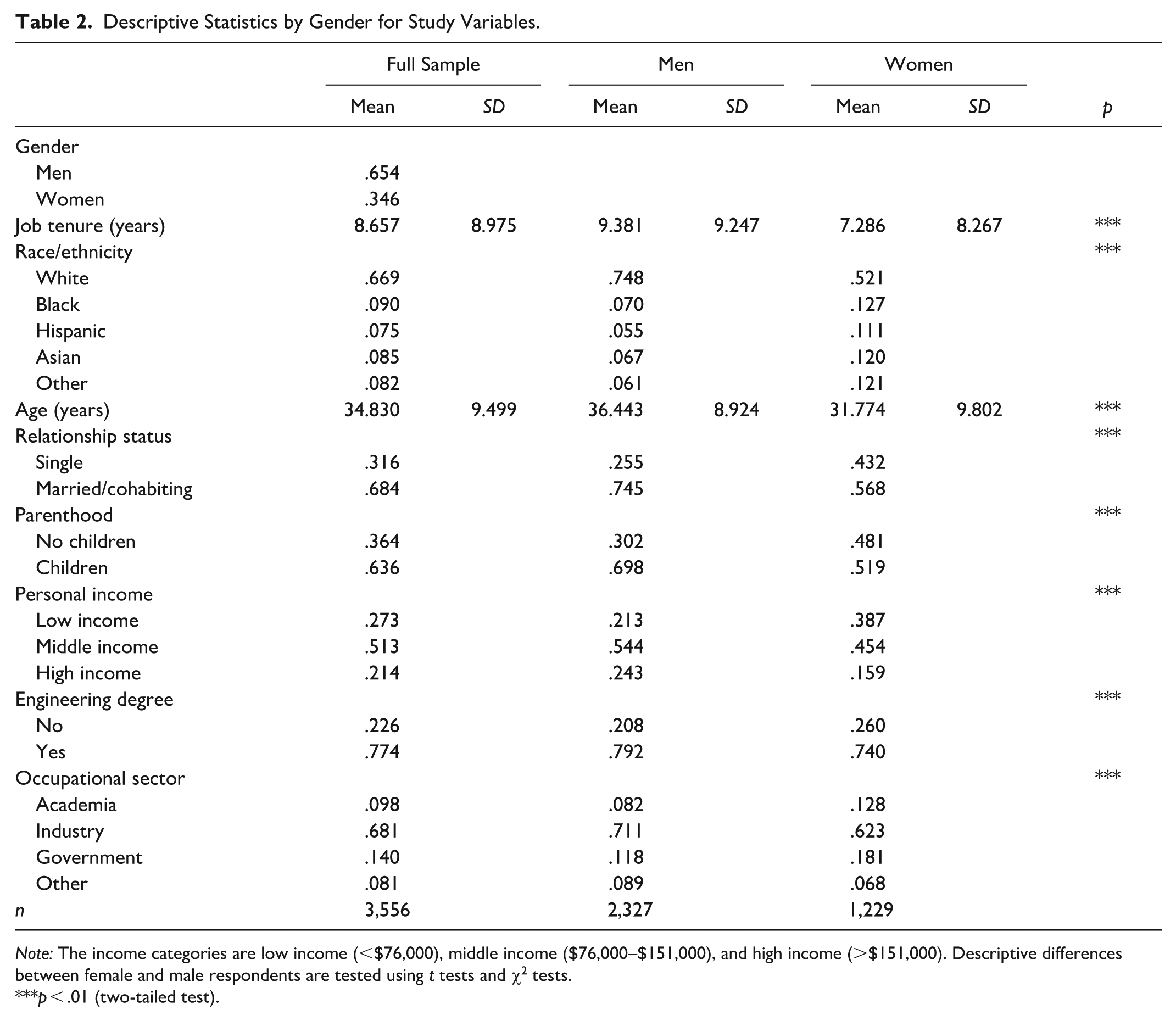
Note: The income categories are low income (<$76,000), middle income ($76,000–$151,000), and high income (>$151,000). Descriptive differences between female and male respondents are tested using t tests and χ2 tests.
p < .01 (two-tailed test).
Analytic Strategy
To address our research questions, we estimate multinomial logistic regression models to examine the association between gender and perceived workplace challenges, controlling for demographic, socioeconomic, and occupational factors. We calculate the average marginal effects of gender on these challenges and test for significant differences between men and women. Additionally, we estimate interaction terms between gender and job tenure to explore how the association between job tenure and perceived workplace challenges varies by gender, presenting the average marginal effect of job tenure for each challenge category separately for men and women.
Results I: Gendered Perception of Workplace Challenges
Table 3 presents the average marginal effects of gender on perceived workplace challenges, estimated from multinomial logistic regression models that examine the association between gender and perceived workplace challenges in CSEM fields (predictive margins are provided in Online Supplement Table S3). The findings support hypothesis 1c, which posits that gender differences in perceiving workplace challenges become salient when such challenges either disrupt the notion of organizational gender neutrality or confirm cultural schemas about gender and work-family obligations. Specifically, women in CSEM fields are more likely than men to identify structural discrimination and work overload as their primary workplace challenges, underscoring areas where gender disparities are evident and cannot be justified by meritocratic or “gender-neutral” cultural schemas.
Average Marginal Effects of Gender Based on Multinomial Logistic Regression Models Estimating the Association between Gender and Perceived Workplace Challenges.

Note: All models include age, racial identity, relationship status, parenthood, personal income, holding a postsecondary degree in engineering, occupational sector, and occupational tenure as control variables. Predictive margins and marginal effects are multiplied by 100 in the tables to represent the percentages rather than the probabilities of reporting workplace challenges. AME = average marginal effect.
p < .10, **p < .05, and ***p < .01 (two-tailed test).
The results also partially support hypothesis 1a, which predicts that women in CSEM are more likely than men to experience and report workplace challenges aligned with the five domains of gendered organizations. Beyond structural discrimination and work overload, women in the study are also more likely to perceive low self-efficacy and less likely to report having no major challenges compared with men.
In contrast, women are less likely than men to perceive technological and educational challenges as their primary workplace challenges. These findings contradict our research hypotheses, which assumed women would perceive more workplace challenges overall than men in CSEM fields. Although women are less likely to perceive employment opportunities as their primary workplace challenge, this may reflect the distinction made in the analysis between gender-neutral employment reports and those linked to structural discrimination. This separation suggests that women may acknowledge the salience of gender when structural barriers are present (Britton 2017). Last, no significant gender differences were observed in perceptions of interpersonal challenges. The average marginal effects of gender on perceived workplace challenges, as outlined in Table 3, are visually depicted in Figure 1.

Average marginal effects of gender on perceived workplace challenges in computer science, engineering, and mathematics fields.
Results II: Gender, Job Tenure, and Perceived Workplace Challenges
Table 4 presents the average marginal effects of job tenure on perceived workplace challenges, focusing on gender differences. Consistent with the expectation that gender gaps in perceived challenges might narrow with longer job tenure (hypothesis 2a), the findings show that greater job tenure is associated with an increased likelihood of reporting no major workplace challenges for both women and men in CSEM. Additionally, among women, longer tenure is associated with a lower probability of perceiving low self-efficacy, suggesting a potential convergence between women’s and men’s perceptions in this particular domain.
Average Marginal Effects of Job Tenure Based on Interaction Terms of Gender and Job Tenure on Perceived Workplace Challenges.

Note: AMEs are estimated on the basis of interaction terms of gender (men and women) and job tenure. All models include age, racial identity, relationship status, parenthood, personal income, holding a postsecondary degree in engineering, and occupational sector as control variables. Marginal effects are multiplied by 100 in the tables to represent the percentages rather than the probabilities of reporting workplace challenges. AME = average marginal effect.
p < .05 and ***p < .01 (two-tailed test).
However, the relationship between job tenure and other perceived workplace challenges varies substantially by gender, providing only partial support for the idea that tenure reduces gendered disparities. Among men, longer tenure is negatively associated with perceiving limited employment opportunities and technological challenges. In contrast, women’s perceptions of these challenges show no significant association with tenure. Notably, women with longer tenure are more likely to report interpersonal challenges, whereas men’s likelihood of reporting such challenges remains stable across tenure levels.
Although the findings do not support the proposition that tenure would increase women’s recognition of structural challenges (hypothesis 2b), they suggest that job tenure may widen the gender gap in perceptions of structural constraints. Specifically, longer job tenure is associated with a decreased likelihood of perceiving structural challenges (i.e., employment and advancement opportunities) among men, while no significant association is observed for women. The average marginal effects of job tenure on perceived workplace challenges by gender, as shown in Table 4, are visually represented in Figure 2.

Average marginal effects of job tenure on perceived workplace challenges in computer science, engineering, and mathematics fields by gender.
Supplementary Analysis: Parenthood and Perceived Workplace Challenges
Although job tenure is a critical organizational position shaping gendered workplace experiences, it is not the only one. Social roles outside of work, particularly parenthood, also significantly influence workplace dynamics. A substantial body of research shows that parenthood contributes to the gender wage gap, occupational segregation, and advancement disparities (Correll et al. 2007; Glauber 2018; Hook and Pettit 2016; Yu and Kuo 2017). In STEM, in which ideal worker norms emphasize uninterrupted availability and singular devotion to work (Blair-Loy and Cech 2022; Cha 2013), balancing work and family responsibilities can be especially challenging (Glass et al. 2013). Given this, the relationship between gender and perceived workplace challenges may be shaped by parental status.
To explore this, we conduct a supplementary analysis testing the interaction between gender (men and women) and parenthood status (parents and non-parents) across eight categories of perceived workplace challenges. 6 We estimate average marginal effects while controlling for key demographic and occupational characteristics. Descriptive counts and full model results appear in Online Supplement Tables S4 and S5, respectively.
Several patterns are noteworthy. Parenthood is associated with a lower likelihood of perceiving structural discrimination for both genders, with a more pronounced effect for women (−8.4 percent) than for men (−1.2 percent). Parenthood is also linked to a higher likelihood of reporting no workplace challenges among men (+8.9 percent) and a smaller, yet similar, increase among women (+4.5 percent). Given the pervasive cultural belief in STEM that motherhood holds power to undermine one’s professional legitimacy (Thébaud and Taylor 2021), parents, particularly mothers, may seek to minimize their association with it by distancing themselves from structural discrimination or by asserting that they face no significant challenges. Likewise, fathers report fewer limited advancement opportunities compared with nonfathers (−4.9 percent). This finding may reflect the “fatherhood premium,” wherein fathers are perceived as more closely aligning with organizational hegemonic masculinity and are therefore seen as more deserving of career advancement (Hodges and Budig 2010). Or, it is also possible that fathers may hesitate to report workplace challenges, as the same organizational norms that discourage acknowledgment of caregiving-related constraints among women may similarly suppress the perception and reporting of such challenges among men (Cooper 2000). These are possibilities for future research to explore. Parenthood also increases perceptions of work overload for both men and women, while mothers are more likely than nonmothers to report technological challenges. Among men, parenthood is associated with fewer educational challenges, but no parenthood-based differences emerge for interpersonal challenges or low self-efficacy.
Although these results are not robust enough to form the basis of a primary argument, these findings underscore the value of considering how parenthood intersects with gender in shaping perceptions of workplace inequality. Future research with larger and more balanced samples will be better positioned to examine these dynamics in depth, particularly in the context of gendered organizational environments such as STEM.
Discussion
Gendered organization theory argues that work structures are organized around the image of the “ideal worker,” an abstract figure modeled on traditional masculinity and rewarded for uninterrupted commitment, autonomy, and emotional detachment (Acker 1990). This ideal remains deeply embedded in male-dominated professions such as STEM, where women continue to face systemic barriers, cultural exclusion, and interpersonal marginalization (Bird and Rhoton 2021; Blair-Loy and Cech 2022; Glass et al. 2013). Paradoxically, STEM fields are also shaped by dominant cultural schemas that frame them as meritocratic and “gender neutral,” such that career outcomes are presumed to reflect individual talent, effort, and qualifications (Cech and Blair-Loy 2010; Seron et al. 2018). This contradiction between persistent gendered inequalities and the cultural ideal of neutrality raises a central theoretical puzzle: If structural barriers persist, yet organizational culture frames STEM success as fair and objective, how do STEM professionals perceive the challenges they face? Complicating this further is the role of job tenure, a positional status often interpreted as a sign of assimilation into workplace norms (Cech and Blair-Loy 2010; Patterson et al. 2017). Although tenure may reinforce men’s sense of fit and belonging, it may carry different consequences for women, potentially heightening exposure to exclusion or scrutiny (Kanter 1977). This study explores how gender shapes perceptions of workplace challenges in CSEM fields and examines how these perceptions vary across career stages, offering new insight into the interpretive dimensions of organizational inequality.
To address this puzzle, we analyze how CSEM professionals describe their workplace challenges. In contrast to prior research that emphasizes workers’ internalization of meritocratic and “gender-neutral” schemas (Bird and Rhoton 2021; Blair-Loy and Cech 2022; Seron et al. 2018), our findings reveal that women in CSEM are significantly more likely than men to perceive and report challenges across multiple domains. Notably, the most common perceived challenge reported by women is gendered structural discrimination. These perceptions suggest that gendered inequalities remain visible to women in CSEM professions, despite the normative emphasis on merit and gender-neutrality.
Our findings extend Britton’s (2017) argument that gender becomes salient in male-dominated workplaces when women encounter overt violations of fairness, such as biased hiring practices, exclusion from leadership, or the questioning of their professional legitimacy, which undermine the meritocratic and “gender-neutral” cultural schemas of STEM organizations. In our analysis, such experiences are captured in the category of structural discrimination, which is overwhelmingly reported by women, challenging the notion that STEM professionals universally internalize meritocratic and “gender-neutral” cultural schemas.
In contrast, women are also more likely to report work overload as a primary challenge, describing both family-related and job-related time demands. Yet these reports do not challenge the legitimacy of meritocratic schemas as women’s reports of work overload align with long-standing cultural assumptions that women (but not men) must navigate competing work and family obligations (Ecklund and Lincoln 2016). This is particularly notable, as the men in our study are much more likely to be parents and to report, in the qualitative analyses, that family is a source of support rather than a source of constraint. As such, even gendered experiences of overwork may be interpreted through culturally sanctioned narratives that locate the problem within the individual, rather than the organization. These patterns show that although gender becomes salient in the perception of structural discrimination and work overload, the latter is often framed in ways that leave dominant meritocratic and “gender-neutral” logics intact.
Simultaneously, men are more likely than women to identify limited employment and career advancement opportunities (i.e., structural challenges framed in ostensibly “gender-neutral” terms) as their primary workplace challenges, which is contrary to our expectations. Considering that women often encounter greater structural discrimination and barriers to career progression (Campero 2021; Sege, Nykiel-Bub, and Selk 2015), we expected women to report these challenges more frequently than men in CSEM. This counterintuitive finding may stem from how women describe their career challenges in gendered terms. In our analysis, responses that emphasize gender or other identity-based discrimination are categorized as “structural discrimination.” Therefore, women reporting gendered barriers to career advancement may have been classified under “structural discrimination” rather than “employment and advancement opportunities.” Although we do not combine these two categories in the analysis, our supplemental analyses (not shown, but available upon request) suggest that women are indeed more likely than men to perceive challenges related to both “structural discrimination and employment opportunities.”
The findings also show that men are significantly more likely than women to report having no major workplace challenges. In fact, reporting “no challenge” is men’s second most commonly reported challenge. This pattern may reflect the alignment between stereotypically masculine behaviors (e.g., assertive self-presentation and an emphasis on career ambition) and professional advancement in CSEM fields (Blair-Loy and Cech 2022; Parson and Ozaki 2018). Men may draw on these norms to present themselves as unencumbered by obstacles, reinforcing their fit within a meritocratic organizational culture. In contrast, women’s lower likelihood of reporting no workplace challenges may indicate that either embodying traditional masculinity is less accessible to them in CSEM, or that they genuinely encounter more significant workplace challenges, as gendered organization theory suggests (Acker 1990).
Collectively, gendered differences in perceptions of structural constraints, work overload, and the absence of challenges reveal the core tension between gendered workplace challenges and meritocratic and gender-neutral cultural narratives in CSEM fields. Our findings show that many women directly identify structural discrimination as their primary workplace challenge (the most commonly reported issue among women in our sample), directly challenging prevailing cultural schemas that frame STEM workplaces as meritocratic and gender neutral (Bird and Rhoton 2021; Blair-Loy and Cech 2022; Seron et al. 2018). At the same time, women also frequently describe their challenges in terms that align with culturally accepted individualistic narratives, such as overload or diminished self-confidence. Men, by contrast, are significantly more likely to report no workplace challenges at all, a pattern that may reflect not only fewer perceived obstacles but also a stronger investment in sustaining the view that STEM environments are meritocratic. This divergence suggests that in STEM fields shaped by dominant schemas of meritocracy and neutrality, some workers challenge these logics while others interpret their experiences in ways that obscure inequality, divisions that are closely patterned by gender. These findings highlight the importance of treating perception as a key dimension of organizational inequality, one that is shaped by, and helps reproduce, broader gendered structures.
Understanding gendered perceptions of workplace challenges requires consideration not only of gender differences but also of organizational position. Job tenure, in particular, is often viewed as a signal of integration into workplace norms, suggesting stability, authority, and cultural fit (Cech and Blair-Loy 2010; Patterson et al. 2017). However, the symbolic and practical implications of tenure are not experienced uniformly across gender. Although tenure may reinforce men’s sense of belonging and shield them from recognizing organizational inequalities, prior research on racial and gender inequality suggests that higher status individuals from marginalized groups may become more, not less, attuned to structural barriers as they advance (Wingfield and Chavez 2020). For women in CSEM, organizational longevity may come with increased scrutiny, heightened expectations, or continued exclusion from leadership and decision-making networks.
Our findings indicate that the relationship between job tenure and perceived workplace challenges in CSEM is partially gendered. Overall, longer tenure is associated with a lower likelihood of reporting major workplace challenges, with both women and men increasingly likely to report no significant difficulties as their careers progress. This pattern suggests that organizational experience may ease some forms of perceived difficulty over time. However, the underlying patterns diverge meaningfully by gender. Among women, increased tenure is associated with a decline in perceived low self-efficacy, suggesting that sustained experience in CSEM may help bolster confidence in navigating male-dominated environments (Blaique et al. 2023). At the same time, this pattern may also reflect a process of selective attrition, whereby women with persistently low self-efficacy are more likely to leave the field earlier in their careers, leaving behind a more self-assured group with longer tenure (Cech et al. 2011). For men, longer tenure predicts a lower likelihood of reporting technological challenges, potentially reflecting greater familiarity with technical responsibilities or transitions into roles with fewer direct technical demands, such as supervisory or managerial positions.
Most striking, however, are the gender differences in how tenure relates to perceptions of structural barriers. Among men, longer tenure is associated with a decreasing likelihood of reporting limited career opportunities, suggesting that professional longevity may reinforce men’s sense of mobility and organizational fit. In contrast, women’s perceptions of structural barriers, such as discriminatory advancement processes or unequal access to leadership, remain largely unchanged over time. This finding contradicts the expectation that seniority would mitigate perceived structural inequality for women, either through increased access to resources or alignment with dominant organizational norms. Prior research has suggested that women in senior roles may come to attribute gender inequality to individual shortcomings rather than structural conditions (Cech and Blair-Loy 2010), or that tenure might reduce the salience of gendered stereotypes (Patterson et al. 2017). Our findings challenge this perspective. Rather than diminishing recognition of inequality, women’s sustained presence in CSEM fields appears to preserve their awareness of persistent structural barriers. Tenure, in this context, does not signal gender-neutral integration; instead, it may expose long-tenured women to new forms of exclusion and marginalization that become more visible over time.
Last, job tenure is also associated with increased gender differences in perceptions of interpersonal challenges. Among women, increased tenure corresponds with a higher likelihood of reporting difficulties related to collegial interactions, supervisory relationships, or professional exclusion, patterns not observed among men. This trend may reflect the intensified scrutiny and heightened expectations that women encounter as they rise into more visible or authoritative roles (Kanter 1977). As women advance, their leadership may be evaluated through gendered lenses that question their competence, authority, or emotional comportment—pressures less commonly experienced by their male peers (Varty, Barclay, and Brady 2021). Rather than insulating women from interpersonal difficulties, greater tenure may deepen their exposure to subtle forms of resistance or bias, including microaggressions, undermining, or exclusion from informal networks. These findings suggest that seniority may increase women’s interpersonal burdens, reinforcing the broader argument that tenure operates as a gendered mechanism that shapes how inequality is perceived, experienced, and reproduced within CSEM organizations.
Limitations
A key limitation of our study is the insufficient sample size, particularly among women of color, which prevents an intersectional analysis despite the overall large sample and oversampling of underrepresented minorities compared with their national representation in STEM fields (Funk and Parker 2018). An intersectional perspective posits that gender interacts with race, both additively and multiplicatively, to shape whether and how disparities in work outcomes emerge (Collins 2002; McCall 2001; Pessin, Damaske, and Frech 2023). Moreover, organizations are not only gendered but also racialized, with disparities manifesting at micro (e.g., worker identity formation), meso (e.g., interpersonal challenges), and macro (e.g., vertical inequalities) levels (Acker 2006; Ray 2019; Wingfield and Alston 2014). STEM workers of color likely perceive similar workplace challenges to those outlined earlier, potentially leading to a “double disadvantage” for women of color in STEM (Carter, Dueñas, and Mendoza 2019; Fry et al. 2021; Liu, Brown, and Sabat 2019); we anticipated intersectional differences would emerge in our findings.
In supplemental analyses not presented in the main manuscript but available upon request, we estimate gender-stratified logistic regression models examining the association between race/ethnicity and perceived workplace challenges for men and women separately. Although our findings are suggestive that the intersection of race and gender does shape workplace perceptions (particularly of structural discrimination), the small sample size in many intersectional groups, often fewer than 30 participants, compromises the reliability of these results. Further research is needed to better understand how gender and race intersect in shaping perceptions of workplace challenges in STEM fields.
Additionally, our measures of workplace challenges are based on workers’ self-reports of their perceived primary challenges and do not capture gender differences in the frequency and intensity of these challenges. As both frequency and intensity have significant implications for workplace practices and occupational development, future research would benefit from incorporating both perceived experiences and systematic assessments of how often and how severely these challenges are encountered. Such an approach would offer a more comprehensive understanding of the scope and depth of gendered workplace inequality.
Last, the systematic exclusion of respondents who provided nonsensical answers may introduce selection bias into our sample. Online Supplement Table S1 shows that parents, individuals with longer job tenure, and those with postsecondary engineering degrees are more likely to give such responses. To address this, we estimated multinomial logistic regression models that included these respondents (available upon request). The results showed no substantial differences from our original models, suggesting that excluding these respondents, on the basis of scholarly protocols to improve sample reliability (Modrakovic et al. 2024), is unlikely to affect our study’s overall findings.
Conclusion
This study offers new insight into how gender inequality in CSEM fields is not only produced through institutional structures and occupational outcomes but also interpreted through workers’ own perceptions. Rather than focusing on well-established occupational disparities (e.g., disparities in wage and promotion opportunities), we shift analytic focus to how inequality is seen, named, and explained by workers themselves. Our findings show that women are significantly more likely than men to perceive workplace challenges, particularly in the areas of structural discrimination, work overload, and low self-efficacy, whereas men are far more likely to report no challenges at all. This pattern may reflect men’s stronger investment in upholding meritocratic narratives. These patterns complicate assumptions that workers fully internalize dominant meritocratic and “gender-neutral” schemas; instead, they point to a gendered divergence in how individuals make sense of their professional environments with gendered structural discrimination being the most common challenge reported by women.
We also show job tenure does not operate as a neutral signal of assimilation but rather functions as a gendered organizational mechanism. Whereas men’s perceptions of challenges diminish as their tenure increases, women’s perceptions of structural and interpersonal barriers persist or intensify, even as self-efficacy improves. This divergence challenges the idea that tenure naturally leads to convergence in workplace experience and suggests instead that gendered inequalities may become more visible, not less, across career stages. These findings underscore the importance of understanding perception as a critical dimension of organizational inequality, one that shapes, and is shaped by, workers’ positions within enduringly gendered institutions.
Supplemental Material
sj-docx-1-srd-10.1177_23780231251376456 – Supplemental material for Job Tenure and Gendered Perception of Workplace Challenges in Gendered Organizations: Computer Science, Engineering, and Mathematics Fields
Supplemental material, sj-docx-1-srd-10.1177_23780231251376456 for Job Tenure and Gendered Perception of Workplace Challenges in Gendered Organizations: Computer Science, Engineering, and Mathematics Fields by Jisu Park, Sarah Damaske, Jiwon Choi, Susan McHale, Joshua Rosenberger and Junjun Yin in Socius
Footnotes
Acknowledgements
We are grateful for constructive feedback provided by Jessica Hardie and Carrie Shandra.
Funding
The authors disclosed receipt of the following financial support for the research, authorship, and/or publication of this article: This work was supported by a generous donation from Cisco Systems and by the Population Research Institute, which is supported by a grant from the Eunice Kennedy Shriver National Institute of Child Health and Human Development (P2CHD041025) and by The Pennsylvania State University and its Social Science Research Institute.
Ethical Approval and Informed Consent Statements
Penn State institutional review board approval was received for this project, and all study participants received and approved online informed consent statements. An online consent form was presented to study participants before being allowed to proceed with the online survey. Subjects clicked on an “I Agree” or “I Disagree” button. If subjects clicked on the “I Agree” button, they were taken to the first page of the survey. If subjects clicked on the “I Disagree” button, they were taken to a page thanking them for their time.
Data Availability Statement
The data used in this study contain sensitive information and are subject to confidentiality agreements approved by the principal investigator’s institutional review board. As a result, the data cannot be publicly shared or made available. Stata code is available upon request.
Supplemental Material
Supplemental material for this article is available online.
1
 presents logistic regression results showing that longer job tenure, parenthood, and holding a postsecondary degree in engineering are positively associated with providing nonsensical responses, such as “yes.” This suggests that excluded observations are more likely to include individuals with these characteristics. Although we remain cautious about this bias in both qualitative and quantitative analyses, the job tenure coefficient in Online Supplement Table S1 indicates that our findings related to tenure may be conservative, potentially underestimating the importance of senior workers’ nonresponse.
2
This qualitative coding process was conducted manually by the authors and two undergraduate research assistants, a common practice in qualitative research involving open-ended survey questions (e.g., Nelson et al. 2021; Schonlau, Gweon, and Wenemark 2021).
3
Although the majority of responses in this category focused on gender discrimination, some participants, both men and women, also described experiences of racial discrimination, as well as instances of ageism and ableism. These findings stand in stark contrast to the meritocratic assumption that workplace opportunities are based solely on individual qualifications and effort.
4
Although it is challenging to find studies that use open-ended qualitative findings in multinomial logistic regression analysis, several studies using mixed-methods approaches have similarly converted qualitative responses into categorical variables for quantitative analysis (e.g., Fakis et al. 2014; Faragó 2024; Sowell et al. 2003; ).
5
The “other” racial category includes Native American and multiracial individuals, because the sample size of these two groups was too small to include separately.
6
Although this is a theoretically rich and substantively important line of inquiry, our analysis is constrained by sample size limitations, particularly among women. This introduces constraints in terms of statistical power and limits the precision with which interaction effects can be estimated. For this reason, and given our study’s primary focus on job tenure, we present these findings as supplementary.
Author Biographies
References
Supplementary Material
Please find the following supplemental material available below.
For Open Access articles published under a Creative Commons License, all supplemental material carries the same license as the article it is associated with.
For non-Open Access articles published, all supplemental material carries a non-exclusive license, and permission requests for re-use of supplemental material or any part of supplemental material shall be sent directly to the copyright owner as specified in the copyright notice associated with the article.
