




Abstract
Does exposure to migrant death alter immigration-related public opinion? Scholarship has extensively demonstrated the impact of events on attitudes toward immigrants and immigration. In doing so, however, focus has almost exclusively been placed on events that pose a direct threat to ingroup members. The authors extend this line of research to further comprehend the formative basis of the said attitudes by focusing on events that uncover the threats outgroup members are subjected to, such as migrant shipwrecks. The authors examine one of the deadliest migrant shipwrecks that have occurred in the Mediterranean Sea in recent history, the so-called 2013 Lampedusa shipwreck, in which at least 368 migrants lost their lives. Using Italian data from the European Social Survey (round 6), the authors show that in the aftermath of the event, attitudes toward immigration changed, and Italians became more willing to adopt a less restrictive immigration policy. However, attitudes toward immigrants remained unchanged: the levels of perceived ethnic threat were not altered. These findings not only expand on the prevailing understanding of the effect of salient migration events on immigration-related attitudes but also highlight the divergent formative basis of these attitudes.
Forced displacement and undocumented border crossings are on the rise. By sea or land, people continue to flee their countries in search of refuge, often undertaking journeys that entail high risks and even have fatal consequences. The display of the suffering and deaths of migrants on the move has gained more visibility all around the globe over the past years. For instance, in 2012, news about the so-called 2012 Indian Ocean migrant boat disaster, in which more than 200 asylum seekers mostly fleeing from war-torn Afghanistan died while heading toward Australia, spread worldwide, while since 2015 the numerous shipwrecks of boats in the Bay of Bengal carrying Rohingya people attempting to cross to Bangladesh have become commonplace. More recently, in June 2019, images of the lifeless bodies of Óscar Alberto Martínez Ramírez and his 23-month-old daughter, Angie Valeria, who were found face down in the shallow waters of the Rio Grande while trying to wade through to reach Texas circulated globally. Their fate was reminiscent of the case of Ālān Kurdî, the 3-year-old Syrian toddler who was washed up on a Turkish shore in September 2015 and had sent shockwaves through Europe and beyond, or that of the still unnamed teenage boy from Mali, whose body was found in April of the same year in the depths of the Mediterranean Sea with his only belonging a yearly school report sewn into his trousers’ pocket. In fact, the Mediterranean Sea has become a focal point of such events. On the basis of data gathered under the Missing Migrants Project of the International Organization for Migration, 73,000 people lost their lives or went missing across the world from 2014 to 2024; about half of these deaths took place in the Mediterranean Sea (>31,000), while approximately 8,000 were documented in Central America and North America, most of these people heading to the United States. 1
Such recurring, tragic events have brought the issue of border crossings into the spotlight of public debates in destination countries. Against this background, the responsibilities of receiving countries to prevent the deaths of migrants and asylum seekers are juxtaposed with the purported necessity to protect their sovereignty by sealing permeable borders. Policies reflecting either logic have, in turn, been introduced (FitzGerald 2019; Saatçioğlu 2021). In certain cases, such events have inspired countries’ willingness to coordinate search and rescue operations on an international level (see, e.g., the United Nations’ New York Declaration of 2018) and have influenced the behavior of public officers in charge of asylum decisions at the micro-level (Emeriau 2024). Yet despite the centrality of such events in shaping public debates and policies on immigration, the extent to which they influence public opinion remains largely unexplored. Beyond its empirical relevance, addressing this issue would contribute to the ever increasing scholarly interest in understanding the role of exogenous events in shaping intergroup relations (cf. Godefroidt 2023). Although this has furthered our understanding on the determinants of relevant attitudes and behaviors (for reviews, see Ceobanu and Escandell 2010; Fussell 2014; Hainmueller and Hopkins 2014), this line of research has almost exclusively focused on a particular type of event, namely terror attacks, or, put differently, events where ingroup members are subject to threat by outgroups.
In this study, we contribute to broadening this literature by moving away from the study of events that are threatening to the ingroup. Instead, we examine whether—and if so, how—events that display the suffering and death of migrants affect public opinion on immigration in countries at the receiving end of border crossings. These events, such as migrant shipwrecks, on the one hand, may arouse humanitarian concerns but, on the other hand, they may trigger fears relating to lack of securitization and outgroup threat. It therefore remains unclear which logic would dominate people’s reactions, thus determining the direction of the impact. We focus on one of the largest and most salient migrant shipwrecks to have occurred in the Mediterranean Sea in recent times: the so-called 2013 Lampedusa shipwreck, which occurred off the Italian island of Lampedusa on October 3, 2013. In this shipwreck, at least 368 people lost their lives in Italian territorial waters of Italy, marking a precursor to similar events that followed as part of the 2015–2016 refugee crisis and beyond. We use data from the European Social Survey (ESS; round 6) and leverage an unexpected deviation in the fieldwork’s timing in Italy, which coincided with the occurrence of this major shipwreck. By comparing respondents interviewed right before and after the event, we empirically demonstrate that, in the aftermath of this shipwreck, anti-immigration attitudes were reduced: respondents became more likely to accept more immigrants to their country. This effect is rather large: with education being among the most important predictors of such attitudes (Hainmueller and Hiscox 2007), the size is in a model specification roughly equivalent to moving respondents from primary education to a doctoral degree. However, anti-immigrant attitudes—or, put differently, the threat perceived from immigrants prevailing in the Italian society—remained unaffected.
Our findings make two main contributions to the literature. First, by showing that exposure to immigrant shipwrecks can alter attitudes toward immigration, we expand the literature’s analytical focus and further illustrate the role of external events as relevant sources of variation. Theoretically, we rely on important yet largely overlooked insight from Herbert Blumer, whose central contribution in the development of group threat theory is more nuanced by highlighting the role of unexpected events in shaping intergroup relations. In light of more recent scholarship’s prevailing attempts to reduce exclusionary attitudes through targeted interventions (e.g., Adida et al. 2018; Dinas, Fouka, and Schläpfer 2021; Kalla and Broockman 2023), our findings also suggest that drawing attention to the tragic events that have, unfortunately, become ever more common, can sensitize people and encourage them to take positions that would help reduce human suffering. Second, responding to the calls from Ceobanu and Escandell (2010), we aim to strengthen the current literature’s conceptual range. We not only highlight the importance of distinguishing between attitudes toward immigration and attitudes toward immigrants, which are not always considered separately and, as we show, respond differently to this event (e.g., Hangartner et al. 2019; Hopkins, Tran, and Williamson 2014); but also propose that it is important to examine them in parallel rather than separately. Doing so can lead to a better understanding of their dynamic relationship and their relation with external factors.
Exclusionary Intergroup Attitudes and Events
The theoretical apparatus guiding scholarship on public attitudes toward immigration and immigrants has long been honed on the existence of some form of threat, perceived or actual, that immigrants (outgroups) pose in society. Over time, various forms of threat have been proposed, ranging from economic self-interest and labor market competition at the individual (Facchini and Mayda 2009; Mayda 2006; Scheve and Slaughter 2001) and contextual levels (Blalock 1967; Bobo and Hutchings 1996), to sociotropic concerns about migrants’ cultural impact on society (Brader, Valentino, and Suhay 2008; Hopkins 2010; Ivarsflaten 2005; Sniderman, Hagendoorn, and Prior 2004). More recently, the rise of large social surveys and the ubiquity of “always-on” online data (Salganik 2017) have allowed researchers to apply causal inference techniques to leverage external events as exogenous sources of variation in outcomes of interest (Muñoz, Falcó-Gimeno, and Hernández 2020). As a result, increasing attention has been placed on the role of events in shaping various relevant attitudinal and behavioral outcomes (e.g., Balcells and Torrats-Espinosa 2018; Nussio 2020; Rabby and Rogers 2010; Van de Vyver et al. 2016).
Driven by the scholarship’s prevailing theoretical logic, contemporary studies consider events that are of threatening nature to ingroup members and have placed almost exclusive focus on terror attacks (see Godefroidt 2023 for a review). Within this framework, evidence suggests that terror events can increase exclusionary stances toward immigration (Blinder, Ford, and Ivarsflaten 2019; Finseraas, Jakobsson, and Kotsadam 2011). They can also spur anti-immigrant attitudes—that being the levels of perceived ethnic threat—in the countries where the attacks take place (Boomgaarden and de Vreese 2007; Echebarria-Echabe and Fernandez-Guede 2006; Hopkins 2010; Mancosu and Ferrín Pereira 2021); as well as in countries that, although not directly targeted, are ideologically and/or culturally proximal to the targets (Ferrín, Mancosu, and Cappiali 2020). Similar results have been found in cases where ingroup members remain the targets, but in faraway settings (Legewie 2013). It has been posited that these attitudinal changes may arise either from an increase in perceived threat from an outgroup (Huddy et al. 2005), or because the event highlights preexisting sources of intergroup conflict, such as concerns about the demographic composition of a population or the purported economic strain that immigrants introduce into society (Hopkins 2010; Legewie 2013).
Interestingly, this empirical shift toward studying the impact of events on intergroup relations echoes a relatively overlooked dimension of Blumer’s (1958) theoretical paradigm of prejudice as a sense of group position- a paradigm that constitutes one of the building blocks of the literature’s theoretical apparatus. Specifically, in this framework, Blumer (1958) stressed that unexpected, external events have the capacity to shape prejudice by altering the perceived image of an outgroup. In proposing to shift attention away from “individual lines of experiences,” he highlighted the importance in exploring the processes by which groups define each other, their attributes, and their reciprocal relations (p. 3). In these processes “big events,” as Blumer defined them, play a key role. In a later contribution coauthored with Troy Duster, they argue, “The scholar is in no position to grasp . . . what is happening in race relations if no attention is given to the play of events in the mapping out of views and orientations by the racial groups” (Blumer and Duster 1980;231).
For an event to be considered “big,” Blumer (1958) outlined four conditions: first, events need to bear great significance within a social context; second, they need to provoke an unexpected emotional reaction; third, they need to challenge prevailing perceptions of intergroup relations; fourth, they need to affect ingroup members’ identification with their group. In Blumer’s own words,
We are led to recognize the crucial role of the “big event” in developing a conception of the subordinate racial group. The happening that seems momentous, that touches deep sentiments, that seems to raise fundamental questions about relations, and that awakens strong feelings of identification with one’s racial group is the kind of event that is central in the formation of the racial image. . . . The definition of these events is chiefly responsible for the development of a racial image and of the sense of group position. (p. 6)
Put differently, the sense of group position cannot be explained solely on an objective, material, and instrumental basis. Rather, it is normatively constructed and, as such, contains a nonrational and socioemotional component. It is this component that makes group attachments an adaptive social force, responsive to momentous events. Specifically, this component extends along two dimensions: hierarchical ordering and positioning, which relate to the ingroup perception with regard to other groups, and inclusion versus exclusion, namely, the sense of embrace or recoil of the outgroup (Blumer 1965; Bobo 1999:453–55). A key tenet of Blumer’s framework is that events can have ambivalent effects on intergroup relations. As Blumer and Duster (1980) put it, “The superordinate group . . . is caught in the contest between the exclusionary tendency and the gate-opening disposition, a contest which can become profoundly political under certain sets of circumstances and in response to certain kinds of events” (p. 236). Big events can therefore alter the ingroup’s collective definition of an outgroup in ways that increase prejudice in cases, and reduce it, in others. It is, in fact, a process of interpretation that determines this alteration. This dimension is crucial and highlights the constructivist lens of Blumer’s approach: it is not the nature of an event that, by itself, determines its consequences for intergroup relations, but rather the ways in which it is defined in a society. 2 Perhaps this ambivalent interpretability explains why some studies find that threatening events have either no effect or improve intergroup relations (Castanho Silva 2018; Czymara and Schmidt-Catran 2017; Finseraas and Listhaug 2013). Regardless, these insights, despite being central in Blumer’s account, have been overlooked by the literature on the impact of events on public attitudes toward immigrants and immigration which has been grounded primarily in theories of threat rather than in a theorization of the role of events. Instead of exploring Blumer’s proposition on the role of “big events” only circumstantially, it seems imperative to broaden the literature’s analytical focus. This would constitute a first step toward developing a typology of “big events” and their impact immigration-related public opinion.
Beyond Ingroup Threat
Undoubtedly, not all events that bring migration to the fore of public discussions pose a first-order threat to ingroups. In fact, analogous attention is drawn to the issue of migration when outgroups are threatened. A nascent line of research in the field of social psychology has indirectly assessed the role of events displaying the suffering and death of outgroups on intergroup attitudes, or, put differently, events that divulge the threats these groups face. It has done so by focusing on the death of Alan Kurdi, the three-year-old Syrian toddler whose body was found lying face down on a Turkish shore in 2015. Evidence suggests that the photo’s extensive circulation in mainstream and social media was followed by increased public interest in the Syrian refugee crisis and donations to projects aiding refugees (Slovic et al. 2017). Exposure to this, now “iconic”, photo is described to have activated moral emotions that, in turn, redirected public attention to the plight of migrants and thus fostered humanitarian responses toward the outgroup this victim belonged to. This tragic event also raised awareness of the system/state’s “failings” (Prøitz 2018); decreased preferences for restrictive refugee policies, at least in the short run (Sohlberg, Esaiasson, and Martinsson 2019); and led to increased levels of solidarity with refugees (Thomas et al. 2019). In fact, the principle of solidarity with an unfortunate “other” constitutes one of the possible ways that lead to de-emphasize intergroup boundaries, thus accentuating feelings of communality (Lamont 2000; Lamont and Bail 2005). On the basis of these insights, it seems that exposure to events that uncover the fatal risks migrants encounter during their migration journey could reduce hostility toward them among the ingroup.
However, it should be acknowledged that the case of Alan Kurdi exhibits characteristics of a very particular nature, meaning that making direct extrapolations to other events involving the suffering and death of migrants is hardly possible. First, it relates to the case of a single victim of a very young age. Insights from social psychology have established that the intensity of empathetic reactions toward people in need or under threat depends on the size of a group, with single individuals arousing stronger levels of emotions compared with larger groups (Small, Loewenstein, and Slovic 2007; Västfjäll et al. 2014). Indeed, even small changes in numbers can lead to large differences in reactions (Kogut and Ritov 2005b). Second, the identifiability and availability of personal information trigger stronger emotions of empathy (Kogut and Ritov 2005a), especially when these are considered related to higher degrees of “deservingness” to asylum (Flores and Schachter 2018; Shiff 2021). This is especially relevant as migrants’ facial expressions and other personalizing features are not commonly detailed when these populations are visually represented in the media (Bleiker et al. 2013). In this vein, when depicted as a group, an analogous personalized dimension is not prominent. Yet the availability of personal information and personalized narration is a strong mechanism of interpersonal and intergroup empathy which, in turn, could lead to the reduction of exclusionary attitudes among ingroups (Kalla and Broockman 2023). Simultaneously, exposure to information in a solely cognitive manner does not necessarily lead to the updating of cognitive beliefs: it is not uncommon for people to use this new information as a means of reinforcing their already held opinions (Jørgensen and Osmundsen 2020; Lawrence and Sides 2014). Therefore, exposure to information about migrant shipwrecks does not necessarily indicate that hostility among the ingroup will be reduced.
In fact, exposure to information concerning the plight of migrants can be interpreted through different lenses. Rather than focusing on the humanitarian urgency associated with these events, people residing in destination countries might instead interpret these events as “illegal acts” and as instances where these groups do not respect the laws of the receiving country (McKay, Thomas, and Kneebone 2012). Simultaneously, the irregularity of crossings could lead to migrants being seen as a threat to national sovereignty (Lazaridis and Wadia 2015; Panebianco 2020). Such representations promote an image of immigrants as being a low status and exploitative group (Lee and Fiske 2006), which, in turn, influences moral assessments about them (Flores 2018). The recurring trope of the “threatening, criminal immigrant” perpetuates and is aimed at strengthening boundaries between outgroup and ingroups (Estrada, Ebert, and Lore 2016; Flores and Schachter 2018). In this vein, if the occurrence of migrant shipwrecks acts as a reminder of the permeability of sovereign borders, exclusionary attitudes toward outgroups among ingroup members might increase.
Distinguishing between Attitudes toward Immigrants and Attitudes toward Immigration
Naturally, public opinion on immigration encompasses preferences across multiple related dimensions. Most commonly, scholarship focuses on two key attitudinal measures. The first concerns immigrant flow, that is, individuals seeking to enter a society (for a review, see Hainmueller and Hopkins 2014). Often referred to as attitudes toward immigration, this captures people’s preferences toward the desired levels of immigration into a country (e.g., Citrin et al. 1997; Hopkins 2010). The second focuses on the immigrant stock, meaning migrants already residing in a society (for a review, see Ceobanu and Escandell 2010). This dimension reflects perceptions of immigrants’ impact in various domains, such as the economy and culture, and is commonly termed attitudes toward immigrants (e.g., Schneider 2008; Semyonov, Raijman, and Gorodzeisky 2006). Interestingly, these migration-related attitudes are rarely examined in parallel. On the contrary, some empirical studies conflate them, combining both into a composite index (Hopkins, Tran, and Williamson 2014; Hangartner et al. 2019). However, given that attitudes toward immigration and attitudes toward immigrants are conceptually and empirically distinct, such an approach risks obscuring important systematic differences in how people think about migration (Gorodzeisky and Semyonov 2019; Margalit and Solodoch 2022). To build a more nuanced understanding of migration-related public opinion, it is thus essential to not only distinguish between these two related but distinct, but to also examine them in parallel. This is the approach we adopt in our analysis, aiming to uncover and clarify the unique formative basis of each.
Background: The 2013 Lampedusa Shipwreck
In the early morning of October 3, 2013, a rickety trawler that had set off from the coast of Libya 13 days earlier was approaching the Italian island of Lampedusa carrying more than 500 migrants. The majority of them originated from Eritrea. According to reconstructions by the Office of the United Nations High Commissioner for Refugees, approximately a quarter mile away from the Italian shores the engines of the boat stopped functioning. To signal the boat’s position, clothing and blankets were set to flames. The fire generated panic on board, which caused the boat to capsize, throwing migrants overboard. Three hundred sixty-eight people died in one of the earliest and deadliest shipwrecks that have occurred in the Mediterranean Sea in contemporary times (UNHCR 2013). The morning after the tragedy, the front pages of Italy’s three most widely circulated Italian newspapers immediately highlighted its scale and the staggering loss of life: the moderate newspaper Corriere della Sera reported a “massacre on the migrants’ boats” featuring on its front page a photo of young Black men who had survived the shipwreck (Stella 2013); the progressive La Repubblica described the event as a “shameful massacre,” with its main image showing covered dead bodies in blue bags laid out at the port (La Repubblica 2013); and the centrist La Stampa headlined a “mass slaughter of migrants at Lampedusa” accompanied by photos depicting both young male and female passengers (La Stampa 2013). This shipwreck triggered immediate public reactions, among the most prominent figures in Italy. The pope of the Roman Catholic Church, a key charismatic figure in the public debate of Italy, characterized the incident “a disgrace” and called for prayers “for the victims of the tragic shipwreck,” while the Italian prime minister, Enrico Letta, referred to the shipwreck as “an immense tragedy.” The morning after the shipwreck, the Italian government declared a national day of mourning, while hundreds of Lampedusa’s inhabitants participated in a candlelit march in honor of the victims. Following the event, on October 9, Italian authorities accompanied the president of the European Commission, José Mario Barroso, to the airport of Lampedusa, where 111 coffins lay; 4 of these coffins were tiny and white for the children who had died in the shipwreck. News media were given access to the hangar and allowed to take pictures and film the area while the Italian prime minister knelt in front of the deceased. The image of these rows of coffins and government delegates standing before them became emblematic of this tragedy, starkly highlighting the unprecedented number of deaths resulting from this shipwreck. Outside, residents of Lampedusa heckled, crying out “Shame!” and “Murderers” (Reuters 2013b).
During his visit to Lampedusa, Barroso pledged €30 million to improve refugee centers in Italy (Reuters 2013a). Shortly thereafter, the European Union set up Eurosur, a shared border surveillance system to support the cooperation among national immigration agencies and the Task Force Mediterranean, to identify preventive measures to avoid further “human tragedies” (European Commission 2013). On October 18, the Italian government introduced a navy and air force operation aiming to search and rescue migrants at risk, beyond territorial waters, and arrest smugglers (Ministero della Difesa 2013). To this day, October 3 marks the Italian National Day of Remembrance and Reception in memory of the thousands who have lost their lives while attempting to cross to European soil.
Analytical Sample and Identification Strategy
We use data procured from the ESS round 6, a biennial representative survey of European populations (ESS 2012). The fieldwork for each ESS round is typically scheduled to span from September until December; in the case of round 6, it was planned for September to December 2012. However, in Italy, fieldwork started much later, on June 1, 2013, and ended on December 16, 2013. 3 This deviation from the original time frame coincided with the Lampedusa shipwreck, which occurred on October 3, 2013. This permits us to conceptualize the shipwreck as an exogenous shock and explore its effect on immigration-related attitudes in a “pre/post” design. The adoption of a natural experiment design rests on the assumption that there is no difference in the composition of the control and treated groups. The ESS (round 6) in Italy used a probability sampling scheme guaranteeing in principle the same inclusion probability across the whole Italian population (p = .00005436). However, the timing of when an interview was conducted is not random. Certain respondents are systematically more difficult to survey, because of their underlying characteristics and therefore more likely to be interviewed later during the fieldwork. This could introduce selection to the treatment of certain groups and result in unreliability of our average treatment effect estimator. We investigate this in Figure 1, where we illustrate in detail the progression of the ESS round 6 in Italy, relative to the day of the shipwreck. Among a total of 958 interviews, 74.8 percent were conducted in the 119 days of fieldwork before the shipwreck (n = 717) and 25.2 percent in the 74 days of fieldwork conducted after the shipwreck (n = 241). We impute missing values to obtain a final sample size n = 958, which is equivalent to the totality of interviews completed in Italy for the ESS round 6.

Daily distribution of interviews and attempts to interview during European Social Survey round 6 in Italy, relative to the date of the shipwreck (vertical line), reconstructed using integrated data from contact forms.
In Figure 1, we also plot the number of daily attempts to interview, as retrieved from the survey’s contact forms. Among the 958 respondents of our final sample, those included in the treatment group were contacted an average of 3.38 times before the interview’s successful completion, as opposed to an average of 2.42 times for the control group. This difference in attempts to interview is statistically significant (t = −8.8, p = .00), confirming different levels of reachability across the two groups. As shown in Table 1 (under “Before Rebalancing”), this difference in reachability carries over to the distribution of key characteristics of the two subsamples. In particular, the “control” group appears to be composed of lower educated and slightly more right-wing respondents compared with the “treated” group. By implication, a naïve strategy of comparing the average outcome before and after the shipwreck would return biased coefficients. In this case, identified effects could be due to the shipwreck but also simply due to compositional differences across the two groups. To address this issue, we rely on entropy balancing, a generalization of the propensity score method proposed by Hainmueller (2012) and reweight data with the aim of matching the treatment and control group by the first, second, and third moments of relevant covariates. We rebalance treated and control groups using the same variables used for stratification in the ESS sampling scheme, namely age, gender, educational level, and geographical region at the Nomenclature of Territorial Units for Statistics second-division (NUTS-2) level (ESS 2014). We also include occupation, immigration background, and political ideology (left to right), as these are relevant to our research question and likely correlated with the attitudes of interest. Finally, to account for other potential unobservable factors, we include in our rebalancing covariates the number of times each respondent was contacted, before an interview was completed. Table 1 (under “After Rebalancing”) shows that, after reweighting, none of these variables is significantly different across the two groups (lower p value of .80 for the “other” category of education). In Figure 2, we show how entropy balancing operates by plotting not only the relation between the standardized difference in means for the two groups, but also the variance ratio for the treatment and control groups, before and after reweighting, against the thresholds suggested by Rubin (2001) to evaluate group imbalances. This comparison suggests that imbalances exist with regard to their geographical composition, in particular with regard to regions, for which there are only a few observations in the sample. 4 Yet these differences are eliminated after rebalancing: as shown in Figure 2b, all variables fall within Rubin’s threshold and differences in mean approximate zero. Thus, the balance between the control and treated groups approaches the standards of a randomized experiment.
Control versus Treatment Groups before and after October 3, 2013.

Note: Nomenclature of Territorial Units for Statistics second-division regions are omitted from this table.
p < .05 (t test).

Group imbalances before (a) and after (b) reweighting.
Dependent Variables
To measure our first dependent variable, attitudes toward immigration—or, put differently, immigration flow—we leverage three ESS items that capture immigration policy preferences by asking respondents the extent to which [Italy] should allow into the country people (1) of the same race or ethnic group as most [Italian] people, (2) of a different race or ethnic group than most [Italian] people, and (3) from poorer countries outside of Europe. Responses are given on a 4-point scale, ranging from “allow many” (0) to “allow none” (4). To measure our second dependent variable, attitudes toward immigrants—or, put differently, immigration stock—we leverage three items that draw on the perceived threat posed by immigrants to the economic and cultural spheres. Respondents are asked to express if they believe that (4) it is generally bad or good for [Italy’s] economy that people come to live here from other countries, (5) [Italy’s] cultural life is generally undermined or enriched by people coming to live here from other countries, and (6) [Italy] is made a worse or better place to live in by people coming to live here from other countries. These items capture overall perceptions of contribution or threat of immigrants to different aspects of respondents’ country. Undoubtedly, some overlap between these two types of attitudes is to be expected, as these “swim around in the same head” (Ceobanu and Escandell 2010:313, quoting Schuman). In fact, the degree of correlation between these items in the sample of Italian respondents in ESS round 6 is quite high, with a Cronbach’s α coefficient of .85.
As a means of further ensuring that these six items should rightly be reduced into the aforementioned two dependent variables, we perform factor analysis with orthogonal rotation, in accordance with the Kaiser rule (the first and second factors yield eigenvalues of 2.49 and 1.89, respectively). Table 2 reports factor loadings and summary statistics for the six items just described. As evidenced, items 1 to 3 load strongly onto the first factor, which we interpret as representing support for anti-immigration policies, where higher values reveal stronger opposition to liberal immigration policies. Items 4 to 6 load strongly onto the second factor that we interpret as drawing on anti-immigrant attitudes, where higher values correspond to higher levels of perceived threat.
Survey Items Used in Factor Analysis to Generate Dependent Variables.

Note: Kaiser-Meyer-Olkin measure of sampling adequacy = 0.865; the Bartlett test of sphericity rejects the null hypothesis of no intercorrelation (p = .00). Determinant of the correlation matrix = 0.009. Comrey and Lee (1992) proposed cutoffs for factor loadings of 0.32 (poor), 0.45 (fair), 0.55 (good), 0.63 (very good), and 0.71 (excellent).
Estimation Model
We estimate the effect of the shipwreck on our dependent variables according to the following model:

where Yi represents our outcome variables, which are regressed on a dichotomous treatment-assignment indicator, D
t
, depending on the time of interview compared with October 3, and
We also present models that take into consideration the possibility that, in larger time frames, time trends exist in our dependent variables, and, in turn, could be driving our results as these trends would naturally correlate with the treatment indicator, Dt. Accordingly, we present estimations for models where we add time trends, T, both as their own regressors and interacted with the treatment dummy, D, to capture trends and potential changes in trends caused by the event. We write these models as follows:

We test for the possibility of linear and quadratic trends (first and second polynomial), that is, by adding T and T2 to our models, along with their interaction with the treatment indicator, D. We conduct a range of additional robustness and sensitivity checks that we present in the Appendix: we estimate models on a placebo treatment set at the empirical median of the pretreatment period (Figure A4); we correct for possible bias from correlation across regression equations through seemingly unrelated regressions (Tables A3 and A4); and we estimate treatment effect on the basis of a traditional propensity score matching approach (Figure A5). These models confirm the results of our analysis, presented in the following sections.
Results
Descriptive Evidence on Shifts in Public Sentiment after the Shipwreck
Before looking at our regression results, we begin our analysis providing descriptive evidence on shifts in public sentiment following the Lampedusa shipwreck in Italy. We leverage news coverage, web search as well as ESS data to characterize this event as a “big event” in the terms proposed by Blumer (1958). As described above, Blumer indicated that, for an event to be characterized as “big” and potentially capable of shifting perceptions of intergroup relations, four main conditions must be met: first, it should bear great significance in a social context; second, it need to create an unexpected emotional reaction; third, it need to challenge the perceptions of intergroup relations; fourth, it need to affect the identification of ingroup members with their group.
Looking at news data collected from Factiva, a comprehensive database of news sources, we find that in the month after the event, more than 9,000 news stories on the subject were printed or posted online, compared with only 546 in the month before. The relative increase in stories in worldwide news media was even larger, with 22,000 and 1,001 articles produced in the month after and before the event, respectively (see Figure A1). Beyond the “supply” of news from traditional media, we have collected Google search volumes from Google Trends. Comparing the Google search volumes for the search term Lampedusa with a control trend over a 10-year period around the shipwreck, namely, from 2008 to 2018, evidence for the interest of Italian Internet users on the event is further reinforced (Figure 3). We use the search term Pantelleria—another Italian island located in the heart of the Mediterranean, of comparable size, also an arrival point for migrants—as our control trend. Web searches for both islands show a monthly cyclical pattern typical of tourist destinations: searches increase toward the summer. On the month of the shipwreck, however, there was a sizable spike in search intensity for the keyword Lampedusa, unparalleled within the time frame analyzed. A similar pattern is not present for the keyword Pantelleria. This indicates important variation in interest among Italian web users on Lampedusa caused by the unexpected event of October 3, 2013. This increased public attention on the event clearly indicates the public’s emotional reaction to it, which further permits the event’s characterization as “big” or, in Blumer’s terms, as an event that “bear[s] great significance in a social context.”

Search intensity for Lampedusa before and after the shipwreck.
The 2013 Lampedusa shipwreck also contributed to increasing associations of the island of Lampedusa to the phenomenon of migration. This shift indicates that the event affected the boundaries of intergroup relations: what was once primarily seen as a tourist destination gradually became linked to a migrant location in people’s minds. Drawing on Google search volumes, we uncover that the shipwreck altered the search terms frequently associated with the keyword Lampedusa (Table 3). In the 30 days prior to the shipwreck, the search terms most frequently associated with the keyword Lampedusa concerned tourism and leisure activities, such as weather, hotel, flights, last minute. In the 30 days following the events, associated keywords relate to references to the shipwreck, namely tragedy, carnage, and dead, but also immigrants, immigration, and refugee arrivals (see Tables A1 and A2 for additional evidence). As we detail in the Appendix, these changes are not limited to Italy but also extend to worldwide users (Figures A2 and A3). On the basis of the above, it seems that the shipwreck not only captured the attention of the Italian public, thus representing a case of overwhelming saliency, but also shifted the content of public interest toward the issue of migration, at least in the short run.
Term Association with Web Searches for Lampedusa before and after the Shipwreck.

Because an important mechanism according to Blumer’s framework relates to emotional reactions to the big event, we leverage ESS variables that capture self-reported happiness, life satisfaction, and a battery of questions on self-reported mood over the previous week. In particular, the ESS asks respondents how often they have felt, over the previous week, “sad,” “lonely,” “anxious,” “depressed,” or “calm and peaceful” and how often “everything [they] did [felt] as effort.” Overall, these eight items can help us characterize the emotional reaction of our sample following the shipwreck. We present conditional means in these variables before and after the shipwreck in Figure 4. Across all self-reported moods, we observe a significant deterioration, with the exception of the item for how often respondents felt “peaceful and calm.” Life satisfaction and happiness, self-reported by respondents, also show a deterioration after the shipwreck, indicating the emotional salience of this event.

Effect of the shipwreck on emotions.
Discontinuity Plots for the Two Factor Variables
Next, we investigate if, and how, the 2013 Lampedusa shipwreck altered attitudes toward immigration and immigrants. Figure 5 plots continuity tests for our two main dependent variables, that is, the factors capturing attitudes toward immigration (Figure 5, top) and attitudes toward immigrants (Figure 5, bottom), before and after the event. Two linear regression lines have been fitted into the scatterplots for the two periods (solid lines), with 95 percent confidence intervals denoted by the dashed lines around them. This plotting of the data allows to visualize discontinuities at the threshold, a widely recommended practice in empirical research (Imbens and Lemieux 2008; Lee and Lemieux 2010). In fact, this visualization offers an initial descriptive check for the potential existence of an immediate effect of the shipwreck on the variables of interest. As shown in Figure 5 (top), the shipwreck appears to have generated a downward shift in the intercept for the first factor that captures anti-immigration attitudes. There is thus an indication of a relaxation in preferences for restrictive immigration policies after the event. Focusing on the second factor, anti-immigrant attitudes, the distance of the two intercepts appears smaller, and the regression lines are virtually continuous at the threshold. Although the confidence intervals overlap at the threshold in both cases, this initial visual check hints at a differential effect of the shipwreck on the two sets of attitudes, a pattern that we investigate and confirm in the regression analysis that follows.

Discontinuity plots for the two factor variables.
Regression Results
In Figure 6, we show the estimation results for equation 1, where each of our dependent variables is regressed on a treatment indicator set to 1 for respondents interviewed after the shipwreck and to 0 otherwise (D t in equation) For each model, we plot coefficients and their 95 percent confidence. These coefficients represent the average change in anti-immigration and anti-immigrant attitudes after the shipwreck for the matched samples, with and without controls. Although identification in our setting does not rely on the addition of controls, including covariates to the model adds precision to our estimates, reduces bias and represents a way to make sure that identification is not restricted to model selection of covariates (Imbens and Lemieux 2008). In the regression without controls (left column), we observe that the first factor, anti-immigration, is negatively correlated to the treatment (q = −.15, p = .008). This suggests that the treatment reduced anti-immigration attitudes. Coherently with the discontinuity plots shown above, we do not observe any statistically significant effect of the shipwreck on the second factor, anti-immigrant attitudes (q = .05, p = .258).

Main regression results.
Focusing on each of the six ESS item separately, we observe that point estimates of coefficients are consistently negative for all three items loading onto the factor representing anti-immigration attitudes. Yet some differences among them emerge. Specifically, after the shipwreck, respondents become more willing to accept a higher number of immigrants from the same ethnic group as Italians, a finding that holds in the models both with and without controls. For the item capturing willingness to accept immigrants from different ethnic backgrounds, we find that coefficients are significant at the 5 percent level after adding controls (q = −.11, p = .036; Figure 6, right) but not in the model without any additional covariate (q = −.10, p = .086; Figure 6, left). For the item capturing willingness to accept immigrants from poorer countries, neither model presents significant results (p = .089), possibly indicating stronger resistance to immigration after “big events” when the economic side of the phenomenon is emphasized in the framing of the question. For each of three items comprising perceived ethnic treat, the confidence intervals are rather large, overlapping the zero line. This indicates that the effect of the shipwreck is not significant, a finding consistent with the evidence that the shipwreck did not have an effect on anti-immigrant attitudes. Although the analysis in Figure 6 reports regressions with and without covariate adjustment, the remainder of the analysis always includes all covariates described in equation 1. In the Appendix, we provide full regression tables for all models presented in this section, with and without controls (section 3 of the Appendix, Tables A5–A18).
In Figure 7, we augment our models by adding linear and quadratic time terms (in days), interacted with the treatment indicator, as described in equation 2. We report the point estimates for the dichotomous treatment indicator while controlling for potential underlying time trends in our dependent variables. This ensures that the pre-post effect captured by the treatment indicator is not driven by underlying trend in the dependent variables of interest. Following Gelman and Imbens (2018), we only focus on first and second-degree polynomials. These results further confirm the previously identified pattern: the shipwreck significantly reduced anti-immigration attitudes, while it had no significant effect on anti-immigrant attitudes. Focusing on the first factor, which captures anti-immigration attitudes, as well as on each of its composing items, we find a statistically significant coefficient for the effect of the shipwreck in seven of eight regressions. On average, respondents in the treatment group display a greater willingness to accept immigrants across all proposed backgrounds. In the model shown in Figure 7, which includes a second-degree polynomial term for time trend and its interaction with the treatment indicator (right panel), the coefficient of interest, q (i.e., the instantaneous effect of the treatment), is rather large (q = −.96, p = .000). In fact, the effect of the shipwreck on anti-immigration attitudes is comparable with that of moving respondents from a primary education to a doctoral degree in the same model (q = −.80, p = .000).

Controlling for time trends in dependent variables with polynomial interactions.
In Figure 8, we explore the sensitivity of our results to different estimation bandwidths. We present coefficients for four sets of models, restricting the bandwidth iteratively by 15 days, starting from 60 days before and after the shipwreck. The anti-immigration attitudes factor consistently shows a negative coefficient and remains statistically significant at the 5 percent across all specifications, confirming that the shipwreck led a relaxation in preferences for anti-immigration policies. In contrast, for the anti-immigrant attitudes factor, we again fail to observe any statistically significant effect of the shipwreck across all bandwidths. Scrutinizing the shipwreck’s effect on each single item comprising anti-immigration attitudes independently, we observe the same pattern: respondents in the treatment group appear more willing to accept immigrants from the same ethnic group, different ethnic groups and immigrants from poorer countries. Coefficients for all three items are negative and statistically significant across all four models. For the items comprising the anti-immigrant factor, none show significant effects across bandwidths, with the exception of the item concerning immigrants’ contribution to the economy, which is negative and significant in the 45-day and 30-day windows. Taken together with the robustness checks presented in the Appendix, these findings point to a clear conclusion: anti-immigration attitudes were significantly reduced in the aftermath of the shipwreck, while anti-immigrant attitudes remained unchanged.

Sensitivity of estimates to different estimation bandwidths.
Social Desirability as a Potential Alternative Mechanism for the Observed Effect
Before turning to our conclusions, it is important to consider an alternative mechanism: the observed decrease in anti-immigration attitudes may reflect a temporary rise in social desirability, leading to a bias in our estimats of the treatment effect. Following a tragic event, in fact, respondents may feel compelled to express more favorable opinions toward a more open immigration policy when answering relevant survey questions, not because of an actual change in preference but because of an external pressure to express a socially desirable opinion. Discussing this alternative explanation is relevant in light of recent research that unveils evidence of social desirability in the patterns of survey responses after threatening events, such as terror attacks (Singh and Tir 2023). However, we argue that our results do not easily lend themselves to this interpretation. If social desirability were indeed the primary driver of the observed changes, it would be challenging to explain why it is at play for preferences for restrictive immigration policies, but not anti-immigrant attitudes. Beyond this consideration, we empirically investigate, to the extent possible, whether social desirability may be driving our results, as reported in Figure 9. We analyze patterns of item missingness for each of the six items that compose our factor scores. In the presence of social desirability pressures, one might expect respondents’ willingness to answer sensitive questions, such as those relating to immigration, to change after the shipwreck. However, we find no significant differences in the prevalence of missing values for all items considered before and after the shipwreck, with the exception of the item capturing whether “immigrants contribute to Italy’s culture.” In this case, missingness decreases significantly after the event; but, the total number of missing responses is very small (17 in total) with 12 before and 5 after the event. Furthermore, following Singh and Tir (2023), we conceptualize social desirability as a pressure to report engaging in socially acceptable behaviors, such as reporting to having voted in previous elections. Leveraging ESS round 2 data, Singh and Tir showed a discontinuity in respondents’ probability of reporting to having voted in the previous election after the assassination of Dutch filmmaker Theo Van Gogh in 2004. Applying this same check, we do not find any discontinuity in self-reported past voting after the Lampedusa shipwreck. We extend this analysis by examining responses to another item measuring a socially desirable behavior: whether respondents reported participating in volunteer work over the past year. Again, we do not observe any significant change after the shipwreck. Finally, to account for the possibility of interviewer-induced social desirability, we control for interviewer fixed effects in the model of equation 1. We do not find significant changes in our treatment coefficient in these models. taken together, these checks support the interpretation that the identified decrease in anti-immigration attitudes is a response to the shipwreck itself, rather than an artifact of social desirability bias.
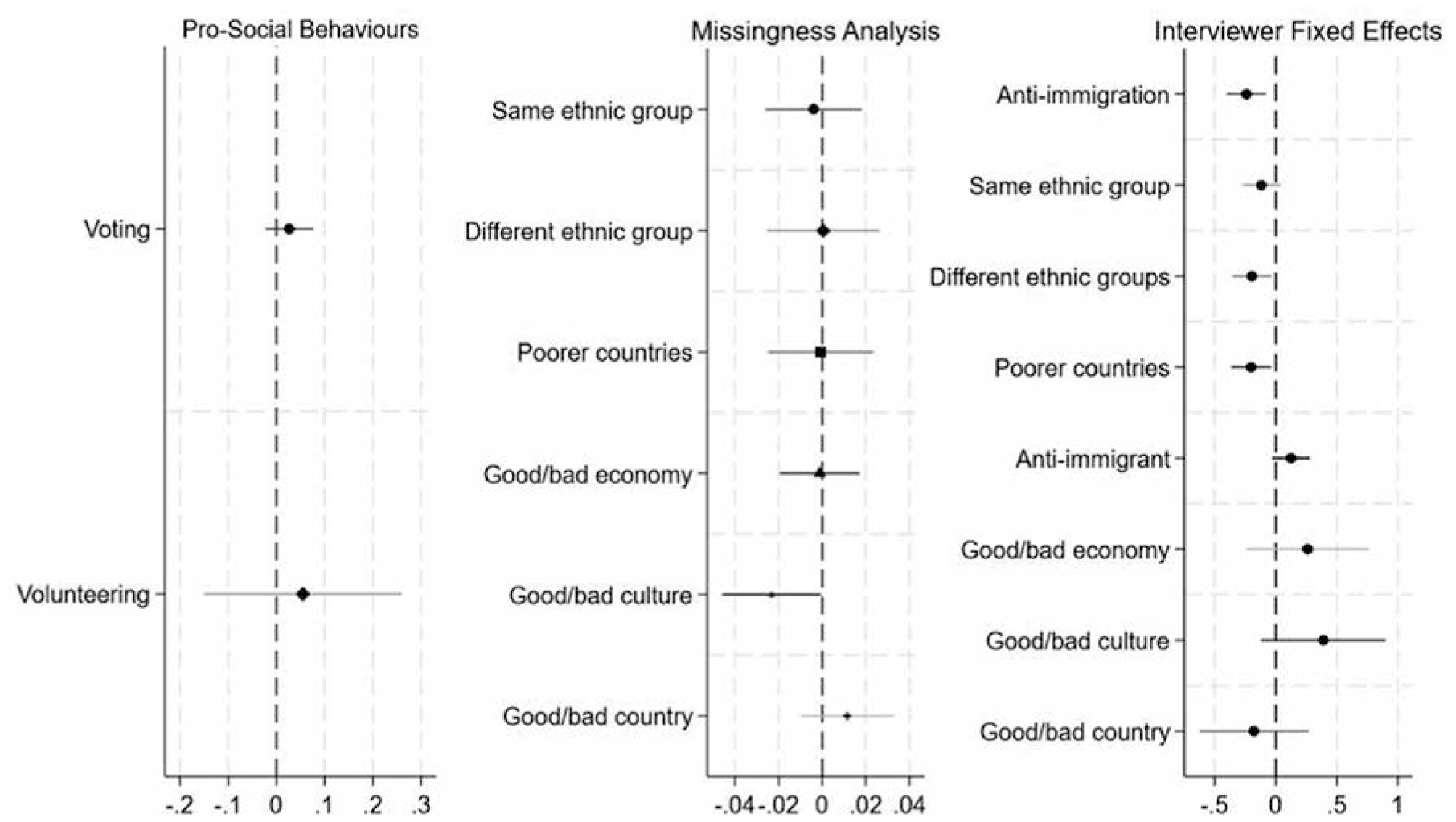
Exploring social desirability as a potential mechanism.
Discussion and Conclusion
Despite the global strengthening of border regimes, undocumented crossings are on the rise. Importantly, these crossings entail great risks and often result in fatalities for migrants, a fact that has increasingly gained visibility in the public sphere of countries at the receiving end of these crossings. Yet the ways in which such events shape public attitudes on immigration-related issues remains unexplored. This stands at odds both with the importance these tragic events carry in migration-related debates and, simultaneously, the burgeoning scholarly interest in the role of events in shaping intergroup attitudes. Extending analytical inquiry toward this direction, we examined the impact of one of the earliest and deadliest migrant shipwrecks to have occur in the recent history of the Mediterranean Sea: the so-called 2013 Lampedusa shipwreck. We find that the shipwreck altered anti-immigration attitudes among Italian respondents. Specifically, in the aftermath of the shipwreck, Italians expressed greater willingness to support more liberal immigration policies, allowing higher inflows of migrants into Italian society. This suggests that exposure to this informational shock generated humanitarian concerns, rather than reinforcing securitization logics that might have led to support of a more restrictive immigration policy. Importantly, this finding aligns with those of Emeriau (2024), who shows that French asylum officers were more likely to grant asylum in the days following similar migrant shipwrecks. Although Emeriau focused on frontline bureaucrats, our findings extend this insight for the broader public: tragic migration events appear capable of shifting attitudes toward immigration. This is an important finding. It points to migrant tragedies as previously underrecognized drivers of public opinion on immigration, even in contexts in which migration is highly politicized as is the Italian one.
Second, we do not find any changes on anti-immigrant attitudes. Attitudes toward the immigrant stock (i.e., the perceived impact of immigrants already residing in society) appear to remain unaffected by the shipwreck. This null finding is important and, when considered alongside the observed changes in anti-immigration attitudes, holds further analytical value stressing the importance of always considering the type of event. The 2013 Lampedusa shipwreck, as evidenced, brought attention to the realities faced by immigrants attempting to enter a society (i.e., immigration flow); however, it did not draw focus to the conditions of immigrants already present within a society (i.e., the immigrant stock). Consequently, immigration-related public opinion shifted only with regard the specific dimension made salient by the event—attitudes toward immigration—while attitudes toward immigrants remained stable. Viewed through this lens, the findings appear theoretically consistent and highlight the general calculative nature of attitude formation. Simultaneously, they serve to make two important contributions to the literature on immigration-related public opinion. Methodologically, they underscore the importance of distinguishing between these two closely related, yet distinct, immigration-related attitudes. This differentiation has not always been clearly maintained in prior literature (cf. Hangartner et al. 2019), despite growing recognition that these two constructs capture different aspects of immigrant-related public opinion (see also Margalit and Solodoch 2022). At the same time, our findings stress the analytical promise of not only distinguishing but also examining these two attitudinal dimensions in parallel. This can allow the development of a better understanding of the divergent formative basis of these two attitudes, in turn providing important insights for the development of an overarching immigration policy relating both to the arrival and integration of migrants into society.
Our contribution to the literature is twofold. First, we broaden the analytical framework for understanding the impact of events on intergroup attitudes. As discussed, existing literature has focused almost exclusively on events that pose a threat to the ingroup. By contrast, we examine an event that poses a threat to the outgroup. Research on events remains limited, and the few existing studies have rarely examined attitudinal change or done so across the general population (i.e., Emeriau 2024; Slovic et al. 2017; Sohlberg et al. 2019; Thomas et al. 2019). Advancing research in this direction is crucial. The importance of studying events has long been theoretically underscored as imperative for the understanding of race relations (Blumer 1958; Blumer and Duster 1980). Yet most empirical studies have theorized it through the lens of competitive threat (Hopkins 2010; Legewie 2013) reflecting a long-standing “fixation” on understanding exclusionary attitudes as a function of threat to one’s individual or ecological spheres (Ceobanu and Escandell 2010:310). Yet as Blumer (1958:6) noted, “big events” are also instrumental in the formation of the ingroup’s collective image of the outgroup: external events that meet the four conditions qualifying them as “big” can shape intergroup relations independently of sources of individual threat. The 2013 Lampedusa shipwreck can qualify as a “big event” in Blumer’s terms. As we have demonstrated, it acquired social significance and triggered an emotional response among the Italian population. Nevertheless, it also challenged the ways in which public figures referred to the phenomenon of irregular migration as well as changed attitudes of their relating to aspects of immigration, indicating a clear challenge in their perception of intergroup relations and subsequent identification with their own group (Blumer and Duster 1980:234–35). Considering this alternative focus, our study takes an important first step toward developing a typology of such events. However, we must acknowledge that by focusing on a single event, we cannot fully assess whether all the outlined conditions are necessary to trigger the relevant processes (i.e., the scope conditions of Blumer’s theorization of “big events”). Undoubtedly, this can only be determined through ongoing analytical testing and theoretical refinement, which we hope our work will help initiate. Simultaneously, and in light of the scholarship’s recent efforts to reduce exclusionary attitudes through relevant interventions designed to foster perspective-taking among ingroup members (e.g., Adida et al. 2018; Dinas et al. 2021), our analytical shift, and the related findings that follow, suggest that drawing attention to the tragic events that have unfortunately become almost commonplace can sensitize populations in a similar manner. With our second contribution, we stress the methodological and analytical importance of not only distinguishing between attitudes toward immigration and immigrants but also of analyzing them in parallel. Doing so can advance scholarly understanding on immigration-related public opinion and, in turn, provide more nuanced insights for policymaking. As it is also analytically important to understand subpopulation patterns in reactions to such “big events,” we provide a set of relevant analyses in the Appendix (section 4) that highlight potential avenues for subgroup investigation. However, because of the limited sample size, these should be interpreted with caution and rather represent potential directions for future investigations.
Lastly, because of data availability, our analysis focuses only on Italy: the country in whose territorial waters the shipwreck occurred. A relevant open question is whether similar results would emerge in other countries that are not geographically exposed to such events. Anecdotally, we reported that both Google search data and newspaper analyses from countries beyond Italy show notable changes in the volume and content public interest following the shipwreck (see also Appendix 1). The increase and shift in the patterns of interest after the shipwreck lay at the core of our identification strategy and permitted us to tentatively argue that results for Italy may represent a carbon paper for changes occurring in other countries, at a time prior to the intensification of border crossings in Europe and beyond. It is also worth noting that Italy, as one of the countries most persistently exposed to migrant arrivals, offers a setting where public attitudes toward immigration and immigrants may have had more time to form and stabilize. The fact that we observe changes in such a context underscores the potential power of major humanitarian events to shift public opinion. Future research should further investigate the impact of migrant deaths at borders on immigration-related attitudes by examining on countries that are not directly on the frontlines of border crossings and therefore do not explicitly bear responsibility for rescue operations. Future research should also explore other aspects of immigration-related public opinion: because of data availability, we focused only on the event’s impact on related preferences, specifically, attitudes toward immigration and immigrants. However, immigration salience and xenophobia, among others, are also key such components of public opinion on migration (Böhmelt, Bove and Nussio 2020; Castanho Silva 2018; Hatton 2021) and understanding how such tragic events shape these dimensions is analytically important.
Focus should also be placed on assessing the scope conditions of Blumer’s theoretical paradigm and whether all four conditions outline should be met for an event to be characterized as “big” and, in turn, shape intergroup relations. Moreover, future research should investigate how persistent exposure to such tragic, salient events, as well as to other recurring “smaller” migration events that acquire contextual significance, could contribute to shaping these attitudes. Reports indicate that more than 40 shipwrecks resulting in more than 100 deaths or missing persons have occurred in the Mediterranean Sea since 2014. To fully grasp the scope of this phenomenon, it may be necessary to shift the analytical focus from isolated “events” to “regimes of events,” in which attitudes are examined within the ongoing social process of interpretation that connects one event to the next (Abbott 2016).
Supplemental Material
sj-docx-1-srd-10.1177_23780231251372795 – Supplemental material for Migrant Deaths at Borders and Immigration Attitudes: Evidence from the 2013 Lampedusa Shipwreck
Supplemental material, sj-docx-1-srd-10.1177_23780231251372795 for Migrant Deaths at Borders and Immigration Attitudes: Evidence from the 2013 Lampedusa Shipwreck by Nicolò Cavalli and Effrosyni Charitopoulou in Socius
Footnotes
Supplemental Material
Supplemental material for this article is available online.
1
2
 posited that “this idea that in such areas of group life the independent variable automatically exercises its influence on the dependent variable is, it seems to me, a basic fallacy . . . there is a process of definition intervening between the events of experience presupposed by the independent variable and the formed behavior represented by the dependent variable” (p. 686).
3
In the original ESS dataset, two interviews are recorded on May 2 and May 8, 2013, respectively, but we have discarded these two interviews that took place almost a month before fieldwork.
4
Large values in the variance ratio for the two groups are due to the small numbers of observations from these highlighted regions. Rebalancing on the basis of geography is also relevant because refusal conversions, which happen later on in the fieldwork, were carried out only in the six largest Italian cities (:119–25).
Author Biographies
References
Supplementary Material
Please find the following supplemental material available below.
For Open Access articles published under a Creative Commons License, all supplemental material carries the same license as the article it is associated with.
For non-Open Access articles published, all supplemental material carries a non-exclusive license, and permission requests for re-use of supplemental material or any part of supplemental material shall be sent directly to the copyright owner as specified in the copyright notice associated with the article.
