




Abstract
Social movement scholars assert that collective action depends on the construction of a robust collective identity within social movements. Yet the author witnessed a particularly weak collective identity over two years of observation and interviews at an immigration clinic. This article explains that counterintuitive finding, demonstrating how field and organizational policies and practices can limit collective identity work among movement participants, inhibiting collective identity development even in organizations whose public self-presentation would seem to provide a ready-made source of collective identity, like an exclusive commitment to Christianity. Given the importance in the literature of collective identity to collective action, these findings suggest a puzzle: how can social movement manifestations characterized by limited collective identity mobilize participants? The findings show that volunteers and staff members use clinic labor to verify their personal identities as moral people, which provides feelings of authenticity, self-efficacy, and self-esteem that motivate ongoing mobilization. The clinic’s reliance on participants’ personal identities, rather than collective identity, for mobilization—alongside its blended service, civic, and activist labor—exemplify a novel but increasingly important form of social movement organization, which the author conceptualizes as a personalist blended social movement organization. These findings have implications for the study of mobilization and collective action, particularly politically liberal religious mobilization.
Keywords
Why do people participate in social movements? Scholars have demonstrated that a variety of factors influence mobilization, including the existence, perception, and accessibility of political opportunities (McAdam 1999; McAdam, Tarrow, and Tilly 2001; Meyer 2004) and resources (McCarthy and Zald 1977; Morris 1981, 1999); the availability of social networks (Jasper and Poulsen 1995; Larson 2021; McAdam 1986); movement communicators’ appeals to resonant frames (Benford 1993; Benford and Snow 2000; Hunt, Benford, and Snow 1994; Jasper and Poulsen 1995; Snow et al. 1986); and characteristics of potential participants facilitating participation (McAdam 1986).
Yet many scholars argue that mobilization requires an additional factor: that movement participants interactively construct and manage a group’s sense of itself as a “we” united by goals or tactics and contrasting with out-groups, a process called collective identity (Melucci 1995; Snow 2001; Taylor and Whittier 1992). The concept has proved so productive for explaining collective action—purposeful collaborative activity promoting or inhibiting social change (Oliver 2013)—that many scholars have concluded that movements cannot endure without developing a strong collective identity (Della Porta and Diani 2009; Flesher Fominaya 2018). That development requires significant identity work, that is, interactional ideating that ties movement activity to participants’ identities (Einwohner, Reger, and Myers 2008; Snow and McAdam 2000).
Given the importance of robust collective identity across the literature, I found something unexpected over two years of participant observation and interviews at an immigration clinic: a weak collective identity among participants alongside ongoing collective action and an institutional commitment to an exclusively Christian public identity. Given the evidence indicating the essentiality of strong collective identity to collective action, alongside the presence of a ready-made Christian public image, how could I explain this weak collective identity? And given that weakness, what kept people mobilized initially and over years?
I address these puzzles in two broad steps. First, I illustrate the clinic’s weak collective identity by showing how volunteers and staff employ three strategies—avoiding, tangentializing, and redirecting—to minimize collective identity work and limit identity development. These strategies emerge from the interaction between immigration law policies and norms with organizational practices, together making clinic labor individualistic, relentless, ambiguous, and dependent on diverse, empowered participants. These factors make Christianity interactionally invisible despite the clinic ministry’s exclusively Christian public image.
Limited collective identity and religious invisibility raise a second puzzle: how does the clinic mobilize participants without constructing a strong collective identity, given its importance in the literature? I address this question by drawing on the concept of personalism—the pursuance of self-fulfillment through collective action—to show that movement participation verifies participants’ deepest individual identities, providing personal motivation for labor toward collective goals by providing participants feelings of self-esteem, and self-efficacy, and authenticity (Lichterman 1996).
My findings make three broad contributions to the study of collective action. First, they show how a novel organizational form can facilitate collective action without strong collective identity. I refer to this understudied organizational form as a personalist blended social movement organization (PBSMO) because it changes society by drawing on personal motives to engage participants in blended service, civic, and activist labor. Qualifying adjectives—such as blended and personalist, which mark participant motivation and organizational activity—are especially important today as SMOs increasingly blend various types of labor in personalist ways (Sampson et al. 2005; Tucker 2018). This is particularly true in politically liberal religious communities, which face declining adherence and consequent increasing reliance on empowered non-coreligionist volunteers. This reliance in turn limits religion as a source of collective identity, making these communities’ collective action more personalist.
Beyond the PBSMO concept, this study suggests additional implications for scholarship on social movements and religion. On one hand, the findings indicate that movement scholars ought to center movement models and definitions on collective action rather than on particular organizational forms, identities, or behaviors (e.g., protest). Most obvious, fixating on collective identity can blind us to personalist forms of collective action like that at the clinic. This insight is not new, and it suggests that researchers might benefit from revisiting classical scholarship on the relationship between self-interest and collective action. De Tocqueville’s ([1835] 2013) writing on Americans’ pursual of individual interest through collaborative action that improves society—self-interest rightly understood—would be a good place to start, as personalism represents a contemporary version of his concept.
Finally, the interactional invisibility of Christianity at the clinic suggests that secularization scholars should focus less on macro-level, society-wide generalizations about modernity and more on organizational and field-level policies and practices that make religion invisible in everyday life, including explicitly religious spaces like the clinic. Such a focus could illuminate how people interactionally construct secularity in everyday life.
Blended Social Movement Organizations
McCarthy and Zald (1977) defined a social movement organization (SMO) as “an organization which identifies its goals with the preferences of a social movement or a countermovement and attempts to implement these goals” (p. 1218). SMOs are formal firms that work to change society within a larger movement. Scholars have especially employed the concept to analyze organizations engaged in disruptive politics, particularly protest. Yet SMOs incorporate all organizations that draw participants together in shared labor to change society (Zald and Ash 1966).
This expansive definition matters because blended SMOs (BSMOs)—SMOs engaged in a “blend” of activist, service, and civic labor—increasingly drive social change. Sampson et al. (2005) showed that activists regularly organize collective action events around civic forms that make explicit political claims, like an art fair calling for change to AIDS policy. These blended social action events, which are simultaneously civic in form but political in purpose, made up only 4 percent of collective action events in 1970 but 12 percent in 2000, slightly more than protests. Civic events composed the majority of social action events. In other words, blended action events are more common than protest today, and civic events have probably always driven change. The shift away from disruptive politics toward blended collective action exemplifies what Meyer and Whittier (1994) called the spillover effect of social movements in a society, that is, the transformation of movements on the basis of what they learn from each other and a changing movement field. Sampson et al. (2005) showed that as protest becomes more societally routine, it becomes less effective, and its ability to drive change increasingly “spills over” to blended organizational forms.
Various societal changes drive this spillover, including diminishing rates of protest participation, increasing reliance on spontaneous protest over long-term organizing, and the incorporation of violent extremists into movements, delegitimizing protest (Chenoweth 2020). Likewise, new media make organizing protest easier and thus less impactful for political actors while facilitating repression (Tufekci 2017). Narrowcasting also tribalizes knowledge (Meyer and Pullum 2015), polarizing communities, while institutionalizing protest diminishes its novelty and inspirational value (Meyer and Tarrow 1998) Consequently, recent generational cohorts express less interest in protest (Kim and McCarthy 2018) Finally, the expansion of the bureaucratic state can limit the efficacy of exogenous pressure (like protest) to change systems, advantaging organizations able to leverage resources from within (Klein and Thompson 2025).
Driven by declining protest efficacy, moral entrepreneurs increasingly organize through labor across civic, service, and activist spheres (Feenstra 2018). Hasenfeld and Gidron (2005) described such organizations as multipurpose hybrid voluntary organizations, but I prefer Sampson et al.’s (2005) blended language for three reasons. First, in drawing explicitly on the social movement literature, the term blended social movement organization emphasizes that these organizations seek first and foremost to improve society, using whatever form(s) seems most efficacious. Second, by drawing on an established literature and acronym, BSMO is less linguistically unwieldy. Finally, qualifying SMOs as blended marks the reality that different organizational forms develop and pursue change in distinct ways, a fact sometimes obscured by a narrow focus on disruptive politics.
Collective Identity in Contemporary SMOs
Scholars conceptualize collective identity as an ongoing interactive process through which groups construct some sense of shared “we-ness” in contrast to explicitly defined or implied out-groups and marshalled toward shared agency (Flesher Fominaya 2018; Melucci 1995; Snow 2001; Snow and Corrigall-Brown 2015; Taylor and Whittier 1992; Wolford 2010). Many scholars argue that movements cannot pursue collective action without a strong collective identity uniting participants (Della Porta and Diani 2009; McDonald 2002; Taylor and Whittier 1992). Della Porta and Diani (2009) exemplified this view, writing,
Collective action cannot occur in the absence of a “we” characterized by common traits and a specific solidarity. Equally indispensable is the identification of the “other” defined as responsible for the actor’s condition and against which the mobilization is called. (p. 94)
Yet some scholars question this “orthodoxy” (McDonald 2002), arguing that collective identity is less important to collective action today than in the past. These scholars maintain that the modern network society facilitates weak links promoting individualism over collectivism, especially online (Cammaerts 2021; McDonald 2002).
This scholarship suggests that collective identity development depends on how institutional and organizational practices shape interaction (Reger 2002; Staggenborg 2002). Yet although these scholars focus on media, others show that organizational forms and institutional structures have always mattered. Gamson (1996) demonstrated that organizations adjust their public identities (e.g., targeting academic vs. commercial audiences) to gain legitimacy and access resources. Gamson’s focus on public identities contrasts with Van Stekelenburg and Boekkooi’s (2013) analysis of organizational formality shaping participants’ interaction, with formal organization facilitating stronger collective identity. These studies demonstrate that organizational forms and field-level policies shape how organizations present themselves publicly and how participants interactionally develop collective identity.
Like Van Stekelenburg and Boekkooi (2013), Rohlinger and Bunnage (2018) asserted that organizational conditions drive participant interaction. These scholars show that organizations that facilitate interaction among participants, mobilize locally, prioritize collective identity as a goal, and cultivate community-seeking participants develop thick collective identities, that is, deeper solidarity and shared meaning behind collaborative labor. In contrast, organizations that hierarchically limit interaction, mobilize (inter)nationally, deprioritize collective identity, and attract participants uninterested in community develop thin identities. Collective identity density provides a useful analytical tool for making sense of different manifestations of collective identity. Scholars might, for example, conceptualize the loose collectivity that all groups exhibit (see Tajfel and Turner 2004) as the thinnest of identities, while Student Nonviolent Coordinating Committee (SNCC) activists’ “beloved community” (McAdam 1990) might exemplify a particularly thick identity.
Movement research tends to focus primarily on protest SMOs with thick identities, such as the SNCC. But what about organizations working through thin identity, like the clinic I studied?
Personalism as Self-Interest Rightly Understood
Personalism—individual self-fulfillment through collective action—provides a helpful conceptual tool for making sense of SMOs characterized by limited collective identity. As Lichterman (1996) observed,
Personalism does not necessarily deny the existence of communities surrounding and shaping the self, but it accentuates an individualized relationship to such communities . . . [with] the personal self get[ting] developed by reflecting on individual biography, by establishing one’s own individuality. (p. 6)
Personalism means people collaborate to meet personal needs for growth and development. Van Stekelenburg and Boekkooi (2013) asserted that contemporary liquid societies’ constantly changing institutions make movements increasingly personalist. Tucker (2018) maintained that neoliberal gigification—making a living through varied, flexible, freelance forms of project-based labor rather than traditional employment—drives individual self-marketing, while cultural change facilitates experimentation with diverse, intersecting identities in the search for the “authentic” self. Social media facilitate these economic, aesthetic, and expressive forms of individualism, promoting weak identities and autonomy across networks. The result is a twenty-first century version of organic solidarity (Durkheim [1893] 2014), as mobilization toward collective well-being emerges from individualistic autonomy and difference, driving movements ranging from Occupy, Black Lives Matter, and MAGA. Personalism also drives movements outside the United States (Perez 2018) demonstrates that Argentine activists use routines to enact personal identities as “respectable,” civically engaged proletarians, while Jokela (2024) described how a Helsinki community organized a neighborhood street party around “solo gig” community improvements. These examples show personalism’s globalization, undermining assertions that thick collective identity is essential to collective action.
Yet although perhaps more observationally prominent today, personalism is not new; the concept harkens back to classical conversations about the relationship between personal and collective well-being. Aristotle (1981) wrote about the tragedy of the commons, while Smith ([1776] 2018), Friedman ([1962] 2002), and Rand (1964) pushed economics to focus on self-interest in promoting collective well-being. Perhaps de Tocqueville (2013) came closest to articulating a classical version of personalism, observing that Americans tie self-interest to collective good, often sacrificing short-term desires for long-term well-being. Tocqueville wrote,
[Americans] are pleased to explain almost all the actions of their life with the aid of self-interest well understood; they complacently show how the enlightened love of themselves constantly brings them to aid each other and disposes them willingly to sacrifice a part of their time and their wealth to the good of the state.
For de Tocqueville, self-interest rightly understood drives people to eschew both grand sacrifices and narcissistic individualism as they pursue personal fulfilment through collective action benefiting society (Hibbs 2024). Personalism is a contemporary expression of self-interest rightly understood, as personal goals drive collective action toward communal well-being. Yet personalism does not necessarily exclude thick collective identity; in fact, it can provide a basis for such an identity.
Personalist Collective Identity
Evidence for this conclusion comes from scholarship on interfaith organization’s use of shared frames to link participants’ personal goals, values, and experiences. Braunstein (2017) described how a progressive coalition of Christian, Jewish, and Muslim leaders called Interfaith grounded collective action in religious diversity, while the Tea Party sacralized participants’ autonomy. For these movements, personalism facilitated collaboration. Similarly, Delehanty (2023) and Delehanty and Oyakawa (2017) showed how progressive Christian coalition ELIJAH constructed thick collective identity out of varied personal stories about institutional trauma, with leaders framing the stories as manifestations of the same unjust capitalist system and calling on participants to collaborate in changing that system.
These studies show that personalism can foster thick collective identity when organizational leaders engage in the identity work—that is, interactional labor that helps people tie together personal identities with organizational activity (Einwohner et al. 2008)—of framing varied experiences as expressions of the same underlying problem. Personal religious identities in particular can serve as solidaristic glue, but only if leaders celebrate diversity and inclusion.
To summarize, social movements around the world are increasingly driven by SMOs that are blended—engaging in service, civic, and activist labor—and personalist, that is, uniting participants together through personal identity fulfillment. Personalism can serve as a source of thick collective identity, particularly in religiously diverse communities, but only through ongoing interactional identity work.
Yet questions remain about personalism and collective action. Most relevant to this study, some organizations maintain exclusive public religious images that would seem to provide ready-made sources of collectivity identity. Yet participants eschew them in favor of personalist motivations. What field and organizational practices/policies drive this commitment to personalism and minimization of collective identity, despite an institutionally religious public image? And given the essentiality of collective identity for collective action, how do these organizations mobilize participants?
In this article I address these questions after briefly describing the study site and data collection and analysis.
Methods
The Clinic and Its Ministry Organization
Located in a midwestern city of 70,000, the immigration clinic provides low-cost legal services for immigrants, while occasionally advocating for political action and educating the community. Founded in 2014, the clinic forms one branch of a larger Christian ministry organization that has provided community financial, food, homeless, and childcare support for about 50 years. The ministry supports the clinic through shared leadership, finances, equipment, public and internal communication, workspaces, etc.
The ministry frames itself as a Christian organization that welcomes people from different faiths. Its workspaces are adorned with crosses and pictures of saints, and its website lists more than 50 supporting communities from a range of theological backgrounds, including conservative (e.g., Alliance of Reformed Churches), mainline (e.g., United Methodist), and liberal (e.g., Unitarian Universalist) Protestant congregations, as well as Catholic, Church of Latter-Day Saints, and ethnic minority (e.g., Korean Methodist) parishes and parachurch groups such as Broken Chains Biker ministries. The ministry publicly embraces diversity within Christianity, much like Interfaith’s (Braunstein 2017) use of shared Abrahamic identities, claiming to be a manifestation of the Church (the capital C denotes universality across diversity).
Yet although the ministry welcomes non-Christian participants and clients, its public image excludes their communities from official support. Ministry publications cite few non-Christian thinkers and leaders while liberally referencing the Bible and Christian doctrine. Likewise, the ministry regularly holds events in churches (e.g., a food pantry). Sometimes exclusion becomes explicit. Two Jewish volunteers shared that the ministry denied their synagogue’s request—part of an application to become an official supporter—that it print a Star of David alongside the cross on publications. The synagogue rescinded its application.
In sum, although the ministry makes overtures toward non-Christian inclusion, it maintains an exclusively Christian public image, potentially dissuading non-Christian participation. Given this public image, I expected that most participants would identify as Christians and see their labor as expressing that shared identity.
Participant Demographics
I interviewed seven out of eight core volunteers—those seeking U.S. Department of Justice (DOJ) accreditation 1 —along with the clinic Director and two volunteers who participated for months. 2 This group performed much of the clinic’s activity. Fewer than half identified as Christian. Two identified as Jewish, two as atheists or agnostics, two as nonreligious, and one as secular Hindu. 3
Seven interviewees identified as white, and two of those identified as Jewish. One participant, a naturalized U.S. citizen from Sierra Leone, identified as “African,” while another said she is “Indian from India.” One participant was a Central American U.S. permanent resident. Participants were highly educated; all but two had some postgraduate education, and four held terminal degrees. Only one participant was younger than 25 years, while five participants were working age (26–64 years) and four were 65 years or older. Three of these worked full-time, while one completed a master’s degree and the other left the workforce to raise her children. Seven participants identified as women and three as men. Table 1 lists descriptive statistics.
Descriptive Statistics of Interviewees.

The Clinic as a BSMO in the Immigrant Rights Movement
I address the clinic’s personalism in the findings section, but it is clearly a BSMO. Day to day, clinic participants provide legal support to immigrants who have paths to residency or citizenship but lack resources. Some participants work with asylum applicants, while others assist clients seeking benefits through relatives, relief from legal infractions, or success on the citizenship test.
Participants also engaged in civic labor. Some managed a booth at the city’s annual Latino festival, while others organized community education events. At one event, clinic participants met with community members while I presented about immigrants’ rights when interacting with law enforcement. Education events such as these equip communities to exercise their rights, much like the SNCC’s 1960s freedom schools (McAdam 1990).
Participants occasionally engaged in protest. At a 2018 “Never Again Is Now” rally against the first Trump administration’s separation of immigrant children from their parents, clinic participants shared about the clinic’s work alongside participants from the American Civil Liberties Union and local immigrant rights organizations. As hundreds of protestors filled a local Episcopalian sanctuary waving signs declaring “love knows no borders” and “we’ve made American cruel again,” local political and religious leaders—including the mayor, a rabbi, and an NAACP representative—compared Trump’s policy with the Holocaust. The clinic Director spoke to applause about resisting “the anti-immigration rhetoric,” concluding that “we don’t need more information, we need action.” An example of clinic activism, the rally illustrates the centrality of BSMOs to the immigrant rights movement, given that blended SMOs like the NAACP, American Civil Liberties Union, and YWCA facilitated it.
Given the above, I treat the clinic as a BSMO. My approach follows scholarly convention, as exemplified by movement analyses of organizations providing abortion access funding (Daniel and de Leon 2020), support for sexual trauma victims (Findler 2022), micro-loans to entrepreneurs (Chakravarty and Chaudhuri 2012), and pro bono legal services (Boutcher 2013). Indeed, scholars have developed seminal movement theory by studying organizations that provide civic education (like the clinic) structurally denied to marginalized communities (e.g., McAdam 1986, 1990).
Data Collection and Analysis
From February 2018 through November 2019, I conducted several hundred hours of participant observation, recording 87 separate ethnographic narratives, each based on field notes jotted in a pocket notebook during a 2- to 4-hour clinic session. I also took notes during 12 1-hour lunch meetings. Ultimately, I spent more than 200 hours volunteering. I also assisted with fundraising events such as the annual dinner the clinic hosts with local restaurant sponsors, and I attended the 2019 CLINIC convening in Pittsburgh with clinic participants. This three-day conference of SMOs and attorneys facilitates legal training and networking among immigrant rights organizations. I also conducted and transcribed 10 semistructured interviews, each lasting 1 to 3 hours and structured around questions about religiosity, activism, and collective identity.
I coded transcripts using thematic, process, and in vivo coding, focusing on participants’ framing of “we-ness,” out-groups, and purpose. I used emergent themes to code ethnographic data, writing memos abductively synthesizing interviews, ethnography, and theory (Timmermans and Tavory 2012). Several themes emerged, including avoidance, tangentializing, and redirecting as strategies minimizing collective identity, as well as individualism, relentlessness, ambiguity, and diversity as structural limitations to collective identity development.
Findings and Analysis
I present findings in three subsections. First, because it is impossible to demonstrate an absence of collective identity, I draw on ethnographic vignettes to show interactional strategies participants used to limit identity work. I augment these vignettes with interviews in case I missed something observationally. This section demonstrates that participants actively minimized identity work opportunities. Next, I share ethnographic and interview data showing that immigration law and organizational policies and practices together made participants’ labor individualistic, relentless, and ambiguous, limiting opportunities for collectively effervescent activity. These factors also drove the clinic’s reliance on diverse, empowered participants, limiting its ability to impose a religious identity on them. Finally, I demonstrate that participants initially mobilized through the clinic to affirm core senses of self and continued because labor verifies their personal identities, providing feelings of self-esteem, self-efficacy, and authenticity.
Limiting Collective Identity
In this section, I demonstrate three strategies participants used in minimizing identity work that facilitates collective identity (Einwohner et al. 2008): (1) avoiding identity work; (2) tangentializing, or prioritizing personal identities over collective identity work; and (3) redirecting, or prioritizing practical action over collective ideation.
Avoiding
In October 2019, I attended a meeting between the Director 4 and four accredited participants. These meetings were rare when I started at the clinic; participants did most of their day-to-day labor alone, collaborating primarily during irregular meetings and fundraising and education events. However, by the end of my observation, the Director had institutionalized these meetings as monthly check-ins.
During the meeting, participants shared labor updates. The Director and Ada, a white mainline Christian volunteer in her 70s, shared about working late Friday night to submit documents on time. “Hopefully this type of deadline never occurs again,” the Director said. Chuckling, Ada replied, “How many more months do we have?” The Director responded, “We should have a second calendar on the wall [alongside the volunteer schedule].” Another participant then redirected conversation, suggesting participants wait for policy changes rather than outracing them. The Director then shifted conversation toward financial issues.
Adding an unspoken but implied clause into Ada’s comment, the sentence would read, “How many more months do we have [until there is a new presidential administration]?” This exchange would seem to indicate that participants’ shared antipathy toward the administration played a vital role in participation. Indeed, Ada clearly saw Trump as a villain, and several participants criticized his policies and rhetoric at other times, with one interviewee expressing “disgust.”
Yet participants responded to Ada’s comment not by magnifying and coalescing around shared anti-Trump feelings but, rather, by shifting conversation to mundane, practical concerns, such as funding. This interaction exemplifies a trend I witnessed repeatedly: a participant would express antipathy toward a shared enemy. Other participants might agree, and then someone would refocus on practical work. Antipathetic exchanges seemed to distract from collective action, not to unify participants. Put differently, these interactions seemed incidental, perhaps even inhibitory, to collective action, not essential to it, with participants actively avoiding them.
Perhaps these exchanges were brief because participants already agreed on shared enemies, so interaction represented fleeting group identity affirmation. Interview data suggest not. Only four participants started participating because of Trump’s policies, with the rest explaining participation for personal reasons. Three interviewees never mentioned Trump, and several criticized him only when asked. Interviews thus suggest that although participants shared a dislike of Trump, this sharing played at most a minor role in participation.
During collaborative labor, participants rarely referenced antagonists, only mentioning them during interviews. Different interviewees highlighted different enemies—hypocritical Christians, immigration authorities, capitalism, Satan, and others—with limited overlap. These findings, alongside the avoidance evidenced in the vignette, suggest participants ideated about villains individually, not collectively.
Tangentializing
In July 2018, I volunteered at the clinic at the same time as three volunteers. Schedule synchronicity was rare, and we took a break at the same time, congregating in a hallway as Brenda shared about visiting an East African orphanage. My notes follow:
The Director asked Brenda if she’d heard the starfish story. . . . She said it’s about a person walking on the beach putting starfish into a bucket who says he can’t save them all but can help individuals. The Director said that’s what we can do—we can’t change the world, but we can help individuals.
This story, told to volunteers gathered informally during a break, would seem to be the stuff that collective identity is constructed from; indeed, Benford (1993) called narratives like these vocabularies of motive because they articulate shared inspiration for collective action. The Director’s story presents “we” as people who save individuals even if we cannot alter structures. The Director clearly thought this story illustrated the clinic’s labor and identity, repeating it to me later.
Yet were stories like this vital to participation, we would expect participants to mention them in interviews. Neither volunteer present mentioned the starfish story or similar identity work. Instead, they said personal history and contemporary change drove their participation. Marsha, a convert to Judaism in her 70s, said she volunteers because the clinic meets people’s needs, certainly a starfish story theme. Yet Marsha said structural change—the election of “a racist, misogynist, disgusting human being” to the presidency—catalyzed her to volunteer because of her past. She said,
When I first got out of college, I went into social work. That was my original goal. . . . There was a lot of injustice. And a lot of blaming the victim. I got involved with trying to form a union of welfare workers. . . . That was my introduction to the kind of injustice that people who don’t have resources have to contend with. That’s what really what drew me to the clinic: knowing that people who are in those kinds of situations don’t have resources, and they don’t have people that they can even think to call [for help].
Wolford (2010) showed that scholars sometimes assume participants’ similar terminologies indicate thick collective identity. Yet such similarities may obscure distinct senses of self. Read alone, Marsha’s focus on structural inequality might suggest that identity work like the Director’s story drove her labor. But read alongside her extended narrative, it becomes clear that Marsha’s participation was driven by a deeply internalized personal commitment to fighting injustice developed half a century earlier and catalyzed by Trump’s election. Marsha’s commitment was personal, not the embodiment of a starfish story. Her case illustrates how volunteers tangentialized collective identity work, rooting their clinic dedication in personal experiences, not collective ones.
Redirecting
Participants also minimized identity work by redirecting interaction away from group definition toward practical concerns. The Judge epitomized redirecting with his direct, businesslike manner, cultivated over years as a state judge. He said,
I’m attempting to help people resist and overcome the inequities or barriers created by the immigration system. . . . The people we’re working with don’t have the means to hire somebody. . . . I’m trying to achieve a result. And I’m associated with an organization trying to achieve that result.
The Judge’s focus on getting things done came out in interactions. To conclude a meeting, the Director announced, “We’re much stronger, and our capacity is much bigger because of you. Thank you.”
The Judge stood up, picked up his briefcase, and gestured toward a document shared during the meeting, saying “There’s always a typo in the first paragraph.” The meeting thus ended with an opportunity for collective effervescence interrupted by the most insignificant practical concern, a typo. This example highlights the mundanity of redirecting. Participants regularly refocused potential identity work on practical concerns like typos and procedures.
Thin Collective Identity
Participants’ avoiding, tangentializing, and redirecting suggests that collective identity was not vital to their labor. But what field and organizational policies and practices drove this minimization of collective identity? Below I show that a commitment to volunteer-driven service for as many clients as possible, alongside immigration system practices and norms, made the clinic’s labor individualistic, relentless, and ambiguous, empowering a diverse workforce. These characteristics limited opportunities for sharing the emotionally charged experiences which are essential to collective identity (Collins 2005; Draper 2014; Durkheim [1912] 1995; V. Taylor 1989). Likewise, participants’ diversity and empowerment made religion invisible despite the clinic ministry’s exclusive Christian public image. The result is that participants experienced few opportunities to build collective identity.
Individualism
Immigration cases require long-term, individualized attention, which can make assigning them to individuals more efficient than working cross-organizationally. Consequently, participants worked at the clinic on their own schedules, laboring with clients and translators but rarely with each other. Marsha said,
We don’t spend a lot of time around each other so it’s not like I’ve gotten to know [the other volunteers] really well. . . . Unless you’re here on the same day, you don’t even really see each other, and then you don’t have a tendency to be working on a case together.
The clinic’s dependence on highly educated volunteers helps explain its individualistic approach to case management. All volunteers held at least a bachelor’s degree, and 8 of 10 had completed postgraduate work. Formal education facilitates immigration labor in several ways. Attorneys do not have to complete DOJ accreditation, while experience in academia prepares people to accomplish accreditation, which involves passing a course and assembling a portfolio. Higher education also fosters communication and critical thinking skills, which are vital for working through the arbitrary rules, regulations, “legalese,” and reasoning of immigration law. In short, formal education facilitates clinic participation. But that facilitation also empowers participants, who can take their in-demand skills to other BSMOs.
Because the clinic depends on empowered volunteers, it has limited control over them and must permit them to work at times convenient to them, sometimes from home, limiting interaction. The necessity of individualizing legal cases, alongside dependence on empowered volunteers, creates a highly individualistic workplace, limiting opportunities for the collective effervescence necessary to construct collective identity (Collins 2005; Draper 2014; Durkheim [1912] 1995; V. Taylor 1989).
Relentlessness
Below, I share a field note excerpt highlighting the case of a Peruvian client who took his citizenship test a second time after failing the first because of his limited English:
[The Director] popped into the office where I was working, [saying,] “I have some good news: [the client] passed his citizenship test!” [and] thanking me for helping. . . . [I said] “that’s great news!” . . . She said, “We’ll have to have a party to celebrate. I’ll let you know.”
The Director never let me know, and there was no party. There was not time to organize and celebrate a “win.” There was too much work to do—too many other cases—and participants working on this client’s case moved on to another.
The punitive nature of U.S. immigration law, alongside structural forces (economic and climate change, gang violence, state repression, etc.) driving immigration, mean that the demand for immigration support outweighs supply, creating a heavy caseload at organizations like the clinic. The specialized knowledge required to work in immigration law in turn limits the clinic’s caseload. Together, overwhelming need and limited human resources stretch the clinic’s capacity, leaving little time to celebrate victories or lament defeats.
Ambiguity
Victories and defeats are also rare—the naturalization case described above was unusual—because the complexity and case load for immigration judges make ambiguous continuations routine. During a meeting, the Judge said that he felt “very anxious about having a case that is going to be very hard to win” but “relieved” upon realizing that “what we’re doing is not to win but to delay.” I heard similar sentiments from other participants: the inefficiency of the immigration system could help clients survive until a new presidential administration altered policy. Participants such as the Judge, accustomed to definitive decisions in other legal areas, redefined success from winning to delay.
This redefinition of success resembles the process that Summers Effler (2010) described among Catholic Workers in making collective sense of failure. But unlike Catholic Workers, who drew on “mystical humility” in interpreting failure, clinic participants dealt with cases that remained ambiguous for months or years (p. 87). Unresolved cases provided few opportunities for collective lament or celebration and attendant collective effervescence, leaving participants in the emotional limbo of immigration ambiguity.
Religious Invisibility
One could still imagine participants drawing on Christianity as a source of collective identity. An exclusive commitment to diverse Christianity is, after all, central to the clinic ministry organization’s public image, and diversity can foster thick collective identity, as in organizations ELIJAH and Interfaith, mentioned earlier. One might expect diverse but exclusive Christianity to be central to the clinic’s collective action, perhaps in a personalist way. But despite the centrality of exclusive Christian identity to the clinic ministry’s public identity, only 4 of 10 clinic interviewees identified as Christian, with the rest identifying as Jewish, Hindu, atheist, agnostic, or nonreligious.
Specialization across the legal profession underlay this diversity. As one of my Jewish respondents put it,
If there was another organization who did the same thing that was not affiliated with any religious organization, that’s probably where I would go. . . . But [immigrant support through a religious organization] is the way things are done in the Midwest.
The specialization of immigration law—requiring time-consuming, costly accreditation courses—means that only well-resourced organizations can support a clinic. In many towns, exclusively Christian ministries may be the only such organizations, leaving those who want to assist immigrants with no alternatives. The result is a diverse group of participants.
At the same time, clinic participants’ educational empowerment (described above) limits the ministry organization’s ability to impose its public image on them, as they could take their skills elsewhere. The combination of participant diversity and empowerment make religion interactionally invisible at the clinic, as infusing labor with Christianity—even a diverse form—could alienate non-Christian participants. Interactional invisibility is intentional. The Director said,
We don’t want to be Christian to the point that we don’t seem inclusive and welcoming. And we don’t want to make the faith a requisite for service. . . . There is some intentionality to ensure that everybody finds a place here. . . . We are faith-based, [but] we are different [in our personal identities]. And that is a strength, and not something we should hide.
In embracing diversity as a “strength,” the Director avoids pressuring participants to conform to the ministry’s public imagine, ensuring that “everybody finds a place” in this “inclusive and welcoming” space. The Judge, an ethnic and cultural Jew who expressed supernatural agnosticism, described the consequences of this policy on clinic labor, saying
I don’t think anybody’s ever said a prayer at any of our meetings. There’s some religious art up on the walls. . . . That doesn’t bother me. . . . I feel like we’re working as a volunteer law office, the same way that [local legal support organizations do]. Whatever the decorations are up on the wall has very little to do with the work we’re doing.
In summary, the combination of specialization, individualization, and overwhelming case load, alongside the clinic’s reliance on empowered, diverse volunteers limit opportunities for collective effervescence and make religion interactionally invisible as a source of collective identity. Figure 1 illustrates this process.

Limited collective identity at the clinic.
The result is that the clinic develops only a thin collective identity, and participants minimize the importance of that identity by avoiding, tangentializing, and redirecting identity work. Yet given the importance of collective identity to collective action in the literature, how does the organization mobilize participants?
Personalist Mobilization
In this section, I draw on interviews in demonstrating that participants came to the clinic to affirm key identities that they internalized as vital to maintaining stable, positive senses of self (Miles 2014). Rooted in values, these core selves encompass people’s senses of what it means to be and do good and oppose evil (C. Taylor 1989). When people experience core selves as threatened by changing situations, they seek out spaces where they can affirm those selves (Miles 2014; Snow and McAdam 2000). This identity seeking mobilizes people to pursue personalist self-interest rightly understood, as they pursue collective good through personal identity fulfillment. Below, I highlight three avenues of identity seeking, one per interview. These avenues should not be seen as discrete but as overlapping, as participants explained participation through more than one.
Grassroots Authenticity
Karl could not afford an attorney to bring his mother-in-law to the United States. He learned of the clinic, whose participants “were very kind” and “willing to help,” and his mother-in-law arrived in the United States the day before our interview. Like Karl, some participants came to the clinic for its services. These participants sought help for their own or family members’ immigration cases but could not afford attorneys.
Karl shifted from client to participant to complete a graduate school project and then continued volunteering, saying,
Whatever I do has to be in agreement with what I believe. My faith [as an evangelical Christian] is my worldview. It is the moral compass for me. It’s what guides me in everything that I do. . . . I saw the clinic as an organization that was doing stuff completely in line with what I believe.
Situational change—a family member’s new immigration needs—threatened Karl’s identity as a husband, bringing him to the clinic as a client. But his core sense of self as a Christian—his “worldview” and “moral compass”—drove him to volunteer as he witnessed what Walker and Stepick (2020) referred to as grassroots authenticity, that is, alignment between participants’ behavior and audiences’ idealized, moralized expectations of how SMO participants should act. Clinic participants’ “kindness,” “interest, and “concern” were “completely in line with what I believe,” drawing Karl to participation after identity threat brought him to the clinic.
Karl exemplified participants who came to the clinic as clients and shifted to volunteering as they witnessed grassroots authenticity. A communication professional NGO manager, Karl helped the clinic Director develop a clinic communication plan. Another beneficiary-turned-participant provided clients transportation for appointments in the state capital, an hour’s away. Others interpreted, translated, and assisted with fundraising. Like Karl, these participants initially came as clients, volunteering as they experienced others’ grassroots authenticity and sought to express their own.
Borrowed Approximation
Molly served as president of a local immigrant rights organization. She described growing up in the clinic’s town, moving away for higher education, and then returning in 2016 with the financial and temporal flexibility—which sociologists (McAdam 1986) call biographical availability—to volunteer. Molly’s felt driven to participate because of how her brother-in-law’s undocumented status limited his educational opportunities. She said,
He thought his life was just going to be working at Burger King. . . . He started to get really depressed. . . . That was the first time I [realized] there’s a whole other world there, of people who don’t have legal status, and don’t know what to do. . . . That was a really important experience. . . . [It] became a theme in [my life].
Molly identified with all undocumented immigrants by associating them with her brother-in-law, whose status limited his opportunities. That identification—which scholars call borrowed approximation because it “borrows” identification from a significant other and extends it to anonymous others—formed a core part of Molly’s sense of self (Wahlström, Peterson, and Wennerhag 2018). Moving home gave her an opportunity to act on this “central theme.”
Other clinic participants likewise identified with immigrants through borrowed approximation, extending concern for family and friends to immigrants generally. Some of these participants also pointed toward a second situational change driving volunteering: Trump’s election.
Morally Shocked Participants
A naturalized U.S. citizen from India, Parvati felt that Hillary Clinton would have been “supportive of women and children” as president. Parvati was “very disheartened” by Trump’s victory and joined several progressive organizations as she transitioned from asking, “‘what happened in the elections,’ to what can we do?” She said, “It’s just not enough to . . . have certain beliefs. But you need to make sure they’re upheld.”
Parvati experienced moral shock—feelings of outrage driving one to political activity (Jasper and Poulsen 1995)—when a misogynist won the presidency. That shock drove her identity seeking to express her core identity as a feminist (Snow and McAdam 2000). She said she was “going crazy” and offered to “help in any way.”
Parvati stopped volunteering at other organizations after February 22, 2017, when a white Islamophobe murdered an Indian engineer and wounded two others in Olathe, Kansas, while yelling racial slurs and calling his victims terrorists. Parvati organized a vigil. The murder made her immigrant identity salient. She said,
As an immigrant . . . you’re surrounded by a lot of people who you don’t know whether they like immigrants or not. . . . There are a lot of . . . closeted [xenophobic] people. . . . Just because I’m brown, and I’m an immigrant, does not mean I’m less patriotic than you are. That does not mean that I care less about this country than you do. But some paranoia in me was like, am I being viewed that way? I’m a successful person. I’ve lived in this community for thirty-three years. I’ve lived here more than any other place in my entire life. My kids were born here. I got my education here. I worked here. This is where I choose to call home . . . I’m no less American than you are.
The murder and Trump’s election pitted two of Parvati’s core identities against each other, suggesting that she could not be both a successful American and an immigrant with dark skin. Yet she saw herself as both, and the clinic provided a space to enact both identities. Parvati’s experience of immigrant double-consciousness was unusual among clinic participants, most of whom were U.S. born (Du Bois [1903] 1994). But her journey through core identity threatening situational change and moral shock was common.
In sum, the interviews above illustrate three avenues for coming to the clinic, all of which follow a similar pattern: situational change—threat or opportunity—activates some aspect of a person’s core sense of self, for example, as a good son-in-law (Karl), immigrant ally (Molly), or feminist immigrant (Parvati). The participant responds by searching out a place to affirm that core sense of self. Participants thus initially mobilized by finding ways to pursue collective good through personal identity fulfillment.
Yet initial mobilization does not explain continuing participation, which requires ongoing commitment, especially from participants seeking DOJ accreditation. Most research suggests that continual mobilization requires ongoing collective identity work. Yet as demonstrated above, collective identity was largely peripheral to clinic participation. What then kept participants at the clinic, after they had acted to initially affirm identities?
Ongoing Participation: Identity Verification and Motivation
The interview excerpts below demonstrate that participants labored at the clinic over time because doing so affirmed their value identities, that is, their deepest self-conceptualizations, which are rooted in consistency between behavior and moral principles. Character value identities are based in people’s conceptions of how they should be, while terminal value identities emphasize how the world should be (Gecas 2000) and oppositional value identities differentiate good people from immoral others (C. Taylor 1989). Through clinic labor, participants affirmed their character, terminal, and oppositional identities, which provided motivating feelings of self-esteem, efficacy, and authenticity. These feelings in turn drove continuing participation. Each interview excerpt highlights one type of value identity and motivation, but most participants referenced multiple identities and motivations.
Character Value Identities
After election 2016, Parvati, who has a PhD in French, was tired of “candy-striping,” that is, networking and fundraising. She told the Director, “I want to use my brain. . . . I’m really good at research. I’m good at writing.” Parvati took a “mind-blowing,” “eye-opening” accreditation course requiring an exam to complete. “I’m a high achiever. . . . I need to get an A+, a hundred percent on everything,” she told me, laughing. Her husband asked how she did on the exam. She said that she passed but felt “sad” because she “only got 80%.” Her husband responded, “Oh my gosh, will you stop? You don’t know law. . . . You crammed through everything [while caring for your dying father]. . . . You got 80%. That’s amazing!”
This vignette demonstrates how Parvati’s clinic labor verified her character value identity as an intelligent, resourceful person. “Now I always think, there’s a way out, you know? I think we can figure this out. . . . You have to be a little investigator.” Passing her test and learning about immigration alongside attorneys reinforced Parvati’s identity as an intellectual.
A secular Hindu, Parvati describes herself as spiritual, which she defines as “your values and your belief systems . . . how you validate others, and you feel validated by [them].” She has “very strong values,” including “kindness, charity, truthfulness, honor, [and] do[ing] your best without expecting anything in return.” She behaves spiritually not “because I want to go to heaven” but because “that’s the standard I want to live to.” Through her clinic labor, Parvati embodied spirituality by treating clients with “kindness, charity, truthfulness, [and] honor.”
Parvati said that enacting her character value identities—her intelligence and spirituality—was “selfish” because “you’re doing it for yourself. That’s what makes me feel good. I live by my own standards.” Parvati’s description perfectly captures Tocqueville’s concept of self-interest rightly understood, showing how “selfish” personalist identity fulfillment can drive collective action for a better world.
Parvati came to the clinic because of moral shock over the misogynist threat posed by Trump’s election. Her clinic labor then reinforced her character value identity, emphasizing her intelligence and spirituality. Other clinic participants highlighted various identities that their labor verified, including ethnic and religious/spiritual identities involving forgiveness and altruism. Although specific identities varied, all participants described a similar character value identity verification process: working at the clinic confirmed that they were, indeed, good people, whatever that meant to them, giving them feelings of self-esteem that drove continuing participation.
Terminal Value Identities
Describing herself as “the most religious non-religious person I’ve ever met,” Jill said she had been religiously “seeking” since her evangelical family disowned her for being gay. Jill suggested to her wife that they convert to Judaism because a phrase from the local synagogue’s mission statement resonated. She said,
I don’t even know how to say it. But it’s T-I-K-K-U-N O-L-A-M, and it means repairing the world. . . . This is probably for me, in my own moral code . . . the most important thing . . . making the world . . . a better place. . . . I think that’s what as people we need to be doing.
Jill described her vision for a better world—her terminal value identity (Gecas 2000)—as “at the core” of her sense of self. Terminal value identities are goal-oriented, pointing toward a termination point when the world reaches the holder’s sense of how it should be. A better world for Jill would include “all the things that Jesus told us to do,” including “true equality,” “social justice,” caring for “the needy,” “feeding the hungry,” and “welcoming people like immigrants.” She said that “repairing the world. . . starts in my community” through “be[ing] kind,” “reasonable,” and forgiving.
Jill described assisting a family facing deportation because of a 20-year-old legal infraction. The wife had a disability leaving her unable to work, and the daughter was a U.S. citizen. Jill said,
[Going to Mexico] would be the only way if he was deported that [the daughter] could be with her father. . . . He’s their total source of income. . . . How [can you] . . . be okay with just sending that guy back because he made a mistake twenty years ago? . . . If you are a decent human being, you can’t think that that’s okay.
By demonstrating kindness in assisting clients, Jill behaved like “a decent human being,” verifying her terminal value identity by “repairing the world” client by client.
Most participants worked at the clinic to improve the world. Some looked forward to a socialist utopia, while others wanted everyone to be treated with dignity or to see cultural, racial, and ethnic diversity celebrated. Participants said these visions for a better world kept them participating, which reinforced that they were the kind of people who improve society. That reinforcement provided feelings of self-efficacy, a powerful driver of continuing behavior (Gecas 2000). Jill said that asylees immigrated from “broken places,” acknowledging that she could not “go to a country and fix their economic situation” or improve immigration policies. But, she added, “there is some control that I can have in my community. . . . And maybe that’s getting that person started [at the clinic].”
Clinic labor empowered Jill in repairing the world. Other participants felt similarly. Parvati described volunteering at anti-Trump organizations as “venting” without accomplishment, in contrast to the “direct contact with people who need help” at the clinic. By verifying participants’ agency to make the world better, clinic labor provided a personalist sense of self-efficacy, driving continuing participation over time.
Oppositional Identities
Karl described clinic participants as “truly Christian” because of their behavior, comparing them to the first people labeled Christians, ancient Antiochians. Like biblical Christians, participants did not “flaunt their Christianity,” demonstrating it through “kindness,” “interest,” and “concern,” not preaching. Karl knew that some colleagues identified as non-Christians. Yet for him, behavior in line with Jesus’s teachings, not religious affiliation, made one “truly Christian.” He said,
The Bible says, “Faith without action is dead.” We have to live our faith . . . on a day-to-day basis. People look at you and, even without opening your mouth, they are able to determine what type of person you are. . . . What I see at the clinic is [consistent with “truly Christian” identity].
Karl contrasted clinic participants’ grassroots authenticity, expressed through “truly Christian” behavior, with the “hypocrisy” of many “people who say, ‘we belong to the Christian faith,’” comparing hypocrites with the Pharisees, who killed Jesus. He said,
[The Pharisees] were portraying themselves as the ones that were actually practicing the true religion. . . . They were fasting; they were not committing adultery. They could name all the sins that they were not [doing]. . . . But then they hated other people, and Jesus would tell them that . . . if you’re not [loving others], then obviously your religion is useless. . . . That’s the kind of thing that I see. . . . The Republicans . . . identify themselves as the true Christians. . . . But when I look at some of the actions they take, then I ask myself a lot of questions.
Drawing on the biblical narrative of faithful Christians and hypocritical Pharisees, Karl positioned clinic participants and Republican Christians as opposites, with participants living out Jesus’s teachings and Republicans denying him. As Walker and Stepick (2020) pointed out, authenticity depends on audiences’ perception of behavior as genuine, not manufactured. Republicans demonstrated grassroots inauthenticity—misalignment between behavior and expectations—by loudly and publicly claiming Christian identity while doing unchristian things like “hat[ing] other people.” In contrast, clinic participants demonstrated authenticity by “live[ing] out their faith” without “flaunting” it. Through this framing, Karl emphasized his own oppositional value identity, his sense of being part of a moral, authentic in-group in contrast to an immoral, inauthentic out-group. Like his colleagues, Karl showed “kindness,” “interest,” and “concern,” demonstrating his “truly Christian” identity, in contrast to hypocritical others.
Participants deemed varied groups immoral. Some pointed toward hypocritical Christians. Jill rhetorically asked self-identified Christians, “What kind of Christian are you? Are you one of the good ones or one of the bad ones?” Other participants differentiated themselves from those who demonstrated selfishness or indifference toward suffering, or from manipulative politicians.
Whatever group they saw as immoral, participants framed themselves as distinct. Clinic labor verified their oppositional value identities, motivating continued participation by providing authenticity. Karl described the experience like this: “I don’t go about trumpeting [my faith]. . . . But I want to make sure that I do the things so that when people see the way I conduct myself, then they will say . . . that this person is a Christian.” Identity verification gave participants a sense of authenticity, demonstrating that they were acting— not just talking—in ways consistent with their ideals for how they should be. For Karl, that meant quiet, “truly Christian” behavior, while Parvati said, “it’s just not enough to . . . have certain beliefs. But you need to . . . make sure they’re upheld.” Jill said that her “integrity is the most important thing. If I don’t have that, I don’t have anything.” These feelings of personal authenticity—facilitated through oppositional value identity verification—motivated continuing collective action at the clinic.
The experiences of participants like Parvati, Jill, and Karl illustrate what I call the participation-verification-motivation cycle. The cycle works like this: participation verifies value identities, which in turn motivates more participation, which again verifies identities, in an ongoing loop. Figure 2 illustrates this social-psychological mechanism driving ongoing personalist mobilization in BSMOs like the clinic.

The participation-verification-motivation cycle.
To summarize, participants initially mobilized to enact core selves activated by situational change, while they continue to participate as labor verifies their value identities, providing motivating emotions. In Parvati’s words, participation is “selfish,” fulfilling personal identity needs while collaboratively changing the world. Figure 3 illustrates how this process of initial and ongoing personalist mobilization played out at the clinic.
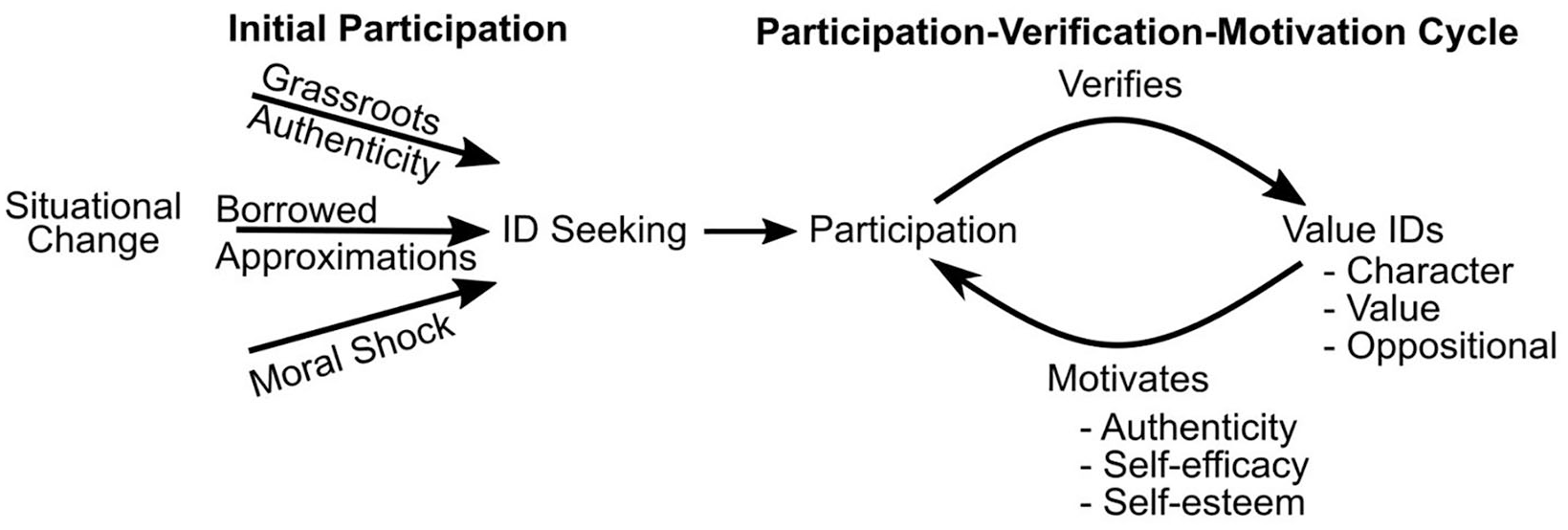
Personalist mobilization at the clinic.
Discussion and Conclusion
I have drawn on ethnographic and interview data in demonstrating that participants developed a thin collective identity at a Christian immigration clinic by avoiding, tangentializing, and redirecting identity work. I explain this identity thinning as a response to the clinic’s commitment to empowered, diverse volunteer labor in assisting as many clients as possible within an immigration system characterized by specialization, individualism, and unlimited need. These factors make clinic labor individualistic, relentless, and ambiguous, allowing few opportunities for collective effervescence and making religion interactionally invisible. Furthermore, findings show that participants come to the clinic to enact core identities in the face of new threats or opportunities and continue participating because doing so verifies their senses of themselves as good people who improve the world, fostering feelings of self-esteem, efficacy, and authenticity.
In engaging personalist motivation to pursue blended labor, the clinic represents a novel, understudied type of organization that I refer to as a PBSMO. PBSMOs increasingly drive social movements in a network society characterized by decreasing protest efficacy, and the concept provides an analytical tool for studying them. It may be especially useful for analyzing politically liberal religious organizations, given that a changing religious landscape likely makes such communities particularly dependent on PBSMOs and BSMOs with diversity-driven collective identities. Religious adherence is declining for most religious groups, but the decline is among the steepest for mainline Protestant denominations, which tend toward political liberalism (Smith et al. 2025). Diminishing adherence means that these communities cannot rely on a broad unifying identity, such as “evangelical” among conservatives, to unify participants. Instead, they must increasingly depend on racially and religiously diverse, highly educated non-coreligionists (Doherty and Kiley 2020; Smith et al. 2025), that is, on diverse, empowered participants. Thick collective identity that does not celebrate diversity cannot bring together such a community. For this reason, liberal religious social change will increasingly come through diversity-focused BSMOs and PBSMOs such as the clinic.
In addition to conceptualizing PBSMOs and unpacking the dynamics of one organization, this study suggests other implications for studying religious change. Secularization scholars have long maintained that religious pluralism drives decreasing religiosity (e.g., Berger 1990). Yet the clinic shows that field-level norms—specialization and individualization—and organizational commitments, such as a dependence on empowered volunteers, can make religion interactionally invisible even at an exclusively Christian ministry. Yet contrary to secularization theory, diversity did not drive religious invisibility by inspiring participants’ to question their beliefs and identities; rather, religion failed to provide common ground, even as it motivated individual participation, so it disappeared from interaction. This finding suggests that scholars should attend more closely to the organizational and field-level dynamics that minimize religious interaction within putative religious contexts, like SMOs, nonprofits, and universities rather than on societal-level measures of secularization. Such a focus could help scholars understand how people simultaneously live out secularization and religion.
Beyond religious contexts, this study suggests that scholars ought to center collective action in our definitions of social movements rather than limiting analyses to particular organizational forms (e.g., protest groups, formal SMOs) that center collective identity. Although these ideal typical organizational forms provide important spaces for studying social change, restricting our analyses can limit theoretical development while simultaneously stretching the definition of collective identity so that we assume its existence, even where other concepts (e.g., personalism) might better explain observations. Put differently, by focusing primarily on the mechanical solidarity of collective identity, scholars risk neglecting the power of organic solidarity in driving change (Durkheim [1893] 2014). In fact, many SMOs may benefit from minimizing mechanical solidarity’s focus on social boundaries, which can impede personalist organic solidarity. Cultural sociologists have long highlighted how simultaneous cohesion and ambiguity give artifacts cultural power to “linger in the mind” and shape behavior (Griswold 1987:1105). Social movement scholars have demonstrated the importance of cohesion, but we should give more attention to ambiguity and interdependence as assets, not obstacles, for collective action.
At the broadest level, findings suggest scholars of social change might benefit from returning to classical scholarship on the relationship between personal self-interest and collective well-being. De Tocqueville (2013) observed personalism driving collective action in early nineteenth-century America, suggesting that the pursuance personal interests through collaborative labor improving communal well-being has a long history. In prioritizing collective identity, scholars may have limited our understanding of personalist self-interest rightly understood as a driver of collective good. We might benefit from revisiting Tocqueville and others who emphasize that self-interest can support collective well-being.
In conclusion, this study found a surprisingly thin manifestation of collective identity at an BSMO, explaining it through field and organizational policies and practices shaping labor. It also highlighted the personalist motivations driving ongoing participation, conceptualizing organizations like the clinic as PBSMOs. Future research should continue examining similarly unexpected findings to refine our understandings of collective behavior, mobilization, and identity across organizational forms.
Footnotes
Acknowledgements
The author would like to thank Daniel Winchester, Rachel Einwohner, Jean Beaman, and the editor and anonymous reviewers for their invaluable insights for improving this manuscript.

1
To represent clients, nonattorneys must achieve DOJ accreditation, a process involving months of study, exams, and portfolio creation.
2
I use the term volunteers to refer everyone except the Director—the clinic’s only paid employee—and the term participants to refer to the Director and volunteers together.
3
Some participants adopted multiple religious identities.
4
I use individual and organizational pseudonyms or titles (e.g., the Director) to protect participants’ privacy.