




Abstract
Collective identity is important for the cohesion of social movements, yet there is an inherent tension between group unity and heterogeneity when multiple groups are motivated to come together to work for change. Through a three-year investigation of the early stages of a women’s rights movement following the Libyan revolution, we explore the dynamics of collective identity development. Our findings capture how two heterogeneous groups, Libyan locals and Libyan diaspora, interact to negotiate and re-negotiate the boundaries of collective identity. We find that this process unfolds through an ongoing struggle where the point of difference between the groups—their uncommon past—is the mechanism first used to ensure inclusion of insiders, and then to exclude outsiders from the collective identity. Our paper contributes to our understanding of the relational process through which collective identity co-evolves, and the challenges faced by heterogeneous groups engaging in collective action.
Introduction
Under the 42-year rule of Libyan leader Muammar Gaddafi, independent press and civil society institutions were violently suppressed. Gaddafi saw civil society as “a bourgeois culture and an imitation of the West that has no place here [in Libya]”. 1 Fueled by the recent successes of Tunisia and Egypt in overthrowing their own dictators, protests against the Gaddafi regime emerged across Libya on February 15, 2011. These protests soon developed into a civil war that would eventually topple the regime. As the events of the revolution unfolded, individuals inside and outside Libya formed organizations and media channels, and set up quasi-governments to deal with the crisis. The events in Libya illustrate how disruptions due to economic instability, social strife, or political upheaval can motivate people to take advantage of new opportunities for activism (Cress & Snow, 2000; Tarrow, 1994). Individuals and organizations who feel aggrieved about a common cause, and optimistic that acting collectively can bring about change, can then engage in collective action to alter institutional arrangements (Cress & Snow, 2000; McCarthy & Zald, 1977; Schneiberg & Lounsbury, 2008).
For decades, researchers have focused on understanding this unity, how collective action emerges and with what outcome (e.g., Flesher Fominaya, 2010, 2018; Melucci, 1995, Poletta & Jasper, 2001; Snow & McAdam, 2000). This work has uncovered the importance of collective identity, a sense of “we-ness” among individuals and groups (Gerson & Peiss, 1985; Snow, 2001), which is essential for sustaining collective action (Bernstein, 2005; Flesher Fominaya, 2010, 2018; Melucci, 1995; Poletta & Jasper, 2001; Snow & McAdam 2000). Movement actors are able to produce collective action because of a shared definition of the movement based on common interests, experiences, and solidarity among members (Melucci, 1995; Taylor & Whittier, 1992). Defining who is and is not a part of the collective action requires drawing boundaries between movement members and non-members as actors work to create a sense of “us” and “them” (Gamson, 1997; Hunt, Benford, & Snow, 1994; Taylor & Whittier, 1992).
Understanding the internal and ongoing dynamics of collective identity is especially important considering that political changes can motivate multiple heterogeneous groups to work for change (Campbell, 2005). These groups may have varying stakes in the movement, perceive the opportunity differently, and have access to diverse resources that shape interactions within the collective. For example, in the United States civil rights movement of the 1960s, black churches focused on motivating and enlisting people to participate in street protests because of their access to large congregations; black nationalist groups, such as the Black Panthers, focused on more radical acts to gain attention and threaten established authorities because they had small tight-knit groups of actors (McAdam, 1985). More recently, the #blacklivesmatter movement has debated the inclusion of white participants in signaling allyship, disrupting racism, and accessing different social and cultural resources (Mann & Baker, 2020). These very different groups, including what would typically be considered “insiders” and “outsiders,” create a difficult challenge for building a shared collective identity that will shape the nature of the movement and the potential for success.
Yet, research on how collective identity is developed has largely focused on two elements: how collective identity is configured when actors assert their differences from external audiences (e.g., Benford, 1993; Flesher Fominaya, 2007; Snow & Benford, 1988) and how differences are established between a dominant group of movement actors and subgroups claiming membership (e.g., debates about whether transgender people are part of the gay and lesbian civil rights movement; Gamson, 1997) (see also Ghaziani, 2011; Taylor & Whittier, 1992). Further, this body of work has often been situated in relatively stable institutional environments where there are clear protagonists and antagonists, and framing strategies for movement actors to draw on for differentiation (Hunt et al., 1994; Flesher Fominaya, 2010). Yet little research has directly explored the tension between unity and heterogeneity in the development of collective identity particularly under conditions of instability and chaos. Given that shared ideologies, experiences, and interests provide internal cohesion that enables collective identity, understanding how diverse actors come together and stay together in the face of huge uncertainties and disruptions is important for our understanding of collective action and its potential for social change.
We explore this challenge through a three-year investigation of the emergence of a women’s rights movement in Libya after the removal of the Gaddafi regime. As public sector institutions such as ministries, laws, and organizations were being created, local Libyan organizations (insiders) and Libyan diaspora-based organizations (outsiders) focused on developing a women’s rights field. The unprecedented events in Libya provide a unique opportunity to explore our research question: What are the dynamics of collective identity development when movements involve both insiders and outsiders? We find that in this extreme context of institutional chaos, shifting crises in the institutional environment enable insiders and outsiders to take on different relational activities within the movement over time. Through these interactions, we found that the groups negotiate and re-negotiate the boundaries of collective identity. This process unfolded through an ongoing struggle where the two groups’ uncommon past is the mechanism first used to ensure inclusion of insiders, and then, when the institutional chaos subsides, to exclude outsiders from the collective identity, and ultimately, collective action. Our paper details how crises in institutional environments and group interactions within a movement can evolve to create impetus for negotiating and re-negotiating boundary demarcation.
In doing so, our study offers three main contributions. First, we uncover the process through which the institutional environment, movement interactions, and collective identity co-evolve based on the symbolic use of the uncommon past as a mechanism to manage the identity boundary. As such, our study highlights the reciprocal relationships between collective action, group interactions, boundaries, and collective identity triggered by a disruption in the institutional environment.
Second, our study adds to our understanding of the past as a symbolic resource. While recent organization theory has shown how the past can be used to elicit nostalgia, thereby bringing people together (Howard-Grenville, Metzger, & Meyer, 2013) or used as a symbolic resource to revive a collective identity (Lamertz, Foster, Coraiola, & Kroezen, 2016), we show how an uncommon past, as a point of difference, can be used for both inclusion and exclusion. At first, the groups’ common Libyan identity brought them together. But when a crisis of focus led to questions of who belongs, the uncommon past was used for inclusion—insiders were needed because they knew Libya and could translate the movement in acceptable ways. Insiders leveraged their difference to negotiate specific activities for themselves that only they could take on to ensure their inclusion. As the next crisis led to further questions about who belongs, the point of difference was again used, but this time to exclude outsiders. In contrast to previous work, we show how different pasts, not just shared pasts, can be a symbolic resource for actors, a resource that can be used for both bringing groups together and breaking them apart.
Third, our case captures how a context of institutional chaos, an extreme disruption in the institutional environment, can drive the formation of collective identity across diverse groups. When the political environment that triggers collective action is a state of institutional chaos, differences between groups can be masked and similarities highlighted. However, as chaos subsides, differences in history can come to dominate, destroying the fragile collective identity that had formed in chaos. As such, this process can fall short of what groups had first envisioned for the movement.
Theoretical Background
Boundary work and collective identity emergence
Collective identity emerges as a process of interpretation that takes place within a particular social surrounding and between members of particular groups (Zerubavel, 1996). While a specific movement consists of many actors, which have their own subjective meanings of belonging, goals, and strategies to achieve the goals, actors need to share some similar conceptions of the world (Boström, 2004). Membership in a collective can be based on generalized ties where participants are connected to each other due to a common cause, or particularized ties, where participants are directly connected to each other, rather than indirectly through an issue (Hardy, Lawrence, & Grant, 2005).
Boundary work is the process in which actors (re-)negotiate or (re-)configure boundaries to either further integrate or differentiate between actors (Hunt & Benford, 2004). This work, which entails constructing both a collective self and a collective other (Gamson, 1999; Hunt & Benford, 2004; Taylor & Whittier, 1992), has been shown to be a central mechanism in collective identity construction (Gamson, 1997; Hunt & Benford, 2004). For example, Benford (2002) found that peace activists used narratives that included gossip, rumor, and ridicule to construct identity boundaries that clearly identified who was not associated with the peace movement. Jagger’s (1992) study of the animal rights movement uncovered the use of certain behaviors, such as practicing veganism, to create a boundary marker that stood between ingroup and outgroup members.
These studies highlight the boundary negotiations that occur between movement actors and those explicitly opposed to them. However, boundary demarcation and maintenance activities (Hunt & Benford, 2004) are also used by social movement organizations to distinguish themselves from others within the movement. For example, in their study of lesbian-feminist communities, Taylor and Whittier (1992) show how identity communities are created through the construction of boundaries that both insulate and differentiate non-mainstream groups from dominant groups in the collective. Gamson’s (1997) work looking at lesbian and gay activism and queer collective identity investigates the debate over the inclusion of transgender and bisexual people. He explores the “border skirmishes” over membership conditions and group boundaries.
While these studies provide important insight on the boundary work done by minority groups as they claim membership with more dominant actors within a movement, it raises questions about how outgroups might navigate boundaries with those considered ingroups. The dynamics of collective identity development across ingroups and outgroups are likely to be very different from previous studies where outgroups were excluded or where the negotiation for membership was between minority insiders within a larger group. Outsider groups need to stake a claim in the collective identity yet cannot claim to be part of the insider group, creating distinct challenges that will impact the outcomes of collective identity.
The context of collective identity development
The context in which collective identity forms provides the pre-existing rules of interaction that help guide actors as they negotiate membership in a movement, enabling the management of movement boundaries. Many studies have looked at collective identity emergence within stable arenas, with existing social movement organizations and rules of action present. These studies tend to focus on the claims actors make about who they are, assuming a predictable environment where there is a degree of certainty about the consequences of action, and a common stock of views regarding relationships, vocabularies, values, practices, and worldviews (Jasper, 1997; Swidler, 2001; Taylor & Rupp, 1993). However, as Sewell (1996, p. 848) argues, in times of dramatic ruptures “no one [can] be entirely sure what actions [are] safe or dangerous, moral or wicked, advantageous or foolish, rational or irrational.”
In unstable conditions, we often see a wide range of heterogeneous actors rushing in, as they perceive the disruption as one that allows for radical reconstruction of the institutional environment to create a new future. Indeed, this is what we saw following the recent civil war in Libya, which created a situation of institutional chaos, where the institutional environment is characterized by instability and unpredictability. Research, however, has not examined how collective identity emerges in this context of chaos, especially in the latent phase of movement activity, in contexts where environments are unstable (Armstrong, 2005; Flesher Fominaya, 2010) and movement membership is much more ambiguous.
When the present is in a state of chaos and diverse groups are rushing in without clear guidance on movement membership and a collective identity, historical relationships and interactions are likely to surface. Research has pointed to the productive role of history in shaping connections between participants, as it influences how we understand ourselves and act with others as members of a social group (de Saint-Laurent & Obradović, 2019). History gives meaning to group identities and can provide the content for the formation, maintenance, and strengthening of a collective identity by providing unique features to the collective (Bar-Tal, 2007; Oren, Bar-Tal, & David, 2004). For example, collective memory, those memories shared with other members of a social group (Halbwachs, 2020), can play a role in resurrecting an old collective identity (Howard-Grenville et al., 2013). Additionally, collective memories stemming from conflicts can lead to a sense of collective victimhood that brings people together (Bar-Tal, 2003).
These studies suggest that a common past can act as an important symbolic resource for the formation of collective identity. Yet, the role of the past when groups are heterogeneous and the past is not common is much more complex. Our analysis of actors striving to build a women’s rights field in post-civil war Libya allows us to explore the dynamics of collective identity development between insiders and outsiders, with both common and uncommon pasts, in a context of institutional chaos.
Methodology
Empirical context
Women in pre-evolution Libya
The first women’s rights groups in Libya started to emerge in the 1950s under the King Idris monarchy (Hweio, 2018). These groups focused on encouraging young girls to go to school, and training initiatives in cooking, knitting, embroidery, reading, and writing. During the 1950s and 1960s, several women’s associations and forums, including magazines and radio shows, had been established to promote women’s participation and taking a role in the social and political arena in Libya (Hweio, 2018). By 1964, Libyan women gained the right to vote (Hweio, 2018). This first wave of a women’s movement took a turn when the monarchy was overthrown in a coup d’état led by Muammar Gaddafi in 1969. As soon as Gaddafi took power, he abolished parliamentary institutions and banned elections, political parties, and all forms of autonomous organized activity including non-state-owned media and non-governmental organizations, except for a few regime-supervised organizations (Vandewalle, 2008).
When Gaddafi came to power, he encouraged women to take up jobs such as teaching, nursing, and administrative work. Yet, despite the Gaddafi regime allowing equal status as men in matters such as social security, rights to obtain work and financial independence, women’s rights and freedom suffered under increasing civil rights restrictions by the regime, and traditional family laws that maintained a discriminatory stance toward women in Libya. Gaddafi imposed restrictions on education including making military training mandatory in high school. Stories started to emerge of young girls being taken from their home or the military academy and forced to become members of his “harem,” or sexually abused and used as blackmail to enforce loyalty to the regime (Cojean, 2013). This led to an exodus of women from the workforce and girls from school, with many never completing their high school education. Women became afraid to bring attention to themselves (Hweio, 2018). This fear, in combination with the patriarchal bias of gender roles, led to the exclusion of women from the political, economic, and social arenas in Libya for decades. 2
At the time of the revolution, the few non-governmental organizations that existed were charities mostly focused on food distribution (Hweio, 2018). Even outside Libya, a limited number of Libya-focused organizations existed. These organizations were managed in secrecy due to fear that these activities would endanger their families still in Libya.
February uprising
On February 15, 2011, protests against the Gaddafi regime emerged in Benghazi. After only a few days, what initially started as peaceful protests turned into violence, and escalated into a rebellion that spread across the country. By February 28, 2011, Libya had ignited into a full-fledged, and soon to be bloody, civil war. On August 21, 2011, the final city under regime control fell. After months of bloody fighting and NATO-led offenses, the war was over and the Gaddafi era had ended.
During this time Libyan citizens started to create the first impromptu civil society organizations. Some of these organizations were focused on collecting and distributing aid or taking over services that the regime controlled such as garbage collection, schooling, and traffic control. To counter the misinformation that was being shared by state-owned media stations, technology-savvy individuals were coming together to create their own radio stations, YouTube channels, and social media feeds to share what was happening with those outside Libya. Civil society-based institutions were being created at a rapid speed.
Data collection
Our data collection period lasted for more than three years, starting March 2011 and ending September 2014. This window of observation provided prolonged interaction and analysis of the processes that emerged over time. Our findings reflect the first author’s direct involvement in the field, including participation in newly formed activist organizations, conference attendance, workshops, and focus groups and interviews with participants in both English and Arabic depending on the individual’s fluency in the language.
Fifty-three semi-structured interviews were conducted, averaging 90 minutes each and resulting in 239 pages of transcripts. The first author’s Libyan nationality and involvement in civil society allowed her to be trusted and build on the rapport that already existed between her and many of the participants, both local insiders and outsiders from other countries. These interviews provided both retrospective and real-time accounts of their involvement in Libya’s emerging civil society. Recognizing that the first author’s familiarity with the context could also lead to assumptions and missed opportunities to question that which is taken-for-granted, active and critical conversations with the second and third authors were conducted throughout the data collection process.
Data collection took place in three phases. Data collection in the first phase mostly consisted of gathering and analyzing archival data to build our understanding of the historical context, participating in meetings for some of the organizations located outside of Libya, following various social media accounts related to Libya, and talking to individuals who were just starting to build their organizations. This phase took place at the early stages of the revolution, starting when the regime started to lose control (March, 2011) and ending around the time Gaddafi was captured (and killed) and a transitional government took over (November, 2011).
In the second stage, the first author spent 65 days in Libya, visiting three times in one year for data collection using semi-structured interviews and observations and retrieving additional documents. During these trips, the first author attended workshops, conferences, focus groups, and meetings on women’s rights. Observations were recorded in 137 pages of field notes including descriptions of the participants such as where they were born, where they spent most of their life, what they were doing before the revolution, events, general impressions of what was happening, relationships, and emerging patterns.
In the final phase, we followed up with key informants to track progress and changes in the nature or focus of their work, gathering insights on their perception of shifts in the field. Table 1 provides an overview of the interviews in each phase.
Overview of interviews across the three phases of data collection.
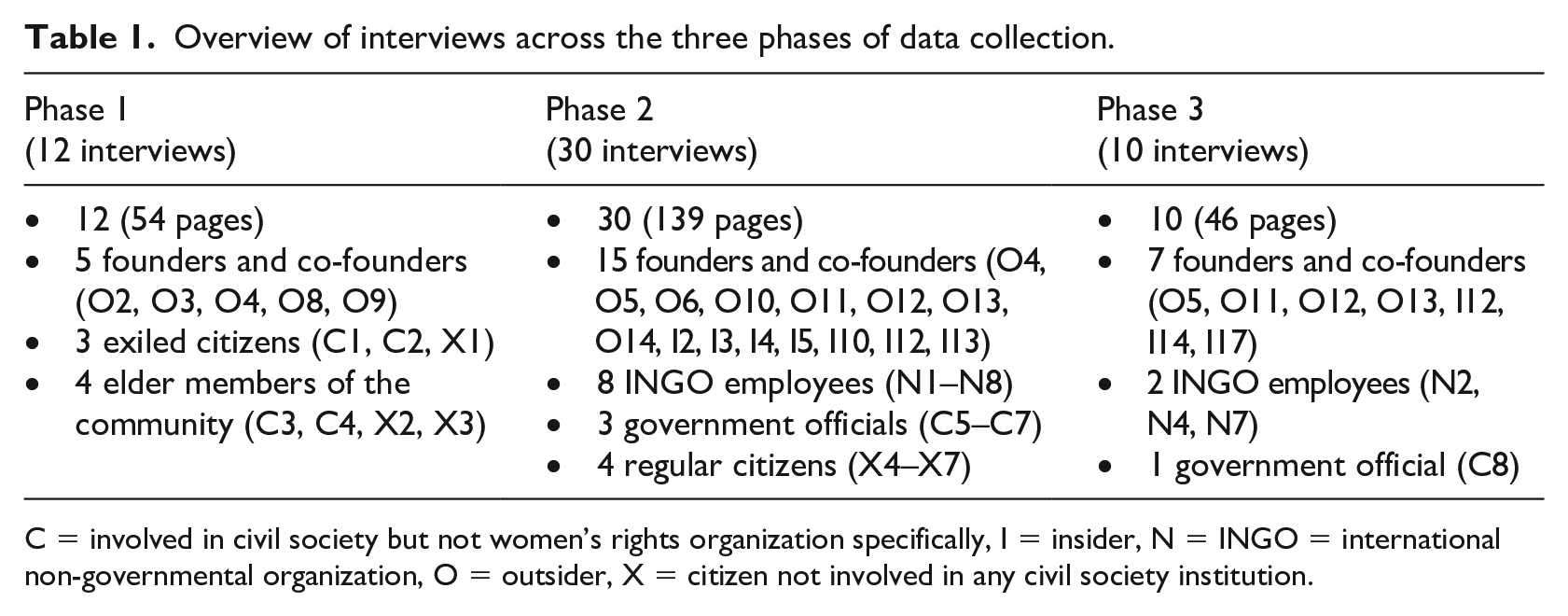
C = involved in civil society but not women’s rights organization specifically, I = insider, N = INGO = international non-governmental organization, O = outsider, X = citizen not involved in any civil society institution.
Given the volatile and dangerous security situation in Libya, most respondents and civil society organizations’ names have been changed to protect their identity. All transcripts were transcribed and translated by the first author. This was to ensure the accuracy of the translation, since the Libyan dialect is unique and can be difficult for non-Libyan Arabic speakers to understand; this also ensured that the identity of all informants was protected.
Additionally, we gathered news articles, reports, documentaries, online videos, proposals, bylaws, and civil society organizations’ promotional material. Across the three phases of data collection, we followed various Facebook and Twitter groups related to Libya including those unrelated to women’s rights, such as the pages of organizations focused on humanitarian aid, lobbying efforts, and transitional justice. These sources of data were then used for triangulation, providing multiple angles on the conversations and activities being launched and implemented in Libya.
Data analysis
Our analysis proceeded iteratively through three main stages: temporal bracketing, identifying interactions, and finally the relationship between the crises, activities, and the boundaries of collective identity.
In the first stage of data analysis, we created a visual map (Langley, 1999), initially bracketed into three phases based on our data collection process that noted distinct changes in activities and conversations at these times. We leveraged field notes news reports, and the first author’s experiences to map key incidents and events, such as conferences, elections, important meetings, announcements, and projects. For example, the liberation of Benghazi was noted as a key event in the temporal evolution of the context because we noticed that in both Canada and Libya, informal groups started to transform into organizations and this timing coincided with the first international non-governmental organizations (INGOs) entering Libya.
We then deepened our mapping and analysis by delving into the actors’ perceptions using the interview data to visualize the sequence of events and the actors involved and the phases more clearly. We noticed key challenges, or crises, at particular points in time that significantly shifted the approaches the actors were taking and how they interacted with each other.
In our second stage of analysis, open coding was used to identify first-order categories in the interview transcripts and media coverage. We paid particular attention to the actions of individuals as they interpreted and reacted to events and the evolution of relationships between individuals (Langley, 1999; Peterson, 1998). We analyzed the presence or absence of scripted actions (Meyer, 2008) and reflexive language (Voronov & Weber, 2016). For example, when we came across statements such as “we put together a bylaw,” we explored why they took that action: “a lawyer told me to,” and reflection on the action, “I felt stupid because I didn’t know what a bylaw even was.” One of the difficulties in studying collective identity “lies in a ‘how will I know it when I see it?’ conundrum” (Flesher Fominaya, 2018, p. 430). Poletta and Jasper locate collective identity in “the individual’s cognitive, moral, and emotional connection with the broader community, category, practice, or institution” (2001, p. 285), while Whittier (1991) argues that it is located in the observable actions and interactions of individuals. We used Flesher Fominaya’s (2018) argument that collective identity is both. Therefore, to analyze our data from a collective identity lens, we examined how actors related to each other, identity markers, language, symbolic representations, and the actions and interactions between insiders and outsiders.
In our third stage of analysis, we visually mapped our codes, exploring differences over time and how perceptions, actions, and behaviors changed following each crisis point. Initially, we viewed our civil society organizations actors as a unique group of elite individuals participating in the emerging women’s rights field. However, upon closer examination of the transcripts, we noticed references to “others” within this group, indicating that our participants saw those actively engaged in the women’s rights field as belonging to different groups: “The ones who came from outside” or “What these people don’t get . . .” or “I tried to help them as much as I can.” We went back to our database of participants and this time divided our sample of actors into those who came from the diaspora (outsiders) and those who were inside Libya (insiders) when the revolution started. This was a critical point in our data analysis.
We then revisited to our chronology of events and put tags on each action based on whether the actor was an insider or outsider. In situations where a participant did not clearly fit into one category or another, we analyzed how they identified themselves. For example, one of our participants grew up in Canada. Yet she had been living and attending a university in Libya when the revolution started. She did not clearly fit our description of an insider or an outsider. However, the interview transcripts suggested that she was an outsider, as she referred to herself as the “little Canadian girl.”
We reanalyzed the transcripts, this time paying attention to differences between the two groups and the emergent codes, distinguishing between interactions within and between each group. As we continued to work iteratively between our data, our chronology of events, and the literature, we uncovered a process of collective identity boundary negotiation and renegotiation that we elaborate on in the next section.
Findings
Our analysis reveals how collective identity emerges and eventually falls apart between two heterogeneous groups, local Libyan “insiders” and Libyan diaspora “outsiders.” At first, both groups are motivated to act due to a crisis of opportunity. As insiders and outsiders cross into the chaos, movement boundaries start to be configured and a fragmented collective identity starts to form. However, as more individuals join the movement a crisis of focus leads to outsider-driven boundary contracting; insiders respond by drawing on their uncommon past to re-negotiate their place in the movement so that they are included in the collective. Eventually, a crisis of legitimation emerges that questions who belongs. It is only now, after the chaos subsides, that insiders leverage their uncommon past to delegitimate and exclude the outsiders, therefore defining the boundaries of the movement and forming a more cohesive and narrow collective identity. We present our model (Figure 1) and elaborate on our key findings below.
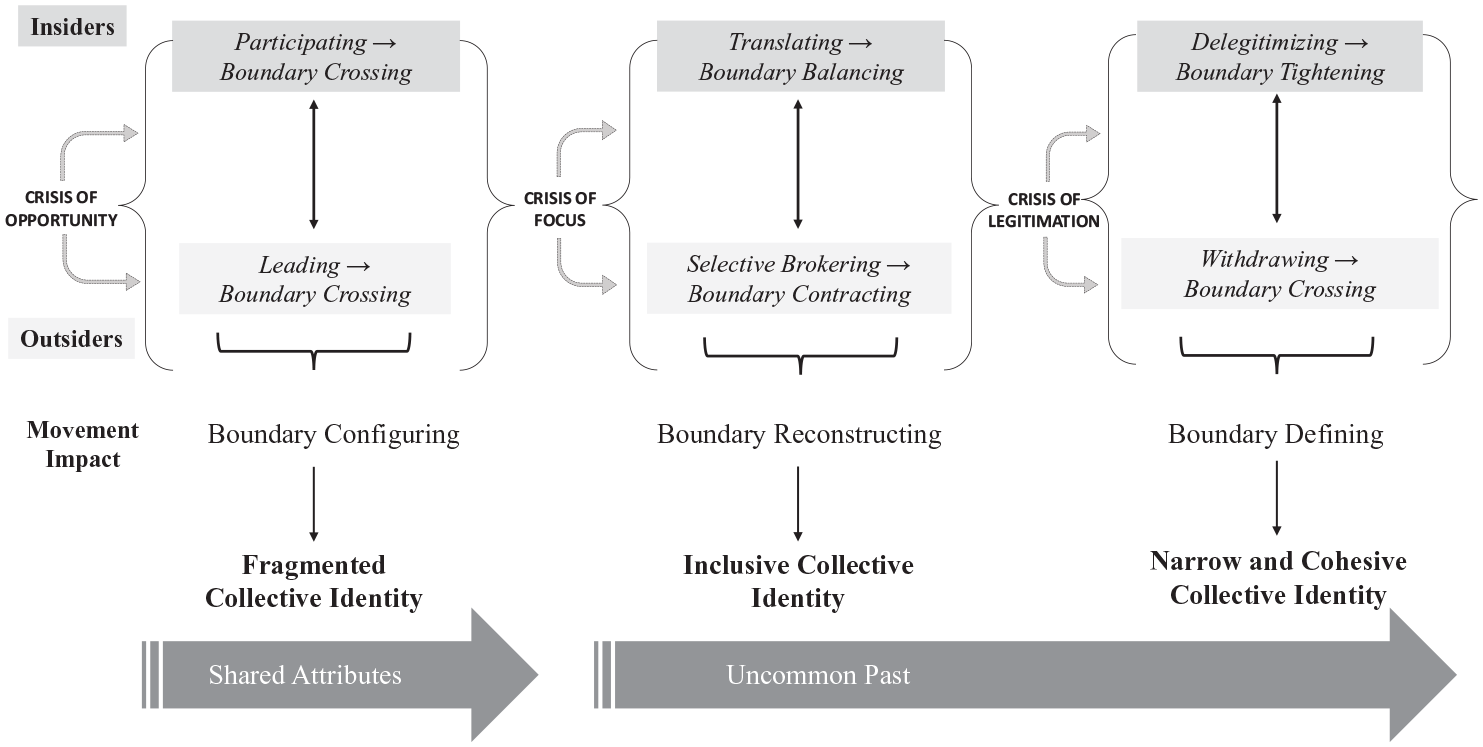
Model of collective identity development.
Crisis of opportunity and boundary crossing
Crisis of opportunity
A crisis of opportunity presented itself to both insiders and outsiders as the protests cascaded into a dramatic fight to remove the regime, motivating the work that followed. With a whole country involved in dissent, and some regions no longer under regime control, Libyans now could speak and act without fear.
The dire humanitarian conditions and the lack of civil society institutions also created an urgency to act. Insiders and outsiders had similar perceptions of the opportunity created by the disruption in that it enabled both groups to envision a new Libya. One insider shared: Before, even when I dream, I wake up and I think nothing will ever change. But now, I think if this revolution happened then we can do whatever. (I4)
Outsiders saw the revolution as a rare window of opportunity for more specific changes. As one outsider pointed out to us: “My dream? To turn this revolution into a feminist movement” (O2). When interviewing Seeham, a Canadian political science student, she discussed her thoughts for what she was hopeful for.
I really fear that we won’t get any progress when it comes to women. I am working so hard for this and they’re like, “why are you killing yourself for this?” But you don’t understand, the window of opportunity is so small and every day it gets tighter and tighter.
Leading and outsider boundary crossing
Both groups shared a vision of a new Libya and a motivation to be a part of creating this new Libya. The outsiders, with experience living in societies with strong civil society-based institutions, took the lead in mobilizing resources and sharing knowledge as they focused on starting a women’s rights movement. For example, Hana, a banker from the United Kingdom, shared with us: So, I had this thing that this is something that I am personally very passionate about, women and Libyan assets . . . and where Libya really should be right now. (O2)
Some outsiders physically moved to Libya to set up their organizations there. With a “rebel-controlled” border
3
in the liberated city of Benghazi, even the outsiders who had lived in exile for decades were now able to make their way back to Libya. In a broadcast panel discussion, Zahra Langhi, founder of the Libyan Women Platform for Peace organization, talks about how she went back to Libya after being forced to live in exile for over 30 years to “ensure that there was equal participation, and the voices of women were at the table when it came time to rebuild the country”.
4
When they got to Libya, their goal was to grow the movement: “There were two goals for all these meetings. Build contacts in one sense, but it was really to basically put pressure and to add people to help us and to support a women’s movement” (O11). Another outsider shared: This was our chance to finally do something. I have always carried a sense of guilt with me . . . my country needs me, and I have never been able to give it what it needs. Now I can. (O9)
This was a sentiment many outsiders shared with us.
Participating and insider boundary crossing
On the other hand, when the revolution started, the insiders were trying to participate in any way they could. They were less familiar with civil society but still wanted to be a part of building this new Libya. They started to form small groups and organize activities related to relief efforts. Many insiders engaged in humanitarian work to deal with the immediate needs of people around them. For example, a medical student we interviewed shared that their involvement started with just doing anything they could: The hospital became the hub for Gaddafi activity. So we couldn’t do anything there, but we started stealing medicine and supplies, and I don’t know why, and honestly, I still don’t remember whose idea it was to start taking things, but I remember it began to happen. (I7)
The insiders wanted to be part of the change that they saw taking place. As one of the insiders shared, “I just wanted to participate. I didn’t just want to sit and watch” (I2 interview). The insiders explained that the revolution created an opportunity for them to do something different and be a part of something. Sarah, who was helping organize protests at the start of the revolution, shared: I used to be a very shallow and shy person. I would just go study, think about shopping, hanging out with friends. Same thing every day, and since that day at the square, everything changed. I now have a promise to myself that I will never go back to being that person. (I2)
While they did not cross geographical boundaries like the outsiders, insiders did cross into a sector or space that they had never been involved in. As one insider shared with us: Civil society is where I want to work. I want to be something in it. I’m not sure what, but this is where I want to work now. (I3)
The outsiders led capacity-building workshops for local people looking to participate. These workshops were either led by outsiders with insiders as attendants or were led or funded by INGOs and leveraged outsiders to help run them. Interestingly, the INGOs had trouble getting “in” and needed to leverage outsiders to do the work. The director of a European organization shared with us her experience trying to access rape survivors at one of the refugee camps: “Early on we realized we were not going to be able to get to the survivors at the camp . . . no one would talk to us, not until we brought with us Libyan women on our team” (N3). Many times, people referred to INGOs as having “an agenda” and being “untrustworthy.” Zeineb, a Libyan Tunisian who grew up in Libya, worked for one of the INGOs. She provided some insight on the exclusion many of her colleagues were facing.
It’s like you must speak their language. Not literally just their language, but you have to understand the cultural fabric, the social fabric. The international NGOs don’t. A lot of times they think they can bring in a template from whatever country they were in before and use that, but we’re different in Libya. (N1)
Boundary work entails constructing a sense of “us” and a “them”’ (Gamson, 1997; Hunt et al., 1994; Taylor & Whittier, 1992). The INGOs became the “them,” missing the common interests, experiences, and solidarity required for a collective identity (Taylor & Whittier, 1992). Our data suggests that this helped emphasize the commonality the outsiders and insiders shared, a Libyan identity. While the INGOs were excluded from the collective identity, both insiders and outsiders began to see themselves as a group working together. Our data suggests that these initial interactions between outsiders and insiders, as a result of the crises of opportunity, shaped the initial boundaries of the movement, ultimately leading to a loose, emerging collective identity.
A fragmented collective identity of “civil society”
Both groups welcomed the other into the newly forming movement and created a collective identity as “civil society in the new Libya.” At this point in the emerging social movement, they started considering themselves a “we,” in contrast to the beginning of this phase, where each person was focused on the organization they were building and talking as “I.” In one of the workshops, a participant from a local organization voiced her concern about what to do if people push back on her organization’s efforts. An American founder of a Libyan civil society capacity building organization was leading the session and replied: Wait a minute. What is the role of civil society? Is it to sit down if someone says “no”? No! Our role is to scream and make noise, and make sure things change. (O4)
Participants were very clear that both groups were involved in building civil society in the post-revolution Libya. One insider (I3) shared: “It’s a mix [of organizations from outside Libya and those inside]. But the ones who came from outside, they have more experience and typically have the stronger organizations. They’re taking the lead.”
As can be seen in this quote, while there was room for insiders and outsiders within the collective identity, there also remained two distinct sub-groups, and this created tension right from the beginning. Outsiders were leading workshops, campaigns, communication with various media outlets, and interactions with the INGOs, sidelining the insiders. When we asked why this was happening, one activist shared that the outsiders “speak English. They are better at networking and therefore getting exposed. They know the strategy” (C5). The outsiders were soon being referred to as “the 50,” an elite group within the movement.
In a number of our interviews, people would share with us that civil society in Libya was this group of 50. The following comment by Sura, one of the founders of a youth-based organization in Libya, Libya Today, sums up a theme that repeatedly came up during the interviews: There is a group now that is civil society. Because right now, wherever you go, a workshop, an event, whatever, it’s the same people. It’s maybe 50 people. Even in Benghazi and here, it’s the same people you see all the time. This is Libya’s civil society. (I19)
Crisis of focus and boundary reconstructing
Crisis of focus
By this point, there was a dramatic increase in the number of organizations being created to meet a wide range of needs. Before the civil war, only a few NGOs were registered in Libya, including the Boy Scouts and two charities led by the daughter of Colonel Gaddafi. Only three months after the first protests in Libya, the newly formed Transitional Libyan Government formed a Ministry of Culture and Civil Society to manage the growing number of non-governmental organizations that were created across Libya. According to the Minister of Civil Society at the time, over 200 organizations were registered within the first month (May 2011). By the time we had made our first visit to the field, 8 months later, over 2,000 organizations were registered. By 2014, Libya had the greatest number of memberships in volunteer organizations per capita than any other country in North Africa (Perroux, 2015).
With hundreds of civil society organizations now present, no formal rules regulating them, and little coordination between them, the outsiders were motivated to focus the groups on women’s rights, selecting which groups were in and which were not.
Selective brokering and outsider-driven boundary contracting
Outsiders started bringing attention to women’s rights as a legitimate and important focus for Libyan civil society organizations. Outsiders started directing participants to their cause, in this case, the creation of a women’s rights field, and connecting resource providers to the participants that outsiders deemed legitimate.
For example, one of the key events to take place during this time was a large conference led by the Voice of Libyan Women, an organization created by a young Canadian Libyan. The theme of the conference was loosely coupled around women’s rights in Libya, with a five-day event that included topics such as politics, the economy, and social engagement. The conference gave many attendants an opportunity to get involved in what appeared to be an attractive arena in the “new” Libya. Representatives of some of the largest NGOs in the world and many key political actors from inside and outside Libya were present, meaning that this was a key event for attracting resources.
Outsiders were very careful about who was invited to the conference. One of the organizers shared: We specifically chose the women who were doing work during the revolution. Or like, serious work. Which pissed a lot of people off, which was the big fallout of the conference. Lots of people said, “I’ve been doing work since 1995” or “No, she was the first engineer who ever graduated from Tripoli, how can you not invite her?” And our reaction was “Who gives a shit?” (O14)
The conference was intended to build excitement around women’s rights also emphasized the boundaries that had been created.
There’s a demonstration outside, basically women groups that wanted to come and they were like, “You weren’t invited so you can’t come.” So one of these women was like “Ok, you don’t want to invite me, well don’t call yourself the Libyan women conference.” So this whole controversy happened around this conference and who was allowed in and who wasn’t. (O4)
Similarly, outsiders used any opportunity possible to promote the select insider organizations, getting the media and funding agencies to focus on them. For example, I was meeting with international organizations and NGOs and some journalists that were coming to me and they’d want to know about the rebels, and I would be like “No! You want to know about this fantastic group of women. You want to interview them and write about them.” So basically, I just shoved these women organizations out there as much as possible. (O5)
Outsiders were directing resources to the select group of insider organizations they had met at workshops and events during the crisis of opportunity or organizations they had heard about through their networks. This selective brokering led to boundary contraction around a smaller group of movement members.
Translating and insider-driven boundary balancing
Insider organizations that were now involved in the women’s rights movement were becoming more skilled in how to run their organizations, apply for funding, and communicate their work. The head of a Danish non-governmental organization pointed out: They’re more sophisticated now. Their outreach, in terms of communicating to the public or the communities. They’ve taken on a more sophisticated sort of approach. And I think they kind of advanced in terms of their knowledge. I mean if you spoke to them a year ago, they wouldn’t have the information they do now. (N4)
With the insiders’ strong understanding of societal culture and the knowledge they were picking up from outsiders and the INGOs they shifted from just participating in the movement to becoming important translators of information and activities, reframing things into digestible forms for a country where civil society never existed before. A women’s rights movement was drastically different from what anyone living in Libya was used to. The insiders were focused on taking more subtle approaches. As one insider shared: We didn’t want the stigma of being hard activists and then it would be hard to get a lot of people to trust us. (I13)
Insiders downplayed the movement through various strategies, including renaming political capacity-building workshops to “cultural workshops,” and focusing the advertising on the non-political activities of the workshop such as healthcare and makeup application: You can’t go from women not leaving the house to women sitting in on political meetings. So instead, we found a way to get women out of the house first. (I11)
In this phase, we saw the insiders emphasizing their own knowledge of how to push the agenda forward, since as insiders, they understood the context and how to keep their actions aligned with the cultural values of the country.
So the idea is not to talk and just hand out flyers about gender violence . . . It was silent for a few reasons, first to represent how the topic is being addressed now. No one talks about it. And we taped our mouths shut because we didn’t want people to say “Ah, here are the girls out on the street, making a scene.” The reaction was amazing. It was being shared on every Libyan Facebook page. We know what to do. We don’t go against the social laws. (I12)
It is at this point in the movement that we begin to see the uncommon past being brought up, as insiders started to frame their belonging in the movement around their time in Libya: “That way they were open to this. We know Libyans. We grew up here” (I13).
At this stage, it was not as focused on excluding outsiders, those who did not grow up in Libya, but instead it was about including insiders, those who “grew up here.”
What these people [outsiders] don’t get is that the problem wasn’t Gaddafi, before . . . Mothers raised their sons to protect their sisters and one way to protect them was to not let them drive and instead drive them places. So this has become our focus. And our programs have been around this. And one of the reasons we’re so successful is because we lived here most of our life. We went to public and private school. We went to Libyan university. I know rich people, poor people. (I13 interview)
Inclusive collective identity emergence
Having re-negotiated the contracting boundaries to ensure balance, the groups began working together in a more cohesive way. Whereas in phase 1, we saw a collective identity start to form, this identity was forged by a common Libyan identity, and little collaboration was taking place. The outsiders were taking the lead in most of the activities related to building a women’s rights movement. In phase 2, we started to observe collective action, where both insiders and outsiders were working together, leading to a more cohesive identity: We started to collaborate more because I think for us it was very much seeing which other organizations will last, which organizations can we work with, and which ones are doing things which represent us, or are doing things we are OK with. (I12)
For example, a secret Facebook group, Libya Outreach, formed during the early days of the fighting, connecting Libyan diaspora individuals and newly formed organizations. While at the start of the revolution the group was focused on lobbying international support for military action in Libya, by the end of phase 2, the group had over 2,000 members from both inside and outside Libya (field notes, October 2012). Discussions about the group’s activities, strategies, and how they were going to address various issues were no longer a top-down approach where the outsider founder would take the lead, but a collective discussion. For example, as part of a project to address sexual harassment in Libya, a small coalition of members of Libya Outreach, made up of insiders and outsiders, started working on a public service announcement strategy. We noted the discussion that took place on Facebook, which included reference to a “we”; “We need to make this about religion. Can we get some religious leaders to come and say something?” (field notes, April 2012).
When the Voice of Libyan Women was preparing for their second conference, they did things differently compared to the first conference in order to build a more cohesive movement. This time they reached out to members of prominent insider organizations and asked them if they could help them identify women’s groups across Libya to invite to the conference. As the founder shared: And we wanted to fly in 35 women and at that point we realized we needed someone to help select these women. So we called Amina Megharbi, at Tawsil. We called them and we asked them if they can help us out a little. (O13)
The brochure of this second conference had a list of participating organizations at the back which included a variety of insider and outsider organizations that were located across Libya. The inclusion of these organizations, in what was arguably the most important event related to the current women’s movement, represented a turning point in an emergent collective identity that was inclusive of both groups.
The interactions between insiders and outsiders broke down the tension about the boundaries that were present in the first phase, allowing for a more cohesive group that was now collectively working together for women’s rights.
Crisis of legitimation and boundary defining
Crisis of legitimation
The institutional chaos that characterized civil society was now starting to stabilize. Whereas the chaos brought excitement to the possibilities of what a new Libya could look like, the stability introduced a crisis of legitimation characterized by stagnating civil society-related activities. A little less than a year after the first elections had taken place, the motivation to continue for many of the actors was slowly starting to wane. As a member of an INGO shared: The biggest challenge was dealing with the lack of motivation in civil society. People wanted to move on. They went back to work, they got tired of volunteering, their husband, or fiancé or brother started pressuring them to stop. (N4)
The INGOs were starting to leave, taking with them the large amount of funding that had fueled most of the organizations, leaving no process to obtain funding, and the country’s political system was showing little progress. Tensions were rising as resources were depleting: Things are taking too long now. People have become unmotivated, and the spirit is down. We are all just watching and there is no new news. (I5)
Delegitimizing and insider-driven border tightening
Once considered leaders in the women’s rights movement in Libya, the outsiders were now under a lot of pressure to prove that they were there for the “right” reasons and should have a role in the new field. Insiders leveraged the uncommon past again, but this time it was to exclude the outsiders, those who had not grown up in Libya. As one participant said, “They didn’t suffer like us. And now when things are good, they want to come back here and run the show” (C4). One of the insiders told us that her organization does not take funding from any of the international organizations, but in doing so, she questioned the motivations of the outsiders. “I can take the money [from international organizations] and make a fancy conference and become famous like some of the others, but I just want to help Libyans.” Similarly, another insider shared: I think they are getting the rest of the people in civil society to do the donkey work for them. They get the publicity, and media coverage, and you know, the trips abroad, and handshakes with the ambassadors, and so on, and the real work is done by the locals, you know, the society on the ground. (C3 interview)
At a small conference on violence against women, things became very heated when one of the speakers, a Libyan American, introduced herself in Arabic, and then said she would continue her presentation in English as she is more comfortable with English when it came to academic discussions. The venue had professional translators and had equipped the audience with headsets for the translations. When she was finished, an insider took the microphone to ask a question, but instead she angrily pointed out: “This is a Libyan conference, if you cannot address the audience in Arabic, then you do not belong here.” Many of the participants applauded her remark.
Withdrawing and outsider boundary crossing
Although some of the outsider organizations were able to expand to include insiders, most notably, most outsiders started to withdraw. They started to make conscious decisions to focus on Libya-related issues back “home” in the countries where they lived. Early on “home” was in reference to Libya and returning home; now, “home” referred to Canada, the US, the UK, etc. (field notes, March 2014). Some of the outsiders noted how they had started to feel like “foreigners in my own country” (field notes, September 2014). Participant O12 told us, “Shit, I sometimes don’t know what the hell I’m doing here.” Months after this conversation, she left Libya. The once confident actors who were keen on taking a lead in the “New Libya” were now pushed out, withdrawing from the women’s rights movement they had come to Libya for. When we talked to one of the organizers from the large women’s conference during this phase, she told us: “There is no doubt. We were pushed out” (O13).
Development of a narrower, cohesive collective identity
While some of the insiders also became non-participants as everyday demands pulled them away, other insiders were still active and viewed their survival as affirmation of who deserved to still be present and who did not. As one participant pointed out, “The ones who are really working for a cause, they’re still alive” (I12 interview).
The insiders started seeing themselves as capable individuals leading organizations that were able to secure the limited funding and work with other organizations.
People in this space, know everything now. Everyone has become more professional, more structured. We’re all learning quickly, and we are definitely collaborating more now. At the beginning of the fighting, everyone was together, and working together. Then everyone started to do their own thing, and now we see it come back, people and these organizations are working together again because they’ve realized this is the best way to help the country. (I17)
They had affirmation from their thriving organizations and the public that they were there for the “right” reasons. The collaborations we noted now were with groups of insiders, where participants felt they were all similar: “We got to know some great NGOs, Free Generation Movement, H2O, ShababLibya, Alnahda. Successful NGOs. They are similar to us, you know.”
During this time, we noted a heightened feeling of solidarity: It was awesome. Did you see it [referring to a large event several organizations collaborated on]? We all worked together. It wasn’t just one of us. No one can point and say it’s a bunch of girls for this cause. No, this is real. You have an issue with us, you’re going to have to fight all of us (laughing). (I13)
Our data collection ended here as the situation in Libya became very volatile and a number of women activists were assassinated. We end with a heightened sense of collective identity and collective action by a much smaller remaining group of actors. While this by no means indicates the end of the social movement, there was a moment of stability in the identity, a temporary convergence around a narrow, cohesive collective identity.
Discussion
Disruptions in the institutional environment can enable opportunities for social change but can also create challenges when diverse groups come together as they form a collective identity. We set out to explore the dynamics of collective identity development in the face of disruptions in the institutional environment when a social movement includes both insiders and outsiders. Our study of a women’s rights movement in Libya, after the fall of a brutal dictator regime, provides a rich account that challenges our assumptions about the nature and dynamics of collective identity when groups are heterogeneous. Our findings suggest that insiders and outsiders take on different relational activities as a result of how they perceive, and are able to address, crisis events that emerge. Our findings show how actors negotiate and re-negotiate boundaries as they leverage their points of differences, in our case, their uncommon past, and shape an emerging collective identity through an ongoing struggle for inclusion and exclusion.
Our study offers three overarching contributions to the research on collective identity development. First, we outline the process through which two diverse groups of actors create and adjust their collective identity boundaries. The extant literature on collective identity has been criticized for its static character, its focus on one actor as opposed to the interplay among actors, and the reduction of complex experiences to strategic calculation (McAdam, Tarrow, & Tilly, 2001; McDonald, 2002; Poletta & Jasper, 2001). The underlying assumption has been that the collective identity that brings actors together to form collective action is permanent once developed and does not change. While boundary work has been shown to be an important element of collective identity formation (Blee, 2002; Bernstein, 2005; Gamson, 1997; Taylor & Whittier, 1992), our findings suggest that boundaries are not necessarily a result of the purposeful and strategic work of actors trying to carve out a collective identity. This research reveals that boundaries are more amorphous and contentious, as actors’ understanding of what they bring to the movement transforms the relationship between groups in the movement. Our findings illustrate a more relational, contingent, and socially constructed process as opposed to a durable and static collective identity.
Second, our findings add to our understanding of the past as a symbolic resource for identity emergence (Howard-Grenville et al., 2013; Lamertz et al., 2016). Our findings resonate with recent work which argues that temporality, the ongoing relationship between the past, present, and future (Schultz & Hernes, 2013), is particularly relevant for claims on identity (Schultz & Hernes, 2013). In particular, this research suggests that the past can be used to interpret the present, bringing people together (Howard-Grenville et al., 2013; Lamertz et al., 2016; Schultz & Hernes, 2013). In our case, insiders and outsiders shared a common “homeland,” Libya. At the early stages of a social movement, shared elements, such as homeland, enable collective identity boundaries that includes Libyan insiders and outsiders (diaspora). The shared element can be amplified when set against “others” with no shared background, such as the INGOs in Libya. However, while the solidarity derived from this place-based relation made collective action possible, there were many elements of their past that they did not share. Interestingly, their uncommon past was used first to build a more inclusive collective identity and then to break it apart later on. Recent studies have suggested that a shared past, as a point of similarity, can be an important part of the creation of new identities (e.g., Howard-Grenville et al., 2013; Lamertz et al., 2016; Schultz & Hernes, 2013). Collective memory of a conflict can bind members of society together and connect the present with goals and aspirations for the future (Bar-Tal, 2007). We found, however, that when collective memory differs between groups, it can both bind and tear apart. Our findings suggest that an uncommon past can also be leveraged, and it can be leveraged for identity formation and for its destruction.
Finally, our study has implications for our understanding of how disruptions shape collective identities. The fall of the Gaddafi regime created a disruption enabling grievances of both insiders and outsiders to be expressed and transformed into a social movement. Importantly, the institutional chaos that resulted brought these two groups together, initially masking their differences and highlighting their similarities. It was when the chaos started to subside that their differences created a cleavage in the identity that had emerged. Thus, our analysis provides a deeper understanding of how a fragile collective identity can emerge from institutional disruptions that motivate and drive social change efforts. This is an important shift from prior work on social movements where opportunities for social change assume institutionalized environments (Armstrong, 2005). Our study is situated in the very early stages of a movement and in a context where the “rules of the games are called into question” (Armstrong, 2005, p. 166). As such, the process we uncover illuminates the very early stages of a movement, highlighting how collective action is enabled by diverse actors who are able to see through their differences at first, but as the context shifts to less uncertainty and instability, these differences take focus.
Generalizability and future research
Social movements often include and benefit from heterogeneous groups that bring different resources to the collective action. While our in-depth exploration of the extreme events that unfolded in Libya after the civil war allowed us to study the rapid development of collective identity in a context without clear guidance on who was in and who was out, our findings reveal a process that has much broader implications.
The mechanism underlying collective identity development in our case was a point of difference between the heterogeneous groups, indicating that the greater the difference between groups, the more likely that we would see these same dynamics play out. We would therefore expect that our findings would apply to other social movements that attempt to span both insiders and outsiders, as these movements face the greatest challenge in constructing a collective identity. For example, the challenging conversations around allyship in #blacklivesmatter indicate that similar struggles for inclusion and exclusion are indeed playing out in this context, where the movement is attempting to span insiders and outsiders. It is likely that the core point of difference between black and non-black participants will similarly be leveraged to shift the boundaries of inclusion and exclusion. We would expect that the more chaotic context in the immediate aftermath of police violence and the eruption of global protests might first mask differences as groups rush in to participate, enabling an early collective identity. However, the greater stability in this context even in the early stages of the movement might hinder collective identity development, and we would expect differences to become highlighted. At first, differences may be used to negotiate new relational activities that utilize the different resources of the heterogeneous groups, but over time, we would expect those differences to be used to exclude outsiders, as “illegitimate” members of the movement, as even other racialized groups do not share a common past. We expect that the collective identity of insider-outsider movements will be inherently more fragile than those that only involve insiders.
Following our data collection, Libya erupted in violence due to a political vacuum and the presence of armed militia groups. Many activists were assassinated, and women were sidelined in a number of changes to the government following the elections, creating severe challenges for the movement. While our study explores the development of collective identity due to disruptions, we were not able to follow the sustainability of the movement during this return to chaos. Although we observed a more cohesive and narrow collective identity at the time our study ended, this means the work in the movement has been localized to a small number of organizations that lack support of the diaspora. We expect this narrow collective identity to have important implications for the sustainability of the movement. Scholars have long recognized the important role the diaspora play during times of crisis (Ketkar & Ratha, 2010) and, as we found as well, they act as bridges or mediators between their home and host societies, sharing social networks and resources, and building coalitions. We encourage future work to explore these ongoing dynamics to extend and test our findings over time and in a variety of contexts, and to uncover how differences can be overcome in changing institutional contexts.
Footnotes
Acknowledgements
We are grateful to the Guest Editors of this Special Issue and to the three anonymous reviewers for their insightful and very helpful comments. We would like to thank Christine Oliver, Roy Suddaby, Mike Valente, Mark Weber and members of the Ontario Qualitative Methods Work Group for their helpful suggestions and Hassan Shehata and Yara Ahmad for their help with manuscript preparation. Earlier versions of this paper were presented at the 2016 European Group for Organization Studies (EGOS) and at the 2016 Meeting of the Academy of Management. We thank the participants for their helpful suggestions and comments on earlier versions of this paper.
Funding
The author(s) disclosed receipt of the following financial support for the research, authorship, and/or publication of this article: we thank the Social Sciences and Humanities Research Council Canada for its generous financial support of the empirical research.
