




Abstract
Since the Civil Rights Act, state oversight has constrained racial discrimination in employment to some degree. Interpretational gaps among victims and perpetrators, loopholes in the law, and adjudication by judges, however, arguably allow such discrimination to persist. Building on prior work and drawing on rich qualitative detail from judicial decisions from two states, the authors analyze in this article (1) how employees versus employers discuss potentially discriminatory incidents and (2) the criteria judges draw from when making legal determinations about whether employer actions are, in fact, discrimination. Minority workers point to unequal treatment while their employers in such cases mostly highlight a meritocratic process or some problematic feature of the employee in question. Administrative judges, in trying to rectify otherwise contrasting narratives, mostly side with employers given several legal loopholes in discrimination law—i.e., loopholes that allow judges to infer employer fairness from compositional diversity or the fact that the employee in question was originally hired in the first place. Although racial/ethnic minority employees prevail periodically, this is relatively rare, usually requiring explicitly racist behavior by employers, a clean employee work history, and very strong comparative case evidence. The authors conclude by discussing these findings and their pertinence for racial inequality, legal justice, and sociology of work scholarship.
Legal decisions, including those pertaining to racial discrimination specifically, generally consist of two related things: a resolution of an evidence-based dispute between parties, and a decision as to whether what occurred meets some defined legal threshold. In the case of employment discrimination, a deeper understanding of how actions are interpreted from opposing sides and how cases are legally adjudicated is critical if we hope to understand workplace inequality more clearly, generate a deeper understanding of how contemporary discrimination continues to manifest, and garner insight into how discursive processes matter. We do so in this article, drawing on unique and rich content-coded workplace racial discrimination case files from two states. The qualitative context of discrimination case materials are especially sociologically useful because they include a triangulation of interpretations from the employee (complainant) and employer (respondent) but also the final case determinations and underlying rationales that administrative law judges (ALJs) use.
The questions we raise about the interpretations of potentially discriminatory actions and the rationales undergirding court decisions are important to both sociological and legal scholarship and are informed by two important yet distinct streams of research. First, our use of case-specific data and materials (i.e., materials that are qualitatively detailed and capture workplace interactions from multiple vantage points) is relatively rare in the research literature given difficulties and bureaucratic hurdles when it comes to gaining access. Even less common are analyses that juxtapose employee and employer interpretations about the same allegedly discriminatory acts. An exception in this vein is Light, Roscigno and Kalev’s (2011) analyses of discrimination claims, employer responses to such charges, and the extent to which there are common interpretational combinations (see also Byron 2010; Byron and Roscigno 2014). In the present analyses, we ask whether our findings and the empirical patterning of employer and employee claims are similar in more recent data on workplace racial discrimination specifically.
Even more unique to our analyses, we consider how competing narratives are adjudicated by the judiciary. Here, we build on earlier work by Berrey, Nelson, and Nielsen (2017), who interviewed employees, employers, and attorneys in workplace discrimination suits (see also Nielsen, Berrey, and Nelson 2017). Their analyses reveal ways in which status biases make their way into case processing and why individuals who experience workplace discrimination face mostly uphill battles. Our analyses extend such earlier work, as well as recent conceptualization regarding relational inequality and claims-making (Tomaskovic-Devey and Avent-Holt 2019), by focusing more precisely on how law judges resolve conflicting narratives from opposing parties. We find that ALJs often reference existing “legal loopholes” or legal precedents favoring employers when justifying their decisions—loopholes and precedents that we highlight in our analyses. We conclude by discussing our key findings in these regards and how such in-depth qualitative analyses, particularly when used to investigate core interpretations and discursive rationales, offer important insights for sociology of work, inequality, law, and race/ethnicity scholarship.
Discrimination, Employee/Employer Interpretations, and the Courts
Research regarding underlying employment discrimination processes and claims-making and how ALJs at the state level resolve disputes is surprisingly rare. There is, however, some informative work at the federal level. Edelman et al. (2011), for instance, demonstrated how district judges increasingly look to the presence or absence of antidiscrimination policies and programs in a workplace to help determine if illegal discrimination occurred. They showed how judges, over time, tend to move from referencing company policies, to citing such policies in support of their decisions, to outright deferring to such policies as definitive proof that discrimination could not have possibly occurred.
Although judges have specialized training, there is some evidence that they are not very different from lay-persons in terms of the influence of background attributes on decision making (Englich, Mussweiler, and Strack 2006; Guthrie, Rachlinski, and Wistrich 2001; Miller 2019). If this is indeed the case, then it is worthwhile to consider how the public generally interprets and defines discrimination (for recent work in this vein, see Harnois 2023; Valentino and Warren 2025). We know that defining (or at least suspecting) an act as discrimination is the first step in a successful challenge to unjust treatment (Nielsen and Nelson 2005). Research also shows that differences in personal, community, and organizational characteristics influence whether an employee constructs behaviors as discriminatory and thus illegal (Avery, McKay, and Wilson 2008; Weinberg and Nielsen 2017). For instance, an employee is more likely to identify behavior as discriminatory when they are of a different race than their supervisor or most other employees at the workplace (Avery et al. 2008). Moreover, organizational factors, such as levels of racial integration, formal diversity training, and standardized employee screening procedures, can also have implications for how behavior is interpreted (see especially Avery et al. 2008; Dobbin and Kalev 2022; Hirsh and Kmec 2009; Hirsh and Kornrich 2008; Hirsh and Lyons 2010; Kalev, Dobbin, and Kelly 2006).
Prior findings, although incredibly insightful, tend to beg several important questions, namely: If an employee is less likely to perceive discrimination when they share the same race as a supervisor, would a judge likewise be less likely to see actions as discriminatory when an alleged discriminator is the same race as the person harmed? And if a worker is less likely to perceive discrimination in more diverse workplaces, do ALJs similarly place value on compositional information when it is presented? We interrogate such questions by considering how often and for what purposes ALJs cite employer arguments surrounding general workplace demographics and the racial/ethnic overlaps between employees and supervisors. Of course, such facts do not directly prove if discrimination did or did not occur. Yet, racial similarity or difference and compositional context could plausibly create an inference that discrimination is more or less likely (Hernández 2007).
Considering factors like workplace racial composition or employee-employer racial match or mismatch in legal decision making suggests and indeed encourages a more structural and indeed constructionist view of law. In this regard, law is seen as an active process of structural creation and re-creation through precedent and influenced by a variety of social processes and potential biases rather than something that is immutable once initial legislation is created. Some prior work concurs, noting how there can be local and federal variations in judicial interpretations that define and redefine exactly what specific laws mean (Kleps 2022; Selmi 2001; Weinberg and Nielsen 2012).
Beyond such flexibility, recent and forthcoming work in legal and sociological scholarship notes that the very structure of law itself presents several structural and indeed “legal loopholes” that can effectively nullify claims and evidence of discrimination in the courts and shape the decision making of judges. These include procedural constraints on employees regarding when, where, and how a case is filed and the fact that the burden of proof largely lies with discrimination’s victims. 1 No less important, certain precedents accepted by the courts, such as the employment-at-will doctrine, 2 the bona fide occupational qualification, 3 the same actor inference, 4 and others mean that ALJs can ignore more detailed evidence of what occurred and expeditiously find in favor of employers (Britt 2022; Byron and Roscigno forthcoming; Hernández 2007; Manley 2009). Indeed, such loopholes can make the adjudication of workplace discrimination claims far from balanced and represent significant structural tilting in favor of employers. 5
Our analyses contribute to more constructivist and structural interpretations of law by considering such possibilities and by analyzing how important decision makers in workplace racial/ethnic discrimination cases (i.e., ALJs) interpret evidence, make sense of distinct and often conflicting interpretational accounts, and attempt to enforce the law (see also Kleps 2022; Nielsen and Nelson 2005). In doing so, they shape understandings of law and legal rights both downward (to citizens) and upward (to the court system). As noted above, ALJs may draw from past precedents that can guide and/or constrain their decision making and/or shape the very evidence they consider. Likewise, they must contend with equal opportunity and fair employment practice offices (i.e., offices that often generate evidence and adjudicate cases prior to such cases reaching public hearings in the first place).
Equal Employment Opportunity Offices
To understand discrimination from employer and employee perspectives and the role of ALJs as interpreters and gatekeepers necessitates some discussion of the process of filing a discrimination claim. Although the Civil Rights Act of 1964 is likely the most well-known piece of legislation outlining employment discrimination based on race, gender, and other protected categories, it was preceded by other civil rights acts (e.g., 1866) and state-level laws with similar prohibitions and has been followed by further civil rights law (i.e., 1991) explicitly focused federal amendments or enhanced state-level legislation. In fact, and in some instances, state laws since the Civil Rights Act of 1964 provided expanded protection against discrimination for additional protected classes, such as sexual orientation. As of 2015, all 50 states had laws on the books prohibiting different forms of employment discrimination (National Conference of State Legislators 2015).
Employees who believe they have been discriminated against must file a complaint with the federal Equal Employment Opportunity Commission (EEOC) or a state fair employment practice (e.g., civil rights, human rights) agency. Charges filed with state offices are often also typically jointly filed with the Federal EEOC. Work share agreements between the local, state, and federal offices determine which agency handles the complaint. A local, state, or federal EEOC office often conducts a full investigation of allegations of discrimination and attempts to mediate a resolution between the parties.
Most state and federal EEOC offices follow a similar procedure after a complaint is filed. The charge is assigned to an investigator who immediately contacts both parties to determine if they are interested in having the claim mediated. If the parties both agree, the case is then sent to a mediator who attempts to resolve the dispute, without deciding on the merits of the claim. If mediation fails or both parties are not in agreement, the complaint will be handled by a civil rights investigator. The investigator will request position statements from both parties outlining their overall argument in the case, their interpretations of what occurred, and lists of potential witnesses and/or other relevant evidence.
The employee has the initial burden of proof and is required to show that it is more likely than not that the employer committed some discriminatory action. Employers are also provided with the opportunity to rebut employees’ allegations by either denying the alleged conduct occurred or by providing a legitimate business or otherwise nondiscriminatory explanation for their actions toward the employee in question. Employees then have an opportunity to try to prove that the employer’s stated justification is pretext (i.e., false or misleading). After conducting a full investigation, the investigator issues a recommendation as to whether, in their view, there is probable cause (i.e., is it more likely than not likely) that discrimination occurred. The parties then have another opportunity to have the case mediated. If the investigator finds probable cause and the parties are unable to mediate the case, 6 an ALJ will then review the case, conduct a public hearing, and issue a decision.
The cases we selected for analyses are those in which the investigator found probable cause and the parties were unable to mediate the matter, thus requiring consideration from an ALJ. When ALJs take on a case, their decision carries strong weight. They outline in their decision making what kind of conduct is permitted or prohibited in the state, and issue penalties to employers if they are found to have violated the law. This is part of the reason that their decisions and the rationales undergirding them are so important.
Our analyses center uniquely on adjudication by ALJs, albeit with two relevant and interconnected foci, informed by prior literature. Consistent with iLight, Roscigno, and Kalev’s (2011) attention the employee versus employer legal disputes, we first interrogate divergent interpretational accounts of what occurred from the employee’s versus the employer’s vantage point. The most frequent connection, according to prior work, is one in which an employee claims differential treatment while the employer claims a meritocratic (fair or nondiscriminatory) reason undergirding their actions. We similarly expect distinct and contradictory narratives, and our analyses highlight the most prevalent patterns and combinations in these regards. Such narratives can be important and are central to the evidence presented in court.
The second part of our analysis focuses on ALJs, their interpretations of divergent claims, whether and how they draw from employee and employer discourses, and the rationales undergirding their final determinations. As noted earlier, Edelman et al. (2011) suggested that judges and the legal system more broadly elevate if not reward culturally resonant claims of merit (see also Castilla and Benard 2010). Moreover, and consistent with our earlier discussion of prior precedent, Hernández (2007), Taylor (1999), and Byron and Roscigno (forthcoming) note that legal actors will often draw on the Same Actor Inference or see a more compositionally diverse workplace as evidence of a more progressive context where discrimination is less likely to be present. Berrey et al. (2017) concur and suggest that this is at least partially why cases are often either dismissed altogether or found in favor of employers. Indeed, and beyond highlighting multiple stereotypical and bureaucratic biases in the processing of cases, they showed how employees largely lose at more advanced levels of adjudication.
Building on these prior strands of research, we correspondingly expect that ALJs will, by and large, similarly draw from and, in fact, cite employer policies and claims of merit in their final determinations despite alternative evidence offered by plaintiffs. We further speculate that they will also likely make inferences about discrimination from what the employer conveys about the workplace’s current racial/ethnic composition and/or the racial/ethnic status of the alleged victim and perpetrator. None of this is to imply, of course, that ALJs will always rule against minority workers. Our data and analyses leave open the possibility of decisions in favor of the employee—decisions that we also examine and discuss in subsequent sections.
Case Data, Coding, and Methods
The data we use allows for the interrogation of employer and employee interpretations and what ALJs consider when adjudicating between two divergent narratives. We draw from and analyze the full body (n = 91) of legally adjudicated and openly available public administrative hearings case files of workplace racial or national origin discrimination from the states of Ohio and Massachusetts between 2005 and 2020. Each case ranged from 20 to 80 pages, or nearly 2,500 pages of text material in total (i.e., material that we systematically content coded). 7 We restrict our analyses to charges filed by racial/ethnic minority workers (i.e., African American, Latinx, Asian, and Middle Eastern) who, consistent with prior analyses (see Berrey et al. 2017), make up the vast majority of those charging racial discrimination. Ohio and Massachusetts were chosen because they publish every decision reached by an ALJ. Both states contain a mix of cities, small towns, and rural areas. Their racial demographics resemble the United States as a whole, with mostly White residents, substantial bodies of Black or Latinx residents, and smaller percentages of other racial minorities. Finally, both have work-share agreements with the EEOC, meaning they follow similar legal protocols. 8
It is important to acknowledge that cases that reach an ALJ are not random. In fact, and as noted earlier, most workplace discrimination cases are withdrawn by plaintiffs because of time and monetary costs, resolved via settlement or conciliation, or are dismissed altogether rather than reaching an administrative judge (Berrey et al. 2017). Cases that reach ALJs are consequently more likely to be those in which the respective parties stood firm in their accounts and offer significantly divergent accounts of what occurred (i.e., accounts that the judge must adjudicate between). We also recognize that such differing accounts, although possibly deeply held, are also affected by the nature of litigation. In this regard, parties could very well be encouraged to put forth a depiction of events that is best suited, legally speaking, to prevail before the judge.
To systemetize qualitative case material, two sets of codes were developed. The first set focuses on the case itself, what kind of discriminatory behavior is alleged from the employee’s side, and the defense and interpretation offered by the employer. A second set of codes focus more specifically on the evidence, narratives, and language used by the ALJ in their own interpretation and resolution of the case. Our coding in these regards was iterative and was refined through several initial rounds of reading through a subset of cases.
Once refined, the first author coded all cases with regard to the parties involved, the state in which the case occurred, whether workplace demographics (specifically by race) were mentioned, the type of discriminatory action alleged by the charging party (e.g., discharge, pay), the employer’s explanation for their action (e.g., business necessity, poor performance), the legal theory undergirding the judge’s decisions (e.g., disparate treatment, same actor inference), specific details the judge used to arrive at their decision (e.g., comparators, lack of evidence), whether the judge deemed the claims on each side credible or not, and which side the judge found in favor of. The second author, using the same coding device as the first author, coded a random 20 percent of cases to help bolster confidence in the coding device used and coding consistency. Intercoder reliability was approximately 94 percent. Where differences among coders emerged, we revisited the specific case and collectively decided what the appropriate coding should be (see Hodson 1999). The resulting coding device and scheme as well as the reliability they afforded enabled us to confidently capture differences in the claims of employees and employers but, just as important, judicial determinations and the logics surrounding them.
Employee versus Employer Interpretations
We coded employee interpretations into seven different categories of adverse action (i.e., the specific harm experienced). As a case can contain multiple adverse actions, the overall numbers reported do not necessarily match the exact number of cases (i.e., 91). Ranked in order of occurrence, these adverse actions (reported in Table 1) include discriminatory discharges (i.e., firing), discrimination in promotions and pay, disparate treatment when it comes to discipline, hostile work environments, miscellaneous disparate treatment, failure to hire, and discriminatory actions surrounding demotions or transfers.
Adverse Discriminatory Action Alleged by Employee.

Interpretations and defenses offered by employers were coded into nine distinct forms, summarized in Table 2. As employers can provide multiple defenses, the total number of defenses is greater than the total number of cases. Defenses range from alleged employee misconduct and violations of formal or informal workplace rules, to “general policy” violations such as attendance and tardiness, to poor performance. Others include outright denial that discriminatory actions occurred, that the employee (or potential employee) was simply not qualified, or that the actions being investigated, rather than targeted toward a specific employee, were more general in character or undertaken for business reasons.
Legal Defenses Offered by Employers.

Coding Judicial Language, Rationales, and Decision Making
In the second portion of our analyses, we interrogate how ALJs themselves process divergent accounts of what occurred as well as the information and legal precedents they use to reach a given determination. Table 3 reports the language and dominant rationales they draw from when ruling for or against a plaintiff. About 40 percent of the time, according to our data, ALJs conclude that the employer’s actions seemed reasonable under the circumstances. Other judicial rationales within these data entail an emphasis on comparators, a general lack of evidence, an argument that the case “fails as a matter of law,” and an inference that discrimination likely did not occur (typically noting the demographics of the workplace or the fact that the employer hired the employee in question from the outset).
Language and General Rationales Undergirding Judicial Decision.

Through coding and iterative in-depth readings of the decisions, we refined these codes to eight specific justifications (drawn from the evidence in the record) that were used to support the language and dominant rationale reported in Table 3. We report these more detailed justifications in Table 4. The first, “credibility,” 9 appears 68 times across the 91 specific cases and captures whether the judge makes explicit reference to the credibility of a statement of either of the opposing parties. Other factors include “comparators,” “workplace racial demographics,” the use of “slurs,” “work performance,” “same hire same fire” (i.e., same actor inference), and “same race” (i.e., employee shares the same race as the alleged discriminator).
Specific Factors Cited by Judges to Support Their Decision Making.

Results
Employee versus Employer Interpretations
Initial findings and content analyses suggest that employers rely primarily on seemingly neutral bureaucratic and meritocratic defenses in response to almost all adverse actions, apart from hostile work environment claims. This reliance is due partly to the especially high burden of proof faced by employees in workplace discrimination claims. Indeed, after the initial claim and counter claim, victims of discrimination or alleged discrimination must provide sufficient evidence to overcome the presumption that the employer’s behavior was neutral in application and was undertaken for legitimate business-related reasons.
Figure 1 provides a useful visual representation of the dynamics about which we are speaking. Using a stacked bipartite plot, the reader can see the volume of each adverse actions (left), each defense (right), and how commonly they appear together. Square size reflects the overall percentage representation of a given claim or defense, while line thickness reflects the percentage of times that a given defense was offered for each adverse action claimed. This allows one to see in summary fashion how common each employer defense is relative to alleged discriminatory actions.

Worker allegations (left) and employer defenses (right) (percentages).
Employees face long odds once they reach the point of a public hearing. Of the 44 cases decided by such ALJs in Ohio, only 5, or about 11 percent, include some decision on behalf of the employee. Employees in Massachusetts face somewhat better odds, with 20 of 47 cases (43 percent) including some decision in the employee’s favor. It is important to recognize, however, that cases often contain multiple decisions from a judge. For example, an employee may allege that they were subject to a hostile work environment and then discharged in retaliation for filing a claim. ALJs can issue different decisions for each claim and provide distinct rationales or draw on unique evidence for each determination. Overall, and within our data, ALJs issued decisions on 129 claims within the 91 cases, only finding for the employee in 30 decisions or about 23 percent of the time. Although this is somewhat higher than we expected, we remind the reader that the case and evidence at this point has already been vetted to a considerable degree, including being given a probable cause designation by a Civil Rights investigator.
Results regarding the discriminatory action alleged and the defense an employer offers illustrate several important patterns. Echoing the earlier findings of Light, Roscigno, and Kalev (2011), four employer defenses (i.e., misconduct, poor performance, limited qualifications, and general policy) all fall under the more general umbrella of bureaucratic neutrality and “meritocracy.” That is, they suggest organizational neutrality and/or deficits regarding the employee. Such rationales make up approximately three quarters of employer defenses offered. Importantly, much of the focus within each shifts attention from employer actions and possible differential treatment toward performance, dependability, and/or character flaws of the employee. 10 Indeed, being discharged (or discriminatory firing) is defended around 50 percent of the time by employers who allege some form of employee misconduct. This poses a particular problem for workers, who may not have pristine workplace records let alone comparative insight into whether similarly situated white employees are held to the same standards.
We find a somewhat similar pattern of focusing on the employee’s alleged misconduct, raised in nearly 80 percent of cases surrounding discriminatory employer discipline. In one case, the
Complainant and [a coworker] were involved in a verbal and physical altercation on Respondent’s premises. During the altercation, [the coworker] called Complainant’s deceased mother a “bitch.” Complainant slapped [the coworker] across the face in response to her comment about his mother.
The employee in question admitted to this behavior but notes clearly that he was singled out for especially harsh discipline because of his race. In this case, comparative cases materials were present, yet the judge still determined that the plaintiff was treated fairly and similarly to others.
Misconduct is not the only meritocratic defense offered. Some employers instead focus on allegations of improper performance to defend against claims of disparate termination or discipline. For example, two employees admitted to the errors that placed them on their employer’s progressive discipline track yet argued their manager “piled on” performance issues and disciplinary actions to accelerate their eventual terminations. Meanwhile, the employer argued that “Accuracy of work was listed as the first and most important work criteria of Complainants’ positions,” and they failed to perform adequately in this area. In another illustrative case, a fired employee argued her manager “yelled at [me] in front of customers and coworkers because she was ‘simply a racist.’” The same manager subsequently “completed a 90-day associate evaluation” and rated the Complainant as “poor in productivity, follow up, problem-solving skills, attendance, and having a sense of urgency.”
In cases alleging discrimination in pay or promotion, employers tend to eschew the misconduct defense and focus more exclusively on qualifications (38 percent), general policy (38 percent), or performance (24 percent). It is not particularly surprising that these factors, often entailing what social scientists refer to as “soft skill” evaluative criteria, play a large part in denying a promotion or in justifying pay disparities. As with discharge cases, employer defenses primarily draw on meritocratic portrayals of the workplace. Whether this is truly the case, however, depends on the extent to which other employees are held to the same criteria. In one case, for instance, the Complainant testified that she was denied a promotion because of her race, noting that “I’m the only person is his department who has not been promoted. And everyone else is Caucasian, and I’m black.” The employer meanwhile testified that “the denial of Complainant’s request for re-allocation was based on the fact that she did not supervise anyone.”
One interesting pattern, mentioned at the outset, surrounds hostile work environments, which employers mostly deny. This should be expected, as many allegations underlying hostile work environment claims, such as the use of racial slurs, are not defensible for any work-related reason. Some other hostile environment cases are defended with arguments centering on the employee’s performance. Here, a given employer suggests that their “reasonable” work-related supervision was being misconstrued as creating a hostile work environment. An example would be suspensions or mandatory meetings with a supervisor, wherein the employee feels unfair targeting because of their race. The employer, in contrast, suggests they are merely taking necessary steps to curb or alter an employee’s behavior. In smaller handful of hostile environment cases, employers simply suggest that the alleged harm does not rise to the level of what should be considered a hostile work environment.
The Decision Making and Rationales of ALJs
Our initial analyses of judicial decision making highlights the most common rationales that ALJs use and suggests that they most often confirm the employer’s decision making as reasonable. An important exception is the denial defense, which is usually resolved on the basis of holding that one side’s evidence is simply more credible than the others. Our more detailed analyses clarify that ALJs listen and look to the presented evidence and discourses about what occurred, but also to legal precedent, to support their decisions in unique ways.
From the reasons that ALJs cite (e.g., overall workplace demographics, the employee’s past performance, how comparator employees were treated, and if the employer’s policies were uniformly enforced overall) we can discern what separates a winning and losing case and how ALJs conceive of discrimination. Indeed, the factors judges cite generally reflect and capture their conceptions of what discrimination under the law is and what it is not. Figure 2 reflects a bipartite visual representation, focusing specifically on employer’s legal defenses (left) and the rationales that ALJs draw from (right). As displayed in Figure 3, we can also examine the patterning of the discrimination allegations made by a given employee (left) relative to how the ALJ reaches their own final determination (right).

Employer defense (left) and judicial legal reasoning (right) (percentages).
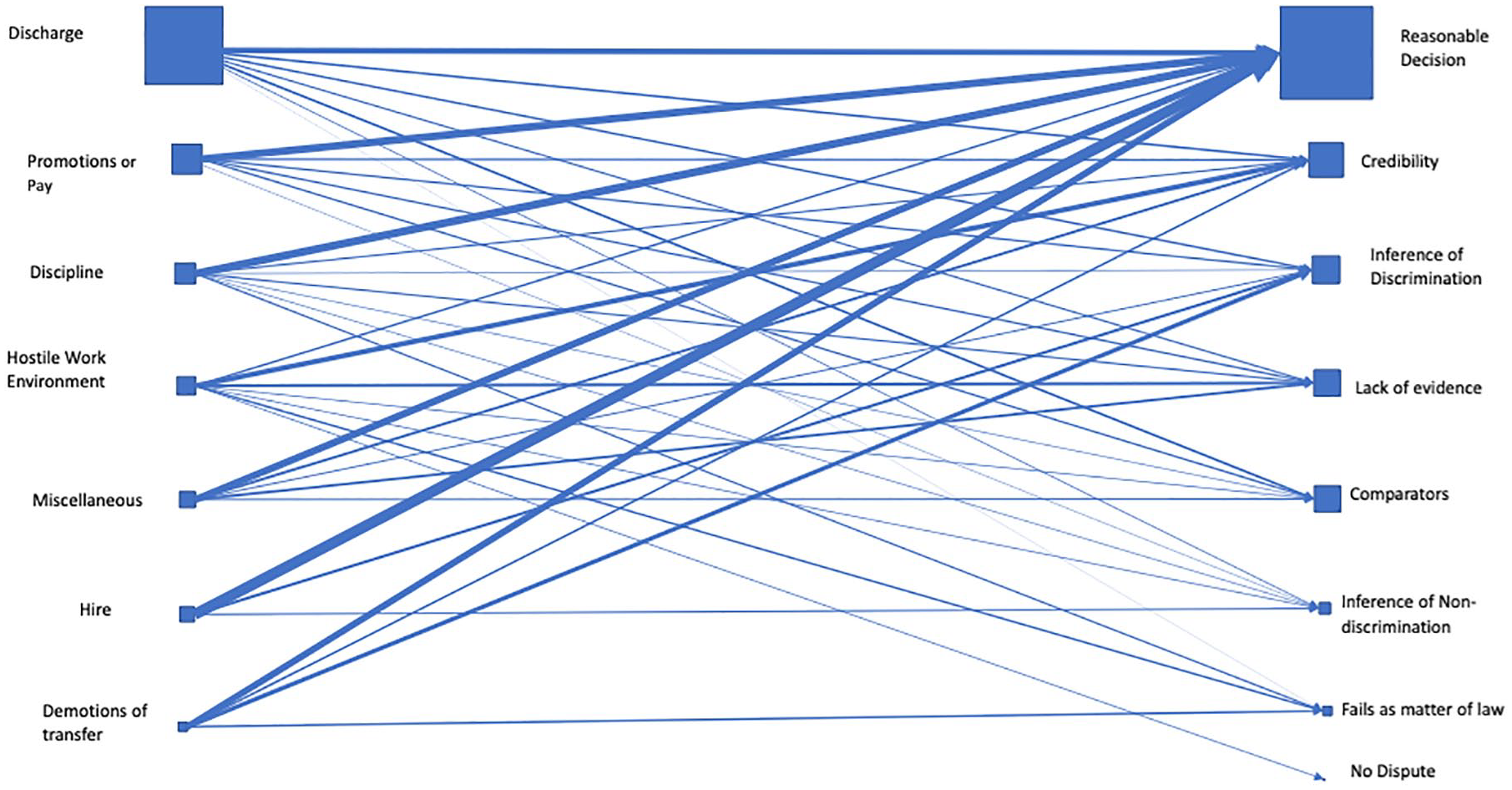
Worker allegations (left) and judicial legal reasoning (right) (percentages).
Why Employees Mostly Lose, and How ALJs Make Such Determinations
As both figures above suggest, regardless of the type of allegation raised, ALJs mostly affirm employer’s actions as reasonable overall. One exception is in hostile work environment cases, where the credibility of each side is the most common criteria ALJs rely on. We further discuss dominant patterns in these data later and highlight with italics the primary factors underlying judicial decisions.
One principal factor in judicial determinations, and charging party losses in general, is limited evidence and lack of comparators. Workers lose about 75 percent of claims that go to ALJs, according to our data, in part because they hold the larger burden of proof and consequently must provide robust evidence in support of their case. Where they cannot provide direct evidence (including but not limited to convincing comparative cases) that they were disciplined differently than an employee of a different race, they tend to lose the case.
In many cases, comparative information is either not introduced at all or, when it is, some ALJs do not even consider it because of either charges of employee misconduct by the employer or the amplification of the same actor inference by the judge (i.e., that the person was hired by the employer in the first place and thus the employer likely is not motivated by racial animus). In the following case, for instance, the same actor inference is directly invoked when the judge concludes, “Respondent argues that the allegation of race discrimination defies ‘common sense’ in this case because the station manager knew Complainant’s race when he hired and fired him.”
A similar logic is employed by another judge on a different case. Here, the judge notes that the same manager hired and fired the employee in question and that the time gap between the hiring and firing was not that large. The assumption by the judge is that it is simply not rational for a given manager to hire somebody and then treat them unfairly.
The facts in this case demonstrate that [supervisor] was the sole person involved in Complainant’s hire . . . and her discharge approximately three months later. The brief period between these employment actions creates a strong inference that race discrimination was not a determinative factor in Complainant’s discharge.
When ALJs cite such facts, employees mostly lose. Presumably, there are cases in which the employee wins and the judge merely makes no mention of these facts. That explicit references to such facts are so strongly correlated with winning and losing, however, indicates that ALJs often consider such factors as relevant. Moreover, they have the leeway and legal precedents to act on such inferences.
Our findings regarding shared race or being hired and fired by the same person suggest that judicial decision making in discrimination cases is undergirded mostly by a view of discrimination as an individual act that is largely overt and intentional. The reasoning in these cases is essentially that if someone hired a Black employee, then they must not hold racial animus. What this conspicuously ignores is the possibility that employers can discriminate later in the process, after hire, particularly when or if they hold employees of one race to higher or different standards. Indeed, this creates a form of judicial myopia around the possibility of discrimination once employed. This is a lingering vulnerability for minority workers but also represents potentially powerful legal cover for employers.
Along somewhat similar lines, employees seldom prevail when ALJs cite that the investigating personnel or even the discriminatory actor is of the same race as the employee who is claiming that they were discriminated against. Following is an excerpt of a judge’s rationale along these lines: “The fact that the investigation was conducted by an African American investigator and was ultimately upheld by Respondent’s then African American Commissioner, lead me to conclude there was less likelihood of the potential for bias based on Complainant’s race.”
As we discuss in the next section, which outlines several situations in which charging parties win, ALJs seem to treat more traditional forms of explicit racism, such as the use of racial slurs, more seriously. Yet, ALJs in our data tend to dismiss such evidence as nonrelevant when it occurs outside of the charging party’s presence. Indeed, the use of racially charged language and slurs appears to not be sufficient in and of itself. Take the following case, for instance, where slurs and explicitly racist conduct was on display, yet the judge throws out such evidence because such use was not undertaken in front of the employee in question:
The testimony of [coworker], Caucasian, who was employed by Respondent from 2006 through December 2009, is particularly elucidating regarding the random and stray nature of [supervisor’s] use of racist epitaphs in the workplace. . . . The Commission’s evidence regarding [supervisor’s] use of racial epitaphs and displaying racist symbols did not establish when and where the statements and the conduct occurred or that it was close in time to the decisional process to terminate Complainant. . . . Supervisor’s racist statements and the display of a noose were said and done in front of an audience of Caucasian employees but were not done when African Americans were in a zone of observation to be able to see or hear his conduct. . . . The evidence of [Supervisor’s] use of racist epitaphs and symbols in the workplace is not direct evidence that [Supervisor’s] recommendation to terminate Complainant was based on Complainant’s race.
Even if the judge found in the employee’s favor in the case above, it is important to note that reliance on “smoking gun” evidence by judges, like the use of racial slurs in the course of employment, is problematic in that it (1) ties legal decision making about workplace discrimination specifically and exclusively to explicit individual bias and racism and (2) largely glosses over systemic unequal treatment in the workplace, including the use of ostensibly neutral rules, oversight, and criteria in differential ways (Roscigno 2007).
Judicial Decision Making and Charging Party Legal Victories
One important benefit of data like ours is that it affords the opportunity to interrogate more deeply cases in which the employee wins and the kinds of evidence ALJs draw from when making such determinations. Even if relatively less commonplace, understanding when employees win in such cases can provide useful insights into how ALJs conceptualize illegal discrimination. Three clear patterns emerged in this regard: a good employment record, evidence of both explicitly racist animus and comparators, and temporal proximity of differential treatment along with retaliation.
Evidence of long-standing good employment with the employer appears to be strongly associated with employee victories in these data. The fact that work performance is considered is not surprising given that many employees are supposedly discharged for misconduct or poor performance. A good performance history, on the other hand, helps establish that the employer’s explanation for the adverse action may simply be pretext while the real motivation is discriminatory. 11
Second, the interplay of explicit racism with evidence of comparatively distinct treatment seems to carry significant weight with many ALJs and sometimes works in favor of charging parties. In our data from Ohio, a mere five cases resulted in a win for the employee. Three of these cases included a finding that racial slurs were used in the workplace, aimed directly and explicitly toward the minority employee in question. In four of them, the judge also accepted evidence that employees who behaved similarly in the workplace but who are of a different race were treated more favorably. In one of these, a worker was fired for violating the employer’s policy about violence in the workplace but pointed to the fact that White employees were not treated with the same level of discipline. Like the response to many employees who file discrimination claims, the employer highlighted the employee’s misconduct. However, in this case, the judge found sufficient evidence that White employees were not treated as harshly, stating,
Each time it came to [Supervisor’s] attention that a white employee had been accused of violating Respondent’s policy regarding inappropriate behavior in the workplace, he characterized the white employee’s conduct as not rising to the level of conduct that would warrant termination pursuant to policy.
The judge further described some of the misconduct of six White employees that did not result in a discharge, including malicious physical conduct, burning a coworker’s beard during a prank, and flipping a coworker out of their chair.
It would be problematic to conclude that one cannot win without such evidence, but these findings certainly highlight the critical importance of certain forms of evidence for ALJs. In Massachusetts, 19 cases resulted in a win for the employee. Of these, 9 involved a judge’s determination that there were good comparators. Six of these also involved the use of slurs. Some included a finding that the employee had a long tenure as a good employee; something noted earlier that arguably speaks clearly to the employee’s credibility. For example, in a case in which an employee was discharged for allegedly refusing a supervisor’s direct order, the judge noted,
Respondent’s witnesses testified that throughout her 14-year tenure, Complainant was a very good employee—hard-working, reliable and committed to the patients. Complainant also formed good relationships with Respondent’s residents and their families. She was not known to refuse to follow a supervisor’s orders or to be insubordinate, until the incident in 2014 that precipitated her termination.
The significant role of explicitly racist treatment and slurs in the workplace in the eyes of judges is perhaps better highlighted by looking at two similar cases resulting in different decisions. In the first case, the employee was fired for poor work performance. Only 12 percent of employees in that workplace were Black. The hearing officer found that the employee’s supervisor spoke to her in a rude and condescending manner but did not speak to other employees with the same tone. The employee complained to human resources about the tone during interaction, and the supervisor was counseled. The judge decided on behalf of the employer that the employee was fired for job-related reasons.
In the other case, the employee was fired for insubordination. He was the only Black employee within his position type. A supervisor had numerous loud confrontations with the employee. At one point, outside of a confrontation, the supervisor was overheard referring to the employee as a monkey. Both cases above exhibited strikingly similar facts regarding tumultuous interactions between a supervisor and a subordinate minority employee. What distinguishes the two, and led to the second plaintiff prevailing, is the evidence presented of racially charged language in the second case.
In a somewhat similar vein, the importance of comparative evidence is clear. In one case, for instance, a Black trainee was employed by the police academy and was fired for cheating on the final exam. The employer’s policies considered cheating to be a “class 1” violation, which can result in immediate termination. The employee alleged disparate treatment in termination arguing that white officers in training were not fired for other forms of misconduct but rather that their violations were considered “class 2” and not subject to immediate termination. There were no other known incidents of cheating on an exam. The investigator found for the employee, holding that although the white officers had not committed the same act (cheating on an exam), they could have been subject to stricter discipline for their own misconduct but were not. As the judge noted,
Respondent [employer] argues that the recruits who received lesser discipline are not Comparators because they were not disciplined for class I integrity violations. Such is the case but this distinction overlooks the disparate nature of the charges themselves, i.e., the imposition of more serious charges in relation to black recruits and less serious charges in relation to white recruits. A disciplinary pattern that reflects the racial identity of the recruits is itself a form of disparate treatment whether or not the circumstances leading to each discipline are identical.
In a second case, a Black employee was promoted multiple times during the course of his employment but was eventually fired after an investigation showed he left store keys with an unauthorized employee, let hourly employees remain inside the store after clocking out, and inspected the store at closing unattended. The employee alleged disparate treatment in termination, arguing white employees were not fired for similar misconduct. He did not, however, provide specific comparative evidence in this regard. In this case, the judge ruled in favor of the employer.
That ALJs pay particular attention to the use of slurs or comparator employees should not be surprising. The first, the use of slurs, lines up well with legal perspectives that assume discrimination to be largely an explicit and overt individual act (for further discussion about this, see Nelson, Berrey, and Nielsen 2008 and Roscigno 2007). Although probably much less apparent than in the past, such behavior has certainly not vanished from the contemporary workplace.
Notably, only three cases with findings in favor of the employee in Massachusetts did not include such evidence (i.e., racial slurs, comparator evidence, or employee otherwise in good standing). Further review of these three cases all showed that there was a close proximity in time between an event that raised the specter of discrimination and/or retaliation. In two of these, the employee was fired shortly after raising concerns about discrimination. In the third, the employee had an offer of employment rescinded shortly after the employer learned he was presumably Middle Eastern and Muslim. Time proximity of the adverse action, relative to an individual raising concerns about discrimination and/or the employer uncovering more detail about a prospective employee’s racial/ethnic background, was cited by ALJs in all three cases as the primary explanation for their decisions.
Conclusion
Although excellent sociological research has been undertaken on the topics of workplace inequality and racial justice, much less attention has been devoted to analyses of the legal adjudication of disputes regarding inequality and discrimination specifically. Investigations and mediation by the EEOC and state-level civil rights commissions surely matter for the resolution of disputes, but so does legal adjudication by ALJs (i.e., judges who must weigh countervailing narratives and determine whether the actions in question are a violation of civil rights law). Given the potential of antidiscrimination law as a tool for racial equality, evaluation of all stages in discrimination claims-making is essential if we are to understand if and/or how legal processes reinforce inequality or bring about racial justice.
Our analyses, which draw on content coding and systematic analyses of 91 in-depth cases of workplace racial discrimination, provide several important insights for inequality, discrimination, legal, and employment scholarship. One insight surrounds the importance of discursive processes and narratives about what occurred. We know from recent research that there are important ambiguities in the aforementioned regards (i.e., what precisely is discrimination, what level must the evidence rise to prove it, etc.) (see, e.g., Harnois 2023; Valentino and Warren 2025). More formal cases of employment discrimination likewise can present countervailing interpretations and evidence, often if not always entailing a claim of discrimination but also a counter-response.
It is interesting, although not entirely surprising in data that has reached the level of legal adjudication, that the narratives of employees claiming discrimination and employers trying to fend off such charges differ significantly. One side overwhelmingly sees and recognizes uneven and unequal treatment by race while the other side mostly amplifies supposedly neutral procedures, policies, and merit, and/or vilifies the employee in question by raising the specter of misconduct or poor performance. It is important to recognize, however, that such interpretational patterns and their legal adjudcation are often shaped by the structural context of the law—a structural context within which (1) the larger burden for proving a discrimination case lies with workers, (2) claims of neutrality and merit resonate culturally and legally and are often are inferred from organizational policies, and (3) there are numerous legal loopholes regarding employers’ rights to hire and fire who they wish and problematic precedents and assumptions regarding the same actor and/or compositional diversity.
Such legal loopholes, partly revealed within our data and certainly commented on in critical legal scholarship (Hernández 2007; Taylor 1999), create an uneven playing field, provide leverage for ALJs to find mostly in favor of employers, and warrant much greater recognition in inequality, employment, and discrimination scholarship. Indeed, they represent structural inequalities in legal processing that undercut workplace fairness and racial justice. They confer leverage to employers and, relatedly, offer several opportunities to have discrimination cases against them dismissed. Some defenses speak to the discrimination itself and whether the evidence reaches some legal threshold of severity, at least according to the interpretation of ALJs. Other defenses circumvent accusations of discrimination and harassment altogether. They do so by making the case that the employee in question is problematic in some manner, lacks necessary credentials, and/or that the organization has a formal nondiscrimination policy and therefore is constrained to act in just and neutral ways toward its employees. Alternatively, and seemingly just as effective, is the argument that a given workplace has plenty of minority workers or that the person accused of discrimination hired the minority worker in question and, thus, cannot possibly be biased.
It is also important to recognize that other legal loopholes and defenses, especially those surrounding statutes of limitation and employment at will, are effective legal strategies employers can draw from and that probably keep many discrimination cases from ever reaching an ALJ in the first place. In such cases, employers can ignore all details of a discrimination complaint, who was responsible, and how the harassment or discrimination unfolded, and instead push to have cases thrown out without the unearthing of details. This is problematic because in many cases individuals delay filing because of limited knowledge of how to file, compounding life circumstances, the fact that they may want to keep their job and paycheck, and fear of employer retaliation. And in the case of employment-at-will decisions, commission bodies or ALJs may feel legally bound to ignore the content and character of discriminatory actions and harms given that the doctrine privileges the right of an employer to terminate an individual’s employment even if their reasoning may be questionable.
In other instances evident in our findings, such as the same actor inference and demographic diversity defenses, those who have experienced discrimination have a large evidentiary hill to climb from the very outset. Indeed, these two defense strategies begin with the premise that the employer could not have possibly discriminated against the plaintiff because the same employer hired them in the first place (same actor inference) or that the company has a large amount of minority employees working for them (demographic diversity defense). It is difficult to imagine how one might counter such defenses without a smoking gun—that is, a smoking gun wherein detailed evidence is somehow unearthed that shows that the employer or its agents targeted the employee in question or an entire protected group with explicitly racist intent. Furthermore, it is likely also the case that the shifting burden offered by these defenses lightens the rhetorical load carried by ALJs. Indeed, evidence can be extensive and contradictory at times, and significant justification is required to rule one way or another. The defense strategies and loopholes we have been discussing may very well serve to reduce the effort needed by a judge to rule on behalf of the employer.
Whatever the case may be and regardless of the specific type of defense against accusations of discrimination, one thing is painfully clear: legal-judicial leverage surrounding employment discrimination, harassment, and retaliation lies overwhelmingly with employers. The onus of proving discrimination, on the other hand, lies with discrimination’s victims, that is, victims who, aside from fearing retaliation and going through time, resource, and emotionally taxing experiences having to do with filing a charge, must then grapple with a legal system that is far from balanced and that has many exits for employers. Such structural imbalance poses critical problems for discrimination litigation as a mechanism to pursue racial justice. Moreover, given some shifts over time from overt discrimination toward more subtle forms, as well as efforts by employers to appear more neutral via formal policy statements, diversity training, and internal grievance procedures, it is not surprising that proving discrimination is difficult and that the power and leverage is mostly on the side of employers.
We recognize limitations of case-specific data, to be sure, and we correspondingly hope future work might expand on our analyses and fill any particularly important analytic gaps. For instance, we acknowledge that these materials arguably reflect cases in which charging parties have overcome legal, monetary, time, and emotional hurdles, and where parties could not or would not resolve the case through mediation. Most discrimination charges and claims are rectified much earlier in the process. Moreover, the line between genuinely held beliefs (on either side) and effective and formal legal arguments is arguably blurred in materials such as ours. This is perhaps less problematic (and even useful) when the attention is on judicial decision making, but the degree to which employer and employee narratives are genuine versus legally vetted, formalized, and structured is a separate question worth deeper interrogation. Case analyses over time, from the initial identification and naming of a behavior as discriminatory to then tracing the evolution of the charge and language throughout investigation and legal hearings could shed important light on this (see Berrey et al. 2017).
Future work on the pertinence of our arguments and results to other forms of workplace discrimination, such as that pertaining to gender, age, and/or disability, would also be worthwhile. As is the case with race cases, the burden of proof in gender, age, and disability cases likewise lies with the employee or prospective employee, and procedural constraints (i.e., how, when and where a case can be filed) across these bases of charge likely also afford more leverage to employers. Other specific legal loopholes that benefit employers, such as the employment-at-will doctrine and the bona fide occupational qualification may be more or less relevant depending on the basis of charge. We suspect that specific defenses regarding workplace diversity, the attributes of the plaintiff and the employer, and the same actor hiring and firing the employee in question may be relevant to some extent in sex/gender discrimination cases. Yet stereotypes around motherhood and gendered attitudes may result in distinct legal discourses, charges, and defenses. We hope that future work will undertake such analyses and also consider intersectional patterns surrounding legal vulnerability.
Despite any such limitations and acknowledging the clear need for further empirical work, we believe that attention to language and discourse and the role they play in discrimination and in defenses, legal vetting, and judicial decision making is a challenging but important future research agenda for those interested in inequality reproduction and structural barriers to justice. Indeed, and as revealed by our analyses, individuals interpret and experience harm in ways that they see and sometime name as discriminatory. Employers defend their actions in either seemingly neutral ways or by drawing attention to flaws, misconduct, or poor performance of a given employee. And every bit as important, ALJs act on both evidence and legal precedents, inferences, and assumptions that typically afford more leverage to employers, reflect large holes in contemporary civil rights law and protections and, in our view, make racial justice in employment and in the courts, in our view, far from neutral and blind.
Footnotes
1
Such procedural constraints can represent a significant time, financial, and emotional burden on potential plaintiffs and help explain why a significant portion of discrimination suits are ultimately dropped and never reach a commission decision let alone an ALJ in a public hearing (Berrey et al. 2017;  ).
).
2
Employment at will is a legal principle and legal precedent stating that an employer can terminate an employee at any time, for any reason, or for no reason at all, with or without notice, so long as that reason does not violate civil rights law. What this means is that an employer can simply cite seemingly neutral criteria such as “business needs” or cost savings as the reason behind their actions and the more specific details of what occurred from the employee side can either thrown out or not considered at all.
3
4
The same actor inference and precedent in civil rights cases assumes that if an employer hires someone in the first place, they likely do not harbor discriminatory animus against that employee’s protected characteristic. Thus, it is inferred that any subsequent behavior is not motivated by discrimination (Taylor 1999). In these cases, the actual detail of what occurred could presumably be thrown out altogether. As noted by Hernández (2007) and , this type of inference has been extended to situations in which there is some compositional diversity in the workplace (i.e., there is a legal assumption of non-discrimination when there is reasonable representation of other racial minority employees in that very workplace).
5
Correspondingly, final decision making is not simply about who has the stronger evidence. Rather, our argument is that judges will, often at the behest of employers, draw on such precedents, explicitly or implicitly, and in a manner that shapes interpretation of what occurred or even whether evidence presented by the employee in question will be considered at all.
6
There is some variation by state in these regards. For instance, in New York, all probable cause cases are brought to public hearings. In Illinois, all cases are brought directly to public hearings when filed with the Illinois Human Rights Commission. In Florida, a complainant may request a hearing before a judge in the Division of Administrative Hearings.
7
These case materials are publicly available. Cases from Massachusetts are available at https://www.mass.gov/collections/mcad-hearing-decisions. Cases from Ohio are available at .
8
We initially considered sex discrimination cases as well although several key issues make the legal adjudication sex discrimination cases unique and warranting specific attention. We revisit this point and discuss the generalizability of our results in our conclusion.
9
Credibility and comparators are reported in both tables but capture subtly distinct processes. Credibility in Table 3 has to do with the judicial statements regarding witness credibility, whereas in it is more about the weight of the witnesses’ credibility in the judge’s final determination. Likewise, when comparators are reported in Table 3, it is in reference to the mentioning of comparators. References to comparators in Table 4 refer to the centrality of comparators to the judge’s final determination.
10
Roscigno (2011) refers to claims of neutrality as a form of “symbolic amplification,” wherein some culturally resonant frame is used to legitimate otherwise questionable actions. He referred to employer framing of an employee as criminal, problematic, and undependable as “symbolic vilification.” Our case materials suggest that amplification and vilification can and often do happen simultaneously in employer responses.
11
Chi-square tests bolster our confidence that references to workplace demographics (a racially segregated workplace) are significantly correlated with employee victories. This suggests that judges consider such information and that employees could increase their chances of success by highlighting such facts to the judge when offering evidence.