



Abstract
Bryan L. Sykes and Meghan Ballard on racial justice acts.
In the wake of recurring racial awakenings on systemic bias in the United States, some policymakers have attempted to redress racial and ethnic wrongs in the criminal legal system. For example, legislators have passed Racial Justice Acts (RJAs) in Kentucky (1998), North Carolina (2009; repealed in 2013), and California (2020). RJAs prohibit the seeking and imposing of criminal sentences on the basis of race.
In Kentucky and North Carolina, their RJAs have prohibited the seeking and imposing of criminal sentences on the basis of race in capital cases. The California RJA (CRJA) (CA Penal Code § 745), on the other hand, is the first of its kind in prohibiting prosecutors from seeking, obtaining, or imposing any criminal conviction or sentence on the basis of race, ethnicity, or national origin. The CRJA has been championed by civil rights groups and criminal justice reform advocates for providing relief when evidence demonstrates purposeful discrimination and/ or significant racial or ethnic disparities. In practice, this means that parties need only to demonstrate that there exists a significant difference in charging, conviction, and/or sentencing across racial and ethnic groups.
Little is known about the overall impact and efficacy of the law to curb racial and ethnic bias in California’s criminal legal system. As such, we recently undertook an inquiry into both the existence of racial and ethnic disparities in sex-related offense charging and sentencing decisions in Los Angeles County, and into ways to systematically prove disparate intent in charging, convicting, and sentencing of three related charges: Human Trafficking (CA Penal Code § 236-237), Pimping and Pandering (CA Penal Code § 266), and Prostitution (CA Penal Code § 647). In addition to different minimum and maximum sentence lengths, each of these charges carries additional collateral consequences, such as lifetime firearm prohibition, probation ineligibility, a Third Strike (TS) trigger, and lifetime sex offender registration.
Documenting Racial Disparities
We use administrative data on arrests and criminal charges to examine racial and ethnic disparities in filing decisions and additional penalties. The Los Angeles County District Attorney’s Office supplied these administrative data in response to a CA Public Records Act (CPRA) Request.
These data include 7,100 arrests and charging decisions for Human Trafficking, Pimping and Pandering, and Prostitution cases between 2012 and 2021 in Los Angeles County, including arrests where the District Attorney declined to file a case (i.e., declinations, pre-plea diversions, and/or informal diversions). Whites comprise 6.7% of all cases; 49.9% are against Blacks, 26.6% against Hispanic/ Latinx, 3.3% against Asian, and 4.0% against other racial and ethnic groups. Race or ethnicity is missing in 9.5% of these data, which is a substantial improvement in data quality over previous data extracts. The quality of these data bolster confidence in our analyses of racial and ethnic disparities.
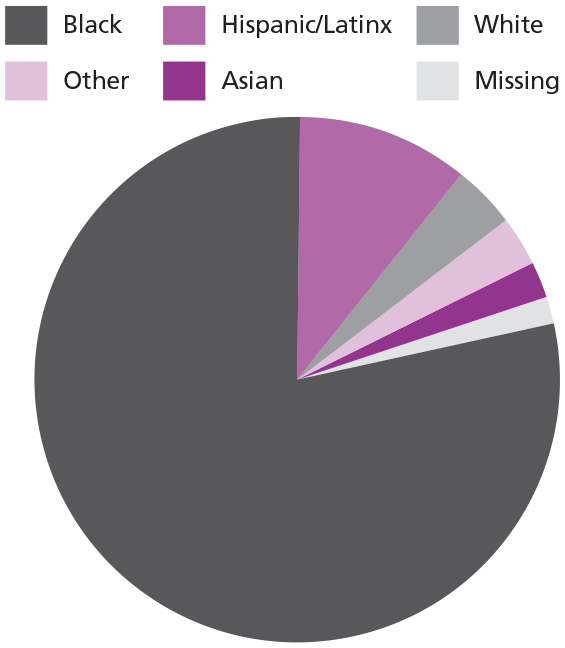
The pie chart (right) shows the percentage of all human trafficking cases filed by race and ethnicity. Nearly 4-in-5 (78.8%) human trafficking cases filed in Los Angeles County have Black defendants, compared to only 4% of White defendants. These statistics alone run counter to recent 2021-2022 federal data from the U.S. Bureau of Justice Statistics on racial differences in human trafficking, which shows that, of all human trafficking defendants in federal cases, 63% are White compared to 18% who are Black.
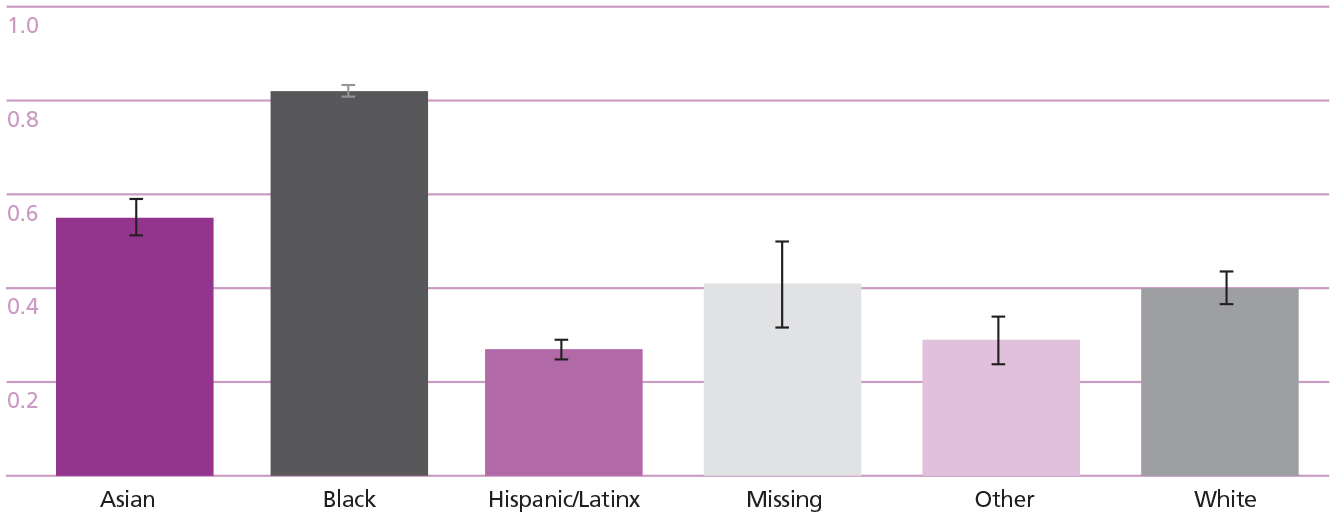
The next figure (top right) presents the proportion of felony cases filed, by race and ethnicity. Black defendants are twice as likely to have a felony human trafficking case filed against them than White defendants; over 4-in-5 Black defendants (82.2%) have had a felony case filed against them for human trafficking, compared to roughly 2-in-5 White defendants (40.1%). This filing rate is not due to chance alone (as confirmed with Cochran-Mantel-Haenszel [CMH] and Chi-square tests [p <.0001]).
Percentage of all human trafficking cases filed, by race and ethnicity
Source: Authors’ calculations of the data provided by the LA County District Attorney’s Office.
Proportion of felony cases filed, by race and ethnicity
Source: Authors’ calculations of the data provided by the LA County District Attorney’s Office.
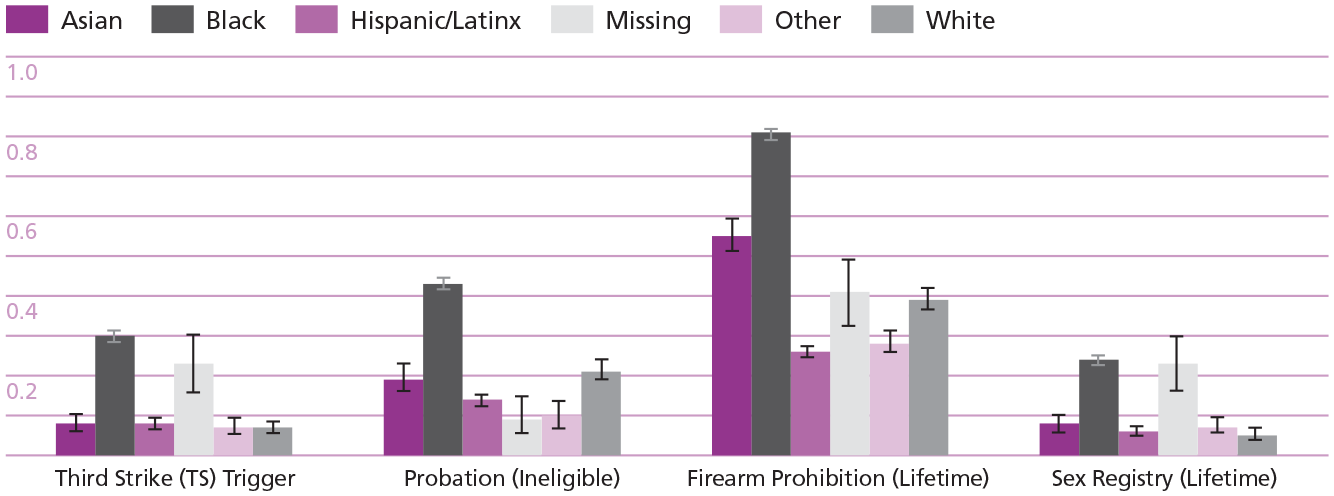
Additional penalties associated with felony charges filed, by race and ethnicity
Source: Authors’ calculations of the data provided by the LA County District Attorney’s Office.
In figures not shown here, Black defendants represent 72.2% of all PC 236.1(C)(1) cases (human trafficking)— which carries a minimum sentence of 5 years and a maximum sentence of 12 years in prison—compared to 2.6% of White defendants charged under this statute. Similarly, Black defendants comprise 85.7% of all PC 236.1(C)(2) cases (human trafficking), which carries a minimum sentence of 15 years and a maximum sentence of life in prison; however, no Whites have been charged under this statute in the last decade. Lastly, Black defendants represent 85.7% of all PC 664/266I(B)(1) cases (pimping and pandering)—which carries a minimum sentence of 3 years and a maximum sentence of 6 years— compared to 0% of White defendants charged under this statute. These statistics implicate race as a salient factor in the charges brought against defendants for sex-related offenses. These examples illustrate the increasing likelihood that Blacks will spend longer periods behind bars for similar offenses.
Because racial and ethnic inequality exists in the filing of felony cases, specific charges also include additional penalties that enhance and/or lengthen a potential sentence. The final figure displays selected penalties associated with felony charges filed, by race and ethnicity. Blacks are significantly more likely to have a lifetime firearm prohibition than Whites (81.6% versus 39.9%), be at risk of felony probation ineligibility (43.7% versus 21.9%), experience a Third Strike (TS) trigger (30.2% vs. 7.3%), and to be on the sex offender registry for their lifetime (24.7% versus 5.8%). The racial and ethnic disparities consistent with the pattern of these data are not random, nor are they due to chance alone (again, as confirmed by CMH and Chi-square tests [p <.0001]). The findings demonstrate how criminal charging for specific sex offenses can impinge on other constitutional rights and constitute a double punishment for Black defendants.
Nearly half of all cases in our data have Black defendants, even though, per the U.S. Census Bureau, Blacks comprise only 9% of Los Angeles County. Preliminary analyses also show that not only are Black and Hispanic/Latinx defendants disproportionately more likely than non-Hispanic/ Latinx Whites to be charged with the more serious offense of Human Trafficking, they are also more likely to be sentenced and convicted for Human Trafficking rather than one of the less serious offenses of Pimping and Pandering or Prostitution. These outcomes demonstrate racial and ethnic disparities in charging and sentencing decisions in Los Angeles County. Beyond these findings, however, our pending geospatial analyses of precinct-level data may transform the very nature of CRJA deliberations from having to only consider evidence of disparate impact to also including disparate intent (i.e., where police concentrate their surveillance and human trafficking investigations in Los Angeles County).
It may be easy or convenient to dismiss racial and ethnic bias in cases where defendants have allegedly committed sex-related offenses; however, failing to both acknowledge and redress racial and ethnic disparities in this context calls into question the legitimacy and constitutionality of criminal charging decisions for all defendants, regardless of their charges and/or criminal classification. Our research has focused on sex-related offense charges, but the CRJA allows for inquiries into other classifications of criminal charges. By providing evidence of racial and ethnic bias in charging and sentencing decisions under the CRJA, social scientists can unveil the racial and ethnic biases and inequities that have embedded themselves within the broader architecture of the criminal legal system for centuries and that constitute disparate impacts for people and communities of color.
Footnotes
This research is supported by a Graduate Fellowship Grant from the California Policy Lab (CPL).