



Abstract
Studies have demonstrated evidence of racial discrimination in public accommodations. Within urban nightclubs specifically, blacks experience racial discrimination when attempting to gain access, yet little is known about the treatment they receive once inside. To assess whether there is racial discrimination inside urban nightclubs, the authors sent black and white men testers to 30 nightclubs in Chicago to determine whether black men paid more for drinks than white men paid for the same drinks. Drawing on quantitative and qualitative data from our field tests, the authors found evidence that black men paid more for drinks on average than did white men and that nightclub staff members add fees to the cost of drinks for black men but not for white men. The authors contribute to the literature by demonstrating specifically how the diffusion of racial discrimination can affect black consumers at multiple points in the same service encounter.
Researchers have found evidence of racial discrimination toward blacks in public accommodations (Brewster, Lynn, and Cocroft 2014; Brewster and Rusche 2012; Feagin and Sikes 1995; Harris, Henderson, and Williams 2005) and related consumer markets (Gabbidon 2003; Gabbidon et al. 2008). This discrimination has been largely covert in nature and includes blacks receiving degradation of goods and service (Harris et al. 2005), facing discriminatory behaviors by servers in restaurants (Brewster and Rusche 2012), and encountering increased surveillance in retail establishments (Schreer, Smith, and Thomas 2009).
Within urban nightclubs specifically, researchers have focused on discrimination in gaining access to the nightclubs, including identifying the ways in which bouncers assign differential statuses to patrons on the basis of race and gender (Rivera 2010), uncovering bouncers’ use of dress codes as a pretext for denying black patrons access (May 2014; May and Chaplin 2008; May and Goldsmith 2018), and revealing several exclusionary tactics used to limit blacks access to urban nightclubs (May 2018, 2022). This body of research focuses on the treatment blacks receive when attempting to gain access to urban nightclubs but provides little insight into the treatment blacks receive once inside urban nightclubs. We seek to broaden this literature on racial discrimination in public accommodations by focusing on the treatment black patrons receive once inside urban nightclubs. Specifically, we want to know whether black patrons pay more for drinks than white patrons.
We focus on racial discrimination in urban nightclubs because they are central to social life in major cities across the United States (Clark [2004] 2011; Grazian 2007; May 2022) and represent an estimated $23 billion industry (Statista 2021). Although the existing literature recognizes the importance of urban nightclubs to the social and economic life of cities (Chatterton and Hollands 2002; Garcia 2018; Grazian 2007; Hae 2012), few studies engage in explicit examination of racism and racial discrimination within the context of urban nightclubs (e.g., Ghaziani 2024; Hunter 2010; May 2014). This is a curious gap in the literature given the consistent reports of racial discrimination at urban nightclubs (May 2018; May and Goldsmith 2018), and the pervasiveness of racism and racial discrimination in other public accommodations and institutions (Bonilla-Silva 1997, 2001; Brewster and Brauer 2017; Brewster and Nowak 2021; Pedulla 2016; Pedulla and Pager 2019; Ray 2019). We seek to fill this gap in the literature with the present study.
To assess whether there is racial discrimination inside urban nightclubs, we conduct an audit pairs test—a type of field experiment. We send similarly dressed white-presenting and black-presenting men testers to urban nightclubs to determine if they are charged the same drink prices. 1 Drawing on quantitative and qualitative data from our audit pairs tests we find evidence of discrimination by race: black men pay more for drinks on average than do white men, and white men are never charged more for drinks than black men. Our qualitative data provide evidence that nightclub staff members add fees to the cost of drinks for black men but not for white men. Additionally, black men report unfavorable treatment in the process of securing drinks within nightclubs.
We contribute to the literature by demonstrating not only the existence of racial discrimination inside urban nightclubs but also by identifying different points at which patrons might experience racial discrimination. Unlike most studies of racial discrimination in public accommodations and consumer markets, we go beyond a focus on one aspect of discrimination taking place, such as whether shoppers are surveilled (Gabbidon 2003) or charged different prices for the same car (Ayres and Siegelman 1995). Instead, we draw on observations from our study and previous studies to argue that diffusion of racial discrimination can affect black consumers at multiple points in the same service encounter within urban nightclubs. We consider these observations within the broader context of racial discrimination in public accommodations and consumer markets.
Racial Discrimination in Public Accommodations and Consumer Markets
With overt racial discrimination becoming less acceptable after Jim Crow (Lennartz, Proost, and Brebels 2019), researchers have found evidence of covert discrimination taking place in public accommodations and consumer markets. For instance, there is evidence that restaurant servers discriminate against black customers (Brewster and Brauer 2017; Brewster et al. 2014; Brewster and Nowak 2021; Brewster and Rusche 2012), and nightclub staff members discriminate against black patrons seeking access to urban nightclubs (May 2014, 2018; May and Chaplin 2008; May and Goldsmith 2018; Rivera 2010). These discriminatory practices are sometimes revealed in the media, but owners effectively deflect the allegations by using cultural scripts (i.e., socially acceptable talk) to mask their discriminatory practices (May 2018). Such efforts help obscure both the nature and frequency of discrimination toward blacks in public accommodations.
Similar to urban nightclubs, racial discrimination is commonplace in retail and other consumer services through surveillance. Researchers label this form of discrimination consumer racial profiling (Harris et al. 2005). Owners have institutionalized this form of racial profiling by employing off-duty police or security guards to protect their merchandise. Researchers have found evidence that police (Gabbidon 2003), security guards (Lee 2000), and salespeople engage in consumer racial profiling in retail stores (Schreer et al. 2009). These incidents of discrimination include not only practices by individuals but also organizations on the basis of the discriminatory practices embedded within the organizations (Elegido 2011; Hebl, Cheng, and Ng 2020; Ray 2019). Still, many victims of racial discrimination in consumer settings elect not to take any legal action against individual perpetrators or companies (Bone, Christensen, and Williams 2014; Cohen 2012; Employment Law Office of John H. Haskin & Associates, LLC 2022; May 2022; Ossei-Owusu 2021; Pedulla 2016; Pedulla and Pager 2019; Roscigno, Karafin, and Tester 2009), in large part because of the perception that little can or will be done (Gabbidon and Higgins 2020). In sum, the literature on public accommodations and consumer markets generally demonstrates the existence of covert discrimination in service and surveillance. We take a closer look at urban nightclubs as they represent a distinctive type of public accommodation in which to explore the existence of racial discrimination.
Urban Nightclubs and Racial Discrimination
Urban nightclubs are broadly defined as privately owned entertainment venues that cater to the public and attract early evening and/or late-night patrons (May 2014). These venues include restaurants, bars, dance clubs, cocktail lounges, concert halls, and other public accommodations (Cavan 1966; Chatterton and Hollands 2003; Grazian 2007; May 2014; Mears 2020). Social scientists have recognized the importance of urban nightclubs to the social and economic life of the city (Clark [2004] 2011). They have examined them from a variety of perspectives including exploring how urban nightclubs and nightlife function as cultural productions wherein owners provide “branded” or scripted experiences (Chatterton and Hollands 2002; Grazian 2007), as contested spaces where racialized minorities and LGBTQ persons contend for access (Brown-Saracino 2021; Ghaziani 2024; Gieseking 2020; Greene 2014, 2024; Hunter 2010; Orne 2017), as sites where the wealthy spend excessively to affirm identity (Mears 2020), as racially homogenous spaces defined by sociability (Anderson 2004; May 2001), and as business establishments at the center of political and economic conflict in cities (Garcia 2018; Hae 2012).
Although urban nightclubs are public accommodations, they are distinctive because unlike most other public accommodations, there is a built-in understanding that there is some discrimination, though of course supposedly not racial, in the entry process. As Grazian (2007) pointed out in his ethnographic study of nightlife in Philadelphia, nightclub owners engage in gatekeeping and scrutinize the type of patrons they admit to their nightclubs to maintain their venues as exclusive. Similarly, Rivera (2010), in her ethnographic and interview study of doormen at an elite nightclub in Boston, showed that the doormen draw on specific status schemas to determine the relative material, moral, and symbolic worth of particular client groups that aspire access to nightclubs. The doormen assign regular customers or those tied to regulars, women, and those well dressed to statuses for inclusion. Like the owners and doormen who scrutinize potential nightclub clientele, so too do nightclub promoters. In her study of urban nightclub promoters, Mears (2020) demonstrated how promoters build reputations for recruiting attractive women because the promoters know that this is vital for accessing elite nightclubs and thus maintaining relevance as nightclub promoters.
The gatekeeping practices of owners, doormen, or promoters at urban nightclubs should not result in racial discrimination, but still racial discrimination occurs. For instance, Rivera (2010) showed how race signals to doormen patrons’ underlying economic potential and willingness to spend and their propensity for trouble. On the basis of doormen’s assessments, they assign racial and ethnic minorities low status for inclusion in nightclubs. Such assignment can have a negative impact on the patrons, as May and Chaplin (2008) pointed out in their ethnographic study of black men’s rejection from urban nightclubs for purported dress code violations. According to May and Chaplin, the underlying theme for the black men rejected from nightclubs is that the dress codes were put in place by white bar owners in response to the presence of black men. Expanding on this notion, May (2018) demonstrated through high-profile media reports that racial discrimination in access occurs at multiple urban nightclubs throughout the United States.
Although this line of research uncovered racial discrimination in gaining access to urban nightclubs, there had been little systematic analysis of such discrimination in access until May and Goldsmith’s (2018) study of dress code enforcement. In their study, May and Goldsmith sent pairs of black, white, and Latino male testers dressed in the same clothing to 53 nightclubs in Austin, Dallas, and Houston, Texas, to identify instances in which testers were treated differently on the basis of their race. They found evidence that black men were more likely than white and Latino men to experience discrimination in their attempts to gain access to urban nightclubs. In short, bouncers were simply using dress codes as a pretext for denying black men access. May and Goldsmith’s study provides systematic evidence of racial discrimination taking place in access to urban nightclubs.
Denying access to black patrons on the basis of dress codes is just one exclusionary tactic that bouncers use. According to May’s (2022) analysis of ethnographic data, nightclub staff use additional “exclusionary tools” to limit access to urban nightclubs. For instance, May pointed out that bouncers engage in “steering”: the informal or formal directing of blacks to some areas and away from others. May suggested that “steering” might be a coordinated effort on the part of nightclub owners or simply a practice wherein bouncers direct black patrons to specific nightclub locations identified as “black nightclubs.” Irrespective of their specific motivation, bouncers engage in “steering” black patrons on the basis of race. An additional exclusionary tactic that May identified is the use of “fake guest lists”, that is, partially or fully fabricated lists purporting to contain the names of those individuals who will be permitted access to nightclubs. Holding “fake guest lists” in hand, bouncers ask patrons their names and then feign reviewing the list only to announce to the aspiring patrons that they will not be granted access because their names do not appear on the guest lists. Taken together, these studies illustrate how racial discrimination is perpetrated against black patrons seeking access to urban nightclubs. But what about racial discrimination occurring inside urban nightclubs?
Given the literature on racial discrimination in access, it seems likely that racial discrimination is also occurring inside urban nightclubs. Yet we have very little systematically gathered evidence of racial discrimination occurring in urban nightclubs except for a study conducted by the Greater New Orleans Fair Housing Action Center (GNOFHAC 2005). The study was commissioned by then New Orleans mayor Ray Nagin after the death of Levon Jones in 2003. Jones, a black man, had been seeking access to Razzo’s nightclub on Bourbon Street when he was choked to death by three bouncers in a dispute over dress codes. The incident brought a great deal of national scrutiny to how nightclub staff members in New Orleans treat black men.
In the study, GNOFHAC (2005) used actors to investigate treatment of black men vis-à-vis white men inside urban nightclubs, including whether black men paid more for drinks than white men. GNOFHAC compiled a database of Bourbon Street nightclubs and bars that were similar in operating hours and service and randomly selected 40 nightclubs for the tests. They then sent the actors to the 40 nightclubs. The study revealed that at 40 percent or 16 of 40 audited sites, black men were charged more for drinks, even when their white counterparts ordered the same drinks. More specifically, at 27 percent of the sites where black men were charged more for drinks than white men, the same bartenders served both the black and white actors. This observation supports the findings that the inflated prices black men paid were not based on the bartenders who served them but rather on discriminatory practices at the nightclubs.
We replicate the GNOFHAC study to some degree, following Freese and Peterson’s (2017) perspective on replication of research in the social sciences. 2 Freese and Peterson suggested that researchers replicate studies for generalizability using new data to determine whether key results of a previous study can be observed or to evaluate whether similar findings may be observed across different methods or settings (p. 152). We focus on the latter purpose of replication for generalizability to compare findings across different settings. We suggest that replicating the GNOFHAC study provides value because it gives us an opportunity to evaluate research conducted 20 years ago in New Orleans vis-à-vis recent research conducted in Chicago. 3 We suspect that the findings of this study will help us understand how differential drink pricing operates presently and within a northern city much different from New Orleans. Hence, the results of our present study and the results of the GNOFHAC study may be combined to strengthen the larger generalizations we can make (Freese and Peterson 2017) about racial discrimination in urban nightclubs.
Although well conceived, the GNOFHAC study had one important limitation that has consequences for its findings. We raise that limitation here given the importance of GNOFHAC’s methodological approach to our present study. 4 In the GNOFHAC report, we learn that the black actors were charged more for drink purchases than the white actors, but we are told nothing about the form of purchase used by the actors. The form of purchase matters because urban nightclubs at which credit cards are typically used for purchases produce digital records of all transactions. The owners have access to these transactions and can verify the sales. Relatedly, patrons are required to sign for the purchases and receive printed copies of the receipts. Credit card purchases thus provide records of verification of the transaction for owners, servers, and patrons and allows correction of unintentional errors or intentional mischarges in the purchase process. Urban nightclubs at which cash is the typical form of purchase undertake much less precise record keeping than those at which credit cards are used. In typical cash transactions, the bartender enters the sales transaction in the register but does not provide the patron with a receipt, so the patron has no record regarding the transaction. It is also typical that in cash transactions, the bartender verbally quotes a price for a drink to the patron and has the liberty to misstate the cost. Hence, urban nightclubs at which cash transactions are the norm create the opportunity for differential drink pricing to flourish, with or without the owner’s knowledge. Given this observation, we would expect findings to be influenced by the type of transactions typically occurring. 5 In our present study, we use credit cards to produce complete records of the testers’ transactions to avoid differentials that might occur by purchase type.
As in the GNOFHAC study, we use black-presenting and white-presenting men testers to determine the frequency and nature of discrimination taking place within urban nightclubs. We focus on men testers because as research has shown, men are the focus of surveillance in urban nightlife, and their presence is noted by men and women alike (Grazian 2007; Rivera 2010). Black men are often the primary targets of surveillance (Anderson 1999; May 2014, 2018), and they have higher reports of discrimination in public accommodations than other men and women (Byron 2022). Hence, in our tests, the treatment differential between black-presenting and white-presenting men testers should be readily observable when the two groups seek to purchase drinks from the same bartender at the same nightclub. Our goal is not to replicate the GNOFHAC study per se but rather to extend and update the literature on racial discrimination occurring inside urban nightclubs by focusing on nightclubs in Chicago.
Method
To assess whether racial discrimination is taking place at urban nightclubs, we conduct audit pairs tests. An audit pairs test is a field experiment that isolates a characteristic of interest (e.g., race) by matching individuals with nearly identical characteristics, except the characteristic of interest, and using them to test for discriminatory behavior. Audit pairs tests are particularly useful for examining racial discrimination because they combine experimental methods within real-life contexts (Bertrand and Mullainathan 2004; Gaddis 2015; Oh and Yinger 2015; Pager and Western 2012; Yinger 1995). 6 We adopt the audit pairs method because it allows us to isolate the role of race in what people pay for drinks. We test whether black-presenting and white-presenting men testers are charged the same prices for the same alcoholic beverages in urban nightclubs. We collect both quantitative and qualitative data from the test. We use this convergent design—collecting quantitative and qualitative data—because the two forms of data provide different insights, and combined allow us to see the problem from multiple angles and multiple perspectives (Creswell and Creswell 2022).
Differential Drink Price Audit
Our panel of three evaluators selected two black-presenting and two white-presenting men testers to act as patrons purchasing alcoholic beverages at urban nightclubs in Chicago. The panel avoided selecting testers who had either unusually desirable or undesirable characteristics that would have them stand out. All four of the testers were 21 years old, average in appearance, and similar in height, weight, and physical stature. Each of the black-presenting testers had medium brown skin and was selected on the basis of whether their skin matched the skin tone of the other black tester. Each of the white-presenting testers had light flesh tone and was selected on the basis of whether their skin matched the skin tone of the other white tester. Although no color palette was used for comparing skin tone, each evaluator agreed that the black-presenting testers would be received as black and the white-presenting testers would be received as white. For the tests, all four testers were outfitted in a polo shirt, blue jeans, and casual shoes, attire the first author observed as being appropriate for gaining access to nightclubs.
We selected Chicago as a field site on the basis of its reputation as a top city for urban nightlife and for its convenient location. The nightclubs in Chicago at which the tests would be conducted were selected on the basis of whether they were in a central nightlife district with a high density of nightclubs that are in a walkable distance from one another and attract diverse crowds. As the literature indicates, it is the presence of these conditions in nightlife districts that triggers the implementation of exclusionary practices to discourage black patrons’ participation (May 2021; May and Goldsmith 2018; Rivera 2010).
Prior to the field tests, the first author conducted field observations in several nightclub districts in Chicago and settled on Shoreland (a pseudonym), one of several nightclub districts that fit the inclusion criteria. The Shoreland nightclub district is in a wealthy northside neighborhood of Chicago known for attracting diverse local populations and tourists to its many nightclubs and restaurants. Beginning in the summer of 2021, the first author conducted weekly ethnographic observations at multiple nightclubs in the approximately 12-square-block area with the intent of collecting observational data on nightclub use. During the year of data collection, the first author made several observations that would become the basis for conducting our audit pairs tests. These observations also shaped the methodological choices we made for conducting these tests.
First, we observed that despite the racial and ethnic diversity of the patrons in the Shoreland area, many of the nightclubs were filled primarily with white-presenting patrons. Second, we observed that nightclub owners in the area used dress codes like those identified by May and Chaplin (2008) and May and Goldsmith (2018) to ban black-presenting patrons on the pretext of dress code violations. Third, we observed that bouncers at several of the nightclubs charged higher admission to patrons who were black presenting compared with patrons who were white presenting. Fourth, we observed that black-presenting patrons seemed to receive poorer quality service (e.g., extended wait time for drinks, unenthusiastic engagement by staff members) vis-à-vis white-presenting patrons at multiple nightclubs in the area.
One event that occurred during the pre–field test observations became the main impetus for our drink pricing audit test. The first author, who is black, noted during field observations that he was charged for “rocks” (ice), and when he inquired of a white patron whether they also were charged for “rocks” in a similar drink and they indicated that they were not, the first author hypothesized that the inconsistency was not simply by chance given the other practices he had observed. After several additional visits to nightclubs in the area at which the first author was charged for ice, we organized a research team to test for differential drink pricing at nightclubs in the Shoreland area. We identified 41 nightclubs in the area that remained open after 11 p.m. on Friday and Saturday nights and randomly selected 30 of these nightclubs for our tests. The establishments we identified for the tests tend to focus on late-night entertainment for the 21-and-older crowds and are places where sorting of patrons most frequently occurs.
We provided each tester with $100 in cash, as we had observed that bouncers charge variable admissions fees on the basis of the race of patrons during our pre–field test observations. Although most of the nightclubs in the area did not charge admissions fees, we instructed the testers to pay the admissions fees if they should encounter them so that they could still conduct the differential drink price test inside the nightclub.
Before sending the testers out to the nightclubs, we provided them with a standardized script and training on how to follow the script to mitigate demand effects. The script included directions for each stage of the interaction with bartenders during the initial drink request, payment, and end of sale. Each tester was to go to the selected nightclub, gain access, approach the bartender, and order a drink. The scripted drink request for all testers was “May I have an ‘X’ whiskey and ‘Y’ cola, single, on the rocks?” 7 This very specific request of a widely available beverage was intended to make certain that all of the testers asked for the same brand of whiskey and cola, the same quantity (i.e., a single pour, 1 ounce of alcohol) and the addition of “rocks” (ice), which as previously noted triggered an additional charge during the pre–field test observations. The uniformity in requests meant that each tester should have paid the same price at the same establishment, especially considering that all the nightclubs in the area use point-of-sale computers that include touch screen standardized pricing for each drink item.
Once the bartender returned with the drink, the tester was to pay for the drink with a credit card, add a tip, sign the merchant copy of the receipt, and secure the customer copy and itemized copy of the receipt for comparative purposes. We instructed the testers to move away from the bar and find a location to take a single sip of the drink and briefly jot notes. Each tester was to contact the first author on the group text once they had completed the transaction. The first author would then instruct each of the testers when to move to the next nightclub. Following the experiments for the night, the testers would return to base, and all four testers would meet with the first author and review each transaction to determine if different prices were charged for the same drink. After logging the drink prices on a spreadsheet, the testers would compile extensive notes from their previous field note jottings.
We conducted the tests on Friday and Saturday nights over two weekends. The testers were sent into the nightclubs in the following sequence: black tester 1, white tester 1, black tester 2, and white tester 2. The purpose of this was methodological. As we hypothesized unequal drink prices by race, we want to ensure that there was no substantial within-group heterogeneity in prices. Establishing this first would bolster any findings regarding cross-group differences. Although the nightclubs were selected randomly, we did not use a random assignment for sending the testers into the nightclubs for three interrelated logistical reasons. First, on the basis of pre–field test observations, we concluded that the amount of time it would take for a tester to complete the entrance, purchase, and jottings at one nightclub was approximately 15 minutes. This was considerably more time than the 3 to 10 minutes May and Goldsmith (2018) used for their dress code experiment. The variability in bartender service and drink preparation meant that we needed to allot more time for each tester to enter and complete the required tasks.
Second, the testers were instructed to order drinks from the same bartender to avoid potential variation in price on the basis of which bartender served the tester. Although this should not have been a concern, as all bartenders were using the point-of-sale computers with standardized prices, we decided to exercise caution so that we could state unequivocally that the difference in price was based upon something other than who served the tester. To effectively complete the test process, the tester following the initial tester would need information about the bartender’s location and physical appearance. Each tester was instructed to provide this information via the group text at the conclusion of the test so that the subsequent tester could purchase the drink from the same bartender. On the basis of the frequency of drink sales typical at the selected nightclubs, we had little concern that the bartenders would suspect that the testers’ purchases were connected.
Third, we reasoned that given the length of time to run a test, if we used random assignment, this would have required that the subsequent testers occupy themselves outside the nightclubs in the area until they were instructed to go on to the next nightclub for their assignment. This could have imposed significant complications on time and movement of the testers. 8 To avoid these complications we chose to send the testers in the sequential order black tester 1, white tester 1, black tester 2, and white tester 2. With this sequential ordering, we would be better able to manage the pacing of movement of the testers between each nightclub.
Differential Drink Price Qualitative Data and Analysis
Although we focused specifically on differential drink pricing, we instructed the testers to write jottings on their exchanges with bouncers, bartenders, and any observations that they made about the general composition of patrons in the nightclubs. They were instructed to write these short jottings using their cellphone note applications inside the nightclubs and at the end of the night to compile extensive notes of their experiences on the basis of their jottings.
We instructed the testers to carry out what May and Pattillo-McCoy (2000) called “collaborative ethnography,” wherein “two or more ethnographers coordinate their fieldwork efforts to gather data from a single setting” (p. 66). We used this approach because it “increases the body of data that can be used to describe and understand the social world under observation” (p. 66). By having the testers write separate field notes about their experiences before discussing them with one another, our research team would be given an opportunity to examine a single nightclub from the perspective of four different testers.
As we were focused on what happens at the point the testers attempt to purchase drinks at the bar, we coded the tester field note data with the explicit purpose of comparing the experience of black-presenting testers’ encounters with bartenders with that of white-presenting testers’ encounters with bartenders. We sought to identify patterns and emergent themes in their encounters during the analysis of data (Glaser and Strauss 2017). With the constant comparative method of interpreting themes and comparing them with prior and/or existing ones (Corbin and Strauss 2008; Denzin and Lincoln 2011), we were able to identify characteristics of testers’ experiences. We report narratives from the qualitative data that sharpen the insights provided by our quantitative analysis.
Results
Differential Drink Price Quantitative Analysis
Do black men pay more for drinks than white men? To estimate discrimination by drink prices, the four testers, two black and two white, entered a bar and ordered drinks. The prices of the drinks ordered were recorded. These purchases were attempted at a total of 30 nightclubs. It is worth noting that at 2 different locations, one of the black testers was denied entry and so was unable to order a drink. These two cases could not be used for testing differences in drink prices. These discriminatory episodes are nonetheless significant. Indeed, they underscore important questions this research project raises: the multiple points of potential discrimination encountered in the nightclub setting.
We examine discrimination when ordering a drink at the bar. Table 1 shows descriptive statistics by tester race. These values were obtained first by taking the average price of drinks across the four groups of testers at each nightclub and the average price between the testers of the same racial background. 9 Thus, the summary statistics are based on these cross-group averages. The descriptive statistics of each tester group are shown in Table 2. The mean, minimum, and maximum values in Tables 1 and 2 are expressed in U.S. dollars. The mean price for a drink was $12.97. White testers, on average, paid slightly less than this value. Black testers, on average, paid $0.24 more for a drink. Across the 30 nightclubs, there were 5 instances in which black testers were charged more. That means that of 118 total drink orders, 4.2 percent were higher. More specifically, of the 58 orders made by black testers, 8.6 percent were charged a higher price. At one nightclub, both white testers were charged $16.13, while both black testers were charged more. One was charged $2.31 above this price. The other was charged a total of $19.60, a difference of $3.47 compared with the white testers. At another nightclub, one of the black testers was charged $24.51, the highest price paid by any tester. This was $4.07 more than everyone else (including the second black tester). No white tester was ever charged more for a drink than a black tester.
Descriptive Statistics for Drink Prices across Auditor Groups.

Descriptive Statistics for Drink Prices for Auditor Groups.

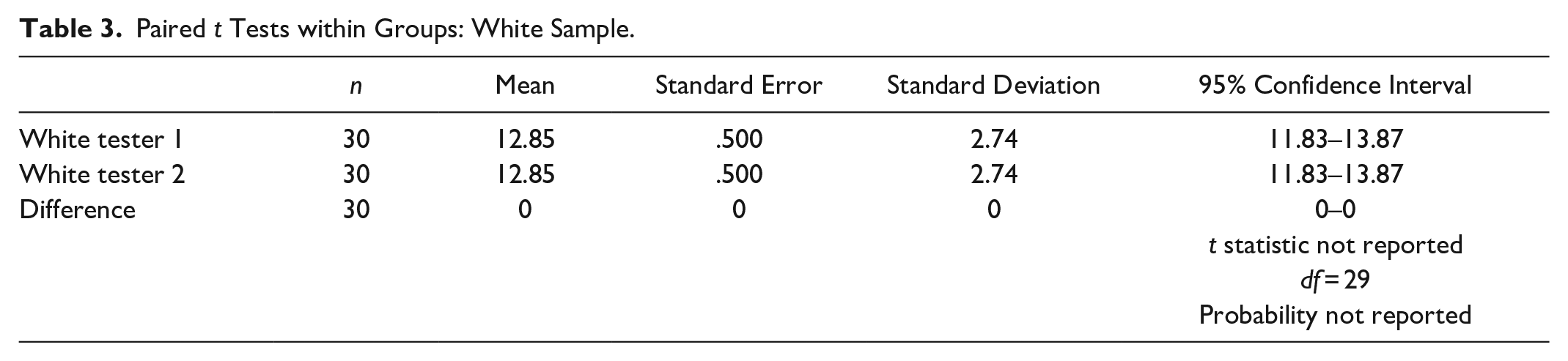
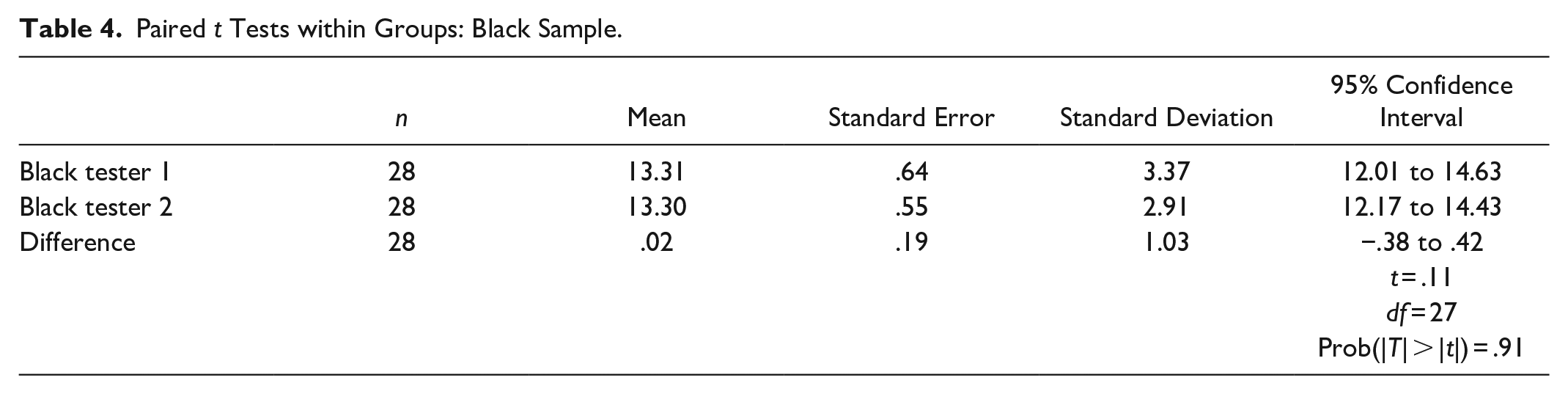
To test for differences in prices paid, we perform paired t tests. Importantly, as we have two pairs of testers from the same racial background, we do the following. We first test if there are differences within a group. We display these within-group results in Table 3 (white sample) and Table 4 (black sample). The null hypothesis is that there are no significant differences within a group. We therefore use a two-tailed test. In the case of white testers, these results are null, as shown in Table 3. This is because all white testers paid exactly the same price, so there are differences between the two groups. Accordingly, Stata did not report a p value or t statistic, and this explains why there is a missing value reported in Table 3. In Table 4, we compare differences within the black testers. There are within-group differences, but the two-tailed p value is higher than conventional levels (p < .05), indicating that they are not different from zero. What this means is that despite some black testers paying more for drinks than other black testers, these differences are not significant within group. This value is just shy of the p < .10 level. This makes sense, as there are some differences in prices paid at the same club, while the other was not. At one club, both black testers were charged more. The other three incidents happened in clubs in which one black tester was charged a higher drink price while the other was not. Taken together, as the p value is less than .05, we are confident in aggregating prices by group to do a paired t test in which we compare differences between the black and white groups. In other words, knowing that there are no significant differences within groups, we are in a position to make cross-group comparisons.
Paired t Tests within Groups: White Sample.
Paired t Tests within Groups: Black Sample.
To aggregate prices by tester race, we do the following. We total the prices paid at each nightclub for white and black testers. We then divide these values by the number of testers within each group. That is, there is a total price for white testers and black testers. By dividing by the number of testers, we can accommodate the fact that in two cases, black testers were denied entry and therefore excluded from these results. With these two average values, we perform a paired t test between black and white testers.
These results are shown in Table 5. There is a mean difference in drink prices between black and white testers of $0.51. As we hypothesize that black testers are charged more for a drink, we calculate a one-tailed test in which the difference between black and white drink prices is greater than zero. Table 5 shows that the p value is .031. We can therefore reject the null hypothesis and conclude that there is a statistically significant difference in drink prices between black and white testers. Our results taken together confirm racial discrimination in nightclubs by prices paid for drinks for those allowed to enter.
Paired t Tests between Groups for Total Sample.

Qualitative Data on Differential Drink Pricing
Beyond the quantitative evidence supporting the practice of differential drink pricing given to black testers and white testers, our comparative analysis of qualitative data from these experiments highlights aspects of the treatment black and white testers received during these tests. For instance, as noted previously there were two occasions on which the black tester was denied access to a nightclub and therefore prevented from conducting the drink price test. In the first instance, black tester 1 arrived at X nightclub and stepped up to the bouncer seeking admission. The bouncer reviewed black tester 1’s attire and then denied access to black tester 1 for the stated reason that reservations were required before the 12 a.m. hour. Several minutes after black tester 1 was denied access, white tester 1 arrived at X nightclub. The bouncer reviewed white tester 1’s identification and then granted him access. After white tester 1 departed, black tester 2 arrived and the bouncer reviewed his identification and granted him access. Finally, white tester 2 arrived at X nightclub, and the bouncer reviewed white tester 2’s identification and granted him access. All four testers had arrived before 12 a.m., and therefore on the basis of the information the bouncer provided black tester 1, all of the testers should have been told that they needed reservations before 12 a.m. Only black tester 1 was denied access for the stated reason that he did not have a reservation.
In the second instance, black tester 1 arrived at Y nightclub entrance, and the bouncer reviewed his identification and gave black tester 1 access. After black tester 1 departed, white tester 1 arrived at Y nightclub, and the bouncer reviewed his identification and gave him access. After white tester 1 departed, black tester 2 arrived at the nightclub. As black tester 2 approached the door to show his identification card, the bouncer denied him access for the stated reason that there was a “private party.” After black tester 2 was denied access and departed, white tester 2 arrived at the nightclub. The bouncer examined white tester 2’s identification card and gave him access. The bouncer did not mention to any of the other three testers the existence of a “private party.”
On the basis of these two incidents, we suggest that the bouncers’ statements “reservation required” and “private party” are phrases used at the bouncer’s discretion to exclude particular categories of patrons (May 2022). We note that only black tester 1 and black tester 2 were informed that they could not enter using these two phrases. Furthermore, the testers who were granted access to the nightclubs noted that there were no reservations required and no private parties occurring in the two nightclubs. Interestingly, when the testers who were permitted to enter nightclubs X and Y did conduct the differential drink price tests, all of the testers were charged the same prices for their drinks. Hence, it appears that rather than attempt to deter black participation through differential drink prices, the bouncers at X and Y nightclubs simply prevent access in the first place.
Now let us take a closer look at the results of the differential drink pricing tests inside the nightclubs. How is it that black testers were charged more for their drinks, especially given that each nightclub used point-of-sale computers with standardized prices for drinks and add on items? The answer is that bartenders charged the black testers more for drinks in at least two different ways. First, in A nightclub, the testers were simply charged variable prices for the drink they requested. For instance, black tester 1 had a line item on his receipt with the correct description of the brand of whiskey. He was charged $17 for that brand of whiskey. (This price was more than the white testers paid for the same brand.) Black tester 2 had a line item on his receipt with the incorrect brand of whiskey, and he was charged $16 for the incorrect brand of whiskey. It is important to note that the brand of whiskey listed on black tester 2’s receipt is a less expensive brand of whiskey than that requested by all of the testers (he was charged more for a cheaper brand of whiskey than the white testers were charged for the premium brand of whiskey). Finally, both white tester 1 and white tester 2 had a line item on their receipts with the correct brand of whiskey, and each of the testers was charged only $14 for that item. Hence, it appears that the bartender—all of the testers had the same bartender—simply adjusted the price for the drink at the register. If the point-of-sale computers at this nightclub are typical, then this particular manipulation likely would require the server to have manager access to make pricing changes on the spot, unless of course management had already designated keys for such upcharges. Ultimately, the black testers were charged a combined $5 more than the white testers for their drinks.
The second way in which black testers were charged more for their drinks was through the addition of a seemingly typical charge, a charge for “rocks” (ice). This particular practice was the technique of choice when there was differential pricing for drinks between what the black testers were charged and what the white testers were charged. For instance, when comparing the itemized receipts from two nightclubs, only the black testers were charged an additional “rocks” fee of $2.
Beyond the nature of differential pricing identified in our qualitative analysis, our black testers reported feeling as though they were being treated with little regard in their interactions with bouncers and bartenders. They were experiencing what Sue et al. (2007) identified as racial microaggressions. For instance, black tester 1 and black tester 2 recounted that the bouncers conducting security checks at the entrance of Z nightclub aggressively grabbed their IDs, patted their jackets, and frisked their waistbands. In contrast, white tester 1 and white tester 2 reported that the bouncers lightly patted them down and skipped a waistband search altogether. The bouncers’ dispositions toward the white testers are consistent with the ways in which security in other consumer contexts evaluate white men vis-à-vis black men who are present in the same spaces (Gabbidon 2003; Pittman 2020; Schreer et al. 2009). The black testers and white testers, wearing similar clothes, of similar stature, and making similar requests, were being treated very differently at Z nightclub. As further evidence of this differential treatment, black tester 1 was charged a $20 admissions fee, while the other testers were not. During the post–field test debriefing with the rest of the research team, black tester 1 acknowledged that his experience at Z nightclub was humiliating. This humiliation is consistent with what researchers have observed in studies of racial microaggressions (Harwood et al. 2012; Johnson-Ahorlu 2013; Sue et al. 2008; Williams, Skinta, and Martin-Willett 2021).
Discussion
Urban nightclubs represent a unique kind of public accommodation wherein there is an understanding among nightclub owners, managers, staff members, and even patrons that the nightclub staff will engage in some preferential treatment. Although this preferential treatment is supposedly not based on race, previous literature has shown how doormen read race as a signal about a patron’s underlying economic potential and willingness to spend (Rivera 2010), bouncers use dress codes as a pretext for denying access to black patrons (May and Chaplin 2008; May and Goldsmith 2018), and nightclub staff members use exclusionary tactics such as “steering” and “fake guest lists” to limit black patrons’ participation at urban nightclubs (May 2022). These practices are not limited to nightclubs in a few cities but occur in multiple urban nightclubs throughout the United States (May 2018). Hence, there is clear evidence that racial discrimination occurs at urban nightclubs when it comes to gaining access.
Our findings that black patrons also experience racial discrimination inside urban nightclubs are consistent with the literature. Like the black-presenting and white-presenting actors in the GNOFHAC (2005) study, we find that black-presenting men pay more for drinks than their white counterparts. Although we hesitate to make comparisons between the GNOFHAC study and ours given the different time frames and cities, it is worth noting that there are considerably fewer instances of differential drink pricing (8.6 percent) in our study than in the previous GNOFHAC study (27 percent). 10 These differences might be read as an improvement, but we are cautious in this interpretation because of the limitation with respect to purchase type that we identify in the GNOFHAC study. As we noted, cash purchases create opportunities for differential drink pricing to flourish because there are limited records of transactions and limited accountability to patrons. Hence, the higher percentages of differential drink pricing in the GNOFHAC study could be an artifact of higher rates of cash purchases occurring in that study vis-à-vis the credit card purchases in our study. Irrespective of the potential impact of the purchase differences on rates of differential drink pricing, we still find it particularly troubling that differential drink pricing occurs at nightclubs at which most every transaction is electronic and point-of-sale computers make standardization of pricing straightforward.
One underlying question resulting from our findings is, Why is differential drink pricing occurring for black-presenting men vis-à-vis white-presenting men at urban nightclubs? This question might have numerous answers, but we propose possible explanations related to both the previous literature on racial discrimination in urban nightclubs and our own observations in the Shoreland neighborhood in Chicago. On the basis of the previous literature, we suggest that differential drink pricing occurs as part of a broader strategy by some nightclub owners to limit the participation of black patrons in their urban nightclubs. We speculate that because of conventions against overt racial discrimination and the potential for lawsuits, nightclub owners implement covert tactics that target black patrons based largely on stereotypes.
For instance, the unsubstantiated notion that black patrons are a threat to security at urban nightclubs because they are generally “troublemakers” or violent (May 2014, 2018) provides owners with one motive for implementing strategies such as differential drink pricing. Owners speculate that differential drink pricing will deter black patrons from entering, staying, or returning to nightclubs because the owners assume that black patrons lack the discretionary income necessary for sustained patronage to urban nightclubs. As Rivera (2010) demonstrated, this stereotypical assumption is one that drives doormen to exclude black patrons.
For some bouncers, the assumption that blacks lack discretionary income is affirmed when black patrons choose to depart a nightclub because the costs appear prohibitive. On the basis of our pre–field tests observations in Shoreland, differential pricing appears to be an effective strategy for owners, as the first author noted that several black patrons departed nightclubs after bouncers working the door stated an upcharge admissions fee. 11 Still, we do not know if the black patrons departed because the cost was prohibitive or because they heard bouncers quote a substantially lower admissions price to the white patrons in front of them. Irrespective of why the black patrons decide to depart, owners continue to use differential pricing both in drinks and admission as tools for discouraging black patrons use of urban nightclubs.
Our tests and previous literature have helped us identify several ways in which these practices might be intertwined to form a collection of discriminatory practices that black patrons may encounter in a single visit. Although these acts of discrimination typically occur in isolation at urban nightclubs, they can sometimes be deployed in tandem. For instance, as we have observed, a black patron might encounter differential admissions pricing at the nightclub entrance and then once inside be subjected to differential drink pricing, as was the case with black tester 1. We can also envision a black patron experiencing racial microaggressions in several encounters they have with servers, bouncers, and bartenders at the same nightclub on the same visit. Our observations provide a nuanced perspective of how black patrons might encounter multiple incidents in one service encounter, thereby moving beyond the observations offered in most studies of racial discrimination in public accommodations that focus on one type of incident or tactic. We suggest that paying attention to the multiple ways in which black patrons might be subjected to discrimination in a single visit provides a more realistic account of the impending nature of racial discrimination in public accommodations where black consumers are targeted.
The impact of racial discrimination in urban nightclubs on black patrons is not just the denial of the full and equal enjoyment of the goods, services, facilities, privileges, advantages, and accommodations rendered to white patrons, or the humiliation and frustration associated with receiving discriminatory treatment, but also the impact of racial discrimination is the associated negative effects on health, wellbeing, and mental health on those who experience it Forrest-Bank and Cuellar 2018; Nadal et al. 2012; Ong, Fuller-Rowell, and Burrow 2009; Pierce 1995; Williams, Kanter, and Ching 2018). In addition to these costs, we have shown that there is a literal cost that black patrons pay when they encounter racial discrimination.
We identify at least three limitations to consider when evaluating our findings. First, given that our sample is focused on a small geographical area, it is difficult to generalize our findings from the observations we made at nightclubs in Shoreland to other nightclubs in Chicago and in other cities. Other cities and other regions might very well be different. Despite this limitation, our findings do offer an extension and update to previous literature on racial discrimination in urban nightclubs.
Second, we use face-to-face audit pairs, which may suffer the potential of experimental and personal biases despite our efforts to control all potential confounders. For instance, because of the number of outside variables we cannot control, the observed qualities of the testers we selected may not equate to the testers’ being matched in all the unobservable qualities (e.g., body language, confidence, and presence; Heckman 1998). We submit that such challenges are in part due to human differences and exist for regular patrons in much the same ways they might exist for our testers. These differences are a by-product of humans with different personalities engaging in face-to-face interaction.
Third, we focus our analysis on men’s experience with differential drink pricing at urban nightclubs. This approach fails to consider the ways in which gender expression might influence racially discriminatory practices at urban nightclubs. We do not know whether black women vis-à-vis white women are systematically subjected to racial discrimination in the same ways in which the black men in our study have experienced racial discrimination. Whether black women are treated differently is an empirical question that we hope to answer in future tests of racial discrimination in urban nightclubs. Despite these three limitations, our research has provided important insights regarding racial discrimination inside urban nightclubs.
Conclusion
Antiblack discrimination exists in urban nightclubs. Interestingly, if we consider instances of racial discrimination in urban nightclubs within the grand scheme of the many ways in which blacks experience racial discrimination, then we might conclude that discrimination in urban nightclubs is trivial. And yet we believe that urban nightclubs provide a space in which we can observe the simultaneous impact of racial discrimination at the interpersonal and organizational levels, and this layered view of racial discrimination further exposes its multifaceted reach. We hope to further understand not only the multifaceted reach of racial discrimination for blacks at urban nightclubs but also how such discrimination might affect the experiences of other people of color who seek to enjoy urban nightclubs as spaces of leisure.
Footnotes
Acknowledgements
We would like to thank the editor, reviewers, and Illinois Sociology Paper Workshop for their comments and recommendations on earlier drafts of this article. We also thank our research assistants for data collection.
Editor’s Note
This article was handled by Maria Abascal as editor to avoid a potential conflict of interest.
1
We adopt the language of “black-presenting” and “white-presenting” in reference to the testers to acknowledge that the testers are being classified from the view of the bouncers and bartenders within the context of urban nightclubs irrespective of how the testers view their own racial identities. For a discussion of the ways in which racially ambiguous people tend to be classified consistent with racial stereotypes, see  .
.
2
Although we use the term replicate here, we note that our study was conceived and developed without prior knowledge of the rarely cited GNOFHAC study (e.g., there are a total of six citations on Google Scholar since 2005). Thus, our discussion of replication here is post hoc. We thank the reviewers for recommending the inclusion of a discussion of replication as advanced by Freese and Peterson.
3
Although limitations on space do not allow us to articulate one-to-one comparisons regarding time difference and city differences, we do recognize that a number of notable changes have occurred since 2005 and that different city characteristics might influence practices of racial discrimination in urban nightclubs.
4
As an additional aside, GNOFHAC produced their study and report using techniques developed through training. They acknowledged this in the report: “Trained by national experts, the organization conducts sophisticated testing and investigation in the fields of rental, sales, lending, insurance, and public accommodations” (p. 5). Although we do not question the study’s findings, we do recognize that given the process used for organizational reports, it is unlikely that the GNOFHAC report had the benefit of a peer-review process.
5
As there has been a decrease in the use of cash (see ), it is likely that there were more cash transactions at urban nightclubs in 2005 than in 2022. As such, there would have been greater potential for differential drink pricing for those nightclub staff members inclined to engage in the practice in 2005 than in 2022.
6
This method has been used in multiple settings, including consumer markets (e.g., negotiations at a car dealership, hailing a taxi, customer service), housing (e.g., housing searches, mortgage lending), and labor markets (Ayres and Siegelman 1995; Pager and Shepherd 2008; Pager and Western 2012; ).
7
The testers were instructed to ask for a specific brand of whiskey and cola, but we represent them here as “X” whiskey and “Y” cola to avoid the association of those brands with potential discriminatory practices.
8
For example, if we used a random table of numbers and black tester 1 was assigned first to enter nightclub A, but fourth to enter nightclub B, then black tester 1 would have had to stand outside of the nightclub conspicuously drawing attention while waiting for testers 2, 3, and 4 to complete the estimated total 45-minute process for nightclub A. Then black tester 1 would have had to wait for testers 2, 3, and 4 to complete the estimated total 45-minute process before entering nightclub B as the last tester. Black tester 1’s presence in front of the nightclub or nearby the nightclub simply waiting to enter would likely draw the attention of bouncers and increase the chance that the tester would be denied access to the next nightclub.
9
The denominator is adjusted in the two cases in which black testers were denied entry.
10
We use 27 percent as opposed to 40 percent for the GNOFHAC study because it is in 27 percent of the sites in which the differential pricing occurred where the same bartender served both the black and white actors. Hence, this percentage more accurately aligns with our percentages on the basis of the same bartender serving both the black-presenting testers and the white-presenting testers.
11
The first author undertakes an extended discussion of differential admissions pricing in a book-length manuscript currently in preparation.