




Abstract
Night-time economies have traditionally clustered in city centres and nightlife districts. Yet, due to regulation, urban regeneration and gentrification, nightlife activities and spaces, including nightclubs and club nights, are increasingly located across cities. However, the significance and spatial dynamics of this diffusion and the relationships between different nocturnal spaces and scales remain poorly understood. This paper examines the intra-urban dispersal of nightclubs in Amsterdam and the ways in which nightclub promoters attune their curatorial practices to urban processes through genre-based commercial and cultural imperatives. Drawing on interviews with 36 nightclub promoters, 111 hours of participant observation at clubs and document-based analysis, it demonstrates how these reflexive actors respond and contribute to intra-urban dispersal by (1) spatialising music genres, (2) staging affective atmospheres at different scales and (3) spatialising audiences. The paper contributes to studies which focus on nocturnal spaces, actors and activities and the evolving urban geography within cities.
Introduction
Over the years, urban scholars have explored the development and global diffusion of night-time economies in cities as a response to deindustrialisation and the need to revitalise abandoned city centres (Chatterton and Hollands, 2003; van Liempt et al., 2015). Existing studies highlight local variations and the role of specificity in shaping the production, regulation and experience of urban night-time economies in different cities while identifying commonalities across space (Acuto et al., 2021). Night-time economies typically include an assemblage of nocturnal entertainment venues and services such as bars, clubs, cinemas, theatres, cultural festivals, restaurants, public transport and taxi stands (Hae, 2011; Shaw, 2014; van Liempt et al., 2015). While city centres have always offered these amenities in some form, the ‘24-hour city’ concept endeavoured to spatially concentrate and promote nightlife to attract residents, visitors and businesses back into cities during the evenings (van Liempt et al., 2015). Nightlife is historically perceived as a ‘liminal space’ that produces ‘inappropriate behaviour’ (excessive drinking, drug-use, vandalism, crime, noise, etc.) (Seijas and Gelders, 2021), prompting policy makers to ‘manage’ these problems through regulation (such as policing, surveillance, alcohol restrictions, noise-bans, curfews) (Acuto et al., 2021). Spatially, night-time economies tend to cluster in city centres or nightlife districts which have developed organically over time or through deliberate policies. To date, most research on the urban night has focussed on these locations (Chatterton and Hollands, 2003; Hubbard, 2019; Shaw, 2014; van Liempt et al., 2015).
Nightlife has also been associated with processes of gentrification. Hae (2011), for example, describes how New York City nightclubs, which symbolise bohemian life and creativity, attract affluent tenants to formerly unpopular neighbourhoods. Yet, once the new middle-class residents have settled, the same clubs and late-night bars are forced to close because of noise and disorder complaints or rent rises. Artists leaving neighbourhoods as property prices go up is now a familiar trope in gentrification discourse, but Hae (2011) argues that their relocation is often preceded by nightlife venues, dubbing this phenomenon ‘gentrification with and against nightlife’ and arguing that nightlife is both an enabler and a victim of urban regeneration. Analysing this process, urban scholars have scrutinised the residential choices of artists and creatives but less attention has been paid to the ways in which cultural businesses such as nightclubs contribute and adapt to the dynamic urban fabric of the day-time and night-time city (Grodach et al., 2014).
There is evidence that urban processes such as gentrification, regulation and regeneration, are negatively impacting established night-time economy clusters: nightlife activities, including nightclubs, are ‘de-clustering’ (Acuto et al., 2021; Campkin and Marshall, 2017). While most cities have traditionally featured a mainstream and highly visible nightlife cluster as well as smaller, alternative and sometimes hidden ‘underground scenes’ located in ‘other’ neighbourhoods or the fringes of the city, the scattering of nightlife activity across cities and the diversity of venue spaces seems to be growing (Campkin and Marshall, 2017). Yet, the evolving geography of urban nightlife in cities remains poorly understood (Seijas and Gelders, 2021; van Liempt et al., 2015). In particular, there is an ongoing need to study developments within established night-time economy clusters as well as processes of de-clustering, the emergence of new nightlife areas in cities and the relationships between different nocturnal spaces and scales. Moreover, the specificity of cities, which feature different histories, cultures, planning and regulatory regimes, development paths and urban geographies, must also be taken into account (Durose et al., 2022; van Liempt et al., 2015). Indeed, even cities in Western Europe such as London, Berlin and Paris, let alone those in the Global South, feature unique elements which help to explain the spatial dynamics of their night-time economies (Grodach et al., 2014). Thus, more research on the ways in which nightclubs shape and respond to urban processes like gentrification, regeneration and tourism in specific cities is needed (van Liempt et al., 2015).
As night-time spaces are socially mediated and constituted by social struggles about what should and should not happen in certain nocturnal spaces and who is welcome where, more research is also needed on the motivations and practices of intermediary actors (Durose et al., 2022; van Liempt et al., 2015). Existing studies focus on urban actors such as policy bodies (Wicks, 2019), owners (Chatterton and Hollands, 2003), musicians and artists (Hracs et al., 2011) and consumers (Garcia, 2016). Yet, crucial intermediary actors who bridge the interests of these different groups have received less attention in urban studies – with the notable exception of Seijas and Gelders’ (2021) recent investigation of night mayors. In nightclubs, for example, promoters’ main responsibility is music programming (Koren, 2024), but their work also involves negotiating creativity and commerce as well as regulation and spatial contexts. Promoters connect aesthetic values, economic viability and audiences, as is common in ‘conventional’ cultural industries such as recorded music, but also negotiate space at the meso scale, with respect to neighbourhood-specific dynamics and regulation, such as curfews, and the micro scale with respect to venue design and door policies.
To address these gaps this paper examines the changing geography of nightclubs in Amsterdam, which we define as intra-urban dispersal, and the ways in which nightclub promoters attune their curatorial practices to urban processes such as regeneration, regulation, and gentrification through genre-based commercial and cultural imperatives. While existing cases and theories in urban studies have informed our knowledge and approach, the paper offers a novel contribution and nuances our collective understanding of urban geography and night-time economies. Rather than focussing on established nightlife clusters in the core of a city, emerging nightlife in urban peripheries or the relationships between core and periphery (Phelps et al., 2023; Pieterse, 2019), the paper considers spatial developments and relationships within the city of Amsterdam. Moreover, instead of adopting existing terms like de-clustering (Campkin and Marshall, 2017), diversifying geographies (Acuto et al., 2021) or diffusion to explain the situation, the paper uses intra-urban dispersal which more accurately reflects the simultaneous persistence of Amsterdam’s established cluster with the dynamic scattering of new nightlife activities across the city. Instead of tracing the closure of specific types of venues, it also highlights the cultural and commercial changes within nightclubs, in particular curatorial strategies based on specific articulations of music genres.
This implies focussing on nightclub promoters who play a key curatorial role within nightclubs. Drawing on interviews with 36 nightclub promoters, 111 hours of participant observation at clubs and document-based analysis, the paper places the understudied ‘assembler’ of urban assemblages centre stage (Durose et al., 2022) and demonstrates how these reflexive actors respond and contribute to intra-urban dispersal. After providing a brief overview of Amsterdam’s urban geography and night-time economy three empirical sections examine how nightclub promoters negotiate intra-urban dispersal by (1) spatialising music genres, (2) staging affective atmospheres at different scales and (3) spatialising audiences. These sections are preceded by a review of the research design and two key concepts: (1) curation and (2) affective atmospheres.
Conceptualising curation
In the marketplace for cultural products value often rests on symbolic rather than material properties (Hracs et al., 2013). Because it is difficult to predict consumer tastes and preferences the marketplace features a high degree of uncertainty. These conditions have long necessitated the involvement of cultural intermediaries, such as nightclub promoters, who Bourdieu (1984) defined as market actors, existing in-between producers and consumers, involved in the framing, qualification and circulation of symbolic goods, services and experiences. These individuals share common characteristics, including high levels of cultural capital, and positions within subcultures, scenes, industries and organisations, which contribute to and validate their legitimacy and authority (Jansson and Hracs, 2018).
Curation is a distinct subfield of intermediation which involves negotiating and producing space at different scales (Jansson and Hracs, 2018). Traditionally associated with ‘caring’ for art and museum collections, the role of curators has shifted from preserving and archiving art to selecting, evaluating, displaying and framing pieces (Balzer, 2014). Recently, the concept has been applied to curators in other fields such as music, fashion, food and craft (Balzer, 2014; Jansson and Hracs, 2018). The focus on curatorial practices has also extended beyond objects to include services, interactions and experiences such as fashion weeks, food markets and music festivals.
Curators are motivated by a range of economic and non-economic imperatives such pay and profit, exerting influence by shaping tastes or reinforcing their positions and value within local scenes while enhancing their own brands and social and cultural capital (Jansson and Hracs, 2018). Spatially, curation is performed in a range of physical, temporary and virtual spaces (including record shops, food markets and music streaming platforms) that shape the nature, qualities and outcomes of curation (Hracs and Webster, 2021; Jansson and Hracs, 2018). Yet, there is a need to investigate how curation is shaped by specific urban contexts and the relationships between different scales including neighbourhoods (meso) and cultural venues (micro). To date, researchers have highlighted how curatorial activities are impacted by regulation, from London venues upscaling from reggae to rave to attract less attention from the police (Talbot, 2004), to Amsterdam promoters evading clubs with table service that are under scrutiny for supposed links with organised crime (Koren, 2024). But the impact of urban dynamics, such as regeneration and gentrification, on curation has not received systematic attention yet.
Assembling affective atmospheres
Nightclub promoters negotiate cultural, social, artistic, and economic goals in the creation of a venue-specific, multimedia, and participatory cultural product: the club night. These events require curation to assemble the appropriate ‘affective atmosphere’. In Anderson’s (2009) terms, affective atmospheres are an always emerging, transforming ‘shared ground’– that exceeds an assembling of human bodies – from which collective affects emerge, such as shared euphoria on a dancefloor. While some urban scholars focus on the meso scale (location, neighbourhood) or the micro scale (the home, the bar), we regard urban spaces as ‘porous’, as affective atmospheres include ‘sensory transitions’ between the ‘inside’ and ‘outside’ (Bille and Hauge, 2022). This approach highlights how scales interact and how urban dynamics such as regulation, regeneration, and gentrification impact the types of collective affects cultural venues stage.
Affective atmospheres do not just ‘emerge’ out of nowhere. Indeed, in the context of nightclubs, part of the work that allows collective affects to emerge is done in advance. Affective atmospheres are both perception and production: they reflect the actions of and relations between various actors who are trying to take ownership by controlling and steering the atmosphere (Bille and Hauge, 2022). Malbon’s (1999) nightclub ethnographies underline that affective atmospheres are shaped by curatorial discourses and practices: promoters, DJs, and other key actors attempt to stage club nights to synchronise audience reactions and create emotionally charged leisure experiences (Swartjes and Vandenberg, 2022). For example, underground clubs’ design choices such as a darkened dancefloor and a DJ-booth at ground level speak to the auditory senses enabling a dialogue between DJs and the crowd, while in more commercially oriented subgenres prominent visuals such as screens and light shows have become the centre of attention (Rietveld, 2013). This highlights that in the urban cultural economy, different club nights in different genres stage different kinds of affective atmospheres.
Since nightclubs sell a complex cultural product that requires audience participation, promoters aim to anticipate and control what happens on a night out at their venue by matching appropriate music and appropriate spaces with appropriate audiences. Like Rietveld (2013), Tan (2014) argues that for nightclubs space is not just a neutral backdrop, as dancefloors are ‘engineered’ through ‘theatrical assemblages of dimmed lighting and pulsating music’ (Tan, 2014: 27). The affective atmospheres of nightclubs are ‘porous’ (Bille and Hauge, 2022): historically, rave organisations’ search for available space often led them to abandoned industrial buildings, which continues to inspire a taste for a ‘post-industrial romanticism’ in electronic dance music (Garcia, 2016). Promoters need to determine which audiences their matching of music and space requires: enticing bar-hopping audiences with cheap alcohol in nightlife districts (Tan, 2014) or promising ‘subcultural authenticity’ to music enthusiasts willing to travel beyond city centres (Garcia, 2016). This paper builds on these insights by highlighting the dynamic urban context, from commercialised nightlife districts to abandoned industrial buildings, to which nightclub promoters attune and adapt their curatorial strategies.
Methods
The paper is based on a case study of Amsterdam’s nightclub sector, with fieldwork conducted in 2019 (before clubs closed their doors to comply with government-imposed lockdown regulations in March 2020 due to the COVID-19 pandemic). The research design consisted of three methods: semi-structured qualitative interviews with nightclub promoters, short-term ethnography and document-based analysis. Before starting fieldwork, clubs were categorised by looking at their programming, use of genre labels (Lena, 2012) and social media and marketing (Measham and Hadfield, 2009). This inspired an analytical distinction between niche-EDM clubs (niche-orientated electronic dance music clubs, that predominantly programme house, techno and electro) and eclectic clubs (that programme hip-hop, R&B, dancehall, pop and Latin). 1 Genres organise and enable cultural production in urban cultural economies (Lena, 2012): during the interviews, participants used a genre-based vernacular to connect curatorial practices and space, both on a material level (commercial viability of certain styles) and on a representational level (place-based images of neighbourhoods).
We focus on nightclub promoters because they match music and audiences with appropriate spaces, for example venue location, club layout and lighting, to create the desired affective atmospheres. This is a curatorial role that includes both club personnel tied to a specific club (club promoters) as well as freelancers and event companies (external promoters). Club promoters are responsible for music programming which involves booking DJs or selecting external promoters. External promoters organise club nights by setting up a short-term or long-lasting collaboration with an appropriate venue, booking DJs, and maintaining a social network which ensures attendance and can be ‘sold’ to clubs as a new target audience. In their curatorial practices, promoters straddle the line between commerce (ticket sales, bar revenue) and creativity (innovative music, trendsetting clubbers) (Hesmondhalgh, 2013). Given the spatial awareness of promoters and the role urban space plays in their curatorial practices, we conceptualise the promoter as a self-reflexive urban actor.
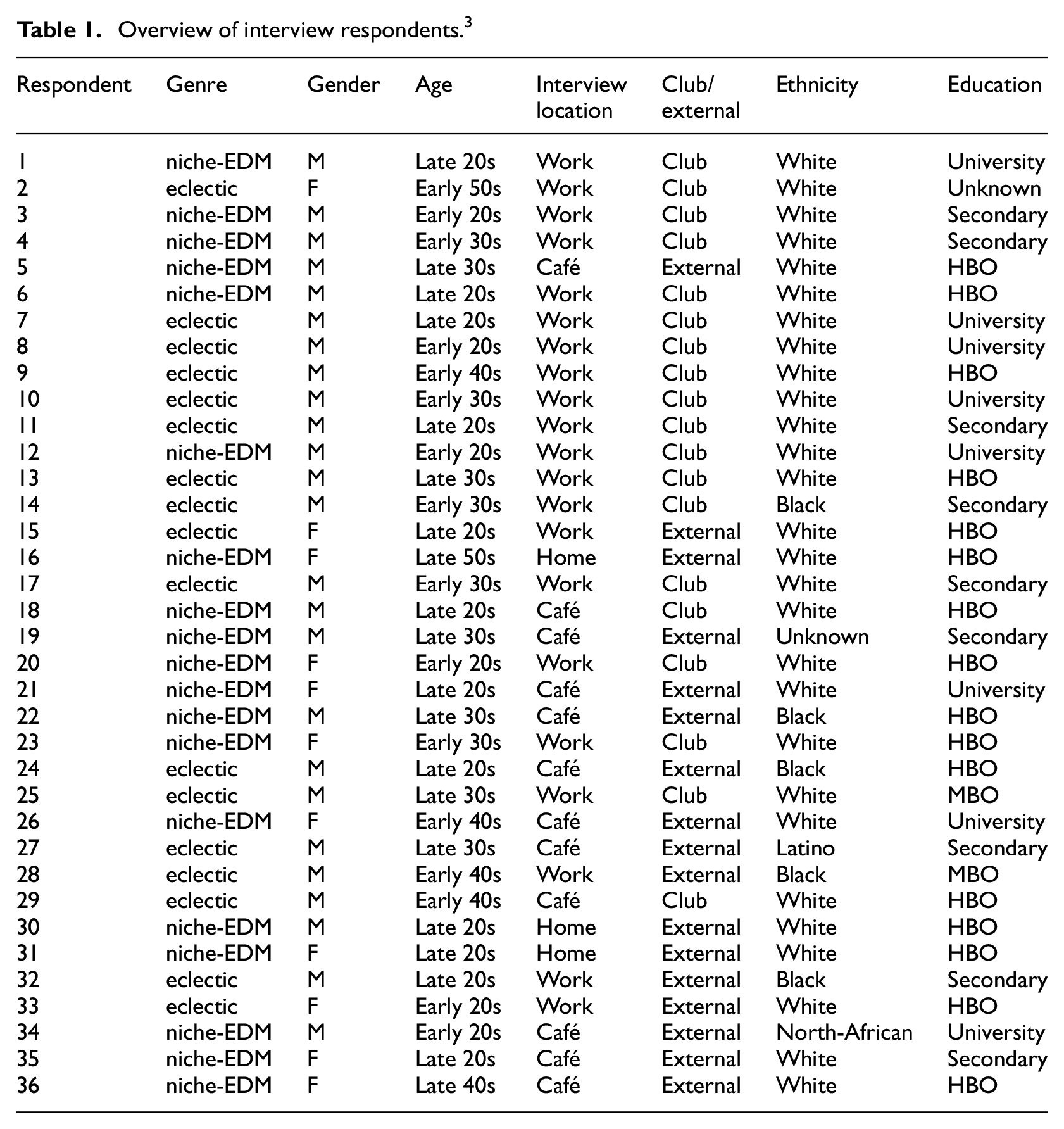
While both authors contributed to the research design and data analysis, the first author conducted the fieldwork. The interview material consists of semi-structured, qualitative interviews with 36 Amsterdam-based promoters. Table 1 provides an overview of the characteristics of the participants but to summarise: 19 were employed by a nightclub (club promoters). Nine promoters worked for niche-EDM venues, 10 promoters worked for eclectic clubs. 2 About 17 promoters were self-employed or worked for an external event organisation (external promoters). Respondents were mainly male (25/36), mainly white (29/36), mainly in their 20s or 30s (29/36), and most had completed a university-level degree or were in the process of doing so (24/36). The first author shared social characteristics (male, white, Dutch, university degree, in his late 20s during fieldwork) with the majority of the respondents.
Overview of interview respondents. 3
The interviews are corroborated by 111 hours of short-term ethnographic visits (Pink and Morgan, 2013) at nightclub and industry events. These were crucial to understanding how promoter’s strategies and motivations behind staging affective atmospheres ‘come alive’ on the night itself, but also to witness planned elements that do not materialise or unplanned, spontaneous moments. Club visits constituted an ‘archive of experience’ (Garcia, 2013) that captures the significance of location, door policies, venue design, lighting and sound, musical conventions and audience behaviour. The fieldwork covered a variety of clubs (28 club nights at 22 different clubs), capturing a broad picture of Amsterdam’s nocturnal geographies, but time constraints prohibited systematic analysis of the same venues to grasp an even more in-depth look at curatorial strategies. However, prior to fieldwork, the first author had lived in Amsterdam for eight years and regular clubbing contributed first-hand knowledge to the ‘archive of experience’.
To enhance rigour and comparability, short-term ethnographies were conducted using a topic list designed to capture the temporality of the club night: observation started outside (the building, queue, door policy), proceeded to the ‘entrance’ (security, ticket booth, cloak room), examined the club space (rooms, outside areas, toilet stalls, smoking areas), before zooming in on the dancefloor (sound and light design, DJ performance, audience behaviour). To capture the temporality of club nights and potential transformations of atmospheres (Anderson and Ash, 2015) visits lasted at least a few hours to witness how events evolve. Field notes were taken on the notes app of a smartphone and typed out and expanded on the next day.
Different atmospheres coexist (Anderson and Ash, 2015): the first author never felt unsafe during clubbing, but clubbers of colour rejected at the door or female clubbers dealing with sexual harassment on nights visited would undoubtedly assess atmospheres differently. Moreover, the first author did not drink during fieldwork: sometimes he felt a distance from the rest of the crowd, that often disappeared through enjoying the music, feeling a peculiar sense of tiredness, anonymity and witnessing crowd euphoria. No on-site interviews were conducted so as not to interfere with the atmosphere or ‘vibe’ (Garcia, 2013). In sum, positionality has been attended to in terms of the researcher-researched relationship in interviews, encountering atmospheres and the ethics and practicalities of conducting fieldwork in nocturnal spaces.
To understand affective atmospheres in their historical, urban and cultural context, and develop a vocabulary to ‘name’ them (Anderson and Ash, 2015), a background document analysis, consisting of policy documents, newspaper articles, business archives, dance music history books and TV documentaries, was conducted, comprising material from 1988 (when house music rose to popularity in Amsterdam) to February 2020 (the start of the COVID-19 pandemic). These documents help situate the fieldwork in a specific time and place and in dialogue with different urban policy rationales and cultural ideals, highlighting the importance of temporality and locality.
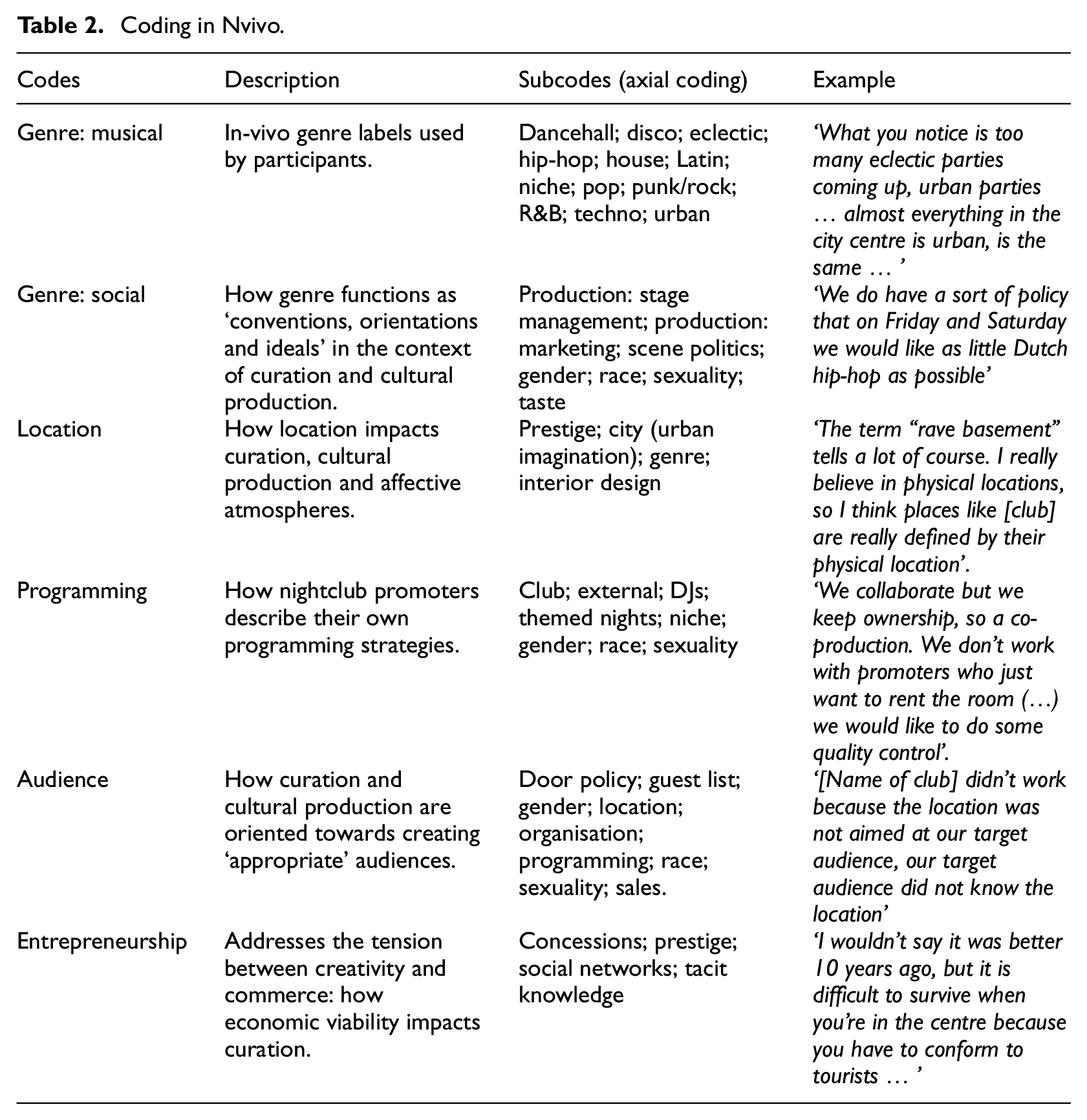
As illustrated by Table 2, data analysis involved a systematic process of coding and re-coding with Nvivo. At first, sections relevant to the research themes and questions were labelled. After that, initial codes were applied to the labelled sections which were derived from the theoretical framework. This process was followed by axial coding, which allowed thinking about different codes relationally and discursively through creating subcodes. We then moved towards identifying preliminary theories and collapsing categories into overarching themes through an iterative process of moving back and forth between data and research questions, interview guides and literature.
Coding in Nvivo.
The case of Amsterdam
Although many cities in the Global North share similar challenges, policies and development patterns, this section provides a short historical overview of relevant events and developments that have changed Amsterdam’s night-time landscape. For this research we define a nightclub as a venue with a dancefloor and a DJ that programmes weekly club nights, mostly after midnight. Figure 1 shows the location of the 49 DJ-oriented nightclubs we identified as of 2019 with 32 classified as eclectic and 17 as niche-EDM. As the map illustrates, nightclubs are mainly found in the nightlife districts around Rembrandtplein and Leidseplein in Centrum– the historical cluster we designate as Zone 1 (Nabben, 2010). But there is evidence of intra-urban dispersal as 14 out of 17 niche-EDM clubs are not located in Centrum (Zone 1).
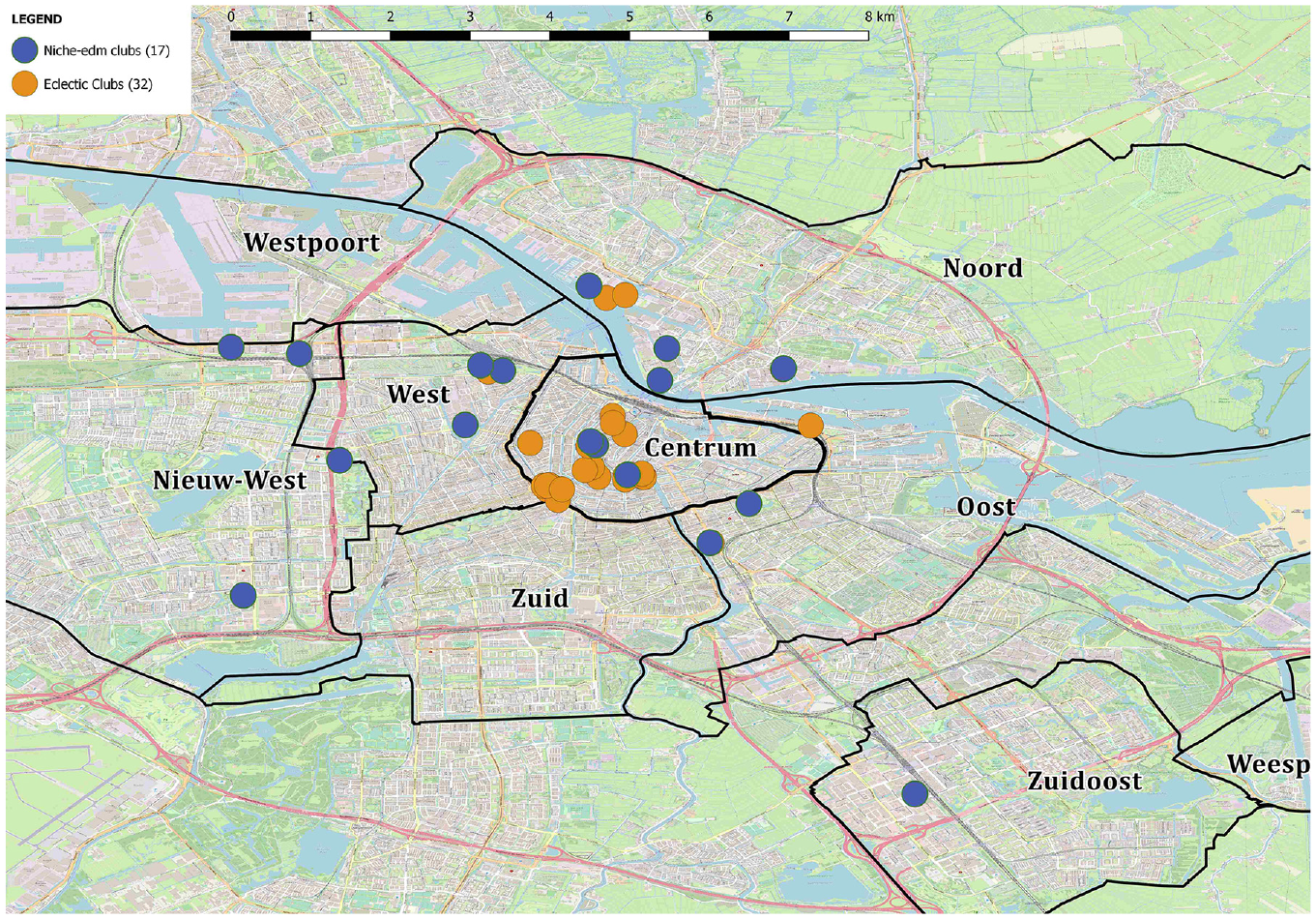
Nightclub locations in Amsterdam (2019).
From the late 2000s onwards, niche-EDM clubs increasingly started opening in re-used buildings in the ‘nineteenth century crescent’ (West, Zuid, Oost) which we refer to as Zone 2 (Savini et al., 2016). More recently, licensed nightlife venues have been moving beyond Zone 2 and outside the A10 highway into Nieuw-West and Zuidoost (post-WWII suburbs) as well as Westpoort (an industrial/harbour area). Noord is the northern area above the river IJ (Noord). Although it has historically been perceived as ‘remote’ by Amsterdammers because pedestrians and cyclists can only reach it by ferry, Noord has become more popular with venues (Savini and Dembski, 2016). We will refer to Nieuw-West, Noord, Westpoort and Zuidoost as Zone 3.
What explains the intra-urban dispersal of Amsterdam’s nightlife from the historical cluster in Centrum (Zone 1) to areas in Zone 2 and 3 (Acuto et al., 2021)? Because part of understanding these urban dynamics entails reviewing the development and impact of gentrification in Amsterdam, we provide a short overview below. 4 After two decades of decline, Amsterdam’s population started to rise again from the mid-1980s, followed by policies introduced in the mid-1990s favouring middle-class homeownership and deregulation of housing associations (Savini et al., 2016; Van Gent and Boterman, 2019). From the 2000s onwards this was followed first by a strategy of urban boosterism to enhance international competitiveness (Peck, 2012) and drive large-scale urban redevelopment after the 2008 financial crisis (Van Gent and Boterman, 2019). While these ‘waves of gentrification’ resemble classic cases like New York City, Amsterdam’s gentrification contains distinctly Western European elements as it is shaped by the demise of social democracy, housing policies that are traditionally non-segregationist, and tenant protection (Van Gent and Boterman, 2019). So, while low-income groups are still able to live in Zone 1 in the social housing that remains, these policies have reduced access to the core city for new low-income groups (Uitermark et al., 2023). Importantly, now that gentrification has started to impact middle-income groups and creative businesses, many early gentrifiers have started to oppose further gentrification (Boterman and Van Gent, 2023).
These spatial developments impact the nightclub sector (Dorst, 2015): in the eyes of the council, creative businesses such as nightclubs contribute to the ‘pioneering stage’ of urban redevelopment which is necessary to create demand for owner-occupied housing (Boterman and Van Gent, 2023). Gentrification has increased pressure on Centrum (Zone 1): a relatively small geographical area that contains the city’s tourism and leisure sector, which includes the night-time economy, as well as residential zones. In the 2000s, the combination of gentrification and increasing tourist numbers sparked a public debate as residents objected to Amsterdam becoming a ‘theme park’ (Pinkster and Boterman, 2017). At the same time, newspapers and magazines reported a dearth of nightlife activity, giving voice to discontent among the city’s nightlife entrepreneurs, mainly because of the difficulty in obtaining the right permits and the relatively early 5am curfew – a result of Amsterdam’s mayor trying to appease Zone 1 residents (Carvalho, 2006).
For nightlife entrepreneurs, a breakthrough came when the 2010 policy notion Topstad bij Nacht (‘Top City by Night’) coupled nightlife, creativity, economic prosperity, and growth in tourism, thereby offering an ‘enabling frame’ for a city seeking new pathways for economic growth (Peck, 2012). Concomitantly, the council expressed the desire to ‘roll out’ the city centre and densify former industrial space to take the pressure off Centrum (Zone 1) by moving tourism and leisure activities to Zones 2 and 3. A few years later, an increasingly professionalised night mayor – an independent broker between nightclubs and city councils – gained a major victory after securing a pilot with 24 hour permits for creative and innovative nightclubs. In line with government policy and to address residents’ complaints, these 24 hour clubs had to be located outside of Centrum (Zone 1). In 2013, Trouw, located in Oost (Zone 2), was the first club with a 24 hour permit.
The success of the 24 hour pilot coupled with the high rents in Centrum (Zone 1), and the availability of larger club spaces with less sound isolation requirements due to distance from residential areas, encouraged new niche-EDM clubs to open in Zone 2 and Zone 3. These clubs made use of cheap space, but like nightlife elsewhere, often could only do so through temporary licences and eventually had to make way for property development (Hae, 2011; Peck, 2012). These developments have dispersed Amsterdam’s night-time economy beyond the established cluster in Centrum (Zone 1) and inspired a new spatial discourse where niche-EDM promoters do not see the historic Zone 1 nightlife districts, such as Leidseplein and Rembrandtplein, as cool anymore. Moreover, nightclub workers have – in response – addressed the lack of affordable space for nightlife to policy makers, arguing for more opportunities for newcomers and long-term rental contracts (Gemeente Amsterdam, 2021). Long-term contracts are important because nightclubs make investments (such as interior design and isolation), so they need time for these investments to pay off. The following sections focus on how promoters negotiate this evolving landscape and a range of spatial, cultural and economic imperatives through their curatorial practices.
Spatialising music genres
The urban dynamics described above shape the curatorial practices of nightclub promoters, but their work is also enabled and constrained by genre-based cultural and economic imperatives (Hesmondhalgh, 2013). Indeed, music genres – as a set of cultural ideals, conventions, and orientations – inform curatorial practices, types of affective atmospheres and commercial orientations (Lena, 2012). This section highlights how Amsterdam’s increasingly dispersed night-time economy aligns with an urban geography of music genres and how this landscape is shaped by urban processes as well as promoters’ curatorial practices.
In both genres nightclubs rely on a few hours on two weekend nights to make a profit, but the eclectic genre is typically seen as more commercially viable than the niche-EDM genre, which helps to explain why eclectic clubs can afford to stay in Centrum (Zone 1). In the niche-EDM genre, DJs are seen as stars or artists which means they have a high degree of autonomy during club nights. Their fees are higher and their performances are based around obscure music tracks. In this genre, promoters expect lower bar revenues, not only because of musical connoisseurship (‘going out for the right reasons’), but also because of higher drug intake among audiences. In the eclectic genre (R&B, hip-hop, dancehall, Latin, etc.), the qualities of a DJ are centred around playing recognisable hits at the right time. DJ taste is less guiding and therefore less risky, so fees are lower, and alcohol intake is expected to be higher, increasing bar sales. As one eclectic promoter points out: niche-EDM club owners have to ‘dare to do it’ and ‘need patience’, because it takes longer for a club to fill up consistently every weekend. For Amsterdam-based clubs, choosing the genre to participate in can be understood as a response to the city’s urban dynamics.
Since genres are also cultural ideals that inform curatorial practices, Amsterdam’s geography of genre implies that nightclubs in different parts of the city stage different types of affective atmospheres. In the eclectic genre, promoters assess a DJ’s quality not by their mixing abilities or musical connoisseurship, but rather by their ability to use well-known songs to create an atmosphere to ‘synchronise’ the audience reaction (Swartjes and Vandenberg, 2022). For example, an eclectic promoter explains that a DJ set is ‘a story’ that needs a build-up: if a DJ wants an audience to mosh and jump around, they first must play records that audiences will sing along to or put their hands in the air to. Producing this atmosphere requires orchestration of people’s actions (Bille and Hauge, 2022): the sought after audience reaction spans a range of emotions (singing along, putting hands in the air) that eventually leads to a collective affective outburst (jumping) inspired by the music.
In the niche-EDM music genre, promoters describe a DJ’s quality in different terms: they place more emphasis on musical connoisseurship, distancing themselves from eclectic clubs by stating that DJ-ing should not be about playing the hits. Rather, they see the DJ as an autonomous artist, someone with an inspiring taste, who should be given artistic freedom. This implies that audiences need to be ‘open’ to new styles and sounds. As a niche-EDM promoter explains, the electronic dance music DJ must make sure that the audience ‘gets behind it’: the DJ’s originality is key to producing ‘the biggest feeling’. For niche-EDM, DJs’ music choices rest less on hits, nostalgia and collective memory, so the DJ’s task of synchronising the audience is arguably more difficult – it is harder to determine the outcome. Promoters want DJs who are forward-thinking and will introduce the audience to new music but promoters are also aware that audiences enter the club with certain expectations of what the night will look like, and therefore might experience DJs as too innovative, experimental, obscure, or novel. Here, we see how different genre-based conceptions of DJ quality stage distinct affective atmospheres: the eclectic promoter’s ideal ‘journey’ is more audience-centred, while the niche-EDM promoters put the DJ centre stage.
This section demonstrates that nightclubs and their promoters use specific articulations of genre to respond to intra-urban dispersal, unintentionally contributing to gentrification. Indeed, while there might still be a few niche-EDM club nights in Centrum (Zone 1) it is harder for their organisers to keep them commercially viable. Promoters and clubs realise this. One interviewee, for example, said their club (located in Centrum/Zone 1) used to be more ‘disco-oriented and experimental’, but when that did not draw in the desired audience numbers, their profile became ‘more accessible’. Promoters attune their curatorial practices to location in a material sense (commercial viability), but they also make sense of urban space on a representational level (informed by a neighbourhood’s urban charisma as well as genre histories). Therefore, the specificities of each genre create a complex arena in which promoters operate and while they use a genre’s cultural ideals, conventions, and orientations to programme appropriate music they also match this music with appropriate spaces.
Staging affective atmospheres at the meso scale and the micro scale
Against the backdrop of Amsterdam’s intra-urban dispersal of licenced clubs into Zone 2 and Zone 3, this section shows how genre has become entangled with spatial discourses that impact curatorial choices at the meso scale (neighbourhood-level) and micro scale (the venue itself). Nightclub promoters negotiate the aesthetics, place-based connotations and practicalities of different urban environments by ‘embracing’ and ‘mediating’ spaces. While they may embrace an area discursively, they also need to mediate the material implications: accessibility, proximity to clusters of other relevant activities, regulation and characteristics such as its perceived remoteness. Space at the meso scale also impacts curatorial choices at the micro scale. Sometimes, promoters treat their location as ‘porous’ (Bille and Hauge, 2022), for example when embracing the industrial aesthetics and connotations of a re-used building in an industrial area. At other times, they mediate their place of activity: for example when promoters attune to different genres and organisers by arranging the ‘appropriate’ lighting plan, decorations and design. This highlights how the meso scale and micro scale interact when staging affective atmospheres.
Clubs in different genres treat the same urban area differently. Promoters in the eclectic genre continue to organise events in Zone 1, benefitting from clustering and centrality in terms of accessibility (especially public transport) and commercial viability (spending power, tourism). Venues in this part of the city are often re-used leisure spaces such as cinemas, sometimes purpose-built and often, because these spaces have been used as a club for decades, extensively refurbished to meet sound isolation requirements. Yet, niche-EDM promoters have started to dissociate themselves from Zone 1. From the 1960s to the 1990s countercultural venues would spring up in Amsterdam’s Zone 1 (Nabben, 2010), but intra-urban dispersal has prompted niche-EDM promoters to start branding Centrum (Zone 1) as a ‘no-go area’ in terms of non-mainstream nightlife. They perceive Zone 1 venues as polished, boring, safe, commercial, and inauthentic. For example, a niche-EDM promoter explains how she feels Amsterdam nightlife is ‘overregulated’, reminiscing about a queer club before it changed strategy and its interior became more polished and clean: ‘it used to be a bit filthy you know, but you did go there’.
Amsterdam’s niche-EDM promoters are more orientated towards Zone 2 and Zone 3. Stimulated by the availability of cheaper space and the 24h permit policy, niche-EDM promoters have reflexively re-oriented their curatorial practices towards something ‘different’, embracing ‘grit’ in search of subcultural authenticity (Garcia, 2016; Hracs et al., 2013). Nightclubs outside of Centrum (Zone 1) are typically housed in regenerated buildings, such as former industrial estates or schools. These clubs are often part of the council’s densification and gentrification strategies (Savini and Dembski, 2016). Yet, locating in abandoned areas is not often about joining a designated or branded nightlife district, but rather proximity to other types of creative businesses and service industries. But over time, as project developers subsequently densify the area, these clubs and other temporary creative spaces make way for residential housing or other types of urban redevelopment. This is the familiar story of ‘gentrification with and against nightlife’ (Hae, 2011). However, clubs are implicated in gentrification not only on a material level, but also on a symbolic level: on a material level, because their ‘pioneering’ work increases market pressure and makes areas fit for redevelopment (Boterman and Van Gent, 2023) and on a symbolic level, because while promoters criticise the polished post-gentrification city centre, they do not criticise the grittier urban aesthetics of ‘pioneering stage’ cityscapes. So, niche-EDM nightclubs continue to look for possibilities to transform space at gentrification’s frontiers for (mostly middle-class) consumption.
While niche-EDM clubs dissociate from Zone 1 and embrace associations with industrial heritage, locating outside nightlife districts creates new curatorial challenges. On the one hand, clubs feel they attract a more dedicated audience (Garcia, 2016), who feel a hard-to-find venue adds to the exclusivity and experience of a night out (Hracs et al., 2013). On the other hand, if locations are perceived as too remote or too ‘exclusive’, they will discourage people and require more effort and planning than a spontaneous night out. A telling example is a promoter’s reflection on the curfew for his nightclub in Noord (Zone 3) being extended from 4 am to 5 am by the local council. He explains that it makes a big difference, because people might not be willing to travel from Zone 1 to Zone 3 for one or two hours, but they might for three or four. For club nights outside of nightlife districts, therefore, promoters must produce something that is cutting-edge, unique and worth travelling for to attract audiences ‘in the know’.
Yet, despite the scattering of club nights across the city, intra-urban dispersal does not necessarily lead to the formation of new, long-term nightlife clusters. Longevity is an issue for nightclubs outside of traditional nightlife districts as licences are often temporary. Due to zoning and permits, nightclubs that shut down in Zone 1 are typically replaced by another nightclub, while clubs in Zone 2 and Zone 3 typically make way for other uses of space, such as housing (Savini and Dembski, 2016). With available spaces in Zone 2 and Zone 3 disappearing and Zone 1 being ruled out as a poor fit for the type of club nights they want to organise, many niche-EDM promoters feel the need to consider new spaces further out. For example, in 2019 the art and event space Het Hem had just opened in Zaandam, a town north of Amsterdam and beyond what we defined as Zone 3. Interviewees perceived this as a landmark moment in redefining how far Amsterdam-based clubbers are willing to travel for on a night out and suggest that the intra-urban dispersal of nightlife in Amsterdam may intensify across existing zones (2 and 3) and extend to new, more distant zones in the future.
As affective atmospheres are ‘porous’ and venues are located within neighbourhoods, intra-urban dispersal is also negotiated at the micro-scale (Bille and Hauge, 2022). Once again, promoters embrace and/or mediate specific spatial dynamics and contexts. For example, niche-EDM is associated with old industrial heritage: nightclubs re-use vacant buildings and ensure lighting, decoration, and the aesthetics of a club’s dancefloor and non-dancefloor spaces (including e.g. bar, cloakrooms, lounge areas, smoking rooms, bathrooms) emphasise the neo-industrial romanticism of urban grit (Garcia, 2016). The following excerpt from the fieldnotes illustrate how this assemblage of objects and practices (Shaw, 2014) creates an affective atmosphere by extending the sense of discovery of going to a hard-to-find part of the city to the club space itself: In this building nothing is straight – it’s the opposite of the black cube that so many clubs are. All the dark spaces make it feel like a club, but you can tell it was not designed as such. It gives people the freedom to appropriate space the way they want. Its maze-like structure adds to a sense of possibility, of discovery. (Field notes, 20 October 2019)
Conversely, nightclubs in Zone 1 mediate the permeability of their location. For these venues, resembling ‘black cubes’ which have been used as nightclubs over many years to host both niche-EDM and eclectic nights, genre-based ideals shape the micro-spatial design choices. Promoters are aware that on certain nights the dancefloor should not come across as too polished and clean. Light and sound engineers are instructed to attune to a party’s needs, as becomes clear from this comparison of two club nights: For our Latin night we always put palm trees, nice decorations, balloons, it’s cheerful. The light needs to be a bit higher, we add a disco ball. To make sure people can see each other we add some platforms that people use as dance stages…[but] when we do a drum & bass night we need strobes, a smoke machine, to turn off the lights … (Club promoter, 30s, eclectic, city centre)
Different genres require different approaches: dancefloor space can be transformed accordingly to stage ‘big feelings’ or collective euphoria. The darkness of niche-EDM dancefloors can be seen as an effort to stage an affective atmosphere where music is central, one that fits the expectation that most of the tracks played will be unknown by the audience – darkness emphasises focus on the aural senses (Rietveld, 2013). By contrast, at eclectic nights in Amsterdam, the warm feeling contributes to the cheerful atmosphere where people can ‘see and be seen’– eliciting flirting (Tan, 2014). Genre differences can play out as promoters connect the meso-scale (an aesthetic vision of what the city at night should look like) with the micro-scale (an aesthetic vision of what the dancefloor should look like) to shape nightclubs’ affective atmospheres. However, at other times music genres’ aesthetic ideals are used to reshape a venue, for example when promoters try to make sure a drum & bass club night does not come across as too polished and clean. This section demonstrates how the meso and micro scales of night-time economies interact and how promoters negotiate and manipulate a range of spatial dynamics, by embracing and mediating specific spaces, to stage affective atmospheres.
Spatialising clubbing audiences
Audiences co-produce the affective atmosphere of a club night, because even a carefully attuned combination of music and space will not work if the audience does not feel they can share ‘ownership’ of the club night (Bille and Hauge, 2022). Therefore, nightclubs devote a lot of attention to curating audiences (Rietveld, 2013; Tan, 2014). Academics have written about the role of door policies as a tool to select the appropriate audience, for example attracting cool subcultural or affluent audiences (Measham and Hadfield, 2009). But the search for the appropriate crowd starts long before the event night and the real-time selection process at the door. Indeed, promoters seek to match genre, space (locations and venues), marketing, guest lists and door policies to attract the audience they want (Koren, 2024). Most importantly, curating audiences entails a negotiation of not just musical but also spatial context: promoters not only need to navigate how audiences move through the night and which audiences go where, they also need to consider audiences’ spatial knowledge and preferences. For example, niche-EDM promoters expect house and techno enthusiasts to be sceptical of the subcultural credibility of clubs in the Canal District (Zone 1), while eclectic promoters think post-industrial locations in Zone 3 are not well connected to public transport, discouraging their visitors.
Given the wide range of entertainment and nightlife options available in a city like Amsterdam, nightclubs cannot just rely on their reputation as a venue but need to stand out on a nightly basis. Location in a nightlife district is not enough: it is not the venue, it is the night, as a club promoter explains: People really know what they’re coming for at the door – the party … And that’s not a bad thing, because … they’re really going for it instead of cowardly standing on the side and leaving after five minutes. So you have a cooler crowd but it’s not like if you open the doors on Friday we’ll have 500 people pop in. That’s not the case anymore. (Club promoter, 30s, eclectic, city centre)
The observed change from spontaneous to informed audiences highlights the impact of nightlife’s intra-urban dispersal. Promoters prefer crowds who know what they are in for, not only because of their increased enthusiasm, but also because it makes the curatorial aspect more interesting: it allows them to challenge audiences with new and innovative sounds and trends rather than tried-and-tested formats. Location is a key mediator for how promoters curate appropriate audiences who add value and co-produce and co-promote the club experience (Hracs et al., 2013).
At the same time, audience curation is a complex process that is difficult to navigate. Door policies may help to select the appropriate crowd, but also exclude audiences along classed, gendered and racialised lines (May and Chaplin, 2008) and many promoters feel morally ambiguous about these policies (Koren, 2024). Moreover, strict door policies are expensive in a competitive nightlife sector like Amsterdam, because turning people away means loss of revenue. Therefore, to attract the appropriate people, clubs strategically consider audience curation early in the planning process. Many promoters use ambassadors to create a ‘buzz’ around their club or event. For example, a club promoter explained that in the previous club he worked in he thought the atmosphere was too ‘boorish’, by which he meant heteronormatively masculine. So, when he could open his own space, his first marketing strategy was a combination of distributing flyers in Amsterdam’s gay saunas as well as offering guest list spots to ‘tastemakers’. The club’s idea is that by attracting a core group of people who fit into their envisioned audience, other clubbers with similar taste, style and behaviour will follow suit. 5
Yet, clubs also need to consider uninformed, more spontaneous, or more sporadic audiences. This is mediated by space. The subcultural authenticity of (post-)industrial locations and re-used buildings attracts electronic dance music enthusiasts to such an extent that niche-EDM promoters brand Centrum (Zone 1) as a ‘no-go area’. This is mainly because of the overwhelming presence of mainstream tourists in Centrum, who can be distinguished from more informed, subculturally savvy tourists that also frequent niche-EDM clubs in Zone 2 and Zone 3. Zone 1 promoters aim to attract local clubbers by organising and marketing club nights in genres other than niche-EDM, but they are also aware that, because of their location, they attract mainstream tourists who lack a (tacit) knowledge of local nightlife and might not have looked at the venue’s programme. Zone 1 clubs experience mainstream tourists as a mixed blessing: Amsterdam’s international image fills dancefloors and brings in revenue, but too many or the ‘wrong’ type can potentially ruin the atmosphere of a club night. For example, ‘stag parties’ were a frequent scapegoat among the interviewed promoters.
Curating audiences entails imagining what audiences might think when they approach or enter a club. Once again, promoters attune their curatorial strategies through embracing or mediating the venue’s location. Promoters acknowledge that to stage the desired affective atmosphere, they need to consider the audience’s musical frame of reference. For example, a promoter for a club in the touristy Centrum (Zone 1) explained that on a night where they only played Dutch hip-hop mainstream tourists left. Because they brand themselves as a hip-hop club, he argued his club should curate hip-hop in such a way that it is also understandable to someone ‘from France’. Another example of embracing location is a Zone 1 club accommodating a Tuesday night external promoter that distributes flyers at youth hostels, given that it is hard to attract a local audience on a school night.
With respect to mediating the venue’s location, reflecting on a niche-EDM club that used to be in the Centrum (Zone 1), a promoter explains that door policies become more important for clubs in nightlife districts, to be able to distinguish between different groups of tourists: to reject ‘stag parties’ and ‘people who think they’re going to one of the commercial clubs’– in other words, people who might ruin the collective affective experience. At an earlier stage, therefore, the curatorial strategy of the marketing department is one of selected visibility (Hracs et al., 2013): promoters explained they tried to reduce their presence on Google Search and tourist websites and only advertise on specialist websites like Resident Advisor. Promoters figure out the appropriate – both physical and virtual – promotion channels to engage with the desired audiences (Jansson and Hracs, 2018). For clubs located in Zones 2 and 3, a strategy of selected visibility is not as needed as their location ensures they mainly attract informed, subculturally savvy tourists on weekend nights.
Thus, club promoters not only consider what happens inside the venue but negotiate a series of urban challenges that are fundamental to the functioning of the night-time economy, including gentrification, urban regeneration, regulation, and tourism. Geographers and urban scholars have highlighted that these processes impact nightclubs’ location and longevity (Hae, 2011). Our discussion of music genres, spaces, and audiences shows that these processes also shape the curatorial practices of nightclubs, highlighting not only how urban and economic contexts enable and constrain creative opportunities, but also the self-reflexive manner with which promoters seek to create ‘the biggest feeling’ as they carefully attune club nights to intra-urban dispersal.
Conclusion
Although night-time economies have traditionally clustered in city centres and nightlife districts, there is evidence that nocturnal spaces and activities, including nightclubs and club nights, are ‘de-clustering’ within cities (Acuto et al., 2021; Campkin and Marshall, 2017). However, the drivers and directions of these spatial changes in specific cities, which feature unique histories, geographies and policies, remain poorly understood. To address this gap this paper examined the intra-urban dispersal of nightclubs in Amsterdam, demonstrating that while the established cluster in the city centre (Zone 1) remains attractive, for specific activities, genres and audiences, clubs and club nights are scattering across Zone 2 and Zone 3. The analysis also revealed how nightclub promoters respond and contribute to these changes by negotiating a range of urban, economic and cultural constraints, imperatives and opportunities. For example, like early gentrifiers becoming opponents of further gentrification (Boterman and Van Gent, 2023), nightclubs contribute to gentrification on a symbolic level by aestheticising urban space and on a material level by paving the way for owner-occupied housing (Hae, 2011), but they are also aware that subsequent intra-urban dispersal comes with (economic) challenges that impact curatorial practices.
The paper demonstrated the relationship between the intra-urban dispersal of Amsterdam’s nightlife and genre. As a set of ideals, orientations and conventions, promoters employ music genres to create distinct and appropriate affective atmospheres. Because nightclub promoters perceive the eclectic genre as more commercially viable, clubs in Zone 1 programme or transition to these musical styles to be able to organise more cost-effective club nights, paying lower DJ fees, while continuing to ensure attendance. By contrast, niche-EDM nightclubs, move to Zone 2 and Zone 3 for cheap space, which allows them to programme commercially riskier DJ-oriented club nights, which typically entail paying higher DJ fees, for audiences open to new styles and sounds.
The paper also explored the practice of embracing and mediating a venue’s location and spatial dynamics. Nightclub promoters in traditional, more touristy nightlife districts in Centrum (Zone 1), especially in the eclectic genre, embrace their location by catering to mainstream tourists through specific articulations of music genres and marketing strategies, while others, particularly in the niche-EDM genre, mediate their central location by decreasing their online and offline visibility to attract subculturally savvy clubbers. Niche-EDM promoters moving out of the city centre into Zone 2 and Zone 3 typically embrace their less central locations which fit the genre’s gritty, post-industrial aesthetics (Garcia, 2016), while dissociating from Zone 1, which is perceived as too polished and too commercialised. The paper also highlighted the connections between the meso and micro scales and the ways in which promoters spatialise audiences. For example, the subcultural authenticity and sense of discovery associated with ‘finding’ formerly vacant venues beyond Zone 1 is amplified by a nightclub’s maze-like structure that invites audiences to discover new rooms. Other, often purpose-built, clubs mediate the club space to avoid being perceived as ‘too clean’ by desired audiences through lighting design and decorations.
These findings make several important contributions to urban studies and related fields. We introduced the term intra-urban dispersal to conceptualise the urban changes in Amsterdam’s night-time economy and demonstrate that while traditional nightlife districts continue to exist, new nightclubs are increasingly scattered throughout the city. We also employed a genre-based analysis to reveal that intra-urban dispersal has a strong cultural dimension, impacting what types of affective atmospheres are staged where. Nuancing our understanding of these processes, we examined the nightclub promoter as a reflexive urban actor and asserted that affective atmospheres do not just ‘emerge’, but are ‘assembled’, through the complex negotiation of space and other elements in advance and in real time. In so doing, we contributed to existing theory and conceptualisations of affective atmospheres and curation – including how spatial dynamics and Amsterdam’s unique urban context shape the curatorial practices of promoters. The findings show that while nightclubs are implicated in gentrification processes, contributing on a symbolic and a material level, the subsequent lack of available space for new nightlife ventures has made promoters critical of gentrification. This dissent is also outlined in the city council’s Night Vision (Gemeente Amsterdam, 2021), although the extent to which nightlife will be prioritised in urban planning remains to be seen. Finally, by exploring the case of Amsterdam, the paper nuances our understanding of urban night-time economies and processes of urban change while highlighting the important role of locational, historical and contextual specificity (Chapuis, 2017; van Liempt et al., 2015). Ultimately, while this research focussed on Amsterdam as a critical case study, the findings and themes hold wider relevance for urban scholars who seek to track and trace the ongoing evolution of night-time economies in a variety or urban settings.
Footnotes
Acknowledgements
We would like to thank Peter Sunley, Phil Hubbard, and the anonymous reviewers for their insightful comments and feedback. We would also like to thank Thomas Calkins for his help with Figure 1.
Declaration of conflicting interests
The author(s) declared no potential conflicts of interest with respect to the research, authorship, and/or publication of this article.
Funding
The author(s) received no financial support for the research, authorship, and/or publication of this article.
