




Abstract
Amid recent controversies in American policing, the authors draw on insights from political science to explore the case of “conflicted conservatives,” Americans who self-identify as conservative but who are operationally liberal in policy preferences. Compared with other political collectives, conflicted conservative attitudes are theorized to be driven primarily by utilitarian concerns about social conditions and government performance rather than by symbolic beliefs. This orientation is believed to enable the group to wield disproportionate influence on elections and public policy, acting as decisive swing voters. The authors use data from Harvard University’s Cooperative Election Study (n = 39,174) to examine support for police reform among conflicted conservatives and other ideological groups. The findings indicate that the views of conflicted conservatives toward reforming the police differ from those of “consistent conservatives,” who are both symbolically and operationally conservative. However, the findings reveal that conflicted conservatives do not show special regard for utilitarian concerns over symbolic beliefs. These findings collectively highlight the complexity of contemporary political ideology and underscore the need for further inquiry into the social policy preferences of emerging and established ideological groups.
In the wake of nationwide demonstrations sparked by the 2020 police-involved murder of George Floyd, Jr., most Americans (58 percent) expressed the need for “major” changes to improve policing (Crabtree 2020). Deep-rooted concerns about racial injustice in law enforcement received widespread attention, leading to renewed demand for specific reforms (e.g., mandating officer body-worn cameras) as well as broader calls to reimagine policing and take more radical approaches (e.g., defunding the police) (Craig and Reid 2022; Vaughn, Peyton, and Huber 2022). Prior research demonstrates that public attitudes, particularly changes in public attitudes, can significantly influence criminal justice policy and practice (Enns 2014; Pickett 2019). Consequently, changing sentiments toward proposals to improve policing may have critical implications for subsequent shifts in law enforcement.
A growing body of research has explored public attitudes toward police reform in the post-Floyd era (e.g., Baranauskas 2022; Pickett, Graham, and Cullen 2022; Reid, Ramos, and Brown 2024; Thompson et al. 2025; Vaughn et al. 2022). Still, researchers have yet to consider the policing attitudes of a uniquely situated group of Americans identified by Stimson (2015) and Ellis and Stimson (2011, 2012) as “conflicted conservatives.” In their in-depth assessment in Ideology in America, Ellis and Stimson (2012) described conflicted conservatives as a “puzzling group of citizens who combine self-identified conservatism with wholly liberal issue views” (p. 149). This idea highlights a disjuncture between citizens’ symbolic ideology (e.g., identifying as conservative) and operational ideology (e.g., supporting liberal spending policies).
Stimson (2015) argued that the views of conflicted conservatives are weakly entrenched in symbolic beliefs compared with those of consistent liberals and consistent conservatives (whose symbolic identity aligns with their operational preferences). According to Ellis and Stimson (2011:148), this situation positions conflicted conservatives as a “politically important swing group” that may cast votes across ideological lines and shift public opinion on issues. Against this backdrop, the group is believed to exert a disproportionately large influence on electoral and legislative outcomes (Ellis and Stimson 2011, 2012; Stimson 2015). Conflicted conservatism provides a valuable lens for sociologists to examine recent controversies in American policing, as it helps reveal how ideological labels, material interests, and social identity can intersect in conflicting ways to shape support, resistance, and ambivalence toward reforming societal structures linked to race and class-based oppression (e.g., the police).
The present study draws on the conflicted conservatism literature and data from Harvard University’s Cooperative Election Study (CES) to inform the ongoing debate on police reform in the United States. First, given their purported political influence, we examine whether attitudes toward police reform vary between conflicted conservatives and other political groups, specifically consistent conservatives, moderates, and liberals. Second, we evaluate a central claim regarding conflicted conservatism: compared with others, the policy preferences of conflicted conservatives are guided more by utilitarian concerns than by symbolic beliefs (Stimson 2015). This argument suggests that the policy reform attitudes of conflicted conservatives are more likely to be shaped by perceptions of social conditions and government performance than by deeply held ideological sentiments (Silver and Pickett 2015). The following sections provide an overview of the literature on conflicted conservatism, discussing utilitarian concerns and symbolic beliefs that may shape support for police reform among this group and other political collectives. We then present the study’s methodology and findings and conclude by discussing the implications of this work, its limitations, and opportunities for future research.
Conflicted Conservatism and Ideology in America
Political ideology, in the broadest sense, refers to “stable, interrelated beliefs and attitudes that organise views on political and social issues” (Claessens et al. 2020:336). In the American context, it is understood to exist along a spectrum, with “liberalism” and “conservatism” constituting opposite ends. People draw on general political ideologies (e.g., the notion that “big government” suppresses individual liberty) to arrive at specific policy preferences (e.g., opposition to expanding government health care). Ideology in America is often translated into governance through direct voting for policy or government action, or by selecting individuals or political groups to make decisions on one’s behalf (Bergman and Passarelli 2024; Scoglio and Nayak 2023). In the latter case, these representatives often form “parties” organized to advance a general political ideology across various policy issues. Amid the trend of increasing polarization (Schedler 2023), general political ideologies have become increasingly salient in American politics, as significantly fewer voters “swing” between parties in their preferences and voting behavior (Smidt 2017). Still, political science research indicates that some individuals hold policy preferences that conflict with those of many others who share the same ideological label. The willingness of these individuals to deviate from the expected stances of their political party has significant implications for political and public policy outcomes.
Stimson (2015) and Ellis and Stimson (2012) demonstrated the importance of two dimensions of political ideology, one symbolic and one operational. According to Stimson, symbolic ideology refers to one’s self-identified political ideology based on beliefs about and affect toward ideas and symbols associated with conservatism or liberalism (e.g., “law and order,” civil rights), as well as general political views (e.g., government spends too much). These may differ from one’s perception of the party that purports to represent those views (e.g., the Republican or Democratic Party). One’s operational ideology, on the other hand, refers to specific attitudes and behaviors typifying how one reacts when faced with the need to decide on particular public policies (e.g., voting to continue current spending on a federal program). The difference is critical in comprehending a fundamental paradox within the electorate: many Americans have a mismatch between their symbolic ideology and their operational preferences, “with nearly all of that mismatch go[ing] in one direction, a preference for conservative self-identification and liberal operational views” (Ellis and Stimson 2012:150). Stimson and Ellis and Stimson (2011, 2012) described these so-called conflicted conservatives as those whose lack of commitment to ideological consistency leads to a willingness to diverge from conservative ideology on specific issues. For example, according to Ellis and Stimson (2012), [Conflicted conservatives] are not pro-tax but generally content with their own tax burden (and more strongly in favor of more progressive taxation), certainly more so than constrained [i.e., consistent] conservatives. They are more strongly in favor of equal opportunity and nontraditional moral behavior and more likely to perceive discrimination against disadvantaged groups than constrained conservatives. And, on balance, they appear not even to be afraid of the specter of “big government” or of a stronger government role in solving social problems. These citizens choose the conservative label but show little evidence of conservatism in either issue preferences or social and political values. (p. 152)
Conflicted conservatives, who constitute over half of self-identified conservatives and about 20 percent of the American electorate (Ellis and Stimson 2012), appear to share more in common with self-identified liberals, with whom they generally hold similar orientations toward government and spending policy preferences (Stimson 2015). A plurality of the American public are “passionate partisans,” with aligned symbolic and operational preferences on either side of the ideological spectrum. These passionate partisans, referred to as consistent liberals and consistent conservatives, constitute roughly 30 percent and 15 percent of the American public, respectively. Moderates make up a substantial portion of the public (about 30 percent), holding centrist views that fall toward the middle of the ideological spectrum. Meanwhile, “conflicted liberals”—those who self-identify as liberal but have conservative policy spending preferences—are exceptionally scarce, constituting less than 2 percent of the electorate (Stimson 2015).
Political utilitarianism is thought to distinguish conflicted conservatives (Silver and Pickett 2015). They “are nonideological pragmatists who trust or distrust each side equally” (Stimson 2015:150), more often separating their ideological positioning from partisan identification. As such, their votes can swing to either party depending on which they perceive will do better in a given context or at a given time (Ellis and Stimson 2011). Given their greater degree of political involvement in an environment of polarization, conflicted conservatives likely wield significant influence on American politics and public policy relative to consistent conservatives and liberals (who seldom cast votes across ideological lines) and moderates (who generally exhibit political indifference and vote less frequently) (Ellis and Stimson 2012).
Conflicted Conservatism and Criminal Justice Attitudes
A review of criminology and criminal justice literature reveals only two studies using the conflicted conservative construct, one exploring political group variation on support for police use of force (Silver and Pickett 2015) and the other examining associations between anti-Black racial bias and punitiveness (Brown, Socia, and Silver 2019). Using responses to the General Social Survey from 1972 to 2014, Silver and Pickett (2015) revealed distinctions between conflicted conservatives and consistent conservatives in views toward police use of force. However, their findings did not support conflicted conservatives’ emphasis on utilitarian concerns over symbolic beliefs. In a subsequent analysis using similar data from the General Social Survey, Brown et al. (2019) found that conflicted conservatives aligned with moderates and diverged from consistent conservatives in their support of the death penalty. However, they converged with consistent conservatives in advocating for harsher court penalties.
The highly publicized murder of George Floyd, Jr., by police in Minneapolis, Minnesota, in May 2020, alongside a series of other deadly police-citizen encounters, led to a protest and reform movement that mobilized activists in more than 140 cities across all 50 states (Putnam, Chenoweth, and Pressman 2020). These events prompted many Americans to reevaluate the role of police in the United States and to consider measures to enhance the quality of crime control nationwide while curtailing police misconduct and violence. We aim to understand the extent of politicized attitudes toward policing in this turbulent era. In particular, we examine whether the attitudes of conflicted conservatives toward police reform differ from those of other political groups and to what extent utilitarian concerns versus symbolic beliefs drive them. In the following section, we discuss how utilitarian concerns and symbolic beliefs may influence views on police reform in the United States.
Utilitarian Concerns, Symbolic Beliefs, and Police Reform Attitudes
Factors that inform political views can be divided into two categories: utilitarian concerns and symbolic beliefs. When considering policing attitudes, utilitarian concerns relate to the “perceived need for the detection and control of deviance, as well as with the expectations about the criminal justice system’s ability to perform those functions” (Silver and Pickett 2015:653). We argue that citizens’ fear of the police, confidence in government, and concerns about the economy represent utilitarian concerns that may influence attitudes toward police reform following the 2020 policing crisis.
One utilitarian concern is fear of the police. That a citizenry with negative views of the police, especially fearful views, may be more supportive of reforms has been demonstrated in the empirical literature. For example, Block (1971) found that whether civilians felt police were respectful was predictive of their support for empowering the police with additional authority and how strongly they felt measures such as civilian oversight agencies and legal protections for defendants were necessary. Block interpreted ratings of police respectfulness as a negative proxy for fear of the police, noting that while “fear may be the foundation on which the institution of police was constructed” (e.g., historical fear of urban crime), “fear is not the construction material for continuing support for the police in relatively normal times” (p. 100). Later, Pickett et al. (2022) found that fear of police was primarily responsible for support for defunding the police and police abolition. Accordingly, individuals who fear the police should be more supportive of reforms to limit police powers and reduce the scope of policing.
A second utilitarian concern is confidence in government. Broadly, one’s confidence in government is based on evaluating “whether or not political authorities and institutions are performing in accordance with normative expectations held by the public” (Miller and Listhaug 1990:358). When asked about unspecified confidence, respondents differentiate between targets of that confidence, such as local versus state and federal governments, different government functions, and spheres of activity (Shaw and Reinhart 2001). Overall, though, research indicates that public views of the government and the police are highly correlated (Jackson and Bradford 2010). For example, Jang, Lee, and Gibbs (2015) found that reporting greater general confidence in the government increased respondents’ likelihood of reporting general confidence in the police. Confidence in government, and associated confidence in the police, may therefore be assumed to reduce individuals’ desire to alter or reform the police (Feather 1998), while a lack of confidence may increase support for alternatives to current policing models (Haas, de Keijser, and Bruinsma 2014). In other words, individuals with more trust and confidence in the government would view the police as in no (or less urgent) need of reform. This relationship may also work in reverse, as Reid, Brown, and Dmello (2024) found that respondents with more positive views toward the police had greater trust in the federal government.
A final utilitarian concern is economic uncertainty, a phenomenon in which “the state of the present or future economy engenders feelings of anxiety or fear” (Fahey et al. 2020:30). Economic concerns may be part of a generalized anxiety about a decline in social order and one’s social position in it (Dammert and Malone 2003, 2006), which, in turn, may negatively affect perceptions of police (Jackson et al. 2009; Wozniak 2016) and increase concerns about or fear of crime (Britto 2013; Singer et al. 2020). However, few have directly examined whether concern about the economy influences preferences for reforming the police (see Baranauskas 2022 for a notable exception). Thus, we have little basis on which to predict, with confidence, how economic anxiety is associated with positions on issues of police reform. On the one hand, reducing police funding might be viewed as a practical necessity by someone concerned about the local government’s economic viability. On the other hand, individuals with greater economic anxiety may want a robust police force to maintain order and stability during uncertain times.
Different from utilitarian concerns, Lau and Heldman (2009) define symbolic beliefs as “early learned affective responses to familiar political symbols such as Democrats and Republicans, conservatives and liberals, blacks and whites” (p. 514). A set of otherwise individual symbolic beliefs form the affective underpinning of political ideology. In this study, we examine four types of symbolic beliefs: religiosity, adherence to gun culture, punitiveness, and racial resentment.
Religiosity refers to one’s commitment to traditional, institutionalized practices related to a search for, and acknowledgment and maintenance of, some relationship with the transcendent, usually some identified deity or set of deities (Hackney and Sanders 2003). It is one of the most salient sources of symbolic belief embedded in American culture. Generally, conservative ideology has been associated with religiosity (Castle et al. 2017; Margolis 2018). Nevertheless, the relationship between religiosity and individuals’ support for criminal legal agencies or their reform is likely complex. In a study of whether crime victimization enhanced respondents’ support for punitive criminal justice policies, Unnever, Cullen, and Fisher (2007) found that church attendance was negatively associated with support for the death penalty but positively associated with support for harsher sentences by local court systems. Moreover, the effect of religiosity on perceptions of police and other criminal legal institutions appears to be racialized. Johnson, Matthews, and Ayers (2018) found that religious participation is associated with more positive assessments of the criminal legal system’s effectiveness by American respondents, except those identifying as Black. In this latter group, religiosity was correlated with less favorable assessments of police performance, and the same was found in a study of Mexican immigrants (Correia 2010). Therefore, although one might expect religiosity to be negatively correlated with support for police reform, there are reasons to expect more support for reform among some religious individuals.
A second symbolic belief is adherence to gun culture, which has been characterized as a distinctly American phenomenon (cf. Shahbazov and Afandiyev 2020). According to Joslyn et al. (2017): Gun culture embraces a historical model of strong individualism and the “gun symbolizes much that is right in [American] culture” including “self-sufficiency and independence,” wherein “the Second Amendment is sacrosanct and gun ownership is viewed as crucial to protecting constitutional liberties from government encroachment. . . . Possession of a firearm implies a psychological and social commitment to guns, a willingness to purchase a gun, a motivation to keep the gun, and generally a public statement of ownership. But gun ownership is much more than this. It likely introduces an individual into a larger gun culture that represents a host of values that are distinctive and increasingly politicized. (pp. 383, 393–394, quoting Wright 1995:68)
We find almost no studies on the relationship between those who subscribe to a “gun culture” and attitudes toward police reform. In one of the few studies relating gun culture adherence to perceptions of police, Carlson (2012) found gun owners have relatively negative views of police, primarily because of perceptions of ineffectiveness. Studies examining police officers’ relationships with gun culture illustrate the tension between officers who must cope with the dangers of policing a gun-carrying civilian populace while often holding identities founded in gun cultures (e.g., Carlson 2019; Woldoff, Litchfield, and Matthews 2017). It is unclear whether adherence to gun culture might lead one to view the police positively as fellow gun culture members or negatively as instruments of gun control.
A third symbolic belief is punitiveness, which refers to the degree to which one accepts pain and punishment as the appropriate response to rule violations (Carvalho, Chamberlen, and Lewis 2020). Punitiveness is associated with support for proactive and aggressive policing as a status quo (Harkin 2015; Silver and Pickett 2015), which should correlate with opposition to police reform. Punitiveness is also related to other factors, such as conservatism and opposition to changing the status quo (Goff, Silver, and Iceland 2022), as well as a fear of crime (Singer et al. 2020), which may influence views on police reform.
A final symbolic belief relates to racial resentment (also referred to as symbolic racism). Resentment involves a “feeling of animosity or antipathy toward a person or group of people who are perceived to be unfair or unjust recipients of some outcome” (Wilson and Davis 2011:117). Much of the study of racial resentment documents the extent of white resentment toward Black Americans. The central premise supporting this animosity rests on “claims not that blacks are genetically inferior to whites but that they lack the moral values of individualism, hard work, discipline, and self-sacrifice that whites believe are central to their race and American society as a whole” (Carmines, Sniderman, and Easter 2011:101). Resentment arises when policies are emplaced to address disproportionality in adverse outcomes, purportedly giving Black Americans an “unfair or unjust” advantage. Mancini, Metcalfe, and Lehmann (2024, 21) found that racial resentment “shaped strong opposition toward measures that would increase accountability and oversight of the police,” such as those put forward in progressive police reform proposals. Similar evidence has been presented by others (e.g., Baranauskas 2022). To the extent that police reform is associated with “benefits” for particular groups (e.g., Black Americans) or the agendas of advocates related to those groups (e.g., Black Lives Matter [BLM]), racial resentment may operate to stymie support for reform.
The aim of the present study is to assess the influence of utilitarian concerns and symbolic beliefs on police reforms that aim to either (1) alter policies relating to police transparency and accountability or (2) reduce resources and funding for the police. How we operationalize these reforms, as well as utilitarian concerns and symbolic beliefs, is discussed next.
Data and Methods
We examine policing attitudes using data from Harvard University’s CES (Ansolabehere, Schaffner, and Luks 2021), a recurring national stratified sample survey. As a premier data source, the CES has been instrumental in individual-level analyses of political information, intentions, and behaviors, as well as how Americans perceive various aspects of the sociopolitical landscape. The 2020 CES, upon which this study’s analyses are based, was distributed by the YouGov polling firm using a matched random sampling methodology with online respondents. A total of 61,000 adults were interviewed from September through October 2020. A second wave of the survey, with different items, was administered from November to December 2020, following the general election; however, not all respondents participated in the follow-up survey. Our total sample of eligible respondents consisted of 44,817 individuals who completed both the pre- and postelection versions of the survey and who met other criteria discussed below.
Political Subgroups
The present study focuses on four political subgroups: conflicted conservatives, consistent conservatives, moderates, and liberals. We construct these groups by using respondents’ ideological and spending preferences as outlined in prior research (Brown et al. 2019; Ellis and Stimson 2012; Silver and Pickett 2015; Stimson 2015). First, respondents’ symbolic ideology (i.e., ideological self-identification) was partitioned from their operational ideology (i.e., spending preferences) by using the CES’s ideological self-identification question, coded so that respondents fell into one of three categories: symbolically liberal (respondents identifying as “very liberal” or “liberal”), moderate (respondents identifying as “moderate”), or symbolically conservative (respondents identifying as “conservative” or “very conservative”). Anyone who chose “not sure” (n = 2,806) was dropped from the analysis.
Next, we specify operational ideology by using respondents’ public spending preferences. Ellis and Stimson (2012) suggested that preferences linked to a stronger government role in addressing social problems related to national priorities, such as education, race, cities, health care, welfare, and the environment, are crucial for identifying operationally liberal versus conservative individuals. These topics, according to Stimson (2015), embody policies from the New Deal that “divide the parties” and make up the “traditional battleground of the welfare state” (pp. 76–77). We identified items in the CES survey that considered three of these subject areas, asking respondents whether they wanted their state legislature to “greatly increase,” “slightly increase,” “maintain,” “slightly decrease,” or “greatly decrease” spending on welfare, health care, and education. Responses for each policy item were recoded such that a liberal response (“greatly increase” or “slightly increase”) was coded 1, a conservative response (“slightly decrease” or “greatly decrease”) −1, and a neutral response (“maintain”) 0. We summed up these responses. Scores ranging from −3 to −1 indicated a conservative spending preference, 0 indicated a neutral spending preference, and 1 to 3 indicated a liberal spending preference.
Combining symbolic and operational ideology variables, conflicted conservatives are those who hold a conservative symbolic ideology but liberal spending preferences. In contrast, consistent conservatives are those who adhere to a conservative symbolic ideology and exhibit conservative spending preferences. Following the work of Silver and Pickett (2015), symbolic conservatives with spending preferences that summed to zero were dropped from the analysis (n = 3,898), as this represents support for a status quo that we have no adequate way to characterize. Moderates and liberals include those who self-identified as moderate and liberal, respectively, regardless of their spending preferences. With this, we created a measure that identifies political subgroup, wherein conflicted conservatives are the reference group coded 0 and represent 13.30 percent of the overall sample, consistent conservatives are coded 1 (11.31 percent), moderates are coded 2 (36.31 percent), and liberals are coded 3 (39.08 percent). 1
Dependent Variables
The 2020 CES includes seven items measuring whether respondents support (coded 1) or oppose (coded 0) various policing reforms. These items include initiatives to end the use of chokeholds, permit civil litigation against police officers, mandate officer body-worn cameras, create a national registry for officer misconduct, demilitarize the police, and reduce police funding to reallocate resources to other social services. We entered these variables into a factor analysis using oblique rotation, which yielded two distinct constructs, labeled (1) support for police policy reform (eigenvalue = 2.39, with factor loadings ranging from .7149 to .8262) and (2) support for police resource reform (eigenvalue = 2.27, with factor loadings ranging from .7662 to .9616). 2
Support for police policy reform was made up of four items measuring whether respondents support or oppose requiring “police officers to wear body cameras that record all of their activities while on duty,” allowing “individuals or their families to sue a police officer for damages if the officer is found to have ‘recklessly disregarded’ the individuals’ rights,” creating “a national registry of police who have been investigated for or disciplined for misconduct,” and banning “the use of chokeholds by police.” A higher score on this measure indicates more support for these reforms.
Support for police resource reform consists of three items measuring whether respondents support or oppose ending “the Department of Defense program that sends surplus military weapons and equipment to police departments,” decreasing “the number of police on the street by 10 percent, and increas[ing] funding for other public services,” and increasing “the number of police on the street by 10 percent, even if it means fewer funds for other public services” (reverse coded). Higher scores indicate more support for reforms centered around police resource allocation. Descriptive information for these and all other variables analyzed is presented in Table 1.
Weighted Descriptive Statistics, by Political Group.

Independent Variables
Utilitarian Concerns
We assess the influence of three utilitarian concerns. Fear of police was measured using a single item, “Do the police make you feel,” followed by the response options, “mostly safe,” “somewhat safe,” “somewhat unsafe,” and “mostly unsafe” (ranging from 0 to 3, respectively), coded such that a higher score indicates more fear of the police. Confidence in government was measured using three items: whether respondents strongly approved, somewhat approved, somewhat disapproved, or strongly disapproved of President Trump, Congress, and the Supreme Court. Because of missing responses on some of these questions, we used an average index to preserve cases and measure the average support for the government. 3 If someone skipped all three questions, they were coded as having a missing response. Scores on this variable ranged from 0 to 3, with higher scores indicating greater confidence in government. Economic concerns were measured using a survey item that asked respondents whether they perceived the nation’s economy to have gotten much better, somewhat better, stayed about the same, somewhat worse, or gotten much worse in the past year. Scores on this variable ranged from 0 to 4, with higher values indicating more economic uncertainty.
Symbolic Beliefs
We examine the role of four symbolic beliefs. Religiosity is measured using three CES items, which ask respondents how important religion is in their lives, how often they attend religious services, and how frequently they pray. Response options varied for each question, so responses were standardized to facilitate their merger. We also used an average index to preserve all cases when respondents answered at least one of the three questions. Scores from this index ranged from −3.6 to 4.4, with higher scores indicating a greater degree of religiosity. Although Mencken and Froese (2019) demonstrated the complexities of measuring symbolic adherence to gun culture, research suggests that family or household gun ownership remains fundamentally linked to gun cultural values (Kleck et al. 2011; Mencken and Froese 2019). Given data limitations, we measure Gun culture using a single item that asks if someone in the respondent’s household owns a gun. Scores of 0 indicate that no one in the home owns a firearm, while scores of 1 indicate someone does. Punitiveness was measured with a CES item asking whether respondents supported or opposed eliminating mandatory minimum sentences for nonviolent drug offenders. Opposition to this policy was coded 1, indicating more punitive beliefs. Finally, we use an additive index to operationalize racial resentment on the basis of respondents’ levels of agreement with the following two statements: (1) “Irish, Italians, Jewish and many other minorities overcame prejudice and worked their way up. Blacks should do the same without any special favors,” and (2) “Generations of slavery and discrimination have created conditions that make it difficult for blacks to work their way out of the lower class” (reverse coded). The Cronbach’s α coefficient for the index was .8546, with higher scores indicating greater racial resentment.
Controls
To isolate the correlative effect of our predictors, we incorporate well-established correlates of policing attitudes as control variables (Baranauskas 2022; Reid 2024; Roscigno and Preito-Hodge 2021; Silver and Pickett 2015; Weitzer and Tuch 2004). Several controls capture respondents’ sociodemographic characteristics: age (in years), male (0 = no, 1 = yes), race 4 (0 = white, 1 = Black, 2 = Hispanic, 3 = Asian, 4 = other), married (0 = no, 1 = yes), children in household younger than 18 years (0 = no, 1 = yes), education (0 = no high school, 5 = postgraduate degree), and being employed (0 = no, 1 = yes). We also account for whether respondents live within a city (0 = no, 1 = yes) and whether their regional location is in the South (0 = no, 1 = yes). Notably, the respondents in our sample come from diverse religious backgrounds, which may have implications for how religiosity, as a symbolic belief, translates into attitudes toward policing and reform (see Selod 2018; Whitehead and Perry 2020). Therefore, to minimize the possibility of drawing misleading conclusions about the role of religiosity, we incorporate a control variable accounting for the religion with which respondents are affiliated (0 = atheist, 1 = Christian, 2 = Jewish, 3 = other). Finally, although fear of crime is likely an essential utilitarian concern linked to policing attitudes (Baranauskas 2022; Silver and Pickett 2015), the 2020 CES does not include perceptual measures that capture respondents’ fear or concerns about crime in their area. Still, because crime rates may inform public opinion on law enforcement policy, we incorporate the Homicide Rate (per 10,000 residents) for the county in which respondents reside. We constructed this variable using pooled 2019–2020 Federal Bureau of Investigation Supplementary Homicide Reports (Kaplan 2021) and population data from the 2022 American Community Survey 5-year estimates. Homicide data were appended to respondent records using Federal Information Processing Standards codes within the CES.
Plan of Analysis
We use ordinary least squares regression for our analyses, which is appropriate given the continuous nature of both outcome variables. After excluding respondents who did not take both waves of the survey (n = 9,449), those who did not answer the political ideology question (n = 18) or responded with “not sure” (n = 2,806), and conservatives who were operationally neutral (n = 3,898), our total eligible sample size was 44,817. Using full-case analysis, our final analytic sample consisted of 39,174 respondents, representing approximately 12.5 percent missingness. The analyses use weighted data via the CES’s commonpostweight variable, enabling the results to generalize to noninstitutionalized adult Americans, including those registered to vote and those who are not (Ansolabehere et al. 2021; Solon, Haider, and Wooldridge 2015).
We found no substantive issues with multicollinearity, with variance inflation factors across our models ranging from 1.12 to 1.19. However, diagnostic tests revealed heteroskedasticity among the models. Although robust standard errors can be used to address this issue, they cannot be applied to weighted data. We reestimated all regression models shown below using robust standard errors and unweighted data; the results of these analyses did not differ substantively from those obtained with weighted data. We therefore elected to prioritize generalizability by using survey weights in the regression analyses. The investigation proceeds as follows. First, we examine whether the views of conflicted conservatives differ from those of other political groups regarding police policy reforms and police resource reforms. Second, we evaluate predictors of support for police policy and resource reforms among subsamples of conflicted conservatives and other political groups, with a particular interest in the role of utilitarian concerns and symbolic beliefs.
Results
Table 2 presents the overall levels of support for each dichotomous measure used to construct our police reform outcome variables. Among the full sample of respondents, all police policy reform proposals received at least 80 percent support, with an overwhelming majority of CES respondents (94 percent) in favor of requiring the use of officer body-worn cameras. The items used to construct the resource reform variable, however, all had noticeably lower overall support. A slight majority of respondents favored demilitarizing the police (55 percent) or reducing police spending (58 percent). Similarly, 56 percent favored increasing police spending (which we reverse coded in our analyses, resulting in 44 percent of respondents opposing increased police funding). The bivariate findings across the four political groups are consistent with expectations. Liberals displayed the highest levels of overall support for each proposal, followed by moderates, conflicted conservatives, and consistent conservatives. Next, we turn to the multivariate results to examine these relationships more closely using our composite measures.
Support for Specific Police Reforms in the Cooperative Election Study, Overall and by Political Group.
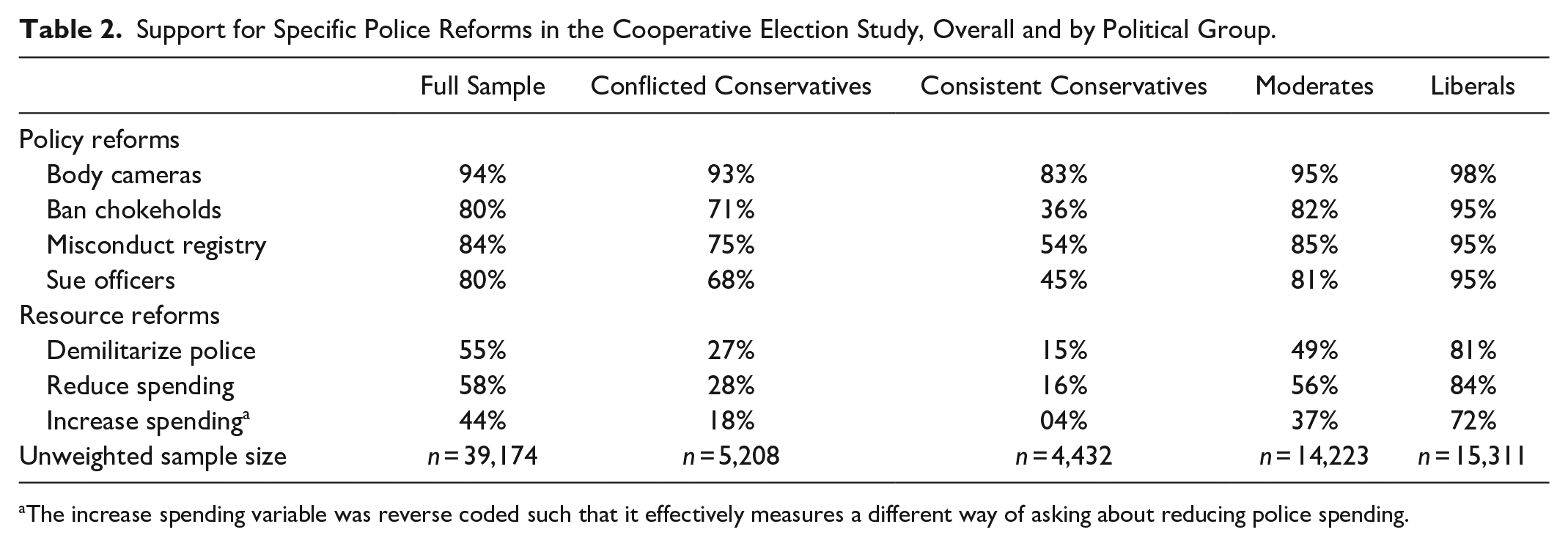
The increase spending variable was reverse coded such that it effectively measures a different way of asking about reducing police spending.
Political Differences in Support of Reform
Table 3 presents the results of two regression models that include only the political groups as predictors, along with demographic and situational control variables. Model 1 examines predictors of support for police reforms aimed at changing policy, such as requiring police to wear body cameras or making it easier for individuals to sue the police for civil rights violations. The results show that conflicted conservatives meaningfully differ from each of the other three groups. Conflicted conservatives were more likely than consistent conservatives to support policy reforms (b = −.234, p ≤ .001) but were less supportive compared with moderates (b = .106, p ≤ .001) and liberals (b = .216, p ≤ .001). Model 2 presents similar results when examining the predictors of support for police reforms aimed at resource changes, such as reducing police funding and demilitarizing the force. Consistent with expectations, the results show that conflicted conservatives were more supportive of resource reforms than consistent conservatives (b = −.132, p ≤ .001) but were less supportive than moderates (b = .169, p ≤ .001) and liberals (b = .433, p ≤ .001).
Weighted Regression Models Displaying Support for Police Reforms for the Full Sample of Respondents.

Note: All models use weighted data.
p ≤ .05. **p ≤ .01. ***p ≤ .001.
In substantive terms, the results of both models in Table 2 demonstrate that significant political differences exist in American attitudes toward police reform. In particular, the policing attitudes of conflicted conservatives differ substantively from those of consistent conservatives, aligning with Silver and Pickett’s (2015) findings. Although Brown et al. (2019) found that conflicted conservatives and moderates are at times indistinguishable in their viewpoints, our results do not suggest this overlap. Nor are conflicted conservatives effectively liberals by another name. They significantly differ in their levels of support for police reform compared with both liberals and moderates, suggesting that, at least as it pertains to these policies, they represent a distinct ideological group. Across both models in Table 3, several of the controls had notable correlational effects. For example, respondents who were married, employed, or religious (in comparison with those identifying as atheists) were less likely to support both reforms. Black respondents were more supportive of both sets of reforms than white respondents. Hispanic and Asian respondents were also more supportive of policy reforms but less supportive of resource reforms than their white counterparts.
Utilitarian Concerns versus Symbolic Beliefs
Table 4 presents the predictors of support for police policy reforms among conflicted conservatives (model 1), consistent conservatives (model 2), moderates (model 3), and liberals (model 4). Here, we include measures of three utilitarian concerns, four symbolic beliefs, and our control variables. Silver and Pickett (2015), informed by Stimson (2015) and Ellis and Stimson (2012), suggested that the policing attitudes of conflicted conservatives should be primarily driven by utilitarian concerns rather than by symbolic beliefs. However, we find that both sets of concerns were predictive of overall support for policy-oriented policing reforms. Model 1 in Table 4 shows that two of the utilitarian concerns predicted conflicted conservatives’ support for police policy reforms. Specifically, conflicted conservatives who were more fearful of the police (b = .062, p ≤ .001) and more concerned about the economy (b = .027, p ≤ .001) expressed greater support for police policy reform. All four symbolic beliefs were also predictive, with conflicted conservatives who were more religious (b = .005, p ≤ .05), adhered less to gun culture (b = −.038, p ≤ .001), were less punitive (b = −.054, p ≤ .001), and had less racial resentment (b = −.024, p ≤ .001) exhibiting more support for policing policy reforms. We reestimated this model using standardized coefficients to examine the relative effect sizes across variables, and we found that racial resentment (β = −.235) and fear of police (β = .193) had the largest relative effects. These findings align with research suggesting that utilitarian concerns are essential in influencing the opinions of conflicted conservatives. Still, they also contradict the idea that symbolic beliefs should matter less to this group.
Weighted Regression Models Predicting Support for Police Policy Reforms among Each Ideological Group.
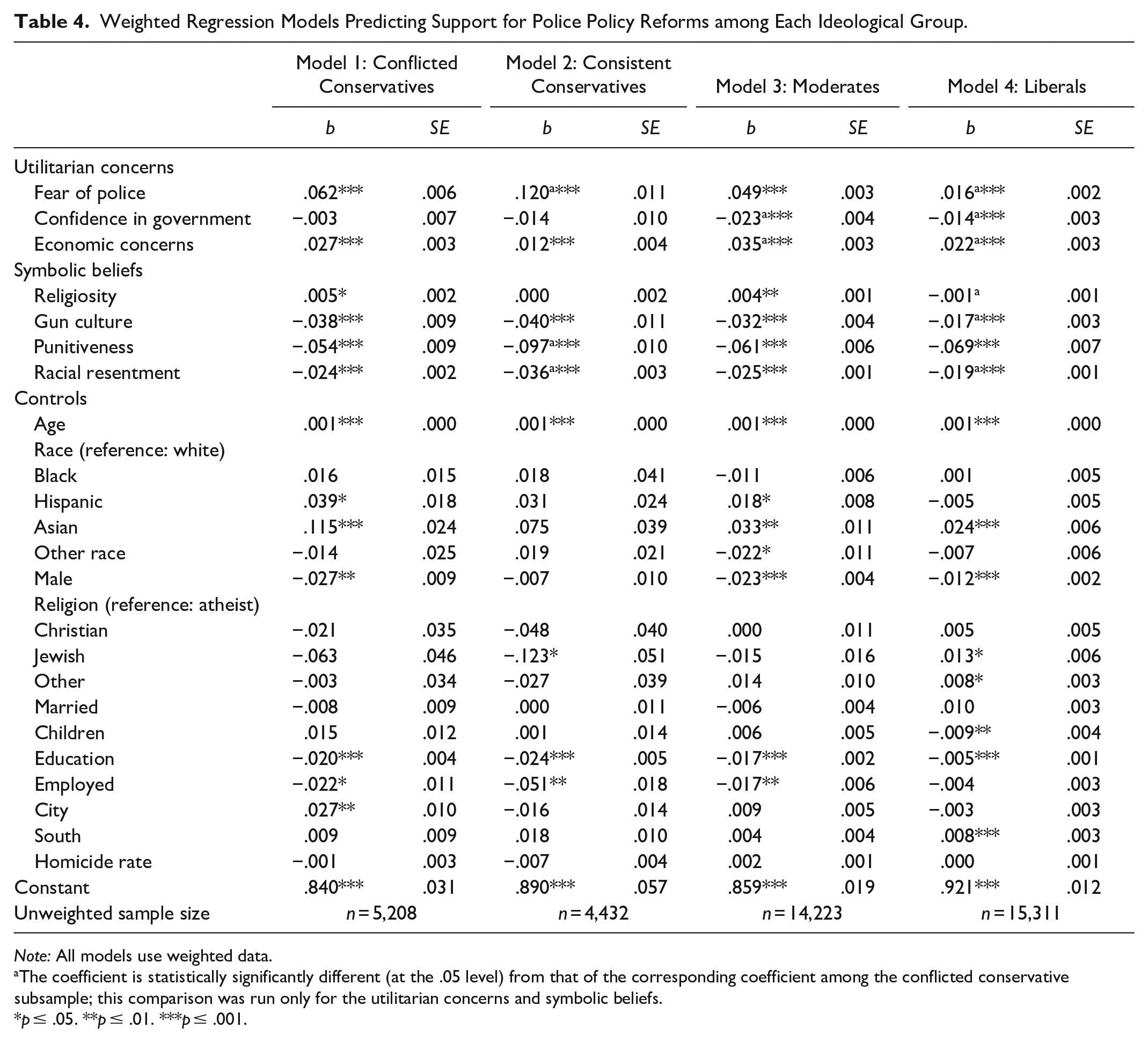
Note: All models use weighted data.
The coefficient is statistically significantly different (at the .05 level) from that of the corresponding coefficient among the conflicted conservative subsample; this comparison was run only for the utilitarian concerns and symbolic beliefs.
p ≤ .05. **p ≤ .01. ***p ≤ .001.
When examining the roles of utilitarian concerns and symbolic beliefs for the other three political groups (i.e., models 2–4), we find that most of these variables were predictive of support for police policy reforms. The direction of the correlative effects was also consistent across groups. For example, respondents in all four political groups were more likely to support policy reforms if they had lower levels of racial resentment (with effect sizes ranging from −.019 to −.036). The effects of only two variables of interest differed across groups: religiosity was not a significant predictor among consistent conservatives or liberals, and confidence in government was not a significant predictor among conflicted or consistent conservatives. For consistent conservatives and moderates, racial resentment and fear of police had the largest relative effect size when examining standardized coefficients; for liberals, racial resentment and punitiveness were the most important predictors.
Table 5 shows the predictors of support for the resource-oriented policing reforms among conflicted conservatives (model 1), consistent conservatives (model 2), moderates (model 3), and liberals (model 4). Model 1 of Table 5 shows that conflicted conservatives are motivated by all three utilitarian concerns. In particular, conflicted conservatives who are more fearful of the police (b = .116, p ≤ .001), less confident in government (b = −.025, p ≤ .001), and more concerned about the economy (b = .008, p ≤ .01) are more likely to support police resource reforms. Symbolic beliefs, assumed to play a lesser role in their policy views, likewise had correlative effects similar to those displayed in Table 4. Conflicted conservatives who more strongly adhered to gun culture (b = −.018, p ≤ .05), who were more punitive (b = −.065, p ≤ .001), and had more racial resentment (b = −.027, p ≤ .001) were less likely to support police resource reforms. When reestimating this model using standardized coefficients, fear of police (β = .243) and racial resentment (β = −.179) had the largest relative impact on support.
Weighted Regression Models Predicting Support for Police Resource Reforms among Each Ideological Group.

Note: All models use weighted data.
The coefficient is statistically significantly different (at the .05 level) from that of the corresponding coefficient among the conflicted conservative subsample; this comparison was run only for the utilitarian concerns and symbolic beliefs.
p ≤ .05. **p ≤ .01. ***p ≤ .001.
Models 2 to 4 examine the roles of utilitarian concerns and symbolic beliefs among the other three political groups. The results reveal that fear of police, economic concerns, punitiveness, and racial resentment had consistent correlational effects across the three groups. Moderates (model 3) were also motivated by confidence in government, religiosity, and gun culture; religiosity also motivated liberals (model 4). In short, the support for police resource-based reforms among each political group was predicted by both utilitarian and symbolic beliefs. 5 An examination of standardized coefficients once again revealed that the most substantive predictors were racial resentment and fear of police (with liberals’ support also being heavily predicted by punitiveness).
Several control variables in Tables 4 and 5 warrant brief discussion. For example, the homicide rate was not a significant predictor of support for policy reforms for any of the four political groups. Still, it did predict support for resource reforms for all groups except conflicted conservatives. Education also had relatively consistent correlational effects, being inversely related to support for policy reforms across all political groups but positively related to support for resource reforms among moderates and liberals. Among conflicted conservatives, racial and ethnic minority status generally predicted more support for both reforms (when it was statistically significant). For moderates, Hispanic and Asian respondents were more supportive of policy reforms, while “other race” respondents were less supportive. Black and Hispanic moderates, however, were less supportive of resource reforms than their moderate white peers. Similarly, Asian liberals were more supportive of policy reforms than white liberals. Still, Black liberals, Hispanic liberals, and “other race” liberals were less supportive of resource reforms than white liberals. Race has consistently been a predictor of support for various policing reforms (e.g., Weitzer and Tuch 2004). However, we find that some variation exists depending on the respondents’ political affiliation, a finding that aligns with recent work by Thompson et al. (2025).
Supplemental Analyses
This study’s results align with research suggesting that conflicted conservatives form a distinct group of ideologists whose views differ significantly from those of consistent conservatives, moderates, and liberals. We conducted supplementary analyses to examine whether effect sizes for each utilitarian concern and symbolic belief coefficient varied between conflicted conservatives and each of the other three groups. These results are presented in Tables 4 and 5, with an superscript lowercase a indicating coefficients that significantly differ from the corresponding coefficients for conflicted conservatives. Although we find some statistically significant differences, the directions (and often even the magnitudes) of these differences are similar. Overall, it appears that the factors motivating conflicted conservatives are similar to those of other groups; that is, both utilitarian concerns and symbolic beliefs seem to inform the views of different ideological groups on both types of police reform.
We conducted additional analyses (not shown) to investigate how conflicted conservative voters may differ from others. For example, Ellis and Stimson (2012) suggested that conflicted conservatives are less interested in politics than consistent conservatives and liberals, more politically active than moderates, and more likely than consistent conservatives or liberals to vote across party lines. 6 We conducted chi-square analyses revealing that conflicted conservatives had the lowest level of political interest (2.24 on a scale of 0–3) compared with the other three groups in our sample. However, this was only slightly lower than that of moderates (2.27). Similarly, conflicted conservatives had the lowest level of political participation (.64 on a scale of 0–6) among the four groups, again, only slightly less than moderates (.75). In both cases, liberals and consistent conservatives displayed higher levels of interest (liberals = 2.60, consistent conservatives = 2.66) and participation (liberals = 1.53, consistent conservatives = 1.18) than moderates or conflicted conservatives, consistent with Ellis and Stimson’s (2012) expectations. The hypothesis that conflicted conservatives would vote more across party lines was also supported. We find that 23.36 percent of conflicted conservatives in our sample voted across party lines in 2020, compared with only 1.85 percent of consistent conservatives and 2.62 percent of liberals. Notably, however, conflicted conservatives and moderates were less likely to vote in the first place (87 percent each), compared with consistent conservatives (96 percent) and liberals (94 percent). Chi-square analyses confirmed that these differences were statistically significant.
Discussion
Extant research has demonstrated the influence of public opinion on criminal justice policy (Enns 2014; Pickett 2019). However, deepening polarization across the political landscape raises questions about who holds meaningful influence in social policy and criminal justice matters. Stimson (2015) and Ellis and Stimson (2012) presented the concept of conflicted conservatism, characterizing conflicted conservatives as individuals who self-identify with the conservative ideological label but exhibit operational liberalism in their policy spending preferences. Compared with other political collectives, the attitudes of conflicted conservatives concerning social policies are theorized to be “driven more by utilitarian concerns, which include perceptions of social conditions and government performance, than symbolic (or expressive) beliefs, which describe deeply held ideological worldviews” (Silver and Pickett 2015:651). This orientation is purported to enable the group to wield disproportionate influence on which of similarly represented but opposing views achieves a public majority and, by extension, becomes public policy (Ellis and Stimson 2012; Stimson 2015). As conflicted conservatives serve as a potential barometer of majority public opinion, evaluating their views on police reform can contribute to a deeper understanding of the present and future of American policing.
Against this backdrop, the current study empirically examines two claims about conflicted conservatives advanced in prior research. First, Stimson (2015) and Ellis and Stimson (2012) argued that conflicted conservatives “represent a distinct group, [that is] certainly not ‘conservative,’ and not quite ‘liberal’ or ‘moderate,’ either” (p. 152). Our findings support this notion. Compared with consistent conservatives, conflicted conservatives were generally more supportive of reforming the police, yet less supportive than both liberals and moderates. Second, the theorists argue that the policy attitudes of conflicted conservatives, compared with other groups, are more motivated by utilitarian concerns than by symbolic beliefs. Although our study demonstrates that utilitarian concerns were essential for informing police reform attitudes among conflicted conservatives, we also find that symbolic beliefs significantly predicted support for various police reform proposals. The most salient predictor of conflicted conservatives’ support for policy-based reforms was racial resentment, a symbolic belief. Likewise, both utilitarian concerns (especially fear of police) and symbolic beliefs (especially racial resentment) were salient predictors of support for consistent conservatives, moderates, and liberals. These findings, therefore, diverge from theoretical expectations, suggesting that, at least regarding recent calls for police reform, conflicted conservatives do not exhibit a unique consideration of utilitarian concerns over symbolic beliefs. Instead, the views of each political group appear to be motivated by a combination of utilitarian and symbolic indicators.
This divergence from theoretical predictions could be a function of the temporal context in which politicized police reform attitudes were assessed. The CES survey used in this analysis was administered in 2020—a turbulent sociopolitical period marked by “diffuse anxiety” related to a once-in-a-century global pandemic and numerous overlapping national crises (see Reid et al. 2024). According to the U.S. Crisis Monitor, the confluence of emergent issues placed the nation at a heightened risk for political violence and instability (Kishi and Jones 2020). Misinformation and divisive political rhetoric surrounding the 2020 presidential election further exacerbated polarization and reinforced a climate of deep collective uncertainty across the country (Chen et al. 2021). Calls for police reform were, of course, also particularly salient in 2020 following the murder of George Floyd and the ensuing national and international BLM protest movement. Despite similar events in the past—such as the beating of Rodney King in Los Angeles or the shooting of Michael Brown in Ferguson, Missouri—the scope of mobilization efforts following Floyd’s death is considered among the largest in American history. The widespread turmoil and hyper-polarized environment in which CES respondents were asked to reflect on these proposals may have influenced their views in anomalous ways unique to this unprecedented period. Perhaps in relatively stable times, theoretical expectations concerning utilitarian versus symbolic concerns may be more strongly supported.
When Stimson (2015) first introduced the phenomenon of conflicted conservatism in the first edition of his book in 2004, the political landscape in America was markedly different than what exists today. The political ascent of President Donald Trump, for example, has ostensibly redefined the Republican Party in various aspects. Additionally, the make America great again (MAGA) movement, for which he is the key figure, is emblematic of fundamental shifts in the orientation of American politics. MAGA and the values it represents are now a distinct symbol of modern-day conservatism, differing in subtle yet meaningful ways from the conservatism of past periods. Such a situation has important implications for understanding what defines the “conflicted” nature of ideology in today’s context and highlights the complexity and ever changing nuances of ideology in America. The role of utilitarian concerns and symbolic beliefs in guiding policy preferences, as described by Stimson (2015) and Ellis and Stimson (2012), may have changed over time, operating differently in “Trump’s America.” Future research would benefit from analyzing long-term data spanning before, during, and after the Trump presidential era to enhance understanding of the mechanisms that inform politicized attitudes at different periods, not only toward police reform but also toward other salient criminal-legal and social policies. Matters concerning immigration and border security, for instance, have long animated American political discourse and offer potentially promising areas for future scholars to explore.
Beyond the mixed support for theoretical expectations, the present study shows that overall support for reform among each political group is particularly noteworthy for measures presented in the George Floyd Justice in Policing Act, 7 including the ban on chokeholds, the establishment of a national police misconduct registry, and limitations on qualified immunity protections. Results in Table 2 show that the vast majority of liberals (95 percent to 98 percent) and moderates (81 percent to 82 percent), as well as a substantial share of conflicted conservatives (68 percent to 75 percent), supported these individual efforts. In contrast, consistent conservatives were far less supportive, with only 36 percent supporting a ban on chokeholds, 45 percent favoring increased access to civil litigation against police for misconduct, and a slight majority of 54 percent in favor of a federal misconduct registry. Other proposals, not included in the George Floyd Justice in Policing Act, also had varying levels of overall support across groups. For example, 81 percent of liberals compared with 49 percent of moderates, 27 percent of conflicted conservatives, and 15 percent of consistent conservatives, support ending the U.S. Department of Defense program that sends surplus military weapons and equipment to police departments. Together, these findings suggest that politicized views toward police policy and resource reforms likely depend on the specific proposal being considered.
Furthermore, irrespective of ideology, Table 2 shows broad popular support for requiring officer body-worn cameras (94 percent support) and establishing a national misconduct registry (84 percent support). However, at the direction of President Donald Trump, the Department of Justice has discontinued its national database tracking misconduct incidents among federal law enforcement officers (Cauchi 2025). Likewise, the Drug Enforcement Administration has abandoned the use of body-worn cameras, reportedly to comply with President Trump’s executive orders (Ariza 2025). Considering the findings presented in Table 2, these policy outcomes raise critical concerns within the context of U.S. representative democracy, where aggregate public opinion and constituents’ policy preferences are expected to inform such policy decisions (Lax and Phillips 2012).
Our results also highlight several key correlates of Americans’ attitudes toward reforming the police. For example, measures of racial resentment and fear of the police invariably and robustly informed views on police reform, regardless of respondents’ ideological orientation. Respondents with higher levels of racial resentment were less likely to support both composite measures of police reform. Conversely, those who harbored greater fear of the police were more inclined to support these measures. Prior research has extensively documented an entrenched view within American society and culture that conflates blackness with negative archetypes of violence and criminality (e.g., Headley and Blount-Hill 2021; LeCount 2017; Russell-Brown 2009), which has been shown to influence views of criminal justice matters (e.g., Baumgartner, Caron, and Duxbury 2023; Chiricos, Welch, and Gertz 2004). To the extent that police reform—and criminal justice system reform, more broadly—is desired, stakeholders will need to address resentment toward Black Americans as well as other minoritized racial groups. To aid in this endeavor, future research is encouraged to examine the role that racial resentment and anti-Black bias play in influencing politicized attitudes, with the aim of understanding how resentment develops, the factors that may exacerbate or mitigate its influence, and how it can be challenged in ways that promote greater equity and justice.
This line of inquiry is also relevant among police officers, who have proved to be more racially resentful than nonpolice personnel (LeCount 2017). Research by Roscigno and Preito-Hodge (2021) suggests that police officers often hold the view that they should receive more funding and have the right to use physical force against citizens. With this in mind, racialized and arguably racist views that are especially apparent among white male officers (LeCount 2017; Roscigno and Preito-Hodge 2021) may intersect with “vested occupational interests” and, from time to time, lead to deadly police-citizen encounters (Roscigno and Preito-Hodge 2021). It is these types of encounters that help condition at least some Americans to live in fear of the police (see Pickett et al. 2022), and, in turn, this fear can lead to policy preferences favoring reform, as evidenced in this study and others. Stakeholders have come to recognize that how communities view the police plays a critical role in shaping their interactions with law enforcement, their trust in police as an institution, and their willingness to support funding or other policy initiatives related to policing. To the extent that police departments do not want to lose community support or funding, it is essential to address fear of the police among their constituents. Still, this is admittedly easier said than done. Among other things, this work requires intentional efforts to change the historical intergroup narrative that shapes how police and neighborhoods understand, perceive, and interpret each other and their actions (Blount-Hill, McLean, and Jenkins 2023). 8
Like all research, the current study has its limitations. Because of data constraints, we were unable to account for respondents’ exposure to the media, particularly media reporting on police-related issues. Although the press serves a critical role in disseminating the demands of social movements, Reid and Craig (2021) highlight the tendency of mainstream news outlets to frame or portray social protest events linked to racial minorities as “threatening” irrespective of their peaceful nature. Such coverage in the context of 2020 anti–police brutality demonstrations may have served to delegitimize BLM protestors’ calls for reform and potentially sway respondents’ views in one way or another. Relatedly, measures from the CES were relatively limited in their ability to assess the utilitarian and symbolic concerns that might impact support for police reform. For example, we assessed gun culture using the CES question “Do you or does anyone in your household own a gun?” Although this item has been used in prior assessments of gun culture (e.g., Silver and Pickett 2015), one could argue that it captures a utilitarian concern related to self-protection rather than a symbolic belief. In addition, considering the influence of local government over the police, it would have been preferable to evaluate confidence in local government as a utilitarian concern, rather than the national-level measure we used. We encourage future scholars to use more robust measures of confidence and gun culture to enhance their ability to pinpoint patterns in symbolic versus utilitarian support for police reform.
Finally, Ellis and Stimson (2012) suggested the possibility that conflicted conservatives can be further divided into two groups. The first comprises cultural conservatives who hold liberal views on spending and conservative views on social issues, and the second consists of true conflicted conservatives who hold liberal views on both spending and social issues. What if utilitarian considerations have less influence on cultural conservatives than their truly conflicted counterparts? In that case, differences may emerge between the two groups concerning levels of support and the underlying drivers of police reform attitudes. Data limitations prevented us from performing such an analysis. However, to deepen understanding about conflicted conservatism, future studies might consider a more differentiated conceptualization of the group.
Despite these limitations, the present study offers nuanced insights into the role that political ideology plays in guiding police reform attitudes in the post-Floyd era. Our findings demonstrate a clear political divide in American attitudes toward police reform, not merely between the often studied liberal-conservative dichotomy, but most notably among Americans who self-identify with the conservative ideological label. We find the policing policy preferences of so-called conflicted conservatives differ significantly from those of consistent conservatives, with the former being considerably more supportive of police policy reforms. Although we uncovered no uniform political differences in the symbolic and utilitarian indicators associated with these attitudes, our results underscore the importance of moving beyond treating conservatives as a homogeneous group in research on political ideology and criminal justice matters. In particular, our results point to the analytical value of considering the distinct position of conflicted conservatives.
Footnotes
1
“Conflicted liberals” (those who identify as liberal but with conservative policy spending preferences) were assessed. They constituted only 0.54 percent of the sample. Their low prevalence is consistent with Ellis and Stimson’s (2012) and Stimson’s (2015) theory and findings. Following  , we combined consistent and conflicted liberals into a single “liberal” group. However, one might argue that these represent a sufficiently distinct phenomenon that they should be analyzed separately (just as we suggest for conflicted conservatives). In supplementary analyses, we reestimated all regression models with the conflicted liberals excluded from the sample, but the findings remained unchanged. In supplementary models that included conflicted liberals as a distinct category, there were divergences in significance because of the smaller sample size. Still, the directions and magnitudes of the observed correlative effects were consistent for both liberal subsamples, regardless of these specifications.
2
To facilitate factor analysis with dichotomous variables, we used the tetrachoric and factormat commands in Stata 16, and we used regression scoring to create all factor scores.
3
In total, 84 respondents did not answer the question about their approval of President Trump, 2,317 did not report their approval of Congress, and 3,910 did not answer about the Supreme Court.
4
We use the term race in its broadest sense to include both racial and ethnic groups. For example, although Hispanics can be categorized into different racial groups, for the purposes of this study, we refer to them as a distinct subgroup. Additionally, the CES uses the term Hispanic as opposed to Latinx. We therefore mirror this terminology for consistency.
5
As a robustness check, we also examined logistic regression models that replicated Tables 4 and , using the decomposed dichotomous measures for each outcome. We consistently found that a combination of both utilitarian and symbolic beliefs was predictive of attitudes for each ideological group, demonstrating that the results are not sensitive to the operationalization of the dependent variables.
6
To assess one’s interest in politics, respondents were asked, “Some people seem to follow what’s going on in government and public affairs most of the time, whether there’s an election going on or not. Others aren’t that interested. Would you say you follow what’s going on in government and public affairs,” and respondents could choose among five options: “most of the time,” “some of the time,” “only now and then,” “hardly at all,” or “don’t know” (we dropped this last group from this analysis). Chi-square tests were used to examine differences across these categories for each of the four political groups. Respondents were also asked whether they had participated in any of seven different types of political activism (e.g., donating to a campaign, attending a protest) in the previous year. These activities were combined in an additive index measuring political participation, with higher scores indicating a more politically active respondent. Because of the continuous nature of the variable, analyses of variance were used to assess differences across the four political groups. Respondents also reported who they voted for in the 2020 election, with their responses grouped into three categories: Joe Biden, Donald Trump, or another candidate. Conflicted and consistent conservatives who voted for anyone but Trump were considered to have voted across party lines. At the same time, liberals who voted for anyone but Biden were also considered to have voted across party lines. Moderates were not included in this particular analysis, nor were respondents who did not vote. Because of the categorical nature of both variables, χ2 tests were used to assess differences across groups of voters.
7
This federal bill was initially presented in 2020 following the murder of George Floyd. The bill seeks to promote transparency in law enforcement practices, enhance police accountability, and limit the use of excessive force. Fundamental aspects of the bill include banning chokeholds and no-knock warrants, limiting qualified immunity, creating a national police misconduct registry, enhancing use-of-force standards, expanding the U.S. Department of Justice’s investigative powers, mandating data collection on police encounters, and prohibiting racial profiling.
8
Although often overlooked in the literature, Kondrat, Reid, and Brown (2025) examined how national security threats related to the infiltration of far-right extremists within the US military could have downstream consequences for American law enforcement. As roughly 20 percent of American police officers are military veterans, the authors called for stakeholders to urgently address what is seemingly a culture of permissiveness toward far-right extremism within the U.S. Armed Forces. According to Kondrat et al., the “institutional pipeline between the military and police . . . may serve as a conduit for the transfer of overtly racist individuals into civilian law enforcement” (p. 3), threatening public safety and potentially eroding public trust in law enforcement institutions.