



Abstract
This research draws on conflict-based accounts to examine how perceptions of out-group threats shape White resistance to police and criminal justice reform. Using nationally representative data from the ANES-GSS 2020 Joint Study, we find that White Americans who perceive immigrants as a criminal threat are more likely to prioritize the need for more robust social controls rather than supporting efforts toward reforming the police and the criminal legal system. We also uncover a link between racial competition for political power and White preferences for a stronger emphasis on law and order through expanded policing and more stringent enforcement of the laws. This preference supersedes the desire to address bias against minorities in the criminal legal system through police and court reforms. The implications of these findings for understanding the current context of American racial and immigration politics, as well as the future of American policing and criminal justice, are discussed.
Introduction
Public anxiety and fear over immigration are deeply ingrained in the American consciousness. From Benjamin Franklin’s assertion that German migrants “will never adopt our language or customs” to President Trump’s claim that Mexican immigrants are “bringing drugs [and] crime,” anti-immigrant sentiment seems to be as American as apple pie (Rosenfeld, 2015). However, discrimination and intolerance are not the only deleterious outcomes that newcomers may experience. Immigrants today must also confront an increasingly punitive immigration and criminal legal system that is difficult to disentangle (Beckett & Evans, 2015).
Referred to as crimmigration, scholars argue that the criminal justice system is now used as a tool for identifying and expelling immigrants from the United States (U.S.) (Jiang & Erez, 2018; Stumpf, 2006). At the heart of the crimmigration process is the police (Pickett, 2016). Although immigration enforcement has traditionally fallen under the federal government’s purview, a wave of legislative acts since the 1980s has given increased powers to local and state police to engage in immigration enforcement (Muchow, 2024). These policy changes led to a concerted effort to identify and apprehend “criminal aliens,” or noncitizens with arrest records, including not only those who committed violent crimes and felonies but also those with misdemeanors or traffic violations (Eagly, 2013). The result is that noncitizens with a deportable status will typically come to the attention of immigration officials after an arrest, most often by the police. From this perspective, the police are not just the gatekeepers of the criminal justice system, they are also on the frontlines of immigration enforcement (Pickett, 2016).
In light of the increasing role of local police in immigration enforcement, the goal of the current study is to examine the relationship between immigrant threat and resistance to criminal justice reform during the recent policing crisis. In May 2020, George Floyd’s death at the hands of Minneapolis police reignited the Black Lives Matter (BLM) campaign and sparked the largest protest movement in U.S. history (Putnam et al., 2020). Millions of Americans across more than 140 U.S. cities took to the streets to advocate for an end to police brutality and racial inequities (Buchanan et al., 2020).
At the heart of the protests were widespread calls for criminal justice reform, particularly policy changes (e.g., mandating officer body-worn cameras and establishing a national misconduct registry) that would increase transparency and accountability in policing (Hanink & Dunbar, 2024). However, critics of the movement labeled protestors as “thugs” and blamed the demonstrations for spurring civic unrest and historic increases in violence (Baranauskas, 2022). In response, conservative pundits called for law and order, a veiled term that has historically been used to link people of color with violence and disorder and to justify anti-crime policies (Pickett, 2016). The summer of 2020 was, therefore, a critical period for politicians and advocates jockeying for public support over the appropriate response to the Floyd protests—reform or law and order (Reid, 2024a). Both responses have implications for immigration, as police reform may scale back local polices’ involvement in immigration enforcement, while “tough on crime” initiatives would likely amplify deportations and fear within immigrant communities (Macías-Rojas, 2018).
On the heels of the Floyd protests, numerous studies have examined public perceptions of the BLM movement and police reform (Cobbina-Dungy et al., 2022; Vaughn et al., 2022). These studies reveal that individual characteristics such as age, education, LGBTQ status, political affiliation, and racial resentment have a salient effect in predicting public support for the protests and policing reforms (Drakulich et al., 2020; Hanink & Dunbar, 2024; Reid et al., in press). However, few studies have examined this issue through the lens of minority threat, especially immigrant threat (Baranauskas, 2022). Drawing on racial threat theory, we investigate whether various forms of immigrant threat—cultural, economic, and criminal—influence Whites’ resistance to police and criminal justice reform at the height of the policing crisis. We argue that Whites who perceive immigrants as a threat will be less likely to support initiatives that weaken the criminal justice institution primarily responsible for racialized social control—the police—and, instead, be more likely to favor law and order policies that have traditionally been used as racial dog whistles to control threatening populations (Baranauskas & Stowell, 2022; Cullen et al., 2021). We base our argument on the notion that negative attitudes toward immigrants likely enhance support for punitive policies that increase social control as opposed to reform initiatives that may weaken local police and their ability to regulate immigration.
Racial Threat Research
Racial threat theory argues that the presence or growth of minority populations threatens the relative status of the majority group, most often Whites, which then influences support for social control (Blumer, 1958). In his description, Blalock (1967) outlined two types of threat—political and economic—and primarily focused on race relations between Whites and Blacks. His argument was that punitive controls are more likely to occur in contexts where there is racial competition for jobs, housing, and political power.
Research on racial threat has primarily focused on whether the size or growth of minority populations, most often Blacks, influence a variety of formal and informal social control outcomes. While the evidence on racial threat theory is mixed, studies show that contexts with large or burgeoning Black populations are positively associated with police per capita, imprisonment rates, lynchings, and punitive attitudes (Feldmeyer et al., 2015; Kent & Jacobs, 2005; Tolnay & Beck, 1992; see Stults & Swagar, 2018 for a review). Evidence also shows that compositional indicators of economic and political threat, such as White-to-Black unemployment and voting rates, are associated with a higher likelihood of interracial violence (Reid, 2023, 2024b), receiving an incarceration sentence (Wang & Mears, 2010), and a larger police force size (Stults & Baumer, 2007).
An important extension of the racial threat hypothesis is the racial typification of crime (Chiricos et al., 2004). Scholars argue that growing shares of minorities also yield beliefs that connect Black and Brown individuals with crime, which then influences support for social control (Feldmeyer et al., 2015; Stults & Baumer, 2007). For example, Unnever and Cullen (2012) found that stereotypes linking Blacks and Hispanics with violence were associated with White support for capital punishment in 1990 but not in 2000. In another study, Chiricos et al. (2004) found that the racial typification of crime was related to greater punitive attitudes among Whites, even after controlling for racial prejudice, political affiliation, crime trends, and other factors.
Although Blalock (1967) originally developed the theory to examine racial conflicts between Whites and Blacks, recent work now includes indicators of Hispanic and immigrant threat (Feldmeyer et al., 2015; Light et al., 2014). In 2003, Hispanics surpassed Blacks as the largest minority group and now represent roughly 19% of the U.S. population (Funk & Lopez, 2022). The growth of the Hispanic population is primarily attributed to increases in immigration (Cullen et al., 2021). From 1990 to 2010, the foreign-born population more than doubled from 19.8 million to nearly 40 million, with recent estimates placing this figure at over 46 million (U.S. Census Bureau, 2024). While most studies conceptualize Hispanics and immigrants as distinct threats, others suggest that hysteria over current immigration trends “allows for the veiled expression of broader anti-Latino sentiments” (Pickett, 2016, p. 108).
Overall, research on Hispanic and ethnic threats is less consistent than that examining racial threats. However, empirical evidence on immigrant threat is in line with the basic tenets of racial threat (Light et al., 2014). For example, Chiricos et al. (2004) and Stupi et al. (2014) found that cultural, economic, and criminal threats associated with undocumented immigration predicted public support for both external and internal immigration enforcement. Pickett (2016) found that both Latino economic and political threats increased support for enhancing local police powers, presumably to investigate immigration violations. Subsequent analyses revealed that this relationship was only found for White respondents, which is consistent with prior research illustrating that Whites tend to have less favorable views toward immigrants than non-Whites (Doherty, 2006).
Linking Immigrant Threat to White Resistance to Police and Criminal Justice Reform
The premise of racial threat theory is that the criminal justice system is used as a tool to protect the power and interests of Whites (Blalock, 1967). Although most studies focus on contexts with large or growing shares of the minority population to capture racial threats, this perception can also be linked to social movements (Drakulich et al., 2020; Reid & Craig, 2021). As Updegrove et al. (2020, p. 90) argue, “privileged individuals steer public opinion toward increasingly punitive sentiments to protect their privilege from threat.” Thus, Whites who perceive immigrants as a threat should be more likely to favor policies that emphasize law and order as opposed to criminal justice reform, particularly during a context of mass protests seeking to challenge the status quo (Cullen et al., 2021; Drakulich et al., 2020).
The primary motivation behind crimmigration is the idea that immigrants increase crime (Pickett, 2016). While a large body of evidence has contradicted this claim (see Ousey & Kubrin, 2018), politicians and media personnel often rely on stereotypes to promote immigration policies as crime-fighting measures (Zatz & Smith, 2012). Even some of the country’s harshest anti-immigration policies are touted as public safety initiatives in the names of the bills, such as Arizona’s SB 1070 (Support our Law Enforcement and Safe Neighborhoods Act) and Alabama’s HB 56 (Beason-Hammon Alabama Taxpayer and Citizen Protection Act). Moreover, throughout past decades, federal laws have expanded the list of crimes that can lead a noncitizen to be categorized as a “criminal alien” and, subsequently, be eligible for deportation (Muchow, 2024). Many of the crimes on this list are non-violent, such as embezzlement, fraud, shoplifting, and immigration violations (e.g., illegal re-entry). As such, Ewing et al. (2015) stress that the term “criminal alien” is misleading because the majority of those deported are removed for immigration violations, not for any of the FBI’s Part I offenses. Of the approximately 37,000 noncitizens in detention on July 14, 2024, roughly 60% have no criminal record (Transactional Records Access Clearinghouse, 2024).
Although most Americans do not believe that immigrants increase crime, research shows that those who do are motivated by negative out-group attitudes such as racial resentment and racial threat (Baranauskas & Stowell, 2022). Scholars argue that racial animus serves as the ideological foundation for influencing both crimmigration and law and order policies that implicitly label people of color, including immigrants, as dangerous classes that need to be controlled (Beckett & Evans, 2015). This argument suggests that out-group attitudes among Whites amplify perceptions of racial and immigrant threat and increase resistance to policies (e.g., police reform) they perceive as weakening the criminal justice system’s ability to protect the status quo (Cullen et al., 2021). A recent experimental study by Metcalfe and Pickett (2022) supports this position. They found that respondents were more likely to support repressive tactics (e.g., riot gear and non-lethal weapons) to control protests when racial resentment was high and the goals of the protests centered on promoting minority rights (i.e., pro-BLM or pro-immigrant). As Drakulich et al. (2020) stress, “social movements advocating for racial equality present direct threats to status quo race relations” (p. 374), and “some Americans may. . . see the police as defenders of a racial order” (p. 376).
Immigrants are not only depicted as criminals. They are also deemed as threats to America’s culture and national identity, the economy, and the political influence of natives, especially Whites (Chiricos et al., 2004; Huntington, 2004; Wang, 2012). Much of this rhetoric focuses on perceived threats posed by Latino immigrants, portraying high immigration levels from this group as an “invasion” in danger of eroding America’s Anglo-Protestant identity (Chavez, 2008). Other arguments, such as Replacement Theory, suggest that immigration from Asia and Latin America is a covert attempt to replace U.S.-born Whites and take control of America’s political and economic institutions (National Immigration Forum, 2021). Furthermore, research shows that those who perceive immigrants as cultural, economic, and political threats are more likely to support policies that enhance immigration control and border security (Chiricos et al., 2004; Pickett, 2016). To be sure, research has long documented similar anti-immigrant sentiments in Western European nations, specifically toward Muslim and northern African immigrants (Croucher, 2011; McLaren, 2003). These findings from the U.S. and international studies suggest that racial/ethnic competition in economic, political, and cultural domains elicits threats to the status quo in ways that enhance social control.
Importantly, in the years preceding Floyd’s death, the United States was amid one of the most hostile periods toward immigration. Much of this hysteria emanated from then-President Trump, who made immigration control a central focus of his campaign (Baker & Bader, 2022). Trump disparaged Black immigrants from African nations and Haiti and asked why we could not have “more people from Norway” (Kirby, 2024). In 2017, Trump signed an executive order banning immigration and refugees from six Muslim-majority countries. While many of the provisions were later banned by the Supreme Court, the order itself is reflective of the anti-immigrant sentiment that permeated society (Baker & Bader, 2022). Further, the administration’s “zero tolerance” and family separation policies spurred widespread protests calling for an end to the Immigration Customs and Enforcement (ICE) agency. Immigrant advocates also rallied in support of BLM protestors, emphasizing that both groups were united behind a common cause to address systemic racism in the criminal justice system (Narea, 2020). Finally, the outbreak of COVID-19 further sparked anti-immigrant sentiment and hate crimes against both native- and foreign-born Asians (Lantz & Wenger, 2022).
Against this backdrop, the present study extends prior research by investigating the relationship between immigrant threat and Whites’ resistance to police and criminal justice reform during the post-Floyd era. We argue that the immigrant threat spurs Whites’ opposition to reform because of the fear that legislative changes will weaken the police and dismantle crimmigration policies that control the immigrant population and uphold the status quo. Moreover, because of the various sources of fear associated with immigration, we examine the specific threats—cultural, criminal, and economic—that predict Whites’ support for law and order policies as opposed to police and criminal justice reform. We address this issue using nationally representative data collected in the months following the 2020 presidential election—a period of heightened political instability and widespread discussions about police and immigration reform.
Data and Methods
We examine the role of various dimensions of minority threat using data from a first-of-its-kind collaboration between the American National Election Study (ANES) and the General Social Survey (GSS), known as the 2020 ANES-GSS Joint Study (American National Election Studies, 2022). The ANES and GSS are premier data sources for examining public perceptions of the social, economic, political, and ideological landscape in the United States and have been used extensively in prior research. The ANES-GSS 2020 Joint Study resulted from a sample of U.S. citizens who completed the 2016 to 2020 GSS Panel Study and were invited by the National Opinion Research Center at the University of Chicago to complete a post-election interview as part of the ANES 2020 Time Series study. Using self-administered web questionnaires, 1,164 eligible GSS respondents completed post-election interviews for the ANES between November 8, 2020, and January 4, 2021. After dropping 239 respondents who identified as non-White, we had a potential sample of 925 respondents. Complete case analysis left us with 825 respondents, with roughly 11% of our sample lost due to missing data.
Key Variables
Resistance to Criminal Justice System Reform
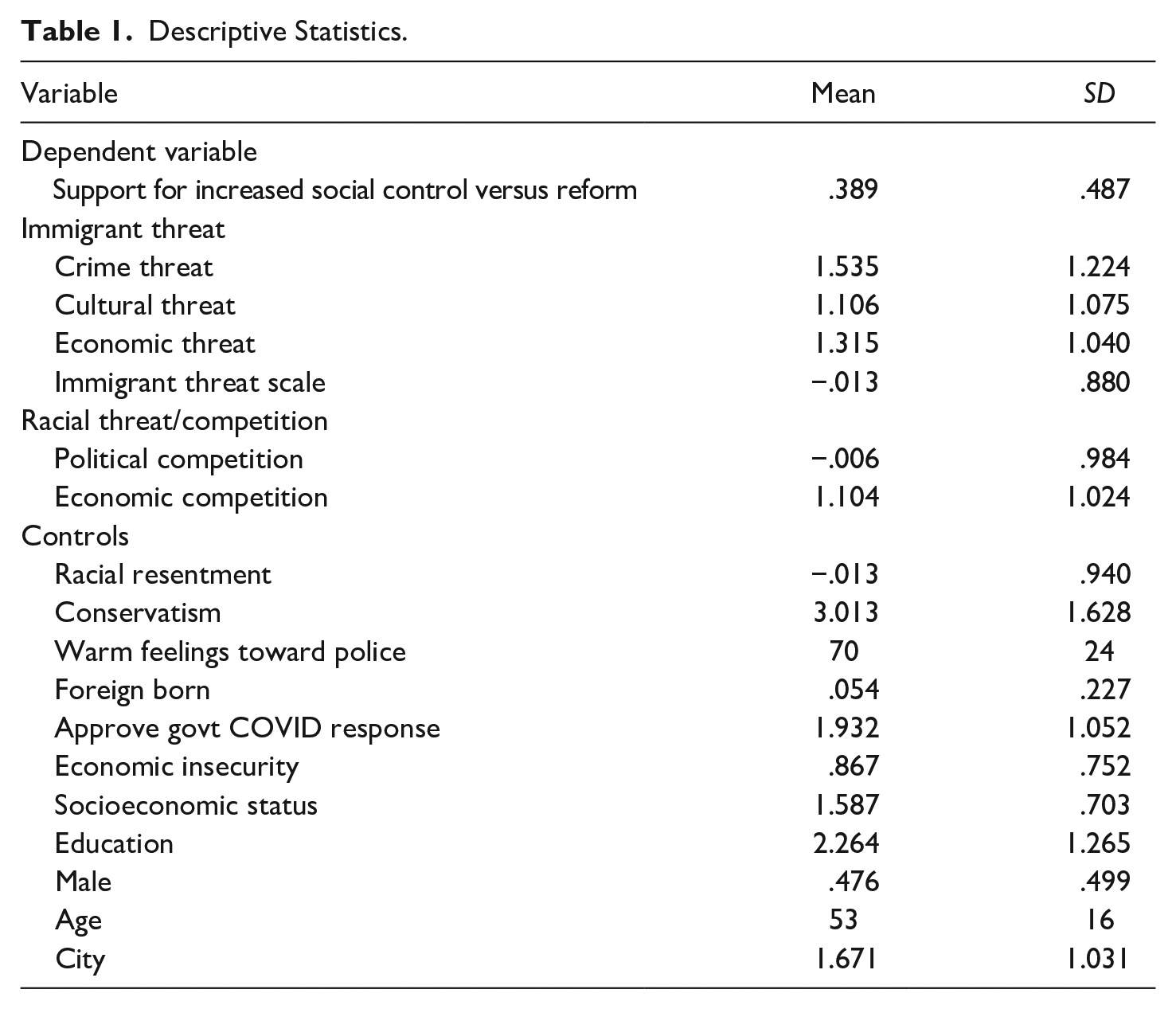
Our dependent variable focuses on White Americans’ resistance to police and court reform. Views toward reform are based on a single item in which respondents were asked: “Which [among two responses] do you think should be the bigger priority for the U.S. criminal justice system today?” The first response, which indicates resistance to reform and is coded as 1, recommends “strengthening law and order through more police and greater enforcement of the laws.” The second response, which indicates support for reform and is coded as 0, recommends “reducing bias against minorities in the criminal justice system by reforming court and police practices.” Roughly 39% of the respondents in our sample prioritized more robust formal social control measures over mitigating bias in the criminal legal system through law enforcement reform. The descriptive information for all variables is presented in Table 1.
Descriptive Statistics.
Immigrant Threat
The 2020 ANES-GSS Joint Study has three variables capturing perceptions of immigrant threat, with each assessing the degree to which respondents agreed or disagreed with the following: (1) “Immigrants are generally good for America’s economy” (reverse coded); (2) “America’s culture is generally harmed by immigrants;” and (3) “Immigrants increase crime rates in the United States.” We code each measure on a five-point scale (0 = strongly disagree, 4 = strongly agree). Using principal factor analysis, we also combined these variables into a global immigrant threat scale. All three immigrant threat variables loaded highly on the scale (eigenvalue = 1.75), with factor loadings ranging from 0.723 to 0.792. The Cronbach alpha score for the global immigrant threat measure was 0.832.
Racial Threat/Competition
Similar to perceptions of immigrant threat, out-group threats emanating from racial and ethnic minorities should also have an independent role in shaping Whites’ criminal justice attitudes. To capture these effects, we consider two critical dimensions of threat outlined in the racial threat literature: political competition and economic competition. We measure the political dimension of racial threat using three separate items that ask White respondents, “How important is it that more (1) Black, (2) Hispanic, and (3) Asian Americans be elected to political office?” Responses were coded on a five-point scale (0 = extremely important, 4 = not at all important). We submitted these items to a principal factor analysis to generate a factor score representing the construct of political competition. The eigenvalue for this factor was 2.74, with factor loadings ranging from 0.94 to 0.96 (Cronbach’s alpha = 0.974). The economic dimension of racial competition was measured with a single item that asked respondents, “How likely is it that many Whites are unable to find a job because employers are hiring minorities instead?” Responses were coded on a five-point scale (0 = not at all likely, 4 = extremely likely).
Controls
To isolate the effects of our threat predictors, we incorporate a range of control variables representing institutional, political, and racial attitudes, as well as socioeconomic and demographic attributes. Four controls capture respondent demographics: Self-reported Socioeconomic Status, which ranges from lower class (coded as 0) to upper class (coded as 3); Education, which ranges from no high school (coded as 0) to a post-graduate degree (coded as 4); Male (0 = no, 1 = yes); and Age (in years). We also control for whether respondents reside in the City (0 = rural area, 1 = small town, 2 = suburb, 3 = city) and their degree of Economic Insecurity (0 = pretty well satisfied with my financial situation, 1 = more or less satisfied, 2 = not satisfied at all). Furthermore, because 2020 was also a year where there were protests restricting mass gatherings due to the pandemic and against police violence after the murder of George Floyd, we evaluate whether respondents approve of their Local Governments’ Handling of COVID-19 (0 = disapprove strongly, 3 = approve strongly) and whether respondents have Warm Feelings Toward the Police (0 = coldest-negative feelings, 100 = warmest-positive feelings). The analysis also captures whether a respondent is Foreign-Born 1 (0 = no, 1 = yes), along with their degree of Conservatism (0 = extremely liberal, 6 = extremely conservative) and Racial Resentment 2 (four-item scale).
Analytic Strategy
We use logistic regression models to examine how perceptions of out-group threats impact criminal justice attitudes among Whites. This modeling strategy is appropriate given the binary coding of our dependent variable. All analytic models are estimated in STATA 17 and use the weighting variable “V200017b” to enhance the generalizability of our study’s results. Moreover, the variance inflation factors for all variables included in the analyses were below 4, suggesting that multicollinearity was not a problem.
Results
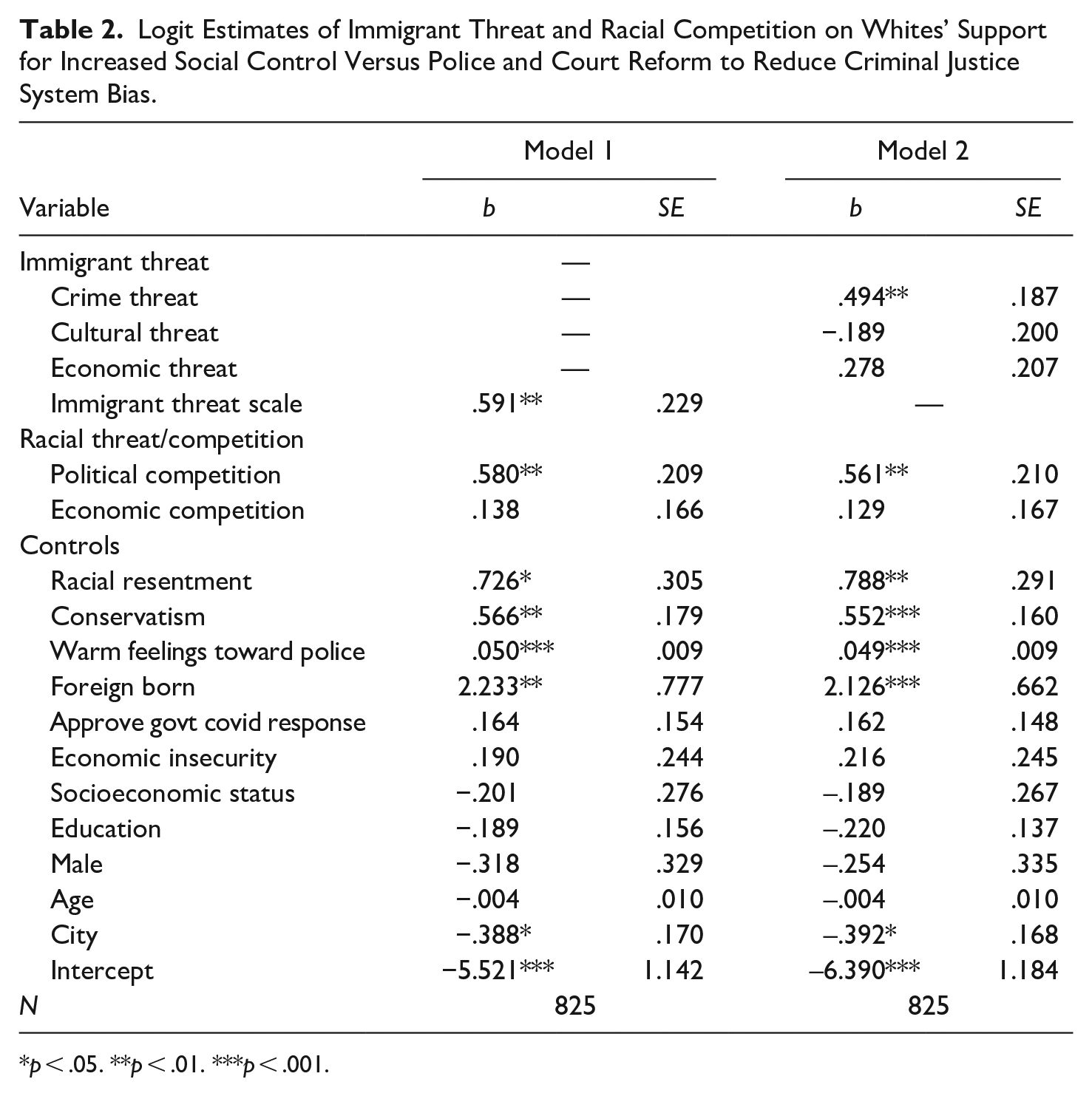
Table 2 displays the results of two logistic regression models predicting respondents’ support for law and order efforts that increase police enforcement or reform efforts to reduce racial/ethnic biases in the criminal justice system. A positive coefficient indicates that a respondent is more likely to support the former and, therefore, opposes efforts at system reform. Consistent with our arguments outlined above, we find that immigrant threat predicts White respondents’ preference for strict enforcement of laws by the police and the courts.
Logit Estimates of Immigrant Threat and Racial Competition on Whites’ Support for Increased Social Control Versus Police and Court Reform to Reduce Criminal Justice System Bias.
p < .05. **p < .01. ***p < .001.
In Model 1, the immigrant threat scale—which combines measures of perceived criminal, cultural, and economic threat—predicted opposition to race-related reforms in the criminal justice system. Specifically, the coefficient of .591 suggests that for each one-unit increase on the immigrant threat scale, respondents had over 80% greater odds of opposing reform, net of controls (1-exp (.591) × 100 = 80). Of the two racial threat measures, only political competition was a salient predictor, with each one-unit increase in perceived political competition associated with nearly 79% higher odds of opposing legislation aimed at reducing racial/ethnic biases in the criminal justice system. Each one-unit increase in racial resentment and conservativism increased the likelihood of opposing reform by 107% and 76%, respectively. Each one-unit increase in warm feelings toward police was associated with a 5% increase in opposition to reform; an individual who chose “100” on this scale would be 510% more likely to oppose reform than someone who chose “1” on this scale. Foreign-born respondents were 833% more likely than native-born respondents to oppose these reforms. Finally, each one-unit increase on the city variable was associated with a 32% decrease in opposition to reform; relatively speaking, someone who lived in a rural area was 97% more likely to oppose reform than someone who lived in a city.
Together, the results in Model 1 of Table 2 reveal several significant predictors of opposition to criminal justice reform, including both immigrant threat and politically-driven racial threat. Just as racial threat can be broken down into various dimensions of threat—such as political and economic threat—so, too, can immigrant threat. In Model 2 of Table 2, we disaggregate the immigrant threat scale into its distinct parts: crime threat, cultural threat, and economic threat. Although all three forms of threat would be expected to influence people’s willingness to mobilize the criminal justice system against immigrants, research has been inconsistent regarding which type of threat predicts a given outcome (Baranauskas & Stowell, 2022; Chiricos et al., 2004; Pickett, 2016; Stupi et al., 2014). The disaggregation here allows for a deeper understanding of the specific immigrant threats that influence crime-related policy views.
Results show that respondents who perceive immigrants as criminally threatening were 63% more likely to support law and order policies rather than reform. Neither cultural nor economic threat perceptions had a significant effect. The effects of the control variables were consistent with the first model, with sentiments of political competition, racial resentment, conservatism, views of the police, immigrant status, and rural residency all predictive of respondents’ policy views. These results suggest that perceptions of immigrants as criminals drive overall perceptions of immigrant threat, at least in relation to respondents’ views of crime control policies.
Discussion
Blalock’s (1967) work on racial threat theory suggests that when Whites feel threatened by minority populations, they will be more likely to mobilize social control mechanisms like the police and the criminal justice system to control those populations. Although racial/ethnic divisions continue to permeate U.S. society, immigration-related issues have become increasingly politicized since Blalock’s time. The number of immigrants entering America—both legally and illegally, and from mostly non-White countries—has increased dramatically in the past half-century (U.S. Census Bureau, 2024). Politicians advocating for immigration control have called for building a border wall, ending protections for immigrants who entered the country illegally as children, increasing funding for ICE and the U.S. Border Patrol, and have stoked fears about “immigrant caravans” to mobilize their bases around perceptions of immigrant threat. Against this backdrop, it is vital to understand how immigrant threat fits within the racial threat framework that has traditionally focused on racial minorities.
The crimmigration hypothesis suggests that crime policy is now used to control the immigrant population (Stumpf, 2006). Along these lines, scholars have invoked Blalock’s (1967) racial threat theory to argue that immigration will undermine and endanger the social status of Whites, which will influence calls for punitive controls (Wang, 2012). While numerous studies have offered support for the impact of immigrant threat on social control mechanisms, notably absent from this research is how perceptions of out-group threats—stemming from fears of both immigrants and racial/ethnic minorities—might play a role during particularly tumultuous periods. This study examined these issues within the context of the 2020 policing crisis and the presidential election—an era rife with political polarization and instability (Reid et al., 2024). In this particularly volatile context, we ask, how do perceptions of threat—especially immigrant threat—influence Whites’ views on criminal justice reform?
The ANES-GSS 2020 Joint Study provided a unique opportunity to examine this question because the survey asked respondents not just for their support or opposition to various reforms, but challenged them to choose between two competing priorities: “strengthening law and order through more police and greater enforcement of the laws” or “reducing bias against minorities in the criminal justice system by reforming court and police practices.” A majority of the sample (61%) favored reform. However, we hypothesized that perceptions of immigrant threat would predict White Americans’ opposition to such reforms. The analysis revealed several key findings that largely aligned with our hypothesis.
First, perceptions of immigrant threat predicted Whites’ views of criminal justice reform. The first analysis found that the global measure of immigrant threat—which combined criminal, cultural, and economic threats—was a significant predictor of Whites’ opposition to police and criminal justice reform. This finding aligns broadly with the racial threat theory and prior research that finds that perceptions of immigrant threat influence public opinion on crime and immigration policy (Baranauskas & Stowell, 2022; Chiricos et al., 2004; Pickett, 2016). More specifically, however, there are divergences in this literature regarding the types of immigrant threats that matter. Aligning with Stupi et al. (2014), our analysis of the disaggregated immigrant threats found that concerns about the perceived criminality of immigrants were the only threat variable that influenced opposition to criminal justice reform. While it is not surprising to see that immigrant criminal threat is the most salient factor when examining criminal justice policy preferences among Whites, it is important to highlight that prior studies have found a connection between other dimensions of threat (e.g., economic) and support for greater social control (Chiricos et al., 2004; Pickett, 2016). Nevertheless, future research should examine additional crime- and immigration-related policy outcomes—such as support for stricter sentencing policies, the death penalty, police reforms like body camera requirements, building a border wall, or expanding deportation policies.
Second, the analyses revealed that perceptions of racial political competition and racial resentment both had a salient effect on Whites’ views. Specifically, respondents who had more negative sentiments toward non-White populations and who perceived more political threats from these out-groups were more likely to oppose reform and instead favor law and order policies that strengthen law enforcement. These findings are not surprising as prior research has found that racial animus is a significant predictor in nearly every study examining Whites’ opinions on social and criminal justice issues, especially when those initiatives are perceived to benefit out-groups, such as the reform measure examined here (Cullen et al., 2021). Moreover, we argue that one reason why minority political threat is significantly associated with Whites’ resistance to reform is because of the perception that legislation that threatens the status quo is more likely to be enacted when there is greater representation of non-Whites in the policy arena. Taken together, these findings align with the traditional racial threat propositions and suggest that the original race-based focus of the theory extends more broadly to multiple forms of out-group threat (i.e., immigrant threat). As such, researchers should continue to expand our understanding of out-group threat by examining how other dimensions of threat—such as those stemming from illegal immigrants, “model” minorities (e.g., Asians), the LGBT community, minority advocacy groups (e.g., BLM), and others—might condition Americans’ views on relevant political issues and policy preferences.
Third, we found that White foreign-born respondents were more likely than native-born Whites to oppose criminal justice reform. This finding might appear, at face value, to contradict the crimmigration argument that the criminal justice system is mobilized against immigrant populations. However, it may be the case that White immigrants are less likely to be racially profiled or live in communities characterized by over-policing, thereby minimizing their risk of the adverse effects of crimmigration. Unfortunately, our dataset does not contain information on potentially relevant factors like immigrant ethnicity, country of origin, or age at immigration, which precludes our ability to explore this finding further. Additional research should continue to probe the views of immigrants—and explore potentially contrasting opinions between White and non-White immigrants—to explore how perceptions of threat may be influencing their beliefs toward various crime-related policies.
Limitations
This study is not without limitations. First, the study is cross-sectional, and future research should incorporate longitudinal models to examine how shifts in perceptions of immigrants might contribute to shifts in policy over time. Second, we focus on individual-level perceptions of immigrant threat, which improves upon prior research that only uses objective measures of out-group size and usually focuses solely on the Black-White racial dichotomy. However, future research is needed that combines perceptual and objective measures to provide a more holistic understanding of how contextual factors condition individual-level perceptions toward immigrants and other minorities. Third, our study focused on three dimensions of immigrant threat, but the data precluded an analysis of political threat. Future research should examine this unique dimension of out-group conflict. Finally, there are a number of potentially confounding variables that could not be controlled for, including fear of crime or concerns about crime. The dataset did include a measure of fear of crime, but missingness reduced the sample dramatically. Supplementary analyses with this measure included showed no substantial differences in findings. Future research should incorporate perceptions of crime and other potentially relevant variables.
Conclusion
Overall, these findings align with racial threat theory, more recent extensions of immigrant threat, and broader crimmigration research. When asked to choose between two competing criminal justice policy options, White Americans’ views are substantially influenced by their perceptions of out-group threat. The policy implications of these findings are somewhat limited, as the literature on immigrant threat is still relatively new. However, these findings do suggest that substantive, national-level (and even state-level) criminal justice reform is unlikely to occur if politicians and the media continue to use rhetoric that promotes perceptions of immigrant threat. Such rhetoric exacerbates moral panics not grounded in reality as research continually finds that immigrants are not more likely than native-born Americans to commit crimes (Ousey & Kubrin, 2018).
In recent years, many organizations, such as The Movement for Black Lives, have extensively worked to increase awareness and discourse about the effects of anti-Black sentiment and policies within both the criminal justice system and the broader American context. Since 2020, policing institutions in America have been challenged to address concerns about equity in police treatment, improve historically low police-community relations in minority neighborhoods, and navigate calls for reform that previously were viewed as unpalatable. It is clear that similar sentiments and policies are likewise at play for immigrant populations. The criminal justice system—including both local police and ICE—will need to contend with these politicized fears as they develop a new status quo to handle concerns about immigration in the future.
Footnotes
Acknowledgements
We thank the reviewers for their constructive comments. Also, thanks to the National Opinion Research Center (NORC) at the University of Chicago and John Roman.
Declaration of Conflicting Interests
The author(s) declared no potential conflicts of interest with respect to the research, authorship, and/or publication of this article.
Funding
The author(s) received no financial support for the research, authorship, and/or publication of this article.
