




Abstract
Climate change countermovements (CCCMs) play a central role in spreading misinformation and delaying policy action. Although most research has focused on the United States, less is known about CCCM networks in other national contexts. The authors analyze the Swedish online CCCM using social network analysis to (1) examine its structure and composition; (2) assess potential hierarchical influences, including how narratives flow from global think tanks to informal social media groups; and (3) identify distinct ideological groupings within the network. This exploratory analysis reveals four main communities, ranging from traditional climate-skeptic platforms to conspiracy theorists and far-right extremists. These alliances are asymmetric: although traditional climate-skeptic sites receive substantial attention from other groups, they link primarily to international sources and scientific content, serving as hubs that channel global CCCM discourse into Sweden. This asymmetric convergence highlights how climate denial is embedded within broader populist and far-right networks, not through ideological unity, but through shared antagonism. By mapping the structure and dynamics of the Swedish CCCM, the study underscores the transnational character of climate misinformation and its entanglement with domestic political currents.
Keywords
In its latest report, the International Panel on the Information Environment (2025) underscored the role of climate change countermovements (CCCM) in undermining public understanding of climate science. It identified the spread of misleading information, particularly via social media, as a “key mechanism of delay” that fuels polarization and obstructs effective climate action (see also IPCC 2023). Sweden is particularly interesting in this context, with recent research indicating that climate misinformation has played a significant role in shaping national climate discourse and influencing recent policy shifts (Vowles 2024; Vowles, Ekberg, and Hultman 2024)
Online platforms, including blogs, Web sites, and social networking platforms, have become the primary vehicle for producing and disseminating climate misinformation and mainstreaming denialist narratives (Brulle et al. 2021; Treen, Williams, and O’Neill 2020). This evolving “rhetorical landscape” (Bloomfield and Tillery 2019) has granted unprecedented visibility and legitimacy to denialist discourses by bypassing traditional media institutions and established scientific gatekeepers (Jungherr, Schroeder, and Stier 2019). These digital environments shape public perception, influence policy debates, and have the potential to redirect national climate policy trajectories (Matthews 2015; Treen et al. 2020),
Yet despite growing recognition of the importance of these dynamics, most empirical studies on CCCM have focused on the United States. Far less is known about the structure, composition and ideological makeup of such network in other national contexts. This gap is critical: although climate discourses often circulate globally, climate policy decisions remain largely national in scope, both directly through domestic legislation, and indirectly through the selection of political representatives to supranational bodies. Understanding how transnational denialist narratives are adapted and mobilized in specific local contexts is therefore essential.
The aim of this study is to address this gap by analyzing the structure and dynamics of the Swedish CCCM through its hyperlink practices, that is, the ways actors link to each other across Web sites and platforms. Sweden offers a particularly compelling case because of a combination of historical, political, and methodological factors. The country’s strong tradition of public service media, rooted in norms of scientific credibility and ethical journalism, has historically marginalized contrarian voices, pushing CCCM actors toward alternative digital platforms such as blogs, fringe media outlets, and social media groups (Anshelm and Hultman 2014; Berglez, Höijer, and Olausson 2009; Schulze 2020). These conditions have fostered a fragmented but vibrant misinformation ecosystem operating outside the mainstream, ideal for exploring how denialist discourse circulates in peripheral online environments.
At the same time, there is mounting evidence that these digital spaces have had a tangible impact on national climate policy. Sweden, once hailed as a global climate frontrunner, has seen a notable political shift in recent years, fueled by the rise of the far-right Sweden Democrats—a party with documented links to climate denialist networks (Vowles 2024). Despite the relatively modest size of the Swedish CCCM, its influence has proved disproportionate, with several high-profile national politicians emerging from this milieu and shaping the country’s climate policy agenda from within (Vallström and Törnberg 2025).
Moreover, Sweden presents unique methodological advantages for empirical research. The linguistic boundary of Swedish allows a more clearly delineated national network, in contrast to more diffuse English-language ecosystems. Its relatively contained size makes it possible to conduct a more comprehensive mapping of structural relationships and dynamics, offering a rare opportunity to study the connective architecture of climate misinformation in a nationally delimited context.
The rest of the article is structured as follows. First, we review the existing literature on online climate misinformation, identifying three central trends that inform our research questions regarding the Swedish CCCM network. We then present our methodological approach, including data collection and network analysis techniques. In the results section, we provide an overview of the Swedish CCCM, identifying four main communities (C1–C4) with distinct ideological profiles and linking practices. We show that the Swedish CCCM is not a monolithic entity, but a heterogeneous, functionally integrated network of partially overlapping actors. Notably, we identify an asymmetric alliance, in which climate-skeptic Web sites act as central hubs, receiving extensive linkage from other ideological groups while primarily linking out to international sources and scientific content. These central nodes play a strategic role in amplifying and translating global denialist narratives into the Swedish context, reinforcing the broader network’s reach and coherence.
Three Trends in Existing Research Literature on Online Climate Misinformation
TV personalities and right-leaning media outlets have been instrumental in amplifying contrarian views on climate science, often framing the debate as a “fake balance” whereby scientifically unsubstantiated claims are given equal footing alongside well-established scientific consensus (Oreskes and Conway 2010; Petersen, Vincent, and Westerling 2019). This phenomenon has been particularly pronounced in the United States and the United Kingdom. In the United States, outlets such as Fox News and figures such as Tucker Carlson have been vocal in questioning climate science, often highlighting short-term weather events or isolated studies to undermine broader trends (Benkler, Faris, and Roberts 2018). Similarly, in the United Kingdom, media such as The Daily Mail and certain BBC figures have aired climate skepticism under the guise of balanced reporting (Boykoff and Boykoff 2004; Painter and Ashe 2012). This contrasts with Sweden’s media landscape, which, because of its historical dominance of public service broadcasting, has been more firmly anchored in scientific consensus (Vowles 2024).
The rise of social media has increasingly shifted focus to the role digital platforms play in spreading climate misinformation, bypassing traditional media gatekeepers, and disrupting knowledge consensus. Informal actors such as bloggers, political influencers, and networks of individuals on social media have created their own media ecosystems, spreading climate denial tropes (Bloomfield and Tillery 2019; Brulle et al. 2021). An emerging field of research explores the characteristics of these networks, identifying the actors involved and the dynamics through which climate denialist discourses are propagated. We identify three key patterns in this body of research that inform the argumentation and research design of this article: (1) the tendency of climate denialist networks to form echo chambers or other forms of discursive closure, (2) the hierarchical flow of narratives from well-resourced international organizations to more informal domestic actors, and (3) the capacity of social media to enable convergence between ideologically disparate but system-critical groups.
The first pattern concerns the structural and epistemic characteristics of CCCM networks. Several studies describe these networks as relatively homogeneous and closed systems, where actors predominantly link to like-minded entities, such as other skeptical sites, rather than engaging with political adversaries or mainstream media (Bloomfield and Tillery 2019; McKie 2021). Elgesem, Steskal, and Diakopoulos (2019) found that although communities accepting climate change frequently link to skeptical sites, skeptical communities however often form insular networks with limited ties to nonallied sites. Sharman (2014) observed that central skeptical blogs on climate science shifted focus from mainstream media to the unregulated blogosphere, effectively turning bloggers into gatekeepers within a parallel knowledge infrastructure. Similarly, Holder et al. (2023) described blogs and social media sites as “echo chambers,” accelerating the spread of misinformation and reinforcing thought patterns that safeguard the interests of fossil fuel corporations. In contrast, Kaiser’s (2019) network analysis of German climate skeptic blogs reveals connections to left-wing groups, suggesting more permeability and ideological cross-lineage within the network.
These partially contradictory results align with newer research that complicates the image of online radical communities as epistemically sealed or socially isolated. Nguyen (2020) offers a useful distinction between epistemic bubbles—which arise from a lack of exposure to dissenting views, often due to algorithmic filtering—and echo chambers, which actively foster distrust toward outside perspectives, reinforcing internal cohesion through deliberate exclusion. Some CCCM actors clearly operate as echo chambers, constructing boundaries of trust that filter out challenges to their worldview. Others, however, may not fit neatly into either of Nguyen’s categories.
Empirical studies of far-right groups show that these groups frequently cite mainstream sources and platforms such as YouTube and X, not to participate in deliberative debate but to misrepresent or decontextualize content in ways that bolster ideological claims (Haller and Holt 2019; Törnberg and Nissen 2022). Through selective quoting, visual memes, and distortion, these actors transform external material into rhetorical ammunition (Peucker and Fisher 2023). Rather than operating as closed echo chambers, such networks seem to resemble “trigger bubbles”: networked environments in which antagonistic content is not filtered out but strategically incorporated to provoke outrage, mock opponents, and reaffirm in-group identity through a type of “trench warfare dynamics” (Karlsen et al. 2017; Törnberg and Wahlström 2018).
Trigger bubbles differ from epistemic bubbles in that they are not built on the absence or ignorance of alternatives, and from echo chambers in that they do not uniformly reject outside information. Instead, they thrive on hostile engagement, using selective exposure to mainstream or oppositional content as a tool for narrative reinforcement and emotional mobilization (Törnberg 2022). In this sense, antagonistic interaction serves a paradoxical protective function: it shields key narratives not by excluding external perspectives, but by incorporating them in distorted or inflammatory ways. However, the degree to which the online CCCM network is structurally open or closed remains an open empirical question.
The second pattern concerns the global structure of the CCCM and the way its narratives travel. Oreskes and Conway (2010) famously described the “denial machine” as a coordinated infrastructure of think tanks, lobby groups, and media platforms that produce and disseminate climate misinformation through a hierarchical, trickle-down logic. There is evidence pointing to that this pattern of centralization—whereby a relatively small number of well-connected actors generate and distribute core narratives—is also replicated in the digital context, albeit through a more decentralized, layered network structure.
Several studies have shown that highly organized U.S.-based think tanks and philanthropic institutions play a disproportionate role in shaping the international climate denial agenda (Farrell 2019; McKie 2021). These actors function as both ideological and informational hubs, with Web sites such as Climate Audit, Watts Up with That, Friends of Science, and the Nongovernmental International Panel on Climate Change Web site functioning as central nodes in transnational hyperlink networks. Similarly, research by Almiron et al. (2020, 2023) demonstrates how U.S.-produced counter-frames are routinely translated, repackaged, and circulated by European organizations such as the Institute for Economic Affairs, the ATLAS Network, the European Institute for Climate and Energy in Germany, and CLINTEL in the Netherlands, even in the absence of formal institutional ties.
These findings suggest that similar dynamics operate within the online CCCM: international actors, particularly think tanks, generate narratives that are picked up by domestic groups and blogs. These intermediaries thus play a key role in translating and adapting denialist content for broader publics, facilitating its diffusion into informal arenas such as forums and social media groups. This points to the existence of a layered and routinized pathway of influence, in which social media users link to national blogs, which in turn connect to international sources, creating a hierarchical chain through which denialist narratives travel from elite institutions to grassroots publics.
The third pattern centers on the convergence of climate denialism with broader forms of system critique. Digital media environments have provided fertile ground for the convergence of diverse oppositional movements, often centered around critiques of institutional authority, expertise, and mainstream media (Gerbaudo 2018; Krämer 2017). These system-critical actors typically position themselves as truth-tellers in a world governed by lies, frame their discourse in populist terms (Wodak 2019), and portray mainstream media as aligned with corrupt elites rather than fulfilling their democratic watchdog function.
The extent to which such system-critical attitudes are directly linked to climate denial, however, remains debated. Although some scholars caution against overstating this connection—arguing, for instance, that populism may reject climate policy without necessarily rejecting climate science (Jylhä and Hellmer 2020; Kulin, Johansson Sevä, and Dunlap 2021)—others identify significant overlaps. Conservative political identity, especially among white males, has been repeatedly associated with climate change denial (Dunlap and McCright 2011; Krange, Kaltenborn, and Hultman 2019). A recent large-scale study by Czarnek et al. (2025) confirmed that political conservatism is consistently associated with lower concern about climate change across 28 countries and that this association has grown stronger over the past three decades. Although this does not amount to outright denialism, it underscores an ideological disposition that often correlates with resistance to climate science and policy.
In line with this, Kaiser and Puschmann’s (2017) manual mapping of German hyperlink networks describes a digitally mediated “alliance of antagonism,” in which climate-skeptic Web sites are embedded alongside conspiracy theorists, men’s rights activists, and racist sites, groups united less by a shared ideology than by a shared opposition to liberal democratic institutions and mainstream discourses. A similar formation was identified by Lewis (2018) in her study of YouTube’s “alternative influencer network,” which brings together reactionary influencers who collaborate to critique political correctness, environmentalism, and legacy media while presenting themselves as alternative authorities.
Whether such ideological convergence is a defining feature of the Swedish CCCM remains an open question. However, there are reasons to expect that similar dynamics may be observable. As previously noted, Sweden’s system-critical actors, especially those on the far right, have historically had limited access to legacy media, incentivizing the use of digital platforms for visibility and coalition building (Schulze 2020). These conditions may facilitate the formation of a similarly antagonistic digital network.
Building on the patterns in existing research outlined above, we operationalize our broad aim into a set of specific research questions. First, what are the defining characteristics of the Swedish CCCM online network? To what extent does it exhibit features commonly associated with echo chamber or related phenomena such as trigger bubbles? Second, what role do international actors and hierarchies of influence play in shaping the network’s structure? Third, in what ways, if any, does the Swedish CCCM reflect an “alliance of antagonism,” whereby ideologically disparate actors converge around a shared antagonism toward climate science, institutional expertise, or the political mainstream?
To address these questions, we map hyperlink use within the Swedish CCCM network using social network analysis. Hyperlinks offer a valuable window into online alliances and discursive strategies: they are not only pathways between Web sites but also signals of affiliation, authority, and ideological orientation (Ackland and Gibson 2013; De Maeyer and Holton 2015; Ryfe, Mensing, and Kelley 2016). In networked settings, hyperlinks enable actors to shape visibility, frame social and political issues, and foster discursive cohesion, particularly for politically marginalized or oppositional movements (Caiani 2018; Durham and Power 2010).
Data and Method
The Swedish CCCM includes both organized or quasi-formal entities, such as blogs and Web sites maintained by groups or individuals, and more informal discussions on user-driven platforms. Our aim is to explore communication flows between these actors, which we do through an analysis of how they link to one another. Data collection was conducted in two phases, both in November 2023.
In the first phase, we focused on the more organized parts of the CCCM network. Using a snowball sampling strategy, we began with five central sites: Klimatupplysningen (The Climate Enlightenment), Klimatsans (Climate Sense), Klimatfakta (Climate Fact), Det Goda Samhället (The Good Society), and Nya Tider (New Times). From these sites, we collected all outgoing URLs using the Ahrefs tool. 1 To verify the completeness of the Ahrefs dataset, we cross-checked a selection of the sites using custom-built Web scrapers based on the Python package BeautifulSoup. After confirming that the link collections aligned across methods, we proceeded with Ahrefs for the remainder of the sampling because of its efficiency.
We then followed the outgoing links from these initial sites, expanding our sample to approximately 50 interconnected sites and blogs, continuing until we reached data saturation. For each site, we analyzed the top 200 most linked pages. These included both blogroll links (indicating long-term affiliations) and in-post hyperlinks (reflecting current debates; Koop and Jansen 2009). To prevent the overrepresentation of blogroll links, often embedded in site headers and therefore repeated across multiple pages, we counted each unique URL only once.
In the second phase, we captured informal discussions on two major user-driven platforms: the Facebook group Bränsleupproret (Fuel Uprising), and the Flashback forum. Bränsleupproret, a grassroots group advocating for lower fuel prices with more than 560,000 members (Portinson Hylander et al. 2024), was sampled using CrowdTangle. We extracted 15,000 posts from the group, selecting only those containing climate-related keywords. 2 Because of technical and ethical limitations—primarily that CrowdTangle provides access to posts but not comments—comments were excluded from the dataset.
For Flashback, recognized for its right-wing and often xenophobic tendencies (Törnberg and Törnberg 2016), we collected 60,000 posts from its most active climate change discussion thread. This thread is characterized by a predominantly climate-skeptical orientation. These posts were scraped using a customized tool (Uhnoo and Ekbrand 2017). From both Bränsleupproret and Flashback, we extracted all URLs mentioned in the posts, allowing us to examine how informal actors contribute to the circulation of CCCM content.
Analytical Technique
We conducted the network analysis using the open-source software Gephi, using traditional methods from social network analysis. To assess the overall structure of the CCCM hyperlink network, we calculated key metrics including network density, average degree, network diameter, path length, and clustering coefficient enabling comparison of integration and interconnectivity across network communities. At the node level, we used weighted in-degree and out-degree to account for both the presence and frequency of hyperlinks, providing a measure of each site’s connectivity strength. We also calculated betweenness centrality to identify potential gatekeepers—nodes that serve as bridges within otherwise disconnected clusters—and eigenvector centrality to capture influence on the basis of ties to other central actors.
To detect cohesive subgroups, we used the Louvain algorithm (Blondel et al. 2008), which partitions the network into distinct communities on the basis of modularity optimization.
The initial network comprised 3,515 nodes and 7,796 directed edges. As many nodes were linked only once, often as incidental references, we focused on a more stable core by including only nodes with two or more hyperlinks, resulting in a refined network of 956 Web sites (nodes) and 5,111 hyperlinks (edges).
We then conducted a manual content coding of all nodes in this focused network. Each Web site was coded according to its country of origin and assigned to a media category designed to reflect ideological and functional characteristics. These included categories such as mainstream media, government organizations, alternative media, sharing platforms, and private blogs. Blogs and alternative sites were further classified on the basis of their dominant ideological orientation, allowing us to analyze alliances between actors and assess the role of international sources and their potential hierarchical influence within the network.
To ensure consistency and reliability in the classification process, we consulted a range of external sources, including Wikipedia, mainstream news reporting, Expo (a Swedish nonprofit organization tracking extremism and disinformation), and Media Bias/Fact Check. Both authors participated in the coding process, flagging ambiguous cases for joint review. A detailed overview of the categories and representative examples is provided in Table 1.
Media Categories, Including Definitions and Examples.

Ethical Considerations
Digital data sources often present ethical challenges. Although all data analyzed, such as blog content, hyperlinks, and public forum posts, were publicly accessible, Internet research involving Web scraping and network analysis raises important ethical questions about user privacy expectations, consent, and potential harm.
Web scraping can risk violating platform terms of service and user privacy. To mitigate this, we limited our data collection to publicly available data, excluded usernames and personal identifiers, and ensured that scraping activities were nonintrusive and did not disrupt site functionality.
Network analysis adds further complexity, particularly when visualizing communities or identifying central actors. Although we do not analyze individuals, we remain attentive to the risk of amplifying harmful content or stigmatizing groups. Our approach follows established ethical principles for Internet research—such as transparency, data minimization, and harm reduction—in line with current best practices and regulatory standards (British Sociological Association 2017; Franzke et al. 2020). The study was reviewed and approved by the Swedish Ethical Review Authority (2024-01285-01).
Findings
Global Network
Figure 1 illustrates the full network, consisting of 956 nodes and 5,111 directed ties. Node size represents betweenness centrality, indicating the extent to which a node connects different parts of the network and potentially controls the flow of information. Node color represents modularity class on the basis of Louvain community detection. The network layout was generated using the Fruchterman-Reingold algorithm to improve visual clarity.

The partial directed network of 956 nodes and 5,111 ties; node size reflects betweenness centrality, and node color indicates community. An interactive version is available at https://bit.ly/GephiInteractiveNW.
The network can be described as a partial whole network, organized around a core of 47 Web sites that play key roles in promoting a climate-skeptic agenda in Sweden. These core nodes, along with their outgoing links, form the backbone of the Swedish CCCM ecosystem and are hereafter referred to as the “core network.” This structure allows us to analyze both the internal composition of the CCCM and its external referencing patterns, that is, the kinds of sources it draws upon in their communication.
As shown in Figure 1, the network comprises four major communities, each with distinct ideological profiles and linking practices. These communities are analyzed in more detail in the “Communities” subsection.
Because of the partial nature of the network, standard whole-network metrics, such as density, average degree, and the number of strongly connected components, are of limited interpretive value. These metrics can be misleading in networks where peripheral connections are underrepresented. Instead, we apply these measures to compare internal characteristics of the four communities and analyze relative centrality and influence within the network.
Media Category
The network is dominated by mainstream media, which accounts for 30 percent of all sites, followed by far-right outlets (9.8 percent), climate-skeptic Web sites (9 percent), and government organizations (8.8 percent) (see Table A1 in the Appendix). Smaller categories include scientific sources (5.4 percent), sharing platforms (4.9 percent), and conspiracy media (2.7 percent). In terms of national origin, more than half of the sites are Swedish (51.6 percent), while just over a quarter are based in the United States (26.6 percent). There is a notable drop in United Kingdom–based sites at 4.7 percent. Overall, the network spans 27 countries, including sites from 24 additional national contexts (see Table A2).
To assess which media categories are most active in directing attention within the CCCM network, Table 2 analyzes the “core network” using weighted out-degree. Far-right outlets lead at 36.2 percent, followed closely by antiestablishment sites (34.2 percent), climate skeptics Web sites (16.5 percent), conspiracy sites (6.9 percent), think tanks (4.4 percent), neoliberal sources (1.6 percent), sharing platforms (0.2 percent), and conspiracy media (0.1 percent). This diversity reflects an “alliance of antagonism,” showcasing extensive collaboration among ideologically driven groups.
Media Source Type of Ties (In-Degree and Out-Degree) in the Network.
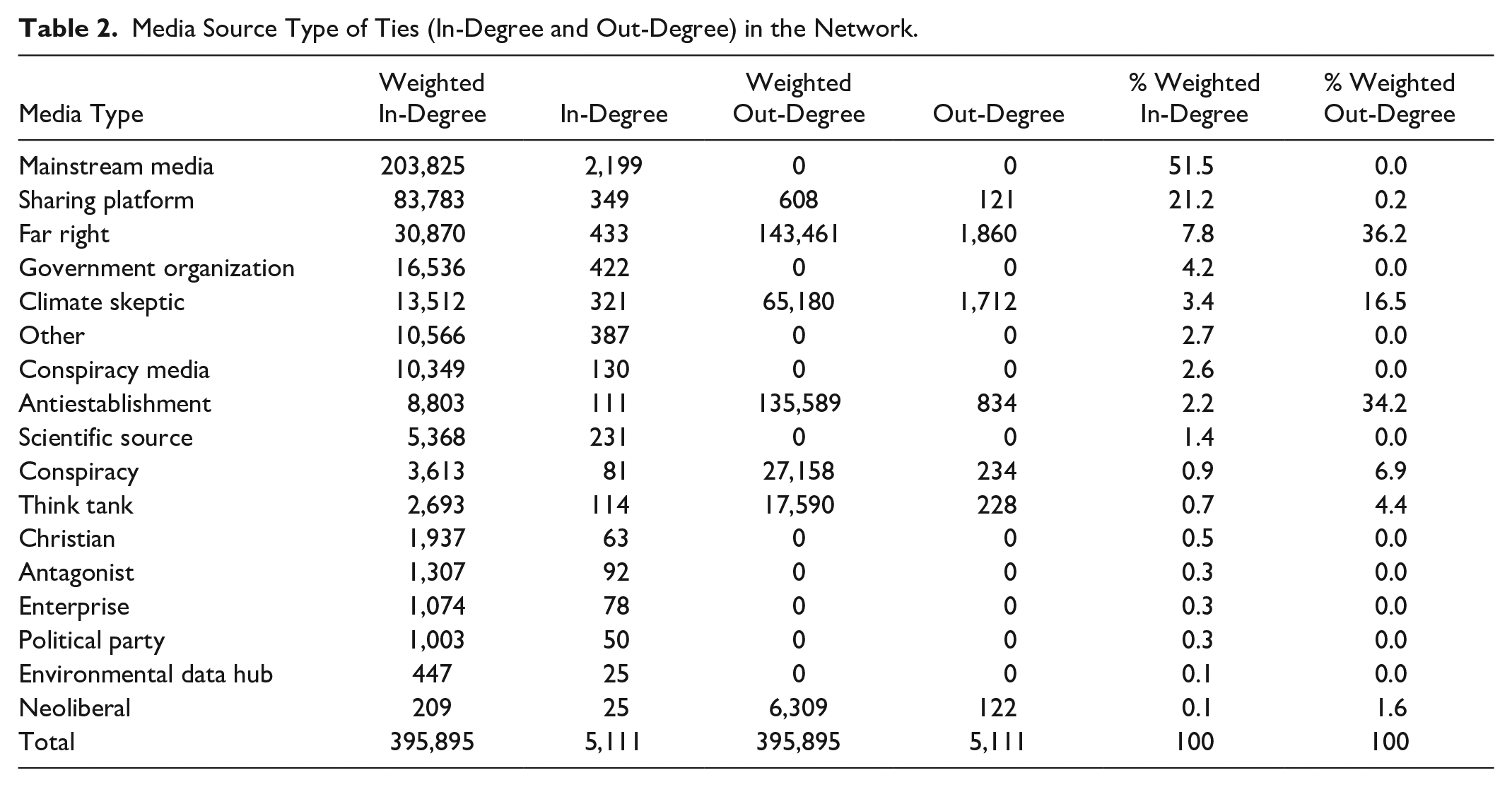
In contrast, weighted in-degree shows which media categories attract the most hyperlinks from within the network (Table 2), shedding light on the external sources the core network engages with in its communication. Mainstream media dominate here as well, receiving approximately 52 percent of all incoming links, followed by sharing platforms (21.2 percent), far-right outlets (7.8 percent), government organizations (4.2 percent), and climate skeptics (3.4 percent). Other categories, including conspiracy media, antiestablishment, scientific sources, conspiracy sites, and think tanks, receive significantly fewer links.
This pattern suggests that the CCCM network is not epistemically isolated. It draws extensively on mainstream media and sharing platforms, indicating a relatively open structure rather than a closed echo chamber or epistemic bubble. However, it is important to note that “mainstream media” encompasses a broad spectrum of ideological positions; it is not a uniform or neutral category.
Node Centrality
To identify central Web sites within the network, we applied a range of centrality measures. Table 3 highlights key sites driving attention, using betweenness centrality as the primary metric. This measure identifies the key nodes among the 47 “core network” sites promoting a climate-skeptic agenda in Sweden. The far-right political blog Thoralfsblogg emerges as the most influential site, followed by the climate-skeptic sites Klimatsans (Climate Sense) and Klimatupplysningen (The Climate Enlightenment). Other prominent sites include alternative and far-right media outlets such as Swebbtv (Web TV), Nyheter Idag (News Today), and Samtiden (Current Era), as well as collective blogs such as Petterssonsblogg (Pettersson’s Blog) and Det Goda Samhället (The Good Society). Additionally, the far-right site Snaphanen (The Snaphane), and the conspiracy blog Vaken (Awake) hold central positions.
Top 15 Most Influential Sites Based on Centrality Measures (Ranking Based on Betweenness Centrality).

Many of these sites also rank high in weighted out-degree, meaning that they function as important connectors within the Swedish CCCM network. Their bridging roles allow them to influence and channel information flows between otherwise disconnected parts of the network.
Overall, the network reflects a fragmented but collaborative ecosystem, bringing together climate skeptics, antiestablishment actors, far-right groups, and conspiracy platforms. This coalition spans both organized groups and individual bloggers, pointing to a loosely coordinated movement.
Table 4 ranks the 10 most central sites in terms of receiving attention, on the basis of weighted indegree and eigenvector centrality. Major global platforms such as YouTube, X, Wikipedia, and Facebook dominate, alongside key Swedish mainstream media outlets such as SvD, DN, and public broadcaster SR (Swedish Radio). These sites not only attract the most inbound links but also score highly in eigenvector centrality, indicating strong connections to other influential nodes and positioning them as central sources within the network.
Top 10 Central Nodes Getting Attention through Linking (Weighted In-Degree).

To assess influence beyond mainstream platforms, the second part of Table 4 excludes mainstream media, global sharing platforms, and the “other category.” This refined ranking reveals influential actors linked to government organizations, the far right, climate skepticism, and conspiracy media. Notable examples include the U.S.-based far-right outlet Breitbart and Swedish far-right outlet Fria Tider (Free Times), both of which show high weighted in-degrees and eigenvector centrality, reflecting frequent incoming links and strong network integration. The internationally recognized climate skeptic blog Watts Up with That also stands out for its high in-degree but low eigenvector centrality, indicating broad visibility but from a smaller, less connected audience. Far-right outlets Nyheter Idag and Snaphanen demonstrate dual influence, ranking highly in both in-degree and out-degree, and thereby shaping traffic flows in multiple directions.
Interestingly, key Swedish institutions—including the police, government, and parliament— also emerge as central nodes, receiving significant attention. Although government and parliamentary Web sites exhibit high eigenvector centrality, reflecting their links to many core network sites, the Swedish police site, despite receiving links, shows lower eigenvector centrality, suggesting a smaller but active set of connections.
In summary, these sites occupy strategic positions within the CCCM network, commanding significant attention and shaping flows of information. Their influence underscores the distributed but coordinated dynamics that sustain the network’s activities and discursive power.
Communities
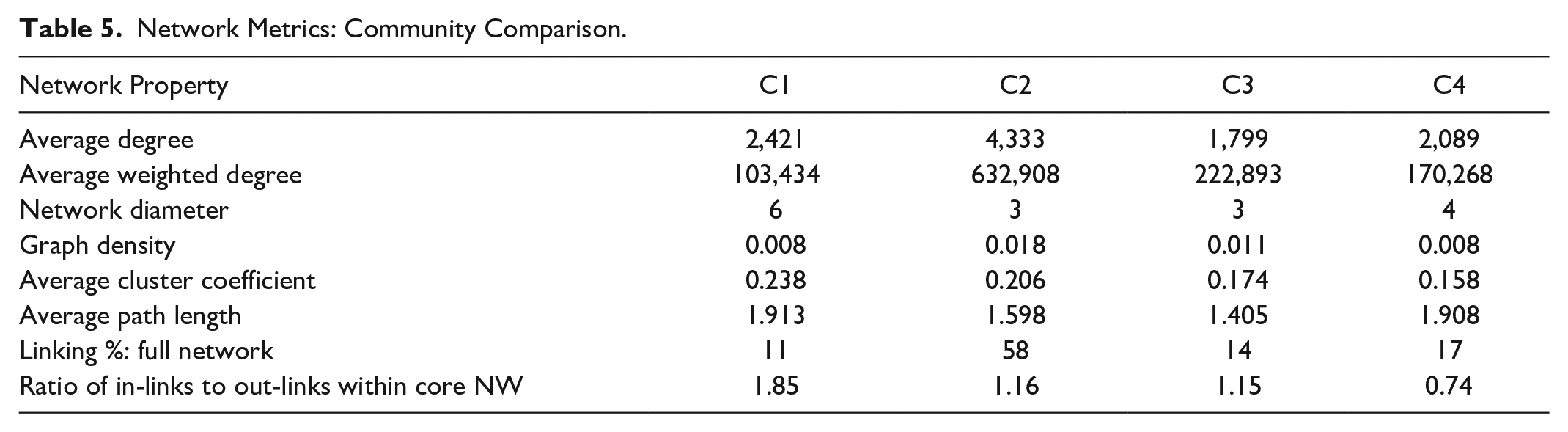
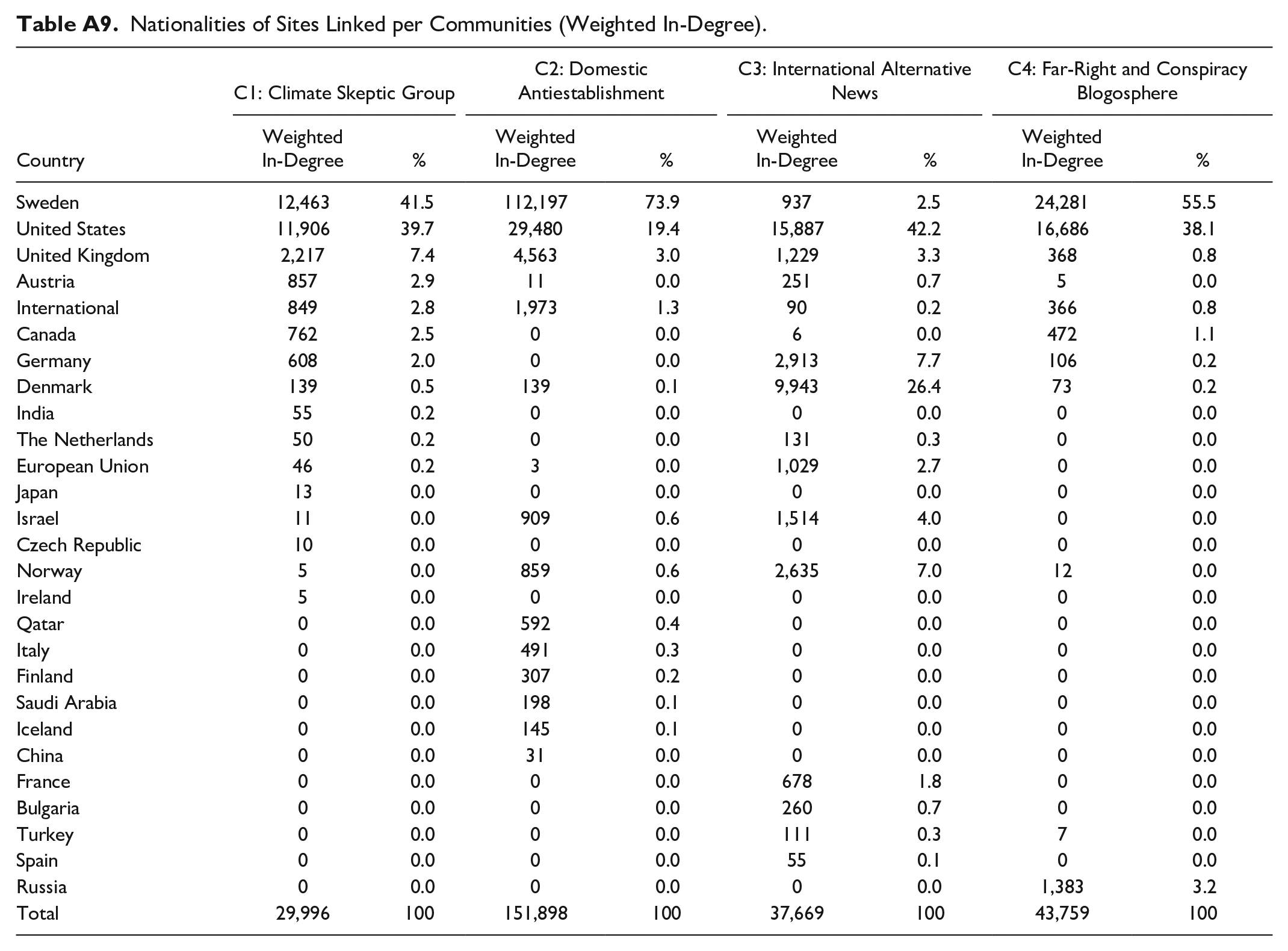
Using Louvain community detection analysis, we identified four main communities within the network (see Figure 2). These communities are more densely connected internally, with a higher proportion of ties within each community compared with links between them. To simplify visualization, we display only the actors in the core network (the 47 sites with out-links), although the community detection algorithm was applied to the entire network. Figure 3 compares media categories across the four communities, while Figure 4 shows the national composition of sites. Table 5 summarizes key network metrics across the four communities. In the following discussion, we present and analyze each community.
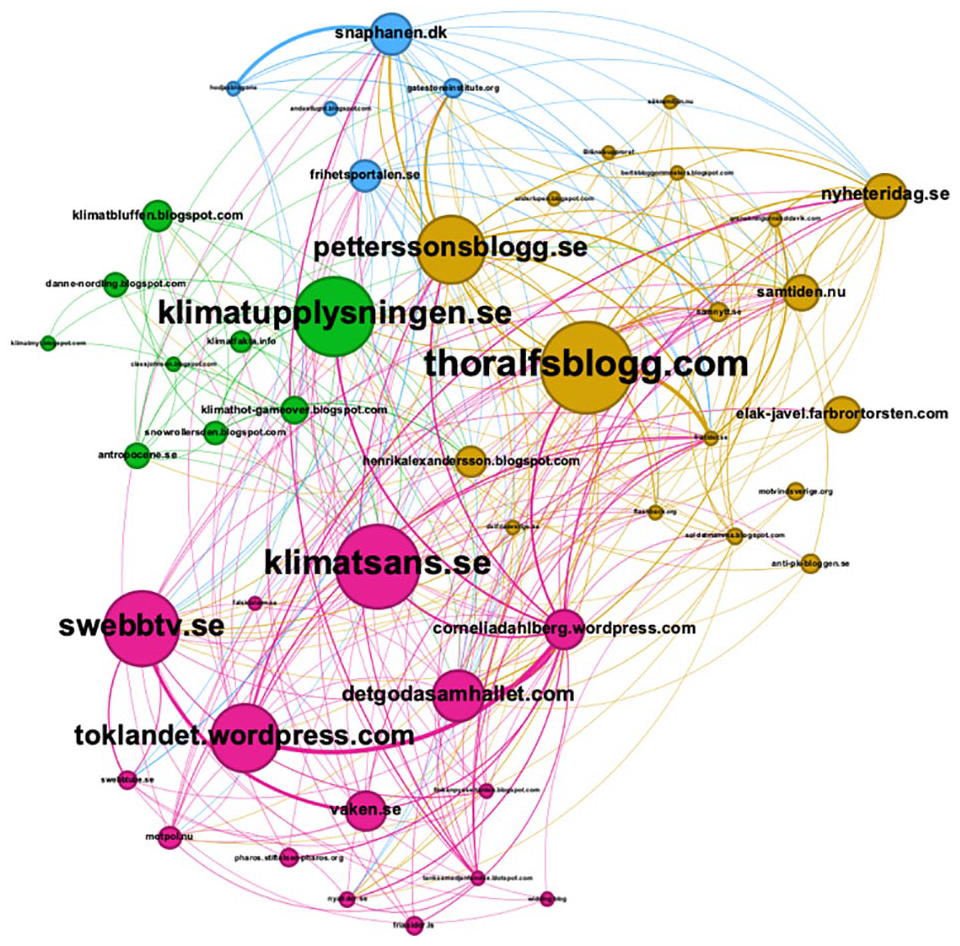
Visualization of the four communities in the core network of 47 Web sites. Node size represents betweenness centrality, and colors indicate community. An interactive version is available at https://bit.ly/GephiInteractiveNW.

Comparison of media types linked across the four communities (weighted in-degree).
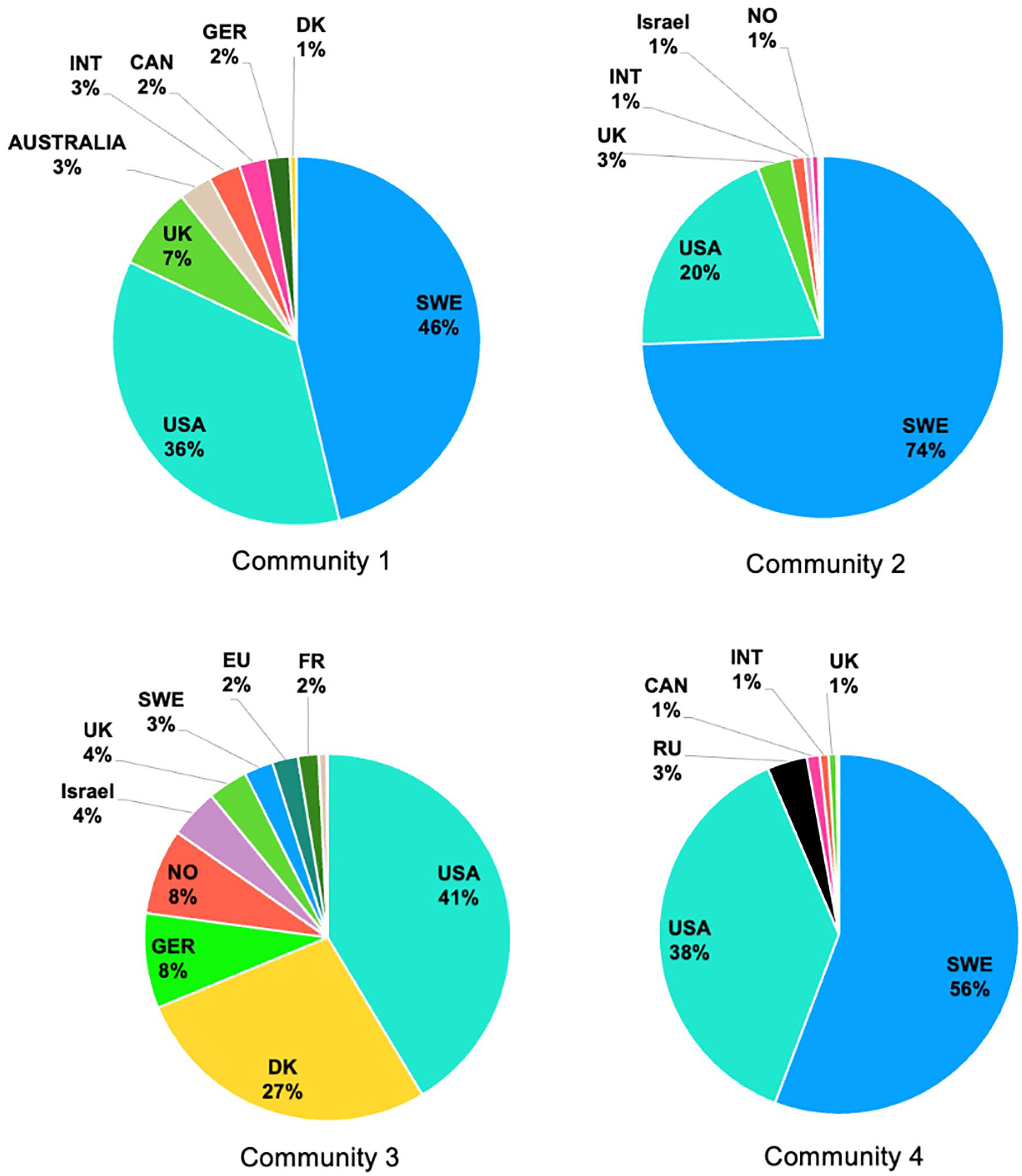
Comparison of nationality of sites across the four communities.
Network Metrics: Community Comparison.
C1: Climate Skeptics (30 Percent)
This community consists of 290 sites, centered primarily on classical climate change skepticism. Core actors include prominent climate-skeptic platforms such as Klimatupplysningen and blogs like Klimatbluffen (Climate Bluff), Klimatmyt (Climate Myth), Klimatfakta (Climate Fact), and Klimathot-Gameover (Climate Threat Game Over). These actors drive the majority of activity in this community, accounting for approximately 82 percent of the total linking activity, followed by far-right groups (9 percent).
As shown in Figure 3, C1 links primarily mainstream media (38 percent), other climate-skeptic sites (27 percent), scientific sources (14 percent), government organizations (6 percent), and think tanks (2 percent), distinguishing it from the other communities (see also Table A7).
Excluding mainstream media, the most frequently linked sites include internationally recognized climate-skeptic platforms and blogs such as Watts Up with That, Drroyspencer, The Climate Scam, Notrickszone, Joannenova, and Judithcurry. Scientific sources such as and Sweden’s weather forecasting agency SMHI, also feature prominently. Prior research suggests that climate-skeptic actors often reference scientific data to bolster their credibility, amplify contrarian scholars, or discredit mainstream climate research by highlighting ambiguity or misrepresentation (Bloomfield and Tillery 2019; Peucker and Fisher 2023; Tillery and Bloomfield 2022).
Geographically, 71 percent of the top-linked sites in this community are U.S. based, followed by Swedish (13 percent) and British (7 percent) sites (Figure 4). This community also includes more than double the number of conservative and neoliberal think tanks than any other cluster, including Swedish actors such as the Confederation of Swedish Enterprise, Timbro. In both composition and orientation, this community most closely mirrors the CCCM as described in earlier scholarship.
Network metrics for this community—such as relatively high network diameter and average path length, combined with low density and clustering coefficient—suggest a dispersed structure with strategic connectors or bridge nodes that facilitate traffic between different parts of the community (Table 5). Furthermore, the high ratio of incoming to outgoing links reveals a pattern of asymmetrical interaction: this community receives substantial attention from other parts of the network but rarely links back, reinforcing its role as a source of influence.
C2: Domestic Antiestablishment (25 Percent)
This diverse community consists of 240 sites, 18 of which are part of the core network. Key actors include antiestablishment blogs, climate-skeptic groups, and far-right sites such as Nyheter Idag, Fria Tider, and Samnytt (Community News). Social media platforms such as Flashback and Bränsleupproret are also central. The majority of hyperlinking activity is driven by antiestablishment sites (78 percent), followed by far-right groups (18 percent) (Table A7).
A defining feature of this community is its high proportion of links to mainstream media (67 percent) and sharing platforms (17 percent), with smaller shares directed toward government sites (6 percent) and far-right sites (5 percent) (Figure 3). Most of these sites are Swedish (74 percent), followed by U.S. sites (20 percent), mainly sharing platforms (Figure 4). Top-linked sites include “establishment” institutions, such as the Swedish Public Service Television Company (svt.se), Swedish Radio (sr.se), and government organizations such as the Swedish Police, the Government Offices of Sweden, Parliament (Riksdag), and the Supreme Court.
As Vowles and Hultman (2021) observed, links to such institutions are often used antagonistically—to deflect blame, criticize political elites, or frame quotations as “scare quotes,” undermining their credibility. For example, references to police statistics often serve to support claims about crime involving “nonethnic Swedes” or gang activity, feeding broader critiques of multiculturalism (Törnberg and Wahlström 2018).
This community has the highest average degree and weighted degree of any cluster, indicating dense and active interlinking. Although its network diameter is lower, moderate levels of density and clustering coefficient suggest a well-connected and cohesive group. The domestic antiestablishment community can be understood as an integrated Swedish blogosphere, unified around a localized antiestablishment discourse (Table 5).
Also notable is the inclusion of the two informal social media groups; Bränsleupproret and climate skeptic discussions on Flashback. Bränsleupproret, which advocates for cheaper gas prices, largely link to mainstream media and automobile-related sites. It also links frequently to the climate-skeptic group Klimatupplysningen, though few other climate-skeptic sites appear. In contrast, Flashback shows minimal engagement with mainstream media, instead referencing scientific sources (e.g. Nature, ResearchGate) and international climate-skeptic sites such as Unrealclimate, Watts Up with That, and Drroyspencer.
C3: International Alternative News (18 Percent)
This community comprises 169 sites, with few represented in the core network. Core actors are predominantly far-right and climate-skeptic sites such as Snaphanen, Gatestone Institute, Frihetsportalen (Freedom Portal), and Hodjasblog (Sage’s Blog). Linking activity is driven primarily by far-right sources (83 percent).
The community has a pronounced international orientation, with 42 percent of its sites based in the United States, 26 percent in Denmark, 8 percent in Germany, and 7 percent in Norway, while only 2 percent are Swedish (Figure 3). It links predominantly to mainstream media (46 percent), far-right sites (20 percent), sharing platforms (12 percent), and conspiracy media (18 percent) (Figure 3). Frequently linked sites include well-known conspiracy and far-right platforms such as Breitbart, The Gateway Pundit, American Thinker, and Bitchute.
As shown in Table 4, this community has the lowest average degree but a relatively high weighted degree, indicating fewer overall connections but stronger or more influential ones. The low clustering coefficient and short average path length suggest an efficient network structure, optimized for rapid information flow, a hallmark of international disinformation networks dominated by a few but highly central actors.
Although structurally similar to C2, this community operates in a global rather than domestic discursive space. Compared with C1, which primarily channels American climate-skeptic narratives into Sweden, C3 serves as a gateway for importing broader antiestablishment sentiments, mainly from the United States, into the Swedish CCCM. Its role as a transnational bridge connects Swedish actors with international far-right and antiestablishment networks.
C4: Far Right and Conspiracy Blogosphere (27 Percent)
This heterogeneous community comprises 257 sites, varied in both composition and linking behavior. Core actors include a mix of far-right, conspiracy, and antiestablishment sites and blogs, such as Swebbtv, Nya Tider, Det Goda Samhället, Falskt Alarm (False Alarm), Klimatsans, Motpol (Counter Pole), Widding, and Vaken. Linking activity is evenly driven by conspiracy sites (44 percent) and far-right sites (44 percent).
Unlike other communities, this cluster links far less to mainstream media (only 9 percent) (Figure 3). Instead, it focuses on sharing platforms (33 percent), far-right sites (19 percent), conspiracy media (10 percent), and antiestablishment, conspiracy, and climate-skeptic sites (each about 7 percent). Prominent linked platforms include X, Reddit, Telegram, and YouTube, alongside far-right platforms such as Swebbtv and various antiestablishment blogs. This heavy reliance on social media likely contributes to the community’s structural heterogeneity.
In terms of nationality, the majority of sites are Swedish (56 percent) and American (38 percent), with the U.S-based sites consisting largely of sharing platforms (Figure 4). Notably, this is the only community to link to Russian sites such as VK, RT, and Sputniknews. The climate-skeptic site Klimatsans is also frequently linked here, likely because of its extensive engagement with sharing platforms and an active comment section that often links to far-right sites.
Network metrics indicate that this community has an average degree similar to C1, with slightly higher density but lower clustering coefficient, suggesting substantial interaction but less cohesive substructures (Table 5). It also has the lowest ratio of inward to outward links (0.74, almost half the amount of C1), indicating that although it links outward extensively, it receives far fewer links in return. This asymmetry suggests a broadcasting function, positioning the community as a distributor of content rather than a receiver.
Conclusion and Discussion
Our exploratory dissection of the Swedish online “denial machine” reveals a heterogenous and dynamic media ecosystem, encompassing formal organizations, alternative news outlets, informal blogs, and user-driven social media groups. On the basis of hyperlinking patterns, these actors form distinct but interconnected communities with differing ideological profiles and structural characteristics, all linked by a shared skepticism toward climate science and/or climate policy.
Addressing our first research question, we identified four main communities within the network. These range from classic climate-skeptic groups focused on scientific discourse to far-right, conspiratorial, and overtly racist or nationalist platforms. The communities differ in their reliance on mainstream media, sharing platforms, as well as in their orientation toward national versus international content. However, contrary to the common depiction of the CCCM as a self-contained echo chamber (Kaiser and Puschmann 2017; Walter, Brüggemann, and Engesser 2018), our findings suggest a more complex structure. The Swedish CCCM is not epistemically isolated, but deeply entangled in both national media systems and transnational information flows.
Although some actors within the network display common features of echo chambers, actively rejecting and discrediting mainstream perspectives, others clearly engage with antagonistic content, suggesting trigger bubble dynamics, but this cannot be determined without a closer analysis of individual posts and interactions. We are therefore unable to conclude whether such engagement reflects a deliberate effort to debate opposing views or whether it serves more antagonistic purposes, such as provocation, ridicule, or reinforcing group identity. What can be stated with greater certainty is that the CCCM network does not function as a uniformly sealed epistemic enclave; rather, levels of openness and interaction vary substantially across different communities within the network.
In relation to our second research question, we find partial support for the hypothesis of a hierarchical structure within the CCCM, though not one based solely on organizational form. Rather, hierarchy is expressed through the flow of discourse: from formal, internationally connected climate-skeptic sites to more local, informal, and politically antagonistic actors. Classic climate-skeptic sites such as Klimatupplysningen appear to serve as hubs for disseminating contrarian narratives, particularly those couched in scientific-sounding language, which are then picked up and reframed by broader antiestablishment networks. Notably, the Facebook group Bränsleupproret, representing informal and populist spaces, links frequently to established skeptic blogs, while discussions on the Flashback forum primarily linked international sources, suggesting platform-specific cultures of engagement.
Our qualitative coding also revealed a preliminary but intriguing pattern: part of the climate-skeptic community appears to engage in similar data-driven analyses with public coronavirus disease 2019 data as they do with climate data. Although these findings are tentative, they suggest motivations beyond simple contrarianism, potentially rooted in a broader epistemic ethos of independence, skepticism toward authority, and self-directed inquiry. Such dynamics warrant further study, as they may reflect the rise of methodological counter-publics, defined not by ideology alone but by alternative frameworks for interpreting evidence and expertise.
Turning to our third research question, the distinct yet interconnected communities within the network support the notion of an “alliance of antagonism” (Jylhä and Hellmer 2020; Kaiser and Puschmann 2017; Kulin et al. 2021). This informal coalition encompassing climate skeptics, conspiracy theorists, men’s rights groups, and racist or nationalist sites, united by a shared antagonism toward perceived elites and institutional authority. Many sites, particularly within the blogosphere, clearly engage with multiple political issues, blurring traditional ideological boundaries. This resonates with previous research linking industrial or breadwinner masculinities to far-right and antiestablishment discourses (Anshelm and Hultman 2014; Pulé and Hultman 2019).
However, our analysis also reveals that this alliance is not fully reciprocal. Although far-right and antiestablishment actors frequently link to climate-skeptic sites, the latter tend to operate with greater autonomy, focusing on importing international CCCM discourse into the Swedish context, particularly from U.S.-based platforms and think tanks, rather than forming alliances with local antagonistic groups. These narratives are then selectively appropriated and reframed by other actors to serve distinct political agendas, such as undermining institutional legitimacy or advancing nationalist claims.
This pattern challenges the common assumption of ideological coherence or convergence often associated with the notion of an “alliance of antagonism.” Instead, we observe an asymmetrical convergence: a loose coalition where discourses circulate across ideological lines, but without full alignment or coordination. Whether this dynamic is specific to Sweden or indicative of broader global trends remains an open question. Future comparative research will be essential to determine how these formations operate across contexts, and how climate discourse is strategically weaponized—by whom, and to what ends—in the evolving political and informational landscape.
This asymmetrical “alliance of antagonism” serves as a concrete demonstration of how climate change has become deeply politicized. Far-right political actors eagerly and strategically foster ties with climate-skeptic groups because of their shared antagonism, aiming to expand their influence. These denialist narratives are not just passively sustained but are actively mobilized to serve broader political conflicts and reshape policy debates at the national level.
Footnotes
Appendix
Nationalities of Sites Linked per Communities (Weighted In-Degree).
| C1: Climate Skeptic Group | C2: Domestic Antiestablishment | C3: International Alternative News | C4: Far-Right and Conspiracy Blogosphere | |||||
|---|---|---|---|---|---|---|---|---|
| Country | Weighted In-Degree | % | Weighted In-Degree | % | Weighted In-Degree | % | Weighted In-Degree | % |
| Sweden | 12,463 | 41.5 | 112,197 | 73.9 | 937 | 2.5 | 24,281 | 55.5 |
| United States | 11,906 | 39.7 | 29,480 | 19.4 | 15,887 | 42.2 | 16,686 | 38.1 |
| United Kingdom | 2,217 | 7.4 | 4,563 | 3.0 | 1,229 | 3.3 | 368 | 0.8 |
| Austria | 857 | 2.9 | 11 | 0.0 | 251 | 0.7 | 5 | 0.0 |
| International | 849 | 2.8 | 1,973 | 1.3 | 90 | 0.2 | 366 | 0.8 |
| Canada | 762 | 2.5 | 0 | 0.0 | 6 | 0.0 | 472 | 1.1 |
| Germany | 608 | 2.0 | 0 | 0.0 | 2,913 | 7.7 | 106 | 0.2 |
| Denmark | 139 | 0.5 | 139 | 0.1 | 9,943 | 26.4 | 73 | 0.2 |
| India | 55 | 0.2 | 0 | 0.0 | 0 | 0.0 | 0 | 0.0 |
| The Netherlands | 50 | 0.2 | 0 | 0.0 | 131 | 0.3 | 0 | 0.0 |
| European Union | 46 | 0.2 | 3 | 0.0 | 1,029 | 2.7 | 0 | 0.0 |
| Japan | 13 | 0.0 | 0 | 0.0 | 0 | 0.0 | 0 | 0.0 |
| Israel | 11 | 0.0 | 909 | 0.6 | 1,514 | 4.0 | 0 | 0.0 |
| Czech Republic | 10 | 0.0 | 0 | 0.0 | 0 | 0.0 | 0 | 0.0 |
| Norway | 5 | 0.0 | 859 | 0.6 | 2,635 | 7.0 | 12 | 0.0 |
| Ireland | 5 | 0.0 | 0 | 0.0 | 0 | 0.0 | 0 | 0.0 |
| Qatar | 0 | 0.0 | 592 | 0.4 | 0 | 0.0 | 0 | 0.0 |
| Italy | 0 | 0.0 | 491 | 0.3 | 0 | 0.0 | 0 | 0.0 |
| Finland | 0 | 0.0 | 307 | 0.2 | 0 | 0.0 | 0 | 0.0 |
| Saudi Arabia | 0 | 0.0 | 198 | 0.1 | 0 | 0.0 | 0 | 0.0 |
| Iceland | 0 | 0.0 | 145 | 0.1 | 0 | 0.0 | 0 | 0.0 |
| China | 0 | 0.0 | 31 | 0.0 | 0 | 0.0 | 0 | 0.0 |
| France | 0 | 0.0 | 0 | 0.0 | 678 | 1.8 | 0 | 0.0 |
| Bulgaria | 0 | 0.0 | 0 | 0.0 | 260 | 0.7 | 0 | 0.0 |
| Turkey | 0 | 0.0 | 0 | 0.0 | 111 | 0.3 | 7 | 0.0 |
| Spain | 0 | 0.0 | 0 | 0.0 | 55 | 0.1 | 0 | 0.0 |
| Russia | 0 | 0.0 | 0 | 0.0 | 0 | 0.0 | 1,383 | 3.2 |
| Total | 29,996 | 100 | 151,898 | 100 | 37,669 | 100 | 43,759 | 100 |
Funding
The author(s) disclosed receipt of the following financial support for the research, authorship, and/or publication of this article: This research was supported by a grant from FORMAS, the Swedish Research Council for Sustainable Development (2022-01844).

1
Ahrefs is an all-in-one search engine optimization tool set that crawls the Web to collect data, updating its index every 15 minutes and processing up to 8 billion pages daily.
2
The keywords were “alarmism,” “climate*,” “carbon dioxide,” “emission*,” “greta,” “co2,” “doomday,” “Thunberg,” and “environment.”