




Abstract
State-centered Christian statism (CS) and society-centered religious traditionalism (RT) are two conservative religious nationalist ideologies that share Christian symbolisms but contain different attitudes about how the state and religion should interact; specifically, CS reflects the belief that Christianity needs to be the guiding ideology of the federal government, and RT mainly promotes the Christian ethos within civil society. We investigate whether these two ideologies predict different forms of religiosity. Analyzing the Baylor Religion Survey (Wave 6), we find that religious believers with stronger agreement with CS show a more self-oriented and petitionary religiosity, in which God is seen as especially interested in and responsive to them. And they tend to pray for divine assistance to meet their personal wants. In contrast, controlling for CS sentiment, believers with stronger RT agreement express a more praise-oriented and confessional religiosity, in which they feel personally accountable for their sins and routinely ask for forgiveness. RT believers also view God as more concerned with the well-being of the whole world and are less likely to ask for personal blessings. These findings further indicate that CS believers tend to express an individualized religiosity and that RT believers are more likely to spread faith and praise God.
The overarching concept of American Christian nationalism (CN) contains different ways to imagine a Christian America—state-centered Christian statism (CS) and society-centered religious traditionalism (RT; Li and Froese 2023). The duality of CN reflects the lasting division between ethnocultural and creedal nationalisms in American politics and moral foundations (Braunstein 2019; Goff, Silver, and Iceland 2024; Li and Froese 2023; Smith and Adler 2022; Theiss-Morse 2009). Specifically, Li and Froese (2023) note that CS and RT have different goals and visions for national boundary building and that CS is associated with ethnoreligious exclusion and overt White racism, whereas RT is more religiously tolerant and ethnically inclusive, reflecting a color-blind patriotism. Most scholars have asymmetrically investigated CS given its association with the unexpected rise of Trump’s profane and populist conservatism and authoritarianism (Smith 2024), finding that conservative partisans and institutions explicitly use conservative Protestant symbolism and rhetoric to justify White racism and ethnocultural nativism (Djupe, Lewis, and Sokhey 2023; Gorski 2017a; Perry et al. 2022; Whitehead and Perry 2020). Although CS and RT share similar conservative Protestant symbolisms and rhetoric, believers in RT tend to be less nativist and racially exclusive than believers in CS; RT advocates also tend to be more trusting of others and ethnoculturally inclusive (Braunstein 2021, Li and Froese 2023).
American nationalisms often utilize religious narratives and sacred symbolisms (Berger 1990; Bonikowski and DiMaggio 2016) to justify various national boundaries (Berger 1990; Calhoun 2007; Gorski 2013). The ideologies of CS and RT both share the idea that the United States is, at root, a Christian nation. In addition, believers in CS and/or RT also tend to believe that American nationality is religiously sacred and exceptional (Goff et al. 2024; McDaniel, Nooruddin, and Shortle 2022) and that the United States was founded on Judeo-Christian values (Bellah [1964] 2005; Gorski 2017a; Wuthnow 1988). Although similar, CS ultimately represents a more radical and extreme version of RT. In particular, believers in CS are more religiously, racially, and nationally exclusive than believers in RT (Li and Froese 2023). We are therefore interested in whether these differences in belief are related to different religious practices and stories about God-human relationships. In other words, do differences in religious nationalisms reflect different types of religiosity?
We analyze data drawn from a recent national survey with more than 50 measurements of religious beliefs and behaviors among American believers. Our findings show that CS and RT are associated with distinct packages of religious beliefs and behaviors regarding God-human relations. We conclude that strong believers in CS tend to express a highly petitionary, biblical literalist, and self-confident religiosity in which God is believed to be particularly responsive to the conservative Protestants’ needs and desires. This form of religiosity logically fits with the core attitudes predicting CS, namely, the politically focused desire to seek state support for Protestant religious values and practices and national representation of White conservative Christianity (e.g., Friedland 2001; Whitehead and Perry 2020).
When controlling for agreement with CS, believers with strong agreement with RT show a similar conservative religiosity but is more praise-oriented, confessional, and intercessory. These believers tend not to ask for personal rewards but rather routinely ask for forgiveness and the well-being of others. This form of religiosity logically fits with the core attitudes predicting RT, namely, the civic-oriented desire to enhance and sustain conservative Christian communities through individual religious conversions (Gorski 2009; Hollinger 2022). For that reason, RT has roots in a long-term tradition of private devotion in American Christianity.
Nationalized Christianity
Most Americans agree that they should have a common national culture and identity, but it remains unclear what these shared moral, religious, and political ingredients of our national culture should be or how it can be achieved (Bonikowski and DiMaggio 2016). Although often secular, nationalisms routinely employ explicitly religious language to elevate the nation to the status of sacred object, deserving of worship and reverence (Gill 2008). By expressing sacred narratives of nationhood (Smith 2003, 2008), nationalisms can begin to resemble a religion, in a Durkheimian sense (Bellah [1964] 2005; Marvin and Ingle 1999). And different groups of nationalists compete for similar religious legitimations (Bonikowski and DiMaggio 2016; Gorski 2000; Hunter 1992; Mann 2012). In the American experience, political-theological narratives are designed to make citizens feel proud of their national identity and promote the idea of American exceptionalism, customarily asserting that God supports and facilities American economic and military hegemony (McDaniel et al. 2022; Swidler 1986; Wuthnow 2021).
Scholars find that American nationalists, specifically right-wing elites, routinely utilize Christian narratives as ideological tools to justify their various ethnocultural exclusionary and secular agendas (Cremer 2022; Djupe et al. 2023; Gorski and Perry 2022; Martí 2020; Whitehead and Perry 2020). Within the population of American religious nationalists, social scientists note the difference between radical White Christian nativism and color-blind Judeo-Christian patriotism (e.g., Braunstein 2021; Gorski 2009, 2017a). This differentiation corresponds to Li and Froese’s (2023) division of CN into CS, a strong form of Protestant nativism, and RT, a more inclusive form of theological conservatism. It also resonates with findings in Goff et al. (2024) that CS items are linked to a moral foundation pairing loyalty and sanctity and that RT items are linked to a distinct pairing of liberty and sanctity.
RT prioritizes color-blind national solidarity, supports voluntary acculturation, and functions as a conservative civil religion (Wuthnow 1988). In her qualitative work, Braunstein (2021) highlights the color-blind Judeo-Christian aspect of religious traditionalism that utilizes a more inclusive Christian symbolism to legitimate its creedal nationalism in the American culture wars. With national survey data, Delehanty, Edgell, and Stewart (2019) also find a “secularized evangelical discourse” (SED) that fuses “religiously non-particularistic terms” in evangelical traditions with a liberal republicanism. Conceptually and measurement-wise, SED, color-blind Judeo-Christian civil religion, and RT all feature society-centered nationalism, or the notion that American nation is primarily a national civil society of free individuals rather than a state-enforced national collectivity within a more ethnically and racially inclusive Christian peoplehood (e.g., Li and Froese 2023). This is not to say that RT’s “colored-blindness” is anti-racist but rather that RT is not overtly racist or exclusionary.
Although sharing many symbolisms and narratives of RT, CS centers on ethnoreligious boundary building and is characterized by notions ranging from promoting policies informed by the Christian Right (Perry and Grubbs 2025; Seto, Schmidgall, and Perry 2025) to building a nation-state that legally marginalizes non-Christians and non-White individuals (Gorski and Perry 2022; Ingersoll 2015). Sociologists often use the term “White Christian nationalism” to refer to CS due to its close relationship with white supremacy, racial antipathy, and ethnoreligious intolerance (see Gorski and Perry 2022; Whitehead and Perry 2020). Political scientists also note that CS reflects the Republican Party’s current focus on culture wars issues and White identity politics rather than religious compassion and piety (e.g., Armaly, Buckley, and Enders 2022; Djupe et al. 2023; Jardina 2019). CS is therefore depicted as a religiously cloaked dog-whistle of overt racism that has successfully mobilized White Republican voters to associate whiteness with “traditional” Christianity (Dennen and Djupe 2023; Djupe et al. 2023).
Figure 1 shows the bivariate relationship between RT and CS. 1 The scatter plot with a locally weighted polynomial regression line (light-salmon colored) shows there is a positive correlation between RT and CS. But the correlation is asymmetrical. Whereas respondents who agree or strongly agree with CS report high levels of agreement with RT, the inverse relationship is different. Many respondents who agree or strongly agree with RT vary in their assessment of CS. Additionally, there are very few respondents with high levels of CS but low levels of RT. These findings align with Li and Froese (2023), suggesting that CS and RT should be considered together in statistical modeling to isolate the effect of RT.

Bivariate relationship between Christian statism and religious traditionalism.
In sum, CS and RT are both forms of religious nationalism employing evangelical symbols and narratives that overlap but differ in their levels of racial inclusivity and religious tolerance (Li and Froese 2023). In addition, strong believers in CS seek the power of the federal government to promote their exclusive form of White Christianity, and they are staunch supporters of Donald Trump. Strong believers in RT, although showing moderate or low agreement with CS, also tend to vote for Republican candidates but do not seek Christian authority through the state but rather through the religious cultures of their communities. But in utilizing the same Christian symbolisms and narratives, the political differences between CS and RT may come from different religious beliefs and behaviors regarding the sacred. To further clarify the distinction between CS and RT, this article explores their relationships to expressions of religiosity to determine if they inspire or are produced by different kinds of spirituality and God-human relationships.
American Religiosities
The way we measure religiosity with survey data in the United States has been largely standardized (Wuthnow 2015). Self-reported religiosity and spirituality are common measures that over the past century, have shifted from being essentially synonymous to representing very distinct types of lived religion; in general, “spirituality” refers to individualized religious expression, and “religiosity” is associated with institutionalized religion. Religious affiliation, standardly measured by the RELTRAD schema (see Steensland et al. 2000), and frequency of worship attendance offer measures of commitment to a specific religious tradition. Biblical literalism is another commonly used measure of religiosity; this indicator, although purporting to be about one’s beliefs about the Bible, is better conceptualized as a marker of conservative identity and fundamentalist belief (Ammerman 1982, 1987; Franzen and Griebel 2013).
But beyond self-reported identities and adherence to a specific tradition, we are concerned with how American religious nationalisms reflect different religious beliefs and behaviors. We focus on (1) types of God images, which estimate how a believer understands the character of divine authority, and (2) the content of prayers, which reveals the kind of relationship a believer has with God. We expect a person’s sense of the divine should influence how they envision a Christian America. More specifically, we investigate the prayers performed and the God imagined by Americans who seek the political supremacy of White conservative Christians. Is their religious way of life distinct?
Images of God
Images of God measure how people feel about God’s character, personality, and role in this world (Greeley 1995; Simmel, Helle, and Nieder 1997). Following Greeley’s (1995) pioneering work, sociologists of religion (e.g., Froese and Bader 2015; Froese and Uecker 2022) find that Americans hold very different images of God, even among self-identified orthodox Christians. Utilizing national surveys, researchers find that Americans perceive God’s image in four overlapping dimensions. The first one (the caring God) is a generic belief about the extent that God is directly engaged in world events and benevolently cares about human outcomes (Froese and Bader 2015; Froese and Uecker 2022; Liu and Froese 2020). The second (the punitive God) captures the extent to which God is wrathful and punishing (Ammerman 1987; Murphy 2008; Smith and Emerson 1998). More recently, Froese and Uecker (2022) added two new dimensions: The third (the impersonal God) indicates that God is distant, unengaged, and generally unresponsive, and the fourth (the righteous God) measures the extent to which believers think God is angry about human sin.
All varieties of religious nationalisms should depict a highly engaged and caring God simply due to the fact that these ideologies assert that God can bless and uplift a nation; this claim assumes an active and benevolent divinity. Monotheists overall seek to maintain a sacred and orthodox God-human relationship (Luhrmann 2020; Smith and Emerson 1998; Wuthnow 2012) because it provides them with a sense of existential security and spiritual authenticity (Norris and Inglehart 2019; Siedentop 2014; Taylor 1989). For American religious nationalists, specifically, conservative Protestants, keeping and asserting the relationship is a priority not just for individual salvation but also national success. Consequently, we expect that both CS and RT will evoke belief in an engaged and personal God (caring God) and, in turn, eschew beliefs that depict God as distant or indifferent (impersonal God).
Based on research on religious nationalism, we expect that people who score high on CS or RT will agree that the American nation’s prosperity depends on orthodox belief and orthopraxy (Friedland 2001; McDaniel et al. 2022). However, we expect that those who agree with CS will no longer hold that living a God-fearing life in a free religious market is enough to restore a Protestant nationhood; instead, they will think a Christian state needs a more powerful, expedient, and systematic remedy to restore White Protestant power. Accordingly, we expect that people who score high on CS will tend to support a statist solution to this problem by seeking to ensure the supremacy of evangelical Protestantism through the authority of the state.
We also expect that people who score high on RT but not on CS will tend to prioritize community proselytizing and individual piety and worry that the world of politics is potentially corrupting. For them, God’s relevance in national politics and this worldly affairs remains transcendent, mysterious, and limited (Bellah [1964] 2005; Gorski 2017a). And God’s relationship with believers is more individualistic than collectivist. In fact, we think that believers in RT might even fear that a state can become sacralized and that a president can become seen as a messiah (Djupe et al. 2023; Friedland 2001). Instead, believers in RT hope their pious and spiritually centered lifestyle will set an example for their co-nationals. For this reason, we expect that RT will evoke more concern for the wages of sin and the judgment of God than CS. In other words, strong believers in RT should prioritize the percieved authority of God over the authority of politicians or the state. Therefore, we expect that believers in RT will also believe that God is highly concerned with personal piety and that God is the ultimate arbiter of sin.
Prayer
Whereas images of God indicate how believers perceive the character and role of God, prayer reveals how believers interact with God. As Stark and Finke (2000:280) note, “prayer builds bonds of affection and confidence between humans and a god.” Praying to God triggers strong emotions and psychological outcomes that, in turn, impact cultural and social behaviors (Froese and Jones 2021; Froese and Uecker 2022; Luhrmann 2020). Like image of God indicators, the practice of prayer is multidimensional. Froese and Jones (2021) propose one can study prayers in four directions: (1) prayer quantity, (2) prayer styles (how to pray), (3) prayer purposes (both the reason for and topic of one’s prayer), and (4) prayer targets (which overlaps with images of God). We want to focus more exclusively on prayer purposes to determine whether agreements with CS or RT are associated with different goals and targets of prayers. In particular, we look at the reason people say they pray, which is an indicator of how effective they believe prayer to be, and the topics people pray over. In terms of prayer topics, we are interested in the difference between petitionary prayers, or requests for real-world outcomes and solutions, and prayers of praise, thanksgiving, and intercession, which focus on exulting the authority of God (Froese and Jones 2021; Upenieks 2023).
Conservative Protestants have long seen prayer as a reliable means for seeking God’s help on both personal and global issues (Froese and Jones 2021; Froese and Uecker 2022; Smith and Emerson 1998). In sum, most Americans believe strongly that “prayer works” in that it provides real benefits to practitioners. We expect that both ideologies of CS and RT will promote the belief that God will respond to prayers and bless the faithful.
Although believing in CS and RT might both be associated with belief in the efficacy of prayer, we expect that these attitudes might inspire different prayer requests. Research on the content of prayer is complex and tends to produce detailed taxonomies of prayer topics (Ladd and Spilka 2006). Froese and Jones (2021) propose that the distinction between “petitionary” prayers, where “the practitioner is asking God for an in-this-world blessing to fill some specific need,” and other forms of prayer, such as praising God or confessing of sins, is the most sociologically important. Petitionary prayer indicates a self-focused religiosity in which the faithful expect God to provide them with real-world blessings (Giordan 2017). Prayers of praise, thanksgiving, and intercession, by contrast, tend to focus on God’s authority, the suffering of others, and becoming a less sinful person (Luhrmann 2012; Richards 1991); these prayers also are more concerned with piety, ritual, and obedience than petitionary prayers.
Because the ideology of CS is mainly concerned with earthly power, we expect these beliefs to be strongly associated with petitionary prayer. The ideology of RT, on the other hand, is more focused on the spiritual realm and, therefore, should evoke prayers of praise, thanksgiving, and intercession.
Data and Method
The data we are using were drawn from the 2021 (sixth) Wave of the Baylor Religion Survey (BRS6). BRS6 is a cross-sectional national survey collected via mail and web between January 27, 2021, and March 21, 2021. The survey was conducted in English and Spanish by the Gallup Organization. The complete sample is a random sample with a size of 1,248 adults (18 years old or older) residing across 50 states and the District of Columbia in the United States. The sampling weight was created to handle nonresponse rate and to match age, education, gender, race, ethnicity, and census region based on the 2020 American Community Survey for the American adult population. The full data are now publicly accessible at theARDA.com. The final response rate was 11.3 percent.
We choose this data set because it is so far the only nationally representative survey that contains both CS and RT items and more than 50 measurements that were particularly designed to measure concepts of the image of God and prayer in sociology of religion (Froese and Bader 2008, 2015; Froese and Jones 2021; Greeley 1995). We draw three samples of analysis from BRS6 due to specific survey design. Besides the full sample (N = 1,248), we have two subsamples: (1) Image of God items were asked to respondents who do not deny the existence of God or higher/cosmic powers (n = 945), and (2) prayer items were asked to those who confirmed their practice of prayers (n = 939). 2
Following Li and Froese (2023) and Roos and Bauldry (2021), we treat CS and RT as latent factors and use structural equation modeling to test our hypotheses. This latent-factor approach is more preferrable than using simply additive index in handling correlation between the two factors in statistical modeling. Specifically, by modeling CS and RT as latent variables, we can account for measurement error of ordinal survey items and obtain standardized parameters, which also helps mitigate potential multicollinearity issues (Cole, Perkins, and Zelkowitz 2016; Kline 2016). 3
Findings
Preliminary Analysis
We first conduct a three-part preliminary analysis to test if CS and RT are associated with traditional religiosity measures distinctively. First, we build a multiple indicators and multiple causes (MIMIC) model to examine if CS and RT are associated with different demographic indicators and sociocultural identities (political party and religious tradition). The MIMIC model provides a multivariate analysis that is commonly used to test the influence of a set of exogeneous variables of interest on latent factors. Figure 2 visualizes the MIMIC model.

Multiple indicators and multiple causes (MIMIC) modeling.
In our MIMIC model, the endogenous latent factors are CS and RT. Following Li and Froese (2023), CS is a latent factor indicated by items asking respondents (1) whether the federal government should declare Christian nation and (2) whether the government should promote Christian values. RT is a latent factor indicated by items asking (1) whether the federal government should allow public display of religious symbols and (2) whether the government should allow public school prayer. For exogeneous variables, we include six categories of religious tradition, church attendance, self-reported religiosity and spirituality, party identity, conservative ideology, four categories of race-ethnicity, sex, age, education, census region of residency, and urban residency, as related literature suggest (Li and Froese 2023; Sherkat, Lehman, and Julkif 2024; Whitehead and Perry 2020). 4
Figure 3 presents our preliminary findings with MIMIC modeling. 5 We find that CS and RT have different association patterns with these exogenous indicators. First, we find CS and RT are associated with different religious identities and behaviors in threefold. (1) We find that a conservative Protestant (either White evangelical or Black Protestant) reports a significantly higher CS score than other religionists and that a Protestant (White evangelical, Black Protestant, or mainline Protestant) predicts a significantly higher RT score than non-Protestants. Specifically, as shown in Figure 3, Black Protestants show no significant difference from evangelicals (the reference group) in CS scores (the brown error bars representing confidence intervals of coefficient estimates overlap with zero or the dashed vertical line), and all other religious traditions (mainline Protestant, Catholic, other religions, and religious nones) score significantly lower (their coefficient estimates’ confidence intervals is below zero and do not overlap with evangelicals or Black Protestants). For RT scores, Black and mainline Protestants show no significantly lower RT scores than evangelicals (their error bars overlap with zero), and Catholics and religious nones show moderately lower but not significantly different RT scores from Black and mainline Protestants, but they are significantly lower than evangelicals. Only believers of other religions report significantly lower RT scores than all Protestant groups. The CS finding is similar to Sherkat et al.’s (2024) finding that CN is stronger in conservative and sectarian Protestantism, and the RT finding partially supports Delehanty et al.’s (2019) claim that secularized color-blind evangelical values are shared by a broad group of Christians (both conservative and mainline Protestants and Catholics; see Delehanty et al. 2019:Table 3). We also find that only CS is positively related to church attendance, as do Whitehead and Perry (2020). Interestingly, we find that CS is positively associated only with self-reported religiosity and that RT is positively associated with both self-reported religiosity and spirituality. It indicates that a respondent who feels higher spirituality is more likely to support RT.

Multiple indicators and multiple causes (MIMIC) modeling results (standardized).
Regarding political indicators, we find that both Democrats and Independents report significantly lower CS and RT scores than Republicans. In addition, Democrats report significantly lower RT scores than Independents. And we find that stronger conservative ideology is associated with higher scores on both measures.
In addition, CS and RT are related to different demographic indicators. We find that older respondents report a higher CS score and that respondents who hold bachelor’s degrees report lower CS and RT scores. People living in the East or West census regions report lower RT scores than people living in the South. However, not all indicators are relevant. Neither CS nor RT is related to race and ethnicity, gender, or urban residency. Overall, our preliminary findings suggest that CS and RT are associated with dual sociocultural groups and hence should be treated as different sentiments.
Second, following Sherkat et al. (2024), we focus on biblical literalism. We also find that CS and RT predict biblical literalism differently. Like Li and Froese’s (2023) fashion of modeling (Li and Froese 2023:Figure 2), we construct a similar structural equation model (SEM) and treat biblical literalism as the endogenous variable.
Figure 4 visualizes our SEMs. To keep modeling consistency, our model accounts for both CS and RT (both are latent factors) and the same set of covariates as in the previously described MIMIC model concomitantly. We model CS and RT as predictors rather than mediators between the covariates and exogeneous variables in this analysis because our theoretical interests lie in understanding how CS and RT relate to different religious beliefs and practices, not how much they mediate the effects of the covariates. As Table 1 shows, strong agreement with CS predicts lower odds of holding that the Bible contains human errors or that the Bible is fictional. This suggests a higher level of theological conservatism for believers in CS and echoes with findings in Figure 3 that nonconservative Christians often believe in RT as well.

Structural equation modeling.
Structural Equation Modeling on Biblical Inerrancy (N = 1,082).

Note: All covariates in preliminary analysis are included; 165 out of 1,248 cases are missing due to covariates. The estimation is conducted in Mplus Version 8.8 (Mac), and MLR is the default estimator for multinomial logistic regression. Full information maximum likelihood is set to handle missing data on the endogenous variable, and sampling weight is included in calculation.
p < .05. **p < .01 (two-tail test).
Third, we test how CS and RT correlate with prayer frequency using the same SEM as in Figure 4. Because prayer frequency is measured in two ways (one asks how often respondents pray, and the other asks how long they pray), we choose not to construct additive scales but see itemized findings. And we categorize the prayers into (a) public prayers and (b) private prayers, as in Froese and Uecker (2022:670). As Table 2 indicates, our findings reveal two patterns: Respondents with higher CS scores engage in longer prayer sessions and more frequently pray for longer than five minutes, and those with stronger RT scores demonstrate a greater regularity in saying grace.
Structural Equation Modeling on Prayer Frequency (n = 822).

Note: All covariates in preliminary analysis are included; 117 out of 939 cases are missing due to covariates. The estimation is conducted in Mplus Version 8.8 (Mac), and ULSMV is the estimator. Pairwise deletion is set to handle missing data, and sampling weight is included in calculation.
p < .05. **p < .01 (two-tail test).
We utilize similar SEMs as in Figure 4 to further examine how the duality of CN reflects different God-human relations. In addition, the convenience that SEMs allow multiple endogenous variables with correlated residuals empowers us to investigate how CS and RT predict individual items within each dimension of God-human relations. We expect that the way of modeling will contribute richer and more nuanced findings than relying on additive scales for all dimensions would provide. Therefore, we use itemized association to find more detailed information.
Images of God
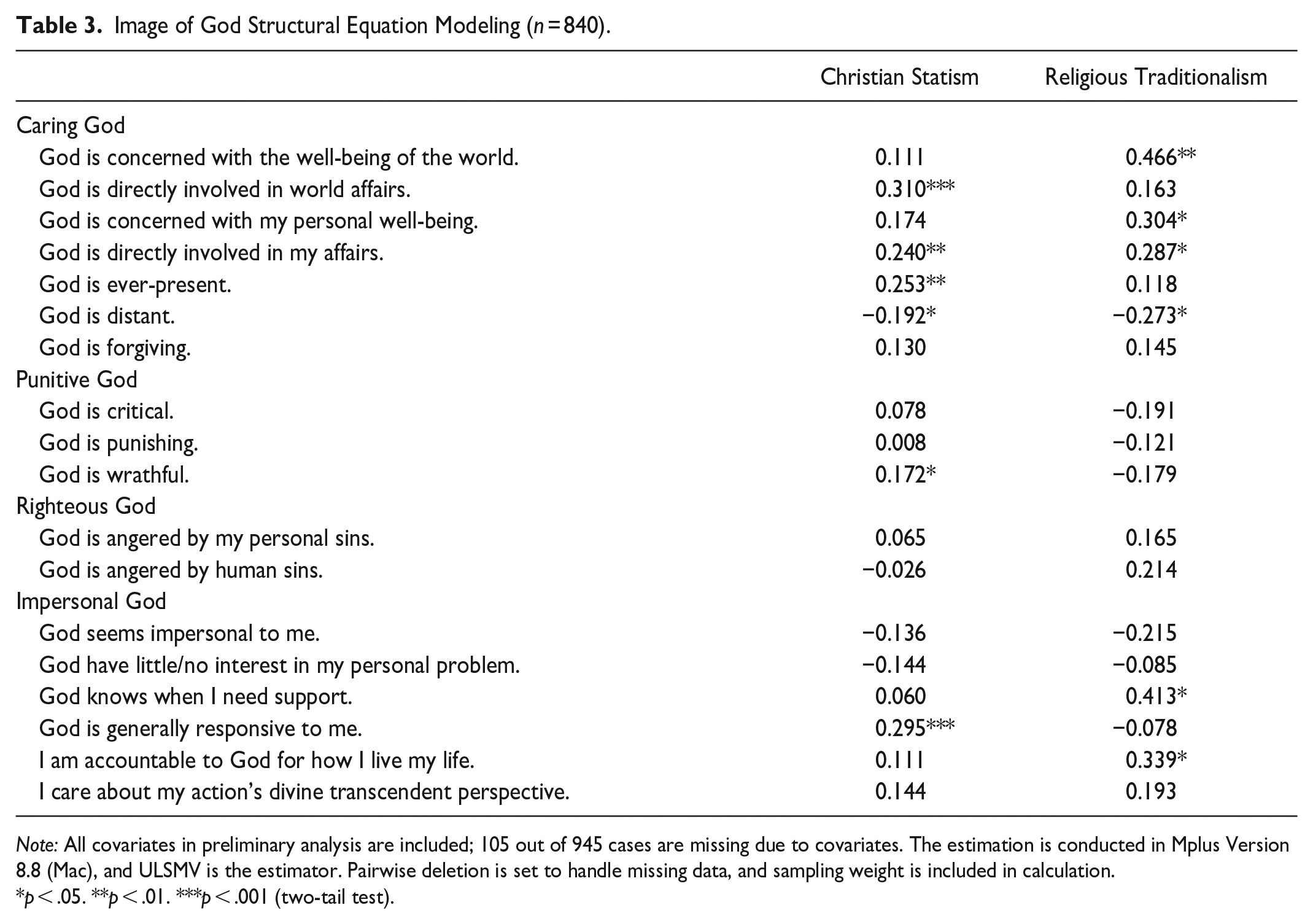
Table 3 shows how CS and RT are differently associated with images of God. First, higher CS score predicts stronger agreements with notions that God is (1) “directly involved in world affairs,” (2) “directly involved in my affairs,” (3) “ever-present,” (4) not “distant,” and (5) “responsive to me”; higher RT score predicts stronger agreements that God is (1) “concerned with the well-being of the world,” (2) “concerned with my personal well-being,” (3) “directly involved in my affairs,” and (4) not “distant”; (5) “God knows when I need support”; and (6) “I am accountable to God for how I live my life.” These findings illustrate an important distinction; namely, these sentiments, although both associated with the image of an engaged God, depict different directional patterns in how people relate to the divine. This suggests strong believers in CS may emphasize God’s responsiveness to human needs, whereas strong believers in RT appear to emphasize human accountability to God.
Image of God Structural Equation Modeling (n = 840).
Note: All covariates in preliminary analysis are included; 105 out of 945 cases are missing due to covariates. The estimation is conducted in Mplus Version 8.8 (Mac), and ULSMV is the estimator. Pairwise deletion is set to handle missing data, and sampling weight is included in calculation.
p < .05. **p < .01. ***p < .001 (two-tail test).
Neither CS nor RT are significantly associated with the image of a righteous God. Interestingly, CS is only positively and significantly associated with the notion that God is wrathful but not with notions that God is critical and punishing. Combining with our findings that CS is related to an engaged God image, these result indicate that CS has a weak but still notable association with an authoritarian image of God, as Gorski (2020) and Froese and Bader (2015) suggest.
In sum, our findings concerning CS align with sociologists’ observations that modern conservative Protestantism tends to emphasize God’s love, grace, and benevolence (Bellah 1975; Hunter 1983; Putnam, Campbell, and Garrett 2012). Our data add more nuance by showing that CS adherents embrace a God who is wrathful yet not punishing for sins—maintaining divine anger while emphasizing God’s direct responsiveness to human needs. This may indicate the American conservative Protestantism is still evolving. In addition, it echoes with Friedland’s (2002) theory that American religious statism relies on a distorted obsession to a loving and patriarchal God who actually spoils His true believers.
Prayers
Table 4 show results about why people pray. Findings suggest that higher CS scores predict higher confidence that (1) praying is the best way to address personal and world problems, (2) praying makes them better people, (3) praying helps them to know God, (4) God answers their prayers, and (5) they receive forgiveness from God. But strong believers in RT are not as confident about the power of their prayer to fulfill these concrete petitions. And interestingly, the association between RT and belief that God answers personal prayers is negative although not significant. Taken together, our findings imply that belief in RT is not related to belief in the power of prayer, whereas believers in CS pray with strong confidence that God will grant whatever their petitions are.
Structural Equation Modeling on Prayer Reason (n = 822).

Note: All covariates in preliminary analysis are included; 117 out of 939 cases are missing due to covariates. The estimation is conducted in Mplus Version 8.8 (Mac), and ULSMV is the estimator. Pairwise deletion is set to handle missing data, and sampling weight is included in calculation.
p < .05. **p < .01. ***p < .001 (two-tail test).
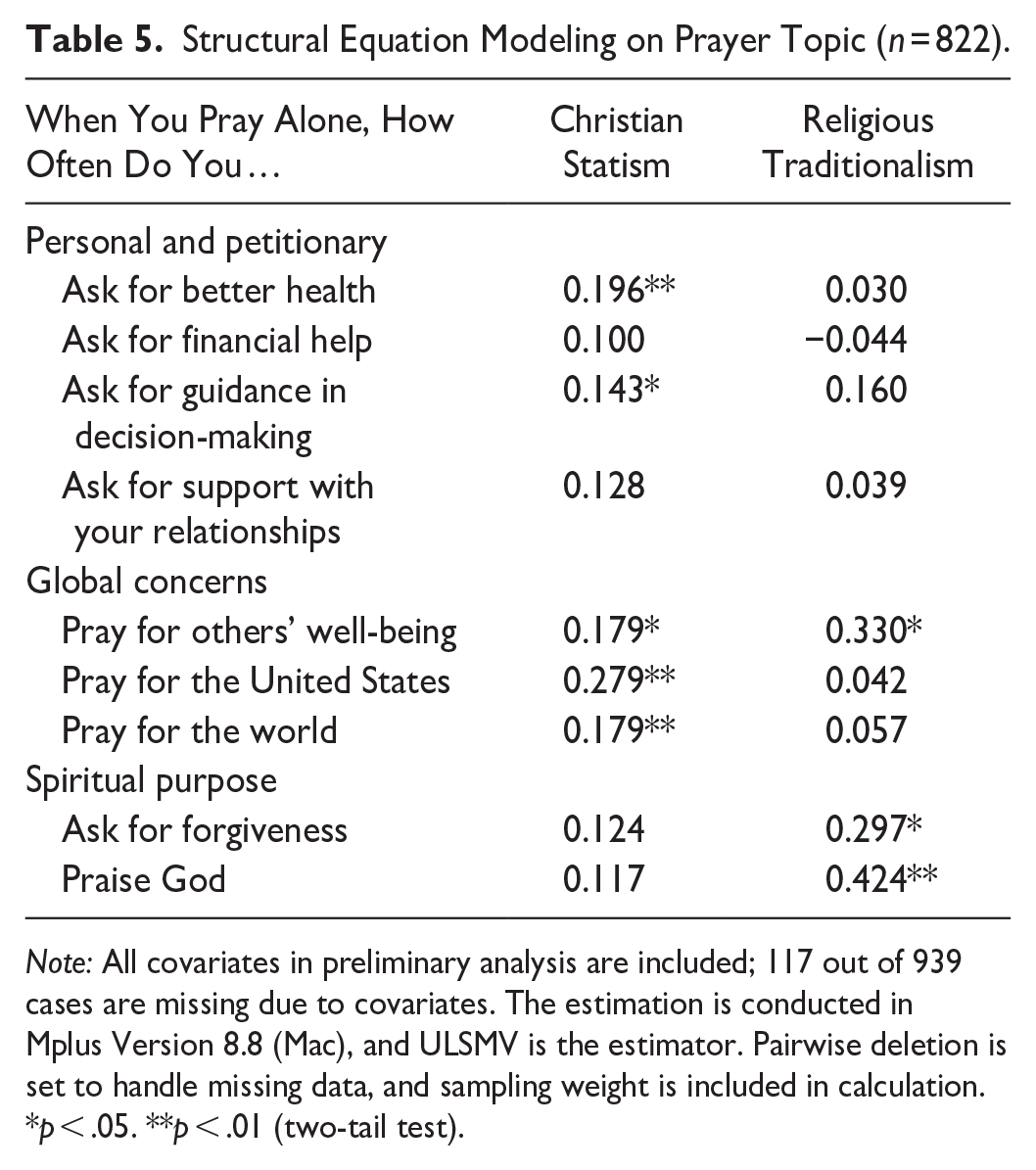
Table 5 shows findings on prayer topics. These findings might provide indications of why strong believers in RT are less likely to believe in the power of prayer—it could be because the content of their prayer is different. We find that higher CS scores relate to prayers almost solely for this-worldly goods, including (1) better health, (2) guidance for decision-making, (3) others’ well-being, (4) for the United States, and (5) for the world. But strong believers in CS tend not to pray for forgiveness or praise God with prayer. In contrast, strong believers in RT tend to pray for forgiveness frequently and regularly praise God. And they also pray for others’ well-being. In sum, believers in CS focus on petitionary prayer, and believers in RT engage in prayers of praise, forgiveness, and thanksgiving.
Structural Equation Modeling on Prayer Topic (n = 822).
Note: All covariates in preliminary analysis are included; 117 out of 939 cases are missing due to covariates. The estimation is conducted in Mplus Version 8.8 (Mac), and ULSMV is the estimator. Pairwise deletion is set to handle missing data, and sampling weight is included in calculation.
p < .05. **p < .01 (two-tail test).
Conclusion and Discussion
Individual religiosity remains a reliable predictor of American nationalism (Fea 2016; Greenfeld 1993; McDaniel et al. 2022). But to what extent is religious nationalism guided by political and partisan concerns rather than religious or spiritual ones? Some social scientists suggest that both aspects of CN (CS and RT) are really secular phenomenon because these researchers argue that Christianity should be private, ecumenical, and spiritually oriented (Du Mez 2020; Perry, Whitehead, and Grubbs 2024; Whitehead 2023). And there is ample evidence that Americans’ religious identities are deeply affected by their partisan politics; in fact, Margolis (2018) finds that one’s political identity in young adulthood is the best predictor of one’s religiosity in middle age.
Although conservative political attitudes and voting certainly predict belief in both CS and RT, these beliefs also reflect religious beliefs and practices. Strong believers in CS and RT both say they are “religious” and “Christian.” In fact, survey items used to measure CS and RT (e.g., Gorski and Perry 2022; Li and Froese 2023; Whitehead and Perry 2020; Whitehead, Perry, and Baker 2018) were initially developed to capture the ideology of “sacralization” in mass opinion (Froese and Bader 2008; Froese and Mencken 2009), although few studies (Davis 2023; Li and Froese 2023; Perry and Whitehead 2015) recognized the connection. Therefore, it appears that religious nationalists are driven by a fear of secularization and a desire for sacralized society. For this reason, we are less concerned with whether CS or RT are the “proper” expressions of Protestant Christianity and more focused on how believers in these ideologies live their religion. And we find that believers in CS and RT exhibit distinct beliefs and practices regarding God-human relationships.
Utilizing data from BRS6, we analyzed two sides of God-human relationship: how God is imagined and how believers pray to God. We find different God images and prayer topics for believers in CS and RT. Strong believers in CS tend to believe in a God who is wrathful as well as active, benevolent, and highly responsive to His people, specifically, conservative evangelical Protestants. This makes logical sense. An engaged, caring, but still wrathful God can more easily legitimate the profane goals and political power of CS. For this form of religious nationalism, God may still be wrathful on the surface, but he celebrates and rewards the faithful without much moral judgement or critique. Consequently, these believers may be less worried about appearing profane or too partisan in their goals. In contrast, strong believers in RT tend to believe in a God who keeps account of believers’ actions. Perhaps this makes these believers less likely to presume that they are entitled to state power and may, in fact, cause them to worry that any overtly political ploy might contaminate their religious and spiritual purity.
Many religious supporters of Trump fear that a meek and humble Christianity will not do the job in the modern world and that the faithful now require an assertive and aggressive person to fight politically for their values (Whitehead 2023). This justification prioritizes right-wing partisanship and populism over spiritual purity and piety to achieve Christian dominance. It also reflects the ideology of CS, in which believers advocate for an ethnoreligious state imposed through legislation and force. More importantly, strong believers in CS seem to be asserting that God approves of their will to power as a necessary form of self-defense from “demonic” Democrats (Nie 2024).
The prayer topics of strong believers in CS also suggest a sense of self-regard. They are more likely to enter into petitionary prayer and expect God’s blessings in this world. But it is unclear why God should bless them, especially considering that they tend not to feel accountable to God and not to praise God or ask for forgiveness. This all suggests that strong believers in CS feel elected by God to have power, not because of their piety or subservience. In this way, the religiosity of CS follows from and reinforces the politics of CS.
The opposite may be true for the ideology of RT. Strong believers in RT are more concerned with God’s judgment and grace. They pray for forgiveness and God’s glory often. This suggests that these believers step more cautiously into the profane world of politics, hoping their faith will influence fellow citizens and political leaders to sin less rather than seeking state power to enforce religious conformity in the American nation.
Finally, we also find some evidence that strong believers in RT are more invested in understanding scripture and God’s plan. As Table 6 shows, strong believers in RT are more likely to “spend time alone reading the Bible, Koran, Torah or other sacred book” outside of religious services. Not surprisingly, the association of religious reading with belief in CS is both statistically insignificant and substantially much weaker than the association with belief in RT (CS’s coefficient estimation is 0.078, whereas RT’s is 0.277). This finding further bolsters our overarching theme that believers in CS are less concerned with spiritual cultivation and religious education than believers in RT (also see Whitehead 2023).
Structural Equation Modeling on Religious Reading (N = 1,083).

Note: All covariates in preliminary analysis are included; 165 out of 1,248 cases are missing due to covariates. The estimation is conducted in Mplus Version 8.8 (Mac), and ULSMV is the estimator. Pairwise deletion is set to handle missing data, and sampling weight is included in calculation.
p < .05 (two-tail test).
Contributions
First, our study contributes to the sociology of American popular nationalisms. Sociologists of nationalism (Bonikowski and DiMaggio 2016; Brubaker 2012; Gorski and Türkmen-Dervişoğlu 2013) have argued that there are two different links via which religion sacralizes national identity in the United States: The first one sees no difference between political loyalty to the nation-state and religious piety to conservative Protestantism, and the other suggests a loosely defined Anglo-Protestant tradition is historically predominant and continues to influence American culture. These two approaches map onto the difference between the ideologies of CS and RT. Our study supports and enriches the literature by seeing how American popular nationalisms relate to different expressions of religiosity. We conclude that the religiosity of CS is one of political accommodation and that the religiosity of RT is more focused on praising God, praying for forgiveness, and reading holy scriptures.
Second, our study updates the literature on images of God. Many studies have found that the belief in a benevolent and engaged God is positively related to believers’ mental health and reduces their existential insecurity. For example, Greeley (1995) and Froese and Bader (2015) have found that the caring God image was associated with social inclusivity, communitarianism, and progressive Christianity. In contrast, scholars have argued that the Old Testament image of a punitive and wrathful God constitutes the core symbolism of CS to justify an “us versus them” mentality (Gorski 2017b, 2020; Murphy 2008; Perry et al. 2022), such as Lakoff’s (2016) theory that conservative politics and morality depend on a “strict father” model.
But our findings show a more nuanced morality model. Whereas Lakoff (2016) posits that conservatives predominantly employ a “strict father” morality in their policies, our analysis reveals that those scoring high on CS demonstrate a multifaceted conception of God that includes both disciplinary and indulgent characteristics. Specifically, strong believers in CS embrace a God who is strict with sinners but also like a nurturant parent who cares about the personal well-being of the faithful. Similarly, strong believers in RT also view God as caring and lovingly engaged with the world. In sum, our findings suggest that believers in CS are abandoning a “traditional” theology of fire and brimstone and mainly view God as wrathful divine patron who may be wrathful toward others but selectively favors His believers.
Our findings suggest something new—that faith in a caring God might more easily legitimate one’s political aspirations. This belief also reduces existential insecurity. In fact, scholars find that an anxiety over a collectivist existential insecurity is a strongly related to belief in CS (Armaly et al. 2022; Fea 2018; Hollinger 2022; Li and Froese 2023). In fearing the loss of a White Protestant dominance in the United States (Gorski 2017b, 2020; Hochschild 2016; Jardina 2019; Norris and Inglehart 2019; Perry and Grubbs 2025), perhaps strong believers in CS also fear that they will lose God’s favor (Friedland 2001; Gorski 2017a; Juergensmeyer 2003). Therefore, their quest to assert their ethnocultural chosenness through state power has become a rational choice for many conservative and sectarian Protestants (Li 2022; Sherkat et al. 2024).
Unlike believers in CS, believers in RT do not assert that God’s ethnocultural chosenness is necessary for salvation (Delehanty et al. 2019; Fea 2016; Gorski 2009; Hollinger 2022). Although strong believers in RT tend to be White Protestants, they seek a society guided by conservative religious morals rather than a state that enforces ethnocultural homophily as an identitarian force (Brubaker 2012; Gorski 2017a). In short, RT’s religiosity is morally centered and prioritizes spiritual salvation, not national homophily.
Last, this article challenges studies such by Djupe et al. (2023) and Dennen and Djupe (2023). In responding to criticisms from Davis (2023) and Smith and Adler (2022), these studies suggest that scholars can keep using the six-item CN scale that does not distinguish CS and RT because they find the old six-item CN scale combining CS and RT has similar predictive power with CS. Their argument also implies that RT is not only a part of CS but only adds very limited information. However, our findings suggest something different. We provide more empirical evidence confirming that scholars should analyze CS and RT as different sentiments. Furthermore, we encourage scholars to continue to test if the predictive powers of RT and the six-item CN scale are similar.
More broadly, understanding how CS and RT relate to different forms of religiosity is of important theoretical and tangible implications. Our distinction helps prevent conceptual inflation in the CN literature by demonstrating that these constructs not only differ in political expression but also are rooted in different religiosities. Additionally, our findings provide more understandings of nonradicalized religious conservatives, showing how believers who score high on RT but not high on CS maintain traditional religious practices without endorsing the ethnoreligious exclusion characteristic of CS. It echoes Smith’s (2024) criticism that our popular literature often fails to consider those who are low on CN scales.
More importantly, although scholars agree that CS radicalizes conservative Christians and threatens American democracy, little discussion has addressed how to prevent such radicalization. Our study suggests potential pathways for preventing religious traditionalists from being drawn into CS because the distinct religious beliefs and prayer practices of RT believers may serve as buffers against political extremism. This distinction also challenges Whitehead and Perry’s (2020) claim that religiosity runs counter to CN, revealing that the relationship is more complex—certain types of religious practice (petitionary, confidence-based) align with CS, and others (praise-oriented, humble) characterize RT.
Limitations
There are a number of limitations to our study. First, while utilizing structural equation modeling, our use of cross-sectional data cannot address the causality of any of the relationships that we have discussed. Second, the data were collected during the COVID-19 pandemic, which may have affected the response rate. In addition, although the BRS6 is favorably comparable to the distribution from the General Social Survey in terms of many demographic indicators, we find cell sizes remain small for certain racial-ethnic minorities, such as non-Hispanic Asian, American Indian and Alaska Native, and mixed races. So we have to merge these groups together for enough computational powers. Finally, the secondary survey limits our ability to address other substantially relevant alternatives for CS and RT, such as American religious exceptionalism and American civil religion (Chapp 2012; McDaniel et al. 2022). Future survey research about the intertwinement between religiosity and American popular nationalism should oversample racial minorities, use longitudinal or experimental data, and/or contain more measurements related to the notion of Christian America.
Footnotes
Appendix
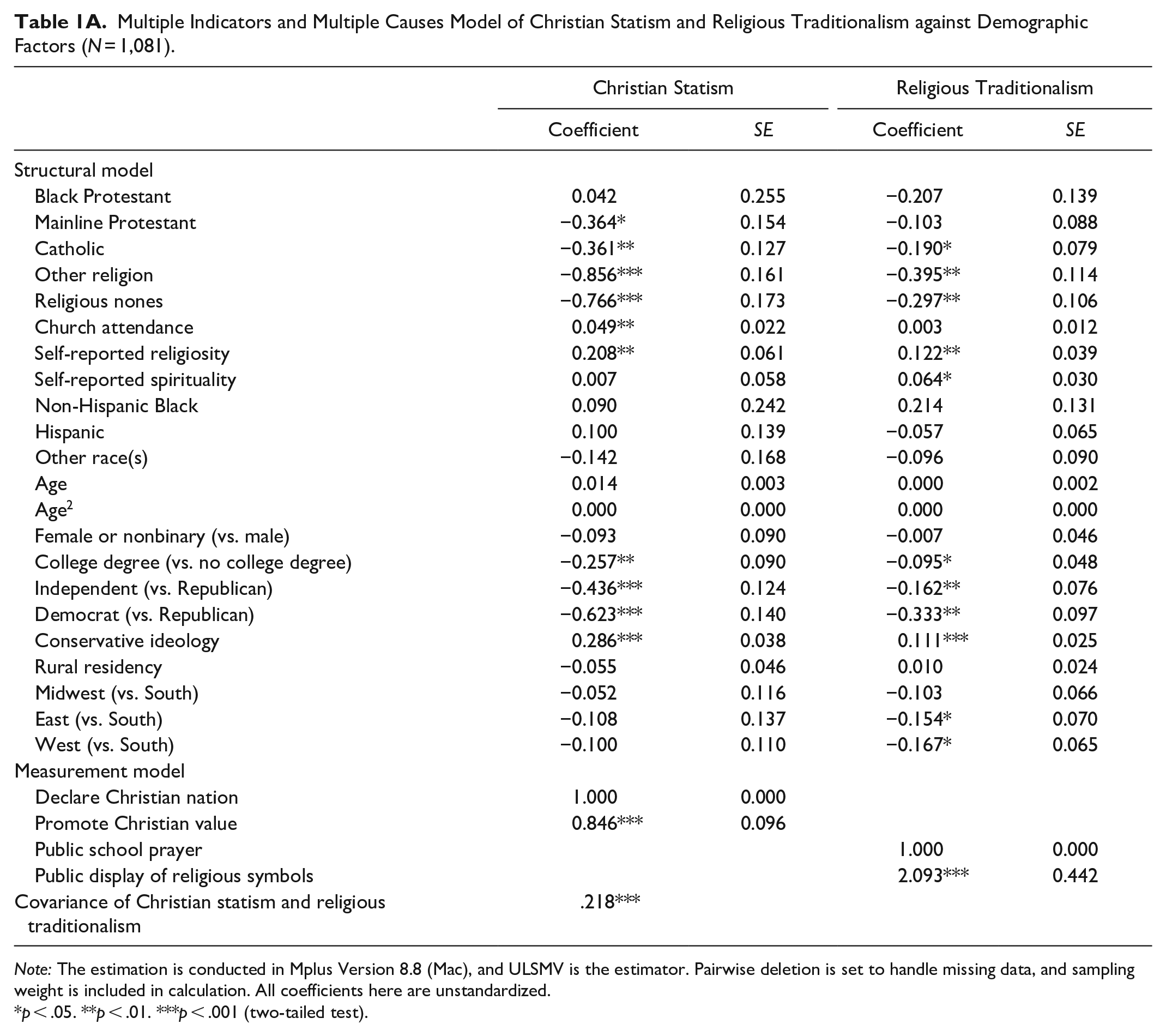
Multiple Indicators and Multiple Causes Model of Christian Statism and Religious Traditionalism against Demographic Factors (N = 1,081).
| Christian Statism | Religious Traditionalism | |||
|---|---|---|---|---|
| Coefficient | SE | Coefficient | SE | |
| Structural model | ||||
| Black Protestant | 0.042 | 0.255 | −0.207 | 0.139 |
| Mainline Protestant | −0.364* | 0.154 | −0.103 | 0.088 |
| Catholic | −0.361** | 0.127 | −0.190* | 0.079 |
| Other religion | −0.856*** | 0.161 | −0.395** | 0.114 |
| Religious nones | −0.766*** | 0.173 | −0.297** | 0.106 |
| Church attendance | 0.049** | 0.022 | 0.003 | 0.012 |
| Self-reported religiosity | 0.208** | 0.061 | 0.122** | 0.039 |
| Self-reported spirituality | 0.007 | 0.058 | 0.064* | 0.030 |
| Non-Hispanic Black | 0.090 | 0.242 | 0.214 | 0.131 |
| Hispanic | 0.100 | 0.139 | −0.057 | 0.065 |
| Other race(s) | −0.142 | 0.168 | −0.096 | 0.090 |
| Age | 0.014 | 0.003 | 0.000 | 0.002 |
| Age2 | 0.000 | 0.000 | 0.000 | 0.000 |
| Female or nonbinary (vs. male) | −0.093 | 0.090 | −0.007 | 0.046 |
| College degree (vs. no college degree) | −0.257** | 0.090 | −0.095* | 0.048 |
| Independent (vs. Republican) | −0.436*** | 0.124 | −0.162** | 0.076 |
| Democrat (vs. Republican) | −0.623*** | 0.140 | −0.333** | 0.097 |
| Conservative ideology | 0.286*** | 0.038 | 0.111*** | 0.025 |
| Rural residency | −0.055 | 0.046 | 0.010 | 0.024 |
| Midwest (vs. South) | −0.052 | 0.116 | −0.103 | 0.066 |
| East (vs. South) | −0.108 | 0.137 | −0.154* | 0.070 |
| West (vs. South) | −0.100 | 0.110 | −0.167* | 0.065 |
| Measurement model | ||||
| Declare Christian nation | 1.000 | 0.000 | ||
| Promote Christian value | 0.846*** | 0.096 | ||
| Public school prayer | 1.000 | 0.000 | ||
| Public display of religious symbols | 2.093*** | 0.442 | ||
| Covariance of Christian statism and religious traditionalism | .218*** | |||
Note: The estimation is conducted in Mplus Version 8.8 (Mac), and ULSMV is the estimator. Pairwise deletion is set to handle missing data, and sampling weight is included in calculation. All coefficients here are unstandardized.
p < .05. **p < .01. ***p < .001 (two-tailed test).
Acknowledgements
A part of a previous version of the article was titled “A Christian Society or Christian State? How Civic Christian Nationalism Is Radicalized” and presented at the 2023 SSSR&RRA Annual Meeting in Salt Lake City, Utah. We are grateful to the audience who attended our panel for their constructive suggestions and criticisms. We also thank the anonymous reviewers for their valuable feedback and recommendations, all of which have strengthened this article. All of these comments make our article stronger.
1
Utilizing Baylor Religion Survey Wave 6 data, we created the CS and RT scales using the rowMeans() function in R to calculate the average agreement rating across multiple items for each construct. This method generates scores that maintain the original 1 to 5 scale of the individual items, where 1 represents “strongly disagree” and 5 represents “strongly agree.” By using means rather than sums, each scale point retains substantive meaning, allowing for direct interpretation of a respondent’s position on both dimensions as displayed in  .
.
2
Data for this study are publicly available at https://www.thearda.com/data-archive?fid=BRS2021. R code and replication materials are available on the Open Science Framework at .
3
For statistical softwares and packages, we rely on Mplus Version 8.8 (Mac) to handle the ordinal variables (Likert scales). We use RStudio with R (Version 4.3.1) to manage statistical coding with the help of the “tidyverse” package for data cleaning and “MplusAutomation” package to facilitate analyses in Mplus (Hallquist and Wiley 2018; ).
4
These exogeneous variables are coded as follows. (1) The six religious tradition categories are evangelical Protestant (reference in modeling), Black Protestant, mainline Protestant, Catholic, other religions, and religious “nones”; (2) church attendance is a 8-point scale from “never attend” to “several times a week”; (3) the four race-ethnicity groups are non-Hispanic White (reference), non-Hispanic Black, Hispanic, and other races; (4) gender is recoded to a binary variable: male versus nonmale; (5) education is recoded to a binary variable: four-year college degree or above versus no four-year college degrees; (6) urban residency is measured as a continuous variable ranging from 1 = a rural area to 4 = a large city because it is geographic population density based; (7) political party is recoded to a three-category indicator—Democrat (including strong Democrat, Democrat, and lean Democrat), Independent, and Republican (including strong Republican, Republican, and lean Republican); (8) conservative is recoded to a 7-point scale ranging from 1 = extreme liberal to 7 = extreme conservative; and (9) census region is measured with four categories: East, West, Midwest, and South.
5
We standardized coefficients for a convenient comparison across indicators. For unstandardized results, see Table 1A in the .