




Abstract
Differences in family values between Muslims and non-Muslims have been widely debated in Europe, but gender differences within Muslims remain less explored. Using survey data from immigrants and children of immigrants in France, this study investigated the gender differences in ideal family size among Muslims and non-Muslims. Poisson regression models show that male Muslim children of immigrants tend to prefer larger families, like their foreign-born parents, and that their female counterparts, like non-Muslim men and women, prefer smaller families. Decomposition analysis shows that differences in education and friendship networks explain only a small part of this gender gap. Notably, religiosity does not explain the gap. Instead, the stronger influence of in-group friendship networks and residential segregation on men’s fertility ideals accounts for most of the observed difference. These findings contribute a gender perspective to acculturation research on family values.
In Europe, differential outcomes among the second generation have become a focus of research and policy debate. Groups traditionally classified by national origin, legal status, ethnicity, or race are increasingly identified as “Muslim” in Western European societies (Allievi 2005; Foner and Alba 2008). Islam has become a significant social boundary that delineates various aspects of otherness. Muslims, often seen as outsiders and embodying the essence of the “other,” are positioned by the host population at the bottom of the ethnic hierarchy (Alba 2005; Zolberg and Long 1999). This perception of Muslims as “unassimilated” is supported by some earlier empirical evidence that reveals significant value differences between Muslims and non-Muslims in Western countries (Carol and Milewski 2018; Norris and Inglehart 2012).
Existing work on Muslim family values has focused on differences in gender role ideology, examining how attitudes toward women’s employment and men’s domestic work differ between Muslim and non-Muslim populations (Alexander and Welzel 2011; Röder 2014). Recent studies have found that the links between Muslim religiosity and traditional gender ideology have weakened over time and across generations (Beek and Fleischmann 2020; Glas 2023; Van Klingeren and Spierings 2020). However, it remains unclear whether there is such a “decoupling” effect on another important family-life value, fertility ideals, in Muslim families.
More broadly, the fertility ideals of Muslim immigrants have received less attention in previous research because most migration studies focus mainly on fertility behaviors, such as the timing of childbearing and completed fertility (Kulu and González-Ferrer 2014; Pailhé 2017; Wilson 2019). Fertility ideals, unlike actual fertility behaviors shaped by economic or institutional constraints, more reflect personal and cultural preferences, making them a key indicator of cultural adaptation among immigrants (Milewski and Mussino 2019). Although conventional migrant fertility studies often compare immigrants to natives, this study explores variation within immigrant groups, examining whether Muslim immigrants and their children maintain higher ideal family sizes than non-Muslim immigrants. This comparison is critical because the contrast between Muslim and non-Muslim immigrants examines whether Muslims are adopting mainstream Western values, a central debate in European integration discourse (Alba 2005; Brubaker 2013). This approach explores how cultural influences from origin countries and religious identity shape fertility ideals beyond a simple convergence with native norms.
Building on the role of acculturation in shaping fertility ideals, gender emerges as a significant factor in family values among immigrants, although it has received less attention in research. Among immigrants, men tend to have more “successful” outcomes in education and employment. This is largely because men are often labor migrants, whereas women typically migrate as dependents following their husbands (Donato, Piya, and Jacobs 2014). However, this pattern tends to reverse within a single generation. On both sides of the Atlantic, second-generation women often achieve better educational and employment outcomes than their male counterparts (Valdez and Tran 2020). Moreover, second-generation men were found to have more traditional family values than women (Maliepaard and Alba 2016; Nawyn and Park 2019). Interestingly, despite the clear gendered nature of fertility, gender differences in fertility acculturation have received relatively little attention.
To address this gap, I employ a two-step methodological approach using two different samples from the Trajectories and Origins (TeO) survey in France, which provides detailed measures of fertility ideals, religion, and country of origin. In the first step, I examine gender differences in ideal family size among Muslim and non-Muslim immigrants and their children, distinguishing cultural influences from origin-country fertility levels and religious effects in the models. In the second step, to further explore the gender differences among Muslim children of immigrants, I use a decomposition model to investigate the mechanisms—educational attainment, religiosity, intrareligious friend networks, and residential segregation—that shape gender differences in fertility ideals between men and women in this group (Alba and Nee 2003; Drouhot 2021; Fleischmann and Phalet 2012; Glas 2022; Ng 2023). This approach clarifies whether high religiosity or social closure plays a dominant role in shaping these differences. By integrating these processes, the study contributes to the theoretical literature on gender and family values, offering insights into the cultural and religious factors shaping fertility ideals within immigrant populations across generations beyond the conventional focus on acculturation to native norms.
Fertility Convergence of Immigrants and Their Children
Neoclassical assimilation theory suggests that immigrants and natives become increasingly similar over time and across generations (Alba and Nee 2003). Applied to fertility patterns, this theory implies that the fertility of immigrants will gradually converge with those of the native population. In France, where the total fertility rate (TFR) is approximately 1.83 children per woman (INSEE 2021), native-born women have smaller family sizes compared to many Muslim migrants from countries such as Algeria, where the TFR is higher (e.g., Algeria TFR = 3.02; World Bank 2022). As immigrants settle, their exposure to French society—through everyday interactions, media, and especially schools—begins to reshape their fertility (Kulu et al. 2019; Pailhé 2017). This shift is even more pronounced in their children, who are raised in France and embedded in its social world. Compared to their foreign-born parents, they tend to delay childbearing and prefer smaller families, aligning more closely with local norms (Milewski 2009; Pailhé 2017; Wilson 2019; Woldemicael and Beaujot 2012).
However, the assimilation process may not apply equally to all migrants and their children. Research has shown that immigrants with a Muslim background—whether Muslims or those from Muslim-majority countries—tend to hold more traditional family values than both native populations and other migrant groups (Diehl, Koenig, and Ruckdeschel 2009; Kalmijn and Kraaykamp 2018). In the French context, for example, Muslims tend to have children at a faster pace and express a stronger preference for larger families than non-Muslims (Ng 2024b). This may be due to high religiosity, strong parent-child bonds, and cultural ties to countries of origin where fertility rates are generally higher. Although fertility convergence between immigrants and natives has been observed across most Western European countries, migrants from Muslim-majority countries such as Turkey, Pakistan, and Bangladesh show slower fertility convergence than other groups (Kulu et al. 2017; Pailhé 2017).
To better understand these patterns, it is important to consider both the diversity of Muslims by country of origin and the various social contexts shaping their lives in Europe. Muslims come from diverse cultural backgrounds and regions, including Indonesia, Morocco, Turkey, and Somalia, bringing distinct religious traditions, cultural norms, and family values. At the same time, their integration experiences vary across Europe, shaped by factors such as discrimination, economic disadvantage, and social exclusion (Drouhot 2021; Maliepaard and Alba 2016). These challenges influence how they navigate cultural change while maintaining religious and family traditions.
Despite this diversity, studies on Muslim acculturation have often relied on broad comparisons between Muslims and non-Muslims. This approach has been criticized for oversimplifying the complexity within Muslim populations. Sometimes referred to as “Muslimization” (Statham 2024), it risks reinforcing stereotypes rather than identifying the factors shaping different acculturation patterns (Brubaker 2002, 2013). It also overlooks important variations in family values within and between Muslim groups, failing to capture the diversity of experiences among Muslim immigrants and their children. By overlooking important variations in family values both within and between Muslim groups, such analyses fail to capture the full range of experiences among Muslim immigrants and their children. This study argues that a comprehensive understanding of the potentially distinct fertility patterns among Muslim children of immigrants requires both between-group comparisons—which contextualize Muslim fertility ideals relative to those of non-Muslims—and within-group analyses that reveal the diversity within Muslim populations.
Gender Differences in Fertility Ideals among Muslim Children of Immigrants
Among the many dimensions of diversity within Muslim communities, gender differences are evident across various social and demographic outcomes. Although fertility is strongly gendered, with different motivations and consequences for men and women in the decision to have children, gender differences among migrants and their children have received comparatively less attention, particularly in studies of fertility ideals. However, research on gender differences among Muslim migrants has been more extensive in the realm of gender roles, particularly in studies on attitudes toward women’s employment and family responsibilities. These studies generally find that second-generation Muslim women tend to hold more liberal gender role ideologies than their male counterparts (Idema and Phalet 2007; Maliepaard and Alba 2016; Scheible and Fleischmann 2013). Although these findings highlight important gendered dynamics, less attention has been given to whether similar patterns emerge in fertility ideals. Building on the existing research on gender roles, this study shifts the focus to gender differences in fertility ideals among Muslim migrants and their children—an area that remains less explored. Based on the literature, several mechanisms may help explain these gender differences.
Rational Choice
Rational choice perspective provides a useful framework for understanding gender differences in fertility ideals among second-generation Muslims in France. Women in this group may prefer fewer children as a way to increase their autonomy within the family, a preference shaped by their exposure to liberal gender and family values in institutions such as schools (Kulu and González-Ferrer 2014). Limiting family size can further support this pursuit of autonomy because smaller families reduce childcare responsibilities, granting women greater independence, particularly after marriage (Atake and Gnakou Ali 2019). This pattern may be especially pronounced among highly educated women, who often have fewer children to maintain their economic freedom and personal autonomy.
These values sometimes contrast with those of their foreign-born parents, who were not socialized in France. Findings from more patriarchal societies in the Middle East and North Africa region suggest that in some settings, such as Egypt, having two or more children can increase women’s decision-making power within the household (Friedrich 2023). This may still hold for immigrant women in France who maintain strong cultural ties to their countries of origin. However, it is less relevant to female children of immigrants, who are more influenced by France’s secular and egalitarian norms.
Because most female children of immigrants are educated in France, they are more likely to express lower ideal family sizes and fertility rates, aligning with French norms that emphasize liberal values and personal autonomy (Pailhé 2017). In contrast, male children of immigrants may be more inclined toward larger families under rational choice theory, aiming to preserve traditional family structures and reinforce their status. Compared to women, they are more likely to retain traditional gender roles (Maliepaard and Alba 2016; Ng 2022) and may view women’s increased autonomy as a challenge to their authority, making higher fertility a way to secure their position within the household. This reasoning is not exclusive to Muslim men but also applies to men whose parents come from high-fertility, traditionally patriarchal societies. As a result, male children of immigrants from these backgrounds, whether Muslim or not, are generally expected to desire more children than their female counterparts.
Educational Attainment
Differences in ideal family size preferences between female and male Muslim children of immigrants may partly stem from differences in educational attainment. Although some recent research suggests that in some high-income countries younger cohorts with higher education levels exhibit a positive association with fertility (Lim 2021; Okui 2024), the prevailing trend remains that higher educational attainment is linked to lower fertility ideals (Behrman 2015; Niu and Qi 2020; Silva, Lima, and Oliveira 2022). More educated individuals, particularly women, tend to prefer smaller families due to competing demands from career aspirations, economic independence, and personal autonomy.
In the context of migration, female children of immigrants tend to perform better in school and have higher academic aspirations than men (Park, Nawyn, and Benetsky 2015; Valdez and Tran 2020). The gender gap in education may be even more pronounced among Muslims in Europe, partly due to the social and economic barriers they face. Muslim men, in particular, may experience stronger expectations to adhere to traditional gender roles, prioritizing early labor market entry and financial stability over long-term educational investment (Khattab and Modood 2018). This educational divide influences fertility preferences: Because female children of immigrants achieve higher education and greater economic independence, they are more likely to prefer smaller families, aligning with the smaller family norms dominant in French society. Conversely, men, who are less likely to pursue higher education and more likely to retain traditional gender roles, may prefer larger families as a way to reinforce their authority within the household and uphold conventional family structures.
Friend Networks and Residential Segregation
Divergence in social networks may contribute to the differences in the ideal number of children between second-generation Muslim women and men. This perspective builds on extensive research in the social sciences that has examined how social networks, interactions, and communication influence attitudes (Axelrod 1997; Baldassarri and Bearman 2007). In migration research, attitudinal change among immigrants is expected to occur through the formation of close relationships with majority members and integration into mainstream social spaces (Gordon 1964). For example, as migrants gain economic experience, they may move out of ethnic neighborhoods (Alba, Logan, and Crowder 1997) and, in turn, form friendships with natives. This proximity to natives facilitates entry into mainstream social spaces (Alba and Nee 2003). For the children of immigrants, growing up in native-dominated neighborhoods and having native friends increases their exposure to mainstream society and its cultural values, such as gender role ideologies, which may differ from those of their foreign-born parents (Maliepaard and Alba 2016; Ng 2023). Conversely, without these social ties, the second generation may experience social closure and limited exposure to the dominant culture, making it difficult to change their cultural values and attitudes (Wimmer and Soehl 2014). Second-generation Muslim men may be more likely than their female counterparts to remain within their ethnic community and have fewer non-Muslim social ties. These differences may therefore contribute to the gender differences in fertility ideals among Muslim children of immigrants.
Religiosity
Religiosity plays a key role in shaping the gender gap in ideal family size among second-generation Muslims in France, with men often demonstrating stronger religious commitment, which reinforces a preference for larger families. Individuals make fertility decisions based on personal values and social influences, and for Muslim men in France, religiosity may strengthen the perceived benefits of upholding traditional family norms, including larger families and patriarchal roles (Goldscheider 2006). In many immigrant communities, men tend to participate in religious services more frequently than women (Scheible and Fleischmann 2013), and sons are often more influenced by their parents’ religious beliefs than daughters (Jacob 2020). This greater religiosity aligns with broader patterns showing that religious Muslims tend to favor larger families, distinguishing them from non-Muslims (Behrman and Erman 2019). A study in Germany further illustrates this link, finding that religiosity is associated with higher fertility intentions, 1 particularly among men (Bein et al. 2023). Although France and Germany have different immigrant demographics, the association between religiosity and family size preferences among Muslim communities may still be relevant in the French context.
The influence of religiosity on fertility ideals differs notably between second-generation Muslim men and women in France, reflecting distinct ways in which Islamic values are interpreted. For men, religious commitment often reinforces traditional gender roles, which may include a preference for larger families as a means to uphold cultural identity (Huschek, De Valk, and Liefbroer 2011; Maliepaard and Alba 2016). Studies show that second-generation men retain stronger ties to traditional norms than women, with religiosity reinforcing this tendency (Huschek et al. 2011), and highly religious men exhibit higher fertility intentions (Bein et al. 2023). However, for women, religiosity does not necessarily translate into traditionalism. Some Muslim women who grew up in Europe engage with Islamic teachings in ways that align with more liberal family ideals, such as smaller family sizes and egalitarian roles (Glas 2023; Van Klingeren and Spierings 2020). In Germany, religious Muslim women display diverse reproductive attitudes, with some showing openness to assisted reproductive technologies—suggesting flexibility rather than rigid adherence to large family norms (Milewski and Haug 2020). Similarly, although first-generation Muslim women in Europe tend to have higher fertility, this trend weakens with longer residence, reflecting adaptation to host country norms (Blekesaune 2020). Among Muslim women raised in France, this shift appears even more pronounced. Research indicates that the connection between religiosity and traditional gender attitudes weakens across generations (Glas 2023). Thus, although religiosity reinforces traditional family ideals for men, its influence on women is more complex and often aligns with preferences for smaller families.
The French Context: Fertility and Religion
In France, as in other high-income countries, childbearing has been delayed in recent decades. However, this delay has not significantly affected the completed fertility rate. Since the mid-1970s, France’s TFR has remained relatively stable at about 1.8 children per woman, with minor fluctuations. Since the end of the 1990s, France has differed from many other European countries: Fertility began to recover somewhat in 1996, and the TFR has remained stable at over 1.8 since 2000. The predominant preference for two children is accompanied by a significant number of women who wish to have three children, and the preference for one or no children is uncommon (Testa and Grilli 2006). Generous and multifaceted family policies, including family allowances, tax credits, and childcare services, help narrow the gap between ideal family size and completed fertility in France relative to most European countries (Toulemon, Pailhé, and Rossier 2008). Within France, fertility rates vary across immigrant groups. In particular, Muslim immigrants and their children and those from countries of Islamic origin tend to desire larger family sizes and have children earlier than other immigrants and second-generation individuals (Ng 2024b; Pailhé 2017).
Most Muslim immigrants to France have historically been male “guest workers” and their spouses from North African countries such as Morocco, Tunisia, and Algeria. Initially, there was minimal hostility toward these immigrants because native-born French workers moved into the middle class and left manufacturing and construction jobs (Laurence 2012). However, after the recession and the first oil shock, Muslim workers were blamed for allegedly taking jobs from natives. Meanwhile, secularism (laïcité) in France increasingly pushed for religion to be confined from the public to the private sphere (Koenig 2005). The contrast between secular native French citizens and religious Muslims has become a prominent issue in France and much of Western Europe (Alba 2005; Alba and Foner 2015). This tension has been the focus of public discourse and academic research, with some claiming that Islamic doctrine is incompatible with Western “liberal values,” such as gender roles and fertility ideals. Recent research, however, challenges this view and suggests that it may reinforce stereotypes and exaggerate cultural differences (Statham 2024).
Data and Method
This study uses data from a nationally representative survey of immigrants in France, the TeO, conducted by the French Institute for Demographic Studies in 2008–2009. The survey used confidential government data to construct a sampling frame of immigrants and their children, followed by face-to-face interviews with working-age respondents (18–60) in metropolitan areas of France. The TeO survey included extensive questions on immigrants’ country of origin and various socioeconomic and religious characteristics, such as educational attainment, religious affiliation, religiosity, and social networks. Notably, it is one of the few immigrant-focused surveys to ask about ideal family size. 2
Sample
For this analysis, I restricted the sample to immigrants and their children (n = 16,550). To match information on total fertility rates with country of origin, I only included respondents whose (parental) country of origin was identified in the survey. After excluding observations from unidentifiable countries (n = 1,060) 3 and the missing values of the ideal number of children dependent variable (n = 989), 4 the final sample consisted of 14,501 respondents, consisting of 4,932 immigrants and 9,569 children of immigrants 5 from 52 countries of origin, including both Muslim and non-Muslim individuals. This broad sample enables a comparison of fertility ideals between Muslims and non-Muslims, examining whether gender moderates these differences. To deal with missing values in the independent variables, I used multiple imputation techniques in the first analytical step, Poisson regression analysis. This method preserved the sample size and minimized potential biases that could arise from listwise deletion. For the second analytical step, I further restricted the sample to Muslim children of immigrants (n = 3,041) to investigate mechanisms driving gender differences in ideal family size using the decomposition method.
Dependent Variable
The TeO asked respondents to evaluate their personal ideal family size as follows: “In your opinion, what is the ideal number of children in a family?” Respondents who answered “don’t know” and refused to answer are coded as missing.
Independent Variables
Religious affiliation
The TeO asked respondents if they had a religion and if so, which one (an open-ended question). Based on their responses, the TeO compiled a detailed list of religions. I then recoded these into a dummy variable where non-Muslims = 0 and Muslims = 1, reflecting the theoretical interest in comparing the Muslim and non-Muslim populations in Europe.
Religiosity
Respondents were asked about the importance of religion in their lives using a 5-point scale: 1 = nonreligious, 2 = not important at all, 3 = a little bit important, 4 = a fair amount of important, and 5 = a lot of important.
Origin-country fertility
I used the TFR of the respondent’s (or their parents’) country of origin at the time the respondent was 15 years old. 6 This measure provides a more precise representation of fertility conditions in the country of origin than using a fixed average TFR for a given period because it is calculated annually and varies by birth cohort. The variable is constructed based on three factors: the respondent’s year of birth, their parent’s country of origin, and the corresponding TFR of that country. As a result, individuals from the same country of origin may have different values for this variable depending on their birth cohort.
Gender
A binary variable indicates whether respondents are biologically male or female.
Educational attainment
The categorical education variable was also coded using 5-point scale: 1 = primary or less, 2 = lower secondary, 3 = upper secondary, 4 = two-year college, and 5 = bachelor’s degree or higher.
The proportion of friends with the same religion
TeO also asked respondents about the proportion of friends who share the same religion as the respondent using a 3-point scale: 1 = less than half, 2 = half and half, 3 = more than half. Respondents who answered “don’t know” and refused to answer are coded as missing.
The proportion of migrant populations in the neighborhood
Respondents were also asked about the proportion of immigrant residents in their neighborhood using a 5-point scale, with higher values representing a greater number of immigrant residents: 1 = few or none of whom are of immigrant origin, 2 = less than half of whom are of immigrant origin, 3 = half of whom are of immigrant origin, 4 = more than half of whom are of immigrant origin, and 5 = almost all of whom are of immigrant origin. Respondents who answered “don’t know” were coded as missing.
Control Variables
In addition to the independent variables, the study included the following control variables in some models that may affect the association between the independent and dependent variables.
To create the variable union formation and partner’s migration background, the research combined data from two sources: the respondent’s current union status and the immigrant background of their current spouse, whether married or cohabiting. These two sources were combined to create a five-category variable that includes the following groups: (1) individuals who are single, including those who have experienced divorce, separation, or widowhood; (2) individuals with a native-born partner; (3) individuals with a foreign-born partner. Life course variables, such as age, age squared, and current actual number of children, were controlled for in the ideal family size model because people’s ideal family size may change over the course of their lives. The descriptive statistics are presented in Table A1 in the supplemental material.
Methods
In the first part of the analysis, I use Poisson regression models with clustered standard errors at the country of origin level to examine gender differences in ideal family size among Muslim and non-Muslim immigrants and their children. 7 In the second part, I conduct a threefold Blinder-Oaxaca decomposition analysis without multiple imputation, a method recently widely used in labor economics and demography to analyze differences in outcomes such as wages between two groups (e.g., men and women or different ethnic groups; Behrman and Erman 2019; Borwein et al. 2024; Choi and Ramaj 2024). I apply this method to assess whether educational attainment, religiosity, intrareligious friendship networks, and neighborhood segregation explain the gender gap in ideal family size between Muslim men and women raised in France. 8 This approach distinguishes between differences in characteristics (endowments) and differences in how these characteristics influence ideal family size (coefficients). Details of the methodology are provided in the supplemental material. The sample for this analysis includes only Muslim children of immigrants, with 1,551 men and 1,490 women, for a total of 3,041 respondents.
Results
Ideal Family Size of Immigrants
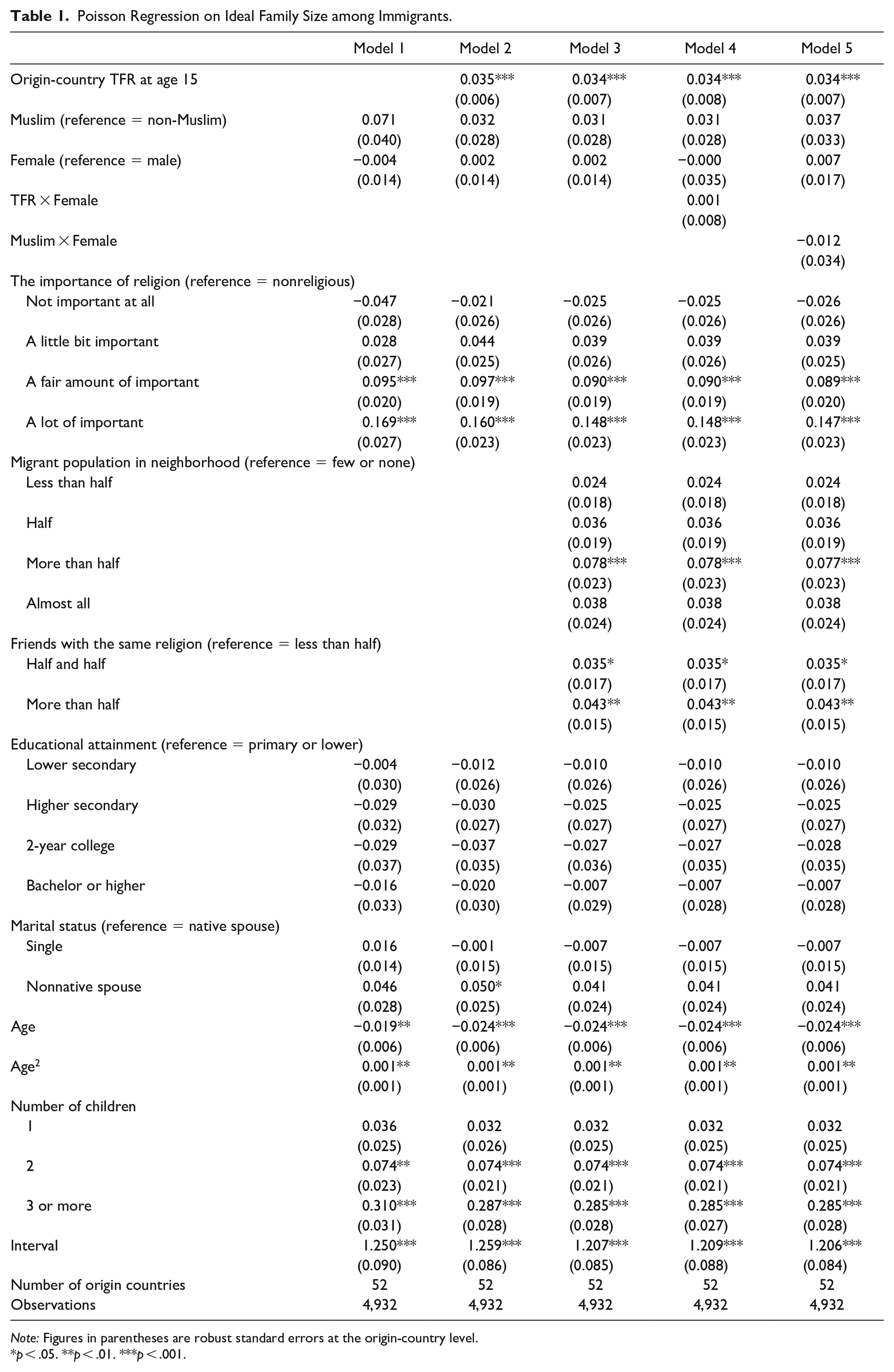
Table 1 presents the gender and religious differences in ideal family size among immigrants. Models 1, 2, and 3 display the main effects, and Models 4 and 5 introduce interactions between gender and TFR at age 15 and gender and Muslim identity. In the main effects models (Models 1–3), there is no evidence that Muslims have a larger ideal family size than non-Muslims regardless of whether the model includes the TFR of the country of origin at age 15, which captures fertility patterns at a given point in time. However, origin-country fertility is significantly associated with immigrants’ ideal family size, as shown in Models 2 and 3.
Poisson Regression on Ideal Family Size among Immigrants.
Note: Figures in parentheses are robust standard errors at the origin-country level.
p < .05. **p < .01. ***p < .001.
The interaction models reveal further insights. Model 4 indicates no significant gender differences in ideal family size among immigrants from high-fertility countries, that is, the interaction between origin-country TFR at age 15 and female is nonsignificant. Additionally, the main effect suggests that female immigrants do not generally prefer smaller families. Similarly, Model 5 shows that Muslim female migrants do not desire fewer children than their male counterparts. This finding suggests that Islamic doctrine is not necessarily linked to a preference for larger families, aligning with recent research on gender role ideology (Glas 2023; Ng 2022; Van Klingeren and Spierings 2020). Instead, fertility patterns in the country of origin exert a much stronger influence on ideal family size for both Muslim and non-Muslim immigrants regardless of gender.
Across the five models, some variables are also associated with an ideal number of children. Consistent with previous research (Behrman and Erman 2019; Ng 2024b), more religious individuals tend to prefer larger families, that is, those who consider religion important report higher ideal family sizes. The results also highlight the role of social networks among both friends and neighbors. Specifically, individuals who report that more than half of their friends share their religion are more likely to prefer larger families than those with fewer co-religious friends. Similarly, those living in neighborhoods with a majority immigrant population tend to express a preference for more children, with this effect being strongest among individuals whose neighborhoods are predominantly immigrant. However, for those whose neighbors are almost entirely immigrants, the association is not significant, possibly due to the small sample size. These findings suggest that religiosity and social networks play a key role in shaping fertility ideals among immigrants. Finally, as expected, individuals who already have more children are more likely to express a preference for larger families. However, it is important to acknowledge the possibility of reverse causality: Those who prefer larger families may simply be more likely to have more children.
Ideal Family Size of the Children of Immigrants
I replicate the same models in Table 1 for the children of immigrants in Table 2. In all models, the TFR of the country of parental origin at age 15 is consistently associated with higher ideal family size. This finding is consistent with recent research that the fertility ideals of children of immigrants are still influenced by their parental country of origin, as are their parents (Ng 2024a). The most notable difference between immigrants and their children, as shown in Table 2, is that Muslim children of immigrants express a significantly higher preference for larger families than their non-Muslim counterparts, whereas no such difference exists between Muslim and non-Muslim immigrants. This finding suggests that attributing more traditional family values to Muslims solely based on Islamic doctrine or identity may be problematic because the pattern emerges only among children of immigrants, not among immigrants themselves.
Poisson Regression on Ideal Family Size among the Children of Immigrants.

Note: Figures in parentheses are robust standard errors at the origin-country level.
p < .05. **p < .01. ***p < .001.
In the interaction models, Model 4 tests the interaction between parental origin-country TFR at age 15 and gender (female). The results show no significant effect, indicating that fertility ideals do not differ meaningfully between men and women from high-fertility backgrounds in their parental country of origin. However, the main effect of origin-country TFR remains positively significant. These findings do not support the idea that children of immigrants from high-fertility countries, particularly men, would express a stronger preference for larger families than their female counterparts.
In contrast, Model 5 indicates that female children of Muslim immigrants express a significantly lower ideal number of children than their male counterparts (coefficient = −0.086, p < .001), whereas the main effect of being male children of Muslim immigrants is positively associated with a higher ideal number of children (coefficient = 0.121, p < .001). Additionally, the main effect of gender (female) becomes insignificant in these interaction models, including Models 4 and 5. 9 To further examine whether gender differences in fertility ideals are particularly pronounced among Muslim children of immigrants, the next section presents a visualization of the predicted probabilities for each group (non-Muslim men, non-Muslim women, Muslim men, and Muslim women) across different migration generations (Figures 1 and 2).

Predicted ideal family size of immigrants.
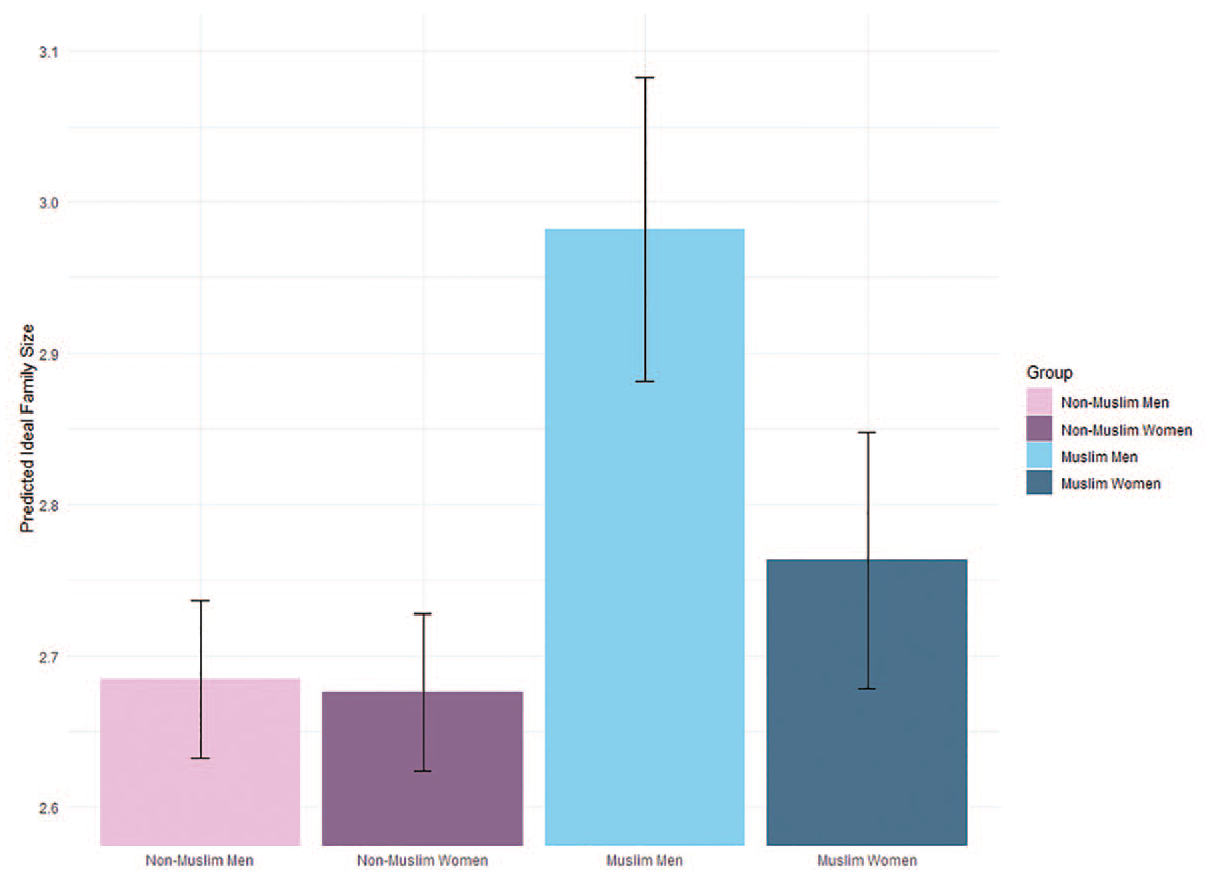
Predicted ideal family size of children of immigrants.
The patterns for other variables across the models remain consistent with those in Table 1. For example, individuals who are more religious, have more friends of the same religion, and live in immigrant-majority neighborhoods are more likely to prefer larger families. Conversely, some factors previously linked to fertility behavior, such as union formation and spouse’s migration status, do not appear to be associated with ideal family size in this study.
Predicted Ideal Family Size by Gender and Religion for Immigrants and Children of Immigrants
The results of Model 5 in Tables 1 and 2 are illustrated in Figures 1 and 2, respectively. Figure 1 shows the ideal family size among four groups—non-Muslim men, non-Muslim women, Muslim men, and Muslim women—within the immigrant population, and Figure 2 presents the same groups among the children of immigrants. As shown in Figure 1, there are no significant differences in ideal family size among immigrants, with all groups reporting an average preference of approximately 2.95 children. However, Figure 2 reveals a notable difference among the children of immigrants, particularly between Muslim men and other groups, including Muslim women. Muslim men in this group prefer an ideal family size of close to 3 children, whereas other groups, including Muslim women, favor a smaller average of approximately 2.72 children.
These findings suggest that although ideal family size remains similar across groups among immigrants, subtle but meaningful differences emerge among the children of immigrants. In particular, Muslim men maintain slightly higher fertility ideals than other groups, including Muslim women. Although this gap is not particularly large, its significance indicates that shifts in fertility preferences do not occur uniformly across gender and religious lines, underscoring the importance of considering both factors when examining the fertility ideals of immigrant populations. The next section will further investigate the gender gap in fertility ideals among Muslim children of immigrants.
Decomposition Analysis: The Difference in Ideal Family Size between Muslim Male and Female Children of Immigrants
Whereas Poisson regression models estimate the average effect of independent variables on ideal family size, the decomposition model explains differences in outcomes between groups by separating these differences into the effects of characteristics and the returns to those characteristics. Figure 3 presents the results of the threefold Blinder-Oaxaca decomposition, which breaks down the 0.36 difference in actual ideal family size between Muslim men (3.08) and women (2.72) children of immigrants based on raw data rather than Poisson predictions. The model includes factors tied to acculturation—education, religiosity, intrareligious friendship networks, and residential segregation—treated as continuous variables for simplicity. For ease of interpretation, all variables are coded as continuous in the decomposition model. Figure 3 highlights three components: endowment effects (differences in levels), coefficient effects (differences in impacts), and interaction effects.

Decomposition results of male and female Muslim children of immigrants.
Endowment effects indicate the extent to which differences in ideal family size between Muslim male and female children of immigrants can be attributed to differences in the levels of these predictors. In other words, they estimate how much the gender gap would shrink if both groups had the same average levels of these characteristics. Overall, only a small portion of the gender gap in ideal family size can be explained by differences in these predictors. Specifically, variation in educational attainment and friend networks accounts for just 7.5 percent ((0.015 + 0.012) / 0.36) of the gap, meaning that if second-generation Muslim men had the same levels of education and Muslim friendships as women, their ideal family size would be only slightly lower. The effect of religiosity is negative, suggesting that differences in religiosity do not contribute to the gender gap. Additionally, neighborhood composition has no discernible impact on gender differences in ideal family size.
Coefficient effects tell a different story from endowment effects. Whereas endowment effects focus on differences in the levels of explanatory variables between men and women, coefficient effects highlight how variations in the impact of these variables shape the gender gap in ideal family size. Specifically, two variables—neighborhood segregation and intrareligious friend networks—emerge as the strongest positive contributors, suggesting that these factors exert a greater influence on men’s ideal family size than on women’s. Specifically, living in a community with a higher proportion of immigrants is more strongly associated with men’s preference for larger families. Similarly, intrareligious friend networks have a pronounced effect on men’s fertility ideals, indicating that having more friends of the same religion is associated with a greater desire for children among men than among women. Together, these two variables account for 86 percent of the total gender gap in ideal family size ((0.14 + 0.17) / 0.36)). This is striking because Muslim men and women have similar levels of neighborhood segregation and intrareligious friendships, yet these factors are significantly more influential in shaping men’s fertility ideals.
As in other regression models, the positive effect of intercept suggests that even after accounting for differences in education, religiosity, co-religion friend networks, and neighborhood segregation, unobserved factors may still contribute to the gender gap in ideal family size. In addition, the small interaction effects—less than 2 percent of the gender gap in ideal family size—indicate that the relationships captured by endowments and coefficients are not strongly moderated by each other. This suggests that readers can focus primarily on the main effects when interpreting the results.
Discussion and Conclusion
Muslims, particularly in Western Europe, are often viewed as a religious group that is fundamentally incompatible with Western values. Empirical research suggests that Muslims, including immigrants and their children, generally hold more traditional family values, such as attitudes toward gender roles and fertility ideals, than their non-Muslim immigrant and native counterparts. Whereas existing research tends to focus on differences in the acculturation of gender role ideology within Muslim populations (Glas 2023; Van Klingeren and Spierings 2020), the acculturation of fertility ideals has received less attention. Yet understanding these fertility preferences is important for examining broader demographic transitions and fertility patterns not only among migrants but also in the general population. This article aims to address this issue by using TeO data to examine gender differences in ideal family size with a specific focus on Muslim children of immigrants in France. It further explores how religiosity, educational attainment, social networks, and neighborhood segregation contribute to these differences.
The findings from the first part of the analysis, using a broad sample of Muslim and non-Muslim immigrants and their children, show that Muslim immigrants, regardless of gender, do not express a significantly stronger preference for larger families than non-Muslims. However, among the children of immigrants, a subtle divergence emerges: Muslim men raised in France report slightly higher ideal family sizes, and Muslim women, like their non-Muslim counterparts, tend to prefer smaller families. This pattern suggests that Muslim men may be less influenced by acculturative shifts in fertility preferences than women. Although the difference is modest, it aligns with the idea that Islamic ideals are not necessarily linked to traditional family values for women (Glas 2023; Ng 2022; Van Klingeren and Spierings 2020).
To understand why Muslim men and women raised in France differ in their ideal family sizes, the second part of the analysis, focusing on a sample of Muslim children of immigrants, examined the influence of education, religiosity, Muslim friendship networks, and neighborhood segregation on this gender gap. Using a threefold decomposition model, I separated the gap into two components: differences in the levels of these factors between men and women (e.g., how much education or religiosity they have) and differences in how these factors influence fertility ideals (e.g., the strength of their effect on family size preferences).
The analysis reveals that this gap is not primarily driven by variations in education, religiosity, or exposure to Muslim social networks because men and women exhibit similar levels in these areas. Instead, the key distinction lies in how these networks shape fertility ideals. Although both genders maintain comparable ties to Muslim friends and neighborhoods, these connections exert a much stronger influence on men, reinforcing a preference for larger families to a greater extent than they do for women. This highlights a gendered effect in how social environments shape fertility ideals.
These findings contribute to theoretical discussions in several ways. First, in contrast to recent studies on gender role ideology (Glas 2023; Ng 2022; Van Klingeren and Spierings 2020), the analysis shows that religiosity remains generally associated with a preference for larger families. However, gender differences in religiosity do not explain gender differences in ideal family size among Muslim children of immigrants. In other words, men do not desire more children simply because they are more religious than women. Second, and more importantly, the results suggest that the gender gap in ideal family size is not driven merely by the quantity or proportion of intrareligious friendships but by how these friendships shape fertility preferences differently for men and women. These findings emphasize that acculturation processes, not just outcomes, are highly gendered. Although Muslim men and women raised in France may have similar numbers of intrareligious friends, these friendships exert a much stronger influence on men’s ideal family size than on women’s.
This study enriches migration research by highlighting the gendered dimensions of acculturation, particularly in relation to family values. It builds on previous literature on gendered acculturation (see Maliepaard and Alba 2016; Scheible and Fleischmann 2013; Valdez and Tran 2020) by showing that for Muslim men, acculturation is shaped not only by the size of their social networks—where they tend to have fewer non-Muslim friends and more Muslim friends—but also by the nature of these networks. Men who remain in ethnic enclaves, often among the most disadvantaged groups, are significantly less likely to integrate into the mainstream than women in similar circumstances.
Why are in-group social networks disproportionately stronger for Muslim men than for women? Several explanations are possible. One possibility is that men, whether Muslim or non-Muslim, face stronger peer pressure to conform to traditional family values within their religious community. However, this explanation is less likely because similar patterns are not observed among non-Muslim men of the same background; there are no significant gender differences among non-Muslim children of immigrants.
Alternatively, the challenging social climate faced by Muslim men in France (Mansouri and Perlow 2024; Valfort 2020) might prompt Muslim parents to prioritize passing down traditional values to their sons more than their daughters. Close intergenerational bonds and parental socialization could serve as a buffer against exclusion (Baysu, Phalet, and Brown 2011; Portes and Hao 2002; Soehl 2020), with these values potentially taking deeper root in boys—especially those surrounded by Muslim peers whose norms reinforce parental expectations. Verifying this idea would require data linking parent and child perspectives to determine if sons of more traditional parents are less swayed by external influences. However, the TeO survey lacks such paired data, and other data sets with parent-child information do not cover fertility ideals or childbearing preferences.
It is also possible that emotional support structures differ between Muslim men and women. Muslim men, especially those who are socioeconomically disadvantaged, may rely more heavily on friend networks for emotional support and validation, increasing the influence of these networks on personal decisions, such as family size. In contrast, women may have more diverse support networks, diluting the influence of any single group. Future research could use a social network perspective with friend network data to examine this potential mechanism.
One limitation of this study is the inability to establish causality, particularly in the decomposition model. It is possible that men who hold more traditional views on family size are more likely to form and maintain strong intrareligious friendships, creating the appearance of a stronger effect of these friendships on their fertility ideals—a homophily effect, to borrow a term from social network research. For example, men with traditional views on family size may actively seek and sustain friendships within their religious community, finding greater comfort and validation in social circles that reinforce their values. Similarly, homophily may lead individuals to choose neighborhoods where peers hold similar family-oriented values, which can intensify the impact of neighborhood composition on men’s fertility preferences, as indicated by the larger coefficient effects observed in the decomposition analysis. Addressing this issue would require longitudinal data, which the TeO unfortunately does not provide.
Despite its limitations, this study offers a valuable example of how to avoid the pitfalls of Muslim essentialism and Muslimization (Brubaker 2013; Statham 2024). Rather than treating Muslims as a monolithic ethnic category and focusing solely on group mean comparisons between Muslims and non-Muslims, this study distinguishes the influence of cultural and religious origins on fertility ideals, examines gender differences among Muslim children of immigrants, and tests potential mechanisms using decomposition analysis. The results reveal the mechanisms of gendered acculturation, showing that disadvantaged Muslim men disproportionately adopt more traditional fertility ideals compared to similarly situated women.
This study also demonstrates that acculturation is not a uniform process but is clearly gendered. The stalled acculturation observed among men is not solely explained by the quantity of intrafaith or interfaith friendships or neighborhood composition. Instead, social networks may function differently for men and women, with men’s intrareligious networks potentially acting as stronger gatekeepers of cultural continuity. This perspective is critical not only for immigrant populations but also for broader groups facing similar structural conditions, such as racial, socioeconomic, and urban-rural divisions. It is essential to carefully define and measure categorical variables to avoid reinforcing social stereotypes. More broadly, this approach highlights the importance of avoiding an overreliance on categorical variables when analyzing social phenomena. Decomposition methods provide a valuable tool for reexamining and unpacking group differences across social categories and groups.
Supplemental Material
sj-docx-1-srd-10.1177_23780231251351671 – Supplemental material for Gender Differences in Fertility Ideals among Muslim and Non-Muslim Immigrants and Their Children in France
Supplemental material, sj-docx-1-srd-10.1177_23780231251351671 for Gender Differences in Fertility Ideals among Muslim and Non-Muslim Immigrants and Their Children in France by Ka U Ng in Socius
Footnotes
Acknowledgements
I would like to thank Emma Labovitz, Bowei Hu, Po-Chien Lin, Jen-Chen Chao, and Sakeef Karim for their insightful suggestions during the early stages of this project. I am also grateful to the anonymous reviewers and the editor for their constructive feedback on the manuscript. All remaining errors are my sole responsibility.

Data Availability
Supplemental Material
Supplemental material for this article is available online.
Notes
Author Biography
References
Supplementary Material
Please find the following supplemental material available below.
For Open Access articles published under a Creative Commons License, all supplemental material carries the same license as the article it is associated with.
For non-Open Access articles published, all supplemental material carries a non-exclusive license, and permission requests for re-use of supplemental material or any part of supplemental material shall be sent directly to the copyright owner as specified in the copyright notice associated with the article.
