




Abstract
In this article, we analyze headscarf debates that unfolded in the first decade of the twenty-first century in France, the Netherlands, and Germany. Through a socio-historical overview looking at newspaper articles and policy and legal documents, we show how the headscarf has become a site for negotiating immigrant-related, postcolonial difference. We argue that certain feminist understanding of gender liberation and postcolonial difference in the headscarf debates reveal the continuity of control mechanisms from the colonial to the postcolonial era. We highlight the possibilities for decolonial thought and practice by centering the situatedness of headscarf. This allows us to show how Muslim citizens are active participants in producing contemporary Western European histories even as some of their practices face overt rejection.
Over the past decades, the headscarf has become a site for negotiating immigrant-related, postcolonial difference in Western European countries, like France, the Netherlands and Germany. In our work, we analyze how gender-based arguments have shaped varied forms of headscarf regulation both through formal law and policy and informal everyday interaction. We focus on how certain feminist understanding of gender liberation and postcolonial difference in the headscarf debates reveal the continuity of control mechanisms from the colonial to the postcolonial era. However, we do not solely focus on colonialism’s continuities; we also highlight the possibilities for decolonial thought and practice by centering the situatedness of the headscarf (Bhambra, 2014; Lugones, 2010; Mignolo and Walsh, 2018; Sheth, 2006). This allows us to show how Muslim citizens are active participants in producing contemporary Western European histories even as some of their practices face overt rejection.
To understand the link between liberal and other forms of feminisms, ideals of gender liberation, postcolonial trajectories, and decolonizing possibilities, we turn to France, the Netherlands, and Germany as three countries that witnessed intense public debate regarding wearing the headscarf during the first decade of this century (also see Amiraux, 2013). 1 During this first decade, liberal feminists in all three countries equated headscarves with gender inequality and influenced the shape of formal headscarf regulations, albeit with different results for each country. In addition, feminist interpretations shaped public perception of the meaning of the headscarf.
In our analysis of these debates, we join a group of scholars who highlight how immigrant-related postcolonial difference is rejected by mobilizing a narrow interpretation of gender equality (Dahinden et al., 2020; El-Tayeb, 2011; Keskinen, 2019; Mishra, 2013). Our contribution to this scholarship is to analyze the role of Western liberal feminist interlocuters in the headscarf debates that took place at the beginning of this century and to illuminate the role of such feminists in the regulation of postcolonial difference. At the same time, we foreground the contributions of headscarf-wearing women’s decolonial projects, to show how they introduce new European subjectivities and disrupt the colonial power of a Western liberal feminist narrative of Muslim women as ‘victims’ (also see Vanzan, 2016).
Below, we will first provide a brief description of the headscarf regulation in the three countries, then discuss our framework for integrating postcolonial and decolonial approaches into the headscarf literature, and give an overview of our methodologies. We then apply the conceptual framework we develop in the first part of the article to analyze news media and political debate in each country in turn, highlighting the impact of postcolonial trajectories on the gendered racialized production of difference and concomitant decolonial possibilities. We conclude that liberal feminists and other feminist-inspired interlocutors have been instrumental in regulating postcolonial difference in all three countries albeit with different strategies. At the same time, we show that European Muslim women find decolonial possibilities that refuse colonial/postcolonial narratives.
Regulating the headscarf: postcolonial difference and decolonizing possibilities in the early 2000s
Postcolonial politics in France, the Netherlands, and Germany have been shaped by differing colonial histories reflected in contemporary diverse Muslim populations from colonies, like Algeria, or from migrant-sending countries, like Turkey or Morocco (which themselves need to be read against postcolonial trajectories of labor-importing states) (Albrecht, 2011). Unlike the other two countries, Germany did not have overseas colonies, which may suggest that postcoloniality has only limited effect in contemporary politics. Instead, we argue that though each nation state has specific historical colonial relationships, in the contemporary era, postcoloniality traverses Western Europe and becomes the interpretive lens for the perceived practices of Muslim inhabitants (Foroutan, 2019; Purtschert, 2019).
Colonial/postcolonial practices are expressed in different domains of formal regulation in the three countries under study: in France, headscarf-wearing has been regulated through lawmaking, while in the Netherlands and Germany, the early 2000s saw the application and interpretation of existing law in both restrictive and inclusive ways. In France, the targets initially were elementary and high school students – where schools are the sites of citizenship production in the French republic (Amiraux, 2009; Bowen, 2008; Scott, 2007). In 2004, France famously passed a law banning students’ wearing of headscarves in elementary and high schools. In the Netherlands, the field of formal regulation has been very dispersed. Rather than a focus on efforts to create new laws (though those did exist), the headscarf was largely regulated through bottom-up conflict in multiple domains of school, university, leisure, sport, and government (Roggeband and Lettinga, 2016). Advisory rulings of the precursor to the Dutch Commission for Human Rights often protected the right of women to cover themselves but pressures to limit that right continue to be exerted throughout all domains of social life. In Germany, the Constitutional Court has been the primary actor, regulating headscarf-wearing among teachers, and devolving the specifics of that regulation to individual states (von Blumenthal, 2009). While initial regulation focused on prohibiting teachers from wearing a headscarf, Germany has also seen some debate about headscarf-wearing women’s employment more generally. Across the three countries, liberal feminist arguments that model women’s liberation on a normative White European woman structured regulation (Delphy, 2015; Ferree, 2012; Moors, 2011). Such forms of feminism are rooted in what Rottenberg (2014) describes as ‘classic liberal feminism whose raison d’être was to . . . [reveal] the gendered exclusions within liberal democracy’s proclamation of universal equality, particularly with respect to the law, institutional access, and the full incorporation of women into the public sphere’ (p. 419). While feminism expresses itself different in each country (see Ferree, 2012; Scott, 2007), the basic tenet of treating a form of gender equality rooted in the experiences of white, middle-class women as the goal of liberation cuts across our cases.
In addition to formal regulation, headscarf-wearing women in all three countries witnessed informal, everyday regulation through the development of discursive repertoires that interpreted the meaning of headscarf-wearing in everyday life, often in negative ways (see Korteweg and Yurdakul, 2014). Contemporary public discourse foregrounded three dimensions of postcolonial difference. First, the headscarf highlighted a particularly gendered way for women to present their bodies in the public sphere (Gökariksel and Secor, 2014). The headscarf’s marking of gender difference received scrutiny because of a perception that the headscarf indicated a denial of underlying equality between the sexes; seen from the outside, wearing the headscarf was often interpreted as a form of submission that signals that Muslim women were unequal both to Muslim men and to ‘Western’ women (Moors, 2009; Scott, 2007). Note that gender equality remains undefined in these articulations of gendered submission (see also Korteweg, 2017). Second, in the European context, headscarf-wearers were racialized, as people perceived the headscarf as a sign of belonging to a minority group that was ethnically or racially differentiated from the majority in ways that rendered these populations inferior as a result of colonial histories (Ahmed, 2011; Moors, 2011; Scott, 2007). Finally, headscarf-wearing represented a religiosity, Islam, which was increasingly seen as a threat to the political stability of Western European countries (Amiraux, 2013). Indeed, during the decade under study, those with roots in Muslim majority countries were increasingly portrayed as Muslims, rather than as people originating in countries such as Turkey, Morocco, Algeria, and other countries with predominantly Muslim populations. With this transition to understanding immigrants as Muslims, came an approach to headscarf-wearing in which apparently universal values rooted in gender and sameness came to inform racialized understandings of women’s agency and liberation (Mohanty, 1984). At the same time, the headscarf became a symbol not only of the private oppression of Muslim women but also the public’s fear of ‘Islamization’ and terror (Korteweg and Yurdakul, 2014).
The colonial roots of postcolonial trajectories: the case of headscarf
Why has the headscarf attracted such intense debate? We join a long list of authors who argue that the headscarf becomes a piece of cloth upon which to project the tensions of our postcolonial situation (Scott, 2007; Sheth, 2006; Yeğenoğlu, 1998). Indeed, as Asad (1993) argues, contemporary regulations of Muslim symbols in the public sphere in Europe are an extension of the violence of colonizer in the colonial history. A typical binary in colonial discourse is the universalized representation of sovereign Western women in opposition to Muslim women victimized by their religious communities (Mohanty, 1984; Yeğenoğlu, 1998). Veiling is the epitome of this victimization; colonial forces already presented veiling as a symbol of gendered oppression and ordered for its regulation (Ahmed, 2011). Ahmed (1992) discusses the cultural and religious transformation initiated by British colonial forces in Egypt that paved the way to removing of veils. Ahmed describes this colonial time as the British introduction of modernization and industrialization to Egypt, which simultaneously created a social transformation and deep sense of moral inferiority through racializing colonialized populations. This racialization was deeply gendered, as Western liberal feminism’s expression in Egypt failed to take the situatedness of gender liberation into account (Ahmed, 1992: 151). Similarly, in her historical analysis of French colonialism in Algeria, Scott (2007) shows that under French rule, Algerian women had to cast off their veils in 1830. Taking off the veil was a sign of gender liberation and being civilized simultaneously.
This colonial style of governing through the binary logic of racialized natives versus civilized Europeans was soon adopted by the local ruling elite in these Muslim countries. Local ruling leaders enforced their power by emulating colonial elites, joining in civilizing projects of leaving the veil behind and adopting ‘European’ style of clothing (Ahmed, 1992; Korteweg and Yurdakul, 2014; Scott, 2007). Thus, local leaders built on both local practices of oppression and new colonial modalities: Mernissi (1987) aptly showed how male ‘ulama’ in Morocco used religious texts in order to strengthen their dominant position, especially toward Muslim women (see also Mir-Hosseini et al., 2015). As such, women in Muslim countries have dealt with gendered oppression through the local patriarchy and then through the colonizers.
Although we observe a common historical thread of a forceful colonization in the literature, Mohanty (1984) criticized the depiction of ‘Third World’ women as victims of colonialism. By giving examples from struggles of women to overcome colonial rule, she showed that feminist struggle had been present in the ‘Third World’ long before ‘Western’ feminists struggled for their own rights. Analogously, Ahmed (1992) shows the irony of British colonizers exporting gender equality to Egypt while jailing suffragettes in Britain. Today, many Muslim countries have strong feminist movements, which are anti-colonial and anti-government (Mutluer, 2019). These are part of the histories that Muslim women who immigrated to Europe bring with them and pass on to the next generations of Muslim women who are born in European countries.
Decolonizing the headscarf: politics of refusal
In the contemporary era, we witness how gendered headscarf regulations of colonial rule are transformed into new regulations of immigrant integration. In the postcolonial context, ‘civilization’ is replaced with ‘immigrant integration’ or ‘social cohesion’ discourses that inscribe an equation between headscarf-wearing and gender oppression (Korteweg, 2017). However, by highlighting the postcolonial continuities of headscarf regulation, we risk privileging the colonial perspective without paying attention to what gets lost in the colonial/postcolonial binary (Chakrabarty, 2000).
For many Muslim women who are second- and third-generation Muslims in Europe, headscarf-wearing represents a politics of refusal (Emejulu, 2019; Simpson, 2014). Their headscarf is not their mother’s traditional headscarf anymore, it is also not the Muslim woman’s oppression, as liberal feminists would argue (Ast and Spielhaus, 2012; Sheth, 2006; Zimmerman, 2015). Muslim women redefined the meaning of their headscarves in the European public postcolonial context after their family’s migratory experiences. As a redefined gendered symbol, Muslim women’s headscarf offers an opportunity to recognize the colonial/postcolonial trajectory of this symbol, to embrace self-determination over Muslim women’s own bodies, and to enact quests of inclusion as full citizens in European countries (Korteweg and Yurdakul, 2014; also see Al-Kazi and Gonzalez, 2018 for a quest for social mobility).
Indigenous scholar Audra Simpson develops the concept of a ‘politics of refusal’ to articulate how Haudenosaunee (and other Indigenous peoples in Canada) reject the sovereignty of the Canadian state in conditions where that rejection is also always to some degree impossible (Simpson, 2014). Her politics of refusal center on a rejection of settler colonial sovereignty. We link this to the very different circumstances of postcolonial subjects in European sovereign space: rather than continuing to perceive subjects from former colonies through a lens of interloper, visitor, or person who is not yet but can become European, we argue that these subjects are fully part of the European project, rooted as that project is in colonialism. At the same time, the refusal to participate in civilizing projects (as articulated through social cohesion or integration language) signals an attempt to refuse the post/colonial imaginary that shapes contemporary politics of postcolonial difference.
In each country, different spaces for such refusal open up. As citizens of Europe, Muslim women’s political activities make the headscarf a European symbol and engage in a decolonization process that offers a multivalent challenge to postcolonial politics of repression. At the same time, some Muslim women act as ‘codebreakers’, or women who take up a position as representing ‘authentic’ voices from Muslim communities (see Bracke, 2011; De Jong, 2017; Yurdakul, 2010). They join liberal feminists who work in consort with governments to address gender equality issues in ways that mimic colonial uses of gender equality and that reinforce a particular understanding of postcolonial difference.
Methods
To analyze the ways in which contemporary headscarf regulations reveal the workings of colonial, postcolonial, and decolonial power, we analyzed three main sources of data: newspaper reporting, government documents including parliamentary debates and commission reports, and court decisions (see Table 1 for a description of the data). In each country, we chose newspapers that cover the range of class positions and political outlooks in public and political debate. We gathered the data by searching for the words voile islamique (Islamic veil) and foulard islamique (Islamic scarf) in the French case, hoofddoek (headscarf) and boerka (burqa) in the Dutch one, and Kopftuch (headscarf) and Burka (burqa) in the German case. These were the key terms used in public debate (in the subsequent decade, debates included niqab as well but this term was not the focus in earlier debates). Note that the analysis we present in this article highlights debates on the headscarf, not face coverings. In the French case, we then tried to narrow this down by adding ‘femme(s)’ or ‘fille(s)’ but this did not reduce the number of articles by more than 5%. In addition, we looked at a variety of government and legal documents in each country case. We also conducted a few very targeted interviews in the Netherlands and Germany to talk to outspoken pro-headscarf activists, because their voices are underrepresented in the media debate. The data gathered for each country differed somewhat in order to reflect the sites in which regulation took place – rather than imposing uniformity on our data gathering efforts, we chose to gather the most comprehensive set of data for each country case.
Data sources.
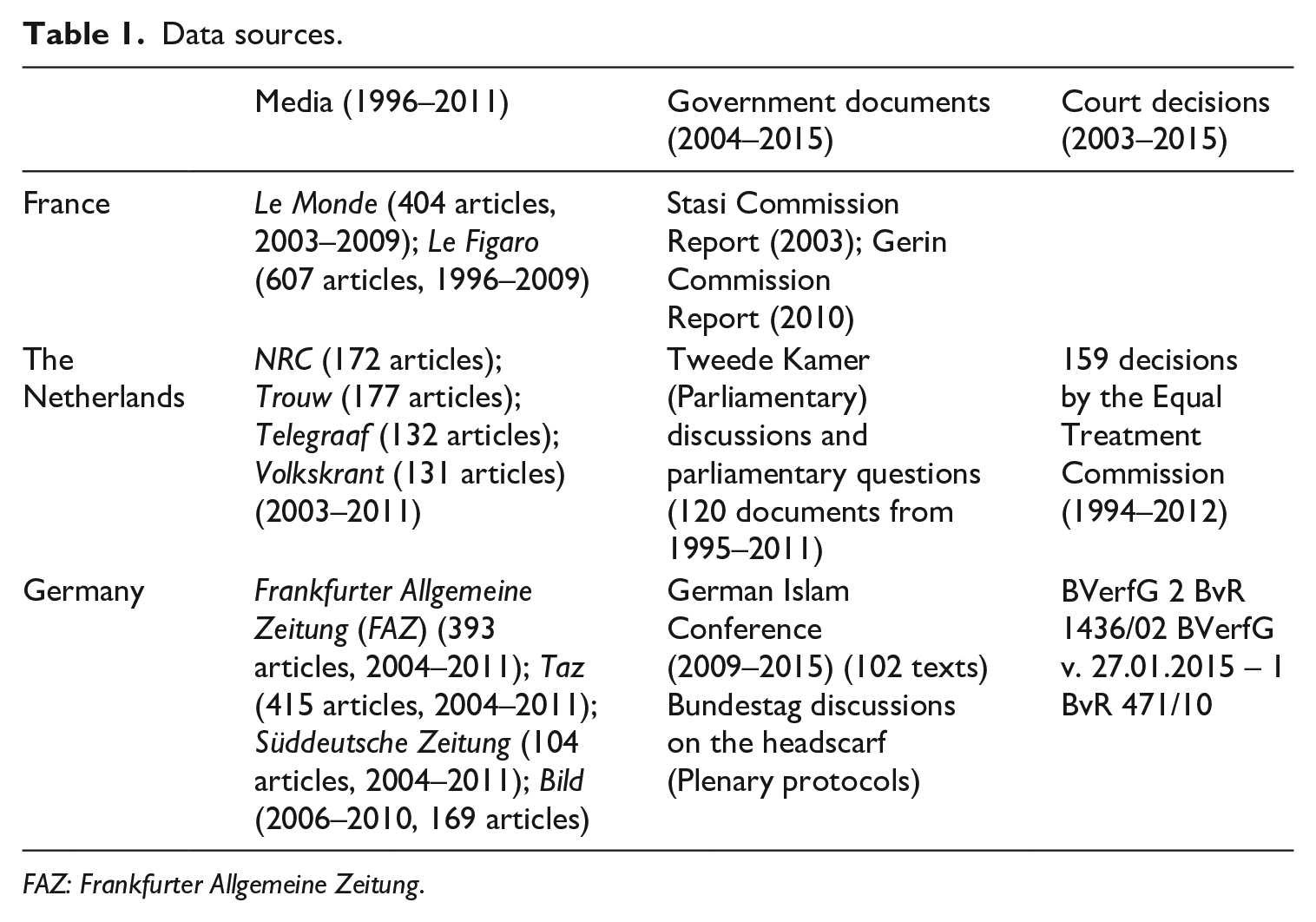
FAZ: Frankfurter Allgemeine Zeitung.
Our data analysis follows practices associated with the extended case method, combining inductive and deductive approaches (Burawoy, 1998). Sorting through all newspaper articles, government documents, and court decisions, we first identified the main themes of these texts inductively. In each country, we focused explicitly on gender politics, highlighting the participation of women’s organizations in debates about regulation and foregrounding arguments overtly rooted in feminist tradition or history. We identified which self-identified feminist actors and interlocutors engage in the debates in order to capture both claims-making discourses and practices of engagement. Finally, we pay particularly close attention to the contributions of European Muslim women, given a postcolonial politics of overlooking their active contributions to change in European societies.
Findings: debating the headscarf in France, the Netherlands, and Germany
France
French headscarf politics exemplify an alliance between postcolonial codebreakers and feminists. Prominent women associated with various NGOs and government-funded women’s advocacy organizations drew on the image of the vulnerable Muslim girl or woman to demonstrate that Islam is inherently hostile to women (Billaud and Castro, 2013). The anti-violence women’s organization Ni Putes, Ni Soumises (Neither Whores, nor Submissives, NPNS) located in the highly diverse postcolonial banlieues of Paris was a particularly important generator of discourses that reinforced this interpretation of the relationship between Islam and women’s oppression (Lépinard, 2014). NPNS became a powerful interlocutor for government, especially in the anti-headscarf lawmaking undertaken in 2003. 2 NPNS was founded by Fadela Amara and Samira Bellil, both of Muslim background, to address violence against women and girls in the banlieues. NPNS saw Islam as condoning such violence and argued that girls wore the headscarf as protection from the boys and men that harassed, attacked, and raped them (see also Weil, 2008). Amara (who later became a minister in Sarkozy’s government) promoted forbidding the headscarf in schools: ‘I do not accept that we should tolerate the veil under the pretext of respecting the cultures from which it originates’ (Amara cited in Le Monde, 8 March 2005). 3
The participation of women who represent postcoloniality in feminist politics is illustrated by the actions of Gisele Halimi, a woman of Tunisian-Muslim and Jewish descent and a prominent writer, lawyer, and activist. As president of Choisir la cause des femmes, a pro-choice organization she co-founded with Simone de Beauvoir and others in 1971, she focused an op-ed on what she posited as the source of the problem with the headscarf – Islam: The veil is a terrible symbol of women’s inferiorization. I don’t need to elaborate – this is precisely the way it’s intended by the Koran. Defined in relation to man, to his desires, to his compulsions, the woman must hide all that could seduce, that could indicate sexual transgression. (Le Monde, 24 October 2003)
Halimi allied herself with organizations like NPNS to portray Islam as a threat to Muslim women. As someone of Tunisian descent, engaged in organizations that have ties to various government apparatuses, Halimi articulated a simplistic and uniform meaning of the headscarf. Drawing on a liberal feminist discourse, Halimi aligned herself with restrictive headscarf regulations as an ‘emancipatory’ project, strongly echoing French colonial practice in Tunisia. This approach disregards the postcolonial context in which the headscarf gains new meanings.
We then see how the arguments of codebreakers like Amara, Bellil, and Halimi dovetail with pronouncements by leaders of prominent women’s organization to inform a consensus that there is no way to understand the headscarf as anything but a symbol of oppression. For example, Anne Vigerie and Anne Zelensky, both leaders of prominent women’s organizations, wrote, The headscarf ‘symbolizes women’s place in Islam as it is understood by Islamism. This place is in the shadows, relegated, in submission to men. The fact that women claim it as their decision does nothing to change its meaning . . . There is no surer oppression than self-oppression’. (Le Monde, 30 May 2003)
Vigerie and Zelensky invigorated liberal feminism which projects the Western portrayal of gender inequality (seen as women’s submission to men) onto Muslim communities. They unapologetically spoke on behalf of oppressed women they believed were unable to speak as independent subjects, and denied Muslim women’s capacity to resist such interpretations of the postcolonial context.
Thus, prominent feminist French activists, Muslim, Arab, and others positioned themselves as knowledgeable about Islam and capable of interpreting the Koran for the general public. They gave depictions of Islamic practice as unitary and oppressive to women, despite a body of research that documents far more nuanced and diverse interpretations of the headscarf in France (Bloul, 1996; Gaspard and Khosrokhavar, 1995; Killian, 2003; Laxer, 2019; Parvez, 2017; Scott, 2007; Winter, 2008). From this vantage point, they advocated for the abolishment of the headscarf in elementary and high schools. Their discourses show the paradox of liberal feminism: Muslim women are actively self-oppressing by wearing headscarves, but government’s oppressions or the silencing of headscarf-wearing women during the making of regulations and policies that affect their religious practices goes unquestioned. The continuities of colonialism/postcolonialism are striking.
In France, feminists directly influenced lawmaking processes: prominent politicians drew on arguments that the headscarf should be banned from schools in order to protect women’s equality and agency. However, these same politicians then turned these discourses back in on themselves to promote unveiling as a way to ensure that women would properly mother the next generation of French citizens. For example, Dominique Perben, French Minister of Justice argued: ‘To accept the veil is to accept a conception of woman that is fundamentally contrary to her dignity . . . Any solution must take the equality of the sexes to heart’, concluding ‘social integration occurs through women’ (Le Monde, 16 November 2003). The notion that women facilitate their children’s integration into French society pointed to a key paradox in French gender politics: the unquestioned assumption of women’s primary role in parenting and the attendant reinscription of gender difference (see also Scott, 2007).
Echoing the image of the colonial subject depicted by Vigerie and Zelensky, only two headscarf-wearing women were among those interviewed by the Stasi commission that developed the 2004 ban on headscarf-wearing in schools. These women were chastised by Commission members for wearing the scarf (Laxer, 2019). Even before the Stasi Commission published its findings, Bernard Stasi suggested to the French media that young women frequently wore the veil ‘because their parents, older brothers and religious groups obligate them to do so’ (Le Monde, 2 November 2003). Patrick Weil, a historian of citizenship and member of the Stasi Commission, stated that the argument that girls wore the veil to protect themselves from the sexual aggression of boys and men in the banlieues had a particularly strong influence on that Commission’s recommendations (Weil, 2008: 2707). Politicians were taken with Muslim women’s testimony against the headscarf, and the NPNS and Amara were among the most-cited referents in the parliamentary debates (Bowen, 2008: 137). Through adopting the colonial discourse of saving Muslim women from Muslim men, liberal feminism informed the exclusion of Muslim headscarf-wearing French women from educational institutions and meaningful participation in public debate.
Yet, even in France, where the ties between feminist interlocutors and government informed highly restrictive laws, we see decolonial challenges through a politics of refusal that started in French schools and streets. For example, in 2003, Alma and Lila Lévy, 13-year-old twin sisters, became pro-headscarf activists after being denied entry to their high school as they adopted their French-Algerian mother’s religion. They demonstrated that they had freely chosen to wear the scarf, directly contradicting the link between religious expression and gender oppression, and managed to gain significant media attention. Similarly, debates on the eventual passage of the 2004 Stasi law that prohibited headscarf-wearing in elementary and high schools led to large street protests with young women taking up slogans like, ‘The veil, my choice’ that was front page news. Such slogans reinterpret the politics of headscarf-wearing in the language of liberal feminism while also subverting that language. Yet, voices like those of the Levy sister and protestors in the street were not taken seriously in the halls of government and these European Muslim women’s interventions did not prevent the passage of restrictive laws.
The Netherlands
In the Netherlands, too, we see the influence of codebreakers. Formal regulation through the law was far more ad hoc than in France and had less restrictive results. For example, over its 18-year existence between 1994 and 2012, 159 cases came before the Equal Treatment Commission (ETC). This body made advisory rulings based on laws defining equality, and rights to freedom of expression and religion until 2012 when that task was taken over by the newly formed Commission for Human Rights. The ETC tended to view headscarf-wearing as a form of religious expression protected by laws of state neutrality in religion. A number of the ETC’s cases were broadly discussed in the Dutch media where outspoken Dutch Muslim women echoed French feminists by linking the headscarf to women’s oppression.
Ayaan Hirsi Ali, a Somali refugee who became a Dutch citizen, was directly engaged in government as a parliamentarian for the right-liberal governing VVD party and their spokesperson on immigrant integration. In an opinion piece, she argued that the laws in place should be tightened to enable the Dutch state to restrict headscarf-wearing. Like French feminists, Hirsi Ali fulfilled the role of an authentic voice of a Muslim ‘codebreaker’ as she argued that women wear headscarves in order to avoid men’s lust (NRC, 13 April 2004). Hirsi Ali further asserted that Muslim women who try to free themselves from this oppressive interpretation of their sexuality, body, and personhood risked extreme violence by family members ‘hell-bent’ on enforcing these norms (Hirsi Ali quoted in NRC, 13 April 2004). As a parliamentarian, Hirsi Ali engaged in efforts to eradicate headscarf-wearing in Dutch society.
Naema Tahir, a Dutch Muslim columnist and lawyer, also put forth the headscarf as a symbol of women’s subordination but she granted headscarf-wearing women a form of agency. In one column, Tahir responded to French demonstrations against the headscarf ban. She wrote, ‘It must feel very powerful, my sister’ to participate in making the headscarf ‘one of the most complicated pieces of clothing of our time’ (NRC, 24 January 2004). Like Hirsi Ali, Tahir drew on the legitimacy conferred by her own childhood to explain her understanding of the headscarf to a largely non-Muslim Dutch audience. She wrote that wearing a headscarf as a teen in Pakistan, she toyed with men’s sexual attention while overtly adhering to strictures of modesty: My headscarf became a culturally determined expression of how I could express my sensuality, [a way to get revenge on] my uncles and nephews, who in their tight western jeans, dictated how ‘their women’ should act, even though they did not restrict themselves in anything. (NRC, 24 January 2004)
Thus, both Hirsi Ali and Tahir re-used common colonial tropes about Muslim men as exploitative and of Muslim women in need of liberation from those men through unveiling projects (Abu-Lughod, 2002; Razack, 2004). Neither Hirsi Ali nor Tahir, whose roots are in Somalia and Pakistan, respectively, represented former Dutch colonies, but both embodied the postcolonial foreign in the Dutch imaginary and both strategically used their background of growing up religiously Muslim to explain to a presumed non-Muslim audience why they should fear the headscarf.
Tahir differed from Hirsi Ali in that she introduced the notion of an agentic Muslim woman, claiming that she believed that young Dutch Muslim women wear the headscarf as A statement against Western society . . . a counterweight to the peer pressure in your own circle and as the winning prize: keeping the imam, your brother, your father and the jerk-calling-you-whore around the corner at bay. (NRC, 24 January 2004)
Yet, in this, she also echoed French feminists’ claims that there is no agency possible when adopting the headscarf’s presumed oppression. For Tahir, this was a delusion on the part of these women, not a true act of liberation.
The impact of such representations was profound. The Dutch Green Left Party has had one of the stronger track records of inclusivity when it comes to Dutch migration politics. Yet, Femke Halsema’s, then leader of the Dutch Green Party (who in 2018 became mayor of Amsterdam), statements on the headscarf shows the impact of positioning Muslim women in alignment with tropes of colonial victims on her thinking about the headscarf. In 2009, Halsema gave a much-discussed interview with De Pers (a free daily with a circulation of 200,000 published between January 2007 and March 2012), where she stated, You can’t force women’s emancipation from above. It has to come from the women themselves. . . . But that does not mean I do not have difficulty with the headscarf. I can’t wait for the moment in which they fling off their scarves in freedom, I would most prefer to see every woman in the Netherlands without a headscarf. (De Pers, 8 September 2009)
Halsema’s inability to imagine that women may find freedom in the headscarf and her visceral discomfort at sitting next to headscarf-wearing women (see also Moors, 2009) resulted in an account showing a uniform path toward women’s liberation: through feminism that tolerated Dutch headscarf-wearing women only insofar as exposure to Dutch values and practices of tolerance would have salutary effects where, in time, headscarf-wearing women, bolstered by Dutch egalitarianism, were presumed to fight for their own liberation from the scarf. The possibility of decolonizing thought and practice in which headscarf-wearing women can be full members of polity and society is not possible in such accounts.
Rejecting such interpretations, Dutch Muslim feminist activists created decolonial political projects to carve out public places for themselves, which addressed the ways in which headscarf debates excluded them from the Dutch economy and society. Leyla Çakir was a non-headscarf-wearing leader of an organization for Dutch Muslim women. Her organization created a series of posters that proclaimed the headscarf ‘Really Dutch’, inspired by the utterances of Dutch ultra-right politician Geert Wilders who had made extremely disparaging remarks about the headscarf. Nora el-Jebli was one of a small group who, in 2009, started the Polder Moslima Headscarf Brigade (PMHB) in response to what they perceived as the real problem of the headscarf: persistent labor market discrimination, particularly among headscarf-wearing women aspiring to professional positions. The PMHB made the news when they awarded the ‘silver headscarf’ to the employer most welcoming of headscarf-wearing employees (a supermarket chain). Finally, Fatima Elatik embodied new possibilities when she became the first headscarf-wearing Amsterdam borough president (stadsdeelraadvoorzitter), governing a section of Amsterdam with 112,000 inhabitants, supervising a staff of one thousand. In our interview, Elatik said she was tired of being asked to explain the headscarf she could not imagine being without – ‘I am so much more than that scarf!’ Yet, this scarf powerfully symbolized decolonizing possibilities for a European, Muslim, gendered subject.
Unlike in France, where the interventions of headscarf-wearing women and girls were discounted as non-agentic, in the Netherlands, these three public figures embodied an embedded, agentic Muslim womanhood, providing a counterweight to postcolonial representations of the headscarf as signaling women’s subordination. These women refused to be defined through post/colonial tropes of victimization and by defining new forms of political subjectivity engaged in decolonial political projects.
Germany
As in the Netherlands, codebreaker women, who presented an ‘authentic’ voice, actively engaged in formal politics took a leadership role in arguing against the right to wear a headscarf. In early January 2004, 3000 Muslim women protested on behalf of Fereshta Ludin, the woman whose attempts to become a headscarf-wearing public school teacher had been thwarted by the Constitutional Court. Discounting the protestors’ claims, Lale Akgün, Bundestag member for the Social Democratic Party (SPD) of Turkish descent (in our interview with her, she said that she does not identify as Muslim but as secular Turk) and then the SPD’s spokesperson on issues related to Islam, stated, It is absurd to declare the clear subordination under a symbol of gender separation as emancipation and to see this in principle as the normal case of female Muslim existence. [Those who really want] emancipation in the sense of the Enlightenment and of humanism will critically watch a headscarf discourse that does not concern the individual Muslim woman, but rather the religious-cultural power of interpretation within Islam. (Taz, 24 January 2004)
4
As privileged explainer of Muslim culture to the larger German public, Akgün argued that the headscarf represented women’s subordination while marking Islam itself as undemocratic. Thus, Akgün developed a German iteration of the notion that the state is responsible for women’s emancipation while disregarding women’s own definitions of their liberation.
As in the French case, such liberal feminist arguments resonated in statements of powerful non-Muslim politicians. SPD President of the German Parliament Wolfgang Thierse contrasted Christianity with Islam and argued that the state ‘fundamentally has the duty to be neutral toward all religions. [However] a cross is not a symbol of oppression, while the headscarf is for many Muslim women’ (FAZ, 4 January 2004). Where Akgün turned to a Western-defined humanism, Thierse clearly rooted his understanding of freedom within an interpretation of Christianity that discounted its own oppressive practices. However, both reinforced colonial understanding of difference as lack and backwardness.
The politics around Fereshta Ludin’s failed attempt to be a public school teacher while wearing a headscarf also generated an unusual moment in which non-Muslim politicians drew on feminist arguments to generate a counter-narrative to the postcolonial declarations of Muslim woman’s victimhood (Ludin and Abed, 2015). Barbara John and Rita Süssmuth of the CDU and Marieluise Beck of the Green Party expressed a commitment to gender equality rights in which women should have the freedom to define their own religious expression. In an open letter, they wrote, ‘A ban of the headscarf [for teachers], . . . would be gender-specific, would be a religiously-based discrimination, which amounts in practice to a complete exclusion from a profession’ (Bundeszentrale für politische Bildung (BpB), 2005). Rather than calling on the state to protect women from the oppression signified by the headscarf, these three politically powerful women called on the state to refrain from making religious distinctions that would disproportionately affect (Muslim) women, therefore calling the politicians to take the immigrant-related difference into account for the sake of fostering immigrant integration. However, their attempts to refuse a postcolonial politics that reinforces colonial tropes of victimhood were ignored and the 2004 Ludin decision made it impossible to teach and wear a headscarf. The decision of the Constitutional Court on headscarf ban in schools was overturned a decade later when a different group of judges entered the court.
As in France and the Netherlands, prominent women with a migrant background in a Muslim majority country shaped public discourse through general proclamations against the headscarf (Noll, 2010). Necla Kelek (2005), a Turkish immigrant to Germany, made her name as a sociologist with intimate knowledge of Turkish communities in Germany through the publication of her 2005 bestseller The foreign bride (Die Fremde Braut). Kelek has often been invited to serve on government committees regarding integration, women’s rights, and Islam, including a seat in an important state advisory board, the German Islam Conference, even though she has distanced herself from being Muslim (Hernández Aguilar, 2018). Echoing French debates on the place of students’ headscarves in schools, Kelek used the German Islam Conference as a platform to argue: On this point, the Basic Law [Constitution] is very clear. As of the age of 14, a person reaches the age of discretion in the matter of religion. It is for this reason that I say that the headscarf cannot exist in primary schools. The headscarf turns girls into sexual beings before they reach puberty; their ‘right to a childhood’ is taken away. This is not compatible with our society, which needs equal, self-assertive, and responsible citizen. Whoever forces a headscarf on little girls, abuses the principle of freedom of religion. (Deutsche Islam Konferenz, 14 April 2009)
By focusing on children, persons incapable of consent, Kelek (2019), like her Dutch codebreaking counterparts, reinforced images of Muslim families as violent toward their children and rooted the oppression of Muslim women in childhood. Kelek advocated for a French-style ban on headscarves for children under 14, which is the age of confirmation in most Catholic Churches, and therefore a presumed age of consent for teens.
Drawing on Germany’s painful history with the Holocaust is a powerful way to attract public attention, specifically on the debates on minorities and immigrants (Yurdakul, 2006). Schwarzer, the founding editor of women’s magazine Emma provocatively argued in an interview, The headscarf is the flag of Islamism. The headscarf is a sign that makes women into others, into second-class humans. As a symbol, it is a form of ‘marking’, akin to the yellow star. (Schwarzer cited in FAZ, 4 July 2006; see also Schwarzer, 2011)
Schwarzer implied that Muslim women are pressured by their families to wear headscarves, just like the Jews were forced by the Nazis to wear yellow stars. Thus, she insinuated that Muslim women are subjected to eradication, just as Jews had been during WWII, evoking an extreme account of being outside civilization. Schwarzer’s pronouncements shifted Germany’s everyday discursive repertoire on the Holocaust in new directions, even as her analogies were widely criticized as inappropriate. Regardless of their criticism, many interlocutors, especially many German liberal feminists (both Muslim and non-Muslim), hewed to a narrow interpretation of women’s oppression, rooted in colonial representations of postcolonial difference, with many seeing headscarf-wearing women as victims of oppression (Taz, 23 July 2004; Taz, 19 October 2006; Taz, 20 August 2009).
Some German Muslim women disrupted the connections made across anti-headscarf arguments, in which liberal feminism provides both a clear-cut analysis of the headscarf as oppressing women and a clear-cut solution, namely that it should be banned (see also Amiraux, 2003; Nyhagen, 2017). For example, Die Zeit reported that Saliha Kubilay, a young Muslim woman, asked Schwarzer during a public discussion at a university, ‘Where in the feminist movement did you stop progressing so as to fail to grasp to this day that Islamic feminism has been long present in Germany?’ (Die Zeit, 26 January 2011). Kubilay showed how postcoloniality inflects Germany’s headscarf debates: By intervening through a decolonial approach to claim feminism her own, Kubilay suggests that feminism is not a product or possession of the West (Rinaldo, 2014). Fereshta Ludin, the subject of the first laws restricting headscarf-wearing in Germany offered yet a different take on feminism, arguing that she did not fight to wear her headscarf, but for self-determination over her own body (Ludin quoted in the daily German newspaper Tagesspiegel, 7 August 2013). She claimed her own liberation, refusing to be emancipated through liberal feminism that echoed colonial tropes that equated uncovering with freedom. These long-standing colonial tropes of unveiling women as liberation (Ahmed, 2011; Scott, 2007) were clearly powerful in German debates.
Conclusion
In our research, we show discursive trends that millions of Muslim women living in European countries must take off their headscarves in order to adopt a Western liberal feminist understanding of gender liberation. Although the place of religion and toleration of minority religions vary in secular countries in Europe for historical, legal, and political reasons, as we show in our data analysis, postcolonial difference is still represented as a foreign, backward, and oppressive symbol through the fusion of liberal feminism and Muslim immigrant integration discourses (Yurdakul, 2009).
The three-country cases show how headscarf debates that unfolded in the first decade of this century exhibit important variation in how the Muslim headscarf is regulated as well as meaningful differences in who participates in these debates. France was formally the most restrictive country, even putting into question whether headscarf-wearing women were capable of independent speech. In addition to state regulations of headscarf bans, as Lépinard (2014) shows in her interview-based empirical work, French liberal women’s organizations adopt a ‘gender first!’ approach, which ignores postcolonial difference. In both the Netherlands and Germany, such arguments were also part of regulatory discourses but they were countered by alternative articulations of the right to wear a headscarf. However, when we turn to the arguments of feminist interlocutors, we saw striking overlaps. Across the three cases, the headscarf was mostly portrayed as a powerful symbol of women’s subordination in disregard of postcolonial difference reflected in interpreting the meaning and practice of headscarf-wearing among these countries highly diverse populations.
Successful liberal feminist claims for formal regulation reflect the inroads feminists working within the context of the state have made. Resulting headscarf regulations manage postcolonial difference through demands that Muslim communities adhere to gender relations that signal ‘women’s liberation’ and echo colonial desires regarding unveiling women. By analyzing our data for the ways in which liberal feminists activate colonial tropes about saving brown or Muslim women from their men (Delphy, 2015; Spivak, 1988), we show that liberal feminism’s engagements with the headscarf treat classrooms and courts as postcolonial spaces that need to be regulated in order to erase the threat associated with postcolonial difference. At the same time, both Muslim and non-Muslim women’s decolonial projects generate alternative discourses in which headscarves might signify women’s agency and political, social, and economic participation; however, they had more limited impact on shaping public discourses and almost no impact on regulation.
In the contemporary context, where the difference is both materially related to postcolonial migrant streams and interpreted in the context of colonial histories, liberal feminist discourses overlooked a particular double-talk. If headscarf-wearing women were passive victims of families, religion, and rigid gender norms, they can be freed by the regulations of European governments. Simultaneously, our ongoing research shows that decolonial projects of headscarf-wearing women are increasingly presented as active threats to European nations, insistently marking their Islamic presence in the European public sphere. In this context, feminist ideas of liberation become harnessed to political projects that risk denying racialized women’s agency and political efficacy through attempts to erase postcolonial difference (Korteweg, 2017; Orloff and Shiff, 2016).
Ultimately, liberal feminism has largely failed headscarf-wearing women in its too-narrow understanding of liberation and in its inability to see gender relations as power relations deeply imbricated by multiple differences. Our findings show that the liberatory practices upheld by liberal feminists are exclusionary practices in the postcolonial context (Sheth, 2006).
Further research is needed on the decolonial potential of headscarf-wearing Muslim women not as victims but as agents of gender equality in the postcolonial context (e.g. see Van Es, 2016; Zimmerman, 2015). This has the potential to show us why the headscarf continues to be a site of regulation, particularly in light of ongoing attempts to criminalize Muslim women’s bodies as they engage in religious expression.
Footnotes
Acknowledgements
We have presented various versions of this article in various international conferences and lectures as sole or co-presenters. We thank Anna Amelina, Myra Marx Ferree, Pascale Fournier, Helma Lutz, Raka Ray, Hae Yeon Choo and three anonymous reviewers for their constructive feedback during the presentations and writing process of this article.
Funding
The author(s) disclosed receipt of the following financial support for the research, authorship, and/or publication of this article: This research was partially supported by a Social Science and Humanities Research Council of Canada Standard Research Grant and Humboldt University of Berlin’s Gender Equality Funds.

Notes
Author biographies
Address: Department of Sociology, University of Toronto, 7 25 Spadina Avenue, Toronto, ON M5S2J4, Canada.
Email:
Address: Berlin Institute of Migration and Integration Research, Institute of Social Sciences, Humboldt University of Berlin, Unter den Linden 6, 10099 Berlin, Germany.
Email: