




Abstract
Care work, both paid and unpaid, has drawn attention from feminist scholars and activists regarding its devaluation and the growing shortage of workers, especially after the coronavirus disease 2019 pandemic. The authors examine plans to enter care work among more than 1 million high school students in the United States and 29 comparison Organisation for Economic Co-operation and Development countries, using data from five waves of the Program for International Student Assessment surveys spanning the period from 2000 to 2022. The authors develop theoretically motivated research questions that guide an examination of trends and determinants of adolescent expectations to enter care work. This is the first large-scale longitudinal and comparative study to track youth intentions to pursue care work. A persistent gender gap is evident in both the United States and comparison countries, with young women far outpacing their male counterparts in plans to pursue care work. The authors also find two key mismatches. First, more students plan to pursue care-related professions than there are labor market opportunities in these fields. Second, care professions requiring college credentials are oversubscribed, while noncollege care roles attract little interest. Within care-work fields, interest in medically related care work in the United States increased over the period from 2000 to 2018, while interest in the pursuit of careers in teaching declined.
Care work has become a focal point for feminist scholarship across various academic fields, including sociology, economics, political science, gerontology, public health, and history. Researchers from diverse disciplines have converged on care work as an essential yet undervalued aspect of the modern occupational system (England 2005; Finch and Groves 2022; Gopnik, Levi, and Ugolnik 2025). Numerous studies have highlighted the fact that care work, predominantly performed by women, is often compensated less than comparable occupations. This emphasis on paid care work is part of a broader analysis of gender and care in both paid and unpaid contexts (Evandrou and Glaser 2003; Gonalons-Pons and Ansari-Thomas forthcoming; Ophir 2022; Raiber, Visser, and Verbakel 2022).
Although pursuing care work as a career can happen at any stage of life, choices made at the end of compulsory schooling are particularly pertinent (OECD 2004). First, individuals approaching the conclusion of their compulsory education can tailor their academic pursuits toward a career in the care sector (Looker and Pineo 1983; Schoon 2001). Second, the factors that shape their teenage career plans may reflect the same sociocultural influences that guide their decisions to enter the care profession at subsequent stages in life (Akosah-Twumasi et al. 2018).
Longitudinal studies of occupational expectations reveal that, although not all adolescent career plans predict outcomes in young adulthood, a considerable subset of teenagers succeed in aligning their paths with their initial expectations. Additionally, features of expectational distributions, such as the feminization of career ambitions, persist from adolescence into the early and mid-20s, even if many individuals change their career preferences as they grow older (Schoon 2001, Sikora 2019).
Thus, in this study, we explore interest in care work among teenagers, who represent a pool of potential future workers in care-related occupations. 1 Although extensive literature has examined the career aspirations and plans of high school and college students (Flores et al. 2021), little research has focused specifically on care work as a career interest.
In this article, we outline several research questions that investigate the levels, trends, and determinants of interest in care-work fields in the United States. We use data from five cohorts that participated in the Program for International Student Assessment (PISA), covering the period from 2000 to 2022. Our analysis includes data from 29 Organisation for Economic Co-operation and Development (OECD) countries for comparative purposes.
This study contributes to the literature on care work in several ways. It is the first large-scale study of care work career plans, the first to do so with data over time, and the first to compare the United States to other countries. Although we emphasize the commonalities across care-work occupations, this study builds on research that investigates heterogeneity within care work. Finally, it is the first study to explore the intergenerational linkages in plans to pursue care work.
Care-Work Occupations
England, Budig, and Folbre’s (2002) analysis of care work, based on U.S. data from the 1980s, positioned it as labor that enhances human capabilities through direct, face-to-face interactions, thereby fostering physical health, cognitive abilities, emotional well-being, and social skills. Although, with progressing digitalization, the face-to-face dimension might lose its relevance in some forms of care work, so far, it remains a distinct characteristic of client-oriented service work. This work is often undervalued economically, leading to a “wage penalty” that care workers face, even when they possess qualifications and skills similar to those in noncare employment sectors (Duffy 2011; England et al. 2002; Folbre, Gautham, and Smith 2021; Kinder 2020).
The devaluation of care work has been attributed to a variety of factors. A cultural argument posits an association of care work with traditionally feminine and familial roles and gender essentialist perceptions that care skills are “natural” or less valuable than the technical skills common in male-dominated fields (Lynch and Lyons 2016; Schmader and Block 2025). This devaluation persists despite the high societal importance of care work, which is evident across various professions.
Economic explanations have focused on the labor-intensive, interpersonal engagement that is difficult to automate or to “achieve productivity gains per worker” (England et al. 2002:456). This characteristic partly accounts for the low wage growth in care sectors relative to fields that benefit from technological advances. Finally, the intrinsic, altruistic motivation often expected of care workers adds to the wage penalty due to the implicit expectation that care work should be provided out of compassion rather than for financial gain. This contributes to a reluctance to pay care workers competitively and also aligns with the perception that care work is an activity well suited to women (Charles and Bradley 2009).
Although we accept the important commonalities across care-work occupations, we maintain that it is important to acknowledge the variability within care work by economic sector and training requirements. 2 Care work industries include education, health care, childcare, social services, and religious services. These sectors vary in many respects. Within these domains, care work varies by skill level. For example, within the health care system, training requirements vary between professionals, such as physicians and nurses, technicians, such as occupational and speech therapists, and health aides who provide essential support to the physical and mental health of individuals. Health-related professions are notably popular among adolescents as they contemplate their future career trajectories (Sikora and Pokropek 2011). Furthermore, comparative research indicates that teenagers are more interested in the professions than in related less skilled vocations (Sikora and Saha 2009). Therefore, analyses presented in this article document trends in interest in care work as a whole while also differentiating among care work by sector and skill level.
A Shortage of Care Workers?
Although much of the research on care work has examined the level of compensation for employees in care-work fields, a closely related line of research has focused on the shortage of care workers (Boniol et al. 2022; Razavi and Staab 2010). Several prominent themes have emerged in this aspect of care-work research.
The rapid aging of the population and other factors will continue to increase the demand for care workers (Cangiano and Shutes 2010; Fujisawa and Colombo 2009; Spetz et al. 2015). Frequent labor turnover among care workers further contributes to the staffing shortages in this area (Delp et al. 2010; Manlove 1993; Stone 2004). Researchers have documented the prominence of international care workers, which reflects both a shortage of domestic care workers as well as the devaluation of this type of labor (Ehrenreich and Hochschild 2004; Salami, Duggleby, and Rajani 2017). Finally, the coronavirus disease 2019 (COVID-19) pandemic contributed to the burnout of care workers, especially in the health care sector, which has further raised concerns about the shortage of care providers (Prasad et al. 2021; Sharifi, Asadi-Pooya, and Mousavi-Roknabadi 2020).
In this study, we examine trend data on career plans to shed light on the potential future supply of care workers and gain insights into potential pathways into care work. The prevalence of interest in care work on the part of teenagers is likely to relate to the level of interest in pursuing care-related fields of study in college and care-related training programs for fields that do not require a college degree. In other words, teenagers’ plans to pursue care-work occupations may provide some insights into the potential future supply of employees in care-work fields.
Theory and Prior Empirical Research on the Occupational Expectations of Teenagers
Interest in examining occupational expectations in sociology can be traced back to the 1950s. Researchers have sought to distinguish between aspirations, which represent the ideal achievements individuals hope to attain without regard for social, cultural, or structural limitations, and expectations, which reflect a more realistic assessment of what they believe they can achieve given perceived constraints (Caro and Pihlblad 1965; Empey 1956; Frank 1935a, 1935b). Occupational expectations became a central pathway in studies of intergenerational social mobility and occupational attainment (Haller 1982; Haller et al. 1974).
A notable finding from studies on occupational goals is that a significant number of high school students report lofty career aspirations (Davis and Bradburn 1962). A large proportion express aspirations to enter highly skilled professional occupations, even though the actual rates of individuals attaining such roles in the labor force suggest not all will succeed. Data from panel studies indicate that both career aspirations and expectations decline as students age, complete high school and enter the labor force (Jacobs et al., 2017; Schoon 2001). Teenagers’ occupational expectations also disproportionately favor the professions, but they are more realistic than their aspirations, as research consistently indicates that expectations serve as stronger predictors of actual outcomes than aspirations (Goyette 2008; Saha and Sikora 2008; Saha 1997).
Many studies have focused on gender differences, as expectations differ starkly between female and male-identifying students. Gender socialization continues to emphasize gender essentialism; girls and young women are viewed as “naturally” caring (Chodorow 1999; Maccoby 1998; Schmader and Block 2025). Women’s focus on care in the work setting may be viewed as an extension of their roles as mothers and caregivers in the family setting (Charles and Bradley 2009; Sikora and Pokropek 2012).
In addition to gender, socioeconomic factors shape career expectations. This finding came to be understood as a central pathway in research on intergenerational social mobility and occupational attainment (Haller 1982; Haller et al. 1974). Career plans reflect social reproduction and cultural production processes, where young people from higher socioeconomic backgrounds strive to replicate or exceed parental occupational achievements (Bourdieu 1984; Goyette 2008). Differences in career plans between immigrant children and their native-born peers reflect the influence of social background, that have been theorized in a variety of ways, on career achievement (Modood 2004; Sikora and Pokropek 2021).
Among children with similar socioeconomic backgrounds, it is pertinent to distinguish between the effects of high occupational class and the specific occupational specializations of parents. The growth of women’s labor force participation has led researchers to examine gender-specific (homolineal) parental role modeling as a mechanism influencing adolescent career interests (Korupp, Sanders, and Ganzeboom 2002; Polavieja and Platt 2014), particularly in teaching and health-science professions (Sikora and Pokropek 2012; Sikora 2021). In comparative settings, maternal occupations have been found to influence daughters’ choices more often when feminized occupations were involved. The opposite was the case for the influences of fathers on sons (Sikora and Pokropek 2012). Examination of the gender-specific effects of parents’ occupations on their children’s career plans thus links the gender-focused and socioeconomic research streams.
Research Questions
Given the dearth of comparative historical trend data on occupational expectations, we seek to answer six research questions:
Research Question 1: Are young women in the United States more likely to plan to enter care-work occupations than are young men?
A substantial body of scholarship has theorized and documented gender differences in socialization that relate to career plans (Finch and Groves 2022). Many scholars in this area have focused on care work in particular (see review by Schmader and Block 2025), although prior empirical examination of plans to pursue care-work fields remains lacking. We strongly expect gender differences to be evident in the PISA data. In addition to an overall gender divergence, we also consider time trends and gender-specific parenting effects, as we discuss later.
Research Question 2: Has the gender gap in care-work plans in the United States narrowed since 2000?
A number of researchers have suggested that the “gender revolution” has stalled in recent years (England 2010; England, Privalko, and Levine 2020; Scarborough, Sin, and Risman 2019; but see Jackson 1998 for an opposing view). This perspective would lead us to expect little or no change in the gender gap in care-work plans since 2000.
Research Question 3: Does a lack of interest in care work among teenagers contribute to an undersupply of care workers in the labor market? And has interest in care work in the United States declined since the COVID-19 pandemic?
Low pay and challenging conditions, particularly in lower skilled care work, may contribute to a shortage in the pool of prospective care workers. Even doctors can face demanding work environments. These prospective challenges may have been exacerbated during the COVID-19 period. A number of academic observers, as well as journalists and occupational specialists, have raised alarms about burnout and exits from frontline care-work fields since the pandemic (Sharifi et al. 2020). Here we assess whether the COVID-19 experience has filtered down to teenagers who are beginning to make their career plans.
Research Question 4: Are there heterogeneous trends that emerge within care work?
We differentiate between medically related care fields and education-related areas. We further differentiate between care work professions and nonprofessional care work that does not require a college degree. Care work represents a broad category of occupations, and insufficient attention has been paid to variability within care work.
Research Question 5: Are the levels and trends in interest in care-work fields in OECD countries similar to those in the United States?
Macro-oriented political sociologists have long debated questions about American exceptionalism, and the distinctive features of the U.S. welfare state have played a prominent role in these debates (Esping-Andersen 1990; Lipset 1996; Orloff 1993, 2009). One might expect lower interest in care-work occupations in the United States compared with OECD countries, where there is often a more extensive public commitment to care through a more comprehensive welfare state (however, see Winant 2021 for a contrary argument).
Duffy and Armenia (2021) documented variation in care work across 47 countries but do not examine career expectations or trends over time. Examinations of cross-country variations in teaching plans found weak correlations with salaries, career development opportunities, demand for teachers or their prestige relative to comparison professions (Han, Borgonovi, and Guerriero 2017; Park and Byun 2015). Some country-level analyses found a moderate impact of school education systems on youth career expectations (Han 2016; Hillmert 2015). These studies showed that individual student characteristics mattered much more than school or country differences.
Research Question 6: Is interest in care-work fields socially selective? Specifically, apart from the gender gap, are teenagers who report an interest in care-work occupations advantaged in terms of academic test scores, parental background and other social characteristics?
The literature leads us to expect that academic performance and social background affect expectations to enter professional occupations. The question for care work is whether the low pay of many care-work fields offsets this effect, discouraging high-achieving individuals from pursuing care-related careers despite their professional status. Alternatively, intrinsic motivations, such as a commitment to helping others or societal perceptions of care work as a moral vocation, may attract individuals from diverse social backgrounds, particularly young women.
The multivariate analysis that addresses this research question also allows us to examine time trends in more detail. Specifically, it will enable us to isolate the effects of time trends, net of any compositional changes in the attributes of teenagers and their social backgrounds, during the examined period. DiPrete and Grusky (1990) referred to “net time effects” as capturing structural or contextual shifts, such as institutional, cultural, or labor market changes, as opposed to changes in the attributes of the population over time.
Data
We use data from the triannual OECD’s PISA surveys. PISA surveys nationally represent student populations aged 15 years and nine months on average and contain test scores that denote student achievement in domains that rotate among literacy, numeracy, and science every three years. Additionally, students answer questions about their family background, schooling experiences, attitudes, motivation, and work. 3
Thirty-nine nations and regions collected data on occupational expectations in 2000, 2006, 2015, 2018, and 2022. We limit our analyses to the United States and 29 comparison OECD member countries; that is, we compare the United States with pooled data for Australia, Austria, Belgium, Canada, Chile, the Czech Republic, Denmark, Finland, France, Germany, Greece, Hungary, Iceland, Ireland, Israel, Italy, Japan, Korea, Latvia, Mexico, the Netherlands, New Zealand, Norway, Poland, Portugal, Spain, Sweden, Switzerland, and the United Kingdom. These OECD countries provide the most substantively informative comparison with the United States, given their similarity in levels of education, economic development, and social development.
We also compare care work plans with the actual distribution of employment in care-work occupations for the United States for 2022, using published data from the American Community Survey (U.S. Census Bureau 2024).
Measurement
Three dependent variables form the core of our multivariate analysis. The first is a binary indicator representing care-oriented occupations. We use the open-ended PISA question about occupational expectations:
What kind of job do you expect to have when you are about 30 years old? Write the job title: ____________________
Student answers were initially coded into the International Standard Classification of Occupations ISCO-88 (ILO 1990) or ISCO-08 four-digit codes (ILO 2012). Then, data expressed as ISCO-88 codes were converted to ISCO-08. Eighty occupations were coded as care work (see the Appendix). Our definition includes the caring occupations listed by England et al. (2002) and some additional occupations that fit their criteria. The most notable additions are veterinarians, counseling psychologists and pharmacists (see Table S2 in the Supplementary Materials). Psychologists are therapists, a key concept in the 2002 definition, also included in many definitions of care work (e.g., Folbre, Gautham, and Smith 2023). Veterinarians provide face-to-face services that build human capabilities by preventing zoonotic disease, ensuring food safety, advancing medical research, and supporting emotional health via companion animals. The caring dimension of veterinary medicine has been cited as a contributing cause of the feminization of this field (Lofstedt 2003). Pharmacists work face-to-face and enhance health capabilities through medication management, health education, and therapeutic consultation. Our coding is well suited for international data and aligns with previous PISA studies that distinguish health services.
In more detailed analyses, we divided care work into medically related care occupations, our second dependent variable, and educationally related care fields, our third dependent variable. In our descriptive analyses, we also distinguish between professional and technical fields and care-work roles that do not require higher educational qualifications.
Independent Variables
Our primary variable of interest is self-identified gender, which was collected by PISA using a dichotomy. Several English-speaking countries allowed students to choose “other” gender in the 2022 collections, but the number of cases is too small for any meaningful analysis. Female-identifying students constituted one category, and male-identifying students made up the other category.
Our measure of socioeconomic status is the OECD-derived scale of the economic, social, and cultural status (ESCS) in students’ families of origin (Avvisati 2020). Although rarely recognized as such, this scale corresponds to Bourdieu’s concept of social class. The ESCS integrates indicators that capture students’ material and cultural resources. First, the International Socio-Economic Index of Occupational Status is used to quantify parental occupation in terms of its societal standing (Ganzeboom and Treiman 1996). This scale converts various job roles into a standardized measure that considers the educational requirements and income of occupations, providing a robust indicator of social positioning. Parental education is another component of the ESCS, capturing the number of years of schooling completed. This represents an institutionalized form of embodied capital that encompasses specific attitudes and preferences (Lamont and Lareau 1988). The ESCS index also includes indicators related to family possessions, which reflect objectified forms of Bourdieu’s cultural capital (Lamont and Lareau 1988). Family wealth depicts the material resources available to the student, while home educational possessions encompass items such as books and other study aids that directly support learning. Cultural capital is also represented by high-brow cultural items found in the home (e.g., art or classic literature), which provide access to cultural and intellectual resources that can offer academic advantages. The ESCS is standardized with a mean of zero and a standard deviation of one across all PISA-participating OECD countries.
To differentiate between the vertical dimension of socioeconomic status and the gender-specific occupational preferences passed from parents to teenagers, we include father’s and mother’s employment in care work, health care, or teaching, as additional factors in our analyses. These were derived using the same codes and procedures used for coding student expectations.
Immigration status can serve as a significant indicator of student outcomes (Feliciano and Rumbaut 2005). The PISA immigrant variable categorizes students on the basis of the countries of birth of both the student and their parents. This measure was introduced in PISA 2000 and has been maintained in subsequent surveys. The index differentiates between three groups: (1) native students, with at least one parent born in the host country, (2) first-generation students born abroad with parents born outside the host country, and (3) second-generation students born in the host country to parents born abroad. Missing data for the student or both parents results in a missing value for this variable. Measures of self-identified race are not available in PISA because of issues of international comparability. Additionally, ethnicity indicators, except for the information on whether students spoke the language of the test at home, are not in a comparable format for the entire period considered here.
PISA uses imputed values to indicate student test performance, thereby mitigating challenges related to test length and student fatigue. Approximately one third of students complete all the test questions, while the remaining students answer only a subset. To estimate test scores, PISA imputes several plausible values for each student. Initially, 5 plausible values were generated in PISA 2000 and 2006; since 2015, 10 plausible values have been produced. For consistency in our analysis, we rely on the 5 imputed values across different cohorts, and sensitivity analyses have confirmed that there is no difference in our results between using 5 or 10 plausible values.
Mathematics scores are used wherever possible; however, reading scores were used in 2000 for all countries and in 2006 in the United States because of the unavailability of mathematics data. PISA reading and mathematics scores are highly correlated (e.g., r = 0.82 in 2022) but are not identical. Original PISA test scores, which have a mean of 500 and a standard deviation of 100, have been rescaled to a mean of 5 and a standard deviation of 1. This rescaling simplifies interpretation without affecting the substantive findings.
Descriptive statistics for all independent variables are in the Table S3 in the Supplementary Materials.
Adjusting for Sample Design
PISA uses a two-step sampling design: first, schools are selected, and then students are chosen from those schools. This approach leads to complex sample designs, which require the use of appropriate weights in all data estimations. For our analysis, we used the Stata package REPEST, developed by OECD analysts (Avvisati and Keslair 2014).This package incorporates replicate weights to account for the complex sampling design and is compatible with multiple imputations, which we use to minimize bias from missing data in our models.
Additionally, REPEST makes use of imputed values provided by the OECD, to measure student achievement. Following discussions with Avvisati and consulting the literature on the proper weighting of PISA data (Jerrim et al. 2017), we apply senate weights for estimations involving pooled countries or years. Each survey is weighted to a target sample of n = 3,000.
Missing Data
Some adolescents do not report occupational expectations, and our predictor variables, including data on parental occupations, also contain missing values. 4 Initially, we estimated all models using listwise deletion of cases with missing data. To ensure robustness, however, we also conducted multiple imputations on both dependent and independent variables, drawing on available data for each student’s self-identified gender, ESCS, academic test scores, and, when available, their expectations of studying at university. We report the estimations on the basis of imputed data, but those from listwise deletion yield substantively similar conclusions.
To match the number of five plausible values representing PISA academic test scores provided by the OECD, we derived five separate imputations for each missing value on our variables of interest. These imputations were computed independently for each country and year in the dataset. Combined estimates were calculated using Rubin’s rule (Little and Rubin 2002; OECD 2017) by the REPEST package. Results based on imputed data, including imputed dependent variables, are preferable as they reduce potential bias in the findings (Newman 2014; Schafer and Graham 2002).
Methods
We present descriptive statistics on the proportions of PISA respondents in the United States who plan to pursue care work. We also subdivide care work into medically related and educationally related fields. We examine trends over the period from 2000 to 2022 and compare our findings for the United States with the typical trends across 29 OECD comparison countries.
We conduct multivariate regression analyses to identify the factors that predict the choice of care-work fields. For ease of interpretation, we employ linear probability models or ordinary least squares regressions to present our results; however, equivalent logistic regression models have also been estimated, yielding the same conclusions.
Results
We start by documenting the time trends in care-related occupational plans in the United States. Figure 1a tracks the interest among U.S. PISA respondents in pursuing care work by 30 years of age, categorized by gender, from 2000 to 2022.

(a) Care work plans, 2000 to 2022 (United States, Program for International Student Assessment [PISA]). (b) Health care plans, 2000 to 2022 (United States, PISA). (c) Teaching plans, 2000 to 2022 (United States, PISA).
Care work has consistently been a popular choice among U.S. female teenagers. Half or more young women showed interest in care-related fields at each time point. Between 2000 and 2018, the level of interest in care work gradually increased for young women and men. However, in the most recent PISA wave, there was a noticeable decline in interest in care occupations, which coincided with the COVID-19 pandemic. 5
It will come as no surprise that young women express more interest in pursuing care-work occupations than do their male counterparts. Nor is there any evidence regarding a narrowing of the gender differential during this period. In 2000, interest in care work was declared by 51 percent of female respondents to 15 percent of young men; in 2022, the percentages were nearly the same (50 percent of female vs. 14 percent of male respondents). The answers to the first two research questions, then, are in line with theoretical expectations. 6
The data clearly do not support the notion that there is a shortage in the pool of prospective care workers (research question 3). Even after the modest post-COVID-19 downturn, the pool of prospective care workers remains robust. As we will see, however, this conclusion will require modification once we differentiate among fields within the care-work penumbra.
Much of the distribution of care work preferences reflects the interest in skilled health care. Figures 1b and 1c present trends in interest in care work divided into medically and educationally related occupations. 7 Interest in health care far exceeds interest in education-related fields of care work. The former grew markedly between 2000 and 2018, only to fall during COVID-19. Interest in education, in contrast, has declined gradually since 2000, with no evident change in the slope of the decline associated with the COVID-19 outbreak. To summarize, from the perspective of care work as a whole, the growth in interest in medically related care work was partly offset by declines in interest in educationally related care work. The evidence supports the premise of research question 4, regarding heterogeneous trends among care-work occupations.
A notable feature of the trends in Figures 1a to 1c is that male preferences show little change over time. A small proportion of adolescent boys are interested in medical fields, but almost none want to pursue teaching. So, in those 20 years, the overall fluctuation in adolescent care career interest is effectively a historical change in female preferences.
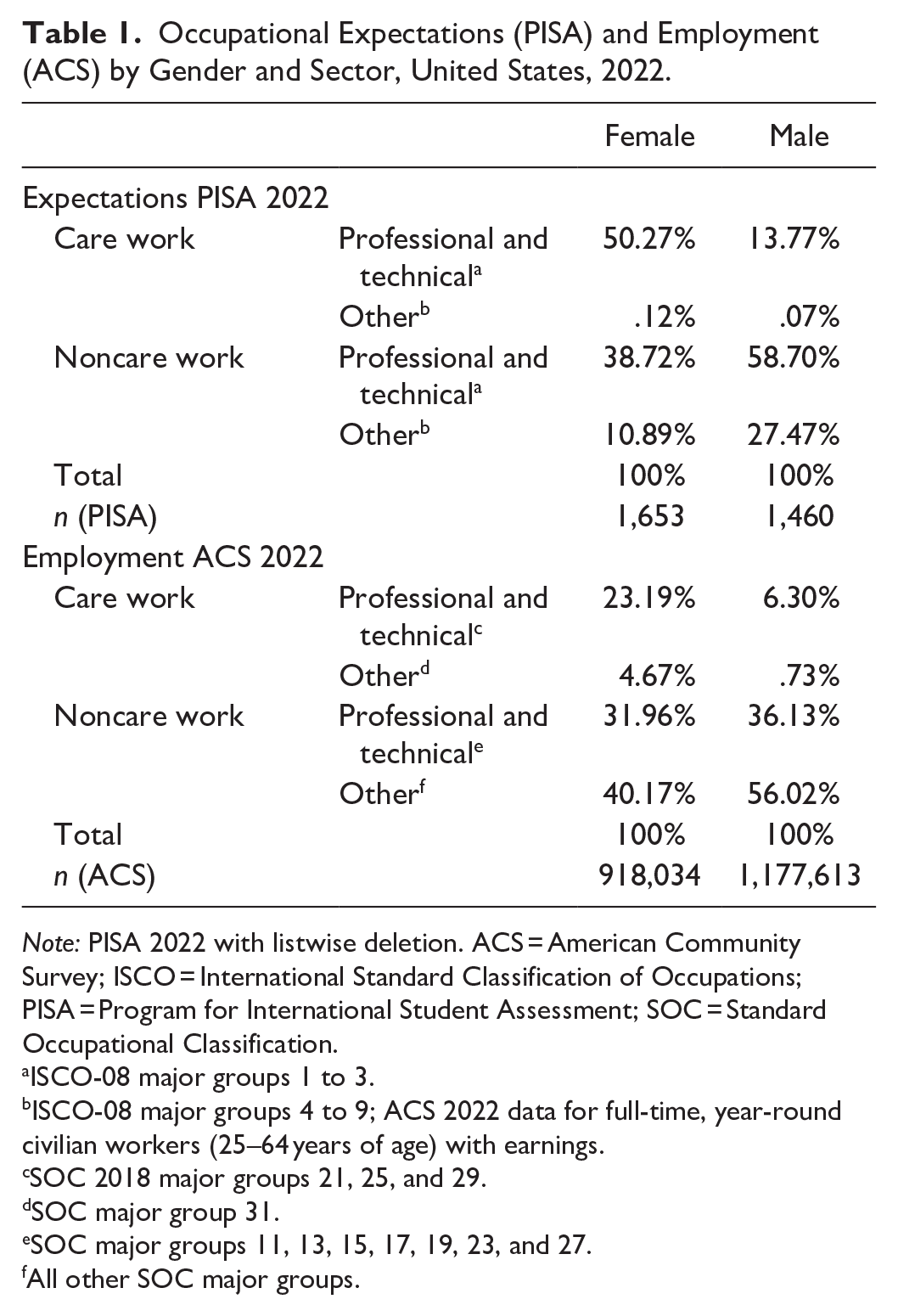
Table 1 compares U.S. care-work expectations in 2022 with plans to enter non-care-work fields. It also includes a comparison with the U.S. labor force in 2022, contrasting the professions and technical fields with non-care-work occupations, coded to major Standard Occupational Classification 2018 groups. Here again, we see that young women are more likely to plan to pursue care-work fields than young men. In 2022, roughly half of U.S. young women, who were PISA respondents, planned to enter care-work fields, compared with fewer than one in seven of their male counterparts.
Occupational Expectations (PISA) and Employment (ACS) by Gender and Sector, United States, 2022.
Note: PISA 2022 with listwise deletion. ACS = American Community Survey; ISCO = International Standard Classification of Occupations; PISA = Program for International Student Assessment; SOC = Standard Occupational Classification.
ISCO-08 major groups 1 to 3.
ISCO-08 major groups 4 to 9; ACS 2022 data for full-time, year-round civilian workers (25–64 years of age) with earnings.
SOC 2018 major groups 21, 25, and 29.
SOC major group 31.
SOC major groups 11, 13, 15, 17, 19, 23, and 27.
All other SOC major groups.
Female U.S. teenagers’ interest in care-work fields far exceeds the prevalence of corresponding occupations in the U.S. labor force. For example, in 2022, we find that 23.19 percent of the female labor force was employed in care-work fields, compared with 50.27 percent of young women who plan to enter these fields. Far more young women indicate plans to pursue care work at age 30 than there are available opportunities in the labor force. 8 In contrast, on the basis of their career goals as teenagers, young men by themselves would fall short in meeting the demands of the labor market for care workers. Although roughly half of young women plan to enter care-work fields, fewer than one quarter were employed in these fields in 2022. For men, the gap between plans and occupational opportunities was similarly roughly 2:1 (13.77 percent vs. 6.30 percent). 9
The data presented in Table 1 also make it clear that adolescents overwhelmingly plan to pursue fields requiring college degrees and often advanced training. The concentration of professional choices, however, is greater for care-work fields than for non-care-work occupational plans.
Ultimately, youths who plan to pursue care work overwhelmingly choose professional or technical fields to an even greater extent than those who plan to pursue non-care-work fields. This pattern is evident for both young women and young men. The data in Table 1 thus show that care work plans are not simply a reflection of a general tendency to choose professional fields.
The data thus highlights mismatches between career expectations and labor-market opportunities, particularly for young women. Although there is a strong interest in care work among this group, the current U.S. job market cannot accommodate these ambitions. Moreover, within the care sector, another disparity exists. Although many are drawn to care professions, there is a lack of interest in lower paying supporting roles that do not require college degrees and are not well compensated financially.
Comparison of the United States with OECD Countries
Figures 2a to 2c compare trends in the United States with the average trends across 29 OECD countries. In calculating the OECD estimates, we weighted the sample sizes so that each country contributed equally.

(a) Care work plans, 2000 to 2022 (United States vs Organisation for Economic Co-operation and Development [OECD], Program for International Student Assessment [PISA]). (b) Health care plans, 2000 to 2022 (United States vs OECD, PISA). (c) Teaching plans, 2000 to 2022 (United States vs OECD, PISA).
We first consider important similarities. Care-work occupations are popular among teenagers in the United States and OECD comparison countries, with young women showing more interest in caring professions than men. In both regions, interest in medically related care work has increased since 2000, while interest in educationally related care work has declined, albeit at somewhat different paces. Overall, there are notable commonalities between the United States and comparison OECD countries regarding plans to enter care-work fields. With regard to research question 5, then, the results thus broadly support the commonality of OECD countries, rather than the distinctiveness of the United States.
However, there are several notable differences. The gender gap across the comparison OECD countries is smaller than in the United States, as adolescent women in the OECD show less interest in health work but more in teaching compared with their U.S. peers. These trends persisted from 2000 to 2022. Additionally, a notable decline in interest in medical fields in the United States coincided with the COVID-19 pandemic, a pattern less evident in comparison OECD countries. Across the OECD, female interest in health care rose steadily between 2000 and 2022, while interest in teaching fell more quickly in the United States than in the OECD. During these two decades, young men in both regions maintained a relatively low interest in health care jobs and teaching.
Stronger interest in health care careers in the United States could be attributed to the relative economic prosperity of the sector (OECD 2019), possibly inspiring greater enthusiasm among teens. The United States offers better pay for nurses compared with most OECD countries (OECD 2019). There is also a significant presence of foreign-trained doctors, suggesting that their working conditions are attractive by international standards.
Conversely, the steeper decline in interest in teaching careers in the United States could be linked to lower compensation and more challenging working conditions. Park and Byun (2015) indicated that internationally, U.S. teachers faced lower social standing than other tertiary-educated professionals. They earned lower salaries than similarly educated workers relative to comparison OECD countries (OECD 2020). Many of these countries offer better working conditions and higher pay for teachers, which may engender more favorable perceptions of the profession. However, a downward trend in teenage plans is also evident in OECD countries, although not as pronounced as in the United States.
Multivariate Analyses: How Teenage Interest in Care Depends on Parental Class, Immigration Status, and Academic Achievement
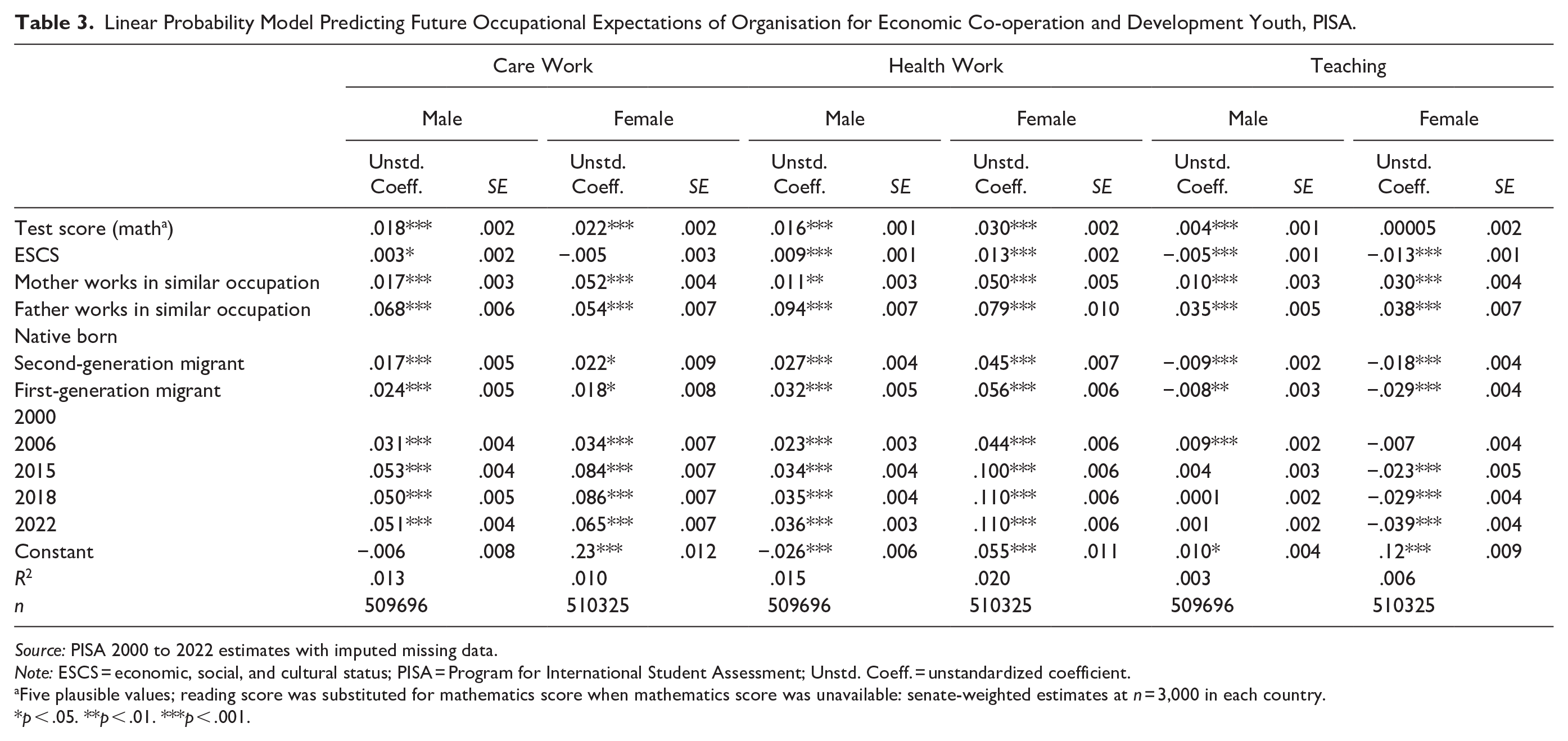
Figures 1 and 2 reveal persistent gender gaps in care work interest, which have changed little over the time period examined despite fluctuations in average interest for specific care professions. Research on youth occupational expectations highlights gender divides, juxtaposing them with class backgrounds, migration status, parental modeling, and academic achievement. Thus, we analyze these social determinants of care work expectations separately for young men and women in the United States (Table 2) and across the OECD (Table 3).
Linear Probability Model Predicting Future Occupational Expectations of U.S. Youth, PISA.

Source: PISA 2000 to 2022 estimates with imputed missing data.
Note: ESCS = economic, social, and cultural status; PISA = Program for International Student Assessment; Unstd. Coeff. = unstandardized coefficient.
Five plausible values; reading score was substituted for mathematics score when mathematics score was unavailable.
p < .05. **p < 0.01. ***p < .001.
Linear Probability Model Predicting Future Occupational Expectations of Organisation for Economic Co-operation and Development Youth, PISA.
Source: PISA 2000 to 2022 estimates with imputed missing data.
Note: ESCS = economic, social, and cultural status; PISA = Program for International Student Assessment; Unstd. Coeff. = unstandardized coefficient.
Five plausible values; reading score was substituted for mathematics score when mathematics score was unavailable: senate-weighted estimates at n = 3,000 in each country.
p < .05. **p < .01. ***p < .001.
In the United States, care work plans are more socially and academically selective for young men than they are for young women. Test scores, socioeconomic background, and immigration status all increase the young men’s likelihood of expressing interest in care work. These effects are generally stronger in the pursuit of careers in the healthcare sector than in the field of education.
In the United States, young men who are first- and second-generation migrants are marginally more likely to seek careers in care work (Table 2). However, coefficients are insignificant for second-generation migrants in health care and teaching-specific models. For first-generation migrants, we see a stronger preference for medically oriented fields among men, an extra 5.4 percent, and a tiny negative tendency for choosing to teach among men, at 0.1 percent. For young men, having a father employed in care work increased their chances of expressing similar career interests. The father-son connection is stronger (8.0 percent) than that observed for mothers and sons (1.9 percent).
In contrast, the social and academic selectivity of young women into care work plans is weaker and less consistently evident. The coefficients for test scores, the ESCS social status measure, and the immigrant status measures are all quite weak and generally not statistically significant, either for the overall care measure or for indicators that focus on health and education.
The weaker pattern for women than for men in Table 2 may reflect greater focus on skilled occupations such as physicians or dentists among care-oriented men (see Table S2 in the Supplementary Materials). In absolute terms, more women than men express interest in medicine, but young women in the United States also plan to pursue a much broader range of care-work fields, from nursing to teaching to social work. 10 This broader set of choices may account for their plans being less academically and socially selective.
The most consistent pattern evident for young women is the influence of their mothers. Higher socioeconomic status in the family of origin matters little for U.S. women’s career choices in the care fields. However, maternal employment in care raises the chances of a similar choice among daughters by 3.5 percent, with all else being equal. It raises the chances by 5.3 percent for health care and 4.5 percent for teaching.
The year coefficients show a general increase in interest in care work since 2000. Although female interest remained stable from 2000 to 2006, notable changes appeared by 2015. Female interest in teaching declined over time, and for men, a significant decrease of 1.3 percent in teaching preferences occurred only in 2022. These time effects account for changes in social background, test scores, or immigration status since 2000. Notably, interest in care work declined in 2022 compared with 2018, especially among women opting for health care. Time trends and compositional effects are considered more closely in Section 5 of the Supplementary Materials.
Overall, parental occupational class, test scores, and migration status account for little variation in adolescent expectations of working in care work (Table 2). Our models account for between half a percent and 1.8 percent of the variance, much less than the effect of gender alone. In the US, gender without other predictors explains about 15 percent of the variance in care work plans, about 13 percent in plans to work in health, and 1.2 percent in teaching plans (Supplementary Materials Table S6). Thus, the conclusion regarding research question 6 is that academic and social selectivity into care work plans in the United States is quite weak, especially for young women.
We repeated the multivariate analysis for the United States, as presented in Table 2, for the 29 OECD comparison countries. The findings are presented in Table 3. The patterns are broadly similar to those obtained in the United States. The magnitude and direction of the social background coefficients are similar, and the model’s explanatory power is quite weak. Although many of the individual coefficients are statistically significant, it is essential to note that statistical significance should not be overemphasized in large samples, such as ours, which includes approximately half a million cases for each gender.
Across the OECD, the social selectivity regarding interest in care work is similar for both young men and women. Paternal influences tend to be stronger for men than maternal influences. However, for young women, parental role modeling has an equal impact regardless of the parent’s gender. Additionally, migrants are also more likely to express interest in care occupations. A focus on health-related roles primarily drives this interest, as the data shows negative associations for teaching careers.
In comparison with the United States, the post-COVID-19 decline in interest in care work was less pronounced in the OECD comparison countries. Notably, although the average level of interest in health care jobs is lower in the OECD, Table 3 shows that it has been increasing steadily over the past 20 years compared with the United States. Meanwhile, interest in teaching, although still higher in the OECD, is also declining. Thus, the trends over time for interest in education are moving toward convergence.
Conclusion and Discussion
We examined gender disparities in career expectations among adolescents in the United States and across OECD countries, addressing several research questions. We investigated whether young women are more likely than young men to plan careers in care-related fields, if the gender gap has narrowed since 2000, how teenage interest relates to labor force needs, and what role academic achievement and social background may play in shaping these expectations. We compared the United States with the average of 29 comparison OECD countries. Additionally, we analyzed heterogeneity within care work by examining trends in interest in medical and educational care fields.
Our findings confirm that young women in the United States are significantly more likely than young men to plan careers in care-related occupations, with the gender gap remaining substantial and largely stable over the past two decades. This gap is especially pronounced in medically related and therapeutic fields, highlighting entrenched societal norms and occupational stereotypes that persist despite policy interventions. Although women’s expectations have evolved, showing increased interest in health care professions and a decline in enthusiasm for teaching, young men’s interest in care work has generally remained low.
The gender gap in care work plans has not narrowed since 2000. Although young women’s interest in health care professions remains strong, their enthusiasm for teaching has declined significantly. By 2022, American teenagers reported much lower interest in education careers than two decades earlier, indicating a potential supply deficit in the teaching workforce. Conversely, interest in professional health care roles increased until a COVID-19-related decline. The pandemic likely influenced perceptions of care work, though its long-term effects remain uncertain. Interest in health care careers remains considerably higher in the United States than in comparison OECD nations, where it is also growing among women.
In the United States, the number of adolescents planning to enter care-work roles far exceeds available job opportunities. This finding suggests that shortages in staffing medical positions stem from structural constraints, such as limited training, low pay, high turnover, and challenging working conditions, rather than a lack of interest. However, this interest is concentrated in high-credential professions requiring university degrees, whereas enthusiasm for nonprofessional care roles, such as home health aides, is minimal across all sociodemographic groups. This raises concerns about sustaining an adequate workforce for these undervalued but critical roles.
We suggest that the “leaky pipeline” metaphor may be extended to care work. As many more young women plan to pursue care professions than are ultimately employed in these fields, future research should examine when and why they shift career paths.
A key concern is whether adolescents’ interest in care work can alleviate future workforce shortages. Although enthusiasm for professionalized roles is high, low interest in nonprofessional care work signals potential labor market deficits. Although the medical sector may continue attracting sufficient entrants in the United States and the OECD, caring occupations requiring fewer credentials are likely to face severe worker shortages, absent economic and organizational inducements.
Heterogeneous trends within the care work sector are evident; health care–related professions maintain their strong appeal, while the appeal of teaching has been declining, and nonprofessional care work remains largely unattractive. These trends appear to be evolving in similar directions across the United States and the OECD. However, health care professions are significantly more attractive in the United States, whereas teaching remains more popular in the OECD. The decline in teaching interest has been steeper in the United States than in the OECD since 2000.
Academic success and advantaged social backgrounds account for little of the variance in interest in care-work fields among young men in the United States; the relationships are even weaker for young women. Same-gender parental influence is the prominent exception to this generalization: daughters tend to follow their mothers into care work, as sons tend to follow their fathers. In contrast, interest in nonprofessional care work is consistently low across all socioeconomic groups, exacerbating concerns about labor supply in these roles.
The trends observed in the United States broadly align with those in comparison OECD countries, though some divergences, such as the stronger interest in medical careers in the United States, suggest country-specific dynamics that warrant further investigation.
Further research is needed to disentangle the long-term impacts of the pandemic on care work plans and workforce dynamics. Although some Australian studies have followed labor market entrants’ career plans that evolve in their early twenties, more research is needed on how adolescents’ care work expectations evolve into their late twenties, thirties and beyond.
Data limitations in the PISA surveys prevented us from examining race and ethnic differences in care-work career plans. Future research is needed to address this gap.
Early career plans offer valuable insights into future workforce supply, but converting adolescent interest into sustainable employment requires addressing structural barriers. Limited educational pathways, high turnover, inadequate remuneration, and challenging working conditions, particularly in teaching and nonprofessional care roles, remain likely obstacles.
Our findings have significant implications for policymakers, educators, and workforce planners. Persistently low interest in unskilled care work among U.S. adolescents suggests a continued reliance on recent migrant workers to fill these roles. The prospect of expulsion of immigrants from the United States and limitations on future immigration concerns about workforce supply and the quality of services. To foster a stable and diverse care workforce, policymakers must enhance job attractiveness by offering higher wages, improved job security, and clear pathways for professional advancement. Public campaigns can help reshape perceptions of care work by emphasizing its societal importance. At the same time, vocational training programs in high schools and community colleges could encourage greater domestic participation in these fields.
Systemic reforms are likely to be needed to align the workforce supply with societal needs. Strategies should focus on diversifying care professions, reducing gender disparities, and addressing the chronic undersubscription of specific roles. Retaining workers is as important as attracting new entrants, necessitating targeted interventions to mitigate the factors driving high attrition rates. Comprehensive workforce planning will be required to address the shortage of direct personal care workers (Swanson-Aprill et al. 2019). Longitudinal research tracking adolescents with care work expectations could contribute to this effort by evaluating how early career interests translate into long-term employment outcomes and identifying effective retention strategies, particularly for nonprofessional jobs.
This study provides key insights into how teenage career plans reflect broader societal attitudes toward gender roles and the perceived value of care work. Persistent gender imbalances, the declining appeal of certain care roles, and broader workforce sustainability challenges must be addressed to ensure an adequate and equitable supply of care workers, especially in nonprofessional roles. By addressing these issues, stakeholders can better meet the increasing demand for care services and develop a more engaged and resilient care workforce.
Supplemental Material
sj-docx-1-srd-10.1177_23780231251348501 – Supplemental material for Planning to Care: The United States in Comparative Perspective, 2000 to 2022
Supplemental material, sj-docx-1-srd-10.1177_23780231251348501 for Planning to Care: The United States in Comparative Perspective, 2000 to 2022 by Joanna Sikora and Jerry A. Jacobs in Socius
Footnotes
Appendix
Care work in this study is grouped into three categories: health related, education related, and other care work (e.g., religious professionals). On the basis of ISCO-08 titles, all occupations listed here were coded as care work. Although PISA 2000 and 2006 used ISCO-88, we recoded all job titles into ISCO-08 before creating our categories. ISCO-08 codes starting with 1, 2, and 3 represent managerial, professional, and associate professional occupations, respectively. Occupational codes not beginning with 1, 2, or 3 and not listed here are treated as noncare, nonprofessional work.
Supplemental Material
Supplemental material for this article is available online.
1
We use the terms interest in care work, planning to care, and expecting to work in a care-work occupation synonymously. Later, we discuss the distinction between occupational expectations and aspirations.
2
Although several studies have examined heterogeneity within care work (e.g., Lightman 2017), researchers and commentators typically continue to treat care work as an undifferentiated sector (e.g.,  ).
).
3
We assessed the validity of teenagers’ responses to PISA’s open-ended question about career plans by comparing the results with research that provided respondents with a list of approximately 60 occupations to choose from (Stolzenberg et al. 2019). Specifically, we compared each PISA wave with large-scale national surveys of college freshmen collected by the Higher Education Research Institute at the University of California, Los Angeles, in the same years. We considered whether PISA’s approach to eliciting information on career plans may be vulnerable to a form of “familiarity bias” (Estrada, García-Ael, and Martorell 2015; Foad 2010). The results (available in ) are broadly similar to those obtained from the open-ended PISA question, in terms of gender differences and time trends. At the same time, the concentration in care-work fields is modestly lower in the Higher Education Research Institute data.
5
Unfortunately, in the 2022 wave of PISA data, there was a marked increase in nonresponse on the career expectations question (see in the Supplementary Materials). This was not limited to the United States but was consistent across all participating countries. Nonetheless, this fact renders conclusions about the impact of the COVID-19 epidemic more tentative than they would otherwise be.
6
The narrower definition of care work used by produces somewhat lower estimates, primarily because of interest in veterinary medicine and psychological counseling. Restricting care work to approximate England et al.’s job list more closely by removing these two occupations would reduce female interest in care work in the United States from 50 percent to 42 percent in 2022.
7
Figures 1b and 1c do not include a relatively small third “other” category. It is defined according to the ISCO-08 job lists in the .
8
reported that 24 percent of the U.S. labor force was employed in care-work occupations during the period from 2014 to 2019. One might object to this conclusion on the grounds that care work positions are often understaffed, and thus the labor force patterns understate the full need for employment in care-work fields. Although there is no doubt some validity to this point, the gap between career plans and employment far exceeds current patterns and is too large to be accommodated in any plausible alternative scenario. In other words, even if there were a 20 percent or 30 percent increase in the number of care work positions filled, the proportions expressing plans to pursue such work would remain far in excess of what the labor market could absorb.
9
We recognize that the labor force data do not fully reflect that “true demand” for care work employment because systematic shortages in caring occupations are common. The gap between plans and opportunities in this area, however, is far too great to be attributed to the failure to fully fill needed positions.
10
Few would be surprised that more young women plan to become nurses and teachers than young men. It is notable, however, that young women in the United States surpass their male counterparts in terms of interest in medical careers. Pooling the data over the period from 2000 to 2022, 1,616 young women PISA respondents in the United States set their sights on some career in medicine, including dentistry, compared with 548 young men ().
Author Biographies
References
Supplementary Material
Please find the following supplemental material available below.
For Open Access articles published under a Creative Commons License, all supplemental material carries the same license as the article it is associated with.
For non-Open Access articles published, all supplemental material carries a non-exclusive license, and permission requests for re-use of supplemental material or any part of supplemental material shall be sent directly to the copyright owner as specified in the copyright notice associated with the article.
