




Abstract
In the global arena of municipal policymaking, cities do not merely address local concerns but actively engage with other cities in a global relational space, referencing and being referenced by others. Within these networks, certain “model cities” emerge, linking urban transformation strategies to specific city experiences. Although much research focuses on the production of model cities—how they gain prominence and status—less attention has been given to the peer cities that reference them. The authors examine how model cities rise by analyzing “referential styles”: the ways cities express interest in one another. Drawing on urban sociology, cultural theory, and network analysis, the authors propose two propositions to explain the forces that influence referencing styles: the cultural domination proposition, which suggests that the characteristics of referenced cities shape how they are discussed, and the networks from culture proposition, which suggests that referencing cities’ attributes drive their interpretations. Using public art policy documents (1959–2020) from 26 major anglophone cities and computational techniques, the authors investigate the referential styles cities use to discuss one another. The authors find support for both propositions: although dominant cities determine where to look, it is often the attributes of referencing cities that determine how to look that shape the referencing style. These results suggest orienting policy-mobility research more toward the peer-network ecologies that actively construct urban meaning.
Keywords
How ideas get attached to places is a fundamental problem of urban sociology. Many rich theories have been developed to explain this fusion of ideas and places and its outcomes. Concepts such as “truth spots” (Gieryn 2018), “scenes” (Silver and Clark 2016), “distinctive places” (Molotch, Freudenburg, and Paulsen 2000), and “local identity cultures” (Brown-Saracino 2015) highlight the social construction processes that associate cities and destinations with particular meanings. This attachment is especially significant in the urban policy domain, where cities learn from, compete with, and imitate one another. This domain (Wimmer 2021) is filled with “model cities” (Kennedy 2016) that link transformation strategies to a particular city experience: Bilbao exemplifies cultural regeneration through its iconic museum (González 2011); Medellín, a transition from violence to innovation through mobility systems (Duque Franco and Ortiz 2020); and Singapore, an evolution into a global knowledge hub (Huat 2011). A “model city” thus implies two distinctive dimensions: the qualities it represents and the audience of cities that look to it as a reference point within a particular region, country, or even globally.
Unlike “truth spots” and “scenes,” model cities are not just spatial configurations describing what places are like; they also indicate to other cities what they could or should be. Consequently, actors in other cities adopt and adapt these models on the basis of their goals and contexts. For instance, Latin American cities used the Barcelona model to foster local political support and alliances for urban regeneration projects (Silvestre and Jamovich 2021). Through such mutual interpretation, cities generate discursive relationships marked by distinctive styles. Some cities are frequently referenced, whereas others make references but receive little in return, forming a hierarchical network (Keidar and Silver 2024a). This hierarchy emerges across many forums and discursive spaces, but prominent among them are the policy documents that city agencies routinely generate (Saleem et al. 2023). References to other cities often justify new policies: if New York is doing it, so should we (or not) (Bunnell 2015 ; Bunnell et al. 2022; Keidar and Silver 2024a; Kennedy 2016; McCann 2017).
Although much research examines urban model production (González 2006, 2011; McCann 2011, 2013; Peck and Theodore 2015; Wood 2022), little research examines their discursive relationships with their peer cities. These relationships are vital for understanding how model cities are reconstructed by their audiences, providing vehicles for shaping aspirations, persuading local stakeholders, and even signaling pitfalls to avoid (Keidar and Silver 2024a; Kennedy 2016; Lauermann and Vogelpohl 2019; Silvestre and Jamovich 2021). Although peer cities’ external gaze is critical to model city prominence (Bunnell 2015; Honeck 2018), little is known about how these discussions influence policymaking. As a crucial part of being a model city is that actors in other cities would be interested in reproducing the approach, examining how policymakers direct their attention to one another in policy formulation processes is critical to explaining how urban models are created, and more generally in articulating the mechanism through which ideas become associated to a place.
In this article we develop concepts and methods to identify such discursive relations and styles and to understand their bases, via the case of a particular policy model: the percentage for public art, a popular funding mechanism. For this purpose, we use approximately 150 public art policy documents published between 1959 and 2020 in 26 cities with more than 1 million residents in the anglophone world. We pursue two central research questions:
What are the major referential styles cities use to discuss one another?
To what extent do these styles depend on cities’ referential relationships to one another; specifically, do the qualities of the referencing or the referenced city influence the referencing style the most?
To address the first question, we use natural language processing tools and track any reference a city makes to another city in our corpus of public art policy documents. On the basis of these references, we generate a reference network in which two cities are connected if one city mentions the other. We analyze the text around each reference using structural topic models to identify the meanings behind each reference, and categorize them into various referencing styles. To do so, we develop methods to find what we term “meta-topics.” Overall, we find that referential styles sometimes depict a city in a more generalizing mode of discourse in which it illustrates broader processes such as globalization, postindustrialization, or the rise of culture. In other cases, they speak in a more particularizing style in terms of specific distinctive features of a city, such as its public art program or public artwork locations.
These discursive styles inform our investigation of the second question: how do referential relations shape referential styles? Drawing on theories from networks and culture (Lizardo 2006; Marantz and Cattani 2024; McLean 2017; Vaisey, Lizardo, and Dame 2010), global culture (Buchholz 2022; Janssen, Kuipers, and Verboord 2008; Kaufman and Patterson 2005; Kuipers 2011; Yoon and McCumber 2024), and critical urban studies (Marcuse 2005; Roy 2011), we propose two core propositions. First, a network with a few dominant cities at the center (e.g., New York and Paris) suggests a top-down diffusion model, in which features of these referenced cities primarily determine how others, such as Phoenix, Melbourne, or Calgary, discuss them. This is the cultural domination proposition. Alternatively, cities may selectively adapt ideas from major players, driven by their own local goals and interests. In this networks from culture proposition, features of the referencing city take precedence: Phoenix or Melbourne’s discussions of New York reflect their own positions and priorities. Both propositions stem from the intuition that referential styles reflect either dominance or active curation by cities engaged in these networks. Rather than treating these perspectives as mutually exclusive, we explore them as complementary explanations for how referential relations shape referential styles.
Indeed, we find support for both propositions. The network reveals a small number of highly referenced cities, aligning with the cultural domination proposition and studies on cities in the world system. However, when analyzing referencing styles within this network, we find more support for the networks from culture proposition: referencing styles are more determined by the attributes of referencing cities than the referenced cities. Overall, we find that cities most often reference one another in particularistic terms, focusing on specific policy procedures. When they use generalistic styles, typically in references to central cities, these broader discussions of cultural or economic processes are adapted to fit local needs and priorities rather than adopted wholesale. As our findings show, cities that are central within global aesthetic and economic hierarchies do not necessarily dictate meaning in a top-down fashion. Instead, they offer a semiotic diversity of discursive possibilities that other cities selectively draw upon. Thus, rather than intrinsic qualities, the meanings associated with a model city are shaped largely by its group of peers.
The article is structured as follows. The literature section synthesizes research on discursive relationships between cities and introduces the cultural domination and networks from culture propositions. The methods section details the construction of the referencing network, the identification of referential styles, and the analysis of factors influencing their adoption. The results section combines a networkwide analysis of discursive styles with a closer examination of the referencing patterns of specific cities.
Urban Discursive Styles and References
Discursive relationships between cities are not new. Ancient cities such as Athens and Sparta, Renaissance cities such as Rome and Venice, and modern capitalist cities such as New York and London often refer to one another to define themselves (Clarke 2012). However, recent decades have witnessed an intensification of the discursive relations between cities in general, which increasingly incorporate mutual referencing into policymaking practices. This intensification of discursive relations has been well documented in urban studies over the past two decades, with scholars exploring how and why referencing has become a common practice (Bunnell 2015; Peck and Theodore 2015; Roy and Ong 2011).
A crucial component of this process is an increasingly extensive flow of policies between cities and the novel dynamics this flow creates at both local and extralocal levels. At the local level, referencing other cities has become an essential part of municipal political processes, including policy learning, policy adaptation, and coalition building (Enseñado 2024; McCann 2017). When an urban model—whether broad like “smart cities” or specific like “building-integrated agriculture”—gains traction, it is often adopted and emulated by other cities, citing earlier adopters’ experiences to legitimize their own approach (Camponeschi 2023; McCann and Ward 2010). Additionally, when cities face urgent challenges requiring rapid responses or structural changes, they may not have the time or resources to develop their approach independently and frequently look to the strategies of other cities for guidance (Goh 2020; Peck and Theodore 2015; Wood 2022). In these instances, referencing is not just about emulation but also a matter of necessity, and the need to learn rapidly from others’ experiences. Moreover, referencing serves as a valuable resource for coalition building, functioning as a discursive tool that helps persuade relevant actors, and to articulate and reinforce a local vision (Bunnell et al. 2022). In all these instances, the discursive relations with other cities can help achieve local goals.
At the extralocal level, various transfer agents play a crucial role in facilitating the process of referencing. Consultants, for instance, often incorporate the experiences of other cities they have worked with into their reports (Keidar 2023; Prince 2014). Additionally, referencing can result from cities promoting themselves as “policy models” (Kennedy 2016). Cities such as Vancouver and Copenhagen in sustainability policies (Camponeschi 2023; McCann 2013), Singapore in housing strategies (Pow 2014), Bilbao in cultural regeneration (González 2011), and Barcelona as an overarching powerhouse for urban policy (Leffel et al. 2023) actively encourage other cities to learn from their experiences through policy tours and consulting work.
This referencing activity often leads to the development of a professional sector within the cities being referenced (Goh 2020; González 2011; Pow 2018). Moreover, transnational institutions such as the Organisation for Economic Co-operation and Development (Theodore and Peck 2011), UN Habitat (Cociña et al. 2019), and UNESCO (Alasuutari and Kangas 2020) incorporate city referencing into their working methods with cities, promoting specific global development strategies across working groups and professional networks. They also establish their own repositories of best practices, operating as storehouses of potential references (Ribeiro 2024). Through these interactions with various transfer agents, referencing styles are shaped by extralocal visions and interests.
Beyond the local and extralocal forces that motivate referencing, in this article we develop the notion of “referencing styles”: distinct rhetorical modes through which cities publicly engage with the experiences of other cities. Bunnell (2015) highlighted the referential effects that model cities exert on others, particularly in setting expectations for future urban development. On the “demand side,” Romano (2024) emphasized how different styles of policymaking emerge in the process of borrowing, shaped by the specific contexts and priorities of the referencing city. For example, studies on China sometimes describe a “Chinese style” of cherry-picking policies, favoring technical solutions. However, longitudinal observations reveal significant variation, suggesting that no single style uniformly applies across Chinese cities (Romano 2024). In contrast, referencing in Latin American cities often reflects a more contextual approach rather than a narrow focus on technical solutions (Silvestre and Jamovich 2023). The Barcelona model, for instance, has been referenced in Argentine and Brazilian cities for its broader strategies, such as project-led and strategic planning. Similarly, narratives about Bogotá and Porto Alegre have demonstrated a multiscalar impact, transcending shallow adoption to influence diverse governance layers and policy domains (Montero and Baiocchi 2022). Although in these and related works the literature therefore offers intriguing examples of referencing styles, little is known about the typical forms they take. Our analysis does more than plug this gap in the literature; it (1) theorizes referential style as a distinct mechanism in urban policy circulation; (2) introduces a methodology for tracing those styles at scale; and (3) shows empirically that peer cities, not hegemonic “model” cities, do the heaviest semiotic work, though both play a role.
Cultural Domination and Networks from Culture
To examine referential dynamics between cities, we introduce and evaluate two broad propositions, stemming from literature in urban studies and the sociology of culture, about how meanings are constructed within urban networks. Both emphasize the embeddedness of cities in an evolving set of social relations that influences the creation and adoption of policy discourses (Keidar and Silver 2023, 2024b). Each proposition spotlights a different side of the relationship between the referencing and referenced cities. One suggests that the global prominence of the referenced cities shapes the meanings other cities attach to them, what we call the cultural domination proposition. The other, the networks from culture proposition, suggests that the outlook and interests of referencing cities matter most in shaping how they discuss others. The two perspectives are not necessarily mutually exclusive. In some instances, the referencing city’s needs may be paramount, while in others, features of the referenced city may draw specific forms of engagement. Our primary question centers on the relative priority of each side: on balance, are discussions driven more by the “attractive force” of dominant cities, or by the strategic interests of the cities doing the referencing?
Research in the political economy tradition studying cultural globalization offers a classic neoinstitutional model, which highlights the cultural domination of central nodes in the global network. Earlier writing on globalization argued that globalization has bound cities together in one hierarchical space in which the capitalist system now operates (Castells 1996; Friedmann 1986; Sassen 1991). Although this system represents a new global division of labor, central nodes within it—the global cities—are where global capital agglomerates, operating as command-and-control sites over other more peripheral nodes (Sassen 1991). More recent studies have empirically demonstrated that the world city system is dominated by a small group of cities monopolizing its power and prestige (Alderson and Beckfield 2004; Leffel et al. 2023; Taylor and Derudder 2015). According to this perspective, since the 1970s, in parallel with the development of this global economic system, profit-driven actors from core centers have pushed to open cultural markets of goods and content (Buchholz 2022). Although the United States is often described by the core-periphery literature as the source of these cultural circuits, cities in Japan, China, and South Korea are also recognized as “winners” for cultural products and platforms, such as Japanese animation, K-pop, and TikTok (Fang 2023; Gu, Lim, and O’Connor 2020). The result according to these analyses is a set of culturally dominant countries in sectors like music, fashion, movies, sport, art, and food, and the establishment of a hierarchical but fairly homogeneous and monocentric international cultural system (Janssen et al. 2008; Kaufman and Patterson 2005; Kuipers 2011).
The literature on the circulation of urban ideas and images of urbanity also emphasizes the unequal character of this isomorphism (Robinson 2013; Roy and Ong 2011; Stoltenberg 2024). This circuit features the “problem of synecdoche” (Amin and Graham 1997): the tendency to represent the experience of a small group of so-called “global cities” as that of the whole system or to represent only the experience of iconic parts of those systems as stand-ins for the entire city. Proponents of this view argue that the position and status of cities, both in the economic global hierarchy and in urban networks, play a crucial role (Leffel et al. 2023; Papin and Fortier 2024). This suggests that cities at the top of this hierarchy have a significant impact on shaping urban models and norms, because of their dominant cultural and economic status.
The literature on culture and networks by contrast emphasizes that cultural features, whether of individuals, organizations, or cities, are integral to the formation and sustenance of both social ties and the broader network in which they are situated. In a foundational work in this literature, Lizardo (2006:802) described an alternative to the “structural selectionism” assumption of network theory, which is also assumed in the cultural domination literature. This is the presupposition that individuals or cities are bound by their structural position and operate as passive receptacles of content and tastes invoked by external fixed networks. Instead, he suggested a “relational ecology model,” in which culture serves as a motivating force: cultural features influence who joins the network, while cultural content shapes the ties. These ties, which carry cultural information, are unstable and may change over time; some may die while others are born.
When examined at a given moment, ties show meanings constituted in situated interactions, influenced not only by overarching structural forces, but also by the actors’ cultural tastes, skills and schemas (McLean 2017). Empirical research on various networks reveals that actors’ cultural tastes and “network know-how” (Kane 2011) determine who joins a network, whether for a job, conversation, or other social interaction. Studies also show the process in which the content of the ties is generated within various social interactions and institutional settings, for instance, in book groups (Childress and Fridkin 2012; Rawlings and Childress 2019), global high-end fashion houses (Godart and Galunic 2019), and elite art museums (Zamora-Kapoor, Godart, and Zhao 2020). Observing the interpreter side closely, “networks from culture” studies show how “structural outsiders” and “disconnected” nodes can become influential when assessed according to the cultural classifications of the consumers (Phillips 2011; Rossman and Fischer 2021).
Urban policy mobility studies examining “network formation” (Goh 2020) demonstrate how cities actively shape and transform urban networks through their participation. Far from simply emulating global models, cities reconstruct models locally to fit the political interests and constraints of local elites (Keidar 2018; Rugkhapan 2021). Because of their strong connections to local interests, these “fast policies” significantly affect local policies, even when their best practices are only referenced in a shallow way (Montero and Baiocchi 2022). In this context, the characteristics of the referencing cities, those that adopt or discuss the urban models, are seen as pivotal. This proposition suggests that the way cities are perceived and talked about is influenced more by the orientations of the cities that reference them than by the dominant cultural narratives projected from the central nodes of the global urban hierarchy (Bunnell et al. 2022; Honeck 2018; Silvestre and Jamovich 2023). We move to examine the two propositions with public art policies and the particular popular policy model: the percentage for public art.
The Case of Public Art
Prompted by postindustrialization, rising concerns about quality of life, and other socioeconomic shifts, public art policies have developed during the past several decades as part of broader municipal efforts to integrate arts and culture into urban development (Grodach and Silver 2012; Mendelson-Shwartz and Mualam 2024; Silver and Clark 2016). Among the various strategies to promote arts and culture, we focus on a particularly influential and widely circulated model, the percentage for public art policy. This funding mechanism, distinct within the cultural policy toolbox, establishes a clear baseline for cities to compare themselves and learn from one another, in contrast to the broader and more diffuse category of “arts and cultural policy.” First initiated in Philadelphia in 1959, the percentage for art has been widely adopted across the anglosphere, and over time many variations have emerged in terms of the actual percentage, what is defined as “public art,” who is responsible for managing the tool, and the goals behind it.
In line with previous observations on powerful cities in the world system (Alderson and Beckfield 2004), the public art referencing network is dominated by a small number of selected nodes (Keidar and Silver 2024a). Among them are New York, London, and Los Angeles, which are located at the top of the global hierarchy of urbanity, as well as Chicago, Seattle, Montreal, and Austin, which are recognized as leaders in the public art policy domain. Both types of cities are identified in the literature as future-making resources, often used in an aspirational manner (Bunnell et al. 2022). In the case of public art policy, Keidar and Silver (2024a) found that many ties are not equally reciprocated, and thus that interreferencing is often not a dialogue between cities but more of a monologue of cities toward each other.
These previous findings lend some initial plausibility to the cultural domination proposition, in which cultural domination is projected from central nodes outward. On the other hand, more situational approaches stemming from the networks from culture proposition may suggest that although the global power structure directs where to look, it is the attributes of the referencing cities that determine how to look.
Methods
Constructing the Public Art Referencing Network
To generate the public art referencing network and describe its contents, we collected a corpus of 149 public art–related policy documents from 26 cities with more than 1 million residents in the anglosphere. 1 This sample includes cities in the United States (n = 13), Canada (n = 6), Australia (n = 5), and the United Kingdom (n = 2). These documents vary in length and type, encompassing bureaucratic ordinances as well as more open-ended municipal research and cultural plans. We categorized the documents into four types: public art plans (n = 49), broader cultural plans that include public art sections (n = 54), bureaucratic guidelines (n = 34), and open-ended research reports (n = 12).
However, the distribution of these documents is uneven across cities. Some, like Toronto and Edmonton, have a more extensive policy publication culture, producing numerous and lengthier cultural plans and research reports, whereas others have fewer and more concise publications. As these variations may influence cities’ referencing volumes, as will be described below, we controlled for the amount of referencing made by each city by integrating out-degree index into the regression as well as for the document type. 2 The temporal period of the documents ranges from 1959, when the city of Philadelphia first published guidelines for the adoption of percentage for art, to 2020. 3
We followed a series of methodological steps to produce the public art reference network from this raw textual data. Initially, we created a dictionary of all city names (from the R package maps) and used this dictionary to identify all instances of those city names mentioned in the corpus. 4 We reviewed results manually to exclude mentions that did not pertain to cities but rather to individuals, streets, plazas, and other noncity entities. 5 On the basis of this cleaned list, we constructed an edge list in which two cities are connected when one references another. These edges formed the fundamental unit of our analysis. We then construct a directed network (see Figure 1); for example, an edge from Chicago to New York differs from one in the reverse direction. In addition to mapping out these relationships, we calculated standard network centrality scores for the cities, including degree centrality (in and out) and network authority scores, to describe the position of each city within the network.

Simplified version of the content flowing in the public art referencing network.
Identifying Referential Styles
To articulate different “referential styles” that cities use when mentioning others, we adapt structural topic modeling methods. The goal is to identify the main ways in which cities discuss other cities, by observing keywords that appear together in their references to one another, and constructing typologies of meanings or “styles” in these references. First, we extract text windows around each city reference, beginning with a window of 100 words. Thus, for a reference to “Chicago,” we extract the 50 words before “Chicago” and the 50 words thereafter. However, because the overall meaning of the reference can be affected by the size of the word window, and we have no a priori reason to prefer one window size to another, we also extract windows of 90, 80, 70, 60, and 50 words. These word windows of varying sizes are the core documents in the ensuing text analysis. We then applied structural topic modeling to each set of word windows and used a novel approach to group similar topics across sizes into “meta-topics” that represent general referential styles. This process included community detection algorithms to interpret the meta-topics and link them to the documents, resulting in each document being assigned a meta-topic score. Additional details about this approach are in the supplementary materials.
Investigating the Use of Referential Styles
The meta-topic scores become the dependent variables in our regression analysis, as they represent how strongly each word window exemplifies each referential style (i.e., meta-topic). More specifically, to investigate whether it is the qualities of the referencing or the referenced city that most influence the referencing style, the referential styles are used as the outcome variables in a series of multilevel regressions, while different attributes of the referenced and referencing cities are the independent variables. The window size is the level 2 variable, to account for effects that may be unique to a specific size.
More formally, consider observation i within word window j. Let Yij denote the outcome of interest and define the vector of predictors as

The multilevel model is then formally specified as

where
As interreferencing takes part in a comparative space structured by various factors, we focused on variables capturing features of cities closely related to public art policymaking (Keidar and Silver 2024a). The first set of variables examines cities’ centrality within the public art discourse network itself. We examine how centrality within the network correlates with referential styles. We used degree centrality: the number of mentions made by and to other cities (in-degree and out-degree). Although in-degree captured centrality in the referencing network, out-degree allowed us to control for cities’ different referencing habits. We also used the authority score, which identifies connections to other important nodes.
The second set of variables captures economic, aesthetic, regional, and demographic factors to examine how different characteristics of the global structure influence referencing. This set of variables includes economic importance, based on the Globalization & World Cities Research Network (GaWC) index 6 ; iconicity, measured in terms of the number of times a city is home to a work of public art included in lists of prominent and iconic artworks 7 ; population size in millions; and North American versus non–North American cities, given that past research has demonstrated strong regional variation.
The third set of variables includes attributes associated with cities’ relationship to the public art policy domain. This includes early adopters, cities that established their public art programs before the 1980s, and UNESCO Creative Cities Network membership, membership in at least one of UNESCO’s Creative Networks. We also controlled for document type as described earlier, according to its content and function.
In the present study, we consider all intercity references over the full 60-year span to capture the long-run orientation of cities toward one another. Although most referencing does occur after 2000, retaining earlier decades avoids discarding foundational discussions in the early period of the field, including from early-adopter cities that may discuss and be discussed in distinct ways. Our present analysis thus highlights how referencing and referenced cities affect the overall pattern of discursive relationships, recognizing that these relationships likely shift over time as some cities become more or less frequently discussed. A more fine-grained examination of how such references evolve at distinct historical junctures is beyond the scope of this study, yet it remains a promising avenue for future research.
Results
What Are the Main Referential Styles Cities Use to Discuss One Another?
To answer our first research question, we first unpack the content of references that cities make toward one another, as represented in the meta-topics. We find five meta-topics, described in Table 1, which fall into two overall referential styles, one more generalizing and one more particularizing. The supplementary materials include a detailed description of these meta-topics, which present their top words, illustrative quotes, and top referencing cities.
Main Referential Styles.

Note: This table summarizes the main referencing styles derived from our meta-topical analysis of how public art policy documents reference cities. They represent consistent themes by which cities are discussed, across references of varying lengths.
As Table 1 shows, referencing may represent a type of generalization about the city, for instance, about a city’s overall strategy, trend, or atmosphere. We found three variations of such generalizing referencing styles: first, cities’ investment in arts and culture; second, cities’ cultural life; and third, cities’ economic prosperity related to arts and culture. Taking for example, economic prosperity, Birmingham justifies its own policy initiatives aimed at sparking a “creative economy” by comparing itself to “other English ‘Core Cities’ (Bristol, Manchester, Leeds, Newcastle, Sheffield, Liverpool, and Nottingham),” and noting that “in 2007, Birmingham had the second-largest absolute number of creative jobs, behind Leeds.” Similarly, Toronto motivates its efforts to build a creative city through referring to how “New York, Chicago, San Francisco, Montreal, even London” exemplify a general movement toward capitalizing on diversity in a globalizing economy, while talking about the city’s cultural life:
“Planners in most major cities have figured out that cultural and ethnic diversity is required for success in a global economy. Cultural and ethnic diversity have become the top selling points in many cities’ marketing plans. New York, Chicago, San Francisco, Montreal, even London—each of these trumpets that it is the most diverse city in the world. As of 2001, 51 percent of Torontonians were immigrants, Toronto can easily lay claim to being one of the most diverse cities anywhere in the world.”
These generalizing referential styles are sometimes used simultaneously and are often used to justify the application or advancement of a policy strategy, without necessarily borrowing or rejecting another city’s particular way of doing things.
Referential styles may also be more particularizing. Such styles highlight how a specific city approaches public art. In our data, these particularizing references include, first, learning about the operation of a specific public art program and second, discussing specific artworks’ locations. For example, Perth speaks in detail about how the
“City of Taipei established a Percent for Art Programme. Since then, Taipei has been developing a diverse range of public artworks which have been incorporated into public spaces, such as MRT stations, schools, commercial buildings, science parks, streetscapes and public infrastructure.”
Likewise, Sydney justifies its approach to placing specific public art works high-up around how other cities have handled this particular program’s challenge of “visual distraction and competition for space at street level” with references to concrete works: “Janet Echelman, Tsunami 1.26, 2011, Town Hall Square, Sydney; Pipilotti Rist, Die freiheit in und ueber uns, 2010, Vienna; and Rachel Whiteread, Water tower, 1998, New York City.” Each of these referential styles illustrates how in the course of referring to one another, cities develop characteristic styles for doing so.
As these results show, cities speak in various ways when discussing one another. Articulating the meta-topics helps emphasize the patterns of this mutual examination and to elicit broader organizing categories. Specifically, generalizing references, in which cities refer to broader processes they experience, such as postindustrialization and cultural globalization. And second, particular issues related to the policy matter that they aim to solve. This broad pattern of generalizing versus particularizing referencing styles provides the basis for pursuing our second and third research questions.
Which Has a Greater Influence on Referencing Style, the Qualities of the Referencing City or Those of the Referenced City?
We now turn to the second research question, examining to what extent do referential styles depend on cities’ referential relationships to one another. As discussed earlier, we investigate this question by evaluating the cultural domination and networks from culture propositions. The fact that the public art referencing network has a few central nodes would suggest the cultural domination proposition (Keidar and Silver 2024a). On the other hand, recent studies about the role of peer cities’ external gaze point toward the networks from culture proposition, which predicts referencing rather than referenced cities will have a greater weight in determining which referential style will be used.
To test whether the qualities of the referencing or the referenced city influence the referential style the most, we aggregate the five meta-topics into a single discursive style variable (a description of the procedure is in the supplemental materials). This variable captures the degree to which one city’s references to another tend to be more generalizing or particularizing, on average.
Figure 1 displays the discursive network that emerges from the repeated interpretative activity of cities’ discussing one another. Each line in the network is a compressed representation of statements that, for example, San Francisco policymakers make about Chicago, or Philadelphia authors make about New York. Within the interreferencing network, cities themselves become complex discursive objects, with multiple meanings depending on who is referring to them and why.
The discursive referencing network displayed in Figure 1 highlights the centrality of a selected group of cities. However, the variety of nodes and the colors of the edges suggest multiple dynamics. A central insight is that city policies refer to one another more frequently in terms of their specific programs (blue) rather than in terms of their overall characters (red). They are overall more interested in specific artworks, locations, procedures and programs than general cultural and economic processes. Some other general patterns are also observable. The most central cities, such as New York, Los Angeles, and Seattle, are referenced by and reference others using both generalizing and particularizing styles, though particularizing styles tend to predominate. Although we still find particularizing styles in less referenced cities, relative to the most central cities in the network, those at the periphery are more likely to be discussed in generalizing terms: the referencing styles of cities in the bottom decile of authority scores are about 25 percent more generalizing than those in the top decile (.46 vs. .34). Cities such as Miami and Winnipeg are discussed mainly in generalizing terms, often to illustrate broader processes.
However, the size and complexity of the graph make more specific conclusions difficult to draw regarding how and how much features of referencing versus referenced cities shape referencing styles. Each city is a complex bundle of multiple attributes, and is in and of itself a network of people and organizations (Brandtner 2022; Neal 2012). San Antonio, for example, which is the second “heaviest” referencing city in the sample (out-degree centrality = 49), shows a range of characteristics. According to the measures we use, San Antonio’s economic and aesthetic standing is low (categorized as “high sufficiency,” 2 out of 12 on the GaWC scale; it has no iconic artworks). Yet it is also a member of UNESCO Creative Networks. Moreover, San Antonio tends to often speak about public art in three types of documents, which also affects its discursive style. Many of the cities have a similarly mixed bag of attributes.
Given this complexity, a statistical analysis helps unpack in a more systematic way these diverse features of cities in interreferencing relations, and the referential styles they use. Figure 2 presents the results of a multilevel regression model, which analyzes factors predicting referential style. Table 2 summarizes the variables used in this model.

Factors predicting referential styles in the public art interreferencing network.
Variables.
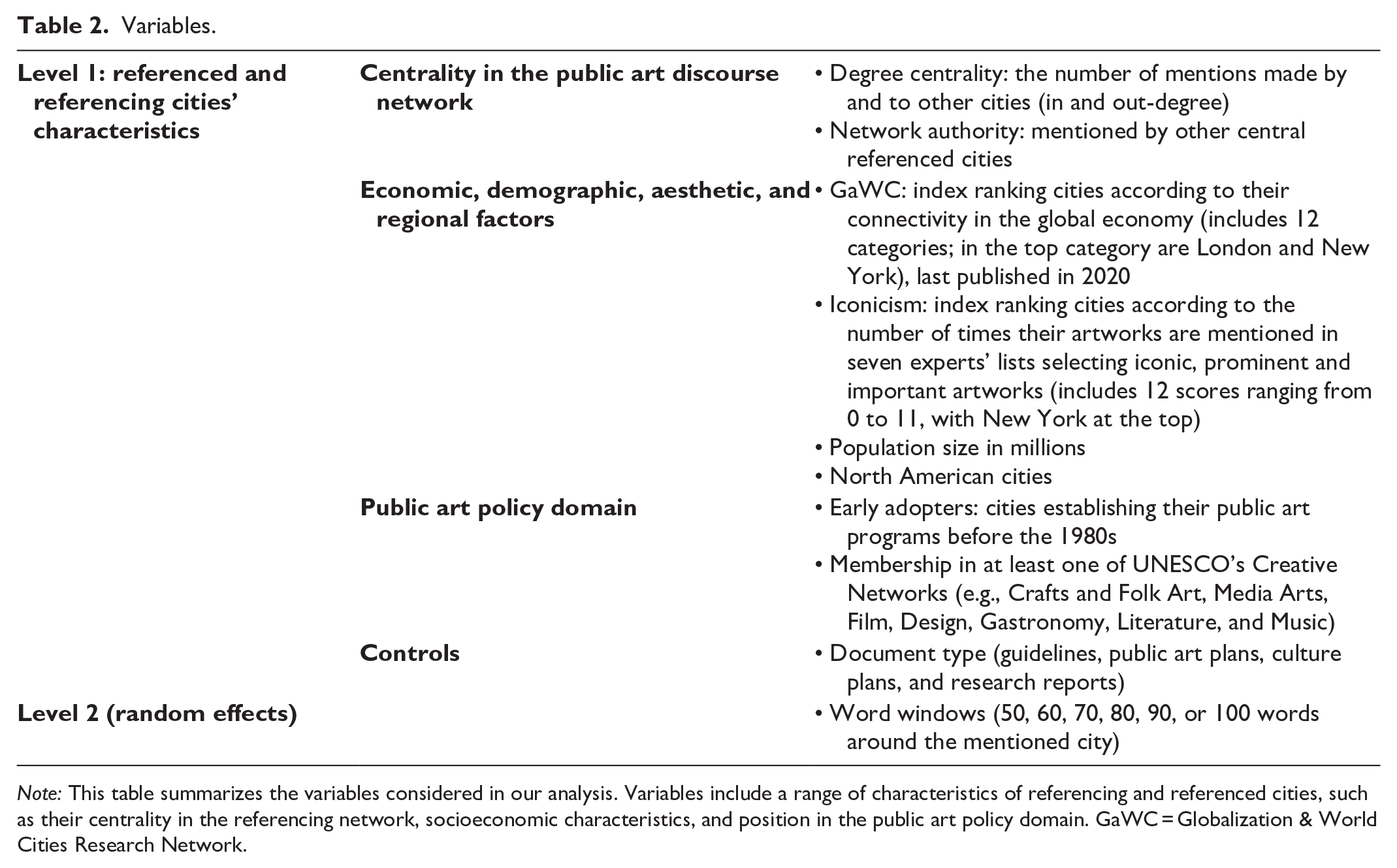
Note: This table summarizes the variables considered in our analysis. Variables include a range of characteristics of referencing and referenced cities, such as their centrality in the referencing network, socioeconomic characteristics, and position in the public art policy domain. GaWC = Globalization & World Cities Research Network.
The crucial test for answering our second research question comes from comparing the coefficients of referencing and referenced cities in Figure 2. Table 3 shows the results of this test. It summarizes results from a series of linear proposition tests to determine whether the coefficients of paired variables (e.g., UNESCO membership of the referencing city vs. the referenced city) differ significantly. Additionally, Table 3 identifies which city characteristic had a greater influence on the outcome by comparing the absolute values of their coefficients. The variable with the larger absolute coefficient is considered to exert a stronger impact, indicating whether the referenced or referencing city’s attribute plays a more dominant role in shaping the referential style.
Comparison of Coefficient Strengths.
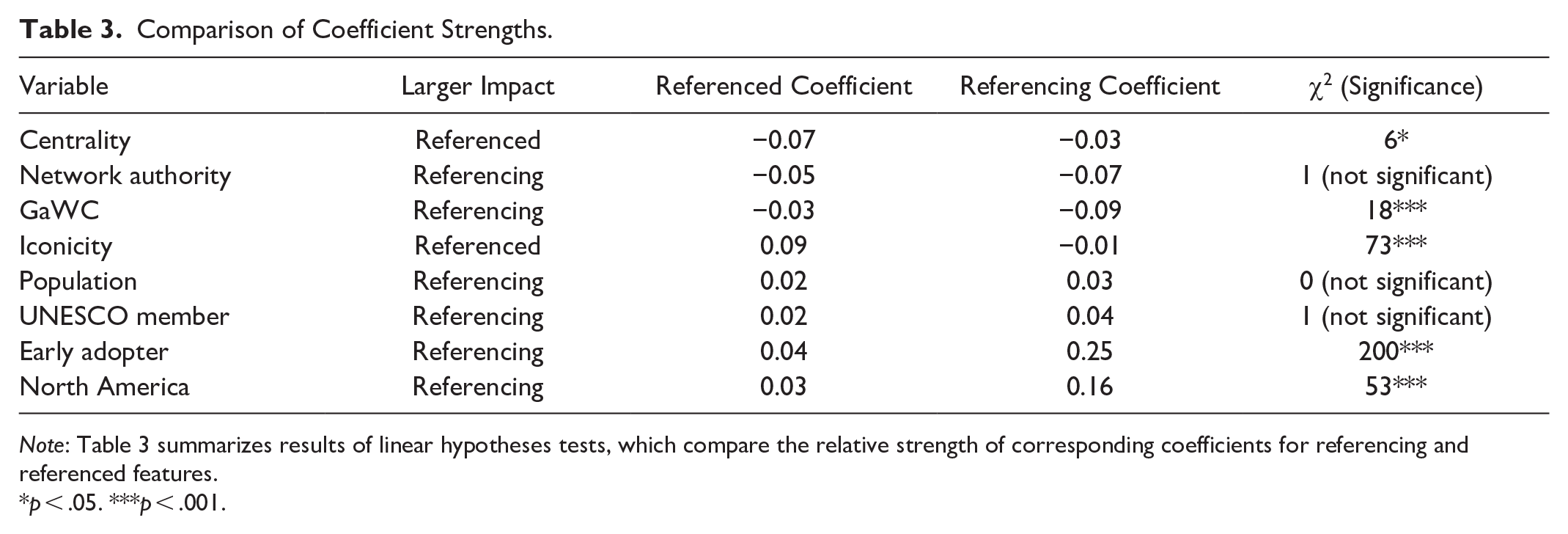
Note: Table 3 summarizes results of linear hypotheses tests, which compare the relative strength of corresponding coefficients for referencing and referenced features.
p < .05. ***p < .001.
Overall, Table 3 suggests modest support for the networks from culture proposition. In three of the eight comparisons, the coefficient of the referencing city is significantly larger than that of the referenced. By contrast, the referenced city coefficient is stronger in two of eight (though the difference in degree centrality is rather small). Three coefficients do not differ significantly. On the whole, though both processes occur, discursive styles arise less frequently from a top-down process by which central cities determine how they are seen, and more by cities determining how they choose to see one another.
Although the overall pattern of results summarized in Figure 2 and Table 3 point toward the networks from culture proposition rather than the cultural domination proposition, the table also indicates variability. In most cases, attributes of referencing cities predominate. However, this is not always the case. Looking at Table 3, it appears to suggest that the cultural domination proposition tends to hold for cities with the most mentions of iconic works of public art in public lists and rankings of international public artworks. These are cities such as New York, Paris, Dubai, Bilbao, and Chicago, whose public artworks routinely are discussed in publications such as Architectural Digest for offering the most “fascinating” works: Louise Bourgeois’s Maman in Bilbao or Jeff Koons’s Balloon Flower in New York. In this way, the larger positive coefficient for referenced cities’ iconicity suggests support for the cultural domination proposition: whether or not the referencing city is North American, large, is a UNESCO member, or has a long history of cultural policymaking, it tends to discuss “the same thing” when it refers to a New York, Paris, or Chicago. These latter cities determine how they are discussed, and it seems to be usually in relatively generalizing terms, as avatars of broader processes.
However, a closer look reveals a more complex picture. It turns out that the cities with the most iconic works of public art are discussed in both particularizing and generalizing ways, while it is the cities with few to no iconic works of art that are more likely to be discussed in more distinctly particularizing terms.
Figure 3 illustrates this contrast by zooming in to the referencing patterns for Chicago and Brisbane. Chicago is home to major iconic works of public art, most notably Anish Kapoor’s Cloud Gate. Chicago is discussed moreover in a variety of referencing styles. When discussed with generalizing styles, Chicago is described often by way of its cultural life (Table 1), highlighting attributes such as its “aesthetic focus,” reflected in its “curves along a lake” (Houston, Civic Art Master Plan). Similarly, its overall cultural strategy is described frequently by the investment in arts and culture referencing style from Table 1, placing the city alongside “visionary and progressive cities such as Barcelona, Seattle, Chicago, and Paris,” with San Diego emphasizing that its own vision “must be an integral part of the urban infrastructure” (San Diego, Public Art Master Plan). Alongside the generalizing style, the particularizing style often highlights Chicago’s unique public art program style, using a “museum without walls” approach, where public spaces are transformed into opportunities to showcase world-class art (San Diego, Public Art Master Plan, 2004). Specific projects such as Millennium Park and its iconic artworks are frequently used in the artwork location style, serving as examples in cultural planning documents. For instance, San Antonio draws on Chicago’s Millennium Park when redeveloping its own Hemisfair Park, describing it as a “premier example of a contemporary art collection with engaging and interactive installations located in an urban park setting” (San Antonio, Hemisfair Master Plan, 2015). Similarly, Sydney highlights both the artwork location and investments in arts and culture styles, referring to Cloud Gate as “the poster child for the city it transformed,” situated “at the heart of Chicago’s Millennium Park” (Sydney, City Centre Public Art Plan, 2013).

How Chicago and Brisbane are referenced by other cities.
Brisbane, which does not have iconic public art works that are mentioned in the sources we compiled, is discussed almost exclusively in particularizing ways. For example, Perth describes in details various aspects of Brisbane’s program, while Sydney discusses successful public art locations in Brisbane. This is a common pattern among the cities with no iconic works: they are referenced on average with about 14 percent more of a particularizing style, compared with those with iconic works of public art. This pattern suggests that even where the cultural domination proposition seems to hold, it must be qualified: it is not the cities with the most iconic aesthetic offerings that inspire or determine that others talk about them in the same way; rather, it is the cities with few to no iconic works that, if they are discussed at all, tend to provide a resource for concrete and specific examples of programs and policies for others to draw from. Conversely, the way the most aesthetically recognized cities drive the discourse is primarily through offering not a single unified narrative but rather a variety of discursive resources for others to draw upon. As the example of Chicago shows, it is referenced both for its contextual aspects and its specific public art approach: semiotic diversity “dominates.”
Although features of referenced cities do sometimes drive the public art discourse, the more common situation involves referencing cities selecting what and how to discuss others for their own purposes. Figure 4 illustrates what this means more substantively with the cases of Sydney and San Francisco.

How Sydney and San Francisco refer to other cities.
Sydney and San Francisco illustrate how cities refer to others, from different vantage points. San Francisco was one of the earliest adopters of formal public art policy and a pioneer in this space of ideas, while Sydney waited until the international wave of policy adoption in the late 1980s and early 1990s to join. San Francisco is discussed frequently by other cities central to the discursive network (it has the fourth highest authority score), while Sydney is in the bottom half of in-degree centrality and its authority score of .067 puts it below the mean (.087). Sydney, however, is a “heavy referencer,” referring to the third most other cities (out degree = 46), while San Francisco discusses fewer other cities (out degree = 14). At the same time, Sydney is an “Alpha plus” city in the GaWC rankings, while San Francisco is an “Alpha minus” city. San Francisco is North American, and Sydney is not. Each appears on two lists of recognized iconic works of public art. Both are members of the UNESCO Creative Cities Network.
Keeping in mind the complexity of any given city’s discursive styles across its various references, looking more closely at Figure 4 illustrates some general patterns. Exemplifying the average tendency of cities higher in the GaWC, Sydney tends to speak of other cities in relatively particularizing ways on average. For instance, using what we term the public art program style, Sydney discuss borrowing the idea of having a thinkers-in-residence program from Adelaide, it describes plans to bring artists “such as Beijing-based Ai Weiwei, New York artist Josiah McElheny, and Rosemarie Trockel from Cologne . . . to assume leading conceptual roles from the outset . . . [as] Sydney’s first artists-in-residence” (Sydney, City Centre Public Art Plan, 2013). As this quotation illustrates, Sydney discusses both cities at the top of the global hierarchy (e.g., New York, Beijing) and those lower down (e.g., Adelaide, Cologne), as well as North American cities (e.g., Chicago) and non–North American cities (e.g., Barcelona). Likewise, when Sydney does speak of other locations such as Bilbao and Abu Dhabi in more generalizing ways using styles such as investments in arts and culture and cultural life, it emphasizes Sydny’s own vantage point. For instance, the work of the architect Frank Gehry is described as “instrumental in the renaissance of Bilbao, Spain (1997) and in the complete remaking of Abu Dhabi. Successful case studies such as these underscore an economic imperative that Sydney cannot afford to ignore” (Sydney, City Centre Public Art Plan 2013).
San Francisco, for its part, tends to speak in relatively particularizing terms. Its proportion of generalizing references of .23 puts it well below the mean (.39). This contrasts with the average tendency of early-adopter cities but is in line with the average discursive styles of cities higher in the GaWC scale and those with high authority scores. More important in the present context is how San Francisco discusses other cities: it does so in ways that reflect its own purposes and agendas. For instance, San Francisco’s Art Commission Strategic Plan (2014–2019) describes a year-long process of “a comparative benchmark study of other major U.S. cities’ municipal arts agencies that helped establish its (the city) agenda” (p. 1). One of the referenced lessons is that “in large urban centers (e.g., Chicago, Los Angeles, New York, Philadelphia, Seattle . . . boards serve in an advisory capacity only.” San Francisco chose to differ, as its “Arts Commissioners are eager to improve their ability to be engaged and govern effectively to achieve the goals in this plan” (p. 30).
Discussion
Research on the relationship between places and ideas in urban sociology and urban policy mobility has overwhelmingly focused on the production side of urban models. As a complementary approach, in this article we showed how meanings are attached to places by their networks of peers. Our empirical investigation of the public art referencing network focused on cities directing their attention to one another throughout the policymaking process by articulating the different referencing styles they use and the referential relationships that shape them. To explore how referential relationship influences referential styles we articulated two core propositions: the Cultural domination proposition suggesting a top-down diffusion model in which what selected central cities do and say determines other cities’ approaches, and the networks from culture proposition suggesting that cities have an agentic role in picking and choosing policy elements, even when they look to the leading cities.
By investigating the public art policy network case, we explored the referencing styles cities use when gesturing to other cities in their public art policy documents. Using structural topic models joined with novel methods for identifying “meta-topics,” we found five main referential styles. In three of these styles, cities referenced other cities in a generalizing way, often to justify or advance a broader strategy without committing to a particular way of doing things (these include cities’ investment in arts and culture, cities’ cultural life, and cities’ economic prosperity related to arts and culture). In another two styles, cities referenced other cities’ particular policy elements (these include references describing the public art program, or its artworks’ locations). To streamline the results, we aggregated these five meta-topics into a single contrast, describing whether a city’s references tend to be more particularizing or generalizing.
Overall, cities tended to refer to one another in more particularistic terms, highlighting specific programs, artworks, locations, and procedures rather than general cultural or economic processes. However, although particularizing styles dominate interreferencing practices, cities varied in how they referenced others and were themselves referenced. Heavy-referencing cities such as Sydney used generalizing styles but, as our close reading revealed, often adapted contextual factors from other cities to suit their own needs. Less central cities, such as Brisbane, were referenced exclusively in particularistic styles and primarily by cities with structural connections to them. By contrast, central cities like New York, Chicago, and Seattle exhibited semiotic diversity, being referenced in both particularistic and general styles. These central cities offered a broader range of discursive resources, serving as versatile reference points for others.
Given the overall tendency of cities to use referencing styles that align with local interests, we then used regressions and a coefficient comparison test to systematically examine how variation in referencing styles depends on the attributes of the referencing or referenced city, and how each attribute influences these dynamics. The network appears to have a small number of highly referenced cities (Keidar and Silver 2024a), a finding that seems to align with the classic neoinstitutional cultural domination proposition (Buchholz 2022; Janssen et al. 2008; Kaufman and Patterson 2005; Kuipers 2011) and is consistent with studies on cities in the world system (Alderson and Beckfield 2004; Taylor and Derudder 2015). However, when comparing how the attributes of referenced and referencing cities influence the uptake of any of these referential styles, we found modest support for the networks from culture proposition over the cultural domination proposition. Referencing styles were more influenced by the attributes of the referencing cities, particularly their position in the global economy (GaWC), early adoption status, and whether they were North American cities.
This finding suggests that the circulation of meanings operates in this domain more on a “relational ecology model” (Lizardo 2007), where the transmission of content is not solely top down (Phillips 2011; Rossman and Fisher 2021). Instead, referencing cities influenced referential styles for both higher and lower ranking cities in the global hierarchy. Even in the case of iconicism, where the aesthetic allure of the referenced cities had a stronger impact on the referential style, the dynamics were more complex. Iconic cities did not merely channel meanings but were discussed in both generalizing and particularizing ways. It was rather the noniconic cities that “limited” the meaning, being discussed only by particularizing styles when referenced.
Building on this relational perspective, our analysis of the public art referencing network also highlights opportunities for further exploration, particularly in considering additional geopolitical layers beyond the local-global binary, such as regions or states. Existing literature on national cultural policy typologies (e.g., Chartrand and McCaughey 1989) has shown that countries adopt distinct models of cultural governance, which in turn shape how cities engage with arts policy. Similarly, Keidar and Silver (2024b) demonstrated that these frameworks not only define funding structures and governance models but also influence the discursive use of public art. Accordingly, national-level cultural policies may shape the referencing styles cities employ in public art, reinforcing or reshaping their positioning in global policy networks.
This work contributes to sociological understandings of how meanings are attached to places by extending the focus beyond local dynamics to include the broader networks of peer cities. Although theories in sociology have explored the processes of soldering ideas to places through concepts like “truth spots” (Gieryn 2006, 2018), “scenes” (Silver and Clark 2016), “distinctive places” (Molotch et al. 2000), and “local identity cultures” (Brown-Saracino 2015), these frameworks largely emphasize on-site, localized production of meaning. Similarly, urban policy mobility studies in geography have examined the creation and narration of model cities (Bunnell et al. 2022; González 2006; Honeck 2018) and their global circulation (Duque Franco and Ortiz 2020; González 2011; Pow 2018; Prince 2014; Whitney 2022), but often focus on the production side or specific case studies. Our research shifts attention to the underexplored consumption and reproduction of policy models by peer cities, which is crucial for understanding how places become model cities. Although policy documents alone cannot fully reveal the processes behind the emergence of model cities, they provide insight into the different referencing styles cities use in relating to one another. Investigating how these styles shape the transformation of cities into models remains an open question for future research.
Our empirical findings highlight that even in a referencing network with a limited number of influential nodes, such as the public art referencing network, particular local interests shape referencing styles, and the characteristics of the referencing cities, rather than the referenced ones, primarily influence their uptake. This dynamic can inform research on key examples of model cities, such as Bilbao, Medellín, and Singapore, which we introduced at the beginning of this article. For example, Bilbao’s transformation into a model city cannot be explained solely by its cultural regeneration efforts through starchitect-designed institutions (Patterson 2012), the policy tourism it organized (González 2011), or its local media’s narration of its changing identity (Lindsay and Sawyer 2022). Instead, in a globalized world characterized by extensive policy mobility, Bilbao’s status as a model city is also shaped by the meanings attached to it within a web of peer cities. As Wimmer (2021) suggested, this global domain is not structured hierarchically like a tree but resembles a rhizome, with cities forming interconnections that collectively shape their symbolic significance.
Supplemental Material
sj-docx-1-srd-10.1177_23780231251344977 – Supplemental material for Urban Referencing Styles and Networks: How Cultural Domination and Local Interests Shape Policy Discourse
Supplemental material, sj-docx-1-srd-10.1177_23780231251344977 for Urban Referencing Styles and Networks: How Cultural Domination and Local Interests Shape Policy Discourse by Noga Keidar and Daniel Silver in Socius
Footnotes
Acknowledgements
We thank Clayton Childress for his thoughtful feedback on an earlier draft, and the members of the University of Toronto and Hebrew University Research and Training Alliance for the valuable discussions that helped shape this work. We are also grateful to the anonymous reviewers for their insightful comments, which improved the paper.
Funding
This paper is part of the University of Toronto and the Hebrew University Research and Training Alliance, and the Urban Genome Project, which was supported by the University of Toronto’s Connaught Global Challenge Award and the School of Cities’ Urban Challenge grant. This research also received support from the Ontario College of Arts and Design University.
Supplemental Material
Supplemental material for this article is available online.
1
Although our sample size is smaller than some big data computational text analysis, it covers the near complete universe for this domain of large anglophone cities.
2
Authorship is also an important factor. Consultants and policy advisers often work across multiple cities, potentially shaping referencing patterns. For instance, a consultant advising one city may also influence policy documents elsewhere, leading to references that do not stem from direct municipal engagement. However, authorship of these documents was only partially publicly recognized. With the assistance of an arts and culture policy consultant, we attempted to identify authorship to incorporate this factor into our model. Because of incomplete results, we ultimately did not integrate it into the analysis.
3
Approximately 90 percent of the documents were published after 2000, with a notable increase from 2010 onward.
4
This approach means that although referencing cities are restricted to the large anglophone cities for which we collected policy documents, referencing cities may include any city to which those anglophone cities refer. For example, later we include a quotation from Perth about Taipei. Thus, in our analysis the iconic art of Paris can still play a role in drawing discussion from anglophone cities, even if Paris’s own referencing is not included. A more global multilingual sample would clearly give a broader picture, and although this raises various methodological challenges around translation, it is a ripe area for additional research with new emerging tools.
5
We repeated this cleaning process when investigating the network visualizations and particular nodes that do not only represent cities. Washington, for instance, was mentioned in multiple cases to refer to squares, streets, and the state of Washington, rather than to the city of Washington, D.C.
6
Cities not included in these first two indexes (GaWC and iconicity) were assigned a zero score in these two scales and are still integrated in the analysis. This group potentially encompasses thousands of cities and settlements, which may adopt different referential approaches. At one end of the spectrum, they may reference extensively as a compensatory mechanism, while at the other, structural marginality may result in minimal referencing.
7
The measure is based on a compilation of online lists in English with titles such as “Most Famous/Iconic/Legendary/Fascinating Public Art Around the World.” These lists highlight different angles on public art: three lists were curated by culture, arts, design and architecture magazines The Artists (2021), Architectural Digest (Mafi and Cherner 2019), and CONASÜR (2019); another two lists were composed by tourism magazines Far and Wide (Lemmin-Woolfrey 2023) and Departures (Rizzo 2021); one list was selected by the BBC (The Lonely Planet 2010); and another was chosen by The Collector ( ), a history and philosophy magazine .
Author Biographies
References
Supplementary Material
Please find the following supplemental material available below.
For Open Access articles published under a Creative Commons License, all supplemental material carries the same license as the article it is associated with.
For non-Open Access articles published, all supplemental material carries a non-exclusive license, and permission requests for re-use of supplemental material or any part of supplemental material shall be sent directly to the copyright owner as specified in the copyright notice associated with the article.
