




Abstract
The October 7, 2023, Hamas attack on Israel and the subsequent military response sparked global controversy, deeply affecting young American and Israeli Jews. Drawing on 20 interviews with Jewish college students from both countries, this study explores how they interpret Israel’s actions through the lens of neutralization theory. Although most participants used traditional neutralization techniques to justify or rationalize Israel’s military engagement, a significant minority articulated counternarratives, challenging dominant frames of justification. Denial of victim was the most common technique, though its application varied by country; American students were not only more likely to use this justification but also more inclined to acknowledge the suffering of Gazan residents. Israeli students, by contrast, were more likely to appeal to higher loyalties, emphasizing national duty and security. These findings extend the application of neutralization theory beyond its typical focus on deviant behavior to illuminate how individuals make sense of morally charged situations involving state violence. By demonstrating how young people navigate competing values, reconcile personal and national identities, and construct narratives around military operations, this study provides new insights into the moral reasoning processes shaped by national context and lived experience.
Keywords
On October 7, 2023, several Palestinian armed groups (e.g., Qassam Brigades, Quds Brigades, Omar al-Qasim), which were led by Hamas, launched a deadly attack on Israel’s southern border, killing 1,139 people 1 and taking approximately 250 hostages (Human Rights Watch 2024; Miller 2024; The New Arab Staff & Agencies 2023). Many victims were young Israelis attending the Nova music festival. Israel responded swiftly, calling up military reserves and launching airstrikes on Gaza (Axios 2023; Ferris and Lyons 2024). Within nine months, Israel’s military actions resulted in approximately 40,000 Palestinian deaths (Farge and Al-Mughrabi 2024; Khatib, McKee, and Yusuf 2024), sparking global outrage and calls for a ceasefire (United Nations 2024).
The events of October 7 are embedded in a complex historical context that extends back before the founding of Israel in 1948. During the 1948 Arab-Israeli War, thousands of Palestinians were displaced—a moment often referred to as the Nakba, or “catastrophe,” in Arabic—which the United Nations (1948) recognizes as a pivotal event in the Palestinian historical narrative. Over the past 75 years, tensions have been fueled by land disputes, sovereignty, and national identity. One key source of escalating tension has been Israeli settlement construction (Gazit 2015), with settler-related attacks rising by 39 percent in the first half of 2023 (UN OCHA 2023). Additionally, Israel’s decade and a half blockade on Gaza has severely affected the economy and residents’ quality of life (UNRWA 2023). These factors have contributed to a volatile environment.
For young American and Israeli Jews, Israel’s military action was especially challenging. Israeli youth were called to fight an elusive enemy. In the United States, the Jewish community has historically been a proud supporter of civil rights and liberties (Cohen and Liebman 1997), which many Jews see as vital for limiting prejudice and discrimination against them and other minorities. During the ensuing months, thousands of college students across the United States protested against what they saw as Israeli aggression (Ulfelder 2024) and what some have described as the country’s colonial legacy (Powers 2024).
Young people are an especially valuable population for understanding war narratives because they are the ones most likely to enlist or be drafted (The Learning Network 2020). They also tend to be more vocally opposed to war and agitating for change (Muchnick and Kamarck 2023; Royden and Hersh 2021). Because they are typically young and just entering adulthood, historical events, such as Israel’s military action in Gaza, are likely to have an enduring influence on their identities and views for years to come.
This study investigates how Israeli and American Jewish college students understand Israel’s military response to the attacks on October 7, 2023. Specifically, I examine the extent that they draw on and deploy neutralization techniques to make sense of the military action. Using neutralization theory (Sykes and Matza 1957), ideas from symbolic interactionism (Cooley [1902] 1983; Goffman [1959] 2021), and 20 interviews with Israeli and American Jewish college students, I reveal the complexity in students’ views about Israel’s military action. Although the majority of respondents drew on traditional neutralization procedures, a substantial minority provided counter narratives, sometimes in conjunction with standard techniques. In both countries, the most popular neutralization method was denial of victim, with the Americans being more likely to justify the military action and humanize the other side. Israelis frequently defended the war and loss of life through appeals to higher country loyalty, whereas Americans, lacking the same personal experiences in the country and mandatory military service, rarely used this justification. The findings advance our understanding of how neutralization techniques apply to war narratives.
Meaning Making in Context
Understanding Jewish students’ views on Israeli military action requires examining how these young people construct their identities and anticipate how others see them. Drawing on the concept of the looking-glass self, Cooley ([1902] 1983) argued that we perceive ourselves on the basis of how we feel others view us, which affects our sense of identity and how we respond. Likewise, Goffman’s ([1959] 2021) idea of impression management highlights how people try to influence the way others view them to maintain a certain image. The “audience,” whether real or imagined, shapes how they present themselves. When they are on the “front stage” people attempt to conceal or minimize socially undesirable attitudes or actions that they anticipate others will find problematic (Goffman [1959] 2021).
To discern their meaning-making process, we need to view Jewish students’ discussions on the Gaza crisis from the broader historical and cultural position of Jews in Israel and the United States. The Jewish community remains deeply connected to World War II and the Holocaust, in which Nazi Germany and its allies killed nearly 6 million Jews (Zubarev 2024). After the war, with Allied support, Israel declared independence, displacing many Arab residents (Kamel 2019). Since then, military disputes with neighboring territories have persisted (O’Dell 2024), with some scholars (Grassiani 2013) arguing that Israeli soldiers have grown numb in regulating Arab and Palestinian residents and neighbors. Likewise, scholars have noted that a wide range of educational initiatives, both within Israel and among the diaspora, focused on Hebrew, Jewish history, and Israel have been framed through a Zionist lens (Alexander 2015; Segev 2006), potentially shaping how Jewish Americans come to identify with the Israeli state.
Reformed Israeli and American Jews may also be seen as holding an elite global status. Israel, often called the Middle East’s only democracy (Smooha 2002), ranks high in freedom (Freedom House 2024), education (OECD 2024), and income (WRAI 2024), though Arab residents report discrimination (Chacar 2023). In the United States, Jews are wealthier and more educated than average, with 44 percent earning more than $100,000 (Pew Research Center 2021). Scholars have tied their liberal stance on LGBTQ rights, abortion, and civil liberties (Adamczyk 2017, 2025; Pew Research Center 2013) to their minority status (Cohen and Liebman 1997).
Israel’s military action in Gaza sparked antiwar protests across U.S. campuses, particularly at Columbia University and City College, where outside demonstrators joined students (Capellini and Moore 2024; Epstein 2024). Rising anti-Semitism led Jewish leaders and donors to pressure colleges (Lapin 2024). Administrators struggled, and some, including Columbia’s president, resigned after public controversies (Aratani 2024; Nadworny 2024). This study’s interviews, conducted in spring 2024, capture young Jewish people’s views about Gaza in the context of these protests, the ongoing crisis, and their global elite status.
Neutralization Theory
To understand young Jewish students’ perspectives on the Gaza crisis, I draw on neutralizations used to justify military action. Neutralization theory was initially developed to explain juvenile delinquency, but its application has greatly expanded (Maruna and Copes 2005). According to Sykes and Matza (1957), people are at least partially committed to dominant cultural values. Society’s normative system has some flexibility, whereby rules are not binding under all conditions. Rather, dominant norms and values offer qualified guidance for action, depending on the time, place, person, and circumstances. People use excuses, justifications, and rationalizations to exploit the flexibility in societal rules. These “neutralization techniques” help individuals avoid societal condemnation while also maintaining views and behaviors that may challenge societal norms and values. Neutralization techniques may be used to convince a group of people to support military action or make sense of actions afterward. For understanding sensemaking in war, the sequence of act and justification is not vital.
Sykes and Matza (1957) put forth five neutralization techniques. These techniques are listed in Table 1, in which I also illustrate how they could explain views about military action in Gaza. Denial of responsibility refers to the acts being outside of one’s control. With denial of injury, people either reject or downplay any harm that actions may have caused. They may also argue that the harm was warranted if a greater goal (e.g., peace, safety) was or would be achieved. Additionally, victims may be seen as deserving the injury, hurt, or moral indignation (i.e., denial of injury) because they provoked it (e.g., kidnapping the hostages). The fourth technique is condemnation of condemners, which is when perpetrators shift their focus to disapproving others. The final technique is appeal to higher loyalties, which is when societal norms are neutralized by appealing to a larger group or goal. Although other researchers (e.g., Maruna and Copes 2005) have proposed additional neutralization techniques (e.g., claim of entitlement), this study focuses on the original five most popular ones, which were well represented in the interviews.
Techniques of Neutralization, Their Inverse, and Descriptions as They Apply to Military Engagement.
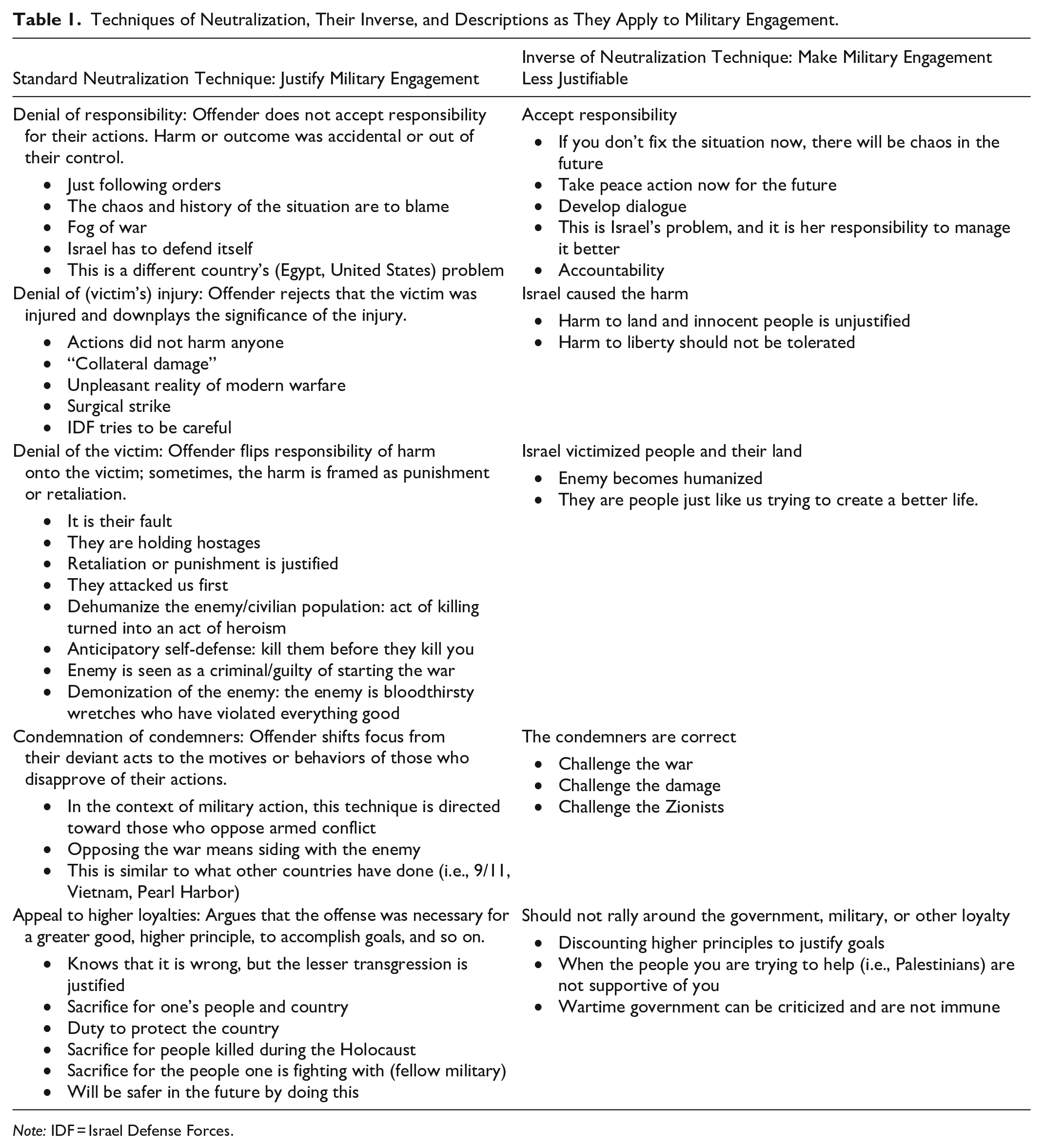
Note: IDF = Israel Defense Forces.
Neutralization techniques provide justifications for attitudes and behaviors that conflict with societal norms. However, people may also push back and offer explanations that defend the alternative, which this research also examines. The majority of qualitative studies that investigate neutralization techniques typically select on the outcome (i.e., dependent variable). When examining the neutralization techniques used during the Rwanda genocide, for example, Bryant et al. (2018) analyzed transcripts of testimonies from accused genocide perpetrators and not those that were deemed innocent. Likewise, in their study of Christian domestic discipline, Deshotels et al. (2019) researched publicly available testimonials and Web sites devoted to this issue instead of more neutral sources that may or may not have been supportive. When a study focuses only on perpetrators, we are unable to see the alternative narrative. The present study moves research forward by considering not only the five major neutralizations, but also their counter narratives, which are also presented in Table 1.
Neutralization Techniques and Narratives about Military Action
Among criminologists, neutralization theory is one of the most popular (Maruna and Copes 2005). Other social scientists have applied the theory to a wide range of different subjects and situations, including sustainability scandals (Boiral et al. 2022), military loyalty (Connor et al. 2021), school bullying (Obermann 2011), “uncaught” street offenders (Topalli 2005), and occupational misconduct (Pershing 2003) (see review by Maruna and Copes 2005). Most relevant for understanding how young Jewish people describe Israel’s use of force are studies that have implemented this framework to examine military action (e.g., war and genocide) (Alvarez 1997; Bryant et al. 2018; Kooistra and Mahoney 2016) and those that focus on understanding people’s attitudes, even when they are not engaging in the actual behavior (Alexander and Opsal 2021; Deshotels et al. 2019).
The bulk of research on neutralization techniques focuses on people who personally participate in deviant behaviors. However, the present study follows previous scholarship (Alexander and Opsal 2021; Deshotels et al. 2019) in examining the techniques used by some people who are trying to neutralize societal norms to explain why something is acceptable, even if they are not the direct perpetrators. The vast majority of people will never take someone else’s life. But their views contribute to public opinion, which can shape key government decisions about whether to start or end military action.
Many young Jewish students from the United States and Israel have liberal views about military action in Gaza. Indeed, their attitudes tend to be more progressive than those of older people (Muchnick and Kamarck 2023). When asked about their feelings regarding Israel’s military action, many provided multiple neutralization techniques to rationalize their support. However, several students from the United States and Israel offered unsupportive or mixed views. This paper investigates how Israeli and American students frame Israel’s military offensive. I specifically assess the extent that they draw on and deploy neutralization techniques to make sense of this military action. In the following, I explain how I gathered the interview data and then present my analysis.
Data
This study relies on data from 20 interviews conducted between May 28, 2024, and June 19, 2024. I was interested in assessing views about the initial Hamas attack and Israel’s response for American Jewish and Israeli college students. These American and Israeli young people have several points of commonality (e.g., similar age and social status, same ethnic and religious group, some shared language and education, Holocaust historical memory, etc.). But they are also distinct, which is relevant for understanding variation in their narratives and neutralization techniques.
The biggest difference between the two groups is that the Israelis are living in a place that has regularly experienced insecurity since the country was founded in 1948 (Center for Preventive Action 2024; Council on Foreign Relations 2024). The October 7, 2023, attacks occurred in close proximity to residential areas, and for some Israelis, directly within their homes, contributing to a pervasive sense of personal violation and national trauma. Additionally, if they had not already participated in mandatory military service, which typically includes the Israel Defense Forces (IDF), they would likely do so in the future, like many of their friends and family members. Furthermore, all of the Israelis (and none of the Americans) I interviewed were in the country when Israeli residents were killed and kidnapped on October 7, 2023. Hence, they have had a closer experience with the attacks and subsequent military action than their American siblings. Conversely, American Jewish college students had firsthand exposure to student protests opposing the war. Additionally, their homes are not located in a relatively new country surrounded by hostile neighbors. This study considers how young people’s country location shapes their views. Descriptive information on the respondents can be found in Table 2.
Descriptive Statistics of Respondents Included in the Sample.

All study participants had to be between the ages of 19 and 24 years, currently enrolled in college or graduating in spring 2024, and identify as Jewish in a way that the respondent determined. Students from the Orthodox Jewish community were excluded since this group constitutes a minority of Jews in the United States and have an especially unique lifestyle and perspective that could not easily be generalized. Additionally, at the time of the interviews, Orthodox Jews were not required to enroll in government service, the major organization being the IDF.
In Israel, local social science faculty were asked to share a recruitment advertisement with their undergraduate students. Interested students were instructed to contact me directly via e-mail. They had the option of a virtual or in-person interview. But as many were recruited through in-person classes and my temporary office was located in the same building as the classrooms, all of them chose to talk with me in my private office. Because I had limited time in Israel and needed to keep the number of interviews manageable, I restricted the number to 10.
To be consistent with the Israeli sample size, I focused on interviewing 10 people in the United States. Students were first recruited through a department e-mail sent to all of the social science programs at the college, which generated the first few subjects. Some Jewish students then shared the recruitment e-mail with the Hillel organization at their college and others. Hillel is a student-led organization that supports Jewish campus life, providing a community for college students to celebrate, learn, and explore their Jewish heritage (Hillel International 2024). Hillel explicitly embraces a Zionist framework, which has led to policies that restrict anti-Zionist perspectives. According to its official guidelines, Hillel chapters are prohibited from hosting speakers or organizations that challenge Israel’s legitimacy or support boycotts against it (Hillel International 2014). As a result, Hillel has been criticized for marginalizing dissenting views (Berube 2016; Keane 2024).
After interviewing all of the students who had initially been contacted via e-mail from the social science departments at the college, I began interviewing students who learned about the study from their Hillel organization. I wanted a diversity of perspectives in Israel and the United States. I noticed that the interviews with the Hillel students were especially conservative. To diversify the views, I used snowball techniques to recruit more liberal students who could balance out the sample.
Because Jews are a minority, even in New York City, the U.S.-based sample includes students from a handful of different colleges in the Northeast, with the vast majority coming from the city. Conversely, all of the Israeli students came from a single Tel Aviv university. I completed the Israeli interviews over a nine-day period, followed immediately by the U.S.-based interviews, which took about two weeks to complete. All of the U.S.-based interviews were conducted via Zoom from a secure office located at a major university in New York City.
Students from both countries were from liberal regions (i.e., Tel Aviv and New York City and the U.S. Northeast) that were affected by the attacks and subsequent military action. Many of the Israeli students had either done or were about to engage in their official service obligation, which for many would be the military. In spring 2024, New York City colleges, especially Columbia University and City College, were major sites of U.S.-based student protests (The New York Times and Closson 2024), which were in full swing right before I conducted my interviews. The Tel Aviv campus where my interviews took place had experienced minimal Gaza-related protests. Conversely, hundreds of thousands of Israelis were regularly protesting Prime Minister Netanyahu’s government and agitating for a deal that would release the hostages (Jordan and Cuddy 2024).
Students from both countries were offered a financial incentive that was the equivalent of $20 for doing the interview. In Israel, students were provided with shekels. In the United States, students were offered an electronic gift card from a popular outlet of their choice (e.g., Amazon, Barnes & Noble, Target). All students accepted the incentive. My college’s institutional review board approved verbal consent to conduct the interviews. All but one interview was audibly recorded and then transcribed. One Israeli student asked to stop the recording halfway through because he worried that the information was too sensitive. I was allowed to take notes instead. Each interview lasted between one and two hours. My Israeli office was soundproof, which I shared with the students, hoping it would make them more comfortable.
I am the only person who conducted interviews, and my positionality certainly matters. I am a white, middle-aged American woman who was trained as a sociologist of religion and has a midwestern accent. I do not identify as Muslim or Jewish. But because I conduct religion-related research, I am familiar with Judaism and America’s northeastern liberal Jewish community. When I was in Israel, I gave presentations on my research and met with graduate students. Several of the undergrads who I interviewed heard me speak, and I encouraged them to participate in the study. In the United States, the students knew that I am a professor. However, I had not recently been teaching undergraduates, and none of my former students volunteered to be interviewed. In both countries, all of the students spoke fluent English. In the following, I explain my analysis strategy before presenting the results.
Analysis
This interview questions focused on respondents’ views of the original attacks and subsequent military action. After transcribing and checking the interviews, I coded them using inductive and deductive approaches. I relied on the qualitative sorting techniques outlined by Meyer and Avery (2009) to organize the interview themes within Microsoft Excel. My initial reading revealed themes of double standards and an inclination to defend Israel’s position, leading to a focus on neutralization techniques. I also found that discussions about the events always included one of the following terms: one-state, two-state, settlements, gov, courts, Benjamin, Netanyahu, BiBi, prime minister, BB, military, occupy, Gaza Palestine, Palestinian, bank, war, and terror. Using these terms, I filtered responses into “mentions,” capturing statements before the next question or interviewer comment. Using these key terms, I found that the Israeli students produced 217 mentions, and the Americans had 124.
After isolating the mentions in an Excel spreadsheet, I examined whether they referenced a neutralization technique or its opposite. In Israel, 98 mentions used a neutralization technique, while in the United States, there were 89. Most mentions involved a single technique or its opposite, though some included multiple ones. Each mention was coded on the basis of the instrument in Table 1, and then independently coded by a second person. Discrepancies were reviewed and resolved. In the following, I analyze the proportion of techniques and their alternatives in Israel and the United States, using interview excerpts to illustrate how respondents applied these techniques and contextualizing their views.
Findings
Figure 1 presents the proportion of each neutralization technique and its opposite when Israeli and American students discussed the attacks and subsequent military action. In both countries, the majority of mentions (79 percent in Israel and 73 percent in the United States) focused on the five major neutralization techniques, with the remaining suggesting the alternative whereby the technique is turned around to explain why Israeli military action may be seen as problematic.
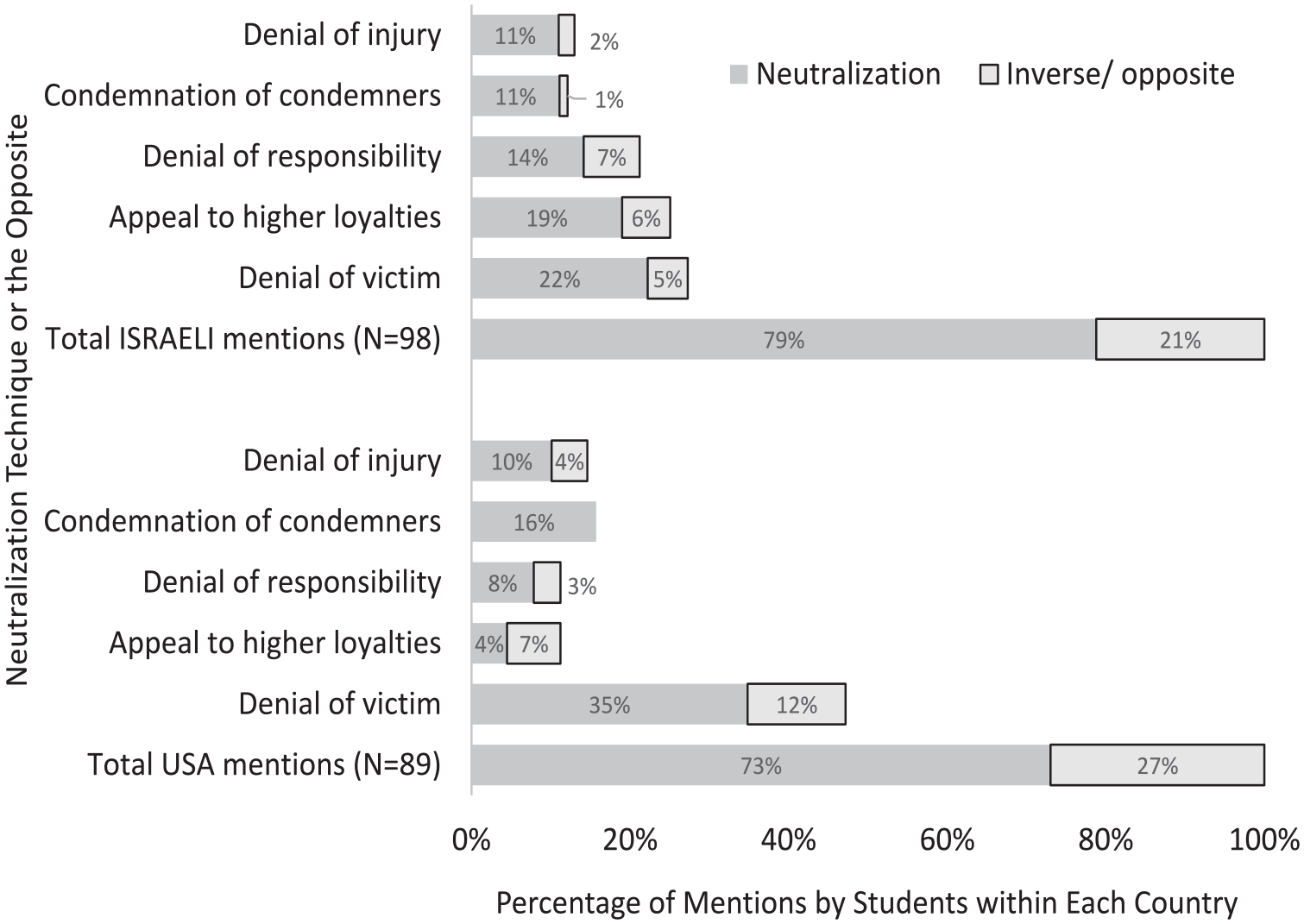
Percentage of neutralization techniques or their opposite used in each mention by country (total mentions, n = 187; interviewees, n = 20).
For the Israeli respondents, the majority of mentions regarding neutralization focused on denial of victim (22 percent) and appeal to higher loyalties (19 percent). The neutralization techniques with the smallest proportions were denial of injury (11 percent), and condemnation of condemners (11 percent), with a slightly higher percentage of mentions (14 percent) focused on denial of responsibility.
Similar to the Israelis, the majority of neutralization mentions also focused on denial of victim (35 percent) for the Americans. But in contrast to Israel, the second most popular theme was condemnation of condemners (16 percent), which was followed by denial of injury (10 percent). The two least popular techniques were denial of responsibility (8 percent), followed by appeal to higher loyalties (4 percent), which was the second most popular neutralization technique used by Israelis. In the following, I explain how respondents used each justification and their alternatives, which are also presented in Figure 1.
Denial of Victim and the Opposite
Previous research has referred to the denial of responsibility as a “master account” because it offers the ultimate resolution, as the act is framed as not the offender’s fault (Cohen 2001). However, Israeli respondents gravitated to denial of victim as the most popular technique. Denial of victim posits that even when one accepts responsibility for the conflict and admits that an injury occurred, they may flip accountability for the harm to those enduring the aggression, possibly framing it as punishment or retaliation. Given the country context and timeline of the most immediate events (i.e., October 7, 2023), these techniques were especially relevant for both Israeli and American respondents.
The immediate trigger for Israel’s military action was Hamas’s attack on October 7, 2023. Israelis 2 drew on the attacks to rationalize their support for military action, arguing that Hamas deserved what Israel did because they attacked first and killed and kidnapped innocent people. As Olivia explained, “At the beginning, I think the war was extremely justified. . . . They did so many horrible things. Like, there’s nothing we can do. We have to do something.” Meredith also highlighted the attacks: “Unfortunately, most of the people still think that Israel is blamed for October 7th, when in reality we didn’t start it,” arguing that Israel was not responsible for the original aggression. Tamar, added that initially, “I felt very sorry for the Palestinian people.” But after she saw the videos and read the media reports, she questioned her first impression because “you can see all the citizens really involved [in the attacks].” She suggests that the local population was not so innocent, and their victimhood could therefore be denied.
Related to the above statement, multiple Israelis thought that Gaza civilians bore some responsibility, even if they did not physically kill or take hostages, thus justifying military action and limiting their victimhood status. As Yara explained, I think Hamas is not only an organization, but it’s like the way you see life because they say their first intention is to destroy Israel. . . . They have nothing to lose so they become terrorists because they get money from Hamas, they get food. So, we cannot eliminate terrorism from the world, but I think Israel should try to eliminate them from this area.
Yara is arguing that her country should not have to endure terrorism. Another interviewee, Maya, explained that we don’t really know who is innocent: “[Even if he did not kill anyone], maybe he was helping; maybe he was hiding our hostages and mistreating them. Maybe he really killed people; maybe he planned it.” Kyla added, “I think right now the children that are going to be terrorists will be terrorists if Hamas still exists, but they won’t be terrorists if they release the fear by destroying Hamas.” She justifies Israeli military action by arguing that some children will become terrorists, and thus are not worthy of victimhood status, unless Hamas can be eliminated.
Like the Israelis, the Americans also used the denial of victim neutralization technique. But they focused almost exclusively on denying victimhood to Hamas, rather than both Gaza militants and civilians. Their comments were especially poignant, and disconnected from the region’s complex history (e.g., displacement of thousands of Palestinian during the Nakba, increases in settler-related violence, 16-year blockade on Gaza, etc. [UN OCHA. 2023; United Nations 1948; UNRWA 2023]) For example, Mike almost gleefully uses the phrase, “punched in the face” to describe Hamas in the wake of Israel’s response. “And now they are crying on the floor, saying, ‘How could you do this to us?’ And it’s like, you know like you just invaded our country and killed 1,200 people. What do you expect was going to happen?” Tara added, “My understanding of it is Israel is trying to exterminate Hamas because Hamas is a terrorist group that has been infiltrating Israel and [conducting] suicide bombings and stabbings forever.” From her perspective, Hamas’s ongoing harassment precluded it from being a victim. Ariel explained, “if the Jews were to put down their weapons, they would all be dead,” the idea being that Israel’s military action is justified because they would kill the Israelis first if they could and thus are not legitimate victims. A fourth American, Preston, rationalized Israel’s response after October 7, stating, “And people are saying this is an act of resistance. [But] you don’t kidnap people in an act of resistance. You don’t rape women in an act of resistance. You don’t kill children in active resistance.” For Preston, Israel’s response was justified because Hamas’s actions were especially ugly, and thus they are denied victimhood.
Compared with the Israelis, the Americans were less likely to say that local Arabs may have supported Hamas. Rather, the Americans were more likely to justify the military action by arguing that Hamas attacked first, thus denying them their victim status and justifying civilian deaths.
Although denial of victim was a popular neutralization technique for students from both countries, respondents also drew on the counter narrative (i.e., humanize the enemy), especially the Americans, making clear that they did not unilaterally exonerate Israel. Anne, who was an American Jew who did not use any standard neutralization techniques (see Figure A1 in the Appendix), humanized who she saw as the victims (i.e., Palestinians) and accused Israel of war crimes: “But the war now is just you know, it’s ethnic cleansing, that’s just what it is. I know Gaza is like 50 percent children, so it’s mostly children who are dying.” Later she explains that because the Israeli government has “continuously disenfranchised the Palestinians” they cannot congregate to develop a democracy and make their territory better. Lior agrees, explaining, “It would also be ignorant for an American or a Jewish person to act like this conflict does not have roots in long-term history and that it’s not stemming from years of like small aggressions and poor policy handling.” He goes on to say, “When Israel pulled out of the of the West Bank, they didn’t leave proper infrastructure.” From Lior’s perspective Israel’s poor treatment of Palestinians has contributed to their frustration.
The Israelis also drew on the opposite of denial of victim: humanizing the enemy and perceived associates (e.g., Gaza residents, Palestinians), albeit to a lesser extent than the Americans (see Figure 1). For example, Yara spoke about how his Palestinian neighbor checked on him after October 7: Some Arabs are very, very, very angry. And some of them, like that Palestinian, he lives on the West Bank. I think he wants a Palestinian country here, but he can still be a human and a friend, asking me if everything is okay.
Other Israelis felt that the people living in the territories were simply fighting for their rights. As Maya explained, “I think the Hamas are fighting for the land, are fighting for dignity. I don’t think they just fight because they hate Jewish people.” Advocating for a one-state solution, Olivia argued, “we both are supposed to be here and we need to just deal with it. The country needs to take into consideration that there’s another population living here.” Through personal experiences (i.e., Yara) and a critical perspective of history and rights (i.e., Olivia and Maya), some Israelis were empathizing with the other side.
Appeal to Higher Loyalties and the Opposite
Compared with denial of victim, Israelis were almost as likely to focus on an appeal to higher loyalties, which was minimally used by the Americans. In fact, across the five techniques, the gulf between the Israelis and the Americans is the widest for appeal to higher loyalties (19 percent in Israel vs. 4 percent in the United States). With this neutralization technique, the offense is framed as necessary for a greater good, higher principles, or to accomplish an important goal (Sykes and Matza 1957). When Kooistra and Mahoney (2016) were doing their research on war narratives, they argued that it also includes the duty to protect one’s country and make a sacrifice for one’s people, country, and fellow combatants. Young Israelis used the appeal to higher loyalties neutralization technique to discuss concerns about peace and survival of their country and support for their young military fighters, with whom so many had connections.
Most of the Israelis felt that their country was regularly under threat. Hence, many of the comments about appealing to higher loyalties focused on Israel’s right to exist peacefully. For example, Gabriel explained, “I think I’ve always thought that the war is not the end goal. I think that the end goal is to reach some sort of sustained quietness.” Another respondent, Kyla, felt like Israel was fighting for its right to nationhood: A lot of [Israelis] feel like there’s no other home for us. And if we don’t have this country, we’re going to lose ourselves. And the Jewish nation survives over 5,000 years; that’s insane. . . . So, we’re not going to let a terror organization take us down and take the country that we built here.
Kyla also mentioned that, like people did during the Holocaust, it was very important to “transfer the information from generation to generation, because history was made on October 7th and it’s still being made.” Tim explained that his mother, who is an IDF officer, “ingrained in me the idea that you don’t have to have conservative ideas to serve your country and help it because, in the end, your biggest debt is to your country before it is to your own political ideas.” Many Israelis felt that the October 7 attacks meant that the country’s legitimacy was under fire, justifying military action with an appeal to country loyalty.
All of the Israelis I interviewed had connections to people in the IDF. Knowledge that you or someone you know could be endangered as part of Israel’s military operation also led to an appeal to higher loyalties focused on supporting military soldiers. Some of those appeals were oriented toward military action, but others referred to personal sacrifices, like remaining in the country or residents not being divided over the current government. Tim explained, “There does come a point in which you need to also uphold your end of the contract between the military and the soldier serving it in which they’re sworn to protect their soldiers.” Another respondent, Kyla, mentioned the internal turmoil that Netanyahu’s government was experiencing. She felt that to support the country and soldiers, Israelis should set aside their grievances, I want to think people are better than that, and they won’t keep their political place in exchange for people’s lives. I believe that he wants people back home as much as every other Israeli. He doesn’t want like more soldiers to get killed.
A final respondent, Maya, felt that it was important for her to remain in Israel, despite the military action because “Israeli soldiers are sacrificing their lives. The least I can do is stay here to try to continue the economy, to try to continue life, to study.” Some of the Israeli college students were appealing to the higher loyalty of country and soldiers to not only justify military action, but also personal decisions, like moving abroad, and putting political divisions aside.
A sensibility marked by strong in-group loyalty, moralized Jewish solidarity, and deep identification with the state seemed to shape how some Israelis made sense of their position. This ethos, cultivated through military service, national education, and cultural narratives of collective survival, can foster a sense of unity, binding people together. Although these values are often presented as virtuous, they can also facilitate extreme conformism and justify repressive actions. In such a framework, participation in or support for military aggression may be seen not only as a duty, but as a moral imperative that may be undertaken without sustained reflection.
In contrast to the Israelis, only two Americans mentioned appeal to higher loyalties. Preston, for example, explained that countries like Egypt, Jordan, and Saudi Arabia have been having peace talks with Israel, acknowledging the state: I believe that the more people are open to a Jewish state being there, the more they learn and recognize that this is the Jewish land, this is where they have been, this is where they belong, and this is where they will stay.
Preston is making the case that Israel has a legitimate right to exist, which others (e.g., Hamas) should recognize by engaging in peace talks. Although the Americans were similar to the Israelis in a number of ways, they differed substantially in their appeal to higher loyalties. Relative to the Americans, Israelis had firsthand experience with the October 7 attacks, friends and family in the IDF, and ongoing threats to the country’s security, which may be why they drew on these connections to make their case.
Although the Israelis were more likely than the Americans to neutralize the military aggression with an appeal to country loyalty, neither group was completely faithful to Israel. When I was conducting interviews, tens of thousands of Israelis were regularly turning out to protest their own government (e.g., Melnick et al. 2024) At the liberal Israeli college where these interviews were conducted only a few interviewees supported the government. Many expressed frustrations that could be interpreted as the opposite of appeal to higher loyalties and lacked the sentiment that Israelis should rally around the government during war. For example, Levi explained, “first of all, we should get rid of this disastrous government that we have, because I personally believe that at this point Netanyahu is the worst leader in, at the very least, the entire history of this country.” Meredith added, “Once you don’t feel like you can trust the government, it’s very hard to trust the country you live in.” Gabriel thought the Israeli government did not have a clear goal, “So, I think that the fact that this war is being fought without some sort of end in sight is problematic. . . . There needs to be some sort of strategic effort.” These Israelis were clearly frustrated with the current government and direction of the war, which captured a part of the country sentiment at the time, as illustrated in the massive protests that were regularly happening.
The Americans were also critical of the Israeli government, likewise implying the opposite of appeal to higher loyalties. The comments made by Claire, Anne, and Lior, who did not use any traditional neutralization techniques to justify Israel’s military action (see Figure A1), dominated this perspective. Claire, for example, described Netanyahu as “tyrannical.” Referring to the Israeli protests, she says “this is one guy who’s not listening to millions of people. . . . This is not the thing to be doing.” Anne added, “the idea of the ethno-state that Israel is obviously trying to promote is incredibly problematic and never allows for any type of actual peace to be sustained.” Finally, Lior noted that although it is good to have a Jewish country, this does not justify expansion or “the strongest military in the world because they have to fight a bunch of kids with rocks.” He also explained that “you’re so used to all Jewish holidays being about oppression . . . [but] now Israel is actually a superpower. It’s not oppressed by these territories. We are oppressing them.” These Israelis and Americans challenged the monolithic view that Jews should support Israel’s wartime government in an appeal to higher loyalties.
Israel was founded in the aftermath of World War II, during which 6 million Jews were killed in German-occupied Europe. I considered the possibility that some respondents might justify Israeli military action by referencing the immense loss of Jewish lives during the Holocaust. Their reasoning could be that because Jews suffered such devastating losses because they did not have their own country, Israel may now be seen as justified in using extreme military force to defend itself. Whereas the Israelis minimally mentioned the Holocaust, half of the Americans discussed it, but not consistently to defend Israeli military action. For example, Preston, who is American, stated, “I do truly believe nothing should ever be compared to the Holocaust. All of us are just comparing different genocides in terms of how killings went down.” He expressed frustration with how some American protesters were invoking the Holocaust, explaining, “what really pisses me off is how people go off and say that . . . what Jews are doing to Palestinians is the equivalent of what Nazis did to Jews in the Holocaust, which blows my mind.” The limited references to the Holocaust among Israelis may reflect differences in national context; in Israel, where nearly everyone is Jewish, exposure to alternative perspectives, such as those voiced by some American campus protesters, may be less common (McGreal 2024; Sella 2024).
Americans also referenced the Holocaust when comparing the proportion of Jewish deaths to civilian casualties in Gaza. As Zane explained, “I mean, Jews lost 30 percent of our total population in the Holocaust, 60 percent in Europe. That’s just one genocide.” When asked whether a certain proportion of deaths in Gaza would make the military response unjustifiable, he responded, “I don’t know if there’s a percentage, but 1.5 percent [of their population], I don’t consider [it that high]. If I’m throwing a number, I don’t know, 5 percent to 10 percent, maybe, I don’t know.” For many Americans, Holocaust education and its prominence in religious and academic institutions serve as key points of connection to Israel (Dettmer 2024). Although the Holocaust remains significant for Israelis, other factors and more immediate experiences appear to play a greater role in shaping their views.
Denial of Responsibility and the Opposite
Across the five techniques, students moderately drew on denial of responsibility, constituting 14 percent of the Israeli mentions and 8 percent of the American ones. With denial of responsibility, the offender does not accept responsibility for their actions. Rather, harm or the outcome is viewed as accidental. In the context of military aggression, denial of responsibility includes “the fog of war,” which is the uncertainty in situational awareness experienced by participants during military operations. Likewise, the impetus for military action or the loss of civilian life might be described as someone else’s problem (e.g., other Arab nations), though not the fault of Hamas, which would be categorized as denial of victim (i.e., they brought this on themselves).
Many of the young Israelis I interviewed were contemplating the cost of war and reconciling the idea that innocent lives in Gaza would be lost. As Gabriel explained, “That isn’t specific [to Gaza]; it’s about this war, but it could have been present in any other wars, so Vietnam war, like you know, it’s just like a common debate in wars, cost versus benefit.” In discussing civilian losses, another respondent, Tamar, added, “I think also it could be just another price of war, and if you’re fighting in such a densely populated area, I guess there’ll be casualties.” Some of the Israelis had come to terms with the loss of life in Gaza. They were managing the cognitive dissonance by framing the loss of innocent lives as part of war.
Some students also felt that other countries bore some responsibility for the factors shaping the war and its aftermath. As Tim explained, I think it’s a very important thing to address, that when nations like Iran pressure and fund groups like Hezbollah and Hamas and influence them and ingrain the idea that fighting will result in a positive result, it affects the population. And it affects the military capabilities of these groups.
He goes on to say that the United States is also influencing Israel with its support. Likewise, Yara felt that other countries had a responsibility as well. As she explained, I think that many countries, maybe like the U.S. and some Arab countries—Egypt, Saudi Arabi and so on—should take responsibility of Gaza and make sure there are no terrorist organizations. Because as long as there are, Israel has no choice but to go in there, and people will die from both sides.
These young people felt that the international community had a role in shaping Israel’s military action and resolutions that could either take or preserve life.
Fewer Americans used the neutralization technique of denial of responsibility. But the way they used it was similar to the Israelis, mentioning the chaos of war or implicating other countries. For example, Zane told me that he is frustrated with the U.S. media’s focus on Gaza’s loss of life: “It’s a war that not everyone needs to know about. It’s not everyone’s business. There are wars everywhere. It’s an internal conflict that they’re having.” Ariel similarly said that “deaths are going to happen. It is a war.” They are making the point that the situation in Gaza constitutes a war, rather than merely a defensive military response by Israel, and that, in the fog of war, civilian deaths are inevitable.
Americans also felt that other countries had either contributed to the dispute or failed to help resolve it. Mike, for example, pins some blame on the United States: “I would say also Biden has a role in it, and Biden did not extend, you know, the Abraham Accords.” Upset about U.S. media attention given to the loss of life in Gaza, Zane laments, “[they make] it look just like it’s a country just filled with white people who are oppressing them, who have no right to this land . . . regardless of the fact that the British split it.” Finally, Ellie calls Israel’s neighboring Muslim countries (i.e., Jordan, Egypt, and Lebanon) “murderers” because they are not accepting Palestinian refugees. She goes on to say that they wanted Gaza civilians to die “so that they can blame Israel, so that Israel looks bad on the world stage.” Her point is that neighboring Muslim countries bear responsibility for the Palestinian civilian casualties resulting from Israel’s military actions. Some interviewees overlooked the possibility that many Palestinians may not want to leave. The concept of sumud, Arabic for steadfastness, reflects a deeply rooted commitment to nonviolent resistance and remaining on one’s land despite hardship (Hammad and Tribe 2021). Rather than simply refusing entry, neighboring countries may be responding in ways that align with this principle, recognizing that displacement contradicts at least some Palestinians’ desire to remain.
The Americans and Israelis drew on discourse about denial of responsibility that implicated other countries. They also used narratives about the “fog of war,” whereby causalities result from confusion, lack of communication, and limited perspective during military action.
Although respondents from both countries used the denial of responsibility neutralization technique, the Israelis especially felt that their country needed to take more responsibility for what transpired. Implicating his nation, Levi, for example, spoke about a military drone hitting a convoy in Gaza that was delivering food. Criticizing the IDF, he explained, “So, I do think there was definitely some loosening of rules of engagement. I don’t know on what level if that is on the strategic or tactical level.” Olivia, who is also an Israeli, thought that Israel contributed to the context that led to the country’s military action: Not enough was being done to support who was in Gaza and the Palestinians in general and the Arabs living in Israel who also mostly identify as Palestinian. And you know, when you’re such a minority group that’s constantly being pushed to the background and constantly not being given equal rights and equal opportunities then a lot goes from there.
Finally, Tim, who is also an Israeli, argued that both sides needed to set aside their “tribalism” and reconcile: “Whether it’s Gaza children or Palestinian children in the West Bank, they shouldn’t be worried for their safety over a conflict that started three generations ago and has nothing to do with them themselves.” These Israelis felt that Israel needed to take more responsibility for previous and current infractions. Conversely, the Americans were much less likely to use neutralization techniques related to denial of responsibility or the opposite.
Condemnation of Condemners
The two remaining themes, condemnation of condemners and denial of injury, each captured approximately 11 percent of the neutralization techniques in Israel. In the United States, condemnation of condemners was ranked third among the techniques used, capturing 16 percent of the mentions. With condemnation of condemners, offenders shift the focus from the deviant act to the motives or behaviors of those who may disapprove of their actions. In the context of war and killing, this technique is directed toward those who oppose the armed dispute.
In Israel, several of the interviewees who used this technique mentioned the United States. By the time I was conducting my interviews, the United States had given substantial military funding and support to Israel (Taylor et al. 2024). Additionally, U.S. student protests against Israel’s military action were just winding down for the spring term. The students knew I was an American, though not my opinions. Olivia, who is an Israeli, took issue with the colonizer argument that was sometimes part of U.S.-based protests, Israelis were here, we do have a history, we didn’t just choose to be here because we saw this piece of land and we decided, “Okay, we want to be here.” No, they put us here. The Jews aren’t white-based. It’s not like white colonizers.
Tamar, who is also an Israeli, felt that “the Israeli government is held to a much higher standard than [other] governments of the world.” For example, when 9/11 happened, “Bush wasn’t held accountable for what happened to the Twin Towers. . . . But when terror attacks here happen, you know, suddenly it’s the [Israeli] government’s fault.” Their fellow countrywoman, Yara, made a similar comparison: “No one can judge Israel for her actions . . . because after 9/11, the U.S. didn’t care. They invaded Iraq and Afghanistan, and they killed millions of people, and many were innocent. And they did it because they had no choice.” Other Israelis compared Israel’s response to America’s military action following Pearl Harbor and during the Vietnam War. With condemnation of condemners, the Israelis were trying to condemn the U.S. opposition, especially their student peers across the ocean.
To a similar extent, the Americans used this neutralization technique, condemning what they perceived to be arguments from U.S.-based pro-Palestinian protesters. As Preston explained, “You have troops on the ground with bombings occurring. This is coming after a deadly attack. This truly is a war. It’s a war against terrorism. What the United States did after 9/11 was a war against terrorism.” Tara picked up the refrain about terrorism, explaining, “I mean, we [i.e., the United States] killed Bin Laden, right?” Ellie passionately felt that Americans were too focused on criticizing Israel, Palestinians had it the worst because their own government doesn’t care about them. And on top of that, Israel treats them badly. It’s just that in other countries, we [i.e., the United States] don’t care how other countries treat another country’s people. We care how their government treats them. But in Israel, there’s always a double standard.
Zane expressed a similar sentiment, explaining that
America funds a lot of different wars. We like to play policemen with everyone. We like to fund everyone. . . . But I think people care too much about this war and not about any other war. They don’t care enough about Jews dying. They don’t care enough about October 7th.
Many of the American Jewish students felt that there was a double standard regarding the amount of negative attention Americans were devoting to Israel’s military action.
The double standard was not limited to the United States. The American students felt that Israel was being held to a higher standard on the world stage as well. As Mike, an American, explained, “Now, like any other country, Israel does not have the perfect human rights record . . . but I’ve definitely seen Israel held to another standard in other countries.” His compatriot, Ellie, expressed a similar sentiment, explaining, The comparison that is often made is, oh well, the Jews went through the Holocaust, and now they’re doing the same thing to the Gazans. It is a huge double standard to not think about the lives that usually come at the cost of war in any other circumstance and to all of a sudden put the responsibility of civilian casualties in Gaza on Israel. It’s a war, and that double standard does not exist elsewhere.
Israelis and Americans alike used condemnation of condemners to neutralize Israeli military action, focusing on potential critics from the United States and other countries.
Denial of Injury
The final neutralization technique is denial injury. Like denial of responsibility (i.e., harm may be framed as accidental) with denial of injury harm may be downplayed and described as “collateral damage.” Because of the close connection between them, I coded some passages as both denial of injury and responsibility. Whereas denial of responsibility relates more to the confusion in war, denial of injury focuses more on innocent lives being lost, while damage is described as minimal. Americans and Israelis similarly used denial of injury (approximately 10 percent across the mentions).
In Israel, the denial of injury largely focused on the IDF doing its best not to harm civilians. As Israeli Meredith, explained, “And we do try to, like, not kill and not endure and do any damage to Palestinians as much as we can. But of course, there will be casualties along the way.” Yara added, But the IDF is the Israeli Defense Force; we do not start wars. We only defend; I know from all of my friends that are serving in the IDF they do everything they can to not hurt any innocent people.
Through her connections, Kyla had specialized knowledge about when the IDF approved an attack, “you’re not allowed to kill someone unless they want to kill you and like physically. . . . So, it’s really like everything is being calculated, and everything is okay.” Finally, Maya felt that people outside of Israel only saw the Palestinian viewpoint: People are dying there as much as here, but because we don’t show what really happens all the time here and what had happened on October 7th, then I understand why they have a hard time to support Israel 100 percent.
Maya downplayed the loss of life in Gaza., describing it as similar to what Israel was experiencing. However, she felt that outsiders were unaware because Israel was not advertising it.
The Americans took a similar approach as the Israelis in framing the loss of life as related to the challenges of density and urban warfare, arguing that the IDF does the best it can. As American, Zane, explained, “Israel needs to basically decide, like in the moment saying, ‘Am I going to bomb and potentially kill some civilians or like am I just going to let this Hamas-like organization run and grow rampant.’” Ariel added that
the Israeli army is just fighting back [and] obviously the numbers are gonna be high on both ends because it is what it is—they’re sending missiles or sending things. I mean, they don’t ultimately know where it’s gonna end up and who’s within that area. People are gonna die.
Preston was impressed with how few civilian lives had been lost, “in this day and age, with such much more advanced technology, to have a full-scale war like this with only as little as 30,000 dead.” Like the Israelis, Ellie, who is from the United States, felt that the IDF was doing everything they could to minimize risk “to make these missions on foot and minimize civilian casualties in Gaza, whereas they [i.e., Israel] could just drop a bomb.” Many Israelis and Americans felt that despite the losses, the IDF was doing everything it could to minimize casualties. As illustrated in the discussion of denial of victim, respondents’ descriptions of the IDF were especially stark compared with Hamas’s October 7 attack. Despite the losses in Gaza, Hamas’s kidnappings and killings were understood to be especially violent. The contrast added to how some Israelis justified military aggression.
Discussion and Conclusion
This study examined how Israeli and American Jewish college students make sense of Israel’s military response to Hamas’s attacks on October 7, 2023. Drawing on neutralization techniques, the interviews revealed the extent to which Jewish college students from these two nations draw on and deploy neutralization techniques to interpret Israel’s military operation. In both countries, the majority of comments focused on standard neutralization techniques, with a minority presenting an alternative perspective. Israel is the only country in the world that has a majority Jewish parliament and government and is often described as a country for Jews (Chappell and Estrin 2019). My sample consisted of Jewish-identifying students. Hence, we should not be surprised to find that the majority of respondents used standard neutralization techniques to justify the military campaign, as opposed to alternative themes. However, even Israeli Jews sometimes countered traditional neutralization techniques by, for example, humanizing Gaza residents, acknowledging Israel’s historical role, and recognizing residents’ loss of liberty. These findings make clear that even people with a strong incentive to support the military aggression feel some ambivalence.
In both countries, denial of victim was the most popular technique. Israeli respondents denied victimhood to two groups: Hamas and their perceived supporters. Partially because of how the October 7 events unfolded, interviewees from both countries oriented their aggression toward Hamas, thereby justifying Israeli military action. In contrast to the Americans, some Israelis also denied victimhood to people living in the territories and those deemed supportive of Hamas. The Americans used both the standard denial of victim neutralization technique, as well as the opposite perspective, which the Israelis minimally used. On U.S.-based campuses, many pro-Palestinian protesters have focused on the loss of Gaza civilians (El-Bawab 2024). Hence, unsupportive Jewish Americans may have gravitated to or helped introduce this alternative narrative—Israel was indiscriminately killing innocent people—inverting the denial of victim narrative.
For Israelis, the second most popular technique was appealing to higher loyalties, emphasizing national allegiance and support for soldiers. Since its founding in 1948, Israel has struggled to legitimate itself and maintain peace. With mandatory public service, most Israelis also have direct ties to the IDF, influencing their justification of military action through loyalty to their country and comrades. In contrast, few Americans had personal connections to the IDF, and although some defended Israel’s actions, they minimally used country loyalty to justify the military action.
By examining the rationalizations people use to neutralize military aggression, we see how supporters across these countries may frame it. For government officials and social movement leaders who want to change people’s minds, these narratives offer insight into which ones are most compelling and which counter-messages might elicit an alternative view (Kooistra and Mahoney 2016). Given the popularity of the traditional denial of victim neutralization technique and the counternarrative (i.e., humanize the enemy), American and international changemakers may want to focus on the counternarrative of innocent lives being lost to shape public perspectives. On the world stage, the viewpoint that thousands of Gaza civilians are being killed in an attempt to rid the area of terrorists (i.e., Hamas, Hezbollah) is already steeped in many people’s minds (Mohamed et al. 2024). Conversely, in Israel, the focus on Palestinian civilian deaths, which was not a popular counternarrative, may be less effective for shifting views about military action. Instead, Israeli-based changemakers may want to emphasize long-term solutions that extend beyond eliminating local terrorists to maintain peace in Israel because this narrative is consistent with an appeal to higher country loyalty, which was one of the most popular neutralization techniques among Israelis.
As I was analyzing the interviews, I considered the role of the Holocaust in shaping perspectives. The history of the world’s Jewish community is intimately tied to the Holocaust, when 6 million Jews were killed (United States Holocaust Memorial Museum 2023). I analyzed the extent to which discourse about the Holocaust arose in reference to the neutralization technique, appeal to higher loyalties, and other justifications. Americans in particular drew on the Holocaust and discussions about genocide to both defend and condemn Israeli military action. I found minimal consensus within either country about how this dark history systematically enters contemporary discussions about Israel’s military action. These findings suggest that any narrative about the Holocaust or genocide is not helpful in shaping current Jewish perspectives about the military campaign.
This study has implications for understanding how Israeli soldiers and supporters ultimately cope after the military operation concludes or once they leave the armed forces. Although the students were not actively fighting, all of the Israelis had connections with the IDF through personal experiences and close friends and family who had served. During the initial invasion of Iraq, about 20 percent of American troops reported that they were directly responsible for killing a noncombatant (Hoge 2010). Assuming a similar proportion for the IDF, Israeli soldiers will carry a heavy weight. Neutralization techniques make it possible for someone to do the unthinkable. When they fail, trauma may arise. For example, when people can no longer deny the victim, the enemy is humanized, and combatants may retrospectively struggle to justify the killing.
European countries are increasingly condemning Israel’s military aggression because of civilian casualties and the humanitarian crisis (Lau 2024; Xinhua 2024). In spring 2024, the United States was roiled by college protests against ongoing Israeli military action (Swanson and McKay 2024). On the world stage, a narrative that challenges denial of victim is regularly offered. For people who neutralize the violence by telling themselves that the killing is justified, the trauma may be great if the initial reasoning ultimately collapses. Furthermore, with the labeling process, people who define themselves, rather than the act, as “bad” may be inclined to accept the label as their master status, leading to additional deviance and trauma (Becker 2008). In this case, the neutralization technique would have failed to protect them from societal judgment, and they may manage the cognitive dissonance by accepting the new label of being a “bad” person.
When I was conducting the interviews, the world did not know where the military aggression would lead. On November 13, 2023, dozens of human rights and social movement organizations signed a letter to the International Criminal Court (ICC) calling for it to address Israel’s “crimes of genocide” (ESCR-Net 2023). On November 21, 2024, the ICC issued an arrest warrant for Israeli prime minister Netanyahu for “the war crimes of starvation as a method of warfare and of intentionally directing an attack against the civilian population; and the crimes against humanity of murder, persecution, and other inhumane acts” (ICC 2024), deepening Israel’s isolation. The hostages had still not been returned. My findings should be understood in the context of the events that took place through spring 2024, when I was conducting interviews. As the situation evolves and domestic and international frustration with Prime Minister Netanyahu grows, the most popular neutralization techniques and their counternarratives may change.
All of the 20 students in my sample self-identified as Jewish. But I did not include Orthodox Jews, because they are underrepresented in the United States and among young university students in Israel. Additionally, my study focused only on subjects from two regions (i.e., Tel Aviv and the northeastern United States). If I had interviewed different segments of the Jewish community (e.g., Levy 2012) or focused on alternative regions in these countries, the findings may have been different. However, my sample captures an important segment of the population. Young people are especially valuable for understanding war narratives because they are most likely to serve in the military (Parker, Cilluffo, and Stepler 2017) and participate in protests against armed action (Muchnick and Kamarck 2023; Royden and Hersh 2021). Because they are just entering adulthood, Israel’s military action will likely have an enduring influence on their identities and lives. Future research should draw on the theoretical framework and analysis presented here to get a better understanding of how these findings apply more generally to Israelis and Americans.
This study makes an important sociological contribution by extending neutralization theory beyond its traditional focus on deviance to understand moral justifications in the context of military action. By exploring how Israeli and American Jewish college students use neutralization techniques to justify their positions regarding the crisis, this research broadens the theory’s relevance to understanding how young people navigate and rationalize high-stakes moral dilemmas, even when they are not personally making military decisions. This study also connects neutralization theory with symbolic interactionism, showing how individual identities and national contexts shape the construction of military narratives. By focusing on a contemporary and controversial international crisis, this research offers valuable insights into the processes that underlie justifications for military action and violence and their counternarratives.
Footnotes
Appendix
Acknowledgements
I am especially grateful to the students who allowed me to interview them, as well as the Israeli university and faculty members who assisted in the coordination of the study. Lindsay Lerner and Bosco Villavicencio helped transcribe and code the interviews, and provided comments. Columbia University Seminar: Studies in Religion & Content and Methods presented an opportunity for me to workshop an early draft. Tony Carnes and Samantha Majic provided especially valuable feedback. The Office for the Advancement of Research Open-Access Publication Funding Program at John Jay College of Criminal Justice piad Socius’ open access fee.

2
Comments from the Israeli men on this topic were minimal.