




Abstract
The author examines how peer influence acts as a catalyst for individual academic growth or decline, focusing on grade-rank changes between lower secondary and upper secondary education. The aim is to identify school-level factors that either promote or hinder learning, emphasizing the role of peer ability and country background segregation. Using population-based register data from Norway and using fixed-effects and multilevel random-effects models, the analysis reveals that girls tend to improve more than boys in the theoretical subjects found within academic tracks, while boys excel in practical subjects within vocational tracks. Although country-based segregation is less critical than peer ability, some negative effects of segregation are evident, particularly for non-Western students and subjects requiring language proficiency. Interestingly, students show significant grade-rank improvement in schools with lower peer ability levels. These findings suggest that in terms of grade improvement, attending schools with lower ability peers can be beneficial, particularly for girls.
In both Europe and the United States, critics have raised concerns about the potential negative effects of mass immigration on educational systems (Silveira et al. 2019). In Norway, a recurring media-driven debate has centered on ethnic school segregation and “white flight” from immigrant-dense school districts. Twenty years ago, Norwegian mass media fueled a heated discussion about so-called ghetto schools in Oslo. More recently, debates have emerged over how school intake policies and grade-based admissions in upper secondary education contribute to both ethnicity- and ability-based segregation. Even so, evidence of its problematic effects remains limited. In the Norwegian context, most evidence points to negligible or minimal effects on academic achievement or attainment. Instead, several studies highlight the importance of socio-economic background and human capital (Fekjær and Birkelund 2007; Hardoy, Mastekaasa, and Schøne 2018; Hardoy and Schone 2013; Hermansen and Birkelund 2015; Reisel, Hermansen, and Kindt 2019).
This research contributes to the field by exploring the influence of peers on student advancement or decline. Specifically, I investigate how peers’ country background and ability level, measured by lower secondary school grade point average (GPA), relate to changes in grade rank between lower and upper secondary school. By analyzing both country background segregation and peer ability levels, I seek to uncover the complex relationship between these elements and their effect on student advancement. A significant body of literature explores the connection between student performance and peer-group influence. Underlying this research is the question of whether schools simply reproduce preexisting inequalities, magnify them, or help reduce them (Downey and Condron 2016). The analytical approach, centered on analyzing grade-rank changes, aligns with existing research while also diverging in key aspects. By focusing on grade-rank changes between lower and upper secondary school, the factors that contribute to student flourishing or decline are examined. Consequently, although certain factors may sustain the status quo (such as the continuity of high performance from lower to upper secondary levels), the focus here is on the drivers of improvement or decline.
Why Peers Matter
Peer characteristics significantly affect student outcomes, and two key mechanisms explain how peer composition influences school achievement and educational attainment: normative influence and social comparison dynamics.
The normative model posits that students are influenced by the behaviors, attitudes, and expectations prevalent in their peer group, leading to a homogenization of academic norms and performance. Coleman (1966) argued that middle-class students often exhibit behaviors and beliefs associated with greater academic achievement, fostering a normative climate that promotes educational success. This perspective underpinned school desegregation policies in the United States, which sought to expose working-class African American and Latino students to middle-class academic norms. However, gender dynamics adds complexity to this model, as gender-specific peer norms shape how male and female students respond to academic environments. Legewie and DiPrete (2012) found that in academically oriented schools, boys benefit from positive peer influences because such environments suppress oppositional constructions of masculinity and instead encourage academic competition. Conversely, in lower quality schools, boys may be more susceptible to peer pressure that devalues academic achievement, particularly in contexts where traditional masculinity conflicts with school success.
This mechanism is also relevant in the context of ethnic peer effects. Immigrant students, on average, tend to have lower academic performance in Organisation for Economic Co-operation and Development countries, which may contribute to the formation of localized peer cultures that diverge from mainstream academic norms (Fekjær and Birkelund 2007). Ethnic segregation intensifies this dynamic by concentrating students with immigrant backgrounds in certain schools, reinforcing alternative peer norms and reducing exposure to mainstream academic expectations. Furthermore, ethnic segregation reflects broader patterns of social division and provides insight into how ethnic groups assess and relate to one another in society. In highly segregated schools, particularly those with lower overall achievement, boys may be more prone to adopting oppositional, countercultural behaviors, exacerbating gender gaps in academic performance. In contrast, girls, who tend to be more academically oriented across contexts, may be less influenced by these peer norms, resulting in smaller performance declines.
A second, and contrasting, model rooted in social comparison theory (Festinger 1954) builds on the human tendency to evaluate their own views and capabilities in relation to others. The frog pond model, which stems from this perspective, suggests that individuals assess their abilities relative to their peers. In educational settings, this means that students’ self-confidence and academic aspirations are shaped by the achievement levels of their classmates (Crosnoe 2009; Davis 1966; Jonsson and Mood 2008; Marsh 1987; Rosenqvist 2018). When students are placed in high-achieving environments, they may experience lower self-perceptions of competence and reduced educational aspirations because their peers outperform them, often referred to as the small-frog-in-a-big-pond effect. Conversely, students in lower achieving environments may develop greater self-confidence and higher educational expectations, as they perceive themselves as relatively high achieving compared with their peers, known as the big-frog-in-a-small-pond effect. This model suggests that students may benefit from standing out among their peers, making a less selective school environment advantageous.
Teachers may also assess students more favorably in such settings, potentially leading to inflated grades without corresponding improvements in actual ability (Crosnoe 2009; Jonsson and Mood 2008). Although the frog pond effect primarily relates to ability-based peer effects, gender differences further complicate these dynamics. In environments with less competition, girls’ typically higher conformity to academic norms may provide them with a relative advantage, strengthening their grade-rank positioning and self-confidence (Legewie and DiPrete 2012). This suggests that in less competitive academic settings, girls might experience a significant boost in self-confidence, which could translate into better academic outcomes compared with boys.
A key distinction between the normative model and the frog pond model lies in how they conceptualize peer influence. Ability-based peer effects operate through both normative influence, where peer behaviors shape academic expectations, and social comparison mechanisms, where students evaluate themselves relative to their peers. Importantly, however, the two perspectives lead to contrasting predictions.
Expectations of direct ethnic peer effects are primarily tied to the normative model, as segregated schools may shape the academic climate in ways that influence students differently on the basis of gender and cultural factors. Although the frog pond effect suggests that having lower achieving peers can boost students’ self-perception and teacher evaluations, the normative model emphasizes how academic behaviors and norms within peer groups reinforce performance disparities, particularly among boys in highly segregated schools.
In relation to ethnicity and the mechanisms of the frog pond model, high ethnic segregation does not directly alter academic performance. However, improved performance may follow in these contexts, but as a result of exposure to lower achieving peers rather than ethnicity itself.
Research on Peer Effects
Borgen, Borgen, and Birkelund (2022) highlighted an important point for peer ability studies by demonstrating how different peer effects can offset each other, resulting in a “zero effect” finding when studying gender segregation. High-achieving peers can enhance the learning environment, yet simultaneously diminish students’ academic self-confidence and motivation. Additionally, they may contribute to grading biases that make it more challenging for students to achieve high grades. Therefore, mechanisms identified in the normative model might operate alongside those from the “frog pond” perspective, where students’ perceptions of their abilities are influenced by the achievements of their peers. This finding was corroborated by Borgen (2022), who, in a study of immigrant concentration in lower secondary schools, found discrepancies in the effects on school grades and standardized test scores. Thus, highlighting the importance of differentiating effects across outcome distributions. In a third study, covering upper secondary completion, Borgen (2024) found that the negative effect of attending immigrant-dense upper secondary schools is statistically significant for those with Norwegian origins. However, these results are not driven by exposure to immigrant peers per se but indicate that the disadvantages of attending immigrant-dense schools are most likely caused by an inferior educational setting.
Birkelund, Hermansen, and Evensen (2010) examined the relationship between immigrant shares in upper secondary schools and early school leaving in Oslo. Consistent with much of the Norwegian research, and after controlling for lower secondary grades, they find no direct effects of immigrant share on upper secondary dropout rates. The association is mostly driven by socioeconomic segregation. In two comparable studies of upper secondary outcomes, the authors corroborate this by showing that the effects of immigrant concentration are mostly caused by selection and student quality (Hardoy et al. 2018; Hardoy and Schone 2013).
Likewise, using a fixed-effects (FE) approach on Swedish lower secondary schools, Brandén, Birkelund, and Szulkin (2019) aimed to assess whether attending an ethnically segregated school affects educational outcomes. For the most part, their findings indicate that the social interaction effects of ethnic composition on grade point scores are marginal or close to zero. Consequently, the authors concluded that the ethnic composition of Swedish schools does not have any substantial social interaction effects on students’ grade point scores.
Some Norwegian studies also find positive effects on educational outcomes from high immigrant concentration. Hermansen and Birkelund (2015) found that after controlling for individual and school-level characteristics, a 1 percentage point increase in the share of immigrant students is related to a 0.073 percentage point higher probability of upper secondary completion. Likewise, Fekjær and Birkelund (2007) found a small positive effect of attending upper secondary schools with many minority students on educational achievement and attainment.
Moving away from the Nordic studies, in an analysis covering lower secondary school in the Netherlands, Veerman, van de Werfhorst, and Dronkers (2013) looked at the effect of ethnic composition on school performance. In contrast to most of the Nordic studies above, the study revealed that a higher proportion of migrant students negatively affects the academic performance of native pupils, while migrant pupils are less affected. In a similar Dutch study, analyzing how the share of immigrant children in the classroom affects the educational attainment of native Dutch children, the authors found that Dutch students face a worse learning environment when they are studying with more immigrant students in the classroom (Ohinata and van Ours 2013). The authors did not find negative spillover effects on the academic performance of the native Dutch students. Likewise, analyses from primary schools in Austria suggest that high immigrant concentration has adverse effects on grade repetition and uptake of upper secondary education for migrants (Schneeweis 2015). The author does not find any adverse effects for the native students.
Reardon (2016) investigated whether segregation exacerbates racial educational inequality in the United States. His findings suggest that residential segregation is not linked to racial achievement gaps when socioeconomic characteristics and school segregation patterns are considered. Similarly, Sacerdote (2011) examined the “acting white” hypothesis, which posits that students in schools with a high concentration of white students may overachieve to fit in with their peers and vice versa. Supported by an extensive literature review, Sacerdote found no evidence for the “acting white” phenomenon.
In a novel study that combines population data from Florida with a family FE approach, Figlio et al. (2023) showed that the presence of immigrant students positively affects the academic achievements of both immigrant and U.S.-born students. Notably, this study stands out from several other U.S. studies by using an analytical strategy that accounts for school selection, specifically white flight.
Overall, there appears to be an overweight of studies, both in the Nordic countries (Reisel et al. 2019) and beyond (Silveira et al. 2019), showing that once socioeconomic sorting is accounted for, immigrant concentration has little to no adverse effect on educational outcomes.
The Norwegian Context
Norway is considered a challenging region for immigrants to enter the labor market (Jakobsen, Korpi, and Lorentzen 2019). In an analysis of segregation based on country of origin, it is evident that country of origin often overlaps with living conditions and labor market attachment (Højbjerre et al. 2023). Thus, a description of segregation based on country of origin will necessarily overlap with other forms of segregation related to socioeconomic status and class background.
School segregation is often linked to admission policies in education (Hansen 2017). Currently, most large Norwegian cities have implemented grade-based admission to upper secondary schools. Alongside the introduction of grade-based admissions in most major Norwegian cities, there has also been an increased focus on ethnic and socioeconomic segregation in schools, although there is little evidence to demonstrate a causal relationship between the two. Evidence from Sweden, however, suggests that ethnic sorting is stronger where there is an increased availability of school choice (Brandén and Bygren 2022).
Aside from being characterized by primarily grade-based admission, the Norwegian upper secondary education system can be described as a dual-track system, where students choose between vocational or academic tracks. The academic track prepares students for higher education, focusing on subjects like science, humanities, and languages. The vocational track provides practical training and skills for specific trades and professions, often including apprenticeships. Gender differences in school performance are notable, with girls outperforming boys in theoretical subjects such as reading, mathematics, and science (Borgonovi, Ferrara, and Maghnouj 2018). Immigrants in Norway tend to perform worse in upper secondary school compared with the majority population, but they often have higher educational aspirations than their native peers (Friberg 2016; OECD 2022). Overall, the performance development in grades after primary school is more positive in vocational programs compared with academic programs (Grøgaard and Arnesen 2016). This indicates that there are different evaluation regimes in upper secondary education programs. Admission to upper secondary school is, as mentioned, most often based on grades. Consequently, there are significant variations in student intake grades between schools, depending on track and school reputation. Nearly all Norwegian youth attend upper secondary education (98 percent), and more than 80 percent complete it within five or six years (the standard duration is three or four years depending on the track).
Anticipated Outcomes
On the basis of the foregoing review, I have formulated four hypotheses.
A substantial body of research on school attainment and immigrant concentration consistently demonstrates that the impact of a student’s country of origin or ethnicity is often mediated by related factors, such as an inferior educational setting. In light of this, the first expectation is as follows:
Hypothesis 1: School segregation does not have an independent effect on grade-rank change when peer ability level is taken into account.
Girls consistently outperform boys in upper secondary school, particularly in theoretical subjects. On the basis of this observation, I hypothesize as follows:
Hypothesis 2: Gender differences in grade-rank change are more pronounced in favor of girls in academic tracks, which have a more theoretical curriculum, compared with vocational tracks.
The normative model emphasizes the positive effects of peer abilities, with these effects being more pronounced for boys. This leads to the third hypothesis:
Hypothesis 3: The normative model posits that higher peer abilities in general will have a positive effect on grade-rank change, with the female advantage being less prominent in high-ability schools.
Conversely, the elaboration on the frog pond model leads to a fourth, competing hypothesis:
Hypothesis 4: The frog pond theory posits that lower peer abilities will have an overall positive effect on grade-rank change. Moreover, the higher conformity to academic norms typically observed among girls can provide them with an advantage versus boys.
Methods and Data
Analyses were conducted using comprehensive register-based data provided by Statistics Norway. The dataset encompasses the entire Norwegian population from the early 1990s through 2020–2021. For the present study, individual-level data with family and household linkages on demography, income, social background, education, and a range of other socioeconomic characteristics is used. The study population consists of students who completed lower secondary school between 2004 and 2017 and finished upper secondary school within a maximum of five years, resulting in a total sample size (N) of 593,533 individuals. This time frame corresponds to students graduating from upper secondary school between 2007 and 2020. Importantly, the inclusion criteria exclude those who did not finish upper secondary education within five years, as these students cannot be ranked according to their upper secondary GPA. The potential implications of these inclusion criteria are discussed in more detail under limitations.
Separate analyses were performed for vocational- and academic-track students, with upper secondary schools offering dual tracks treated as separate units. Running separate track-specific analyses is sensible, as previous research, as mentioned earlier, suggests distinct evaluation regimes for the two tracks, with vocational track evaluation practices assumed to be more lenient. Furthermore, separate analyses allow a direct comparison of random-effects (RE) and FE estimates (school track is constant and would be canceled out in a FE model in which both tracks were combined). This approach results in a total of 961 school-track units, of which 497 are academic and 464 are vocational. Schools with fewer than 20 graduates each year have been excluded, as these are most likely schools that cater to students with special needs.
The dependent variable, grade-rank change, measures the percentile rank change in a student’s GPA between lower and upper secondary school. To enhance interpretability, the raw ranked scales for lower secondary and upper secondary GPAs have been transformed into percentile ranks, each ranging from 1 to 100. The dependent variable grade-rank change is defined as each student’s upper secondary percentile rank subtracted by their lower secondary percentile rank. Thus, it indicates percentile grade-rank change on a theoretical scale from −100 to 100, where 0 indicates the same rank in lower secondary and upper secondary school. Ranks are calculated for each cohort, comparing students who completed lower and upper secondary school in the same academic years.
The multivariable analyses incorporate both individual-level and school track–level explanatory variables. At the individual level, the analysis includes gender, country background, parental household income at age 16 (in deciles), and parental education. Upper secondary graduation year dummies are included as controls.
Country background is categorized into three broad groups, following the standards of Statistics Norway (2023). Thus, for individuals born outside of Norway, own country of birth is recorded, while for those born in Norway, parental country of birth has been registered (with priority given to the mother’s country of birth if the parents differ).
Group 1: Africa, Asia, America except the United States and Canada, Europe except the European Union/European Free Trade Association and the United Kingdom, Oceania except Australia and New Zealand, and polar regions
Group 2: The Nordic countries except Norway, the European Union/European Free Trade Association, the United Kingdom, United States, Canada, Australia, and New Zealand.
Group 3: Norway.
Although slightly imprecise, the first group will sometimes be referred to as “non-Western” and the second group as “Western” in the remaining text. The three-group split reflects common practice in official statistics and public discourse in Norway, capturing key demographic distinctions and disparities in integration, education, and socioeconomic outcomes
Parental education is an ordinal variable with six levels, ranging from incomplete or missing primary school to long tertiary education. When parental education differs, the parent with the highest education is selected. In the regressions, it is treated as a continuous variable.
At the school-track level, an annual segregation measure based on the work of Åslund and Skans (2010) is defined (see the Appendix for a formal description). 1 The measure is based on the probability that a student with a specific country background encounters, or is exposed to, another student with the same country background at school. Country background is based on Statistics Norway’s three-group standard defined earlier. A high probability indicates strong segregation. To account for the fact that the probability of being exposed to students with a particular country background at school is linked to the group’s prevalence in the population, the measure is normalized by the probability of encountering a student with the same country background measured for the entire municipality. The overexposure measure is not limited to two-group comparisons and has the advantage of being intuitive and easy to interpret. For example, a measure of 1.1 indicates that the probability of encountering a student with the same background at school is 10 percent higher than if students were randomly placed. If no segregation occurs, meaning if the proportion of students with different backgrounds in schools reflects the municipality as a whole, the measure would be 1. Overexposure is included in two-way interactions with country background to allow the identification of country-specific segregation effects.
Another critical school track–level variable is peer ability level, which is based on students’ GPAs from lower secondary school. Specifically, this variable represents the cohort-specific average of GPA within each of the 961 school-track units. In the regression analyses, peer ability level is included in two-way interactions with gender. This approach allows the examination of whether the influence of peers’ overall achievement levels differs for boys and girls.
For the regression analyses, multilevel RE models and FE models have been applied. The RE model has the advantage of leveraging both within- and between-school variation, thus capturing the full scope of data variability. The FE model, on the other hand, only takes into account within-school variation but has the significant strength of mitigating the risk for bias caused by time-invariant, school-level unobserved characteristics that might bias the RE model.
The results from the two approaches were mostly similar, suggesting robustness in my findings. Given this consistency, I will primarily draw on the RE model for interpretation. 2 This approach is well suited, as it allows the modeling of the hierarchical structure of the data, enabling the estimation of variance at both the individual and school levels and facilitating the exploration of cross-level interactions between school-level segregation, peer abilities, and individual-level background factors.
Results
Distribution of Variables
The dataset comprises a total of 593,533 students, with 207,668 following the vocational track and 385,865 following the academic track. Ideally, grade-rank changes should sum to zero over the full population, as moving up one position necessarily means someone else moves down one position. However, because of varying durations between three and five years for different upper secondary school cohorts, the annual ranking does not perfectly balance to zero, as same-cohort lower secondary students can finish upper secondary school at different times. On average, the grade-rank improvement stands at 0.8. Table 1 shows that the grade-rank change for vocational-track students is positive and notable, at almost 10 percentile points. Conversely, academic-track students, on average, decrease their percentile rank by 4 percentile points.
Descriptive Statistics for Dependent and Independent Variables (N = 593,533).

Note: EU = European Union; GPA = grade point average.
Moving to the independent variables, the overall gender distribution is fairly balanced, with a slightly higher proportion of male (50.7 percent) compared with female (49.3 percent) students. Male students are, however, overrepresented within vocational education, while female students are more numerous in academic tracks. The majority of the sample (74.2 percent) are from Norway, with smaller proportions from non-Western backgrounds (12.4 percent) and Western backgrounds (13.5 percent). Students of Norwegian background are overrepresented in vocational tracks relative to their overall representation
Reflecting the general population growth, the cohort distribution shows an increasing trend over time, with the largest cohorts in more recent years. Parental education data indicates a substantial proportion of parents with upper secondary (42.1 percent) and short tertiary (34.9 percent) education levels. Parental education is markedly higher for academic-track students than for their vocational-track peers. Household income, measured in deciles, show an overall average near the midpoint (M = 5.6, SD = 2.81), but with higher household income among academic-track students than among vocational-track students.
Both peer ability, measured by school-level average lower secondary GPA, and individual-level lower secondary GPA are about 4.1 (on a scale from 1 to 6). Both are substantially higher in the academic tracks. School-level own-group overexposure averages 1.0, indicating that the average student is exposed to the same share of students with the same country background in school as in the wider community (municipality).
Multivariable Regression Analyses
Before running the multivariable regressions, intraclass correlation coefficients (ICCs) for the RE models were estimated. The ICC for vocational-track students indicates that 6 percent of the total variance is attributable to the school level. In contrast, the ICC for academic-track students indicates that 17 percent of the variance can be found at the school level.
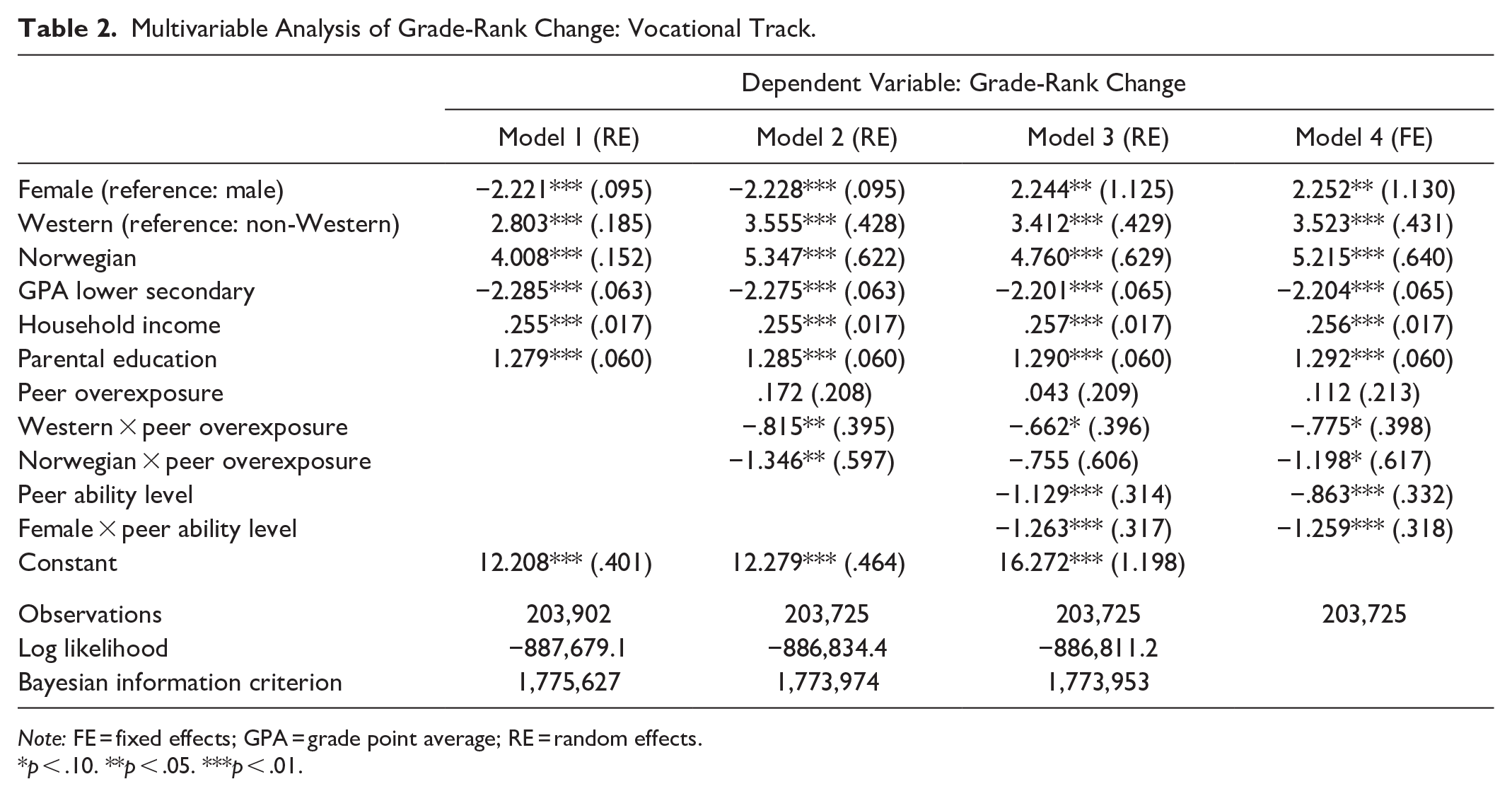
Analyses are presented in two separate tables: one for vocational-track students (Table 2) and one for academic-track students (Table 3). For both analyses, models 1 to 3 include RE estimates, and model 4 includes FE estimates. Model 1 includes estimates for demographic factors, GPA from lower secondary school, socioeconomic background, and cohort dummies added as controls. Model 2 introduces the critical cross-level interaction between own-group overexposure (segregation) and individual country-background dummies. In model 3, peer ability level interacted with gender is incorporated. Model 4 presents the comparable FE estimates. The presence of track-specific analyses as well as several interaction terms complicates the intuitive interpretation and comparability of some coefficients. To enhance clarity, I provide and discuss plots of predicted probabilities relevant to the proposed hypotheses in a separate section below.
Multivariable Analysis of Grade-Rank Change: Vocational Track.
Note: FE = fixed effects; GPA = grade point average; RE = random effects.
p < .10. **p < .05. ***p < .01.
Multivariable Analysis of Grade-Rank Change: Academic Track.

Note: FE = fixed effects; GPA = grade point average; RE = random effects.
p < .10. **p < .05. ***p < .01.
Overall, the RE and FE estimates for both track-specific analyses are closely aligned. Given the negligible difference between the FE and RE estimates, school-level unobserved heterogeneity likely does not substantially affect the model outcomes. Therefore, and because of the ability to exploit the variation across school-track units, the RE estimates are considered reliable for the analyses and are the main focus of attention when interpreting the results
Table 2 contains the estimates for vocational-track students. In models 1 and 2, the effect of being female is negative. Thus, after controlling for demographic factors, socioeconomic background, cohort, and GPA from lower secondary school, girls show less grade-rank improvement than boys. This effect is significant across all four models, although it becomes less interpretable in models 3 and 4 because of the inclusion of gender and peer ability interactions. Model 1 also reveals that students from Western countries and Norway improve their grades substantially more than students of non-Western origin. However, the effect of country background in models 2 through 4 is not directly comparable with model 1 because of interaction terms with peer overexposure. As expected, GPA from lower secondary school have a significant and negative effect on grade-rank improvement. The effects of household income and parental education are significant and positive across all four models.
In model 2, the critical cross-level interaction between own-group overexposure and country background are introduced. Interestingly, none of the coefficients are significant at the 1 percent level. After including peer ability in model 3 (RE), own-group overexposure indicates negative effects significant at the 5 percent level for students of Western origin. These effects are elaborated on and compared further in Figure 1.

Predicted grade-rank change and own-group overexposure: vocational track.
Models 3 (RE) and 4 (FE) add peer ability and its interaction with gender. Overall, the effect of peer ability is negative, but more so for girls. This suggests that having high-ability peers is associated with a negative change in grade rank for vocational-track students.
Table 3 contains the estimates for academic-track students. Interestingly, the effect of being female is here positive. Thus, contrasting vocational track girls, academic track girls improve their grade ranking more than boys. The gender effect is significant across all four models but less interpretable in models 3 and 4 because of the inclusion of gender and peer ability interaction. Notably, country background seems less important for grade-rank change for academic-track students than for vocational-track students. Even so, models 1 and 2 indicates that students of Western and Norwegian backgrounds improve their grades more than non-Western students. Lower secondary GPA has a significantly negative effect on grade-rank change. Parental income has a weak but significant negative effect on grade-rank change, while the effect of parental education is positive and substantial.
In model 2, school-level segregation is added. Aligning with the results from vocational-track students, school segregation seems to be of little importance for grade-rank change. There is, however, a weak positive effect of own-group overexposure for students of Western background significant at the 5 percent level in models 3 and 4. This effect are scrutinized in more detail in Figure 2.
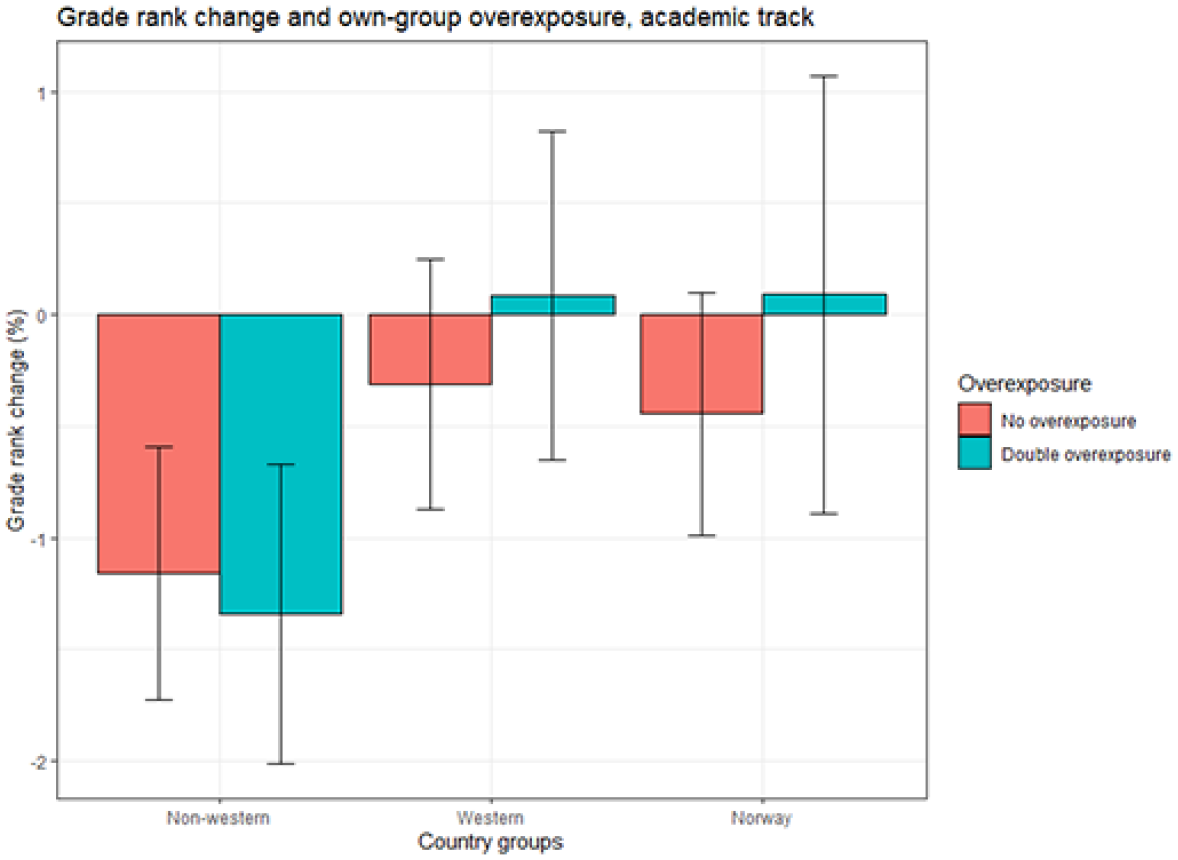
Predicted grade-rank change and own-group overexposure: academic track.
As for vocational track, the overall effect of peer ability level is negative. Thus, the higher the ability of peer students, the more negative changes in grade rank. Notably, the negative peer ability effect is much stronger for girls.
School segregation and grade-rank change
Figure 1 visualizes the key cross-level interactions between own-group overexposure (segregation) and country background for vocational-track students. Overexposure is defined using two values: 1 (no overexposure) and 2 (double overexposure). This allows a comparison between schools where students are either equally or twice as likely to encounter peers of the same origin as in their municipality. The first condition is close to the average for students of Norwegian background, while the second, though less common, applied to 20 school-track units in 2020. The predictions focus on boys with average grades from lower secondary school who completed upper secondary education in 2020, with parental education, income, and peer ability levels held at their mean values.
On the basis of theory and relevant literature, hypothesis 1 predicted that after controlling for peer ability, ethnic segregation would have no separate effect on grade-rank change. Consistent with this, overexposure to one’s own country group appears to have little impact on grade-rank change among vocational-track students. Estimates from Table 2 indicated a negative but borderline significant effect of own-group overexposure for students of Western origin. However, the visual comparison of students who are highly overexposed to their own group with those who are not overexposed reveals only minimal differences, suggesting that country-background segregation has a negligible effect.
Figure 2 presents comparable predictions for academic-track students. Compared with vocational-track students, academic-track students generally experience a less positive grade-rank change. In partial alignment with hypothesis 1, the effects of country-background segregation appear trivial for academic-track students as well. The only significant finding is a positive effect of own-group overexposure for Western students (Table 3). However, when comparing predicted grade-rank changes in Figure 2 between highly and nonsegregated students, segregation effects remain minor for academic-track students.
Peer Ability Level and Grade-Rank Change
Figure 3 illustrates the cross-level interactions between gender and peer ability levels for vocational-track students attending schools with either very low (5th decile) or very high (95th decile) peer ability levels. The predictions focus on students of Norwegian background with average lower secondary school grades who completed upper secondary education in 2020. Parental education, income, and peer ability levels are held at their mean values.

Predicted grade-rank changes and peer ability levels for vocational track boys versus girls.
Two competing hypotheses were formulated regarding the effects of peer ability. Hypothesis 3, based on the normative model, predicted that higher peer ability levels would positively affect grade-rank change, particularly for boys. Conversely, hypothesis 4, based on the frog pond theory, posited that lower peer ability levels would lead to higher grade-rank improvements, especially for girls. The findings support hypothesis 4: both boys and girls in vocational tracks improve their grades more when attending schools with low peer ability levels than when attending schools with high peer ability levels. However, this effect is more pronounced for girls. Boys in low peer ability vocational tracks improve their grade rank by 8.5 percentile points, compared with 6.9 percentile points in high peer ability schools. For girls, the improvement is 6.4 percentile points in low-ability schools but only 3.0 percentile points in high-ability schools. These findings provide empirical support for the frog pond theory within vocational tracks.
Figure 4 presents comparable predictions for academic-track students. Overall, a negative relationship emerges between peer ability and grade-rank change. Girls experience the strongest positive grade-rank improvement when attending schools with low peer ability levels, further supporting H4 and the frog pond theory. Academic-track girls in low-ability schools improve their grade rank by 7.7 percentile points, whereas boys improve by only 0.9 percentile points. Conversely, girls in high-ability schools experience a grade-rank decline of −1.8 percentile points, while boys experience a reduction of −1.9 percentile points. These findings indicate that peer ability has a substantially greater impact on grade-rank change for academic-track girls than for boys.

Predicted grade-rank changes and peer ability levels for academic track boys versus girls.
Comparing overall gender differences in Figures 3 and 4 reveals distinct patterns: girls improve their grade rank more than boys within academic tracks, while boys outperform girls in vocational tracks. This supports hypothesis 2, which posited a positive grade-rank change difference favoring girls in academic tracks and a negative difference favoring boys in vocational tracks.
Sensitivity Analyses
The main analyses confirmed that peer ability level, or the composition of student skills, is an important factor for grade-rank change. However, the mechanisms behind the school-level effects are not firmly established. Could the observed strong positive effect of attending an academic track with low-achieving peers be attributed to students selecting different study subjects? Is grade-rank improvement primarily a result of gifted students enrolling in more demanding subjects, where good grades are harder to achieve?
To explore whether this is the underlying factor driving the peer ability effect, additional analyses were conducted, focusing on grades and grade ranks from specific common subjects that are mandatory for academic track upper secondary students and follow a standardized national curriculum. These subjects are Norwegian and English. It is expected that Norwegian grades, in particular, will be sensitive to the country background composition of the peer group. Vocational tracks were excluded from this analysis, as they follow a different curriculum with other requirements.
The estimates from the regression analysis are presented in Table A1 in the Appendix, with the most noteworthy results plotted later for comparison.
Table A1 shows that own-group overexposure has a significant positive effect on grade-rank improvement for students of Western and Norwegian origin, while the effect for non-Western students is negative. This suggests that, when focusing on language, particularly Norwegian, the country of origin of peers appears to play a role. Even so, Figure 5 reveals a relatively modest impact of even high levels of student segregation

Predicted grade-rank change and own-group overexposure for Norwegian and English in academic tracks.
Figure 6 presents the predicted grade-rank change for academic-track students in Norwegian and English, disaggregated by gender and schools with very low (5th decile) or very high (95th decile) peer ability levels. Similar to the main analyses for both academic and vocational-track students, the effect of peer ability level is significantly negative, indicating that the lower the peer ability level, the greater the improvement in grade ranks in Norwegian and English. Furthermore, consistent with the main academic-track analysis in Table 3, Figure 6 shows that girls experience a particularly strong positive effect from attending schools with very low intake levels. This cross-level interaction is much less pronounced for boys. 3 Thus, when focusing on academic tracks and subjects where girls traditionally outperform boys, peer ability level is considerably more impactful for girls than for boys.

Predicted grade-rank changes and peer ability levels for boys versus girls in Norwegian and English subjects within academic tracks.
Conclusions
Analyzing the influence of peers on grade-rank change contributes to an extensive body of literature on the importance of peers in school performance. The focus on grade-rank change, however, shifts attention to slightly different processes than those typically examined in studies of school achievement and attainment. By concentrating on change, the study inherently focuses on factors that either promote or hinder learning. This approach sheds new and potentially surprising light on peer group effects in upper secondary education. The peer effects examined in this study, such as the impact of ability composition and ethnic segregation on academic outcomes, are fundamental social mechanisms that apply across various educational systems. Thus, although the study is set within a small Nordic social democracy, the findings should be relevant to a broader international audience.
The first hypothesis predicted no independent country segregation effect when peer ability level was taken into account. This hypothesis did not receive unconditional support in the analyses. In the main analyses, and after controlling for peer ability, segregation on the basis of country of origin was found to have little impact on grade-rank change. However, when focusing on standardized subjects that require mastery of the Norwegian language, non-Western students tended to do slightly worse if surrounded by peers with the same background. For Western and Norwegian-background students, the effect pointed in the opposite direction.
Overall, and in line with hypothesis two, girls improve more than boys in the theoretical subjects found in academic tracks, while boys improve more in less theoretical subjects found in vocational tracks.
Consistent with international research, peer ability level plays a crucial role in grade-rank change. Interestingly, for both vocational- and academic-track students, this effect contradicts the expectations of the normative model. Grade-rank improvement is significantly stronger in schools with lower peer ability levels, aligning with the predictions of the frog pond model and the fourth hypothesis. This was particularly prominent for girls following academic tracks. This trend persisted and was reinforced when considering standardized subjects, indicating that the results are not influenced by subject choice.
How can the strong negative effect of peer abilities within academic tracks be interpreted? Borgen et al. (2022) observed that mechanisms related to the normative model and the frog pond model coexist. One tentative explanation is that frog pond effects are stronger within academic tracks than vocational tracks, which is reasonable given that academic tracks are often stepping stones for further education. This is particularly pertinent within high-prestige and highly competitive academic-track schools, where grade deflation might be an issue. These are mere speculations that require further empirical scrutiny.
There are other notable findings. The overall positive effect of following a vocational track is in line with previous findings (Grøgaard and Arnesen 2016), but perhaps not directly relevant for future educational prospects. Vocational-track students typically do not compete with academic-track students for the same jobs or higher education slots. However, an interesting exception is vocational-track students completing a supplementary year that qualifies them for higher education. This option has become more popular recently and currently accounts for more than 20 percent of vocational-track students. With this alternative in mind, a vocational-track student might compete for the same higher education slots as some academic-track students.
These results have interesting and perhaps surprising implications. For a female student with mediocre results from lower secondary school pursuing higher education, it is rational to choose a “bad” academic-track school if grade improvement is the primary concern. This approach disregards the potential discrepancy between grades and learning outcomes (Borgen 2022; Crosnoe 2009; Jonsson and Mood 2008). For traditional vocational students, peer ability level is less important; the vocational track seems beneficial regardless of peer abilities.
Overall, segregation on the basis of country of origin is less important for grade-rank improvement than peer ability level. Even so, students of non-Western origin benefit from not being overexposed to their own group. This is especially relevant for academic track standardized subjects, which is perhaps unsurprising, as learning a subject such as Norwegian depends on the students’ proficiency in the language.
A precautionary policy approach would be to avoid strong ethnic segregation in schools. However, the benefits of this approach, particularly regarding grade-rank improvement for ethnic minorities, may not be as significant as expected. Ethnic segregation often coincides with other forms of segregation, such as those related to socioeconomic status and class background. These factors can contribute to low intake grades, which, as we have seen, might be beneficial for grade-rank improvement. Therefore, for students of non-Western origin, it may be challenging to achieve the positive effects of attending schools with low intake grades while simultaneously avoiding the negative impacts of segregation.
Limitations
Although the findings of this study provide valuable insights, several limitations must be considered when interpreting the results.
First, the primary outcome variable in this study, grade-rank change, is a relative measure that captures individual academic growth or decline within a cohort, rather than absolute performance. Although this metric is valuable for understanding academic progression, it may have limited direct relevance to broader outcomes such as labor market placement or long-term career success. Therefore, the implications of grade-rank change for posteducational outcomes should be interpreted with caution.
Second, the exclusion of early school leavers from the analysis introduces a potential bias. As the analytical population includes only students who completed upper secondary school, there is a risk for selection bias if dropout is systematically related to peer ability. If students exposed to higher peer ability are more likely to drop out, the analytical population may underrepresent those negatively affected by being ranked low. This would imply that the observed effect—that students improve their rank more when surrounded by lower ability peers—is conservative and that the true effect could be even stronger than estimated. Conversely, if students exposed to higher peer ability are less likely to drop out, the effect might be overstated. However, on the basis of empirical support for the frog pond theory, the former scenario appears more plausible.
Furthermore, early school leaving is more prevalent among students enrolled in vocational tracks. Although only 9 percent of academic-track students fail to complete upper secondary school within 5 to 6 years, the dropout rate among vocational-track students is significantly higher, at 19 percent.
Table A2 compares dropouts and nondropouts across several observable characteristics, while Table A3 presents linear probability analyses of dropout risk for the two tracks separately. As expected, dropouts tend to come from lower socioeconomic status families and have lower GPAs than their peers who complete upper secondary school. Interestingly, however, these socioeconomic and academic disadvantages are more strongly associated with dropout risk in the academic track than in the vocational track. This suggests that differences in grade-rank changes are unlikely to introduce greater bias in the vocational track estimates compared with the academic track estimates.
Footnotes
Appendix
Linear Probability Models on Risk for Dropout From Vocational and Academic Tracks (N = 669 363).

| Dependent Variable: Dropout From Upper Secondary School | ||||
|---|---|---|---|---|
| Academic Tracks | Vocational Tracks | |||
| Coefficient | β | Coefficient | β | |
| Female (reference: male) | .009*** (.007) | .019 | .0469*** (.001) | .0625 |
| Western (reference: non-Western) | .018*** (.001) | .028 | −.001 (.003) | −.001 |
| Norwegian | .022*** (.001) | .044 | −.001 (.002) | −.001 |
| GPA lower secondary | −.094*** (.005) | −.286 | −.065*** (.001) | −.138 |
| Household income | −.002*** (.000) | −.0249 | −.002*** (.000) | −.018 |
| Parental education | −.000 (.000) | −.000 | −.004 (.001) | −.001 |
| Constant | .458*** (.002) | .369*** (.004) | ||
| Observations | 415,968 | 253,395 | ||
| F | 6,225.31 | 962.96 | ||
| R 2 | .082 | .022 | ||
Note: Values in parentheses are standard errors. Standardized coefficients (β values) are listed in separate columns. GPA = grade point average.
p < .01.
Funding
The author disclosed receipt of the following financial support for the research, authorship, and/or publication of this article: This work was supported by the Research Council of Norway (grant 324718).
Data Availability Statement
The data that support the findings of this study are available from Statistics Norway. Restrictions apply to the availability of these data, which were used under license for this study.
1
An alternative specification of ethnic peer composition could be immigrant shares. Although immigrant share is an important indicator for understanding peer influence, segregation offers a more precise measure of social division and cohesion, as it reflects actual patterns of group interaction rather than simply the composition of populations. For example, identical immigrant shares in different cities may indicate vastly different levels of integration or segregation, highlighting that immigrant share and segregation capture distinct but complementary aspects of social dynamics.
2
The Hausman specification test is sensitive to the statistical power of an analysis ( ). In this case, running analyses on large-scale population data, the test will most likely reject the RE specification irrespective of the correlation or lack thereof between predictors and units. Instead, estimates from the two models have been compared and assessed individually.
3
Peer ability level is not significant for boys in the FE specification.