



Abstract
This paper investigates the effect of attending immigrant-dense schools on student outcomes, which consists of the joint effect of immigrant peers and school context. The sorting of students into schools is not random, and a large immigrant peer effect literature uses school fixed effects to eliminate selection bias. However, keeping schools fixed also eliminates the effect of the school context and is accordingly unsuited to estimate the total effect of attending immigrant-dense schools. By using both a value-added approach and by drawing on application data to manage selection bias, this paper demonstrates that attending immigrant-dense upper secondary schools in Norway increases student dropout, even though a school fixed effects model indicates no detectable immigrant peer effects. These findings suggest that immigrant-dense schools affect students in other ways than through mere peer exposure, and that research on the consequences of school segregation should take into account the effect of both school context and peers.
Keywords
Introduction
A massive increase in migration to affluent Western European countries over the last decades has introduced new lines of social stratification (Heath et al., 2008). One strand of research that studies stratification along ethnic lines concerns the role of school segregation, meaning that students from different racial, ethnic, or socioeconomic backgrounds attend different schools (Coleman et al., 1966; Owens, 2019). A large literature has provided sound evidence on how peer composition affects student outcomes (peer effects) (Sacerdote, 2011), which is essential to understand the consequences of school segregation. However, immigrant school segregation could affect students’ educational achievements via both the composition of the peer group and the contextual settings at segregated schools, such as teacher quality and school resources (Coleman et al. 1966). Compared to peer effects, the evidence on the impact of contextual differences between segregated schools is considerably more limited (Reardon and Owens, 2014).
The heavy emphasis on peer effects in the school segregation literature may be partly a legacy of the Coleman report, which concludes that “the social composition of the student body is more highly related to achievement, independent of the student's own social background, than is any school factor” (Coleman et al., 1966, p. 325). Additionally, the development of the counterfactual model of causality in the 1970s and onward (Morgan and Winship, 2014), improvements in data availability (Einav and Levin, 2014) and computational efficiency (Cioffi-Revilla, 2017), and the novel use of school fixed effects models (Hoxby, 2000) may have nudged the literature towards estimating peer effects.
The school fixed effects approach has become popular because it removes or at least alleviates selection bias. Students in different schools may be systematically different on unobserved characteristics, known as the selection problem (Hoxby, 2000). By including school fixed effects, one compares subsequent cohorts of students who attend the same school. However, by comparing students within the same school, the fixed effects research design disregards the potential effects of contextual differences between schools. Thus, the widespread use of school fixed effects has provided us with extensive literature that credible estimates of immigrant peer effects (e.g. Conger, 2015; Fletcher et al., 2021; Hardoy et al., 2018; Hermansen and Birkelund, 2015). In contrast, the total effect of attending schools with different peer compositions remains underinvestigated.
This paper reintroduces the idea that immigrant school segregation may affect students’ educational outcomes beyond peer effects and uses methods that allow for credible estimation of the effects of attending immigrant-dense schools (effects of peers and school traits in total). Using high-quality population-wide Norwegian administrative data, I examine whether attending immigrant-dense schools influences students’ likelihood of completing upper secondary school. An application fixed effects strategy is used to address the selection problem without discarding the effect of school traits. While school fixed effects manage selection by comparing students who attend the same school, the application fixed effects strategy compares students who apply to the same school but are admitted to different schools.
While U.S. school segregation research has mainly, but not exclusively, focused on black–white segregation (Reardon and Owens, 2014), a comprehensive immigrant school segregation literature has emerged in Europe (e.g. Brunello and De Paola, 2017). Unlike the segregation literature that measures immigrant school segregation as deviations from an even distribution of immigrants across schools, this paper relates to the literature that measures school segregation by the makeup of students and estimates effects of the proportion of immigrant peers (Owens, 2019). Thus, I ask whether a student's likelihood of completion would have been different had the student attended a school with a different immigrant density, not whether the likelihood of completion had been different if all immigrants were distributed equally across schools.
This paper argues that immigrant school segregation may conceptually play a role in social stratification even in the absence of detectable immigrant peer effects. 1 It highlights that students who attend immigrant-dense schools may be offered systematically different chances of succeeding in education than students in other schools.
Theory
Attending immigrant-dense schools may affect students through interactions with immigrant peers and via school characteristics correlated with immigrant proportion, such as teacher quality, curriculum, and facilities (Reardon and Owens, 2014).
Immigrant peer effects
The scientific literature on peer effects is large (Sacerdote, 2011) and reaches back to the 1960s (Duncan et al., 1968). Peer effects arise from a complex process where various mechanisms are at odds with one another and where the influence of peers on academic outcomes is a composite of different mechanisms (Borgen et al., 2023). To begin, the normative model of peer effects argues that students are affected by their peers’ achievement levels as high-achieving peers make for a learning-oriented peer culture (Goldsmith, 2011; Jencks and Mayer, 1990; Legewie and DiPrete, 2012). Immigrants are a heterogeneous group with widely different educational performances; however, immigrants perform on average lower than natives in most OECD countries (OECD, 2010). Thus, according to the normative model of peer effects, one could expect on average adverse spillover effects of immigrant peers.
By itself, the normative model might give a too simplistic view of peer effects. According to the so-called “frog pond” perspective, students evaluate themselves relative to their peer group (Crosnoe, 2009; Jonsson and Mood, 2008). Students may gain academic self-confidence and educational aspirations by standing out among their peers (Rosenqvist, 2018). Since immigrants have lower average achievement levels, having immigrant peers may positively affect student achievements (Crosnoe, 2009; Goldsmith, 2011).
Another mechanism through which immigrant peers might affect students is by so-called congestion effects (Lazear, 2001). Immigrants often have poorer language proficiency (Espenshade and Fu, 1997) and more behavioral problems than their native counterparts, perhaps because they have experienced trauma and distress (Caspi et al., 2002, Hällsten et al., 2013). These characteristics may cause teachers to spend more time on discipline and less time teaching (De Bruyn et al., 2003; McCoach and Siegle, 2001), thereby harming students’ educational achievements (Fletcher, 2010). At the same time, immigrants tend to have higher educational aspirations than their native counterparts (Jonsson and Rudolphi, 2011; OECD, 2010), show more positive attitudes toward school, and spend more time doing homework (Lauglo, 1999). This “immigrant drive” (Portes and Rumbaut, 2001) leads us to expect the opposite of congestion effects; having more immigrant peers may create a better learning environment and positively affect students’ achievements.
Furthermore, peers’ parents constitute a part of students’ networks that provides informal knowledge on how to achieve educational success. The benefit of this parental network may decline when it includes many immigrant parents with limited informal knowledge (Conger, 2015). On the other hand, many immigrants have parents who aspire for their educational careers, situating them to perform academically (Kao and Tienda, 1995). A strong community of aspiring parents can reinforce teachers’ efforts to make students work hard (Coleman and Hoffer, 1987) and, consequently, positively influence their children's peers’ educational outcomes.
Schools that host immigrant students
The school context of immigrant-dense schools may differ systematically from other schools in ways that may affect students’ achievements. Such contextual differences could occur either if immigrants typically sort into schools with certain traits or if schools become different due to hosting immigrant students. First, studies have suggested that schools with a high share of immigrant students may have lower quality (Jennings et al., 2015). Students in immigrant-dense schools may receive inferior schooling in terms of curriculum, time spent on curriculum, facilities, and information on their own achievements (Gandara et al., 2003). Furthermore, teaching traditions may be systematically different in immigrant-dense schools than in other schools (Cebolla-Boado and Garrido Medina, 2011). Additionally, teacher effectiveness, which influences students’ educational outcomes (Hanushek et al., 2004), is considerably lower in schools that serve poor and minority students (Peske and Haycock, 2006). Schools that host many immigrant students are more likely to struggle with inexperienced teachers and teacher attrition and are accordingly at higher risk of offering low-quality teaching than other schools (Karsten et al., 2006; OECD, 2010).
Second—and contradictory to the first point—the sizeable native-immigrant performance gap has spurred a range of policy initiatives that pour extra resources into immigrant-dense schools (OECD, 2010). These initiatives may compensate for, or even outweigh, the potential challenges related to teacher attrition and teaching quality.
Finally, schools that differ in immigrant share may vary with respect to the characteristics of the native student body. Immigrants tend to be overrepresented in socioeconomically disadvantaged schools (Jean et al., 2007), which means that students in immigrant-dense schools are likely to have socioeconomically disadvantaged native peers as well as immigrant peers. Attending schools with socioeconomically disadvantaged peers has been shown to have adverse effects on individual academic performance (Cebolla-Boado and Garrido Medina, 2011; Legewie and DiPrete, 2012; Portes and MacLeod, 1996). Thus, attending an immigrant-dense school may affect student outcomes not only because of immigrant peer effects but also through peer effects stemming from disadvantaged native peers. 2
Previous research
There is a large empirical literature aiming at isolating immigrant peer effects; a literature that has found mixed effects. However, one should keep in mind that while the mechanisms producing peer effects may be universal in theory, contexts of investigation may differ and both facilitate and hamper the potential of these mechanisms playing out.
Some research finds negative immigrant peer effects on educational outcomes, including in Sweden (Szulkin and Jonsson, 2007), Israel (Gould et al., 2009), Italy (Ballatore et al., 2018), Austria (Schneeweis, 2015), and the Netherlands (Veerman et al., 2013). Other studies find no or even positive immigrant peer effects. Ohinata and Van Ours (2013) find no spillover immigrant peer effects on natives in Dutch schools; Geay et al. (2013) find no peer effects of non-English-speaking students in the United Kingdom; and Brandén et al. (2018) find mixed—albeit modest—immigrant peer effects in Sweden. Silveira et al. (2019) find that both immigrant and nonimmigrant students benefit from more immigration by investigating cross-national data from 41 high-income countries. An overall conclusion of immigrant peer effects requires close consideration of context, outcome, and methods of peer effect studies. Brunello and De Paola (2017) provide a detailed review of this literature and conclude that while the findings from Europe are mixed, the share of immigrant peers in class or school generally seems to have adverse effects on students, and more so on immigrants than native students.
In the Norwegian setting, Hermansen and Birkelund (2015) find no immigrant peer effects on short-term educational outcomes in lower secondary school and modest positive immigrant peer effects on long-term outcomes. Hardoy and Schøne (2013) find negative immigrant peer effects in upper secondary schools, but these findings are rebutted by Hardoy et al. (2018), who find no immigrant peer effects. Borgen (2022) finds positive immigrant peer effects on standardized test scores for low achievers. Thus, research on the Norwegian context has given somewhat mixed answers. Still, the overall tendency seems to be that exposure to immigrant peers has a positive, if any, effect on student outcomes.
Like peer effects, there is a vast literature on the effect of school characteristics such as school resources and teacher quality on student outcomes (e.g. Darling-Hammond, 2000; Jackson et al., 2016; Morgan and Shackelford, 2018). Thus, if one is concerned with research questions defining the effect of peers, school quality, or school resources as the relevant estimand, the literature provides a well of evidence. However, this is not the case when the estimand is the effect of attending immigrant-dense schools on student outcomes; research on the consequences of school segregation, considering both peer effects and contextual differences between schools, is scarce (Raitano and Vona, 2010; Reardon and Owens, 2014), at least when considering studies that credibly takes into account sorting across schools. Cebolla-Boado and Garrido Medina (2011) do consider school effects in the Spanish context and find negative effects of the immigrant share, which differences in school resources cannot explain. In the Norwegian context, Fekjær and Birkelund (2007) found no effect of the immigrant share at upper secondary school on the likelihood of continuation into higher education. However, the estimates were not adjusted for students’ sorting across schools other than on observed characteristics. Borgen (2022) uses a value-added approach to handle sorting across schools and finds positive effects of attending immigrant-dense lower secondary schools on teacher-assigned grades for high-achievers, and positive effects on national test scores for low-achievers.
Norway as a case
Norway is comparable to other wealthy, European host countries with regard to migrant inflows (OECD, 2020). The proportion of immigrants and children of immigrants has increased rapidly over recent decades, from 1.5% in 1970 to 17.7% in 2019 (Statistics Norway, 2000, 2019a).
The Norwegian educational system consists of three main levels: compulsory education (ages 6–15), upper secondary education (ages 16–19), and higher education. Every student who completes compulsory education is entitled by law to upper secondary education (Education Act, 1998), and the vast majority, 92.8% of all those aged 16–18 years in 2019, attend upper secondary school (Statistics Norway, 2019b). Students enroll in either an academic track (usually a three-year program), culminating in University and College Admission Certification, or a vocational track (usually a four-year program including an apprenticeship). 3
Contextual differences between Norwegian upper secondary schools are likely to be modest. Historically, social democratic ideas of equality and justice have substantially influenced school politics (Oftedal Telhaug et al., 2006). For instance, all upper secondary schools are publicly funded, most are publicly owned, and most do not charge tuition fees. As of 2017, 90.2% of students in academic programs and 95.5% in vocational programs attend public schools. 4 Moreover, although a school reform in 2006 gave local schools more freedom to define subject content and teaching methods, a centralized basic curriculum remains prescribed by the government (Oftedal Telhaug et al., 2006). The initial modest contextual differences between schools make Norway a conservative case for investigation, which should be considered in interpreting the effects of attending immigrant-dense schools.
There are, nevertheless, reasons to believe that upper secondary schools with high shares of immigrant students are systematically different from other schools. On the one side, there may be a risk of lower teacher quality, as teachers in Norway have been shown to prefer teaching at schools with native students and have a higher tendency to leave schools with high minority shares (Bonesrønning et al., 2005). However, teachers seem not to leave schools because of increasing shares of immigrant students (Mikalsen, 2021). On the other side, compensatory resource allocation across schools could reduce contextual differences between schools (Hægeland et al., 2005). For instance, extra resources may be allocated to provide language- and special tutoring. However, at least in Oslo, where the largest immigrant population is found, these additional resources are cut in half in upper secondary schools compared to compulsory education and may have a weaker compensatory effect in upper secondary schools (Deloitte, 2018).
The Norwegian upper secondary school application and admission regime have features that facilitate the use of application fixed effects, presented in detail below. Individuals usually apply for public upper secondary schools in one joint application addressed to their home county (Norwegian Directorate for Education and Training, 2018), where they rank their school and program preferences. Applicants usually compete for admission to their preferred schools and programs based on their grade point average (GPA) from lower secondary schools (Regulations to the Education Act, 2006) and receive an offer of admission only to the highest-ranked school and program preference for which their GPA suffices. That is, if the applicants’ GPA entitle them to admission to their first choice of school and program, they will not get an offer of admission to any of their lower-ranked choices. Consequently, students with similar school preferences and approximately similar GPA—characteristics that are likely to account for school selection—may be sent to different schools depending on whether their GPA suffice for outcompeting other applicants. 5
Methods
Data and sample
I use high-quality population-wide administrative data constructed by merging several administrative registers, which include information on all Norwegian residents since 1960 and information on their siblings, parents, and grandparents. The analysis sample contains those who enrolled in an academic upper secondary track the year they turn 16, between 2003 and 2010. Academic track programs include “general studies,” “sports and physical education,” and “music, dance, and drama,” which are the programs that have remained parts of the academic track throughout the time span of the data despite reforms of the upper secondary education (Report No. 030 (2003–2004) to the Storting, 2004). In line with previous research, the 7.37% who attend private schools, schools that admit fewer than ten students on average each year, and school cohorts with fewer than ten students are excluded from the sample because private schools and small schools are likely to be specialized or serve students with special needs (Hermansen and Birkelund, 2015). Further, immigrants in the remaining sample who arrive after school starting age are excluded (2.02%). Information on school applications exists for almost 96% of the remaining sample.
Measures
The outcome variable is completing upper secondary education, indicating 1 if the individuals are registered with a completed education within the nominal three years plus one year, and 0 otherwise. 6 The treatment variable is the individual's proportion of immigrant peers within the school program cohort (excluding the individual), measured at the beginning of upper secondary education. A peer is considered an immigrant if they are born abroad or has only foreign-born parents.
Individual controls include dummies for gender, family status (if the student lived in an intact or reconstituted family at age 16), residential relocation during compulsory education, country of origin, and immigrant category, as well as first-order terms for mother's age when giving birth, number of siblings, and birth order, and first- and second-order terms for GPA from lower secondary school. 7 Parental controls measured when the individual is aged 11–15 include first- and second-order terms for the sum of parents’ average annual earnings (ranked in percentiles within children's birth cohort) and a dummy for parental receipt of social welfare indicating whether the parents received total social welfare transfers above the monthly basic amount rate in one or more years. 8 Dummies indicate whether the highest education of the parents when the individual is aged 16 falls into either category: No registered education, basic compulsory education, upper secondary education, postsecondary education at the BA level, and postsecondary education at the MA level. Other controls include sets of dummies indicating the individual's lower secondary school, lower secondary school county, school cohort, and study program.
Table 1 shows descriptive statistics and a t-test of the difference between native and immigrant means. On average, immigrants have worse academic achievements (GPA) and lower socioeconomic status than natives (parents’ income, education, and social welfare transfers). However, there is a large heterogeneity among immigrants, for instance, according to their region of origin, as shown by online appendix A.
Descriptive statistics.
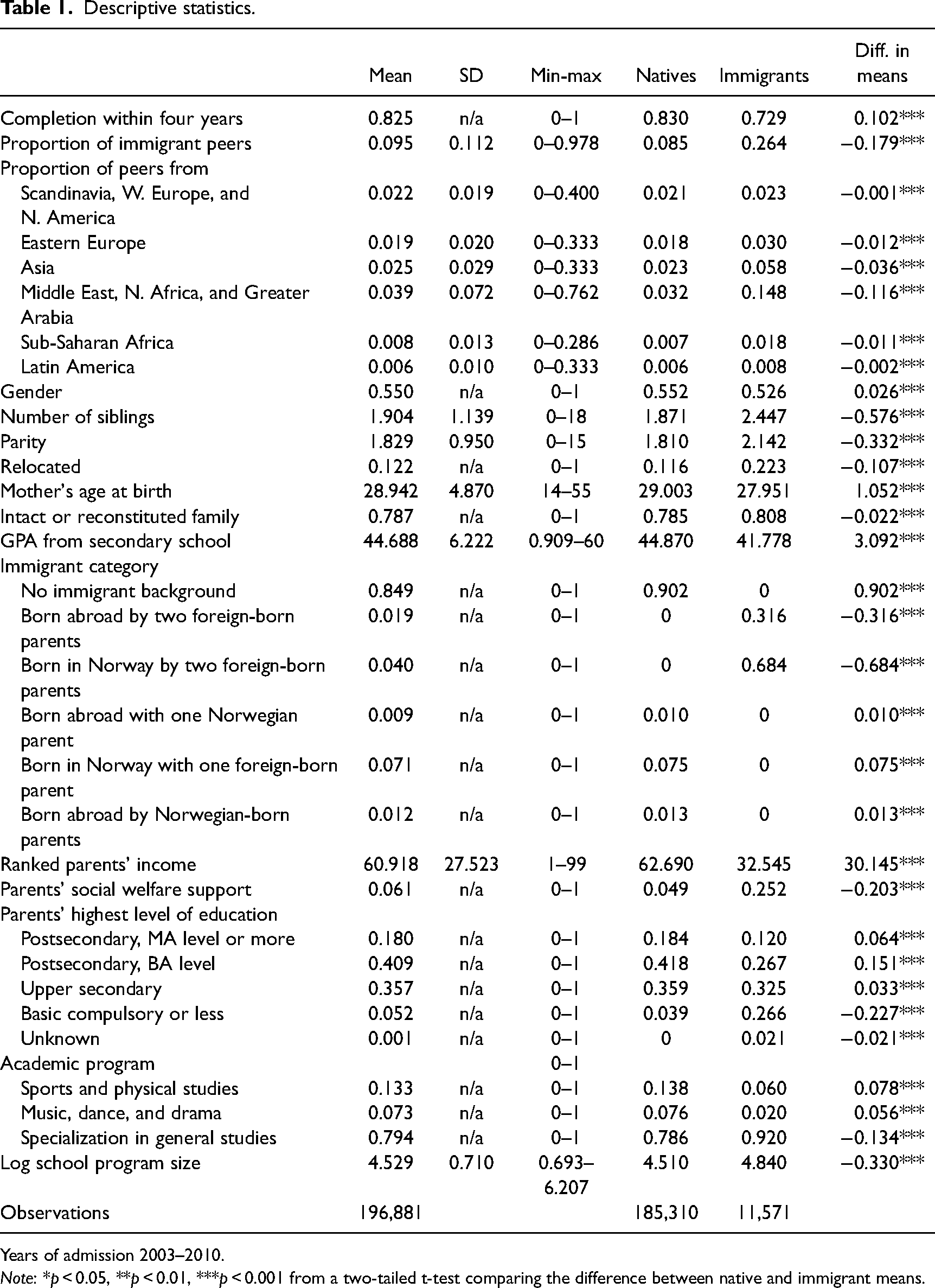
Years of admission 2003–2010.
Note: *p < 0.05, **p < 0.01, ***p < 0.001 from a two-tailed t-test comparing the difference between native and immigrant means.
Analytical strategies
Four linear probability models (i.e. OLS models) are estimated. The first model disregards potential confounding variables (controlling for cohorts and programs only)

Model 2 captures the effect of peers and school traits, as it compares students attending different schools. The inclusion of GPA from lower secondary school makes Model 2 resemble what is often referred to as a value-added model (VAM; Hanushek and Rivkin, 2010). 9 Studies have suggested that the potential selection bias is likely to be small in VAMs (Koedel et al., 2015).
Nevertheless, I use an application fixed effects strategy to further strengthen the design, which resembles how the seminal study by Dale and Krueger (2002) used application data in the higher education literature.
10
The application fixed effects model, Model 3, groups students in the same cohort who rank the same school and program first in their application list for upper secondary school. The general idea is that students reveal some of their otherwise unobserved characteristics, such as academic ambition, through their upper secondary education applications. Including application fixed effects may accordingly further alleviate confounding. Model 3 with application fixed effects can be written as follows:
In the fourth and final model, I include school-by-program fixed effects instead of the application fixed effects. This model compares students who attend the same school and program across cohorts while adjusting for prior academic achievements and other individual and parental characteristics. The school fixed effects model uses idiosyncratic variations in immigrant proportion over time within a school and program, making it well suited for estimating the causal effects of peers (Hoxby, 2000). The strategy also removes the effect of any time-invariant contextual differences between schools and programs. This makes the strategy unsuitable for investigating the effect of attending immigrant-dense schools, as these schools may differ not only concerning peer composition but also with regard to other contextual traits (Coleman et al., 1966; Reardon and Owens, 2014). The school fixed effects model can be written as
While a school-by-program fixed effects strategy compares students attending the same school and program combination, the application fixed effects strategy compares students who prefer to attend the same combination. Notwithstanding this key difference, the application fixed effects model may account for selection bias just as well as the school-by program fixed effects model; if students self-select into schools and programs based on unobserved characteristics, it seems plausible that students’ school preferences will take account of bias caused by self-selection in the same manner as students’ school attendance. 13
The merit of this paper lies in the combined insights that can be drawn from the third and fourth models. The school fixed effects model allows for isolating peer effects from other school characteristics, whereas the application fixed effects model allows for identifying the total effects of attending immigrant-dense schools (including peer effects). Thus, one may assess whether there is an effect of attending immigrant-dense schools apart from, or even in the absence of, detectable immigrant peer effects. However, the models rest on several underlying assumptions, and there are challenges related to both of them.
The main underlying assumption is that any unobserved student characteristics that correlate with immigrant share at the school and affect their likelihood of completion—thus potentially biasing the effect of the immigrant share—are kept constant within the fixed effects groups. One source of bias could be the student's travel distance to school. Data on the distance to school is unavailable as the schools are assigned an encrypted organizational number and thereby anonymized in the data. However, this concern is alleviated by including lower secondary school fixed effects, as enrollment in lower secondary schools is determined by local catchment areas and serves as a proxy for place of residence.
Further, since the school-by-program fixed effects utilize variation within a school program over time, the estimation strategy rests on the assumption that school characteristics that correlate with the immigrant share and affect completion are constant over the time period investigated. The concern for time trends is somewhat relieved by adding cohort fixed effects. In the application fixed effects model, on the other hand, the groups consist of individuals who apply within the same year, and varying time trends are of less concern.
There is also an underlying assumption of the application fixed effects model that completion is not affected by whether one is admitted to the top-ranked school and program or not. I have tested this assumption by including a dummy for whether one is admitted to the top-ranked choice or not. Online appendix E shows that including this dummy does not significantly alter the estimate.
A drawback of the application fixed effects approach is that it leaves students who apply for the least popular school and program combinations out of the estimation, which is presumably the very least ambitious students. The least popular school and program combinations have fewer applicants and are more likely to admit all applicants. Students who rank an unpopular combination at the top of their application will thus end up in fixed effects groups where all students are admitted to the same school and program, leading to variation in neither school context nor peers within these groups of students. Consequently, the application fixed effects results cannot be directly generalized to the least ambitious students.
Another potential challenge of using application fixed effects is variations in application and admission practices across counties and changes in these practices over time. For example, while counties normally allow students to apply for any school in the county, some counties restrict available schools to those within the local county region (The counties’ information service for applicants to upper secondary education and training, 2018). I manage potential bias from shifts and variations in admission regimes by utilizing only within-cohort variations and by controlling for lower secondary school county. Besides, evaluations of changes in admission practices have shown little change in applicants’ behavior (Lødding and Helland, 2007). Consequently, different practices across counties and time should not bias the estimates. However, practices that restrict the number of schools available for the students could reduce the estimates’ precision because such practices limit the number of students in each application group that attends different schools.
A final potential challenge worth mentioning is that the county may base up to 50% of admissions to the two programs “sports and physical studies” and “music, dance, and drama” on documented skills or admission tests, in addition to GPA (Regulations to the Education Act, 2006). In online appendix F, I test whether such additional admission criteria affect my main results by running the application fixed effects model on a sample of students who compete for admission to general studies only, where the competition is based purely on GPA. I find no significant differences between this analysis and the main analysis.
Results
Figure 1 shows the distribution of immigrant peers with vertical lines indicating the immigrant share at the 10th and 90th percentile, which is 0% and 20.5%, respectively.
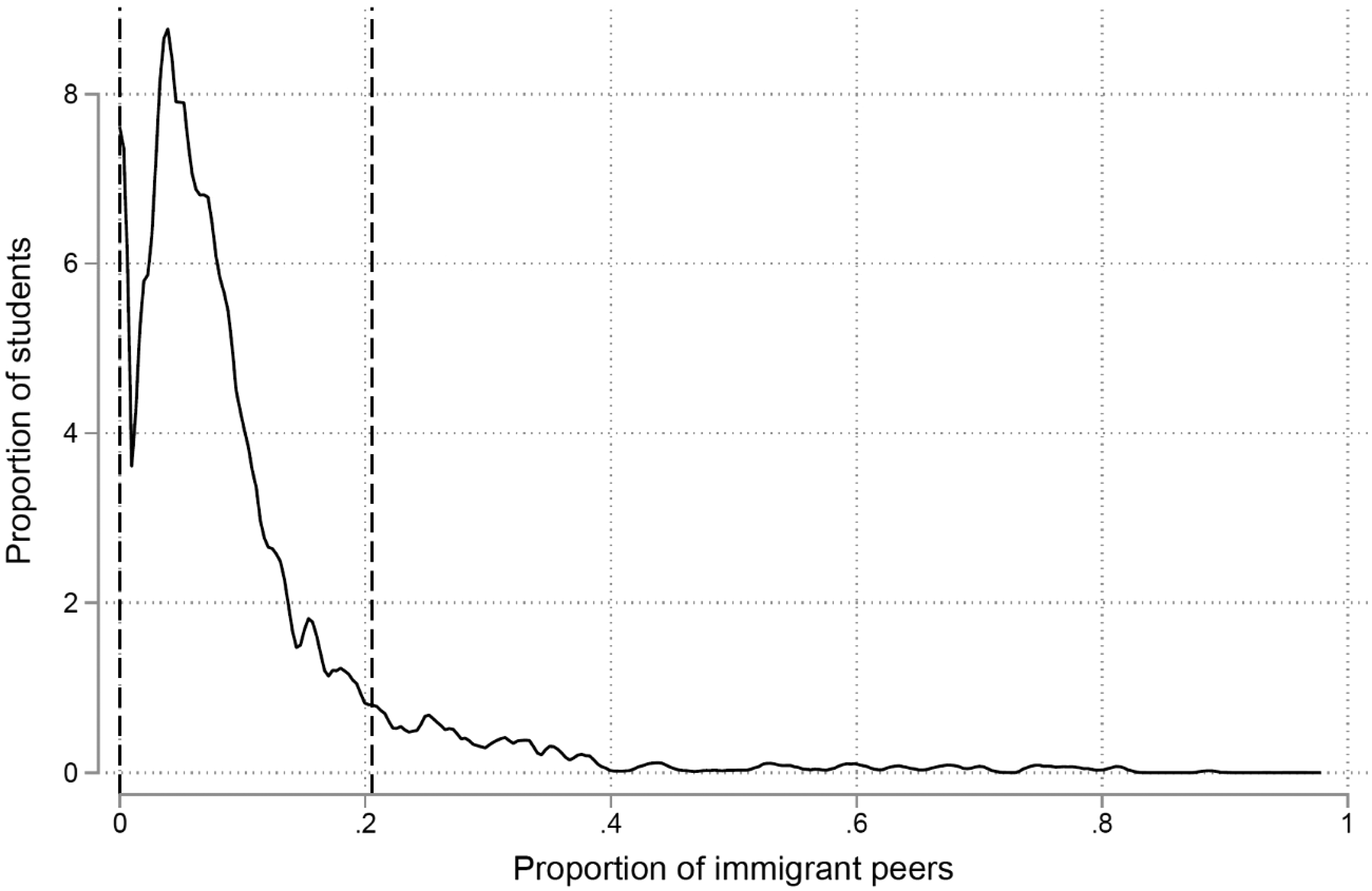
Proportion of students with different proportions of immigrant peers, separate for natives and immigrants.
The top row in Table 2 shows that, on average, immigrants account for 9.5% of students’ peers, with a standard deviation of 11.2. The fixed effect approaches utilize only the variation in immigrant proportion within each fixed effect group. The amount of utilized variation is expressed in Table 2 by the standard deviation of residuals from regressing the proportion of immigrants on each of the fixed effects specifications. Application fixed effects utilize more variation than school-by-program fixed effects, as the between-school standard deviation (0.047) is larger than the within-school standard deviation (0.036).
Immigrant proportion overall and within fixed effects groups.
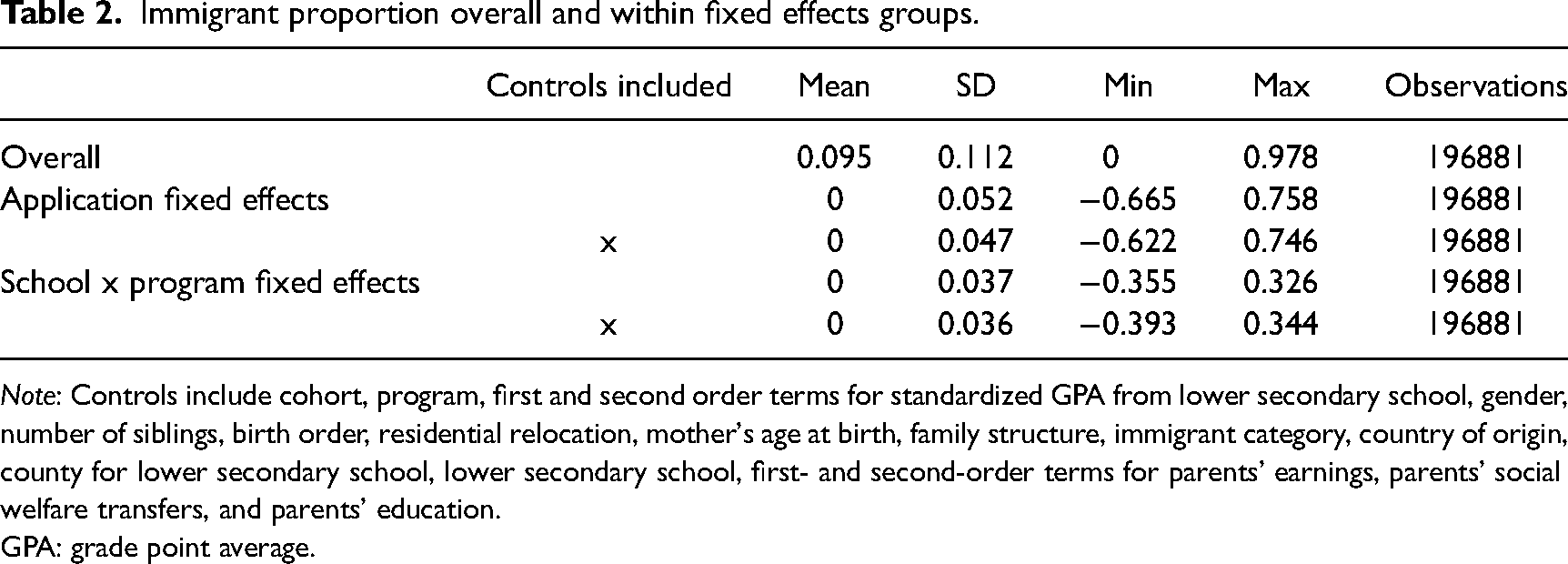
Note: Controls include cohort, program, first and second order terms for standardized GPA from lower secondary school, gender, number of siblings, birth order, residential relocation, mother's age at birth, family structure, immigrant category, country of origin, county for lower secondary school, lower secondary school, first- and second-order terms for parents’ earnings, parents’ social welfare transfers, and parents’ education.
GPA: grade point average.
Table 3 describes the different fixed effects groupings. As expected, there are more and smaller application groups than school-by-program groups. These preliminary results show a fair amount of variation in immigrant proportions within both school-by-program groups and application groups by which to identify potential effects.
Description of fixed effects groups.

Main analyses
Table 4 presents models estimating the effect of proportion of immigrant peers on completing an academic track in upper secondary school. The coefficients represent changes in completion when the share of immigrant peers changes from 0 to 1 (0 to 100%) and can be multiplied by about 0.2 to compare a range comparable to the 90th vs. the 10th percentile (see Figure 1). In a naïve model without any individual-level controls or fixed effects (Model 1), students at the 90th percentile have 4.7 percentage points lower likelihood of completion compared to students at the 10th percentile (−0.235*0.2).
Effects of proportion immigrant peers on completion of academic track.
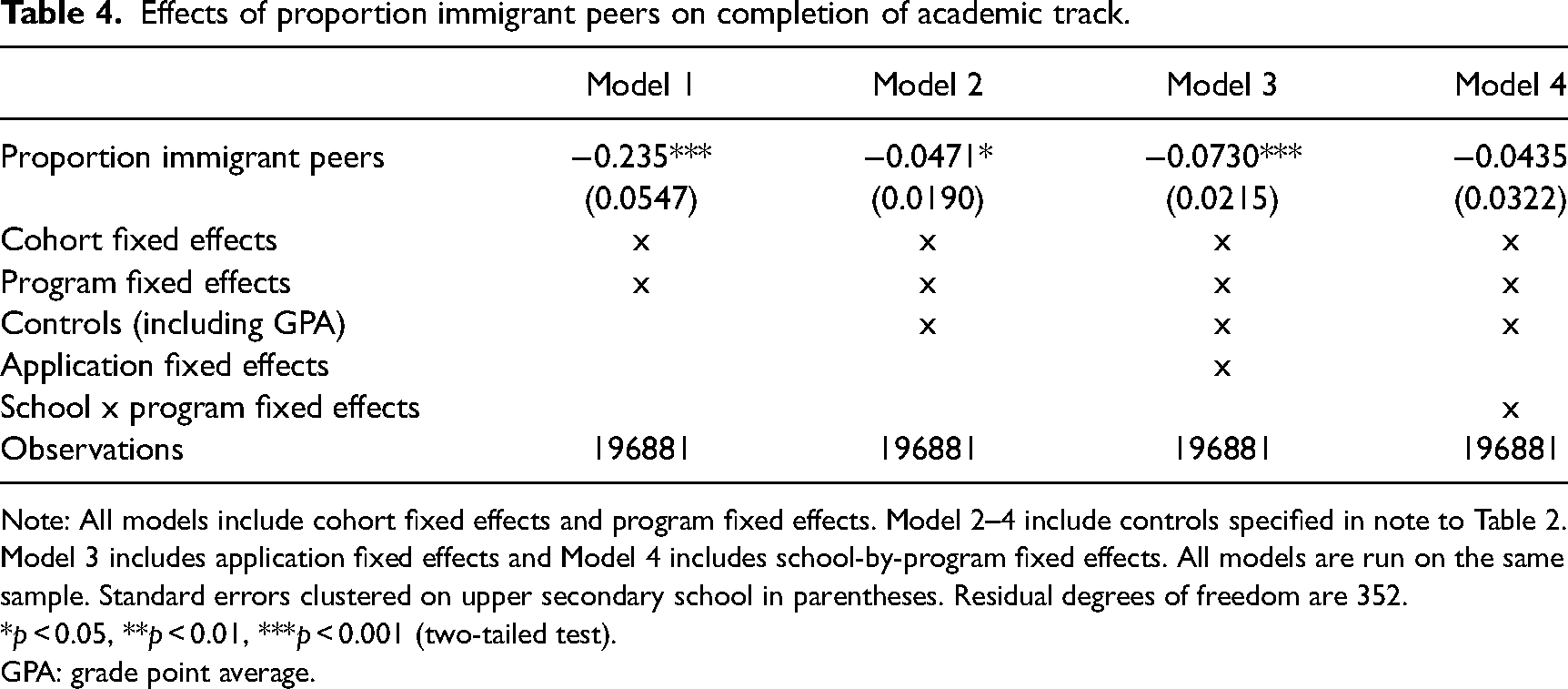
Note: All models include cohort fixed effects and program fixed effects. Model 2–4 include controls specified in note to Table 2. Model 3 includes application fixed effects and Model 4 includes school-by-program fixed effects. All models are run on the same sample. Standard errors clustered on upper secondary school in parentheses. Residual degrees of freedom are 352.
*p < 0.05, **p < 0.01, ***p < 0.001 (two-tailed test).
GPA: grade point average.
Including prior academic achievements and other individual and parental characteristics (Model 2) substantially reduces the effect size; the VAM indicates that students at the 90th percentile have close to 1 percentage point lower likelihood of completion compared to students at the 10th percentile (0.0471*0.2). Including application fixed effects on top of the value-added specification (Model 3) strengthens the effects somewhat, to 1.46 percentage points (0.073*0.2).
Model 4 identifies immigrant peer effects by including school-by-program fixed effects to the value-added specifications instead of the application fixed effects. Thus, it utilizes idiosyncratic variation in the proportion of immigrants across cohorts within each school and program and keeps the school context constant. The immigrant peer effects estimated by Model 4 are of similar magnitude as the effects estimated by the VAM but are not statistically significant (p-value = 0.0177). Because the school fixed effects model utilizes less variation in the data (see Table 3), the standard error in this model is larger than in the VAM and the application fixed effects model. The school fixed effects coefficient needs to be at 0.063 to be significant at the 5% level with the current standard error (i.e. standard error*1.96). 14
The difference in results between the application fixed effects model and the school fixed effects model serves as an example that a mere focus on immigrant peer effects may conceal consequences of school segregation. They illustrate a case where it is tempting to conclude no impact of immigrant school segregation if one only relies on the immigrant peer effect estimate, while a negative and statistically significant effect nevertheless is found once assessing the effect of attending immigrant-dense schools consisting of both peer effects and effects of other school traits.
Trends and thresholds
Figure 2 examines the potential nonlinear effects of immigrant share by including dummies for no immigrant peers, 0–10%, 10–20%, 20–30%, 30–40%, and over 40% immigrant peers (with no immigrant peers as the reference group). The left-most panel compares students in different school settings using the application fixed effects model (Model 3). It reveals that the likelihood of completion tends to decrease gradually as the proportion of immigrants increases. Compared to students in school settings without immigrant peers, the likelihood of completion is 3.15 percentage points lower for those in schools with 10–20% immigrant peers and 5.29 percentage points lower for students with more than 40% immigrant peers.
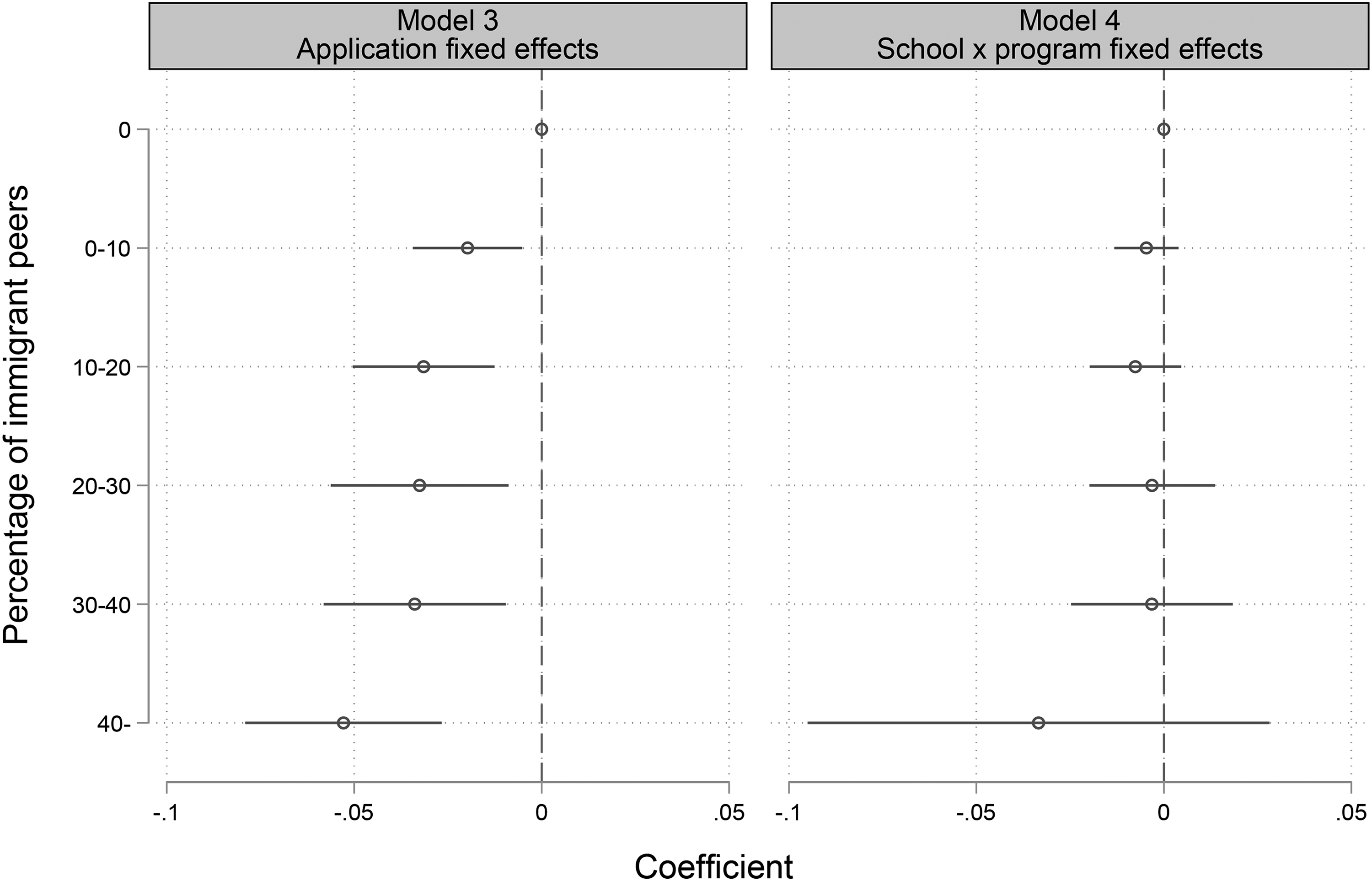
Effects of having different proportions immigrant peers on likelihood of completion.
The right-most panel shows immigrant peer effects estimated using a school-by-program fixed effects model (Model 4). The coefficients are close to zero for immigrant proportions less than 40% with fairly tight confidence intervals. Thus, the peer effect estimate of having more than 40% immigrant peers is negative but imprecisely estimated and not significant at conventional levels.
Heterogeneous effects
Immigrants from different origins are a vastly heterogeneous group, as shown by online appendix B. Table 5 shows results from analyses using the proportion of peers from different regions of origin as treatment variables. Additionally, the effects of these treatments are estimated for students from different regions of origin by interacting the treatment of each model with a dummy for whether the individual has a specific region of origin. The top part of the table shows estimates from the application fixed effects model (Model 3). The results suggest that the negative effect of attending immigrant-dense schools is statistically significant for those with Norwegian origins. There is a negative impact of attending schools with high shares of peers from all six separate origins (shown by the top row), but the coefficients are only statistically significant concerning estimates for the proportion of peers from the Middle East, North Africa, and Greater Arabia, as well as for Sub-Saharan Africa.
Effects of proportion of immigrant peers from separate origins on completion of academic track for separate origin groups.
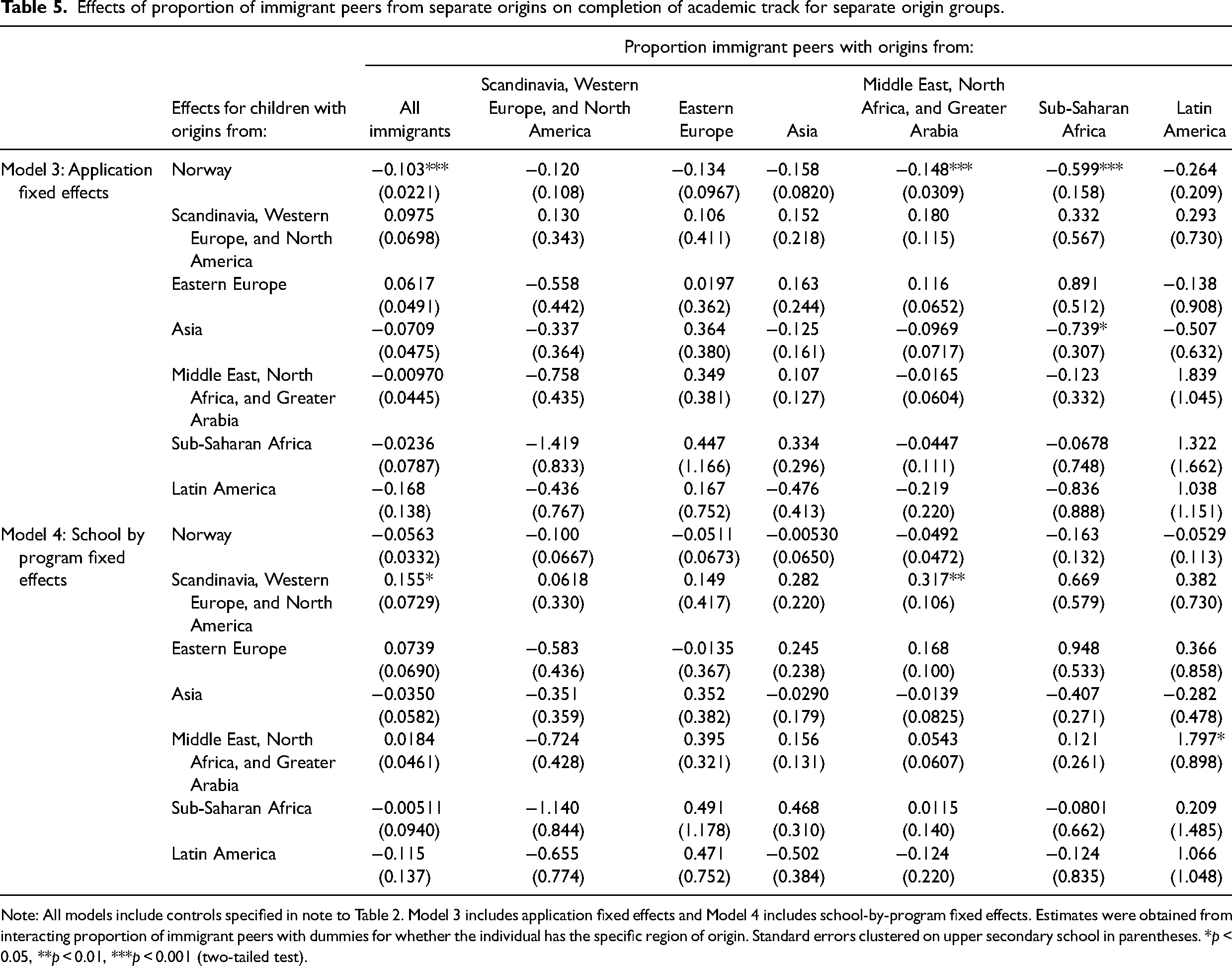
Note: All models include controls specified in note to Table 2. Model 3 includes application fixed effects and Model 4 includes school-by-program fixed effects. Estimates were obtained from interacting proportion of immigrant peers with dummies for whether the individual has the specific region of origin. Standard errors clustered on upper secondary school in parentheses. *p < 0.05, **p < 0.01, ***p < 0.001 (two-tailed test).
The results are mostly insignificant for children with immigrant backgrounds, except for students with Asian origins, who seem to have a substantially lower likelihood of completion when in schools with a high proportion of Sub-Saharan peers. However, the detailed stratification results in larger standard errors. For many of the groups, it is therefore hard to know whether the insignificant effects are because of low statistical precision.
The bottom part of the table gives estimates from the school by program fixed effects model (Model 4). Again, the results are imprecise, and it is difficult to draw strong conclusions. However, these results seem to confirm that the negative effects of attending immigrant-dense schools are not driven by exposure to immigrant peers. In fact, the statistically significant peer effects coefficients are positive; exposure to immigrant peers seems to improve the likelihood of completion for the Scandinavian, Western European, and North American student group, which likely is driven by positive peer effects of peers from the Middle East, North Africa, and Greater Arabia. Additionally, there is a very strong positive effect of having Latin American peers for students from the Middle East, North Africa, and Greater Arabica. However, it should be noted that there is a chance of obtaining “false positives” from such a large number of estimates as in Table 5; when testing 49 peer effects coefficients, we should expect that 2–3 coefficients may be significant by chance, and one should be careful relying too heavily on the specific estimates (Muñoz and Young, 2018). Nevertheless, the overall picture is a negative impact of attending schools with immigrant peers even though there are no negative immigrant peer effects.
Conclusion
The seminal Coleman report from 1966 (Coleman et al., 1966) set out to investigate school segregation by examining differences in peer composition and differences in educational contexts across schools, such as teacher quality and school resources. While recent decades have provided a large body of literature on immigrant peer effects, research considering both peer effects and contextual differences between schools are scarce (Reardon and Owens, 2014). This paper highlights that immigrant school segregation may conceptually play a role in social stratification even in the absence of peer effects and demonstrates this empirically by using credible identification strategies.
The results indicate that attending immigrant-dense schools in Norway has a small but significant negative effect on students’ likelihood of completing upper secondary education. This effect could be due to immigrant peer effects, school traits correlated with immigrant peers, or both. These results are from a well-established value-added approach known to handle bias from students selecting into schools (Koedel et al., 2015) and additionally draw on application data to further limit potential selection bias. A school fixed effects model, which allows for isolating the immigrant peer effects from other school traits correlated with immigrant peers, shows no significant immigrant peer effects. Overall, the results suggest that other school traits than immigrant peers are responsible for the adverse effects of attending immigrant-dense schools.
This paper's results fit with previous research in finding little evidence for immigrant peer effects (Hardoy et al., 2018; Hermansen and Birkelund, 2015). Finding no immigrant peer effects could suggest that students are unaffected by having immigrant peers or that complex and contradicting mechanisms produce peer effects that even each other out (Borgen et al., 2023). For instance, the potential adverse effects of having, on average, low-achieving immigrant peers (OECD, 2010) could be outweighed by positive externalities of these peers’ “immigrant drive” (Portes and Rumbaut, 2001). Alternatively, it could be that immigrant peer effects exist but are too small to be identified by the current data and model. Finding significant negative effects of attending immigrant-dense schools, in the absence of significant peer effects, indicates the educational disadvantages of attending immigrant-dense schools are not caused solely, or perhaps even at all, by exposure to immigrant peers. Rather, it may suggest that students in immigrant-dense schools are offered an inferior educational setting.
The literature that uses credible identification strategies to investigate the effects of attending immigrant-dense schools is sparse, and more research is needed to support the findings in this paper. Further, future research should be more attentive to the vast heterogeneity across children with immigrant backgrounds. Statistical precision is lacking in the analyses that separate between effects of different immigrant groups for different immigrants, and no definite conclusions can be drawn from these analyses. More precise estimates and conclusions may perhaps be drawn by future research on more cohorts and thus larger samples. Furthermore, more research is needed to unpack the mechanisms behind the negative effects of attending immigrant-dense schools. Previous research suggests explanations such as differing teacher quality (Hanushek and Rivkin, 2010; Peske and Haycock, 2006), differing curricula, time spent on curricula, facilities, and achievement feedback (Gandara et al., 2003), differing teaching traditions (Cebolla-Boado and Garrido Medina, 2011), and differing socioeconomic peer compositions (Cebolla-Boado and Garrido Medina, 2011; Legewie and DiPrete, 2012; Portes and MacLeod, 1996). Investigating the existence and comprehensiveness of other contextual differences across segregated schools, and investigating the mechanisms producing systematic differences between segregated schools, could provide valuable, policy-relevant insights.
Even the modest effects found in this paper could suggest consequences of school segregation that are of both theoretical and practical importance. First, the effect size of attending immigrant-dense schools on completion should be seen in the light of the prospects of measures to increase completion. It is notoriously difficult to identify and implement measures that increase completion rates (OECD, 2012). Finding that school segregation affects completion even in a modest manner could thus serve as a valuable guideline for identifying measures to increase completion. From this perspective, this study's effect size is quite large. This paper suggests that a 20 percentage point increase in immigrant peers reduces the likelihood of upper secondary education completion by 1.46 percentage points. To put it in context, this effect size is equal to about 14.3% and 18.4% of the sample's raw native-immigrant gap and raw girl-boy gap in completing academic upper secondary education, respectively. Moreover, relative to the baseline dropout rate of 17.5% in this study's sample, 1.46 percentage points increase in upper secondary dropout amounts to an 8.3% increase in the dropout rate, which is arguably sizable.
Second, upper secondary school completion is a critical outcome, as school dropout is related to a range of disadvantages for individuals and society (OECD, 2012). Thus, even a relatively modest effect of school segregation on completion may have substantial consequences. Furthermore, using completion as an outcome as opposed to a continuous outcome variable such as GPA may entail that students make an extra effort not to reach the “tipping point” of the outcome. Recall also that the estimation strategy fails to include the least ambitious students, who may be closer to this tipping point. The outcome measure and the estimation strategy could accordingly underestimate the consequences of attending immigrant-dense schools.
Third, the effect size could be larger among students in vocational tracks where completion rates are generally lower (Statistics Norway, 2018). Another less obvious implication of restricting the sample to students on the academic track is that it favors theories that anticipate positive effects of immigrant density. While immigrants are less likely to enroll in academic programs than vocational programs (OECD, 2010), those who enroll in academic programs are more likely to be academically able (Bjørkeng, 2013). Consequently, students in academic programs with a high immigrant share may be more likely to experience positive spillover effects of the “immigrant drive.” The estimated negative effect of attending immigrant-dense school programs could thus be net of potentially positive spillover effects of “immigrant drive.”
Finally, differences in school contexts across schools in Norway are likely to be modest, as the vast majority of Norwegian upper secondary schools are public, publicly funded, and without tuition fees (Oftedal Telhaug et al., 2006). Finding negative effects of attending immigrant-dense school contexts in an assumedly conservative case like Norway suggests that the effects of immigrant school segregation may be substantially larger in settings with more contextual differences between schools. More research is needed to confirm whether there are effects of attending immigrant-dense schools even though peer effects are nonexistent or nondetectable.
Supplemental Material
sj-docx-1-asj-10.1177_00016993231154128 - Supplemental material for It's not all about the peers: Reintroducing school context to the school segregation literature
Supplemental material, sj-docx-1-asj-10.1177_00016993231154128 for It's not all about the peers: Reintroducing school context to the school segregation literature by Solveig T Borgen in Acta Sociologica
Footnotes
Acknowledgments
I thank Gunn Elisabeth Birkelund, Are Skeie Hermansen, Nicolai Topstad Borgen, Rannveig Kaldager Hart, Arne Mastekaasa, and anonymous reviewers for valuable inputs and comments. I am also grateful for comments from other colleagues at the Department of Sociology and Human Geography, University of Oslo, and especially members of the Social Inequalities and Population Dynamics research unit. Earlier versions of this article have been presented at the 2018 European Consortium for Sociological Research Conference in Paris, at seminars at the University of Oslo, and at the Norwegian Demographic Association. I have access to Norwegian administrative data through the project “Ethnic segregation in schools and neighbourhoods: consequences and dynamics.” Statistics Norway made the administrative data available.
Funding
The author(s) disclosed receipt of the following financial support for the research, authorship, and/or publication of this article. This work was supported by The Research Council of Norway (grant number 236793).

Supplemental material
Supplemental material for this article is available online.
Notes
Correction (February 2023):
Article updated to include the reference details of Borgen (2022) in the reference section.
Author biography
References
Supplementary Material
Please find the following supplemental material available below.
For Open Access articles published under a Creative Commons License, all supplemental material carries the same license as the article it is associated with.
For non-Open Access articles published, all supplemental material carries a non-exclusive license, and permission requests for re-use of supplemental material or any part of supplemental material shall be sent directly to the copyright owner as specified in the copyright notice associated with the article.
